Thoughts on preaching

Thoughts on preaching

I’ve been intentionally experimenting with my preaching over the past few years. I am grateful for the expository preaching model I was handed at seminary. It’s a good model. It’s the best model. But, there are different flavors within that broad framework. The past few Sundays, I’ve tried something radical for my sermon preparation. It is radical for me, but perhaps not for you. I shall share it, anon.

But, first some observations about expository preaching, as it is sometimes practiced―as I used to practice it!

Against audiobook commentary preaching

I have grown increasingly disappointed with a style of preaching I shall call “audiobook commentary.” This is where the pastor is basically an Audible version of an introductory bible commentary. Abraham Kuruvilla, whom I consider to be the ablest preaching teacher working in North America today, summarizes this pretty well:

This I call the hermeneutic of excavation—the exegetical turning over of tons of earth, debris, rock, boulders, and gravel: a style of interpretation that yields an overload of biblical and Bible-related information, most of it unfortunately not of any particular use for one seeking to preach a relevant message from a specific text.

Abraham Kuruvilla, A Vision for Preaching: Understanding the Heart of Pastoral Ministry (Grand Rapids: Baker, 2015), p. 13.

Last year, my wife and I attended a conference where we were subjected to this very approach. During a time while we waiting to be “refreshed,” I dutifully listened to a pastor (with both an earned DMin and a PhD) explain the alleged Latin etymology for the English word “sword.” This pastor was a disciple of John MacArthur, and preached just like him. Indeed, MacArthur personifies this audiobook commentary style of preaching. He is a faithful expositor and a steadfast shepherd, but I don’t believe he is the best preacher. This observation is heretical in some circles, but here I stand. I understand if you disagree.

Exegesis is not preaching. It’s a waypoint on the road to preaching.

You don’t need more commentaries

You don’t need another commentary. There is nothing new to say. I promise. I swear. I just read C.K. Barrett’s remarks on John 4:23 (The Gospel According to St. John (London: SPCK, 1958), pp. 198-199), then cracked open D.A. Carson (The Gospel According to John, in PNTC (Grand Rapids: Eerdmans, 1991), p. 224). He appears to have copied Barrett, down to the choice of specific phrases, without citing him. At the very least, Carson echoes Barrett to an eyebrow-raising degree. I’ve no idea if he did it deliberately, nor do I care. My point is there is likely nothing new to be said.

You want an exegetical commentary? The language work has been done. It really has. You hopefully had language training yourself, too. Barrett will do you fine. So will Calvin. If you get yourself a small, trustworthy stock of exegetical commentaries, you won’t need to buy anymore.

Most commentaries have little value for preachers, because they specialize in hermeneutical excavation. They don’t help you understand the passage as a passage. As literature. As a composition. As a pericope that God is doing something with. Instead, they often major on grammatical observations, syntactical nuances. They summarize oodles of scholarly literature, then sometimes forget to make observations of their own. They’re good for technical reference, perhaps, but you probably have enough of those.

Their interpretive filters are too often cardboard. I just read R.C.H. Lenski declare Peter uttered an imprecatory curse at Acts 8:20. This is unlikely. Maybe … (and call me crazy) … just maybe Peter utters an angry exclamation! Maybe there’s no theological weight behind his short statement, which I translate colloquially as “you and your money can go to hell!” (cf. Phillips’ translation).

Here’s another example.

If you’re preaching on Stephen’s sermon before the Council (Acts 6:8 – 8:1), a discussion on whether Stephen properly applied Amos at Acts 7:42-43 is useless to you. It means nothing. It does not help you communicate God’s message to your congregation. It might interest you. It might intrigue you. It might pique your interest for an article. It does nothing to help you preach the passage. That’s why most commentaries are unhelpful homiletical aids.

You probably don’t need more commentaries.

Preach by passage, not by verse

How many sermons would you use to preach Stephen’s speech before the Council (Acts 6:8 – 8:1)? Six years ago, I did it in four sermons. A few weeks ago, I did it in one sermon that totaled 50 minutes … and I think it was 10 minutes too long.

I almost titled this section “read the bible as literature,” but thought better of it. However, it’s true. You should try to capture the bible’s flow of thought pericope by pericope, or passage by passage. We express thoughts in paragraphs, in sections. We don’t do it in sentences. Sentences are pieces of a whole. But, that’s too often the way we preach. I just saw a pastor announce on social media that he planned to wrap up his series on Jude, by preaching vv. 20-25. This means he cut his last sermon at v. 19. Why would you do that?

We’ll do one sermon covering Stephen’s false arrest (Acts 6:8-15). Another on God’s promises to Abraham (Acts 7:1-16), where we bring in some Genesis tidbits and wax eloquent about the Abrahamic Covenant. Then, we’ll discuss Moses’ origin story, praise the Hebrew midwives who refused to bow to Pharaoh, etc. (Acts 7:17-23). If we’re adventurous, we’ll fold Moses’ flight to the desert into that sermon (Acts 7:23-29). And so it goes, until we finally dispatch Stephen into Jesus arms by mercifully concluding the miniseries at Acts 8:1.

The problem is that’s not what Stephen did. He selected and deliberately framed (and re-framed) key incidents from Israel’s past in order to make a powerful accusation to the Council. The shape of his sermon should be ours. It was one sermon. One message. It had rhetorical force because of that shape.

“But,” we object, “it would take two hours to preach Acts 6:8 – 8:1 verse by verse!” Yes, it would. That’s why you don’t preach it verse by verse. You preach the passage. You hit key points paragraph by paragraph, discerning and following the shape of Stephen’s argument.

To borrow another insight from Kuruvilla, scripture isn’t a window we point through towards an object inside. It’s a stained-glass window we point at, like a curator at a museum. We show it to people. We describe it. We explain it. Then, we show them what this beautiful picture has to do with their lives, so they can be more like Christ.

It would be criminal to cut Stephen off, to atomize his speech into a miniseries. To turn his denunciation into a sermon about Moses in Egypt. To spend five minutes explaining why Stephen correctly applied Amos 5:25-27. Leave that bit to MacArthur.

Shorter sermons

I believe that if you go over 40 minutes, you’re going on too long. I know the objections. I understand that, if people consume all sorts of awful content the other six days of the week, they ought to be able to listen to a 50 or 60 minute sermon. I agree. But …

I suspect that, like me, you really don’t have 50 minutes of content. I think you could have made your point better by cutting some stuff out. I’m willing to bet 10-15 minutes of your sermon was unnecessary; the debris from all that excavating. I suspect you “feel” your sermons are better when they’re shorter. If that’s your experience, I don’t believe it’s an accident you feel that way. It’s because they are better when they’re shorter.

Maybe this is all just me. Maybe I’m not gifted enough to fill 50 minutes with dynamic content. Maybe you are. Maybe your pastor is. Maybe you’re awesome, and I’m just ordinary. It’s possible. But, maybe we’re both just ordinary people, and neither of us should really be preaching for 50 minutes?

My goal is 35 minutes. I rarely make it. But for the past three weeks, driven by a quest to be more efficient with my time as a bi-vocational pastor, I’ve changed my approach to sermon prep. This approach has yielded shorter, better sermons (31, 38, and 35 minutes, respectively). They’re tighter, more focused, and more direct. I ruthlessly ditch rabbit-trails that are unnecessary to the author’s point in that passage. In the latest sermon, on 10 October 2021, my notes ran to a mere 866 words―506 of which were the scripted introduction + conclusion. My notes for the body of the sermon ran to 360 words (this is not an outline, but notes regarding the text). I also finished my prep on Thursday, which is unusual for me because I’m bi-vocational.

In the next article, I’ll share a sermon manuscript and how I now prepare my notes. I’ll also embed the video of a sermon.

For now, I’ll leave you with this sermonic gem from Abraham Kuruvilla from a recent chapel session at Southern Baptist Theological Seminary, where he lately took up residence as Professor of Christian Preaching. The content is good, but note particularly the homiletical technique he uses. I’ll explain more, later. For now, behold his sermon:

Religious exemptions and the COVID vaccine

Religious exemptions and the COVID vaccine

Vaccine mandates have arrived, and so have questions about religious exemptions. What should Christians think about them? I’ll provide one over-arching principle, then briefly discuss some common religious justifications we see offered up.

A warning

The Third Commandment tells us we must not misuse God’s name (Ex 20:7; Deut 5:11). One way we do this is when we invoke God as an authority to justify something we want to do. I want to do something, so I use God as a blank check, and I get my free pass. But … did God really say that?

People misuse God’s name for all sorts of sins. To justify divorce in unwarranted circumstances, sexual immorality, sexual confusion, gender identity, and the like. Look anywhere, and you’ll find professing Christians using God as justification for their unholy ways. This is a violation of the Third Commandment.

Now we come to religious exemptions for vaccines. You must think carefully, very carefully, about why you object to the vaccine. If you’re using God as a free pass to escape a vaccine mandate, then you’re violating the Third Commandment.

You may object and cite an abortion connection, freedom of conscience, and the like. Fair enough―we’ll get there. But ask yourself, “Is [insert religious justification] really why I don’t want the vaccine, or is [insert religious justification] a convenient pass for me to avoid something I just don’t want to do?” If the answer is yes, then you’re in danger of violating the Third Commandment.

As a well-known news anchor once said, that’s “kind of a big deal.” You don’t want to do that. Now, to the religious justifications themselves.

The Abortion Objection

This is perhaps the strongest religious exemption of the lot. Some Christians claim the various COVID vaccines have a connection to abortion. Various news outlets explain this connection is distant and far removed, and that the vaccines themselves don’t contain fetal tissue. Still, some Christians find this horrifying. Here is a representative example from a professing Christian, quoted in the New York Times:  

My freedom and my children’s freedom and children’s children’s freedom are at stake,” said Ms. Holmes, who lives in Indiana. In August, she submitted an exemption request she wrote herself, bolstered by her own Bible study and language from sources online. Some vaccines were developed using fetal cell lines from aborted fetuses, she wrote, citing a remote connection to a practice she finds abhorrent. She quoted a passage from the New Testament: “Let us purify ourselves from everything that contaminates body and spirit.”[1]

The Louisiana Attorney General provides a sample exemption letter with an identical objection.[2] Back to the New York Times article―note that this woman fronts her remarks with a discussion of “freedom.” Also, notice that she apparently didn’t consult her faith community about the veracity of her religious objection. Instead, she did independent study and looked up “sources online.” She then quotes 2 Corinthians 7 out of context and assumes a vaccine will “contaminate” her. As Michael Bird would say, “sweet mother of Melchisedec!”  

But, this woman isn’t you. Perhaps you have a more sophisticated form of this objection. Fair enough.

Back to the Third Commandment.

I want to ask you to re-ask that same question again―does this distant abortion connection really outrage you, or is it just a “get out of jail free” card you’re willing to use? Please think very carefully before answering this question. One way to be introspective here is to consider whether you were already against the vaccine before you learned about the abortion nexus.

Body as a temple

Proponents cite the Apostle Paul’s well-known remarks at 1 Corinthians 3:16-17, 6:19. One organization, called Health Freedom Idaho, published a sample exemption letter on its website that used this objection and cited these passages. It read, in part:

Accordingly I believe, pursuant to my Christian faith, that my body is a temple of the Holy Spirit. It is a God-given responsibility and requirement for me to protect the physical integrity of my Body against unclean food and injections.[3]

Again, this does violence to the text. First, Paul’s remarks about the body as a temple were directed to the Corinthian church as a body, as a whole―the “you are God’s temple” is plural! So, he is not referring to you as an individual at all. Some may quibble about 1 Corinthians 6:19, but the best one could say there is that Paul is addressing the community as a whole with an aim to individual application. The references are still plural, as follows:

ἢ οὐκ οἴδατε (“do you all [plural] not know”) ὅτι ⸂τὸ σῶμα⸃ ὑμῶν (“that your collective [plural] body [singular]“) ναὸς (“is a temple [singular]“) τοῦ ἐν ὑμῖν ἁγίου πνεύματός (“of the Holy Spirit, within you all [plural]?”).

If one still wishes to lodge an objection and lasso this citation to a COVID vaccine, one must deal with the interpretive problem. The sample exemption letter mistakenly interprets the temple motif to refer to physical pollution to one’s body, when Paul is in fact interjecting a rhetorical question (an accusation, really) about sins that may destroy their community (“the temple”), among which Christ resides (1 Cor 3). In the 1 Corinthians 6:19 reference, Paul refers to moral impurity “contaminating” the temple that is the Christian community. He says nothing about a vaccine. He’s talking about sin, about evil, about lawlessness (cf. 1 Jn 3:4).

This objection has no interpretive merit.

It’s a sin to do what I don’t want to do

The Liberty Counsel is a Christian legal ministry. It also provides a sample religious exemption letter on its website. This letter manages to encapsulate peak narcissism with its interpretive method:

It is against my faith and my conscience to commit sin. Sin is anything that violates the will of God, as set forth in the Bible, and as impressed upon the heart of the believer by the Holy Spirit. In order to keep myself from sin, and receive God’s direction in life, I pray and ask God for wisdom and direction daily. As part of my prayers, I have asked God for direction regarding the current COVID shot requirement. As I have prayed about what I should do, the Holy Spirit has moved on my heart and conscience that I must not accept the COVID shot. If I were to go against the moving of the Holy Spirit, I would be sinning and jeopardizing my relationship with God and violating my conscience.[4]

According to this letter, if the Spirit “has moved” you then you have a free pass―presumably about anything. This is absurd. Christianity is not a subjective religion with scripture that shape-shifts according to taste, like an Etch-a-Sketch. God gave us His word. That word has content. That content has meaning that can be known and understood in community with the brotherhood of faith in your local congregation, and in consultation with the Great Tradition of brothers and sisters who have gone before.

This definition of sin is also specious. Sin is lawlessness (1 Jn 3:4); doing what God’s Word forbids. The author wishes to make sin Play-Dough; it’s anything the Holy Spirit “impresses upon” him to be wrong. Sin isn’t concrete anymore, it’s subjective.

This kind of bible interpretation can justify anything, and it’s dangerous.

Freedom of conscience

This objection has a strong siren song, but is harder to justify than it seems. A Christian must have a rational basis for claiming a conscience objection. If food is sacrificed to demons, then that’s a pretty good reason to avoid eating it (1 Cor 8). You get it. You can “see” the problem.

What is the conscience issue with the vaccine? It isn’t enough to hold to some form of, “I don’t like it, so it violates my conscience, so I don’t have to do it.” That’s never been how responsible Christians have interacted with society. Health Freedom Idaho offers this attempt:

… the New Testament requires of Christians that we, “Render to Caesar the things that are Caesar’s, and to God the things that are God’s.” (Mark 12:17). When it comes to consuming things into our own bodies, as opposed to make payments to government, compliance with God’s law is required. The mandated vaccine, with its numerous additives and its mechanism for altering my body, is the equivalent of a prohibited “unclean food” that causes harm to my conscience. Vaccines to me are unclean. I believe in and follow God and the principles laid out in His Word and I have a deeply held belief that vaccines violate them.[5]

This objection says very little. It is scarcely believable that unclean foods under the Old Covenant are a parallel to a COVID vaccine. As just a preliminary step to justify this argument one would have to establish a basis for the division of clean and unclean foods, and I wish you luck as you survey the literature on that topic! The author provides no justification about why the vaccine violates his conscience. He just asserts it as a “deeply held belief.” That isn’t good enough. Some people have a “deeply held belief” that Arbys makes good roast beef sandwiches. That don’t make it so …

God doesn’t require it

This is a novel interpretation. The New York Times reports the following:

In rural Hudson, Iowa, Sam Jones has informed his small congregation at Faith Baptist Church that he is willing to provide them with a four-paragraph letter stating that “a Christian has no responsibility to obey any government outside of the scope that has been designated by God.”[6]

This argument is a non-starter. God hasn’t mandated seatbelts, either. Nor the Bill of Rights. The pastor owes it to his congregation to provide a more robust argument than this. If the pastor has one, it didn’t make it into the news article.

Christians shouldn’t be afraid

This is a well-meaning but sad argument. Its logical end is to eschew all medical aid in toto. The New York Times related the following:

Threatened with a formal reprimand if she skipped work in protest, Ms. Holmes woke up in the middle of the night with a Bible verse from the book of 2 Timothy in her mind: “For God has not given us a spirit of fear, but of power and of love and of a sound mind.”[7]

The Liberty Counsel also rallied to the cause by declaring Christians have a religious exemption because they have “… a reliance upon God’s protection consistent with Psalm 91.”[8]

2 Timothy 1:7 has nothing to do with rejecting all medical aid, nor does Psalm 91. It’s a symptom of what Scot McKnight has described as a puzzle piece hermeneutic rather than a contextual reading of the bible as a story. If a man cheats on his wife, can he cite 2 Timothy 1:12 (“I am not ashamed …”) and declare he has nothing to apologize for? Why not? It’s in the bible!

Final words

There may well be valid religious exemptions out there from a Christian perspective. Those cited here are largely specious; arguments in search of proof-texts. The abortion connection has the most merit, but I again caution believers to avoid misusing God’s name and violating the Third Commandment.

One Christian named Curtis Chang, who is a former pastor, wrote what Yosemite Sam would consider to be fightin’ words:

Christians who request religious exemptions rarely even try to offer substantive biblical and theological reasoning. Rather, the drivers for evangelical resistance are nonreligious and are rooted in deep-seated suspicion of government and vulnerability to misinformation.

Perhaps this goes too far. But, it is true for too many Christians. Maybe that isn’t you. Maybe you do have objective religious grounds―what are they? What have your pastors said? What has your faith community said? What has the global church said? Are your objections really grounded in the scripture, or are they a prop for some very non-religious reasons?

Only you know the answer.


[1] Ruth Graham, “Vaccine Resisters Seek Religious Exemptions. But What Counts as Religious?” New York Times, 11 September 2021, https://www.nytimes.com/2021/09/11/us/covid-vaccine-religion-exemption.html?smid=url-share.  

[2] Retrieved from http://ladoj.ag.state.la.us/Article/10941.

[3] Health Freedom Idaho, “Sample Letter for Religious Vaccine Exemption,” https://healthfreedomidaho.org/sample-letter-for-religious-vaccine-exemption/.

[4] Liberty Counsel, “Sample Religious Exemption Requests For COVID Shot Mandates,” 26 July 2021, p. 3. https://lc.org/Site%20Images/Resources/Memo-SampleCOVID-ReligiousExemptionRequests-07262021.pdf.

[5] Health Freedom Idaho, “Sample Letter.”  

[6] Graham, “Religious Exemptions.”

[7] Ibid.  

[8] Liberty Counsel, “Sample Exemption” p. 1.

How we worshiped one Sunday in September

How we worshiped one Sunday in September

I’d like to share the way our congregation structures its worship service. I have nothing special to offer―only my own reflections on where our congregation is, and perhaps where we’ll go. What we do on Sunday mornings, and how we do it, is important. Perhaps my comments here will be useful.

The Missing Link

Many Christians don’t think critically about what happens on Sundays. This isn’t a rebuke, just an observation. Over 40 years ago, Robert G. Rayburn shared similar misgivings:

… having personally visited in a large number of churches in recent months and years, sometimes as a guest preacher, I have been amazed at the carelessness and insincerity that were evident in the services. The people were going through the motions of worship singing the words of the hymns and maintaining quiet when prayers were being uttered, but with no apparent sincere worship of God. The pastors who conducted the services were also careless in a number of services, for example there was nothing to remind the congregation that it is only the pure in heart who shall see God and it is only those whose lives have been cleansed from evil who are able to pray with the confidence that the Lord will hear them.1

How many of us plan worship services without much thought? By rote? We have a template, and we plug the components in. We have four songs to fill. Maybe we pick them ourselves, maybe we delegate. Maybe they follow a theme keyed to the sermon. Maybe they’re just random songs. Maybe the prayers are deliberate, or maybe they’re extemporaneous―with lots of “umm …” and “just ….”. Maybe we begin with announcements. Maybe we have a call to worship. Maybe we don’t know what a “call to worship” even is! Maybe we suspect it’s a Catholic thing … and we can’t have that, can we?

I say “we,” because that was me until a few years ago. I inherited a liturgy (sorry, an “order of service”), and I copied it. I only knew what I saw modeled. I didn’t think introspectively about what happens on a Sunday morning. I do remember an embarrassing moment during my ordination. I sat in Victory Baptist Church, in Pleasant Prairie, WI. The questioning had been going on for about two hours. Somebody, I forget who, asked “what are the components of a worship service?”

I muttered something like “preaching, singing, reading the scripture … and … umm …” I trailed off. My mind had blanked. Then, Marty Marriot, the President of Maranatha Baptist Bible College, rescued me. He stared at me until I “felt” his gaze, then he bowed his head and made an exaggerated steeple with his hands. “Prayer!” I shouted. The questioning moved on.

My point is that some of us don’t think very hard about why and how we do what we do on Sundays. For a long time, I didn’t. My focus was the sermon. The rest of the service was like previews at the movie theater. Sure, it was all important stuff. But, my focus was the sermon. I’m not alone.

Why do we only post the sermons on our websites? What about the rest of the service? Why is the barometer for a “healthy church” almost always the sermon? We all took several homiletics classes at seminary―how many on a theology of worship?

What We Do on Sundays

I’ve gotten older since then, and a tiny bit wiser. Here is what we do on Sunday mornings, along with some brief comments.

Announcements

I really don’t like them, but I can’t get rid of them. I’ve tried and failed. I have given up. But, when should we do them? I’ve seen some guys do them at the end, but that’s just weird, in my opinion. It’s a letdown. It ruins the whole impact of the service.

I do them at the beginning,2 because it’s the best bad option. I rationalize this by telling myself the service doesn’t really begin until the Call to Worship, which immediately follows.

1: Call to Worship

Many worship theologians remark that worship is a dialogue where God speaks, and we respond. The Call to Worship is a proclamation from God about what He has done, which provokes a response from us. It can be a scripture reading, a creed recitation, a song of praise―many things.3 But, it should actually call people to worship; it shouldn’t be a random verse that sounds nice.4 Yesterday, we used Isaiah 54:6-8.

1a: Gospel Connection

I stole this idea from my friend, Pastor Ted Clarke, at Radisson Road Baptist Church in Ham Lake, MN. I take two minutes and frame some Gospel remarks to accompany the Call to Worship text I just read. Sometimes it’s an explicit call for a decision, other times it’s more of a “look at God’s grace!” thing. This is what I said yesterday, keyed to Isaiah 54:6-8:

God meant for His people to find comfort in these words. The analogies of the grieving spouse. God as the loving, compassionate husband―our Lord, the Rescuer, who buys us back from the slave market. In the Christian story, this slave market is Satan’s orphanage.

Jesus’ death was the payoff to Satan that bought our freedom. His resurrection was the bait and switch where Jesus took that ransom back and defeated Satan by trickery.

That story of the strong man, from Mark 3, is when Jesus tells us He’s beaten Satan down, gone into his house and is plundering everything Satan has … and that’s us! Jesus rescues everyone who comes to Him.

When we worship, we give Him thanks, and encourage one another to pursue a total-life commitment to Him―to be living sacrifices!

In the event you raised your eyebrows when I presented the resurrection using the Christus Victor model, see my article on the subject. I believe both penal substitution and Christus Victor are valid facets of the same diamond.

1b: Prayer

God has spoken to us, and now we respond to Him.

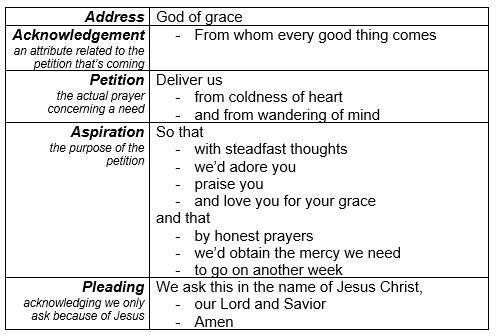
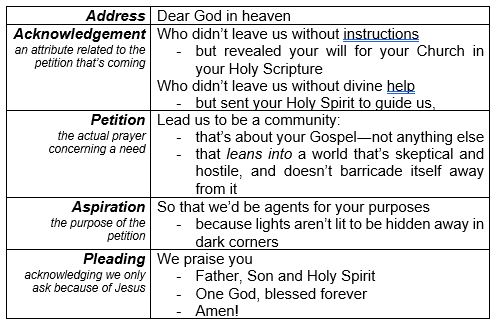
My public prayers are now very short.5 I’m convinced long prayers are a waste of time because people zone out and start thinking about lunch. I have been writing my prayers out beforehand for some time. But now, following Rayburn’s suggestion, I structure them as collects. This means they’re very short and follow a five-step pattern:

  • Address: I address the Father to open.
  • Acknowledgment. I mention an attribute that is keyed to the need I’m addressing.
  • Petition. What I’m asking for, on behalf of the people.
  • Aspiration. Why I’m asking―why the petition matters.
  • Pleading. We only have access to pray because of Jesus.

The prayer to end the call to worship looked like this, yesterday:

2: Reading

God speaks to us again. We alternate between responsive and solo readings, and the content is either scripture or creeds and confessions. Yesterday we read a scripture selection from the hymnal about God’s comfort.  

3: Songs

We praise God in response to His declaration from the reading. The songs are keyed to the sermon theme, as are the reading and the remaining prayers. Yesterday, in this set, we sang “Because He Lives” and “The Solid Rock.”

4: Prayer of Intercession

Here, we respond to God after praising Him in song. This is also known as the “pastoral prayer.” Again, the prayer is in the form of a collect. Yesterday, the sermon was on Acts 5:12-42 and the prayer was keyed to my exhortation from that text:

5: Offering

We do no prayer for the offering; the Prayer of Intercession swallows it up.

6: Song

Now, in our dialogue, we address God again. We have two more songs, both keyed to the sermon theme. Yesterday, these two songs were “Amen” (by I am They) and “In Your Hands” (by Unspoken).

7: Sermon

God now speaks to us. My sermon was on Acts 5:12-42. The focus was how Luke shows us a picture of a God-honoring Jesus community and a realistic idea about the reception we can expect from the world―a mixture of hatred and admiration, depending on the audience.

7a: Prayer for Illumination

This is otherwise known as “the prayer the pastor does after the sermon introduction.” I’m including these collects because I think they’re important:

7b: Prayer of Confession

I explicitly have a time to confess our sins, keyed to the exhortation from the sermon. I don’t yet have congregation participation, but I’ll likely tiptoe that way. This kind of prayer is a radical departure for many evangelical churches, and I’m treading carefully, here:

8: Charge and Blessing

The service should end with a charge and an assurance of God’s blessing. This isn’t a time to re-preach your sermon. It’s simply a very brief charge to do the thing the entire service was about. This can be done by a scripture reading, a song, or a responsive reading of some sort. Yesterday, we sang one stanza from “Because He Lives,” to center our perspective on God’s grace and our real mission as a congregation.

Resources

I’ve found these very helpful, and perhaps you will, too. There are other good helps, but these are my favorites:

  1. Christ-Centered Worship, by Bryan Chapell. The best overview.
  2. O Come, Let us Worship, by Robert G. Rayburn. Penetrating analysis of worship and outstanding practical suggestions.
  3. Engaging with God, by David Peterson. Brilliant theology of worship that takes us beyond the tired regulative v. normative worship wars.
  4. The Worship Sourcebook (2nd), ed. Carrie Steenwyk and John Witvliet. The best sourcebook available. Period.
  5. Gathering for Worship: Patterns and Prayers for the Community of Disciples, ed. Christopher Ellis and Myra Blyth. A very valuable well of model prayers and orders of service for all occasions.
  6. Book of Common Prayer. Does anything need to be said?
  7. Book of Common Worship (PCA). A very valuable sourcebook.
  8. The Hymnal for Worship and Celebration, Tom Fettke. An older hymnal (1986), but it has the best worship helps I’ve seen―especially the selection of scripture readings. I love this hymnal, and our church uses it.
  9. The Book of Psalms for Worship. Beautiful arrangement of hymns set to music.

1 Robert G. Rayburn, O Come, Let Us Worship: Corporate Worship in the Evangelical Church (Grand Rapids: Baker, 1980), p. 19.  

2 Rayburn, O Come, Let Us Worship, p. 170.  

3 Variety is important. There are many ways to invite people to worship God. Bryan Chapell has some excellent charts and resources about how to achieve a result by employing varying methods, week in and week out, so the liturgy doesn’t grow stale (Christ-Centered Worship: Letting the Gospel Shape Our Practice (Grand Rapids: Baker, 2009) pp. 147f).   

4 Rayburn, O Come, Let Us Worship, pp. 176-177.  

5 See especially Rayburn, O Come, Let Us Worship, pp. 197-203.