My little book about Paul’s letter to the churches in Galatia is now published by Wipf & Stock. This is a “commentary,” which is a nerdy way of saying that it “comments” on every passage in Galatians and explains what it means. This book is my best shot at telling Christians, in simple language, what on earth the apostle Paul is saying in this letter.
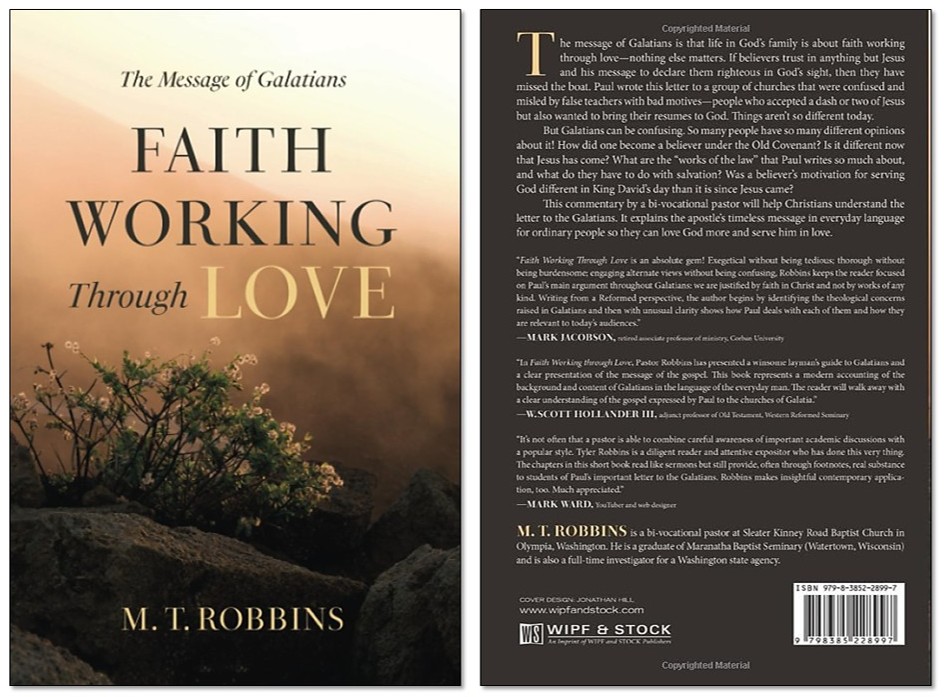
Please consider buying a copy and reading through it as you study the letter to the Galatians. You don’t need to be a theologian to understand it. In fact, I deliberately wrote it for “normal” people like you. Here is a short interview I gave about the book:
Why did you write a book about the letter to the Galatians?
I come from a background that was very negative about the Old Covenant law. My tradition almost (but not quite) taught that life for Moses, David, and the psalmists in the old covenant was a slog—that relationship with God was more about works and less about loving obedience. It framed old covenant life as a series of tests and failures and covenant curses … until Christ came to finally bring us grace. So, my tradition basically taught that justification by faith (and not works) was a new thing. They didn’t explicitly say that (and the scholars within the movement do not teach or write that), but that’s how it came across from the pew—and therefore many Christians are confused about what Paul is saying to the Galatians.
What is the message of Galatians?
The message is that “in Christ Jesus neither circumcision nor uncircumcision has any value. The only thing that counts is faith expressing itself through love” (Gal 5:6). We bring nothing meritorious to the table when we come to God for salvation. There is no merit, no earned credits, no consideration of your moral resume. There is only your faith in Jesus, which works or expresses itself by means of your love for him. The Galatians had become confused about this, and Paul wrote to set them (and us) straight.
Why do Christians need to understand the message of Galatians?
For at least two reasons, which Paul explains to us over and over again in the letter.
First, the foundation for a believer’s relationship with God has always been loving obedience. We love God, so we want to do what he says. It was true under the Old Covenant. It’s still true under the New Covenant. What has changed is not the way of salvation (it’s always been through Jesus), but the covenant shape of our relationship with God.
Second, we need to know (to really, truly know) that God makes us right with him (what the bible calls “justification”) by grace alone, through faith alone.
Why is Galatians so important for understanding salvation the right way?
First—if you think the way of salvation is new or radically different than it was for Moses, David, and Isaiah than it is for you, then you’ll read your bible all wrong. You’ll be confused. You won’t understand the Christian story. It’ll be like those newspaper pictures that printed slightly misaligned—everything will be out of focus.
Second, if it were possible to be good enough, smart enough, righteousness enough, obedient enough to be saved by obeying the Old Covenant law, then Christ came here and died for no reason (Gal 2:21)! So, we really need to understand how we can become right with God, and Paul tells us all about it.
What makes your book about Galatians worthwhile? Aren’t there other books about the same thing?
There are lots of great books about Galatians! Here are a few reasons why mine is worth your time:
- I’m a bi-vocational pastor, which means I work fulltime in the real world and am used to “translating” Christianity into English for normal people! Nerdy stuff stays in the footnotes, and the text just explains what Paul says, section by section, in everyday, non-technical language.
- I spend a lot of time emphasizing the right way to understand the Old Covenant law and the whole Christian story considering what Jesus has now done. I try to set the Galatians “episode” in its place in God’s bigger story.
- It’s short!
You can find the book here, or at any major online retailer.
Here’s an excerpt:
Jewish agitators who believed themselves to be Christians were on the move among the churches in Galatia. Sure, they believed that Christians must trust in Jesus and His message, but they also believed we must observe Jewish boundary markers like the sabbath, circumcision, Old Covenant feast days, and other culturally “Jewish” ways of life.
These agitators were likely right–wing, hardline Jews who had “converted” to Christ and had not shed their Pharisaic tendencies. David deSilva characterizes them as a sort of clean–up team that sought to “fix” Paul’s “liberal” approach to the Mosaic law (cp. Acts 15:1–4; Phil 3:2–21). “[T]hey wanted to preserve fully the Jewishness of the new Christian movement and keep it firmly anchored within Judaism.”
In their eyes, Paul was a libertine who had tossed the Mosaic law aside. He couldn’t be trusted. He wasn’t teaching the truth, because he had forsaken the God–ordained cultural identity markers that made the Jews “God’s people.” So, the agitators attacked Paul’s authority. Their perspective shared some kinship with the more “Jewish flavor” of the congregation in Jerusalem, which was never entirely comfortable with Paul’s perspective on the Mosaic law’s role in the life of a New Covenant believer (Acts 21:21–22).
On the other side, Paul believed these agitators were not preaching the Christian message, but “another gospel” entirely. “I am astonished that you are so quickly deserting the one who called you to live in the grace of Christ and are turning to a different gospel—which is really no gospel at all. Evidently some people are throwing you into confusion and are trying to pervert the gospel of Christ,” (Gal 1:6–7).
Paul wrote this letter to warn the churches in southern Galatia against these false teachers. The letter is tinged throughout with a kind of hurt outrage—not bitterness, but wounded sorrow. “[H]e writes to the Galatians in the agony of heart which comes of the feeling that his work in Christ is being undone by false teachers, factious rivalries, and a mixture of stupidity and vice.” He wonders if he’s wasted his time on these believers (Gal 4:11). His relationship with them is particularly special because he first preached the gospel to them while ill, and the Galatians nonetheless welcomed him and listened to what he had to say (Gal 4:13).
But now so much has changed. They don’t trust Paul—the agitators have poisoned their minds against him. He’s forced to defend his credentials (Gal 1:11–2:10). He asks, “Have I now become your enemy by telling you the truth?” (Gal 4:16). So, Paul writes to explain the truth of the Gospel to them once again, to defend his own teaching, and to explain why “works of the law” can never be the vehicle for salvation.
Here’s another excerpt about the different ways to “read” the letter to the Galatians:
I like Nutella. A lot. My wife and I discovered it while we were stationed in Italy for six years, while I was in the military. Since we returned to the United States, we’ve made sure to always have some on hand. We often spread Nutella on toast, or maybe a croissant or a bagel. But, alas! some people don’t like Nutella. They prefer jam, or butter, or even cream cheese. What you put on the bagel will affect how it tastes. It’ll color everything about it. Sure, a bagel is a bagel—but it tastes very different with butter or Nutella!
Bible interpretation is kind of like that. What you bring to the table will color how the scripture “tastes”—how you read and interpret it. Different Christian traditions have their preferred way to “eat” the bagel! The book of Galatians is particularly tricky, because there are at least five questions which any interpretation of Galatians must answer:
- What were the grounds of salvation under the Old Covenant?
- How did these grounds of salvation relate to the “works of the law” about which Paul wrote in Galatians?
- What were the Galatian agitator’s opinions on “works of the law”?
- What was Paul’s position on the “works of the law”?
- What was Paul’s main burden in the letter to the Galatian churches?
Depending on the flavor of your Christian tradition, you’ll answer each of these questions differently. This may surprise you. But the book of Galatians is a prism which refracts many assumptions about “what the bible clearly says” and exposes them to the light of day. When that happens, we find that many bible–believing Christians do not see eye to eye on “obvious” things.
We’ll highlight three different theological frameworks below. Each framework answers those five questions differently. In faithful, bible–believing churches in 2024 America, it’s likely you will find one of these three perspectives on offer.
What are these three different frameworks and how do they read Galatians differently? I’m afraid you’ll have to buy the book!


 The Eccentric Fundamentalist
One thought on “My Simple Commentary on Galatians for Everyone”