Christians often wonder what on earth Paul is saying at 1 Corinthians 11:3-16.
- Is this a passage about how women must submit to their husbands?
- Should all Christian women wear head coverings?
- Why does the apostle Paul mention angels?
It’s all very confusing! In this article, I’ll do three things:
- I’ll give a summary of what I believe Paul is saying.
- I’ll talk about what “head” means in 1 Corinthians 11:3.
- Then, I’ll suggest a common-sense application for Christians in 2025 America.
This is an abbreviated version of a much longer article you can read in PDF here. Go there for more in-depth discussion.
What is Paul saying?
This is a passage about holiness and propriety, according to the cultural code language of the day, in an honor/shame context.
- So, according to the cultural code language active in Corinth in the early 50s A.D., every man praying or prophesying with a head covering disgraces Christ, his prominent representative or “head.” He does this because local men in pagan worship often used head coverings. If a Christian man follows local custom and uses one, it communicates the wrong idea.
- But, on the other hand, every woman praying or prophesying with her head uncovered disgraces her husband, her forward-facing relationship proxy or “head.” She does this because, according to the cultural code language of that day, if she prays or prophesies without her head covered she is signaling that she is one and the same as a prostitute and a whore.
“[I]t is the Corinthian women, not modern women, whom he wishes to persuade to cover their heads.”[1] To understand this passage’s meaning for today, we must (a) extract the principle from the A.D. 50-ish cultural dress in which it’s clothed, and then (b) translate that principle into 21st century American cultural code language.
What does “head” mean in 1 Corinthians 11:3?
This verse is the crux of the passage and is the hinge upon which the other tricky bits turn. Christians have a long tradition of interpreting passages like this through a misogynistic lens. This doesn’t mean Christian scholars from bygone days used to be sexist pigs. It just means they were men of their times and, in those days, women were often treated as intellectual inferiors.
- One commentator said, without explanation, that “the subordination of the woman to the man is perfectly consistent with their identity as to nature …”[2] Another wrote that this was simply “the Christian order” and didn’t bother to defend his statement.[3]
- Still other writers show clear misogyny. One scholar declared that the man “must be head and chief; as he is also with respect to his superior gifts and excellencies, as strength of body, and endowments of mind, whence the woman is called the weaker vessel …”[4]
So, what on earth does “head” mean in 1 Corinthians 11:3, in the Greek dialect of the day? The verse reads: “But I want you to realize that the head of every man is Christ, and the head of the woman is man, and the head of Christ is God.” There are three common options: authority, source, or prominent representative. You don’t need to know Greek to decide—the context will help you.
Think about it:
- Authority. Is Christ the authority over man, and the man the authority over the woman, and God the authority over God?
- Source. Is Christ the source/origin of man, and the source/origin of the woman, and God the source/origin of Christ?
- Prominent representative. Is Christ the representative for man, and the man the representative for the woman, and God the representative for God?
Does “head” mean authority?
The “authority” option struggles to explain in what way God has authority over Jesus. Some advocates point to the incarnation, but that is a temporary arrangement, and Paul speaks in the present tense-form—God is the authority over Christ right now.
So, that’s a problem.
“Authority” in this context, according to the standard Greek dictionary, means “superior rank.”[5] Another dictionary explains it means “one who is of supreme or pre-eminent status, in view of authority to order or command.”[6] Is this really the Father’s eternal relationship to the Son? Superior rank? Authority to command? Superior status?
If so, this would create a hierarchy in the Godhead. That’s bad.
If there is a hierarchy, then we have different wills, different agendas, an order that must be imposed—an authority structure. Different wills are a problem for monotheism. Christians have always denied that God is a composite whole—he doesn’t consist of various “parts.”[7] There is one being that is God, who eternally consists of three co-equal and co-eternal Persons. God has one will. There are not three wills to be corralled or commanded. There is no ”consensus” and compromise to arrive at a united decision. There is a single will, because of the mysterious circulation of the divine life that binds the three into one (Jn 10:30, 17:21-23).
Does “head” mean source or origin?
In this understanding, God is the source of Christ, and Christ is the source of man, and man is the source of the woman. The problem is that the word just isn’t used that way by anyone directly before, during, or directly after Paul’s era.[8]
The word can mean “source” in classical Greek,[9] but that was 4-5th century B.C.—perhaps 400 to 500 years before Paul wrote. However, it is absurd to believe that Paul suddenly uses word in a way that’s as much as half a millennium out of date at this point. Here’s a contemporary example to illustrate how ridiculous this is:
| ME: | The bible is absolute! |
| OTHER PERSON: | I agree. The bible is our supreme authority. |
| ME: | Yes, but that’s not what I said. I said the bible is perfect. |
| OTHER PERSON: | No, you didn’t say “perfect.” You said “absolute.” |
| ME: | Exactly. |
| OTHER PERSON: | But, “absolute” doesn’t mean “perfect.” |
| ME: | Ah, but it meant that in 1604![10] That’s the way I used the word just now. |
| OTHER PERSON: | Seriously … ? |
“Source” would also make God the “source” of Jesus, perhaps meaning the incarnation, but that could only work in the sense that Jesus “came from” the Father’s location in heaven, but location is not source/origin. Finally, it is difficult to see how “source” could work in the sense of “the source of every man is Christ”—are women are not also “from” Christ?
Does “head” mean prominent representative?
The idea here is that the “head” is a figure of speech for a matrix of related ideas,[11] such as:
- To occupy a place at the front of something, with the idea of prominence. Jesus is the cornerstone or, more literally, “the head of the corner” of a metaphorical building (Ps 117:22, LXX; cp. KJV at Ps 118:22). That is, Jesus is the most prominent stone in the structure. God told Israel that, if they obeyed him, “The LORD will make you the head, not the tail” (Deut 28:13), and vice versa (Deut 28:44). We still employ this usage in English as to “be at the head of the class,” etc. Likewise, God cut off “both head and tail” from Israel in the form of corrupt dignitaries and lying prophets, respectively (Isa 9:13-16). That is, he smote the most prominent and visible people in society.
- The uppermost part or extremity (BDAG, s.v., sense 2.b.) The remnants of Saul’s army took their stand against Joab “on top of one hill;” that is, at the head of the hill (2 Kgdms 2:25 [2 Sam 2:25]). Solomon’s temple had “two bowl-shaped capitals on top of the pillars” (2 Chr 4:12).
- The literal head being a figure of speech referring to the whole person. “Your blood be on your own heads!” (Acts 18:6). Solomon told Shimei that if he ever left Jerusalem “you can be sure you will die; your blood will be on your own head” (3 Kgdms 2:37 [1 Kgs 2:37]). The blessings of his father and mother “will be upon the head of Joseph” (Gen 49:26, LES). Ezra confessed that: “our sins have multiplied beyond our heads” (Esdras A8:72).
The sense would be that “head” in 1 Corinthians 11:3 signifies one who is the prominent, forward-facing representative of another. This “head” is prominent because he is “out in front” (as it were). He is also the “head” because he is the proxy for the larger relationship.
In a similar way, in Baptist polity the pastor is not the “ruler” or “authority over” the congregation. Rather, he is the most prominent member because he is “out in front” and forward facing. He is the local church’s proxy because he represents the congregation. This is why “he must also have a good reputation with outsiders, so that he will not fall into disgrace and into the devil’s trap” (1 Tim 3:7). In this sense, the pastor is “the head” of the local church.
Which use of “head” best fits the context?
“Source” is unlikely, as we have seen. This leaves “authority” or “prominent representative.” Which makes best sense of (a) the text of 1 Corinthians 11:3, and (b) the larger context of 1 Corinthians 11:3-16?
“But I want you to understand that …”
The “authority” option
| Meaning | Significance |
| Christ is the [authority] of every man | Christ rules over the man. |
| And the man is the [authority] of a woman | Man rules over the woman. |
| And God is the [authority] of Christ | God rules over Christ. |
The “prominent representative” option
| Meaning | Significance |
| Christ is the [prominent representative] of every man | Christ represents man. |
| And the man is the [prominent representative] of a woman | Man represents woman. |
| And God the [prominent representative] of Christ | God (i.e., the Father) represents Christ. |
Look at what Paul says in 1 Corinthians 11:4-5: the woman who prays with her literal head uncovered dishonors or disgraces her “head” (i.e., the man). Whatever “head” means, it is the reason why the disgrace happens. The shape of this relationship explains the disgrace. How do our two options explain this?
- Authority. The idea is that insubordination makes the leader look weak. This is the most basic corollary to emphasizing authority and disgrace—you must not be a very competent ruler. Thus, the woman can disgrace the man by rebelling against his authority. Christ can do the same to the Father. Man may do the same to Christ. This cannot stand, etc.
- Prominent representation. Your wrong action brings shame and disgrace upon the forward-facing, “out in front” proxy for your relationship. You disgrace your husband. The husband disgraces Christ. Christ disgraces his heavenly father. The prominent representative is the hinge upon which honor and glory pivot towards the whole. You must not bring dishonor upon your prominent representative.
Paul’s focus is dishonor, disgrace, and shame. We know this because that’s what he says in 1 Corinthians 11:5-6 (“dishonors her head … disgrace for a woman”).[12] The issue is not disobedience, which is the slant the “authority” option takes.[13] This tilts the scales in favor of “prominent representative.” It is a metaphorical usage well supported in contemporaneous Greek literature. It retains the “head” wordplay Paul deliberately employs. It makes good sense of the context of 1 Corinthians 11:3-16. It fits with the honor and shame culture in which Paul operated—one in which honor and dishonor were “the primary axis of value.”[14]
The passage has little or nothing to do with the issue of the man’s authority over the woman. What mars the headship relationship, whether between man and woman or between Christ and man, is dishonour, not disobedience: so the woman praying or prophesying with her head uncovered ‘dishonours her head’ (v.5). The question of authority is irrelevant to a discussion of the proper manner in which men and women should pray and prophesy; nor is it a valid deduction from the idea that man has authority over the woman that she should veil herself in worship, an activity directed not towards the man but towards God.[15]
The emphasis is honor to one’s prominent representative, and its negative corollaries dishonor, shame, and disgrace. Mulan understood this well.
What does all this mean for modern-day Christians?
The principle is this = a woman must not disgrace her prominent representative “head” by broadcasting “sexually available and interested” signals in the cultural code language of the day.
This means you must not do whatever behavior communicates that message in the cultural code language of your day.
- First, consider what dress, actions, and behaviors a woman can use that signal to the wider world that “I’m sexually available and interested”?
- Second, don’t do those things. You will disgrace your husband and yourself.
Summary of Paul’s Argument—Verse by Verse
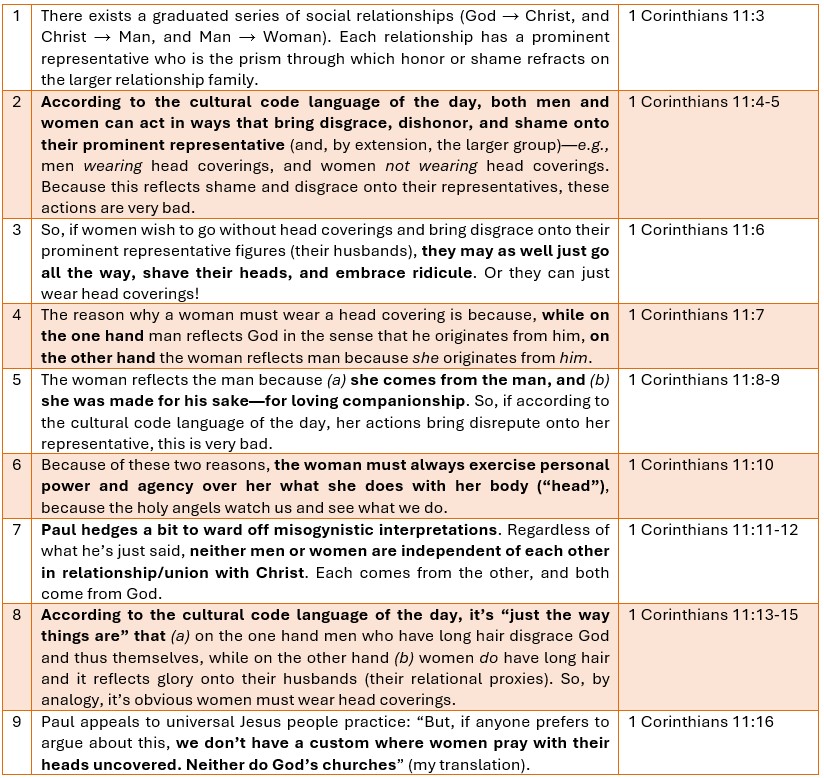
Again, here is my much longer article for more information. I hope this honor/shame approach helps you understand Paul’s message and make it real in your life.
[1] Craig S. Keener, The IVP Bible Background Commentary: New Testament, 2nd ed. (Downers Grove: IVP, 2014), 482.
[2] Hodge, 1 Corinthians, 206.
[3] Edwards, 1 Corinthians, 271-72.
[4] Gill, Exposition of the New Testament, 2:683.
[5] BDAG, s.v. “κεφαλὴ,” 1.b.; p. 542.
[6] L&N, s.v. “κεφαλὴ,” p. 738.
[7] John Gill, A Complete Body of Doctrinal and Practical Divinity, new ed. (reprint; Paris: The Baptist Standard Bearer, 1995), 33; Augustus Strong, Systematic Theology, combined ed. (Philadelphia: American Baptist Publication Society, 1907),245f.
[8] I looked at every usage in the LXX, the New Testament, and the apostolic fathers—the usage just isn’t there. David Garland rightly observes, “[t]he paucity of lexicographical evidence—no Greek lexicon offers this as an option—makes this meaning for ‘head’ highly suspect,” (1 Corinthians, in BECNT (Grand Rapids: Baker, 2003), 515).
[9] See Henry George Liddell et al., A Greek-English Lexicon (Oxford: Clarendon Press, 1996), s.v., sense II.d. For example, Philo speaks of a virgin goddess “whom the fable asserts to have sprung from the head (ἐκ τῆς τοῦ Διὸς κεφαλῆς) of Jupiter” (Peder Borgen, Kåre Fuglseth, and Roald Skarsten, “The Works of Philo: Greek Text with Morphology” (Logos Bible Software, 2005).
[10] Robert Cawdrey, A table alphabeticall, conteyning and teaching the true writing, and understanding of hard usually English words, borrowed from the Hebrew, Greek, Latine, or French etc with the interpretation thereof by plaine English words, gathered for the benefit & help of ladies, gentlewomen, or any other unskillful persons, whereby they may the more easily and better understand many hard English words, which they shall hear or read in scriptures, sermons, or elsewhere, and also be made able to use the same aptly themselves (London: IR, 1604), 10. Retrieved from https://tinyurl.com/4jwxyadh.
See also Oxford English Dictionary, s.v., “absolute” adj. and n., sense II.8.a., June 2025, https://doi.org/10.1093/OED/8089207512.
[11] See (1) A. C. Perriman, “The Head of a Woman: The Meaning of κεφαλὴ in 1 Cor 11:3,” in The Journal of Theological Studies, OCTOBER 1994, NEW SERIES, Vol. 45, No. 2, pp. 602-622, and (2) Anthony C. Thiselton, The First Epistle to the Corinthians: A Commentary on the Greek Text, in NIGTC (Grand Rapids: Eerdmans, 2000), 811-23. Garland follows them both (1 Corinthians, 514-16).
[12] Paul uses καταισχύνω in 1 Cor 11:4-5, which means dishonor, disgrace, or shame (BDAG, s.v., senses 1-2). He uses αἰσχρός at 1 Cor 11:6, which is “a term esp. significant in honor-shame oriented society; gener. in ref. to that which fails to meet expected moral and cultural standards [opp. καλός]) pert. to being socially or morally unacceptable, shameful, base” (BDAG, s.v.).
[13] Hodge says this passage is based on the principle “that order and subordination pervade the whole universe, and is essential to its being” (1 Corinthians, 206). Gould writes: “This rank and subordination form the principle on which the apostle bases his teaching in regard to the veiling of women” (1 Corinthians, 93).
[14] David A. DeSilva, Honor, Patronage, Kinship & Purity: Unlocking New Testament Culture (Downers Grove: IVP, 2000), 25.
[15] Perriman, “Head of a Woman,” 620. Emphasis added.


 The Eccentric Fundamentalist
My personal belief is that Paul is quoting a faction of men from Corinth who wrote him in 1 Corinthians 11:4-6. I believe it is a faction of men who want women to be veiled while praying or prophesying. The men are making a “literal” head argument saying:
4″Every man who has [anything] down over his head while praying or prophesying disgraces his [own] head. 5But every woman who has her head unveiled while praying or prophesying disgraces her [own] head, for it is one and the same thing as having been shaved. 6For if a woman is not veiled, let her also have her hair cut off; but if it is disgraceful for a woman to have her hair cut off or to be shaved, let her be veiled.”
Because the men made a “literal” head argument, Paul gives his model (v.3) with the “figurative” meaning of “head/kephale” which means “source/origin/first/beginning.”
Then, in verses 7-16, Paul gives his rebuttal where he refers back to his model. He starts off by saying, 7″For a man indeed ought not to veil his [figurative] head, since He [Christ] is the image and glory of God, but the woman is the glory of man.” Here, Paul is using Jesus Christ as a correlation as to why women should not be veiled. “Hyparchon” (V-PPA-NMS) is not referring to “aner” (N-NMS) in verse 7; it is referring to “Christos” (N-NMS) in verse 3. Indeed, it is Jesus Christ (not man) who is the image and glory of God. (Please see 2 Cor 4:4, Col. 1:15, John 1:14, Heb. 1:3, Phil. 2:5-6, Rev. 21:23 for confirmation of this.) Male and female are created IN the image of God, but only Jesus Christ IS the image of God because He is the Word made flesh.
So, Paul is saying that just as a man ought not to veil his head, Christ, since He is the image and glory of God, so also the man ought not to veil the woman since she is his glory. Then, in verses 8-10, Paul goes on to give the reasons as to why a woman is a man’s glory.
Also, verses 13-15 should be translated as statements, not questions. Paul is continuing to refute their argument by saying:
13″Judge for yourselves that it is proper for a woman to pray to God unveiled. 14For not even nature itself teaches you that if a man has long hair, it is a dishonor to him, 15but if a woman has long hair, it is a glory to her because the long hair has been given [to us all] instead of a covering.”
In verse 15, the pronoun “aute” (to her) is omitted by Papyrus 46, D, F, G, and also by the majority of later Greek manuscripts. Therefore, I do not believe it was original to Paul. Paul is saying that nature (which God has created) does not teach us that if a man has long hair, it is a dishonor to him. God had commanded that men such as Samson and Samuel have long hair. If God did not want men to have long hair, then He would have disallowed it through nature just as He has disallowed women from growing mustaches or beards through nature. Also, Paul is saying that nature does not teach us that if a woman has long hair, it is her glory (as many women have undesirable hair). God did not give long hair to men to shame them, nor did He give long hair to women for vain beauty purposes. He gave the option of having long hair to both men and women for protection (as a covering) from weather extremes so that they do not have to wear an additional covering every time they step outside.
Paul ends the debate by saying, 16″But if one is inclined to be contentious, we have no such practice [of requiring women to veil their heads], nor have the people of God.”
Anyway, this is just what I believe from my study of Scripture. Thank you for allowing me to share.