Meeting Jim Crow

Meeting Jim Crow

Like many Americans, I knew very little about the context of the civil rights era. I learned about Martin Luther King, Jr. in elementary school, like everyone else. That’s about it, for me. As a Christian, of course I condemn slavery and racism as evils; a poisonous fruit of the Fall.

However, like so many others, I have recently been assaulted with anti-racism rhetoric that seemingly sprang forth from nowhere. This perspective often comes from Critical Race Theory (“CRT”), a new religion I began writing about a little while ago. I have encountered this anti-racism “training” at work in State government, peddled by unwitting Human Resource personnel so the agency can now say it’s “done something” in the wake of Mr. Floyd’s death and the ensuing riots.

A host of revisionist Christian pastors, all darlings in the woker quarters of the evangellyfish pond, have sallied forth to denounce racism – often employing extra-biblical categories to push a watered-down CRT in the Church. One such well-known black pastor recently called for reparations from white Americans and foolishly cited Exodus 12:33-36 as support.

Well, I want to actually learn something about the civil rights era and its context. I don’t want it from woke Christian pastors, or by radical scholars pushing an agenda. I want it from responsible sources. My studies have only begun, but I wanted to pass along some excellent resources to better understand the context of Jim Crow laws and the civil rights era:

  1. The Strange Career of Jim Crow by C. Vann Woodward. This classic, endorsed by MLK, Jr., was written by the dean of Southern historians in the mid-1950s after Brown v. Board of Education, and revised three times (the last being in 1974). It advanced the so-called Woodward thesis, that Jim Crow laws did not follow immediately on the heels of the Civil War, but were a calculated step backward after Reconstruction that deliberately disenfranchised the entire black population and reversed racial progress. The thesis is much more nuanced than I’m presenting it (racial prejudice certainly still existed during Reconstruction). But, it’s a horrifying look at how a culture deliberately took a step back towards pure evil.
  2. The Rise and Fall of Jim Crow by Richard Wormser. This is a short history of the entire Jim Crow era, with particular focus on eyewitness accounts. It is the most horrifying book I’ve ever read and literally changed my perspective forever. I will never think of my country the same way again. You wonder how the Nazis constructed concentration camps? Then, wonder how a “Christian” people did this to other human beings in America. Sin can warp the mind worse than anything else. Terrible. 
  3. Devil in the Grove by Gilbert King. Pulitzer Prize-winning account of Thurgood Marshall and the NAACPs legal strategy to destroy Jim Crow, using the Groveland Four case (from late 1940s Florida) as a foil. One of the most readable, enjoyable books I’ve ever read.
  4. Grand Expectations by James Patterson. Part of the Oxford History of the United States series, focusing on 1945-1974. Essential for capturing the greater context to understand the civil rights era.

I’m listening to the Oxford History entry on the Reconstruction era right now. I plan on listening to a detailed history of the pre-Civil War era slave issue (likely Impending Crisis, by Potter) after that. 

On Divine Persons and Three-Headed Dogs

On Divine Persons and Three-Headed Dogs

This series of more academic articles are the fruit of my own study about divine Personhood in the Trinity. Eventually, I will make more popular versions for “normal” people. For those who, after reading this article, are on tenterhooks wondering what my own framework is, see this sermon I preached on Trinity Sunday 2020.

It’s not partisan to declare that social trinitarianism abandons Nicene concepts of divine Personhood.[1] It does. It adopts a completely different framework. Many non-confessional evangelicals likely adopt it unwittingly.

With one exception, the most influential social trinitarians are not widely read in evangelical circles; certainly not by the average seminary-trained pastor. They are Jurgen Moltmann,[2] Leonardo Boff,[3] Wolfhart Pannenberg,[4] Robert Jenson[5] and Millard Erickson.[6]Pannenberg’s influence is profound; Erickson, Jenson and William L. Craig each studied under him.

Is revision allowed?

First, we need to decide whether it’s possible to put a new framework on biblical truth. Millard Erickson suggests three ways to contextualize theology:[7]

  1. To transplant. You simply state the message using biblical categories, and do no contextualization at all
  2. To transform. The faith needs to be “updated” for modern times, and truth is not found in outdated doctrines.
  3. To translate. “The translators attempt to say what the Bible would say if it were being written to us in our present situation.”[8]

Erickson is a translator, and his social trinitarianism is an example of him doing just that.[9] If you believe it’s possible to re-frame theology in contemporary terms, if necessary re-working allegedly outmoded frameworks while retaining “timeless truth,”[10] then you’ll be open to accepting a re-framing of divine personhood in the Trinity.

What do these social trinitarians do with “personhood?”

A new framework

The first thing to note is a dissatisfaction with the classical understanding of Person.[11] Robert Jenson, for example, rejects divine simplicity as incoherent.[12] He dismisses Augustine’s thinking on the trinity,[13] claiming he was undone by “the old dissonance between the metaphysical principles of the Greeks and the storytelling of the Gospel.”[14] If the Persons are just active subjects of the same, identical nature, then it does not matter which Person does what. It’s irrelevant. Jenson criticizes Augustine, who admitted as much.[15] The classical doctrine has Father, Son and Spirit as the same Being, so all their actions are the same action. The Persons do not merely work together, they do the same thing. Their actions are indivisible.[16]

How, then, can we know the Persons at all!? Pannenberg observed that the idea of “person” seems to requirean individual subsistence, but this is “not compatible with the unity of divine essence.”[17]

So, social trinitarians argue, we must cast aside the straightjacket of Greek metaphysics and see the Persons as scripture sees them.[18] The answer, Jenson argues, is in the Cappadocian scheme of perichoresis and unity of action.[19] The Persons don’t perform the same action, but the same thing together. If there is no meaningful self-distinction within the Godhead, Jenson insists, then we are really speaking nonsense. We’re inventing formulas without meaning, and that makes dogma useless.[20]

What is a person?

So, we have a quest to define “person” more precisely; to put flesh on what is otherwise an alleged abstraction. Leonardo Boff is one such pilgrim.[21] Pointing to John 14:11 and 17:21, he sees divine Personhood as defined by an “I + Thou” relationship:

… a knot of relationships, an identity formed and completed on the basis of relationships with others … Interiority (consciousness in its ontological aspect) and openness to the other (freedom and ethical dimension) constitute the mode of being proper to a person.”[22]

Pannenberg explains:

If the trinitarian relations among Father, Son, and Spirit have the form of mutual self-distinction, they must be understood not merely as different modes of being of one divine subject but as living realizations of separate centers of action.[23]

The classical position, remember, sees the divine Persons as active subjects of the same nature. Consciousness, will, emotion (etc.) all each proper to a nature, not a person. The Father does not think one thing, while the Son thinks another. The Son does not will one thing, and the Spirit another. There is no individual self-consciousness. Everything is collective, because the Persons are the same Being.  

Social trinitarians say no. Each Person has his own will and self-consciousness. The old, stale view of Personhood is “merely an item of linguistic debris knocked from Hellenistic philosophy by collision with Yahweh.”[24]

“A person,” Boff declares, “is a subject existing as a centre of autonomy, gifted with consciousness and freedom.”[25] But, in the closeness of their union, they are really one:

the Father, the Son and the Holy Spirit are three intelligent and free subjects; but they possess the same intelligence and the same will, like a triangle with three angles but only one area. All three Persons affirm themselves as an ‘I,’ not in order to close in on themselves, but in order to give themselves to the other two. What emerges is a real psychological perichoresis.[26]

Boff explains he does not reject the classical position; he “develops and completes it.”

since there are not three consciousnesses there, but only one … At most we can say that in the Trinity there is one substantial consciousness (nature) which is really expressed by three divine, conscious beings (Persons). What we can say is that, analogically, each divine Person is a center of interiority and freedom, whose raison d’etre (nature) consists in being always in relation to the other Persons.”[27]

His contribution is that he sees a divine Person as more than a particular active subject of the divine nature; more than even a specific, unique existence of the divine nature. He emphasizes the personal, conscious, relational aspect of each to the other in the same nature through perichoresis. Jenson suggests we drop person and use the term identity; “there are three identities in God …”[28]

Jurgen Moltmann believes it is a strawman to say social trinitarians believe in a “modern” understanding of Personhood. Critics like Karl Rahner, he charges, are actually imputing a caricature of extreme individualism.[29] Instead, real “personhood” can only truly be defined as an individual in relationship with others; “the ‘I’ can only be understood stood in the light of the ‘Thou’ – that is to say, it is a concept of relation. Without the social relation there can be no personality.”[30] Pannenberg warns that, if the only way you can distinguish the Persons is by their manner of origin, then “one cannot do justice to the reciprocity in the relations.”[31]

In this way, social trinitarians have re-framed the doctrine of God. However, to Moltmann, because the classical position understands the Persons as merely active subjects of the same nature, this means God communicates only with Himself in an internal, self-dialogue. There is no “I + Thou” conversation; there is only the one subject speaking to Himself. There is no community. Interpersonal relationships with the Trinity are surrendered. Man looks to God for a communal example and can only become “turned inwards and solitary,”[32] for God speaks only to Himself, about Himself.

So, Moltmann flatly denies that the Persons are the same identical essence.

If we search for a concept of unity corresponding to the biblical testimony of the triune God, the God who unites others with himself, then we must dispense with both the concept of the one substance and the concept of the identical subject.[33]

Moltmann points to the imago dei for support. “A person is only God’s image in fellowship with other people.”[34] Many theologians, independent of this controversy, have agreed.[35] Accordingly, the Persons must relate to one another in a real “I + Thou” relationship. This means the Persons must have individual self-distinction, intelligence, consciousness and will.

Thus Erickson, the one conservative evangelical proponent of social trinitarianism, suggests the Trinity must be understood as a society of persons.[36]

In union with each other

How do social trinitarians avoid tri-theism? Through perichoresis, a doctrine first formulated in the East by the Cappadocian Fathers. The Persons are united without confusion and mutually indwell one another without any blending or mingling, without change or division. Erickson calls perichoresis the “guard against tritheism.”[37]

If God is love (1 Jn 4:8), then He must be more than one person. Love needs an object. “Thus, if there were not multiplicity in the person of the Godhead, God could not really be love prior to this creation of other subjects.”[38] Unlike human persons, however, the Trinity is incorporeal and has no spatial limitations that hinder interpersonal relations. Their union is such that there are no separate experiences and so none of the typical barriers to perfect love. Nor is there any self-centeredness.[39]

Moltmann likens this union to a “circulation of eternal divine life.”[40] He explains that “[b]y virtue of their eternal love they live in one another to such an extent, and dwell in one another to such an extent, that they are one.”[41] There is not one subject; there is only “the living fellowship of the three Persons who are related to one another and exist in one another. Their unity does not lie in the one lordship of God; it is to be found in the unity of their tri-unity.”[42] Erickson, echoing Moltmann, explains the Persons “are so intimately linked and intertwined that they are unable to live apart from one another. Each supplies life to the others. What they do, although it may be primarily the work of one of them, is done together.”[43]

He suggests we stop thinking of God as metaphysically simple and consider Him as an organism; a union.[44] In a similar fashion, Pannenberg describes God’s essence as a “single constellation.”[45] No Person can exist without the other; “[n]one has the power of life within itself alone.”[46] Boff notes, “[t]heir relationship is one of reciprocal participation rather than production and procession.”[47] This abolishes the classical doctrines of eternal generation and procession. Yet, Moltmann avers, without this “perichoretic unity, then Arianism and Sabellianism remain inescapable threats to Christian theology.”[48]

Indeed, Moltmann contends that this perichoresis of three individual centers of self-conscious Persons is the only way to make sense of salvation history.[49] All ideas of subordinationism are now gone; the concept “has no validity within the eternal circulation of the divine life.”[50] Each Person eternally brings glory to the other in this circulation.[51]

Analogies

Following the classical model, we recall that Donald Bloesch proposes the analogy of the Trinity as different dimensions of the same space; height, width and depth.[52] The dimensions, though real, are distinct aspects of the one shape. If the dimensions had independent status, you would have three shapes. But, you do not have three shapes. You have one shape with three facets.

Social trinitarians cry foul and see this as modalism by any other name. William Craig is a social trinitarian. In perhaps the very worst analogy in the history of the Church, he offers up the analogy of Cerberus, the three-headed dog who guards Hades, to explain the Trinity.[53] In a more responsible fashion, Erickson suggests the idea of the human organism consisting of heart, brain and lungs. Each is distinct, but not separable. Each depends on the other for existence. They can only exist together as a unit. They share the same life. He also proposes the analogy of Siamese twins who share the same organs. There are two, but also one.[54]

We close by returning to Erickson’s notion of “translating” doctrine. Can it be done? Donald Bloesch, independent of this issue, warns, “We can and must avail ourselves of philosophical concepts, but we must not let these concepts rule our thinking. We must always be prepared to modify them and perhaps set them aside as new light breaks forth from God’s holy word.”[55] If this be true, have social trinitarians done it here?

Barth warns that, if you have three separate objects of worship, you have three gods.[56] In denying the Persons’ numerical identity of essence (homoousia), is this what the social view hath wrought?

It is time for thinking Christians, especially pastors, to decide what “Person” means. Unfortunately, most don’t know it’s an issue. One may be right to stand in opposition to Church doctrine that is nearly 1600 years old. But, you should at least do it consciously!

A special thanks to my friend, Tito Lyro (Pastor, Bible Presbyterian Church, Olympia, WA and President of Western Reformed Seminary, Lakewood, WA) for reviewing this article!


[1] Robert Letham declares, “The idea of social Trinitarianism is alien to the classic doctrine, for which the unity and indivisibility of the Trinity, together with the inseparable works of God, are axiomatic,” (The Holy Trinity: In Scripture, History, Theology, and Worship, revised ed. [Phillipsburg: P&R, 2019; Kindle ed.], KL 386).

[2] Jurgen Moltmann, Trinity and the Kingdom, trans. Margaret Kohl (reprint; Minneapolis: Fortress, 1993; Kindle ed.). 

[3] Leonardo Boff, Trinity and Society, trans. Paul Burns (reprint; Eugene: Wipf & Stock, 2005).  

[4] Wolfhart Pannenberg, Systematic Theology, vol. 1, trans. Geoffrey Bromiley (Grand Rapids: Eerdmans, 1991).

[5] See both The Triune Identity (Minneapolis: Fortress, 1982) and Systematic Theology, vol. 1 (New York: Oxford University Press, 1997). 

[6] Millard J. Erickson, God in Three Persons: A Contemporary Interpretation of the Trinity (Grand Rapids: Baker, 1995). Erickson did postdoctoral studies under Pannenberg and dedicated his Christian Theology (in part) to him.

[7] Millard J. Erickson, Christian Theology, 3rd ed. (Grand Rapids: Baker, 2013; Kindle ed.) KL 1681-1842. 

[8] Erickson, Christian Theology, KL 1771.

[9] In addition to Erickson’s God in Three Persons, see his other two monographs on Theology Proper and Christology in which he goes his own way on a number of issues; (1) God the Father Almighty: A Contemporary Exploration of the Divine Attributes (Grand Rapids: Baker, 1998; Kindle ed.), and (2) The Word Became Flesh (Grand Rapids: Baker, 1991). 

[10] “… the really crucial task of theology will be to identify the timeless truths, the essence of the doctrines, and to separate them from the temporal form in which they were expressed, so that a new form may be created,” (Erickson, Christian Theology, KL 1842).

[11] Robert Jenson believes that, had the gospel been birthed in a culture other than one steeped in Greek thought, then the Church would have used a different framework for understanding God. “The fathers did not, as is still often supposed, hellenize the evangel; they labored to evangelize their own antecedent Hellenism, and succeeded remarkably if not fully,” (Systematic, 90). 

[12] Jenson, Systematic, 110-114. 

[13] “Augustine imported Eastern doctrine, interpreted it according to his lights, and passed on the result … he was mostly blind to Athanasius’ and the Cappadocians’ specific achievement, and where he saw it he rejected it,” (Jenson, Systematic, 110-111). 

[14] Jenson, Systematic, 112. 

[15] Jenson, Systematic, 111.

[16] Augustine, “On the Trinity,” 15.5, in NPNF1, 14 vols. (Buffalo: Christian Literature Company, 1887), vol. 1.3. “He who is sent is not therefore less than He who sends because the one sent, the other was sent; since the Trinity, which is in all things equal, being also equally in its own nature unchangeable, and invisible, and everywhere present, works indivisibly.” Emphasis added.

[17] Pannenberg, Systematic, 1:286. 

[18] “To find a basis for the doctrine of the Trinity we must begin with the way in which Father, Son, and Spirit come on the scene and relate to one another in the event of relevation,” (Pannenberg, Systematic, 1:299). 

[19] Robert Letham has a good initial definition but, as a classical trinitarian, he shows his cards in his description: “The mutual indwelling of the three persons of the Trinity in the one being of God. In social Trinitarianism, the word is used in a quite different way, to claim that the three hypostases are like three human persons engaged in a dance around one another, a development hinting at tritheism,” (Holy Trinity, KL 11553). It is not an accident that theologians allow no wiggle-room on the issue of divine Personhood; it goes to the heart of who God is.

[20] Jenson, Systematic, 113. 

[21] Boff, Trinity and Society, 118ff. 

[22] Boff, Trinity and Society, 89. 

[23] Pannenberg, Systematic, 1:319. 

[24] Jenson, Triune Identity, 108. 

[25] Boff, Trinity and Society, 115.

[26] Boff, Trinity and Society, 116. 

[27] Boff, Trinity and Society, 89. 

[28] Jenson, Triune Identity, 111. 

[29] “What Rahner calls `our secular use of the word person’ has nothing in common with modern thinking about the concept of persons. What he describes is actually extreme individualism: everyone is a self-possessing, self-disposing centre of action which sets itself apart from other persons,” (Jurgen Moltmann, Trinity and the Kingdom KL 2133-2134).

[30] Moltmann, Trinity and Kingdom, KL 2135-2136.

[31] Pannenberg, Systematic, 1:319.

[32] Moltmann, Trinity and Kingdom, KL 2290.        

[33] Moltmann, Trinity and Kingdom, KL 2199-2200. 

[34] Moltmann, Trinity and Kingdom, KL 2277.

[35] Robert Reymond quotes Charles Hodge approvingly, who believed the imago dei consisted in both knowledge of God and moral rectitude toward one’s neighbor. The fall ruined both our vertical relationship with God and our horizontal relationship with our neighbors (A New Systematic Theology of the Christian Faith, revised ed. [Nashville: Thomas Nelson, 1998], 429). To be in the image of God includes the concept of relationship.

Erickson takes a structural view and explains that God made us a certain way in order to fulfill the relationships He meant us to have. “Humanity qua humanity has a nature encompassing all that constitutes personality or selfhood: intelligence, will, emotions. This is the image in which humans were created, enabling them to have the divinely intended relationship to God and to fellow humans, and to exercise dominion,” (Christian Theology, KL 10321).

[36] Erickson, God in Three Persons, 221ff. 

[37] Erickson, God in Three Persons, 228-238. 

[38] Erickson, God in Three Persons, 221. 

[39] Erickson, God in Three Persons, 223-225. 

[40] Moltmann, Trinity and Kingdom, KL 2548. 

[41] Moltmann, Trinity and Kingdom, KL 2547-2548. 

[42] Moltmann, Trinity and Kingdom, KL 2558-2560. 

[43] Erickson, God in Three Persons, 234-235. 

[44] Erickson, God in Three Persons, 231, 264. 

[45] Pannenberg, Systematic, 1:359. 

[46] Erickson, God in Three Persons, 264. 

[47] Boff, Trinity and Society, 145; see 145-147. 

[48] Moltmann, Trinity and Kingdom, KL 2208-2211. 

[49] “For this trinitarian history is nothing other than the eternal perichoresis of Father, Son and Holy Spirit in their dispensation of salvation, which is to say in their opening of themselves for the reception and unification of the whole creation. The history of salvation is the history of the eternally living, triune God who draws us into and includes us in his eternal triune life with all the fullness of its relationships. It is the love story of the God whose very life is the eternal process of engendering, responding and blissful love. God loves the world with the very same love which he is in himself,” (Moltmann, Trinity and Kingdom, KL 2300-2303).

[50] Moltmann, Trinity and Kingdom, KL 2562. 

[51] Moltmann, Trinity and Kingdom, KL 2567-2568. “The Persons of the Trinity make one another shine through that glory, mutually and together. They glow into perfect form through one another and awake to perfected beauty in one another.”

[52] Donald Bloesch, God the Almighty (Downers Grove: IVP, 1995), 186. 

[53] William L. Craig and J.P. Moreland, Philosophical Foundations for a Christian Worldview (Downers Grove: IVP, 2003), 593. 

[54] Erickson, God in Three Persons, 233-234. 

[55] Bloesch, God the Almighty, 35. 

[56] Karl Barth, Church Dogmatics, 1.1, trans. G. W. Bromiley, 2nd ed. (Edinburgh: T&T Clark, 1975), 349.

I Love Me …

I Love Me …

Carl Trueman’s forthcoming book will be required reading for any pastor (or, anybody, really) who is interested in a Christian explanation for the cult of self-worship in the West. He summarizes the issue in an article published today titled “The Rise and Triumph of the Modern Self … And How the Church Can Respond.”

Even if you aren’t a Christian, do you want to know what’s happened to the world? To people? Where did this “you do you!” ethos of self-worship come from? Why do people see their psychologized self-conception (which, tellingly today, almost always centers on sex) as the thing that defines them?

Trueman sums up the problem in the article:

… the idea that happiness is personal psychological satisfaction—“self-fulfillment”—is the staple of sitcoms, soap operas, movies, and even commercials. And this narrative, this illusion, has powerful implications. When the goal of human existence is personal psychological satisfaction, then all moral codes are merely instrumental, and therefore continually revisable, to this subjective, psychological end.

I’ve preached both a sermon that touched on this a BIT:

and one that touched on this a LOT:

and hopefully have an article forthcoming in a Christian magazine that lays some of this out. My latest article about the Bostock decision also noted that this lens of narcissism is behind SCOTUS’ redefinition of “sex” to include sexual orientation and gender identity.

Trueman closes his article with this:

We have been here before—despised, considered immoral, standing on the margins. And we can learn lessons that will fortify us as we move into an uncertain future.

I’m looking forward to the book.

Sign Gifts and the Church

Sign Gifts and the Church

In the Book of Acts and the rest of the New Testament letters, people do some amazing things. They miraculously speak foreign languages without study. They raise people from the dead and heal the sick. They provide direct revelation (prophecy) from God. These gifts are known as sign gifts.

This means they’re signs or credentials which show that the Kingdom of God has broken into this world in the person of Jesus. Something new and amazing has happened, and these miracles are signs from God proving it. It’s as if Jesus is saying, “I am God the Son. See, watch this! [Insert miracle here] Now, listen to my message …”

Jesus pointed to His miracles as proof the kingdom had come (Lk 7:21-23; cp. Isa 35:4-6). That’s why the scripture says “God also bore witness by signs and wonders and various miracles and by gifts of the Holy Spirit distributed according to his will,” (Heb 2:4). The apostles agreed (Acts 2:22), and that’s why some of them had these gifts, too (Acts 2:43).

Do these sign gifts continue, today? People have different opinions, ranging from (1) absolutely not, to (2) yes, absolutely, and (3) many shades in-between.

I’ll briefly answer the question, then define my terms and suggest a scriptural way to handle it if somebody claims to have an apostolic sign gift. This article is nothing more than a primer to frame the issue for the congregation where I serve, so I won’t defend my statements here. I’ll just place some guardrails so I can have that conversation during an upcoming theology class.

Answering the question

1 Corinthians 12-14 suggests there was a time when many Christians had the apostolic sign gifts. Scripture does not teach that the sign gifts will disappear, and efforts to prove otherwise are at best circumstantial and at worst desperate. Nevertheless, in some (not all) Christian traditions these sign gifts are not normative like they were in Paul’s day. But, it’s more than a bit brazen to suggest God does not or will not give these sign gifts again. God can still give these gift if He wants. Does He? I’m not sure, nor are you. So, just test for the gift.

Defining terms and testing the spirits

  1. Tongues. This word means “language.” Over time, some Christians have assumed it means something it doesn’t. The “tongues” in Acts and in Paul’s letters (e.g. 1 Cor 12-14) are real human languages. According to the example from Acts 2 (and 10:46), the gift of tongues means the supernatural ability to immediately speak a foreign language without training. We test this gift by acquiring an interpreter for the language in question and inviting the Christian to demonstrate miraculous, instantaneous fluency in the foreign language.
  2. Healing. According to the examples from scripture, this is the supernatural ability to completely cure somebody from a disease, injury or illness instantaneously. Invite the person claiming this gift to use it as Jesus did–to demonstrate that the kingdom of God has broken into this world. This gift should not be kept in a dark corner.
  3. Raising people from the dead. It means what it says. Again, ask the  person to use this gift in public for the glory of God.
  4. Prophecy. This means you receive a direct revelation from God, and you give that revelation to God’s people. Prophecy is not a feeling or a leading (though both of these may be promptings from the Spirit). Prophecy is direct communication from God; as in “the oracle of the word of the LORD to Israel by Malachi,” (Mal 1:1). There are two tests for a true prophet; (1) the prophecy must always come to pass (Deut 18:21-22), and (2) the prophet must never prophesy or teach anything opposed to the scriptures (Deut 13:1-5).

Once we understand terms, the short answer to the question of whether sign gifts continue is: “Well, maybe! God can do anything! If you have the gift, please prove it.” One Christian theologian has written some good advice about this:

What we must do, then, is to evaluate each case on its own merits. This does not mean that we are to sit in judgment on the spiritual experience or the spiritual life of other professing Christians.

What it does mean is that we cannot assume that everyone who claims to have had a special experience of the Holy Spirit’s working has really had one. Scientific studies have discovered enough non-Spirit-caused parallels to warn us against being naively credulous about every claim. Certainly not every exceptional religious experience can be of divine origin, unless God is a very broadly ecumenical and tolerant being indeed, who even grants special manifestations of his Spirit to some who make no claim to Christian faith and may actually be opposed to it.

Certainly if demonic forces could produce imitations of divine miracles in biblical times (e.g., the magicians in Egypt were able to imitate the plagues up to a certain point), the same may be true today as well.

Conversely, however, no conclusive case can be made for the contention that such gifts are not for today and cannot occur at the present time. Consequently, one cannot rule in a priori and categorical fashion that a claim of [speaking in tongues] is spurious. In fact, it may be downright dangerous, in the light of Jesus’s warnings regarding blasphemy against the Holy Spirit, to attribute specific phenomena to demonic activity.

Millard Erickson, Christian Theology, 3rd ed. (Grand Rapids: Baker, 2013; Kindle ed.), p. 802.

It’s never a good policy to repeat the mistakes of the Pharisees, who attributed the power of God to Satan (Mt 9:32-34). God can do anything He wants. But, we should be cautious and follow the scripture in testing for the gift.

Resources

I will recommend a few resources, if you’re interested:

  1. Spiritual Gifts: What They Are and Why They Matter by Thomas Schreiner. 121 pages. Perhaps the best modern book on the topic.
  2. The Charismatic Phenomenon by John Whitcomb and Peter Masters. 100 pages. A great book that’s a bit more stern than Schreiner … or me!
  3. Chapter 52 (especially pp. 1031 – 1046) from Systematic Theology, by Wayne Grudem. He takes a more open position on the sign gifts, and Grudem redefines “prophecy” for the New Covenant era.
  4. I wrote a short article explaining what I believe 1 Corinthians 14 is saying.

I hope this very short primer is helpful.

Jim Crow wasn’t inevitable

Jim Crow wasn’t inevitable

C. Vann Woodward was a celebrated historian of the American South. His most well-known work is The Strange Career of Jim Crow, originally published in 1955 and updated for the last time in 1974. He aimed to explain why and how, exactly, we went from (1) the end of the Civil War and Reconstruction to (2) a segregation more complete than anything experienced in the antebellum, pre-war South.

His startling thesis was that the Jim Crow laws did not follow immediately on the heels of the Civil War, but came perhaps 30 years later and destroyed the (in some quarters) considerable progress that had been made in race relations. This is known as the “Woodward thesis.” He explains:

The obvious danger in this account of the race policies of Southern conservatives and radicals is one of giving an exaggerated impression of interracial harmony. There were Negrophobes among the radicals as well as among the conservatives, and there were hypocrites and dissemblers in both camps. The politician who flatters to attract votes is a familiar figure in all parties, and the discrepancy between platforms and performance is often as wide as the gap between theory and practice, or the contrast between ethical ideals and everyday conduct.

My only purpose has been to indicate that things have not always been the same in the South. In a time when the Negroes formed a much larger proportion of the population than they did later, when slavery was a live memory in the minds of both races, and when the memory of the hardships and bitterness of Reconstruction was still fresh, the race policies accepted and pursued in the South were sometimes milder than they became later.

The policies of proscription, segregation, and disfranchisement that are often described as the immutable ‘folkways’ of the South, impervious alike to legislative reform and armed intervention, are of a more recent origin.

The effort to justify them as a consequence of Reconstruction and a necessity of the times is embarrassed by the fact that they did not originate in those times. And the belief that they are immutable and unchangeable is not supported by history.

C. Van Woodward, The Strange Career of Jim Crow, 3rd ed. (New York: OUP, 2002; Kindle ed.), 65.

Now, that’s something to chew on. Here’s something more – where were the Christians in the South as this reversion to evil took place?

Note: The feature photograph (above) depicts Sheriff Willis McCall, of Lake County, FL, in November 1951 moments after he murdered one man and shot another during a fake “escape attempt” he staged as he transported both men to a State prison. This case of the so-called “Groveland Four,” in which his department framed four innocent men for the illusory rape of a white woman, is a poster child for the evils of the Jim Crow laws.

6: Bostock, transgenderism, and the cult of self-worship

6: Bostock, transgenderism, and the cult of self-worship

Read the rest of the series about the Bostock v. Clayton County court decision.

The Bostock ruling made two momentous decisions; (1) it read “sexual orientation” into Title VII of the 1964 Civil Rights Act, and (2) it did the same for “gender identity.” So far in this series I’ve focused on the former. Now it’s time for the latter.

The transgender component of Bostock involves a man named Mr. Stephens. He identifies as a woman and all references to him in the Bostock literature are to “Aimee Stephens” or “Ms. Stephens.” However, I will refer to him as Mr. Stephens throughout.

Mr. Stephens was terminated from employment at Harris Funeral Homes (“Harris Funeral”) after he declared he would begin presenting as a woman to perform his duties as a funeral director. Mr. Stephens filed an EEOC complaint which eventually wound its way to the Sixth Circuit. In its petition for review to the U.S. Supreme Court (“SCOTUS”), Harris Funeral’s counsel argued:

… the Sixth Circuit ordered it to allow a male funeral director to dress and present as a woman at work. Harris Homes must do that even though its owner reasonably determined that the employee’s actions would violate the company’s sex-specific dress code and disrupt the healing process of grieving families. The language of Title VII does not mandate that result.

Petition, 2

Harris Funeral advanced two key arguments (Petition, i):

  1. Title VII says it’s unlawful to discriminate in employment matters “because of … sex.” The law never mentions “gender identity.” In fact, these are two very different things. So, Mr. Stephens can’t appeal to Title VII.
  2. The Sixth Circuit wrongfully applied the precedent from Price Waterhouse v. Hopkins to Harris Funeral. In Price, SCOTUS found it was unlawful for an employer to use sex-based stereotypes to deny a woman a promotion. In Price, employers considered the woman too “macho” and otherwise unladylike, so they did not promote her. But regarding Harris Homes, its attorneys argued, “[t]he Sixth Circuit thus treated the very idea of sex—which determines a person’s status as male or female based on reproductive anatomy and physiology—as an illicit stereotype,” (Petition, 11).

These are dividing lines. How do you know what you know? Christians have a divine revelation that tells them about the world, about themselves, about God, and about reality. Unbelievers have nothing but social conventions.

This is why the culture can re-invent the meaning of “sex” when it’s convenient. It’s also why it can assume that “sex = reproductive function” is a harmful stereotype. This is what Mr. Stephens’ attorney argued.

He was fired, the attorney declares, “because of [his] employer’s stereotypes about how women and men should appear and behave … because [his] appearance would no longer conform to his sex stereotype,” (Response, 1).

The Sixth Circuit decision remarked:

discrimination because of a person’s transgender, intersex, or sexually indeterminate status is no less actionable than discrimination because of a person’s identification with two religions, an unorthodox religion, or no religion at all. And “religious identity” can be just as fluid, variable, and difficult to define as “gender identity”; after all, both have “a deeply personal, internal genesis that lacks a fixed external referent.

Petition, Appendix A, pgs. 24-25a, footnote 4.

During oral arguments before SCOTUS, Mr. Stephens’ attorney proclaimed:

the objection to someone for being transgender is the ultimate sex stereotype. It is saying, I object to you because you fail to conform to this stereotype: The stereotype that if you are assigned a male sex at birth, you must live and identify for your entire life as a man.

Oral arguments transcript, 20:22 – 21:3.

Identity is the thing

At some point, you have to decide how and why you “know” what you know. Do you know it because you have a standard that transcends cultural values and trumps subjective opinion? What’s your basis for telling the other guy he’s wrong and you’re right?

The world has no standard. That’s why it’s gone mad. I fear it will now take a divine intervention for some people to even acknowledge what used to be accepted facts of reality.

The real problem is the cult of narcissism. The idea that you, as a person, are the sum total of your feelings. This is what our world teaches, encourages, indoctrinates us with. I preached about that, recently.

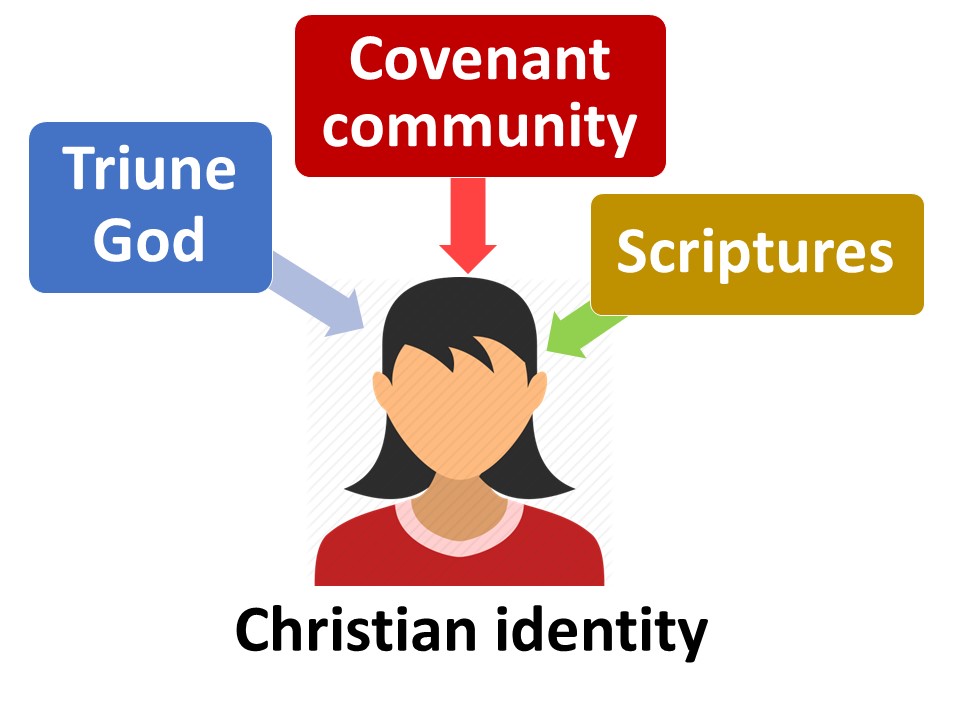
There are factors that shape you as a person. They determine how you see yourself and the world. How you see reality. There are the four primary agents of socialization in a person’s life (Kerry Ferris and Jill Stein, The Real World: An Introduction to Sociology, 6th ed. [New York: W.W. Norton, 2018], 109ff):

In fact, according to many sociologists, the “self” is not a fixed thing. “[T]he self is created and modified through social interaction over the course of a lifetime,” (Real World, 102). Your identity is putty, ready to be formed and re-formed as you live your life. And this self-conception of you is often formed by those four agents, above.

There is certainly some truth to these insights. You are, in a meaningful sense, a product of your environment. But, our culture used to have “understood” guardrails inherited from the Christian faith that defined reality; mores that hemmed in the overt damage of our worst impulses even among unbelievers. This is what John Calvin called the second use of the moral law (Institutes of the Christian Religion, 2.7.10). God’s word, as the foundation for right and wrong in Western society, restrains evil by threat of punishment. It’s a deterrent:

Such persons are curbed, not because their mind is inwardly moved and affected, but because, as if a bridle were laid upon them, they refrain their hands from external acts, and internally check the depravity which would otherwise petulantly burst forth

Institutes, 2.7.10

But now, Western society has deliberately cut itself off from the Christian story that alone can anchor and explain reality. The world has tossed the moral law overboard; a move that was implicit for a while but has now become explicit.

Mr. Stephens is the result. We drift aimlessly on the swells of … feelings. Psalm 2 has something to say about God’s response to that. So now, these vehicles of socialization have no guardrails stopping them from jumping the track and plowing through a sub-division. Our feelings, our worship of self, knows no bounds. So, you see, to believe that “sex” is immutable is to be a hater.

Along with a whole range of beliefs in the modern world, there is confusion as to how they are to be understood and a yawning chasm as to how they are to be grounded. Originally pioneered in the West and grounded in Jewish and Christian beliefs, human dignity, liberty and equality are now often left hanging without agreement over their definition and their foundation.

If the original Jewish and Christian foundations of human dignity, liberty and equality are to be rejected, the ideas themselves need to be transposed to a new key or eventually they will wither. The Western world now stands as a cut-flower civilization, and such once-vital convictions have a seriously shortened life.

Os Guinness, The Global Public Square: Religious Freedom and the Making of a World Safe for Diversity (Downers Grove: IVP, 2013; Kindle ed.), KL 847).

When he wrote that last sentence, seven years ago, Guinness was right. But now, that cut flower has died. The world has tossed it into the rubbish bin. The arguments Mr. Stephens’ attorney used prove it:

  1. Sex isn’t a biological fact. It’s a feeling validated by a mental health professional’s diagnosis; a verdict which is nothing less than our culture’s sacrament of grace dispensed on letterhead.
  2. To believe sex is a fixed, biological and reproductive reality is to discriminate. To cause harm. To be a hater. Cancel yourself now, bigot.

This “no guardrails” new normal is why a modern (c. 2019) sociology text can blithely dismiss the view that sex is fixed and immutable as an idea “found outside the discipline in such fields as medicine, theology, and biology,” (Real World, 256). It doesn’t appear to bother sociologists that their field, alone among all disciplines, goes its own way. Instead, the authors declare, “most mainstream sociologists” (i.e. the smart ones, you know) “believe notions of gender are socially determined, such that a binary system is just one possibility among many,” (Ibid).

This is why CNN, in an article recommending increased cervical cancer screening, refers to women as “individuals with a cervix.” After all, we can’t assume only women have cervixes, right? That would be a … discriminatory stereotype.

Tellingly, another sociology text that’s only 13 years old (c. 2007) knows nothing of “gender identity” as a category. The term doesn’t even appear in the index; nor does “transgender,” (Rodney Stark, Sociology, 10th ed [Belmont: Wadsworth, 2007]). It’s gender-based discussions focus on that most un-mainstream of assumptions – sex is immutable. How much changed in those 13 years!

Thus, Guinness the prophet wrote in 2013:

In the end, such a change of worldviews will mean decisive changes for the understanding of humanity, for the defense of human rights and ultimately for the treatment of human beings. Just as the road to Auschwitz began in professors’ studies and academic lecture halls, so the present degraded views of humanity will inevitably create a harvest of evil consequences, even if not fully visible now.

Guinness, Global Public Square, KL 898-913.

Untethered to the grounding of the Christian story, our culture will drift closer and closer to the reef. It will destroy itself because it has no grounding. It will become increasingly crazy. It’s always been this way. This is why in the 5th century Augustine wrote his masterwork apologetics text to teach Christians they don’t belong to this world; they belong to the City of God.

What’s the Christian’s task? To explain reality to a confused world. To insist, gently but firmly, on the truth. Women are women. Sex is sex. Right is right. Wrong is wrong. You are not your feelings. You’re so much more than that. You don’t have to be a slave to yourself. There’s a God, named Yahweh, who made you because He loves you. He wants to fix you. He longs to fix you. He asks for your allegiance first.

What’s the Christian’s hurdle to achieving this? It’s that none of this great witnessing will ever happen if the Church’s agents of socialization aren’t stronger than the world’s:

As you consider these two competing frameworks for identity, these two prisms for understanding yourself, consider which one has more influence in your life. Consider how Mr. Stephens came to believe what he does.

Our culture teaches us to worship ourselves. So, we tend to do exactly that. Christians aren’t immune to the siren song of narcissism. But our story, our scriptures, our God, tell us to worship Him and His estimation of our identity and value.

On Christian Civil Religion

On Christian Civil Religion

Christian Nationalism, the tendency to conflate American patriotism with the Christian faith and message, came into its modern form in the Eisenhower years. It did so largely as a civil religious bulwark in the context of the escalating Cold War and domestic “Red Scare.” It was deliberately fostered by President Eisenhower. It morphed into the political arena in a meaningful way from the 1980s to roughly 2004; the glory years of Moral Majority and, later, the Religious Right.

Frances Fitzgerald wrote about this in her book The Evangelicals (which I previously reviewed):

Eisenhower and Graham did not agree on theology or foreign policy, but they agreed on the place of religion in what both considered perilous times. They agreed that America was fighting atheistic Communism and that national survival rested on the belief of Americans in God.

“A spiritual awakening,” Graham said, “will restore our spiritual heritage, create moral stamina and consciousness, bring back the sanctity of the home . . . strengthen the bulwarks of freedom and bring integrity back to the people of the world.”

They agreed that patriotism and religious belief were synonymous and that America had a moral and spiritual mission to redeem the world. “If you would be a loyal American, then become a loyal Christian,” Graham said in one sermon, and in another, “We are created for a spiritual mission among the nations.”

Graham, of course, did not believe that just any religion would do. In a sermon titled “Satan’s Religion” he offered five ways Americans could “most effectively combat Communism.” The first was “by old-fashioned Americanism”; the second “by conservative and Evangelical Christianity”; the third by prayer; the fourth by spiritual revival; and the fifth “by personal Christian experience.” “The greatest and most effective weapon against Communism today is to be a born-again Christian,” he said.

Despite his sectarian perspective, Graham’s position was closer to Eisenhower’s than to that of liberal Protestant leaders, all of whom objected to the conflation of Christianity with Americanism, and some of whom had a disconcerting tendency to call for nuclear disarmament and talks with the Communist Chinese.

It was also closer to the majority position of the day. In 1949 Graham had styled himself as Amos, the prophet crying in the wilderness, but in four years he had become a pastor of the national civil religion.

The Evangelicals, pgs. 185-186.

This is why this article by Michael Svigel is so helpful. He offers up a third way for Christians to engage the world. A way that isn’t isolationism or a bad marriage to politicians and their all too often crocodile promises. It’s a way Svigel calls the “Conscience of the Kingdom” approach:

In this approach, Christians uncompromisingly commit to the Lordship of Jesus Christ with regard to their priorities and values, morals and message. They surrender none of these to any other lord or any other leader. The Church is the community of their primary allegiance, which they will share with no other party or political organization.

However, Conscience Christians view their relationship to the world as analogous to the conscience of an individual. On the basis of God’s Word and in allegiance to the Lord Jesus Christ, Christians speak and act on behalf of righteousness.

Christians address political corruption, weigh in on social ills, take righteous action on behalf of truth, justice, and mercy, and do so in ways that refuse either to empower a “strongman” or take shelter in a bunker.

Svigel’s article provides a helpful corrective for Christians who may tend to conflate American nationalism with the Christian faith. They are very different. They should REMAIN very different. The hopes and dreams that fire a Christian’s heart and mind MUST come from Christ’s kingdom, not from 1600 Pennsylvania Avenue.

Read the whole article. Then, read Svigel’s wonderful book RetroChristianity.

Good book … so far

So far, Gilbert King’s book Devil in the Grove, about Thurgood Marshall and his defense of several black men falsely accused of raping a white woman in rural Florida in 1946, is a great book about a horrifying time in our country.

The author is a very good writer. This isn’t always the case. David Garrow’s biography of Martin Luther King, Jr., Bearing the Cross, which also earned the Pulitzer Prize and covered a similar subject, reads as though it were written by a mad collector of facts who murdered his editor.

Here’s the opening paragraphs from Devil in the Grove, as a teaser:

IF THAT SON of a bitch contradicts me again, I’m going to wrap a chair around his goddamned head.” One acquittal after another had left Tennessee district attorney general Paul F. Bumpus shaking his head in frustration over the NAACP lawyers, and now Thurgood Marshall was hoping to free the last of the twenty-five blacks accused of rioting and attempted murder of police in Columbia, Tennessee.

The sun had been down for hours, and the start of a cool, dark night had settled over the poolrooms, barbershops, and soda fountains on East Eighth Street in the area known as the Bottom, the rickety, black side of Columbia, where, nine months earlier, the terror had begun.

Just blocks away, on the news that a verdict had been reached, the lawyers were settling back into their chairs, fretfully waiting for the twelve white men on the jury to return to the Maury County courtroom. They’d been deliberating for little more than an hour, but the lead counsel for the defense, Thurgood Marshall, looked over his shoulder and knew immediately that something wasn’t right.

Throughout the proceedings of the Columbia Race Riot trials, the “spit-spangled” courtrooms had been packed with tobacco-chewing Tennesseans who had come to see justice meted out. But the overall-clad spectators were equally intrigued by Marshall and his fellow NAACP lawyers: by the strange sight of “those niggers up there wearing coats and talking back to the judge just like they were white men.”

Marshall was struck by the eeriness of the quiet, nearly deserted courtroom. The prosecution’s table had been aflutter with the activity of lawyers and assistants throughout the trial, but none of them had returned for the verdict. Only the smooth-talking Bumpus had come back. All summer long he’d carried himself with the confidence that his Negro lawyer opponents were no match for him intellectually. But by relentlessly attacking the state’s case in a cool, methodical manner, Marshall and his associates had worn Bumpus down, and had already won acquittals for twenty-three of the black men on trial.

The verdicts were stunning, and because the national press had defined the riots as “the first major racial confrontation following World War II,” Bumpus was no longer facing the prospect of humiliation just in his home county. The nation was watching and he had begun to unravel in the courtroom, becoming more frustrated, sarcastic, and mean-spirited as the trial progressed.

“Lose your head, lose your case,” was the phrase Marshall’s mentor, Charles Hamilton Houston, had drilled into him in law school. Marshall could tell that his adversary, seated alone at the prosecutor’s table, was in the foulest of moods as he was forced to contemplate the political ramifications of the unthinkable: his failure to win a single conviction against black lawyers defending black men accused of the attempted murder of white police in Maury County, Tennessee.

The shock from the summer’s not-guilty verdicts had worn off by November, and Marshall sensed that the white people of Columbia were becoming angrier and more resentful of the fact that this Northern Negro was still in town, making a mockery of the Tennessee courts. He’d watched patiently as Bumpus stacked the deck in his own favor by excusing every potential black jury member in the Maury County pool (there were just three) through peremptory challenges that did not require him to show cause for dismissal. And Marshall had paid close attention to the desperation in Bumpus’s closing statement to the jury, when the prosecutor warned them that if they did not convict, “law enforcement would break down and wives of jurymen would die at the hands of Negro assassins.”

None of it surprised Marshall. He was used to, and even welcomed, such tactics from his opponents because they often helped to establish solid grounds for appeals. But Marshall also noticed that the atmosphere around the Columbia courthouse was growing more volatile.

A political cartoonist for the Pittsburgh Courier now doing public relations work for the NAACP had been poking around the courthouse and had come to believe that the telephone wires were tapped and that the defense lawyers were in danger. Learning this, Marshall refused to discuss any case details or sleeping arrangements over the phones, and the PR representative reported back to Walter White, the executive secretary of the NAACP, that “the situation in the Columbia Court House is so grave that anything may happen at any time.”

White issued a memorandum to NAACP attorneys, demanding “no telephone calls be put through to Columbia or even to Nashville [where Marshall was staying] unless and until Thurgood says that it is safe to do so.” White noted that “we are dealing with a very desperate crowd” and want nothing to “jeopardize the lives of anyone, particularly persons as close and as important to us as Thurgood and his three associates.” White even contacted the U.S. attorney general’s office and warned that if anything happened to Marshall while he was in Tennessee, it would “create a nation-wide situation of no mean proportions.”

Gilbert King, Devil in the Grove: Thurgood Marshall, the Groveland Boys, and the Dawn of a New America (New York: Harper-Collins, 2012; Kindle reprint 2013), 7-9.

My Confession

Augustine has his Confessions (the Pine-Coffin translation is the best), and I have mine.

I like paper reference books. I have both a robust thesaurus and a good, intermediate dictionary near my desk which I often consult. They are:

  1. Merriam-Webster Collegiate Dictionary, 11th ed.
  2. Oxford American Writer’s Thesaurus, 3rd ed.

Most people don’t use references like these. If they do, they likely just Google what they want (or, perhaps, Bing it …). I don’t. I use these physical books. A lot. I have an online subscription to the Oxford English Dictionary through one of my seminaries, but I only consult it for deeper matters. For everyday work, I use these two references.

But, I was lamenting recently that my Merriam-Webster is just getting old. The last update was 2003. Now, of course, I can find anything I want online. the collegiate dictionary is updated at Merriam-Webster.com. But, you see, I don’t want to find it online. I want a physical book I can look at, open, and study.

What to do? I have a 2003 dictionary. Merriam-Webster is the last true lexicon left in America. It seemed I had little choice but to soldier on with my trusty Merriam-Webster Collegiate.

Then, it happened. I was looking for something in my thesaurus just today and noticed it was the Oxford American Writer’s Thesaurus.

American.

Then, I remembered that Oxford puts out a New Oxford American Dictionary (now in its 3rd edition). I hadn’t thought about it much, before. Now, I began thinking about it. I looked it up. Published 2010. Perhaps 33% more word entries than the good ‘ole Merriam-Webster. Larger. Newer. Better. It’s content culled from the two-billion word corpus that underlies the entire Oxford English Dictionary.

I decided I must have it. So, I bought it.

What’s my confession? Just that I bought a new dictionary and I’m happy about it.

That is all.

Modalism Redux? The Concept of “Personhood” in Classical Trinitarianism

Modalism Redux? The Concept of “Personhood” in Classical Trinitarianism

This series of more academic articles are the fruit of my own study about divine Personhood in the Trinity. Eventually, I will make more popular versions for “normal” people. For those who, after reading this article, are on tenterhooks wondering what my own framework is, see this sermon I preached on Trinity Sunday 2020.

The doctrine of the Trinity tells us there is “One Being, three Persons.” Of course, it’s more complicated than all that, but we’ll leave it there. In this definition, what is a “person?” That’s a hard question. Two main views are common today; the classical model and the social model. The Church has traditionally held to the classical view. However, if you ask the right questions, you’ll likely find most Christians actually believe in the social model.

Why does this matter? Well, because it’s probably the most practical question you can ask about the Trinity! If the Scriptures show us three Persons who relate to one another in the Gospels, it’s important to know what “Person” means. If you hear “Person” and think of an autonomous individual with his own self-consciousness and will, then you don’t believe in the classical view, you’re at odds with all the great creeds of the Church, and you’ve abandoned the Nicene and post-Nicene understanding of God. Depending on who you ask, you may be a heretic.

Are you interested, now? 

Classical view of personhood

The Church has done most of the heavy lifting about divine Personhood in the context of Christology, so we ought to begin there. That first Christmas, the divine Son added a human nature to His divine nature. That’s why we confess that Jesus is one divine Person with two natures.[1]

How does this help us? It helps us by defining the terms “person” and “nature.” The latter is the seat of the will, mind, emotion and self-consciousness. The former is the active subject or owner of a nature. Think of a “person” as the engine that actuates a nature. The nature gives shape and color to a person, who is simply the active subject who animates or gives life to the nature.[2]

This is why, for example, the Church believes Jesus has two wills; because “will” belongs to a nature.[3] Jesus the Person acts in accordance with the will of either nature. Most Christians aren’t used to this kind of metaphysical thinking, but there it is. I won’t explain the long and difficult road the Church traveled to reach these conclusions from Scripture; a good historical theology text can do that for me.[4]

If this definition of “Person” is sound, and we have the host of Christological creeds to assure us that it is, then we know a “Person” is simply the active subject of a nature. But, God is “One Being, three Persons.” So, now we have a metaphysical conundrum. Because they’re “Persons,” are Father, Son and Spirit different active subjects of the same divine nature?

The classical position says they are.

The Church says Father, Son and Spirit share the same substance, nature or being. The Nicaean Creed says Christ is “of one substance [essence] with the Father.”[5] But, here’s the catch; the Church doesn’t understand this to mean that Father, Son and Spirit share the same category of class of “deity.” I’m a human being. You’re a human being. So, we’re each human. We share the attribute of “humanhood.”

That’s not what the Church believes about the Father and the Son.

The Church believes Father and Son are the same Being, and thus have the same essence, energy and concord of mind. They are, quite literally, identical (“I do not say similar, but identical”) and so these three Persons “have one and the same movement.”[6]

This distinction, that Christ was not a similar essence but literally the same essence as the Father, was the flashpoint for decades of bitter theological combat.[7] It’s the basis for every orthodox Church creed of any denominational flavor. We’ve already seen Nicaea. Here are a few more:

  • 1647 Westminster Confession; 2.3: “In the unity of the Godhead there be three persons, of one substance …”[8]
  • 1561 Belgic Confession; Article 8: “we believe in one only God, who is one single essence, in which are three persons …”[9]
  • 1530 Augsburg Confession, Article 1: “there is one divine essence which is called and is God, eternal, without body, indivisible …”[10]
  • 39 Articles of the Church of England, Article 1: “in unity of this Godhead there be three Persons, of one substance …”[11]

God is not divisible. God is One. This is why you’ve likely heard your pastor say that each Person is fully God in and of Himself. The Son is not 1/3 God, etc. In a way that’s beyond understanding, each Person is fully God because each Person is the same, identical essence. In the words of these same creeds, God is simple or indivisible.

Long ago, Augustine explained “the Father, and the Son, and the Holy Spirit intimate a divine unity of one and the same substance in an indivisible equality; and therefore that they are not three Gods, but one God.”[12] There has always been one God. And, the Son isn’t a creature. This means, by default, He must be of the same numerical substance with the Father.[13]

Words basically fail us at this point as we seek to express the inexpressible. Augustine famously said that we use these terms because we don’t know what else to say![14] John of Damascus lamented that these things are “dimly understood,” but advised “we cannot do else than express ourselves according to our limited capacity.”[15] R.C. Sproul, commenting on the excerpt from the Westminster Confession we saw above, explained:

The subsistences, or persons, are more than offices, more than modes, more than activities, more than masks, and more than ways of appearing. The church historically has said that we do not understand how God is three in one. But we do understand that He is not three gods, and that the Father, the Son, and the Holy Spirit are all divine.”[16]

How to tell ‘em apart?

It’s clear the main conceptual problem is how to distinguish the Persons if they are, in fact, the same Being. The Church has done this by highlighting incommunicable, unique characteristics each Person has that the others do not. John of Damascus explains:

For in these hypostatic or personal properties alone do the three holy subsistences differ from each other, being indivisibly divided not by essence but by the distinguishing mark of their proper and peculiar subsistence.[17]

These distinctions are:[18]

  • Paternity. The Father begat the Son.
  • Sonship. The Son is eternally begotten in an incorporeal, non-physical (“begotten, not made”[19]) and timeless manner (“begotten of the Father before all worlds”[20]) in a way we can’t ever understand. But, this does not imply that the Son is somehow not equal to the Father, that there was ever a time He didn’t exist, or that the Son was created.
  • Procession. The Holy Spirit is sent forth from both the Father and the Son.

How can you distinguish the Persons, then? By these unique characteristics. The Son doesn’t beget; the Father does. The Spirit isn’t begotten; the Son is. The Father doesn’t eternally proceed from the Spirit; the reverse is true. This is how the classical position avoids the charge of modalism.[21]

Robert Letham, perhaps the current dean of Reformed scholarship regarding the Trinity, calls the principles of identity of nature + personal distinctions “the heart of the doctrine of the Trinity.”[22] This is why those same creeds each speak of eternal generation and procession. However, theologians have long struggled to explain these doctrines. John of Damascus admitted they are “quite beyond comprehension,” and could not explain the functional difference between the two concepts.[23] Gregory of Nazianzus built a polemical fence more around what the doctrines are not, rather than what they are.[24]

These doctrines have been criticized by numerous 20th century evangelicals,[25] and it’s likely many non-confessional seminary students and graduates don’t understand them and can’t coherently explain them. It’s telling that the 2000 Baptist Faith and Message[26] and the GARBC Articles of Faith[27] do not mention eternal generation and procession at all. It’s as if the doctrines don’t exist.

The fruit of this negligence, in the eyes of the classical advocates, is that many conservative pastors and seminary graduates don’t understand the Trinity at all. They likely don’t appreciate that homoousia (“same substance”) means identity of essence, and that eternal generation and procession are the linchpins holding the doctrine of the Trinity together. They likely assume a modern version of “personhood.”

Lewis S. Chafer epitomizes this tendency. He explains the Persons act as agent and object to one another and “exhibit intelligence, consciousness, and moral agency.”[28] If Christology tells us that self-consciousness and moral agency are attributes of nature (and it does), then Chafer is quite wrong. This is why, in the eyes of some classical trinitarians, many evangelicals are functional tri-theists. Perhaps it’s not a stretch to suggest that, to classical eyes, many ordinary Christians are functional modalists and too many pastors are unwitting tri-theists.

The 20th century has seen an explosion of interest in the doctrine of the Trinity. That’s why it’s no surprise this past century saw some re-considerations of classical trinitarianism. The idea Father, Son and Spirit were merely active subjects or subsistences of the same exact Being seemed abstract and stale; like a flat Diet Coke. Does that sum up the Gospels? Does it sum up Jesus? When we worship Jesus, are we worshipping a “distinct manner of subsisting?”[29] Is that all there is?

When we read the Gospels, there’s a relentless urge to see the Persons as real individuals with their own self-consciousness, will and intelligence. But, remember, this is not what “same substance” means at all! It means an identical sameness of Being. For if you have three independent centers of consciousness and volition with the Godhead, you have tri-theism. Thus, you have heresy.

Donald Bloesch offers perhaps the best analogy for the classical model. “I prefer to speak of one space with three dimensions – height, length and depth.”[30] This is why two evangelical theologians have dismissed the classical model because “it seems to reduce to classical modalism.”[31]

Some theologians, Emil Brunner in particular, believe it’s dangerous to probe into this metaphysical abyss. It’s “a temptation for the intellect,” he warned, “to which we ought not to give way.” For it is impossible, Brunner believed, to understand “three persons” otherwise than in a tri-theistic sense.[32] To him, it’s a fool’s errand.

We may order people to think thus: ‘Thou shalt think these Three Persons as One,’ but it is no use: there still remains an uncertain vacillation between Tritheism and Monotheism. Not only the idea of ‘substance,’ but also this idea of ‘Person,’ was much too wooden to express the mystery of the unity of the Revealer and what was revealed.[33]

Thomas Watson warned that the Trinity is a mystery, “but where reason cannot wade, there faith may swim.”[34] Nonetheless, some Christians are content to continue wading. So, what do social trinitarians have to offer in return? We turn to that in the next article.

A special thanks to my friend, Tito Lyro (Pastor, Bible Presbyterian Church, Olympia, WA and President of Western Reformed Seminary, Lakewood, WA) for reviewing this article!


[1] As the Chalcedonian Creed says, “… the property of each nature being preserved, and concurring in one Person and one Subsistence …” (Philip Schaff, ed. The Creeds of Christendom, 3 vols. [New York: Harper & Brothers, 1890], 2:63).

[2] For a great discussion of these concepts in relation to Christology, see especially Stephen Wellum, God the Son Incarnate: The Doctrine of Christ (Wheaton: Crossway, 2016), 424ff. 

[3] See the decrees from the Third Council of Constantinople (680-681) in Decrees of the Ecumenical Councils, 2 vols., ed. Norman J. Tanner, S.J. (Washington D.C.: Georgetown University Press, 1990), 1:124-130. 

[4] There are a number from which to choose. See (1) David Beale, Historical Theology In-Depth, 2 vols. (Greenville: BJU Press, 2013), 1:207-333; (2) Jaroslav Pelikan, The Emergence of the Catholic Tradition: 100-600 (Chicago: University of Chicago, 1971), 226-277; (3) J.N.D. Kelly, Early Christian Doctrines, revised ed. (New York: Harper One, 1978), and (4) Kenneth S. Latourette, A History of Christianity: Volume 1: Beginnings to 1500, revised ed. (San Francisco: Harper & Row, 1975).

[5] Schaff, Creeds, 2:59.

[6] John of Damascus, “An Exact Exposition of the Orthodox Faith,” 1.8, ed. Philip Schaff and Henry Wace, trans. S. D. F. Salmond, in NPNF2, 14 vols. (New York: Christian Literature Company, 1899), vol. 2.9. 

[7] J.N.D. Kelly argues convincingly that Nicea didn’t intend the phrase to mean Father and Son were identical. He believes they meant they shared the same category, like you and I do as human beings (Early Doctrines, 233-237). He argues the homoousia was a later development that was read back in. However, Kelly agrees that orthodoxy requires homoousia because of God’s simplicity.

[8] Schaff, Creeds, 3:607-608

[9] Schaff, Creeds, 3:390.

[10] Schaff, Creeds, 3:7. 

[11] Schaff, Creeds, 3:488.

[12] Augustine, “On the Trinity,” 1.7, in NPNF1, 14 vols. (Buffalo: Christian Literature Company, 1887), vol. 1.3.

[13] Augustine, “Trinity,” 1.9. 

[14] Augustine, “Trinity,” 7.7. 

[15] John of Damascus, “Orthodox Faith,” 1.2.

[16] R.C. Sproul, Truths We Confess: A Systematic Exposition of the Westminster Confession of Faith, revised ed. (Sanford: Reformation Trust, 2019; Kindle ed.), KL 1262. Emphasis added.

[17] John of Damascus, “Orthodox Faith,” 2.8.  

[18] For the sake of my sanity and yours, I’m using the Western interpretation of the Holy Spirit’s procession and I won’t dare to discuss the filioque controversy. 

[19] See the Nicean-Constantinople Creed of 381 (Schaaf, Creeds, 58). 

[20] Ibid.

[21] Thomas Aquinas observed, “the Father is denominated only from paternity; and the Son only from filiation. Therefore, if no real paternity or filiation existed in God, it would follow that God is not really Father or Son, but only in our manner of understanding; and this is the Sabellian heresy,” (Summa Theologica, Q28, Art. 1, Obj. 4).

[22] Robert Letham, Systematic Theology (Crossway: Wheaton, 2019), 120.

[23] John of Damascus, “Orthodox Faith,” 1.8; “… there is a difference between generation and procession, but the nature of that difference we in no wise understand.”

[24] Gregory of Nazianzus, “Orations 29 and 30,” in On God and Christ: The Five Theological Orations and Two Letters to Cledonius (Yonkers: St Vladimir’s Seminary Press, 2002).

[25] John Feinberg, for example, says, “Despite their firm entrenchment in both Western and Eastern traditions, the doctrines of eternal generation and eternal procession are unclear and are not required by Scripture,” (No One Like Him: The Doctrine of God [Wheaton: Crossway, 2001; Kindle ed.], KL 11901).

For a critical look at the historical development of the doctrine of eternal generation, see Beale, Historical Theology, 2:142-170.

Millard Erickson noted, “It must be acknowledged that for many persons today, the doctrine does not seem to make much sense. Just what does it mean to say that the Father eternally generates the Son, yet that the Son is not therefore inferior to the Father? How can the Father be the basis of the Son’s being but without this constituting some species of creation of the latter by the former? It may well be that the difficulty of making sense of this concept today is because in our time we are working within a different philosophical framework than that which these earlier theologians were utilizing,” (Who’s Tampering with the Trinity?: An Assessment of the Subordination Debate [Grand Rapids: Kregel, 2009; Kindle ed.], KL 1874-1878).

See also (1) J. Oliver Buswell, A Systematic Theology of the Christian Religion, 2 vols. (Grand Rapids: Zondervan, 1962), 1:110-112; (2) Wayne Grudem, Systematic Theology (Grand Rapids: Zondervan, 1994), Appendix 6; (3) Charles Ryrie, Basic Theology (Chicago: Moody, 1999), 62, and (4) William L. Craig and J.P. Moreland, Philosophical Foundations for a Christian Worldview (Downers Grove: IVP, 2003), 594.

[26] See http://www.sbc.net/bfm2000/bfm2000.asp

[27] See https://www.garbc.org/about-us/beliefs-constitution/articles-of-faith/.

[28] Lewis S. Chafer, Systematic Theology, 8 vols. (reprint; Grand Rapids: Kregel, 1976), 2:293.

[29] Karl Rahner, The Trinity, trans. Joseph Donceel (New York: Herder & Herder, 1970), 110f. 

[30] Donald Bloesch, God the Almighty (Downers Grove: IVP, 1995), 186. 

[31] Craig and Moreland, Philosophical Foundations, 587. 

[32] Emil Brunner, The Christian Doctrine of God, trans. Olive Wyon (London: Lutterworth, 1949), 227.

[33] Brunner, Doctrine of God, 239. 

[34] Thomas Watson, A Body of Divinity (reprint; Birmingham: Solid Ground Christian Books, 2016), 78.