Understanding Daniel’s 70 “Weeks” Prophecy (pt. 2)

Understanding Daniel’s 70 “Weeks” Prophecy (pt. 2)

We continue our look at the great prophecy of Daniel 9:24-27. Read the rest of the series.

Now we come to the fun part of this prophecy. Some of the details from the sweeping vision of Daniel 9:24 will now be spelled out. Daniel wants to know when God will bring his people back from exile and restore his kingdom that has fallen. So, Gabriel gives him God’s answer:

So you are to know and understand that from the issuing of a decree to restore and rebuild Jerusalem, until Messiah the Prince, there will be seven weeks and sixty-two weeks; it will be built again, with streets and moat, even in times of distress (Daniel 9:25).

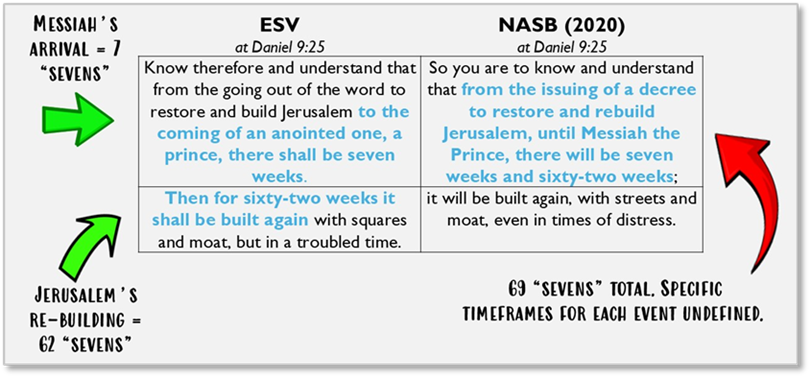
There are two big events in Daniel 9:25: (a) the decree “to restore and rebuild Jerusalem,” and (b) Messiah the prince’s arrival on the scene. Fair enough. But there is controversy about how to translate this passage. I mention this because your bible translation may differ from the NASB (2020) which I’m using in this article.

  • Option 1 suggests (a) Messiah’s arrival = seven “sevens,” and (b) Jerusalem’s re-building = 62 “sevens”—a total of 69 “sevens” (ESV; also RSV, NEB, REB, CEB, NRSV).
  • Option 2 says (a) Messiah’s arrival, and (b) the rebuilding of Jerusalem = 69 “sevens.” The specific timeframes of each are undefined (NASB; also NLT, NET, KJV, NIV, CSB).

You can see the difference in these two examples:

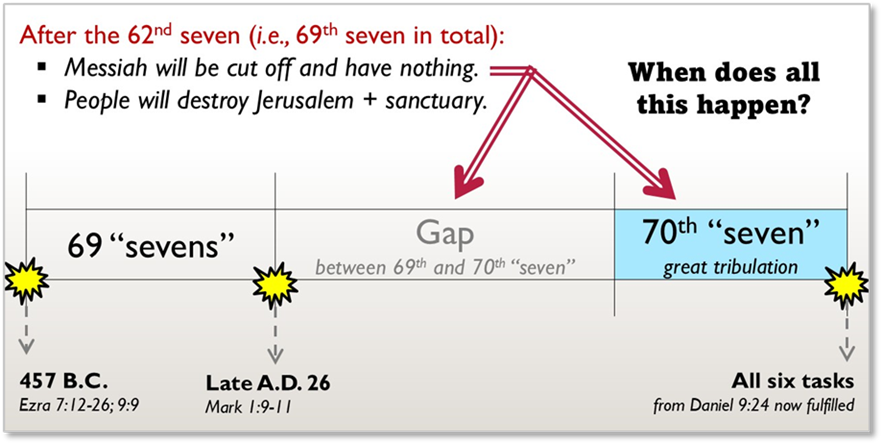
Figure 1. Translation differences at Daniel 9:25.

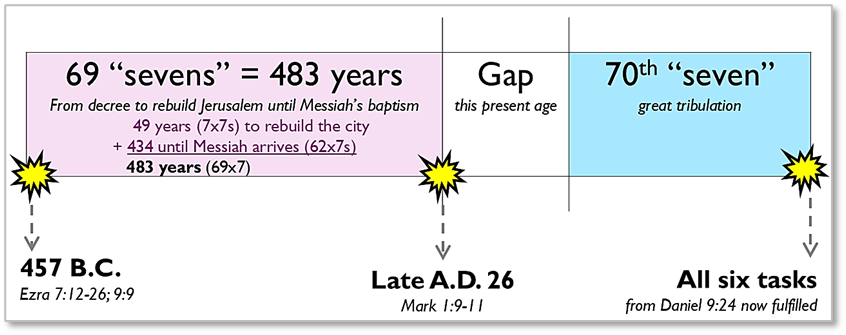
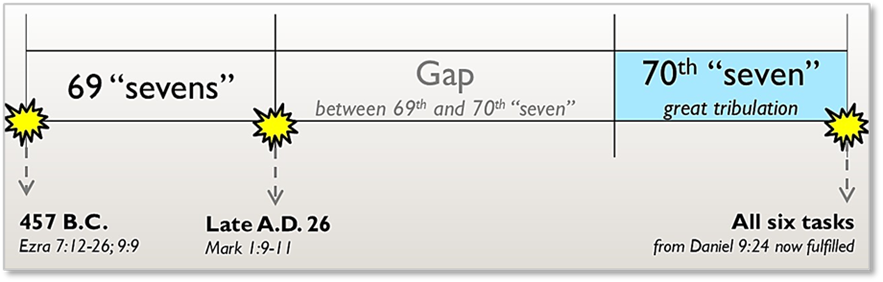
Many good Christians are on each side of this translation issue.[1] Regardless, it’s clear that by the end of the 69 “sevens” Messiah will have arrived on the scene, and Jerusalem will have been re-built. In Daniel’s day, Jerusalem lies in ruins (Lam 5:17-18). Although Daniel couldn’t have known this at the time, bible history tells us that first the exiles returned and rebuilt the city and its temple, and then Messiah arrived on the scene in the opening pages of the New Covenant scriptures. So, it’s best to understand these events as being keyed to the two time-periods, so the 69 “sevens” shake out like this:[2]

At the end of these 69 “sevens” (more on that in a minute), both these events will have happened.

Or have they?

Some otherwise solid bible teachers say that Jerusalem’s “rebuilding” is really about the “spiritual kingdom” of God advancing in the world.[3] This unlikely. There’s no good reason to dismiss the straightforward interpretation that Jerusalem means Jerusalem here—Daniel is talking about the actual city being truly rebuilt.

Of course, that’s exactly what happened. The city and its walls and its temple were rebuilt, “even in times of distress” (Dan 9:25)—just as Gabriel said it would be. Later, in Nehemiah 4:11, the bible tells us about these troublesome times as they tried to re-build the city in the years after Ezra led people back to Israel: “And our enemies said, ‘They will not know or see until we come among them, kill them, and put a stop to the work.’”

What are the “sevens”?

The word your bible may translate as “weeks” means “sevens” (שִׁבְעִ֜ים), which is a vague time marker that context must explain. Sometimes it means years (Dan 9:3). Sometimes it doesn’t. This “sevens” business is weird—why does God communicate to Daniel this way?

The simplest explanation is that God is riffing off the “70 years (שִׁבְעִ֜ים) of captivity before I bring you back to the promised land” thing which promoted Daniel to pray in the first place (see Dan 9:2; cp. Jer 25:11-12, 29:10). That is, God is basically saying:[4]

  • “Yes, Daniel, you’re right—70 “sevens” (שִׁבְעִ֜ים) will elapse before I start to bring y’all back to the promised land.”
  • “But, 70 other “sevens” (שִׁבְעִ֜ים) will elapse before I really, truly fix the root problem.”

And it’s the end of these 70 “sevens” that brings us to paradise in the better tomorrow (Rev 20:21-22).

So, what are the 70 “sevens” from our prophecy in Daniel 9:24-27? We should interpret the bible plainly unless there is reason not to do so. Again, the word your bible may translate as “weeks” means “sevens” (שִׁבְעִ֜ים), which is a vague time marker that context must explain. There are 70 “sevens” or “units of [something]” in this entire prophecy (Dan 9:24). Here are four common options:

  • 70 sets of days (70 days).
  • 70 sets of years (70 years).
  • 70 sets of seven years (490 years).
  • 70 symbolic numbers that have no literal sense of time.

How do we know how to understand these “sevens?”[5] The clearest measure is the 69 “sevens” that elapse from (a) the order to rebuild Jerusalem, until (b) the anointed one (“Messiah”) arrives. However long this time is, it equals 69 “sevens.” So, if we figure out this time-period, we can figure out what a “seven” is. You must first determine the date of one of these two events—the beginning point is the decree to restore and rebuild Jerusalem, and the end point is Messiah’s arrival.

  • Don’t start at the beginning! Many bible teachers (and students!) drown in dates and charts at this point because they try to first determine the date of the decree to rebuild Jerusalem. This is not a good place to start. There are at least four plausible options in the old covenant scriptures, and it all becomes very complicated.
  • So, if there is an easier option to figure this out, we ought to take it and run with it.
  • Fortunately, there is a better option. It’s simpler to begin with the end point (the arrival of Messiah, the prince/ruler) and then work backwards.
  • This date is easier—there is comparatively little debate among bible-believing interpreters about the date of Jesus’ arrival on the scene.

So, we will take the best date(s) for the beginning of Jesus’ ministry (i.e., his “arrival”)[6] and work the 69 “sevens” backwards from there, using each of the four possible “ways” to understand the “sevens” (above). Here is how we do it:[7]

  • I interpret Jesus’ arrival (“until Messiah the Prince”) as his baptism, when his ministry formally kicks off (Mk 1:9-13). If you try to use Christmas as his arrival, no calculation makes any sense at all. So, the baptism it is.
  • It’s very likely the Romans crucified Jesus in April of A.D. 30. Some say A.D. 33. I assume A.D. 30 in the calculations that follow.[8]
  • By counting the number of Sabbaths mentioned during Jesus’ ministry, we determine his ministry probably lasted about 3.5 years.[9]
  • This would put Jesus’ arrival on the scene (his baptism) as late A.D. 26 (i.e., April, A.D. 30 minus 3.5 years = October-ish, A.D. 26).
  • We can now count backward using the various “69 units of something” options to figure out the most likely solution.

There are 69 “units of something” from the decree to rebuild Jerusalem until A.D. 26, when the Messiah who is a prince/leader/ruler arrives.

  1. Option 1—A.D. 26 minus 69 units of days (69 days). This would put the decree to rebuild Jerusalem at 69 days before Jesus’ baptism at Mark 1:10-11. This option clearly doesn’t work. The city was rebuilt long before this point!
  • Option 2—A.D. 26 minus 69 units of years (69 years). This would put the decree to rebuild Jerusalem as happening in 43 B.C. This isn’t true—the returning exiles rebuilt Jerusalem by at least 445 B.C. (Neh 6:15)!
  • Option 3—A.D. 26 minus 69 units of seven years each (483 years). This would put the decree to rebuild Jerusalem as happening in 457 B.C (that is, A.D. 26 minus 483 years). This option fits well with Ezra’s commission to go to Jerusalem and establish God’s community in the city, now that the temple had been built—see Ezra 7:12-26; 9:9.

The Israelite’s return from the east to the promised land didn’t happen all at once. It came in fits and starts. The issues involving these dates are complicated. I’ll use generally accepted dates from conservative sources.[10]

  • Some folks, like Esther and her family, chose not to return to the promised land at all.
  • 538-ish B.C. Many Jews returned when Cyrus, the Persian ruler, gave them money, supplies, and allowed them to return and rebuild the temple in 538 B.C. (Ezra 1-6).[11] This is a tale also told in the books of Haggai and Zechariah.
  • 457 B.C. The next wave of exiles returned to the promised land under the leadership of Ezra, the priest (Ezra 7),[12] with the blessing of the Persian ruler, Artaxerxes I.
  • 445 B.C. About twelve years after Ezra and his party left for Jerusalem to the west, Nehemiah in Persia hears a report about how the city still lies in ruins and is yet to be fully repaired: “… the wall of Jerusalem is broken down and its gates have been burned with fire” (Neh 1:3). He seeks for and receives permission from the Persian ruler, still Artaxerxes I, to go (Neh 2:1-8).

Returning to our options for dating—the only reasonable solution, if we take each “seven” to be a unit of seven years each, is to see the beginning point of the timespan from Daniel 9:25 as Artaxerxes I’s decree for Ezra to head to Jerusalem in ≈ 457 B.C. It shakes out like this:

  • The end point (“until Messiah the prince,” Dan 9:25) is Jesus’ baptism in A.D. 26.
  • 69 “units of seven years each” = 483 years.

So …

Again, this fits well with Artaxerxes I’s decree for Ezra to head to Jerusalem in ≈ 457 B.C. Nevertheless, some good Christians disagree:

  • Some good bible scholars protest that, when the Persian king gave Ezra permission to go to Jerusalem sometime after the first wave of exiles had already returned (Ezra 7:12-26), the city was already in the process of being rebuilt.[13] They claim that the first wave of exiles who returned ≈ 538 B.C. already began this work.
  • After all, the foreigners in the land wrote to the Persian king before Ezra set out, complaining that “the Jews who came up from you have come to us at Jerusalem; they are rebuilding the rebellious and evil city and are finishing the walls and repairing the foundations” (Ezra 4:12).

What shall we do with this data?

  • First, the 457 B.C. date just works. It does. It works perfectly. So, if there is a reasonable solution that lets us keep the date, we should grab hold of it.
  • Second, it is true that Artaxerxes did not specifically tell Ezra to rebuild the city. But, he did send Ezra out to organize the returned exiles into a proper community and establish religious order. Ezra was apparently to be a sort of priest/governor: “And you, Ezra, according to the wisdom of your God which is in your hand, appoint magistrates and judges so that they may judge all the people who are in the province beyond the Euphrates River, that is, all those who know the laws of your God; and you may teach anyone who is ignorant of them” (Ezra 7:25). Ezra understood that his job included rebuilding the ruined city: “to give us reviving to erect the house of our God, to restore its ruins, and to give us a wall in Judah and Jerusalem” (Ezra 9:9).
  • Third, in the mid-440s B.C. when Nehemiah arrived on the scene, the city was still in ruins. “I was inspecting the walls of Jerusalem which were broken down and its gates which had been consumed by fire (Neh 2:13). He told his companions what he’d discovered: “Jerusalem is desolate and its gates have been burned by fire” (Neh 2:17). Working like madmen amidst fierce opposition, the city walls were only fully re-built in 445 B.C. (Neh 6:15; see also Neh 3-5).
  • Fourth, Ezra’s failure to finish rebuilding the city and its walls in the ≈ 12 years before Nehemiah pulled into town doesn’t nullify the Ezra option. It just means Ezra’s time was monopolized with other matters.[14]
  • Fifth, this all suggests the foreigners who wrote that letter to the Persian ruler were lying. The first wave of returned exiles rebuilt the temple in 515 B.C. (Ezra 6:15).[15] But the city was still a mess. A wasteland. Nehemiah tells us so. The folks who wrote that letter had their own reasons—they feared the Jewish people would establish themselves back in the promised land. So, they exaggerated the Jewish people’s progress and imputed sinister motives to them (Ezra 4:13-14) so the Persian king would order a halt to the whole thing. They succeeded (Ezra 4:17-24).

So, the decree to Ezra in ≈ 457 B.C. still makes good sense, which means each “seven” = a unit of seven years. Further, God advised the Israelites that the promised land, which they had defiled, must enjoy the sabbaths the people had ignored for 70 years (2 Chr 36:21). He also warned his people that he would repay them seven-fold for their sins (Lev 25:18, 21). This seems to be the springboard for Gabriel’s 70 “sevens” in our prophecy. The 70 “sevens” of punishment in captivity times 7x for their sins = 490 years = the 70 “sevens” at Daniel 9:24.[16]

All this indicates there is no need to consider the last option for understanding the “sevens”—the symbolic one. So, we have an incredibly detailed prophecy from Daniel 500-ish years before the events occurred—down to the very month of Jesus’ baptism. Gabriel clearly tells Daniel that, 483 years from a future decree to restore and re-build Jerusalem, the city will be rebuilt in times of trouble, and the Messiah will have arrived on the stage.

More details will come in Daniel 9:26, in the next article.


[1] For example, C.F. Keil and Franz Delitzsch spend a great deal of time defending the option that the ESV translation later represented (Commentary on the Old Testament, vol. 9 (reprint; Peabody: Hendrickson, 1996), 729). But, in the end, they agree that by the end of the 69 “sevens” Messiah will have arrived and Jerusalem will have been rebuilt. So, in a sense, the translation difference does not matter—the whole thing will take 69 “sevens.” But, it begins to matter when you try to sort the two events into order.

[2] “… the true reason of the 69 weeks being divided into seven, and 62, is on account of the particular and distinct events assigned to each period …” (Gill, Exposition of the Old Testament, 6:346).

[3] Leupold, Daniel, 424-25.

[4] Moses Stuart writes: “Daniel’s meditation had been upon the seventy simple years predicted by Jeremiah. The angel tells him that a new-seventy, i.e. seventy week-years or seven times seventy years, await his people, before their final deliverer will come” (Daniel, 266; emphases in original).

[5] A brief, reasonable defense of the “seven = one unit of seven years each” and the ≈ 457 B.C. date, which I propose here, is from Gleason Archer, “Daniel,” in Expository Bible Commentary, vol. 7, ed. Frank Gaebelein (Grand Rapids: Zondervan, 1985), 113-16.

[6] If we reckon Messiah’s “arrival” as Christmas morning, then no option but the symbolic one works for the “sevens.”  I do not discuss this “arrival = Messiah’s birth” option here, but you ought to know it is an option. Instead, I take Messiah’s arrival to be the start of his ministry—his baptism.

[7] There are two dating calculations computed by the best bible-believing scholars: (a) the A.D. 26 date for Jesus beginning his ministry at his baptism + the A.D. 30 date for his crucifixion (≈ 3.5 years of ministry), or (b) an A.D. 30 date for the beginning of his ministry + the A.D. 33 date for his crucifixion (also ≈ 3.5 years of ministry).I believe Option A is correct, largely based on this prophecy from Daniel and because the calculations are defensible.

These calculations are extraordinarily technical. See (a) Jack Finegan, Handbook of Biblical Chronology, revised ed. (Peabody: Hendrickson, 1992), §581, §583-4; §615-20, and (b) Harold Hoehner, Chronological Aspects of the Life of Christ (Grand Rapids: Zondervan, 1977), ch. 3, 5.

[8] Finegan, Biblical Chronology, §629 and references therein. Finegan opts for A.D. 33, but his analysis shows A.D. 30 is also quite probable.

[9] “Three years plus a number of months” (Finegan, Biblical Chronology, §628, §600-601).

[10] An excellent overview is Leon J. Wood, A Survey of Israel’s History, rev. David O’Brien (Grand Rapids: Zondervan, 1986), 333-41.

[11] This happened in “the first year of Cyrus king of Persia” (Ezra 1:1), which was 539 B.C. (Jason Silverman, s.v., “Cyrus II,” in The Lexham Bible Dictionary, ed. John D. Barry et al. (Bellingham: Lexham Press, 2016)).

[12] This occurred “in the seventh year of the king” of Persia, Artaxerxes I (Ezra 7:1, 8). This was about 457 B.C. (Walter A. Elwell and Barry J. Beitzel, “Artaxerxes,” in Baker Encyclopedia of the Bible (Grand Rapids: Baker, 1988), 207).

[13] Edward Young, The Prophecy of Daniel (Grand Rapids: Eerdmans, 1949), 202-3; Andrew Steinmann, Daniel (St. Louis: Concordia, 2008), 462, 470.

[14] Archer, “Daniel,” in EBC, 7:114.

[15] For the 515 B.C. date, “[n]ow this temple was completed on the third day of the month Adar; it was the sixth year of the reign of King Darius” (Ezra 6:15), see Paul L. Redditt, s.v., “Temple, Zerubbabel’s,” in Lexham Bible Dictionary).

[16] Joyce G. Baldwin, Daniel, vol. 23, in Tyndale Old Testament Commentaries (Downers Grove: InterVarsity Press, 1978), 187.

Understanding Daniel’s 70 “Weeks” Prophecy (pt. 1)

Understanding Daniel’s 70 “Weeks” Prophecy (pt. 1)

This is the first of three articles about the great prophecy in Daniel 9:24-27. This prophecy is very complicated and very important. One writer called it “the key to prophetic revelation.”[1] Many good Christians disagree about how to interpret it. This bible study will not exhaustively defend its interpretation at every point against all comers. Instead, it makes a positive case for its own position and seeks to be straightforward and understandable to ordinary people.

This bible study takes a literal, futurist view[2]—meaning (a) we should interpret the passage according to the natural, ordinary manner of language in proper context (e.g., poetry is poetry, narrative is narrative, figurative language is figurative, etc.), and (b) its fulfillment lies in the future—not the past.

Prayer answered (Daniel 9:1-23)

This prophecy happens because Daniel prays to God for help. This is a beautiful prayer. Christians should study it. But it isn’t our focus here, so we won’t stay here for long.

The Babylonians conquered the southern kingdom of Judah in 586 B.C., after a lengthy period of national and spiritual decline. The Babylonians took many Jewish people far away to the east (2 Kgs 25:11). Daniel was one of them. But that was a long time ago. He’s now an old man. He’s spent his best years as a civil servant in the Babylonian and Persian bureaucracies, trapped in an exile he doesn’t want. Daniel knows God swore that he would punish Israel for 70 years before he brings his people back to the promised land (Jer 25:11-12; 29:10). These 70 years have just about come and gone.

… I, Daniel, observed in the books the number of the years which was revealed as the word of the LORD to Jeremiah the prophet for the completion of the desolations of Jerusalem, namely, seventy years. So I gave my attention to the Lord God, to seek Him by prayer and pleading, with fasting, sackcloth, and ashes (Daniel 9:2-3).

The angel Gabriel arrives on the scene with God’s reply: “so pay attention to the message and gain understanding of the vision” (Dan 9:23). This bit is especially important—Gabriel is answering Daniel’s question about when God will bringIsrael back to the promised land. Daniel wants to know when God will make good on his “70 years promise.” He begs God: “for Your sake, Lord, let Your face shine on Your desolate sanctuary …” (Dan 9:17).

Well, Gabriel has come with God’s answer. This brings us to the famous prophecy. It summarizes the entire scope of living history–the sum of God’s plan to set everything right that’s wrong in this world.

The sum of the whole thing (Daniel 9:24)

Gabriel says:

Seventy weeks have been decreed for your people and your holy city, to finish the wrongdoing, to make an end of sin, to make atonement for guilt, to bring in everlasting righteousness, to seal up vision and prophecy, and to anoint the Most Holy Place (Daniel 9:24).

The most obvious question is about these seventy “weeks.” What does this mean?

It’s complicated.

We won’t get there until the next section—sorry! But, for now I’ll say that the word means “sevens,” which is a vague time indicator. Its meaning depends on what’s happening in the passage. Your bible may translate it as “weeks” to help you out, but that’s not necessarily the most helpful gloss.

Whatever these 70 “sevens” are—and we’ll figure that out soon enough—clearly God will accomplish a bunch of things by the time they’re fulfilled. There are three bad things that God will fix, and three good things that will happen. Gabriel says these events are directed towards “your people and your holy city” (Dan 9:24).

Sometimes, God speaks directly to certain people, while at the same time speaking also to other people far in the future—sometimes in a deeper and more meaningful way. We usually only see this in light of revelation that comes later in the bible’s story. For example:

  1. God told his rebellious people he would spare them from the poisonous serpents if they looked upon the image of a bronze serpent on a pole and truly believed this act would rescue them (Num 21:4-9). So far, so simple.
  2. But, in a deeper way, this command foreshadowed that God’s people will be spared from the poisonous serpent—“the serpent of old who is called the devil and Satan” (Rev 12:9)—if they “looked upon” Jesus on his cross and truly believed this would rescue them (Jn 3:14-15).

Some of that is going on here. Yes, Gabriel speaks of the Jewish people (“your people and your holy city,” Dan 9:24), but the true reference is bigger than that.[3] Anyone who trusts in Jesus as his savior is a child of Abraham and an heir according to that covenant promise (Gal 3:26-29). After all, considering the bible’s whole story, God’s holy city is called the “new Jerusalem” (Rev 21:2; cp. Rev 21:1-4).

First, Gabriel lists three bad things that God will fix by the end of these 70 “sevens.”

  1. God will “finish[4] the transgression.” Rebellion and transgression will end. The only time in history that rebellion against God will stop is in the new paradise to come—in the better tomorrow: “there will no longer be any curse” (Rev 22:3).
  2. He will “make an end of sin.” Again, the only time in human history when God’s people will never sin is the eternity in paradise, where “the first things have passed away” (Rev 21:4).
  3. There will be made an “atonement for guilt.” In the old covenant, God did provide a way for believers to receive atonement (see Lev 4:27-31). In Leviticus 4:31, the bible says: “So the priest shall make atonement for him, and he will be forgiven.” But Christ’s atonement is different and better. According to Hebrews 10:2, the old covenant sacrifices “can never, by the same sacrifices which they offer continually every year, make those who approach perfect.” This is why Christ is the better priest, who gives his people a better reconciliation: “For by one offering He has perfected for all time those who are sanctified” (Heb 10:14).

Next, Gabriel tells us three good things God will accomplish by the end of these 70 “sevens.”

  1. He will “bring in everlasting righteousness.” This is a righteousness that will never end. The only time when everlasting righteousness will be here on the earth is in the new tomorrow, in paradise (see Rev 22:1-4).
  2. God will “seal up vision and prophecy.” This most likely means there will no longer be any need for God to speak to his people by way of visions or prophecy, because he will reveal himself to us all personally—like he did with Adam and Eve in the garden of Eden (Gen 3:8). This is when “the tabernacle of God is among the people, and He will dwell among them, and they shall be His people, and God Himself will be among them …” (Rev 21:3). 
  3. He will “anoint the Most Holy Place.” This is the satisfaction Jesus makes to God because of our sins and crimes–the personal and legal reconciliation that sets us right with him.

There are two ways to understand what “anoint a most holy” means.

  • The phrase means “holy of holies” or “a very holy thing/place/person.”
  • We’re tempted to think “holy of holies = inner chamber of the temple,” but this is not necessarily correct. The phrase just means “a really, really holy thing.” The context must tell you what this “very holy thing” is in this passage—a person (Jesus Christ) or a place (the Millennial temple)?

Because the passage is about everything wrong in this world being finally fixed at the end of the age, Gabriel is likely referring to Jesus here[5]—God will anoint a most holy person as king at his resurrection and ascension (Acts 13:22-23; cp. Ps 2:6-7). Further, in light of the bible’s whole story, Jesus literally is the new and better temple.

  • In Matthew 12:6, Jesus said that, in himself, something greater than the temple was here.
  • The apostle John says in his vision of the new Jerusalem that he sees no temple, “for the Lord God the Almighty and the Lamb are its temple” (Rev 22:22).
  • The psalmist gives us a prophecy of a king God will enthrone over creation: “I have installed My King Upon Zion, My holy mountain” (Ps 2:6). The apostle Paul explains that this passage refers to Jesus at his resurrection and ascension back to heaven (read Acts 13:32-33).

But some faithful Christian interpreters believe these six events refer to the new covenant era—to the time after Jesus’ ascension when the new covenant has launched. They say this isn’t about the last things at all—it’s all in effect right now. They believe this “everlasting righteousness” is about the righteousness from God (Rom 1:17) which he now offers to everyone who believes in Jesus.[6] To “finish the wrongdoing” and “make an end of sin” refers to Christ’s atonement for his people, etc.[7]

This is probably not right—there is surely no everlasting righteousness in our hearts, in our minds, or in this world. This world is awash in sin and temptation—the apostle Paul calls it “this present evil age” (Gal 1:4). This suggests the six great events are not yet fully accomplished. Believers (and this world) await the experiential transformation to match the legal pardon we already have (Rom 8:18-25).

So, it seems better to interpret these six momentous events as fulfilled when Jesus returns here from heaven to establish his kingdom—the “second coming.” Together, they tell us that God will fix everything that’s wrong in this world. No more transgressions, no more sin, a perfect atonement that brings personal and legal reconciliation with God, everlasting righteousness on earth as it is in heaven, no more need for vision and prophecy because all God’s people will see him as he is, and Christ anointed and ruling as king over his creation.

That’s why this prophecy matters.

How does all this good stuff shake out? We turn to that in Daniel 9:25-27, in our next two articles.


[1] John Walvoord, Daniel: The Key to Prophetic Revelation (Chicago: Moody, 1971; reprint, 1989).

[2] A free, scholarly resource that sketches my viewpoint is from Stephen R. Miller, “Interpreting Daniel’s Seventy Weeks: Dismal Swamp or Blessed Hope?” Available here.

[3] “… for all the people of God; who also were Daniel’s people and city in a spiritual sense, to which he belonged” (John Gill, An Exposition of the Old Testament, vol. 6 (London: Mathews and Leigh, 1810), 343).

[4] A very few English translations and commentators believe the phrase should be translated “restraining the transgression” (ISV translation and Edward J. Young, The Prophecy of Daniel (Grand Rapids: Eerdmans, 1949), 198). But this is almost surely incorrect.

[5] One more strike against this “very holy thing” being the Millennial Temple is that Gabriel calls the temple “the holy place” (וְהַקֹּ֜דֶשׁ) at Dan 9:26, in contrast to the more generic phrase “a most holy thing” (קֹ֥דֶשׁ קָֽדָשִֽׁים) at Dan 9:24. H.C. Leupold is especially good here (Exposition of Daniel (Colombus: Wartburg: 1949; reprint; Grand Rapids: Baker, 1969), 416), as is Young (Daniel, 201). 

[6] “This righteousness, or the Messiah who accomplishes it, was the treasure above all treasures that was most eagerly longed for by the Old Testament saints” (Leupold, Daniel, 414).

[7]  Gill, Exposition of the Old Testament, 6:344.

Die, Dragon!

Die, Dragon!

The traditional Advent theme is that Jesus is on the way. Old covenant prophesies tell us so. Today, I offer something a bit different—a sketch of how Jesus defeats Satan.

The scripture paints this in a grand, epic style. It’s very unlike the dense legal analysis of Jonathan Edwards or Francis Turretin … or the Book of Romans. Instead of logical outlines, Revelation (and good bits of Zechariah and Daniel) tells us its story in a style beyond earthly reality. There are bizarre, otherworldly creatures, vivid pictures, symbolism, and fantastic imagery. There are women in baskets, huge flying scrolls, women with the wings of storks, a seven-headed dragon, a ten-horned beast who crawls out of the sea, a two-horned lamb who bursts out of the earth like a vengeful orc, a woman with a crown of stars, and another who is a dolled-up prostitute with pearls and jewels.

This is a world of fairy tale-like vibes that invites us to experience its message as a fantasy world. It paints in cosmic, sweeping strokes—it is often not about communicating detailed timelines—just contrast the styles of Revelation 12-13 with 2 Thessalonians 2! We know Frozen isn’t set in a “normal” world, even though it communicates real and true things, and so we instinctively re-calibrate our hearts and minds accordingly. We ought to do the same with Revelation—we can’t read it like a legal brief.

The bible paints Satan as an evil dragon who loses a series of battles in the war against God.

  • We meet a holy woman, pregnant, glowing in white, with a crown of 12 stars. She cries out, ready to give birth (Rev 12:1-2).
  • A dragon stands beside her, waiting to kill the child. He is blood red, with seven heads (Rev 12:3-4). We know this isn’t a good character. Dragons never are. Perhaps we ought to picture a hydra-like creature—if one head is chopped off, another will spring up. His evil is unkillable. We can almost see the dragon flexing his claws, snorting bursts of flame, purring madly. Waiting.
  • The child arrives but is caught up to God and his throne. This child will rule the world with a rod of iron. Of course, he is Jesus—the child born at Bethlehem on Christmas morning. The dragon has failed. The woman, who likely represents God’s covenant people from whom Jesus hails, flees to the wilderness (Rev 12:5-6).

Meanwhile, in heaven, now that the child has returned to his throne of glory (Rev 12:7-9; cp. Jn 17:5; Acts 2:22-36) the dragon and his minions are tossed down to earth—a forced eviction (cp. Lk 10:18).

  • This is like the scene from an old Western movie where the hero tosses the bully who has been terrorizing the town out of the saloon and into the dirt in the street outside. The bad guy scrambles to his feet, shakes his fist, and vows revenge. He then rides off to gather his crew and start trouble.
  • This is what happens to Satan once Jesus accomplishes his work here—he is cast down and will now flail about like a crazed, wounded beast (Rev 12:10-12). He is angry. He is furious.
  • But we know the bad man has already lost and John Wayne will surely win—just like Jesus.

Enraged, the dragon races after the holy woman to destroy her (Rev 12:13). God gives her eagles wings (Rev 12:14)—just as he did for his people in the Exodus (Ex 19:4)—and she flees to the wilderness. The dragon breathes out a tidal wave of water to drown her before she can reach safety (Rev 12:15) This is a demonic reversal of the Exodus escape—then the water was a wall of divine protection that allowed God’s people to escape death, here the water is a tsunami intended to kill.

But once again God foils the dragon’s plans. Having failed to strangle the new covenant people (whom the holy woman represents) in the cradle, the dragon storms away “to make war with the rest of her children, who keep the commandments of God and hold to the testimony of Jesus” (Rev 12:17). We are these children—in Jesus communities large and small. We come from this “woman,” who is God’s family—just as surely as the harlot of Revelation 17 represents Satan’s family.

This is the cosmic sketch of world history.

  • The dragon tries to destroy the Christ-child. He fails and is “kicked out” of the heavens above and cast down into the dirt. He is on borrowed time.
  • Enraged, he tries to kill the holy woman. He fails there, too. Once more, God carries his people on eagle’s wings away from the clutches of evil.
  • Now, more furious than ever, the hydra-dragon darts to and fro, trying to immolate the woman’s “children” with fire. Despite local successes, he cannot stamp them all out. Like a divine hydra, God’s new covenant family cannot be killed. There are too many of us.

John’s vision shifts to the dragon standing on the seashore, perhaps huffing and puffing, maybe melancholy. He has failed, but has he given up? Far from it. John shows us two frightening images of the last days, when “the great dragon … the serpent of old who is called the devil and Satan, who deceives the whole world” (Rev 12:9) rolls the dice one last time and goes all in on his wicked schemes.

  • The first horror is a seven-headed beast who crawls out of the sea, spewing blasphemy against God and his people. Mimicking Jesus, he appears to die and is revived. “And the whole earth was amazed and followed after the beast” (Rev 13:3). The dragon gives his power and authority to this ghoul, just as God the Father gives his power and authority to Jesus in the incarnation. This creature is the antichrist—Jesus’ “evil twin.”
  • The second creature bursts out of the earth as a two-horned lamb (Rev 13:11)—perhaps a deliberate mockery of Jesus, “the Lamb of God who takes away the sin of the world” (Jn 1:29). Like the Holy Spirit, he too performs miracles and points everyone to his Christ-like figure (Rev 13:12-14). The true good news, properly understood, is accepted by willing faith. The kingdom of darkness operates by terror and coercion: “he makes the earth and those who live on it worship the first beast …” (Rev 13:12).

But the apostle John does not leave us there. The wicked woman, the alluring false front for evil, will be no more (Rev 17). God destroys Babylon, the city of darkness, from on high with great violence (Rev 18). Jesus returns with the armies of heaven, clothed in a robe drenched in his own blood, to slay the two beasts and cast them into the lake of fire to burn forever (Rev 19). An angel casts Satan into prison and shuts him up for 1,000 years, then afterwards the great red dragon joins his creatures in hell (Rev 20:1-3, 7-10). Jesus reigns with his people, “married” to them in an eternal union that will never be broken again (Rev 19:7-10).

What does this have to do with Christmas? Well, this is how it all ends for the serpent from the garden.

  • Satan loses. His great creature (the antichrist), the false prophet, his evil city, and his wicked woman are gone forever—never to return. The kingdom of darkness is no more. The dragon is cast down and will burn forever.
  • God wins. His eternal Son (the real Christ) reigns forever, heaven is here on a new earth, and the “holy woman” is safe forever in covenant union with him. “There will no longer be any curse; and the throne of God and of the Lamb will be in [the city], and His bond-servants will serve Him” (Rev 22:3).

This is real prophetic history painted in fantasy hues. And it all kicks off with the Savior born in Bethlehem on Christmas morning. This is how it will all end. This is what the boy from Bethlehem will do. This is why Christmas is so beautiful. This is when the dragon’s doom is sealed—it’s the beginning of his end.

Long live the king.

Analogies to understand Christ’s atonement

Analogies to understand Christ’s atonement

In this article, I’ll discuss two common questions that Christians have about Christ’s atonement. By “atonement,” I mean the means by which Christ’s sacrificial death removes our guilt for wrongdoing and therefore reconciles us to God.

Atonement is a key tenet of the Christian story:

  • The prophet Isaiah spoke about a mysterious servant who would be pierced for our offenses, crushed for our wrongdoings, upon whom God would lay our punishment, by whose wounds we are healed. “[T]he Lord has laid on him the iniquity of us all” (Isa 53:7, RSV).
  • The blood sacrifice rituals of the old covenant provided atonement for the participants (Lev 4:20ff) as a living parable of Christ’s perfect sacrifice (Heb 9:9).
  • Mark, the gospel writer, says Jesus came to give his lie as a ransom for many (Mk 10:45).
  • The apostle Peter writes that Christ “suffered for sins once for all time, the just for the unjust, so that He might bring us to God …” (1 Pet 3:18).
  • John the baptizer declared that Jesus was “the Lamb of God who takes away the sin of the world!” (Jn 1:29).

Over and over, we see that somehow, someway, Jesus’ voluntary sacrificial death for his people brings about legal and personal reconciliation with God.

Christ, by his obedience and death, did fully discharge the debt of all those that are justified; and did, by the sacrifice of himself in the blood of his cross, undergoing in their stead the penalty due unto them, make a proper, real, and full satisfaction to God’s justice in their behalf (2LBCF, §11.3).

Fair enough. But here are the two questions:

  1. How, exactly, does God apply the benefits of Jesus’ death to a sinner’s account? The Christian story says it does, but can we logically explain this? How does it work?
  2. How is Jesus’ sacrificial, substitutionary death not a cruel measure? That is, how is it right or fair to punish an innocent man for crimes he did not commit?

I’ll answer these two questions with two analogies.

Question 1—How does atonement work?

The first analogy is that of a representative or delegate.

  • Your state has two U.S. Senators. These senators represent you in Washington D.C. They represent your interests, your concerns. They speak and vote on your behalf. You don’t have to go to Washington because your U.S. senators are there for you. Their actions (and votes) are imputed to you. They are you, in a sense.
  • Your state also has individuals who act as “electors” in each presidential election. We do not elect presidents by popular vote—they’re chosen by electors, who are representatives chosen by each state.

These are two common examples of “representatives” we accept in everyday life. It’s just the way it is. The application of Jesus’ atonement shouldn’t be a problem, then, because the Christian story has always worked through representatives:

  • Adam and Eve are our first parents. The apostle Paul spends much time explaining that they represent us (Rom 5:12ff, 1 Cor 15).
  • Abraham is the great patriarch from whom all true believers are descended.
  • Moses is the great representative of the old covenant—the one through whom God spoke and worked on behalf of the people.

Theologians often call this “federalism.” It means that God works through a representative whose actions set the course—good or bad—for his constituents. The two great representatives in the Christian story are Adam and Christ.

  • Adam is the bad representative. His failure to love and obey God brought sin and its penalty of death to everyone (Rom 5:12). We’re born belonging to him, by default, because God legally imputes Adam’s actions to his constituents. God does this because Adam represents us—he’s our delegate. This is bad news for us—unless we jump ship for a better deal with a better representative.
  • Jesus is that better representative. His success in loving in obeying God brings legal pardon and personal reconciliation for all who belong to him.

The apostle Paul says:

So then, as through one offense the result was condemnation to all mankind, so also through one act of righteousness the result was justification of life to all mankind. For as through the one man’s disobedience the many were made sinners, so also through the obedience of the One the many will be made righteous (Romans 5:18-19).

The question is: “How, exactly, does God apply the benefits of Jesus’ death to a sinner’s account?” The answer:

  • Because, like Adam, Jesus is a representative or delegate whose actions are reckoned or imputed to his constituents.
  • God reckons or imputes the benefits of Jesus’ perfect life and sacrificial death to everyone who trusts in him for spiritual rescue.
  • Those benefits are legal pardon and personal reconciliation with God.

If this seems too fantastic to believe, then I ask you to consider your U.S. senators—don’t you realize they act in the name of their constituents, and their actions are imputed to you? Think of your state’s electors in the 2024 presidential election—do you reject the votes they cast on behalf of your state when they chose the current president?

Jesus is the federal representative for everyone who trusts in him. That’s how and why God cheerfully applies the benefits of his eternal son’s sacrificial death to his people.

Question 2—Cruel and unusual?

The second analogy I’ll offer is that of vicarious liability.

  • Say your state’s Department of Transportation is fixing a highway. They close a lane. They set up cones and warning signs. But they don’t do a good job. A driver misses the signs, crashes into a work truck, and is horribly injured. He can sue the state for negligence and attempt to recoup monetary damages.
  • Suppose an inmate in a state prison needs urgent medical attention. He doesn’t get it. The prison doctors misdiagnosed his symptoms early on. He becomes terribly ill. By the time the prison doctors realize what’s wrong, it’s too late. The inmate dies of stomach cancer two months later. The inmate’s family can sue the state.

This makes sense, right? Nothing controversial here. Nothing outrageous. This is the principle of vicarious liability. The Department of Transportation guy is the one who messed up. The prison doctors are the ones who made the awful mistake. And yet—it is the state who is sued.

Why?

Because the state has voluntarily and willingly said: “If our guys mess up, you can hold us responsible.” It has taken on that responsibility. The state has chosen to bear the guilt of another. Of course, because the prison doctor is an agent of the state (i.e., a state employee), then in certain circumstances the state truly is responsible. But the principle of vicarious liability stands—one person is punished in place of another, as a substitute.

This is precisely what Jesus has done. He died, the just for the unjust, in order to bring us to God (1 Pet 3:18). The great difference, of course, is that we are not like the prison doctor—we aren’t agents of Jesus. He did not have to own us and our guilt, but he chose to do it anyway. “For God so loved the world, that He gave His only Son, so that everyone who believes in Him will not perish, but have eternal life” (Jn 3:16).

So, the question is: “How is Jesus’ sacrificial, substitutionary death not a cruel measure?” The answer is that:

  • Because Jesus willingly and voluntarily offers to bear the guilt of his people’s crimes,
  • God the Father makes his eternal son vicariously liable for our sins,
  • The just for the unjust, in our place, as our substitute, representative, or delegate,
  • And so, Jesus suffered and died to atone for our sins.

If this sounds absurd, then remember that the next time you read about somebody suing a government agency for negligence. I recently investigated an instance in which foster parents physically and sexually tortured a nine-year-old boy. There was one instance when the parents brandished garden shears and tried to castrate the child. Much later, after police intervened and removed him from that evil place, the boy sued the state for negligence because the state placed him in that home. Of course, the state didn’t torture the boy. But the state made the decision (in certain circumstances) to own the actions—good or bad—of the foster parents it licensed.

If you believe the boy can file suit against the state (and I suspect you do), then you also ought to believe that it’s fine for Jesus to be vicariously liable for our crimes. True, Jesus did nothing wrong (2 Cor 5:21). But that’s why vicarious liability is vicarious. It’s also why God is love (1 Jn 4:8).

Helpful?

Christians sometimes know something is good and true even if they can’t fully explain why. We know Christ died for us and his actions change our relationship with God. But the logical mechanics of how and why can be elusive. I hope these two analogies—that of a representative in the form of a U.S. senator or electoral college elector, and the legal concept of vicarious liability—help us understand Christ’s atonement a bit better.

J.I. Packer: Evangelism and the Sovereignty of God

J.I. Packer: Evangelism and the Sovereignty of God

In the Christian story there are some questions that will never go away. They shouldn’t go away. These questions are too important to ignore, and every generation asks them over again. One of these questions is how to reconcile God’s sovereignty and our personal responsibility for salvation.

Long ago, the British theologian J.I. Packer wrote a little book about that exact question. It’s a good book. It’s short. It’s understandable. It’s kind-hearted. It’s biblical. You should read it. Many thanks to the folks at The London Lyceum for allowing me to publish a review this very important book. If you have questions about this topic, Packer can help you out.

Read my review for more.

Understanding Justification by Faith

Understanding Justification by Faith

The heart of the Protestant Reformation is that God declares you to be righteous by faith alone, in Christ alone. If you don’t believe this, then you do not have the true good news. This doctrine is often called “justification by faith.” It’s a churchy phrase that has lost some of its punch—many Christians know it’s “good,” but perhaps they can’t explain what it means. This article will show how the apostle Paul explains this vital truth in Romans 3:19-31. It’s a very big deal. Maybe the biggest deal ever.

The problem

We can trace the “Christian” family through three broad streams:

  1. Eastern Orthodoxy. This stream hails from the traditional Christian lands in modern-day Greece, Turkey, Syria, etc. It largely went its own way after the Western Roman Empire crumbled to bits. We won’t be discussing this tradition here.
  2. Roman Catholicism. This branch developed as a recognizable institution in the remnants of the western Roman Empire beginning from the late 6th century.
  3. Protestants. This is the variegated stream which broke away from the corruption of the Roman Catholic church beginning in the early 16th century, first in modern-day Germany, then in Switzerland, and beyond. If you’re a Christian in the West (that is, you’re not a convictional Roman Catholic and do not belong to a cult), then you’re in the “Protestant” stream—whether you know it or not.

Many churches celebrate “Reformation Sunday” on the Lord’s Day closest to 31 October to commemorate Martin Luther’s challenge to debate a series of theses about reforming the corrupt Roman Catholic church.

The Roman Catholic church believes good and true things about the trinity, about sin, about salvation, about Jesus, the virgin birth, our Savior’s life and death, his resurrection, his ascension, his return, and the new heavens and new earth.

So, what’s the problem?

  • The problem is about the sufficiency of God’s grace by Jesus Christ.
  • How, exactly, do we become Christians?

The Roman church teaches the equation: “Jesus + good works = merits eternal life.” It teaches that “Jesus + good works = forgiveness, reconciliation, and divine pardon.” Rome’s catechism explains (Art. 2010):

Rome speaks of “initial grace” and “the beginning of conversion.” There is no before and after. There is no bright line in the sand. Salvation is a cooperative process, not a divine event. Moved by the Spirit and by love, we must do good works to “merit for ourselves” the grace needed for eternal life.

This is heresy. It is false. It is wrong.

The truth is that we must trust in Jesus alone for salvation. God declares us to be righteous on the basis of what Jesus has already done. Based on that declaration, God gives his people legal pardon and personal reconciliation. Rome may speak of grace, charity, and conversion, but it means something very different.

Like all false religions, Rome teaches a version of “resume-ism.”

If you don’t believe God exists, then you’re not interested in submitting your resume to God. But, if you do believe he exists, then resume-ism will send you to hell—because it’s wrong.

  • You can talk about Jesus all you want, but in the end it’s about you—what you do, what you bring to the table.
  • The true faith is about Jesus, what he did, how he rescues you, and how God pardons you and declares you to be righteous if you trust in what Christ did for you.

The apostle Paul is against resume-ism. It’s his obsession. As we parachute into our passage at Romans 3:19-31, we learn from the first portion of the chapter that everyone is a sinner, without exception.

  • We’re all in trouble. We’re guilty before the King of the universe.
  • God’s old covenant law tells us how his people ought to act.
  • But we don’t act like that all the time, or even most of the time.
  • Most of us don’t want to act like it either.

So, most people don’t belong to God, because they don’t do what he says, nor do they want to. Now, to our passage.

Righteousness from God

The old covenant law tells God’s people how to live and love him. How to be different, weird, and separate from the world until the Messiah comes. This law speaks to people who are under its authority, “so that every mouth may be silenced and the whole world held accountable to God” (Rom 3:19).

He’s saying the old covenant law silences all excuses and acts as an immovable divine witness to which we are all accountable.

How does this accountability work? Why does it silence us as it confronts us?

Because by means of works of the law (ἐξ ἔργων νόμου) nobody will be declared to be righteous, in God’s sight (Rom 3:20). The word your English bible renders here as “righteous” or “justified” is a legal idea that means moral uprightness. You can’t achieve that by doing the works of the old covenant law—because you’ll keep messing up.

How do we know this? Because the law tells us so, because “through the law we become conscious of our sin” (Rom 3:20).

  • The law brings knowledge of sin.
  • It tells us we’ll always fall short of the mark—somehow, some way.
  • No matter what.
  • 100% guaranteed.

This isn’t good, obviously. If God left it there, some people might think he were cruel. But God is not toying with us. The law isn’t about salvation at all. It isn’t there to make us gnaw our fingernails and fear damnation. That’s just resume-ism talking.

  • Law-keeping does not earn us salvation. It never did.
  • Instead, the old covenant law tells us how to live while we wait for our Rescuer—King Jesus.
  • But this “resume-ism” idea had so infected and twisted the popular Jewish understanding of salvation by Paul’s day (and Jesus,’ too) that in many circles it had become the default gateway to a relationship with God.
  • Trust in the coming Messiah. Do law-keeping really well. Repeat (see Lk 18:9-14).

But, the apostle Paul says, that’s all wrong. It’s always been wrong. Now, separate from the old covenant law (χωρὶς νόμου), righteousness from God has now been made known—testified to by the law and the prophets (Rom 3:21). Resume-ism has nothing to do with the righteousness from God that’s on the table.

If this righteousness from God—the kind that can never come by means of works of the law—is testified to by the law and the prophets … is it a new thing?

Of course not. This isn’t new. It’s simply the re-presentation of something very old. Rome would do well to listen to Paul. If so, it wouldn’t speak of “meriting for ourselves” the grace needed for eternal life.

  • Well, how do you get this righteousness that God is offering? “This righteousness is given through faith in Jesus Christ …” (Rom 3:22). We trust in his faithfulness—that he has been perfect for us, as our delegate and representative.
  • Who can have it? Who is eligible? “… to all who believe” (Rom 3:22).
  • Why is this righteousness open to anyone? “Because there is no distinction [between people]—everyone sins and therefore lacks God’s glory” (Rom 3:22-23, my trans.).

The phrase often translated as “fallen short of the glory of God” means to be deficient—to be missing or lacking something. Without Jesus, we are each missing the righteousness and holiness and love for God he made us to have. Instead, we sin, so we’re broken, and so we “fall short of” (i.e., lack) God’s glory.

So, how does this righteousness from God happen? Why is it by faith alone and not works?

  • Because God declares us to be righteous as a gift, or freely, or gratis (Rom 3:24). This declaration is “on the house.” This means there is no “merit” we bring to the table. Rome is wrong. Dead wrong.
  • God issues this declaration to his people by means of his grace, through the liberation (“redemption”) that comes from Christ Jesus (Rom 3:24).

How so?

Well, “God displayed him publicly as the instrument of forgiveness by his shedding of blood, to be received by special faith. God did this to prove his justice because, due to his long-suffering patience, he had let the sins of the past go unpunished” (Rom 3:25, my trans.).

Jesus is the propitiation or sacrifice of atonement or instrument of forgiveness. How so? By means of his death (ἐν τῷ αὐτοῦ αἵματι).

  • This is a Federal, representative concept (see Rom 5:12f).
  • Like Adam, Jesus is the vicarious representative who acts on behalf of his people. Jesus lives the perfect life we cannot. He dies the criminal death we deserve. He defeats Satan and the curse of death on our behalf. He does this as our Federal representative.
  • Jesus takes our sins upon himself in the same manner as an employer that is legally, vicariously responsible for the actions of its employees.
  • The difference is, of course, that Jesus does this willingly and lovingly.

How do we receive this righteousness from God that Jesus achieves? By faith (Rom 3:24). Not by works. In fact, Jesus has retroactively paid for all the sins he had forgiven on credit from the old covenant days gone by (Rom 3:25).

God has done this as a demonstration or proof of his righteousness—his justice (Rom 3:26). I recently investigated a case in which adoptive parents sexually and physically tortured their adoptive children for years. It would have been evil if the state had opted to “forgive and forget” this. We instinctively know that. Crime demands punishment. Justice must be done. It’s the same with God, and so Jesus’ life—his death as our vicarious representative—is what satisfies the justice required. That’s why Jesus’ life and death demonstrates or proves that God is just.

And whom does God justify? Who does God declare to be righteous? The one with the best resume? The one who does more than the guy next to him? The one who does the most good works? No—it is “those who have faith in Jesus” (Rom 3:26).

The inevitable result of resume-ism is pride and self-satisfaction. But, because we now know that righteousness is a gift from God separate from works, we know that all boasting is excluded. It is shut out by the law of faith (Rom 3:27). It has nothing to do with being a Christian. “For we maintain that a person is justified by faith apart from the works of the law” (Rom 3:28). This is open to any person. Jew. Gentile. Azeri. Afghani. Japanese. God will declare anyone to be righteousness who trusts in Christ for salvation (Rom 3:29-30; cp. Gal 3:28-29).

This whole thing (righteousness from God by faith alone, in Christ alone—nothing to do with resume-ism) is not new. The new covenant does not rip up and invalidate the old covenant law. Instead, the apostle Paul declares, it upholds it (Rom 3:31) because Jesus teaches us that the law is about how to live as believers, not how to become a believer.

Why being a Protestant matters

It matters because this is about how you become a Christian. Is Jesus’ grace enough to (a) give us permanent, legal pardon, and (b) permanently heal our broken relationship with God? Or do we need to stir in some resume-ism, too? The apostle Paul says that, because we have been justified by faith, we have peace with God through our Lord Jesus Christ (Rom 5:1).

We’re justified by God because we have faith … in what?

  • That Jesus died for you.
  • That he did it as your vicarious representative, in your place.
  • That resume-ism won’t get you there.
  • That it can’t get you there.

And so, the equation “Jesus + something else = salvation” is wrong. It will send you to hell, because it can’t get you this righteousness from God (Gal 2:21).

  • That means you’re still in trouble, no matter what label you put on yourself.
  • It means you don’t have peace with God through our Lord Jesus Christ, because you haven’t yet trusted in him alone for salvation.
  • You’re still trying to upload your resume to the website.

But God does not want your resume. He wants you to only trust in what his eternal Son has already done for you. He declares you to be righteousness by means of faith and trust in his Son—nothing else. That is the core issue of the Protestant Reformation, and of the true Christian faith.

Review of my Galatians commentary

Review of my Galatians commentary

I wish to thank Dr. Joel Grassi for a very kind and generous review he just published on my book Faith Working Through Love: The Message of Galatians. He writes: “I am happy to recommend it as an addition to pastors for their libraries and churches for their classroom study.”

Some highlights:

I was also very interested to read a commentary written by a man who serves as a “bi-vocational pastor.” Many use this label when in reality they are one of several on a staff of pastors, and their “day job” is teaching in Christian education or something like that. But M.T. Robbins is truly a “bi-vocational pastor,” serving as the senior pastor of Sleater Kenney Road Baptist Church in Olympia, Washington, as well as working full time as a claims investigator for the state government. We are impressed and thankful for his efforts, and can appreciate how difficult, exhausting, and often thankless this particular vein of “tent-making ministry” is.

And this…

Robbins’ work is a down to earth, practical, and straight shooting overview of the message of Galatians. He seems to have labored to express himself clearly and forthrightly, and to try to break down big concepts into understandable sentences and paragraphs, including charts and graphics spread out over 13 chapters.

And finally this:

… we are very happy to recommend this book to those who are studying the book of Galatians either in their personal Bible study or in the setting of the local body of Christ, which is the pillar and ground of the truth, the NT immersionist assembly. We trust that it will help further the Gospel of Christ, which is of grace and unto liberty, and not under the Law to bondage.

I spoke a bit about my book on Galatians here, and you can find more info here. Suffice it to say that it is only 184 pages, it is short, it is written in a normal and conversational style, it has lots of charts and pictures, I pray that it can help you understand what Paul is saying in Galatians. It’s a really important letter in the New Testament! Consider grabbing a copy, and let me know what you think. If you feel I got something wrong (because I surely have), then let me know that, too! You can find more content from Dr. Grassi (who reviewed my book) here.

Identifying and Avoiding False Teachers

Identifying and Avoiding False Teachers

False teachers are a big deal in the bible. Here, I’ll answer three important questions about them that ought to help every Christian be on guard against their tricksy ways.

Q1: What is a false teacher?

The apostle Peter has a lot to say about false teachers. So does Jude. It’s possible that Jude had Peter’s second letter and borrowed a lot of his material for his own letter. If you read them, they sound similar! What, exactly, are false teachers? What makes them “false”? Both authors sum it up very simply:

  • Peter says they “secretly introduce destructive heresies, even denying the Master who bought them …” (2 Pet 2:1).
  • Jude tells us these bad actors are “ungodly persons who turn the grace of our God into indecent behavior and deny our only Master and Lord, Jesus Christ” (Jude 4).

There you have it. A false teacher is someone who denies, disowns, repudiates, or refuses to believe the truth about Jesus. You could say that every heresy, every false teaching, every lie about the gospel always begins by denying something about who Jesus is and what he’s done for his people. People create fake Jesus in their own image. 

  • People say Jesus never really died.
  • That he is not God.
  • That he is not eternal.
  • That he is not co-equal with the Father.
  • That he was not conceived by a miracle of the Holy Spirit in Mary’s womb.
  • That he was not sinless.
  • That he did not die in our place, as our substitute.
  • That his death was not a ransom.
  • That his perfect life and willing sacrifice did not satisfy divine justice.

These lies (and others) keep coming back. Every Easter, a major newspaper trots out an article by some liberal scholar who claims to reveal “the truth” about Jesus. False teachers are alive and well. Peter said they would be: “false prophets also appeared among the [old covenant] people, just as there will also be false teachers among you” (2 Pet 2:1).

Q2: How do we know who Jesus is and what he has done?

If a false teacher is someone who denies some key truth about who Jesus is and what he has done, then what tools has God given us so that we can find out these truths? Very simple—by his message, recorded in the bible, and by the Holy Spirit. 

Peter tells us about that, too. He wants us to know, with sure conviction, that we can trust the account he’s given us. He and the other disciples didn’t follow clever fables when they told everyone about Jesus—they literally saw him in his majestic splendor (2 Pet 1:16)! They saw what happened to him on that mountain, when he transformed before them into a figure of blazing white, radiant with pure holiness and heavenly light. Peter heard the Father speak words of affirmation about his eternal Son from the heavenly cloud of glory that surrounded them on that mountaintop (2 Pet 1:17-18).

So, he reminds us, the prophecies from the old covenant have now been made surer and more certain. Events have confirmed them. These prophesies and promises are like a lamp shining in a dark place, guiding us until that day when Jesus returns to be the literal light of the world (2 Pet 1:19). So, know this first of all, Peter says: these prophesies weren’t private intuitions or ramblings people made up—they were messages given by men as they were moved by the Holy Spirit to speak (2 Pet 1:20-21)!

The scripture is the record of God’s message to us, and that message is all about Jesus. The Holy Spirit is the who confirms and interprets the scripture for us—every Christian should read John Calvin’s short explanation of this (see Book 1, ch. 7, from Calvin’s Institutes of the Christian Religion). So, to know the truth about Jesus, we must read about his message in the holy scriptures and trust the Spirit of God to help us understand it all.

Q3: How can I be sure I’m interpreting the scriptures about Jesus the right way? 

This immediately raises another important question—how do I know that I (and my church) are putting the puzzle pieces together correctly? How do we know we’re believing the right things about Jesus? How do I know I’m interpreting the scriptures the proper way? 

Here is where we must deliberately leave our American individualism behind, and make sure we’re on the same page as the untold millions of our Christian brothers and sisters who have gone before us. Jesus tells us that true believers will hear his voice and follow him (Jn 10:1-4). This means that Christians down the centuries have heard the message of the true Jesus, have followed him, and have written down Spirit-led facts and summaries about what the bible says about the true Jesus. 

We find this broad consensus about Christian doctrine in the great creeds and confessions of the early church. This doesn’t mean these documents stand atop holy scripture like an infallible filter. One Baptist scholar memorably said we ought to believe in suprema scriptura, which means the bible is the highest or supreme channel of religious authority.1 This is good—we believe that “the Holy Scripture is the only sufficient, certain, and infallible rule of all saving knowledge, faith, and obedience …” (2LBCF, 1.1). So, creeds and confessions aren’t filters that interpret the bible for us—but they are guardrails that give us assurance that we haven’t run off the road and into a ditch. 

I’m thinking especially of these documents:

  • The Nicene Creed of 325 A.D. and the Nicene-Constantinople Creed of 381 A.D. These clarified Jesus’ deity and his relationship to the Father. Is Jesus a created being? Is Jesus an angel? If Jesus is God’s “son,” then does this mean he came on the scene later than the Father? If Jesus is God, and the Father is God—are Father and Son one being/substance or two?
  • The Chalcedonian Creed of 451 A.D. What does it mean that Jesus is both divine and human? Did he stop being divine? Or was he not really a fully human person? What happened to him in the incarnation?

From there, see especially the major creedal documents that give shape to your Christian tradition. Assuming you’re a Protestant Christian, the buffet line goes a bit like this: 

  • Lutherans have the Book of Concord, which consists of the Augsburg Confession, Luther’s small and large catechisms, and some other documents.
  • Presbyterians have the Westminster Standards, which include the Westminster Confession of Faith, and the Westminster larger and smaller catechisms.
  • The Reformed have the Three Forms of Unity, which are the Belgic Confession, the Heidelberg catechism, and the Canons of Dort.
  • Baptists are cantankerous in this regard, so I’ll just select one strand of the Baptist tradition and suggest the Second London Baptist Confession (“2LBCF”) and the Orthodox Catechism.2

I don’t care which flavor of Christian you are—go to your tradition’s confession of faith and read what it says about Jesus. No matter which tradition you consult from my list, they all say the same thing about Jesus—the same truths, the same affirmations, the same Jesus. Read the 2LBCF’s explanation here—it’s not long!

Why do creeds and confessions matter? Why are they good guardrails?

Because we don’t need to reinvent the wheel every generation. God gave the same Holy Spirit to our brothers and sisters in 325 A.D. as he does today. He led them into all truth, too. They believed the gospel, read the scriptures, learned from their church leaders and from one another, and had power on high from the Spirit of God. They wrote down summary statements of the faith. We have what they wrote. We would be fools to toss all that aside and start fresh with a blank sheet of paper. 

This means that, if you and your church believe something about Jesus that no credible group has ever believed in the history of the church … then you’re probably wrong. We can consult a record of sorts because we have those creeds and confessions from centuries gone by that tell us what our brothers and sisters in Christ thought about who Jesus is and what he’s done.

How do we avoid false teachers?

They’re tricksy. They don’t wear orange jumpsuits. They preach false things about who Jesus is and what he’s done—they deny the real Jesus. So, we must read the scripture and trust the Holy Spirit to guide us. We make sure we’re on the right track by joining a local church which swims in the broad stream of Christianity that has existed from the beginning—one that doesn’t naively try to re-invent the wheel but appreciates the guardrails of the tradition of which it is a part.

Peter said to: “remember the words spoken beforehand by the holy prophets and the commandment of the Lord and Savior spoken by your apostles” (2 Pet 3:2). We give ourselves assurance that we’re interpreting the prophecies and our Savior’s words the right way if we make sure we’re not contradicting what our brothers and sisters have said for centuries!

Read your tradition’s governing documents. See what they say about Jesus—again, read the 2LBCF’s summary about him here. If your church proclaims no tradition beyond its own statement of faith or that of a niche movement with no meaningful roots in the broad Christian tradition, then you are likely at greater risk of bring tricked by false teachers.


[1] James L. Garrett, Systematic Theology: Biblical, Historical, and Evangelical, Fourth Edition, vol. 1 (Eugene: Wipf & Stock, 2014), 206.

[2] If you want to read a good, short, and learned explanation of the Baptist tradition, see Matthew Y. Emerson and R. Lucas Stamps, The Baptist Vision: Faith and Practice for a Believer’s Church (Nashville: B&H Academic, 2025). 

Loving Your Enemies

Loving Your Enemies

Matthew 5:43-48 is one of the hardest passages in the bible. People usually know two things about Jesus—that he said not to judge, and that he loved people! This is the “he loved people” bit.

The Passage

First, we have Jesus’ statement about a common idea floating around in culture at the time: “You have heard that it was said, ‘YOU SHALL LOVE YOUR NEIGHBOR and hate your enemy’” (Mt 5:43).

This is kinda right and kinda wrong. Yes, the bible does speak of loving your neighbor (Lev 19:17-18). And yes—if you squint just the right way you can twist it to support hating your enemies, too. The Psalms have some hard sayings like this: “Do I not hate those who hate You, O LORD? And do I not loathe those who rise up against You? I hate them with the utmost hatred; They have become my enemies” (Ps 139:21-22).

There is a right way and a wrong way to understand these harsh psalms—but more on that later. For now, it’s enough to know that God has never wanted us to hate and loathe our enemies. But this is where popular piety was in Jesus’ day = love your neighbor, and feel free to hate your enemies if necessary.

This is wrong. Throughout the Sermon on the Mount, Jesus has combatted a lawyerly way of reading the bible. This is an approach that always wants to minimize personal responsibility and find loopholes that make compliance easier. It’s a rules-based approach to a relationship with God. It’s the same thing the lawyer tried to pull with Jesus that prompted the parable of the Good Samaritan.

As he does throughout this sermon, Jesus continues his “you have heard … but I say to you” pattern. How does he correct this misreading of scripture? He says: “But I say to you, love your enemies and pray for those who persecute you …” (Mt 5:44).

This means what it says. There is no hidden meaning in the original Greek that can give you something easier to swallow. We’ll come back to this in a bit. For now, let’s think about why Jesus gives this command. What’s the purpose of this almost impossible task? Jesus tells us: “so that you may be sons of your Father who is in heaven …” (Mt 5:45a).

What is Jesus saying?

He’s saying that if you don’t love your enemies, you’re not one of God’s children. If you don’t pray for your enemies, you’re also not one of his children.

Why does Jesus say this? “… for He causes His sun to rise on the evil and the good, and sends rain on the righteous and the unrighteous” (Mt 5:45b). Jesus is saying that God has a common love (or common grace) for everyone—not just his adopted children. So, if we claim to be Christians, we must be the same way. We must have an authentic, baseline love for everyone, not just our covenant brothers and sisters in the faith.

Why is this important?

Jesus explains: “For if you love those who love you, what reward do you have? Even the tax collectors, do they not do the same? And if you greet only your brothers and sisters, what more are you doing than others? Even the Gentiles, do they not do the same?” (Mt 5:46-47).

Being kind and loving to people who already like you doesn’t make you a Christian. There are plenty of non-Christians who do that all the time. Nice people. Kind people. Caring people. That isn’t counter-cultural. It isn’t revolutionary. So Jesus says this isn’t enough. Being a Jesus person means more than that. A lot more.

But this is the cultural attitude Jesus is up against. When a lawyer asked Jesus what he must do to gain eternal life, Jesus recited the two commandments which summed up a believer’s whole duty—love for God and your neighbor. The lawyer agreed, then immediately tried to minimize the command to make his target smaller: “But wishing to justify himself, he said to Jesus, ‘And who is my neighbor?’” (Lk 10:29).

Jesus corrected this legalistic, lawyerly way of understanding scripture with his famous parable of the Good Samaritan. He said that your “neighbor” was anyone who was in distress—not just your covenant brother and sister.

So, Jesus sums it all up: “Therefore you shall be perfect, as your heavenly Father is perfect” (Mt 5:48). He doesn’t mean “perfect” in the sense of “without fault” (e.g., “a flawless diamond”). Nobody is without fault! Instead, Jesus means “perfect” in the sense of “meeting the highest standard” (e.g., “my birthday was just perfect!”). The standard at issue here is this baseline, common love for everyone. One British translation does a good job by translating Matthew 5:48 like this: “Therefore, just as your heavenly Father is complete in showing love to everyone, so also you must be complete” (NEB).

Does Jesus contradict scripture?

There are several Psalms that show us raw, honest, unfiltered emotion. They ask why. They ask if God cares. They demand justice for evil. They complain about harm, injury, and heartache. They’re “real.” Read Psalm 109 and see for yourself. This all seems to contradict what Jesus says in our passage. Has something changed?

The best answer is that psalms like these teach us that we can be honest and open with God when we’re hurting. We don’t have to pretend we understand. We don’t need to pretend we accept everything without question. We can ask. We can plead. We can beg for justice. We can want evildoers to be punished. These psalmists almost never beg for the opportunity for personal retribution. Instead, they ask God for justice (see Rev 6:10).

There is a very small, but important, difference between (a) praying for God’s vengeance upon your enemies, and (b) hating them. Jesus is saying we must do more than just pray for justice. We must love our enemies, too.

What does it look like to love and pray for your enemies?

Here is where we need to set aside easy and cheap answers.

  • Some people say to love your enemies means giving them the gospel. Yes, but that’s a very safe answer. It’s Christianese. We can do better than that.
  • Others say that Jesus is really talking about “enemies” who persecute the church, so we ought to pray for our brothers and sisters who die for their faith around the world. Yes, but that’s too abstract and easy. It’s a cheap answer that doesn’t ask anything from you because you don’t know the people half a world away. This is correct, but it’s not good enough.
  • Still other Christians opt for half-measures and try to be kind to everyone, but that’s perhaps the cheapest cop-out of them all. Love is not kindness or a “bless your heart” facade. Jesus is demanding a whole lot more.

“Love” means a deep affection. It’s much, much more than being polite to someone. Jesus is speaking about our attitudes. He tells us to care about and have deep affection for the people who hurt us, who do us wrong. We only wrestle with what Jesus is saying when we apply his words here to the people in our life who are hurting us. Anything else is an evasion.

Jesus says to love and pray for the people who hurt you. As he was crucified, the bible tells us: “Jesus was saying, ‘Father, forgive them; for they do not know what they are doing’” (Lk 23:34). As Stephen was being stoned to death he called out: “Lord, do not hold this sin against them” (Acts 7:60).

Set aside the cheap and easy examples. This isn’t about praying for the person who cuts you off in traffic. This is about the people who actually hurt you, harm you, and are cruel to you.

  • We can each think of these people.
  • We can hold them in our mind’s eye.
  • We can see them right now.
  • We remember what they did.
  • What they’re still doing.
  • How they hurt us.
  • How they betrayed us.
  • The ramifications of it all.

We remember it, and a sour scowl comes on our face. We shake our heads to banish them from our thoughts. Jesus says these are the people we must love and pray for.

Will we pray for them? Not a gloating sort of prayer (“Lord, I pray for Steve because he’s a no-good son of a you-know-what who needs judgment!”), but a prayer for the person’s salvation and well-bring. For us to not hate. For us to be willing to forgive.

Why does Jesus want us to do this?

So he can change you from the inside out. So people know we’re different. We sometimes forget why we’re here and disconnect Jesus’ commands from the larger picture.

  • The Christian story is about God rescuing a family, through King Jesus, to love him and be with him forever. This is the sum of Genesis 1 to Revelation 22.
  • Our job is to be a living part of a local church, which is sort of a forward operating base in hostile territory from which we sally forth to convince outsiders to join the Jesus family.
  • The Sermon on the Mount is Jesus telling us how to be countercultural—what it means to be Jesus people.

If there is no Jesus counterculture, then there is no Jesus culture at all. If that’s true, then what are we calling people to join?

  • Are we here to push truth, justice, and the American way? You don’t need the church for that. Just see the new Superman movie.
  • Is it our primary job to love immigrants, help poor people, and foster so-called “inclusion” in society? You don’t need the church for that—just go join an advocacy group.
  • Do you want to make a difference in your community? Run for city council.

It isn’t the church’s main job to do any of these things. It is the church’s job to call people to defect from Babylon and join the Jesus family, and that means being part of a Jesus counterculture which trumpets and lives out Jesus values, Jesus attitudes, and Jesus’ message.

If we claim to be Christians, then we must commit to the Jesus counterculture so his message of love and forgiveness has some teeth to it! One of the soldiers for whom Jesus prayed believed in him just after Jesus died! “When the centurion, who was standing right in front of Him, saw the way He breathed His last, he said, ‘Truly this man was the Son of God!’” (Mk 15:39).

The attitude behind everything Jesus says is in our passage: “love your enemies and pray for those who persecute you” (Mt 5:44). If we claim to be God’s children, we must try to make this our attitude, too. It isn’t easy or pleasant. But it is our duty to try.