The modern city of Alasehir, where the ancient church at Philadelphia was located
This is my own translation of Revelation 3:8-12 from the Textus Receptus, plus a few changes from the UBS-5 text:
8I know your deeds. (Pay attention! I have put an opened door in front of you, and no one ever has [the] power to shut it.) I know you have a little strength, and yet you have obeyed my message and have not disowned my name.
9Pay attention! I will make those from the congregation of Satan who say they are Jews (yet they are not; rather, they are lying) . . . Pay attention! I will compel them, so that they will come and pay homage at your feet and realize that I have always loved you.
10Because you have obeyed my message about perseverance, I, in turn, will keep you from the time of the temptation which is about to come upon the whole inhabited world to put to the test those who are dwelling on the earth.
11I am going to come soon! You must keep on holding fast [to] what you have, so that no one will take your crown. 12The one who will be victorious, I will make him a pillar in the temple of my God and he will never go out again, and I will write on him the name of my God, and the name of my God’s city (that is, the New Jerusalem, which will come down from the heaven, from my God), and my new name.
My Pastor will be covering this text in his sermon this coming Sunday, so I thought I’d translate it myself for a bit of fun. My detailed translation is available here.
The NASB is famous for being very formal in it’s translation. The preface stated, “[w]hen it was felt that the word-for-word literalness was unacceptable to the modern eader, a change was made in the direction of a more current English idiom,” (iii). You can count in this translation to not be interpretive when it redners Koine Greek into English
Tyndale, KJV, ESV and the LEB are not quite as formal as the NASB, but they each stick very close to the original language. Tyndale was a linguistic genius who produced the first complete New Testament translation in English directly from Koine Greek in 1526 (revised for the last time in 1534). The KJV essentially followed Tyndale in many places. The ESV is a very popular, excellent new translation. The LEB, from Logos Bible Software, began it’s life as an interlinear.
The ISV and the NET are a bit more interpretive. The ISV’s New Testament was edited by David A. Black, a well-known teacher and author of several books on Koine Greek. The NET was produced largely by a team of scholars centered around Dallas Theological Seminary. Neither of these translations are particularly “well known,” but they’re excellent. I would put their translation philosophy in the same class as the NIV.
As far as Greek text goes, Tyndale and KJV used what would become known as the Textus Receptus. The ESV, NET, NASB and ISV used the current version of the United Bible Society critical text (UBS-4 for each, I believe). The LEB used the Society of Biblical Literature (SBL) Greek New Testament.
God Made You . . . What!?
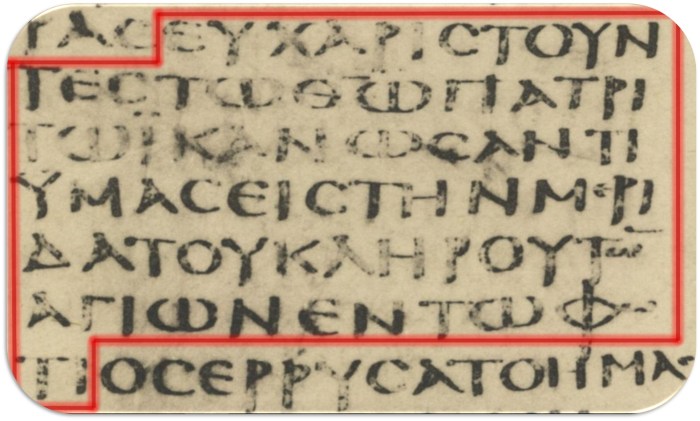
The first issue I want to focus on is the words I translated as “made you acceptable,” (ἱκανώσαντι ὑμᾶς). What does it mean? The standard Koine Greek lexicon defines the word, in this context, as, “to cause to be adequate,” (BDAG, s.v. “3692 ἱκανόω”). Different English translations take this different ways:
“Acceptable” (Me, KJV, Tyndale)
“Qualified” (NASB, LEB, ESV, NET)
“Enabled” (ISV)
Now, the average reader has to admit that there isn’t a lot of difference between these three options. We read either one, and we get it. Paul’s point is that we are not acceptable to God. In order to give His elect eternal inheritance, salvation, redemption and forgiveness, He must first make us acceptable to Him. We cannot do this; God must do it to us. This verb is in the simple active voice, and God is performing the action. We have no part to play here. God’s chosen and called out people simply receive an action God does to them.
Each of these translations are glosses suggested by major lexicons (e.g. BDAG, Gingrich, Friberg, Danker, etc.). They each capture a different nuance or shade of meaning. They each convey subtly different meanings, but the same basic concept. When I translate from Koine Greek, I always have a Merriam-Webster dictionary and a good thesaurus at hand. I need to make sure I chose an English word which actually says what the Koine Greek meant, and I need a thesaurus to help me find synonyms to give the translation some stylistic flair, or else the whole thing will be as dry as a stale saltine cracker. Consider the nuance each translation option brings to the table:
“Acceptable/Meet”
This was my choice, and I obviously think it’s the best one. Merriam-Webster tells us that this means “capable or worthy.” This is good stuff. We’re not worthy, but God can make us worthy “according to the good pleasure of His will,” (Eph 1:5). We’re not capable of doing this; we have no capacity to right the hostility between ourselves and God, to earn His grace, mercy and forgiveness, or to stop our willful rebellion and hatred of Him. We will always be trying to “break their bands asunder, and cast away their cords from us,” (Ps 2:3). I like “acceptable.” I think it gets the point across very well.
However, the word “acceptable” can also conveys a sense of bare adequacy, not excellence. Like being told by your boss, “Well, your performance these past six months has been adequate, nothing more, nothing less.” It’s not a word that really conveys a sense of security. It’s like getting a “C-” on a final exam.
But, context is always key. The context is God making us competent and acceptable to share in the inheritance of the Kingdom of Light. God doesn’t do things half-way or merely adequately – He always does them well. He created creation and pronounced it “good!” Therefore, the word “acceptable” is an excellent choice. It gets the point across.
“Qualified”
Merriam-Webster says this means to be “fitted for a given purpose.” It’s clear that there really isn’t much difference between “acceptable” and “qualified.” In fact, I almost translated this as “made you fit.” We are not fit for salvation and we do not deserve mercy, love, grace or kindness. Yet, for a Christian, God has changed all that. He qualified us to share in the eternal inheritance in the Kingdom of Light! He made us fit, because we cannot make ourselves fit.
However, the word “qualify” can also open the door for a more synergistic view of salvation, whereby God and man cooperate in some form or fashion to achieve redemption. Somebody could interpret “qualify” to mean something like “eligible.” For example, “You’re qualified for a 30-year home mortgage with a low 25% interest rate!” Indeed, Merriam-Webster notes that a second definition for “qualified,” depending entirely on context, is, “having complied with the specific requirements or precedent conditions.” Therefore, God qualifies people to have eternal inheritance, but it is up to the individual to take advantage of God’s grace and repent and believe the Gospel. This is, in fact, what the concept of prevenient grace teaches – that as a result of Christ’s sacrificial and substitutionary death on the Cross, the Holy Spirit works on everybody’s heart, mind and will so they can either accept or reject the Gospel message.
Now, this is not what Colossians 1:12 teaches, and it is not the sense in which the word “qualified” ought to ever be taken here. After all, is it the translator’s fault if a preacher spends his time doing English word studies instead of opening his Greek New Testament!? Not at all! However, I think the potential theological landmine with the word “qualified” makes it an “acceptable” choice (see how much context matters!), but not necessarily the best choice.
“Enabled”
This is a very good word choice. After all, if somebody enables you to do something, it means that you are made able to accomplish what you could not formerly do. Merriam-Webster defines “enabled” as, “to make (someone or something) able to do or to be something.” We cannot ever gain or earn the privilege to share in the saints’ inheritance in the jurisdiction of light. We’re not acceptable to Him. We’re terrorists and criminals in God’s universe, naturally serving our father, the Devil. This is the message of the Bible. David wrote, “God looked down from heaven upon the children of men, to see if there were any that did understand, that did seek God. Every one of them is gone back: they are altogether become filthy; there is none that doeth good, no, not one,” (Ps 52:2-3). But, God has enabled Hs children to share in that inheritance.
However, the word “enabled” could also open the door for an un-Biblical and synergistic view of salvation. “God enabled us to choose, and now we decide to choose Him.” This could imply a two-step process in salvation where God and man work together. After all, God makes us able to choose Him, and the rest is up to us! This made me hesitate to use the word “enabled.”
Let me emphasize this very strongly – anybody with an agenda can take any English word or phrase and twist it completely out of context. That is not any translator’s fault. It is the reader’s fault. Most English-speaking Christians don’t know Koine Greek. They’re not going to consult BDAG, Danker, Gingrich or Friberg. Even if (heaven forbid!) an enterprising Christian has a copy of Strong’s Greek Dictionary handy, the information is next to useless if him if he does not understand how it works in the grammar and syntax of a particular sentence. This is where good English translations come in. Let me explain . . .
The Story of Diligent Christian
Pretend an average man, Diligent Christian, loves and likes the KJV. He reads Colossians 1:12 and is puzzled; God “hath made us meet to be partakers of the inheritance of the saints in light.” What on earth is “meet!?” Diligent Christian is an enterprising fellow, so he logs onto Biblegateway.comto compare different English Bible versions. He sees that many English versions use the word “qualified.” He immediately leaps to an erroneous conclusion about what the Apostle Paul meant by this statement. Diligent Christian is a member of an Arminian, independent, fundamental Baptist church with roots in the Sword of the Lord tradition. He has been conditioned by years of preaching and Bible study to interpret salvation synergistically. He sees no problem with “qualified.” By default, however, he interprets this “qualification” as prevenient grace.
But now, Diligent Christian is a bit confused. He looks at the ISV, and sees the translation “enabled.” This is a tad bit different, because it seems to have slightly more deterministic overtones. By some remarkable coincidence, he actually stumbles upon this pitiful little blog, and sees my own translation of “acceptable.” Diligent Christian is now having to grapple with the idea that God alone makes elect sinners “acceptable” to Him. We contribute nothing to this transaction.
He returns to the KJV, because that is his favored version, and decides to figure out what “meet” actually means once and for all. He reaches for his bookshelf, and pulls down Noah Webster’s 1828 American Dictionary of the English Language, which his Pastor recommended he use when he wants to figure out archaic words from the KJV. It defined “meet,” in this context, as “fit; suitable; proper; qualified; convenient; adapted, as to a use or purpose.” With this meaning firmly in mind, Diligent Christian now completely understands the sense in which “qualified” and “enabled” should be taken in these English translations. Indeed, he even browsed Merriam-Webster and found that this is still a valid use for the word “meet” (as an adjective) even today.
Now, Diligent Christian leans back in his chair, sips his coffee, and ponders the mercy and love of an infinite God who would qualify criminal sinners, enable them to be partakers of such a marvelous inheritance and make them acceptable and fit to be His servants. He is particularly happy to have so many good English translations to help him interpret the Scriptures!
A good friend of mine recently shared a Bible passage which encouraged him. It spoke about the deity of Christ. This is the passage in the KJV:
“And without controversy great is the mystery of godliness: God was manifest in the flesh, justified in the Spirit, seen of angels, preached unto the Gentiles, believed on in the world, received up into glory,” (1 Tim 3:16)
It is obvious that the text says that God was manifest in the flesh, and the context is clearly speaking about Jesus Christ. Good stuff. I like it. But, why does another version read completely differently? Here is the ESV:
“Great indeed, we confess, is the mystery of godliness: He was manifested in the flesh, vindicated by the Spirit, seen by angels, proclaimed among the nations, believed on in the world, taken up in glory,” (1 Tim 3:16)
You can see that, instead of God, we have the word He. In fact, every modern English translation reads He instead of God. Is this some kind of sinister plot? Not at all! It depends which Greek text your English translation is based on. The KJV and the NKJV are based on the Textus Receptus. Every single other major, modern English translation is based on the critical Greek text – the latest editions of which are the NA-28 and the UBS-5.
Regarding the mysterious case of God vs. He in 1 Timothy 3:16, it is obvious that “He” is the original reading. Let me show you an example from the earliest manuscript which contains both options – Codex Sinaiticus (ca. 4th century):
The portion of the text I highlighted reads who. This is obviously what the manuscript originally read, because it’s written in line with the rest of the text. In modern English translations, they clean this up a bit by supplying the implied antecedent “He.” But, did you notice what was scribbled in smaller print just above it?
The normal scribal abbreviation for Godis scribbled above the original who. It looks just like something we’ve all done when writing with pen – we scribble an addition to a previously written text above the original.
What’s truly fascinating is what people did to the other earliest manuscripts for 1 Timothy 3:16. In a manuscript from the 5th century (A), somebody did exactly the same thing – they scribbled “God” above the original “who.” In yet another manuscript from the 5th century (C), you see precisely the same thing again. In another 5th century manuscript (D), the text reads “which,” and a later hand scribbled in “God” above the line there, too.
It is very clear that the original reading of 1 Timothy 3:16 is “who” (i.e. “He”), and not “God.” Somebody scribbled “God” into the manuscript at a later date. Now, I agree that Jesus certainly is God, but the text doesn’t say that here.
William Tyndale hard at work on his English translation of the New Testament
I’ve begun translating the Book of Jude over the past week or so. I’m doing this for three reasons:
Jude is a really short and managable book,
I want an excuse to use and improve my Koine Greek, and
I want to use my study as an opportunity to discuss why Christians should switch their primary English Bible translation for something a bit different
I’ll be comparing my own translation with a couple of others, most likely William Tyndale’s 1526, the KJV, NASB, ESV, ISV and the NET. My translation won’t be very good, and certainly won’t be the best English in the world. I’m not doing this so I can win any Koine Greek awards or stylistic points. Instead, this is a great opportunity to point out why using different English translations can give you an extra glimpse or insight into the Biblical text that one single translation simply cannot do. For instance:
Is Jude the servant or slave of Jesus Christ?
Is he the brother of James or Jacob?
Did Jude write to Christians who are beloved by God, or to those who have been made holy and sanctified by Him?
Depending on which English translation you read, each of these questions will be answered completely differently – and that’s just from the first half of verse 1!
Looking forward to talking about this in the next few weeks . . . once I finish translating Jude!









 The Eccentric Fundamentalist