Analogies to understand Christ’s atonement

Analogies to understand Christ’s atonement

In this article, I’ll discuss two common questions that Christians have about Christ’s atonement. By “atonement,” I mean the means by which Christ’s sacrificial death removes our guilt for wrongdoing and therefore reconciles us to God.

Atonement is a key tenet of the Christian story:

  • The prophet Isaiah spoke about a mysterious servant who would be pierced for our offenses, crushed for our wrongdoings, upon whom God would lay our punishment, by whose wounds we are healed. “[T]he Lord has laid on him the iniquity of us all” (Isa 53:7, RSV).
  • The blood sacrifice rituals of the old covenant provided atonement for the participants (Lev 4:20ff) as a living parable of Christ’s perfect sacrifice (Heb 9:9).
  • Mark, the gospel writer, says Jesus came to give his lie as a ransom for many (Mk 10:45).
  • The apostle Peter writes that Christ “suffered for sins once for all time, the just for the unjust, so that He might bring us to God …” (1 Pet 3:18).
  • John the baptizer declared that Jesus was “the Lamb of God who takes away the sin of the world!” (Jn 1:29).

Over and over, we see that somehow, someway, Jesus’ voluntary sacrificial death for his people brings about legal and personal reconciliation with God.

Christ, by his obedience and death, did fully discharge the debt of all those that are justified; and did, by the sacrifice of himself in the blood of his cross, undergoing in their stead the penalty due unto them, make a proper, real, and full satisfaction to God’s justice in their behalf (2LBCF, §11.3).

Fair enough. But here are the two questions:

  1. How, exactly, does God apply the benefits of Jesus’ death to a sinner’s account? The Christian story says it does, but can we logically explain this? How does it work?
  2. How is Jesus’ sacrificial, substitutionary death not a cruel measure? That is, how is it right or fair to punish an innocent man for crimes he did not commit?

I’ll answer these two questions with two analogies.

Question 1—How does atonement work?

The first analogy is that of a representative or delegate.

  • Your state has two U.S. Senators. These senators represent you in Washington D.C. They represent your interests, your concerns. They speak and vote on your behalf. You don’t have to go to Washington because your U.S. senators are there for you. Their actions (and votes) are imputed to you. They are you, in a sense.
  • Your state also has individuals who act as “electors” in each presidential election. We do not elect presidents by popular vote—they’re chosen by electors, who are representatives chosen by each state.

These are two common examples of “representatives” we accept in everyday life. It’s just the way it is. The application of Jesus’ atonement shouldn’t be a problem, then, because the Christian story has always worked through representatives:

  • Adam and Eve are our first parents. The apostle Paul spends much time explaining that they represent us (Rom 5:12ff, 1 Cor 15).
  • Abraham is the great patriarch from whom all true believers are descended.
  • Moses is the great representative of the old covenant—the one through whom God spoke and worked on behalf of the people.

Theologians often call this “federalism.” It means that God works through a representative whose actions set the course—good or bad—for his constituents. The two great representatives in the Christian story are Adam and Christ.

  • Adam is the bad representative. His failure to love and obey God brought sin and its penalty of death to everyone (Rom 5:12). We’re born belonging to him, by default, because God legally imputes Adam’s actions to his constituents. God does this because Adam represents us—he’s our delegate. This is bad news for us—unless we jump ship for a better deal with a better representative.
  • Jesus is that better representative. His success in loving in obeying God brings legal pardon and personal reconciliation for all who belong to him.

The apostle Paul says:

So then, as through one offense the result was condemnation to all mankind, so also through one act of righteousness the result was justification of life to all mankind. For as through the one man’s disobedience the many were made sinners, so also through the obedience of the One the many will be made righteous (Romans 5:18-19).

The question is: “How, exactly, does God apply the benefits of Jesus’ death to a sinner’s account?” The answer:

  • Because, like Adam, Jesus is a representative or delegate whose actions are reckoned or imputed to his constituents.
  • God reckons or imputes the benefits of Jesus’ perfect life and sacrificial death to everyone who trusts in him for spiritual rescue.
  • Those benefits are legal pardon and personal reconciliation with God.

If this seems too fantastic to believe, then I ask you to consider your U.S. senators—don’t you realize they act in the name of their constituents, and their actions are imputed to you? Think of your state’s electors in the 2024 presidential election—do you reject the votes they cast on behalf of your state when they chose the current president?

Jesus is the federal representative for everyone who trusts in him. That’s how and why God cheerfully applies the benefits of his eternal son’s sacrificial death to his people.

Question 2—Cruel and unusual?

The second analogy I’ll offer is that of vicarious liability.

  • Say your state’s Department of Transportation is fixing a highway. They close a lane. They set up cones and warning signs. But they don’t do a good job. A driver misses the signs, crashes into a work truck, and is horribly injured. He can sue the state for negligence and attempt to recoup monetary damages.
  • Suppose an inmate in a state prison needs urgent medical attention. He doesn’t get it. The prison doctors misdiagnosed his symptoms early on. He becomes terribly ill. By the time the prison doctors realize what’s wrong, it’s too late. The inmate dies of stomach cancer two months later. The inmate’s family can sue the state.

This makes sense, right? Nothing controversial here. Nothing outrageous. This is the principle of vicarious liability. The Department of Transportation guy is the one who messed up. The prison doctors are the ones who made the awful mistake. And yet—it is the state who is sued.

Why?

Because the state has voluntarily and willingly said: “If our guys mess up, you can hold us responsible.” It has taken on that responsibility. The state has chosen to bear the guilt of another. Of course, because the prison doctor is an agent of the state (i.e., a state employee), then in certain circumstances the state truly is responsible. But the principle of vicarious liability stands—one person is punished in place of another, as a substitute.

This is precisely what Jesus has done. He died, the just for the unjust, in order to bring us to God (1 Pet 3:18). The great difference, of course, is that we are not like the prison doctor—we aren’t agents of Jesus. He did not have to own us and our guilt, but he chose to do it anyway. “For God so loved the world, that He gave His only Son, so that everyone who believes in Him will not perish, but have eternal life” (Jn 3:16).

So, the question is: “How is Jesus’ sacrificial, substitutionary death not a cruel measure?” The answer is that:

  • Because Jesus willingly and voluntarily offers to bear the guilt of his people’s crimes,
  • God the Father makes his eternal son vicariously liable for our sins,
  • The just for the unjust, in our place, as our substitute, representative, or delegate,
  • And so, Jesus suffered and died to atone for our sins.

If this sounds absurd, then remember that the next time you read about somebody suing a government agency for negligence. I recently investigated an instance in which foster parents physically and sexually tortured a nine-year-old boy. There was one instance when the parents brandished garden shears and tried to castrate the child. Much later, after police intervened and removed him from that evil place, the boy sued the state for negligence because the state placed him in that home. Of course, the state didn’t torture the boy. But the state made the decision (in certain circumstances) to own the actions—good or bad—of the foster parents it licensed.

If you believe the boy can file suit against the state (and I suspect you do), then you also ought to believe that it’s fine for Jesus to be vicariously liable for our crimes. True, Jesus did nothing wrong (2 Cor 5:21). But that’s why vicarious liability is vicarious. It’s also why God is love (1 Jn 4:8).

Helpful?

Christians sometimes know something is good and true even if they can’t fully explain why. We know Christ died for us and his actions change our relationship with God. But the logical mechanics of how and why can be elusive. I hope these two analogies—that of a representative in the form of a U.S. senator or electoral college elector, and the legal concept of vicarious liability—help us understand Christ’s atonement a bit better.

Understanding Justification by Faith

Understanding Justification by Faith

The heart of the Protestant Reformation is that God declares you to be righteous by faith alone, in Christ alone. If you don’t believe this, then you do not have the true good news. This doctrine is often called “justification by faith.” It’s a churchy phrase that has lost some of its punch—many Christians know it’s “good,” but perhaps they can’t explain what it means. This article will show how the apostle Paul explains this vital truth in Romans 3:19-31. It’s a very big deal. Maybe the biggest deal ever.

The problem

We can trace the “Christian” family through three broad streams:

  1. Eastern Orthodoxy. This stream hails from the traditional Christian lands in modern-day Greece, Turkey, Syria, etc. It largely went its own way after the Western Roman Empire crumbled to bits. We won’t be discussing this tradition here.
  2. Roman Catholicism. This branch developed as a recognizable institution in the remnants of the western Roman Empire beginning from the late 6th century.
  3. Protestants. This is the variegated stream which broke away from the corruption of the Roman Catholic church beginning in the early 16th century, first in modern-day Germany, then in Switzerland, and beyond. If you’re a Christian in the West (that is, you’re not a convictional Roman Catholic and do not belong to a cult), then you’re in the “Protestant” stream—whether you know it or not.

Many churches celebrate “Reformation Sunday” on the Lord’s Day closest to 31 October to commemorate Martin Luther’s challenge to debate a series of theses about reforming the corrupt Roman Catholic church.

The Roman Catholic church believes good and true things about the trinity, about sin, about salvation, about Jesus, the virgin birth, our Savior’s life and death, his resurrection, his ascension, his return, and the new heavens and new earth.

So, what’s the problem?

  • The problem is about the sufficiency of God’s grace by Jesus Christ.
  • How, exactly, do we become Christians?

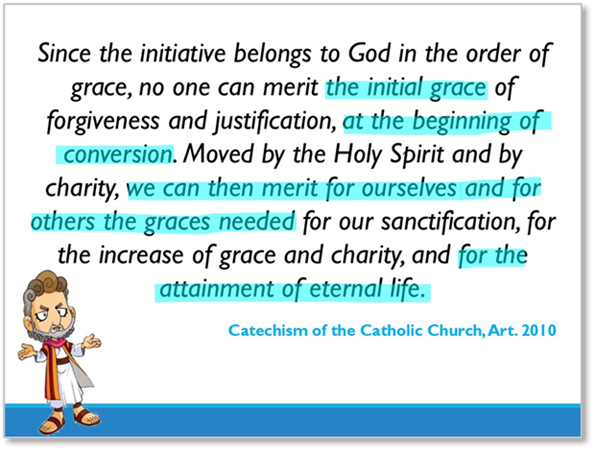
The Roman church teaches the equation: “Jesus + good works = merits eternal life.” It teaches that “Jesus + good works = forgiveness, reconciliation, and divine pardon.” Rome’s catechism explains (Art. 2010):

Rome speaks of “initial grace” and “the beginning of conversion.” There is no before and after. There is no bright line in the sand. Salvation is a cooperative process, not a divine event. Moved by the Spirit and by love, we must do good works to “merit for ourselves” the grace needed for eternal life.

This is heresy. It is false. It is wrong.

The truth is that we must trust in Jesus alone for salvation. God declares us to be righteous on the basis of what Jesus has already done. Based on that declaration, God gives his people legal pardon and personal reconciliation. Rome may speak of grace, charity, and conversion, but it means something very different.

Like all false religions, Rome teaches a version of “resume-ism.”

If you don’t believe God exists, then you’re not interested in submitting your resume to God. But, if you do believe he exists, then resume-ism will send you to hell—because it’s wrong.

  • You can talk about Jesus all you want, but in the end it’s about you—what you do, what you bring to the table.
  • The true faith is about Jesus, what he did, how he rescues you, and how God pardons you and declares you to be righteous if you trust in what Christ did for you.

The apostle Paul is against resume-ism. It’s his obsession. As we parachute into our passage at Romans 3:19-31, we learn from the first portion of the chapter that everyone is a sinner, without exception.

  • We’re all in trouble. We’re guilty before the King of the universe.
  • God’s old covenant law tells us how his people ought to act.
  • But we don’t act like that all the time, or even most of the time.
  • Most of us don’t want to act like it either.

So, most people don’t belong to God, because they don’t do what he says, nor do they want to. Now, to our passage.

Righteousness from God

The old covenant law tells God’s people how to live and love him. How to be different, weird, and separate from the world until the Messiah comes. This law speaks to people who are under its authority, “so that every mouth may be silenced and the whole world held accountable to God” (Rom 3:19).

He’s saying the old covenant law silences all excuses and acts as an immovable divine witness to which we are all accountable.

How does this accountability work? Why does it silence us as it confronts us?

Because by means of works of the law (ἐξ ἔργων νόμου) nobody will be declared to be righteous, in God’s sight (Rom 3:20). The word your English bible renders here as “righteous” or “justified” is a legal idea that means moral uprightness. You can’t achieve that by doing the works of the old covenant law—because you’ll keep messing up.

How do we know this? Because the law tells us so, because “through the law we become conscious of our sin” (Rom 3:20).

  • The law brings knowledge of sin.
  • It tells us we’ll always fall short of the mark—somehow, some way.
  • No matter what.
  • 100% guaranteed.

This isn’t good, obviously. If God left it there, some people might think he were cruel. But God is not toying with us. The law isn’t about salvation at all. It isn’t there to make us gnaw our fingernails and fear damnation. That’s just resume-ism talking.

  • Law-keeping does not earn us salvation. It never did.
  • Instead, the old covenant law tells us how to live while we wait for our Rescuer—King Jesus.
  • But this “resume-ism” idea had so infected and twisted the popular Jewish understanding of salvation by Paul’s day (and Jesus,’ too) that in many circles it had become the default gateway to a relationship with God.
  • Trust in the coming Messiah. Do law-keeping really well. Repeat (see Lk 18:9-14).

But, the apostle Paul says, that’s all wrong. It’s always been wrong. Now, separate from the old covenant law (χωρὶς νόμου), righteousness from God has now been made known—testified to by the law and the prophets (Rom 3:21). Resume-ism has nothing to do with the righteousness from God that’s on the table.

If this righteousness from God—the kind that can never come by means of works of the law—is testified to by the law and the prophets … is it a new thing?

Of course not. This isn’t new. It’s simply the re-presentation of something very old. Rome would do well to listen to Paul. If so, it wouldn’t speak of “meriting for ourselves” the grace needed for eternal life.

  • Well, how do you get this righteousness that God is offering? “This righteousness is given through faith in Jesus Christ …” (Rom 3:22). We trust in his faithfulness—that he has been perfect for us, as our delegate and representative.
  • Who can have it? Who is eligible? “… to all who believe” (Rom 3:22).
  • Why is this righteousness open to anyone? “Because there is no distinction [between people]—everyone sins and therefore lacks God’s glory” (Rom 3:22-23, my trans.).

The phrase often translated as “fallen short of the glory of God” means to be deficient—to be missing or lacking something. Without Jesus, we are each missing the righteousness and holiness and love for God he made us to have. Instead, we sin, so we’re broken, and so we “fall short of” (i.e., lack) God’s glory.

So, how does this righteousness from God happen? Why is it by faith alone and not works?

  • Because God declares us to be righteous as a gift, or freely, or gratis (Rom 3:24). This declaration is “on the house.” This means there is no “merit” we bring to the table. Rome is wrong. Dead wrong.
  • God issues this declaration to his people by means of his grace, through the liberation (“redemption”) that comes from Christ Jesus (Rom 3:24).

How so?

Well, “God displayed him publicly as the instrument of forgiveness by his shedding of blood, to be received by special faith. God did this to prove his justice because, due to his long-suffering patience, he had let the sins of the past go unpunished” (Rom 3:25, my trans.).

Jesus is the propitiation or sacrifice of atonement or instrument of forgiveness. How so? By means of his death (ἐν τῷ αὐτοῦ αἵματι).

  • This is a Federal, representative concept (see Rom 5:12f).
  • Like Adam, Jesus is the vicarious representative who acts on behalf of his people. Jesus lives the perfect life we cannot. He dies the criminal death we deserve. He defeats Satan and the curse of death on our behalf. He does this as our Federal representative.
  • Jesus takes our sins upon himself in the same manner as an employer that is legally, vicariously responsible for the actions of its employees.
  • The difference is, of course, that Jesus does this willingly and lovingly.

How do we receive this righteousness from God that Jesus achieves? By faith (Rom 3:24). Not by works. In fact, Jesus has retroactively paid for all the sins he had forgiven on credit from the old covenant days gone by (Rom 3:25).

God has done this as a demonstration or proof of his righteousness—his justice (Rom 3:26). I recently investigated a case in which adoptive parents sexually and physically tortured their adoptive children for years. It would have been evil if the state had opted to “forgive and forget” this. We instinctively know that. Crime demands punishment. Justice must be done. It’s the same with God, and so Jesus’ life—his death as our vicarious representative—is what satisfies the justice required. That’s why Jesus’ life and death demonstrates or proves that God is just.

And whom does God justify? Who does God declare to be righteous? The one with the best resume? The one who does more than the guy next to him? The one who does the most good works? No—it is “those who have faith in Jesus” (Rom 3:26).

The inevitable result of resume-ism is pride and self-satisfaction. But, because we now know that righteousness is a gift from God separate from works, we know that all boasting is excluded. It is shut out by the law of faith (Rom 3:27). It has nothing to do with being a Christian. “For we maintain that a person is justified by faith apart from the works of the law” (Rom 3:28). This is open to any person. Jew. Gentile. Azeri. Afghani. Japanese. God will declare anyone to be righteousness who trusts in Christ for salvation (Rom 3:29-30; cp. Gal 3:28-29).

This whole thing (righteousness from God by faith alone, in Christ alone—nothing to do with resume-ism) is not new. The new covenant does not rip up and invalidate the old covenant law. Instead, the apostle Paul declares, it upholds it (Rom 3:31) because Jesus teaches us that the law is about how to live as believers, not how to become a believer.

Why being a Protestant matters

It matters because this is about how you become a Christian. Is Jesus’ grace enough to (a) give us permanent, legal pardon, and (b) permanently heal our broken relationship with God? Or do we need to stir in some resume-ism, too? The apostle Paul says that, because we have been justified by faith, we have peace with God through our Lord Jesus Christ (Rom 5:1).

We’re justified by God because we have faith … in what?

  • That Jesus died for you.
  • That he did it as your vicarious representative, in your place.
  • That resume-ism won’t get you there.
  • That it can’t get you there.

And so, the equation “Jesus + something else = salvation” is wrong. It will send you to hell, because it can’t get you this righteousness from God (Gal 2:21).

  • That means you’re still in trouble, no matter what label you put on yourself.
  • It means you don’t have peace with God through our Lord Jesus Christ, because you haven’t yet trusted in him alone for salvation.
  • You’re still trying to upload your resume to the website.

But God does not want your resume. He wants you to only trust in what his eternal Son has already done for you. He declares you to be righteousness by means of faith and trust in his Son—nothing else. That is the core issue of the Protestant Reformation, and of the true Christian faith.

Why Jesus’ Ascension Matters for Christians Today

Why Jesus’ Ascension Matters for Christians Today

Jesus ascended back to heaven 40 days after his resurrection. We know this because Luke tells us (Acts 1:3). It’s a very important event, and Luke is the guy who wrote both accounts of it. One is shorter (Lk 24:50-53), and the other is a bit longer (Acts 1:10). Other New Testament writers constantly reference it, too.

Why talk about the ascension?

One big reason is that the Christian story makes no sense without it.

  • The bible tells us that Jesus is coming back—but coming back from where?
  • The bible says that Jesus is the shepherd for all believers. If that’s true, then where is his “shepherd command center”? Is he in Olympia? In Atlanta? In London? In Durban?
  • If Jesus pours out the Holy Spirit, where does he pour it out from? Is he in a house somewhere in West Olympia, pouring out the Spirit onto new believers in Tokyo? Even the imagery of “pouring out” suggests a spatial position above us somewhere—but where?
  • If Jesus left this earth to prepare a place for us, at what location is he making these preparations?

A helpful analogy to start

Here’s an analogy that helps explain the difference between Jesus’ ministry during the incarnation and now—after the ascension. The analogy is the difference between tactical and strategic command, in a military context.

  • A tactical commander is focused on a specific, local objective with a relatively small number of resources. He and his men must take that hill, right there. This is a very narrow focus.
  • A strategic commander sees the whole picture—not just that hill, but all the hills. The whole battlespace. The logistics. The reinforcements. The larger plan for the entire campaign.

Jesus’ incarnation v. ascension is like that:

  • The incarnation was a tactical command situation. Jesus and a relatively small band of followers wandered to and fro in a very small area, among a fairly small group of people, as he trained a very small cadre of followers. Jesus didn’t worry about what is now China, India, or Argentina. He focused on Capernaum, the Sea of Galilee region, and other local areas.
  • But, at his ascension Jesus pinned back on his Fleet Admiral (5-star) insignia and began running the entire cosmic war from his combat information center at the Father’s right hand. He now acts “from Washington” (as it were) to impact individual “commands” at far-flung outposts (large and small) all across the world.
  • This is tactical v. strategic command.

Goals for studying Jesus’ ascension?

Jesus performs at least three big jobs in heaven:

  1. He’s the King who wages divine war against Satan.
  2. He’s the High Priest who reconciles us to God and always lives to make intercession for his people (see Heb 5-10). I covered this during my ascension sermon in 2024, and you can watch it here.
  3. He is our shepherd and guide—this will be our focus in this article.

This article has two goals:

  1. To show us why the ascension is such an important part of the Christian story.
  2. To know why Jesus’ ascension is a good thing for you, and why it should comfort you.

We’ll make our way through this in three steps:

  1. We’ll look at some (not all) hints from the old covenant, and their fulfillment in the new covenant scriptures so we can “see” the ascension throughout the bible.
  2. Next, we’ll consider where, exactly, heaven is. Have you ever thought about that?
  3. Finally, I’ll provide five reasons why the ascension matters today for you if you’re a Christian.

I could say much more on this topic (especially on Jesus as king and high priest), but we’ll stick to the “Jesus as shepherd” theme here.

From Hints to Reality

I’ll discuss two old covenant hints about the ascension, and two new covenant texts that show these hints have now become reality.

Two old covenant hints

The first old covenant hint we’ll consider that points to Jesus’ ascension is the Day of Atonement ritual. You can find this by comparing Leviticus 16 and Hebrews 9.

  1. You have the tabernacle and its sturdier replacement, the temple building. The bible explains the elaborate rituals the covenant member and the priest perform to atone for the sins of the people. These are foreshadowing’s (or “types”) that signal a greater fulfillment by Jesus in the new covenant (Heb 9:1-9)—the same way a little boy’s tricycle foreshadows his first car.
  2. The tabernacle and its furnishings inside the holy of holies also “stand for” the heavenly realities above (Ex 25:9)—they’re like LEGO figurines of the true reality (Heb 8:5).
  3. So, in old covenant worship, on the Day of Atonement that high priest goes in, offers the blood of the sacrificed animal, and makes atonement for the people.

So far, so good.

But how does Jesus make this picture become real? How does he complete the reality to which the old covenant LEGO mini-figures pointed? He completes it by going to the real throne room in heaven, offering his own blood from his own sacrifice, and making permanent atonement for his own people. This means Jesus must leave here and go back to heaven to complete the picture—this is the ascension.

Next, we turn to King David, who certainly understood at least something about this. Consider Psalm 110:1, which is the most quoted text in the new covenant scriptures! “The LORD says to my lord: ‘Sit at my right hand until I make your enemies a footstool for your feet.’”

Jesus used this text to explain that the Messiah was more than just David’s son—he was a divine figure. He asked folks who the Messiah would be, and they said it would be David’s son (Mt 22:42). Well, Jesus asked, how could David (who spoke by means of the Holy Spirit) call his own son his lord (Mt 22:43)? “If then David calls him ‘Lord,’ how can he be his son?” (Mt 22:45).

Look back at Psalm 110:1 (above), and think with me here:

  1. There are two “Lords” in this verse. One is Yahweh, whose personal name our English bibles always translate in ALL CAPS, so we’ll catch it. We’ll call him “Lord 1.”
  2. But who is this other “lord,” the one not in capital letters? We’ll call him “Lord 2.”
  3. Whoever Lord 2 is, he seems to be divine—this was Jesus’ point in Matthew 22:42-46. What person could sit beside God in heaven? So, Lord 2 is divine, and the Christian story tells us it is Jesus.
  4. Fair enough—but if Lord 2 is Jesus, and Jesus came here during the incarnation, then how does he get back there to take his seat and pin back on his 5-star, Fleet Admiral insignia?

Well, he leaves.

He ascends back to where he’d been before the world began. He went back to heaven. He’s gonna stay there “until I [Lord 1] make your enemies a footstool for your feet” (Ps 110:1). The apostle Peter understood this, which is why he quoted Psalm 110:1 and said: “Therefore let all Israel be assured of this: God has made this Jesus, whom you crucified, both Lord and Messiah” (Acts 2:36).

Remember the tactical v. strategic analogy we mentioned earlier. Now, since the ascension back to the throne room in heaven, Jesus the king is directing this multi-front, cosmic and divine war from heaven until all his enemies (Satan and his minions) are crushed in the dust before him.

Two new covenant realities

The apostle Peter preaches that “[h]eaven must receive him”—that is, Jesus the Messiah—“until the time comes for God to restore everything, as he promised long ago through his holy prophets” (Acts 3:21). When heaven receives Jesus, we have the ascension, which will terminate when Jesus once more descends here with the heavenly host to crush Satan and his minions under his feet (Rev 19; Mt 24:29-31).

The martyr Stephen, whose sad story God preserved for us in Acts 7, saw the risen Christ in heaven after his ascension. When Stephen denounces the Jewish council— “[y]ou stiff-necked people! Your hearts and ears are still uncircumcised. You are just like your ancestors: You always resist the Holy Spirit!”—he faces almost certain death. At that crucial moment, Luke tells us:

… Stephen, full of the Holy Spirit, looked up to heaven and saw the glory of God, and Jesus standing at the right hand of God. “Look,” he said, “I see heaven open and the Son of Man standing at the right hand of God” (Acts 7:55-56).

Jesus is not here. He is “up there,” in heaven. He ascended. And, of course, the Christian story tells us that Jesus is coming back here one day. From where is he coming back? From heaven.

Where is heaven?

I won’t spend too much time here, but it is something many Christians probably haven’t thought about much. I’ll only skim through this one, but it’s worth thinking about. Where is heaven? Here’s what we know:

  1. Jesus is clearly not here.
  2. He is also clearly somewhere else, in some real, physical, actual place. We know this because Jesus keeps his physical, resurrected body, which must take up real estate somewhere.
  3. Jesus taught us to pray “Our Father, who art in heaven” (Mt 6:9), which means the Father is also taking up real estate somewhere. Yes, God is spirit and has no innate physical form with which to occupy a space, but he is “up there” in heaven.
  4. And we know that Jesus will one day come back to here from that place.

But where is it?

  1. It isn’t up in the sky. God isn’t in outer space! If you leave earth’s atmosphere, you won’t find him there. Or on the far side of the moon. Or hiding in one of Saturn’s rings.
  2. But heaven seems to be a physical place somewhere.

So, it’s best seen as a different dimensiona divine alternate realm that’s above this one.

Heaven is the place where God is. It isn’t a fixed address—it moves when God moves. This is why the apostle John tells us that, one day, God will re-locate from heaven to earth. He will bring heaven to earth, just as he promised through the prophet Zechariah (Zech 2:10).

I saw the Holy City, the new Jerusalem, coming down out of heaven from God, prepared as a bride beautifully dressed for her husband. And I heard a loud voice from the throne saying, “Look! God’s dwelling place is now among the people, and he will dwell with them. They will be his people, and God himself will be with them and be their God (Revelation 21:2-3).

But, for now, “heaven” is this alternative divine dimension where Jesus went at his ascension.

Five ways Jesus shepherds Christians from heaven

Because Jesus is our good shepherd, he’s our guide who cares for us in this life and brings us along to the next. Israel’s leaders (“shepherds”) were basically terrible. Worthless. Unreliable. Bad. It’s not that Jewish people were habitually bad. It’s that all of us are habitually bad! We need a leader from outside to get us out of this mess.

God told us that he’d send a special someone to do a proper job.

10This is what the Sovereign LORD says: I am against the shepherds and will hold them accountable for my flock. I will remove them from tending the flock so that the shepherds can no longer feed themselves. I will rescue my flock from their mouths, and it will no longer be food for them. 11“‘For this is what the Sovereign LORD says: I myself will search for my sheep and look after them. 12As a shepherd looks after his scattered flock when he is with them, so will I look after my sheep. I will rescue them from all the places where they were scattered on a day of clouds and darkness (Ezekiel 34:10-12).

That special someone is Jesus, God’s one and only Son. “I am the good shepherd. The good shepherd lays down his life for the sheep” (Jn 10:11).

  1. But remember, he’s not here—so where is he?
  2. He’s your shepherd from heaven.
  3. Remember the analogy of tactical v. strategic command. During his three-year ministry, Jesus exercised local, tactical command in a small place—he shepherded a small, local flock.

But now, since his ascension, Jesus runs the whole show across the entire world. He shepherds the entire flock from the “combat information center” up there, in heaven.

What difference does this make for our lives? Here are five things Jesus does for you from heaven.

First—Christ is shepherding you to spiritual maturity

When Christ ascended on high, he led captivity captive, then gave gifts to his people (Eph 4:8). This means Jesus captured “captivity” itself—by defeating Satan, sin and death—and took it away with him to heaven to imprison it forever.[1] This is imagery, like that of the woman representing sin who Zechariah says was crushed into the basket and carried off to exile far to the east in Babylon (Zech 5:5-11).

Why does Christ do this? Why does he remove captivity from his people and give them gifts (Eph 4:11)? To equip his people for service, so we’d each “grow up” into a mature community in Christ (Eph 4:12).

Jesus is orchestrating all this for you, from heaven. God’s children aren’t generic, faceless numbers—Jesus even says we’re his brothers and sisters (Heb 2:11). Your spiritual maturity matters to Jesus, and that happens in relationship with a local community of Jesus people somewhere that the NT calls “a church.”

Second—Jesus is preparing paradise for you

Jesus said: “My Father’s house has many rooms; if that were not so, would I have told you that I am going there to prepare a place for you? And if I go and prepare a place for you, I will come back and take you to be with me that you also may be where I am” (Jn 14:2-3).

In the garden of Eden, which I’ll call Paradise 1.0, we had physical bodies, we were with God in a perfect creation, in perfect relationship with him, and we used our talents and gifts to build a perfect world.

But that ended pretty quickly and pretty badly.

At the end of the Christian story, in Paradise 2.0 (see Rev 22), we will have that same paradise reality—only this time it will be permanent. Jesus paves the way for Paradise 2.0 by his ascension—everyone who believes in him will follow him to heaven (Jn 14:6). Then, one day he’ll bring all his people to the new creation here to defeat Satan and kick off Paradise 2.0 (Rev 19:11-21).

Jesus can’t do any of that if he stays here. This is why he went there to prepare paradise for you. “[B]y his own appearance there for them with his blood, righteousness, and sacrifice, he is, as it were, fitting up these mansions for their reception, whilst they are by his spirit and grace fitting and preparing for the enjoyment of them.”[2]

Third—Jesus empowers you for evangelism

Jesus said: “Very truly I tell you, whoever believes in me will do the works I have been doing, and they will do even greater things than these, because I am going to the Father” (Jn 14:12). In what way will Christians “do even greater things” than the works Jesus has been doing?

Jesus led people out of darkness and into the light. Jesus rescued people from Satan. He brings people into God’s forever family. Jesus said he fulfills all of God’s covenant promises. Jesus said he could fix you, fix your life, and give you meaning and purpose as an adopted child of God.

What does that have to do with you? With the ascension?

Well, Jesus gives you the power to do the same thing as he did—even quantitatively greater things—because we preach and tell the same message that has the same results. And Jesus orchestrates all this from on high, through the Holy Spirit “because I am going to the Father.” From the Father’s side in heaven above, Jesus is working in your life, and through you in the life of local churches, to spread his message around the world.

A very wonderful promise! But has it been fulfilled? We think it has. For if we look at the wonders of the Day of Pentecost, together with the events that followed in the rapid spread of the gospel during the apostolic age, it does not seem extravagant to regard them as greater than any which took place during the ministry of Christ. And if we compare the spiritual results of the three most fruitful years of the ministry of Paul, of Luther, of Whitefield, or of Spurgeon, with the spiritual results of Christ’s preaching and miracles for three years, we shall not deem his promise vain.[3]

Fourth—Jesus sends the Holy Spirit to rescue people

The bible records Jesus words: “When the Advocate comes, whom I will send to you from the Father—the Spirit of truth who goes out from the Father—he will testify about me. And you also must testify, for you have been with me from the beginning” (Jn 15:26-27).

It is Jesus who poured out the Holy Spirit at Pentecost (Acts 2:32-33). It is Jesus who opens people’s hearts so they believe and trust the gospel (Acts 16:14; 2 Cor 4:3-6). Our passage in John 15:26-27 tells us that:

  1. Jesus goes back,
  2. and then he sends the Spirit,
  3. who then helps us and testifies to us about Jesus,
  4. and we then bear witness to Jesus and his gospel,
  5. and the Spirit testifies about Jesus in the hearts of those whom we reach.

There is no wiggle room here—the Spirit “will testify about me.” He will. He shall. It’s a promise. We bear witness, and the Spirit will testify about Jesus.

Fifth—Jesus is with us, everywhere at once

During his ministry, Jesus was constantly with his people. His physical body limited him to being in a particular place, at a particular time. There are only 24 hours in a day—even for the incarnate Jesus.

So, how can Jesus be with his people, if his people are in Judea, Samaria, and the uttermost parts of the earth? How can Jesus be in all these places at once? Will he hop on a Zoom call with us once per week from wherever he’s at? Wouldn’t, then, our relationship with Jesus be like a long-distance relationship? We know how those go …

The answer is that, since the ascension, Jesus will be with each of us spiritually.

I will not leave you as orphans; I will come to you. Before long, the world will not see me anymore, but you will see me. Because I live, you also will live (Jn 14:18-19).

Christians will not be orphans, which means Jesus won’t abandon us when he ascends back to heaven— “I will come to you.” We will actually see him, and we will “live” because he lives (i.e., after his resurrection).

What does all this mean? “On that day you will realize that I am in my Father, and you are in me, and I am in you” (Jn 14:20).

  1. On the day Jesus comes to us to not leave us as orphans,
  2. we will realize that Jesus is in union/relationship with his Father,
  3. and that we are in union/relationship with him,
  4. and that he is in union/relationship with each of us.

This is Jesus’ spiritual presence with every individual believer, knitting us to him, to one another, and to the Father, by the power of the Spirit. This is an invisible but tangible bond that, as it were, fuses our souls to his at a level that’s marrow deep.

This is a reality that evidently could not happen if Jesus had continued to skulk around Galilee forever after his resurrection, content to remain a tactical commander in this cosmic war. Instead, he ascended back to heaven to assume strategic command of the whole battlespace, re-pinned on his Fleet Admiral insignia, and now guides each of us personally and individually.

And so, because Jesus is with all his people right now from heaven above, he can promise us: “Peace I leave with you; my peace I give you” (Jn 14:27). He tells us all this—these five reasons and others— “so that you will not fall away” (Jn 16:1).

Jesus’ ascension matters. It’s good that he went away. It’s good that he’s running (and winning) this divine war. It’s good that he sends the Spirit to rescue people. And it’s good that we await his return, so the Father can bring heaven to earth forever.


[1] Scholars old and modern are divided over how to understand this “captivity captive” language, and the various English translation choices reflect this (see, for example, the NIV—which disagrees with my interpretation here). For my interpretation see John Gill, An Exposition of the New Testament, vol. 3, The Baptist Commentary Series (London: Mathews and Leigh, 1809), 87–88).

[2] Gill, Exposition, 2:56.

[3] Alvah Hovey, Commentary on the Gospel of John, in American Commentary (Philadelphia: American Baptist Publication Society, 1885), 286.
Is the Papacy Biblical? A Look at Matthew 16

Is the Papacy Biblical? A Look at Matthew 16

Pope Francis’ recent death is an opportunity for bible-believing Christians to consider what we ought to believe about the papacy. The goal is not to dance on a dead man’s grave, but to think about who oversees Christ’s church. Is the papacy a legitimate institution? Does it have biblical warrant?

The Catechism of the Catholic Church (“CCC”) says that:

  1. Peter is the rock of the church, which is built upon him (CCC, Art(s). 881, 552).
  2. Peter has the “keys” and therefore governs the church (CCC, Art(s). 553, 881).
  3. Peter is the shepherd of the church, and priests and bishops have derivative authority under Peter.
  4. Peter is the source and foundation of the unity of the church—he has full, supreme, and universal power (CCC, Art. 882).
  5. According to the first Vatican council (Vatican I, 1869-70, Session 4), if you do not agree with Rome’s teaching about Peter, you are damned to hell.

This is all false and cannot be defended from scripture. Rome’s argument, both in the CCC and at Vatican I, centers on Matthew 16:18 and some supporting citations. My argument here focuses on the Matthew 16 passage. If you want to read more about Rome’s grave and terrible errors about the gospel, I recommend (a) James White, The Roman Catholic Controversy (Minneapolis: Bethany House, 1996), and (b) Tyler Robbins, “How Rome Distorts the Gospel—Atonement Misunderstood.”

Now—on to the papacy!

In Matthew 16:18-19, Jesus gives us two pairs of images: (a) the rock and the gates, and (b) the keys and the bonds. What do they mean? Oracles from “the Greek” won’t help you here—your bible translation is just fine. Whatever these images mean, they must make the best sense of what the passage is taking about in context.

Context—what are we talking about here?

Jesus asks his disciples who people say the Son of Man is (Mt 16:13). He refers to himself as the mysterious figure from Daniel’s famous vision (Dan 7:13-14). Public opinion says that Jesus is a prophet of some sort (Mt 16:14). Now, Jesus asks the disciples who they think he is (Mt 16:15). Peter answers: “You are the Messiah, the Son of the living God” (Mt 16:17).

The “Messiah” is the chosen and anointed one, the special divine envoy (“Son of the living God”) who will make all God’s covenant promises come true. He is God’s promise-keeper. He makes God known to us (Jn 1:18). Jesus agrees and tells Peter that his Father in heaven has revealed this precious truth (i.e., his confession about Jesus’ identity) to him.

So, as we move on to consider the first pair of images, we must get this right—this conversation is about Jesus’ identity and what it means. Any interpretation that takes a hard turn off this road to something completely different is wrong.

Imagery 1—The Rock and the Gates

Jesus says: “And I tell you that you are Peter, and on this rock I will build my church, and the gates of Hades will not overcome it” (Mt 16:18). Here we have our first pair of images.

  1. What are gates for? To keep people in or out.
  2. What is Christ’s church build on? A rock.
  3. Because Hades’ gates cannot prevail against the rock, these gates are imprisoning folks inside, and the rock smashes this gate open to set them free.

So, whatever “the rock” is …

  1. The entire family of God is built on it,
  2. and the rock is so strong, and so powerful,
  3. that Satan’s kingdom can’t withstand it!
  4. so it’s a pretty tough rock— divinely tough!

You have three options:

  1. The rock is Peter—the pope.

Rome places great stock in a Greek wordplay that Jesus uses here: “And I tell you that you are Peter (Πέτρος—petros), and on this rock (πέτρᾳ—petra) I will build my church …” This is a weak argument. Unless context suggests otherwise (and remember, the context is Jesus’ identity and what it means), there is no need to see this as anything other than a playful wordplay.

For example, my first name is Mark. Yet my parents have called me Tyler all my life, so I have no idea why they bothered to name me Mark. A similar wordplay would be if someone told me: “Your name is Mark, and mark my words that …” That is all this need be. Peter has nothing to do with this conversation—they’re talking about Jesus’ identity.

  1. The Rock is Jesus.

When he says, “and upon this rock,” he points to himself. This is weak and desperate. The pronoun translated “this” refers to something nearby in the context. This position rightly rejects Peter as the rock (because it is out of context), and to make Jesus himself “this rock,” they must make him point to himself. There is a simpler way—one that doesn’t require us to pantomime while explaining it.

  1. The rock is Peter’s confession of Jesus’ identity and what it means—his faith and trust in the Messiah.

Option 3 is the right option.[1] Christ’s church family is built on the confession that Jesus is the Messiah, the Son of the living God. You cannot be a Christian (and a member of the worldwide Jesus family) unless you trust and confess the truth about him. Again, remember the context of this passage—this whole conversation is about who Jesus is and why it matters. It is not about a disciple who Jesus is going to call “satan” in four verses. It is not about the disciple who Paul rebuked to his face in Antioch (Gal 2:11-14). It is not about the guy to whom nobody in the scripture gives special authority.

But the conversation certainly is about Jesus, the Messiah, the Son of God. This explains why the rock is so strong, and so powerful, and why the gates of Hades can’t prevail against the church—because it’s divinely tough.

The completed imagery of rock + gates is this:

  1. The rock is the confession that Jesus is the divine promise-keeper and Son of God.
  2. The gates are to Satan’s kingdom, and they can no longer imprison those who believe in the rock.
  3. Jesus (the rock) smashes these gates open—remember the divine rock which smashes the statue of pagan empires (which are really different flavors of Babylon, Satan’s kingdom) at Daniel 2:34-35, 44.

Peter cannot smash these gates open. Yet, this is what the “rock + gates” imagery would have us believe. Your safety, security, and anchor is Jesus. It wasn’t John Paul II. It wasn’t Benedict. It wasn’t Francis. It is not Leo. It’s the Messiah, the Son of the living God—just like the old song says— “On Christ the solid rock I stand. All other ground is sinking sand.”

Imagery 2—The Keys and the Bonds

Jesus continued: “I will give you the keys of the kingdom of heaven; whatever you bind on earth will be bound in heaven, and whatever you loose on earth will be loosed in heaven” (Mt 16:19).

  1. What are keys for? To control access. To let you in or out.
  2. What do bonds do? They confine you. Imprison you.

We know that Jesus has the keys of life and death (Rev 1:18), the keys that lock people into that future, or let them out to embrace a better one tomorrow.

So, whatever the keys are,

  1. They let you into the kingdom of heaven,
  2. and untie or unchain you from the bonds that you’re in,
  3. which means this is a divine power.

You have two options to understand what this means:

  1. Peter has exclusive power to govern the church (the keys), and to absolve people’s sins by a sacred power—the bonds (CCC, Art(s). 553, 881, 1592).

This makes no sense of the “key” imagery. Keys are about access (Rev 1:18, 9:1, 20:1), not governance. Scripture never says to go to Peter—or anyone else—to have your sins absolved. Nor does Peter later claim this right for himself in his two New Testament letters. Instead, the bible tells us that God forgives sins—even David knew this (Ps 51:1-2).

  1. Peter (and every other Christian) offers “the key” to freedom by preaching rescue (“the bonds”) through complete forgiveness of sins.

Option 2 is the correct one.  Again, this entire conversation is about who Jesus is and why it matters. The keys don’t belong to Peter when Jesus speaks—he says he will give them to Peter (future-tense). Later, Jesus clarifies that the entire church has the keys—he even repeats the very same words (Mt 18:18).

The “key + bonds” imagery tells us this:

  1. Jesus’ family,
  2. organized into big and small Jesus communities around the world called “churches,”
  3. are his hands and feet that offer the key to spiritual freedom,
  4. by preaching liberation, forgiveness, and reconciliation.
  5. and we untie the shackles or bonds by accepting people into the brotherhood of the faithful upon a credible profession of faith (see Acts 2:41).

Jesus, through his communities around the world, unlocks the gate to death and hades and lets his people out, just like the song says— “my chains are gone, I’ve been set free, My God, my Savior has ransomed me!”

Peter was a good guy. Peter was an important guy. Peter is a star (not the star) of Acts 1-11. But Peter was just a guy.

Jesus leads his church. Not by one old man in Rome, but by Word + Spirit in his churches around the world, under qualified leaders, through you, and me, and us. And together we build Jesus’ family—just like Peter himself told us. Jesus is the “living stone” (a synonym for “rock”) to whom we come to be built up into the spiritual household of the faithful (1 Pet 2:4-5).

Your leader is not an old man in a white robe who sits in a building financed over 500 years ago by extorting money from millions of peasants with stories of fraudulent “indulgences” that can buy them time off a purgatory that doesn’t exist, and who represents a false “gospel” that has no perfect peace—that doesn’t make you holy and perfect forever (Heb 10:10, 14). Instead, thank God (literally) that the confession and trust in Jesus is your rock. Jesus is your anchor. Jesus smashes open Hades’ gates. Jesus has the keys and loans them to his churches. Jesus, through his communities across the world, unlocks the door to death and Hades to let his people out of darkness and into the marvelous light.


[1] Many conservative Protestant scholars today believe that Peter is the rock. They often comment that Protestants only object to this interpretation because of what Rome does with the passage. See John Broadus’ wonderful commentary on the Gospel of Matthew for a representative example of this line of thinking: https://tinyurl.com/4my9e7y3.

I believe this is wrong, and I have not found the arguments convincing. The context strongly supports Option 3, and it is the best antecedent for the pronoun in ἐπὶ ταύτῃ τῇ πέτρᾳ οἰκοδομήσω μου τὴν ἐκκλησίαν. This is not an academic article, so I will leave the matter here!

The Illusion of Self-Righteousness

The Illusion of Self-Righteousness

This is a series of brief devotional articles on The Orthodox Catechism (“OC”),a Particular Baptist document written by Baptist pastor Hercules Collins in 1680. Read the series.

When confronted with a moral failure, our instinct is to minimize or to blame-shift. Yes, we shouldn’t have said this, but it only happened because you said that. No, we haven’t quite gotten around to fixing the car like we promised, but that’s because you keep using it every Saturday. Although these are silly little examples, the pattern holds true for the larger things.

Jesus summed up the law and the prophets under two heads; (a) love God with everything you have—heart, soul, mind, and strength—and (b) love your neighbor as yourself (Mt 22:37-40). How well do we follow these summary principles? The catechism question before us now is like a mirror that strips away all our self-righteousness. It leaves us, as it were, ashamed and defenseless, alone with the truth about ourselves:

Question 5: Can you live up to all this perfectly?

Answer 5: No. I have a natural tendency to hate God[1] and my neighbor.[2]

Now the minimizing bit comes into play.

  • Living up to all this perfectly? “Well, nobody is perfect …” we muse. But, compared to the other guy, I’m not in bad shape at all.
  • A natural tendency? Well, again, nobody is perfect.
  • Hating God and our neighbor? Hate is a strong word. I love God, and I don’t really hate anybody.

Unfortunately, the minimizing doesn’t work here. Holiness isn’t graded on a curve. In the same way that a woman either is or is not pregnant, and a man either is or is not a father, you either are or are not holy and righteous. To be “holy” is to be pure and perfect—without moral spot or blemish. To be “righteous” means to be morally upright in accordance with God’s standards. The catechism answer says you’ve missed that boat. We all have.

In what way have we missed that boat?

Because we all have a natural tendency to hate God and our neighbor. This tendency is natural because it’s innate, it’s our default setting, it isn’t a learned behavior—it’s just the way we are. The apostle Paul, a Jewish man, pointed out that even Jews had no advantage with God on this point: “Do we have any advantage? Not at all! For we have already made the charge that Jews and Gentiles alike are all under the power of sin” (Rom 3:9).

Paul’s words are important and you should read them again. We’re “under the power of” this malevolent force called sin, which is basically a contagion or disease of pervasive selfishness and narcissism. Because sin is selfishness—not simply “self-love” but more like “self-worship at all costs”[3]—it has a marvelous capacity for self-deception and self-righteousness. We think we’re fine, but we’re not. This is why God must rip the veil away from our hearts and minds so the gospel light can shine in and do its work (2 Cor 4:3-6).

Now we turn to hate. Yes, it’s a strong word. It means something like “extreme enmity” and “active hostility.”[4] Who wants to fess up to that? But lest we assume we have plenty of wiggle-room here, Jesus takes a sledgehammer to our rationalizations. God’s standards aren’t about externals—they’re about internal affections that show in an external way. This means that anger, contempt, and ridicule are the same as murder because they all come from an inner hostility and ill-will towards that other person (Mt 5:21-22). Likewise, adultery isn’t simply the sexual act but also the sexual thought (Mt 5:27-28).

What the catechism is driving at is that, in our hearts, we do not love God and our neighbor perfectly. We fail here because sin is that pervasive selfishness and narcissism that naturally reigns in our hearts and minds. And, because holiness (like pregnancy and fatherhood) is a “yes or no” status, that means we’ve each fallen short.

So, that’s where we are. It brings us round to Questions 2 and 3—the law of God tells us how great our sin and misery are. This naturally prompts a new question: why would God make us to be in such a terrible condition? If a manufacturer makes a bad product, it issues a recall and fixes the problem. Why hasn’t God issued a recall on us? Did he make a mistake with us? Is he holding us responsible for his own design flaws? We turn to these questions next time.


[1] Rom 3:9-20, 23; 1 John 1:8, 10.

[2] Gen 6:5; Jer 17:9; Rom 7:23-24, 8:7; Eph 2:1-3; Titus 3:3.

[3] Augustus H. Strong is particularly good here: “We hold the essential principle of sin to be selfishness. By selfishness we mean not simply the exaggerated self-love which constitutes the antithesis of benevolence, but that choice of self as the supreme end which constitutes the antithesis of supreme love to God” (Systematic Theology (Philadelphia: American Baptist Publication Society, 1907), 567).

[4] Merriam-Webster Collegiate Dictionary, s.v. “hate,” verb, sense 1.  

Expanding John Broadus’ Catechism for Today

Expanding John Broadus’ Catechism for Today

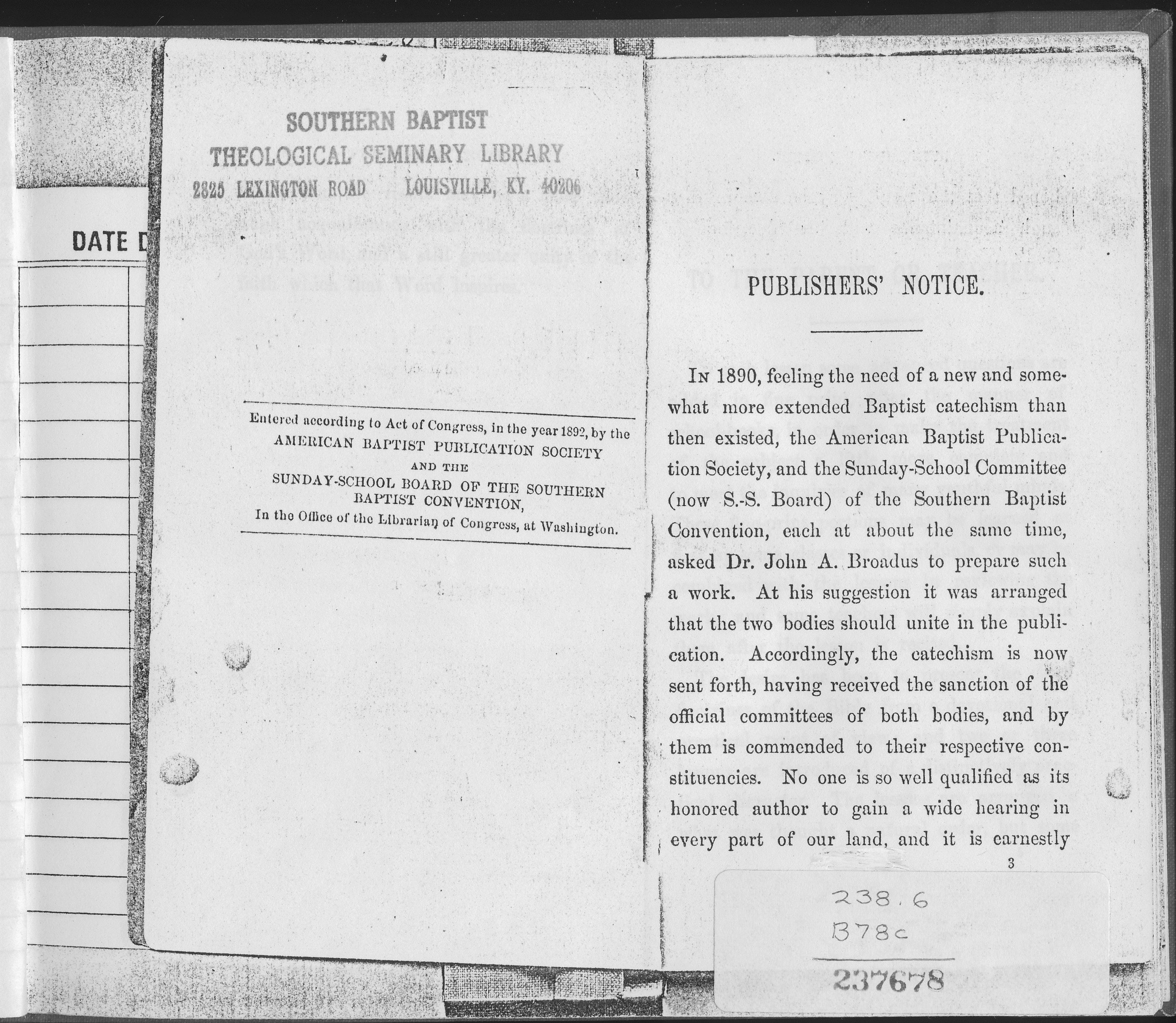
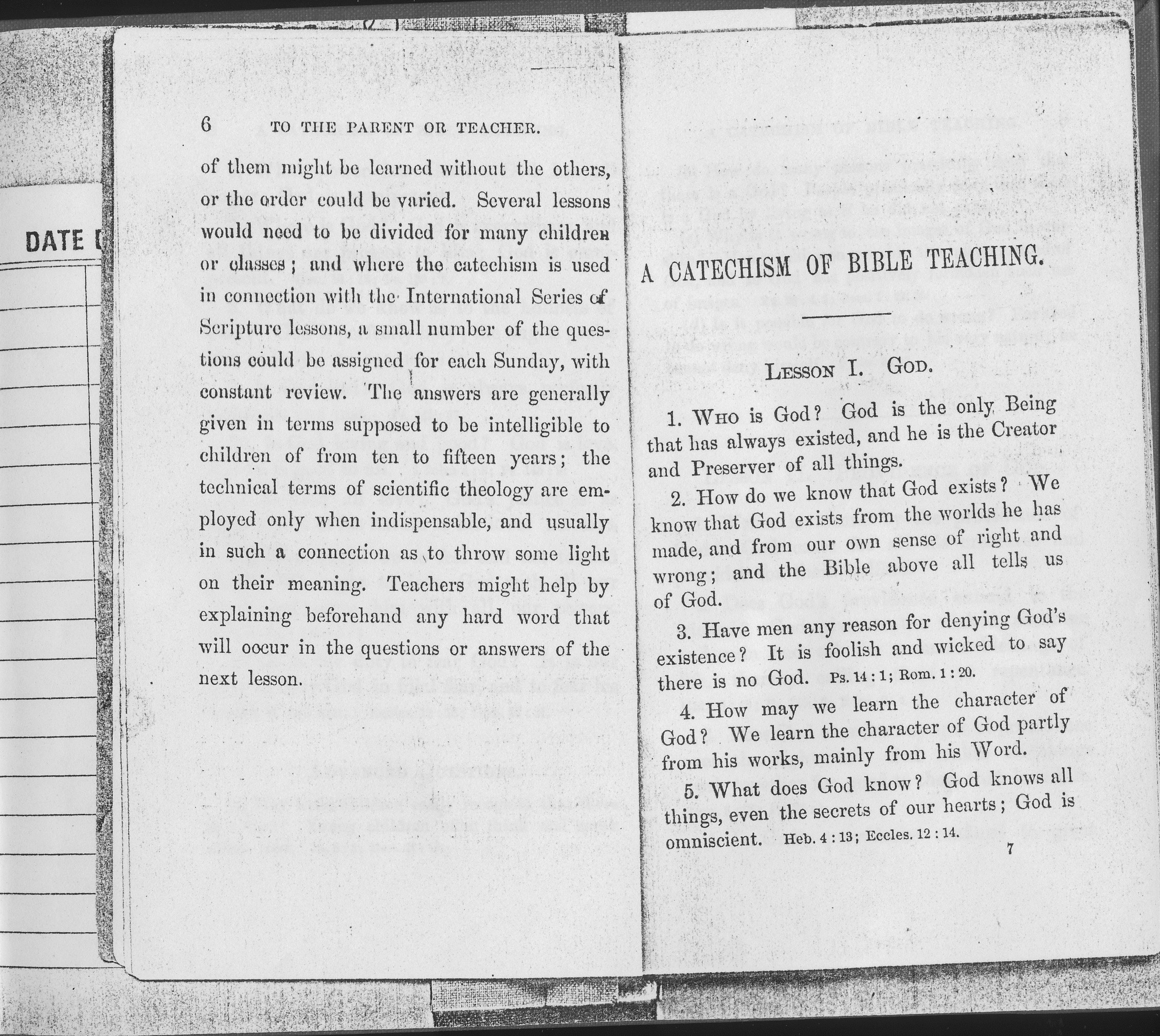
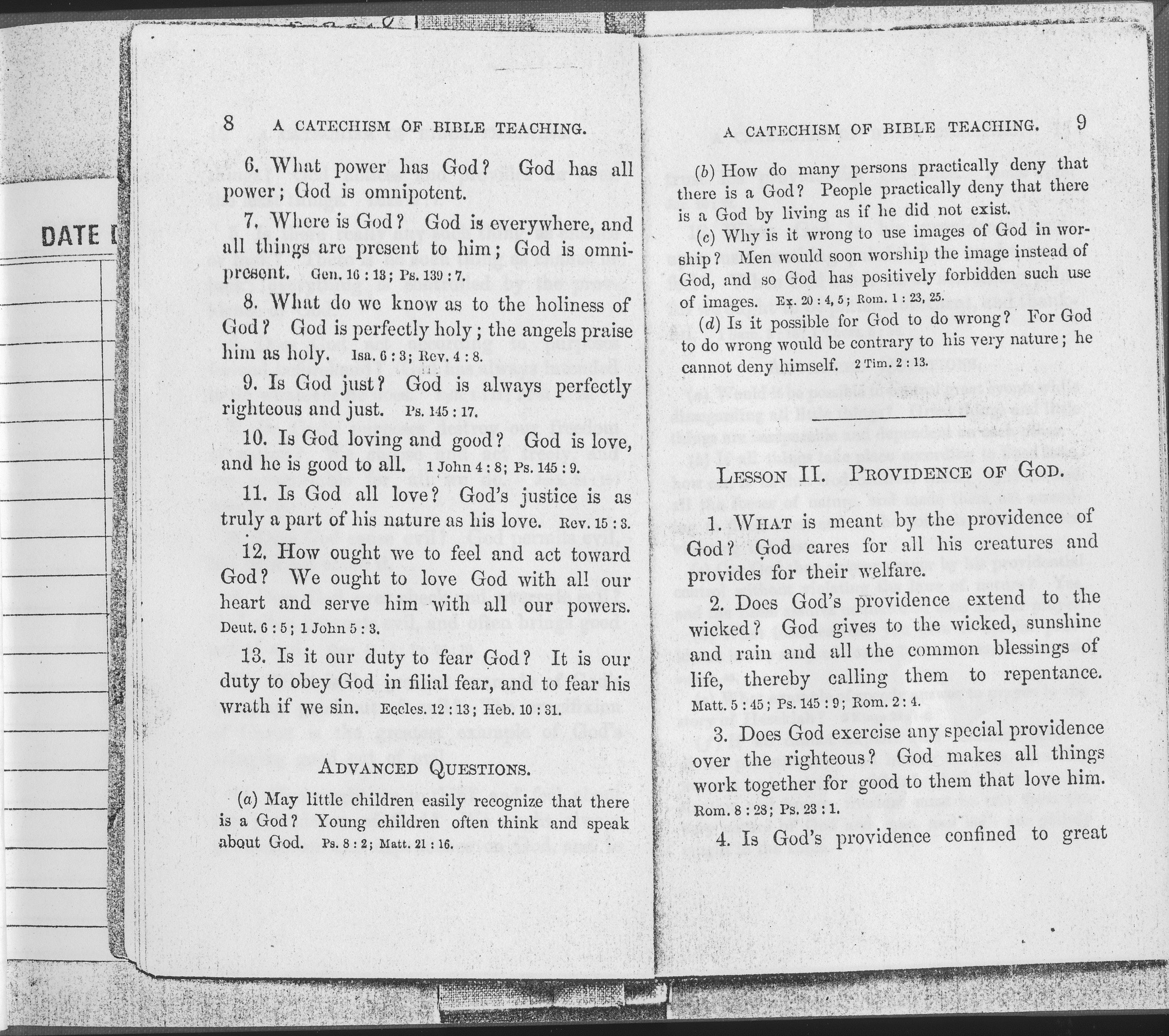
I’m well underway with my next book project–a catechism of the Christian faith based on John Broadus’ “A Catechism of Bible Teaching” from 1882. I’m using Broadus as a foundation, and expanding some of his comments and mixing in odds and ends from other classic Baptist catechisms along the way. I expect the final product to be 261 questions–enough for five questions and answers per week for one year. Pictures and charts will be sprinkled throughout. I’ll likely be self-publishing this one so I can have it for immediate use in our church and for distribution.

Broadus’ catechism is very, very good (so is Boyce’s), and I think every Christian would benefit from it. A preview of the original is below, and you can download a PDF scan of an original here (many thanks to the SBTS library for scanning me a copy!).

How Rome Distorts the Gospel: Atonement Misunderstood

How Rome Distorts the Gospel: Atonement Misunderstood

This article argues that the Roman Catholic Church (“Rome”) is wrong about the sufficiency of Christ’s atonement. In fact, she is so incorrect that her teaching on this matter is grave error that distorts the gospel.

By “Christ’s atonement,” we mean the action by which Christ’s vicarious death reconciles us to God and restores fellowship with him. The dispute here is about the sufficiency of this atonement. Did Christ atone for the consequences of all our sins? Is his atonement permanent or conditional?

Some issues are “in-house” debates—things Christians disagree about “inside the family.” But, some matters are serious enough that they rise to another level because they present two different versions of the Christian faith. The sufficiency of Christ’s atonement is one of those issues. If Christ’s sacrifice does not fully purify, fully reconcile, fully satisfy divine justice for his people once for all and forever, then that means Christ does not “save forever those who come to God through him,” (Heb 7:25, NASB). The word “forever” at Hebrews 7:25 means for all time,[1]or perhaps completely and absolutely.[2] Because Jesus is a priest forever, the rescue he gives his people is total, complete, and forever.

NOTE: This article is a significant abridgement of a larger essay which you can read here. You can consult the larger article for extended discussions of each point.

The bottom line

Rome teaches that Christ’s atonement (a) does not make full satisfaction[3] for all his people’s sins, and so (b) does not make believers holy and perfect forever. Instead, Rome teaches that when a believer commits sins after baptism, a stain affixes which makes her unholy (though still in a state of grace if she has not committed mortal sin), and so she herself must make satisfaction to God for the temporal consequences of these sins. We make this satisfaction to God “through the merits of Christ.”[4]

In other words, a believer’s purity before God is conditional—it depends on our actions. For the temporal consequences of these sins, we can either pay God now by way of the sacrament of penance,[5] or we can pay him later by suffering in purgatory to make satisfaction for our sins.

On the contrary, Hebrews 6:13-10:22 teaches that Jesus is the great high priest who made one single, all-sufficient sacrifice that makes each believer holy and perfect forever. As part of the journey of progressive holiness, God does discipline believers who commit sins, but a believer’s legal purity before God is perfect and complete forever at the time of salvation.[6]

Zooming out to the bigger picture, Rome is wrong because, compared to the old covenant system, her false teaching presents us with a new covenant that isn’t better than the old one. Both consist of a sacrificial liturgy and a band of priests offering repeated sacrifices with temporary atoning effect. Therefore, Rome’s teaching on the sufficiency of Christ’s atonement is a lateral move, not a promotion, and that’s why it’s incorrect. Because the argument from Hebrews 6:13-10:22 is that the new covenant has a better high priest, who brings believers a better hope, built on better promises, who makes a better atonement for his people, Rome’s teaching about the atonement is wrong.

Different sources and methods

However, we have a roadblock to overcome. Roman Catholics and Protestants don’t answer religious questions the same way because they have different authorities.

  • Rome teaches that there is a “living transmission” from the Holy Spirit, called tradition (Catechism of the Catholic Church, “CCC,” Art. 78), that exists alongside scripture as a complementary vessel of divine revelation.
  • Protestants generally hold to what one writer has called suprema scriptura, which means “the Bible as the supreme or highest channel of religious authority.”[7] Under scripture’s authority, in an interpretive dialogue, are church tradition, reason, and personal religious experience in the divine-human encounter.[8]

The issue of authority deserves serious discussion,[9] but we will leave that for another time. For now, it’s enough to say that because Rome teaches that both scripture and tradition flow from “the same divine well-spring” (CCC, Art. 80), her teaching must find scriptural support.[10] In the matter of Christ’s atonement, it does not. I urge Roman Catholics to see if scripture squares with their church’s tradition. If it doesn’t, then you should leave Rome.

Why Rome is wrong

God has revealed his truth in revelation, and grave error is false teaching that leads people away from that revelation. Rome’s understanding of Christ’s atonement is grave error because it contradicts scriptural teaching and negatively affects your understanding of salvation and the gospel.[11] It teaches that Christ’s atonement does not fully purify believers and make them holy and perfect forever at the moment of salvation. Specifically:

  1. Rome falsely teaches that there are “temporal consequences” from sins that Christ’s sacrifice does not fully fix—debts of temporal punishment still remain for sins committed after baptism.[12] The truth is that, in the new and better covenant relationship with God by faith in Christ which began at Pentecost, God promises: “I will forgive their wickedness and will remember their sins no more,” (Heb 8:12).
  • Rome wrongly teaches that, after death, believers may need to be cleansed and purified from the temporal consequences of sins to have the holiness necessary to enter heaven. The truth is that scripture says believers have already been reconciled to God and have peace with him, because he has declared them righteous (i.e., justified) by means of faith in Jesus (Rom 5:1, 10). His “once for all” sacrifice makes us holy already (Heb 10:10).[13]
  • Rome falsely teaches a fictitious system of penance to restore the state of grace ex opere operato as a so-called “second plank of salvation,”and teaches a non-existent treasury of merit from which priests and bishops may apply merit to remit temporal punishment for sins. The truth is that “by one sacrifice [Jesus] has made perfect forever those who are being made holy,” (Heb 10:14). This means this elaborate system is un-biblical and blasphemous to the sufficiency of Christ’s work.

Eight principles from Hebrews 6:13 to 10:22

Principle 1 (Hebrews 6:13-20): Because Jesus is a different and better priest who represents his people forever, he’ll always keep the “anchor of hope” fastened to God for those he reconciles. This suggests Christ’s atonement is effective for his people forever and always.

Principle 2 (Hebrews 7:1-3): Jesus is the king of righteousness, the king of peace, and is the “Son of God” because he shares the same nature and attributes as Yahweh—just like Melchisedec. This is why he is a better priest, and therefore the new covenant relationship with God is better, too. This suggests Christ’s atonement is also better.

Principle 3 (Hebrews 7:18-19, 10:19-22): The old covenant law never made anybody perfect—it never permanently purified or cleansed believers. So, God repealed it and cleared the way for a better hope, by which every believer draws near to God. This better hope is Jesus’ better priesthood, triggered by Jesus’ better sacrifice.

Principle 4 (Heb 7:11-17, 20-28): Because Jesus is a priest forever, he rescues his people completely and permanently, and this means he always intercedes for and protects his people. Jesus’ sacrifice was “once for all” and “forever,” and its atonement needs no re-application. It’s a permanent marker, not a pencil.

Principle 5 (Hebrews 8): The old covenant is obsolete because the better covenant has come, backed by a better priest, based on a better sacrifice, bringing better promises, securing a better arrangement for God’s relationship with his people.

Principle 6 (Hebrews 9:1-15): Jesus’ sacrifice is the concrete reality to which the old covenant sacrifices pointed. He’s set his people free from sins, has already paid the full ransom price to our kidnapper Satan, and the liberation he achieves for believers is everlasting and forever.

Principle 7 (Hebrews 9:16-28): Jesus’ “once for all” sacrifice has already invalidated, annulled, and repealed the power of sin for those who trust in him. He does not repeat or re-apply his sacrifice, or it would not be “better.” It is better because it is forever.

Principle 8 (Hebrews 10:1-18): Jesus’ sacrifice has already made believers holy once for all and forever, and it has already made us perfect forever. Therefore, he will never, ever consider our sins again, and sacrifice for sins is no longer necessary. It is all finished.

The new covenant isn’t a lateral move

In the job world, a “lateral move” is one where you get a new job, but the pay and duties are similar. It isn’t a demotion, but it isn’t a promotion either. The new covenant isn’t like that. It isn’t a lateral move. It’s better.

Yet, Rome believes that Christ’s atonement is essentially a lateral move from the old covenant because it teaches (a) the conditional purification of the believer, (b) resulting in potential temporal consequences for sin which Christ’s sacrifice did not cover, (c) requiring the probable need to suffer in purgatory to satisfy and atone for these temporal punishments, and (d) the existence of indulgences which waive the temporal punishment of our sins by debiting a so-called treasury of merit.

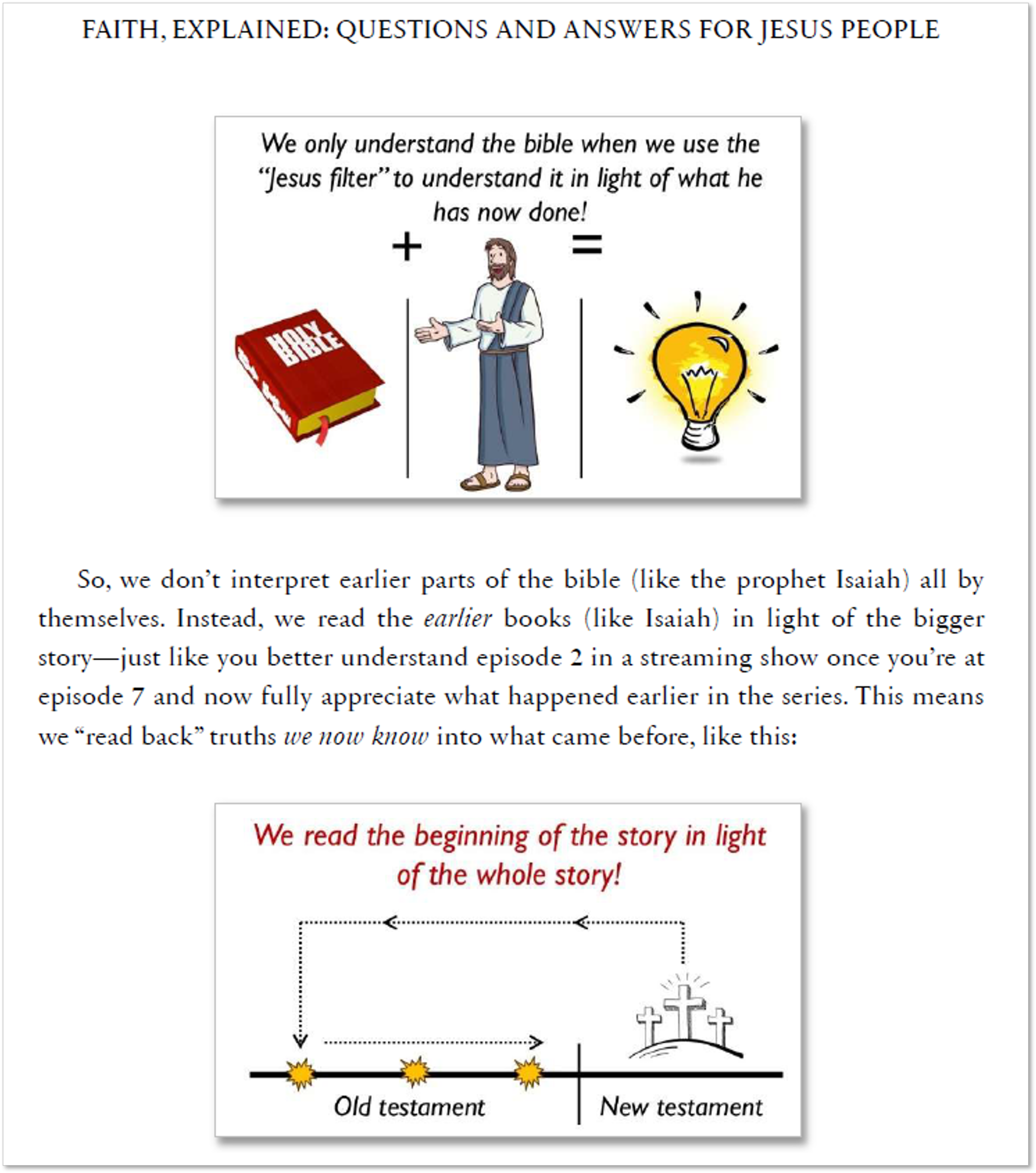
But the bible is a story that moves forward.

  1. It begins with creation in Genesis 1-2,
  2. catalogs the fall in Genesis 3,
  3. and then to the divine rescue through Christ the king that God promised throughout the old covenant, foreshadowed in the temple liturgy and sacrifices, and fulfilled in the story of Jesus in the Gospels,
  4. and finally, it concludes with the defeat of evil and the restoration of all things in Revelation 18-22.

But Rome says that Christ’s atonement does not make satisfaction for his people’s sins once for all and forever—so where is better hope by which we draw near to God (Heb 7:18)? Rome’s system offers a new covenant that’s stuck in neutral—one that is not better than the old covenant. Her story has run aground and hasn’t moved forward. Rome has exchanged a flat Diet Coke for a stale Pepsi. It’s a lateral move, not a promotion.

Hebrews 6:13-10:22 vaporizes all this. Rome offers nothing “new” or “better” in terms of practical effects. It isn’t a promotion, and that’s the bottom-line reason why it’s false, and so Rome’s teaching about the sufficiency of Christ’s atonement fails.

The truth is that: “when this priest had offered for all time one sacrifice for sins, he sat down at the right hand of God, and since that time he waits for his enemies to be made his footstool. For by one sacrifice he has made perfect forever those who are being made holy,” (Heb 10:14).


[1] BDAG, s.v., “παντελής,” sense 2, 754; see RSV, NRSV, NASB.

[2] LSJ, s.v., “παντελής,” 1300; see NET, KJV, NIV, NEB, REB, CSB, CEB.

[3] This means “[r]eparation or compensation for a wrong or a debt incurred,” (Millard J. Erickson, The Concise Dictionary of Christian Theology, rev. ed. (Wheaton: Crossway, 2001), s.v., “satisfaction,” 176).

[4] Tanner (ed.) “Trent,” Session 14, canon 13, in Decrees, 2:713.

[5] In fact, Rome says, if we believe that our penitential works are nothing more than the faith by which we grasp that Christ has already made satisfaction for our sins, then we’re damned to hell (Tanner (ed.) “Trent,” Session 14, canon 12, in Decrees, 2:713).

[6] Augustus H. Strong’s definition of “sanctification” captures the Protestant interpretation very well: “Sanctification is that continuous operation of the Holy Spirit, by which the holy disposition imparted in regeneration is maintained and strengthened.” Strong explained: “Salvation is something past, something present, and something future; a past fact, justification; a present process, sanctification; a future consummation, redemption and glory,” (Systematic Theology (Old Tappan: Revell, 1907), 869). Emphases added.

[7] James Leo Garrett Jr., Systematic Theology: Biblical, Historical, and Evangelical, Fourth Edition., vol. 1 (Eugene: Wipf & Stock, 2014), 206.

[8] Garret, Systematic, 2.206; Thomas Oden, Life in the Spirit: Systematic Theology, vol. 1 (San Francisco: HarperOne, 1987), 330-44.

[9] For example, Bishop James Gibbons wrote: “… the Church is the divinely appointed Custodian and Interpreter of the Bible. For, her office of infallible Guide were superfluous, if each individual could interpret the Bible for himself … God never intended the Bible to be the Christian’s rule of faith, independently of the living authority of the Church,” (Faith of Our Fathers, 10th rev. ed. (New York: John Murphy & Co., 1879), 94). 

[10] One doctor of the church declared: “Holy Scripture is in such sort the rule of the Christian faith that we are obliged by every kind of obligation to believe most exactly all that it contains, and not to believe anything which may be ever so little contrary to it,” (Francis de Sales, The Catholic Controversy, in Library of Francis de Sales, vol. III, 3rd ed., trans. by Canon Mackey (London: Burns & Oats, Limited, 1909), 88 (Part II, Article 1, Ch. 1).

[11] “The concept of heresy is grounded in the conviction that there exists one revealed truth, and other opinions are intentional distortions or denials of that truth. Absent such conviction, ‘heresy’ becomes little more than bigoted persecution. But the Christian belief in revealed truth means that heresy becomes not merely another opinion, but false teaching that leads people away from God’s revelation” (Daniel J. Treier and Walter Elwell (eds.), Evangelical Dictionary of Theology, 3rd ed. (Grand Rapids: Baker, 2017), s.v. “heresy,” 377-78).

Millard Erickson offers up this definition: “A belief or teaching that contradicts Scripture and Christian theology,” (Concise Dictionary, s.v. “heresy,” 88).

[12] Norman P. Tanner, S.J. (ed)., “Trent,” Session 6, Canon 30, in Decrees of the Ecumenical Councils, vol. 2 (Washington, D.C., Georgetown University Press, 1990), 2:681.

[13] The verb is present tense-form, and it can be rendered as “are being made holy” or “have been made holy.” Either way, Jesus’ once-for-all sacrifice is the means by which (διὰ τῆς προσφορᾶς) the holiness happens.

John 14:1-3 and the Rapture (Part 3)

John 14:1-3 and the Rapture (Part 3)

In Part 2 of this series, we presented four options for understanding what Jesus meant at John 14:1-3:

We also suggested a grading scale for evaluating these options:

  • Grade A: Explicit teaching.
  • Grade B: Implicit teaching.
  • Grade C: A principal or logical conclusion—an inference.
  • Grade D: A guess or speculation.
  • Grade E: Poor or non-existent support.

See the other articles in the “rapture series” here. See this entire article on “John 14:1-3 and the Rapture” as a single PDF here.

Now, let’s look at Option 1:

Option 1 can only be maintained by heavily freighting John’s words with presuppositions from elsewhere. This position is almost universally proposed by dispensational premillennialists.

  • It requires Jesus to return twice; (a) once for believers to transport them to heaven, and (b) again to imprison Satan and establish His kingdom (the event historically referred to as the second coming). Unfortunately, John 14:1-3 itself does not explicitly or implicitly support a two-stage return, nor does 1 Thessalonians 4:13-18 which we already examined.
  • It requires us to see a hard distinction been (a) the ethnic people of Israel, and (b) the Jews and Gentiles which comprise “the church.” Because of this distinction, advocates read the Old Testament prophesies about the tribulation as a time of trouble specifically for the ethnic people of Israel—the “church” is not involved. Therefore, Jesus must transport the church away beforehand, and so this passage is about that escape. However, this passage and its context says nothing about that.

Option 1 advocates offer several arguments for their position:

  1. If this passage were about Jesus’ second coming, then He would have mentioned the cataclysmic events of Matthew 24,[1] so He must be talking about something else—the pre-tribulational rapture.

Jesus already discussed those events, and nobody repeats every detail of a subject whenever a topic comes up. John’s gospel is famous for covering different ground than the other three,[2] he wrote 20 or 30 years later than Matthew,[3] and John 14 occurs in a different place in the timeline of Jesus’ ministry. In short, this is a weak argument from silence.

  1. Matthew 24 never mentions “my Father’s house,” but John 14:1-3 does.[4] Therefore John 14:1-3 is about something else—the pre-tribulational rapture.

This wrongly assumes “my Father’s house” must refer to a fixed place “up there,” in heaven. It’s also another weak argument from silence, for the reasons listed above.

  1. The persecution at John 15 is not characteristic of the tribulation.[5] Therefore John 14:1-3 is about something else—the pre-tribulational rapture.

However, in John 15 Jesus is not speaking about the tribulation but a different subject entirely. This objection falls.

  1. In John 14:1-3, Jesus never mentions a return with a trumpet blast accompanied by angels who will gather the elect from the four corners of the earth (Mt 24:30-31). Therefore John 14:1-3 is about something else—the pre-tribulational rapture.[6]

Again, this argument assumes that each biblical author will repeat everything another author says about the same topic. This is not the way human communication works. There is no place in scripture where any author incorporates everything everyone else has said on a particular subject. John was not writing a prophecy encyclopedia nor was Jesus lecturing on the topic—John was memorializing Jesus’ farewell address.

  1. If John 14:1-3 is about the second coming, that means believers will endure the great tribulation. But the tribulation is for the ethnic people of Israel, not the church. Therefore John 14:1-3 is about something else—the pre-tribulational rapture.[7]

Perhaps this is true, but neither this passage nor its context says anything about that. This is an objection from complete silence. If “the church” (as dispensationalists understand it) is not snatched away from earth before the tribulation, then it will be here during this terrible time. So, one writer suggests it would have been “cruel” of Jesus to not mention the tribulation at John 14:1-3 if He intended “the church” to endure it—that, if true, Jesus had “kept” this information from them.[8] A case can be made (and has been made over the centuries) that Matthew 24 already explains everything—just not along dispensationalist lines.

Arguments from silence are weak—and so is this one.

  1. The disciples have a heavenly hope for union with Christ, not an earthly one.[9] Therefore John 14:1-3 is about something else—the pre-tribulational rapture.

This is a conclusion, not an argument. The hope of all believers is community with God—Abraham was “looking forward to the city with foundations, whose architect and builder is God,” (Heb 11:10). This is the heavenly country (that is, the “country” with heavenly attributes[10]) that arrives at Rev 21-22, which contains the city which God has prepared for all believers (Heb 11:16). Community with God in renovated physical bodies (1 Cor 15:50-55) in a new heaven and a new earth (Rev 22)—that is our future.

  1. John 14:1-3 requires the saints “to dwell for a meaningful time with Christ in His Father’s house.”[11] Therefore John 14:1-3 is about something else—the pre-tribulational rapture.

Again, this makes the mistake of assuming “my Father’s house” must be a fixed place “up there” in heaven. This is incorrect. It also overlooks the solution that Jesus in John 14:1-3 simply refers to believers being in the Father’s presence (i.e., His “house”) upon their deaths.

  1. John 14:1-3 parallels 1 Thessalonians 4:13-18, which is about the pre-tribulational rapture. Therefore, John 14:1-3 is about the pre-tribulational rapture.[12]

Unfortunately, 1 Thessalonians 4:13-18 doesn’t explicitly or implicitly teach any such thing, as I’ve discussed.  

  1. The “Father’s house” is in heaven, not on earth.[13] Therefore John 14:1-3 is about something else—the pre-tribulational rapture.

If “the Father’s house” truly cannot be here on earth, then by this logic Jesus’ parents did not find Him in His Father’s “house” when He was 12 years old (Lk 2:49), and the Christian community is not a “spiritual house” (1 Pet 2:5) or God’s “building” (1 Cor 3:9) or His “temple” (1 Cor 3:16-17), and God’s “tent” or “dwelling place” will not be here on earth with His people (Rev 21:3), and the Lord God Almighty and the Lamb will not be the new Jerusalem’s “temple” (Rev 21:22). Fortunately, the “Father’s house” is a figurative shorthand that refers to “the Father’s presence” in various contexts.

  1. John 14:1-3 is about believers going to heaven, whereas at the second coming Jesus is returning to earth. Therefore John 14:1-3 is about something else—the pre-tribulational rapture.[14]

This is a reasonable argument. However, it’s undercut by two weaknesses. First, once again “my Father’s house” is not tied to a fixed place “up there,” but is a figurative reference to God’s personal presence wherever He might be. Second, just because the text suggests Jesus transports believers away from here, it doesn’t give a blank check to a complicated two-stage return for Christ that’s dependent on speculation from elsewhere in scripture. There is a much simpler option—that believers “go to heaven” when they die.[15]

All told, evidence supports a “D” rating for John 14:1-3 being about the pre-tribulational rapture. It’s a perspective build entirely on guesswork from elsewhere. It swamps the text and freights it with a load its words cannot reasonably bear. This doesn’t mean the pre-tribulational rapture is false—it just means it isn’t in this passage.

Arguments from silence can be helpful supports that prop up explicit and implicit bible teaching from elsewhere. They’re backing vocals that ought never be trotted out to carry the entire concert. So it is with John 14:1-3.

In the next and last article, we’ll look at the other three options to understand what Jesus meant at John 14:1-3.


[1] “… the wars and rumors of wars; the famines, pestilences and earthquakes; the great tribulation; the false prophets, etc. of which there is not a word in all of the Upper Room Discourse,” (Carl Armerding, “That Blessed Hope,” in Bibliotheca Sacra, 111:142 (April 1954), p. 150).

[2] See, for example, I. Howard Marshall, New Testament Theology (Downers Grove: IVP, 2004), pp. 491f.

[3] David deSilva tentatively suggests a date in the early 70s for Matthew (An Introduction to the New Testament: Contexts, Methods & Ministry Formation, 2nd ed. (Downers Grove: IVP, 2018), p. 215). N.T. Wright and Michael Bird offer up a date between 80-100 (The New Testament in Its World (Grand Rapids: Zondervan, 2019), p. 579), while Grant Osbourne suggests a date in the mid-to-late 60s (Matthew, in ZECNT (Grand Rapids: Zondervan, 2010), pp. 43-44). John’s Gospel is typically dated in the late 90s, shading to perhaps very, very early in the second century (cp. deSilva, Introduction, pp. 343-344).

[4] Armerding, “Blessed Hope,” p. 150.

[5] Armerding, “Blessed Hope,” p. 150.

[6] Armerding, “Blessed Hope,” p. 151.

[7] Armerding, “Blessed Hope,” p. 151. “And it is this purpose which distinguishes the coming of the Lord as promised in John 14 from His coming as the Son of man as predicted in Matthew 24.”

[8] Jonathan Pratt, “The Case for the Pre-tribulational Rapture,” in Dispensationalism Revisited: A Twenty-First Century Restatement (Plymouth: Central Seminary Press, 2023), p. 251.

[9] John Walvoord, “The Future Work of Christ Part I: The Coming of Christ for His Church,” in Bibliotheca Sacra, 123:489 (January 1966), p. 13). “This was an obvious contradiction of their previous hope that Christ was going to reign on earth and quite different in its general character. It indicated that their hope was heavenly rather than earthly and that they were going to be taken out of the earth to heaven rather than for Christ to come to the earth to be with them.”

“In making the pronouncement in John 14, Christ is holding before His disciples an entirely different hope than that which was promised to Israel as a nation. It is the hope of the church in contrast to the hope of the Jewish nation. The hope of the church is to be taken to heaven; the hope of Israel is Christ returning to reign over the earth,” (Walvoord, The Rapture Question, revised and enlarged (Grand Rapids: Zondervan, 1979), p. 71).

[10] In the sentence, “heavenly” is an attributive genitive: νῦν δὲ κρείττονος ὀρέγονται τοῦτʼ ἔστιν ἐπουρανίου.

[11] Richard Mayhue, “Why A Pretribulational Rapture?” in Masters Seminary Journal, TMSJ 13:2 (Fall 2002), p. 246.

[12] Armerding, “Blessed Hope,” pp. 151-152; Mayhue, “Pretribulational Rapture,” p. 246; Pratt, “The Case for the Pre-tribulational Rapture,” in Dispensationalism Revisited, pp. 250-251.

[13] Walvoord, The Rapture Question, p. 71. “Christ returns to the earthly scene to take the disciples from earth to heaven. This is in absolute contrast to what takes place when Christ returns to establish His kingdom on earth.”

[14] Lewis S. Chafer, Systematic Theology, vol. 5 (reprint; Grand Rapids: Kregel, 1976), p. 164.  

[15] Walvoord dismisses this as “spiritualizing,” which is a common slur in the dispensationalist lexicon (Rapture Question, p. 71).

John 14:1-3 and the Rapture (Part 2)

John 14:1-3 and the Rapture (Part 2)

In the first article, we set out to study what Jesus meant at John 14:1-3. Some Christians believe this passage speaks about the pre-tribulational rapture of the church to heaven, clearing the way for the tribulation here on earth. Is that right?

We began by looking at the context around Jesus’ words, which is His long goodbye talk at John 13:33 to 16:33. In this article, we’ll finish up the context, lay out four possible ways to understand Jesus’ words at John 14:1-3, then propose a “grading scale” to weigh these options. The next two articles in this series will examine these four positions in detail.

See the other articles in the “rapture series” here. See this entire article on “John 14:1-3 and the Rapture” as a single PDF here.

1c: Convo on Phillip’s implicit question (vv. 14:8-21)

Philip, perplexed, asks to see the Father. Jesus explains that Father and Son (and Spirit) mutually indwell one another in a mysterious way (Jn 14:10-11). This interwoven nature helps explain why the one God can eternally exist as three co-equal and co-eternal Persons.[1] This is why to “see” Jesus is to “see” the Father—to be with Jesus by means of trusting His Good News is to be “in God’s presence.”

But still—Jesus is physically leaving! He must leave so He can wage His divine campaign against the kingdom of darkness from on high through us (Jn 14:12).[2] Where does this leave us, then?

Well, Jesus promises to not leave us as orphans. The Father will send “another advocate to help you and be with you forever—the Spirit of truth,” (Jn 14:16-17). Unlike those outside God’s family, we will know this Spirit because He’ll reside with us and be inside us (Jn 14:17).[3] And so He won’t abandon us as orphans: “I will come to you” (Jn 14:18). On that day—that is, the day when the Advocate comes to dwell inside us—we will participate God’s inner life because we’ll be part of this mutual indwelling. “On that day you will realize that I am in my Father, and you are in me, and I am in you,” (Jn 14:20).

1d: Convo on Judas (not Iscariot’s) question (vv. 14:22-31)

When the Spirit takes residence inside us, Father and Son come along with Him: “we will come to them and make our home with them,” (Jn 14:23).

And yet, despite all this talk about being both absent and somehow “with us” at the same time, the fact is that Jesus is physically leaving us. Sure, the Spirit will be His proxy in the interim and, as we’ve seen, Father and Son will also tag along—but there is no physical, tangible “God with us” after the ascension.

Jesus realizes this will be a problem, because He returns to the theme and says it’s best that He leaves (Jn 14:28). If they love Him (and, by extension, love the victory over sin and Satan that His ministry is all about), then they should be glad that He’s headed back to the Father’s throne room. The scriptures “show” us the three Persons who comprise the One God by highlighting the “distinct and harmonious offices in the great work of redemption”[4] that each performs. In this case, Jesus casts a spotlight on the Father’s role in planning this divine rescue plan: “the Father is greater than I” (Jn 14:28). That is, as our vicarious surrogate and representative, Jesus is carrying out the Father’s plan—and that plan has Him leaving here and returning to the Father’s personal presence. By telling them about His departure He’s simply preparing them for this physical separation beforehand, so they’ll trust Him when it happens (Jn 14:29).

1e: Convo about the divine helper (vv. 15:26 to 16:15)

Jesus casts the Spirit’s role, and He and the Father’s spiritual presence within us via the Spirit, as an aid for evangelism (Jn 15:26-27). They must understand this, or else they might fall away from the faith (Jn 16:1). Bad times are coming, and true believers must stick with Him—this is Jesus’ point throughout John 15 (see esp. Jn 15:9-10). “I have told you this, so that when their time comes you will remember that I warned you about them,” (Jn 16:4).

Jesus has carefully meted out more information over time. He didn’t mention His long absence and the community’s mission beforehand “because I was with you, but now I am going to him who sent me,” (Jn 16:4-5). This is a physical departure for another place, returning to His words at John 14:2-4.

Though both Phillip and Thomas have asked Jesus where He’s going (Jn 13:36, 14:5), Jesus knows their questions are actually grief-stricken exclamations borne of shock (Jn 16:5-6). I must go, Jesus explains, because if I don’t, then the Advocate won’t arrive and carry out His mission through you all (Jn 16:7-11). But, when the Spirit arrives, He’ll guide believers into all truth—i.e., they’ll understand it all soon enough (Jn 16:13-14).

“Jesus went on to say, ‘In a little while you will see me no more, and then after a little while you will see me,’” (Jn 16:16). His meaning is unclear, but it’s best to see Jesus as speaking about the resurrection on Easter morning and the 40 days of instruction which follow.[5]

1f: Convo about the resurrection reunion (vv. 16:16-28)

The disciples are once again confused—the concept of Jesus’ death and resurrection makes no sense to them (Jn 16:17-18).

Jesus ignores their questions about the “why” and “how” of His departure, and instead reassures them that “it’ll be worth it all” when He returns (Jn 16:20-23). Their joy at beholding Jesus’ glorified and resurrected person, coupled with the power of the Holy Spirit poured out from on high at Pentecost, will turbo-charge their zeal to take His Good News to Judea, Samaria, and to the uttermost parts of the earth. Therefore, their joy will be irrepressible and complete (Jn 16:22, 24).

During the 40 days between His resurrection and ascension, Jesus will no longer speak to them figuratively— “I will no longer use this kind of language but will tell you plainly about my Father,” (Jn 16:25). Indeed, Luke tells us: “He appeared to them over a period of forty days and spoke about the kingdom of God,” (Acts 1:3).

Jesus then ends His long farewell address by pivoting back to where the discussion began—to His long-term departure, not simply the interval between Good Friday and Easter morning: “I came from the Father and entered the world; now I am leaving the world and going back to the Father,” (Jn 16:28).

Throughout the farewell address, Jesus refers to His departure and return in at least three different contexts; (a) His physical departure to the Father’s presence and eventual physical return, (b) His physical departure to the Father and His spiritual return via the Holy Spirit, and (c) His physical departure by death and His physical return on Easter morning. He dips in and out of these contexts repeatedly; first one, then the other, then still another. This means the reader cannot assume an “obvious” reading of John 14:2-4, but must follow the train of Jesus’ thought throughout the entire farewell address to make a reliable conclusion.

2: What does Jesus mean at John 14:1-3?

This much is clear:

  • Jesus speaks of a physical departure to a place where the disciples cannot follow (Jn 13:33). He identifies His destination as “to the One who sent me,” (Jn 7:33; cp. “just as I told the Jews” at Jn 13:33). The One who sent Him was God (Jn 1:14, 18).
  • Peter asks why they cannot follow Jesus to this destination (Jn 13:36-37).
  • Jesus responds by asking the disciples to trust Him (Jn 14:1). The discussion still centers on Jesus’ physical departure.
  • His destination is the Father’s personal presence, which he figuratively refers to as “my Father’s house.” Assuming the likeness of a kindly innkeeper, Jesus says He’s headed off to prepare “rooms” for all believers and will one day return to bring Christians to His Father’s “house.”

It seems there are four possible options for understanding John 14:2-3, and they each rely on different definitions of “my Father’s house.”

Table 1

2a: A grade scale for bible study

I suggest the following grading scale to evaluate the strength of a passage’s teaching:[6]

  • Grade A: Explicit teaching. The passage either (a) makes some direct statement in proper context, or (b) directly teaches on the specific issue (e.g., justification by faith, Jesus’ resurrection, Jesus as the only way of salvation, the virgin birth, etc.). Hold closely and aggressively to doctrines with Grade A support.
  • Grade B: Implicit teaching. Though there may not be a specific statement in context, or a direct passage about the subject using the summary terms the Church has developed over time, there is only one responsible conclusion (e.g., doctrine of the Trinity, two-nature Christology, baptism of professing believers only). Hold closely and aggressively to doctrines with Grade B support.
  • Grade C: A principal or logical conclusion—an inference. The issue is the application of a general principle from scripture in context, and/or a logical conclusion or inference from the data in proper context. “Because A, then it makes sense that B, and so we have C.” It isn’t the only conclusion possible, but it is a reasonable one (e.g., presence of apostolic sign gifts today, the regulative principle of worship, music styles in worship). Agree to disagree on doctrines with Grade C support, because the evidence is not conclusive for one position or the other.
  • Grade D: A guess or speculation. No explicit or implicit scriptural support, evidence falls short of a persuasive conclusion from the data, and it’s built on shaky foundations—“because A, then it makes sense that B, and therefore it could mean C, and so D.” It’s an educated guess based on circumstantial evidence (e.g., who wrote the Book of Hebrews). Hold very loosely to issues with Grade D support—never force your guess on another believer.
  • Grade E: Poor or non-existent support. No explicit or implicit evidence, no logical conclusion or inference from data, and cannot be taken seriously even as a guess. The passage doesn’t support the issue at hand. Ditch passages with Grade E support.

In the next article, we’ll look at Option 1 from the table, above.


[1] This is called “perichoresis,” which Erickson helpfully defines as: “Indwelling or mutual interpenetration. An ancient teaching that understands the Trinity as consisting of three persons, so closely bound together that the life of each flows through each of the others,” (Concise Dictionary, s.v., “perichoresis,” p. 152).

[2] Calvin, John, p. 2:90. Alvah Hovey, Commentary on John, in American Commentary (Philadelphia: American Baptist Publication Society, 1885), p. 286.

“A very wonderful promise! But has it been fulfilled? We think it has. For if we look at the wonders of the Day of Pentecost, together with the events that followed in the rapid spread of the gospel during the apostolic age, it does not seem extravagant to regard them as greater than any which took place during the ministry of Christ. And if we compare the spiritual results of the three most fruitful years of the ministry of Paul, of Luther, of Whitefield, or of Spurgeon, with the spiritual results of Christ’s preaching and miracles for three years, we shall not deem his promise vain. And if it be urged against the latter instances that miracles are wanting, it may be replied that supernatural works in the realm of spirit are superior, rather than inferior, to those in the world of sense—that to raise a soul from death unto life is really a greater act than to raise a dead body from the grave.”

[3] Gk: ὅτι παρʼ ὑμῖν μένει καὶ ἐν ὑμῖν ἔσται.

[4] 1833 New Hampshire Confession of Faith, Article II. 

[5] This is Chrysostom’s interpretation and it’s followed by many modern interpreters (“Homily LXXIX,” in NPNF1, vol. 14, ed. Philip Schaff, trans. G. T. Stupart (New York: Christian Literature Company, 1889), p. 291).

There are two other reasonable options to understand Jn 16:16f.

First is that Jesus speaking of the coming of the Spirit—they will soon not see Him any longer, but nevertheless they will “see” Him by the illumination of the Spirit. This hinges on the two different words for “see” which John uses, and the conclusion that if John were speaking of them physically “seeing” Jesus soon, he would have used the same word for “sight” in the sentence. But he didn’t. So, there must be some distinction between the two words, and the latter can be interpreted as a mental or spiritual perception (BDAG, s.v., sense A.4). John Calvin is an eloquent champion for this view (Commentary on the Gospel According to John, vol. 2 (reprint; Bellingham: Logos, 2010), p. 147). More recently, Edward Klink advances this proposal (John, ZECNT (Grand Rapids: Zondervan, 2016; Kindle ed.), loc. 18998f). This interpretation is plausible but seems too cute by half. Jesus’ insistence on them seeing Him again and being filled with joy (Jn 16:20f) seem to indicate something more than spiritual enlightenment.

A second option is that Jesus is speaking of His second coming. But His audience never saw the second coming. It seems hollow if Jesus assured them all that they’d soon see Him, but He really meant that the Christians alive at His second coming would see Him.

[6] I am indebted to Paul Henebury’s “Rules of Affinity” as the inspiration for this grading scale. I did not use his grading scale or his descriptions, but I did take his general concept.

John 14:1-3 and the Rapture (Part 1)

John 14:1-3 and the Rapture (Part 1)

Many American Christians have been raised in a church culture that stresses that Jesus will return to “rapture” or snatch away “the church” before the Great Tribulation. They believe “the church” is a different people than ethnic Israel, with a complementary but distinct future.[1] Because this great tribulation is “a time of trouble for Jacob” (Jer 30:7), it is not for “the church.” Therefore, the rapture is the point where “the church” slips out the door just before this tribulation begins.

They believe this rapture will involve (a) resurrection of all believers who died since Pentecost, and (b) a simultaneous snatching away of all believers still alive, all to (c) meet the Lord in the air for transport to heaven while tribulation rages here. Later, Jesus will return from heaven with “the church” to end this great tribulation—this is the second coming.

This is part of a “pre-tribulational” (i.e., Jesus will return before the tribulation), and “premillennial” (i.e., Jesus will establish His kingdom to trigger the millennium) framework called dispensationalism.

Many of these Christians point to John 14:1-3 as proof of the rapture of “the church.” This article will consider what Jesus says at John 14:1-3. First, we’ll examine the entire context of Jesus’ farewell talk at Jn 13:33 to 16:33. Second, we’ll examine four common interpretations about what Jesus said at Jn 14:1-3. Third, we’ll propose a solution.

See the other articles in the “rapture series” here. See this entire article on “John 14:1-3 and the Rapture” as a single PDF here.

1: The long convo—Jesus says goodbye

It’s silly to interpret something without context. You watch a video clip of something that looks terrible, but the whole clip shows it in it’s true light. It’s the same with the bible. So, to get what Jesus says at John 14:1-3, we must consider everything He says during a very long talk after the last supper.

Here’s the outline—and this is “kind of a big deal” because Jesus constantly talks about different ways in which He’ll “come back” and reunite them to the Father. Skip this if you want, but you might want to refer to it later.

  • Jn 13:33-35: Jesus’ announcement about His physical departure, and therefore the necessity of brotherly love as the mark of the true Christian community
    • Jn 13:36 – 14:4: Dialogue on Peter’s question.
      • Believers must trust Jesus. He will physically return to the Father’s personal presence, and eventually bring believers into His Father’s presence, too. Yet, they already know “the way”!
    • Jn 14:5-7: Dialogue on Thomas’ question.
      • Believers are, in a real sense, in the Father’s presence right now by means of trusting in Jesus’ Good News—He is “the way” to the Father’s “house.”
    • Jn 14:8-21: Dialogue on Philip’s implicit question.
      • Jesus and the Father mutually indwell one another, and this is why when you “see” one you “see” the other. Jesus must return to the Father’s presence to direct His campaign against the kingdom of darkness from on high. Meanwhile, He sends believers the Holy Spirit so we aren’t left as orphans. Jesus will reveal Himself to (i.e., be “seen” by) those who love the Father, by means of the Spirit.
    • Jn 14:22-31: Dialogue on Judas (not Iscariot’s) question
      • Jesus will only show Himself to those who love Him, which means those who obey His teaching. The Spirit, through whom Jesus is “with us,” brings believers peace and teaches them. Jesus warns the disciples about all this beforehand, so they’re prepared for the day.
  • Jn 15-16: Jesus and the disciples “walk and talk” on the streets of Jerusalem
    • Jn 15:1-25: Be sure to stick with Jesus.
      • Fruit is the mark of a true Jesus follower, and the defining fruit is brotherly love.
    • Jn 15:26 – 16:15: The work of the Spirit in the New Covenant.
      • Jesus must physically return to the Father and “pass the baton” (as it were) to the Spirit. He will be their Advocate and teacher, and so they’ll be able to endure.
    • Jn 16:16-28: Jesus on His resurrection reunion.
      • The disciples will see Him “after a little while,” (Jn 16:16) and then their grief will turn to joy (Jn 16:20, 22). At that time, Jesus will speak plainly to them about the Father (Jn 16:25).
    • Jn 16:29-33: Farewell address ends

1a: The mic drop—Jesus says goodbye (vv. 13:33-35)

Our passage opens after Judas has bolted from the Last Supper and fled into the night. He’s on his way to betray Jesus to the Jewish authorities (Jn 13:27-30).

Jesus, perhaps taking a deep breath as He sees the walls closing in on Him, explains that both He and God will be “glorified” by what’s about to happen. It’s so certain that Jesus speaks as if His arrest, torture, and execution are already a done deal: “Now the Son of Man is glorified and God is glorified in him,” (Jn 13:31). The word “glorify” here is a churchy term, and it means to be held in honor, or clothed in splendor.[2] Basically, Jesus will be honored triumphantly,[3] and so too will God.

Jesus then explains: “My children, I will be with you only a little longer. You will look for me, and just as I told the Jews, so I tell you now: Where I am going, you cannot come,” (Jn 13:33).

Where is Jesus going? Clearly, it’s back to the Father’s side in heaven (cp. Jn 17:1ff). Now, heaven is not a physical location “up there” in the clouds. Satellites go “up there.” Manned space missions go “up there.” Heaven is not in outer space—it’s best understood as a different dimension where God dwells.[4] It’s the place from which Jesus came (Jn 3:13; 17:1f) and to which He returned at His ascension: “he entered heaven itself, now to appear for us in God’s presence,” (Heb 9:24). It’s the place where God dwells (“Our Father in heaven …” Mt 6:4). It’s the place where believer’s inheritances are kept for them (1 Pet 1:4-5; cp. Mt 6:20). Heaven is God’s throne room (Mt 5:34). Perhaps, then, we should see “the kingdom of heaven” as meaning something like “the kingdom of God’s presence” which has “come near” in Jesus (Mk 1:15)—His reign.

Because heaven in our context is God’s holy presence, then we should remember that God is not a stationary rock—He moves. In fact, the Christian story ends with this declaration: “Look! God’s dwelling place is now among the people, and he will dwell with them,” (Rev 21:3). The story moves from (a) crude representations of God’s throne room under the figures of the tabernacle (Ex 25:9), to (b) the New Testament explanation that these figures taught us in advance about Christ’s sacrifice (Heb 9:1 – 10:18), and finally (c) to Father and Son sharing a throne here on earth, in a new creation (Rev 21:1 – 22:5).

The Apostle John sees “the Holy City, the new Jerusalem, coming down out of heaven from God,” (Rev 22:12). The celestial city represents the pure community of God’s presence just as Babylon is the community of evil and wickedness (Rev 17-18), and one day it will no longer be just “the Jerusalem that is above” (Gal 4:26)—it will be here. No longer will our citizenship in “Mount Zion … the city of the living God, the heavenly Jerusalem” (Heb 12:22) be an abstraction that we can’t see and touch—it will be here.

More than a place, this “heaven” here on earth is also a state of being. There are no tears, no pain, no sorrow, no sin— “nothing impure will ever enter it … no longer will there be any curse,” (Rev 21:27; 22:3). “There will be no more death or mourning or crying or pain, for the old order of things has passed away,” (Rev 21:4). One writer says: “Heaven is the life willed for us originally in creation by God the Father, lived for us by the Son, and finally enabled by the Spirit.”[5] Isaiah speaks of a “new heavens and a new earth” with very physical and earthly descriptions of perfect fellowship in an ideal society (Isa 65:17-25). No old age, no infant mortality, endless crops of plenty, satisfaction from work, blessedness from the Lord, perfect fellowship with Him and each other—it’s all there.

Belinda Carlisle was right— “heaven” will indeed be a place on earth, because heaven is God’s personal presence which brings blessedness and community with Him. This is why the Apostle Peter, casting his mind on promises like these, wrote: “… in keeping with his promise we are looking forward to a new heaven and a new earth, where righteousness dwells,” (2 Pet 3:13).

God has long promised to re-create the fellowship and community our first parents ruined (Zech 2:10; Ezek 48:35), and by the end of the story He will have made good on that promise. This means that “heaven” is not static. New York City doesn’t move, nor does London—but “heaven” does, because “heaven” is where the Lord is.

So, what does Jesus mean in John 13:33 when He says: “Where I am going, you cannot come?” He means (a) that He’s soon returning to the Father’s personal presence (“I am coming to you now …” Jn 17:3), and that (b) the disciples cannot yet come with Him. Why not? Because they’re still alive, and so will remain here. To be absent from the physical body is to be physically present with the Lord in that other place (2 Cor 5:8). But, for now, we who are alive must wait.

1b: Convo on Peter’s question (vv. 13:36 to 14:4)

Peter and the others then ignore Jesus’ urgent pleas for them to show love to one another (Jn 13:34-35), and instead press Him about His departure (Jn 13:36-37)—what’s that all about?

Simon Peter asked him, “Lord, where are you going?”

Jesus replied, “Where I am going, you cannot follow now, but you will follow later.”

Peter asked, “Lord, why can’t I follow you now? I will lay down my life for you.”

How could He leave? What’s going on? Where is He going? After an incredulous aside to Peter (Jn 13:38), Jesus murmurs some comforting words: “Do not let your hearts be troubled. You believe in God; believe also in me,” (Jn 14:1). The word might be better translated as trust (not “believe”), but the point is that Jesus’ departure is not an abandonment.

My Father’s house has many rooms; if that were not so, would I have told you that I am going there to prepare a place for you? And if I go and prepare a place for you, I will come back and take you to be with me that you also may be where I am. You know the way to the place where I am going (John 14:2-4).[6]

This “house” is figurative imagery to express the place where the Father lives—i.e., His personal presence.[7] This is why Jesus referred to the temple, that grand and living object lesson, as “my Father’s house” (Lk 2:49; Jn 2:16)—because the Father lived inside.[8] This is why the Apostle Paul says the Christian community is God’s “house” (1 Cor 3:6; 1 Tim 3:15)—because God’s Spirit dwells in our midst. It’s why the writer of the letter to the Hebrews explained “we are his house,” (Heb 3:6). The temple is God’s “house” (Ps 69:9, cp. Jn 2:17; Lk 19:46).

But “my Father’s house” is not a physical structure anchored to a particular place. God does not live at 777 Eternity Drive. Instead, “my Father’s house” is a figurative reference to God’s personal presence. In the same way, the real throne room in heaven to which Jesus returns is “my Father’s house” because God is there.

We’ve seen that there is no physical house, and there are no real rooms. These are metaphors. Jesus is saying that He won’t abandon them. Adopting the imagery of a friendly innkeeper, Jesus promises that He’s leaving to prepare “rooms” for each one of them in the Father’s personal presence (i.e., “my Father’s house”). And one day Jesus will come back and bring them face to face with God so they can all be there with Him together. In fact,[9] they already know how to get to the Father’s house themselves (Jn 14:4).

We continue looking at Jesus’ farewell talk in the next article.


[1] See Charles Ryrie, The Basis of the Premillennial Faith (New York: Loizeaux Brothers, 1953),ch. 7. Ryrie’s book should be titled The Basis of the Dispensational Faith, because premillennialism is not necessarily dispensationalism.

C. I. Scofield wrote: “Comparing, then, what is said in Scripture concerning Israel and the Church, he finds that in origin, calling, promise, worship, principles of conduct, and future destiny—all is contrast,” (Rightly Dividing the Word of Truth (reprint; Philadelphia: Philadelphia School of the Bible, 1921), p. 11). Scofield’s student, Lewis S. Chafer, lists 24 contrasts between Israel and the Church (Systematic Theology, vol. 4 (reprint; Grand Rapids: Kregel, 1976), ch. 3)!

[2] See BDAG, s.v., sense 2; LSJ, s.v., sense 2.  

[3] Oxford English Dictionary, s.v. “glory (v.1), sense 1,” July 2023, https://doi.org/10.1093/OED/4382797103.

[4] See (a) Millard Erickson, Christian Theology, 3rd ed. (Grand Rapids: Baker, 2013), pp. 1125-1133, (b) Alvah Hovey, Biblical Eschatology (Philadelphia: American Baptist Publication Society, 1888), pp. 156-160.

[5] Thomas Oden, Life in the Spirit: Systematic Theology, vol. 3 (San Francisco, HarperCollins, 1992), p. 460.

[6] The Greek here is pretty straightforward. Any mysteries in this verse aren’t hidden here: Gk: ἐν τῇ οἰκίᾳ τοῦ πατρός μου μοναὶ πολλαί εἰσιν εἰ δὲ (emphasis) μή, εἶπον ἂν ὑμῖν ὅτι πορεύομαι ἑτοιμάσαι τόπον ὑμῖν; καὶ (additive) ἐὰν πορευθῶ καὶ ἑτοιμάσω τόπον ὑμῖν, πάλιν ἔρχομαι καὶ παραλήμψομαι ὑμᾶς πρὸς ἐμαυτόν, ἵνα (purpose + subjunctive) ὅπου εἰμὶ ἐγὼ καὶ (adjunctive) ὑμεῖς ἦτε (subjunctive = paired with ἵνα) καὶ (emphasis) ὅπου (obj. gen.) [ἐγὼ] ὑπάγω οἴδατε (intensive perfect) τὴν ὁδόν (direct obj.).

“In my Father’s house are many rooms. Surely, if this weren’t true, would I have told you all that I am leaving to prepare a place for you? And, if I am leaving to prepare a place for you all, I will come again and take you along with me, so that you will also be where I am. In fact, you already know the way to the place I am going.”

[7] BDAG, s.v., sense 1b.  

[8] Although God never indwelt the second temple, you get the point.   

[9] The NIV drops the conjunction in the phrase: καὶ ὅπου ἐγὼ ὑπάγω οἴδατε τὴν ὁδόν. The conjunction is likely ascensive or perhaps emphatic—the result is the same; the previous thought is focused and further developed.