Understanding Justification by Faith

Understanding Justification by Faith

The heart of the Protestant Reformation is that God declares you to be righteous by faith alone, in Christ alone. If you don’t believe this, then you do not have the true good news. This doctrine is often called “justification by faith.” It’s a churchy phrase that has lost some of its punch—many Christians know it’s “good,” but perhaps they can’t explain what it means. This article will show how the apostle Paul explains this vital truth in Romans 3:19-31. It’s a very big deal. Maybe the biggest deal ever.

The problem

We can trace the “Christian” family through three broad streams:

  1. Eastern Orthodoxy. This stream hails from the traditional Christian lands in modern-day Greece, Turkey, Syria, etc. It largely went its own way after the Western Roman Empire crumbled to bits. We won’t be discussing this tradition here.
  2. Roman Catholicism. This branch developed as a recognizable institution in the remnants of the western Roman Empire beginning from the late 6th century.
  3. Protestants. This is the variegated stream which broke away from the corruption of the Roman Catholic church beginning in the early 16th century, first in modern-day Germany, then in Switzerland, and beyond. If you’re a Christian in the West (that is, you’re not a convictional Roman Catholic and do not belong to a cult), then you’re in the “Protestant” stream—whether you know it or not.

Many churches celebrate “Reformation Sunday” on the Lord’s Day closest to 31 October to commemorate Martin Luther’s challenge to debate a series of theses about reforming the corrupt Roman Catholic church.

The Roman Catholic church believes good and true things about the trinity, about sin, about salvation, about Jesus, the virgin birth, our Savior’s life and death, his resurrection, his ascension, his return, and the new heavens and new earth.

So, what’s the problem?

  • The problem is about the sufficiency of God’s grace by Jesus Christ.
  • How, exactly, do we become Christians?

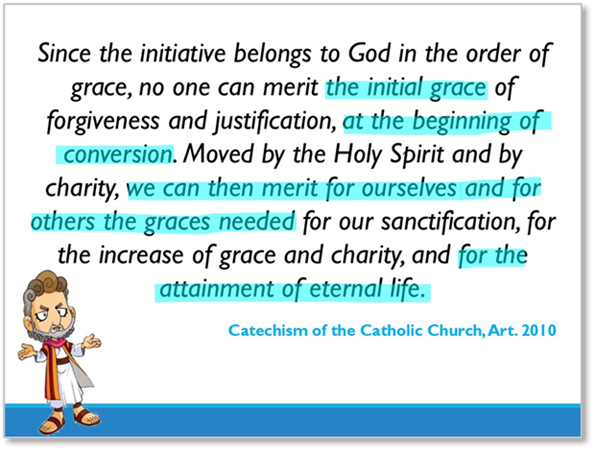
The Roman church teaches the equation: “Jesus + good works = merits eternal life.” It teaches that “Jesus + good works = forgiveness, reconciliation, and divine pardon.” Rome’s catechism explains (Art. 2010):

Rome speaks of “initial grace” and “the beginning of conversion.” There is no before and after. There is no bright line in the sand. Salvation is a cooperative process, not a divine event. Moved by the Spirit and by love, we must do good works to “merit for ourselves” the grace needed for eternal life.

This is heresy. It is false. It is wrong.

The truth is that we must trust in Jesus alone for salvation. God declares us to be righteous on the basis of what Jesus has already done. Based on that declaration, God gives his people legal pardon and personal reconciliation. Rome may speak of grace, charity, and conversion, but it means something very different.

Like all false religions, Rome teaches a version of “resume-ism.”

If you don’t believe God exists, then you’re not interested in submitting your resume to God. But, if you do believe he exists, then resume-ism will send you to hell—because it’s wrong.

  • You can talk about Jesus all you want, but in the end it’s about you—what you do, what you bring to the table.
  • The true faith is about Jesus, what he did, how he rescues you, and how God pardons you and declares you to be righteous if you trust in what Christ did for you.

The apostle Paul is against resume-ism. It’s his obsession. As we parachute into our passage at Romans 3:19-31, we learn from the first portion of the chapter that everyone is a sinner, without exception.

  • We’re all in trouble. We’re guilty before the King of the universe.
  • God’s old covenant law tells us how his people ought to act.
  • But we don’t act like that all the time, or even most of the time.
  • Most of us don’t want to act like it either.

So, most people don’t belong to God, because they don’t do what he says, nor do they want to. Now, to our passage.

Righteousness from God

The old covenant law tells God’s people how to live and love him. How to be different, weird, and separate from the world until the Messiah comes. This law speaks to people who are under its authority, “so that every mouth may be silenced and the whole world held accountable to God” (Rom 3:19).

He’s saying the old covenant law silences all excuses and acts as an immovable divine witness to which we are all accountable.

How does this accountability work? Why does it silence us as it confronts us?

Because by means of works of the law (ἐξ ἔργων νόμου) nobody will be declared to be righteous, in God’s sight (Rom 3:20). The word your English bible renders here as “righteous” or “justified” is a legal idea that means moral uprightness. You can’t achieve that by doing the works of the old covenant law—because you’ll keep messing up.

How do we know this? Because the law tells us so, because “through the law we become conscious of our sin” (Rom 3:20).

  • The law brings knowledge of sin.
  • It tells us we’ll always fall short of the mark—somehow, some way.
  • No matter what.
  • 100% guaranteed.

This isn’t good, obviously. If God left it there, some people might think he were cruel. But God is not toying with us. The law isn’t about salvation at all. It isn’t there to make us gnaw our fingernails and fear damnation. That’s just resume-ism talking.

  • Law-keeping does not earn us salvation. It never did.
  • Instead, the old covenant law tells us how to live while we wait for our Rescuer—King Jesus.
  • But this “resume-ism” idea had so infected and twisted the popular Jewish understanding of salvation by Paul’s day (and Jesus,’ too) that in many circles it had become the default gateway to a relationship with God.
  • Trust in the coming Messiah. Do law-keeping really well. Repeat (see Lk 18:9-14).

But, the apostle Paul says, that’s all wrong. It’s always been wrong. Now, separate from the old covenant law (χωρὶς νόμου), righteousness from God has now been made known—testified to by the law and the prophets (Rom 3:21). Resume-ism has nothing to do with the righteousness from God that’s on the table.

If this righteousness from God—the kind that can never come by means of works of the law—is testified to by the law and the prophets … is it a new thing?

Of course not. This isn’t new. It’s simply the re-presentation of something very old. Rome would do well to listen to Paul. If so, it wouldn’t speak of “meriting for ourselves” the grace needed for eternal life.

  • Well, how do you get this righteousness that God is offering? “This righteousness is given through faith in Jesus Christ …” (Rom 3:22). We trust in his faithfulness—that he has been perfect for us, as our delegate and representative.
  • Who can have it? Who is eligible? “… to all who believe” (Rom 3:22).
  • Why is this righteousness open to anyone? “Because there is no distinction [between people]—everyone sins and therefore lacks God’s glory” (Rom 3:22-23, my trans.).

The phrase often translated as “fallen short of the glory of God” means to be deficient—to be missing or lacking something. Without Jesus, we are each missing the righteousness and holiness and love for God he made us to have. Instead, we sin, so we’re broken, and so we “fall short of” (i.e., lack) God’s glory.

So, how does this righteousness from God happen? Why is it by faith alone and not works?

  • Because God declares us to be righteous as a gift, or freely, or gratis (Rom 3:24). This declaration is “on the house.” This means there is no “merit” we bring to the table. Rome is wrong. Dead wrong.
  • God issues this declaration to his people by means of his grace, through the liberation (“redemption”) that comes from Christ Jesus (Rom 3:24).

How so?

Well, “God displayed him publicly as the instrument of forgiveness by his shedding of blood, to be received by special faith. God did this to prove his justice because, due to his long-suffering patience, he had let the sins of the past go unpunished” (Rom 3:25, my trans.).

Jesus is the propitiation or sacrifice of atonement or instrument of forgiveness. How so? By means of his death (ἐν τῷ αὐτοῦ αἵματι).

  • This is a Federal, representative concept (see Rom 5:12f).
  • Like Adam, Jesus is the vicarious representative who acts on behalf of his people. Jesus lives the perfect life we cannot. He dies the criminal death we deserve. He defeats Satan and the curse of death on our behalf. He does this as our Federal representative.
  • Jesus takes our sins upon himself in the same manner as an employer that is legally, vicariously responsible for the actions of its employees.
  • The difference is, of course, that Jesus does this willingly and lovingly.

How do we receive this righteousness from God that Jesus achieves? By faith (Rom 3:24). Not by works. In fact, Jesus has retroactively paid for all the sins he had forgiven on credit from the old covenant days gone by (Rom 3:25).

God has done this as a demonstration or proof of his righteousness—his justice (Rom 3:26). I recently investigated a case in which adoptive parents sexually and physically tortured their adoptive children for years. It would have been evil if the state had opted to “forgive and forget” this. We instinctively know that. Crime demands punishment. Justice must be done. It’s the same with God, and so Jesus’ life—his death as our vicarious representative—is what satisfies the justice required. That’s why Jesus’ life and death demonstrates or proves that God is just.

And whom does God justify? Who does God declare to be righteous? The one with the best resume? The one who does more than the guy next to him? The one who does the most good works? No—it is “those who have faith in Jesus” (Rom 3:26).

The inevitable result of resume-ism is pride and self-satisfaction. But, because we now know that righteousness is a gift from God separate from works, we know that all boasting is excluded. It is shut out by the law of faith (Rom 3:27). It has nothing to do with being a Christian. “For we maintain that a person is justified by faith apart from the works of the law” (Rom 3:28). This is open to any person. Jew. Gentile. Azeri. Afghani. Japanese. God will declare anyone to be righteousness who trusts in Christ for salvation (Rom 3:29-30; cp. Gal 3:28-29).

This whole thing (righteousness from God by faith alone, in Christ alone—nothing to do with resume-ism) is not new. The new covenant does not rip up and invalidate the old covenant law. Instead, the apostle Paul declares, it upholds it (Rom 3:31) because Jesus teaches us that the law is about how to live as believers, not how to become a believer.

Why being a Protestant matters

It matters because this is about how you become a Christian. Is Jesus’ grace enough to (a) give us permanent, legal pardon, and (b) permanently heal our broken relationship with God? Or do we need to stir in some resume-ism, too? The apostle Paul says that, because we have been justified by faith, we have peace with God through our Lord Jesus Christ (Rom 5:1).

We’re justified by God because we have faith … in what?

  • That Jesus died for you.
  • That he did it as your vicarious representative, in your place.
  • That resume-ism won’t get you there.
  • That it can’t get you there.

And so, the equation “Jesus + something else = salvation” is wrong. It will send you to hell, because it can’t get you this righteousness from God (Gal 2:21).

  • That means you’re still in trouble, no matter what label you put on yourself.
  • It means you don’t have peace with God through our Lord Jesus Christ, because you haven’t yet trusted in him alone for salvation.
  • You’re still trying to upload your resume to the website.

But God does not want your resume. He wants you to only trust in what his eternal Son has already done for you. He declares you to be righteousness by means of faith and trust in his Son—nothing else. That is the core issue of the Protestant Reformation, and of the true Christian faith.

Identifying and Avoiding False Teachers

Identifying and Avoiding False Teachers

False teachers are a big deal in the bible. Here, I’ll answer three important questions about them that ought to help every Christian be on guard against their tricksy ways.

Q1: What is a false teacher?

The apostle Peter has a lot to say about false teachers. So does Jude. It’s possible that Jude had Peter’s second letter and borrowed a lot of his material for his own letter. If you read them, they sound similar! What, exactly, are false teachers? What makes them “false”? Both authors sum it up very simply:

  • Peter says they “secretly introduce destructive heresies, even denying the Master who bought them …” (2 Pet 2:1).
  • Jude tells us these bad actors are “ungodly persons who turn the grace of our God into indecent behavior and deny our only Master and Lord, Jesus Christ” (Jude 4).

There you have it. A false teacher is someone who denies, disowns, repudiates, or refuses to believe the truth about Jesus. You could say that every heresy, every false teaching, every lie about the gospel always begins by denying something about who Jesus is and what he’s done for his people. People create fake Jesus in their own image. 

  • People say Jesus never really died.
  • That he is not God.
  • That he is not eternal.
  • That he is not co-equal with the Father.
  • That he was not conceived by a miracle of the Holy Spirit in Mary’s womb.
  • That he was not sinless.
  • That he did not die in our place, as our substitute.
  • That his death was not a ransom.
  • That his perfect life and willing sacrifice did not satisfy divine justice.

These lies (and others) keep coming back. Every Easter, a major newspaper trots out an article by some liberal scholar who claims to reveal “the truth” about Jesus. False teachers are alive and well. Peter said they would be: “false prophets also appeared among the [old covenant] people, just as there will also be false teachers among you” (2 Pet 2:1).

Q2: How do we know who Jesus is and what he has done?

If a false teacher is someone who denies some key truth about who Jesus is and what he has done, then what tools has God given us so that we can find out these truths? Very simple—by his message, recorded in the bible, and by the Holy Spirit. 

Peter tells us about that, too. He wants us to know, with sure conviction, that we can trust the account he’s given us. He and the other disciples didn’t follow clever fables when they told everyone about Jesus—they literally saw him in his majestic splendor (2 Pet 1:16)! They saw what happened to him on that mountain, when he transformed before them into a figure of blazing white, radiant with pure holiness and heavenly light. Peter heard the Father speak words of affirmation about his eternal Son from the heavenly cloud of glory that surrounded them on that mountaintop (2 Pet 1:17-18).

So, he reminds us, the prophecies from the old covenant have now been made surer and more certain. Events have confirmed them. These prophesies and promises are like a lamp shining in a dark place, guiding us until that day when Jesus returns to be the literal light of the world (2 Pet 1:19). So, know this first of all, Peter says: these prophesies weren’t private intuitions or ramblings people made up—they were messages given by men as they were moved by the Holy Spirit to speak (2 Pet 1:20-21)!

The scripture is the record of God’s message to us, and that message is all about Jesus. The Holy Spirit is the who confirms and interprets the scripture for us—every Christian should read John Calvin’s short explanation of this (see Book 1, ch. 7, from Calvin’s Institutes of the Christian Religion). So, to know the truth about Jesus, we must read about his message in the holy scriptures and trust the Spirit of God to help us understand it all.

Q3: How can I be sure I’m interpreting the scriptures about Jesus the right way? 

This immediately raises another important question—how do I know that I (and my church) are putting the puzzle pieces together correctly? How do we know we’re believing the right things about Jesus? How do I know I’m interpreting the scriptures the proper way? 

Here is where we must deliberately leave our American individualism behind, and make sure we’re on the same page as the untold millions of our Christian brothers and sisters who have gone before us. Jesus tells us that true believers will hear his voice and follow him (Jn 10:1-4). This means that Christians down the centuries have heard the message of the true Jesus, have followed him, and have written down Spirit-led facts and summaries about what the bible says about the true Jesus. 

We find this broad consensus about Christian doctrine in the great creeds and confessions of the early church. This doesn’t mean these documents stand atop holy scripture like an infallible filter. One Baptist scholar memorably said we ought to believe in suprema scriptura, which means the bible is the highest or supreme channel of religious authority.1 This is good—we believe that “the Holy Scripture is the only sufficient, certain, and infallible rule of all saving knowledge, faith, and obedience …” (2LBCF, 1.1). So, creeds and confessions aren’t filters that interpret the bible for us—but they are guardrails that give us assurance that we haven’t run off the road and into a ditch. 

I’m thinking especially of these documents:

  • The Nicene Creed of 325 A.D. and the Nicene-Constantinople Creed of 381 A.D. These clarified Jesus’ deity and his relationship to the Father. Is Jesus a created being? Is Jesus an angel? If Jesus is God’s “son,” then does this mean he came on the scene later than the Father? If Jesus is God, and the Father is God—are Father and Son one being/substance or two?
  • The Chalcedonian Creed of 451 A.D. What does it mean that Jesus is both divine and human? Did he stop being divine? Or was he not really a fully human person? What happened to him in the incarnation?

From there, see especially the major creedal documents that give shape to your Christian tradition. Assuming you’re a Protestant Christian, the buffet line goes a bit like this: 

  • Lutherans have the Book of Concord, which consists of the Augsburg Confession, Luther’s small and large catechisms, and some other documents.
  • Presbyterians have the Westminster Standards, which include the Westminster Confession of Faith, and the Westminster larger and smaller catechisms.
  • The Reformed have the Three Forms of Unity, which are the Belgic Confession, the Heidelberg catechism, and the Canons of Dort.
  • Baptists are cantankerous in this regard, so I’ll just select one strand of the Baptist tradition and suggest the Second London Baptist Confession (“2LBCF”) and the Orthodox Catechism.2

I don’t care which flavor of Christian you are—go to your tradition’s confession of faith and read what it says about Jesus. No matter which tradition you consult from my list, they all say the same thing about Jesus—the same truths, the same affirmations, the same Jesus. Read the 2LBCF’s explanation here—it’s not long!

Why do creeds and confessions matter? Why are they good guardrails?

Because we don’t need to reinvent the wheel every generation. God gave the same Holy Spirit to our brothers and sisters in 325 A.D. as he does today. He led them into all truth, too. They believed the gospel, read the scriptures, learned from their church leaders and from one another, and had power on high from the Spirit of God. They wrote down summary statements of the faith. We have what they wrote. We would be fools to toss all that aside and start fresh with a blank sheet of paper. 

This means that, if you and your church believe something about Jesus that no credible group has ever believed in the history of the church … then you’re probably wrong. We can consult a record of sorts because we have those creeds and confessions from centuries gone by that tell us what our brothers and sisters in Christ thought about who Jesus is and what he’s done.

How do we avoid false teachers?

They’re tricksy. They don’t wear orange jumpsuits. They preach false things about who Jesus is and what he’s done—they deny the real Jesus. So, we must read the scripture and trust the Holy Spirit to guide us. We make sure we’re on the right track by joining a local church which swims in the broad stream of Christianity that has existed from the beginning—one that doesn’t naively try to re-invent the wheel but appreciates the guardrails of the tradition of which it is a part.

Peter said to: “remember the words spoken beforehand by the holy prophets and the commandment of the Lord and Savior spoken by your apostles” (2 Pet 3:2). We give ourselves assurance that we’re interpreting the prophecies and our Savior’s words the right way if we make sure we’re not contradicting what our brothers and sisters have said for centuries!

Read your tradition’s governing documents. See what they say about Jesus—again, read the 2LBCF’s summary about him here. If your church proclaims no tradition beyond its own statement of faith or that of a niche movement with no meaningful roots in the broad Christian tradition, then you are likely at greater risk of bring tricked by false teachers.


[1] James L. Garrett, Systematic Theology: Biblical, Historical, and Evangelical, Fourth Edition, vol. 1 (Eugene: Wipf & Stock, 2014), 206.

[2] If you want to read a good, short, and learned explanation of the Baptist tradition, see Matthew Y. Emerson and R. Lucas Stamps, The Baptist Vision: Faith and Practice for a Believer’s Church (Nashville: B&H Academic, 2025). 

Loving Your Enemies

Loving Your Enemies

Matthew 5:43-48 is one of the hardest passages in the bible. People usually know two things about Jesus—that he said not to judge, and that he loved people! This is the “he loved people” bit.

The Passage

First, we have Jesus’ statement about a common idea floating around in culture at the time: “You have heard that it was said, ‘YOU SHALL LOVE YOUR NEIGHBOR and hate your enemy’” (Mt 5:43).

This is kinda right and kinda wrong. Yes, the bible does speak of loving your neighbor (Lev 19:17-18). And yes—if you squint just the right way you can twist it to support hating your enemies, too. The Psalms have some hard sayings like this: “Do I not hate those who hate You, O LORD? And do I not loathe those who rise up against You? I hate them with the utmost hatred; They have become my enemies” (Ps 139:21-22).

There is a right way and a wrong way to understand these harsh psalms—but more on that later. For now, it’s enough to know that God has never wanted us to hate and loathe our enemies. But this is where popular piety was in Jesus’ day = love your neighbor, and feel free to hate your enemies if necessary.

This is wrong. Throughout the Sermon on the Mount, Jesus has combatted a lawyerly way of reading the bible. This is an approach that always wants to minimize personal responsibility and find loopholes that make compliance easier. It’s a rules-based approach to a relationship with God. It’s the same thing the lawyer tried to pull with Jesus that prompted the parable of the Good Samaritan.

As he does throughout this sermon, Jesus continues his “you have heard … but I say to you” pattern. How does he correct this misreading of scripture? He says: “But I say to you, love your enemies and pray for those who persecute you …” (Mt 5:44).

This means what it says. There is no hidden meaning in the original Greek that can give you something easier to swallow. We’ll come back to this in a bit. For now, let’s think about why Jesus gives this command. What’s the purpose of this almost impossible task? Jesus tells us: “so that you may be sons of your Father who is in heaven …” (Mt 5:45a).

What is Jesus saying?

He’s saying that if you don’t love your enemies, you’re not one of God’s children. If you don’t pray for your enemies, you’re also not one of his children.

Why does Jesus say this? “… for He causes His sun to rise on the evil and the good, and sends rain on the righteous and the unrighteous” (Mt 5:45b). Jesus is saying that God has a common love (or common grace) for everyone—not just his adopted children. So, if we claim to be Christians, we must be the same way. We must have an authentic, baseline love for everyone, not just our covenant brothers and sisters in the faith.

Why is this important?

Jesus explains: “For if you love those who love you, what reward do you have? Even the tax collectors, do they not do the same? And if you greet only your brothers and sisters, what more are you doing than others? Even the Gentiles, do they not do the same?” (Mt 5:46-47).

Being kind and loving to people who already like you doesn’t make you a Christian. There are plenty of non-Christians who do that all the time. Nice people. Kind people. Caring people. That isn’t counter-cultural. It isn’t revolutionary. So Jesus says this isn’t enough. Being a Jesus person means more than that. A lot more.

But this is the cultural attitude Jesus is up against. When a lawyer asked Jesus what he must do to gain eternal life, Jesus recited the two commandments which summed up a believer’s whole duty—love for God and your neighbor. The lawyer agreed, then immediately tried to minimize the command to make his target smaller: “But wishing to justify himself, he said to Jesus, ‘And who is my neighbor?’” (Lk 10:29).

Jesus corrected this legalistic, lawyerly way of understanding scripture with his famous parable of the Good Samaritan. He said that your “neighbor” was anyone who was in distress—not just your covenant brother and sister.

So, Jesus sums it all up: “Therefore you shall be perfect, as your heavenly Father is perfect” (Mt 5:48). He doesn’t mean “perfect” in the sense of “without fault” (e.g., “a flawless diamond”). Nobody is without fault! Instead, Jesus means “perfect” in the sense of “meeting the highest standard” (e.g., “my birthday was just perfect!”). The standard at issue here is this baseline, common love for everyone. One British translation does a good job by translating Matthew 5:48 like this: “Therefore, just as your heavenly Father is complete in showing love to everyone, so also you must be complete” (NEB).

Does Jesus contradict scripture?

There are several Psalms that show us raw, honest, unfiltered emotion. They ask why. They ask if God cares. They demand justice for evil. They complain about harm, injury, and heartache. They’re “real.” Read Psalm 109 and see for yourself. This all seems to contradict what Jesus says in our passage. Has something changed?

The best answer is that psalms like these teach us that we can be honest and open with God when we’re hurting. We don’t have to pretend we understand. We don’t need to pretend we accept everything without question. We can ask. We can plead. We can beg for justice. We can want evildoers to be punished. These psalmists almost never beg for the opportunity for personal retribution. Instead, they ask God for justice (see Rev 6:10).

There is a very small, but important, difference between (a) praying for God’s vengeance upon your enemies, and (b) hating them. Jesus is saying we must do more than just pray for justice. We must love our enemies, too.

What does it look like to love and pray for your enemies?

Here is where we need to set aside easy and cheap answers.

  • Some people say to love your enemies means giving them the gospel. Yes, but that’s a very safe answer. It’s Christianese. We can do better than that.
  • Others say that Jesus is really talking about “enemies” who persecute the church, so we ought to pray for our brothers and sisters who die for their faith around the world. Yes, but that’s too abstract and easy. It’s a cheap answer that doesn’t ask anything from you because you don’t know the people half a world away. This is correct, but it’s not good enough.
  • Still other Christians opt for half-measures and try to be kind to everyone, but that’s perhaps the cheapest cop-out of them all. Love is not kindness or a “bless your heart” facade. Jesus is demanding a whole lot more.

“Love” means a deep affection. It’s much, much more than being polite to someone. Jesus is speaking about our attitudes. He tells us to care about and have deep affection for the people who hurt us, who do us wrong. We only wrestle with what Jesus is saying when we apply his words here to the people in our life who are hurting us. Anything else is an evasion.

Jesus says to love and pray for the people who hurt you. As he was crucified, the bible tells us: “Jesus was saying, ‘Father, forgive them; for they do not know what they are doing’” (Lk 23:34). As Stephen was being stoned to death he called out: “Lord, do not hold this sin against them” (Acts 7:60).

Set aside the cheap and easy examples. This isn’t about praying for the person who cuts you off in traffic. This is about the people who actually hurt you, harm you, and are cruel to you.

  • We can each think of these people.
  • We can hold them in our mind’s eye.
  • We can see them right now.
  • We remember what they did.
  • What they’re still doing.
  • How they hurt us.
  • How they betrayed us.
  • The ramifications of it all.

We remember it, and a sour scowl comes on our face. We shake our heads to banish them from our thoughts. Jesus says these are the people we must love and pray for.

Will we pray for them? Not a gloating sort of prayer (“Lord, I pray for Steve because he’s a no-good son of a you-know-what who needs judgment!”), but a prayer for the person’s salvation and well-bring. For us to not hate. For us to be willing to forgive.

Why does Jesus want us to do this?

So he can change you from the inside out. So people know we’re different. We sometimes forget why we’re here and disconnect Jesus’ commands from the larger picture.

  • The Christian story is about God rescuing a family, through King Jesus, to love him and be with him forever. This is the sum of Genesis 1 to Revelation 22.
  • Our job is to be a living part of a local church, which is sort of a forward operating base in hostile territory from which we sally forth to convince outsiders to join the Jesus family.
  • The Sermon on the Mount is Jesus telling us how to be countercultural—what it means to be Jesus people.

If there is no Jesus counterculture, then there is no Jesus culture at all. If that’s true, then what are we calling people to join?

  • Are we here to push truth, justice, and the American way? You don’t need the church for that. Just see the new Superman movie.
  • Is it our primary job to love immigrants, help poor people, and foster so-called “inclusion” in society? You don’t need the church for that—just go join an advocacy group.
  • Do you want to make a difference in your community? Run for city council.

It isn’t the church’s main job to do any of these things. It is the church’s job to call people to defect from Babylon and join the Jesus family, and that means being part of a Jesus counterculture which trumpets and lives out Jesus values, Jesus attitudes, and Jesus’ message.

If we claim to be Christians, then we must commit to the Jesus counterculture so his message of love and forgiveness has some teeth to it! One of the soldiers for whom Jesus prayed believed in him just after Jesus died! “When the centurion, who was standing right in front of Him, saw the way He breathed His last, he said, ‘Truly this man was the Son of God!’” (Mk 15:39).

The attitude behind everything Jesus says is in our passage: “love your enemies and pray for those who persecute you” (Mt 5:44). If we claim to be God’s children, we must try to make this our attitude, too. It isn’t easy or pleasant. But it is our duty to try.

Understanding 1 Corinthians 11:3-16: Paul’s Message Explained

Understanding 1 Corinthians 11:3-16: Paul’s Message Explained

Christians often wonder what on earth Paul is saying at 1 Corinthians 11:3-16.

  • Is this a passage about how women must submit to their husbands?
  • Should all Christian women wear head coverings?
  • Why does the apostle Paul mention angels?

It’s all very confusing! In this article, I’ll do three things:

  1. I’ll give a summary of what I believe Paul is saying.
  2. I’ll talk about what “head” means in 1 Corinthians 11:3.
  3. Then, I’ll suggest a common-sense application for Christians in 2025 America.

This is an abbreviated version of a much longer article you can read in PDF here. Go there for more in-depth discussion.

What is Paul saying?

This is a passage about holiness and propriety, according to the cultural code language of the day, in an honor/shame context.

  • So, according to the cultural code language active in Corinth in the early 50s A.D., every man praying or prophesying with a head covering disgraces Christ, his prominent representative or “head.” He does this because local men in pagan worship often used head coverings. If a Christian man follows local custom and uses one, it communicates the wrong idea.
  • But, on the other hand, every woman praying or prophesying with her head uncovered disgraces her husband, her forward-facing relationship proxy or “head.” She does this because, according to the cultural code language of that day, if she prays or prophesies without her head covered she is signaling that she is one and the same as a prostitute and a whore.

“[I]t is the Corinthian women, not modern women, whom he wishes to persuade to cover their heads.”[1] To understand this passage’s meaning for today, we must (a) extract the principle from the A.D. 50-ish cultural dress in which it’s clothed, and then (b) translate that principle into 21st century American cultural code language.

What does “head” mean in 1 Corinthians 11:3?

This verse is the crux of the passage and is the hinge upon which the other tricky bits turn. Christians have a long tradition of interpreting passages like this through a misogynistic lens. This doesn’t mean Christian scholars from bygone days used to be sexist pigs. It just means they were men of their times and, in those days, women were often treated as intellectual inferiors.

  • One commentator said, without explanation, that “the subordination of the woman to the man is perfectly consistent with their identity as to nature …”[2] Another wrote that this was simply “the Christian order” and didn’t bother to defend his statement.[3]
  • Still other writers show clear misogyny. One scholar declared that the man “must be head and chief; as he is also with respect to his superior gifts and excellencies, as strength of body, and endowments of mind, whence the woman is called the weaker vessel …”[4]

So, what on earth does “head” mean in 1 Corinthians 11:3, in the Greek dialect of the day? The verse reads: “But I want you to realize that the head of every man is Christ, and the head of the woman is man, and the head of Christ is God.” There are three common options: authority, source, or prominent representative. You don’t need to know Greek to decide—the context will help you.

Think about it:

  • Authority. Is Christ the authority over man, and the man the authority over the woman, and God the authority over God?
  • Source. Is Christ the source/origin of man, and the source/origin of the woman, and God the source/origin of Christ?
  • Prominent representative. Is Christ the representative for man, and the man the representative for the woman, and God the representative for God?

Does “head” mean authority?

The “authority” option struggles to explain in what way God has authority over Jesus. Some advocates point to the incarnation, but that is a temporary arrangement, and Paul speaks in the present tense-form—God is the authority over Christ right now.

So, that’s a problem.

“Authority” in this context, according to the standard Greek dictionary, means “superior rank.”[5] Another dictionary explains it means “one who is of supreme or pre-eminent status, in view of authority to order or command.”[6] Is this really the Father’s eternal relationship to the Son? Superior rank? Authority to command? Superior status?

If so, this would create a hierarchy in the Godhead. That’s bad.

If there is a hierarchy, then we have different wills, different agendas, an order that must be imposed—an authority structure. Different wills are a problem for monotheism. Christians have always denied that God is a composite whole—he doesn’t consist of various “parts.”[7] There is one being that is God, who eternally consists of three co-equal and co-eternal Persons. God has one will. There are not three wills to be corralled or commanded. There is no ”consensus” and compromise to arrive at a united decision. There is a single will, because of the mysterious circulation of the divine life that binds the three into one (Jn 10:30, 17:21-23).

Does “head” mean source or origin?

In this understanding, God is the source of Christ, and Christ is the source of man, and man is the source of the woman. The problem is that the word just isn’t used that way by anyone directly before, during, or directly after Paul’s era.[8]

The word can mean “source” in classical Greek,[9] but that was 4-5th century B.C.—perhaps 400 to 500 years before Paul wrote. However, it is absurd to believe that Paul suddenly uses  word in a way that’s as much as half a millennium out of date at this point. Here’s a contemporary example to illustrate how ridiculous this is:

ME:The bible is absolute!
OTHER PERSON:I agree. The bible is our supreme authority.
ME:Yes, but that’s not what I said. I said the bible is perfect.
OTHER PERSON:No, you didn’t say “perfect.” You said “absolute.”
ME:Exactly.
OTHER PERSON:But, “absolute” doesn’t mean “perfect.”
ME:Ah, but it meant that in 1604![10] That’s the way I used the word just now.
OTHER PERSON:Seriously … ?

“Source” would also make God the “source” of Jesus, perhaps meaning the incarnation, but that could only work in the sense that Jesus “came from” the Father’s location in heaven, but location is not source/origin. Finally, it is difficult to see how “source” could work in the sense of “the source of every man is Christ”—are women are not also “from” Christ?

Does “head” mean prominent representative?

The idea here is that the “head” is a figure of speech for a matrix of related ideas,[11] such as:

  1. To occupy a place at the front of something, with the idea of prominence. Jesus is the cornerstone or, more literally, “the head of the corner” of a metaphorical building (Ps 117:22, LXX; cp. KJV at Ps 118:22). That is, Jesus is the most prominent stone in the structure. God told Israel that, if they obeyed him, “The LORD will make you the head, not the tail” (Deut 28:13), and vice versa (Deut 28:44). We still employ this usage in English as to “be at the head of the class,” etc. Likewise, God cut off “both head and tail” from Israel in the form of corrupt dignitaries and lying prophets, respectively (Isa 9:13-16). That is, he smote the most prominent and visible people in society.
  2. The uppermost part or extremity (BDAG, s.v., sense 2.b.) The remnants of Saul’s army took their stand against Joab “on top of one hill;” that is, at the head of the hill (2 Kgdms 2:25 [2 Sam 2:25]). Solomon’s temple had “two bowl-shaped capitals on top of the pillars” (2 Chr 4:12).
  3. The literal head being a figure of speech referring to the whole person. “Your blood be on your own heads!” (Acts 18:6). Solomon told Shimei that if he ever left Jerusalem “you can be sure you will die; your blood will be on your own head” (3 Kgdms 2:37 [1 Kgs 2:37]). The blessings of his father and mother “will be upon the head of Joseph” (Gen 49:26, LES). Ezra confessed that: “our sins have multiplied beyond our heads” (Esdras A8:72).

The sense would be that “head” in 1 Corinthians 11:3 signifies one who is the prominent, forward-facing representative of another. This “head” is prominent because he is “out in front” (as it were). He is also the “head” because he is the proxy for the larger relationship.

In a similar way, in Baptist polity the pastor is not the “ruler” or “authority over” the congregation. Rather, he is the most prominent member because he is “out in front” and forward facing. He is the local church’s proxy because he represents the congregation. This is why “he must also have a good reputation with outsiders, so that he will not fall into disgrace and into the devil’s trap” (1 Tim 3:7). In this sense, the pastor is “the head” of the local church.

Which use of “head” best fits the context?

“Source” is unlikely, as we have seen. This leaves “authority” or “prominent representative.” Which makes best sense of (a) the text of 1 Corinthians 11:3, and (b) the larger context of 1 Corinthians 11:3-16?

“But I want you to understand that …”

The “authority” option

MeaningSignificance
Christ is the [authority] of every manChrist rules over the man.
And the man is the [authority] of a womanMan rules over the woman.
And God is the [authority] of ChristGod rules over Christ.

The “prominent representative” option

MeaningSignificance
Christ is the [prominent representative] of every manChrist represents man.
And the man is the [prominent representative] of a womanMan represents woman.
And God the [prominent representative] of ChristGod (i.e., the Father) represents Christ.

Look at what Paul says in 1 Corinthians 11:4-5: the woman who prays with her literal head uncovered dishonors or disgraces her “head” (i.e., the man). Whatever “head” means, it is the reason why the disgrace happens. The shape of this relationship explains the disgrace. How do our two options explain this?

  • Authority. The idea is that insubordination makes the leader look weak. This is the most basic corollary to emphasizing authority and disgrace—you must not be a very competent ruler. Thus, the woman can disgrace the man by rebelling against his authority. Christ can do the same to the Father. Man may do the same to Christ. This cannot stand, etc.
  • Prominent representation. Your wrong action brings shame and disgrace upon the forward-facing, “out in front” proxy for your relationship. You disgrace your husband. The husband disgraces Christ. Christ disgraces his heavenly father. The prominent representative is the hinge upon which honor and glory pivot towards the whole. You must not bring dishonor upon your prominent representative.

Paul’s focus is dishonor, disgrace, and shame. We know this because that’s what he says in 1 Corinthians 11:5-6 (“dishonors her head … disgrace for a woman”).[12] The issue is not disobedience, which is the slant the “authority” option takes.[13] This tilts the scales in favor of “prominent representative.” It is a metaphorical usage well supported in contemporaneous Greek literature. It retains the “head” wordplay Paul deliberately employs. It makes good sense of the context of 1 Corinthians 11:3-16. It fits with the honor and shame culture in which Paul operated—one in which honor and dishonor were “the primary axis of value.”[14]

The passage has little or nothing to do with the issue of the man’s authority over the woman. What mars the headship relationship, whether between man and woman or between Christ and man, is dishonour, not disobedience: so the woman praying or prophesying with her head uncovered ‘dishonours her head’ (v.5). The question of authority is irrelevant to a discussion of the proper manner in which men and women should pray and prophesy; nor is it a valid deduction from the idea that man has authority over the woman that she should veil herself in worship, an activity directed not towards the man but towards God.[15]

The emphasis is honor to one’s prominent representative, and its negative corollaries dishonor, shame, and disgrace. Mulan understood this well.

What does all this mean for modern-day Christians?

The principle is this = a woman must not disgrace her prominent representative “head” by broadcasting “sexually available and interested” signals in the cultural code language of the day.

This means you must not do whatever behavior communicates that message in the cultural code language of your day.

  • First, consider what dress, actions, and behaviors a woman can use that signal to the wider world that “I’m sexually available and interested”?
  • Second, don’t do those things. You will disgrace your husband and yourself.

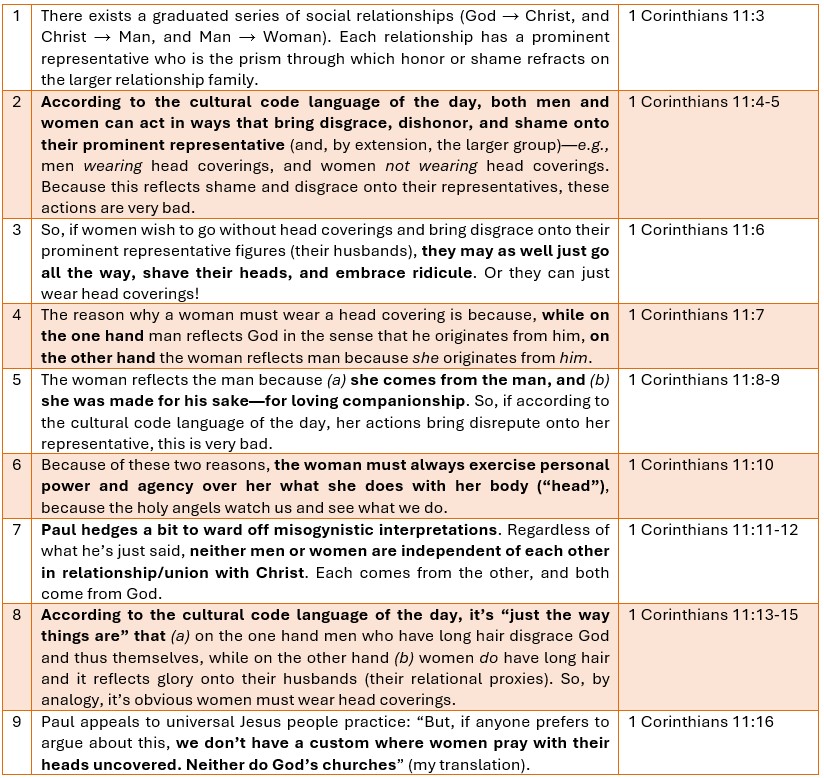
Summary of Paul’s Argument—Verse by Verse

Again, here is my much longer article for more information. I hope this honor/shame approach helps you understand Paul’s message and make it real in your life.


[1] Craig S. Keener, The IVP Bible Background Commentary: New Testament, 2nd ed. (Downers Grove: IVP, 2014), 482.

[2] Hodge, 1 Corinthians, 206.

[3] Edwards, 1 Corinthians, 271-72.

[4] Gill, Exposition of the New Testament, 2:683.

[5] BDAG, s.v. “κεφαλὴ,” 1.b.; p. 542.

[6] L&N, s.v. “κεφαλὴ,” p. 738.

[7] John Gill, A Complete Body of Doctrinal and Practical Divinity, new ed. (reprint; Paris: The Baptist Standard Bearer, 1995), 33; Augustus Strong, Systematic Theology, combined ed. (Philadelphia: American Baptist Publication Society, 1907),245f.

[8] I looked at every usage in the LXX, the New Testament, and the apostolic fathers—the usage just isn’t there. David Garland rightly observes, “[t]he paucity of lexicographical evidence—no Greek lexicon offers this as an option—makes this meaning for ‘head’ highly suspect,” (1 Corinthians, in BECNT (Grand Rapids: Baker, 2003), 515).

[9] See Henry George Liddell et al., A Greek-English Lexicon (Oxford: Clarendon Press, 1996), s.v., sense II.d. For example, Philo speaks of a virgin goddess “whom the fable asserts to have sprung from the head (ἐκ τῆς τοῦ Διὸς κεφαλς) of Jupiter” (Peder Borgen, Kåre Fuglseth, and Roald Skarsten, “The Works of Philo: Greek Text with Morphology” (Logos Bible Software, 2005).

[10] Robert Cawdrey, A table alphabeticall, conteyning and teaching the true writing, and understanding of hard usually English words, borrowed from the Hebrew, Greek, Latine, or French etc with the interpretation thereof by plaine English words, gathered for the benefit & help of ladies, gentlewomen, or any other unskillful persons, whereby they may the more easily and better understand many hard English words, which they shall hear or read in scriptures, sermons, or elsewhere, and also be made able to use the same aptly themselves (London: IR, 1604), 10. Retrieved from https://tinyurl.com/4jwxyadh.

See also Oxford English Dictionary, s.v., “absolute” adj. and n., sense II.8.a., June 2025, https://doi.org/10.1093/OED/8089207512.

[11] See (1) A. C. Perriman, “The Head of a Woman: The Meaning of κεφαλὴ in 1 Cor 11:3,” in The Journal of Theological Studies, OCTOBER 1994, NEW SERIES, Vol. 45, No. 2, pp. 602-622, and (2) Anthony C. Thiselton, The First Epistle to the Corinthians: A Commentary on the Greek Text, in NIGTC (Grand Rapids: Eerdmans, 2000), 811-23. Garland follows them both (1 Corinthians, 514-16).

[12] Paul uses καταισχύνω in 1 Cor 11:4-5, which means dishonor, disgrace, or shame (BDAG, s.v., senses 1-2). He uses αἰσχρός at 1 Cor 11:6, which is “a term esp. significant in honor-shame oriented society; gener. in ref. to that which fails to meet expected moral and cultural standards [opp. καλός]) pert. to being socially or morally unacceptable, shameful, base” (BDAG, s.v.).

[13] Hodge says this passage is based on the principle “that order and subordination pervade the whole universe, and is essential to its being” (1 Corinthians, 206). Gould writes: “This rank and subordination form the principle on which the apostle bases his teaching in regard to the veiling of women” (1 Corinthians, 93).

[14] David A. DeSilva, Honor, Patronage, Kinship & Purity: Unlocking New Testament Culture (Downers Grove: IVP, 2000), 25.

[15] Perriman, “Head of a Woman,” 620. Emphasis added.

Why Jesus’ Ascension Matters for Christians Today

Why Jesus’ Ascension Matters for Christians Today

Jesus ascended back to heaven 40 days after his resurrection. We know this because Luke tells us (Acts 1:3). It’s a very important event, and Luke is the guy who wrote both accounts of it. One is shorter (Lk 24:50-53), and the other is a bit longer (Acts 1:10). Other New Testament writers constantly reference it, too.

Why talk about the ascension?

One big reason is that the Christian story makes no sense without it.

  • The bible tells us that Jesus is coming back—but coming back from where?
  • The bible says that Jesus is the shepherd for all believers. If that’s true, then where is his “shepherd command center”? Is he in Olympia? In Atlanta? In London? In Durban?
  • If Jesus pours out the Holy Spirit, where does he pour it out from? Is he in a house somewhere in West Olympia, pouring out the Spirit onto new believers in Tokyo? Even the imagery of “pouring out” suggests a spatial position above us somewhere—but where?
  • If Jesus left this earth to prepare a place for us, at what location is he making these preparations?

A helpful analogy to start

Here’s an analogy that helps explain the difference between Jesus’ ministry during the incarnation and now—after the ascension. The analogy is the difference between tactical and strategic command, in a military context.

  • A tactical commander is focused on a specific, local objective with a relatively small number of resources. He and his men must take that hill, right there. This is a very narrow focus.
  • A strategic commander sees the whole picture—not just that hill, but all the hills. The whole battlespace. The logistics. The reinforcements. The larger plan for the entire campaign.

Jesus’ incarnation v. ascension is like that:

  • The incarnation was a tactical command situation. Jesus and a relatively small band of followers wandered to and fro in a very small area, among a fairly small group of people, as he trained a very small cadre of followers. Jesus didn’t worry about what is now China, India, or Argentina. He focused on Capernaum, the Sea of Galilee region, and other local areas.
  • But, at his ascension Jesus pinned back on his Fleet Admiral (5-star) insignia and began running the entire cosmic war from his combat information center at the Father’s right hand. He now acts “from Washington” (as it were) to impact individual “commands” at far-flung outposts (large and small) all across the world.
  • This is tactical v. strategic command.

Goals for studying Jesus’ ascension?

Jesus performs at least three big jobs in heaven:

  1. He’s the King who wages divine war against Satan.
  2. He’s the High Priest who reconciles us to God and always lives to make intercession for his people (see Heb 5-10). I covered this during my ascension sermon in 2024, and you can watch it here.
  3. He is our shepherd and guide—this will be our focus in this article.

This article has two goals:

  1. To show us why the ascension is such an important part of the Christian story.
  2. To know why Jesus’ ascension is a good thing for you, and why it should comfort you.

We’ll make our way through this in three steps:

  1. We’ll look at some (not all) hints from the old covenant, and their fulfillment in the new covenant scriptures so we can “see” the ascension throughout the bible.
  2. Next, we’ll consider where, exactly, heaven is. Have you ever thought about that?
  3. Finally, I’ll provide five reasons why the ascension matters today for you if you’re a Christian.

I could say much more on this topic (especially on Jesus as king and high priest), but we’ll stick to the “Jesus as shepherd” theme here.

From Hints to Reality

I’ll discuss two old covenant hints about the ascension, and two new covenant texts that show these hints have now become reality.

Two old covenant hints

The first old covenant hint we’ll consider that points to Jesus’ ascension is the Day of Atonement ritual. You can find this by comparing Leviticus 16 and Hebrews 9.

  1. You have the tabernacle and its sturdier replacement, the temple building. The bible explains the elaborate rituals the covenant member and the priest perform to atone for the sins of the people. These are foreshadowing’s (or “types”) that signal a greater fulfillment by Jesus in the new covenant (Heb 9:1-9)—the same way a little boy’s tricycle foreshadows his first car.
  2. The tabernacle and its furnishings inside the holy of holies also “stand for” the heavenly realities above (Ex 25:9)—they’re like LEGO figurines of the true reality (Heb 8:5).
  3. So, in old covenant worship, on the Day of Atonement that high priest goes in, offers the blood of the sacrificed animal, and makes atonement for the people.

So far, so good.

But how does Jesus make this picture become real? How does he complete the reality to which the old covenant LEGO mini-figures pointed? He completes it by going to the real throne room in heaven, offering his own blood from his own sacrifice, and making permanent atonement for his own people. This means Jesus must leave here and go back to heaven to complete the picture—this is the ascension.

Next, we turn to King David, who certainly understood at least something about this. Consider Psalm 110:1, which is the most quoted text in the new covenant scriptures! “The LORD says to my lord: ‘Sit at my right hand until I make your enemies a footstool for your feet.’”

Jesus used this text to explain that the Messiah was more than just David’s son—he was a divine figure. He asked folks who the Messiah would be, and they said it would be David’s son (Mt 22:42). Well, Jesus asked, how could David (who spoke by means of the Holy Spirit) call his own son his lord (Mt 22:43)? “If then David calls him ‘Lord,’ how can he be his son?” (Mt 22:45).

Look back at Psalm 110:1 (above), and think with me here:

  1. There are two “Lords” in this verse. One is Yahweh, whose personal name our English bibles always translate in ALL CAPS, so we’ll catch it. We’ll call him “Lord 1.”
  2. But who is this other “lord,” the one not in capital letters? We’ll call him “Lord 2.”
  3. Whoever Lord 2 is, he seems to be divine—this was Jesus’ point in Matthew 22:42-46. What person could sit beside God in heaven? So, Lord 2 is divine, and the Christian story tells us it is Jesus.
  4. Fair enough—but if Lord 2 is Jesus, and Jesus came here during the incarnation, then how does he get back there to take his seat and pin back on his 5-star, Fleet Admiral insignia?

Well, he leaves.

He ascends back to where he’d been before the world began. He went back to heaven. He’s gonna stay there “until I [Lord 1] make your enemies a footstool for your feet” (Ps 110:1). The apostle Peter understood this, which is why he quoted Psalm 110:1 and said: “Therefore let all Israel be assured of this: God has made this Jesus, whom you crucified, both Lord and Messiah” (Acts 2:36).

Remember the tactical v. strategic analogy we mentioned earlier. Now, since the ascension back to the throne room in heaven, Jesus the king is directing this multi-front, cosmic and divine war from heaven until all his enemies (Satan and his minions) are crushed in the dust before him.

Two new covenant realities

The apostle Peter preaches that “[h]eaven must receive him”—that is, Jesus the Messiah—“until the time comes for God to restore everything, as he promised long ago through his holy prophets” (Acts 3:21). When heaven receives Jesus, we have the ascension, which will terminate when Jesus once more descends here with the heavenly host to crush Satan and his minions under his feet (Rev 19; Mt 24:29-31).

The martyr Stephen, whose sad story God preserved for us in Acts 7, saw the risen Christ in heaven after his ascension. When Stephen denounces the Jewish council— “[y]ou stiff-necked people! Your hearts and ears are still uncircumcised. You are just like your ancestors: You always resist the Holy Spirit!”—he faces almost certain death. At that crucial moment, Luke tells us:

… Stephen, full of the Holy Spirit, looked up to heaven and saw the glory of God, and Jesus standing at the right hand of God. “Look,” he said, “I see heaven open and the Son of Man standing at the right hand of God” (Acts 7:55-56).

Jesus is not here. He is “up there,” in heaven. He ascended. And, of course, the Christian story tells us that Jesus is coming back here one day. From where is he coming back? From heaven.

Where is heaven?

I won’t spend too much time here, but it is something many Christians probably haven’t thought about much. I’ll only skim through this one, but it’s worth thinking about. Where is heaven? Here’s what we know:

  1. Jesus is clearly not here.
  2. He is also clearly somewhere else, in some real, physical, actual place. We know this because Jesus keeps his physical, resurrected body, which must take up real estate somewhere.
  3. Jesus taught us to pray “Our Father, who art in heaven” (Mt 6:9), which means the Father is also taking up real estate somewhere. Yes, God is spirit and has no innate physical form with which to occupy a space, but he is “up there” in heaven.
  4. And we know that Jesus will one day come back to here from that place.

But where is it?

  1. It isn’t up in the sky. God isn’t in outer space! If you leave earth’s atmosphere, you won’t find him there. Or on the far side of the moon. Or hiding in one of Saturn’s rings.
  2. But heaven seems to be a physical place somewhere.

So, it’s best seen as a different dimensiona divine alternate realm that’s above this one.

Heaven is the place where God is. It isn’t a fixed address—it moves when God moves. This is why the apostle John tells us that, one day, God will re-locate from heaven to earth. He will bring heaven to earth, just as he promised through the prophet Zechariah (Zech 2:10).

I saw the Holy City, the new Jerusalem, coming down out of heaven from God, prepared as a bride beautifully dressed for her husband. And I heard a loud voice from the throne saying, “Look! God’s dwelling place is now among the people, and he will dwell with them. They will be his people, and God himself will be with them and be their God (Revelation 21:2-3).

But, for now, “heaven” is this alternative divine dimension where Jesus went at his ascension.

Five ways Jesus shepherds Christians from heaven

Because Jesus is our good shepherd, he’s our guide who cares for us in this life and brings us along to the next. Israel’s leaders (“shepherds”) were basically terrible. Worthless. Unreliable. Bad. It’s not that Jewish people were habitually bad. It’s that all of us are habitually bad! We need a leader from outside to get us out of this mess.

God told us that he’d send a special someone to do a proper job.

10This is what the Sovereign LORD says: I am against the shepherds and will hold them accountable for my flock. I will remove them from tending the flock so that the shepherds can no longer feed themselves. I will rescue my flock from their mouths, and it will no longer be food for them. 11“‘For this is what the Sovereign LORD says: I myself will search for my sheep and look after them. 12As a shepherd looks after his scattered flock when he is with them, so will I look after my sheep. I will rescue them from all the places where they were scattered on a day of clouds and darkness (Ezekiel 34:10-12).

That special someone is Jesus, God’s one and only Son. “I am the good shepherd. The good shepherd lays down his life for the sheep” (Jn 10:11).

  1. But remember, he’s not here—so where is he?
  2. He’s your shepherd from heaven.
  3. Remember the analogy of tactical v. strategic command. During his three-year ministry, Jesus exercised local, tactical command in a small place—he shepherded a small, local flock.

But now, since his ascension, Jesus runs the whole show across the entire world. He shepherds the entire flock from the “combat information center” up there, in heaven.

What difference does this make for our lives? Here are five things Jesus does for you from heaven.

First—Christ is shepherding you to spiritual maturity

When Christ ascended on high, he led captivity captive, then gave gifts to his people (Eph 4:8). This means Jesus captured “captivity” itself—by defeating Satan, sin and death—and took it away with him to heaven to imprison it forever.[1] This is imagery, like that of the woman representing sin who Zechariah says was crushed into the basket and carried off to exile far to the east in Babylon (Zech 5:5-11).

Why does Christ do this? Why does he remove captivity from his people and give them gifts (Eph 4:11)? To equip his people for service, so we’d each “grow up” into a mature community in Christ (Eph 4:12).

Jesus is orchestrating all this for you, from heaven. God’s children aren’t generic, faceless numbers—Jesus even says we’re his brothers and sisters (Heb 2:11). Your spiritual maturity matters to Jesus, and that happens in relationship with a local community of Jesus people somewhere that the NT calls “a church.”

Second—Jesus is preparing paradise for you

Jesus said: “My Father’s house has many rooms; if that were not so, would I have told you that I am going there to prepare a place for you? And if I go and prepare a place for you, I will come back and take you to be with me that you also may be where I am” (Jn 14:2-3).

In the garden of Eden, which I’ll call Paradise 1.0, we had physical bodies, we were with God in a perfect creation, in perfect relationship with him, and we used our talents and gifts to build a perfect world.

But that ended pretty quickly and pretty badly.

At the end of the Christian story, in Paradise 2.0 (see Rev 22), we will have that same paradise reality—only this time it will be permanent. Jesus paves the way for Paradise 2.0 by his ascension—everyone who believes in him will follow him to heaven (Jn 14:6). Then, one day he’ll bring all his people to the new creation here to defeat Satan and kick off Paradise 2.0 (Rev 19:11-21).

Jesus can’t do any of that if he stays here. This is why he went there to prepare paradise for you. “[B]y his own appearance there for them with his blood, righteousness, and sacrifice, he is, as it were, fitting up these mansions for their reception, whilst they are by his spirit and grace fitting and preparing for the enjoyment of them.”[2]

Third—Jesus empowers you for evangelism

Jesus said: “Very truly I tell you, whoever believes in me will do the works I have been doing, and they will do even greater things than these, because I am going to the Father” (Jn 14:12). In what way will Christians “do even greater things” than the works Jesus has been doing?

Jesus led people out of darkness and into the light. Jesus rescued people from Satan. He brings people into God’s forever family. Jesus said he fulfills all of God’s covenant promises. Jesus said he could fix you, fix your life, and give you meaning and purpose as an adopted child of God.

What does that have to do with you? With the ascension?

Well, Jesus gives you the power to do the same thing as he did—even quantitatively greater things—because we preach and tell the same message that has the same results. And Jesus orchestrates all this from on high, through the Holy Spirit “because I am going to the Father.” From the Father’s side in heaven above, Jesus is working in your life, and through you in the life of local churches, to spread his message around the world.

A very wonderful promise! But has it been fulfilled? We think it has. For if we look at the wonders of the Day of Pentecost, together with the events that followed in the rapid spread of the gospel during the apostolic age, it does not seem extravagant to regard them as greater than any which took place during the ministry of Christ. And if we compare the spiritual results of the three most fruitful years of the ministry of Paul, of Luther, of Whitefield, or of Spurgeon, with the spiritual results of Christ’s preaching and miracles for three years, we shall not deem his promise vain.[3]

Fourth—Jesus sends the Holy Spirit to rescue people

The bible records Jesus words: “When the Advocate comes, whom I will send to you from the Father—the Spirit of truth who goes out from the Father—he will testify about me. And you also must testify, for you have been with me from the beginning” (Jn 15:26-27).

It is Jesus who poured out the Holy Spirit at Pentecost (Acts 2:32-33). It is Jesus who opens people’s hearts so they believe and trust the gospel (Acts 16:14; 2 Cor 4:3-6). Our passage in John 15:26-27 tells us that:

  1. Jesus goes back,
  2. and then he sends the Spirit,
  3. who then helps us and testifies to us about Jesus,
  4. and we then bear witness to Jesus and his gospel,
  5. and the Spirit testifies about Jesus in the hearts of those whom we reach.

There is no wiggle room here—the Spirit “will testify about me.” He will. He shall. It’s a promise. We bear witness, and the Spirit will testify about Jesus.

Fifth—Jesus is with us, everywhere at once

During his ministry, Jesus was constantly with his people. His physical body limited him to being in a particular place, at a particular time. There are only 24 hours in a day—even for the incarnate Jesus.

So, how can Jesus be with his people, if his people are in Judea, Samaria, and the uttermost parts of the earth? How can Jesus be in all these places at once? Will he hop on a Zoom call with us once per week from wherever he’s at? Wouldn’t, then, our relationship with Jesus be like a long-distance relationship? We know how those go …

The answer is that, since the ascension, Jesus will be with each of us spiritually.

I will not leave you as orphans; I will come to you. Before long, the world will not see me anymore, but you will see me. Because I live, you also will live (Jn 14:18-19).

Christians will not be orphans, which means Jesus won’t abandon us when he ascends back to heaven— “I will come to you.” We will actually see him, and we will “live” because he lives (i.e., after his resurrection).

What does all this mean? “On that day you will realize that I am in my Father, and you are in me, and I am in you” (Jn 14:20).

  1. On the day Jesus comes to us to not leave us as orphans,
  2. we will realize that Jesus is in union/relationship with his Father,
  3. and that we are in union/relationship with him,
  4. and that he is in union/relationship with each of us.

This is Jesus’ spiritual presence with every individual believer, knitting us to him, to one another, and to the Father, by the power of the Spirit. This is an invisible but tangible bond that, as it were, fuses our souls to his at a level that’s marrow deep.

This is a reality that evidently could not happen if Jesus had continued to skulk around Galilee forever after his resurrection, content to remain a tactical commander in this cosmic war. Instead, he ascended back to heaven to assume strategic command of the whole battlespace, re-pinned on his Fleet Admiral insignia, and now guides each of us personally and individually.

And so, because Jesus is with all his people right now from heaven above, he can promise us: “Peace I leave with you; my peace I give you” (Jn 14:27). He tells us all this—these five reasons and others— “so that you will not fall away” (Jn 16:1).

Jesus’ ascension matters. It’s good that he went away. It’s good that he’s running (and winning) this divine war. It’s good that he sends the Spirit to rescue people. And it’s good that we await his return, so the Father can bring heaven to earth forever.


[1] Scholars old and modern are divided over how to understand this “captivity captive” language, and the various English translation choices reflect this (see, for example, the NIV—which disagrees with my interpretation here). For my interpretation see John Gill, An Exposition of the New Testament, vol. 3, The Baptist Commentary Series (London: Mathews and Leigh, 1809), 87–88).

[2] Gill, Exposition, 2:56.

[3] Alvah Hovey, Commentary on the Gospel of John, in American Commentary (Philadelphia: American Baptist Publication Society, 1885), 286.

Is the Papacy Biblical? A Look at Matthew 16

Is the Papacy Biblical? A Look at Matthew 16

Pope Francis’ recent death is an opportunity for bible-believing Christians to consider what we ought to believe about the papacy. The goal is not to dance on a dead man’s grave, but to think about who oversees Christ’s church. Is the papacy a legitimate institution? Does it have biblical warrant?

The Catechism of the Catholic Church (“CCC”) says that:

  1. Peter is the rock of the church, which is built upon him (CCC, Art(s). 881, 552).
  2. Peter has the “keys” and therefore governs the church (CCC, Art(s). 553, 881).
  3. Peter is the shepherd of the church, and priests and bishops have derivative authority under Peter.
  4. Peter is the source and foundation of the unity of the church—he has full, supreme, and universal power (CCC, Art. 882).
  5. According to the first Vatican council (Vatican I, 1869-70, Session 4), if you do not agree with Rome’s teaching about Peter, you are damned to hell.

This is all false and cannot be defended from scripture. Rome’s argument, both in the CCC and at Vatican I, centers on Matthew 16:18 and some supporting citations. My argument here focuses on the Matthew 16 passage. If you want to read more about Rome’s grave and terrible errors about the gospel, I recommend (a) James White, The Roman Catholic Controversy (Minneapolis: Bethany House, 1996), and (b) Tyler Robbins, “How Rome Distorts the Gospel—Atonement Misunderstood.”

Now—on to the papacy!

In Matthew 16:18-19, Jesus gives us two pairs of images: (a) the rock and the gates, and (b) the keys and the bonds. What do they mean? Oracles from “the Greek” won’t help you here—your bible translation is just fine. Whatever these images mean, they must make the best sense of what the passage is taking about in context.

Context—what are we talking about here?

Jesus asks his disciples who people say the Son of Man is (Mt 16:13). He refers to himself as the mysterious figure from Daniel’s famous vision (Dan 7:13-14). Public opinion says that Jesus is a prophet of some sort (Mt 16:14). Now, Jesus asks the disciples who they think he is (Mt 16:15). Peter answers: “You are the Messiah, the Son of the living God” (Mt 16:17).

The “Messiah” is the chosen and anointed one, the special divine envoy (“Son of the living God”) who will make all God’s covenant promises come true. He is God’s promise-keeper. He makes God known to us (Jn 1:18). Jesus agrees and tells Peter that his Father in heaven has revealed this precious truth (i.e., his confession about Jesus’ identity) to him.

So, as we move on to consider the first pair of images, we must get this right—this conversation is about Jesus’ identity and what it means. Any interpretation that takes a hard turn off this road to something completely different is wrong.

Imagery 1—The Rock and the Gates

Jesus says: “And I tell you that you are Peter, and on this rock I will build my church, and the gates of Hades will not overcome it” (Mt 16:18). Here we have our first pair of images.

  1. What are gates for? To keep people in or out.
  2. What is Christ’s church build on? A rock.
  3. Because Hades’ gates cannot prevail against the rock, these gates are imprisoning folks inside, and the rock smashes this gate open to set them free.

So, whatever “the rock” is …

  1. The entire family of God is built on it,
  2. and the rock is so strong, and so powerful,
  3. that Satan’s kingdom can’t withstand it!
  4. so it’s a pretty tough rock— divinely tough!

You have three options:

  1. The rock is Peter—the pope.

Rome places great stock in a Greek wordplay that Jesus uses here: “And I tell you that you are Peter (Πέτρος—petros), and on this rock (πέτρᾳ—petra) I will build my church …” This is a weak argument. Unless context suggests otherwise (and remember, the context is Jesus’ identity and what it means), there is no need to see this as anything other than a playful wordplay.

For example, my first name is Mark. Yet my parents have called me Tyler all my life, so I have no idea why they bothered to name me Mark. A similar wordplay would be if someone told me: “Your name is Mark, and mark my words that …” That is all this need be. Peter has nothing to do with this conversation—they’re talking about Jesus’ identity.

  1. The Rock is Jesus.

When he says, “and upon this rock,” he points to himself. This is weak and desperate. The pronoun translated “this” refers to something nearby in the context. This position rightly rejects Peter as the rock (because it is out of context), and to make Jesus himself “this rock,” they must make him point to himself. There is a simpler way—one that doesn’t require us to pantomime while explaining it.

  1. The rock is Peter’s confession of Jesus’ identity and what it means—his faith and trust in the Messiah.

Option 3 is the right option.[1] Christ’s church family is built on the confession that Jesus is the Messiah, the Son of the living God. You cannot be a Christian (and a member of the worldwide Jesus family) unless you trust and confess the truth about him. Again, remember the context of this passage—this whole conversation is about who Jesus is and why it matters. It is not about a disciple who Jesus is going to call “satan” in four verses. It is not about the disciple who Paul rebuked to his face in Antioch (Gal 2:11-14). It is not about the guy to whom nobody in the scripture gives special authority.

But the conversation certainly is about Jesus, the Messiah, the Son of God. This explains why the rock is so strong, and so powerful, and why the gates of Hades can’t prevail against the church—because it’s divinely tough.

The completed imagery of rock + gates is this:

  1. The rock is the confession that Jesus is the divine promise-keeper and Son of God.
  2. The gates are to Satan’s kingdom, and they can no longer imprison those who believe in the rock.
  3. Jesus (the rock) smashes these gates open—remember the divine rock which smashes the statue of pagan empires (which are really different flavors of Babylon, Satan’s kingdom) at Daniel 2:34-35, 44.

Peter cannot smash these gates open. Yet, this is what the “rock + gates” imagery would have us believe. Your safety, security, and anchor is Jesus. It wasn’t John Paul II. It wasn’t Benedict. It wasn’t Francis. It is not Leo. It’s the Messiah, the Son of the living God—just like the old song says— “On Christ the solid rock I stand. All other ground is sinking sand.”

Imagery 2—The Keys and the Bonds

Jesus continued: “I will give you the keys of the kingdom of heaven; whatever you bind on earth will be bound in heaven, and whatever you loose on earth will be loosed in heaven” (Mt 16:19).

  1. What are keys for? To control access. To let you in or out.
  2. What do bonds do? They confine you. Imprison you.

We know that Jesus has the keys of life and death (Rev 1:18), the keys that lock people into that future, or let them out to embrace a better one tomorrow.

So, whatever the keys are,

  1. They let you into the kingdom of heaven,
  2. and untie or unchain you from the bonds that you’re in,
  3. which means this is a divine power.

You have two options to understand what this means:

  1. Peter has exclusive power to govern the church (the keys), and to absolve people’s sins by a sacred power—the bonds (CCC, Art(s). 553, 881, 1592).

This makes no sense of the “key” imagery. Keys are about access (Rev 1:18, 9:1, 20:1), not governance. Scripture never says to go to Peter—or anyone else—to have your sins absolved. Nor does Peter later claim this right for himself in his two New Testament letters. Instead, the bible tells us that God forgives sins—even David knew this (Ps 51:1-2).

  1. Peter (and every other Christian) offers “the key” to freedom by preaching rescue (“the bonds”) through complete forgiveness of sins.

Option 2 is the correct one.  Again, this entire conversation is about who Jesus is and why it matters. The keys don’t belong to Peter when Jesus speaks—he says he will give them to Peter (future-tense). Later, Jesus clarifies that the entire church has the keys—he even repeats the very same words (Mt 18:18).

The “key + bonds” imagery tells us this:

  1. Jesus’ family,
  2. organized into big and small Jesus communities around the world called “churches,”
  3. are his hands and feet that offer the key to spiritual freedom,
  4. by preaching liberation, forgiveness, and reconciliation.
  5. and we untie the shackles or bonds by accepting people into the brotherhood of the faithful upon a credible profession of faith (see Acts 2:41).

Jesus, through his communities around the world, unlocks the gate to death and hades and lets his people out, just like the song says— “my chains are gone, I’ve been set free, My God, my Savior has ransomed me!”

Peter was a good guy. Peter was an important guy. Peter is a star (not the star) of Acts 1-11. But Peter was just a guy.

Jesus leads his church. Not by one old man in Rome, but by Word + Spirit in his churches around the world, under qualified leaders, through you, and me, and us. And together we build Jesus’ family—just like Peter himself told us. Jesus is the “living stone” (a synonym for “rock”) to whom we come to be built up into the spiritual household of the faithful (1 Pet 2:4-5).

Your leader is not an old man in a white robe who sits in a building financed over 500 years ago by extorting money from millions of peasants with stories of fraudulent “indulgences” that can buy them time off a purgatory that doesn’t exist, and who represents a false “gospel” that has no perfect peace—that doesn’t make you holy and perfect forever (Heb 10:10, 14). Instead, thank God (literally) that the confession and trust in Jesus is your rock. Jesus is your anchor. Jesus smashes open Hades’ gates. Jesus has the keys and loans them to his churches. Jesus, through his communities across the world, unlocks the door to death and Hades to let his people out of darkness and into the marvelous light.


[1] Many conservative Protestant scholars today believe that Peter is the rock. They often comment that Protestants only object to this interpretation because of what Rome does with the passage. See John Broadus’ wonderful commentary on the Gospel of Matthew for a representative example of this line of thinking: https://tinyurl.com/4my9e7y3.

I believe this is wrong, and I have not found the arguments convincing. The context strongly supports Option 3, and it is the best antecedent for the pronoun in ἐπὶ ταύτῃ τῇ πέτρᾳ οἰκοδομήσω μου τὴν ἐκκλησίαν. This is not an academic article, so I will leave the matter here!

The Cosmic Civil War: A Palm Sunday Reflection

The Cosmic Civil War: A Palm Sunday Reflection

As Easter draws near, the Christian calendar presents us with a sequence of world-altering events—Palm Sunday, Good Friday, Easter Sunday, and later Pentecost. Each day tells a part of the greatest story ever told, and it begins with Palm Sunday: the moment Jesus Christ enters Jerusalem, hailed as a king, setting into motion the fulfillment of divine promises.

In Luke 19:28–44, we find the account of Jesus’ entry into Jerusalem. But to fully grasp what’s happening, we need to step back and understand the broader picture.

The cosmic civil war

From the beginning of Scripture, humanity has been caught in a cosmic civil war. In Genesis 1 and 2, God creates a perfect world and places humanity under his authority. But in Genesis 3, Adam and Eve reject that authority and choose to go their own way. Genesis 4 onward tells the story of how we all, by birth and by choice, follow that path.

Think of the analogy of the American civil war.

Our spiritual rebellion is something like that. Our first parents founded this “confederacy.” This means we’re each born, by default, as citizens of this confederacy. Just as the southern states illegally broke away from the federal government, we have each broken away from God. Each of us, spiritually speaking, is born a citizen of this rebellion—a fraudulent kingdom opposed to its rightful ruler.

So this is the situation:

  • We can remain in the Confederacy (which is going to lose this war), or
  • We can choose to rejoin the Union.

When Jesus’ ministry begins—when he says that the kingdom of heaven is at hand, and that everyone ought to repent and believe the gospel (Mk 1:15), he’s basically asking: “what’s it gonna be?”

When Jesus enters Jerusalem one week before Passover, his three years of ministry nearly finished, he is asking: “Here I am. I’m your king. Will you choose to love me and swear an oath of allegiance to me and end this stupid war?”

This question is much more important than the American civil war, because this is a cosmic war—your very soul is at stake.

Jesus and the donkey

The turning point comes on Palm Sunday. Jesus approaches Jerusalem from the Mount of Olives, and he tells his disciples to find a donkey. This detail might seem odd, but it’s loaded with significance. Jesus is deliberately fulfilling the prophecy from Zechariah 9:9:

Rejoice greatly, Daughter Zion! Shout, Daughter Jerusalem! See, your king comes to you, righteous and victorious, lowly and riding on a donkey … (Zech 9:9).

A donkey is not exactly the image of power and might. It emphasizes Jesus’ humility—his lowly status. He isn’t a warrior. He comes not to crush enemies but to extend a hand of grace. He is the King foretold in ancient Scripture, arriving not with overwhelming force, but with a gentle invitation. He’s come to proclaim peace to the nations, and to free prisoners from a waterless pit because of the blood-oath of the new covenant he’s come to launch (Zech 9:10-11).

The donkey is not a trivial detail. It’s Jesus’ way of showing the kind of king He is: one who offers peace, not coercion.

Jesus and the palm branches

As Jesus enters the city, people begin to respond. Crowds gather, laying their cloaks on the road and waving palm branches—an ancient sign of honor and victory. They shout:

Blessed is the king who comes in the name of the Lord! Peace in heaven and glory in the highest!” (Luke 19:38; quoting Ps 118:26).

This isn’t spontaneous enthusiasm; it’s deliberate. They’re quoting Psalm 118, a psalm used in royal processions to the Jerusalem temple. This song is a well-known cultural cue, like the national anthem may be to us. They know what it means. They know what they’re singing and why. They’re acknowledging Jesus not just as a teacher or prophet, but as the rightful King of Israel. “[T]he whole crowd of disciples began joyfully to praise God in loud voices for all the miracles they had seen” (Lk 19:37). They recall His miracles: raising Lazarus, healing the sick, casting out demons. Everything Jesus has done points to this moment. He is the Messish and the king.

But not everyone is pleased.

Jesus weeps over Jerusalem

The Pharisees, standing in the crowd, hear the chants and understand their meaning. They demand that Jesus rebuke his followers. They know what this singing means—that Jesus is the fulfillment of all prophecy, the King who brings God’s kingdom. Jesus responds: “I tell you, if they keep quiet, the stones will cry out” (Luke 19:40)

But  Jesus knows the celebration is less than honest. This same crowd is nowhere to be found later in the week, on Good Friday. So as he draws near to Jerusalem, Jesus does something unexpected: he weeps. “If you, even you, had only known on this day what would bring you peace—but now it is hidden from your eyes” (Luke 19:42).

Jesus offers peace with God. Peace for your soul. Peace for your heart. The apostle Paul wrote: “Therefore, since we have been justified through faith, we have peace with God through our Lord Jesus Christ” (Rom 5:1). This is the same peace the angels offered on Christmas morning: “Glory to God in the highest heaven, and on earth peace to those on whom his favor rests” (Lk 2:14). His favor rests on those who come in from the cold and choose to love him.

The King who comes in peace now mourns, knowing that many will reject him. Within days, the same crowds shouting “Hosanna” will yell “Crucify him!” (Mk 15:13). Though peace is within their reach, they will choose rebellion. The city that celebrates him will soon betray him.

The Cosmic Amnesty

After the American civil war, President Andrew Johnson offered amnesty to any Confederate who wanted it.

Johnson specifically says this amnesty was a pardon. His proclamation said that to suppress the rebellion, to convince people to be loyal to the true government once again, and to restore Federal authority, he was offering a pardon if you swore a particular oath and sincerely mean it. Pardon does not mean you’re innocent—it means you’re released from legal liability.

This is exactly what Jesus is offering. We’re so-called “citizens” of a fraudulent nation in rebellion against lawful authority. To suppress this rebellion, to convince people to be loyal to the true government once again, and to restore his divine authority, God is offering a pardon if you swear an oath to his Son—if you repent and believe the good news and sincerely mean it.

As Jesus looks down upon Jerusalem from the Mount of Olives, he’s making an offer: “Swear an oath of allegiance from your heart, and let’s get this done.” But it does not happen. Jerusalem will soon say: “I’ll take Option B.”

So, what will we do? You can do nothing and remain in the Confederacy (which will lose this war), or you can choose to rejoin the Union.

Listening to the Real Jesus: Insights from the Transfiguration

Listening to the Real Jesus: Insights from the Transfiguration

The story of the transfiguration is one of the most remarkable in the gospels, yet its message is pretty simple: listen to Jesus! If you call yourself a Christian, you might think, “Well, of course! That’s obvious.” But listening to Jesus is harder than we admit. Too often, we listen to a fake version of Jesus that we’ve invented—a Jesus shaped by our own preferences, desires, or cultural influences.

A relationship with God begins with love. We love Him because He first loved us. From this love flows our desire to obey him, believe rightly, and do what his Word says. But what happens if we love the wrong Jesus? Well, if we follow a Jesus of our own making instead of the one revealed in scripture, our beliefs and actions will be all wrong. That’s why it’s important to listen to the real Jesus—the Jesus who is the Son of God, not the one we or our culture have reshaped to fit our own ideals.

Why the transfiguration?

When we read what happened in the run-up to the transfiguration, we learn that it was meant to cement Jesus’ claim to absolute authority in his people’s lives. It’s as if he’s saying: “You gotta listen to me! Not well-meaning but false teachers. Not your culture. Me. I’m kind of a big deal …”

This run-up shows us Jesus having an escalating authority controversy with scribes and Pharisees everywhere he goes. The disciples see and hear all this. For sake of space, we’ll parachute into Matthew 15, where Jesus tells some Pharisees and scribes that they’re hypocrites for emphasizing purity traditions over scripture: “These people honor me with their lips, but their hearts are far from me” (Mt 15:8, quoting Isa 29:13). Jesus then privately compared them to invasive weeds his Father had not planted—the day would come when they’d be ripped out of the ground (Mt 15:13-14; cp. Mt 13:24-30, 36-43)!

We then follow Jesus as he speaks to a Canaanite woman who asks him to cast a demon out of her daughter. She calls him Lord. She recognizes him as the son of David—implicitly, as the king of Israel. He commends her faith (Mt 15:28), a huge irony because she (a non-Jewish person) should have trouble embracing the Jewish Messiah!

Jesus then miraculously feeds 4,000 people in the wilderness east of the Sea of Galilee—people who see his miracles and praise the God of Israel. These are probably not Jewish people (Mt 15:29-31; cp. Mk 7:31)! Matthew now immediately pivots to another confrontation with Jewish authorities who demand he prove his credentials by showing them a sign from heaven (Mt 16:1-4). After telling them off, Jesus warns his followers against the teaching (“the yeast”) of the scribes and Pharisees, whose doctrinal errors are like arsenic for the soul (Mt 16:5, 12).

It’s no accident that Matthew next shows us Jesus asking who people thought he was. Peter answered correctly (“You are the Messiah, the Son of the living God,” Mt 16:16), but was it an intellectual answer or a deeply held conviction? Was it a well-intentioned theory or a heart-felt reality? What did they think of these repeated authority clashes? Do they truly believe that Jesus is their authority?

These implicit questions are what the transfiguration was meant to answer.

What does the transfiguration mean?

The transfiguration tells us who Jesus truly is. They go up the mountain. Suddenly, without warning, Jesus is “transfigured” or “transformed” before their very eyes. It happens suddenly, surprisingly. Jesus’ face shines like the sun, his clothes a dazzling white. This is a terrifying metamorphosis! Moses and Elijah, representing the Law and the Prophets, suddenly appear with him, emphasizing Jesus’ fulfillment and embodiment of both (Mt 17:1-3). But the most striking moment comes when a bright cloud overshadows them, and God the Father speaks: “This is my Son, whom I love; with Him I am well pleased. Listen to Him!” (Mt 17:5).

God is saying: “Do what he says! Keep doing what he says! He is your authority. Hear him!”

Why does this matter? Because when we fail to listen to Jesus, we start listening to competing voices—false teachers, cultural narratives, or even our own misguided emotions. The transfiguration was God’s way of making it abundantly clear: Jesus is the one to whom we should listen above all else.

Why Do People Believe in Fake Jesuses?

Throughout history, people have reshaped Jesus to suit their own agendas. Sometimes this is done with good intentions, but the result is always a distortion of the truth. In Jesus’ day, culture had so re-shaped expectations that many expected a “legalistic Messiah.” In America, in the ante-bellum South, some Christians argued that chattel slavery was a good thing because God was using it as a means of evangelism to enslaved black people! Culture makes us create fakes Jesuses like playdough. It’s no accident that these fake Jesuses always follow whatever culture war battles happen to be raging at the time.

Here are a few modern examples of “fake Jesuses” that people often follow:

  1. The homosexual Jesus – The lie that says Jesus has cast aside God’s laws about sexual ethics, and that unrepentant homosexual activity is just fine for Christians.
  2. The transgender Jesus – The lie that says your body can be at odds with your soul—as if your “inner self” can be divorced from your physical body and its gender. We are a unity of body + soul, which is why the doctrine of bodily resurrection is key to the Christian story. You will be resurrected in the physical body with which you were born. There is no legitimate disconnect between your “inner self” and your body.
  3. The Nationalistic Jesus – Many in America have intertwined faith with patriotism, as if Jesus’ mission were to uphold America’s greatness instead of establishing His Kingdom.
  4. The Social Justice-Only Jesus – While Jesus absolutely cares about justice, some reduce him to merely a social activist, ignoring his central message of salvation and repentance.

You can go out today and find false churches that teach and promote each of these fake Jesuses. They’re all lies. They’re each a distortion, and when we follow them, we stop truly listening to the real Jesus. The real Jesus, as revealed in scripture, calls us to deny ourselves, take up our cross, and follow Him (Matthew 16:24). That means (among other things) surrendering our own ideas about who he should be and allowing his Word to shape our understanding.

Listening to Jesus in Everyday Life

So how do we practically listen to Jesus? It’s not just about avoiding theological errors—it’s about daily obedience in both big and small ways. Here are a few examples of what it looks like to truly listen to Jesus:

  • Caring for the sick and elderly – Choosing to honor and care for aging parents instead of neglecting them.
  • Being a faithful spouse – Responding to difficulties in marriage with love and forgiveness rather than bitterness.
  • Serving others in your local church – Helping brothers and sisters in need in your church, even when it’s inconvenient.

Jesus is not a coffee table book

What happens when we don’t listen to the real Jesus? History and personal experience show us that failing to heed his voice leads to confusion, division, and spiritual decay. When we shape Jesus in our own image, we end up walking paths that lead us further from God, not closer to him. Even well-meaning people can fall into the trap of creating a fake version of Jesus that fits their lifestyle rather than allowing the real Jesus to transform their life. The apostle Paul tells us this is an evil age (Gal 1:3-4). The apostle John likens this ruined world, with its corrupt and seductive values, to Babylon–and tells it’s all going down one day (Rev 16-19). This world’s “truth” is, in fact, a pack of lies. Jesus tells us to listen to him.

For too many Christians, Jesus is like a decorative coffee table book—nice to have around, but not something they actually engage with. The transfiguration challenges us to move beyond a passive relationship with Jesus. He’s not just a figure to admire; He’s the King of our lives. If we truly listen to Him, it will shape how we think, believe, and live.

As we reflect on the Transfiguration, let’s take God’s words to heart: Listen to him. Not to the competing voices of culture, not to our own desires, but to the true Jesus who reveals himself in Scripture. Only by listening to him can we be transformed and live out the faith we profess.

How to Be Jesus People

How to Be Jesus People

The Sermon on the Mount is one of the most well-known teachings of Jesus, guiding Christians on how to live in an unholy world. In Matthew 5:2-16, Jesus focuses on how believers are to be a countercultural people (Mt 5:2-12), living as salt and light in the world (Mt 5:13-16). But what does that mean? And how exactly are we supposed to do that?

Understanding the Christian Counterculture

Jesus emphasizes that Christians are not meant to isolate themselves from the world but rather to live differently within it. Being salt and light means standing out—not in a showy or arrogant way, but in a way that draws others to the truth of the gospel. This means engaging with the world while remaining distinct from its values.

The key question, then, is: how do we live as a countercultural people? In Mathew 5:17-20, Jesus answers this by teaching that we must obey God’s law in the right way—with the right heart and the right motives.

  • First, he explains how he fulfills the law and the prophets.
  • Then, he explains our obligations to live according to the law n light of what he’s now done.

The rest of Matthew 5 is Jesus’ illustrations of this principle through everyday examples.

Jesus Fulfills the Law

Many misunderstand Jesus’ relationship to the Old Testament law. Some think He came to replace it with something entirely new, but He clarifies: “Do not think that I have come to abolish the Law or the Prophets; I have not come to abolish them but to fulfill them” (Matthew 5:17).

But what does it mean for Jesus to “fulfill” the law? Essentially, Jesus gives the law its deeper and truer meaning. Instead of following it in a superficial, legalistic way—like the Pharisees did—Jesus calls His followers to obey it from the heart.

How Do We Read the Law Through the ‘Jesus Filter’?

The Bible is a story with a beginning, middle, and end. When we read the Old Testament, we must do so in light of Jesus’ life, death, and resurrection. This is the “Jesus filter”—understanding that everything in Scripture points to Him.

Here is what this looks like:

For example, the sacrificial laws in Leviticus can seem tedious, but they make sense when we realize they were all pointing to Jesus, the ultimate sacrifice. Just like a child might look forward to getting a bicycle, only to later realize that a car is even better, the Old Testament sacrifices (i.e., the ceremonial laws) were placeholders until Christ, the true fulfillment, came.

Three Types of Old Testament Laws

  1. Ceremonial Laws – These included sacrifices, purity laws, and temple rituals. Jesus fulfills these laws by becoming the ultimate sacrifice. Since His death and resurrection, these laws no longer apply in a direct way.
  2. Civil Laws – These governed daily life in ancient Israel, from property disputes to social justice. Since the Old Testament kingdom no longer exists in the same way, these laws don’t directly apply today, though we can learn principles from them.
  3. Moral Laws – These include commandments about right and wrong, like prohibitions against murder, adultery, and lying. These remain in effect because they are rooted in God’s unchanging character.

Because the new covenant has fulfilled or re-shaped the first two categories of the old covenant law, Jesus now pivots in the rest of Matthew 5 to focus solely on moral laws and their relevance for today. He says: “Therefore anyone who sets aside one of the least of these commands and teaches others accordingly will be called least in the kingdom of heaven, but whoever practices and teaches these commands will be called great in the kingdom of heaven” (Mt 5:19).

What does this mean?

Obeying the Law in the Right Way

Jesus warns that it is possible to do the right thing for the wrong reasons. If we simply follow rules without love or genuine devotion, our obedience is meaningless. This was the problem with the Pharisees, who were obsessed with external appearances while missing the heart of God’s law. They wrongly saw the old covenant law as a means of salvation—“I do this for God, and he will do that for me!” This produces a very self-righteous attitude.

Jesus says, “Unless your righteousness surpasses that of the Pharisees and the teachers of the law, you will certainly not enter the kingdom of heaven” (Matthew 5:20). That doesn’t mean we need to follow even more rules than they did—it means our obedience should come from a place of love, not just obligation. We obey God because we love him and have already been made right with God, not to “get” righteousness as a reward at the end of the rainbow.

For example, the commandment: “You shall have no other gods before me” is easy to affirm in theory. But if we examined our lives, what would our actions say? Do we prioritize God above all else? Or do we let other things—our jobs, entertainment, relationships—take first place in our hearts? There is a massive difference between surface conformity and heartfelt obedience. True obedience isn’t just about external actions but about having a heart transformed by love for God.

Faith Expressing Itself Through Love

The Apostle Paul summed it up in Galatians 5:6: “The only thing that counts is faith expressing itself through love.” This means that our obedience to God should not come from fear or duty but from a genuine love for Him. Just as a heartfelt note from a loved one is more meaningful than a generic greeting card from your insurance agent, our devotion to God should be personal and sincere.

Jesus’ teachings in the rest of Matthew 5 give practical examples of this principle. He takes the external commands (like “Do not murder” and “Do not commit adultery”) and shows their deeper meaning. It’s not enough just to avoid murder—we must also guard against anger and hatred. It’s not enough just to avoid adultery—we must also keep our hearts pure.

A Call to Authentic Christianity

Being a Christian counterculture means more than just appearing religious. It means having a heart genuinely transformed by Christ. True righteousness flows from within—it’s not about keeping a checklist of rules but about loving God so deeply that obedience becomes natural.

This is the challenge Jesus sets before us. Are we simply following religious rules, or are we truly living as salt and light in the world? Do we obey because we have to, or because we want to?

Jesus calls us to follow Him from the heart, to let our love for Him shape every aspect of our lives. When we do this, we don’t just become religious people—we become a living testimony of God’s grace and truth.


May we each examine our hearts and ask God to help us live out our faith in a way that is truly countercultural—not just in appearance, but in spirit and truth.

The Illusion of Self-Righteousness

The Illusion of Self-Righteousness

This is a series of brief devotional articles on The Orthodox Catechism (“OC”),a Particular Baptist document written by Baptist pastor Hercules Collins in 1680. Read the series.

When confronted with a moral failure, our instinct is to minimize or to blame-shift. Yes, we shouldn’t have said this, but it only happened because you said that. No, we haven’t quite gotten around to fixing the car like we promised, but that’s because you keep using it every Saturday. Although these are silly little examples, the pattern holds true for the larger things.

Jesus summed up the law and the prophets under two heads; (a) love God with everything you have—heart, soul, mind, and strength—and (b) love your neighbor as yourself (Mt 22:37-40). How well do we follow these summary principles? The catechism question before us now is like a mirror that strips away all our self-righteousness. It leaves us, as it were, ashamed and defenseless, alone with the truth about ourselves:

Question 5: Can you live up to all this perfectly?

Answer 5: No. I have a natural tendency to hate God[1] and my neighbor.[2]

Now the minimizing bit comes into play.

  • Living up to all this perfectly? “Well, nobody is perfect …” we muse. But, compared to the other guy, I’m not in bad shape at all.
  • A natural tendency? Well, again, nobody is perfect.
  • Hating God and our neighbor? Hate is a strong word. I love God, and I don’t really hate anybody.

Unfortunately, the minimizing doesn’t work here. Holiness isn’t graded on a curve. In the same way that a woman either is or is not pregnant, and a man either is or is not a father, you either are or are not holy and righteous. To be “holy” is to be pure and perfect—without moral spot or blemish. To be “righteous” means to be morally upright in accordance with God’s standards. The catechism answer says you’ve missed that boat. We all have.

In what way have we missed that boat?

Because we all have a natural tendency to hate God and our neighbor. This tendency is natural because it’s innate, it’s our default setting, it isn’t a learned behavior—it’s just the way we are. The apostle Paul, a Jewish man, pointed out that even Jews had no advantage with God on this point: “Do we have any advantage? Not at all! For we have already made the charge that Jews and Gentiles alike are all under the power of sin” (Rom 3:9).

Paul’s words are important and you should read them again. We’re “under the power of” this malevolent force called sin, which is basically a contagion or disease of pervasive selfishness and narcissism. Because sin is selfishness—not simply “self-love” but more like “self-worship at all costs”[3]—it has a marvelous capacity for self-deception and self-righteousness. We think we’re fine, but we’re not. This is why God must rip the veil away from our hearts and minds so the gospel light can shine in and do its work (2 Cor 4:3-6).

Now we turn to hate. Yes, it’s a strong word. It means something like “extreme enmity” and “active hostility.”[4] Who wants to fess up to that? But lest we assume we have plenty of wiggle-room here, Jesus takes a sledgehammer to our rationalizations. God’s standards aren’t about externals—they’re about internal affections that show in an external way. This means that anger, contempt, and ridicule are the same as murder because they all come from an inner hostility and ill-will towards that other person (Mt 5:21-22). Likewise, adultery isn’t simply the sexual act but also the sexual thought (Mt 5:27-28).

What the catechism is driving at is that, in our hearts, we do not love God and our neighbor perfectly. We fail here because sin is that pervasive selfishness and narcissism that naturally reigns in our hearts and minds. And, because holiness (like pregnancy and fatherhood) is a “yes or no” status, that means we’ve each fallen short.

So, that’s where we are. It brings us round to Questions 2 and 3—the law of God tells us how great our sin and misery are. This naturally prompts a new question: why would God make us to be in such a terrible condition? If a manufacturer makes a bad product, it issues a recall and fixes the problem. Why hasn’t God issued a recall on us? Did he make a mistake with us? Is he holding us responsible for his own design flaws? We turn to these questions next time.


[1] Rom 3:9-20, 23; 1 John 1:8, 10.

[2] Gen 6:5; Jer 17:9; Rom 7:23-24, 8:7; Eph 2:1-3; Titus 3:3.

[3] Augustus H. Strong is particularly good here: “We hold the essential principle of sin to be selfishness. By selfishness we mean not simply the exaggerated self-love which constitutes the antithesis of benevolence, but that choice of self as the supreme end which constitutes the antithesis of supreme love to God” (Systematic Theology (Philadelphia: American Baptist Publication Society, 1907), 567).

[4] Merriam-Webster Collegiate Dictionary, s.v. “hate,” verb, sense 1.