As Easter draws near, the Christian calendar presents us with a sequence of world-altering events—Palm Sunday, Good Friday, Easter Sunday, and later Pentecost. Each day tells a part of the greatest story ever told, and it begins with Palm Sunday: the moment Jesus Christ enters Jerusalem, hailed as a king, setting into motion the fulfillment of divine promises.
In Luke 19:28–44, we find the account of Jesus’ entry into Jerusalem. But to fully grasp what’s happening, we need to step back and understand the broader picture.
The cosmic civil war
From the beginning of Scripture, humanity has been caught in a cosmic civil war. In Genesis 1 and 2, God creates a perfect world and places humanity under his authority. But in Genesis 3, Adam and Eve reject that authority and choose to go their own way. Genesis 4 onward tells the story of how we all, by birth and by choice, follow that path.
Think of the analogy of the American civil war.
Our spiritual rebellion is something like that. Our first parents founded this “confederacy.” This means we’re each born, by default, as citizens of this confederacy. Just as the southern states illegally broke away from the federal government, we have each broken away from God. Each of us, spiritually speaking, is born a citizen of this rebellion—a fraudulent kingdom opposed to its rightful ruler.
So this is the situation:
We can remain in the Confederacy (which is going to lose this war), or
We can choose to rejoin the Union.
When Jesus’ ministry begins—when he says that the kingdom of heaven is at hand, and that everyone ought to repent and believe the gospel (Mk 1:15), he’s basically asking: “what’s it gonna be?”
When Jesus enters Jerusalem one week before Passover, his three years of ministry nearly finished, he is asking: “Here I am. I’m your king. Will you choose to love me and swear an oath of allegiance to me and end this stupid war?”
This question is much more important than the American civil war, because this is a cosmic war—your very soul is at stake.
Jesus and the donkey
The turning point comes on Palm Sunday. Jesus approaches Jerusalem from the Mount of Olives, and he tells his disciples to find a donkey. This detail might seem odd, but it’s loaded with significance. Jesus is deliberately fulfilling the prophecy from Zechariah 9:9:
Rejoice greatly, Daughter Zion! Shout, Daughter Jerusalem! See, your king comes to you, righteous and victorious, lowly and riding on a donkey … (Zech 9:9).
A donkey is not exactly the image of power and might. It emphasizes Jesus’ humility—his lowly status. He isn’t a warrior. He comes not to crush enemies but to extend a hand of grace. He is the King foretold in ancient Scripture, arriving not with overwhelming force, but with a gentle invitation. He’s come to proclaim peace to the nations, and to free prisoners from a waterless pit because of the blood-oath of the new covenant he’s come to launch (Zech 9:10-11).
The donkey is not a trivial detail. It’s Jesus’ way of showing the kind of king He is: one who offers peace, not coercion.
Jesus and the palm branches
As Jesus enters the city, people begin to respond. Crowds gather, laying their cloaks on the road and waving palm branches—an ancient sign of honor and victory. They shout:
Blessed is the king who comes in the name of the Lord! Peace in heaven and glory in the highest!” (Luke 19:38; quoting Ps 118:26).
This isn’t spontaneous enthusiasm; it’s deliberate. They’re quoting Psalm 118, a psalm used in royal processions to the Jerusalem temple. This song is a well-known cultural cue, like the national anthem may be to us. They know what it means. They know what they’re singing and why. They’re acknowledging Jesus not just as a teacher or prophet, but as the rightful King of Israel. “[T]he whole crowd of disciples began joyfully to praise God in loud voices for all the miracles they had seen” (Lk 19:37). They recall His miracles: raising Lazarus, healing the sick, casting out demons. Everything Jesus has done points to this moment. He is the Messish and the king.
But not everyone is pleased.
Jesus weeps over Jerusalem
The Pharisees, standing in the crowd, hear the chants and understand their meaning. They demand that Jesus rebuke his followers. They know what this singing means—that Jesus is the fulfillment of all prophecy, the King who brings God’s kingdom. Jesus responds: “I tell you, if they keep quiet, the stones will cry out” (Luke 19:40)
But Jesus knows the celebration is less than honest. This same crowd is nowhere to be found later in the week, on Good Friday. So as he draws near to Jerusalem, Jesus does something unexpected: he weeps. “If you, even you, had only known on this day what would bring you peace—but now it is hidden from your eyes” (Luke 19:42).
Jesus offers peace with God. Peace for your soul. Peace for your heart. The apostle Paul wrote: “Therefore, since we have been justified through faith, we have peace with God through our Lord Jesus Christ” (Rom 5:1). This is the same peace the angels offered on Christmas morning: “Glory to God in the highest heaven, and on earth peace to those on whom his favor rests” (Lk 2:14). His favor rests on those who come in from the cold and choose to love him.
The King who comes in peace now mourns, knowing that many will reject him. Within days, the same crowds shouting “Hosanna” will yell “Crucify him!” (Mk 15:13). Though peace is within their reach, they will choose rebellion. The city that celebrates him will soon betray him.
The Cosmic Amnesty
After the American civil war, President Andrew Johnson offered amnesty to any Confederate who wanted it.
Johnson specifically says this amnesty was a pardon. His proclamation said that to suppress the rebellion, to convince people to be loyal to the true government once again, and to restore Federal authority, he was offering a pardon if you swore a particular oath and sincerely mean it. Pardon does not mean you’re innocent—it means you’re released from legal liability.
This is exactly what Jesus is offering. We’re so-called “citizens” of a fraudulent nation in rebellion against lawful authority. To suppress this rebellion, to convince people to be loyal to the true government once again, and to restore his divine authority, God is offering a pardon if you swear an oath to his Son—if you repent and believe the good news and sincerely mean it.
As Jesus looks down upon Jerusalem from the Mount of Olives, he’s making an offer: “Swear an oath of allegiance from your heart, and let’s get this done.” But it does not happen. Jerusalem will soon say: “I’ll take Option B.”
So, what will we do? You can do nothing and remain in the Confederacy (which will lose this war), or you can choose to rejoin the Union.
The story of the transfiguration is one of the most remarkable in the gospels, yet its message is pretty simple: listen to Jesus! If you call yourself a Christian, you might think, “Well, of course! That’s obvious.” But listening to Jesus is harder than we admit. Too often, we listen to a fake version of Jesus that we’ve invented—a Jesus shaped by our own preferences, desires, or cultural influences.
A relationship with God begins with love. We love Him because He first loved us. From this love flows our desire to obey him, believe rightly, and do what his Word says. But what happens if we love the wrong Jesus? Well, if we follow a Jesus of our own making instead of the one revealed in scripture, our beliefs and actions will be all wrong. That’s why it’s important to listen to the real Jesus—the Jesus who is the Son of God, not the one we or our culture have reshaped to fit our own ideals.
Why the transfiguration?
When we read what happened in the run-up to the transfiguration, we learn that it was meant to cement Jesus’ claim to absolute authority in his people’s lives. It’s as if he’s saying: “You gotta listen to me! Not well-meaning but false teachers. Not your culture. Me. I’m kind of a big deal …”
This run-up shows us Jesus having an escalating authority controversy with scribes and Pharisees everywhere he goes. The disciples see and hear all this. For sake of space, we’ll parachute into Matthew 15, where Jesus tells some Pharisees and scribes that they’re hypocrites for emphasizing purity traditions over scripture: “These people honor me with their lips, but their hearts are far from me” (Mt 15:8, quoting Isa 29:13). Jesus then privately compared them to invasive weeds his Father had not planted—the day would come when they’d be ripped out of the ground (Mt 15:13-14; cp. Mt 13:24-30, 36-43)!
We then follow Jesus as he speaks to a Canaanite woman who asks him to cast a demon out of her daughter. She calls him Lord. She recognizes him as the son of David—implicitly, as the king of Israel. He commends her faith (Mt 15:28), a huge irony because she (a non-Jewish person) should have trouble embracing the Jewish Messiah!
Jesus then miraculously feeds 4,000 people in the wilderness east of the Sea of Galilee—people who see his miracles and praise the God of Israel. These are probably not Jewish people (Mt 15:29-31; cp. Mk 7:31)! Matthew now immediately pivots to another confrontation with Jewish authorities who demand he prove his credentials by showing them a sign from heaven (Mt 16:1-4). After telling them off, Jesus warns his followers against the teaching (“the yeast”) of the scribes and Pharisees, whose doctrinal errors are like arsenic for the soul (Mt 16:5, 12).
It’s no accident that Matthew next shows us Jesus asking who people thought he was. Peter answered correctly (“You are the Messiah, the Son of the living God,” Mt 16:16), but was it an intellectual answer or a deeply held conviction? Was it a well-intentioned theory or a heart-felt reality? What did they think of these repeated authority clashes? Do they truly believe that Jesus is their authority?
These implicit questions are what the transfiguration was meant to answer.
What does the transfiguration mean?
The transfiguration tells us who Jesus truly is. They go up the mountain. Suddenly, without warning, Jesus is “transfigured” or “transformed” before their very eyes. It happens suddenly, surprisingly. Jesus’ face shines like the sun, his clothes a dazzling white. This is a terrifying metamorphosis! Moses and Elijah, representing the Law and the Prophets, suddenly appear with him, emphasizing Jesus’ fulfillment and embodiment of both (Mt 17:1-3). But the most striking moment comes when a bright cloud overshadows them, and God the Father speaks: “This is my Son, whom I love; with Him I am well pleased. Listen to Him!” (Mt 17:5).
God is saying: “Do what he says! Keep doing what he says! He is your authority. Hear him!”
Why does this matter? Because when we fail to listen to Jesus, we start listening to competing voices—false teachers, cultural narratives, or even our own misguided emotions. The transfiguration was God’s way of making it abundantly clear: Jesus is the one to whom we should listen above all else.
Why Do People Believe in Fake Jesuses?
Throughout history, people have reshaped Jesus to suit their own agendas. Sometimes this is done with good intentions, but the result is always a distortion of the truth. In Jesus’ day, culture had so re-shaped expectations that many expected a “legalistic Messiah.” In America, in the ante-bellum South, some Christians argued that chattel slavery was a good thing because God was using it as a means of evangelism to enslaved black people! Culture makes us create fakes Jesuses like playdough. It’s no accident that these fake Jesuses always follow whatever culture war battles happen to be raging at the time.
Here are a few modern examples of “fake Jesuses” that people often follow:
The homosexual Jesus – The lie that says Jesus has cast aside God’s laws about sexual ethics, and that unrepentant homosexual activity is just fine for Christians.
The transgender Jesus – The lie that says your body can be at odds with your soul—as if your “inner self” can be divorced from your physical body and its gender. We are a unity of body + soul, which is why the doctrine of bodily resurrection is key to the Christian story. You will be resurrected in the physical body with which you were born. There is no legitimate disconnect between your “inner self” and your body.
The Nationalistic Jesus – Many in America have intertwined faith with patriotism, as if Jesus’ mission were to uphold America’s greatness instead of establishing His Kingdom.
The Social Justice-Only Jesus – While Jesus absolutely cares about justice, some reduce him to merely a social activist, ignoring his central message of salvation and repentance.
You can go out today and find false churches that teach and promote each of these fake Jesuses. They’re all lies. They’re each a distortion, and when we follow them, we stop truly listening to the real Jesus. The real Jesus, as revealed in scripture, calls us to deny ourselves, take up our cross, and follow Him (Matthew 16:24). That means (among other things) surrendering our own ideas about who he should be and allowing his Word to shape our understanding.
Listening to Jesus in Everyday Life
So how do we practically listen to Jesus? It’s not just about avoiding theological errors—it’s about daily obedience in both big and small ways. Here are a few examples of what it looks like to truly listen to Jesus:
Caring for the sick and elderly – Choosing to honor and care for aging parents instead of neglecting them.
Being a faithful spouse – Responding to difficulties in marriage with love and forgiveness rather than bitterness.
Serving others in your local church – Helping brothers and sisters in need in your church, even when it’s inconvenient.
Jesus is not a coffee table book
What happens when we don’t listen to the real Jesus? History and personal experience show us that failing to heed his voice leads to confusion, division, and spiritual decay. When we shape Jesus in our own image, we end up walking paths that lead us further from God, not closer to him. Even well-meaning people can fall into the trap of creating a fake version of Jesus that fits their lifestyle rather than allowing the real Jesus to transform their life. The apostle Paul tells us this is an evil age (Gal 1:3-4). The apostle John likens this ruined world, with its corrupt and seductive values, to Babylon–and tells it’s all going down one day (Rev 16-19). This world’s “truth” is, in fact, a pack of lies. Jesus tells us to listen to him.
For too many Christians, Jesus is like a decorative coffee table book—nice to have around, but not something they actually engage with. The transfiguration challenges us to move beyond a passive relationship with Jesus. He’s not just a figure to admire; He’s the King of our lives. If we truly listen to Him, it will shape how we think, believe, and live.
As we reflect on the Transfiguration, let’s take God’s words to heart: Listen to him. Not to the competing voices of culture, not to our own desires, but to the true Jesus who reveals himself in Scripture. Only by listening to him can we be transformed and live out the faith we profess.
The Sermon on the Mount is one of the most well-known teachings of Jesus, guiding Christians on how to live in an unholy world. In Matthew 5:2-16, Jesus focuses on how believers are to be a countercultural people (Mt 5:2-12), living as salt and light in the world (Mt 5:13-16). But what does that mean? And how exactly are we supposed to do that?
Understanding the Christian Counterculture
Jesus emphasizes that Christians are not meant to isolate themselves from the world but rather to live differently within it. Being salt and light means standing out—not in a showy or arrogant way, but in a way that draws others to the truth of the gospel. This means engaging with the world while remaining distinct from its values.
The key question, then, is: how do we live as a countercultural people? In Mathew 5:17-20, Jesus answers this by teaching that we must obey God’s law in the right way—with the right heart and the right motives.
First, he explains how he fulfills the law and the prophets.
Then, he explains our obligations to live according to the law n light of what he’s now done.
The rest of Matthew 5 is Jesus’ illustrations of this principle through everyday examples.
Jesus Fulfills the Law
Many misunderstand Jesus’ relationship to the Old Testament law. Some think He came to replace it with something entirely new, but He clarifies: “Do not think that I have come to abolish the Law or the Prophets; I have not come to abolish them but to fulfill them” (Matthew 5:17).
But what does it mean for Jesus to “fulfill” the law? Essentially, Jesus gives the law its deeper and truer meaning. Instead of following it in a superficial, legalistic way—like the Pharisees did—Jesus calls His followers to obey it from the heart.
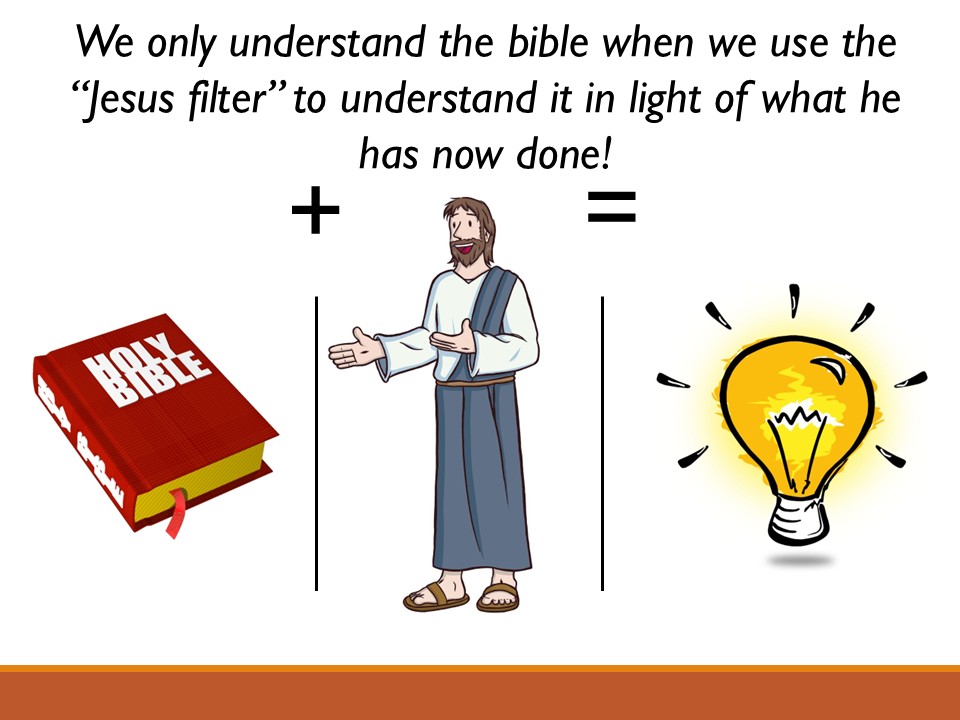
How Do We Read the Law Through the ‘Jesus Filter’?
The Bible is a story with a beginning, middle, and end. When we read the Old Testament, we must do so in light of Jesus’ life, death, and resurrection. This is the “Jesus filter”—understanding that everything in Scripture points to Him.
Here is what this looks like:
For example, the sacrificial laws in Leviticus can seem tedious, but they make sense when we realize they were all pointing to Jesus, the ultimate sacrifice. Just like a child might look forward to getting a bicycle, only to later realize that a car is even better, the Old Testament sacrifices (i.e., the ceremonial laws) were placeholders until Christ, the true fulfillment, came.
Three Types of Old Testament Laws
Ceremonial Laws – These included sacrifices, purity laws, and temple rituals. Jesus fulfills these laws by becoming the ultimate sacrifice. Since His death and resurrection, these laws no longer apply in a direct way.
Civil Laws – These governed daily life in ancient Israel, from property disputes to social justice. Since the Old Testament kingdom no longer exists in the same way, these laws don’t directly apply today, though we can learn principles from them.
Moral Laws – These include commandments about right and wrong, like prohibitions against murder, adultery, and lying. These remain in effect because they are rooted in God’s unchanging character.
Because the new covenant has fulfilled or re-shaped the first two categories of the old covenant law, Jesus now pivots in the rest of Matthew 5 to focus solely on moral laws and their relevance for today. He says: “Therefore anyone who sets aside one of the least of these commands and teaches others accordingly will be called least in the kingdom of heaven, but whoever practices and teaches these commands will be called great in the kingdom of heaven” (Mt 5:19).
What does this mean?
Obeying the Law in the Right Way
Jesus warns that it is possible to do the right thing for the wrong reasons. If we simply follow rules without love or genuine devotion, our obedience is meaningless. This was the problem with the Pharisees, who were obsessed with external appearances while missing the heart of God’s law. They wrongly saw the old covenant law as a means of salvation—“I do this for God, and he will do that for me!” This produces a very self-righteous attitude.
Jesus says, “Unless your righteousness surpasses that of the Pharisees and the teachers of the law, you will certainly not enter the kingdom of heaven” (Matthew 5:20). That doesn’t mean we need to follow even more rules than they did—it means our obedience should come from a place of love, not just obligation. We obey God because we love him and have already been made right with God, not to “get” righteousness as a reward at the end of the rainbow.
For example, the commandment: “You shall have no other gods before me” is easy to affirm in theory. But if we examined our lives, what would our actions say? Do we prioritize God above all else? Or do we let other things—our jobs, entertainment, relationships—take first place in our hearts? There is a massive difference between surface conformity and heartfelt obedience. True obedience isn’t just about external actions but about having a heart transformed by love for God.
Faith Expressing Itself Through Love
The Apostle Paul summed it up in Galatians 5:6: “The only thing that counts is faith expressing itself through love.” This means that our obedience to God should not come from fear or duty but from a genuine love for Him. Just as a heartfelt note from a loved one is more meaningful than a generic greeting card from your insurance agent, our devotion to God should be personal and sincere.
Jesus’ teachings in the rest of Matthew 5 give practical examples of this principle. He takes the external commands (like “Do not murder” and “Do not commit adultery”) and shows their deeper meaning. It’s not enough just to avoid murder—we must also guard against anger and hatred. It’s not enough just to avoid adultery—we must also keep our hearts pure.
A Call to Authentic Christianity
Being a Christian counterculture means more than just appearing religious. It means having a heart genuinely transformed by Christ. True righteousness flows from within—it’s not about keeping a checklist of rules but about loving God so deeply that obedience becomes natural.
This is the challenge Jesus sets before us. Are we simply following religious rules, or are we truly living as salt and light in the world? Do we obey because we have to, or because we want to?
Jesus calls us to follow Him from the heart, to let our love for Him shape every aspect of our lives. When we do this, we don’t just become religious people—we become a living testimony of God’s grace and truth.
May we each examine our hearts and ask God to help us live out our faith in a way that is truly countercultural—not just in appearance, but in spirit and truth.
This is a series of brief devotional articles on The Orthodox Catechism (“OC”),a Particular Baptist document written by Baptist pastor Hercules Collins in 1680. Read the series.
When confronted with a moral failure, our instinct is to minimize or to blame-shift. Yes, we shouldn’t have said this, but it only happened because you said that. No, we haven’t quite gotten around to fixing the car like we promised, but that’s because you keep using it every Saturday. Although these are silly little examples, the pattern holds true for the larger things.
Jesus summed up the law and the prophets under two heads; (a) love God with everything you have—heart, soul, mind, and strength—and (b) love your neighbor as yourself (Mt 22:37-40). How well do we follow these summary principles? The catechism question before us now is like a mirror that strips away all our self-righteousness. It leaves us, as it were, ashamed and defenseless, alone with the truth about ourselves:
Question 5: Can you live up to all this perfectly?
Answer 5: No. I have a natural tendency to hate God[1] and my neighbor.[2]
Now the minimizing bit comes into play.
Living up to all this perfectly? “Well, nobody is perfect …” we muse. But, compared to the other guy, I’m not in bad shape at all.
A natural tendency? Well, again, nobody is perfect.
Hating God and our neighbor? Hate is a strong word. I love God, and I don’t really hate anybody.
Unfortunately, the minimizing doesn’t work here. Holiness isn’t graded on a curve. In the same way that a woman either is or is not pregnant, and a man either is or is not a father, you either are or are not holy and righteous. To be “holy” is to be pure and perfect—without moral spot or blemish. To be “righteous” means to be morally upright in accordance with God’s standards. The catechism answer says you’ve missed that boat. We all have.
In what way have we missed that boat?
Because we all have a natural tendency to hate God and our neighbor. This tendency is natural because it’s innate, it’s our default setting, it isn’t a learned behavior—it’s just the way we are. The apostle Paul, a Jewish man, pointed out that even Jews had no advantage with God on this point: “Do we have any advantage? Not at all! For we have already made the charge that Jews and Gentiles alike are all under the power of sin” (Rom 3:9).
Paul’s words are important and you should read them again. We’re “under the power of” this malevolent force called sin, which is basically a contagion or disease of pervasive selfishness and narcissism. Because sin is selfishness—not simply “self-love” but more like “self-worship at all costs”[3]—it has a marvelous capacity for self-deception and self-righteousness. We think we’re fine, but we’re not. This is why God must rip the veil away from our hearts and minds so the gospel light can shine in and do its work (2 Cor 4:3-6).
Now we turn to hate. Yes, it’s a strong word. It means something like “extreme enmity” and “active hostility.”[4] Who wants to fess up to that? But lest we assume we have plenty of wiggle-room here, Jesus takes a sledgehammer to our rationalizations. God’s standards aren’t about externals—they’re about internal affections that show in an external way. This means that anger, contempt, and ridicule are the same as murder because they all come from an inner hostility and ill-will towards that other person (Mt 5:21-22). Likewise, adultery isn’t simply the sexual act but also the sexual thought (Mt 5:27-28).
What the catechism is driving at is that, in our hearts, we do not love God and our neighbor perfectly. We fail here because sin is that pervasive selfishness and narcissism that naturally reigns in our hearts and minds. And, because holiness (like pregnancy and fatherhood) is a “yes or no” status, that means we’ve each fallen short.
So, that’s where we are. It brings us round to Questions 2 and 3—the law of God tells us how great our sin and misery are. This naturally prompts a new question: why would God make us to be in such a terrible condition? If a manufacturer makes a bad product, it issues a recall and fixes the problem. Why hasn’t God issued a recall on us? Did he make a mistake with us? Is he holding us responsible for his own design flaws? We turn to these questions next time.
[2] Gen 6:5; Jer 17:9; Rom 7:23-24, 8:7; Eph 2:1-3; Titus 3:3.
[3] Augustus H. Strong is particularly good here: “We hold the essential principle of sin to be selfishness. By selfishness we mean not simply the exaggerated self-love which constitutes the antithesis of benevolence, but that choice of self as the supreme end which constitutes the antithesis of supreme love to God” (Systematic Theology (Philadelphia: American Baptist Publication Society, 1907), 567).
[4]Merriam-Webster Collegiate Dictionary, s.v. “hate,” verb, sense 1.
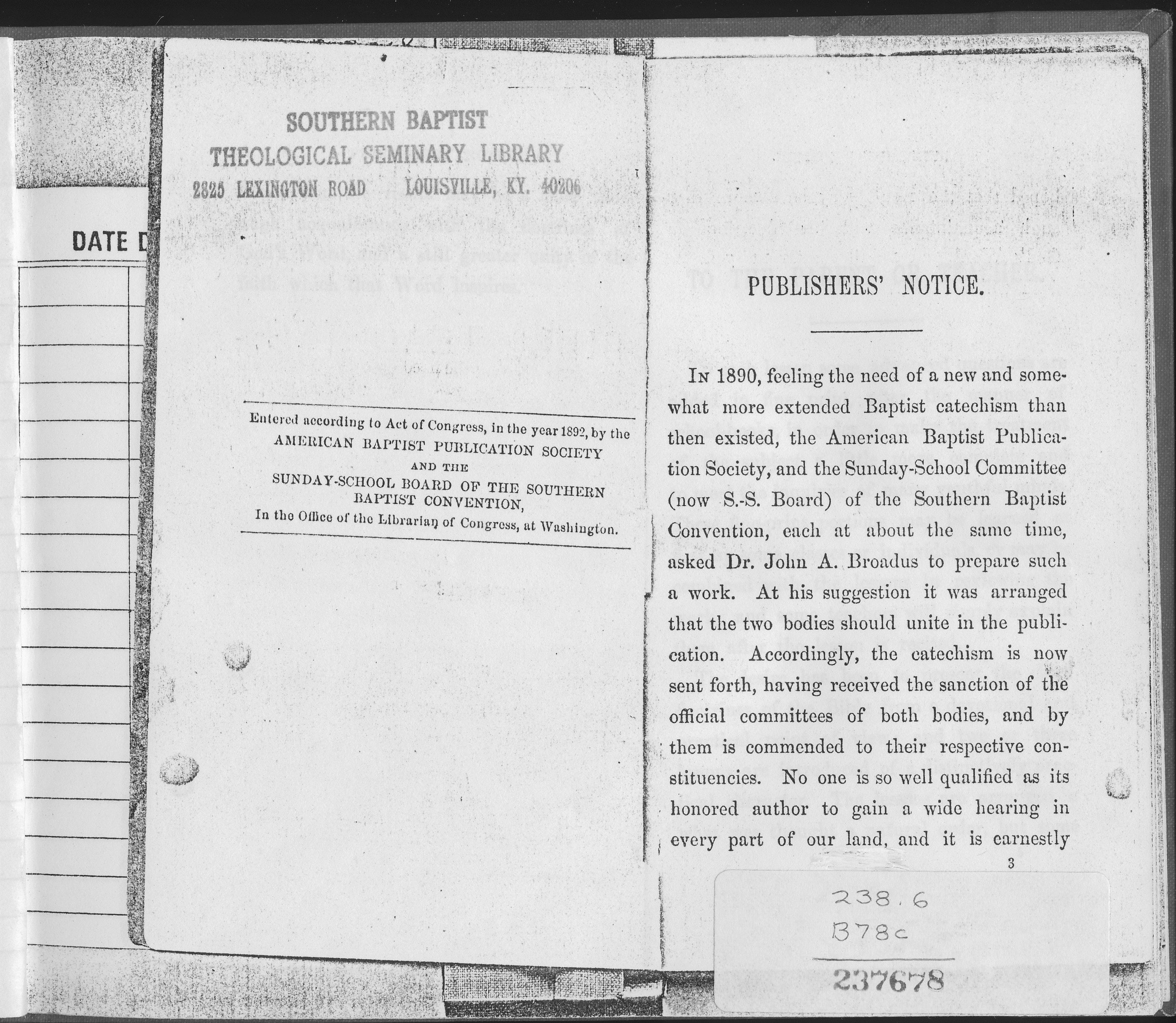
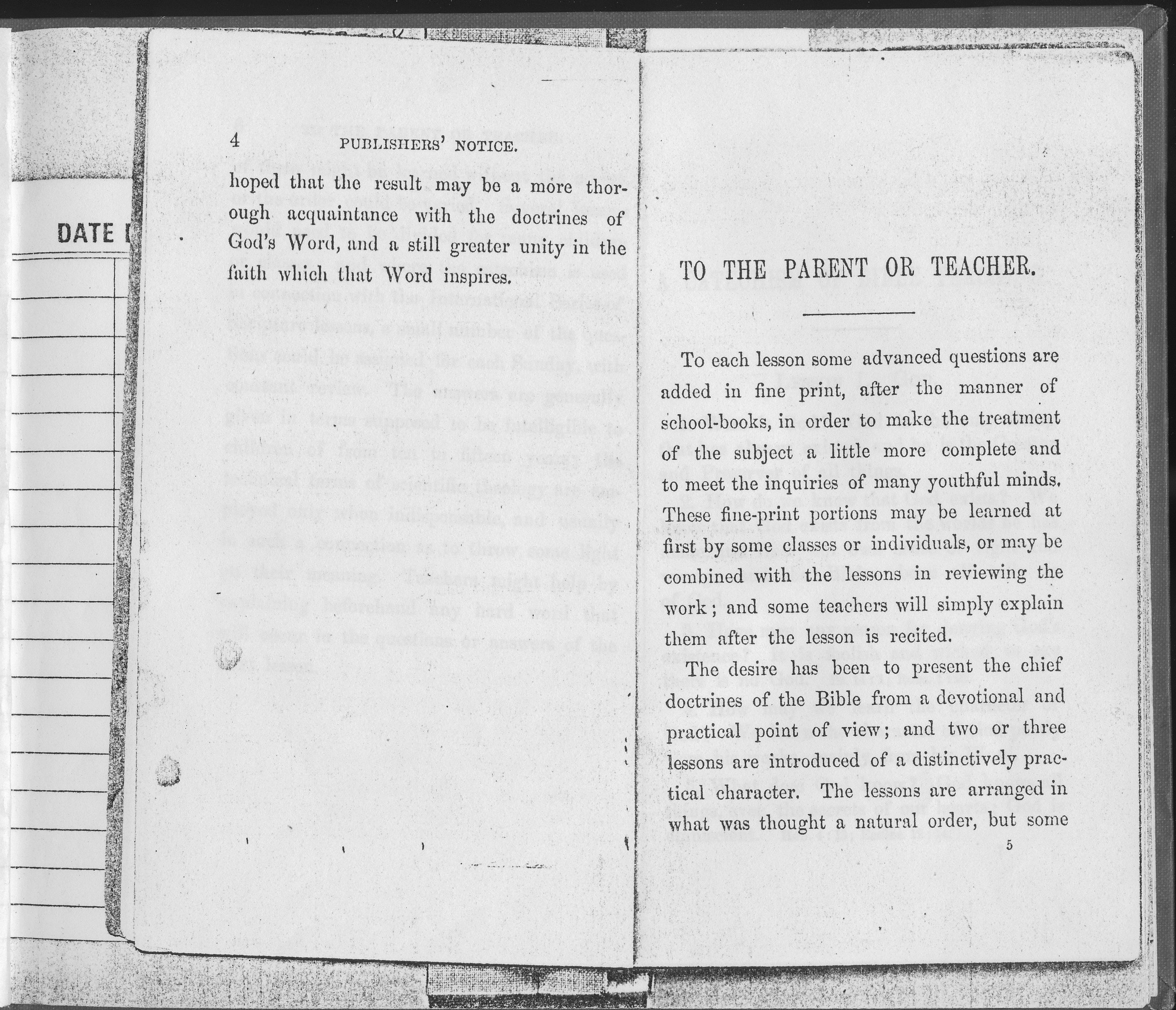
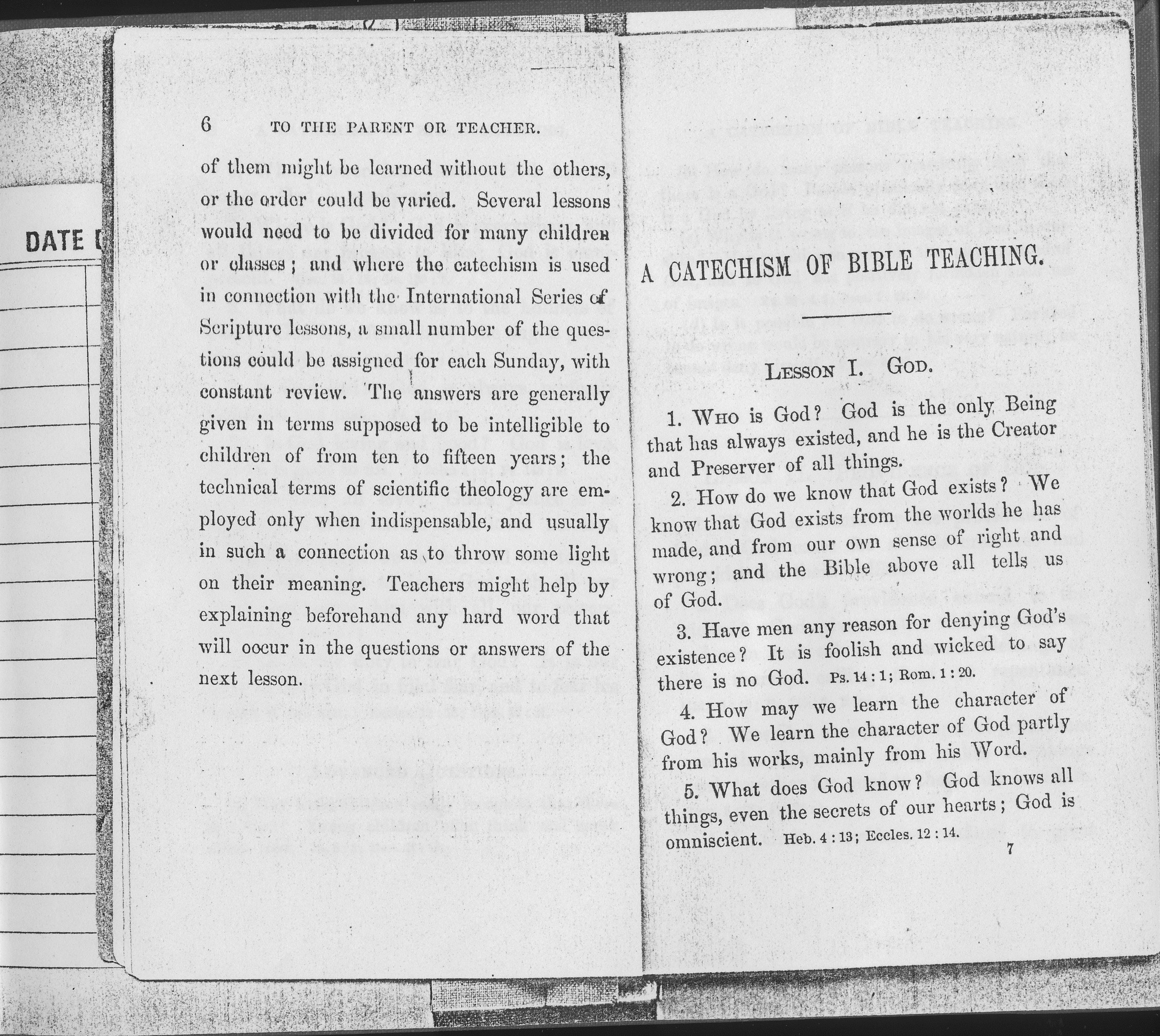
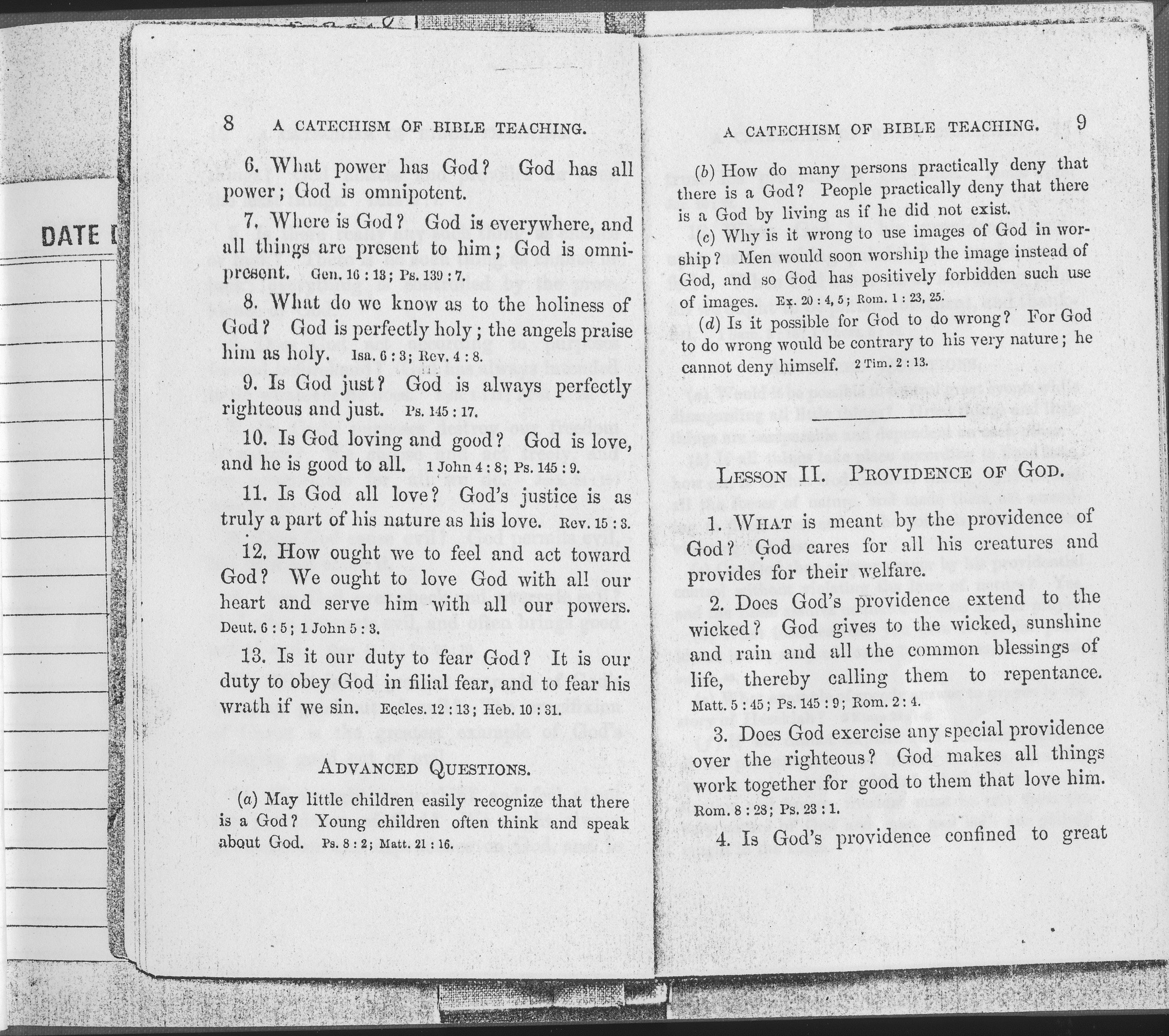
I’m well underway with my next book project–a catechism of the Christian faith based on John Broadus’ “A Catechism of Bible Teaching” from 1882. I’m using Broadus as a foundation, and expanding some of his comments and mixing in odds and ends from other classic Baptist catechisms along the way. I expect the final product to be 261 questions–enough for five questions and answers per week for one year. Pictures and charts will be sprinkled throughout. I’ll likely be self-publishing this one so I can have it for immediate use in our church and for distribution.
Broadus’ catechism is very, very good (so is Boyce’s), and I think every Christian would benefit from it. A preview of the original is below, and you can download a PDF scan of an original here (many thanks to the SBTS library for scanning me a copy!).
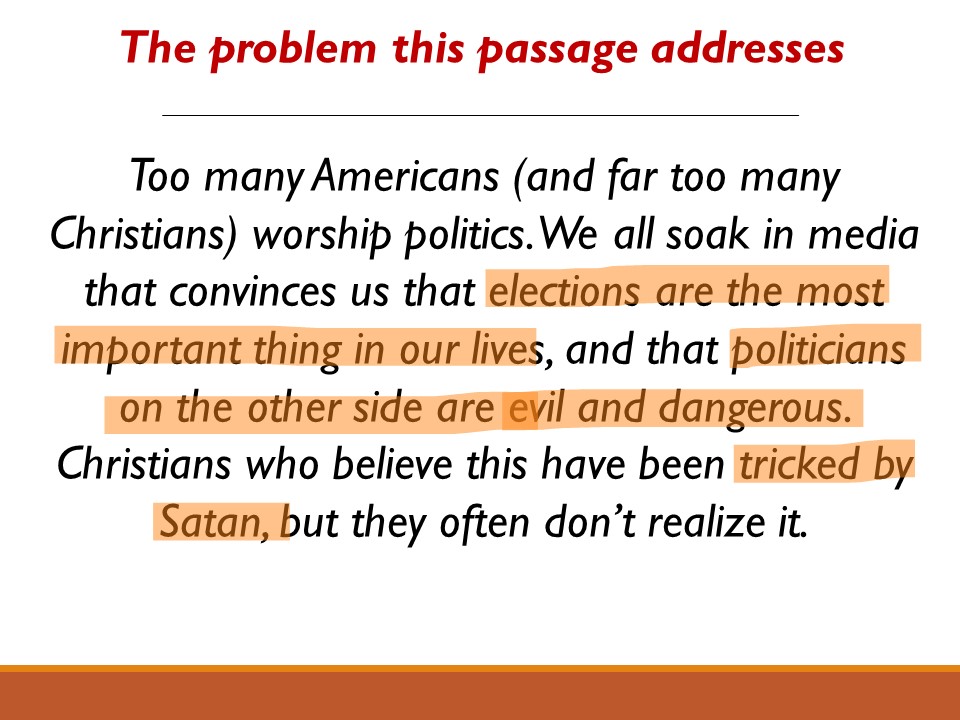
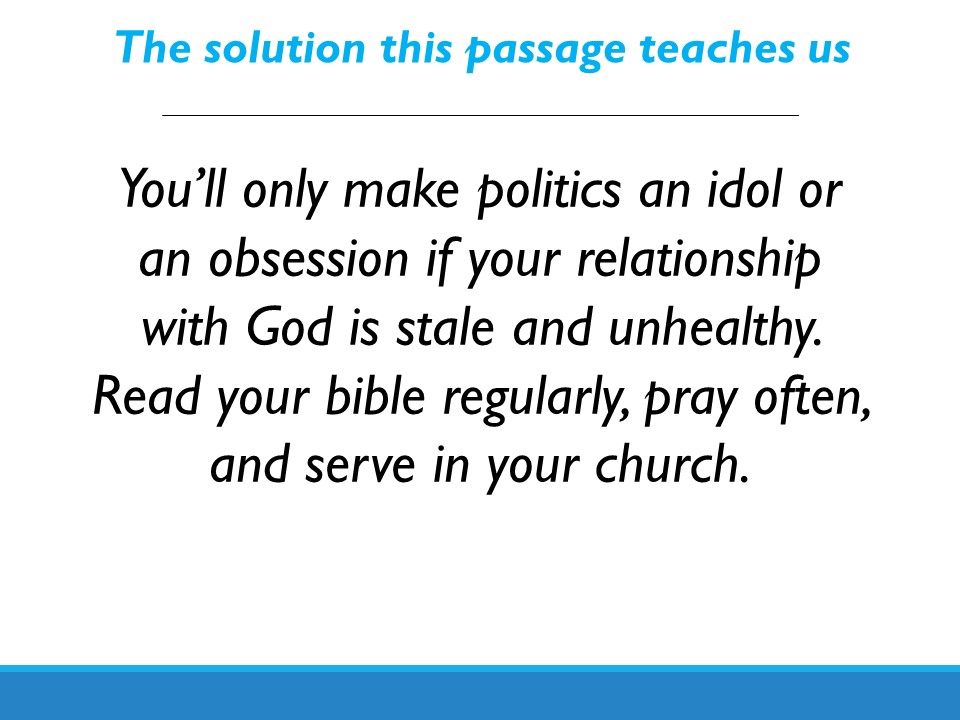
Last Saturday afternoon, I scrapped my planned sermon because of the assassination attempt on former President Donald Trump. In its place I wrote a message about (a) what Christians should think about political violence in American life, and (b) what they can do about it. I urged the congregation to always be centered on God’s wisdom, rather than the poison from partisan media and other influences (from both sides of the aisle). I chose Proverbs 8 as my text.
I begin by surveying the sad and sordid history of attempted and successful assassinations against American Presidents, then segued into Proverbs 8, and then closed.
Here is the problem, as I see it:
Here is the solution:
Here’s the sermon:
And for good measure, here is a sermon I preached on Romans 13 a few months ago:
Providence is what Christians call “God governing things to turn out like He decided.” Either God is trying really hard to make something work, or He directs and controls reality. The scriptures tell us the second option is the right one. But, how does this work? This bible study considers what the scriptures have to say about this issue, and why it matters for your life.
Here are three resources that you might find helpful when considering this topic:
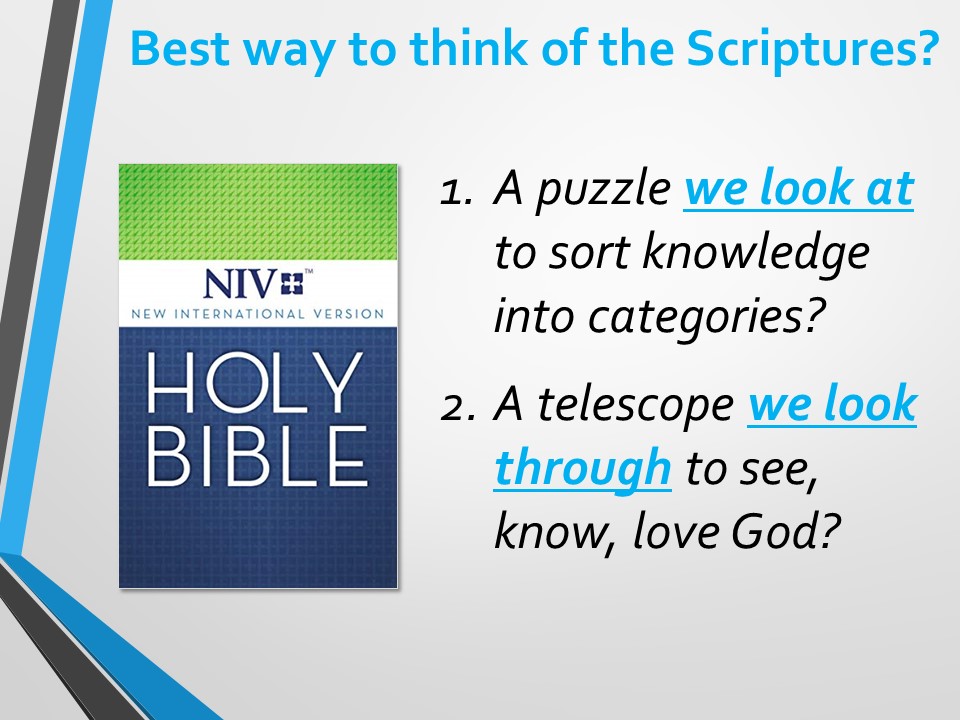
We need to read our bibles. God wants us to read our bibles—it is the story of Him revealing hidden things to us we would otherwise never know! Fair enough. But I first want to ask an important question—what is the best way to think of the Scriptures?
Different Christians answer in different ways; most often as the result of the different emphases of their theological traditions mediated from seminaries to pastors. How you answer the question above will determine what you think happens when you read your bibles. Only one of these answers is the best answer—which one is it?
We will first take a look at a passage from Psalm 119, then look at two possible frameworks for reading Scripture (a puzzle or a telescope?), then wrap up with what I feel is the best approach.
Words Which Give Light
Psalm 119 is a beautiful love song to God’s revelation. Today, on this side of the Cross, we often assume the psalmist is simply talking about the Bible (e.g. “I have hidden your word in my heart,” Psalm 119:11). But he was probably talking about revelation in a general sense.
“Revelation” is when God personally unveils Himself to His people to communicate things we would otherwise never know.[1] God revealed Himself in many ways—through visions, prophecies, individual guidance, dreams, divine appearances, angels, direct speech, most definitively in Jesus Christ (God’s “Word” (Jn 1:1, et al), His revelation, message, and literal speech embodied in the incarnation) … but also in written records. Strictly speaking, the bible is more an inspired and truthful record of God’s revelations than “the” revelation all by itself.[2] My point is that, while my comments here will focus on the Scriptures, all references in Psalm 119 to “the word” are probably about more than “the bible.”
Think about what the psalmist says in Psalm 119:129-136. He says God’s statutes are wonderful, and this loveliness drives him to loving obedience (Ps 119:129). This is not the rote obedience of a legalist, but the joyful response of a good child. He declares “the unfolding of your words gives light; it gives understanding to the simple,” (Ps 119:130). As God communicates to us (however He does it—“words” here means “speech”), His light shines into us, bringing understanding even to the most ordinary among us. God’s speech, His message, unspools and casts light into our hearts, minds, and souls—into our very being.
So, the psalmist wants more and more—“longing for your commands,” (Ps 119:131). He wants more light, more understanding, more relationship. He wants to be a better child. He knows relationship with God is not about rote doctrine. “[R]evelation is primarily a spiritual transaction rather than mere illumination of the intellect … [i]t is easy to see how far removed this is from the bare communication of truth to the mind.”[3] It is “those who love your name” (Ps 119:132) who receive mercy, not “those who follow the checklist.”
So, when the psalmist asks God to “direct my footsteps according to your word” (Ps 119:133), he is asking for more than “help me not do that bad thing again.” There is that, but the reason why he asks “let no sin rule over me” is because he loves God and wants to be an obedient child (cp. Deut 6:4; Mk 12:28-32; Mt 9:13 (cf. Hos 6:6)). He even asks to be rescued from those who hinder him from obeying God’s precepts (Ps 119:134).
When he asks “make your face shine on your servant” (Ps 119:135), he is playing on God’s personal revelation as a luminescent cloud. Just as Moses came down from the mountain with his face all aglow from actual contact with Yahweh, so the psalmist figuratively asks for God to turn to him with blessing, with favor, with divine help—“teach me your decrees.” His love for God flows so deep that “streams of tears flow from my eyes, for your law is not obeyed,” (Ps 119:136). This is not the fuming rage of a legalist (cf. Jn 9:19-34), but the sorrow of a child brokenhearted about externalism in the congregation.
As we consider the psalmist’s attitude about God’s revelation, His “word” (in any format), let us return to the question I asked at the beginning—what is the best way to think about the Scriptures?
a puzzle piece we look at to categorize knowledge, or
a telescope we look through to see, know, experience, and love God?
Which model does our passage best suggest? To answer this question, we will consider each model in turn.
Bible as a Puzzle
When you believe the bible is one big puzzle to be sorted into categories, with various passages filed under this heading or that (“the proper task of theology is to exposit and elucidate the content of Scripture in an orderly way”),[4] then you may tend to read in a cold, analytical, and sterile fashion. It does not mean you will have this attitude—it just means you may lean in that direction, to greater or lesser extent.
Faith can unwittingly become about intellectual knowledge. Do you believe Jesus is the Son of God? Do you believe in the virgin birth? Do you believe Jesus died on the Cross? Do you believe in the resurrection? And so it goes—intellect can unconsciously supplant trust, love, and commitment.
And so, bible study can unconsciously degenerate into an autopsy—cold, dispassionate, clinical.
We end up reading the bible for doctrine, for knowledge—not for love (notwithstanding the honest caveats).
This is often more an attitude or ethos than a conscious decision. Let me share one example from one very influential evangelical theologian from yesteryear. He is discussing the definition of “revelation.”
I have learned a lot from Carl Henry. I like Carl Henry. But, where is the love? Henry saw the Scriptures as a puzzle to be sorted, filed, indexed. A theologian was like a lawyer preparing a brief—“logical consistency is a negative test of truth and coherence a subordinate test.”[5] He looked at Scripture to find truth. This mindset may produce something like the following, which is largely a precis of some of Henry’s system:
God reveals Himself through the bible—all knowledge (even revelation about Christ[6]) flows from the Scriptures. It is the “basic epistemological axiom.”[7]
God does not reveal Himself as personal presence. That would open the door to a subjective mysticism. Instead, He reveals Himself via propositions—“a rational declaration capable of being either believed, doubted, or denied.” Revelation must be cognitive, which means it must be propositional, which means the Scriptures are the ballgame,[8] and the implication is the bible is a storehouse of data.
Therefore, the Spirit’s job in this context is to help us interpret this data that is the bible. He has no meaningful role apart from this.[9] Henry saw danger when the Spirit was “severed from the Word,” and by “Word” Henry meant the Scriptures, not Jesus.[10] Representing this perspective downstream from Henry, John MacArthur did not misspeak when he wrote that the bible “is the only book that can totally transform someone from the inside out.”[11] It is telling that MacArthur did not credit Jesus with granting life, but rather the bible (energized with “Spirit-generated power”).[12]
So, the most important thing we can do is study the bible. “Only the Bible can effect that kind of change in people’s lives, because only the Bible is empowered by the Spirit of God.”[13] The inevitable corollary is a strong defense of Scripture’s integrity, which explains the emphasis from these quarters on Scripture’s inerrancy.
And so, our focus may subtly shift from relationship with the Messiah to whom the bible points, to “the bible” itself—to doctrine, knowledge, cold logic. Henry did not think rationalism was an error, so long as it was based on valid premises.[14]
The bible becomes, de facto, the only channel for relationship with God. This is why many Christians who trend towards “knowledge” as their relationship paradigm for God are very uncomfortable with the “Jesus reveals Himself to Muslims via dreams” issue—because the bible is not in the driver’s seat. In a similar way, these Christians often speak about the Spirit to say what He does not do—it is frequently negative. I suspect these Christians are wary of something non-rational, something supernatural, something they cannot understand with the intellect.[15]
Here is an example. Sometime in years past, I was with a group of pastors, and we were discussing the “problem of evil.” One pastor brought up an example of someone who “walked away from the faith” after suffering sexual abuse as a teen. The woman told her pastor that, if her abuser ever became a Christian, “I could never share heaven with him!”
A man in the group stabbed the air with a forefinger. “Her attitude is that ‘I’m more righteous than God, and so I’m more qualified to make a decision about that person’s fate!’”
There was a moment of silence. I suggested, “Maybe she’s just really hurting? Maybe that’s all that was behind that comment.”
You see, to him, there is not a person here with feelings—there is only icy logic, a remorseless conclusion based on theology. He did not see people who hurt—he saw problems to be categorized into doctrinal cubbyholes, to be sorted, filed, tagged. In practical terms, he unwittingly acted as if the Bible were a cadaver, and the question at hand was an excuse to grab a scalpel, slice it open, and pick at it. This man read the bible for knowledge. It was cold. Clinical. There was no love.
Of course, not everyone is like that pastor. But, some pastors (and some ordinary Christians) are not too far downstream from this. There is a better way!
Bible as a Telescope
At the back of all this is this question—what is a relationship with God about? There is a continuum, with “love” and “knowledge” at opposite poles. A ditch lies at either end—God is either Jello or an iceman. Both poles are important (it is kind of important to know about God, after all!), but you will likely tend towards one over the other—Carl Henry certainly did.
So, let me declare this—love must be the foundation for your relationship with God. Moses said it. Jesus affirmed it. I think that is pretty definitive! On this continuum, trend towards love.
If you think faith is about love and trust in Jesus, you will look through the bible to connect to God. But, if you think faith is about information about Jesus, then you may look at the bible as an end in and of itself. This last approach misses the point.[16]
Let me give you a few examples:
You love espresso. You have an expensive espresso machine. Which is more important—the machine or the espresso it produces? The espresso, of course! Suppose someone objects, “Well, without the machine, we wouldn’t have espresso!” This is missing the point—the goal is to drink espresso! The machine is only valuable insofar as it makes the coffee.
You have a telescope. It is a great telescope—the best! You set it up in your backyard, ready to go. Someone keeps gushing about the telescope; its the features and its general awesomeness. “Isn’t it great?” he asks. It might be a wonderful telescope, but the goal is to look through the scope to see the heavens! The telescope is not the point—it is simply a means to a greater end. It is a tool. To obsess over the telescope is to miss the point.
What I am suggesting is that the bible is a telescope. It lets us see, know, and experience God. It channels God, by the power of the Spirit. It does not exist for its own sake—its only job is to provide a scope to look through to see God and experience Him. We do not look at a telescope—we look through it to see the heavens. In the same way, you look through the Scriptures to see God—you do not look at it!
We saw from our text that as God’s revelation unfolds to us, it brings “light” to our eyes, giving understanding to the simple (Ps 119:130). The Scriptures (God’s truthful record of His revelation) are a telescope which bring God into focus, make Him present, confront us with Him for teaching, rebuking, correction, for training in righteousness (2 Tim 3:16)—“direct my footsteps according to your word” (Ps 119:133).
In another place, the psalmist says, “Your word is a lamp for my feet, a light on my path,” (Ps 119:105). God’s revelation lights our path so we can find our way to Him, so Jesus—the true light (Jn 1:9)—can shine upon we who are in darkness and guide our feet into the way of peace (Lk 1:79). Elsewhere, Solomon says our spirit is “the lamp of the Lord, that sheds light on one’s inmost being,” (Prov 20:27). We are lamps waiting to be lit by Yahweh—“light and life to all He brings!” (cp. Jn 1:4). His revelation—ultimately Jesus as the light of the world—illuminates us from the inside out. The Scriptures are a witness to that revelation (Jn 5:46)—they connect us to Jesus.
Read the Scriptures with Love!
This is what I’m saying, in the end:
Read the bible to know God, not to know about God. This is not a call to toss doctrine to the winds—it is not a “we don’t need no theology in this here church!” attitude. It is a plea to keep warmth, love, and personal encounter with Christ via the Spirit at the forefront. Carl Henry was right to acknowledge that personal faith is a gift of the Spirit,[17] but I fear some who follow in his theological train unwittingly make the same acknowledgments in a pro forma manner.
Read the bible to love God, not to love facts about God. The demons know true doctrine and it does them no good (Jas 2:19)! “The purpose of theology [and bible reading!] is to clarify the propositions involved in faith, but we must never mistake belief in propositions for the faith.”[18]
Read the bible to grow closer to Him in relationship, not to pick at Scriptures with tweezers.
I have one more example to give. Many years ago, I spoke to an individual who did not believe spiritual illumination helped us understand the bible. Instead, she said the Spirit “allows me to receive the text as it is.” I asked her to explain. She said the Spirit never helped people agree on what a text means. She said she had people in her church who were more spiritual than she, but worse bible interpreters—thus a person’s spirituality was irrelevant. The matter would always be settled by grammar, syntax, rules of interpretation.
I interrupted and asked her flat out, “Are you saying you never pray and ask to understand the bible?” She grimaced, then stammered a bit. “I don’t want to say the word ‘understand’ …” She then rallied, and repeated that interpretation was always settled by grammar and interpretative rules, and that the Spirit simply “enables me to accept the text as it is.”
Basically, she followed Carl Henry. She looked at the Scriptures to discover truth from the ink on the page or the pixels on the screen—she did not look through them to see, know, experience, and love God. If we are not careful, our faith may grow cold and rational. Emil Brunner remarked that “[t]his confusion, this replacing of personal understanding of faith by the intellectual, is probably the most fatal occurrence within the entire history of the church.”[19]
We need to read our bibles, but in the right way!
I like my espresso machine, but only because through it I see my espresso—the machine is a means to an end.
We love our bibles, but only because it is a telescope we look through to see, know, and love God.
The bible in your hand is God’s divine means to an end, and that end is a relationship with Him.
It is not a puzzle we look at—it is a telescope we look through.
So, when you read your bibles, read them with an attitude of love—not the attitude of a mortician—so that through the Scriptures you can see, experience, and love God. Read for formation, not simply for information.[20]
[1] See Edgar Mullins, The Christian Religion in its Doctrinal Expression (Philadelphia: Roger Williams Press, 1917), p. 141.
[2] This need not be categorized as a neo-orthodox statement. Long before Barth or Brunner put pen to paper, Edgar Mullins repeatedly called the Scripture “the record of God’s revelation,” (Christian Religion, pp. 137, 140, 142), as did Alvah Hovey before him (Manual of Christian Theology (New York: Silver, Burdett and Company, 1900), pp. 42, 85.
[4] Carl F.H. Henry, God, Revelation, and Authority, vol. 1 (Waco: Word, 1976), p. 238. See especially ch(s). 13-14.
[5] Henry, God, Revelation, and Authority, p. 1:232.
[6] To Henry, the Scripture is the reservoir or conduit of divine truth (Thesis No. 11, God, Revelation, and Authority, vol. 4(Waco: Word, 1979), p.7). It is the end of the line. The Spirit’s role in this context is to illuminate the Scripture (see Thesis No. 12, God, Revelation, and Authority, p.4:129) by enlivening it so we understand what it says. He only helps us interpret but imparts no new information (God, Revelation, and Authority, pp. 4:273, 275)—this is illumination, according to Henry. The Christian looks at the Bible as an end in and of itself.
[7] Henry, God, Revelation, and Authority, pp. 1:218f.
[8] See Henry, God, Revelation, and Authority, pp. 3:455-459.
[9] To Henry, the Scriptures are the vehicle and the Spirit simply shines a light upon them. “God intends that Scripture should function in our lives as his Spirit-illumined Word. It is the Spirit who opens man’s being to a keen personal awareness of God’s revelation. The Spirit empowers us to receive and appropriate the Scriptures, and promotes in us a normative theological comprehension for a transformed life. The Spirit gives a vital current focus to historical revelation and makes it powerfully real,” (God, Revelation, and Authority, p. 4:273).
[10] Henry, God, Revelation, and Authority, pp. 3:482f. “The Bible supplies no basis for the theory that the logos of God must be something other than an intelligible spoken or written word.”
[11] John MacArthur (ed.), The Inerrant Word: Biblical, Historical, Theological, and Pastoral Perspectives (Wheaton: Crossway, 2016), p. 19.
[12] This relentless focus on the Scriptures to the exclusion of anything else led Emil Brunner to intemperately accuse such adherents of idolatry. “The habit of regarding the written word, the Bible, as the ‘Word of God’ exclusively—as is the case in the traditional equation of the ‘word’ of the Bible with the ‘Word of God’—an error which is constantly on the verge of being repeated—is actually a breach of the Second Commandment: it is the deification of a creature, bibliolatry,” (Revelation and Reason: The Christian Doctrine of Faith and Knowledge, trans. Olive Wyon (Philadelphia: Westminster, 1946), p. 120).
[14] “The Christian protest against rationalism in its eighteenth-century deistic emphasis on the sufficiency of human speculation unenlightened by divine revelation is legitimate enough. What is objectionable about rationalism is not reason, however, but human reasoning deployed into the service of premises that flow from arbitrary and mistaken postulations about reality and truth. Christian theology unreservedly champions reason as an instrument for organizing data and drawing inferences from it, and as a logical discriminating faculty competent to test religious claims,” (God, Revelation, and Authority, p. 1:226). Emphasis added.
[15] Carl Henry wrote, “There is but one system of truth, and that system involves the right axiom and its theorems and premises derived with complete logical consistency,” (God, Revelation, and Authority, p. 1:227).
[16] For the position I am advocating, see especially (1) Emil Brunner, Revelation and Reason, pp. 3-57, 118-136, and (2) William Hordern, A New Reformation Theology (Philadelphia: Westminster, 1959), pp. 31-76. My telescope analogy is from Hordern (p. 70). For a helpful cautionary note hitting the brakes on Brunner (et al) while disagreeing with Henry’s more rationalistic perspective, see Millard Erickson, Christian Theology, 3rd ed. (Grand Rapids: Baker, 2013), pp. 157-163. See also James L. Garrett, Systematic Theology, vol. 1 (Grand Rapids: Eerdmans, 1990), pp. 168-182 for a solid, helpful discussion on the bible and authority in Christianity.
[17] Henry, God, Revelation, and Authority, p. 1:228.
[19] Emil Brunner, Truth as Encounter: A New Edition, Much Enlarged, of ‘The Divine-Human Encounter’ (London: SCM Press, 1964), p. 165.
[20] Justo Gonzalez, Knowing Our Faith: A Guide for Believers, Seekers, and Christian Communities (Grand Rapids: Eerdmans, 2019), p. 27. “… our main purpose in reading the Bible must not be information, but rather formation. When we read, for instance, the story of Abraham, what is important is not that we learn by heart the entire route of his pilgrimage, but rather that somehow we come to share that faith which guided him throughout his journey.”
The president of Southern Seminary is on record as saying that government funding for religious schools is wrong, that Baptists “consistently oppose” the public reading of Scripture in public schools, and he even agonized over whether it would “subsidize religion” for churches to be tax-exempt.[1] This president is not Al Mohler, but his predecessor Edgar Mullins, writing in 1908. Some religious outsiders (and perhaps not a few Baptists) would be surprised to learn this. Yet, Mullins was no maverick—so why do his views seem so out of step with evangelical political discourse today?
Broadly speaking, church and state relations can be framed as four choices:[2]
Theocracy. The church controls the State. For example, Rousas Rushdoony, an architect of Christian Reconstructionism, believed the Great Commission was about the church’s mandate to remake society. He declared that focus on salvation of souls at the expense of this mandate was “heretical.”[3]
Constantianism. The State favors the church, which in turn accommodates itself to the government. This is a quid pro quo partnership.
Free church in a free state. Government leaves people alone to worship (or not) as they wish, and the church supports that aim so all can freely choose their own path—without implicit or explicit State sanction.
Isolation. Christians withdraw. They watch their own movies, listen to their own music, go to their own clubs, and effectively segregate themselves from society, culture, and the wider world.
The third path is the historic Baptist position, and it is the one Mullins represented. This is a framework that can bring clarity in polarized times—and, as a bonus, it is enshrined in the 1st Amendment. The position is simple, and one can appreciate it regardless of its sectarian origins:
Each person is responsible for her own relationship with God,
In order to be responsible, each person must be free to make her own choice,
So, the best model for church and state relations is “a free church in a free state.”
Salvation is an individual affair. Jesus calls individuals to “repent and believe,” (Mark 1:15). The Apostle Paul tells believers to put away their old selves, and “put on” their new status as God’s children (Ephesians 4:22-23). The Scriptures speak of individual judgment (1 Corinthians 3:12-15; Revelation 20:11-15). That being the case, choosing God—loving Him with everything you have (cf. Deuteronomy 6:5; Mark 12:28-31)—cannot be based on implicit or explicit coercion. It must be a free choice, an intelligent and willful decision. You cannot force love in a marriage, nor can you compel love for Christ. God is interested in our hearts, which must be freely given. As one early Baptist wrote, “You may force men to church against their consciences, but they will believe as they did afore.”[4]
If all this is true, then it suggests Christians ought to support “a free church in a free state.” The two pillars of this position are codified in the 1st Amendment as the “free exercise” and the “establishment” clauses:
Congress shall make no law respecting an establishment of religion, or prohibiting the free exercise thereof …
Essentially, these two pillars say (1) government will not establish a religion, nor will it (2) prohibit people from freely exercising their religious beliefs. As Christians today survey the evangelical landscape and wonder what to think about the intersection of church and politics, the Baptist ethos is one worth considering. Here are some questions to make this less abstract—consider them in the context of “a free church in a free state,” and the “free exercise” and “establishment” principles.
Should Christians support compulsory Christian prayer in public schools? This practice would compel all students to pray in a Christian manner, regardless of their own beliefs. This is coercion. It also violates the establishment clause. This is why Engel v. Vitale (370 U.S. 421 (1962)) went the way it did—not because “secularists” were on the march, but on principle.
Ought a nativity scene be displayed on public property? Would this be favoring Christianity? What should you think if someone says, “This is a Christian nation, and while other faiths can worship as they wish, the nativity scene must go up!” If government cannot “establish” religion, then what is the solution, here?
May a football coach employed by a public school be fired for engaging in prayer on a football field after a game? The Bremerton, WA school district thought this violated the establishment clause. The Supreme disagreed (Kennedy v. Bremerton School District, 597 U.S. ___ (2022)).
More examples could be given. The “free church in a free state” framework is a flexible model that eschews government coercion in matters of faith, while safeguarding a person’s right to exercise that faith. Government has struggled to fairly implement this framework in the messiness of real life; at times favoring accommodationist or separationist views to solve the muddle.[5]
The point is that there is no theocracy. There is also no church and State quid pro quo partnership. Nor is there a need to withdraw from public life and embrace isolationism. There are only houses of faith being asked to be left alone, declining special treatment, not lobbying for “access” and “power,” not pushing for an explicit or implicit establishment of Christianity—because one day the shoe may be on the other foot. It can do this because the church’s job is not to underwrite American democracy, but to be a counter-cultural community of “foreigners” waiting for the better tomorrow, witnessing for Christ and the Gospel.[6] To be this alternative community, the church must demand to be left alone—not cry out for special favors or long for sepia-toned nostalgia of a bygone de facto Christendom. This is what Howard Snyder called the “countersystem” or “subversive” model,[7] wherein the church is a community summoning people to leave the secular city and join a new society.
Thinking citizens cannot escape this sectarian discussion, because the post-Trump GOP is suffused with populist derivatives of Christian Reconstructionism. Those unfamiliar with the broader stream of Christian theology may assume Reconstructionism is Christianity. Indeed, the “free church in a free state” ethos has fallen on hard times in public discourse—especially at the hands of leaders who know better. Much of the popular uproar in evangelical circles about “losing our country” is because America has been disestablishing Christianity as its de facto civil religion for at least the past two generations.
This framework is sometimes dismissed as utopian or naïve. Somebody’s values will be legislated, why not make sure they are Christian values? There are good books which flesh out the framework I can only sketch here.[8] Suffice it to say that God’s community is not the State; “Church and State might in a perfect society coalesce into one; but meantime their functions must be kept separate.”[9] As one theologian observed, “the church is a colony, an island of one culture in the middle of another.”[10] Resident aliens never mistake a foreign country as their own.
For healthy civic discourse, to ensure a decision for Christ is freely made (whichever way it may go), so the church can be the church, and for a measure of sane pluralism in an insane world—both Christians and concerned citizens should champion the “free church in a free state” ethos.
[1] Edgar Y. Mullins, The Axioms of Religion (Philadelphia: American Baptist Publication Society, 1908), pp. 197-200.
[2] There are many helpful ways to frame this issue—this is merely one of them.
[3] Rousas J. Rushdoony, Christianity and the State (Vallecito: Chalcedon, 1986), pp. 19, 35.
[4] Leonard Busher, “Religion’s Peace, 1614,” from H. Leon McBeth, A Sourcebook for Baptist Heritage (Nashville, TN: B&H, 1990), p. 73.
[5] Take the example of a nativity scene at the county courthouse. A separationist ethic would ban all religious displays at Christmas. An accommodationist view would allow any group to put up any display it wants at Christmas.
[6] See Stanley Hauerwas and William Willimon, Resident Aliens, expended ed. (Nashville: Abingdon, 2014), ch. 2.
[7] Howard Snyder, Models of the Kingdom (Nashville: Abingdon, 1991), pp. 77-85.
[8] See especially Hauerwas and Willimon, Resident Aliens.
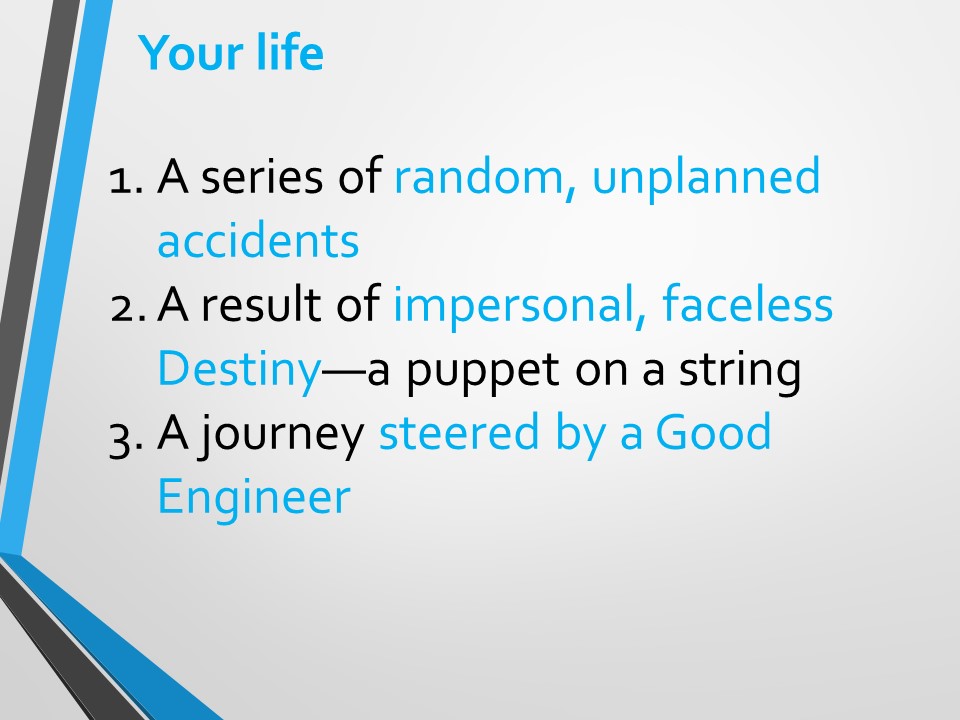
Many people yearn to make sense of their lives and this world. Why do things happen the way they do? Is it part of a plan? Is there no plan? Using the analogy of a train plodding its way along, there are at least ways people often think of this world and their place:
The runaway train. It hurtles down a track without a controller at the wheel—whatever happens happens. This is the way of scientism and secular humanism. There is no plan, no purpose, no guiding hand—malevolent or otherwise. There is just random meaninglessness.
Fate. The train that is this world is controlled by an impersonal, uncaring, disinterested, and faceless controller we don’t know, can’t see, can’t fathom. This is “blind luck,” Fate, Destiny.
The Good Controller. This is the Christian answer. This is the true God. He controls the train. Under His control, you can see Him, know Him, love Him, trust Him—and He makes Himself available to anyone who wants Him.
Christians need to know—to really know—that you, your life, your circumstances, aren’t an accident. Your life isn’t the result of an impersonal, uncaring Destiny. God knows, sees, cares, drives the train that is your life, my life, all of our lives. One life touches so many others,[1] and the confluence of all the events, circumstances, actions (good or bad) in this world work together to bring His story closer to home—His train closer to its station.
The account of Paul’s voyage across the Mediterranean and shipwreck on Malta confronts us with this truth. I didn’t know how to preach the passage. It’s a tough narrative. What are Christians supposed to do with it? If they’re ever imprisoned on a ship headed from Caesarea to Italy, are they to make sure to stay the Winter in Crete? Is that God’s message in that passage (Acts 27:1 – 28:10)?
Then I thought about God’s assurance to Paul that he would indeed testify about Christ in Rome (Acts 23:11). I thought about providence, about God’s rule over this world, and then I thought of the bizarre confluence of events that had to happen to put Paul on that ship from Caesarea that day (Acts 27:1):
Paul could have not gone to Jerusalem. Folks begged him to not go. I likely wouldn’t have gone, I’m not ashamed to say.
Paul could have not gone to the temple that day. He only went to placate James—to please a Judaizing faction within the Jerusalem church (Acts 21:20-26). What if he’d gone the next day, instead?
What if the Jewish zealots hadn’t made an oath to kill Paul (Acts 23:12-15)? They might have then sorted the matter out in Jerusalem.
What if Paul’s nephew hadn’t caught wind of the death plot (Acts 23:16)?
What if Lysias, the Antonia garrison commander who received word of the plot, had been a fool and ignored the threat?
What if Paul had offered Felix a bribe (Acts 24:26)? I might have done!
What if Paul hadn’t appealed to Rome two years later (Acts 25:10-11)?
What if Festus, newly arrived in Judea, had persuaded Paul to be tried at Jerusalem?
What circumstances, actions, and willful decisions had to coalesce together to produce Paul boarding that ship from Caesarea, that day? What similar gelling of decisions, actions, and circumstances have produced your life? Your situation? Is there a Good Controller driving this train, or is it just plunging on blindly—a runaway train bound for heaven knows where?
As I mentioned, I believe you have three choices:
The Christian story says God is the Good Engineer—the Good Controller. He sees. He knows. He cares. He shepherds this world along towards His goal—a kingdom community with restored relationships all round.
Consider what you know about the Scriptures in light of two questions:
First—does Scripture give us the impression that we’re supposed to laze around, eating ice cream, because “God’s in charge”?
No—it takes disciplined effort to obey God! Jesus is genuinely frustrated by our decisions to oppose His Gospel offer (Lk 10:8-16). Paul says we’ll only see the kingdom after much persecution (Acts 14:22). Peter urges us to be a light among the pagans (1 Pet 2:11ff), which suggests we can decide to do otherwise! And then again we have the unique confluence of people, circumstances, and willful decisions that brought Paul to that beach in Malta.
This means your life is a result of choices you’ve made and choices other people make that impact you—our choices do matter!
Second, does this then mean that God is a spectator who simply watches the world from the outside—like a visitor at a zoo?[2]
No—all this happened because God wanted Paul to go to Rome (Acts 23:11, 27:24). Jesus had to be rejected and crucified. The Assyrians had to crush the Northern Kingdom. The Babylonians had to destroy Judah. The Medo-Persians had to destroy Babylon.
So, your life is also a result of choices God has made that shape and impact the choices you and other people make.[3]
Paul went to the temple that day because he was accommodating James, who was accommodating a noisy faction within his congregation.
Jews from Asia “happened” to be there that day (Acts 21:27).
Paul decided not to bribe Felix, so he stayed in custody for over two years.
The knowledge about the assassination plots in Jerusalem no doubt factored into Paul appealing to Caesar—he didn’t feel he would get a fair shake in Judea!
It was Paul’s extensive travel experience, including being shipwrecked thrice and adrift in the open sea for over 24 hours, that gave him credibility with Julius, the detachment commander who escorted him to Rome (Acts 27:42-44; cf. 27:9-10, 21-26, 31-32, 33-38).
It was Julius’ entire upbringing that shaped him to respect Paul’s integrity and keep him alive as the ship foundered on the shoals in St. Paul’s Bay (Acts 27:42-44).
It was Paul’s innate kindness to help gather firewood after the shipwreck that resulted in the viper bite, which resulted in him healing many Maltese islanders.
Is this all an accident? A coincidence? Does this train have a controller at the wheel, or doesn’t it? If you’re a Christian, you must believe it does.
I want to leave you with something much more personal than philosophical axioms, so here it is—providence is about election, not metaphysics.[4] Here’s what I mean:
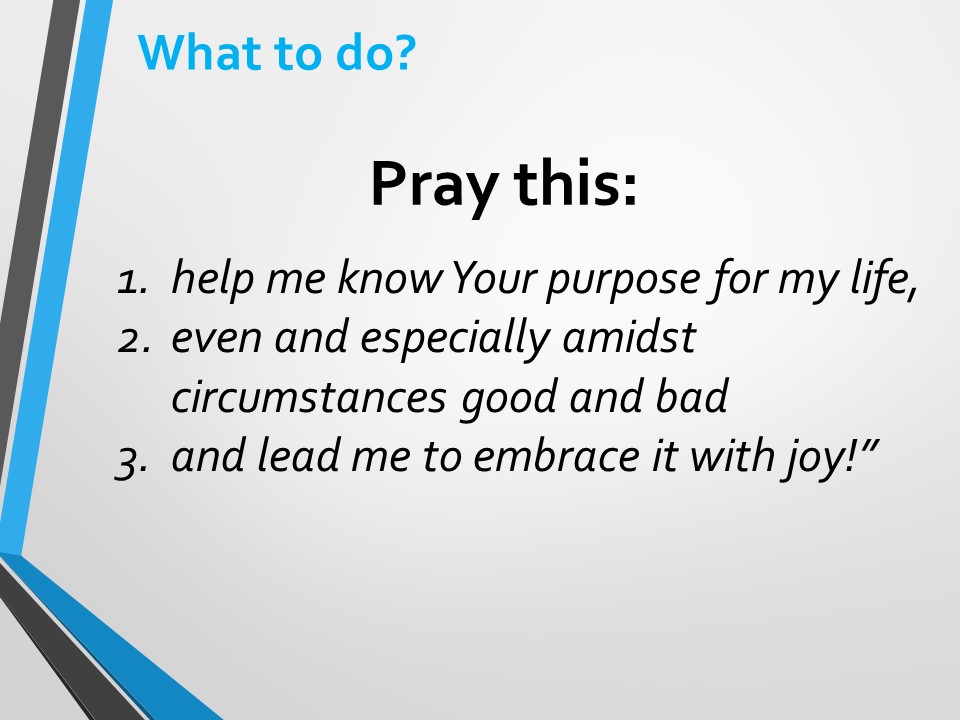
If you’re a Christian, then God is your heavenly Father—think on that!—and you’re His adopted son or daughter, and Jesus is your brother (Heb 2:11). This means it’s the Father’s job, His aim, and His burden to take care of you. Away with cold abstractions about aseity, being “without passions,” or about immutability, or chilly syllogisms. Save these for the lecture hall—I’m talking about real life, for real people, in the real world.
If you’re a Christian,
then God is steering your life, shepherding it along as part of His story
you’re part of that new kingdom community He’s making, so you and all His children can have a perfect relationship with Him in the better world to come
This means you aren’t a pawn, a chess piece, or a cipher on a divine spreadsheet—He chose you, rescued you, and sent His Son to die for you to make you a sibling. That means you’re not a dog tied to a cart, being dragged unwillingly along the path of a cold Fate or faceless Destiny.[5] Good Fathers never do that to their children, and God is the best Father. Why do you think He revealed Himself with this title?
You might ask, why isn’t my life better, then?
Little children don’t understand why parents do what they do—no candy, go to bed early, stay away from “that friend.” The kids don’t understand because they view “fairness” from their little perspective—we know the “right view” is from the parent’s perspective! We can’t see the bigger picture, but if God is the best Father, then He knows what He’s doing. Psalm 23 doesn’t say, “I’ll never have troubles again!” It says, “even though I walk through the darkest valley, I will fear no evil, for you are with me!”[6]
God never promises a care-free life. He does promise that He’s the Good Controller, steering the train towards the right station, in the right way, for the right reasons. Trust and rely on your Heavenly Father.
Your life isn’t an accident. Your circumstances aren’t an accident. You aren’t an accident. You did things (good and bad). People did things to you (good and bad). And God has a plan in and through it all.
Your life isn’t an accident. Trust the Good Controller to bring the train home.
[1] Yes, I’m paraphrasing Clarence, the angel (second class) from It’s a Wonderful Life.
[3] French Confession of Faith (1559), Article 8, from Schaff, Creeds of Christendom, vol. 3, p. 364. “… he hath wonderful means of so making use of devils and sinners that he can turn to good the evil which they do, and of which they are guilty.”


























 The Eccentric Fundamentalist