Understanding Daniel 7: The Vision and Its Meaning

Understanding Daniel 7: The Vision and Its Meaning

Daniel 7 has the same message as Daniel 2. But, while Daniel 2 is more of a summary, Daniel 7 expands that message by way of more fantastic visions. It’s like how Genesis 2 expands on Genesis 1. Curiously, Daniel doesn’t write in chronological order—Daniel 7 returns us to Babylon on the eve of the Persian conquest, but the reader just finished Daniel 6 which shows us Darius the Mede after the conquest!

First, a word about how to interpret prophecy. As we sit comfortably—far removed from the anxious times in which God revealed these visions to Daniel—we can make a mistake. We can obsess over unimportant details and miss the larger point. God didn’t give us these incredible visions so we’d bog down in irrelevant questions. Some enthusiasts teach that Daniel’s visions “provide[] the most comprehensive and detailed prophecy of future events to be found anywhere in the Old Testament.”[1] Perhaps, but that isn’t Daniel’s point or God’s point. This turns Daniel into fodder for abstract speculation, which as far from the point as the east is from the west. Obsessive focus on, say, the identity of the four beasts might be interesting and profitable, but they’re not the point. God gave this vision to Daniel as hope for desperate people. So what’s the point of this vision?

Daniel’s angelic guide tells us plainly: “16So he told me and gave me the interpretation of these things: 17The four great beasts are four kings that will rise from the earth. 18But the holy people of the Most High will receive the kingdom and will possess it forever—yes, for ever and ever,” (Dan 7:16-18). The point is that God wins. He wins big. And even the most fearsome nations will fall before Him. Whatever else you take away from Daniel 7, make sure you get that right.[2]

The dream (Daniel 7:1-14)

Daniel 7 easily divides into two sections; (a) the dream (Dan 7:1-14), and (b) the interpretation (Dan 7:15-28).

First, here is the cast of characters from the vision with my identification for each:

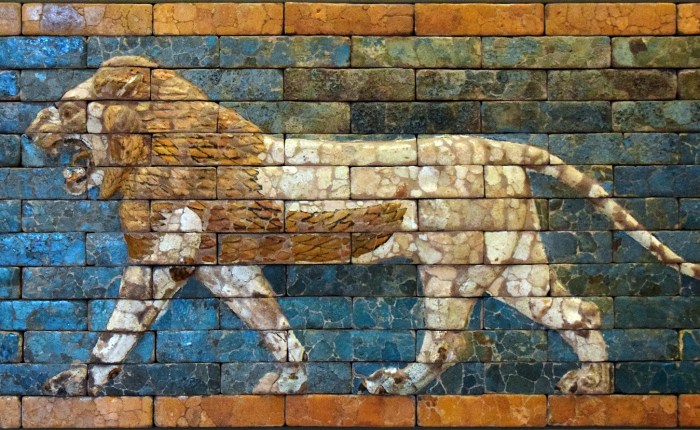
  • Beast 1: the lion with wings. This is Babylon/Nebuchadnezzar.
  • Beast 2: the lopsided bear. This is Persia—the nation in which Esther lived, and from which Cyrus let the Jewish people return home, etc.
  • Beast 3: a leopard with four heads. This is Alexander the Great and the kingdoms belonging to the four generals who succeeded him after his death.
  • Beast 4: iron teeth + ten horns + one little horn. This is the Roman Empire in three derivative phases; (a) the historical kingdom of Jesus’ day, (b) the interim period of nations which in some way derive from the historical Roman Empire, and (c) the kingdom of antichrist of the last days, which grows from among the nations of the interim phase.[3] Some teachers think only “liberals” deny that the fourth kingdom is Rome, but this cruel and incorrect.[4]
  • Ancient of Days: God the Father.
  • Son of Man: Jesus—this is his favorite way to describe Himself.

Second, forget the first three kingdoms. Daniel is simply not interested in the first three kingdoms in this vision. He only asks the angel for clarification about the fourth (Dan 7:19-20). So, the first three kingdoms are not relevant. I believe the “four beasts” in Daniel 7 are parallel to the four-fold statue at Daniel 2, which means the first kingdom remains Babylon (Dan 2:36-28; cp. Dan 7:2-4, 17-18). A different vision addresses the second and third visions (Daniel 8), but they are not the issue here. So, this article will not address the first three kingdoms at all.

Third, focus on the fourth kingdom. The remainder of the article will do just that.

The fourth kingdom is “terrifying and frightening and very powerful.” Like the character Jaws from The Spy Who Loved Me, it has “large iron teeth.” It crushes and gobbles up everything in its path. It also has ten horns (Dan 7:7), about which the angelic guide later explains.

This focus on four kingdoms doesn’t mean they are the only four nation-states that matter in human history. Instead, it suggests there are four kingdoms that will have a particular impact on the people of Israel. God could have discussed a particular Chinese dynasty, but it would have meant nothing to Daniel. In context, this is a message of hope to the people of Israel as they’re in exile in a foreign land. China would have meant nothing to them. This indicates our interpretive options are limited to a nation which has relevance to the people of Israel.

As Daniel stares at this awful creature, pondering the meaning of the ten horns, “there before me was another horn, a little one, which came up among them; and three of the first horns were uprooted before it,” (Dan 7:8). This “little horn” emerges from among the ten—it is not an outsider. Whatever this “little horn” is, it doesn’t represent a revolution from without. Instead, it signals the gradual rise of a new power-center from within. This last horn “had eyes like the eyes of a human being and a mouth that spoke boastfully,” (Dan 7:8). The angelic guide will soon elaborate, but we get the impression of intelligence, shrewdness, and arrogance.[5]

As Daniel looks on in horror, he spies another vision in the heavens above. This one seems parallel to the rise of the fourth beast—it takes place at the same time. “[T]hrones were set in place, and the Ancient of Days took his seat,” (Dan 7:9). This is a solemn, choreographed event. The Ancient of Days has snow white hair, a flaming throne with wheels ablaze, a river of molten fire flows from the chair, and “thousands upon thousands attended him; ten thousand times ten thousand stood before him. The court was seated, and the books were opened,” (Dan 7:10). This is the same imagery Ezekiel used (Ezek 1), and that the apostle John later re-purposes (Rev 5:11, 20:11-15). In other words, the Ancient of Days is God, and the setting is a courtroom.

Then, like a person watching two screens at once, Daniel looks back to the first vision “because of the boastful words the horn was speaking,” (Dan 7:11). He keeps looking “until the beast was slain and its body destroyed and thrown into the blazing fire,” (Dan 7:11). Its doom is like the antichrist’s fate in John’s apocalypse. Jesus tosses the antichrist into the lake of fire at His second coming (Rev 19:20).

Daniel now looks back at the second “screen” depicting the heavenly courtroom. He sees “one like a son of man, coming with the clouds of heaven,” (Dan 7:13). “Son of man” is a woodenly translated phrase which means “person” or “human being.” Jesus often identifies Himself as this mysterious human figure in the context of His triumphant return to this sphere (Mt 16:27, 24:30; Lk 17:30). Once the Son of man arrives, He receives His eternal kingdom: “His dominion is an everlasting dominion that will not pass away, and his kingdom is one that will never be destroyed,” (Dan 7:14). Jesus is the rock from Daniel 2 which smashes the evil kingdom and fills the whole earth (Dan 2:34-35, 44-45).

Christians have strong opinions about when this happens—at His ascension or later? The evidence suggests both are correct.

Jesus hints that He arrives at the holy court immediately after His death (i.e., at His ascension).[6] He tells the Sanhedrin that “from now on you will see the Son of Man sitting at the right hand of the Mighty One and coming on the clouds of heaven,” (Mt 26:64). Jesus says His “arrival” to rule His kingdom will be a reality from here on out, and this “seeing” is repetitive—“from here on out, you’ll be seeing …”[7] That is, the Sanhedrin will be seeing Jesus rule and reign “from now on.” The irrefutable evidence will be that nobody can stop the good news about His kingdom. This is the comforting vision Stephen saw just before the Sanhedrin murdered him (Acts 7:55-56)—meaning it’s a reality right now.

Yet, in Daniel’s vision, the Son of man arrives in the divine courtroom to receive His kingdom after or as the terrible beast is slain—suggesting an enthronement in the last days. This is the future great arrival for which the apostle Paul waits (1 Thess 2:19, 4:16-17)—meaning it hasn’t yet happened. The apostle John refers to this Daniel passage as a future event: “Look, he is coming with the clouds …” (Rev 1:7) and pairs it with a Zechariah quotation about a divine victory over evil (Zech 12:10)—an event that closely resembles those of Revelation 19 (cp. Zech 12:10–13:6).

Evidence suggests:

  • Jesus arrives in heaven after His ascension to take the throne. He immediately makes His authority known to those on earth.
  • Yet, sometime in the future when the kingdom of darkness is at its zenith—the age of the terrible fourth beast of Daniel 7 and the fourth kingdom of Daniel 2 (cp. Rev 17:1-13)—Jesus will return here to destroy evil and establish His kingdom on earth.

The distinction is like an incident from World War 2. Admiral Chester Nimitz took over his duties as Commander-in-Chief, US Pacific Fleet in December 1941—just after the Japanese attack on the naval base at Pearl Harbor. His headquarters remained at Pearl Harbor, HI. However, as the war went on, Nimitz’s Central Pacific campaign re-took territory the Japanese had captured earlier in the war, and he became further and further removed from the center of action. Eventually, in January 1945, Nimitz moved his headquarters from Pearl Harbor, HI to Guam. He had always been the Pacific Ocean Area theater commander, but his move to the scene of action allowed him to exercise more direct and convenient control over his forces.

In a comparable way, while God declared Jesus to be His eternal Son and King at His ascension (Acts 13:32-37; cp. Ps 2, 110), the time will come when Jesus moves His headquarters from heaven to earth. Unlike Admiral Nimitz, Jesus is not hindered by distance, but the concept is similar. He wants to be with His people—it’s why one of His titles is Emmanuel (Isa 7:14, Mt 1:23). His people are here, and so when the time comes Father, Son, and Spirit will shift their flag to Jerusalem.

Daniel is confused. He asks the angel, who (as we saw earlier) gives him the bottom line: “17The four great beasts are four kings that will rise from the earth. 18But the holy people of the Most High will receive the kingdom and will possess it forever—yes, for ever and ever,” (Dan 7:17-18).

But Daniel is still troubled. The fourth beast terrifies him. Who is it? What does it mean? When will it happen? It’s so fearsome—what does it signify (Dan 7:19)?

What the dream means (Daniel 7:15-28)

Daniel is worried about the fourth beast because it’s horrifying. It has iron teeth, bronze claws, and it “crushed and devoured its victims and trampled underfoot whatever was left,” (Dan 7:19). He’s curious “about the ten horns on its head and about the other horn that came up, before which three of them fell—the horn that looked more imposing than the others and that had eyes and a mouth that spoke boastfully,” (Dan 7:20).

Daniel looks again at this image, as if the angel had paused it on a screen, and at the same time the action on the second screen replays the scene from Daniel 7:11—perhaps in slow motion. Daniel sees the “little horn” waging war against the people of the Most High and winning—until the Ancient of Days raps His gavel and puts a stop to it all. Then, God’s people possessed the kingdom (Dan 7:21-22).

What does it all mean? The angel answers in two parts; (a) the rise of the “little horn” from among the ten (Dan 7:23-25), and then (b) the little horn’s demise (Dan 7:26-27).

The rise of the “little horn” (Daniel 7:23-25)

The angel explains:

23He gave me this explanation: ‘The fourth beast is a fourth kingdom that will appear on earth. It will be different from all the other kingdoms and will devour the whole earth, trampling it down and crushing it. 24The ten horns are ten kings who will come from this kingdom. After them another king will arise, different from the earlier ones; he will subdue three kings. 25He will speak against the Most High and oppress his holy people and try to change the set times and the laws. The holy people will be delivered into his hands for a time, times and half a time (Daniel 7:23-25).

The beast represents a mighty kingdom of darkness. It’s identical to the fourth kingdom from Daniel 2, which the angel described as strong as iron—“and as iron breaks things to pieces, so it will crush and break all the others,” (Dan 2:40). We don’t know what kind of animal the fourth kingdom is. It’s teeth and claws sound dragon-like, which would fit with the dragon symbolizing Satan (cp. Rev 12-13).[8]

This fourth kingdom has three phases, each separated by large periods of time but having traceable connections.[9]

Evil Kingdom Phase 1. The historical Roman Empire. It is “different” from all the other kingdoms because of the extent and ferocity of its realm (“devour … trample … crush,” Dan 7:23).

Evil Kingdom Phase 2. This is the age between (a) Jesus and the apostles, and (b) the last days. This makes sense because the ten horns are ten kings who will come from this kingdom (Dan 7:24). They are future developments after the Evil Kingdom Phase 1 leaves the stage.[10] Many bible interpreters lose their audience trying to identify the ten kingdoms. The angel doesn’t tell us what they are, so we should drop the attempt. It is idle speculation that accomplishes nothing—no matter how ingenious it may be.

We can say these ten kings (or kingdoms—the kings in Daniel’s visions are always synonymous with their realms) are a second phase of the historical Roman Empire because one could trace their origins back to it. This line need not be direct. For example, (a) South Korea’s existence derives from Japan’s defeat in the second world war, (b) the present-day Federal Republic of Germany comes from Otto Von Bismark’s unification of 39 independent nation states into the German Confederation in the late 19th century, and (c) the United States derives from the British Empire.

Neither example is a straight line from past to present, but each nation only exists today because of its historical ancestor—the same way a Tesla derives from a Model T Ford. The “10 horns” of Evil Kingdom Phase 2 may be like that—which means they could be any nation in the Western world. The number ten may also be symbolic, which would obviously complicate quests to identify them.

Evil Kingdom Phase 3. This is the time of the antichrist and the last days. We know this because “after them [that is, after the period of the 10 kings] another king will arise, different from the earlier ones; he will subdue three kings,” (Dan 7:24). This mysterious “little horn” is the antichrist, who John later reminds us is on the way (1 Jn 2:18). The angel tells Daniel the little horn will “put down” (RSV) three of the ten nations and arise from somewhere among them (“came up from among them,” Dan 7:8).[11] He’s different from the others because (Dan 7:25):

  • First, he will speak against God. Earlier, Daniel saw that he had “a mouth that spoke boastfully,” (Dan 7:8). This is blasphemy. The apostle Paul later calls this individual “the man of lawlessness” who “will exalt himself over everything that is called God or is worshiped, so that he sets himself up in God’s temple, proclaiming himself to be God,” (2 Thess 2:4; cp. Rev 13).
  • Second, he will oppress believers. This is a long and deliberate campaign that wears believers down (NASB) or wears them out (KJV).[12] The apostle John later saw a vision of antichrist—a horrid beast which combined imagery from all four monsters from Daniel’s visions (Rev 13:1-4). “It was given power to wage war against God’s holy people and to conquer them. And it was given authority over every tribe, people, language and nation,” (Rev 13:7).
  • Third, he will try to change set times and laws. The antichrist will pervert and twist public morality, virtue, and decency into a lie.[13] Some also believe this refers to anti-religious sentiment in general—a pure secularism[14] and a “new table of religious festivals.”[15] It’s both.

God gives His people over to this evil figure’s power for a set period (“3.5 times”) that the angel doesn’t define here but is probably three-and one-half years (cp. Dan 12:5-7, 11).[16] The significance here is not the length of the evil king’s reign, but its sudden crash after a rapid acceleration.[17] It speeds up quickly (“a time, times …”), and then hits a wall and crashes with no warning (“half a time”).

The little horn’s fall (Daniel 7:26-27)

Why does antichrist’s kingdom crash and burn so suddenly?

Because, the angel explains, “the court will sit, and [antichrist’s] power will be taken away and completely destroyed forever,” (Dan 7:26). This is an elaboration on Daniel 7:14. We know the evil empire’s fall will be sudden and violent—remember the stone that smashes the statue from Daniel 2? The apostle John tells of an angel picking up a huge boulder and throwing it into the sea: “With such violence the great city of Babylon will be thrown down, never to be found again,” (Rev 18:21). This is when God avenges the blood of His servants, and the heavenly chorus sings: “Hallelujah! The smoke from her goes up for ever and ever,” (Rev 19:2-3).

Daniel’s vision is the divine courtroom where the Ancient of Days declares: “Enough is enough!” John’s apocalypse tells us that, as antichrist’s evil kingdom smolders in ruins, Jesus the King returns to this sphere with the armies of heaven to do battle with His sinister counterpart. “He is dressed in a robe dipped in blood, and his name is the Word of God,” (Rev 19:13). This is the blood of God’s enemies, tramped and splattered like so many grapes in a vat. The prophet Isaiah explained: “I trampled the nations in my anger; in my wrath I made them drunk and poured their blood on the ground” (Isa 63:6). John warns that Christ “treads the winepress of the fury of the wrath of God Almighty,” (Rev 19:15).

Then, the angelic guide tells Daniel, “His kingdom will be an everlasting kingdom, and all rulers will worship and obey him,” (Dan 7:27).

What does all this mean?

Daniel’s vision tells us six things:

  1. A singularly evil figure will rise from a nation which derives, in some way, from the historical Roman Empire.
  2. This antichrist will then subdue three nations which stem from the historical Roman Empire.
  3. He will persecute God’s people, twisting public decency and morality against everything God says is good—a program of pure secularism that is rabidly anti-religious.
  4. Antichrist will rise rapidly then experience a sudden and spectacular crash (“time, times, and half a time,” Dan 7:25). Revelation 18-19 tells us this “crash” is God’s violent overthrow of Babylon (Rev 18:21-24) and Jesus’ second coming (Rev 19:11-21).
  5. Antichrist will be “slain and his body destroyed and thrown into the blazing fire,” (Dan 7:11; cp. Rev 19:19-21).
  6. The Son of Man will take His seat as King and make all things new (Dan 7:13-14, 28; cp. Rev 21-22). “Then the righteous will shine like the sun in the kingdom of their Father,” (Mt 13:43).

To Daniel and the exiles then, God’s message was: “The kingdoms of this world will surely fall, and I’ll judge them, and I’ll make everything right.”

To churches great and small today, God makes the same promises—even as we’re now several episodes further along in His story. His truth is still marching on. No matter what is happening in your life, in your country, and in your world—God will win. Babylon will lose. And Jesus’ “dominion is an everlasting dominion that will not pass away, and his kingdom is one that will never be destroyed,” (Dan 7:14). God wanted Daniel and the people of Israel to believe that as they lived in exile in an unholy land. He wants us to believe it too.

Here is a recent sermon I preached on this passage:


[1] John Walvoord, Daniel, rev. by Charles Dyer and Philip Rawley (Chicago: Moody, 2012), 181.

[2] Walvoord represents the dispensationalist habit to favor prophetic timelines instead of the author’s point. He devotes two pages to defending the historicity of Daniel’s statements at Daniel 7:16-18, yet never stresses that this is the very point of the whole vision (Daniel, 211-12).

[3] I am following Edward J. Young, The Prophecy of Daniel: A Commentary (Grand Rapids: Eerdmans, 1949), 147-50.

For a very compelling argument from a conservative that the fourth beast is the kingdom of the Syrian madman Antiochus Epiphanes, see Moses Stuart, A Commentary on the Book of Daniel (Boston: Crocker & Brewster, 1850), 205-11. For the old saw about the fourth kingdom being the papacy, Albert Barnes does an excellent job (“Daniel,” in Barnes Notes, vol. 7 (reprint; Grand Rapids: Baker, 1998), 76-99). Leon Wood’s wonderful commentary advocates the dispensational perspective of a “revived Roman Empire,” (A Commentary on Daniel (Grand Rapids: Eerdmans, 1973), ch. 7).

[4] Walvoord does this (Daniel, 7), and so does Andrew Steinmann (Daniel (St. Louis: Concordia Publishing House, 2008), 145).

[5] See Barnes, Daniel, 58.

[6] See especially Steinmann, Daniel, 359-60.

[7] Gk: πλὴν (contrasting conjunction) λέγω ὑμῖν ἀπʼ ἄρτι (temporal preposition + temporal adverb = marks the time at which something changes) ὄψεσθε (iterative future) τὸν υἱὸν τοῦ ἀνθρώπου. “But I’ll tell you all this—from here on out you’ll all be seeing the Son of Man … arriving on heaven’s clouds.”

[8] John Goldingay declares the fourth beast has no dragon-like qualities, and bizarrely suggests it may be a war elephant! (Daniel, vol. 30, in WBC (Dallas: Word, 1989), 163, 186).

[9] Young, Daniel, 147-50.

[10] Barnes, “Daniel,” 56. Wood (Daniel, 188, 200) and Stephen R. Miller believe the ten will be contemporaneous with each other. “They reign contemporaneously as one empire since all exist together, and this fact is expressly stated in Rev 17:12–13. Daniel was predicting that out of the old Roman Empire will arise ten kings (or kingdoms) that will constitute a new phase of that empire at the end of the age,” (Miller, Daniel, vol. 18, NAC (Nashville: B&H, 1994), 213). This may well be the case. The citation from Revelation 17 is a strong one.

[11] Again, Miller makes a good point about these ten kingdoms: “Coming ‘after them’ signifies that the empire will already have been formed by the first ten kings when Antichrist rises to his position of dominance over them. The text does not mean that the new king (Antichrist) will originate from a separate nation from those symbolized by the ten horns, for the empire seems to remain a confederacy of ten after he comes to power,” (Daniel, 213).

[12] Steinmann, Daniel, 374.

[13] Wood, Daniel, 201.

[14] Barnes, “Daniel,” 72-3; Peter Steveson, Daniel (Greenville: BJU Press, 2008), 137. “Denying religious liberty is characteristic of dictators (e.g., Antiochus IV, Nero, Domitian, Stalin, Hitler, and others), but Antichrist will go beyond what anyone has done before in his attempt to create a thoroughly secular world. Even now there are those seeking to rid society of all vestiges of religion,” (Miller, Daniel, 214).

Stuart believes it refers to the Mosaic law because he sees the fourth kingdom as being that of Antiochus Epiphanes (Daniel, 222-3). Steinmann goes beyond the evidence by declaring that antichrist seeks to destroy justification by faith by substituting another gospel (Daniel, 374).

[15] Joyce Baldwin, Daniel, in TOTC (Downers Grove: IVP, 1978), 162.

[16] On the three- and one-half years, see Wood, Daniel, 201-2; Stuart, Daniel, 222-4, and Miller, Daniel, 214. For a rejoinder, see Steinmann, Daniel, 375-6. Barnes takes a middle road and says both figurative and literal senses are well supported (“Daniel,” 72-5).

[17] Keil and Delitzsch, 9:652; Baldwin, Daniel, 162. Dispensationalists often miss this.

The Rock That Crushes: Understanding Daniel 2

The Rock That Crushes: Understanding Daniel 2

Daniel’s visions are endlessly fascinating to Christians.[1] So are those from Ezekiel, Zechariah, and Revelation. They stick in your mind so vividly because they’re exciting, dramatic, bizarre, otherworldly, almost fantasy-like. This is a very particular style of writing God uses to communicate hope to desperate people.[2]

Daniel and many others are prisoners in Babylon. Their homes are destroyed, family members are dead, their nation is no more, and they’re far from home. They’re tired, lonely, anxious, scared, and perhaps doubting God’s promises. God wants to give hope to His people, and for that an essay won’t do. This is why bible books containing these fantastic visions always come during times of terrible persecution and despair. So, Daniel’s visions are not fodder for timeline speculation. They’re about hope for desperate prisoners.

In Daniel 2, God’s point is that one day His kingdom will smash everything bad, everything evil, everything unholy in this world to pieces—and then there will be peace on earth. These visions and the hope they bring aren’t just for the Jews in exile in Babylon. They’re also for believers in exile in this world today who are longing for a better country—a heavenly one (Heb 11:16).

Space does not permit a detailed run-up to the vision itself. Suffice it to say that King Nebuchadnezzar was lying in bed one night when his “mind turned to things to come, and the revealer of mysteries showed you what is going to happen,” (Dan 2:29). He was not a kind or good man. He was brutal and cruel—vowing to kill his magi and their families if they failed to accurately describe the dream and what it meant (Dan 2:4-12). Daniel and three friends are caught up in this death sentence, but God reveals the dream and its explanation to them during the night (Dan 2:14-19). The next morning, they’re rushed into the king’s presence, and we hear about the vision for the first time.

The Vision

Here it is:

31Your Majesty looked, and there before you stood a large statue—an enormous, dazzling statue, awesome in appearance. 32The head of the statue was made of pure gold, its chest and arms of silver, its belly and thighs of bronze, 33its legs of iron, its feet partly of iron and partly of baked clay. 34While you were watching, a rock was cut out, but not by human hands. It struck the statue on its feet of iron and clay and smashed them. 35Then the iron, the clay, the bronze, the silver and the gold were all broken to pieces and became like chaff on a threshing floor in the summer. The wind swept them away without leaving a trace. But the rock that struck the statue became a huge mountain and filled the whole earth (Daniel 2:31-35).

This is a composite statue. The startling bit is the sudden appearance of a rock not fashioned by human hands which pulverizes the figure and turns it to dust (Dan 2:34). The rock strikes its brittle legs, which are forged from a bizarre mixture of iron and clay. Clearly, a rock will crush clay! Because this is a fantastic otherworldly vision, we need not look for absurd literalism (e.g., how can a rock crush iron?). The point is that the rock strikes with such force that the whole thing comes tumbling down and turns to powder. This rock alone now holds the field, and it gradually grows to fill the whole earth.

What the Vision Means

Daniel explains that Nebuchadnezzar represents the head of gold (Dan 2:36-38). The king and his kingdom are synonymous—each represents the other. Daniel does not name any other king or kingdom in this vision. He accurately describes the power and majesty of the king’s reign: “the God of heaven has given you dominion and power and might and glory” (Dan 2:37; cp. Dan 4). Babylon is the preeminent power player in the Ancient Near East. Yet, God is above all. This vision presses that message home forcefully, as we’ll see.

Working on down the statue, Daniel hurriedly mentions two kingdoms which will arise after Babylon passes from the scene (Dan 2:39). The second, Daniel tells Nebuchadnezzar, is “inferior to yours” (Dan 2:39) and is presumably represented by the “chest and arms of silver” (Dan 2:32). The third is “of bronze” and “will rule over the whole earth” (Dan 2:39, cp. 2:32— “belly and thighs of bronze”).

Daniel is most interested in the fourth kingdom because it is the one the mysterious rock attacks (Dan 2:34). This kingdom is incredibly strong. The “iron” composition of its legs means it will smash and destroy “all the other” kingdoms which came before (Dan 2:40). Yet, because its feet is a mixture of iron and clay (Dan 2:33), it is curiously brittle. This frailty means “the people will be a mixture and will not remain united, any more than iron mixes with clay,” (Dan 2:43).[3] Most commentators and English bible translations understand this to mean intermarriage, but the larger point seems to be a kingdom without a shared national identity. Some writers suggest the progressive inferiority of metals represents a progressive inferiority of national unity and identity from Babylon on down the line.[4]

Daniel explains that “in the time of those kings, the God of heaven will set up a kingdom that will never be destroyed, nor will it be left to another people,” (Dan 2:44). This eternal divine kingdom “will crush all those kingdoms and bring them to an end, but it will itself endure forever,” (Dan 2:44). This is surely the rock which smashes the statue.

Because the kingdoms are successive (“after you” … “next” … “finally” (Dan 2:39-40)), and because the rock smashes only the fourth kingdom which has since destroyed “all the other kingdoms” (Dan 2:40), then God’s kingdom will not come until the time of the fourth kingdom. This suggests that when Daniel says, “in the time of those kings” (Dan 2:44), he refers to the fourth kingdom—a secular “kingdom” dynasty which the divine rock suddenly pulverizes.[5] It crushes “all those kingdoms” in that the fourth realm is built upon the ruins of the first three, and when it falls so too do the remnants of the others.[6]

But, in this vision Daniel is not interested in divine timetables or in naming the kingdoms. God’s point is simple—His kingdom will win. That’s it. That’s the point of the vision. “This is the meaning of the vision of the rock cut out of a mountain, but not by human hands—a rock that broke the iron, the bronze, the clay, the silver and the gold to pieces,” (Dan 2:45).

Nebuchadnezzar had been lying on his bed at night, wondering what the future held. Well, God says, this is the future—you lose. Everyone loses. I win. My kingdom wins.[7] I’ll smash everything unholy, dark, and wicked to pieces, and there’s nothing anyone can do to stop it.

What the Vision Means Considering God’s Whole Story

Otherworldly visions like Daniel’s are hope for people who are suffering, tired, and doubtful. Every earthly kingdom is really Babylon under different cover—Revelation 17 and 18 show us the penultimate “city of darkness” falling after God’s avenging angels “pour out the seven bowls of God’s wrath on the earth,” (Rev 16:1). But, in the meantime, “Babylon” shape-shifts.

No matter which nation holds sway over the world, Daniel 2 assures us that God’s kingdom is coming, and it’ll smash everything else to pieces and fill the whole earth (Dan 2:35). All the great nations, the great empires, the great corporations in this world will become like chaff—only God’s work, God’s good news, and God’s values have eternal significance (cp. 1 Cor 3:11-15; Rev 18). Think of Rome, Spain, and Great Britain. Think of corporations like U.S. Steel, Sears, Kmart, or even Red Lobster! They all fade away, and a new kid enters the stage for its five minutes of fame.

What do you give yourself to? Is it worth your heart and soul? Is it of eternal significance? Do you give yourself to something that will be crushed one day?

God, through Daniel, says “Your King is coming!” Just as Nebuchadnezzar is the head of his mighty but temporary kingdom, so Jesus is the head of the eternal kingdom that’s now come—the one that’s smashing everything else to pieces even now as it expands throughout the world. Jesus said He was the stone which crushes His enemies (Lk 20:18), likely alluding to the divine rock from Daniel’s vision. Jesus said His miracles proved that “the kingdom of God has come upon you,” (Lk 11:20). He told the Pharisees that the kingdom of God was not an observable phenomenon, but instead “the kingdom of God is in your midst,” (Lk 17:21). One enters the kingdom of God by being born again of water and Spirit (Jn 3:3, 5).

It’s significant that the stone smashes the fourth and most fearsome kingdom, and then grows into a mountain over time (Dan 2:35).[8] Peter may have adapted this figure when he said each believer was a “living stone” and part of a spiritual house—a “rock” which was gradually growing to fill the whole earth (Acts 1:8) as Jesus people “make disciples of all nations” (Mt 28:19). One commentator explains: “The kingdom adds rock mass as God adds to it royal subjects.”[9] The kingdom is synonymous with Jesus.

Daniel 7 has more details for us about these four mysterious kingdoms, and their fate. But in our passage at Daniel 2, it’s enough to know that God promises hope if you’re suffering, if you’re tired, if you’re doubting God’s promises in the mess of everyday life. At Daniel’s place in God’s story, this vision assured God’s people: “The king will come one day!” Today, from the vantage point of the new and better covenant, Daniel’s vision tells us: “The king is already here—He said His kingdom is in our midst! And He’s coming back again soon!”

Here is a recent sermon I preached on this passage:


[1] Here are four helpful commentaries on Daniel which I recommend. First is Leon Wood, Daniel (Grand Rapids: Zondervan 1973). This is an excellent dispensational commentary—one of the best available. Second is a commentary by Lutheran scholar Andrew Steinmann, Daniel (St. Louis: Concordia, 2008). This is a wonderful commentary that will make you think outside the box. Third is the classic by Presbyterian scholar Edward J. Young, Daniel (Grand Rapids: Eerdmans, 1949). This is a formidable work that deserves to be consulted. Fourth is by 19th century, American Old Testament scholar Moses Stuart, Commentary on the Book of Daniel (Boston: Crocker & Brewster, 1850). Stuart’s work is conservative and almost unknown today. It’s available free online.

[2] See the wonderful discussion on apocalyptic literature in D. Brent Sandy and Martin G. Abegg, Jr., “Apocalyptic,” in Cracking Old Testament Codes: A Guide to Interpreting Literary Genres of the Old Testament, ed. D. Brent Sandy and Ronald L. Geise (Nashville: B&H, 1995), ch. 9.

[3] Leon Wood goes too far when he says: “Because the mixture of baked clay and iron is found only in the feet and toes, and not in the legs, it follows that this element of brittleness would be true of the Roman Empire only in its later period, rather than in its former,” (Daniel, 69). Wood is a dispensationalist and is setting the stage for a “revived Roman empire” in the latter days. This may or may not be correct, but it is not in the text of Daniel 2.

[4] Young, Daniel, 74, and C.F. Keil and Franz Delitzsch, Commentary on the Old Testament (reprint; Peabody: Hendriksen, 1996), 9:558.

[5] “Those kings must of course mean the kings that belong to the fourth dynasty, although they have not thus far been expressly named, but only by implication,” (Stuart, Daniel, 67).

Wood is correct that “the time of those kings” cannot refer to all four kingdoms (contra. Young, Daniel, 78, whose explanation seems desperate). However, he once again goes beyond the evidence when he claims “those kings” refers to the ten kings represented by the little horns of the evil fourth beast from Daniel. For support, he (like many dispensationalists) appeals to the ten toes of the image (Daniel, 71-2). However, Daniel himself does not find the toes significant.

It is a mistake to interpret apocalyptic visions by calling in bits of the image that the writer doesn’t highlight. One might as well appeal to the “two legs of iron” to support a fulfillment in the Eastern and Western Roman Empires, or the “10 fingers” on the silver hands to suggest a successor kingdom to Babylon with ten rulers. However, see Stuart’s able defense of the significance of the ten toes (Daniel, 65).

[6] Stuart, Daniel, 67.

[7] “Daniel apparently wanted the king to recognize through this the final supremacy of God and his program over mankind, and accordingly be brought to a place of humility before this mighty One who had so graciously revealed these things to him,” (Wood, Daniel, 74). See also Steinmann, Daniel, 138.

[8] Steinmann, Daniel, 136.

[9] Steinmann, Daniel, 138.

The Five Kingdoms in Daniel 2 and 7

*I will be adding some charts to this paper sometime in the future to help explain things a bit more clearly*

Introduction

This paper presents a comparison between the two prophesies in Daniel 2 and Daniel 7. They are complementary accounts of God’s program for His people, presented in two separate visions. There are any number of ways to contrast these two prophesies; this paper exposits each vision separately on its own merit in preparation for a side by side comparison of key events, presented in a chart following the exposition.

The picture which emerges is one where God will triumph over the Antichrist, fulfill His covenant promises to Israel and establish a kingdom for His children which will endure forever. The manifold designs and wicked aims of Satan cannot stand against God, who is sovereign over His entire creation. This message is one of hope given to a people under penalty of sin; God was not through with them yet.

It is also the hope of the Gentiles who number themselves among God’s people, a circumstance not even revealed when Daniel recorded these prophesies. It is a reassuring message of God’s supremacy, trustworthiness and glory. As one scholar observed, “in this present world of injustice, wars, and crime, it is reassuring to know that Christ is coming; and when he comes, all of the evils of this age will end (Miller, 1994, 102).

Daniel 2

The Dream

This vision of God’s program from the fall of Jerusalem until the millennial reign of Christ is very brief and lacks the greater detail of Dan 7. Nevertheless, it presents a complete program. Leon Wood (1973) sees specific significance in this one united image, especially when viewed from God’s perspective. “Before God, history is a whole, made up of variations of the same basic aspirations and activities of mankind involved,” (68).

Archer (1985) remarked matter-of-factly that “this section represents the foreordained succession of world powers that are to dominate the Near East till the final victory of the Messiah in the last days,” (46). The image represents five different kingdoms, four from men and the final from God, which together comprise God’s program from the fall of Jerusalem onward.

2:31-32

A great, mighty and frightening image appeared in Nebuchadnezzar’s dream (v. 31). The image was quite imposing and dwarfed Nebuchadnezzar himself; its very appearance was frightening. “Even Nebuchadnezzar, the ultimate ruler (Dan 2:38), recognized this as something greater than himself,” (Walvoord, 2012, 77). It was one single image with multiple composite parts; a head of fine gold (v.32), chest and arms of silver (v.32), a torso and thighs of bronze (v.32), legs of iron (v.33) and feet of both iron and clay (v.33).

There is symbolism in the metals which comprise the image. The preciousness and weight of the metals deteriorates from the head of gold to the feet of mixed clay and iron, while increasing in hardness (Walvoord, 78).

2:34-35

The stone strikes the statue at its weakest and most brittle point, the feet, breaking them into pieces (Dan 2:34). The entire image then disintegrates at once, the pieces are carried away like chaff before the wind (Dan 2:35). Not a trace is found, and the stone becomes a mountain which fills the entire earth.

The Interpretation

This is a prophesy for Israel specifically, and the focus is on the Mediterranean area, which comprises the Biblical concept of “world.” Pentecost (1985) observed that Daniel’s interpretation reveals “the course of Gentile kingdoms which in turn would rule over the land of Palestine and the people of Israel,” (1335).

2:36-38

Nebuchadnezzar is the head of gold (Dan 2:38), and all this power and glory is given to him by God Himself. Nebuchadnezzar, alone among the three kingdoms of men which are to come after, is identified specifically. He embodies Babylon. “After him, its power diminished rapidly. It was far more his kingdom, than he was its king. The same was not true of any ruler of the succeeding empires,” (Wood, 67). The phrase “king of kings” is even used of Nebuchadnezzar again in Eze 26:7; he truly was a supreme monarch who was above all the kings of his generation (Walvoord, 79). This power was given to Nebuchadnezzar (Dan 2:38), emphasizing God’s complete sovereignty over human affairs in His own creation.

2:39

Moving down the statue, two more kingdoms are in view. An inferior kingdom, comprising a chest and arms of silver, will come after Nebuchadnezzar (Dan 2:39a). This is Medo-Persia, which conquered Babylon in 539 B.C. Silver is less valuable than gold, symbolizing the inferiority of the second kingdom. The inferiority is not with respect to territory; Medo-Persia conquered far more area than Babylon did. Peter Steveson (2008) places the inferiority in the rulers; “it will be inferior in that the Medo-Persian ruler will have less power than Nebuchadnezzar,” (34). Likewise, Wood (68) agrees and remarks the inferiority “can have referred only to quality of government.”

The king was not supreme in this second kingdom in the same manner Nebuchadnezzar was in Babylon. “History certainly confirms that the Medo-Persian Empire, and the empire of Alexander that followed, lacked the central authority and fine organization of the Babylon Empire . . . the inferiority of the succeeding empires does not prevent them from wide geographic control, for he [Daniel] specifically stated that the third kingdom will ‘rule over all the earth,’” (Walvoord, 80-81). The arms signify a division in the kingdom – the inclusion of Media and Persia (Steveson, 35).

Yet another inferior kingdom will come after this, the torso and thighs of the statue fashioned of bronze, which will rule over all the earth (Dan 2:39b). This is Greece, which conquered Medo-Persia between 334 – 330 B.C. Greece did indeed extend its military reach farther than the other three kingdoms, all the way from Egypt, Europe and eastward to India. This kingdom was even more inferior from Nebuchadnezzar’s point of view, in that its political system was more republican than monarchy (Archer, 47).

2:40

A fourth kingdom will come after this, comprising the iron legs of the great image. It has two distinct properties; (1) it is strong as iron and (2) it will crush and shatter all opposition. Iron is less precious than gold, silver or bronze, but is stronger. This is precisely what characterized Roman conquest as it swallowed up and engulfed the Greeks; “Rome in its cruel conquest swallowed up the lands and peoples that had been parts of the three previous empires and assimilated those lands and peoples into itself,” (Pentecost, 1335).

2:41-43

Rome regressed into a weaker nation of clay and iron, a mark of progressive weakness and deterioration. The composite nature of the empire signifies a divided kingdom in its later years, hobbled with increasingly frailty. It is significant that the iron legs were not a composite mixed with clay, but the feet were. “It follows that this element of brittleness would be true of the Roman Empire only in its later period, rather than its former,” (Wood, 69). This refers to the moral decay and decline of the Roman Empire, not a future revival.

The two legs represent a political division, which occurred in the mid-fourth century as the Empire split into East and West. Daniel later identified the toes of the image as ten individual kingdoms (Dan 7:7, 20), therefore it is likely the legs also signify a political schism (Steveson, 38).

2:44-45

Daniel’s narrative telescopes at this point, segueing into prophetic future events at the time of the Antichrist.[1] The “days of those kings” when God sets up his millennial kingdom (Dan 2:44) cannot refer to the time of the four kingdoms already mentioned, because Dan 7:24 explicitly mentioned ten kings would reign at the time of the Antichrist. As noted previously, Dan 7 is a much fuller explanation of a different vision containing the same, expanded message. Nor does this refer to a future revival of the old Roman Empire. “This empire has continued to exist in various forms since it began. Daniel here speaks of this empire in its final form. This will be a union of ten strong and weak governments . . . all under the control of the Antichrist,” (Steveson, 41-42).

God will accomplish several things at this time, (1) He will establish His kingdom (Dan 2:44a) which will never pass away, (2) He will destroy the ten kingdoms.God destroys the whole image at once and the end of them all is sure and certain (v.45b). The stone is nothing less than Christ, smiting all vestiges of the preceding kingdoms. “The stone is part and parcel of the sovereignty of God . . . the symbolism clearly indicates an origination with God rather than human beings,” (Walvoord, 89). God will be faithful to His covenants with Abraham, Isaac, Jacob, the nation of Israel and David – He will establish His kingdom, which “shall never be destroyed” and “shall stand forever,” (Dan 2:44).

Though less comprehensive than the vision from Dan 7, there are a number of reasons to support that Christ will establish a future kingdom.

First, the conquest and destruction of the kingdoms is violent and abrupt, not peaceful and gradual, as amillennialists argue (Steveson, 43). The stone struck the image’s feet and broke the entire image into pieces, suddenly and abruptly (Dan 2:34-35). Those opposed to the premillennial interpretation of the text deny a literal, future destruction of these ten kingdoms. Generally, they see the fall of the old Roman Empire as fulfillment of Christ striking the image (Dan 2:34-35). However, Christ and Christianity did not destroy the Roman Empire. It continued on for centuries afterward. Furthermore, its destruction was gradual and drawn-out, not sudden as Dan 2:35 depicts. Christ did indeed come in the days of the Roman Empire, but He did not destroy it (Pentecost, 1336).

Second, Daniel’s prophesy clearly indicates Christ will return again “in the days of those kings,” before defeating them and establishing His kingdom (Dan 2:44).  Daniel’s subsequent vision in Dan 7:7-28 supports this point. However, during Christ’s time on earth the Roman Empiredid not have 10 kings at once. Therefore, the time of the ten kingdom (“ten toes”) is still future.

Third, the church today has not, and is not, conquering the world’s kingdoms. Indeed, as Walvoord notes, “for the past century or more the church has been an ebbing tide in the affairs of the world, and there has been no progress whatsoever in the church’s gaining control of the world politically. If the image represents Gentile political power, it is very much still standing,” (89).

Fourth, Christ will rule over a theocracy. “The God of heaven will set up a kingdom that shall never be destroyed, nor shall the kingdom be left to another people . . . it shall stand forever,” (Dan 2:44). Pentecost observed, “the church is not a kingdom with a political realm, but the future Millennium will be,” (1336).

Daniel 7

The First Three Beasts

7:1-2

Most commentators agree Daniel presented a summary of his dream; “the essential points of significance,” (Wood, 180). Steveson argues the significance of “wind” is that trouble and tribulation will come from all directions (117). Wood agrees, and notes “winds stand for various forces which play upon the nations, serving to bring strife and trouble,” (180).

Walvoord sees the winds here as God’s sovereign power in conflict with sinful humanity. He argues wind always represents God’s sovereign power, which Walvoord maintains is the whole focus of the Book of Daniel. He went on to observe, “Gentile history is the record of God striving with the nations and ultimately bringing them into subjection when Christ returns to reign,” (189).

The dream was given to Daniel to provide comfort to the exiles, lest they believe God was through with them. “God was not through with them, however, and He desired that they know He was not. An effective way to do this was to reveal the historical future which God had in mind for them,” (Wood, 178). God will defeat the Antichrist. He is sovereign and Israel will have a kingdom.

The “great sea” is typically used in Scripture to refer to the Mediterranean. This strongly implies the prophesy involves only the Mediterranean world (Pentecost, 1350). This is a point Steveson also emphasizes later (134).

7:3

The beasts each represent successive nations, different from one another. The sea in question, the Mediterranean, symbolically represents the nations of Biblical prophecy (Pentecost, 116). Daniel later confirms that the beasts were nations, or kings, of the earth (Dan 7:17).

7:4

The first empire is Babylon, under Nebuchadnezzar. This is not really a matter of serious dispute. Walvoord observed, “there is more unanimity on the identification of the first beast of chapter 7 than on any other point in this chapter,” (189). Images of lions have been found in the ruins of Babylon, and Nebuchadnezzar is represented elsewhere in Scripture as a lion (Jer 4:7) and an eagle (Jer 49:22). The wings being plucked off the lion can symbolize either the empire’s rapid deterioration after Nebuchadnezzar’s death, or his insanity (Pentecost, 1350). The transformation from a lion to a more human-like figure represents Nebuchadnezzar’s changed disposition after his seven years of insanity. The fact that he “was lifted up” signifies that he did not change himself; God did it for Him (Miller, 197).

7:5

The second empire is Medo-Persia. Wood observed two points worth noting (183); (1) The lop-sided shape of the animal indicates the Persians had vastly more influence than the Medes in the alliance, and (2) The beast was lop-sided because the beast had one foot in the air, as if to lurch forward, symbolizing the rapid military advance of the Medo-Persian empire.

The ribs the beast was munching on symbolize Lydia, Egypt and Babylon (Walvoord, 193). Archer remarked it was “hopeless” to explain away the identification of Medo-Persia with the second beast (86).

7:6

The third empire is Greece, characterized by extraordinary swiftness of conquest. The wings suggest speed and swiftness. The four heads symbolize the four generals who ruled Alexander’s dominion after his death (Steveson, 123).[2]  “The lightening character of his conquests is without precedent in the ancient world, and this is fully in keeping with the image of speed embodied in the leopard and the four wings on its back,” (Walvoord, 194).

The Fourth Beast

7:7

The fourth beast is Rome, which follows Greece in the chronology of great Mediterranean empires. Wood remarked the most outstanding feature of this fourth beast was its strength, and the emphasis given to this last beast indicates it has far greater significance for Daniel’s vision (183). This beast is characterized by “extensive conquest involving enormous destruction of people and property,” (Wood, 186). It is no accident Daniel describes the beast in such stark terms, such as “terrifying and dreadful and exceedingly strong.” Rome differed from the previous three empires – it had staying power. Daniel noted the permanence of this beast’s conquests, “it devoured and broke in pieces and stamped what was left with its feet.”

Conquest was made at wide range and with the greatest strength and ferocity. Her conquests were more permanent too; for whereas the other empires had been satisfied with only a loose confederation of countries seized, Rome consolidated and organized for lasting control (Wood, 186).

Daniel saw all ten horns at the same time on this fourth beast. This means the empire comprises ten different kingdoms.  Most commentators emphasize the contemporaneous nature of these kingdoms. This is extremely important – Daniel was not speaking of a different empire; he was clearly describing features of the fourth beast.

Is this a re-constituted Roman Empire or merely 10 kingdoms formed from the political ashes of the old? Commentators are divided on the issue. Wood alone sees a reconstituted Roman Empire. “The correct view can only be that there will be a time still future when the Roman Empire will be restored, so that these representations can be true in the manner depicted,” (187). He noted that symbolism shows the horns growing from the fourth beast’s head while it is still alive, demonstrating the Roman Empire must be reconstituted at some future date (200).

Archer is not dogmatic, merely labeling this as a “latter day ten-state federation,” (87).  Walvoord agrees, “ten actual kingdoms will exist simultaneously in the future tribulation period,” (200).

Pentacost disagrees, “when the hordes from the north conquered the Roman Empire in the fifth century a.d., they did not unite to form another empire. Instead individual nations emerged out of the old Roman Empire. Some of those nations and others stemming from them have continued till the present day. The present Age, then, is the 10-horned era of the fourth beast,” (1354). Steveson, as seen in the discussion on Dan 2:43, agrees with Pentecost (41-42, 126).

Many scholars, of varying theology, dispute the literal, premillennial interpretation given above. The crux of the matter was captured perfectly by Walvoord; it comes down to whether one’s hermeneutic is literal or not.

Interpreters who agree that the Roman Empire is in view differ in their explanations about how the ten horns relate to Rome. Amillennial scholars . . . tend to spiritualize both the number ten and the number three, and thus escape the necessity of finding any literal fulfillment. Both of them find literal fulfillment impossible because no ten kings reigned simultaneously in the Roman period . . . Premillenialists offer another view, providing literal fulfillment: ten actual kingdoms will exist simultaneously in the future tribulation period (200).

7:8

There are ten contemporaneous kingdoms. One kingdom, insignificant and unthreatening, rises dramatically and absorbs three others. This last kingdom emerges later, from among the ten others. Most conservative commentators identify this last ruler as the Antichrist. This last ruler was noted for his intelligence and his blasphemous claims.

7:9-10

God will judge the nations, and the court of judgment Daniel sees (Dan 7:10) is nothing less than the Great White Throne judgment (Steveson, 128). The phrase “ancient of days” (Daniel 7:9) suggests God’s eternal nature. His clothing and appearance illustrates His purity and holiness. The flames about the throne demonstrate His righteous judgment. “The fire not only represents the blindingly brilliant manifestation of God’s splendor but also the fierce heat of His judgment on sin and all those opposed to His supreme authority,” (Archer, 89). The wheels of the throne suggest God’s omnipresence and mobility (Steveson, 129);He sees all men’s works and will judge correctly. Reference to the books being opened (Daniel 7:10) is a further reference is Rev 20:12 and the Great White Throne judgment (Pentecost, 1351).

7:11-12

Daniel’s attention is diverted from this awesome vision of God’s final judgment because of the blasphemous words (Dan 7:8) the Antichrist was speaking (Dan 7:11a). The beast is slain and burned with fire (Dan 7:11b). The other three kingdoms pictured in this vision had been defeated by military might and their legacies lived on to some extent; “their dominion was taken away, but their lives were prolonged for a season and a time,” (Dan 7:12). This last kingdom, which rose out of the political ashes of the Roman Empire, will be conquered only by divine judgment and the defeat will be final, total and absolute. The Antichrist is defeated (Rev 19:20) and Christ establishes the MillennialKingdom; “the end [of the fourth kingdom] here is complete as God brings the empire under the absolute authority of Jesus Christ in His reign over the earth,” (Steveson, 130).

There is a clear parallel here with Daniel 2:34-35, where the stone which represents Christ’s kingdom strikes Nebuchadnezzar’s image. The image was destroyed at the same time, “then the iron, the clay, the bronze, the silver, and the gold, all together were broken in pieces,” (Dan 2:35a). Returning to Dan 7:11-12, “each of the three previous empires would be continued, by this reduplication of self in people and culture, in their respective successors; but the fourth would not be,” (Wood, 192). The last vestiges of the previous three empires are destroyed along with the fourth – once and for all.

7:13-14

After the destruction of the Antichrist, Jesus will rule and reign. The covenants promised to Israel will have their literal fulfillment. Compare Dan 7:14 to 2 Sam 7:16, where the prophet Nathan explained God’s covenant with David; “And your house and your kingdom shall be made sure forever before me. Your throne shall be established forever.” What Daniel describes in Dan 7:13-14 is the millennial reign of Christ (Pentecost, 1351) and the ultimate victory over Satan. All believers, including all those who have trusted in Christ throughout history as well as believing Jews at the time of Christ’s return, will receive this kingdom (Dan 7:18). “The final outcome of human history will be a return of Adam’s race under the rule of the divine Son of Man to loving obedience and subjection to the sovereignty of God, never again to fall away from Him,” (Archer, 91).

7:15-18

This is a short summary statement from the angel Daniel asks the “truth” from. It is very straightforward; four kings will arise, but God will inevitably triumph in the end. There has been considerable debate among conservative scholars over what the “saints of the Most High” means. Pentecost adamantly states these are believing Jews, not the church. “The existence of the church in the present Age was nowhere revealed in the Old Testament,” (1352). Walvoord sees this as including the saved of all ages (212),as does Steveson (133), in light of later NT teachings that all saints will rule with the Lord (Matt 19:28; 1 Cor 6:2). Wood also sees both groups (196). In light of later NT clarification and the revealed mystery of the church age (Eph 3:2-7), this is the more likely interpretation.

7:19-22

As Gabriel provides the interpretation of this vision to Daniel, some additional facts come out. The Antichrist will persecute the saints, overcome the nation of Israel and eventually himself be judged by God. These “saints” are primarily Jews, “Since the Antichrist will oppose especially the Jews in Palestine during the latter half of the tribulation, the primary reference must be to them,” (198).

The Interpretation

7:23

The fourth beast will have absolute dominion over the Biblical world. Steveson, drawing from Dan 11:40-44, strongly emphasizes that Daniel has in mind the Biblical world only;

The focus of prophesy is on the Biblical world, the world ruled by the Romans. While this ‘little horn’ (7:8) rules only in the Mediterranean world, he will certainly have worldwide influence (Rev 13:7-8) . . . Nothing in this context gives Antichrist dominion over the whole world. He controls the nations that have come from the old Roman Empire (Steveson, 134-135).

Archer agrees, “the whole earth refers, not to all known parts of the inhabited earth, but rather to the entire territory of the Near and Middle East,” (93). It is the Biblical world, not the whole world that is in view in the prophesy.

7:24

Gabriel clearly identifies the horns with individual kingdoms which rise from the ashes of the old Roman Empire. Again, as Wood reminds us, this fourth kingdom is unique in that it has two periods of existence, one of old time and another of future time (199). Dan 7:24 is future prophesy; the ten kings reign simultaneously before the Antichrist rises and subdues three of them (Walvoord, 215). These conditions have not yet come about.

7:25

The Antichrist’s program is now brought into focus, and Gabriel expands on Daniel’s original vision from Dan 7:8. The Antichrist is blasphemous against God, will persecute the believers and institute his own system of laws during the first half of the tribulation (Pentecost, 1354). He simply must substitute God’s laws for his own, it is critical to his sinister designs. “Antichrist will not be able to accept worship of man without changing the worship of the true God. He does that by either by letting the festival times point to him as God or by substituting other festivities that honor him.” Steveson went on to suggest this will take the form of a new calendar devoid of any and all Christian reference (137). Miller has perhaps the best explanation as he suggests “Antichrist will go beyond what anyone has done before in his attempt to create a thoroughly secular world,” (214). The “time, times, and half a time” refers to the second half of the seven year tribulation (Walvoord, 216 and Wood, 201-202).

7:26-27

This is the explanation of Dan 7:9-12. The Antichrist will be overthrown once and for all; Antichrist will “be consumed and destroyed to the end.”

Summary and Comparison

As noted before, Daniel 7 contains much more material than Dan 2. The two visions are complementary accounts of the same program God has been bringing about from before the foundations of the world. This chart lays out God’s program from both prophesies, with the supporting verses from each chapter.

Event

Chapter 2

Chapter 7

Rise of four successive earthly kingdoms

2:37-43

7:2

These kingdoms will be defeated. God’s people, of all ages, will rule and reign with Him forever

2:44-45

7:17-18

Rise of Babylon

2:32a, 36-38

7:4

God is sovereign over all human affairs

2:37-38

Rise of Medo-Persia

2:32b; 39a

7:5

Rise of Greece

2:32c

7:6

Greece will rule over whole of Biblical world

2:39b

Rise of Rome, more terrifying and stronger than all others.

2:33a, 40

7:7-8, 23

Rome will have a political division into East and West – significance of “legs”

2:33a

Rome will deteriorate and weaken over time

2:33b; 41-43

Future rise of 10 contemporaneous kingdoms from political ashes of Roman Empire

2:44

7:7c; 24a

Rise of Antichrist during time of these 10 kingdoms

7:8, 24b

Antichrist subdues three of these 10 kingdoms

7:8b, 24b

Antichrist is a man, intelligent and blasphemous

7:8c; 20

Antichrist persecutes and harasses Israel, bringing worship to himself and secularizing the world in a manner never seen before

7:25a-c

Antichrist will make war against Israel during second half of tribulation and prevail for a time, until God judges him and Christ establishes His kingdom

7:21-22; 25d

Great White Throne judgment

7:9-10; 26a

Antichrist destroyed, along with his kingdom and residual of previous three kingdoms

2:35a; 44b-45a

7:11-12; 26b

Millennial Reign established

2:35b; 44a

7:13-14; 27

The preceding exposition of both prophecies was done to justify the interpretations presented in the chart above. Comparing both Daniel 2 and Daniel 7, it is clear God provided a comprehensive picture of eschatology for the ever faithful Daniel and his fellow exiles in their time of need. It is also the promise that, after the four kingdoms of men, God will establish His kingdom, free from sin. It is a marvelous portrait of God’s sovereignty, a comfort in a time of storm for all of God’s people past, present and future, until He calls His children home.

Bibliography

Archer, Jr., Gleason L. Daniel. The Expositors Bible Commentary, vol. 7. Grand Rapids: Zondervan, 1985.

Miller, Stephen R. Daniel. The New American Commentary, vol. 18. Nashville: Broadman & Holman Publishers, 1994.

Pentecost, Dwight J. DanielThe Bible Knowledge Commentary: An Exposition of the Scriptures, vol. 1. John Walvoord and Roy Zuck, eds. Wheaton: Victor Books, 1985.

Steveson, Peter A. Daniel. Greenville: BJU, 2008.

Walvoord, John. Daniel. Charles Dyer and Philip Rawley, eds. Chicago: Moody, 2012.

Wood, Leon. Daniel. Grand Rapids, MI: Zondervan, 1973.


[1]. There is disagreement among conservative scholars over where the narrative telescopes. Pentecost (1336), Steveson (41-42) and Walvoord (89) argue for the break at Dan 2:44. Wood breaks ranks with his conservative colleagues, and argues extensively for a break at Daniel 2:42 instead (70-71).

[2]. Steveson noted Alexander did indeed have more than four generals, but four in particular gained prominence and power after his death.