“The truth is that in the mysterious justice of God the wickedness of desire is given rope, as it were, for the present, while its punishment is plainly being reserved for the final judgment,” (City of God, 1.28).

“The truth is that in the mysterious justice of God the wickedness of desire is given rope, as it were, for the present, while its punishment is plainly being reserved for the final judgment,” (City of God, 1.28).
I don’t believe most evangelicals self-consciously think about how they interpret Scripture. We often don’t have to consider how and why we do what we do. This means it’s always interesting when you’re forced to re-think your own assumptions. How can two people with a professed commitment to the Scriptures read the same material and come up with contradictory explanations? I recently wrote a critical review of a book penned by a gay Episcopal priest who advocates for loving, monogamous same-sex relationships in the Church. Here he is, arguing his case from Leviticus:[1]
The prohibitions in Leviticus 18:22 and 20:13 were not about sex and sexual relations as we understand them in the 21st Century. These prohibitions had to do with keeping a rigid and male-dominated society distinct from that which surrounded it: to clearly delineate roles and societal rules.
Much of sex and sexual relations as we understand them in the 21st Century are different from what was experienced and understood when Leviticus was written. Much of the sexual conduct was about taking, power, and what we would consider, in most instances today, rape. To utilize these verses as weapons of condemnation against people who have been made in God’s image is a disservice to the text, a misuse of the Torah and an insult to God’s word as it is made known to us. God’s word is not meant to be frozen in time [echoes of Webb, here], but heard anew today and looked at with fresh perspective and understanding based on the world that is hearing these words anew.
At the moment, I’m not interested in arguing with Dwyer. I’m interested in a conversation about why his approach is incorrect. I believe most evangelicals use some form of the principlizing approach advocated by Walter Kaiser, Henry Virkler, and J. Scott Duvall and J. Daniel Hays. It looks like this:[2]

Our question here hinges on what to do with Step 2, above. How much should background context color our “principlizing bridge?” You see, the crux of the revisionist argument is that culture is the controlling factor in interpretation. If we understand the background culture, we can understand Leviticus. If we miss the context, we miss the point of the text. This is how Dwyer and others like him argue. Is Dwyer wrong? If so, why?
This is the question.
It’s hardly controversial that Scripture was given in a culture-bound context. The Chicago Statement on Biblical Application says:[3]
Universal truths about God and men in relation to each other have to be unshelled from the applications in which we find them encased when first we meet them, and reapplied in cultural contexts and within a flow of history quite different from anything exhibited by the biblical text.
The question is how to legitimately “unshell” this meaning. This leads to another intriguing question; where exactly is God’s revelation situated – in the words or in the ideas these words convey? Millard Erickson goes for the latter option and advocates a dynamic equivalent approach to cultural translation:[4]
The very words of Scripture are those intended by God to be written by the writer in order to convey the message He wished. The real locus of that revelation, however, is the ideas or concepts that the written words convey.[5]
He explains:
It is important to bear in mind that the biblical passages were written to definite audiences at definite times and places. In other words, the expression of the message is already contextualized. It is therefore not enough to determine just what was said in the original passage. We must determine the lasting or uncontextualized version of that message.[6]
This makes good sense. If we believe God moved men to write exactly what He wanted, using a writer’s own unique style and personality on particular occasions in specific contexts, then there must be a difference between culture-bound expression,[7] objective meaning,[8]and interpretation.[9]
The question, again, is how to rightly “unshell” this objective meaning. How far is too far? Why, exactly, is Dwyer wrong to import secular culture into Moses’ mind and interpret Leviticus the way he does? This is not only a problem among so-called progressive Christians; conservatives do it all the time.
I suspect any interpreter (conservative or otherwise), if she looks hard enough, can analyze both Greco-Roman and Ancient Near-East culture and find “support” for anything she wants. Most rebuttals will degenerate into dueling historical citations from dead people few believers have ever read.
So, what to do? What are the guardrails? I won’t attempt to fully resolve these questions now. But, I’ll offer with some general observations to think about.
It’s important to understand the context that shaped Scripture. Not long ago, I read Michael Grant’s Herod the Great.[14] It was a good book. Very helpful. I also recently read A.T. Robertson’s The Pharisees and Jesus.[15] Great stuff.
But, if Scripture is sufficiently clear, then an ordinary person can understand it without help. We do not need a caste of interpretative priests to unveil the real meaning. As Robert Lethem has argued, “[i]f some other principle than Scripture were the key to its interpretation, it would not be the ultimate authority.”[16] One confession proclaims, rightly (WCF 1.7):
All things in Scripture are not alike plain in themselves, nor alike clear unto all; yet those things which are necessary to be known, believed, and observed, for salvation, are so clearly propounded and opened in some place of Scripture or other, that not only the learned, but the unlearned, in a due use of the ordinary means, may attain unto a sufficient understanding of them.
Culture adds color and depth to Scripture’s words, but it isn’t the lexicon that assigns meanings to those words. Teaching is either explicit or may “by good and necessary consequence … be deduced from Scripture,” (WCF 1.6). If the words themselves aren’t enough to give us the basic thrust of 1 Timothy 2:11-15 and 1 Corinthians 8, then Scripture is not clear. But, God says it is clear and it is useful for every Christian (1 Tim 3:16-17). If that means anything; it must at least mean that awareness of historical context is not the controlling factor in interpretation.
Christians have lived and died for a long time. Many of them were smarter than you. Many of them have wrestled with the same questions. Think carefully before you dismiss the weight of the Church’s sustained interpretation on an issue. It’s true that sometimes the barnacles of tradition threaten the Church. In such times, God has raised up men like the prophets, Athanasius, Augustine, Luther, Calvin and Zwingli.
But, let’s be honest – you probably aren’t Zwingli.
Too many evangelicals live lives of faith divorced from the great tradition of the Church. Like cut flowers, they and their congregations sometimes exist as stagnant ponds separated from the river of Christian intellectual and devotional thought. They don’t know what they don’t know. They learn about the Trinity from YouTube, not from Gregory of Nazianzus or even Millard Erickson.
The Scriptures aren’t the only rule of faith and practice; they’re the only infallible rule – the “supreme standard,” (NHCF 1). Tradition is the soft guardrail that keeps us on the road. These guardrails should be a perichoresis of Spirit-led interpretive grids with Scripture as the norming norm, in descending order:
We’re part of a great tradition, and we should be frightened if our interpretations often lead us to jettison the tradition of the Church.
Cultural context is helpful. But, some Christians are too quick to give this background context a controlling influence – even if the text is otherwise clear! And we have seen, even conservatives do it when it suits them. As Thomas Watson explained, “[t]he Scripture is to be its own interpreter, or rather the Spirit speaking in it.”[17] When you’re faced with a difficult passage whose meaning is obscure, interpret it in light of similar passages (WCF 1.9):
The infallible rule of interpretation of Scripture is the Scripture itself; and therefore, when there is a question about the true and full sense of any scripture (which is not manifold, but one), it must be searched and known by other places that speak more clearly
And, very importantly, form your doctrine from teaching passages about the issue in question. You shouldn’t hang your doctrine of atonement on 1 John 2:2; you should hang it on the Book of Hebrews.
God chose to use object lessons from a particular place and time to teach us about Christ through the sacrificial and ceremonial laws (cf. Heb 9:8-9). We can’t “translate” these motifs away. In a culture with no sheep, we aren’t free to recast Jesus as, say, “the pig of God that takes away the sins of the world.” Nor are we allowed to reimagine Christ as “dying for us in the electric chair.” David did not shoot Goliath in the head; he used a sling and a stone.
Sometimes we just shouldn’t translate the Bible into our culture; we must hop into the DeLorean and go back ourselves.
Of course, my remarks don’t answer the question of how to properly “unshell” the text. I leave that to the comment section! But, hopefully my brief reflections will spur some good discussion here.
[1] John Dwyer, Those 7 References: A Study of 7 References to Homosexuality in the Bible (CreateSpace, 2007; Kindle ed.), pgs. 39-40, 40.
[2] J. Scott Duvall and J. Daniel Hays, Grasping God’s Word: A Hands-on Approach to Reading, Interpreting and Applying the Bible, 3rd ed. (Grand Rapids: Zondervan, 2012), 196.
[3] Chicago Statement on Biblical Application (Dallas: DTS, 1986), pg. 9. Retrieved from https://library.dts.edu/Pages/TL/Special/ICBI_3.pdf. Emphases added.
[4] Millard J. Erickson, Evangelical Interpretation: Perspectives on Hermeneutical Issues (Grand Rapids: Baker, 1993), 63-64. He fleshes this out in Christian Theology, 2nd ed. (Grand Rapids: Baker, 1998), 122, 126-134.
[5] Erickson, Evangelical Interpretation, 117. Emphasis added.
[6] Erickson, Evangelical Interpretation, 68. Emphasis added.
[7] That is, the culture-locked shape of the meaning.
[8] That is, the truth intention of the Biblical writer.
[9] That is, one’s understanding of the truth intention.
[10] Walter Kaiser, “A Principalizing Model,” in Four Views on Moving beyond the Bible to Theology, ed. Gary Meadors (Grand Rapids: Zondervan, 2009; Kindle ed.), pg. 35.
[11] “The best solution, then, is not to discount the historical teaching of the church but to say that the social data has changed from Paul’s day to ours. The degree to which one is deceivable or gullible relates primarily to a combination of factors such as upbringing (sheltered or broad exposure), age, experience, intelligence, education, development of critical thinking, economic conditions and personality. Spanning centuries, whether in Paul’s or Isaiah’s culture, many of these factors functioned in an associative way to make women more easily deceived than men. In our culture, however, gender is simply not a viable explanation for this ‘greater deception’ phenomenon,” (William J. Webb, Slaves, Women and Homosexuals: Exploring the Hermeneutics of Cultural Analysis [Downers Grove: IVP, 2001; Kindle ed.], pg. 292).
[12] Representative examples are F.W. Grosheide (Commentary on the First Epistle to the Corinthians, in NICNT[Grand Rapids: Eerdmans, 1953], 187f) and C.K. Barrett (A Commentary on the First Epistle to the Corinthians [New York: Harper & Row, 1968], 187f).
[13] Both Gordon Fee (The First Epistle to the Corinthians, in NICNT [Grand Rapids: Eerdmans, 1987], 359f) and David Garland (1 Corinthians, in BECNT[Grand Rapids: Baker, 2003], 353f) advocate this view.
[14] Michael Grant, Herod the Great (New York: American Heritage, 1971).
[15] A. T. Robertson, The Pharisees and Jesus (New York: Charles Scribner’s Sons, 1920).
[16] Robert Letham, Systematic Theology (Wheaton: Crossway, 2019), 247.
[17] Thomas Watson, A Body of Divinity (reprint; Vestavia Hills: Solid Ground Christian Books, 2016), 23.

I just completed my first Doctor of Ministry (“DMin”) course at Central Baptist Theological Seminary, in Plymouth, MN. A DMin is not a research degree, like a PhD, that requires oodles of original research and a long dissertation. Instead, it’s a professional degree to equip a pastor to function at a high level in the nuts and bolts of everyday pastoral ministry. In that way, it’s similar to the MD that your doctor has, or the JD a lawyer holds.
I had great fun in the course. It’s in module format, which means I had to do quite a bit of reading beforehand and then attend class for four days, on campus. Like most doctoral programs, there aren’t a lot of students. In this case, there were five (including me). Each student did a presentation on a subtopic, then led a discussion on several points of interest from his specialized reading. All told, each student was responsible for leading the class for about five hours, as well as for participating in the discussions the other students led.
I had to read 13 books, which is about 2,500 pages. I had to write a 500-word critical book review on each tome, and prepare a written lesson plan for the presentation and discussion. My lesson plan was 44 pages, and about 10,500 words. My book reviews were a cumulative 6,500 words. So, I read about 2,500 pages and wrote about 17,000 words. For context, 17,000 words is about 68 pages in a normal trade paperback book.
The other students were an eclectic mix of conservative evangelicals:
So, the class was a good mix of personalities and giftedness. My contributions, for what they’re worth, were more theological than practical. All these men have more practical experience than me, so I didn’t chime in too much during those discussions. I preferred to listen and learn.
The best part of the class was the opportunity to wrestle through tough issues with other well-educated, well-read guys and bring the Scriptures to bear on real, practical ministry. Because all the students aren’t cookie-cutter copies of one another turned out by the same seminary, we have different attitudes, opinions and perspectives. The interaction, which was occasionally spirited, was invaluable.
Central Seminary is a great place to learn God’s word. It’s from the more centrist, balanced wing of Northern Baptist fundamentalism. I was particularly fascinated by the library, which is liberally stocked with ThM and PhD dissertations from great Baptist fundamentalist leaders of the past 70+ years – many of whom passed through Central for their postgraduate degrees.
I’m looking forward to more courses as I plug away at remaining seven classes for my degree!

John Dwyer is a gay Episcopal priest. Dwyer’s book is a valuable survey of the revisionist interpretations of Genesis 19, Judges 19, Leviticus 18 and 20, Romans 1, 1 Corinthians 6, and 1 Timothy 1. Dwyer makes no original contributions and produces his survey of the texts on a five-step process:
Rather than provide a detailed look at how Dwyer handles each text, I’ll examine at how he handles Genesis 19. His behavior here is a representative sample of what he does with each text. Dwyer says the following:
Is this last statement true? Let’s examine the texts Dwyer cites:
Therefore Dwyer is wrong. This is typical of him; he never walks through a text in the entire book. He assumes you will believe his summaries. For example:
“In Zephaniah 2 and Ezekiel 16 the prophets warn Israel’s enemies against pride and arrogance, and their ignoring of the poor and needy, and prophesy their destruction like Sodom and Gomorrah.”[7]
This is false. In Zephaniah 2:9f there is no condemnation for ignoring the poor and needy. Rather, there is judgment on Moab because of her pride manifested by taunting God’s people and, thus, Yahweh and His character. Ezekiel 16 is directed at Judah for spiritual adultery, not for pride and arrogance!
Dwyer believes sex in the age of Abraham wasn’t about relationships; it was about power. He argues our preconditions for sex, masculinity and femininity must be modified. “The alignment of male and female, or male and male was not in the gender construction/orientation of ‘relationships,’ the alignment was about power in those relationships.”[8] He explains, “[t]hese stories are all about power, who has it, and how that power is utilized.”[9]
For support, Dwyer only cites one secular classicist[10] who wrote about Greco-Roman culture, not Ancient Near-Eastern culture![11] Dwyer not only asks us to believe Moses was controlled by a secular worldview when he wrote Genesis 19. He also asks us to believe Moses was controlled by a secular Greco-Roman worldview, too …
In sum, Dwyer says Genesis 19 (and Judges 19) teach us how God’s people ought not to act. “These passages are not about mutual sexual relations, but are about the inappropriate activity on the part of humans in the wrongful taking, rape, of another and focus on power, and the abuse of power.”[12]
Here is a summary of what this hermeneutic looks like regarding each passage
Dwyer’s value for the traditionalist perspective is that we see the fruits of a redemptive-movement hermeneutic unshackled from any fidelity to the text. Dwyer argues, “The living and breathing words of God that live in these pages argue for a radical and complete love of all people, the inclusion of all people, and a protection of those who are abused, used, utilized, taken.”[23]
In other words, Dwyer argues for a trajectory that goes beyond the text. Once you go that way, it is difficult to justify an objective place to stop. William Webb tries to place reasonable and commonsense guardrails on this movement in his redemptive-movement approach.[24] Dwyer is what happens when pragmatism and subjectivity are the guardrails.
I emailed Dwyer, quoted his statements that sex in Ancient Near-Eastern and Greco-Roman times was all about power, lust and violence, and asked:
how does Song of Solomon play into your view? Is this not a book that exalts traditional marriage based on a healthy and blessed sexual relationship? Where is the power, domination and strength? Where is the violence? Of course, I’m not certain about your views on the Song’s authorship or its date, but regardless – is it not a book from the Tanakh that exalts a tender, loving sexual relationship? How does this book impact your views of Biblical sexual ethics, and their implications for these seven references?
He did not respond.
[1] “The story of Lot and Sodom is sandwiched in the middle of the Abraham story. This allows the reader to more fully understand: Abraham’s journey of faith; to highlight the manner in which Abraham treats guests; and to emphasis God’s keeping of the covenant promise made to Abraham,” (John Dwyer, Those 7 References: A Study of 7 References to Homosexuality in the Bible [CreateSpace, 2007; Kindle ed.], pg. 6).
[2] “Although by referring to the demands of the townspeople as ‘sex’ or ‘sport’ is not accurate either, as rape is not sex in the mutual connotation of the word. Rape is something far different,” (Dwyer, 7 References, pg. 7).
[3] “Many commentators agree that the ‘sin’ of Sodom is that the townspeople were guilty of the social sin of inappropriate conduct to other human beings,” (Dwyer, 7 References, pg. 8).
[4] Dwyer, 7 References, pg. 7.
[5] Dwyer provides the list in footnote 12 (7 References, pg. 8).
[6] Dwyer, 7 References, pgs. 8-9.
[7] Dwyer, 7 References, pg. 8.
[8] Dwyer, 7 References, pg. 18.
[9] Dwyer, 7 References, pg. 19.
[10] See the biography for Dr. Craig Williams at https://classics.illinois.edu/directory/profile/cawllms.
[11] See fn. 43-44 (Dwyer, 7 References, pg. 18), which cite Craig A. Williams, Roman Homosexuality: Ideologies of Masculinity in Classical Antiquity, 1st ed. (New York: OUP, 1999).
[12] Dwyer, 7 References, pg. 20.
[13] Dwyer, 7 References, pg. 19.
[14] “Genesis 19 and Judges 19 are about living into God’s covenant through the lens of a negative storyline: of living into righteousness and justice. Genesis 19 and Judges 19 are focused on examples of humans not living into God’s covenant but who instead are degrading others,” (Dwyer, 7 References, pg. 20).
[15] “The prohibitions in Leviticus 18:22 and 20:13 were not about sex and sexual relations as we understand them in the 21st Century. These prohibitions had to do with keeping a rigid and male-dominated society distinct from that which surrounded it: to clearly delineate roles and societal rules,” (Dwyer, 7 References, pgs. 39-40).
[16] “Much of sex and sexual relations as we understand them in the 21st Century are different from what was experienced and understood when Leviticus was written. Much of the sexual conduct was about taking, power, and what we would consider, in most instances today, rape. To utilize these verses as weapons of condemnation against people who have been made in God’s image is a disservice to the text, a misuse of the Torah and an insult to God’s word as it is made known to us. God’s word is not meant to be frozen in time, but heard anew today and looked at with fresh perspective and understanding based on the world that is hearing these words anew,” (Dwyer, 7 References, pg. 40).
[17] See fn. 110 (Dwyer, 7 References, pg. 38). He cites Peter Brown, The Body and Society: Men, Women, and Sexual Renunciation in Early Christianity (New York: Columbia University Press, 1988). This is a curious resource to cite to help us understand Moses’ mindset in an Ancient Near Eastern culture …
[18] “The kind of sexual activity that existed at the time Paul was writing was from a patriarchal, male dominated viewpoint in a society severely stratified by class and role and status. Those in the lower strata of society were treated unequally and abusively: physically, psychologically and sexually. This cultural overlay is an important lens through which understanding this text must be viewed. The loving natures of relationships that exist and underpin current understanding of relationships between people today, whether heterosexual or homosexual, were not unknown to Paul, but there existed a mindset that tolerated a taking of another individual, of what we would consider rape and abusive misuse of others,” (Dwyer, 7 References, pg. 57). Emphases added.
[19] “By taking this rhetorical device of Paul’s, the only direct reference in Romans to what we think of as same sex sexual relations, but to Paul was something different, and utilizing this literary device as a categorical and divine denunciation of homosexuality, we fall into the same rhetorical trap Paul set for the initial reader. Paul’s particular selection of the word chresis (‘to use,’ ‘utilization’) proves the point that Paul is making a rhetorical stab at the heart of the community: they must worship God appropriately, not “use” each other in a sexual or other inappropriate way. Paul is not talking about mutuality or love in chapter 1 of Romans. Paul is talking about use, and misuse, of power and authority, and how that impacts one’s relationship with God. He is talking about violence and a wrongful taking, and how those impact one’s relationship with God. Paul is pointing his readers to a proper relationship with God demanding they put away false idols that can and do corrupt that relationship,” (Dwyer, 7 References, pgs. 57-58). Emphasis added.
[20] “Faithful attention to these 12 verses of chapter 6 will show that it is inappropriate to use this text to condemn one or two of the ‘sinners’ listed in Paul’s vice list, when the focus of the passage is on litigation and greed, and not sex,” (Dwyer, 7 References, pg. 61).
[21] “There is no concept of mutuality, or love, or monogamy in what Paul is describing. It is about power and violence and the satisfaction of sexual desire in any available manner, by a person in a higher stratum of society as against a person in a lower stratum. The type and kind of same sex relationship that is mutual, loving, monogamous and entered into freely based upon mutuality, respect and love is not Paul’s focus. This passage, and the list of vices that illustrate a mindset of cruelty and abuse, cannot be utilized, in all good conscience, as against same sex relationships as they exist and are understood in the 21st Century,” (Dwyer, 7 References, pg. 70).
[22] “This passage is not a condemnation of gay and lesbian people in the 21st Century, but rather is a further example of a condemnation of a type of behavior gay and lesbian people, as well as any civilized individual today, would condemn: violence, rape, the unwanted sexual taking of another person. These actions are not homosexuality as it is understood today. The behaviors which are included on the vice list are ones emblematic of a stratified, paternalistic society where power, and sex, and one’s station in life, were intricately intertwined. This passage has nothing to do with a mutually agreed upon, loving relationship between adults, and to use it as such is a misuse of the text that perpetuates an unneeded harm,” (Dwyer, 7 References, pg. 80).
[23] Dwyer, 7 References, pg. 84.
[24] William J. Webb, Slaves, Women and Homosexuals: Exploring the Hermeneutics of Cultural Analysis (Downers Grove: IVP, 2001; Kindle ed.).

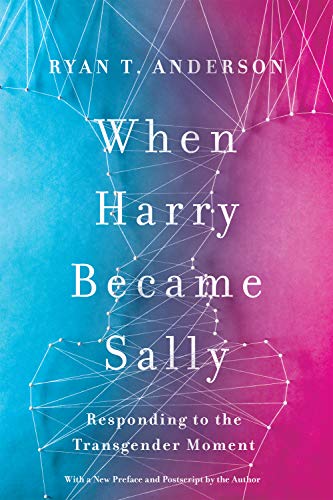
Ryan Anderson is a senior fellow at the Heritage Foundation who holds a PhD in Political Philosophy from Notre Dame. He has written an excellent book surveying the landscape on transgender issues as of 2019. He does not agree with the transgender ideology, and writes a persuasive and winsome case for pushing back against this new secular orthodoxy.
He explains that trans culture is being increasingly normalized in culture,[1] in laws and executive orders,[2] and in the medical field.[3] Advocates seek to silence all opposition, even from respected medical experts who advocate treatment for transgender individuals.[4]
Anderson’s most frightening chapter is where he surveys what activists themselves say. He makes three claims; (1) activists continually expand their demands, (2) they are closed off to contrary evidence, and (3) they incline towards coercion to enforce their creed.[5] The most significant point, as with homosexuality, is one of identity. However, the argument has now advanced one step further – people do not merely see themselves as transgender; society must acknowledge them as transgender. A subjective sense of identity has given way an objective orthodoxy. A “trans man” is a man. Period.[6]
They attempt to ground this in science and medicine,[7] a move perfectly in keeping with the worldview of “scientism.”[8] Sex is not determined by biology; rather, it is determined by one’s gender identity or “internal sense.” This ideology is being taught to young children through infographics such as the “gender unicorn.” At the State agency where I work, the “gender unicorn” was prominently displayed and promoted this past Summer. This unicorn is deliberately sexually androgynous. Indeed, even gender-neutral Barbie dolls are now available. In a news release accompanying the product launch, a Mattel representative explained,
Through research, we heard that kids don’t want their toys dictated by gender norms. This line allows all kids to express themselves freely which is why it resonates so strongly with them. We’re hopeful Creatable World will encourage people to think more broadly about how all kids can benefit from doll play.[9]
This worldview is resulting in a revolution in transgender medicine and policy.[10] Attempts to redirect children towards their biological sex are often deemed unethical. Some activist organizations recommend public schools keep a child’s transgender status from unsupportive parents, and effectively provide schools with guidance to mount a campaign of subversion against such parents.[11]
Anderson believes sex is determined by reproductive function. He cites one such proponent saying that he cannot find any other definition for sex other than what is promoted in social policy literature.[12] The discussion of treatment for gender dysphoria is one of the most horrifying and depressing things I have read.[13]
Anderson rightly concludes that “[w]hat’s at stake in the transgender moment is the human person.”[14] He suggests a comprehensive approach involving, (1) not stigmatizing those who suffer from gender dysphoria, (2) building a network of clinicians who do not agree with transgender ideology, (3) engaging the culture winsomely, particularly with former transgender individuals, (4) and lawyer and public policy experts working together to combat this ideology.[15]
This book’s value is that is accurately captures a snapshot of our cultural moment. It is not a religious book, and Anderson offers no theological insights. Every well-read Christian who pays attention to culture knows where we are headed, but Anderson gives one an invaluable and sobering guided tour through an otherwise familiar neighborhood.
[1] Ryan T. Anderson, When Harry Became Sally: Responding to the Transgender Moment (reprint; New York: Encounter Books, 2019; Kindle ed.), pgs. 9-11.
[2] Anderson, Harry Became Sally, pgs. 12-15.
[3] Anderson, Harry Became Sally, pgs. 15-20.
[4] Anderson, Harry Became Sally, pg. 20-25. One wonders how Mark Yarhouse would recommend responding to the idea of a transgender “identity”!? Perhaps here.
[5] Anderson, Harry Became Sally, pg. 28.
[6] “At the heart of the transgender moment are radical ideas about the human person—in particular, that people are what they claim to be, regardless of contrary evidence. A transgender boy is a boy, not merely a girl who identifies as a boy. It’s understandable why activists make these claims. An argument about transgender identities will be much more persuasive if it concerns who someone is, not merely how someone identifies. And so the rhetoric of the transgender moment drips with ontological assertions: people are the gender they prefer to be. That’s the claim,” (Anderson, Harry Became Sally, pg. 29).
[7] See J.P. Moreland, Scientism and Secularism: Learning to Respond to a Dangerous Ideology (Wheaton: Crossway, 2018).
[8] “Transgender activists don’t admit that this is a metaphysical claim. They don’t want to have the debate on the level of philosophy, so they dress it up as a scientific and medical claim. And they’ve co-opted many professional associations for their cause,” (Anderson, Harry Became Sally, pg. 29).
[9] Mattel Newsroom, “Mattel Launches Gender Inclusive Doll Line Inviting All Kids to Play.” 25 September 2019. Retrieved on 03 January 2020 from https://news.mattel.com/news/mattel-launches-gender-inclusive-doll-line-inviting-all-kids-to-play.
[10] Anderson, Harry Became Sally, pgs. 33-42.
[11] Anderson, Harry Became Sally, pgs. 42-45.
[12] Anderson, Harry Became Sally, pgs. 77-81.
[13] Anderson, Harry Became Sally, pgs. 97-116.
[14] Anderson, Harry Became Sally, pg. 212.
[15] Anderson, Harry Became Sally, pg. 211.

Mark Yarhouse is a conservative Christian psychologist who is active and publishes regularly in his field. He takes a traditional conservative approach to the homosexual issue. Yarhouse published his book in 2010, and it is a wealth of keen insight.
He advances the discussion by examining the presuppositions that undergird the revisionist arguments for unrepentant, “gay” Christianity. Yarhouse organizes his book into three sections; (1) the big picture, (2) honest answers, and (3) questions for the church. His unique contributions largely come from the first section:
Yarhouse also has a great deal of practical advice for spouses and parents dealing with sincere strugglers. But, his greatest value is in his emphasis on combatting the “identity” issue, his challenge to embrace sincere strugglers as brothers and sisters in community,[10] and his analogy of “flipping the script” by offering a better identity “in Christ” than the one the homosexual community is selling.
This is the perhaps the most helpful book on homosexuality available. It should be read with Burk and Lambert’s Transforming Homosexuality (see my review) for maximum effect.
[1] Mark Yarhouse, Homosexuality and the Christian: A Guide for Pastors, Parents and Friends (Minneapolis: Bethany House, 2010; Kindle ed.), pg. 18.
[2] “It is important to recognize that sexuality should be experienced as central to a person’s overall sense of identity. I think this was intended by God. We are inherently physical beings, and we are inherently sexual beings. So we don’t want to communicate that our sexuality is somehow removed from who we are. On the other hand, it is also important to recognize that when we ask what God thinks about homosexuality, we are likely to confuse the pattern of behavior with the person.
In other words, while we can acknowledge that some gay Christians say behavior and identity cannot be separated, other Christians who experience same-sex attraction do precisely that. They separate behavior and identity, seeing it as a necessary step in navigating their sexuality in light of their faith. When we instead ask what God thinks about homosexually oriented people, or what he thinks of people who experience same-sex attraction, we can answer without hesitation that God loves them,” (Yarhouse, Homosexuality, pg. 32).
[3] Yarhouse, Homosexuality, pg. 36.
[4] Yarhouse, Homosexuality, pgs. 37-57.
[5] Yarhouse, Homosexuality, pgs. 40-43.
[6] Yarhouse, Homosexuality, pgs. 46-53. “What competing or alternative script can he expect from the church? When Chris looks to the church he hears very little, and what he does hear is usually an oversimplification of the causes of homosexuality, followed by the claim that it can easily be changed or healed through efforts or faith. Is this the only message the church wants to send Chris?” (Ibid, pgs. 49-50).
[7] “Same-sex attraction may be the ethnic aspect of identity, an unchosen characteristic that can contribute in some way to identity, but there are also civic aspects of identity, and people have choices to make regarding what they believe about sexuality, sexual identity, and sexual behavior. These choices will lead them to different communities that, in turn, confirm and consolidate a sense of this sexual identity into who they are,” (Yarhouse, Homosexuality, pgs. 53-54).
[8] “Let me say it plainly one more time: The traditional Christian sexual ethic does not hinge on the causes of sexual attraction or orientation. Also: The traditional Christian sexual ethic does not hinge on whether or not sexual orientation can change,” (Yarhouse, Homosexuality, pgs. 163-164).
[9] “It got me thinking about why the church doesn’t lead with the thought and attitude that Christians who struggle with homosexuality are our people. Think about that for a second: Sexual minorities in the church, by which I mean believers who experience same-sex attraction, are our people. Framing the issue this way can lead to greater compassion as the church tries to find ways to provide support and encouragement to those in our own communities who would benefit from it,” (Yarhouse, Homosexuality, pgs. 157-158).
[10] “What the Christian community can offer the Christian sexual minority is a vision for what it means to be Christlike. That vision places the Christian sexual minority squarely in the middle of the Christian community. They become us. We are all supposed to be working toward the same goal. Whether we experience same-sex attraction or not, we are all to move toward Christlikeness,” (Yarhouse, Homosexuality, pg. 165).

Here is my annual list of the non-fiction books I read last year. 12 of these are for a Doctor of Ministry class I was prepping for; this accounts for the unusually high total book count.
I had great fun reading this year. About half of these I actually listened to on digital audiobook, and never read. It’s a great way to redeem the time you spend in your daily commute. Who knows what books 2020 will bring …
1: God in Three Persons: A Contemporary Interpretation of the Trinity by Millard Erickson
An excellent book; the most helpful work on the Trinity I’ve read, along with Carl Beckwith’s The Holy Trinity. I reflected on some lessons Erickson’s book taught me about what to emphasize when I teach about the Trinity in a systematic, comprehensive fashion … if I ever manage to do it!
2: Autobiography of Benjamin Franklin
Great book. Franklin was truly a genius, blessed by God with many talents and abilities. It’s a shame his enlightenment context prevented him from seeing his need for salvation through Jesus Christ.
3: Was America Founded as a Christian Nation? by John Fea
I’ve never appreciated revisionist or partisan attempts to re-frame history to suit a particular narrative. Christians are very guilty of this crime. John Fea, a Christian historian at an undergraduate liberal arts institution, does an excellent job of analyzing this question from many different angles. The answer is “it depends,” and he spends the book explaining why.
This book’s chief value to me, besides the analysis of a complicated historical question, are the numerous titles in the footnotes that will lead me to further reading.
4: The Way of Improvement Leads Home: Philip Vickers Fithian and the Rural Enlightenment in Early America by John Fea
The title says it all. John Fea uses Fithian, a Revolutionary War-era Presbyterian minister from rural Pennsylvania, as a foil to discuss how the enlightenment impacted educated colonists in rural America. Good book.
5: Who’s Tampering With the Trinity? An Assessment of the Subordination Debate by Millard Erickson
This is only one of three books, that I’m aware of, that contends that the eternal functional subordinationist position with regards to Christ is a dangerous teaching. I cannot recommend this book highly enough. It’s a watershed look at a very dangerous teaching. Erickson, in his trademark way, examines the other side fairly and objectively, then presents his own analysis. He does a masterful job. Indeed, this is perhaps the last great work from one of the best conservative theologians of the 20th century.
6: American Lion: Andrew Jackson in the White House by Jon Meacham
I gave up this book halfway through. I didn’t enjoy the detailed discussions about the gossipy intrigues of Jackson’s extended family. I understand it was part of the context of Jackson’s presidency, but I still didn’t want to hear about it. I’d have preferred to read a history about Jackson “the man,” and an analysis of his accomplishments and missteps as President. If I wanted a soap opera, I’d have turned on When Calls the Heart – at least that show always has a happy ending.
7: Excellent Sheep: The Miseducation of the American Elite and the Way to a Meaningful Life by William Deresiewicz
8: No Higher Honor: A Memoir of My Years in Washington by Condoleeza Rice
9: Jesus and Pharisees by A.T. Robertson
10: The Evangelicals: The Struggle to Shape America by Frances Fitzgerald.
Good book. See my review.
11: Sketches of the Life and Character of the Rev. Lemuel Haynes, A. M.: For Many Years Pastor of a Church in Rutland, Vt., and Late in Granville, New-York by Timothy Cooley
12: A Spy Among Friends: Kim Philby and the Great Betrayal by Ben Macintyre
13: Lord Jim by Joseph Conrad
14: John Adams by David McCullough
15: The Rise and Fall of the Third Reich by William L. Shirer
16: The Korean War by Max Hastings
17: Secret Thoughts of an Unlikely Convert by Rosaria Butterfield
18: Mere Christianity by C.S. Lewis
19: The Meaning of Everything: The Story of the Oxford English Dictionary by Simon Winchester
20: Man Without a Face: The Unlikely Rise of Vladimir Putin by Masha Geesen
21: God the Father Almighty: A Contemporary Exploration of the Divine Attributes by Millard Erickson
22: The End of White Christian America by Robert Jones
Great book; see my review.
23: Resident Aliens: Life in the Christian Colony by Stanley Hauerwas and William Willimon
24: The Confessions by Augustine
25: Leading in Prayer: A Workbook for Ministers by Hughes Oliphant Old
26: Gathering: A Theology and Spirituality of Worship in the Free Church Tradition by Christopher J. Ellis
27: Catastrophe 1914: Europe Goes to War by Max Hastings
28: One in Hope and Doctrine: Origins of Baptist Fundamentalism 1870 – 1950 by Kevin Bauder and Robert Delnay.
Read this one a few years ago. Read it again, and absorbed much more. Northern Baptists need to read this book and understand their history – especially my brethren in the GARBC or one of its regional associations.
29: To the Praise of His Glory: B. Myron and Thelma M. Cederholm by Larry Oats
A short, breezy biography of the founder of Maranatha Baptist Bible College, now University. I attended Seminary here, and will forever be glad for the precious theological education I received.
For me, this book’s value was not in gaining insight into Cederholm, who I never knew and whose legacy had no impact on me. Rather, it helped augment the story of northern Baptist fundamentalism in my mind, as I’d just finished Bauder and Delnay’s One in Hope and Doctrine. That story ended in 1950, and Cederholm entered from stage right with the Conservative Baptist movement in 1947. If you view Cederholm as a foil to tell the story of the Conservative Baptists, then this book is very helpful and very nice. Truth be told, I’d likely have gone with the so-called “soft core” Conservative Baptists in the big split in the early 1960s.
Larry Oats, the former Dean of Maranatha Baptist Seminary, wrote the book and the University published it. So, it isn’t surprising to see that it’s rather hagiographic. This is not a critical look at Cederholm or the Conservative Baptist movement. It’s a light, insider view of a man who played a pivotal role in northern Baptist fundamentalism for many decades.
30: Scientism and Secularism: Learning to Respond to a Dangerous Ideology by J.P. Moreland
31: Visible Saints: The History of a Puritan Idea by Edmund S. Morgan
32: Homosexuality and the Christian: A Guide for Parents, Pastors, and Friends by Mark Yarhouse
One of the best books on the homosexual issue from a traditional perspective. See my review.
33: Slaves, Women & Homosexuals: Exploring the Hermeneutics of Cultural Analysis by William J. Webb
Excellent and insightful. See my review.
34: Those 7 References: A Study of 7 References to Homosexuality in the Bible by John Dwyer
Dwyer is a gay Episcopal priest who argues that the Biblical authors didn’t have a Biblical worldview, that all sexual relations in the ancient world were about power, lust and violence, and that all homosexual references in the Bible aren’t really saying what we think.
I emailed Dwyer about his “sex in ancient world = lust, power and violence” thesis, and asked whether Song of Solomon hurt his thesis. He didn’t respond. I wonder why …
35: Is God Anti-Gay? by Sam Allberry
No, He’s anti sin. A good book. See my review.
36: God and the Gay Christian: The Biblical Case in Support of Same-Sex Relationships by Matthew Vines
A very dangerous and very important work. A prototype of how to misinterpret and twist the Scriptures for narcissistic ends. See my review.
37: The Bible and Homosexual Practice: Texts and Hermeneutics by Robert Gagnon
38: What Does the Bible Really Teach about Homosexuality? by Kevin DeYoung
Gagnon-lite. See my review.
39: Transforming Homosexuality: What the Bible Says about Sexual Orientation and Change by Denny Burk and Heath Lambert
Perhaps the best book available on this topic. See my review.
40: Spiritual Friendship: Finding Love in the Church as a Celibate Gay Christian by Wesley Hill
An important book from a same-sex attracted Christian committed to celibacy. See my review.
41: Women, Slaves, and the Gender Debate: A Complementarian Response to the Redemptive-Movement Hermeneutic by Benjamin Reaoch
One of the most frustrating and disappointing books I’ve ever read. See my review.
42: God and the Gay Christian?: A Response to Matthew Vines ed. Albert Mohler
See my review.
43: When Harry Became Sally: Responding to the Transgender Moment by Ryan Anderson
Horrifying; see my review.
44: Onward! by Russell Moore
45: Letters to My Students: Volume 1: On Preaching by Jason Allen
Very basic. Probably won’t buy the next volume.
46: Titan: The Life of John D. Rockefeller, Sr. by Ron Chernow
Probably the most enjoyable book I read last year.

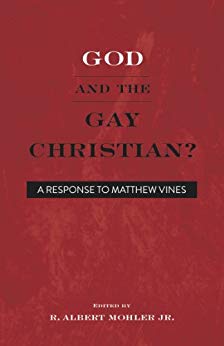
Mohler and a merry band of contributors have produced a very short, punchy and substantive 62-page rebuttal to Matthew Vines’ book (see my review of Vines’ work). There are five chapters which discuss, in turn, (1) an overview of Vines’ position and the dangers it presents, (2) Vines and the Old Testament, (3) Vines and the New Testament, (4) Vines and Christian history, and (5) Vines and the Gospel.
This book is remarkable because it is so substantive, yet so short. The contributors each manage to accurately distill Vines’ arguments and highlight the dangers to orthodoxy:
The book would have been strengthened by a short chapter each on identity and a “me-centered” hermeneutic. Each author makes references to these, but never directly engages. Vines does make his “gayness” his controlling badge of self-identity. He does have a hermeneutic of winsome narcissism; Vines even opens the book with his ridiculous “bad fruit” discussion. These are the controlling presuppositions that make Christians want the hermeneutic Vines is selling. A rebuttal of Vines’ position that does not attack these false presuppositions is incomplete.
Nonetheless, this is an accessible and substantive response to Vines and every church should provide it as a downloadable resource. It and several other ebooks are available free of charge at the SBTS website.
[1] Albert Mohler, ed., God and the Gay Christian?: A Response to Matthew Vines (Louisville: SBTS Press, 2014; Kindle ed.), KL 58-70.
[2] Mohler, Response, KL 125. “Vines claims to hold to a ‘high view’ of the Bible and to believe that ‘all of Scripture is inspired by God and authoritative for my life,’ but the modern concept of sexual orientation functions as a much higher authority in his thinking and in his argument.”
[3] I assume Mohler is referring to the complementarian/egalitarian debate.
[4] Mohler, Response, KL 125-150.
[5] Mohler, Response, KL 191.
[6] Mohler, Response, KL 191.
[7] Mohler, Response, KL 216-228.
[8] Mohler, Response, KL 483.

Reaoch produced a frustrating book engaging William Webb’s work on redemptive-movement hermeneutics (see my review of Webb’s book). Unfortunately, Reaoch excels at missing the point. Webb writes as a systematician advocating a specific hermeneutical approach, whereas Reaoch writes as an exegete who atomizes texts and speaks of grammar and syntax. They frame their discussions differently, because they are writing for very different purposes.[1]
Reaoch begins by falsely claiming Webb believes the issue of gender roles are tied to slavery.[2] He then wastes 61 pages discussing the Bible’s teaching on slavery and gender. Webb wrote about hermeneutics using gender and slavery as a foil; a distinction Reaoch appears to miss. For example:
Reaoch’s approach is to argue against Webb’s applications of his criteria, while not explaining why the criteria itself is wrong. Indeed, nearly all his criticisms have to do with interpretations of individual texts:
The cycle repeats. Again, Reaoch wants to exegete, whereas Webb wrote a book to discuss hermeneutics. Their approaches are like water and oil, and Reaoch erred by not critiquing Webb’s framework. Instead, he contented himself with attacking one of Webb’s foils. In the end, Reaoch does not like the implications of Webb’s hermeneutic[10] and he sees Webb’s work as an attack on complementarianism.[11]
This is a frustrating book, because Reaoch refuses to engage Webb fairly. He exegetes Webb’s applications, then invalidates them and thus dismisses the criteria. Is it true the trajectory of Scripture nudges us in a certain direction, even if it is not explicit in the text? Is it true that, insofar as we can, we should not make results of the Fall transcultural? Is it true that New Covenant status and new creation texts have implications for social status and role, today? Reaoch does not answer these questions; he wants to discuss gender texts. Therefore, his book’s main value is as an example of how to miss the point.
[1] Webb wrote his book to advocate a broad hermeneutical approach wherein one examines the pan-canonical drift of Scripture to discern movement (or lack thereof) along a trajectory, and carries that movement forward. Reaoch wrote his book to critique Webb’s position application of redemptive-movement hermeneutic to the gender issue.
[2] “Pivotal to Webb’s conclusions are the following assumptions: (1) the issue of gender roles is closely analogous to the slavery issue, and (2) patriarchy’s basis in original creation does not conclusively differentiate the two,” (Benjamin Reaoch, Women, Slaves, and the Gender Debate: A Complementarian Response to the Redemptive-Movement Hermeneutic (Phillipsburg: P&R, 2012; Kindle ed.), pg. 8.
However, Webb explained: “This book attempts to provide a collection, in one volume, of the various criteria that can be used in cultural analysis. In order to make the process more objective, I have attempted to establish each criterion from neutral examples before moving to two of today’s more debated topics— women and homosexuals. In this respect, the book has been designed as a tool for the application process in hermeneutics. Although my focus has been primarily on slaves, women and homosexuals, the various criteria may be used as a grid to explore any aspect of Scripture where one might suspect or question the impact of culture. I have used this material in a hermeneutics course for several years. My students have utilized these criteria, along with a redemptive-movement hermeneutic, to explore the question of cultural assessment in a wide variety of issues, for example, war, clothing taboos, government, circumcision, alcohol, child rearing practices, dancing, transvestism, polygamy, church offices, reproductive technologies, capital punishment, Sabbath and animal rights,” (William J. Webb, Slaves, Women and Homosexuals: Exploring the Hermeneutics of Cultural Analysis [Downers Grove: IVP, 2001; Kindle ed.], pgs. 197-298).
[3] Reaoch, Complementarian, pg. 11.
[4] Reaoch, Complementarian, pg. 33.
[5] Reaoch, Complementarian, pgs. 36-37.
[6] Reaoch, Complementarian, pgs. 115-116.
[7] Reaoch, Complementarian, pgs. 116-118.
[8] “Webb has assumed unlikely and hermeneutically simplistic interpretations of the creation account in an attempt to heighten the perceived tension between original creation and today’s culture. In this way he has set up reductionistic arguments that are easily dismantled,” (Reaoch, Complementarian, pg. 118). Reaoch does this repeatedly.
[9] Reaoch, Complementarian, pgs. 122-124.
[10] “We are happy to find movement when we compare the New Testament commands with the first-century culture, and we must recognize this to be ‘absolute movement,’ not ‘preliminary movement,’” (Reaoch, Complementarian, pg. 114).
[11] “The debate over gender roles has not diminished, and I do not see any end in sight. But we must not grow weary in defending the beautiful portrait of gender complementarity presented in the Bible,” (Reaoch, Complementarian, pg. 160).

Webb’s book is a tour de force of individual insights that are somehow greater than the sum of their whole. He seeks to bring cultural analysis to bear on the Bible over against a “static” hermeneutic. Today, he argues, we must distinguish what is cultural and trans-cultural. That is, we must discern between cultural values and kingdom values.[1] The basic approach of his “redemptive-movement” hermeneutic is to:[2]
Webb focuses on the spirit of the text.[3] He proposes a cumbersome 18 criteria for his hermeneutic, organized into four categories; (1) persuasive, (2) moderately persuasive, (3) inconclusive, and (4) extra-biblical considerations. He shows how this works by applying each criteria, in turn, to women in the church, slavery and homosexuality.
Webb has some truly remarkable big-picture insights, particularly on women, including:
However, Webb’s work also has flaws:
Webb has produced an outstanding book. His redemptive-movement approach has much to commend it, but some of his criteria for analysis are redundant for trained pastors, lack trans-culturality (ironically enough!), and are subjective. However, other criteria are extremely powerful and merit serious consideration.
[1] William J. Webb, Slaves, Women and Homosexuals: Exploring the Hermeneutics of Cultural Analysis (Downers Grove: IVP, 2001; Kindle ed.), pg. 36.
[2] “A redemptive-movement hermeneutic is characterized by several key components. At the heart of such an approach to the application of Scripture is its focus on (1) redemptive movement, (2) a multilevel ethic, (3) a balanced perspective, (4) cultural/ transcultural assessment and (5) the underlying spirit within a text,” (Webb, Hermeneutics, pg. 49).
[3] “A static hermeneutic lacks power and relevance, while a secular or radical hermeneutic lacks direction. Only a view that utilizes the redemptive spirit within Scripture as its core can construct an enduring connection between the ancient and modern worlds. A redemptive-spirit approach honors the words of Scripture by not forcing them into modern molds that do not fit. The words of Scripture, as read against the ancient world, provide the Christian with an understanding of its spirit and direction. The redemptive spirit generates the power to invade a new generation; the words of Scripture as read within their broader social context provide the much-needed direction for guiding the invasion of that power within today’s world. Once upon modern soil, a redemptive-movement hermeneutic channels its renewing spirit into the modern world with power to change social structures and direction to guide the renewal process,” (Webb, Hermeneutics, pg. 74).
[4] Webb, Hermeneutics, pg. 103.
[5] Webb, Hermeneutics, pgs. 147-159; 165-171.
[6] Dispensationalism, as a movement, has a tortured hermeneutical relationship with the New Covenant. I assume the Church is a full participant in the New Covenant.
[7] “One might ask if pragmatic factors like these should influence our cultural/ transcultural analysis of Scripture. In short, the answer is yes. The pragmatic factors that drove primogeniture customs were part of the ancient setting but they are no longer part of our world. Pragmatic factors tend to shape the formation of biblical text not so much at the upper abstracted levels of principle, but at the lower concrete expression of principle as it gets fleshed out within a particular cultural context,” (Webb, Hermeneutics, pg. 183).