Book Review: “God and the Gay Christian” by Matthew Vines

Matthew Vines’s book release in 2015 was a watershed event in conservative-ish Christian circles. He effectively popularizes the scholarly arguments for unrepentant, monogamous, same-sex Christian relationships. He has 10 arguments. Here is a representative sample:

  1. A tree and its fruit. Vines argues, based on Mt 7:15-20, for an “experience-based test” that evaluates truthfulness on whether it makes him feel bad.[1] This is narcissism and the fruit of moral, therapeutic deism.
  2. Bad traditions and sexual orientation. The Church was wrong about the earth being the center of the universe, and it is likewise wrong about homosexual orientation. New information about “orientation” gives the church a new lens through which to interpret the Bible.[2] Vines claims ancient sexual preferences were fluid and homosexuality was due to excess passion. He engages no Biblical texts and assumes Scripture is heavily shaped by secular culture, but does not demonstrate this assertion.[3]
  3. Gift of celibacy. Not all homosexual Christians have the gift of celibacy,[4] so Christians must decide which teaching to modify – homosexuality or celibacy. Vines suggests homosexuality, because the traditional view produces “bad fruit” in individuals. This is a version of the prosperity gospel, because Vines refuses to accept mortification of sin as a component of repentance.[5] 
  4. Real Sin of Sodom. Christians only began to interpret this sin as homosexuality until the Greco-Roman era, because of an over-emphasis on ascetism.[6]

The pattern is clear. Vines is largely a popularizer. He is to James Brownson what Kevin DeYoung is to Robert Gagnon. For example, Vines concludes (or, rather, he echoes a scholar who has concluded) that malakoi in 1 Cor 6:9 really means a lack of self-control.[7] What does a word study tell us? The word appears six times in the New Testament and the LXX:[8]

  • Proverbs 25:15 (“gentle”): the sense is gentleness
  • Proverbs 26:22 (“soft”): the sense is pleasant, perhaps tasty
  • Matthew 11:8 [x2] (“soft”): the literal sense is fancy or dressy, but Jesus’ point is something like soft or white-collar in a figurative sense
  • Luke 7:25 (“soft”): identical to above

The sense, then, is “softness.” Words can be literal or figurative. In 1 Corinthians 6, the word is in list of other vices that exclude one from the Kingdom. Is having a gentle or soft character grounds for damnation? Clearly, the word must have a figurative meaning. Because the term is between “adulterers” and “active partners” in a homosexual act, it seems logical to understand it to mean “soft” in the sense of a sexual role. Indeed, this is precisely what lexicons such as BDAG (“pert. to being passive in a same-sex relationship”), Louw-Nida, Friberg, Gingrich, Danker and even Thayer conclude. Which sexual act excludes one from God’s family? Homosexuality. Vines is incorrect, and he can only appeal to revisionist scholars for support.

This, in sum, is how Vines argues. He never does source language word studies, he never exegetes a text, he assumes secular culture had a controlling influence on the Biblical authors, and he appeals to empathy from a place of narcissism.

Vines’ book is infinitely dangerous for the believing Christian, and every Christian leader must understand how the other side argues. This book is the best work a pastor can find to review the revisionist arguments at a popular level.


[1] “Paul wrote in 1 Corinthians 10:13, ‘[God] will not let you be tempted beyond what you can bear.’ But mandatory celibacy for gay Christians is more than many of them can bear. It produces bad fruit in many of their lives, and for some, it fuels despair to the point of suicide. Such outcomes made it difficult for my dad to see how the church’s rejection of same-sex relationships could qualify as a good tree that, according to Jesus, produces good fruit,” (Matthew Vines, God and the Gay Christian: The Biblical Case in Support of Same-Sex Relationships [New York: Convergent, 2014; Kindle ed.], pg. 19).

[2] “Here’s what I want you to notice for our discussion about sexual orientation: Christians did not change their minds about the solar system because they lost respect for their Christian forebears or for the authority of Scripture. They changed their minds because they were confronted with evidence their predecessors had never considered. The traditional interpretation of Psalm 93:1; Joshua 10:12–14; and other passages made sense when it was first formulated. But the invention of the telescope offered a new lens to use in interpreting those verses, opening the door to a more accurate interpretation. The telescope didn’t lead Christians to reject Scripture. It simply led them to clarify their understanding of Scripture,” (Vines, Gay Christian, pg. 24).

[3] “Christians made remarkable shifts in their understanding regarding Gentiles, slaves, and the place of the earth in relation to the sun. And as we are about to see, the new information we have about sexual orientation actually requires us to reinterpret Scripture no matter what stance we take on same-sex relationships,” (Vines, Gay Christian, pg. 42).

[4] “But Jesus’s teaching does not support mandatory celibacy for people to whom celibacy has not been given. If even some gay Christians lack the gift of celibacy, we have reason to doubt interpretations that force celibacy upon them,” (Vines, Gay Christian, pg. 48)

[5] Vines Gay Christian, 43-44. 

[6]  “Christians were influenced by their ascetic environment to interpret Scripture in ways that explicitly condemned taboo practices. In later Christian thought, same-sex relations were thought to be ‘unnatural’ in the same way as masturbation, contraception, and non-procreative heterosexual sex. Each of those practices was understood as going beyond nature’s basic requirement of engaging in sex for the sake of having children,” (Vines, Gay Christian, 74-76).

[7] “New Testament scholar David Fredrickson has argued that malakoi in 1 Corinthians 6:9 be translated as ‘those who lack self-control.’ Based on the evidence, that translation stands on firmer footing than any interpretation that defines the word as a specific reference to same-sex behavior. As we’ve seen, malakoi doesn’t refer to merely a single act. It encompasses an entire disposition toward immoderation,” (Vines, Gay Christian, 122).

[8] The quotations which follow from the LXX are from the Lexham English Septuagint.

Pray for Christians in China

The Chinese government continues to persecute religious groups, including Muslims and Christians. This is largely a policy by China’s President, Xi Jinping, who is attempting to construct a cult of personality around himself not seen since the days of Mao. Organized religion is an obvious roadblock to this goal; thus the systematic persecution. If you have a New York Times subscription (or some free articles remaining), see these background article on China’s attempts build a civil religion centered on the State: https://nyti.ms/2SCC5cO

An evangelical Chinese pastor was recently sentenced to nine years in prison for his refusal to lead his church to bow to persecution. For a latter-day example of Acts 4:23-31 in action, see the church’s statement on its pastor’s sentence, which includes the following:

Praise God for the faithful witness of our brother in Christ, whose reward is now great in heaven. May the Lord use Pastor Wang Yi’s imprisonment to draw many to himself and to bring glory to his name.

China’s mass imprisonment of Muslims in the Western portion of the country is likely the largest mass incarceration and round-up of an ethnic group since the Holocaust. For some context on the crackdown on Muslims, see https://bit.ly/2SQf4n9, and especially:

For news about the Christian persecution, see the articles here: https://bit.ly/39nOGqm.

Pray for the Christians in China!

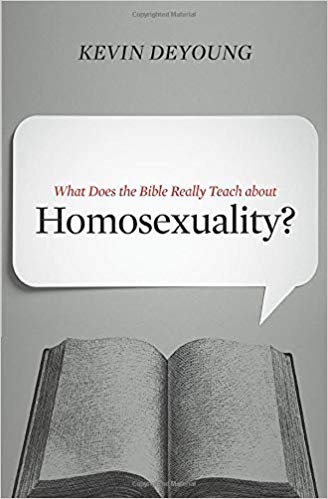
Book Review: “What Does the Bible Really Teach about Homosexuality?”

Kevin DeYoung has produced an outstanding book that is essentially a layman’s translation of Robert Gagnon. He organizes his book by first covering key texts, then interacting with common objections.[1]

He takes a traditional, conservative approach to all texts and covers the issues well. Some comments:

  • Genesis 1-2: He provides five reasons why the text shows gender complementarity in creation. DeYoung goes his own way by suggesting complementarity is hardwired into the Bible’s metanarrative of Christ’s union with the church.[2]
  • Genesis 19: DeYoung’s discussion on Ezekiel 16 and the implications for the sin of Sodom is better than Gagnon’s (by drawing attention to Ezekiel 16:47, not just v. 49) and is considerably shorter.
  • Leviticus: He provides six good reasons why Leviticus is still binding today, but does not explain the nature of the Christian’s relationship to the Law.[3]
  • Romans: DeYoung provides a good, conservative overview of the text. He remarks that word studies are unnecessary; “[t]he context gives us all the clues we need.”[4]
  • 1 Corinthians and 1 Timothy: He frames his discussion around word studies of malakoi and arsenokoitai,[5] which may not be the most valuable use of paper or electronic real estate in a book like this. The implications for conceptual covenant identity and ethics would have been a more profitable discussion.

DeYoung discusses some objections to Church’s traditional position on homosexuality:

  • Hardly mentioned. He give six reasons why this objection is irrelevant. Jesus believed sexual immorality, in its broadest interpretation, is sinful (Mk 7:21).[6] Sexual sin is always very serious, and it must remain so.[7]
  • Loving and monogamous. DeYoung is quite right to point out that this is an argument from silence.[8] He is rightly skeptical of the idea that most sexual relationships in antiquity were predicated on power, wanton lust and violence[9] – something Dwyer advocates.[10]
  • Gluttony and divorce. This chapter is an unfortunate distraction. DeYoung is reacting to allegations of hypocrisy and selective focus. A discussion of the “you’re picking and choosing from the Old Testament” accusation would have been more profitable.
  • Church is for broken people. He argues against free grace by emphasizing repentance. In a wishy-washy evangelical culture, this discussion is unfortunately necessary.
  • Wrong side of history. This is an unfocused and awkward chapter. DeYoung explains that a progressive view of history is false, and often contains strawmen and falsehoods about Christian positions. He discusses Galileo and slavery. He essentially argues it’s the pinnacle of arrogance to suggest the Church (in a Catholic sense) has always been wrong.[11]
  • It’s not fair! This is perhaps DeYoung’s best chapter because it attacks the idea that your sexuality is your identity.[12]
  • God of love. The attribute of love is often elevated to gives shape to all others, and DeYoung corrects this.[13]

Like Burk and Lambert, DeYoung closes with an excellent list of “ten commitments” for churches.[14] This book is an excellent resource for any Christian, and can credibly be referred to as Gagnon-lite.


[1]  Gen 1-2, 19; Lev 18, 20; Rom 1; 1 Cor 6, 1 Tim 1.

[2] “The meaning of marriage is more than mutual sacrifice and covenantal commitment. Marriage, by its very nature, requires complementarity. The mystical union of Christ and the church— each ‘part’ belonging to the other but neither interchangeable— cannot be pictured in marital union without the differentiation of male and female. If God wanted us to conclude that men and woman were interchangeable in the marriage relationship, he not only gave us the wrong creation narrative; he gave us the wrong metanarrative,” (Kevin DeYoung, What Does the Bible Really Teach about Homosexuality [Wheaton: Crossway, 2015; Kindle ed.], pg. 32).

[3] Pg. 48.  

[4] Pg. 54.  

[5] Pgs. 59-68.  

[6] Pg. 74.  

[7] “Far from treating sexual deviance as a lesser ethical issue, the New Testament sees it as a matter for excommunication (1 Corinthians 5), separation (2 Cor. 6: 12– 20), and a temptation for perverse compromise (Jude 3– 16),” (pg. 78).

[8] Pgs. 79-82.  

[9] “It seems demeaning to suggest that until very recently in the history of the world there were no examples of warm, loving, committed homosexual relationships,” (pg. 82).

[10] John Dwyer, Those 7 References: A Study of 7 References to Homosexuality in the Bible (self-published, 2007, Kindle ed.).

[11] “As Christians we ought to fear being on the wrong side of the holy, apostolic, and universal church more than we fear being on the wrong side of discredited assumptions about progress and enlightenment,” (pg. 108).

[12] “But if the summum bonum of human existence is defined by something other than sex, the hard things the Bible has to say to those with same-sex desires is not materially different from the hard things it has to say to everyone else,” (pg. 120).

[13] “No halfway responsible parent would ever think that loving her child means affirming his every desire and finding ways to fulfill whatever wishes he deems important,” (pg. 120).

[14] Pgs. 148-150.  

Already Gone?

Roger Olson is a moderate evangelical Baptist scholar who teaches at Baylor. He recently wrote a sweet retrospective on how church was when he was a kid. Here are some excerpts, with a few comments.

They were conservative, evangelical, moderately Pentecostal, and strict. They were, like many American evangelical churches then, “high demand.” Members were expected to believe and live a certain way and that way was separated from all worldliness. That way also included placing church at the center of one’s life only after family. Or, to put it another way, church was one’s extended family—even more than one’s extended biological family. And placing church at the center of one’s life was the main way of placing God at the center of one’s life—a distinction but not much difference.

What a sweet description. Your congregation as your extended family! This warms my heart.

He continues:

We eschewed all “worldliness” which included anything and everything that was conceivably sexually arousing.

What great advice. This can always descend into legalism, and there are movements that have ended up here. But, isn’t the principle so … right? Speaking for myself, I have no problem watching Bruce Willis slowly picking off terrorists at Nakatomi Plaza, but I would never watch any film with sex in it. You could argue this is a big inconsistency, and you’re probably right. But, for me, I’m not tempted to grab a pistol and stalk terrorists through a skyscraper if I watch Die Hard. But I, and any other man, cannot say the same about watching a film with sex.

Olson went on:

We had televisions in our homes but what was watched was carefully monitored and at church, anyway, talk about secular television shows was rarely heard. The same went for sports; our people could participate in some sports (especially the church softball league) but talking about sports at church was frowned on. So what did we talk about at church? What God was doing in the world, on the mission field, among us, in our lives. Conversation centered around Jesus who was talked about as a personal but invisible presence in our homes, with us at school and work, and in the church.

Yes, yes and yes. This could seem idealic and a bit utopian. But, it doesn’t have to be.

But, and here is a difference from similar churches today (if there are any), we did NOT celebrate America except for freedom of worship. We were not nationalists. In fact, when I was a child we were pacifists, but the Korean War was changing that. There was no talk of politics in the church. Sometimes my parents talked about politics at home, but mostly with regard to which parties and which candidates would protect our freedom of worship.

This is a distinction all evangelical churches in America should think about. Partisan politics is a poison, and it doesn’t belong in the pews. I have written reviews on two books recently that touch on this issue, and I’ll likely post them here in the near future.

So, what I want to know is this. What ever happened to that form of religious life? It seems to be gone forever—except in Latin America, Africa and Asia! My students from those continents and regions describe their churches as much like the ones I grew up in as a child and youth. Intense. Supernatural. Passionate about Jesus. The church as their extended family. Church discipline. Separation from worldliness. Where does that exist in America today outside of “Amish country?”

These are good questions. I’m not yet sure if the whole package Olson describes is (1) a model for a healthy church, or (2) a nostalgic yearning for a slice of mid-century Christian Americana that will never come back. Probably both.

But, you can’t deny that there are so many good things in Olson’s article. So many healthy things. So much that ought to warm our souls and make us look to our own congregations with a kind-hearted, reforming gaze. So much to inspire us, not with a hyper-critical eye, but with a vision of how to perhaps make a good thing better.

You should read Olson’s entire piece. It’s good stuff.

Book Review: “Transforming Homosexuality”

Denny Burk and and Heath Lambert have produced the most valuable book on the homosexual issue available.

They begin with a valuable discussion about “sexual orientation.” They use a secular definition,[1] not because they agree, but because this is how the term is used in everyday conversation. The APA has three triggers for “sexual orientation;” (1) sexual attraction, (2) emotional attraction and (3) self-identity. Burk and Lambert say the Scriptures only support the first of these, and the other two are illegitimate categories for the Christian.[2]

They have a first-rate discussion about whether desire is sinful. They discuss Mt 5:27-28, and answer in the affirmative. The Levitical system prescribed atonement for unintentional sins, which suggests there is no moral distinction between accidental and intentional desire.[3] The moral freight lies in what you wish to do, not how fervently you want to do it.[4] They conclude that the only valid sex desire is within the marriage covenant.[5]

There is an excellent discussion of Christology and incarnation. Jesus did not take on a sinful human nature, thus He was never tempted from within.[6] Too many pastors have a deficient Christology and do not understand this vital distinction.

Burk and Lambert discuss some common myths. They emphasize ethics are not enough; pastors must give people hope about change.[7] Change is not impossible. Change can be harmful, but it is because of the issue at hand, not the attempted treatment. Very importantly, they stress the goal is not heterosexuality, but purity. “The biblical goal of purity, in its manifestations of marriage for some and celibacy for others, replaces the unbiblical goal of heterosexual desire for all people.”[8] Change cannot happen without repentance; a framework quite different from reparative therapy which offers a psychological explanation for homosexual behavior.

Their discussion on change is unfocused and disappointing. The chapter headings are vague and abstract. For example, “repent of covetousness” really means “repent of sexual immorality.” Likewise, “repent of sinful presumption” means “stop living in unrepentant sin while claiming to be a Christian.” They suggest the same sex attracted (“SSA”) Christian “repent of sinful concealing” and find an accountability partner. They also suggest, curiously, singing to Jesus. This is all good advice, but the pastor will find little of substance to grab hold of, here. The best resource on biblical change is still How to Help People Change, by Jay Adams.[9]

The book closes with a discussion on how evangelicals can change to a more fruitful approach. The authors repeatedly emphasize that a focus on ethics is not enough, and here they flesh this out.[10] They offer 10 suggestions, and any congregation that internalizes these will be the better for it.Burk and Lambert’s work is most practical, accessible and substantive brief work available today. It is suitable for any interested Christian and for the busy pastor who needs some straight thinking on a topic that is not, in and of itself, very complicated but has become complicated because of our cultural moment.


[1] From the American Psychological Association’s (“APA”).

[2] Pgs. 26-38.  

[3] Pg. 44.  

[4] “Sin is conceived when desire fixes on evil,” (pg. 56).  

[5] “The only sex desire that glorifies God is that desire that is ordered to the covenant of marriage. When sexual desire or attraction fixes on any kind of non-marital erotic activity, it falls short of the glory of God and is, by definition, sinful,” (pg. 48).

[6] Pgs. 48-56.  

[7] “But we are also concerned that focusing on ethics to the exclusion of the ministry of change both reflects and provides an inaccurate picture that the Bible is all about ethical behavior and not much about how behavior can change,” (pg. 81).

[8] Pg. 76.  

[9] Jay Adams, How to Help People Change: The Four-step Biblical Process (Grand Rapids: Zondervan, 1986).  

[10] They recount a sermon by W.A. Criswell from 1986 that focused exclusively on ethics and offered no hope or grace to SSA individuals (ch. 3, fn. 1).  

Books!

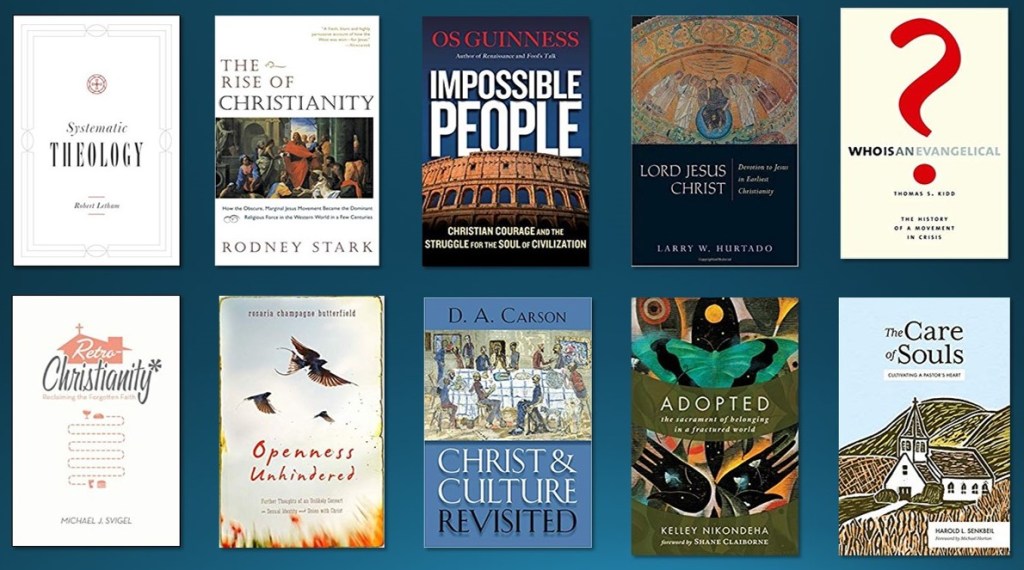
These are the books I got for Christmas:

All but two I purchased on Kindle. I have gone all-in on Kindle books. I probably won’t “read” any of these. Instead, I’ll play them via the “text-to-speech” feature on my Kindle Fire while I drive to and from work each day. It doesn’t have the polish of a professional audiobook narrator, of course, but it’s good enough. I bought a Kindle Fire on sale for $29.99, and it’s only purpose is to be an audiobook player.

A word or two on the books …

  • Systematic Theology by Robert Lethem. I bought a physical copy. I’m looking forward to referencing this new book by a well-respected Reformed scholar. I have many systematic theology texts. My go-to systematic is written by Millard Erickson, who I respect profoundly.
  • The Rise of Christianity by Rodney Stark. Looks to be a fascinating book by a Christian sociologist.
  • Impossible People by Os Guinness. Guinness is always worth reading, and is perhaps the most astute Christian thinker alive today on the practical intersections between the Church and culture.
  • Lord Jesus Christ by Larry Hurtado. The magnum opus of a legendary New Testament scholar on my favorite topic – Christology.
  • Who is an Evangelical? by Thomas Kidd. Looks to be a fascinating book. It continues a trend I began earlier this year of reading books about the evangelical movement.
  • Retro Christianity by Michael Svigel. I read this a few years ago. I want to read it again. It’s a warm exhortation to reclaiming a conservative, Catholic view of church. It challenges me to go far beyond my own fundamentalist training in a conservative, more irenic direction that appreciates the larger traditions of the Church.
  • Openness Unhindered by Rosaria Butterfield. Anything Butterfield writes is excellent.
  • Christ and Culture Revisited by D.A. Carson. Carson wrote it. Need I write more?
  • Adopted by Kelley Nikondema. An interesting-looking book on the concept of adoption by God in salvation.
  • The Care of Souls by Harold Senkbeil. Looks to be a very helpful book. I’ve seen a lot of buzz about it.

Good Advice from a Dead Englishman

J.B. Phillips is best known for his translation of the New Testament, which he began during the War while he was a young Anglican vicar. He also wrote a number of small, practical books for “ordinary” believers. One of these was a little book titled New Testament Christianity, published in 1956.

I picked the book up on my annual pilgrimage to Powell’s Books, in downtown Portland. This is a great little book. I’ll write more on it in the coming weeks. For now, here’s a taster (pg. 99):

We may be full of joy, but we are not here for our amusement. We are here to be used as instruments in God’s purpose. It is a fine thing to know that we are ‘right with God,’ ‘converted,’ ‘born again,’ and all the rest of it, but after a while such experiences become stale an unsatisfying unless we are passing the Good News on to others, positively assisting the work of the Church, or definitely bringing to bear upon actual human situations the pattern of Christian living.

This means in effect that each Christian must ask himself, ‘Am I myself outward-looking in my Christian experience, or am I content to remain in a safe ‘Christian rut?’ The recovery of the Church’s power rests ultimately upon the individual Christian’s answer to such a question.

More to come later …

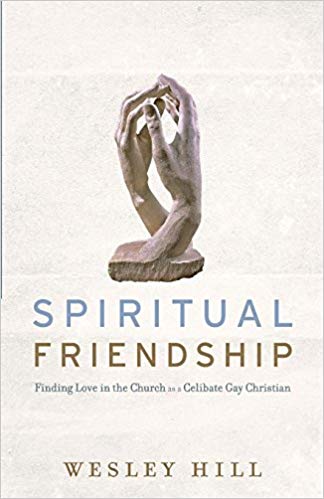
Book Review: “Spiritual Friendship” by Wesley Hill

Wesley Hill is a same-sex attracted (“SSA”) Christian who is committed to celibacy. In this fine book, he makes many good points in an odd way. Reading his book is like speaking to someone who learned English abroad; he’s fluent but he’s not a native! Hill challenges the reader to re-imagine real Christian friendship. Unfortunately, despite his best efforts, one cannot help but suspect Hill wants friendship as a substitute for a romantic relationship.[1]

He denigrates marriage by claiming it cannot fulfill all its promises. Hill asks us to imagine what friendship could be like if it ceased to be “casual,” and became committed.[2] Unfortunately, Hill struggles to marshal Scripture to support his theology of robust friendship; certainly not at the expense of marriage. The passages he does cite are rarely didactically about friendship at all (Prov 17:17, 18:24; Ruth 1; David and Jonathan; Jn 11:3, 15:13), or are otherwise desperate (Lk 23:26). His best discussion is Mk 3:32-35 and the implications of Christian brotherhood and sisterhood. However, it is doubtful Mk 3 can bear all the freight Hill wishes it to.

  • He cites multiple examples of deep friendship (“sworn brotherhood”) from multiple eras, but this by itself proves nothing.  
  • Hill endorses a monastic vision of “spiritual friendship” that’s “a form of same-sex intimacy that sublimated or transmuted erotic passion rather than sanctioning its genital expression.”[3] It is difficult to find this sentiment in Jesus’ words.
  • “We are eager for our friends to say to us, ‘I love you because you’re mine,’ without leaving themselves an escape clause.”[4]
  • “In the New Testament, as we’ve seen, familial language far outweighs the language of friendship when it comes to describing Christian community. Believers are one another’s ‘brothers and sisters in Christ,’ not (primarily) one another’s ‘friends.’”[5]

In short, Hill is inescapably and unbearably lonely. “My question, at root, is how I can steward and sanctify my homosexual orientation in such a way that it can be a doorway to blessing and grace.”[6] He chooses to embrace “gayness” as a badge of self-identity.[7] To Hill, his homosexuality is a call to a vocation of male friendship. “My being gay and saying no to gay sex may lead me to be more of a friend to men, not less.”[8]

To him, spiritual friendship involves a covenant commitment just as deep as that of marriage.[9] Hill is introspective enough to suspect he’s looking to fill a romantic void by sanctifying friendship.[10] His last chapter is full of excellent advice on fostering real friendships in the church.

Hill’s book challenges the reader. It forces you to think beyond the casual relationships we often call “friendship” in our congregations. Speaking practically, his vision is perhaps utopian in its scope and there is only so much an overworked elder team can do in a congregation. However, Hill’s brute honesty makes it an invaluable resource for SSA Christians and a summons to the church to cultivate meaningful community. Its strengths far outweigh its weaknesses.


[1] “As someone trying to reconcile his Christian faith with his homosexuality, I have become increasingly drawn to that notion: that there exists, for someone like me, a location for my love. That, by rediscovering ancient, and not-so-ancient, forms and exemplars of friendship, I might be able to rewrite the lonely future I feared would be my lot as a celibate gay Christian. That I too am called to nurture, deepen, and sanctify my love,” (pgs. 21-22).  

[2] “Should we consider friendship as always freshly chosen but never incurring any substantial obligations or entailing any unbreakable bonds? Or should we instead—pursuing a rather different line of thought—consider friendship more along the lines of how we think of marriage? Should we begin to imagine friendship as more stable, permanent, and binding than we often do? Should we, in short, think of our friends more like the siblings we’re stuck with, like it or not, than like our acquaintances? Should we begin to consider at least some of our friends as, in large measure, tantamount to family? And if so, what needs to change about the way we approach it and seek to maintain it?” (KL 115-131).  

[3] Pg. 33.  

[4] Pg. 42. To Hill, this “escape clause” is the possibility of marriage and the resulting shift of relationship dynamics.

[5] Pg. 60.

[6] Pg. 79.  

[7] Pgs. 79-80.  

[8] Pg. 81.  

[9] Pg. 90.  

[10] “The danger is that I’ll idealize friendship as a quick fix for loneliness and relational burdens rather than as something requiring substantial burden-bearing itself. Insofar as there is an answer to this problem, I suspect it lies in the recognition that friendship involves just as much of an ascetic struggle as marriage or parenting or monastic vows or any other form of Christian love,” (pgs. 98-99).

Book Review: “Is God Anti Gay?” by Sam Allberry

Allberry is a conservative Christian who struggles with same sex attraction (“SSA”). He has produced a fine, short book appropriate to recommend or giveaway, with one major caveat.

He correctly identifies “self-identity” as a key issue.[1] “I am far more than my sexuality.”[2] Allberry guards against over-emphasis by reminding the reader that everyone has sins with which God is unhappy; “He’s anti that guy, whatever that guy looks like in each of our lives.”[3]

His chapter on design in creation is short and effective. He argues for gender complementarity and tips his hat to (or anticipates) the transgender debate by observing, “[y]es, gender is something we humans interpret and lend cultural expression to, but it is not something that we invent or fully define. It is how God created us.”[4] This is foundational for his thinking.[5]

He surveys the usual Scripture passages in one chapter. His analysis is conservative, traditional and clear. Homosexuality is unnatural, it’s a sign of God’s judgment, it’s very serious, but it isn’t inescapable. “It’s not that the Bible opposes all homosexual activity but approves of any and every sexual act between heterosexual people.”[6] Allberry finishes the discussion by criticizing the view that a monogamous homosexual relationship is acceptable by pointing to 1 Cor 5; “[c]onsistency and faithfulness while sinning in no way diminish the sin.”[7]

Allberry then provides good advice for Christians struggling with SSA. He offers a more faithful path than Wesley Hill by condemning SSA as a prism of self-identity. “SSA can become the lens through which the whole of our Christian life is viewed. Yes, it has a significant effect on a number of defined areas of life, but it does not define your life.”[8] In effect, he calls SSA Christians to enmesh themselves in their church community. Unfortunately, this struggle is rarely “safe” to share in conservative congregations. He wisely observes, “I believe that change is possible, but a complete change of sexual orientation is never promised in the Bible.”[9] This dovetails nicely with public statements Rosaria Butterfield has made, comparing the “promises” of reparative therapy to the prosperity Gospel.

However, Allberry stumbles badly by denying that temptation is a sin.[10] The Book of James is clear that temptation is actuated when one is lured away and enticed by his own desire (Jas 1:13-15). There is an internal drawing to a particular action. This desire, when conceived and actuated only as a hypothetical in one’s mind, produces sin – which can be mental or physical. This sin results in death. Allberry believes the capacity to sin is not sinful.[11] But, we are not speaking of mere capacity. What happens in your mind caries moral freight (Ex 20:17). It is difficult to imagine, say, Allberry endorsing the view that it is acceptable to be tempted to sexual relations with golden retrievers as long as one does not consummate the physical act.

Allberry has written a good, short introduction to the issues. His views on sin and temptation are unfortunate, and are enough to stop me from wholeheartedly recommending it.


[1] Pg. 10.  

[2] Pg. 11.  

[3] Pg. 11.  

[4] Pg. 18.  

[5] “The Bible’s teaching on sex and marriage is the foundation for how Christians are to think about the whole issue of sexuality today,” (pg. 22).  

[6] Pg. 38.  

[7] Pg. 40.  

[8] Pg. 46.  

[9] Pg. 48.  

[10] Drawing from Mt 6:12-13, he writes, “We are not asked to seek forgiveness for being tempted, but only for any sin committed when we succumb to it. Instead, we are called to stand up under temptation, to endure it faithfully” (pgs. 63-64).  

[11] “To hear that the very presence of this temptation (irrespective of the extent to which they have endured faithfully under it) is itself a sin to be repented of might easily crush an already very tender believer,” (pg. 64).

Fundys, Evangelicals and the Eye of a Needle …

Fundys, Evangelicals and the Eye of a Needle …

This article was updated on 26 December 2021

I minister in a church sub-culture that has no understanding of the fundamentalism/evangelical debates. I received graduate theological training from an excellent fundamentalist seminary. I’m a doctoral student at yet another fundamentalist institution. But, the church I serve has no self-conscious fundamentalist identity, even though it’s a member of an association that hails from Northern Baptist fundamentalism–the GARBC. I minister in an “evangelical” church, though many members might not know exactly what that means.[1]

Recently, a church member asked me what an “evangelical” is, what a “fundamentalist” is, and how they’re different. This article is basically how I answered. It’s a short answer. But, I think it captures the essential distinction between the two groups.

About fundamentalism

Fundamentalism in America began as a protest movement within conservative Christian circles in the late 19 century. Christian leaders in churches, bible colleges, seminaries and denominations began to be aware of a revisionist, unorthodox approach to the Bible and theology. There was a willingness to reevaluate the integrity of the Bible, how it was transmitted and preserved, whether Adam and Eve were real people, whether Moses really wrote the Pentateuch, whether Isaiah really wrote all of Isaiah, whether Jesus was really conceived by a miracle of the Holy Spirit, whether miracles really happened, and more. This openness to “new ideas” began in seminaries and gradually filtered down to the pulpits in local churches of many denominational stripes. See Jeffrey Straub’s wonderful book The Making of a Battle Royal: The Rise of Liberalism in Northern Baptist Life, 1870-1920, for more context.

Fundamentalism was a movement that fought against that. It marshaled brilliant men; pastors, theologians and laymen, to make the case for orthodoxy. Working in very loose, often disjointed concert, men from many denominations fought this revisionist approach in the denominations, bible colleges, seminaries and churches. They fought them for several decades.

They lost.

Increasingly, throughout the mid-1920s and 1930s fundamentalists faced a choice–stay or go? The forerunners of what became the Conservative Baptist movement stayed within the Northern Baptist convention for about two further decades. Others led their churches out of the denomination much sooner, in protest. The Baptist Bible Union (now the GARBC) and the Orthodox Presbyterian Church are examples.

Until the 1940s, fundamentalists generally thought of themselves as “evangelicals.” The words were synonyms. They meant something like “conservative, bible-believing Christian.” It meant you believed generic Protestant orthodoxy and were probably somewhat loud about it.

So, why are the terms different, today?[2]

About evangelicalism

They’re different because the conservative Christian movement split in the mid-1940s through the late 1950s. It didn’t split over doctrine per se. It split over mood, over approach, over mindset. It split because two camps arose within this big tent, and each had very different approaches to Christian life and ministry. These two camps were fundamentalism and evangelicalism. Roger Olson explains:[3]

The difference between early fundamentalism and later fundamentalism is not so much one of doctrine as of mood. The single most important distinction between them has to do with late fundamentalism’s adoption of a militant stance toward exposing the ‘heresies’ of other Christians and of a policy of separation not only from liberal Christians but also from fellow evangelicals who do not separate from liberal Christian denominations and organizations

This “mood” is indeed different, and so is the mission. First-stage fundamentalism (Olson’s term) was a protest movement to preserve generic Protestant orthodoxy. In its modern form as evangelicalism, this remains part of its core ethos. The overwhelming amount of literature and media designed to protect and equip the church against heresy is produced by “evangelicals,” today.

However, second-stage fundamentalism is less about combating theological revisionism and more about separation from perceived heresies and “disobedient brethren.” Fundamentalist literature preaches avoiding perceived compromise and emphasizes personal holiness. It spends little time combating heresy, and the movement’s influence and reach is so small that even if it did commit the resources to do so, its message likely wouldn’t reach much beyond its own constituency.

For example, historian Kathleen Wellman writes this about Bob Jones University:

Its faculty and the policies the university requires of them preserve its consistent character and ideology. Faculty are not granted tenure and must espouse and support fundamentalist views. For example, science faculty members must now subscribe to Young Earth creationism, the belief that the earth is less than 10,000 years old. The university neither promotes research nor allows academic freedom. Its students must “live obediently under authority.” Not surprisingly, there have been several purges of faculty for disloyalty. Unaccredited for much of its history, Bob Jones University is now accredited by the Transnational Association of Christian Colleges and Schools.

Bob Jones University and its chancellors have had a long history of insisting on theological purity and have regularly fallen out with other evangelicals and even other fundamentalists, condemning them as lax or insufficiently committed to the truth. The university claimed a “purest of the pure” status, defined itself in staunch opposition to modern culture, and rigorously separated itself from it

Hijacking History: How the Christian Right Teaches History and Why It Matters (New York: OUP, 2021), p. 24

Tellingly, its best scholars are often educated at evangelical institutions. The doctrine is largely the same. The mood is different. David Beale called pre-1930 fundamentalism “non-conformist,” and post-1930 fundamentalism “separatist.”[4] The ethos changed. Some agreed, and others didn’t. Thus, the split. In many cases, the heirs of first-stage fundamentalism refer to themselves as “evangelicals” today. Likewise, many second-stage fundamentalists own the “fundamentalist” label proudly.

Some examples may help:

  • The Orthodox Presbyterian Church is a first-stage fundamentalist denomination and is a decidedly “evangelical.” It engages the culture and pushes aggressive orthodoxy. It does not focus on separation from allegedly “disobedient” brethren.
  • The Conservative Baptist movement left the Northern Baptist convention in the early 1940s. It later split into various factions amidst sustained and unfortunate infighting; it was a fundamentalist/evangelical split in microcosm. The heirs of this split include, respectively, the FBFI and CBAmerica. Some readers may be aware the FBFI is a solidly fundamentalist organization. CBAmerica is evangelical.
  • The GARBC, formerly the Baptist Bible Union, left the Northern Baptist Convention in 1923. Whatever it used to be, it is a solidly evangelical association of churches today. It recently changed its purpose statement to drop legacy language from the fundamentalist/evangelical split

The difference in mood is even clearer if you example mission or vision statements:

  • CBAmerica (evangelical): Its vision is “Gospel-centered transformational churches in every community.”
  • FBFI (fundamentalist): “FBFI’s Vision is to perpetuate the heritage of Baptist Fundamentalism complete, intact, pure, and undiluted to succeeding generations of fundamentalists.”
  • GARBC (evangelical): It’s mission is to “champion biblical truth, impact the world for Christ, perpetuate a Baptist heritage” and to “advance the association churches.”

Telling “evangelical” from “fundamentalist,” today

So, what is the difference between “fundamentalism” and “evangelicalism,” today? We can draw some general observations.

Fundamentalism, at its best, is generally concerned with personal holiness and local church purity in practice and doctrine. The content of this holiness and church purity will vary according to the particular flavor of the movement to which the group or church belongs. Its doctrinal emphases are often framed through a prism of separation from compromise and combined with a remnant mindset. Its rhetorical foe is often not theological revisionism, but evangelicalism – those who are believed to have “compromised.” The movement’s essence, according to Beale, is “unqualified acceptance of and obedience to the Scriptures.”[5]

However, the worst elements of the fundamentalist movement can be caustic, arrogant, and extraordinarily legalistic. Edward Carnell, an evangelical scholar with hard feelings about fundamentalism, wrote that the movement had degenerated into an entirely negative mentality with no positive ethos, similar to the mood Olson spoke about. Carnell wrote:[6]

The mentality of fundamentalism is dominated by ideological thinking. Ideological thinking is rigid, intolerant, and doctrinaire; it principles everywhere, and all principles come in clear tones of black and white; it exempts Itself from the limits that original sin places on history; it wages holy wars without acknowledging the elements of pride and personal interest that prompt the call to battle; it creates new evils while trying to correct old ones.

This mentality, Carnell argued, is marked by externalism:[7]

When the fundamentalist develops his ethical code, he is somewhat prompted by a quest for status in the cult. Consequently, he defines the good life as the separated life – separated, that is, from prevailing social mores. Whereas Christ was virtuous because he loved God with all his heart and his neighbor as himself, the fundamentalist is virtuous because he does not smoke, dance, or play cards.

In short, Carnell says “fundamentalism is orthodoxy gone cultic.”[8] In some quarters (but not all), Carnell is right.

Evangelicalism, at its best, is concerned with evangelizing the world and preserving generic Protestant orthodoxy. Its scholars produce mass amounts of literature and media to equip the church to navigate a complex and changing world. Its name is synonymous with “conservative Christian.” Roger Olson explained, “[t]he genius of evangelicalism is its combination of orthodox Protestantism, conservative revivalism, and transdenominational ecumenism.”[9]

Fundamentalists often criticize this movement as having lax doctrine and a diluted sense of personal holiness. However, as noted above, this can produce a “remnant mentality” mindset; a drive to “sound the alarm” against alleged apostasy.[10] You can get a sense of this from fundamentalist Ernest Pickering’s book The Tragedy of Compromise:[11]

All over America and the world at this hour there are churches that are drifting into New Evangelicalism without the remotest knowledge that they are doing so. They are being carried along by the shifting winds of compromise and have long since departed from the solid biblical position established by their predecessors. Young pastors, many without firm doctrinal underpinnings, have led their churches to believe that in order to reach the masses they must abandon the strict biblical principles of yore and embrace more fluid and attractive positions. They have changed, but they do not realize that they have changed.

More recently in 2016, the FBFI devoted an entire edition of its magazine to warn of the threat from so-called “Convergents” who were evangelicals in disguise. One author’s article warned of “long-established churches that are being changed through the hidden agenda of Convergent leadership.” The author declared he was warning Christians to not have their hearts “stolen” by these evangelicals, whom he described as conspiratorial, hypocritical and crafty. He used Absalom, who planned and executed a palace coup against King David, as his foil to describe evangelical pastors.[12]

When I was at seminary, I recall one seminary professor lamenting that Andrew Naselli had “left our movement.” Naselli is a professor at a conservative evangelical seminary, but has a PhD from Bob Jones University (a fundamentalist institution). You can see the “remnant” mindset behind that statement from my former professor.

So, to generalize a bit:

  • Fundamentalism is about purity and holiness. It wants you to obey the Bible, and it wants you to stay away from folks who allegedly don’t.
  • Evangelicalism is about the Gospel and protecting the faith from those who want to re-define it

Many conservative Christian groups in America today are heirs of the fundamentalist-evangelical tradition. Most of these took a side during or after the big split. Where you find yourself is not so much a matter of doctrine, but of mood, approach and emphasis. Of ethos. Both movements try to do good things, necessary things, biblical things. Evangelicalism today takes many forms. Fundamentalism is dying as a movement, but its ethos may well live on.

What does it mean to be “evangelical?”

Many books, many pages, and many gigabytes have been expended to answer that question. In a different generation, Bernard Ramm defined “evangelicalism” as “the historic Christian faith as reflected in the great creeds of the ancient church, and in the spirit and writings of the Reformers,” (The Christian View of Science and Scripture (Grand Rapids: Eerdmans, 1954), preface, p. 4). Nowadays, a more common definition is the so-called “Bebbington Quadrilateral,” which posits four characteristics of the label. The National Association of Evangelicals discusses these four traits, and more. One excellent, recent book, that can help flesh this out further is authored by Christian historian Thomas Kidd: Who is an Evangelical? A History of a Movement in Crisis.

For my part, I’ll stick with the Anglican pastor J.C. Ryle, who gave his summary of the “evangelical religion” a long time ago, in a different context. He had five headings:[13]

  1. The first leading feature in Evangelical Religion is the absolute supremacy it assigns to Holy Scripture, as the only rule of faith and practice, the only test of truth, the only judge of controversy.
  2. The second leading feature in Evangelical Religion is the depth and prominence it assigns to the doctrine of human sinfulness and corruption.
  3. The third leading feature of Evangelical Religion is the paramount importance it attaches to the work and office of our Lord Jesus Christ, and to the nature of the salvation which He has wrought out for man.
  4. The fourth leading feature in Evangelical Religion is the high place which it assigns to the inward work of the Holy Spirit in the heart of man.
  5. The fifth and last leading feature in Evangelical Religion is the importance which it attaches to the outward and visible work of the Holy Ghost in the life of man.

This encapsulates the Christian faith and message so well. It doesn’t distort a good thing out of proportion by framing the Gospel and the Christian life through a prism of separation from error, real or imagined. It’s a balanced expression of divine truth. I admire that old Anglican, and that admiration forces me to align myself with “evangelicalism” today.


[1]  This is not a comprehensive history of either movement, and it doesn’t pretend to be. It doesn’t malign Billy Graham. It doesn’t mention Billy Graham. It’s a very brief, 500 mph drive-by discussion to orient a reader to the general “lay of the land” who knows nothing about this chapter in American religious history. Those who have ears to hear, let them hear. To those that don’t, well … what else do you expect from a “convergent!?”

[2]  Roger Olson lists seven different ways the term “evangelical” is used in contemporary culture (Westminster Handbook to Evangelical Theology [Louisville: WJK, 2004], 2-10). The etymology is fascinating and instructive.

[3] Ibid, p. 36.  

[4] David Beale, In Pursuit of Purity: American Fundamentalism Since 1950 (Greenville: Unusual Publications, 1986), 5.

[5] Ibid, p. 1.  

[6] Edward Carnell, The Case for Orthodox Theology (Philadelphia: Westminster, 1959), 114.  

[7] Ibid, p. 122.  

[8] Ibid, 113.  

[9] Olson, Evangelical Theology, p. 10.  

[10] See especially Rolland McCune, Promise Unfulfilled: The Failed Strategy of Modern Evangelicalism (Greenville: Ambassador International, 2004).  

[11] Ernest D. Pickering, The Tragedy of Compromise (Greenville: BJU Press, 1994), 155.

[12] Dan Unruh, “Why I Left My Fundamental Baptist Church,” in Frontline (Sept/Oct 2016), 11-14.  

[13] J.C. Ryle, Knots Untied: Being Plain Statements on Disputed Points in Religion from the Standpoint of an Evangelical Churchman, 10th ed. (London: William Hunt, 1885), 3-7