On Floating Axheads and Hungry Dragons

The Bible sounds weird to people today. There is no denying that. It is a compilation of 66 individual books, written over a very long period of time, in three different languages. It communicates God’s word in the idiom, speech and garb of a culture that perished long ago. This is why, in every seminary text on homiletics, there is a lot of discussion about how to communicate the Bible’s message to a contemporary culture.

In fact, in my sermon notes, I always included this picture from a preaching textbook[1] as a reminder about what my role was – to faithfully communicate God’s word to the people in the congregation.principalizing-bridge
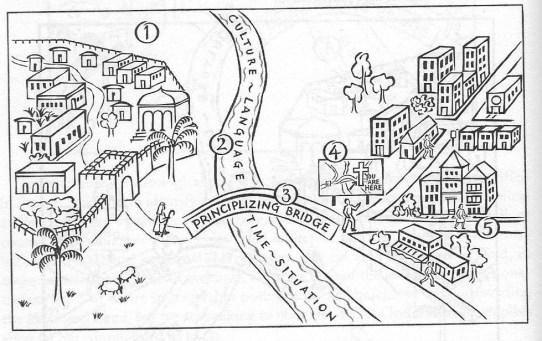
Millard Erickson wrote a good bit about this conundrum, and the unbelieving response of the theological liberals. What he wrote is worth pondering:

One problem of particular concern to the theologian, and of course to the entire Christian church, is the apparent difference between the world of the Bible and the present world. Not only the language and concepts, but in some cases the entire frame of reference seems so sharply different . . .[2]

The average Christian, even the one who attends church regularly, lives in two different worlds. On Sunday morning, from eleven o’clock to noon, such a person lives in a world in which axheads float, rivers stop as if dammed, donkeys speak, people walk on water, dead persons come back to life, even days after death, and a child is born to a virgin mother. But during the rest of the week, the Christian functions in a very different atmosphere.

Here technology, the application of modern scientific discoveries, is the norm. The believer drives away from church in a modern automobile, with automatic transmission, power steering, power brakes, AM-FM stereo radio, air conditioning, and other gadgets, to a home with similar up-to-date features. In practice the two worlds clash. In the Christian’s biblical world, when people are ill, prayer is uttered for divine healing, but in this secular world, however, they go to the doctor. For how long can this kind of schizophrenia be maintained?[3]

All this is surely true. Thus, Erickson continues:

Here we must ask the question, What must we retain in order to maintain genuine Christianity, or to remain genuinely Christian?[4]

Erickson went on to list a few of the answers different people and institutions have given to this problem. What makes somebody a Christian? What is it about “the faith” which transcends cultures, from the 1st century to the 21st?[5]

  • Is it the institution of the church itself? This is Roman Catholicism’s answer. But, perhaps, some passionate Baptists ought to chime in here with a hurrah, as well (for very different reasons!).
  • Is it the cultural interpretation (and reinterpretation, and reinterpretation, etc.) of how God has acted in history?
  • Is it in the shared experiences people of faith have always had?
  • Is it the outward behavior, the zest for social justice, equity and democracy which is true Christianity?
  • Or, is it in the rule of faith, the doctrines and teaching of the Scriptures?

The Christian has always replied that doctrine defines what the faith is, and that doctrine is contained in the Holy Scripture, that “perfect treasure of heavenly instruction . . . the true centre of Christian union, and the supreme standard by which all human conduct, creeds, and opinions should be tried.”[6]

So, then, how do we contemporize the Christian message for men, women, boys and girls in 2017? Here we come to the great divide, the great chasm.

Erickson wrote that some men see themselves as translators; they seek to retain the same Biblical content, but re-package it in a more intelligible form. Anybody who has tried to teach older people how to use a computer has done this. I remember (years ago) trying to explain “File Manager” from Windows 3.11 to my grandfather.

“Imagine it’s a big file cabinet,” I said. “Inside this cabinet are all sorts of files, where everything on your computer is organized.”

I translated “File Manager” for my grandfather. I accurately explained what it was, but I used his own contemporary phrases and reference points as a bridge to explain this mysterious technology to him.

montoyaOthers, however, are transformers. These people seek to make major and systemic changes to the content in order to communicate it the modern listener. “[T]hey do not really regard the essence of Christianity as bound up with the particular doctrines that were held by ancient believers. Thus, it is not necessary to conserve or preserve these doctrines.”[7] Often, these folks use Christian language, but they mean something completely different. As the learned Spanish philosopher Inigo Montoya remarked, “You keep using that word. I don’t think it means what you think it means . . .”

You find these transformers in the so-called “mainline denominations.” These are those denominations which have been hemorrhaging members for decades, dying a slow and pitiful death, because they abandoned true Christianity a long, long time ago. These men do not regard doctrine as containing the true essence of Christianity. They cling to other things, like personal experiences, a perpetual reinterpretation of God’s in biblical history, subjective shared experiences, or an external social ethic.

As J. Gresham Machen noted so long ago, this is not Christianity at all – it is another religion. It is opposed to everything Jesus taught and came to fulfill:

It is perfectly clear, then, that the first Christian missionaries did not simply come forward with an exhortation they did not say: “Jesus of Nazareth lived a wonderful life of filial piety, and we call upon you our hearers to yield yourselves, as we have done, to the spell of that life.” Certainly that is what modern historians would have expected the first Christian missionaries to say, but it must be recognized that as a matter of fact they said nothing of the kind.[8]

Hear, hear!

When we preach and teach the Bible, whether as loving parents, long-suffering Sunday School teachers, bible study leaders or Pastors, we must be committed to be translators of the Word, not transformers. We must read the text, study the text, understand the essence of the doctrine being taught in a particular passage, and build a strong bridge from the Bible to 2017 – and back again.

Note that we are not giving a ‘dynamic equivalence’ of the biblical statement. What we are doing instead is giving a new concrete expression to the same lasting truth that was concretely conveyed in biblical times by terms and images that were common then.[9]

Amen.

NOTE: For an excellent discussion of this “interpretive journey,” see J. Scott Duvall and J. Daniel Hays, Grasping God’s Word: A Hands-On Approach to Reading, Interpreting, and Applying the Bible, 3rd ed. (Grand Rapids, MI: Zondervan, 2012), 39-49.

Notes

[1] J. Scott Duvall & J. Daniel Hays, Grasping God’s Word: A Hands-on Approach to Reading, Interpreting and Applying the Bible, 3rd ed. (Grand Rapids, MI: Zondervan, 2012), 46.

[2] Millard J. Erickson, Christian Theology, 2nd ed. (Grand Rapids, MI: Zondervan, 1998), 116.

[3] Ibid, 117-118.

[4] Ibid, 118.

[5] The list which follows is from Erickson (Christian Theology, 118-122).

[6] 1833 New Hampshire Confession of Faith, Article 1, “Of the Scriptures.”

[7] Erickson (Christian Theology, 123).

[8] J. Gresham Machen, Christianity & Liberalism (reprint; CrossReach Publications, Kindle ed.). KL 359-362.

[9] Erickson (Christian Theology, 129).

We (Do Not) Confess – A Further Response to Bro. Johnson

This post concludes my response to Don Johnson on the fundamentalist movement (see here and here for some background on this kerfluffle). I could say a whole lot more here, but after a month or so of puzzling ‘till my puzzler was sore, I finally thought of something I hadn’t before.

I’m only responding to one point he made, which is really the essence of his disagreement. I asked him what the “marks” of a so-called convergent were. He replied, in part,

Anti-separatism (or at least non-separatism) . . . The most important characteristic is anti-separatism, and a disdain for separatists.

I agree with this distinction, insofar as it goes. Separation is a Biblical concept, and those who oppose it are in error. However, it is clear Johnson means something rather more than “anti-separatism.” I believe he, Unruh and others are actually taking aim at fundamentalists who have different ideas of separation.

John Vaughn, in his editorial from the Sept/Oct 2016 issue of Frontline, wrote,

In seeking to stay in touch with the ever-changing culture, churches can think themselves separate from it while moving away from their moorings. They can soon occupy the space that belonged to the world not long ago, no longer secure on the foundations on which they were built (3).

Dan Unruh, in his unfortunate article from the Sept/Oct 2016 issue of Frontline, entitled “Why I Left My Fundamental Baptist Church,” asked,

How is it possible for a church to get to the place that it is being controlled by those who seem to have little appreciation, and in some cases even disdain, for the strong separatist Fundamental position upon which it was founded? (12)

Again, I agree with this statement, insofar as it stands. The problem with both Johnson and Unruh’s comments is they do not define their terms. Every true fundamentalist agrees that separation is a vital Biblical doctrine. So, we ask them, what exactly are you talking about?

I can only suppose they’re referring to people who have a “disdain” for biblical separation. They don’t agree with the doctrine, and they don’t seek to apply it. More than this, they hate the doctrine. However, Unruh and Johnson have made clear these brigands are still trying to claim the label of “fundamentalist.” They have a “hidden agenda.” They seek to “converge” with evangelicals through stealth, secrecy and cunning.

Johnson explained a bit more about these “convergents” in another blog piece:

. . . they must jettison the idea of separation from worldliness at many levels (music, alcohol and other social issues, are examples) and the idea of separation from broader levels of cooperation with error. In this latter category, they will have to be open to cooperation with charismatics and their sympathizers who promote ongoing revelation and they will have to be open to ecclesiastical entanglements that are represented in the Southern Baptist Convention, Together for the Gospel, and The Gospel Coalition among others.

I share these concerns. If this is what Johnson is worried about, then so am I. However, I believe he fails to distinguish between (1) people who disdainfully jettison the doctrine of separation like an escaped convict casting aside his shackles, and (2) those fundamentalists who have different interpretations on certain biblical issues. But, on an even more fundamental level (pun intended), Bro. Johnson and I are worried for very different reasons:

  • I’m only worried if these activities are in contradiction to their local church’s doctrinal statement.
  • Johnson and Unruh seem to be worried because these seditious activities violate an assumed Baptist fundamentalist confession of faith.

Here is the problem – Johnson, Unruh and others in the FBFI seem to think “fundamentalism” should function as an explicitly confessional association. This is not the case. It has never been the case. It will never be the case.

Fundamentalism is a philosophy of ministry characterized by a militant apologetic defense and passionate, unashamed proclamation of the Christian faith from the Scriptures in the face of pagan unbelief, liberal theology and doctrinal compromise. As such, it has always been a “big tent” concept. It has never been an explicitly confessional movement.

I understand the passion for maintaining doctrinal purity. I share it. This is the very concern which fueled the fundamentalist movement. However, Johnson, Unruh and others have committed two errors with their latest criticisms:

  1. They seem to view Baptist fundamentalism as a pseudo-denomination, with all the confessional standards and expected theological conformity that come with such a label, and
  2. Having elevated Baptist fundamentalism to a confessional movement, they launch polemical broadsides against those who have broken these “confessional” standards . . . which do not actually exist.

Convergents are not “anti-separatist.” They’re just different than you. Johnson’s idea of “church,” in practice, would probably look almost precisely like mine. But, his criticisms about fundamentalism will continue to miss the mark as long as he (and others) continue to view fundamentalism as a tight, confessional movement. It never has been, and it never will be. That is not its function or purpose. That is what the local church is for.

On the Scriptures

books2.pngRead the series on the 1833 New Hampshire Confession of Faith so far.

The 1833 New Hampshire Confession of Faith has always been my personal favorite. It is relatively short, Baptist, Reformed, extraordinarily well-written and powerful. It will encourage any Christian’s heart. Here is the first article:

Of the Scriptures

We believe that the Holy Bible was written by men divinely inspired, and is a perfect treasure of heavenly instruction;[1] that it has God for its author, salvation for its end,[2] and truth without any mixture of error for its matter;[3] that it reveals the principles by which God will judge us;[4] and therefore is, and shall remain to the end of the world, the true centre of Christian union,[5] and the supreme standard by which all human conduct, creeds, and opinions should be tried.[6]

Here are some brief thoughts on this article:

We believe that the Holy Bible was written by men divinely inspired,

The Bible was not written by ordinary men. It was written by “men moved by the Holy Spirit [who] spoke from God,” (2 Peter 1:21). The Apostle Peter said that “God spoke by the mouth of his holy prophets,” (Acts 3:21). This is why the early church considered the Scriptures “the word of God,” (Acts 6:2). The writer of Hebrews quoted Psalm 95:7-11 (Heb 3:7-11), and specifically identified the Holy Spirit as the author of that psalm, even though it was written by a man!

The point is that the Bible is a special book, a unique book. That special book was written by God, through men “divinely inspired,” who were moved to pen precisely what God wanted through the filter of their own personality and character.

and is a perfect treasure of heavenly instruction; that it has God for its author, salvation for its end, and truth without any mixture of error for its matter;

The Holy Scriptures are God’s special revelation to men, containing all that is necessary for us to know Him, understand our just condemnation for sin and wickedness, the provision of salvation through Christ’s life, death, burial and resurrection, and for Christian life and godliness (cf. 2 Peter 1:3).

The Bible’s “end” is to teach men about salvation; why they need it, how it is possible, what Christ has done to secure it for His children, and the means God uses to bring men, women, boys and girls to saving faith in His Son.

The Bible is completely truthful, and does not contain any error.[7]

that it reveals the principles by which God will judge us;

The Bible is the sole, infallible rule of faith for God’s people. This means it tells us all about ourselves; how we ought to act, and how we actually act. How we should love God, and how we actually love Him. The way men and women were originally made to serve God, and the way we actually rebel against Him, like the criminals, spiritual terrorists and children of wrath we actually are.

The Bible tells us why we’re sinful and unacceptable to God, explains His holiness and righteousness, and therefore explains the basis for our eternal condemnation and just punishment – if we reject the only way of salvation in Jesus Christ, who said, “I am the way, and the truth, and the life; no one comes to the Father, but by me,” (Jn 14:6).

and therefore is, and shall remain to the end of the world, the true centre of Christian union, and the supreme standard by which all human conduct, creeds, and opinions should be tried.

The Bible is at the center of the Christian life, and therefore it is the universal point of contact which makes fellowship and cooperative ministry possible between all brothers and sisters in Christ – regardless of where they hail from.

Some Christians have a bizarre understanding of what the Reformation-era motto “Scripture Alone” means. Some think it implies a Christians needs literally nothing except the Bible. I’ve heard of people who shun exegetical commentaries and other reference books; “I don’t need them! I have the Holy Spirit and my Bible! I don’t want man’s opinion.” What silliness.

The principle of “Scripture Alone” has never meant this. It simply means that, although books, Pastors, creeds and confessions may be very helpful, the Bible is the only infallible rule of faith and practice for God’s people. It is the yardstick. It is the goalpost. As this confession explains, the Bible is “the supreme standard by which all human conduct, creeds, and opinions should be tried.”

Ps119:97 Oh, how I love thy law!
    It is my meditation all the day.
98 Thy commandment makes me wiser than my enemies,
    for it is ever with me.
99 I have more understanding than all my teachers,
    for thy testimonies are my meditation.
100 I understand more than the aged,
    for I keep thy precepts.
101 I hold back my feet from every evil way,
    in order to keep thy word.
102 I do not turn aside from thy ordinances,
    for thou hast taught me.
103 How sweet are thy words to my taste,
    sweeter than honey to my mouth!
104 Through thy precepts I get understanding;
    therefore I hate every false way.

Notes

[1] 2 Tim. 3:16, 17; 2 Pet. 1:21; 1 Sam. 23:2; Acts 1:16; 3:21; John 10:35; Luke 16:29–31; Psa. 119:111; Rom. 3:1. 2.

[2] 2 Tim. 3:15; 1 Pet. 1:10–12; Acts 11:14; Rom. 1:16; Mark 16:16; John 5:38, 39.

[3] Prov. 30:5, 6; John 17:17; Rev. 22:18, 19; Rom. 3:4.

[4] Rom. 2:12; John 12:47, 48; 1 Cor. 4:3, 4; Luke 10:10–16; 12:47, 48.

[5] Phil. 3:6; Eph. 4:3–6; Phil. 2:1, 2; 1 Cor. 1:10; 1 Pet. 4:11.

[6] 1 John 4:1; Isa. 8:20; 1 Thess. 5:21; 2 Cor. 13:5; Acts 17:11; 1 John 4:6; Jude 3:5; Eph. 6:17; Psa. 119:59, 60; Phil. 1:9–11.

[7] See the excellent discussion about inerrancy Millard J. Erickson, Christian Theology, 2nd ed. (Grand Rapids, MI: Baker, 1998), 246-265.

Jesus and the Paralytic

jesus-and-paralyticWhy did the paralyzed man want to come to Jesus? This account is in each of the synoptic Gospels (Mt 9:1-8; Mk 2:1-12, Lk 5:17-26). It is a famous story. Many people assume the man came simply to be healed. This is what I believed, too. I remember preaching it this way in teen Sunday School, years ago. But, I was never very comfortable with this interpretation. Like Cinderella’s glass slipper on the ugly step-sister, it really didn’t fit.

I am working through the Gospel of Luke for our family devotions, and I came across this passage again last night. As I read it, the thought occurred to me. The man didn’t come to be healed per se – he came because he wanted to hear the Good News from the Messiah.

Matthew does not cover the passage in great detail, but Mark and Luke do. Here is the first portion of the passage:

Mark 2:1-5

Luke 5:17-20

And when he returned to Capernaum after some days, it was reported that he was at home. And many were gathered together, so that there was no longer room for them, not even about the door; and he was preaching the word to them.

And they came, bringing to him a paralytic carried by four men. And when they could not get near him because of the crowd, they removed the roof above him; and when they had made an opening, they let down the pallet on which the paralytic lay.

And when Jesus saw their faith, he said to the paralytic, “My son, your sins are forgiven.”

On one of those days, as he was teaching, there were Pharisees and teachers of the law sitting by, who had come from every village of Galilee and Judea and from Jerusalem; and the power of the Lord was with him to heal.

And behold, men were bringing on a bed a man who was paralyzed, and they sought to bring him in and lay him before Jesus; but finding no way to bring him in, because of the crowd, they went up on the roof and let him down with his bed through the tiles into the midst before Jesus.

And when he saw their faith he said, “Man, your sins are forgiven you.”

Notice what Jesus is doing in Capernaum. He “is teaching.” He is “preaching the word to them.” The article is important. Jesus didn’t preach “a word,” He preached “the word” (τὸν λόγον).

Jesus is preaching the word or message of the Good News of the coming Messianic Kingdom, and commanding people to repent and believe (cf. Mk 1:14-15 ). He is preaching about liberation from spiritual bondage, and recovery of sight to the spiritually blind through repentance and faith in Himself (cf. Lk 4:16-21; Isa 61:1-2). The immediate context in both Mark and Luke’s account is the coming Messianic Kingdom. In Luke, Jesus explicitly identified Himself as the agent who will accomplish this, in God’s stead.

If this is what Jesus is doing (and it is), and if this is the focus of both Gospel accounts (and it is), then perhaps we ought to re-consider why the paralytic asked his friends to bring him to see Christ.

Here are some observations:

  • There is no room to hear Jesus teach – not even at the door. Luke tells us why; “there were Pharisees and teachers of the law sitting by, who had come from every village of Galilee and Judea and from Jerusalem.” The focus is on the teaching, not the miracles.
  • People often assume the paralytic wanted to be near Jesus so he could be healed. Why not assume the man simply wanted to hear Jesus preach “the word?”
  • Jesus sees the corporate faith of all five men (τὴν πίστιν αὐτῶν), and tells the paralyzed fellow, “Man, your sins are forgiven you.” Mark records something a bit more personal (“Son”), which is likely an addition from Peter, who was there.
  • If the man simply came to be healed, then (1) what, exactly, was the content of the man’s faith, and (2) what about this faith warranted forgiveness of his sins?

Only Luke observes that “the power of the Lord was with him to heal.” This doesn’t mean the man wasn’t interested in healing, of course. But, it should give us a hint that he doesn’t see Jesus as simply a miracle-man. It is safe to assume the man had two motivations:

  1. He wanted to hear the Good News of the coming Messianic Kingdom, and
  2. He believed Jesus was the Messiah, and was thus capable of healing him, if He chose to do so

Therefore:

  1. Jesus saw the man’s faith, and pronounced his sins forgiven on that basis
  2. This suggests the man believed Jesus was the Messiah, and Jesus recognized his desperate struggle to come hear the message of the Messianic Kingdom

The entire focus of the rest of this story is on the charge of blasphemy against Christ, something which will become the key charge against Him throughout His ministry and at His trial. The focus was never on the healing. The healing was incidental, done to prove a point.

I think the man came for the message, not the healing.

Going Too Far . . .

Sometimes, the quest to simplify the Bible in translation can go too far. Here is a bit from D.A. Carson on the limits of functional equivilence in Bible translation:

Functional equivilence must not be permitted to mask the development of and internal relationship within salvation history. Suppose, for instance, that a tribe has a long tradition of sacrificing pigs but has never so much as heard of a sheep. Is it in that justifiable to render John 1:29, “Look, the swine of God, who takes away the sins of the world!” I would argue stronly for the negative, not only because of the importance of historical particularity . . . but because of the plethora of such alusions preserved in Scripture across the sweep of salvation history.

In what sense could it be said that Jesus ‘fulfills’ the Old Testament sacrificial system if that system typically sacrificed lambs at Passover, all the while proclaiming that pigs are ceremonially unclean, whereas Jesus is portrayed in John 1:29 as a swine? How then will John 1:29 relate to Isaiah 52:13-53:12, the fourth servant song, or to images of the warrier lamb in the Apocolypse (e.g. Rev 5:6)? Shall we change all such references to pigs (“We all, like swine, have gone astray . . .”)?

Now that is a funny example.

  • D.A. Carson, “The Limits of Functional Equivilence in Bible Translation,” in The Challenge of Bible Translation, ed. Glen Scorgie, Mark Strauss and Steven Voth (Grand Rapids, MI: Zondervan, 2003), 101.

Delighting in God’s Law

33 Teach me, O Lord, the way of thy statutes;
    and I will keep it to the end.
34 Give me understanding, that I may keep thy law
    and observe it with my whole heart.
35 Lead me in the path of thy commandments,
    for I delight in it.
36 Incline my heart to thy testimonies,
    and not to gain!
37 Turn my eyes from looking at vanities;
    and give me life in thy ways.
38 Confirm to thy servant thy promise,
    which is for those who fear thee.
39 Turn away the reproach which I dread;
    for thy ordinances are good.
40 Behold, I long for thy precepts;
    in thy righteousness give me life!

Psalm 119:33-40 (RSV)

Praying for God’s Vengeance?

Is it all right for a Christian to pray God would destroy his enemies? Read what the prophet Jeremiah wrote (Jer 17:14-18):

14 Heal me, O Lord, and I shall be healed;
    save me, and I shall be saved;
    for thou art my praise.
15 Behold, they say to me,
    “Where is the word of the Lord?
    Let it come!”
16 I have not pressed thee to send evil,
    nor have I desired the day of disaster,
    thou knowest;
that which came out of my lips
    was before thy face.
17 Be not a terror to me;
    thou art my refuge in the day of evil.
18 Let those be put to shame who persecute me,
    but let me not be put to shame;
let them be dismayed,
    but let me not be dismayed;
bring upon them the day of evil;
    destroy them with double destruction!

Jeremiah asked God to destroy his enemies “with double destruction.” This is a lot of destruction! Is it ever ok for a Christian to do this? There are dozens of imprecatory prayers throughout the Bible. This one is hardly unique. Here are some brief thoughts to help us understand the context before we start praying for people to die:

Jeremiah was specifically, directly and unmistakably appointed by God to command the Israelites to repent and return to covenant faithfulness. You have not been.

The Israelites who opposed Jeremiah and sought to discredit and kill him were enemies of God. Those who oppose you may not be:

And when you tell this people all these words, and they say to you, ‘Why has the Lord pronounced all this great evil against us? What is our iniquity? What is the sin that we have committed against the Lord our God?’ then you shall say to them: ‘Because your fathers have forsaken me, says the Lord, and have gone after other gods and have served and worshiped them, and have forsaken me and have not kept my law (Jeremiah 16:10-11) 

Jeremiah was not upset because these people opposed him per se. He was upset because, by opposing him, they were rebelling against God in the face of clear commands to repent and be faithful to their covenant (cf. Ex 19:8ff). In short, he was filled with truly righteous indignation for holy reasons:

O Lord, thou knowest; remember me and visit me, and take vengeance for me on my persecutors. In thy forbearance take me not away; know that for thy sake I bear reproach. Thy words were found, and I ate them, and thy words became to me a joy and the delight of my heart; for I am called by thy name, O Lord, God of hosts (Jeremiah 15:15-16).

You, on the other hand, may simply be upset because you are being persecuted. Jeremiah is upset because, by rejecting him, they are rejecting God who commissioned and sent him (cf. Jer 1:1-12). By rejecting Jeremiah, they reject God. The Lord is dishonored and disgraced by His own people.

Last, I will simply say there is a time and place to be brutally honest with our Heavenly Father and express what we’re feeling. This honesty must always be expressed with a humble and pleading spirit; never in a spiteful and angry manner. We get confused. We get upset. We get sad. We often don’t understand. Are we supposed to put on a mask of stoicism and fraudulent piety and come boldly to the throne of grace, pretending we understand what the Lord is doing in our lives? Do we actually believe God doesn’t know how torn up we are inside?

There is a place for honesty with God, even if we know what we pray or ask isn’t always the “right” thing to say. Like confused, simple and often spoiled children, sometimes we must come before God and ask “why?” You cannot read any of the imprecatory prayers or psalms without confronting this reality. To be more blunt, you cannot be a human being and not understand that.

And now, I’ll let Jeremiah wrap this up. Note what he asks God to do, and why he asks it (Jer 18:18-23):

18 Then they said, “Come, let us make plots against Jeremiah, for the law shall not perish from the priest, nor counsel from the wise, nor the word from the prophet. Come, let us smite him with the tongue, and let us not heed any of his words.”

19 Give heed to me, O Lord,
    and hearken to my plea.
20 Is evil a recompense for good?
    Yet they have dug a pit for my life.
Remember how I stood before thee
    to speak good for them,
    to turn away thy wrath from them.
21 Therefore deliver up their children to famine;
    give them over to the power of the sword,
let their wives become childless and widowed.
    May their men meet death by pestilence,
    their youths be slain by the sword in battle.
22 May a cry be heard from their houses,
    when thou bringest the marauder suddenly upon them!
For they have dug a pit to take me,
    and laid snares for my feet.
23 Yet, thou, O Lord, knowest
    all their plotting to slay me.
Forgive not their iniquity,
    nor blot out their sin from thy sight.
Let them be overthrown before thee;
    deal with them in the time of thine anger.

Some Thoughts on the NET Bible

net-bibleAbout six months ago, I stopped using the KJV for my personal devotions. I’ve preached from the King James for several years, but the time had come when I felt its shortcomings outweighed its strengths. I’d used the NET Bible for several years for comparison purposes. Among “normal” Christians, this translation is not well known.

The NET Bible was produced by a team of scholars centered around Dallas Theological Seminary. The translation’s purpose was “to answer the global need for a Bible translation that can be distributed without cost on the internet and be freely used in ministry.”[1] The finished version was released in September, 2001. The editors explained their translation ended up “somewhere between the two extremes”[2] of formal equivalence and dynamic equivalence.

I’ve used this Bible for six months. I’ve done my private devotions with this translation. I’ve preached from this translation. I’ve compared it to my own rough translation of the entire book of Philippians from Koine Greek. I really like the way the editors and translators handled the New Testament. A lot. I think it is a stunning achievement.

Notes on the NET

But, I am sometimes uncomfortable with the way the NET Old Testament translates poetry. In many cases, I believe it destroys the poetic structure of the text. It is dangerous to make sweeping statements about translation choices, so I’ll provide two concrete examples:

Jeremiah 5:5 (NET)

Jeremiah 5:5 (RSV)

I will go to the leaders and speak with them. Surely they know what the LORD demands. Surely they know what their God requires of them.” Yet all of them, too, have rejected his authority and refuse to submit to him. I will go to the great, and will speak to them; for they know the way of the LORD, the law of their God.” But they all alike had broken the yoke, they had burst the bonds.

Notice the RSV translates what the text actually says. The yoke has been broken. The bonds have been burst. Now, look at the NET. The translation eliminates the imagery and bluntly tells you what the imagery means. Yes, it is true God’s authority has been rejected and they refuse to submit. But, consider the picture of a yoke being put on the Israelites, to guide them and govern them. Consider the allusion of the bonds which tie us to our sovereign God. Poetry is special because of the imagery it creates in your head, the picture the words paint to make the point. The NET has destroyed that here.

Jeremiah 4:4 (NET)

Jeremiah 4:4 (RSV)

Just as ritual circumcision cuts away the foreskin as an external symbol of dedicated covenant commitment, you must genuinely dedicate yourselves to the LORD and get rid of everything that hinders your commitment to me, people of Judah and inhabitants of Jerusalem. If you do not, my anger will blaze up like a flaming fire against you that no one will be able to extinguish. That will happen because of the evil you have done. Circumcise yourselves to the LORD, remove the foreskin of your hearts, O men of Judah and inhabitants of Jerusalem; lest my wrath go forth like fire, and burn with none to quench it, because of the evil of your doings.

The NET, in its zeal to make things clear for the reader, has butchered this command. You can see how much longer it is than the RSV. It abandons the command “circumcise yourselves to the Lord,” which is a phrase rich in Biblical allusions (cf. Jer 9:26; Deut 10:16, 30:6; Rom 2:28-29; Col 2:11, etc.). Instead, the translators sought to explain what it means.

The reader cannot ponder what it means to “circumcise the foreskin of your heart,” because the command has been taken from him. Interestingly, the NET translates this allusion in Rom 2:28-29. However, because the allusion is not translated here in our passage, the English reader might not ever connect the dots in his mind.

Now, to be fair, the NET Bible is infamous for its footnotes. It has over 60,000 of them. In every single place I’m aware of where the translators drop poetic imagery, they have a footnote which tells you all about it. Every single time. Good for them. I’m still not comfortable with it.

There are other examples, but the point is made. I think the NET Bible sometimes does a poor job with poetry. Its desire to help the reader understand the text is commendable. However, in carrying out this mission the translation sometimes destroys allusions and poetic imagery which I think ought to be retained, even at the expense of temporarily puzzling the reader.

What Now?

I’ve decided to check out another translation, and settled on the RSV. This never was a popular translation with fundamentalists or conservative evangelicals. I read one particularly hysterical contemporary review which made me chuckle. I’ve heard this was a very literary, very polished and very good translation. I’ve read Leland Ryken confess he was a “closet” RSV admirer for many, many years.

I recently rescued an old hardback RSV from the booksale cart at my local library. It cost me $0.25. Not a bad deal. I opened my RSV and took a stroll through Jeremiah 4-8, which I had just read in the NET. I was impressed. This looks to be a very literary and very polished translation. It is written in deliberately stately, slightly formal prose. It is certainly not colloquial, but it also isn’t antiquated (e.g. “wist ye not that I must be about my Father’s business?” KJV, Lk 2:49).

I have high hopes for the RSV. I think I’ll try it out for a few months. I know the ESV was a revision of the RSV, which itself was a revision of the ASV, which was based on the English Revised Version, which was a revision of the KJV. Whew, what a mouthful! So, I suspect I may eventually end up with the ESV as my standard translation. I want to settle on something and use it forever.

Regardless, though, I’m really looking forward to the RSV. I like its slightly formal, stately and majestic prose. It reads very well, and sounds dignified without being archaic. It should be fun.

Notes

[1] NET Bible, “Preface to the Reader’s Edition,” 5.

[2] NET Bible, “Principles of Translation,” 1425.

Gospel or Good News?

dictionaryIs the Word “Gospel” Gospel?

The English word “Gospel” has a tortured and convoluted history. I don’t know this because I’m a genius. I know this because I looked at the Oxford English Dictionary. Behold where it comes from:

  • It started out as the Greek εὐαγγέλιον
  • Then it morphed into the Latin evangelium
  • Then Old English translated this as “godspel”
  • We now have it as “gospel”

Why should you care? Well, it matters when you read Jesus saying something like this:

Mark 1:15 He said, “The time is fulfilled and the kingdom of God is near. Repent and believe the gospel!”

The word almost all English translation translate as “gospel” here is the Greek τῷ εὐαγγελίῳ, or “the gospel.” What does this word mean?

Hopefully, you can see the rendering “Gospel” really doesn’t tell you anything at all. The word is useless, in and of itself. It descended from the Old English rendering of the Latin, which in turn was descended from the Greek. The only place in this chain where we really have primary contact with the true definition is in the Greek – because the Old English, Latin and Modern English renderings are just derivatives from the Greek, not the actual definition itself.

So, what on earth did Jesus mean when he commanded everybody to believe in τῷ εὐαγγελίῳ? He meant they must believe the “good news.”

Who Cares?

If we translate terms consistently throughout the Bible, you can see connections easier. I stumbled across a perfect example this evening during my Bible reading:

Isaiah 52:7-10 How delightful it is to see approaching over the mountains the feet of a messenger who announces peace, a messenger who brings good news, who announces deliverance, who says to Zion, “Your God reigns!” Listen, your watchmen shout; in unison they shout for joy, for they see with their very own eyes the LORD’s return to Zion. In unison give a joyful shout, O ruins of Jerusalem! For the LORD consoles his people; he protects Jerusalem. The LORD reveals his royal power in the sight of all the nations; the entire earth sees our God deliver.

The Israelites will go into exile because of their sin. Life will be terrible. It will be hard. They’ll be punished for their sins. But, all hope is not lost. God will deliver them. Enemies will be vanquished and trampled in the mud. The tables will be turned. Because of the new and better covenant, peace, justice, holiness and righteousness will reign in all God’s people and on all the earth. The Israelites will be rescued from their exile, and led back to their own Promised Land by Yahweh Himself.

In our passage, Isaiah gives us a picture of a special messenger from God. The messenger races over the mountains toward them. He has news! He has a message! What is he bringing?

He is bringing good news.

We just saw that phrase somewhere before, didn’t we!? Interesting. How do you suppose the Greek translation of the Old Testament which Jesus and the apostles used translated this word for “good news?”

I’ll bet you can’t guess it! They translated it as εὐαγγελιζόμενος, which is the exact same Greek word (in different form) which Jesus used in Mark 1:15, when He commanded Israelites to believe in the “good news.”

Connecting the Dots

Jesus is called elsewhere the “messenger of the covenant” (Mal 3:1). He is the messenger who will bring word about God’s new and better covenant. In Isa 52:7, He is also the “messenger” who will race across mountains to the Israelites bearing the message of peace (compare the angel’s Christmas message to the shepherds). He comes preaching “good news.”

Coincidence? I think not. Now do you see why “good news” might be a better translation than “gospel?”