Introduction
This paper is not an apologetic for dispensationalism as a system. It is simply a brief overview of the system from friendly sources–a faithful survey of what dispensationalists believe. For book-length overviews, see especially (a) Charles Ryrie, Dispensationalism (reprint: Chicago, Moody: 2007) for traditional dispensationalism, and (b) Michael Vlach, Dispensationalism: Essential Beliefs and Common Myths, revised ed. (Los Angeles: Theological Studies Press, 2017) for progressive dispensationalism.
Now, to business!
Worship
Worship is “the expression of an authentic response to God in appropriate forms.” God has always demanded an authentic response; reverence, love, etc, encapsulated best by Christ Himself (Deut 6:5; Mt 22:37). There must also be an appropriate form of response. Man has an obligation to respond in a specific and appropriate manner, and the form of the worship God desires has changed throughout the dispensations (Means, 1865, 531).
Dispensationalism
A dispensation is a particular way God administers His rule over the world as He progressively works out His purpose for world history (Showers, 1990, 30). God’s purpose for world history is to bring about His Kingdom. It is presumptuous and un-Biblical to presume God is not ruling and reigning over the course of events now, and it is equally un-Biblical to deny God’s eternal plan is marching towards some decreed end in the future. Therefore, it is appropriate to distinguish between the eternal, universal extent of His rule and the method of His rule (McClain, 1959, 21). The extent of God’s rule is all-encompassing, but the method of His rule has changed periodically throughout Scripture with each successive dispensation.
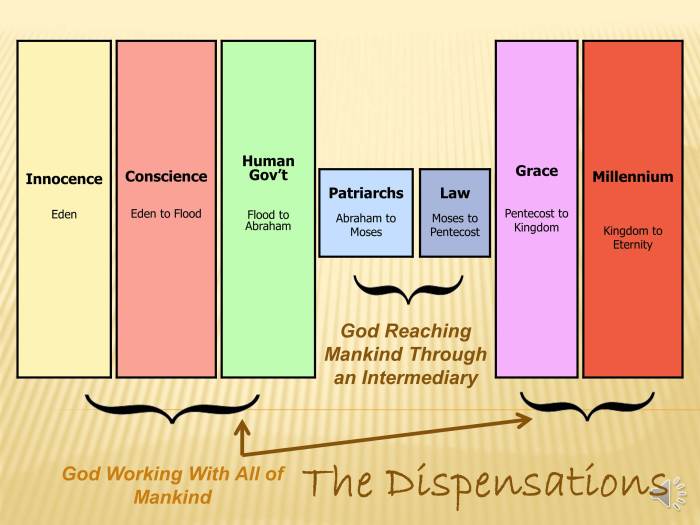
God has changed the administration, or manner, of His rule several times throughout Scripture (Heb 1:1-2). Distinguishing characteristics of a dispensation are (Ryrie, 2007, 40);
- A change in God’s governing relationship with man,
- A resulting change in man’s responsibility, and
- Corresponding revelation to reveal both of the above.
Man’s responsibility in any dispensation is to worship God in the way He commands by (1) an authentic, heartfelt response which takes (2) the appropriate form. The genuine response of the believer has always been an unchanging requirement; Rolland McCune (2009, 125) observed; “faith in God’s revelation was required not only for redemption from sin but also for fulfilling one’s dispensational obligations (Gen 15:6).” The form of that response, however, has changed throughout human history as God periodically alters the method of His rule. This paper will explore the different forms of worship throughout these different dispensations.
God’s Purpose
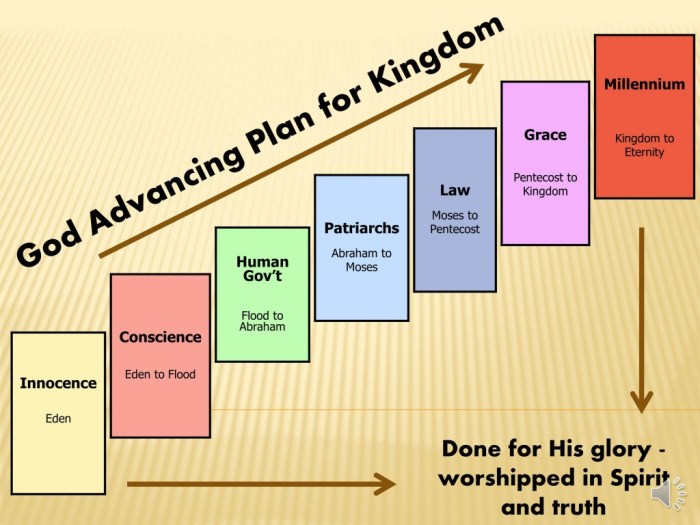
God’s purposes for His creation are to bring about His Kingdom entirely for His own glory. Christians can confidently point out where everything began (Genesis), and most can also point to how it will all end (Revelation 20-21). How God is working out His plan in between these two events is the issue! The dispensational system provides a coherent, Scriptural blueprint to understand how and why God is advancing His Kingdom for His own glory.
His Kingdom
What was created perfect was ruined by willful sin; God is advancing His plan for setting His creation right once again, culminating in a new heavens and a new earth in the eternal state (Rev 21). The personal, visible worship Adam and Eve used to enjoy in the garden was no longer possible with sinful men; after the fall man could not look upon God and still live (Gen 3:8; Ex 33:20). Christ taught us that our earnest prayer should be for God’s kingdom to come (Mt 6:9-15). We should look forward to this blessed event and pray for His will to be done. Through the framework of dispensations, God’s progressive plan to achieve this very end is clearly evident.
For His Glory
This is a difficult concept for unbelievers and, unfortunately, even many Christians to believe. It is not about man – it is about God! The innate selfishness of mankind has allowed far too many Christians to believe they are the center of God’s plan and purposes. This is incorrect; God desires to be worshipped in spirit and in truth (Jn 4:24).
A poor, but useful analogy is that of a father ruling his household. The father has the right to expect his children to obey his rules if they wish to remain in the house. He is owed this respect, after all, it is his house! Any parent would agree that children should honor and respect their parents (Ex 20:12) out of a pure heart because they want to, not because they have to. In the same manner, God has the inherent right to demand proper worship and respect by virtue of who He is (Lev 19:2; 1 Pet 1:16). Therefore, it is a terrible mistake to make ourselves the center of God’s purposes.
Our salvation was done for a purpose; “so that in the coming ages he might show the immeasurable riches of his grace in kindness toward us in Christ Jesus,” (Eph 2:7). Elsewhere, in Ezekiel, God makes it quite clear that His promised restoration of Israel in the MillennialKingdom will be done for His glory, not their own.
Therefore say to the house of Israel, Thus says the Lord God: It is not for your sake, O house of Israel, that I am about to act, but for the sake of my holy name, which you have profaned among the nations to which you came. 23 And I will vindicate the holiness of my great name, which has been profaned among the nations, and which you have profaned among them. And the nations will know that I am the Lord, declares the Lord God, when through you I vindicate my holiness before their eyes (Eze 36:22-23).
Dispensation of Innocence (Gen 1:3 – 3:6)
God’s Revelation
In this glorious state before the fall of man, the world God had created was “very good” (Gen 1:31). Man was created in the image of God (Gen 1:26-27; 2:5b); the only one of His creatures to have this distinction. This makes man special and unique before God. He was created by the very breath, or creative force, of God (Gen 2:7). This image was not physical, but relational. Just as God has authority and power over everything, man was given special authority over God’s creation (Gen 1:28; 2:15). Adam was appointed a steward of God’s creation, meant to have dominion over it all. Eve was created to be a help and companion to Adam in fulfilling this task (Gen 2:18). Man was meant to work the ground, not laze around idly all the day long (Gen 2:5b).
Man’s Worship Responsibility
Adam’s “principal mission” (Matthews, 1996, 209) was to work and keep the garden (Gen 2:15). Numerous subordinate responsibilities included commands to reproduce and fill the earth, subdue it and have dominion over all other creatures (Gen 1:28). The original Hebrew of Gen 2:15 may be better translated as “to worship and obey” rather than the phrase “to work and keep” so familiar to English readers (Sailhamer, 45). Man’s obligation is to appropriately respond to this specific form of worship God desired.
Failure to worship God appropriately constitutes willful rebellion. God clearly defined eating from the fruit of the forbidden tree as rebellion (Gen 2:16-17) to the “worship” he demanded (Gen 2:15). This is strikingly similar to the familiar pattern of blessings and cursings from Deut 28-30. Moses presented Israel with two stark choices, both of which would fit seamlessly in this Genesis narrative; “see, I have set before you today life and good, death and evil,” (Deut 30:15). Proper worship of God entailed authentic, heartfelt response in the appropriate way (Gen 2:15). Willful deviation from this command was rebellion, which would be punished (Gen 2:16-17). “The prohibition against eating the fruit of the ‘tree of knowledge’ gave Adam the opportunity to worship God through loyal devotion,” (Matthews, 211).
Man’s Rebellion
However, Adam and Eve did willfully violate God’s commandment for worship. In so doing, they introduced sin into the world and were expelled from the garden (Gen 3:22-24). “The state of unconscious innocence gave place to a state of conscious rebellion,” (Andrews, 1901, 11).
Their rebellion ushered in the next dispensation in God’s eternal program. God’s grace can be clearly seen in His promise of redemption through their offspring (Gen 3:15) and in a covering for their sin. God’s judgment for their rebellious failure to maintain proper worship is redemptive in purpose, not vindictive (Hamilton, 2005, 46).

Dispensation of Conscience (Gen 3:7 – 8:14)
God’s Revelation
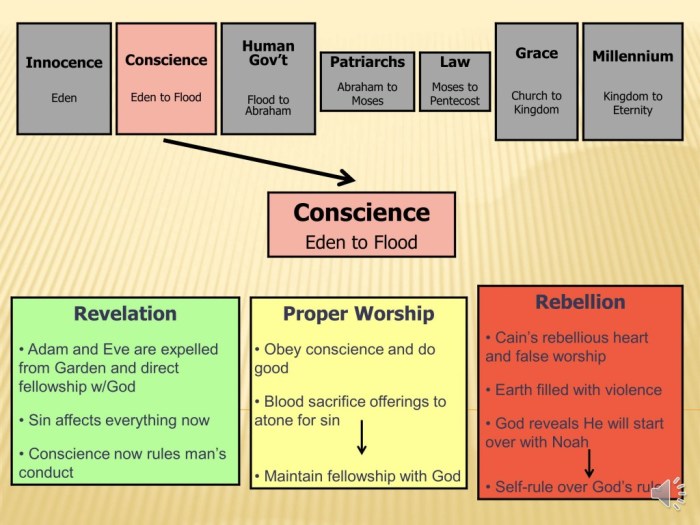
Once sin entered into the world and man had knowledge of good and evil (Gen 3:22), conscience, which is written on man’s heart (Rom 2:14), was the ruling factor or restraint upon man’s sinful lusts. “Obedience to the dictates of conscience was man’s chief stewardship responsibility” in this new dispensation (Ryrie, 60). Scripture records that immediately after consuming the fruit, Adam and Eve were ashamed and hid from fellowship with God (Gen 3:8). There was “a consciousness of guilt or shame before God,” (Keil, 2011, 60). God provided revelation about this new dispensation immediately after the fall (Gen 3:14-24).
Man’s Worship Responsibility
Though Scripture does not explicitly record this new revelation, offerings are an implied part of worship in this dispensation (Gen 4:3-4). Life inside the garden, in the previous dispensation, was “blissful communion with God without mediation,” (Matthews, 259). Sin fundamentally changed this relationship, and the first record of life outside the garden depicts Cain and Abel presenting offerings to God.
Cain brought merely an offering of fruit from the ground (Gen 4:3) which found no favor with God (Gen 4:4b), and Cain became very angry as a result (Gen 4:5). Abel, in contrast, brought a costly blood sacrifice “of the firstborn of his flock.”
Man’s Rebellion
Cain’s failure is representative of mankind’s corporate rebellion and rejection of proper worship (Gen 6:5-6). He responded with both an insincere heart and in the wrong manner. “Abel’s thanks came from the depths of his heart, whilst Cain merely offered his to keep on good terms with God,” (Keil, 69). Cain’s attitude was false, and his subsequent anger betrayed a counterfeit love for God (Gen 4:5b). His rebellion resulted in a willful transgression of God’s requirement for a bloody sacrifice. Scriptural evidence supporting the specific requirement of a bloody sacrifice are circumstantial (Gen 3:21; Heb 9:22), but Crawford’s reasoned statement here is virtually unanswerable; “with the single exception of Cain’s rejected offering, there is no other sacrifice or record before the time of Moses that did not consist of the shedding of animal blood,” (Crawford, 1853, 276).
Therefore Cain responded insincerely to God and in a completely inappropriate manner. He desired to worship in the wrong way and God simply will not accept the wrong form of worship (Gen 4:5). Cain left in exile and founded a large city which flourished (Gen 4:17-24). Scripture records absolutely no worship from Cain again. In contrast, the descendents of Seth “began to call upon the name of the Lord,” (Gen 4:26). Their proper worship undoubtedly consisted of doing good and not evil, in accordance with their conscience, and responding to the Lord with offerings and sacrifices at appointed times.[1]
The corporate failure of mankind to maintain a right heart for God or worship Him appropriately is evident in that “the earth was corrupt in God’s sight, and the earth was filled with violence,” (Gen 6:11). Mankind’s thoughts were “only evil continually,” (Gen 6:5). Noah, however, was “blameless in his generation” and “walked with God,” (Gen 6:9). Evidently Noah, alone among mankind, still loved God and worshipped Him correctly as his forefathers had (Gen 4:26). His Godly character is very apparent – Noah’s immediate response upon exiting the ark after the catastrophic flood was to make a blood offering to God (Gen 8:20-21), illustrating the authentic response of a true believer in this dispensation. It is extremely significant that God’s response came only after He smelled “the pleasing aroma” (Gen 8:21) of the offering. “Man is still fallen; but through an offering on an alter he may yet find God’s blessing,” (Sailhamer, 93) which immediately followed (Gen 8:21b-22).
Dispensation of Human Government (Gen 8:15 – 11:9)
God’s Revelation
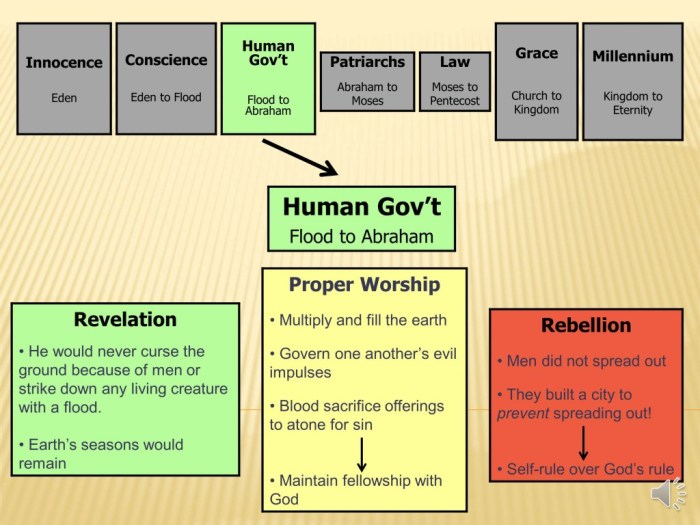
He would never curse the ground because of men or strike down any living creature with a flood again; the earth’s seasons would remain (Gen 8:21-22; 9:9-11).
Man’s Worship Responsibility
Man’s responsible worship is to multiply and fill the earth (Gen 9:1,7). Subordinate to this overarching responsibility, God revealed that all creatures would now fear man (Gen 9:2) and would be able to be eaten for food (Gen 9:3).
The first vestiges of human government are introduced to people as they multiplied and filled the earth, specifically as a “form of control upon the lawless impulses of men,” (McClain, 46). This government took the form of capitol punishment (Gen 9:6).
“If God on account of the innate sinfulness of man would no more bring an exterminating judgment upon the earthly creation, it was necessary that by commands and authorities He should erect a barrier against the supremacy of evil,” (Keil, 97).
Man’s Rebellion
The great rebellion of man in this dispensation was that, rather than spreading out and multiplying on the face of the earth (Gen 8:17; 9:7), mankind gathered together in defiance of God’s command to build a city to prevent their dispersion (Gen 11:4).
God’s judgment is to confound their language, frustrating mankind’s attempt to form what may be termed a “one world government” (Gen 11:6-7). Mankind leaves and disperses throughout the earth, as God initially commanded (Gen 11:8, 9b).
Man’s sin is that of selfishness; choosing autonomy over God. “The sin of the people does not lie in the desire to build a city . . . It is the motivation behind this undertaking that is most prominent.” They desired to build themselves a city which reached to the heavens, to make a name for themselves so they would not be scattered abroad (Gen 11:4). “This is the pagan concept of immortality,” (Hamilton, 75).
It was deliberate rebellion against God’s express command. Man’s responsibility for true worship in this dispensation is to abide by their innate knowledge of right vs. wrong, to multiply over the earth and govern corporately over one another. Man’s basic problem is that he always seeks to worship in his own way; “the characteristic mark of man’s failure up to this point in the book has been his attempt to grasp the ‘good’ on his own rather than trust God to provide it for him,” (Sailhamer, 105). Man’s corporate failure to worship God appropriately, borne out of a hostile heart, brought about a change in God’s administration.
Dispensation of the Patriarchs (Gen 11:10 – Ex 18:27)[2]
God’s Revelation
Rather than working corporately with all of mankind, God now choose to mediate His will through one man and eventually one people. “God turned away from man in the collective sense and called out one particular man through whom the divine regal will is to be accomplished on earth,” (McClain, 49).
God commands an idolatrous man, Abraham (Josh 24:2), to leave the land of his family and journey to a new land God will show him. He makes several distinct promises to Abraham, (1) to make a great nation from him, (2) to bless him, (3) to make his name great, (4) to make him a blessing, (5) to bless those who bless Abraham and curse (or judge) those who judge him, and (6) bless all people on earth through Abraham (Gen 12:1-3). “Abram is the vehicle of the divine gift for the nations. This suggests that a specific plan is envisioned for the blessing upon the nations,” (Matthews, 2005, 117).
God guaranteed Abraham He would be faithful to make a nation from him (Gen 15:5). God went even further, making a covenant with Abraham, promising He would provide a land for the nation (Gen 15:18). God, by passing between the severed pieces of Abraham’s sacrifice, condescended in an extraordinary fashion to place Himself as the weaker party of the covenant (Bartholomew & Goheen, 2004, 56). The covenant with Abraham foreshadowed the covenant with the theocratic kingdom of Israel (Ex 19:1-6), with David (2 Sam 7:16) and the first advent of Christ Himself (Mk 1:15).
Man’s Worship Responsibility
The Patriarch’s worship responsibility is four-fold (McCune, 125-126). First, to believe in God’s promises given in the covenant (Gen 15:6). Second, to receive the sign of the covenant – circumcision (Gen 17:10). Failure to do so will result in exile (Gen 17:14). Third, separation from the other heathen nations. Isaac and Jacob both married Israelite women (Gen 24:3-4; 28:1-2), and Abraham explicitly forbid marriage with foreigners. Fourth, they must remain in the land of promise (Gen 26:2-3).
The Patriarchs executed responsible and faithful worship throughout this dispensation. Regardless of individual moral failings common to all men (Gen 12:10-20; 20:2; 25:32; 26:7; 27:35; 38), they remained faithful followers of God. Abraham’s immediate response after hearing God’s revelation is to worship Him (Gen 12:7). Abraham is still blessed with material wealth upon his return from Egypt (Gen 13:2) and maintained worship afterward (Gen 13:4). The Lord blessed Isaac during his life (Gen 26:12-14). Jacob also maintained proper worship (Gen 33:20).
Scripture provides ample context to demonstrate the sojourn to Egypt was part of God’s sovereign plan from the beginning (Gen 15:13-16), to be executed at His own specific time. Isaac was told to not go to Egypt (Gen 26:2-5), and later Joseph was allowed to (Gen 46:2-4). This event was orchestrated and decreed by God (Gen 45:5-8; 50:20), who promised to bless Israel in Egypt and did so (Gen 46:3; Ex 1:7). This is hardly the result of judgment; rather, it confirms that the Patriarchs, sinful and fallible men though they were, executed faithful and responsible worship. Dispensational attempts to defend the Patriarch’s “failure” by appealing to the tension between God’s sovereignty and man’s free will ignore plain Scriptural context and are unconvincing.[3]

Dispensation of the Law (Ex 19:1 – Acts 1:26)
God’s Revelation
After He led His people up out of Egypt, God forged these tribes of Abraham into a theocratic kingdom at Sinai (Ex 19:1-6). Sinai refined Israel’s understanding of the original promise to Abraham. As Stephen Dempster observed “[t]he promise of this covenant is that an obedient Israel may bring God’s creation blessing to the world,” (Dempster, 2003, 101). God has several goals in mind (Ex 19:5-6); (1) Israel would be a peculiar treasure for God out of all the nations; (2) Israel would be a kingdom of priests for God, and (3) Israel would be a holy nation.
God’s promise to Abraham, Isaac and Jacob continues in a new form. Israel will be a showcase nation, a testimony for God to all the nations of the world, called to live by laws which reflect the character of the one true God (Bartholomew & Goheen, 66).
Victor Hamilton observed, “[t]he purpose of the covenant is to create a new relationship. The purpose of the law is to regulate or perpetuate an existing relationship by orderly means,” (Hamilton, 189). Continuing on, Hamilton quoted from Brevard Childs and noted, “The law defines the holiness expected of the covenant people,” (189). The law itself was not based on fear; faithfulness was predicated on an all encompassing love for God (Deut 6:1-13). Too often, Christians focus on the fact of Israel’s elect status among the nations and the behavior expected of her (Ex 20 – Lev 27) while ignoring why God demanded such behavior in the first place.
Man’s Worship Responsibility
Israel’s theocratic role was to be a holy, set apart people and thereby lead the Gentile nations to God by her own holy example. She would mediate God’s holiness to the other nations. In the same manner that Christians are commanded to be the “light of the world” (Mt 5:16) individually, to draw people to Christ by their testimony, God desired a specific people, Israel, to do this nationally.
Israel’s assignment from God involved intermediation. They were not to be a people unto themselves, enjoying their special relationship with God and paying no attention to the rest of the world. Rather, they were to represent him to the rest of the world and attempt to bring the rest of the world to him. In other words, the challenge to be “a kingdom of priests and a holy nation” represented the responsibility inherent in the original promise to Abraham (Stuart, 2006, 423).
Ezekiel 18 is one of the most striking passages on the failure of Israel to maintain proper worship with God. Faith alone has always been the grounds for salvation, in any dispensation (Gen 15:6; Rom 4:5; Eph 2:8-9). Appropriate worship is mankind’s responsibility, the fruit of a regenerated heart. “These stipulations provided a concrete, practical outworking of faith in the God who redeemed Israel from Egypt and gave the people His law.” Israel failed in this respect (Alexander, 1986, 824).[4]
Righteousness before God consisted in keeping the law to best of one’s ability (Eze 18:5-9). A man who “walks in my statutes, and keeps my rules by acting faithfully—he is righteous; he shall surely live, declares the Lord GOD,” (Eze 18:9). Israel’s worship failure as a theocratic nation was corporate, but its collective failure resulted from innumerable individual rebellions. A man is responsible to God for his own sins (Eze 18:10-13). “The righteousness of the righteous shall be upon himself, and the wickedness of the wicked shall be upon himself,” (Eze 18:20c).
Complete forgiveness is promised for a heartfelt return to God and proper worship (Eze 18:21-23). God, in every dispensation, desires men to be saved. “Have I any pleasure in the death of the wicked, declares the Lord GOD, and not rather that he should turn from his way and live?” (Eze 18:23). Blessings would result from obedience to God’s specific revelation; cursing would follow from disobedience (Deut 28-30).
Man’s Rebellion
There was a pervasive heart issue throughout Israel’s entire theocratic history – Israel repeatedly fell into rebellion and blasphemed the name of God by their idolatrous worship. As Ezekiel documented, this happened at the very establishment of the Mosaic Covenant (Eze 20:5,8,13), prior to the wilderness judgment (Eze 20:15-16) and during the wilderness years (Eze 20:19) the Israelites were specifically commanded to “walk in my statutes, and be careful to obey my rules.” Failure to worship God appropriately is “treacherous,” (Eze 20:27).
Israel failed to drive the nations out of the land and was judged (Joshua 2:1-3). After Joshua’s death, she “abandoned the Lord” and served other gods. The true God was unknown to Israel within a generation of Joshua’s death (Joshua 2:10-15). God appointed judges to rule over the Israel, and this period culminated with devastating civil war and general debauchery (Judges 21:25). The historical kingdom reached its pinnacle in Solomon, when the temple was dedicated and God re-iterated the covenant promise He had already made to David (1 Kgs 9:1-9). Nations round about Israel began to know God through Israel’s holy example; “the queen of Sheba heard of the fame of Solomon concerning the name of the LORD,” (1 Kgs 10:1). After Solomon’s death, the nation fractured into civil war (1 Kgs 12:16-24).
After Solomon’s death, God’s promised judgment (Deut 30:17-20; 1 Kgs 9:1-9) began to be fulfilled. No king was ever again chosen directly by God, but took the throne by inheritance or by force.
The depth of Israel’s worship failure is very striking when one considers the change in the office of the prophet. Originally, at the establishment of the historical kingdom, prophets advised the king and their revelation from God was for immediate application, not future events glimpsed through a glass darkly.
“The prophet spake for his own time; his words were fitted to meet the exigencies of the day; they were pre-eminently practical. The word spoken, whether to the king or people, was to enable them to fulfill present duty, not to discern in detail the remote future,” (Andrews, 80).
However, Israel’s rebellion of false worship would result in a cessation of God’s presence among His people and a need for reliance on the written word instead.
“The period of writing prophets parallels the period of the decline and end of the historical kingdom,” (McClain, 115). Prophets now began to write for the future generations, not to merely guide the current generation. “The transition, therefore, from spoken to written prophesy marks an epoch in the history of the elect people,” (83).
The sickness of Israel was pervasive, encompassing the moral, social, economic and spiritual spheres (McClain, 116). The call was always the same; return to the Law and be blessed;
“Thus says the LORD: “Stand by the roads, and look, and ask for the ancient paths, where the good way is; and walk in it, and find rest for your souls,” (Jer 6:16).
The departure of the Lord’s glory from the temple in Jerusalem shortly after the captivity signified “the end not only of Israel’s political supremacy but also of her religious supremacy,” (McClain, 123).[5]
“Israel might have fulfilled its calling to be ‘a kingdom of priests and a holy nation,’ and that it did not was its sin; and the captivity brought the merited judgment,” (Andrews, 406). Israel’s failure can be reduced to one simple point – she did not love God with all her heart, soul and might (Deut 6:5), therefore she did not worship Him appropriately.
“And many nations will pass by this city, and every man will say to his neighbor, “Why has the Lord dealt thus with this great city?” And they will answer, “Because they have forsaken the covenant of the Lord their God and worshiped other gods and served them,” (Jer 22:8-9).

Dispensation of Grace (Acts 2:1 – Rev 19:21)
God’s Revelation
Here was revealed the mystery of the church age and the Gospel of Jesus Christ, which “is the power of God unto salvation to everyone who believes; to the Jew first, and also to the Greek,” (Rom 1:16).
A new arrangement for God’s dealing with men, this current dispensation was new revelation given to the apostles that the world did not have before (Eph 3:2-3), “which in other ages was not made known unto the sons of men, as it is now revealed unto his holy apostles and prophets by the Spirit,” (Eph 3:5). Gentiles were now revealed to be “fellow-heirs” in the family of God (Eph 3:6).
Rolland McCune aptly remarks, “the new revelation from God is so vast that it cannot be easily reduced to a nice catalogue,” (132). Christ died for the sins of the world, that whosoever believes in Him should not perish but have everlasting life (Jn 3:16). What every previous dispensation looked forward to by blood sacrifices was now made clear; Christ was the perfect lamb without blemish – the final sacrifice. “Behold the Lamb of God, which taketh away the sin of the world,” (Jn 1:29). His sacrifice atoned for sins, and as our High Priest Christ intercedes for His children (Heb 5:7-10).
Gentiles have been grafted into God’s covenant promise to Abraham (Rom 11:17). “God raises up a seed unto Abraham out of the Gentiles by engrafting them through faith in the Christ, and accounting them as the children of Abraham by virtue of their Abrahamic justifying faith,” (Peters, 1884, 396). God is taking out of the world certain people for His name (Acts 15:14). “When the body of Christ is complete, the Lord will come; Gentile times will finish and Israel shall be put in again,” (McClain, 1973, 202).
God’s eternal plan involves two distinct groups – Israel and the Church. God revealed that the Church was an integral part of His plan. The kingdom that was promised to Israel (2 Sam 7:16) is still future. The Jews were waiting for the promised King who would rule over Israel, whose reign would never end. They didn’t recognize Christ was that King. Jesus revealed this present dispensation once it became very clear the Jews were rejecting Him (Mt 21:43). The church, as a corporate body of born again believers, is considered a “nation” of sorts in Scripture (Gal 3:7-9; Rom 10:19), with the same purpose but different method.
Man’s Worship Responsibility
McCune outlined several responsibilities for man in this dispensation (132). Man must receive God’s marvelous gift of salvation, offered to all, by faith (Rom 10:10; Acts 16:31). Believers must worship God in the local church, be baptized, attend worship faithfully and partake of the Lord’s Supper (Acts 2:41-42; Heb 10:24-25). The outworking of a truly regenerated heart will be a desire to live a Godly life (Titus 2:11-14). Renald Shower’s words here cannot be improved upon, “grace practices discipline over believers for the purpose of prompting them to reject a godless lifestyle and to adopt a Godly one,” (44).
He must also spread the Gospel to the world indiscriminately (Mt 28:18-20); which includes discipleship for new believers. This is an active evangelism, rather than the passive ingathering characteristic of the Mosaic Dispensation. Men must pattern the holy ideal of the Kingdom of God in their own lives while passionately reaching out to others with the Good News of Jesus Christ. What Israel failed to do corporately, Christians in this dispensation are called to do individually. God is not mediating His grace through Israel any longer, but dealing with the whole world once again.
Man’s Rebellion
A quick glance around contemporary society proves man has not worshipped God appropriately. John Walvoord, commenting elsewhere in Daniel on the errs of post-millennialism, wrote “for the past century or more the church has been an ebbing tide in the affairs of the world, and there has been no progress whatsoever in the church’s gaining control of the world politically. If the image [in Dan 2] represents Gentile political power, it is very much still standing,” (Walvoord, 2012, 89). Paul wrote to Timothy, warning him that “evil people and impostors will go on from bad to worse, deceiving and being deceived,” (2 Tim 3:13). This is surely the case in society today.
The witness of Scripture testifies that both the Gentile world and Israel will be deceived by the Antichrist following the rapture of the Church (Dan 7:25; 9:27; 2 Thess 2:6-12). The moral, social and spiritual decay in modern society is merely a foretaste of the debauchery to come, culminating in the Antichrist – the ultimate antithesis of Jesus Christ, a man wholly give over to Satan and self-worship (Dan 7:25), every bit as sinful as Christ is holy. “He is Satan’s masterpiece, a human being who is Satan’s substitute for Jesus Christ,” (Walvoord, 353). The fact that mankind will someday willingly worship such a creature is proof of a widespread failure to accept proper worship of God in this present age.

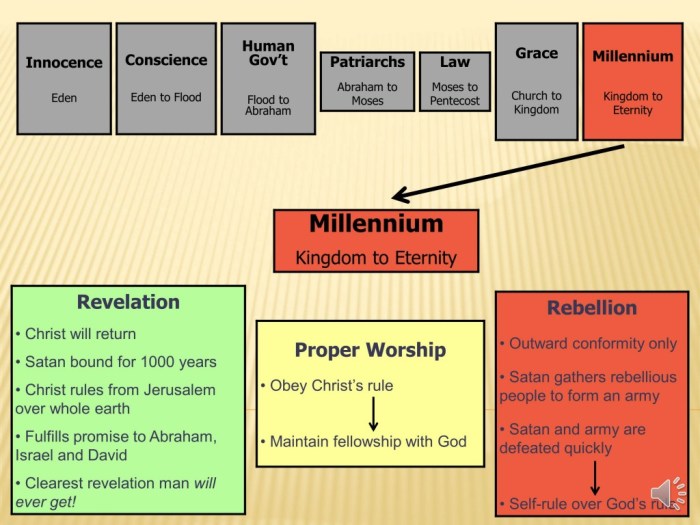
Dispensation of the Millennium (Rev 20:1-15)
God’s Revelation
Christ will return to this world with His saints[6] at his side (Rev 19:14) and defeat the Antichrist conclusively (Dan 7:11b, 22, 26; 9:27; 11:45b). Satan will be bound for 1000 years and cast into the lake of fire (Rev 20:2-3). The Millennial Reign of Christ, the kingdom promised to Israel (Gen 12:1-3; Ex 19:1-6; 2 Sam 7:16) and already offered and rejected by her once (Mt 21:43) will be established at long last (Dan 2:35b, 44a; 7:13-14, 27; Rev 20:6).
Those believing Gentiles and Israelites from the Dispensations of Innocence through the Law will be resurrected to join Christ in the Kingdom. The church has already been raptured prior to the tribulation. Everybody who did not believe in God will be resurrected and judged at the end of the Millennial Reign (Dan 12:1-4; Rev 20:4-6).[7]
Israel and the Church will both worship Christ in spirit and in truth and receive their promised and decreed ends (Amos 9:11-15; 2 Cor 11:2; Rev 19:7-9).
Man’s Worship Responsibility
Those who entered the Kingdom from the Tribulation and their children are responsible to obey Christ’s rule (Rev 19:15). All other believers will have resurrected bodies and be glorified; their sanctification is already complete.
Man’s Rebellion
Mankind will fail here, too. As the earth is re-populated during Christ’s rule for a period of 1000 years, man will still have the option to conform outwardly and yet still remain in willful rebellion against God. McClain observes,
Some people have been genuinely concerned about the problem of sin in an otherwise perfect Kingdom of God in human life. And, of course, Scripture makes it perfectly clear that sin will be present during the MillennialKingdom. The fact that Satan must be bound so that he cannot deceive the nations during the age of the Kingdom (Rev 20:3) shows that in the people of that age there will remain the inclination to respond to satanic temptation. And the prediction that a great multitude will thus respond as soon as Satan is loosed (Rev 20:7-8) only confirms the existence of a sinful human nature (499).
Because Christ Himself is ruling, disobedience to His law will be a very rare exception. “We are not told of any transgression till near the end, when Satan is unloosed . . . This implies that till this unloosing there was at least general obedience to God’s will under the rule of the Messiah,” (Andrews, 355).
Satan’s brief, final rebellion is dealt with astonishingly quickly. The rebellious men who reject the visible, present Lord for Satan are snuffed out as like a candle (Rev 20:9b); “as the light given them has been great, so is their punishment,” (Andrews, 356).
Lessons from the Dispensations
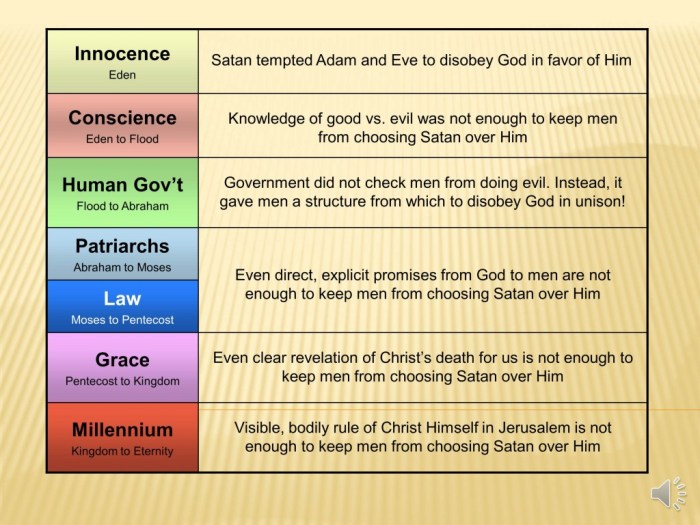
It is not the point of this monograph to examine the implications of the dispensations at length, but one overarching principle stands out quite clearly. Man is utterly unable to save Himself, is completely dependent on God’s grace, and God deserves all the glory He demands and then more. Man’s sin is clearly evident in every dispensation. There is a collective, corporate failure to worship God appropriately or respond to His revelation out of a pure heart. Jeremiah’s words to Judah, though addressed to Israelites, are entirely appropriately to all of mankind in any dispensation;
“Heaping oppression upon oppression, and deceit upon deceit, they refuse to know me, declares the Lord,” (Jer 9:6).
Paul echoes this most fundamental truth in his letter to the Romans (Rom 1:18-32).
Summary
Christ’s statement on worship transcends every dispensation; “You shall love the Lord your God with all your heart and with all your soul and with all your mind,” (Mt 22:37). Such an all-encompassing love for God will produce an authentic desire to worship Him in spirit and in truth (Jn 4:24). Man’s revelation from God has changed throughout human history as God progressively unfolded His plan for His creation. The mark of true worship has been the proper response to Him in accordance with the revelation given. In this, man has continually failed in a corporate sense.
Adam in Eden fell through temptation; the world before the flood was corrupt and evil. The nations descended from Noah ignored God’s command to scatter and multiply. Israel went after foreign gods, ignored her covenant responsibilities and crucified her Messiah. The Church is now dealing with apostasy which will grow ever worse, “and at last all the light and happiness of the Kingdom do not keep many of its subjects from rebellion when the Devil is unloosed,” (Andrews, 356).
In an individual way, however, man has positively responded to God’s revelation out of a pure heart and worshipped God appropriately throughout human history. He is “not willing that any should perish, but that all should come to repentance,” (2 Pet 3:9). Salvation, in any dispensation, has always consisted of an authentic response to God, and corresponding worship in appropriate form.
Praise Him that so many have loved Him, do love Him today, and will love Him in ages to come. Scripture gives divine assurance that, no matter the wiles of Satan and the appetites of sinful men, God will triumph. Christ will rule and reign, defeat Satan once and for all and deliver up the Kingdom to His Father, then all who love God will “dwell in the house of the Lord forever,” (Ps 23:6b).
Bibliography
Alexander, Ralph H. “Ezekiel,” vol. 6, The Expositors Bible Commentary, ed. Frank E. Gaebelein. Grand Rapids: Zondervan, 1986.
Andrews, Samuel J. God’s Revelations of Himself to Men. New York: Putnam, 1901.
Bartholomew, Craig and Michael Goheen. The Drama of Scripture. Grand Rapids: Baker, 2004.
Cooper, Lamar E. “Ezekiel,” vol. 17, The New American Commentary, ed. E. Ray Clendenen. Nashville: B&H, 1994.
Crawford, Thomas J. The Doctrine of Holy Scripture Respecting the Atonement. Edinburgh and London: William Blackwood and Sons, 1853.
Dempster, Stephen. Dominion and Dynasty: A Theology of the Hebrew Bible. Downers Grove: IVP, 2003.
Hamilton, Victor P. A Handbook on the Pentateuch, 2nd ed. Grand Rapids: Baker, 2005.
Keil, C.F. “Pentateuch,” vol. 1, Commentary on the Old Testament. Peabody: Hendrickson, 2011.
Matthews, Kenneth A. “Genesis: 1-11:26,” vol. 1a, The New American Commentary, ed. E. Ray Clendenen. Nashville: B&H, 1996.
Matthews, Kenneth A. “Genesis: 11:27-50:26,” vol. 1b, The New American Commentary, ed. E. Ray Clendenen. Nashville: B&H, 2005.
McClain, Alva J. The Greatness of the Kingdom. Winona Lake: BMH, 1959.
McClain, Alva J. Romans: The Gospel of God’s Grace. Chicago: Moody, 1973.
McCune, Rolland. A Systematic Theology of Biblical Christianity, vol. 1. Detroit: DBTS, 2009.
Means, J. O. “What Is The True Conception Of Christian Worship?” Bibliotheca Sacra 022:88 (Oct 1865): 531.
Peters, George N.H. The Theocratic Kingdom, vol. 1. New York: Funk & Wagnall’s, 1884.
Ryrie, Charles C. Dispensationalism. Chicago: Moody, 2007.
Sailhamer, John H. “Genesis,” vol. 2, The Expositor’s Bible Commentary, ed. Frank E. Gaebelein. Grand Rapids: Zondervan, 1990.
Showers, Renald E. There Really is a Difference. Bellmawr: Friends of Israel, 1990.
Stuart, Douglas K. “Exodus,” vol. 2, The New American Commentary, ed. E. Ray Clendenen. Nashville: B&H, 2006.
Thomas, Robert L. Revelation 8-22. Chicago: Moody, 1995.
Walvoord, John F. Daniel, ed. Charles Dyer and Phillip Rawley. Chicago: Moody, 2012.
Walvoord, John F. Revelation, ed. Philip Rawley and Mark Hitchcock. Chicago: Moody, 2011.
[1] Some dispensationalists do not agree with the traditional dispensational understanding of Gen 6:3, in that the “Spirit” is an inward restraint upon men’s activities; see McClain, Kingdom, 44-45 and Showers, Difference, 36 for this view. Arguments for the “Spirit” being the imparting of long life (“breath of life”) from Matthews, “Genesis,” 332-334 and Keil, “Pentateuch,” 84-85 are sound.
[2] Some dispensationalists disagree with the traditional dispensational understanding that the Patriarchs “failed” and were judged in any sense at the close of this dispensation.
[3] See McClain, Kingdom, 51 and McCune, Systematic, 127 (footnote #58) for these arguments.
[4] See also Lamar E. Cooper, “Ezekiel,” vol. 17, The New American Commentary, ed. E. Ray Clendenen (Nashville, TN: Broadman & Holman, 1994), 187. Both Alexander and Cooper emphasize that Ezekiel is speaking of judgment for sins, not necessarily eternal salvation in this passage. Due to the abysmal spiritual conditions of the day, many Israelites in Judah who thus sinned undoubtedly never exercised saving faith in God, but some certainly did. Regardless, the point germane to this paper is that Israel corporately failed to exercise proper worship in this dispensation.
[5] Eze 8:4; 8:12; 9:3-8; 11:23;21:26-27.
[6] Robert L. Thomas, Revelation 8-22 (Chicago, IL: Moody, 1995), 388. Walvoord [John F. Walvoord, Revelation, ed. Philip Rawley and Mark Hitchcock (Chicago, IL: Moody, 2011), 290-291] believes angels are present also.
[7] Thomas, Revelation, 420. The first resurrection is the righteous to eternal life, all the righteous (Rev 20:4-5). All of the righteous believers will be resurrected before the millennial reign begins, in various stages. Thus “first” does not denote a one-time event, but more of a category. It is the category encompassing the resurrection of all the just in Christ. The second resurrection is for the wicked and ungodly (Rev 20:5) – those who denied Christ and suppressed the truth in unrighteousness until the bitter end.





 The Eccentric Fundamentalist