The church is a subversive society

The church is a subversive society

The president of Southern Seminary is on record as saying that government funding for religious schools is wrong, that Baptists “consistently oppose” the public reading of Scripture in public schools, and he even agonized over whether it would “subsidize religion” for churches to be tax-exempt.[1] This president is not Al Mohler, but his predecessor Edgar Mullins, writing in 1908. Some religious outsiders (and perhaps not a few Baptists) would be surprised to learn this. Yet, Mullins was no maverick—so why do his views seem so out of step with evangelical political discourse today?

Broadly speaking, church and state relations can be framed as four choices:[2]

  • Theocracy. The church controls the State. For example, Rousas Rushdoony, an architect of Christian Reconstructionism, believed the Great Commission was about the church’s mandate to remake society. He declared that focus on salvation of souls at the expense of this mandate was “heretical.”[3]
  • Constantianism. The State favors the church, which in turn accommodates itself to the government. This is a quid pro quo partnership.
  • Free church in a free state. Government leaves people alone to worship (or not) as they wish, and the church supports that aim so all can freely choose their own path—without implicit or explicit State sanction.
  • Isolation. Christians withdraw. They watch their own movies, listen to their own music, go to their own clubs, and effectively segregate themselves from society, culture, and the wider world.  

The third path is the historic Baptist position, and it is the one Mullins represented. This is a framework that can bring clarity in polarized times—and, as a bonus, it is enshrined in the 1st Amendment. The position is simple, and one can appreciate it regardless of its sectarian origins:

  1. Each person is responsible for her own relationship with God,
  2. In order to be responsible, each person must be free to make her own choice,
  3. So, the best model for church and state relations is “a free church in a free state.”     

Salvation is an individual affair. Jesus calls individuals to “repent and believe,” (Mark 1:15). The Apostle Paul tells believers to put away their old selves, and “put on” their new status as God’s children (Ephesians 4:22-23). The Scriptures speak of individual judgment (1 Corinthians 3:12-15; Revelation 20:11-15). That being the case, choosing God—loving Him with everything you have (cf. Deuteronomy 6:5; Mark 12:28-31)—cannot be based on implicit or explicit coercion. It must be a free choice, an intelligent and willful decision. You cannot force love in a marriage, nor can you compel love for Christ. God is interested in our hearts, which must be freely given. As one early Baptist wrote, “You may force men to church against their consciences, but they will believe as they did afore.”[4]

If all this is true, then it suggests Christians ought to support “a free church in a free state.” The two pillars of this position are codified in the 1st Amendment as the “free exercise” and the “establishment” clauses:

Congress shall make no law respecting an establishment of religion, or prohibiting the free exercise thereof …

Essentially, these two pillars say (1) government will not establish a religion, nor will it (2) prohibit people from freely exercising their religious beliefs. As Christians today survey the evangelical landscape and wonder what to think about the intersection of church and politics, the Baptist ethos is one worth considering. Here are some questions to make this less abstract—consider them in the context of “a free church in a free state,” and the “free exercise” and “establishment” principles.

  1. Should Christians support compulsory Christian prayer in public schools? This practice would compel all students to pray in a Christian manner, regardless of their own beliefs. This is coercion. It also violates the establishment clause. This is why Engel v. Vitale (370 U.S. 421 (1962)) went the way it did—not because “secularists” were on the march, but on principle.
  2. Ought a nativity scene be displayed on public property? Would this be favoring Christianity? What should you think if someone says, “This is a Christian nation, and while other faiths can worship as they wish, the nativity scene must go up!” If government cannot “establish” religion, then what is the solution, here?
  3. May a football coach employed by a public school be fired for engaging in prayer on a football field after a game? The Bremerton, WA school district thought this violated the establishment clause. The Supreme disagreed (Kennedy v. Bremerton School District, 597 U.S. ___ (2022)).

More examples could be given. The “free church in a free state” framework is a flexible model that eschews government coercion in matters of faith, while safeguarding a person’s right to exercise that faith. Government has struggled to fairly implement this framework in the messiness of real life; at times favoring accommodationist or separationist views to solve the muddle.[5]

The point is that there is no theocracy. There is also no church and State quid pro quo partnership. Nor is there a need to withdraw from public life and embrace isolationism. There are only houses of faith being asked to be left alone, declining special treatment, not lobbying for “access” and “power,” not pushing for an explicit or implicit establishment of Christianity—because one day the shoe may be on the other foot. It can do this because the church’s job is not to underwrite American democracy, but to be a counter-cultural community of “foreigners” waiting for the better tomorrow, witnessing for Christ and the Gospel.[6] To be this alternative community, the church must demand to be left alone—not cry out for special favors or long for sepia-toned nostalgia of a bygone de facto Christendom. This is what Howard Snyder called the “countersystem” or “subversive” model,[7] wherein the church is a community summoning people to leave the secular city and join a new society.

Thinking citizens cannot escape this sectarian discussion, because the post-Trump GOP is suffused with populist derivatives of Christian Reconstructionism. Those unfamiliar with the broader stream of Christian theology may assume Reconstructionism is Christianity. Indeed, the “free church in a free state” ethos has fallen on hard times in public discourse—especially at the hands of leaders who know better. Much of the popular uproar in evangelical circles about “losing our country” is because America has been disestablishing Christianity as its de facto civil religion for at least the past two generations.

This framework is sometimes dismissed as utopian or naïve. Somebody’s values will be legislated, why not make sure they are Christian values? There are good books which flesh out the framework I can only sketch here.[8] Suffice it to say that God’s community is not the State; “Church and State might in a perfect society coalesce into one; but meantime their functions must be kept separate.”[9] As one theologian observed, “the church is a colony, an island of one culture in the middle of another.”[10] Resident aliens never mistake a foreign country as their own.

For healthy civic discourse, to ensure a decision for Christ is freely made (whichever way it may go), so the church can be the church, and for a measure of sane pluralism in an insane world—both Christians and concerned citizens should champion the “free church in a free state” ethos.


[1] Edgar Y. Mullins, The Axioms of Religion (Philadelphia: American Baptist Publication Society, 1908), pp. 197-200.

[2] There are many helpful ways to frame this issue—this is merely one of them. 

[3] Rousas J. Rushdoony, Christianity and the State (Vallecito: Chalcedon, 1986), pp. 19, 35. 

[4] Leonard Busher, “Religion’s Peace, 1614,” from H. Leon McBeth, A Sourcebook for Baptist Heritage (Nashville, TN: B&H, 1990), p. 73. 

[5] Take the example of a nativity scene at the county courthouse. A separationist ethic would ban all religious displays at Christmas. An accommodationist view would allow any group to put up any display it wants at Christmas. 

[6] See Stanley Hauerwas and William Willimon, Resident Aliens, expended ed. (Nashville: Abingdon, 2014), ch. 2.

[7] Howard Snyder, Models of the Kingdom (Nashville: Abingdon, 1991), pp. 77-85.  

[8] See especially Hauerwas and Willimon, Resident Aliens. 

[9] Mullins, Axioms of Religion, p. 195.

[10] Hauerwas and Willimon, Resident Aliens, p. 12. 

What I read in 2022

What I read in 2022

I do most of my “reading” by audiobook, while driving to and from work. I read 59 books this past year. Some biography, some history, some theology, and a lot of Christian religious and social history. Here’s the list; perhaps you’ll grab some of these and find them helpful. See also my lists from 2021, 2020, 2019, 2018, and 2017.

My Top 10 Books of 2022

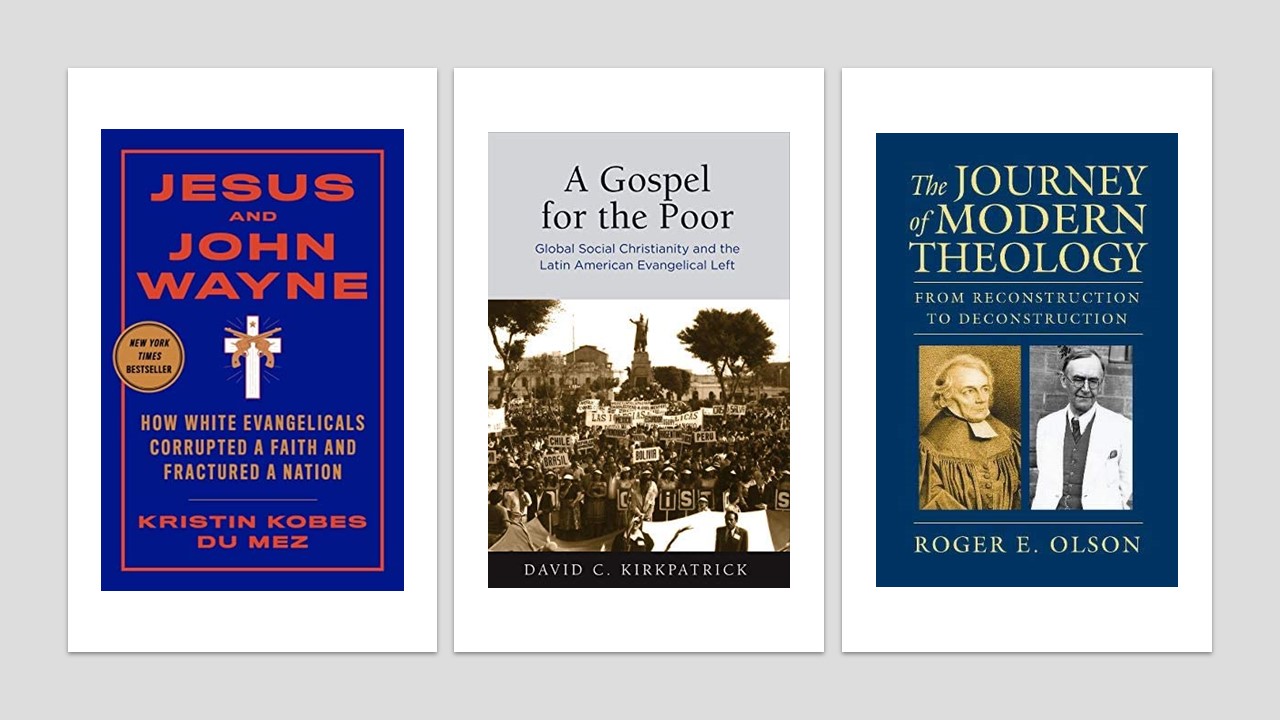
A Gospel for the Poor: Global Social Christianity and the Latin American Evangelical Left by David Kirkpatrick. An extraordinary book that opened my eyes to the Latin American wing of evangelicalism and introduced me to Rene Padilla (et al), the Lausanne Covennant, and the concept of integral mission.

The Journey of Modern Theology by Roger Olson. Olson’s magnum opus, a historical survey of modern theology. I was introduced to more thinkers in this book than I ever have from one volume. Accurate, engaging. It expands your horizons and makes you realize how small a world your particular theological tribe inhabits. Very, very helpful.

Jesus and John Wayne: How White Evangelicals Corrupted a Faith and Fractured a Nation by Kristin Kobes DuMez. I also read this in 2021, but decided to review it once more. This is an astounding book. It gave me the framework for understanding white evangelicalism as a sociological category, rather than simply a set of shared theological commitments. Very well-written, and engaging. This is a landmark book that came along at the right time.

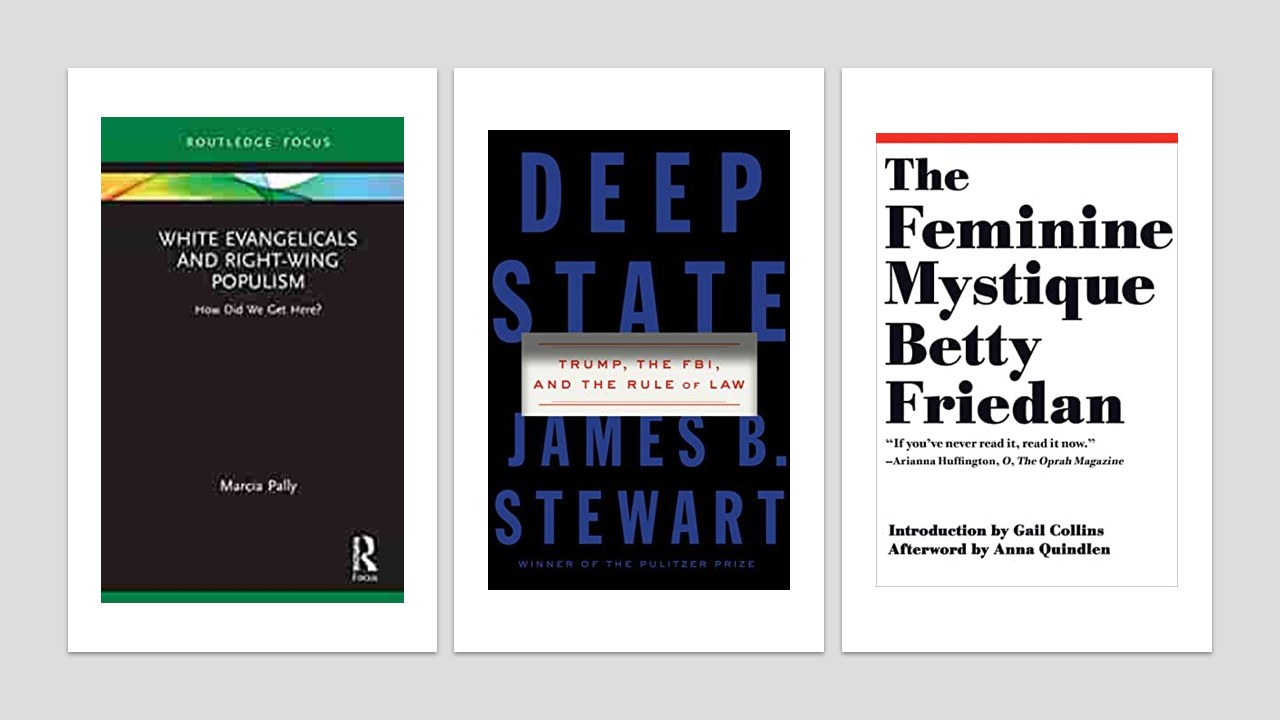
Deep State: Trump, the FBI, and the Rule of Law by James B. Stewart. An outstanding piece of journalism about the entire Trump + FBI investigation debacle. Very informative. Stewart gave a one-hour talk about this book which I found fascinating.

White Evangelicals and Right-Wing Populism by Marcia Pally. An astonishing work, short, but packing a large punch. Its value is Pally’s discussion of populism and its triggers applied to Trump and the current evangelical scene. Pally gave one of the best interviews I’ve ever heard here if you wish to get a preview of the book.

The Feminine Mystique by Betty Friedan. An earth-shattering classic. This work is generally credited with launching second-wave feminism in the United States. It examines “the problem that has no name;” the mid-century, middle-class, white housewife’s sense of loneliness, despair, and purposelessness because she was socialized to not expect or want an identity of her own–everything was subsumed into her husband and family. I see some flavors of complementarian Christianity basically want to enshrine this imaginary utopia as the Christian ideal. I say no. A truly remarkable book.

Mission Between the Times by Rene Padilla. Everything about this little collection of essays is so great. It’s like a breath of fresh air because it doesn’t come from the white, conservative evangelical world. Every pastor or thinking Christian would benefit greatly from reading this volume. Padilla focuses on our “mission between the times” of Jesus’ advents, with critiques of the Western evangelical framework and the incessant wedge it wishes to drive between social responsibility and the Gospel. He comes from Latin American evangelicalism and a completely different context, so his insights are quite refreshing. Padilla did his PhD under F.F. Bruce.

Apostles of Reason: The Crisis of Authority in American Evangelicalism by Molly Worthen. This is a book for the ages. A survey of evangelical intellectual life in the 20th century. Worthen sees evangelicalism as being shaped by a “crisis of authority,” as they tried to balance competing and contradictory emphases and forge an identity.

While they differ from one another on the details of their ideas about God and humankind, three elemental concerns unite them: how to repair the fracture between spiritual and rational knowledge; how to assure salvation and a true relationship with God; and how to resolve the tension between the demands of personal belief and the constraints of a secularized public square. These are problems of intellectual and spiritual authority. None, on its own, is unique to evangelicals. But in combination, under the pressures of Western history, and in the absence of a magisterial arbiter capable of settling uncertainties and disagreements, these concerns have shaped a distinctive spiritual community.

Worthen, Molly. Apostles of Reason (p. 4).

How to be Evangelical Without Being Conservative by Roger Olson. Everything about this little book is refreshing, correct, wholesome, and good. I cannot recommend this book highly enough. For people like me, who are somewhat disillusioned with the tradition they inherited, Olson’s project here is a breath of delightfully fresh air.

The Fifties by David Halberstam. Delightful, majestic, very impressive book. I don’t know how Halberstam did it. It’s a series of chapters of various popular figures, events, and cultural touchpoints of the 1950s. He argues that the chaos of the 1960s didn’t come from nowhere–the foundations were all laid in the 1950s, which are typically remembered in sepia as Mayberry. Without a doubt this was the most enjoyable book I read this year.

The Rest of Them from 2022

Axioms of Religion by Edgar Y. Mullins. An older book (ca. 1908) by the former President of the Southern Baptist Theological Seminary. It presents the Baptist view of Christianity in a comprehensive, winsome way that will benefit any reader. Mullins frames Christianity as a series of axioms which the Baptist ethos best supports. Likely the best apologetic for Baptist polity that I’ve yet read. It’s a shame it’s not well known, today.

The Christian View of Science and Scripture by Bernard Ramm. This was paradigm-shattering for me. Though this work is well-nigh 70 years old, it still captures the basic issues and does it very well. Ramm came out for progressive creationism in an intelligent, winsome way. If you come from a tradition which believes Ken Ham is the 13th apostle, that the Ark Encounter is a good thing, and that the Institute for Creation Research is the only faithful place where science can be done from a faithful Christian perspective, then Ramm will either enlighten you or make you really mad. His burden was to issue a call for charity and clear thinking on science and Scripture. Did he succeed? Read it and see.

Creation Revealed in Six Days by P.J. Wiseman. An interesting little book, largely forgotten to history, which I saw referenced in Ramm’s work (above). The author argues that Genesis 1-2 does not tell us how God created everything. Rather, they record that God took six days to reveal the fact of the creation. This is an attempt to reconcile science and Scripture in the late 1940s. I do not think Wiseman was a crank, and the book is well-reasoned and interesting. You can download a PDF for free at the link.

The Doctrine of the Trinity by Leonard Hodgson. A very good monograph from an Anglican theologian, adapted from a lecture series, which proposes a social theory of the Trinity. Very helpful, well-reasoned. I laughed out loud when Hodgson accurately surveyed the doctrine of eternal generation, then frankly admitted that he had no idea what people meant when they spoke about it. I sympathize and agree!

The Bible Made Impossible: Why Biblicism is Not a Truly Evangelical Reading of Scripture by Christian Smith. This is a provocative book which challenges the way certain conservative Christians read and use the Bible. I agree with much (not all) of this book, and many of Smith’s criticisms are quite accurate. This book is a very helpful prompt for serious introspection.

The Battle for the Bible by Harold Lindsell. A silly little screed from the late 1970s. This is fundamentalism at its worst. Lindsell wrote like a wounded lover lashing out at the woman who wronged him.

The Great Sex Rescue: The Lies You’ve Been Taught and How to Become What God Intended by Sheila W. Gregoire. An outstanding book which details the weirdness and stupidity of much of what conservative Christianity teaches about marriage roles. So, the authors spend much of their time analyzing the best-selling “marriage books” on the Christian market. I suppose it’s because I didn’t grow up as a Christian, but I’ve always found much of conservative Christianity’s rules about dating and marriage roles as absurd, purely cultural, and frankly stupid. The “Billy Graham rule”? Really dumb and unworkable in the modern office environment. This is a wonderful book. If I had to recommend a book for soon-to-be-married couples, I’d buy this one for them so they’d have insight into false narratives around marriage, love, and sex. For pre-marital counseling, I always use Tim and Kathy Keller’s The Meaning of Marriage.

Desperate: An Epic Battle for Clean Water and Justice in Appalacia by Kris Maher. Very entertaining and horrifying piece of journalism.

Christ in Crisis: Why We Need to Reclaim Jesus by Jim Wallis. I read this book, but remember almost nothing about it. I thought it was vague and basically “meh.”

Fundamentalism and American Culture (3rd edition) by George Marsden. A classic for a reason. You must read it. His latest updates encompass the Trump years. Here is a good interview with Marsden about this latest edition, which I enjoyed listening to.

10 Questions to Diagnose Your Spiritual Health by Donald Whitney. Breezy. Short. Good. I read it, then gave away several copies to the congregation.

The Reason for God by Tim Keller. This is a very good book to give someone who has questions about the Christian faith. Keller is a great writer, and communicates very well. We read this book at church in conjunction with the group study materials.

Towards a Recovery of Christian Belief by Carl F.H. Henry. Excellent precis of Henry’s theological program. If his seven-volume God, Revelation, and Authority is intimidating to you, then this slim little volume will give you the basics of Henry’s thought. Incidentally, Roger Olson’s discussion of Henry in his Journey of Modern Theology (above) is quite good.

A Matter of Days: Resolving a Creation Controversy (2nd expanded edition) by Hugh Ross. A winsome, very helpful book by perhaps the most well-known Christian apologist who is not a young-earth creationist. I was particularly moved by Ross’ insistence that the universe must be 14 billion (ish) years old because of the time it takes light to travel. This is very persuasive to me. I know very little about science so I am a great disadvantage when it comes to weighing these matters. Ross makes a good case and I appreciated this book.

Gospel & Law: Contrast or Continuum? The Hermeneutics of Dispensationalism and Covenant Theology by Daniel Fuller. This is an older classic. It made a great impression upon me when I read it, early in 2022. I’m at a loss now to remember much about it. I need to read it again, but I suspect I mentally ditched it when I discovered the delights of progressive covenantalism.

Den of Thieves by James B. Stewart. A fascinating look at the securities scandals of the late 1980s. This was a joy to read.

On Religion by Friedrich Schleiermacher. This is an apologetic work directed to a particular intellectual elite, at a particular time. Some of it was interesting. Much of it was forgettable. I need to read it again.

A Promised Land by Barack Obama. A beautiful memoir by an important President.

To Kill a Mockingbird by Harper Lee. This is a classic for a reason. I usually don’t include fiction books in this annual list, but I made an exception for this one. A moving book.

Principles of Expository Preaching by Merrill Unger. Meh. It’s an older book. It’s very didactic, written with no warmth, and pretty stale. It’s not bad. It’s just very basic.

Elmer Gantry by Sinclair Lewis. Another novel–an infamous satire of fundamentalism, written in 1927. It’s a very sad book, because Gantry is a terrible man. Lewis apparently saw religion as a con-game–or, perhaps better, he saw fundamentalism as a con-game. What’s astonishing is that Lewis clearly understood the fundamentalism he was criticizing. The dialogue and theological reasoning he inputs to his characters is astonishingly accurate. To truly appreciate this book, you need to understand the context of the aftermath of the fundamentalist-modernist controversy in the United States.

American Apocalypse: A History of Modern Evangelicalism by Matthew A. Sutton. A great work of history. Sutton presents the modern evangelical world as a result of an incessant apocalyptic mindset.

Grammar of Prophecy by R.B. Girdlestone. Probably the best book on prophecy I’ve ever read. I haven’t read everything on prophecy (there’s a whole lot of junk), but I’ve read a lot–and this is the best of the lot. An older book, from the late 19th century.

The Interpretation of Prophecy by Patrick Fairbairn. A longer work, just as good as Gilderstone. Great stuff. I suggest people ditch dispensational sensationalists and just read Gilderstone and Fairbairn!

Biblical Hermeneutics by Milton S. Terry. An old classic. A bit long, but a great resource full of keen insight.

Plowshares and Pruning Hooks: Rethinking the Language of Biblical Apocalyptic by D. Brent Sandy. A helpful corrective to dispensationalist interpretive excesses. Lots of common sense, here.

The Hidden Motives of Pastoral Action by Luis Segundo. I remember this book was good. Unfortunately, I don’t remember anything else about it. This is a call to action from a Latin American liberation theologian.

Truth as Encounter by Emil Brunner. A beautiful little book outlining Brunner’s conception of faith as “truth + encounter.” If you’ve read Brunner’s Dogmatics (3 vols.) then this isn’t new. But, it’s helpful to have this in one small volume. Brunner was a real treasure to the church. He is my favorite theologian.

Freedom from Fear: The American People in Depression and War 1929-1945 by David Kennedy. Great history. I loved this book.

Interpreting the Parables (2nd edition) by Craig Blomberg. Read for a class. Good book.

Stories With Intent (2nd edition) by Klyne Snodgrass. Read for a class. Too much material here. It can’t be read as a book. It’s basically an encyclopedia. Much of the info is useless for a pastor. It could be one-third the length.

Anatomy of a Revived Church by Thom Rainer. Rainer excels at very short, very quick books. This one is quite helpful. Every pastor of a small church will appreciate it.

FDR by Jean E. Smith. An epic biography that I enjoyed a lot. I have a newfound appreciation for Roosevelt and what he accomplished.

A Godly Hero: The Life of William Jennings Bryan by Michael Kazin. A good biography of an important man. Kazin is laboring under a handicap here, because he notes that the majority of Bryan’s private correspondence was destroyed. The result is that we don’t really get to understand Bryan very much. I don’t think this is Kazim’s fault. The impression I left it with is that Bryan was a bit of a dreamer, unrealistic, and not somebody I’d take very seriously were he alive today. I feel bad for having that opinion, but that’s where I’m at. For me, the most valuable aspect of this book is that Bryan is a shining example of the kind of populist American Christianity that used to exist–one that believed the Bible, was generally conservative, yet upheld social reform as a Christian imperative. What a concept!

Death in Mud Lick: A Coal Country Fight Again the Drug Companies that Delivered the Opioid Epidemic by Eric Eyre. A beautiful piece of investigative journalism. I thought it was much better than Beth Macy’s Dopesick (see below), which has received far more press.

Stained Glass Ceilings: How Evangelicals Do Gender and Practice Power by Lisa Weaver Swartz. An excellent comparative survey of how two conservative seminaries (one egalitarian the other complementarian) teach gendered roles to their students and their wider ecclesiastical orbits.

Fundamentalist U: Keeping the Faith in American Higher Education by Adam Latts. A delightful and enlightening look at how conservative Christian institutions have tried to “keep the faith” in the American higher education world in the 20th century. Very good book.

The Bible Told Them So: How Southern Evangelicals Fought to Preserve White Supremacy by J. Russell Hawkins. A good book. It gets a bit repetitive, but that’s probably because I’ve read enough along this same line that the stories begin to blur and I lose patience. If you want a great entry point to understand how sociology and culture can create systemic, structural sin, then this is a book to read.

Guaranteed Pure: The Moody Bible Institute, Business, and the Making of Modern Evangelicalism by Timothy Gloege. A delightful book that uses Moody Bible Institute as a prism to frame evangelicalism as a business venture that markets a deliberately generic product with sectarian emphases rounded off (i.e. conservative Christianity) to its constituents. It also acts as a good historical survey of Moody. Highly recommended.

Christianity and the State by Rousas Rushdoony. This is an important book because it reveals at least three key truths; (1) it helps you understand the Christian Nationalist ethos so popular nowadays–much of it is a populist and bastardized flavor of Reconstructionism, (2) it reveals that presuppositionalism as a prism for truth can take you to places where you ought not go, and (3) it proves Rushdoony was quite possibly insane.

Dopesick by Beth Macy. Repetitive. I’d already read A Death in Mud Lick, so perhaps I wasn’t in the mood to cover the same ground again. Still, I feel that book was much better.

The Case for a New Reformation Theology by William Hordern. A generally excellent little book. This was part of a trio of books which Westminster Press put out in the mid-1950s surveying (1) evangelicalism (penned by Edward Carnell as The Case for Orthodox Theology), neo-orthodoxy (this volume), and liberalism (L. Harold DeWolf). Most evangelicals from my orbit know nothing about neo-orthodoxy except that “it’s bad.” What little most people know is that neo-orthodoxy is soft on the doctrine of Scripture. I’ve read Barth on this, and Brunner, and Bloesch, and now Hordern. I don’t believe this charge is quite right. This is a good book.

Two Views on Women in Ministry, rev. ed., by James R. Beck. This is an excellent “two views” book about the ever-present flashpoint of women in ministry. Linda Belleville’s contribution (egalitarian) was particularly instructive for me.

The Last Things: An Eschatology for Laymen by George Ladd. The best little volume on eschatology yet written, that I’ve seen. Historic premillennialist in perspective.

Progressive Covenantalism: Charting a Course Between Dispensationalism and Covenant Theologies ed. Stephen Wellum and Brent Parker. A series of essays fleshing out certain key aspects of a theological system called progressive covenantalism. This is a framework that relies heavily on typology, which Bernard Ramm recommended as an interpretive grid long ago in his Protestant Biblical Interpretation. I believe this approach holds great promise, and I liked these essays.

The Great Reversal: Reconciling Evangelism and Social Concern by David O. Moberg. This classic text is a short, accessible, breezy primer for bible-believing Christians who need a guide to help them think rightly about evangelism and social concern. There was a time when Christians were at the forefront of social betterment, driven by Gospel impulses. Now, after the fundamentalist-modernist controversy, these same impulses are derided in some quarters as “social gospel,” or (more lately) as “woke.” Too often, those who toss these epithets have not read Rauschenbusch themselves, do not understand their own history, and are captive to a very particular flavor of Christian expression that has baptized its outward face in a politicio-conservative philosophy. A few of the chapters here are a bit dated, but this does not detract from the book’s value.

Models of the Kingdom by Howard Snyder. A very helpful little book that provides a taxonomy to chart the different conceptions of “the kingdom of God” that you find in the Christian family throughout the centuries. It will probably help you clarify your own thinking on this subject.

Washington’s Crossing by David H. Fischer. A definitive account of the most crucial period of the American Revolution. I’ve read this book three times now–usually once every few years.

America’s Religious History: Faith, Politics, and the Shaping of a Nation by Thomas Kidd. This seems to be an undergrad-level survey of religion in America. There’s nothing new here, but Kidd does a wonderful job sketching the landscape. If you’re not familiar with this story (like too many reporters at major news outlets are), then this is a worthy book to get.

On Lady Tremaine and God’s Promise

On Lady Tremaine and God’s Promise

The stepdaughter was essentially a slave in her own home. But, what could she do? Her father had died, and the cold and cruel stepmother wasted no time in forwarding the prospects of her own two homely daughters. And so, bit by bit, the poor stepdaughter became no better than a servant—forced to sweep, clean, cook, and tend to the very home in which she had known such joy and carefree light when she was a little girl.

I’m speaking, of course, about Cinderella. There is a moment early in the film when word comes from on high that there was to be a royal ball in honor of the Prince. The boy hadn’t yet married and so the King and the Grand Duke had decided enough was enough—“it’s high time he married and settled down!”

The stepmother, Lady Tremaine, saw her chance. What an opportunity for her daughters! If she could marry one of them off to the Prince, her life’s work would be nearly complete! Cinderella, lurking in the corner, sidled over bravely and declared she could go to the ball, too! Her stepsisters mocked her. How ridiculous! Never!

But Lady Tremaine, never one to miss an opportunity to twist the knife into the odd back, said she could go. “I see no reason why you can’t go… if you get all your work done.”

Cinderella is ecstatic, and rushes away to dig out an old dress from a closet. The stepdaughters descend upon their mother, aghast. How could she agree to such a thing! Outrageous! Didn’t she realize what she’d just said? Lady Tremaine smiled like an evil cat and purred, “Of course. I said, ‘if.’”

There is a moment of silence. Then, they all begin cackling. Cinderella won’t go to the ball—not if they can help it! They’ll make sure she doesn’t get her work done.

Lady Tremaine and her schemes are a helpful way to picture Paul’s point in our passage (Gal 3:15-22). God made a promise to Abraham—a promise based on faith and trust, not merit. Jesus is the ultimate “child of Abraham,” the one who makes all these promises come true. So, who partakes in these promises? It’s the ones who believe in the true “son of Abraham,” Jesus.

The alternative is to see God as a bit like Lady Tremaine, putting a theoretical “if you do this, then I give you that” out there all while knowing we can’t pull it off. This is basically what the Judaizers are proposing (see Gal 3:1-6). It’s a warped twisting of the Old Covenant, and it doesn’t lead anywhere. Cinderella wouldn’t have made it to the ball without a divine intervention from the Fairy Godmother, because she was trapped in a cycle she couldn’t break. So too, we can never complete a “follow these rules and I’ll give you salvation” program—it’s an escape room from hell from which we won’t ever find our way out.

Paul says there is a different way—a better way. The way it was supposed to be from the beginning. A way Abraham understood. He wants us to understand that, so he begins with an analogy about Abraham.

This article is part of a commentary series through the Book of Galatians. This article covers Galatians 3:15 – 22. You can find the rest of the series here: Galatians 3:1-6, and Galatians 3:7-14, and Galatians 3:23 – 4:7, and Galatians 4:8-20, and Galatians 4:21 – 5:12, and Galatians 5:13-26.

Let’s see what Paul has to say.

Brothers and sisters, let me take an example from everyday life. Just as no one can set aside or add to a human covenant that has been duly established, so it is in this case (Galatians 3:15).

Galatians 3:15

Sometimes it’s helpful to put things in everyday terms. Suppose you have a contract or some other legal arrangement.[1] We all know that, once the signatures are on the dotted line, then the deed is done. It’s sealed. You can’t add to or delete anything. It is what it is. Well, Paul says, it’s the same in this case with God and His arrangements with us!

“How so?” you ask. Paul answers …

The promises were spoken to Abraham and to his seed. Scripture does not say “and to seeds,” meaning many people, but “and to your seed,” meaning one person, who is Christ.

Galatians 3:16, quoting Genesis 12:7; 13:15; 24:7

God made a promise—an irrevocable contract—with Abraham and his descendant. But Paul points out something pretty curious. The promise was to Abraham and his descendant—singular. It wasn’t to all Abraham’s offspring, but to one descendant in particular, who is Christ.  

What does this mean?

If you’re a believer, then you’re metaphysically fused with Christ—made one with Him on an invisible level. Your bible translation probably has the phrase “in Christ” a lot in Paul’s letters, because it’s one of his favorite expressions. We’re “baptized into Christ,” “buried with Him through baptism into death,” “crucified with Him,” and “alive to God in Christ Jesus,” (Rom 6:1-11). All this language is expressing that, when we trust in Jesus, we’re made one with him in an unseen way. Perhaps the closest thing I can compare it to is a marriage; there’s a oneness that happens in marriage that’s unseen, hidden, but very real. What Paul is saying is these promises were to Abraham and His crowning descendent, Jesus—along with everyone else who has been made one with Him (see Gal 3:29).

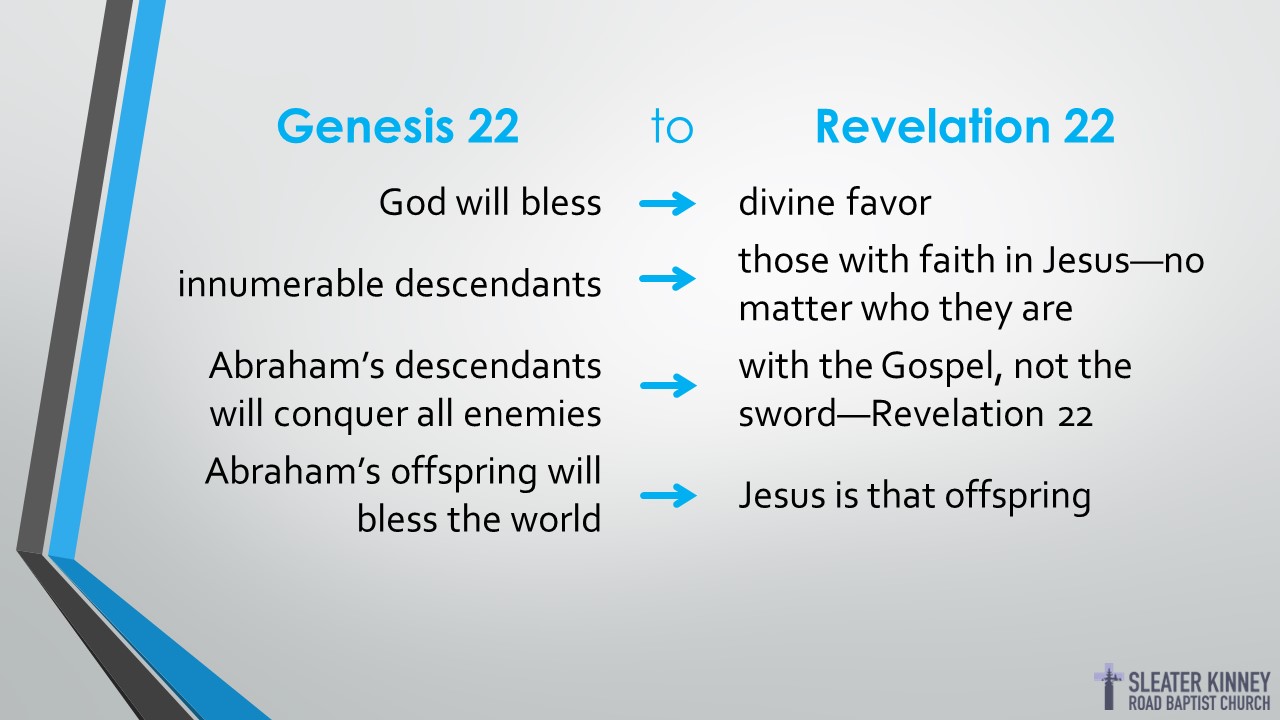
God made several promises to Abraham (see Genesis 22:17-18), and all of them are fulfilled through Christ—including the promise of the land. Paul wrote, “Scripture does not say ‘and to seeds,’ meaning many people, but ‘and to your seed,’ meaning one person, who is Christ,” (Galatians 3:16). This “and to your seed” quotation is from the Greek version of Genesis 17:8, which refers to that land promise. Paul is saying that all the promises to Abraham—even the one about “the whole land of Canaan” (Gen 17:8)—are fulfilled by Christ as the representative son of Abraham (Mt 1:1).

This suggests that Abraham and his physical descendants are a foreshadowing of Jesus and His spiritual brethren.[2] If so, then we can understand all the precious promises to Abraham as shadows of a greater fulfillment—maybe something like this:

So, back to the point.

Paul is saying that, if God made unbreakable promises to Abraham and his descendant—a promise based on faith and trust—then God certainly hasn’t changed the terms of the promise later on. “It was not through the law that Abraham and his offspring (singular—Jesus) received the promise that he would be heir of the world, but through the righteousness that comes by faith,” (Romans 4:13). So, the Judaizers who are peddling the “work to earn your salvation” message are wrong. They have to be wrong. If they’re right, then God changed the terms of the agreement.

Darth Vader once said, “I’m altering the deal! Pray I don’t alter it any further …”[3] Well, God doesn’t alter deals. Unlike Vader, he’s trustworthy.   

What I mean is this: The law, introduced 430 years later, does not set aside the covenant previously established by God and thus do away with the promise. For if the inheritance depends on the law, then it no longer depends on the promise; but God in his grace gave it to Abraham through a promise.

Galatians 3:17-18

The Mosaic law didn’t change the terms of the deal. If we have faith like Abraham, then we’re children according to the promise. Things didn’t change at Mt. Sinai. Instead, it’s the wrong ideas of relationship with God that has warped the common understanding of the Mosaic law by Jesus’ day, and Paul’s, too. Inheritance of the promise isn’t based on effort, but on faith.

Why, then, was the law given at all?

Galatians 3:19

That’s a fair question. If the Mosaic law was never a vehicle for salvation, then what was it?

It was added because of transgressions until the Seed to whom the promise referred had come.

Galatians 3:19

Notice that all the promises to Abraham are summed up as one package (“the promise”—singular), and that Paul attributes this whole bundle to one representative “seed”—Jesus (see the same at Romans 4:13).[4] The Mosaic Law was a tool to hem us in until Christ would come. It told us how to live, how to act, how to maintain loving relationship with God and with each other. It told us how to be God’s people, for a particular time in a particular place, until Christ would arrive on the scene. Picture God’s people from the Exodus to Pentecost as being in a plane, circling the airport, waiting on clearance to land. They know they’ll land, but they aren’t yet there.

So, God told us how to live until He “landed the plane.” We break the law, we feel guilt, we confess our sin and perform the ritual to atone for that sin. We go on. It’s in this way that the Mosaic law “hems us in” and keeps us on the right track, until the Messiah arrives in the First Advent.

The law was given through angels and entrusted to a mediator. A mediator, however, implies more than one party; but God is one.

Galatians 3:19-20

The Mosaic law was entrusted to a mediator—Moses. But this new arrangement, this new covenant, is different. Now, there’s only one party. God Himself makes the contract and obligates Himself to carry it out. There is a straight line starting from (1) when God chose His people by promise with Abraham, (2) connecting right to His promise to David of a perfect king, and from there (3) on to God’s pledge of perfect peace through a new and better arrangement. Along this track, the Mosaic law is just a guardrail keeping us on the trail. It isn’t a different trail at all.

Is the law, therefore, opposed to the promises of God? Absolutely not! For if a law had been given that could impart life, then righteousness would certainly have come by the law. But Scripture has locked up everything under the control of sin, so that what was promised, being given through faith in Jesus Christ, might be given to those who believe.

Galatians 3:21-22

So, then, what does the Law have to do with God’s promises to Abraham? Well, first, if righteousness could have come by way of following the law, then it would have (cf. Gal 2:21). But, in the second place—and here is the crux of it all—the Mosaic law showed us our sin, reminded us of it all the time, so that we’d be ever more ready to embrace the permanent solution Christ offered when He came.

Paul uses a strange phrase. He says the Scripture “locked up everything under the control of sin,” (Gal 3:22). He seems to mean that, although it’s theoretically possible that a perfect person could come along, obey the law in every respect, and receive righteousness as a reward—it’ll never happen. Why not? Because Scripture (the entire Old Covenant canon) shows us we’re not that good. We never will be. It shows us that everything is “locked up” under sin’s power.[5] The original imagery is that of a school of fish swept up in a fisherman’s net—caught! We’re all trapped, as if the door of a great dungeon has swung shut on us.[6] So, that “perfect person” won’t ever come along in this world … unless that person comes from outside the bubble.

When we see God’s rules, then consider our own constant failure to live up to them, then we’re driven to put faith and trust in the promised Savior—the One who loved God perfectly and obeyed the law completely, in our place, as our substitute.[7] That dungeon swings shut … but why? “So that what was promised, being given through faith in Jesus Christ, might be given to those who believe,” (Gal 3:22). “It was to make them understand their real inner life, their alienation from himself, and their need of his grace.”[8]

All those promises to Abraham—which Paul once more sums up as one bundle of blessings (“what was promised”)—are given to those who believe and have faith in Jesus Christ. Once more Abraham, his physical descendants, and the literal promises in the land corresponded to and prefigured something much better.

That was the Law’s purpose. It wasn’t a vehicle for salvation. It was tool to make us look forward to the Messiah so Abraham’s offspring—the true offspring (cf. Luke 3:8)—would recognize Him when He came.  


[1] The Greek word here is the same one we often translate as “covenant,” and some translators assume Paul is referring to a will. It doesn’t matter—Paul just wants you to imagine a legal contract in your mind. 

[2] See especially Thomas R. Schreiner, Galatians, in ZECNT (Grand Rapids: Zondervan, 2010), at Galatians 3:16a-d.

“… if the blessing promise includes a reconstituting of the “seed” with a global identity in Christ, then one should be cautious to separate the land promise from this same transformation. Indeed, within the argument of Galatians 3, the eschatological fulfillment of the land promise appears to stand behind Paul’s argument,” (Jason DeRouchie, “Counting Stars With Abraham And The Prophets: New Covenant Ecclesiology In OT Perspective, in JETS 58:3 (Sep 2015), p. 480)

[3] See https://www.youtube.com/watch?v=3D8TEJtQRhw

[4] For the typological implications of Paul’s declaration that Abraham and his offspring would receive the promise (singular) that he would be heir of the world, see especially (1) Douglas Moo, The Epistle to the Romans, in NICNT (Grand Rapids: Eerdmans, 1996), pp. 273-274; (2) John Murray, Epistle to the Romans, combined ed. (Grand Rapids: Eerdmans, 1968), pp. 141-142; and (3) Emil Brunner, The Letter to the Romans (Philadelphia: Westminster, 1959), pp. 36-40.

[5] The preposition in this statement conveys authority: ἀλλὰ συνέκλεισεν ἡ γραφὴ τὰ πάντα ὑπὸ ἁμαρτίαν.

[6] A.T. Robertson, Word Pictures in the New Testament (Nashville: Broadman, 1931), Gal 3:22. Johann Albrecht Bengel, Gnomon of the New Testament, ed. M. Ernest Bengel and J. C. F. Steudel, trans. James Bryce, vol. 4 (Edinburgh: T&T Clark, 1860), p. 29.

[7] “But, with the help of the Holy Spirit, the prisoners’ very consciousness of their galling bondage and of their total inability to burst their chains, causes them to yearn for a divine Deliverer and to shout for joy when they hear his approaching footsteps,” (William Hendriksen, Galatians and Ephesians, combined ed. (Grand Rapids: Baker, 1979), p. 144).

[8] Alvah Hovey, Commentary on the Epistle to the Galatians, in American Commentary (Philadelphia: American Baptist Publication Society, 1890), p. 48.  

On Bad Checks, “Mirror Reading” and the Mosaic Law

On Bad Checks, “Mirror Reading” and the Mosaic Law

Have you ever listened to just one side of a conversation? You know the kind I mean—someone near you is talking on the phone, you can’t hear the other person, so you try to figure out what’s going on by listening closely to what the person next to you is saying. If you’re able to ask the person about it afterwards, you might discover you figured it out right, or you might have got it all wrong!

We do stuff like this all the time. In my other life, I run an investigations team for a State agency. In one case, we had an insurance agent whom we suspected had stolen lots of money from commercial clients. These companies would write the agent checks for property and general liability insurance for one-year terms. The agent would then alter the payee field to say the consumer wrote the check out to his own personal, unrelated business account. He’d then deposit the checks, and provide fake certificates of insurance to the companies. He never placed the insurance. Nobody knew a thing—until someone tried to file a claim. Oops.

But, there was something weird. The agent also wrote a few checks out to his agency from that same unrelated business account, but he’d falsify the payer field to say it was from a commercial client. We had no idea why he did this—he refused an interview with our investigators. So, we had to do what theologians call “mirror reading.” This means we have to guess at the context which prompted the action—we have to speculate, just like you did with that one half of a phone call you listened to.

In this case, we guessed the agent felt pressured to send at least some of the money he stole along to the agency, so people wouldn’t grow too suspicious. There were smarter ways to do it, but that was our best guess. Nobody ever said this guy was a genius!

My point is that when we read ch(s). 3-4 from the Book of Galatians, we also have to do a bit of mirror reading. We have to take what we know about God, the Gospel, salvation, and relationship with God, and bring it to bear to decipher what Paul is saying. Here, we’ll see why the “key question” I mentioned before is so important.  

This article is part of a commentary series through the Book of Galatians. This article covers Galatians 3:7 – 14. You can find the rest of the series here: Galatians 3:1-6, and Galatians 3:15-22, and Galatians 3:23 – 4:7, and Galatians 4:8-20, and Galatians 4:21 – 5:12, and Galatians 5:13-26.

This passage (Galatians 3:7-14) is perhaps the most difficult portion of Paul’s letter–the relationship of the Mosaic Law to saving faith. Before we begin, I’ll restate some principles from the first article that will help you understand the position this commentary takes. Here they are:

  1. Paul is not arguing against the Mosaic Law as it was. He was arguing against the perverted understanding of the Mosaic Law that was common in his day (and Jesus’ day, too).
  2. The Mosaic Law is not a vehicle for salvation, and it was never intended to be one.
  3. The Law was given to teach God’s people (a) how to worship Him rightly, which includes instructions about forgiveness of sins (moral cleanness) and ritual uncleanness, (b) to have a written moral code that is fairly comprehensive, but not exhaustive, and (c) to live as brothers and sisters in a particular society for a particular time.
  4. The Law is a tool for holy living, a guardian to keep people in a holy “holding pattern” while the plane circled the airport, waiting for Jesus’ first advent so it could “land.”
  5. It is incorrect to believe the shape of a believer’s relationship with God has ever been about anything other than wholehearted love, which ideally produces loving obedience (Mk 12:28-32; cf. Deut 6:4-6; Lev 19).
  6. Some flavors of pop dispensationalism have done incalculable damage by confusing Christians about the relationship between the Mosaic Law and the Gospel.

Now, to the Scriptures!

Understand, then, that those who have faith are children of Abraham. Scripture foresaw that God would justify the Gentiles by faith, and announced the gospel in advance to Abraham: “All nations will be blessed through you.”

Galatians 3:7-8

Who is a child of Abraham? Well, it certainly isn’t about biology. About genetics. About who your parents are. John the Baptist understood that (Mt 3:7-10). No, it isn’t about race or ethnicity—it’s about common faith in Jesus. If you have Abraham’s faith, then you’re one of his children. Easy. Simple.

In fact, Scripture foresaw that the “child of God” concept wasn’t really an ethnic thing at all. God announced the Gospel to Abraham in advance when He announced that “all nations will be blessed through you,” (cf. Gen. 12:3; 18:18; 22:18).

This is extraordinary. The false teachers skulking around the area are Judaizers—folks who push the rules-based legalism we noted, before. The apogee of their “faith” is to be as Jewish as possible which, in their warped understanding, means to follow the rules and traditions of the elders very strictly (cf. Phil 3:4-6). Thus, you violate the Sabbath if you put spices into a pot, but all is well if you add spices to food served on a dish![1] 

Not so, says Paul. Your pedigree before God has nothing to do with this. It only has to do with whether your relationship with God is based on faith and trust in God’s promise, and love—just like Abraham’s.

So those who rely on faith are blessed along with Abraham, the man of faith.

Galatians 3:9

Paul is making a conclusion based on what he’s just said. It could be translated as something like, “this means, then, that those who rely on faith are blessed with Abraham.” If you want to be one of Abraham’s children, then follow his lead and rely on faith!

Now, we get down to the hard part. Remember that question about which I said you must have an opinion? Let’s ask ourselves again:

  • Did God intend the Mosaic Law to be a way of salvation?

The answer is no. Never.

This means that, however difficult Paul may be to follow from here on out, he cannot be agreeing with the false teachers that the Mosaic Law was a vehicle for salvation. Never. It isn’t an option. God doesn’t change the terms of salvation. It’s always been by faith.

So, remember this question and the right answer, because here we go …

For all who rely on the works of the law are under a curse, as it is written: “Cursed is everyone who does not continue to do everything written in the Book of the Law.”

Galatians 3:10, quoting Deuteronomy 27:26

If the Mosaic Law was never about salvation, then Paul is not seriously suggesting the Mosaic Law means this. He can’t be. Rather, his point relies on you understanding everything he just wrote, in vv. 7-9.

  • Salvation is by faith—always has been.
  • Abraham had faith and was counted righteous.
  • That’s how you become one of Abraham’s children—faith in the promise.

The “for” at the beginning of the sentence is explanatory. It’s translated a bit stiffly, as if Paul is a Victorian gentleman—and he ain’t one. It could be rendered as something like, “so, this is what I’m saying—everyone who relies on the works of the law …”

He means, “look, if you wanna go that route and try to earn your salvation, then have at it—here’s a quote from Moses that you can chew on!” He accurately quotes the text of Deuteronomy 27:26, but must be deliberately subverting the meaning. Moses didn’t preach salvation by works. When he asked the people to swear that promise in Deuteronomy 27:26 (along with a bunch of others), he presupposed that everyone understood that love was the driving force behind relationship with God (Deut 6:4-5; 10:12-16). I’m saying Paul misapplied Deuteronomy 27:26 the same way the Judaizers were doing. Paul is saying, “if you want to go that way, have fun trying to accomplish this …”

So, the “curse” Paul mentions isn’t the Mosaic Law as it really was. Instead, the “curse” is the impossible burden of trying to adopt the Judaizer’s perverted understanding of the Mosaic Law. Some Christians imagine Old Covenant life as an oppressive burden, a millstone dragging the believers to a watery grave … until Christ came! How absurd. They believe this because they take Paul literally in vv. 10-12—they believe he’s describing the Mosaic Law as it really was. They’re wrong.

As I mentioned, Paul adopts the Judaizer’s arguments to show how bankrupt they are. Read Psalm 119 and see if the writer is being crushed by the law! “Open my eyes that I may see wonderful things in your law,” (Ps 119:18). He isn’t! He loves God and loves His word (including the Mosaic Law). The Law is only a millstone if you think it’s a vehicle for salvation. But, it ain’t one, so it ain’t a millstone.

I’m comfortable suggesting this, because Paul then sweeps this silly idea of “earning my salvation by merit” aside.

Clearly no one who relies on the law is justified before God, because “the righteous will live by faith.”

Galatians 3:11, quoting Habakkuk 2:4

The law can’t make you righteous. Paul quotes Habakkuk 2:4, which indeed says that “the righteous will live by faith.” So, when he quotes Moses from Deuteronomy 27:26, he can’t really be saying Moses meant it that way. Paul just adopts the arguments from the Judaizers, or from similar sources floating about in the 1st century interwebs, and suggests they have fun trying to do the impossible. He now continues in that vein:

The law is not based on faith; on the contrary, it says, “The person who does these things will live by them.”

Galatians 3:12, quoting Leviticus 18:5

This accurate quote from Leviticus is ripe for misunderstanding. Again, he rightly quotes the text but suggests the wrong meaning. When Paul says “the law is not based on faith,” he assumes the perverted form of their argument. The “law” he mentions here is the wrong understanding of the Mosaic law, not that law as it really is. “You wanna have eternal life?” he asks. “Then, make sure you do everything in the law—just like it says. Have at it, boys and girls!”

Remember our magic question—did God intend the Mosaic Law to be a way of salvation? He did not. So, whatever Paul is saying, he cannot be suggesting the Mosaic Law has anything to do with salvation. This magic question is the key to understanding Paul’s argument. Some Christians fail to ask it, and so their explanations of this passage make little sense.

Christ redeemed us from the curse of the law by becoming a curse for us, for it is written: “Cursed is everyone who is hung on a pole.”

Galatians 3:13, quoting Deuteronomy 21:23

I think we’re making a mistake if we think “curse of the law” is the Mosaic Law. The Law isn’t a curse. It isn’t a bad thing. It isn’t a burden, because it has nothing to do with salvation. The Mosaic Law is simply a vehicle for holy living, while God’s people remained in a holding pattern waiting for Christ. We’ve always obeyed from the heart because He’s already rescued us—not the other way around. “Give me understanding, so that I may keep your laws and obey it with all my heart … I reach out for your commands, which I love, that I may meditate on your decrees,” (Ps 119:34, 48). The man who wrote this didn’t think he was “under a curse.”

So, to return to our verse (Gal 3:13), from what “curse” did Christ redeem us, then?

I think it’s the curse of the capital punishment waiting for every one of us, because (in our natural state) we’ve rejected God. That’s what Deuteronomy 21:23 is about—a person guilty of a capital offense is to be hanged on a pole. We’ve each committed the “capital offense” of rejecting God, so we’re under that death sentence, but Christ has come to free us from that. After all, we can’t free ourselves—we can’t be good enough (cf. Gal 2:21).

So, rather than try and dig our way (i.e. “earning” salvation by merit) out of a situation from which there is no escape, we should rely on Jesus. He became a curse for us. He suffered for our capital crimes by being hanged on a pole. The word “redeem” has lost its original force, in English. It means something like “buying back from slavery.” We can’t bribe our way out of our mess, so Jesus gave Himself to buy us out of Satan’s clutches.   

So, Paul isn’t making a negative assessment of the Mosaic Law at all. The “curse” here isn’t even about the Mosaic Law. But, if we think Paul is talking about that, then I ask this—are we really to suppose that God “cursed” His people from Sinai to Pentecost with a system whose design was to crush their souls? Is that the “average Christian life” vibe you get from Psalm 119? Is that what a circumcision of the heart is all about (cf. Deut 10:16)? Was the average Israelite like poor Pilgrim, struggling with that loathsome burden on his back?  

No! Paul’s not even talking about the Mosaic Law. He’s just suggesting another way, a better way, the true way—“because if we become righteous through the Law, then Christ died for no purpose,” (Gal 2:21, CEB). You can (1) go the Judaizer’s route and try to earn your way into the kingdom, or (2) you can rejoice and trust that Christ has already redeemed us from our death sentence for rebellion (“the curse of the law”).

He redeemed us in order that the blessing given to Abraham might come to the Gentiles through Christ Jesus, so that by faith we might receive the promise of the Spirit.

Galatians 3:14

Why did Christ buy us back from slavery? So that Christ could be the channel for the blessings to Abraham to flow to the rest of the world. We receive the promise of the Holy Spirit by faith. Always have. Always will.


[1] Shabbat 3:5, in Mishnah.  

On Samantha Stephens and Salvation

On Samantha Stephens and Salvation

Samantha Stephens is a witch who fell in love with an advertising executive. Such was the depth of their love that Samantha is ready to cast aside spells, sorcery, and other dark arts to become a sweet suburban housewife. Her mother disapproved—how could her darling daughter marry a mortal man? She visited Samantha on her wedding night, as her anxious husband waited outside to consummate this blessed union, and tried to convince her daughter to see reason. But, Samantha wouldn’t budge. So, the happy couple started a life together.

The first installment of Bewitched featured the mother-in-law’s absurd attempts to ruin their wedding night and Samantha’s magical revenge upon catty guests at a dinner party. The episode closed with Samantha casting a spell upon the dinner dishes to clean themselves while she and her husband adjourned to the bedroom.

Samantha’s bewitching powers were benign, silly. They make us laugh. The idea, of course, is that an otherworldly force is at work to trick, to deceive. Samantha deploys this sinister force by twitching her nose. The Apostle Paul uses the idea in the same way, but in an infinitely darker context—the word he uses in his language conjured up images of “the evil eye.” Bad people have tricked the Christians in Galatia, to the point that Paul sarcastically suggests they’re under a spell of some sort. It’s the nature of this error that occupies Paul’s time throughout ch(s). 3-4.

This is a tricky issue, and it’s the heart of Paul’s message in this letter. But, there is a key—a simple question one can ask which will unlock the whole thing. It’s a question for which every reader of Galatians must have an opinion. How you answer this question will determine whether you rightly or wrongly understand this letter. Here is the question:

  • Did God intend the Mosaic Law to be a way of salvation?

That’s it. That’s the question. If you can answer it, then you’ve unlocked the key to this letter. No matter what happens, if you continually ask yourself this question and remind yourself of the answer, then you can understand this book. If you don’t ask the question, then you’ll likely go wrong. If you answer it wrongly, then you’ll take a bad turn pretty quick. I’ll explain by and by—let’s dive into the heart of this letter.

This article is part of a commentary series through the Book of Galatians. This article covers Galatians 3:1-6. You can find the rest of the series here: Galatians 3:7-14, and Galatians 3:15-22, and Galatians 3:23 – 4:7, and Galatians 4:8-20, and Galatians 4:21 – 5:12, and Galatians 5:13-26.

First, here are some presuppositions of mine, up front, so the reader can know the lay of the land:

  1. Paul is not arguing against the Mosaic Law as it was. He was arguing against the perverted understanding of the Mosaic Law that was common in his day (and Jesus’ day, too).
  2. The Mosaic Law is not a vehicle for salvation, and it was never intended to be one.
  3. The Law was given to teach God’s people (a) how to worship Him rightly, which includes instructions about forgiveness of sins (moral cleanness) and ritual uncleanness, (b) to have a written moral code that is fairly comprehensive, but not exhaustive, and (c) to live as brothers and sisters in a particular society for a particular time.
  4. The Law is a tool for holy living, a guardian to keep people in a holy “holding pattern” while the plane circled the airport, waiting for Jesus’ first advent so it could “land.”
  5. It is incorrect to believe the shape of a believer’s relationship with God has ever been about anything other than wholehearted love, which ideally produces loving obedience (Mk 12:28-32; cf. Deut 6:4-6; Lev 19).
  6. Some flavors of pop dispensationalism have done incalculable damage by confusing Christians about the relationship between the Mosaic Law and the Gospel.

Now, to the text!

You foolish Galatians! Who has bewitched you? Before your very eyes Jesus Christ was clearly portrayed as crucified. I would like to learn just one thing from you: Did you receive the Spirit by the works of the law, or by believing what you heard?

Galatians 3:1-2

They’ve been tricked. Fooled. Hoodwinked. They know the truth, but they’ve been convinced otherwise. Paul preached the truth to them—they saw him explain with their own eyes, heard with their own ears. They know better than this. As Paul asks his question in v.2, we should picture him holding up his hand to forestall any heated objection from his audience.

“No!” he says. “You listen! Lemme ask you one thing—did you receive the Spirit by doing things to gain God’s favor, or by just believing what you heard? Which one!?”

The question is rhetorical. They know the answer. They know what Paul taught them. There’s nothing to say. The Spirit is tied to salvation, and that has never been by works—by doing things from the Mosaic Law.

Are you so foolish? After beginning by means of the Spirit, are you now trying to finish by means of the flesh?

Galatians 3:4

Paul is deliberately provocative, here. To miss the Gospel and wander off into Jewish legalism is a terrible mistake. He’ll explain just how big a mistake it is, later (Gal 4:8-10). But, for now, he presses the point home with another rhetorical question. If they admit they did receive the Holy Spirit by simply believing the truth about Jesus (not by working to curry favor), then do they really suppose they have to add “things” to Jesus, to seal the deal? Add works? Add rules?

Rules are fine. Rules are good. God has standards of conduct. But, these flow from a true love for God—not the other way around. This is the great tragedy of Judaism in Jesus’ day, and in Paul’s. It’s why Jesus was so unhappy with the religious establishment. It’s why they were so angry at Him. They spoke different languages, as it were—they had different faiths. They had a different God.

The Jewish establishment had a God of legalism, where relationship was predicated on right conduct (orthopraxy). To have a relationship with God, you gotta follow the rules. So, for example:[1]

  • A beggar who reaches inside a home on the Sabbath to receive a food gift has committed sin. The act of reaching inside the window makes it so.[2]
  • If you search your clothes for fleas on the Sabbath, you have sinned.[3]
  • On the Sabbath, you must only roast meat if there is time for a crust to form on the surface, during the daytime. If you fail in this, you have sinned.[4]
  • If you rise to extinguish a lamp because you’re afraid of Gentiles or thugs, don’t worry—it isn’t a sin![5]
  • God kills women in childbirth because they are insufficiently reverent when preparing the dough offering.[6]

I could go on. But, it’s clear there is little love in this kind of relationship. Where is the love? There can’t be loving obedience under this kind of system. This is why Jesus said, “They tie up heavy, cumbersome loads and put them on other people’s shoulders …” (Mt 23:4). One writer summed up this “other Gospel” pretty well:

Nothing was left to free personality. Everything was placed under the bondage of the letter. The Israelite, zealous for the law, was obliged at every impulse and movement to ask himself, what is commanded. At every step, at the work of his calling, and prayer, at meals, at home and abroad, from early morning till late in the evening, from youth to old age, the dead, the deadening formula followed him. A healthy moral life could not flourish under such a burden, action was nowhere the result of inward motive, all was, on the contrary, weighed and measured. Life was a continual tournament to the earnest man, who felt at every moment that he was in danger of transgressing the law; and where so much depended on the external form, he was often left in uncertainty whether he had really fulfilled its requirements.[7]

So, yes—it’s foolish to fall for this. To believe this is a real relationship with God. To believe the false teachers who are peddling this nonsense. That’s why Paul is upset.

Have you experienced so much in vain—if it really was in vain? So again I ask, does God give you his Spirit and work miracles among you by the works of the law, or by your believing what you heard?

Galatians 3:4-5

Is everything they’ve accepted about Christ pointless? Was it all worthless? For nothing? Paul repeats his question under a different cover with the same point—do we work to be rewarded with salvation’s blessings, or do we simply believe what we hear about Christ?

So also Abraham “believed God, and it was credited to him as righteousness.”

Galatians 3:6

This question is also rhetorical. The answer is “we believed what we heard about Christ.” Good! They’re in great company, then—because Abraham also simply believed God, and was counted righteous. We should all follow Abraham’s example! He had the right idea before the Mosaic Law became twisted up in knots and perverted by the Jewish establishment. So, Paul suggests, let’s go back to Abraham and see what he can teach us about real faith.

We’ll turn to this, next time.


[1] The Mishnah dates from approximately A.D. 200. But, it is a generally accurate compendium of tradition and rules that were around in Jesus’ day. We see a strong resemblance of its Sabbath regulations in Mark 7. Even if one wishes to quibble about the precise applicability of a compiled book ca. 170 years after Jesus’ death, it still captures the flavor and ethos of the relationship this system imagines God has with His people.   

[2] Shabbat 1:1, in Jacob Neusner, The Mishnah: A New Translation (New Haven: Yale University Press, 1988), 178–179.  

[3] Shabbat 1:3, in Mishnah.  

[4] Shabbat 1:10, in Mishnah.  

[5] Shabbat 2:5, in Mishnah.  

[6] Shabbat 2:6, in Mishnah.  

[7] Emil Schurer, A History of the Jewish People in the Time of Jesus Christ, second division, vol. 2 (Edinburgh: T&T Clark, 1890; reprint; Peabody: Hendrickson, 2012), p. 125. See all of §28.  

How to Interpret Prophecy: A Guide for the Perplexed

How to Interpret Prophecy: A Guide for the Perplexed

I recently completed a massive project which I want to share with you all. I’ve produced a series of nine short videos explaining how to interpret biblical prophecy in a responsible way. Interpreting prophecy is hard! There’s often too much drama, too much speculation, and too much passion invested based on poor methods. This nine-part video series aims to address this problem. I’ve also written a 39-page booklet to accompany this video series, which goes into more detail.

I hope this project is of some use to Christians who are looking for a sane approach to prophecy that avoids the date-setting, “ripped from the headlines” approach which has characterized too much of the genre.

If you’re an “ordinary” Christian looking for a solid book to understand prophecy, perhaps the best I can recommend is an older work by R.B. Girdlestone, The Grammar of Prophecy: An Attempt to Discover the Method Underlying the Prophetic Scriptures. It’s a short book, and Girdlestone was an Anglican minister from an earlier era, but this is an excellent work on the subject. For my money, it’s the best thing a Christian can buy.

The videos are below, and here is the accompanying booklet. If you want more information about a subject I mention, please refer to the booklet.

The Tale of the Two Builders

The Tale of the Two Builders

Recently, our family drove from Washington State to Tennessee, to drop our oldest son off at college. One day, in the wilderness of western Colorado, I spied a shiny new Corvette ahead of me. It was plodding along at about 65 mph on a stretch of interstate where the speed limit was 80 mph. Yet, there he stayed—at 65 mph.

I was driving a rented Toyota Prius, set to “eco” mode. In the fast lane travelling at 85 mph, I rapidly ate up the distance between us. I felt certain the Corvette driver wouldn’t let this happen. Yet, I passed him like he was standing still. The driver was oblivious. The wind was in his silver hair, and he had a big smile on his face. He didn’t care about me or my Prius. We left him behind, the Prius whirred onward in “eco” mode, and the shiny Corvette was soon lost to sight.

That man obviously didn’t buy the Corvette to use it. The car was eye candy, a toy to show off, not a “real” car.

Jesus says our faith isn’t eye candy, something to be pretty but not really touched—it’s a serious thing, not a hobby. The problem for too many of us is that it is external, it is eye candy, it never touches our hearts, it never renovates our lives—or it renovates only the most convenient parts of it. We build our lives on other things, while putting Jesus on our dashboard like a divine bobblehead—“I spend time with Him everyday!”

The parable

This isn’t a new thing—it’s an old, old thing. Our parable, the Tale of the Two Builders, is about this problem.

Therefore, everyone who hears these words of mine and puts them into practice is like a wise man who built his house on the rock. The rain came down, the streams rose, and the winds blew and beat against that house; yet it did not fall, because it had its foundation on the rock.

Matthew 7:24-25

This is a simple, two-point parable that basically explains itself. There is a man, a house, and its foundation. The threat is a flashflood. Will the house stand? Only if its foundation is situated on the rock. The one who does this is the one who hears Jesus’ words and does them. Jesus is the rock.

But everyone who hears these words of mine and does not put them into practice is like a foolish man who built his house on sand. The rain came down, the streams rose, and the winds blew and beat against that house, and it fell with a great crash.

Matthew 7:26-27

The same flood sweeps through, but this house is different—its foundation is built upon sand. The ground will wash away from under. Disaster looms. You either build your house on Jesus or on sand—which is anything but Him. Again, hearing Jesus’ words and doing them determines the foundation.

Well … What Did Jesus Say?

The parable is tied to the words Jesus just finished saying—the Sermon on the Mount (“SoM”). The SoM doesn’t outline “conditions of entry” for us into God’s family. Instead, it describes the inevitable fruit of salvation[1]—renovated hearts + minds = renovated lives.

This isn’t the place to discuss the SoM in any detail. It’s enough to state that it forms the context for the Tale of the Two Builders, and to fashion a sketch outline of Jesus words. There are three categories in the SoM:

MoralAdultery + lust (Mt 5:27-30)
Cheap divorce (Mt 5:31-32)[2]
Rash oaths (Mt 5:33-37)
AllegianceBe salt and light (Mt 5:13-16)
Follow commands—honest fruit (Mt 5:17-20)
Honest, quiet prayer with God (Mt 6:1-13)
Honest, quiet fasting (Mt 6:16-18)
Treasures below v. above (Mt 6:19-24)
Seek His kingdom and righteousness above treasures below (Mt 6:25-34)
Asking God for help (Mt 7:7-12)
Brotherly loveMurder + grudges (Mt 5:21-26)
Love v. retaliation (Mt 5:38-42)
Love for enemies (Mt 5:43-48)
Giving to needy quietly (Mt 6:1-4)
Forgiveness (Mt 6:14-15)
Don’t be hypocritically judgmental (Mt 7:1-5)

I’ll highlight two representative teachings:

  • Adultery + lust. Jesus went beyond externalism and emphasized that the “adultery” prohibition isn’t simply about the act, but about the heart condition which produces the action. Noting that someone is physically attractive is not the issue—lusting is![3] Sin isn’t about the letter of the law, but the spirit. Sin begins with internal premeditation—in the heart, not with overt physical action.   
  • Following commands—fruit. Jesus famously said that “anyone who sets aside one of the least of these commands and teaches others accordingly will be called least in the kingdom of heaven, but whoever practices and teaches these commands will be called great in the kingdom of heaven,” (Mt 5:1). This isn’t a statement emphasizing the impossibility of following the law. Rather, it’s noting the inevitable fruit of real salvation—loving obedience.[4] If you love God, you won’t pick and choose when to follow Him. You’ll just want to do it. This means the enigmatic statement which follows (“For I tell you that unless your righteousness surpasses that of the Pharisees and the teachers of the law, you will certainly not enter the kingdom of heaven,” Mt 5:20) isn’t irony—it’s a real statement of fact. You’ll never see the kingdom of heaven unless your righteousness exceeds the pseudo-righteousness of these “esteemed teachers.”

If you claim to be a Christian, there will be fruit. It might not be the best fruit. It might not even be edible fruit—every tree has a bad year! But, it will be recognizable fruit. This is the SoM. Hence, our parable.  

More Than a Coffee Table Faith

The SoM not just individualistic, but communal—the commands throughout are plural! The Jesus community has a mission, and we’re failing if we lose that focus. If we lose our saltiness, we’re off mission.

The challenge is that we can only perform our mission when we’re in contact with the world around us. “The church is properly understood only when it is seen as the sign of God’s universal kingdom, the firstfruits of redeemed humanity.”[5] We must be seen for what we are. We gotta be salty, which means we gotta hear and do Jesus’ words from the SoM.

There are at least three ways to view “church v. culture:”

  1. withdrawal—run for the hills, disengage, fight defensively.
  2. rule—push for a Christian Americana (e.g. Moral Majority)
  3. be a prophetic minority—“in the world but not of it” (Jn 17:14-16)

The latter is the biblical option. Prophets nettle precisely because they go against the grain. If we’re not following Jesus’ words, who are we following? What are we doing? How then can we fulfill our mission?  

The problem is that there are, right now, two kingdoms + two masters + two cultures.[6] God and Satan are building rival kingdoms in parallel and in conflict over the same space and over the same people. Satan doesn’t simply act by persecution—he acts via seduction, too.[7]

The result of his seduction may well be a “culture Christianity” that’s hermetically sealed from every aspect of your life where it could make a difference. In “culture Christianity,”[8] abstract Christian values are always more important than the Christian Gospel.[9] It often isn’t “real” Christianity, at all. Like that Corvette I passed in a Prius in western Colorado, it’s meant to be put on a shelf, to be seen and admired, never actually embraced.

In the same way, Jesus can become a figurehead to be seen, spoken about, “worshipped,” but never loved—something else has prime of place. Jesus and the Gospel are a coffee table book.

And that means a coffee table “Christianity” will get run over by a semi-truck—because it isn’t real! It’s not an accident the SoM ends with three warnings, right before our parable (Mt 7:13-23): (1) the narrow gate, (2) false teachers and fruit, and (3) true and false disciples? Why do you think our parable begins with “therefore/οὖν” (Mt 7:24)?

Jesus gives us a clue when He opens the SoM by listing those who are particularly blessed by the Good News; (1) the poor in spirit, (2) those who mourn, (3) the meek, and (4) those who hunger and thirst for righteousness.

Why these folks?

Because these are the people for whom Jesus’ counter-cultural call are most attractive, because they’re the ones who feel the injustice of this world most keenly—who are the most uncomfortable. Satan’s seduction has less to work with. So, they’re the ones who are likely the most devoted followers—the folks with their houses on a firm foundation.

Jesus spoke against materialism—the idea that life consists in the abundance of your possessions (Lk 12:14)—and said “seek first his kingdom and his righteousness, and all these things will be given to you as well,” (Mt 6:33). What does that mean?[10]

It means that we take everything else in this world, all our own values, ideals, efforts, and dreams and throw them into the shade for the sake of Jesus and His kingdom more and more as we grow more like Christ, and less like our old selves.

In this parable, Jesus takes a sledgehammer to coffee table Christianity, to the bobblehead Savior, to casual, cultural “faith” that’s designed to look pretty on a shelf, but not actually touch anything in our lives.

In this parable Jesus, in a way infinitely more powerful than if He’d just spoken plainly, says this to each of us:

You can say whatever you like, but everyone builds their life on something. And not everyone who says they love me actually knows me. So—what will happen to your house when the rains come?


[1] See especially Herman Ridderbos, The Coming of the Kingdom, trans. H. de Jongste(Phillipsburg: P&R, 1962), §29, pp. 241-255.

[2] Divorce is allowed in a number of circumstances. See Tyler Robbins, “When May Christians Divorce?” https://eccentricfundamentalist.com/2021/03/23/when-may-christians-divorce/.  

[3] See Sheila Gregoire, Rebecca Lindenbach, The Great Sex Rescue: The Lies You’ve Been Taught and How to Recover What God Intended (Grand Rapids: Baker, 2021), ch. 5.

[4] Along this line, see Ridderbos, Coming of the Kingdom, pp. 246-249.  

[5] Rene Padilla, “The Mission of the Church in Light of the Kingdom of God,” in Mission Between the Times: Essays on the Kingdom, rev. ed. (reprint; Carlisle, UK: Langham, 2010), p. 208.  

[6] Rene Padilla writes, “The purpose of the Antichrist is to destroy the church either by means of persecution from outside on the part of an anti-Christian government, or by means of enticement into error from within on the part of an anti-Christian religion. The reality of his present activity does not allow us to hold that there exists a road by which humanity can travel from history into the Kingdom of God. The pilgrimage toward the Kingdom takes place in the midst of a conflict in which the powers of darkness are constantly opposed to the fulfillment of God’s purpose in Jesus Christ. Thus there cannot be mission without suffering,” (“Christ and Antichrist in the Proclamation of the Gospel,” in Mission Between the Times, p. 138). 

[7] Padilla, “Christ and Antichrist,” in Mission Between the Times, p. 141. 

[8] On this, see especially the discussion in Padilla, “Evangelism and the World,” in Mission Between the Times, pp. 36-42. This paper was Padilla’s talk at the 1974 Lausanne Conference. 

[9] “… from the very beginning, Christian values were always more popular in American culture than the Christian gospel. That’s why one could speak of ‘God and country’ with great reception in almost any era of the nation’s history but would create cultural distance as soon as one mentioned ‘Christ and him crucified.’ God was always welcome in American culture. He was, after all, the Deity whose job it was to bless America. The God who must be approached through the mediation of the blood of Christ, however, was much more difficult to set to patriotic music or to ‘Amen’ in a prayer at the Rotary Club,” (Russell Moore, Onward: Engaging the Culture Without Losing the Gospel (Nashville: B&H, 2015), p. 6).

[10] See especially Ridderbos, Coming of the Kingdom, §32, pp. 285-292.

“It is not these values that determine the content of Jesus commandments, but quite the opposite, the Kingdom is again and again represented as the highest good, which dominates and puts into the shade all human values, interests, and ideals. The ‘righteousness’ required from his disciples by Jesus is not the ‘righteousness of the Kingdom’ because it asserts these ‘values,’ but much rather, because it demands the absolute sacrifice of all these things for the sake of the Kingdom. It is the absolutely theocentric character of the Kingdom which determines the content of Jesus commandments. Especially in their radical demands they are intended to govern the whole of life from this theocratic standpoint and to put everything in the balance for this single goal,” (p. 287; emphasis in original).

It isn’t an accident

It isn’t an accident

Many people yearn to make sense of their lives and this world. Why do things happen the way they do? Is it part of a plan? Is there no plan? Using the analogy of a train plodding its way along, there are at least ways people often think of this world and their place:

  1. The runaway train. It hurtles down a track without a controller at the wheel—whatever happens happens. This is the way of scientism and secular humanism. There is no plan, no purpose, no guiding hand—malevolent or otherwise. There is just random meaninglessness.
  2. Fate. The train that is this world is controlled by an impersonal, uncaring, disinterested, and faceless controller we don’t know, can’t see, can’t fathom. This is “blind luck,” Fate, Destiny.
  3. The Good Controller. This is the Christian answer. This is the true God. He controls the train. Under His control, you can see Him, know Him, love Him, trust Him—and He makes Himself available to anyone who wants Him.

Christians need to know—to really know—that you, your life, your circumstances, aren’t an accident. Your life isn’t the result of an impersonal, uncaring Destiny. God knows, sees, cares, drives the train that is your life, my life, all of our lives. One life touches so many others,[1] and the confluence of all the events, circumstances, actions (good or bad) in this world work together to bring His story closer to home—His train closer to its station.

The account of Paul’s voyage across the Mediterranean and shipwreck on Malta confronts us with this truth. I didn’t know how to preach the passage. It’s a tough narrative. What are Christians supposed to do with it? If they’re ever imprisoned on a ship headed from Caesarea to Italy, are they to make sure to stay the Winter in Crete? Is that God’s message in that passage (Acts 27:1 – 28:10)?

Then I thought about God’s assurance to Paul that he would indeed testify about Christ in Rome (Acts 23:11). I thought about providence, about God’s rule over this world, and then I thought of the bizarre confluence of events that had to happen to put Paul on that ship from Caesarea that day (Acts 27:1):

  1. Paul could have not gone to Jerusalem. Folks begged him to not go. I likely wouldn’t have gone, I’m not ashamed to say.
  2. Paul could have not gone to the temple that day. He only went to placate James—to please a Judaizing faction within the Jerusalem church (Acts 21:20-26). What if he’d gone the next day, instead?
  3. What if the Jewish zealots hadn’t made an oath to kill Paul (Acts 23:12-15)? They might have then sorted the matter out in Jerusalem.
  4. What if Paul’s nephew hadn’t caught wind of the death plot (Acts 23:16)?
  5. What if Lysias, the Antonia garrison commander who received word of the plot, had been a fool and ignored the threat?
  6. What if Paul had offered Felix a bribe (Acts 24:26)? I might have done!
  7. What if Paul hadn’t appealed to Rome two years later (Acts 25:10-11)?
  8. What if Festus, newly arrived in Judea, had persuaded Paul to be tried at Jerusalem? 

What circumstances, actions, and willful decisions had to coalesce together to produce Paul boarding that ship from Caesarea, that day? What similar gelling of decisions, actions, and circumstances have produced your life? Your situation? Is there a Good Controller driving this train, or is it just plunging on blindly—a runaway train bound for heaven knows where?   

As I mentioned, I believe you have three choices:

The Christian story says God is the Good Engineer—the Good Controller. He sees. He knows. He cares. He shepherds this world along towards His goal—a kingdom community with restored relationships all round.

Consider what you know about the Scriptures in light of two questions:

First—does Scripture give us the impression that we’re supposed to laze around, eating ice cream, because “God’s in charge”?

No—it takes disciplined effort to obey God! Jesus is genuinely frustrated by our decisions to oppose His Gospel offer (Lk 10:8-16). Paul says we’ll only see the kingdom after much persecution (Acts 14:22). Peter urges us to be a light among the pagans (1 Pet 2:11ff), which suggests we can decide to do otherwise! And then again we have the unique confluence of people, circumstances, and willful decisions that brought Paul to that beach in Malta.

This means your life is a result of choices you’ve made and choices other people make that impact you—our choices do matter!

Second, does this then mean that God is a spectator who simply watches the world from the outside—like a visitor at a zoo?[2]

No—all this happened because God wanted Paul to go to Rome (Acts 23:11, 27:24). Jesus had to be rejected and crucified. The Assyrians had to crush the Northern Kingdom. The Babylonians had to destroy Judah. The Medo-Persians had to destroy Babylon.

So, your life is also a result of choices God has made that shape and impact the choices you and other people make.[3]

  1. Paul went to the temple that day because he was accommodating James, who was accommodating a noisy faction within his congregation.
  2. Jews from Asia “happened” to be there that day (Acts 21:27).
  3. Paul decided not to bribe Felix, so he stayed in custody for over two years.
  4. The knowledge about the assassination plots in Jerusalem no doubt factored into Paul appealing to Caesar—he didn’t feel he would get a fair shake in Judea!
  5. It was Paul’s extensive travel experience, including being shipwrecked thrice and adrift in the open sea for over 24 hours, that gave him credibility with Julius, the detachment commander who escorted him to Rome (Acts 27:42-44; cf. 27:9-10, 21-26, 31-32, 33-38).
  6. It was Julius’ entire upbringing that shaped him to respect Paul’s integrity and keep him alive as the ship foundered on the shoals in St. Paul’s Bay (Acts 27:42-44).
  7. It was Paul’s innate kindness to help gather firewood after the shipwreck that resulted in the viper bite, which resulted in him healing many Maltese islanders.

Is this all an accident? A coincidence? Does this train have a controller at the wheel, or doesn’t it? If you’re a Christian, you must believe it does.

I want to leave you with something much more personal than philosophical axioms, so here it is—providence is about election, not metaphysics.[4] Here’s what I mean:

If you’re a Christian, then God is your heavenly Father—think on that!—and you’re His adopted son or daughter, and Jesus is your brother (Heb 2:11). This means it’s the Father’s job, His aim, and His burden to take care of you. Away with cold abstractions about aseity, being “without passions,” or about immutability, or chilly syllogisms. Save these for the lecture hall—I’m talking about real life, for real people, in the real world.  

  1. If you’re a Christian,
  2. then God is steering your life, shepherding it along as part of His story
  3. you’re part of that new kingdom community He’s making, so you and all His children can have a perfect relationship with Him in the better world to come

This means you aren’t a pawn, a chess piece, or a cipher on a divine spreadsheet—He chose you, rescued you, and sent His Son to die for you to make you a sibling. That means you’re not a dog tied to a cart, being dragged unwillingly along the path of a cold Fate or faceless Destiny.[5] Good Fathers never do that to their children, and God is the best Father. Why do you think He revealed Himself with this title?

You might ask, why isn’t my life better, then?

Little children don’t understand why parents do what they do—no candy, go to bed early, stay away from “that friend.” The kids don’t understand because they view “fairness” from their little perspective—we know the “right view” is from the parent’s perspective! We can’t see the bigger picture, but if God is the best Father, then He knows what He’s doing. Psalm 23 doesn’t say, “I’ll never have troubles again!” It says, “even though I walk through the darkest valley, I will fear no evil, for you are with me!”[6]

God never promises a care-free life. He does promise that He’s the Good Controller, steering the train towards the right station, in the right way, for the right reasons. Trust and rely on your Heavenly Father.

Your life isn’t an accident. Your circumstances aren’t an accident. You aren’t an accident. You did things (good and bad). People did things to you (good and bad). And God has a plan in and through it all.

Your life isn’t an accident. Trust the Good Controller to bring the train home.  


[1] Yes, I’m paraphrasing Clarence, the angel (second class) from It’s a Wonderful Life.  

[2] Emil Brunner, Dogmatics, 2:150.  

[3] French Confession of Faith (1559), Article 8, from Schaff, Creeds of Christendom, vol. 3, p. 364. “… he hath wonderful means of so making use of devils and sinners that he can turn to good the evil which they do, and of which they are guilty.”

[4] Brunner, Dogmatics, 2:149ff.  

[5] Brunner, Dogmatics, 2:157.  

[6] Brunner, Dogmatics, 2:155.  

Carl Henry and being baptist

Carl Henry and being baptist

I’m reading through a little book Carl Henry wrote during the Reagan years, titled The Christian Mindset in a Secular Society. He writes something here that I felt I must share. It’s about the relationship between the Church and the State. Henry suggests that the church’s job is about more than personal evangelism. Like an occupying army, he suggests the church is to be “light and salt in a darkening and decaying society,” (p. 39). He then writes this (p. 40):

Speaking as a Baptist, should we do as Henry suggests? Should we “insist” on applying Christian ethical absolutes to national life? What is disturbing is that Henry suggests pluralism is a sham. It’s true that somebody’s values will be advanced in any piece of legislation, policy, or administrative rule. It’s also true that a key mark of the Baptist ethos is that we wish government to leave everyone alone so we can all worship as we see fit, without interference or sanction. Baptists believe this because any coercion, any outward pressure, any legal compulsion to “make” someone a Christian is both (1) a waste of time, because it won’t work, and (2) spiritual abuse. So, Baptists have not historically sought or wanted State sanction for religious activities.

Henry was a Baptist. That makes his negative remarks about pluralism (and more recent culture war moves by more modern Baptists) so puzzling. Baptists should not desire State sanction or approval for any religious speech or act, because this would implicitly or explicitly force other faith groups to accept Christian moral values. Baptists recognize that the precedent of State sanction might smile on Christians today, but what about tomorrow? We’re all for State-sponsored approval as long as it favors us. But, what if it doesn’t?

Henry continues:

Henry has doubled down. While I admit I’m not sure how to square (1) my Baptist convictions against State sanction for religion in any form, with (2) my desire to see Christ’s values advocated for in the public square, I insist that Henry’s comments here are not Baptistic in the slightest. His reasoning appears to go like this:

  1. This country was founded on Christian principles
  2. and it ain’t very Christian anymore
  3. so we gotta advocate for Christianity in our national life as part of our Gospel mission

This is incorrect. However, it’s complicated. Behold the 1st Amendment to the U.S. Constitution:

Congress shall make no law respecting an establishment of religion, or prohibiting the free exercise thereof; or abridging the freedom of speech, or of the press; or the right of the people peaceably to assemble, and to petition the Government for a redress of grievances.

See https://constitution.congress.gov/constitution/

You can’t establish a religion, can’t prohibit exercise of religion, and you can’t stop public religious speech. So much is clear. But, it’s also true that the Constitution (and its Amendments) came about in a Christian-ish milieu. The Constitution Annotated, the official “living” government publication providing context for the origin and interpretation of the U.S. Constitution, notes this:

Probably at the time of the adoption of the constitution and of the amendment to it, now under consideration, the general, if not the universal, sentiment in America was, that Christianity ought to receive encouragement from the state, so far as was not incompatible with the private rights of conscience, and the freedom of religious worship. An attempt to level all religions, and to make it a matter of state policy to hold all in utter indifference, would have created universal disapprobation, if not universal indignation.8 The object, then, of the religion clauses in this view was not to prevent general governmental encouragement of religion, of Christianity, but to prevent religious persecution and to prevent a national establishment

The Constitution Annotated, Amendment 1.1.1, Historical Background on Religion Clauses

So, it’s apparent that while America did not have an official State church, its implicit atmosphere was broadly Christian. We can see, then, why Carl Henry and others frame the Church/State relationship the way they do. Are they wrong to do so?

I fear they are indeed wrong. This does not mean I believe Christians should withdraw from society and ignore the moral problems of the day. It also does not mean Christians ought to wed themselves to a particular party, like so many barnacles to a ship. But, these are topics for another time.

I can say, however, that I don’t believe Henry’s approach here can be called Baptist.

Telling the Better Story: Christians and “Pride Month”

Telling the Better Story: Christians and “Pride Month”

Introduction[1]

Fade in on the little town of Bomont, presumably in rural Illinois. At a pulpit in a small local church is the Reverend Shaw Moore. He’s fond of crazed pastoral rants against dancing. You may recognize him—he’s the angry pastor-dad from Footloose.

There are still some Reverend Shaw’s around—less than there used to be, but still plenty everywhere. He epitomizes the wrong way to think about the sexual and gender confusion in our society.

What should Christians think about Pride Month?

This article is not about “why it’s wrong.” It’s not a list of “unstoppable” answers to “destroy” the opposition. Instead, it’s a proposal for a better way to think about these issues. It proceeds in five stages:

  1. A snapshot of reality in 2022—a quick assessment for the church
  2. Stories or scripts … and you
  3. The LGBTQ script
  4. The Christian script
  5. What should Christians think about Pride Month?

Where We Are—A Frank Assessment of Reality in 2022

I’ll share three snapshots of the reality of life in the West, in 2022. These are not crazed stories from dark corners on the web. They’re from mainstream news outlets:

Trans people are … cathedrals?

The first anecdote is a short video from Middle Church, in New York City. This church has a pastor on staff who boasts in his bio that he won the seminary drag contest. The video’s thesis is that “trans people are cathedrals.”[2] Like cathedrals, trans people are always in flux, always being remodeled, expanded, contracted—being restored. And like cathedrals, the narrator intones, trans bodies are sacred, holy spaces.  

Sarah and Dickie

In Dusseldorf, there lives a 23-year-old woman named Sarah Rodo, who wishes to marry her toy Boeing 737, which she’s named “Dicki” (for reasons about which I dare not speculate).[3] One news article features Sarah clad in lingerie, bathed in a deep red light, cradling Dickie in her arms. The caption notes, “Sarah says she is particularly attracted to Dicki’s face, wings and engine.”[4]

Sweet Miku

Thirdly, I present a Japanese man who has married a plush doll depicting a fictional anime character:[5]

… life with Miku, he argues, has advantages over being with a human partner: She’s always there for him, she’ll never betray him, and he’ll never have to see her get ill or die. Mr. Kondo sees himself as part of a growing movement of people who identify as ‘fictosexuals.’

What does this reality mean?

It means people increasingly have no idea what Christianity is or what it means—it’s parallel to us recoiling at Sarah and poor Dickie! And, because nothing is more personal than sex or felt identity, this means there will only be increasing confusion and anger at Christians as we oppose the sexual redefinitions entrenched in our society. So, we need to explain the Christian story to them like they know and understand nothing—because they probably don’t. We need more than, “Jesus loves you, and has a wonderful plan for your life.” That means nothing to many people, today.

If that is the case, then I suggest three wrong approaches that will likely have to die, especially regarding sexual ethics, because of this reality:

First: a retail (“come to me”) evangelism model is weak, and it always has been.

The “if we have the event at the church building, they will come!” mindset needs to die. If you are in the rural or semi-urban Midwest or South, this may not apply.

Second, the death of the confrontational model.

Because of the cultural disconnect between Christ and culture, “one off” evangelistic encounters are likely not enough by themselves to be successful[6]—the “gap” is too much! Could one conversation with Sarah (the plane girl) convince you to initiate a sexual relationship with a toy plane? That’s the “gap” you’re dealing with, in some cases. This gap will only grow!

Salvation is a cultivating process[7] (e.g. parable of the sower, Mt 13:3-8—see also the Rainer model[8]), so relationships and roles are important. When you have a relationship with people, you earn the right to speak truth. In this cultivation cycle, you don’t always know your role—you’re likely a waystation on the person’s spiritual trajectory.   

Third, lots of law, but little or no grace.

This is Rev Shaw’s way. The vibe is not evangelism, but disgust and distance. You change your statement of faith to “keep the gays away.” You amend your by-laws so “they” can’t “force you” to use your church building in a way you disapprove. The goal is isolation from “those people.” This is the default model in many traditional churches—usually led by older pastors from a different era

So, we need something more—we need to “tell the better story.”  Accordingly, there are at least two wrong attitudes that achieve nothing that we ought to throw overboard:

First, don’t be full of anger and outrage.  

This common attitude is directly opposite to what the parable of the weeds and the wheat tell us (Mt 13:24ff).[9] In that parable, the field is the world. Jesus likens the kingdom situation to this world. What’s the situation? The world is a mess—a mixed bag. Good wheat is intermingled with the weeds. The kingdom’s servants ask whether they ought to go pull the weeds up. Jesus says no—wait until the end, and the angels will harvest the field appropriately. Until then, this world will remain a mess.

This false model assumes:

  • The world should be a pure world—a Christian world,
  • But, it ain’t like that,
  • So, that makes us mad,
  • So, we wage a crusade to “take America back” for God.

This is a lie. The true model, from the parable, is that this world is and will remain very messy. So, sexual and gender confusion reign. Big surprise! The second wrong attitude is just as deadly:

Second, don’t be warm Jello.

In our quest to “listen,” we forget God really does have something to say about sexual ethics—and has a message of liberation from wrong ideas and desires.

What’s Your Story?

Everyone has a “story” or a “script” that shapes their view of the world. The filter thru which they interpret things, understand themselves, and their place and role in the world. It answers the “big questions” of life. This “script” also answers more immediate, practical questions:

  • Who do I love?
  • Who can I love?
  • What is a man?
  • What is a woman?
  • How do I know who am I?
  • What’s expected of me and how do I live up to it?

So, the Japanese guy who married a doll has a story.

Sarah Rodo, the plane girl, has a story.

People confused by their gender have a story.

People confused about their sexual feelings have a story.

You may not like it or understand it, but they each have a script that they’ve made up or adopted that makes their choices “make sense” to them and gives them an identity.

Mark Yarhouse, a Christian psychologist out of Wheaton College who specializes in sexual and gender issues, identifies three stages for identity:[10]

  1. Dilemma. My experiences and feelings are not what’s “normal” or “expected.”
  2. Development. The business of finding, sorting, and weighing answers to these dilemmas.
  3. Synthesis. Your solution to the problem—you figure out “who you are” and come to some conclusions.

How you sort all this out depends on what “script” or “story” you find most persuasive about life. Like actors with their scripts for their roles, our “script” gives us our cues, tells us our lines, and lets us know what’s expected of us—“this is your part, this is your role, and this is how we expect you to play it.”

For example, in some generic flavors of American culture today:

  • A 19-year-old boy can’t come back to live at home, because that would make him a loser. But, a girl of the same age can come home without stigma.
  • A man who sleeps around is a hero, but a woman who does the same is morally bankrupt.
  • A man “should” like hunting, fishing, shooting guns, and grilling. A woman “should” like Hobby Lobby, journaling, and Lifetime movies.

None of these are biblically mandated, but they’re real, they’re out there, and they’re “the script” many of us accept as “the way things are.” We learned the script at home, at school, from friends, from family, from experience. They’re baked into everything. The key tell is that these scripts are more felt or implied, than explained.

We have “lines” for sexual feelings + gender, too—but what if these roles don’t fit you very well? Someone’s gonna hand them a new script, a different script—one that claims to “explain” their feelings. It’ll either be the world’s script—the LGBTQ script—or it’ll be Christ’s script. Or it’ll be both. But someone’s gonna hand them a script.

The LGBTQ Script[11]

The LGBTQ community has a script to hand to confused people.[12] I present to you the Gingerbread Person:

Here’s a precis of the LGTBQ script:

  1. Your feelings are natural, good, and healthy.
  2. You need to discover “who you are,” and working out your true “gender identity”[13] is the key to your self-discovery.
  3. Your sexual attractions and/or inner feelings about your gender are the core of who you are as a person—it’s your identity!
  4. So, your sexual behavior and/or gender expression is the fruit of your identity.
  5. The only way you can be “true to yourself” is to live out that identity before the world

This is a very powerful script. If you’re a confused 15-year-old girl, what do you think she’ll find more compelling?

  1. Embrace sexual attractions or inner feelings to “discover who you really are?”
  2. Or, a guy with a “Footloose preacher” vibe: “God made Adam and Eve, not Adam and Steve!”

The Better Story

Taking a strictly defensive “Alamo approach”[14] is the wrong way to respond. This includes (but is not limited to) sermons from Leviticus, amendments to the doctrinal statement to “protect” the church, and anger and rage a la Rev. Shaw.

The right way is to tell a different story; a better story! Identity is not about  feelings as the pathway to self-discovery, but a choice about love and loyalty—will you follow your feelings or will you follow God?

What does God’s story say about identity? The best synopsis is from 1 Peter 2:9-11:

  1. You can be a part of something infinitely larger than yourself.
  2. Part of a chosen people.
  3. Part a royal priesthood to show and tell God’s story of love to the world.
  4. A citizen of a holy nation—one that transcends any nationalist loyalties from the here and now.
  5. Part of God’s special possession to tell about His mercy and love.

God came to rescue us from ourselves, give us a new name, a new family, a new heart, a new mind, and a better tomorrow. This identity is part of a story:

  1. God is making a community,
  2. thru Jesus the King,
  3. for His coming kingdom

You think the bible’s story is about salvation? Covenant? Kingdom? Promise? No—all these are waypoints in aid of something fundamentally simpler—a community, a restoration of the fellowship we were made to have with God and with each other.

This story has at least three plot moves:

  1. Creation. God made everything, and He made it good.
  2. Fall. Our first parents ruined it all, when Satan deceived them.  
  3. Rescue. God’s plan to fix the mess, thru Jesus the King.

What place does Jesus offer us in this story?

  1. Identity—join me!
  2. Peace—reconciliation!
  3. Purpose—to be royal priests!
  4. Renovation—to remodel our hearts and minds to mirror His!

Tell the Better Story

Think with me, now—isn’t this such a different story than the LGBTQ script? Isn’t it such a better response than to only circle the wagons and preach angry sermons from Leviticus 18?

There is a concept in military strategy called “peer competitor,” which refers to an evenly matched geo-political foe. For example, China is a near peer competitor with the USA and some believe they will likely outmatch us within one or two generations.  

The Footloose preacher is not a peer competitor to the LGBTQ script. He’s a babe in the woods, ranting at the sky—an artifact from very different era. He isn’t interested in telling the better story—only in the “purity” of his tribe.

But, the Christian story is more than a “peer competitor” to the LGBTQ script. It’s an alternative story—a better story. So, churches and their people must tell that story, persuade, make people think, beg them to see Jesus and His love.

We must give people real answers to real questions about a sexual or gender script that don’t feel they fit into very well. Basically, we need to tell the better story—the Gospel story.

For the sermon from this material, you can find the audio version here:

You can watch the sermon here:


[1] See also my sermon of the same title from 26 June 2022 at https://youtu.be/rSkL0WWhbDs.

[2] See “Trans Cathedrals: Beauty in Becoming,” (23 June 2022) on Middle Church’s (https://www.middlechurch.org/) YouTube channel at: https://youtu.be/_jy1YnrGK54.

“Cathedrals are trans bodies—beautiful and holy in every inch and in every moment of existence. They are beautiful and holy when they are first built, and beautiful when they are altered and edited, and they are beautiful and holy in the midst of that change. Even engulfed in scaffolding, even in the midst of a collapse. And their holiness and beauty is reflected in the lives of trans people—who do not only mimic the form of Christ on the cross but contain in their bodies the holiness of creation”

[3] Liam Coleman, “ AIR YOU JOKING? I’m turned on by planes and one day want to marry my toy Boeing,” The U.S. Sun. 30 May 2022. https://www.the-sun.com/news/5455665/turned-on-planes-marry/.

[4] See https://nypost.com/2022/05/31/woman-sexually-attracted-to-planes-wants-to-marry-toy-boeing/. This is a re-print of The U.S. Sun’s article, but it contains an additional photograph with the caption which I quoted. 

[5] Ben Dooley and Hisako Ueno, “This Man Married a Fictional Character. He’d Like You to Hear Him Out,” New York Times. 24 April 2022. https://www.nytimes.com/2022/04/24/business/akihiko-kondo-fictional-character-relationships.html.  

[6] “Many Christians learned a mechanical, aggressive approach to evangelism. We attended workshops and read books based on techniques developed by people who have the gift of evangelism. That is the problem. When those of us who are not gifted evangelists muster up the courage to try these techniques, the results are usually disappointing—which makes us feel guilty and often offends others. We begin to think of ourselves as substandard disciples who are simply not able to share our faith. Although we want to see friends and colleagues come to Christ, we stop trying out of fear and frustration.

The problem is one of perspective, not inability. We tend to think of evangelism as an event, a point in time when we explain the gospel message and individuals put their faith in Jesus on the spot. Done!” (Bill Peel and Walt Larrimore, Workplace Grace: Becoming a Spiritual Influence at Work (Longview: LeTourneau Press, 2014; Kindle ed.), KL 196).

[7] Peel and Larrimore, Workplace Grace, KL 258.  

[8] Thom S. Rainer, The Unchurched Next Door: Understanding Faith Stages as Keys to Sharing Your Faith (Grand Rapids: Zondervan, 2003; Kindle ed.), KL 863. 

[9] See my sermon, “Cosmic Risk—The Parable of the Weeds.” 03 April 2022. https://youtu.be/RcBJnM9da1I?t=3251

[10] Mark Yarhouse, Homosexuality and the Christian (Minneapolis: Bethany House, 2010), p. 46.

[11] The approach here is inspired most directly by Yarhouse, Homosexuality and the Christian, ch. 2. A good deal of what follows is from his work.   

[12] See, for example, the latest discussion of the Gingerbread Person at https://www.genderbread.org/. See also the Gender Unicorn for a similar discussion, at https://transstudent.org/gender/.

[13] See “What is Gender Dysphoria?” at https://psychiatry.org/Patients-Families/Gender-Dysphoria/What-Is-Gender-Dysphoria

[14] See my article “Christ, Culture, and the Church,” EccentricFundamentalist.com. 06 June 2022.  https://eccentricfundamentalist.com/2022/06/06/christ-culture-and-the-church/.