This prophecy wraps up here, in the last bit of Daniel 9:27. It is the antichrist will make a covenant. He is the one to whom Titus Vespasianus—the conqueror and destroyed of Jerusalem in A.D. 70—pointed in Daniel 9:26 (“the people of the prince who is to come”). With whom will antichrist make this covenant and for how long? How does this prophecy end, in light of other scripture passages?
The covenant—with whom and for how long?
Gabriel tells Daniel:
And he will confirm a covenant with the many for one week, but in the middle of the week he will put a stop to sacrifice and grain offering; and on the wing of abominations will come the one who makes desolate, until a complete destruction, one that is decreed, gushes forth on the one who makes desolate (Daniel 9:27).
Who are “the many” with whom this evil ruler will make this covenant? Gabriel does not explain who the “many” are. If you believe the “he” in Daniel 9:27 is Jesus, then “the many” would be believers—members of the new covenant in Christ’s blood. But we’ve seen that this isn’t the best interpretation, so we’ll leave that aside and instead assume the antichrist makes a covenant with … someone. There are two good options:
Option 1: Because Gabriel told us at the beginning that this prophecy was “for your people and your holy city” (Dan 9:24), we might assume the “many” here are the people of Israel—the nation.[1]
Option 2: However, another option is that the “many” with whom Antichrist makes a covenant are his followers—that is, the unsaved people who desire (either because of terror or by demonic conviction) to ally themselves to antichrist in a crude imitation of Jesus’ coming kingdom.[2]
Three factors tip the scales in favor of Option 1:
The angel Gabriel said this prophecy was “for your people and your holy city” (Dan 9:24). This suggests the Israeli people are the focus of the prophecy.
The antichrist’s actions in Daniel 9:27 seem to be against the people with whom he made a covenant—they are the ones against whom he moves “in the middle of the week.” It makes little sense for the Antichrist to attack and persecute the people who are already on his side.
Other passages very strongly suggest there will be a period of approximately seven years during which antichrist specifically persecutes Israel (Rev 11, 13). The Book of Revelation paints these events in a dramatically figurative manner with a strong Jewish flavor (see Rev 11:1-8).
So, it seems better to understand the antichrist as making some kind of covenant with the nation of Israel. We do not know what this covenant will be about—whether it will be voluntary or coerced. The covenant may not be voluntary—the word can give the sense of the evil ruler forcing it on the basis of superior strength.[3]
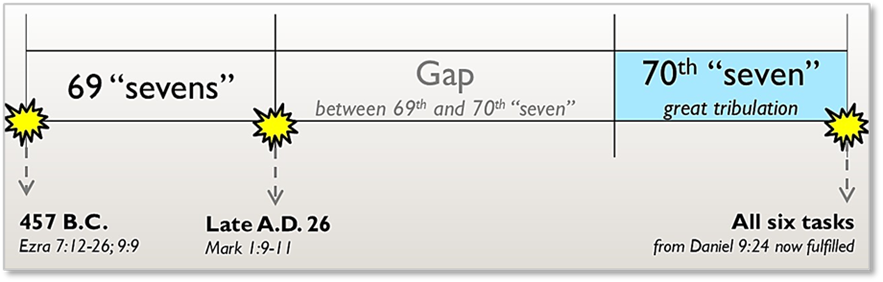
Because we already learned that each “seven” = a unit of seven years, and that the first 69 “sevens” work when interpreted this way, it’s reasonable to believe this 70th “seven” is also one unit of seven years. Remember, this 70th “seven” is the last event in Gabriel’s timeline.
The scriptures often give hints of a terrible calamity during the last days, lasting for approximately seven years.
Revelation 11:1-13 speaks of two special, powerful witnesses for Jesus who go about Jerusalem for 1,260 days or 42 months (≈ 3.5 years), preaching and doing miracles, before a ferocious, sinister, and evil creature kills them both—the Antichrist, empowered by a “dragon” who represents Satan.
This antichrist/beast figure then rules in a cruel and evil manner for 42 months (≈ 3.5 years; Rev 13:1-10).
Combined, this is a total of ≈ seven years, which Daniel hints is characterized by (a) one half (3.5 years) of relative peace but impending danger, and then (b) 3.5 years of abject evil.
In Daniel 9:27, in the midst or middle of this covenant that lasts seven years, we learn “he will put a stop to sacrifice and grain offering.” On face value, this makes no sense—unless there is a temple (complete with a re-launched, old covenant sacrificial system) in Jerusalem at which the antichrist can put a stop to this. Many Christians in America believe it must mean this.[4] If so, there must first occur a series of events so cataclysmic that they seem implausible today:
The modern state of Israel must completely change its character and become a Jewish nationalist state. This would be a big deal. Modern Israel is a very secular country.
Israel must expel all Muslim structures and worshippers from the historical site of the temple in Jerusalem. This is almost too fantastic to believe—it would have to be a miracle.
Israel must have sufficient military and economic resources to pull this off in the face of determined opposition—many, many, many political stars would have to align.
With God, all things are possible. God can do this if he wishes. Many Christians believe he will—this is why so many bible teachers watch Israel and Middle East politics very closely. Unfortunately, some of these teachers make absurd speculations and are poor ambassadors for their position—and for Christianity.[5] But Daniel does not necessarily mean there will be another temple operating in Jerusalem, complete with a restoration of the sacrificial system. It may only mean that worship in general is abolished and, on that interpretation, Gabriel explains this using old covenant language.[6]
Regardless—the antichrist will forcibly stop believers from worshipping the one true God.
How does the prophecy end?
The antichrist will then do two things:
“On the wing of abominations will come the one who makes desolate.” This probably uses the figure of an over-spreading shadow of darkness and evil (the “wing of abominations”) filling the land. This antichrist makes Jerusalem “desolate” because he has outlawed all worship of the true God—it is now an empty shell. The apostle Paul tells us the antichrist “opposes and exalts himself above every so-called god or object of worship, so that he takes his seat in the temple of God, displaying himself as being God” (2 Thess 2:4).
Daniel continues: “… until a complete destruction, one that is decreed, gushes forth on the one who makes desolate.” This darkness will spread across the world until the antichrist is suddenly destroyed.
This tells us that antichrist will be completely destroyed, in accordance with a decision God made long ago. In Revelation 19:20, we learn that when Jesus returns: “… the beast was seized, and with him the false prophet who performed the signs in his presence, by which he deceived those who had received the mark of the beast and those who worshiped his image; these two were thrown alive into the lake of fire, which burns with brimstone.”
Now, once Messiah returns (i.e., “the second coming”) and casts antichrist and the false prophet into the lake of fire and locks Satan away in the abyss (Rev 20:1-4), righteousness will reign and all the promises of Daniel 9:24 will come true. The 70 “sevens” end with Christ inaugurating his 1,000-year kingdom reign on earth.
Immediately after this millennium (“When the thousand years are completed …” Rev 20:7), Satan will be released from prison and lead a rebellion against Jesus’ kingdom, at which point God will vaporize this wicked host with a fireball from on high (Rev 20:7-10).
Some may protest that, because Satan will quickly find folks to join his rebellion at the end of Christ’s millennial reign, the everlasting righteousness (etc.) Gabriel promised in Daniel 9:24 could not arrived at the beginning of the millennial kingdom.
But this need not follow—Satan’s rebellion is put down so swiftly and so decisively that sin and wickedness will not reign or have any impact on the world. God smacks this last gasp rebellion down immediately.
So, we are left with antichrist destroyed. Other important passages tell us this happens when Jesus returns, and at that time “THE RIGHTEOUS WILL SHINE FORTH LIKE THE SUN in the kingdom of their Father” (Mt 13:43) and there will be peace on earth. The six-item list from Daniel 9:24 will be accomplished, and the Messianic reign will begin.
[1] Barnes declares “[t]here is nothing in the word here which would indicate who they were …” (“Daniel,” 182, emphasis in original), but he surely forgets that Gabriel told Daniel (9:24) the emphasis of the prophecy was the people of Israel.
[2] See, for example, H.C. Leupold, Exposition of Daniel (Columbus: Wartburg, 1949; reprint; Grand Rapids: Baker, 1969), 431-32).
[3] Joyce Baldwin, Daniel (Downers Grove: IVP, 1978), 191. “Therefore the thought is this: That ungodly prince shall impose on the mass of the people a strong covenant that they should follow him and give themselves to him as their God” (Keil and Delitzsch, Commentary, 9:736).
[5] Michael Svigel, a dispensationalist scholar, writes: “For some reason, the study of eschatology tends to attract a disproportionate number of—let me be blunt—hacks and quacks. End-times hacks produce mediocre, uninformed, trite work for the purpose of self-promotion or money. They ride the end-times circuits tickling ears with sensationalistic narratives, usually resting their interpretations of Scripture on current events or far-fetched conspiracy theories. Or they flood the market with cheap paperback books with red, orange, yellow, and black covers, usually repeating the same worn-out words they used in previous editions of their end-times yarns—sometimes with updates to fit their interpretations with the latest current events. Many of these hacks can be classified as end-times quacks” (The Fathers on the Future: A 2nd-Century Eschatology for the 21st-Century Church (Peabody: Hendrickson, 2024), 24).
[6] Stephen Miller, Daniel, in NAC, vol. 18 (Nashville: B&H, 1994), 272. Leupold suggests that “all organized religion and worship as offered by the church of the Lord are to be overthrown when this prince has his day” (433).
We come now to the last verse of Daniel’s great prophecy. This has been a long journey. If it makes you feel better, many good teachers have struggled to rightly understand this passage. The most insane discussion of which I’m aware is from a British pastor named Andrew Willett in 1622—he devoted 96 pages to answering 89 questions about the mysterious 70 “sevens”![1]
In Daniel 9:27, there are three key questions to consider:
Who is the mysterious “he” in Daniel 9:27?
With whom and for how long does this guy make a covenant?
How does the prophecy end?
We’ll discuss each, in turn, to wrap up this series. This article answers the first question
Who is the mysterious guy?
The bible says:
And he will confirm a covenant with the many for one week, but in the middle of the week he will put a stop to sacrifice and grain offering; and on the wing of abominations will come the one who makes desolate, until a complete destruction, one that is decreed, gushes forth on the one who makes desolate (Daniel 9:27).
We need to figure out who this person is who will “confirm a covenant with the many for one week.” Because Gabriel doesn’t use a name in Daniel 9:27 but just says “he will put a stop …,” we must look back and identify the last notable person Gabriel mentioned in Daniel 9:26. Who is it?
It is “the people of the prince who is to come” whom Gabriel last mentioned. The guy mentioned in our verse here in Daniel 9:27 doesn’t seem very friendly. He (a) confirms a covenant of some sort for one “seven” or “week” (the 70th in this vision), and (b) he stops the sacrifices and grain offering, (c) he ushers in some sinister abomination that destroys or desecrates, and eventually (d) he himself is destroyed.
So, who is this strange man who does all this? Many good bible teachers have suggested many options. We’ll focus on three common possibilities, one of which we can dismiss immediately:
Option 1: The man in Daniel 9:27 is the Roman general Titus Vespasianus, whom we met in Daniel 9:26, who will destroy the temple and Jerusalem in 70 A.D. Daniel 9:27, the argument goes, is still about what happened in 70 A.D. at the end of the First Jewish War.[2]
Option 2: The guy is Jesus.
Option 3: The antichrist—the evil ruler who is to come (2 Thess 2; Rev 13).
We can dismiss Option 1 straightaway—the six-item summary of the entire prophecy at Daniel 9:24 ends with paradise regained. But Option 1 leaves us stranded at halftime with no resolution, no eternal righteousness, no removal of sin, no closure. This option is wrong.
Option 2 is more interesting. This is how the argument goes:
Jesus establishes or (some say) re-affirms the covenant with his church—that is, the new covenant that the prophets said would one day arrive (Ezek 36:25; Jer 31). He would establish “true religion.”[3]
So, they assume, Jesus “put a stop to sacrifice and grain offering” in the sense that he made the old covenant sacrifices obsolete (Heb 8:1-13; Mt 27:51).
And, following on from that great event, they believe the “abominations” are the manner in which the Roman armies profaned the temple sanctuary by destroying it.
Further, these same Christians also believe the “he” in Daniel 9:27 cannot be the antichrist because:
It is the “people of the prince who is to come” in Daniel 9:26 who will destroy the temple and its sanctuary—an event we now know happened in 70 A.D.
In Daniel’s day this was all in the future. The people who did this (the Romans) belonged to a particular prince or leader (the Hebrew word can mean either one). And, that leader was the Roman general Titus Vespasianus.
So, that whole discussion was over by the end of Daniel 9:26—that verse spoke about Titus Vespasianus, and that subject is finished.
So, Daniel 9:27 must be about a different guy—a guy like Jesus the Messiah.
But this is not best way to understand the passage.[4]Option 3 is the way. There are a few good reasons why:
First, the guy at Daniel 9:27 seems very unfriendly.
Second, the length of this 70th “seven” ought to match those of the other 69 “sevens.”
Third, the last guy Gabriel mentioned was the coming leader whose people will destroy the temple (Dan 9:26)— the Roman general Titus Vespasianus foreshadows the antichrist to come.
First, this guy from Daniel 9:27 doesn’t seem nice. But Jesus is nice. Many (but not all) English bible versions agree and so they translate the conjunction after the covenant as adversative (וַחֲצִ֨י)—the guy does something sinister after he confirms the covenant.
The two emphases are very different. The NASB (et al) sees this leader take a dark turn sometime after he confirms the covenant. The ESV (et al) just sees another event following it. There is no “right way” to render the conjunction—context must decide. But, it’s enough for you to know that many solid bible translations understand Daniel 9:27 to be describing something very bad.
Second, the length of this 70th “seven” ought to match those of the other 69 “sevens.”
If this last and 70th “seven” is only a symbolic number, then why does God specifically say this person will abolish the sacrificial system in the middle of the week? It is difficult to understand why God would give specifics if the time-period is symbolic.
Christians who take this approach really struggle to make this last “seven” make any consistent sense. One bible teacher admitted this was “the most embarrassing portion of the prophecy” because he could not find a good solution.[5]
There are no crazed beasts (Dan 2, 7), flying scrolls, women in pots, or storks carrying a wicked woman off to the far East here (Zech 5) that suggest this passage is figurative language. When we see that stuff elsewhere, we know it isn’t painting reality in “normal” hues. But that isn’t happening here—this is normal language. This suggests we ought to understand the language in a normal, straightforward way.
Also, we ought to interpret the “sevens” consistently throughout this passage. We’ve already seen that the interpretation that understands “one seven = one set of seven years” makes the best sense of the evidence. So, this “70th seven” ought also to be understood as a period of seven years. This suggests the evil leader (the antichrist) will establish a covenant that lasts seven years (i.e., the 70th “seven”).
John Gill, the great Baptist pastor, agreed. It cannot be the Messiah at Daniel 9:27, he argued, “for this is not for one week only, but for ever.”[6] Messiah rules forever, not for one “seven” only!
Third, the last guy Gabriel mentioned was the coming evil ruler whose people will destroy the temple (Dan 9:26), so the antichrist sounds like our guy.
The way language works is that we identify unnamed people, like the mysterious “he” in Daniel 9:27, by two methods: (a) identifying the most recent name just mentioned, or (b) looking back at the most prominent name featured in the paragraph or text cluster which came immediately before.
In this case, the most recent and prominent person is the “prince who is to come” whose people destroy Jerusalem and its sanctuary (Dan 9:26). This suggests the mysterious “he” is the Antichrist.[7]
There are clear bible passages that tell us that a sinister, dark figure will emerge in the last days who will demand divine worship and persecute God’s people.[8] This man of lawlessness will only be destroyed when Jesus returns (see 2 Thess 2; Rev 13; cp. Mt 24:15-31, 1 Thess 4:13-17). Because we know to expect this evil man, it makes sense to see him foretold in our passage here—this is why Jesus explicitly references Daniel 9:27 (in Mt 24:15) and tells us to pay close attention to this very prophecy!
As I mentioned, some bible teachers object that “the prince/leader” in Daniel 9:26 is clearly Titus, so it cannot be the antichrist.[9] True, the most obvious historical referent is the Roman general Titus Vespasianus in 70 A.D., but it’s reasonable to believe he just foreshadows the true evil kingdom that will come in the last days. The prophecy of the crazed, fearsome beast in Daniel 7 suggests the fourth great pagan kingdom in God’s timetable, that of “Rome,” will exist in three phases.[10]
Phase 1: The old Roman Empire under whose jurisdiction Jesus and Pontius Pilate lived (Dan 7:23).
Phase 2: Sometime after Jesus’ day, a splintered remnant that has divided into various pieces (the “10 horns” of the scary fourth beast, Dan 7:23-24).
Phase 3: A powerful king who will arise from among the splintered bits of Phase 2 (Dan 7:24-26).
It is this third phase which the antichrist represents. Jesus himself, in Matthew 24:15-28, seems to shade two calamitous events—the destruction of the city and temple in 70 A.D. and the antichrist’s reign of terror during the last days—together in the telling. Trustworthy bible scholars and teachers of every stripe recognize this—just look at any study bible you have lying about and see for yourself! Just as David’s life and standing is a shadowy reflection that points to Jesus, so too does Titus point to the antichrist in this sense.
If true, then (a) Titus does not exhaust the meaning of “the prince/leader who is to come” at Daniel 9:26, and (b) antichrist is just as much a leader of “Rome” as Titus—he just operates in a different phase of that pagan kingdom.
We tackle the remaining two questions about Daniel 9:27 in our next (and final) article.
[2] This is John Gill’s argument (Exposition of the Old Testament, 6:346-47), and that of Matthew Henry, Matthew Henry’s Commentary, 6 vols. (reprint; New York: Revell, n.d.), 1094-95.
[3] Albert Barnes, “Daniel,” in Barnes’ Notes, vol. 7 (reprint; Grand Rapids: Baker, 1998), 182.
[4] “Ultimately, the question facing every expositor is what interpretation gives the most natural and intelligent exposition of the text” (John Walvoord, Daniel: The Key to Prophetic Revelation (Chicago: Moody, 1971; reprint, 1989), 234).
[5] Barnes, “Daniel,” 183. In desperation, Barnes suggests this last “seven” consists of (a) Jesus’ ≈ 3.5-year ministry, and (b) the apostle’s ministry of “about” 3.5 years (183-85). This is absurd. Does this mean that the new covenant ended 3.5 years after Jesus’ death!?
[6] Gill, Exposition of the Old Testament, 6:346 (emphasis added). I admit that Gill disagrees with my larger position, but everyone disagrees with everyone about how to interpret Daniel!
[7] Edward Young argues mightily that the true antecedent is not the prince but the people, because they are foremost in Gabriel’s mind as he relates the prophecy. This is not taken seriously by any commentator I’ve read, but it is the best attempt I’ve seen to evade the obvious in this passage and it is rhetorically persuasive.
As we march onward in our study of Daniel 9:24-27, we’ve arrived at Daniel 9:26. What happens after the 69th “seven”? That is, after Daniel 9:25? There is still one “seven” left, and a lot of stuff still to be fulfilled from the six-item list Gabriel revealed in Daniel 9:24. As the prophecy goes on, in Daniel 9:26, two key events happen:
The Messiah will be “cut off,” and
“the people of the prince who is to come” will destroy Jerusalem and its temple.
Let’s look at these one at a time.
Messiah and the “gap” between “weeks” 69 and 70
Then after the sixty-two weeks, the Messiah will be cut off and have nothing, and the people of the prince who is to come will destroy the city and the sanctuary. And its end will come with a flood; even to the end there will be war; desolations are determined (Daniel 9:26).
When will the Messiah be “cut off and have nothing”? What does it mean? Considering the bible’s whole story, it seems to suggest Messiah’s death:
He was despised and abandoned by men, A man of great pain and familiar with sickness; And like one from whom people hide their faces, He was despised, and we had no regard for Him … By oppression and judgment He was taken away; And as for His generation, who considered that He was cut off from the land of the living, for the wrongdoing of my people, to whom the blow was due? (Isaiah 53:3, 8).
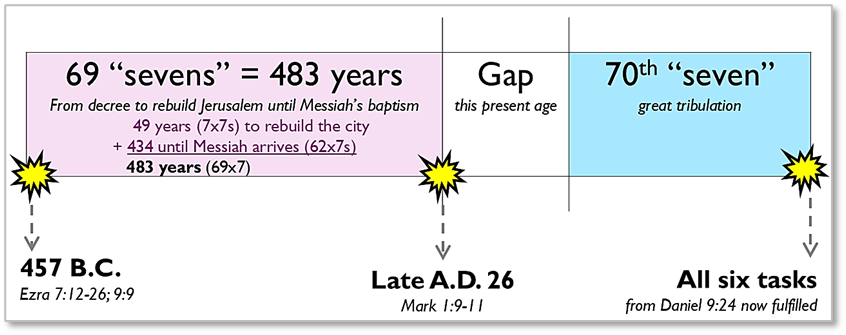
Jesus was despised, rejected, and abandoned—he had nothing. Then he was “cut off”—the Romans executed him. According to Daniel 9:26, this will occur “after the sixty-two weeks …” Remember, there are two sets of “sevens” in Daniel 9:25—(a) seven “sevens,” and then (b) 62 “sevens. The Messiah’s death happens after this second set—the 62 “sevens,” like this:
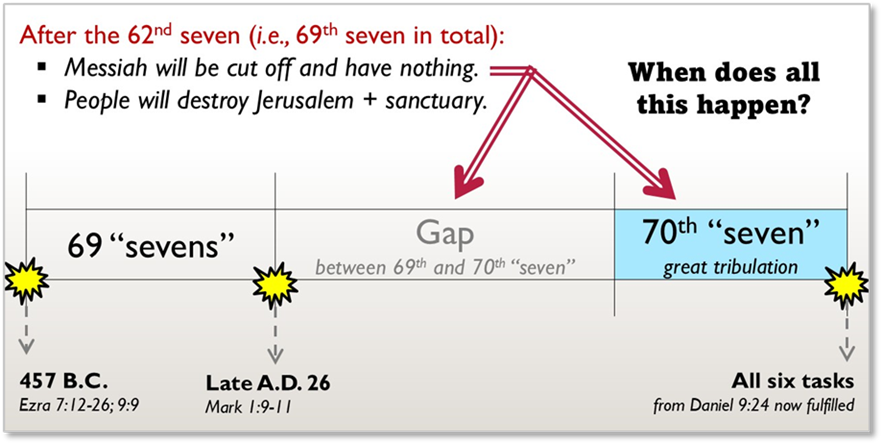
So, while the phrasing is awkward, it seems that the Messiah’s death will happen after the 62 “sevens,” which means after the 69 “sevens.”[1] However, because the 70th “seven” will not begin until Daniel 9:27 (“And he will confirm a covenant with the many for one week …”) it seems there is a “gap” of time here between the 69th and 70th “seven.” If there is no gap, then the 70th “seven” happens immediately—the Messiah dies during the 70th “seven,” because it happened after the 69th “seven.
Figure 2. In which “week” does Daniel 9:26 and Messiah’s death occur?
Evidence suggests there is a gap between “weeks” 69 and 70 because of this chain of logic:
Because the evidence for the first 69 “sevens” suggests each “seven” is a set of seven years, we are obligated to see the 70th “seven” as also being a set of seven years.
Because Messiah was “cut off” after the 69th “seven,” we might assume this happened during the 70th “seven.”
If true, then Jesus was “cut off” at his crucifixion in ≈ A.D. 30.
But …
This would mean all six tasks in Daniel 9:24 (“Seventy weeks have been decreed for your people and your holy city …”) must take place within seven years of Messiah being “cut off” (A.D. 37-ish)—which must be the case if the 70th “seven” truly followed right on the heels of the 69th.
In other words, if there is no gap between the 69th and 70th seven, then …
Because each “seven” is seven years,
and the 70th “seven” begins with Jesus’ death in ≈ A.D. 30 (when he is “cut off”),
then the 70th “seven” would have ended in ≈ A.D. 37,
and so all six promises from Daniel 9:24 would have to be fulfilled by A.D. 37.
That did not happen! So, there must be a gap between the 69th and 70th “seven.” Bible-believing interpreters who do not account for this gap are left with an impossible dating problem. So, they are generally forced to take one of two options:
Option 1: Push the entire thing backwards and make the sinister figure at Daniel 9:27 the wicked Syrian king Antiochus Epiphanes IV, who ruled in the early 2nd century B.C. (read about him in 1 Maccabees 1).[2]
Option 2: Make the mysterious ruler at Daniel 9:27 be Jesus and wrap the entire prophecy up with Jesus’ ascension to heaven.
Neither of these make the best sense of a straightforward reading of the bible. The “gap” between the 69th and 70th “seven” seems to be the best solution. If true, then the 70th “seven” doesn’t begin until the events of Daniel 9:27, which is yet future. I can’t yet make a full case for the “gap theory” of the 70th “seven” until we wrestle with Daniel 9:27, and that must wait for the next article.
The mystery prince
We now turn to the second event from Daniel 9:26:
Then after the sixty-two weeks, the Messiah will be cut off and have nothing, and the people of the prince who is to come will destroy the city and the sanctuary. And its end will come with a flood; even to the end there will be war; desolations are determined (Daniel 9:26).
The word translated as “prince” means leader, ruler, or a male sovereign other thanthe ruling king (i.e., “the prince”). This means that some ruler will come along one day, whose people will destroy Jerusalem and the temple the Jewish people just re-constructed in Daniel 9:25—the tale told to us in the books of Haggai, Ezra, and Nehemiah.
Well, this makes identification pretty simple—who destroyed Jerusalem (“the city and its sanctuary”) and when did they destroy it?
Daniel says it was “the people of the prince who is to come” (Dan 9:26) who will destroy Jerusalem and its sanctuary. Because the Roman army later destroyed this very city and that very temple in A.D. 70 (some ≈ 600 years after Daniel wrote this prophecy), this means our “prince” in Daniel 9:26 is somehow connected to the Roman empire—which Daniel 7 suggested will exist in three phases.[3]
Phase 1: The old Roman Empire under whose jurisdiction Jesus and Pontius Pilate lived (Dan 7:23).
Phase 2: Sometime after Jesus’ day, a splintered remnant that has divided into various pieces (the “10 horns” of the scary fourth beast, Dan 7:23-24).
Phase 3: A very powerful king who will arise from among the splintered bits of Phase 2 (Dan 7:24-26).
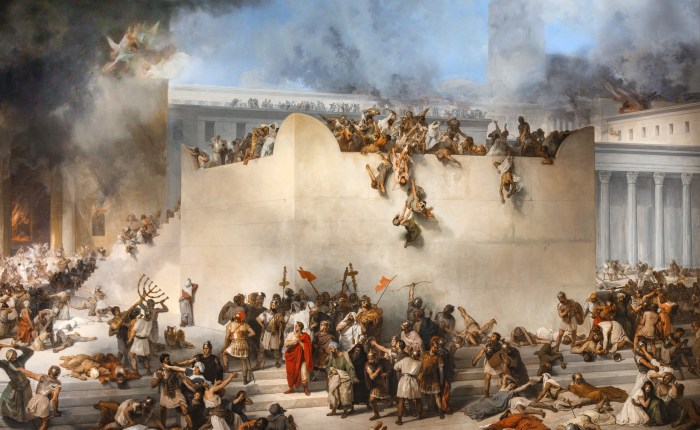
History tells that a Roman general (and later emperor) named Titus Vespasianus destroyed Jerusalem during the First Jewish War,[4] when the Roman empire was still intact in its original form (Phase 1, above). This will be a nasty finish to a brutal war. Gabriel tells Daniel: “… its end will come with a flood; even to the end there will be war; desolations are determined” (Dan 9:26). Now, on the other side of this event, we know that God brought this judgment on his people in A.D. 70 because they rejected the Messiah and Savior whom he sent to rescue them.
The Roman (and Jewish) writer Josephus tells us what happened to Jerusalem when the Romans destroyed it. He knows, because he was there that day.
There was no one left for the soldiers to kill or plunder, not a soul on which to vent their fury; for mercy would never have made them keep their hands off anyone if action was possible. So Caesar now ordered them to raze the whole City and Sanctuary to the ground … [a]ll the rest of the fortifications encircling the City were so completely leveled with the ground that no one visiting the spot would believe it had once been inhabited. This then was the end to which the mad folly of revolutionaries brought Jerusalem, a magnificent city renowned to the ends of the earth.[5]
Josephus tells of one Jewish woman named Mary, driven mad by hunger, who killed her infant son, roasted him, ate one half of him and saved the rest for later[6] (cp. Deut 28:53-57). The temple itself was destroyed by fire in a frenzy of rage by Roman legionnaires who ignored their commander’s orders.
All the prisoners taken from beginning to end of the war totalled 97,000; those who perished in the long siege 1,100,000 … No destruction ever wrought by God or man approached the wholesale carnage of this war.[7]
This must be very hard to hear and understand. We wonder what Daniel thought when he heard this news!
Daniel asks for assurance from God that he will set everything right (Dan 9:3-19)
God sends the angel Gabriel to say that he will make it right (Dan 9:20-23).
In fact, things will be set so right that the six-item list at Daniel 9:24 shows us paradise restored.
This shakes out with (a) Jerusalem being rebuilt, and then (b) Messiah the prince arriving on the scene (Dan 9:25). This will take 69 “sevens” to happen, but it’ll happen.
Everything sounds great. But then, after the 62nd “seven” (i.e., 69 “sevens” in total):
The Messiah will be cut off and have nothing (Dan 9:26).
Jerusalem and its (as yet) un-rebuilt temple will be totally destroyed (Dan 9:26)!
This is a shock. What can it mean? Why will it happen? Why this bizarre reversal? Who is this mysterious prince who is to come? At this rate, Daniel may be thinking, the glorious six-item promise list from Daniel 9:24 seems far, far away. Clearly this is a one step forward, two steps back kind of thing. What is the endgame, here?
Evidence suggests there will be a long series of events after Messiah’s arrival at his baptism at Daniel 9:25 (the end of the first 69 “sevens”), and before the 70th “seven” begins in Daniel 9:27.
At least one of those events will be Messiah’s seeming abandonment (“have nothing”), and his execution by Roman soldiers (“be cut off”).
Another event will be the destruction of the rebuilt temple and the city of Jerusalem by the people of the Roman ruler who will come on the scene (Dan 9:26)—the general Titus, who indeed razed the city in A.D. 70.
This “intermission” seems to best explain the “gap” between the 69th and 70th unit of seven years in the prophecy.
Nevertheless, in our next article on Daniel 9:27, the angel Gabriel tells us how God plans to make good on his six-item list of promises.
[1] John Gill: “To be reckoned from the end of the seven weeks, or 49 years, which, added to them, make 483 years” (Exposition of the Old Testament, 6:346). Stephen Miller writes: “After the reconstruction of Jerusalem in the first seven sevens (forty-nine years), another ‘sixty-two sevens’ (434 years) would pass” (Stephen R. Miller, Daniel, vol. 18, in New American Commentary (Nashville: B&H, 1994), 267).
[2] This is why Moses Stuart, an outstanding American bible scholar from the early 19th century, remarks: “The third period (one week) of course begins with the same excision of an anointed one, and continues seven years, during which a foreign prince shall come, and lay waste the city and sanctuary of Jerusalem, and cause the offerings to cease for three and a half years, after which utter destruction shall come upon him, vs. 26, 27” (Daniel, 274; emphasis added). Stuart does not consider the possibility of a gap between the 69th and 70th “seven.”
[5] Josephus, The Jewish War, trans. G.A. Williamson, rev. ed. (New York: Penguin, 1969), 7:1 (361). Chrysostom suggests, “And let not any man suppose this to have been spoken hyperbolically; but let him study the writings of Josephus, and learn the truth of the sayings. For neither can any one say, that the man being a believer, in order to establish Christ’s words, hath exaggerated the tragical history,” (“Homily 76,” in NPNF 1.10, 457).
[6] Josephus, The Jewish War, 6:199-219 (341-342).
[7] Josephus, The Jewish War, 6:420f. See ch(s). 13-21 (i.e., 3:422 – 6:429).
Daniel 7 has the same message as Daniel 2. But, while Daniel 2 is more of a summary, Daniel 7 expands that message by way of more fantastic visions. It’s like how Genesis 2 expands on Genesis 1. Curiously, Daniel doesn’t write in chronological order—Daniel 7 returns us to Babylon on the eve of the Persian conquest, but the reader just finished Daniel 6 which shows us Darius the Mede after the conquest!
First, a word about how to interpret prophecy. As we sit comfortably—far removed from the anxious times in which God revealed these visions to Daniel—we can make a mistake. We can obsess over unimportant details and miss the larger point. God didn’t give us these incredible visions so we’d bog down in irrelevant questions. Some enthusiasts teach that Daniel’s visions “provide[] the most comprehensive and detailed prophecy of future events to be found anywhere in the Old Testament.”[1] Perhaps, but that isn’t Daniel’s point or God’s point. This turns Daniel into fodder for abstract speculation, which as far from the point as the east is from the west. Obsessive focus on, say, the identity of the four beasts might be interesting and profitable, but they’re not the point. God gave this vision to Daniel as hope for desperate people. So what’s the point of this vision?
Daniel’s angelic guide tells us plainly: “16So he told me and gave me the interpretation of these things: 17The four great beasts are four kings that will rise from the earth. 18But the holy people of the Most High will receive the kingdom and will possess it forever—yes, for ever and ever,” (Dan 7:16-18). The point is that God wins. He wins big. And even the most fearsome nations will fall before Him. Whatever else you take away from Daniel 7, make sure you get that right.[2]
The dream (Daniel 7:1-14)
Daniel 7 easily divides into two sections; (a) the dream (Dan 7:1-14), and (b) the interpretation (Dan 7:15-28).
First, here is the cast of characters from the vision with my identification for each:
Beast 1: the lion with wings. This is Babylon/Nebuchadnezzar.
Beast 2: the lopsided bear. This is Persia—the nation in which Esther lived, and from which Cyrus let the Jewish people return home, etc.
Beast 3: a leopard with four heads. This is Alexander the Great and the kingdoms belonging to the four generals who succeeded him after his death.
Beast 4: iron teeth + ten horns + one little horn. This is the Roman Empire in three derivative phases; (a) the historical kingdom of Jesus’ day, (b) the interim period of nations which in some way derive from the historical Roman Empire, and (c) the kingdom of antichrist of the last days, which grows from among the nations of the interim phase.[3] Some teachers think only “liberals” deny that the fourth kingdom is Rome, but this cruel and incorrect.[4]
Ancient of Days: God the Father.
Son of Man: Jesus—this is his favorite way to describe Himself.
Second, forget the first three kingdoms. Daniel is simply not interested in the first three kingdoms in this vision. He only asks the angel for clarification about the fourth (Dan 7:19-20). So, the first three kingdoms are not relevant. I believe the “four beasts” in Daniel 7 are parallel to the four-fold statue at Daniel 2, which means the first kingdom remains Babylon (Dan 2:36-28; cp. Dan 7:2-4, 17-18). A different vision addresses the second and third visions (Daniel 8), but they are not the issue here. So, this article will not address the first three kingdoms at all.
Third, focus on the fourth kingdom. The remainder of the article will do just that.
The fourth kingdom is “terrifying and frightening and very powerful.” Like the character Jaws from The Spy Who Loved Me, it has “large iron teeth.” It crushes and gobbles up everything in its path. It also has ten horns (Dan 7:7), about which the angelic guide later explains.
This focus on four kingdoms doesn’t mean they are the only four nation-states that matter in human history. Instead, it suggests there are four kingdoms that will have a particular impact on the people of Israel. God could have discussed a particular Chinese dynasty, but it would have meant nothing to Daniel. In context, this is a message of hope to the people of Israel as they’re in exile in a foreign land. China would have meant nothing to them. This indicates our interpretive options are limited to a nation which has relevance to the people of Israel.
As Daniel stares at this awful creature, pondering the meaning of the ten horns, “there before me was another horn, a little one, which came up among them; and three of the first horns were uprooted before it,” (Dan 7:8). This “little horn” emerges from among the ten—it is not an outsider. Whatever this “little horn” is, it doesn’t represent a revolution from without. Instead, it signals the gradual rise of a new power-center from within. This last horn “had eyes like the eyes of a human being and a mouth that spoke boastfully,” (Dan 7:8). The angelic guide will soon elaborate, but we get the impression of intelligence, shrewdness, and arrogance.[5]
As Daniel looks on in horror, he spies another vision in the heavens above. This one seems parallel to the rise of the fourth beast—it takes place at the same time. “[T]hrones were set in place, and the Ancient of Days took his seat,” (Dan 7:9). This is a solemn, choreographed event. The Ancient of Days has snow white hair, a flaming throne with wheels ablaze, a river of molten fire flows from the chair, and “thousands upon thousands attended him; ten thousand times ten thousand stood before him. The court was seated, and the books were opened,” (Dan 7:10). This is the same imagery Ezekiel used (Ezek 1), and that the apostle John later re-purposes (Rev 5:11, 20:11-15). In other words, the Ancient of Days is God, and the setting is a courtroom.
Then, like a person watching two screens at once, Daniel looks back to the first vision “because of the boastful words the horn was speaking,” (Dan 7:11). He keeps looking “until the beast was slain and its body destroyed and thrown into the blazing fire,” (Dan 7:11). Its doom is like the antichrist’s fate in John’s apocalypse. Jesus tosses the antichrist into the lake of fire at His second coming (Rev 19:20).
Daniel now looks back at the second “screen” depicting the heavenly courtroom. He sees “one like a son of man, coming with the clouds of heaven,” (Dan 7:13). “Son of man” is a woodenly translated phrase which means “person” or “human being.” Jesus often identifies Himself as this mysterious human figure in the context of His triumphant return to this sphere (Mt 16:27, 24:30; Lk 17:30). Once the Son of man arrives, He receives His eternal kingdom: “His dominion is an everlasting dominion that will not pass away, and his kingdom is one that will never be destroyed,” (Dan 7:14). Jesus is the rock from Daniel 2 which smashes the evil kingdom and fills the whole earth (Dan 2:34-35, 44-45).
Christians have strong opinions about when this happens—at His ascension or later? The evidence suggests both are correct.
Jesus hints that He arrives at the holy court immediately after His death (i.e., at His ascension).[6] He tells the Sanhedrin that “from now on you will see the Son of Man sitting at the right hand of the Mighty One and coming on the clouds of heaven,” (Mt 26:64). Jesus says His “arrival” to rule His kingdom will be a reality from here on out, and this “seeing” is repetitive—“from here on out, you’ll be seeing …”[7] That is, the Sanhedrin will be seeing Jesus rule and reign “from now on.” The irrefutable evidence will be that nobody can stop the good news about His kingdom. This is the comforting vision Stephen saw just before the Sanhedrin murdered him (Acts 7:55-56)—meaning it’s a reality right now.
Yet, in Daniel’s vision, the Son of man arrives in the divine courtroom to receive His kingdom after or as the terrible beast is slain—suggesting an enthronement in the last days. This is the future great arrival for which the apostle Paul waits (1 Thess 2:19, 4:16-17)—meaning it hasn’t yet happened. The apostle John refers to this Daniel passage as a future event: “Look, he is coming with the clouds …” (Rev 1:7) and pairs it with a Zechariah quotation about a divine victory over evil (Zech 12:10)—an event that closely resembles those of Revelation 19 (cp. Zech 12:10–13:6).
Evidence suggests:
Jesus arrives in heaven after His ascension to take the throne. He immediately makes His authority known to those on earth.
Yet, sometime in the future when the kingdom of darkness is at its zenith—the age of the terrible fourth beast of Daniel 7 and the fourth kingdom of Daniel 2 (cp. Rev 17:1-13)—Jesus will return here to destroy evil and establish His kingdom on earth.
The distinction is like an incident from World War 2. Admiral Chester Nimitz took over his duties as Commander-in-Chief, US Pacific Fleet in December 1941—just after the Japanese attack on the naval base at Pearl Harbor. His headquarters remained at Pearl Harbor, HI. However, as the war went on, Nimitz’s Central Pacific campaign re-took territory the Japanese had captured earlier in the war, and he became further and further removed from the center of action. Eventually, in January 1945, Nimitz moved his headquarters from Pearl Harbor, HI to Guam. He had always been the Pacific Ocean Area theater commander, but his move to the scene of action allowed him to exercise more direct and convenient control over his forces.
In a comparable way, while God declared Jesus to be His eternal Son and King at His ascension (Acts 13:32-37; cp. Ps 2, 110), the time will come when Jesus moves His headquarters from heaven to earth. Unlike Admiral Nimitz, Jesus is not hindered by distance, but the concept is similar. He wants to be with His people—it’s why one of His titles is Emmanuel (Isa 7:14, Mt 1:23). His people are here, and so when the time comes Father, Son, and Spirit will shift their flag to Jerusalem.
Daniel is confused. He asks the angel, who (as we saw earlier) gives him the bottom line: “17The four great beasts are four kings that will rise from the earth. 18But the holy people of the Most High will receive the kingdom and will possess it forever—yes, for ever and ever,” (Dan 7:17-18).
But Daniel is still troubled. The fourth beast terrifies him. Who is it? What does it mean? When will it happen? It’s so fearsome—what does it signify (Dan 7:19)?
What the dream means (Daniel 7:15-28)
Daniel is worried about the fourth beast because it’s horrifying. It has iron teeth, bronze claws, and it “crushed and devoured its victims and trampled underfoot whatever was left,” (Dan 7:19). He’s curious “about the ten horns on its head and about the other horn that came up, before which three of them fell—the horn that looked more imposing than the others and that had eyes and a mouth that spoke boastfully,” (Dan 7:20).
Daniel looks again at this image, as if the angel had paused it on a screen, and at the same time the action on the second screen replays the scene from Daniel 7:11—perhaps in slow motion. Daniel sees the “little horn” waging war against the people of the Most High and winning—until the Ancient of Days raps His gavel and puts a stop to it all. Then, God’s people possessed the kingdom (Dan 7:21-22).
What does it all mean? The angel answers in two parts; (a) the rise of the “little horn” from among the ten (Dan 7:23-25), and then (b) the little horn’s demise (Dan 7:26-27).
The rise of the “little horn” (Daniel 7:23-25)
The angel explains:
23He gave me this explanation: ‘The fourth beast is a fourth kingdom that will appear on earth. It will be different from all the other kingdoms and will devour the whole earth, trampling it down and crushing it. 24The ten horns are ten kings who will come from this kingdom. After them another king will arise, different from the earlier ones; he will subdue three kings. 25He will speak against the Most High and oppress his holy people and try to change the set times and the laws. The holy people will be delivered into his hands for a time, times and half a time (Daniel 7:23-25).
The beast represents a mighty kingdom of darkness. It’s identical to the fourth kingdom from Daniel 2, which the angel described as strong as iron—“and as iron breaks things to pieces, so it will crush and break all the others,” (Dan 2:40). We don’t know what kind of animal the fourth kingdom is. It’s teeth and claws sound dragon-like, which would fit with the dragon symbolizing Satan (cp. Rev 12-13).[8]
This fourth kingdom has three phases, each separated by large periods of time but having traceable connections.[9]
Evil Kingdom Phase 1. The historical Roman Empire. It is “different” from all the other kingdoms because of the extent and ferocity of its realm (“devour … trample … crush,” Dan 7:23).
Evil Kingdom Phase 2. This is the age between (a) Jesus and the apostles, and (b) the last days. This makes sense because the ten horns are ten kings who will come from this kingdom (Dan 7:24). They are future developments after the Evil Kingdom Phase 1 leaves the stage.[10] Many bible interpreters lose their audience trying to identify the ten kingdoms. The angel doesn’t tell us what they are, so we should drop the attempt. It is idle speculation that accomplishes nothing—no matter how ingenious it may be.
We can say these ten kings (or kingdoms—the kings in Daniel’s visions are always synonymous with their realms) are a second phase of the historical Roman Empire because one could trace their origins back to it. This line need not be direct. For example, (a) South Korea’s existence derives from Japan’s defeat in the second world war, (b) the present-day Federal Republic of Germany comes from Otto Von Bismark’s unification of 39 independent nation states into the German Confederation in the late 19th century, and (c) the United States derives from the British Empire.
Neither example is a straight line from past to present, but each nation only exists today because of its historical ancestor—the same way a Tesla derives from a Model T Ford. The “10 horns” of Evil Kingdom Phase 2 may be like that—which means they could be any nation in the Western world. The number ten may also be symbolic, which would obviously complicate quests to identify them.
Evil Kingdom Phase 3. This is the time of the antichrist and the last days. We know this because “after them [that is, after the period of the 10 kings] another king will arise, different from the earlier ones; he will subdue three kings,” (Dan 7:24). This mysterious “little horn” is the antichrist, who John later reminds us is on the way (1 Jn 2:18). The angel tells Daniel the little horn will “put down” (RSV) three of the ten nations and arise from somewhere among them (“came up from among them,” Dan 7:8).[11] He’s different from the others because (Dan 7:25):
First, he will speak against God. Earlier, Daniel saw that he had “a mouth that spoke boastfully,” (Dan 7:8). This is blasphemy. The apostle Paul later calls this individual “the man of lawlessness” who “will exalt himself over everything that is called God or is worshiped, so that he sets himself up in God’s temple, proclaiming himself to be God,” (2 Thess 2:4; cp. Rev 13).
Second, he will oppress believers. This is a long and deliberate campaign that wears believers down (NASB) or wears them out (KJV).[12] The apostle John later saw a vision of antichrist—a horrid beast which combined imagery from all four monsters from Daniel’s visions (Rev 13:1-4). “It was given power to wage war against God’s holy people and to conquer them. And it was given authority over every tribe, people, language and nation,” (Rev 13:7).
Third, he will try to change set times and laws. The antichrist will pervert and twist public morality, virtue, and decency into a lie.[13] Some also believe this refers to anti-religious sentiment in general—a pure secularism[14] and a “new table of religious festivals.”[15] It’s both.
God gives His people over to this evil figure’s power for a set period (“3.5 times”) that the angel doesn’t define here but is probably three-and one-half years (cp. Dan 12:5-7, 11).[16] The significance here is not the length of the evil king’s reign, but its sudden crash after a rapid acceleration.[17] It speeds up quickly (“a time, times …”), and then hits a wall and crashes with no warning (“half a time”).
The little horn’s fall (Daniel 7:26-27)
Why does antichrist’s kingdom crash and burn so suddenly?
Because, the angel explains, “the court will sit, and [antichrist’s] power will be taken away and completely destroyed forever,” (Dan 7:26). This is an elaboration on Daniel 7:14. We know the evil empire’s fall will be sudden and violent—remember the stone that smashes the statue from Daniel 2? The apostle John tells of an angel picking up a huge boulder and throwing it into the sea: “With such violence the great city of Babylon will be thrown down, never to be found again,” (Rev 18:21). This is when God avenges the blood of His servants, and the heavenly chorus sings: “Hallelujah! The smoke from her goes up for ever and ever,” (Rev 19:2-3).
Daniel’s vision is the divine courtroom where the Ancient of Days declares: “Enough is enough!” John’s apocalypse tells us that, as antichrist’s evil kingdom smolders in ruins, Jesus the King returns to this sphere with the armies of heaven to do battle with His sinister counterpart. “He is dressed in a robe dipped in blood, and his name is the Word of God,” (Rev 19:13). This is the blood of God’s enemies, tramped and splattered like so many grapes in a vat. The prophet Isaiah explained: “I trampled the nations in my anger; in my wrath I made them drunk and poured their blood on the ground” (Isa 63:6). John warns that Christ “treads the winepress of the fury of the wrath of God Almighty,” (Rev 19:15).
Then, the angelic guide tells Daniel, “His kingdom will be an everlasting kingdom, and all rulers will worship and obey him,” (Dan 7:27).
What does all this mean?
Daniel’s vision tells us six things:
A singularly evil figure will rise from a nation which derives, in some way, from the historical Roman Empire.
This antichrist will then subdue three nations which stem from the historical Roman Empire.
He will persecute God’s people, twisting public decency and morality against everything God says is good—a program of pure secularism that is rabidly anti-religious.
Antichrist will rise rapidly then experience a sudden and spectacular crash (“time, times, and half a time,” Dan 7:25). Revelation 18-19 tells us this “crash” is God’s violent overthrow of Babylon (Rev 18:21-24) and Jesus’ second coming (Rev 19:11-21).
Antichrist will be “slain and his body destroyed and thrown into the blazing fire,” (Dan 7:11; cp. Rev 19:19-21).
The Son of Man will take His seat as King and make all things new (Dan 7:13-14, 28; cp. Rev 21-22). “Then the righteous will shine like the sun in the kingdom of their Father,” (Mt 13:43).
To Daniel and the exiles then, God’s message was: “The kingdoms of this world will surely fall, and I’ll judge them, and I’ll make everything right.”
To churches great and small today, God makes the same promises—even as we’re now several episodes further along in His story. His truth is still marching on. No matter what is happening in your life, in your country, and in your world—God will win. Babylon will lose. And Jesus’ “dominion is an everlasting dominion that will not pass away, and his kingdom is one that will never be destroyed,” (Dan 7:14). God wanted Daniel and the people of Israel to believe that as they lived in exile in an unholy land. He wants us to believe it too.
Here is a recent sermon I preached on this passage:
[1] John Walvoord, Daniel, rev. by Charles Dyer and Philip Rawley (Chicago: Moody, 2012), 181.
[2] Walvoord represents the dispensationalist habit to favor prophetic timelines instead of the author’s point. He devotes two pages to defending the historicity of Daniel’s statements at Daniel 7:16-18, yet never stresses that this is the very point of the whole vision (Daniel, 211-12).
[3] I am following Edward J. Young, The Prophecy of Daniel: A Commentary (Grand Rapids: Eerdmans, 1949), 147-50.
For a very compelling argument from a conservative that the fourth beast is the kingdom of the Syrian madman Antiochus Epiphanes, see Moses Stuart, A Commentary on the Book of Daniel (Boston: Crocker & Brewster, 1850), 205-11. For the old saw about the fourth kingdom being the papacy, Albert Barnes does an excellent job (“Daniel,” in Barnes Notes, vol. 7 (reprint; Grand Rapids: Baker, 1998), 76-99). Leon Wood’s wonderful commentary advocates the dispensational perspective of a “revived Roman Empire,” (A Commentary on Daniel (Grand Rapids: Eerdmans, 1973), ch. 7).
[4] Walvoord does this (Daniel, 7), and so does Andrew Steinmann (Daniel (St. Louis: Concordia Publishing House, 2008), 145).
[7] Gk: πλὴν (contrasting conjunction) λέγω ὑμῖν ἀπʼ ἄρτι (temporal preposition + temporal adverb = marks the time at which something changes) ὄψεσθε (iterative future) τὸν υἱὸν τοῦ ἀνθρώπου. “But I’ll tell you all this—from here on out you’ll all be seeing the Son of Man … arriving on heaven’s clouds.”
[8] John Goldingay declares the fourth beast has no dragon-like qualities, and bizarrely suggests it may be a war elephant! (Daniel, vol. 30, in WBC (Dallas: Word, 1989), 163, 186).
[10] Barnes, “Daniel,” 56. Wood (Daniel, 188, 200) and Stephen R. Miller believe the ten will be contemporaneous with each other. “They reign contemporaneously as one empire since all exist together, and this fact is expressly stated in Rev 17:12–13. Daniel was predicting that out of the old Roman Empire will arise ten kings (or kingdoms) that will constitute a new phase of that empire at the end of the age,” (Miller, Daniel, vol. 18, NAC (Nashville: B&H, 1994), 213). This may well be the case. The citation from Revelation 17 is a strong one.
[11] Again, Miller makes a good point about these ten kingdoms: “Coming ‘after them’ signifies that the empire will already have been formed by the first ten kings when Antichrist rises to his position of dominance over them. The text does not mean that the new king (Antichrist) will originate from a separate nation from those symbolized by the ten horns, for the empire seems to remain a confederacy of ten after he comes to power,” (Daniel, 213).
[14] Barnes, “Daniel,” 72-3; Peter Steveson, Daniel (Greenville: BJU Press, 2008), 137. “Denying religious liberty is characteristic of dictators (e.g., Antiochus IV, Nero, Domitian, Stalin, Hitler, and others), but Antichrist will go beyond what anyone has done before in his attempt to create a thoroughly secular world. Even now there are those seeking to rid society of all vestiges of religion,” (Miller, Daniel, 214).
Stuart believes it refers to the Mosaic law because he sees the fourth kingdom as being that of Antiochus Epiphanes (Daniel, 222-3). Steinmann goes beyond the evidence by declaring that antichrist seeks to destroy justification by faith by substituting another gospel (Daniel, 374).
[16] On the three- and one-half years, see Wood, Daniel, 201-2; Stuart, Daniel, 222-4, and Miller, Daniel, 214. For a rejoinder, see Steinmann, Daniel, 375-6. Barnes takes a middle road and says both figurative and literal senses are well supported (“Daniel,” 72-5).
[17] Keil and Delitzsch, 9:652; Baldwin, Daniel, 162. Dispensationalists often miss this.







 The Eccentric Fundamentalist