I made this little video for the church where I pastor. It presents six core truths that good Christians ought to be able to agree on, from the book of Genesis, that will help us think carefully about the three common “flashpoints” that often cause disagreements about Christianity and science.
In the last article in this series about Israel and the Millennium, we explained why good Christians disagree about the bible’s big story. Today, we sketch what we believe the true big story is. The article follows, but here is a video discussing most of this if you prefer that medium:
The bible’s big story is about God’s plan to remake the paradise that our first parents ruined in Genesis 3. It’s God’s plan to fix the world, to fix us, and to create a family he can love and which loves Him back. God promises to send His only Son, Jesus—our King—on a special mission. First, Jesus will defeat God’s great and evil adversary and schedule his destruction. Second, Jesus rescues and then transforms a special community to show and tell his Good News to the world and to themselves. Meanwhile we wait to be with him forever in his forthcoming new creation kingdom, when he makes all things new.
This happens by the end of the story, in Revelation 21-22, when we have God’s kingdom complete—one multi-national communion of “Jesus people” (Jew + Gentile) who have trusted in him and have therefore been spiritually rescued from Satan and from themselves. Believers will live forever with God in this new creation kingdom: “Then I saw a new heaven and a new earth; for the first heaven and the first earth passed away …” (Rev 21:1).
The simplest way to understand the bible’s big story is like a three-act play:
Act 1: Paradise made (Genesis 1-2).
Act 2: Paradise lost (Genesis 3).
Act 3: Paradise regained (Genesis 4 to Revelation 22).
Nearly all the bible’s story is about how this Act 3 will happen—God’s one unfolding, progressive plan to make “paradise remade” come true. God does this by way of a series of covenant promises that move the story forward like individual “episodes” of a TV series. Together, these “episodes” string together to form a traceable and logical story—ending in a new creation paradise, where God’s people can worship him and exercise dominion over his good creation, where Satan and evil have been banished and defeated forever.
So, to sum up, (a) we have the bible’s story summed up in three acts, and (b) Act 3 (paradise regained) progressively rolls out by way of a series of covenants God makes that tell us what his new creation kingdom will look like. The account which follows is broadly representative of progressive dispensationalism (i.e., a futurist premillennialism), which at least one of its advocates suggests is better re-branded as “new creation kingdom theology.” I think this is a much better name!
The “three-act play” big picture
The bible’s big story in unfolds in three acts:
Act 1: Paradise made. God made everything good and holy, as it was supposed to be. There was no sin, no rebellion, no imperfection. Our first parents and this world were wholesome and untainted. This is why Moses tell us: “And God saw all that He had made, and behold, it was very good” (Gen 1:31).
Act 2: Paradise lost. Everything falls apart. Satan tricked Eve into eating fruit from the tree of the knowledge of good and evil, and she (in turn) persuaded her husband to do the same (Gen 3:1-7). “Our first parents, by this sin, fell from their original righteousness and communion with God.” As our representatives, their guilt was imputed and their corrupted nature conveyed to each of us—their descendants—by ordinary generation. And so, “death came upon all: all becoming dead in sin, and wholly defiled in all the faculties and parts of soul and body” (see Rom 3, 5).
Act 3: Paradise regained. God rescues a community of people, places them in a new land, and gives them a king to rule over them and be a blessing to all the families of the earth. Sin is banished. There is a new creation—a new heavens and a new earth, “and He will wipe away every tear from their eyes; and there will no longer be any death; there will no longer be any mourning, or crying, or pain; the first things have passed away” (Rev 21:4). Some Christians imagine eternity as a vague spiritual existence in heaven, contemplating God. The truth is that paradise is a “new creation” existence where God’s people fulfill the creation mandate that went haywire in Genesis 3. Paradise is an “Eden 2.0” that will not fail, because Satan, the antichrist, and sin itself are gone forever.
The key is to see that the story is about God fixing what has gone wrong. It culminates in a new creation kingdom paradise, on a true new earth in a truly new creation, where righteousness dwells forever. That’s the goal. That’s the plot.
How does Act 3—this “paradise regained”— happen?
Most of the bible is about how God makes Act 3 of his story—paradise regained—come true (Gen 4-22). God does this through a series of progressive “episodes” that are like episodes in a TV series—they build a coherent story towards a finale where everything is resolved. In the bible, these “episodes” are the biblical covenants.
A “covenant” is a formal agreement God makes that has binding obligations.
God always seals his covenants with an oath wherein he “solemnly swears” (as it were) to do what he promises to do.
Each covenant also has a sign; a symbol that declares something about the covenant it represents.
When we take up this sign—like the Lord’s Supper in the New Covenant—we declare we believe and trust in what the sign signifies.
So, when I speak of the covenants as individual “episodes” in the bible’s big story, I’m referring to the covenants explicitly spelled out in the bible, made with men and women who understood their terms and conditions, and trusted and relied on them. It’s these biblical covenants (the real ones—with oaths, signs, and clear understanding by God’s people) that are the episodes that make up the bible’s story after the fall and tell us how “paradise regained” (the new creation kingdom) will happen. Each covenant progressively sketches in what “paradise regained” will look like.
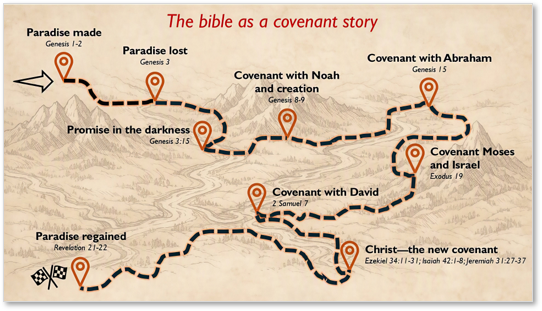
Here’s a map of sorts that shows us this journey. We will begin with the third waypoint or “episode” on this map—the promise to Adam and Eve in the garden, directly after the fall. My intention here is not to explain the entire bible, but to place familiar biblical events into a framework that makes good, natural sense of the bible’s story.
Episode 1: The promise in the garden
Though this is not a covenant, it is the big event which follows right on the heels of “paradise lost.” God promises to send a man, descended from Eve, to destroy Satan (Gen 3:15). This descendant will be injured, but he will crush the serpent’s head. In other words, he will smash the snake and destroy the source of all evil. This promise is immediately in jeopardy when our first parent’s only two children are moved off the board—Cain murders Abel and is banished far away to the east (Gen 4). Where, then, are the children through whom this victorious son will come? God has grace and mercy to provide a new son—Seth.
Episode 2: The covenant with Noah and all creation
As generations pass, the growing human population ignores God’s special promise, and a moral darkness descends. God decides to act (Gen 6:5-8) and “reboots” creation with a dreadful flood that destroys all living creatures, except for a precious few. He orders a righteous man named Noah to build a lifeboat of sorts in which to rescue himself, his family, and various creatures (Gen 6:9-22). After this flood subsides, they exit the boat and the “reboot” begins (Gen 7-9). God makes a covenant to withhold another such judgment, so that there will be a people and a world for the Messiah to rescue (Gen 9:1-17; cp. Mt 1:21), according to the promise God made to Eve in the garden.
Episode 3: Covenant with Abraham and family
Immediately after the global flood, the Noah “reboot” goes off the rails as Noah himself falls into a drunken stupor and Ham disgraces his father and himself (Gen 9:18-29). After the rebellion at Babel (Gen 11:1-9), God scatters men and women across the earth. He chooses one obscure man from nowhere to be the source of blessing to the world—the vehicle to make his promise in the darkness come true (Gen 12:1-3). God made three specific promises to Abraham in Genesis 12:1-3 and confirmed them by way of a covenant in Genesis 15; re-iterated in Genesis 17, and 22, and later to Isaac and Jacob.
This covenant is the fountainhead for all of God’s promises to come. It marks out the Jewish people (those descended from the Abraham-Isaac-Jacob line) as God’s special people, who are promised a specific land of Canaan in which to live, so they can be a blessing to all the families of the earth. This is why the Messiah is the son of Abraham” (Mt 1:1 This covenant is the basis for Mary’s hope (Lk 1:55) and for Zechariah’s, too (Lk 1:72-75).
The raw shape of “paradise regained” is coming into focus—a people, in a land, being a blessing to all the families of the earth.
Episode 3.5: Covenant with Israel at Mt. Sinai
The Lord rescues His special people, Abraham’s descendants, from slavery in Egypt and brings them to their new home to wait for the promise. They agree to a covenant that will teach them how to love him and live holy lives until the Messiah comes (Ex 19:1-9; Deut 18:15-19). Unlike the others, this covenant doesn’t move the story forward. Like an airplane orbiting, waiting for permission to land, God’s people were in a holding pattern waiting for Jesus to arrive. So, God tells them how to live holy lives while they’re waiting.
It established rules and boundaries. Breaking the laws, in and of themselves, did not get you kicked out of the family, but disciplined within it. This covenant taught people about themselves—that they were sinful. It taught people about God—that he is holy and righteous and punishes sin. The ceremonial laws (the sacrifices and such) were object lessons to teach us about Christ. The civil laws (statutes about everyday life) were general principles of righteousness applied to their specific kingdom context. The moral laws were a mirror to show us our true nature, a general restraint on sin, and a vehicle for nudging his people towards greater holiness.
Episode 4: Covenant with David
The conquest and occupation of the Promised Land is haphazard (see the book of Joshua). Many forsake God and go their way, and the High Priest and the judges cannot hold the people of Israel together. While they waited for God’s covenant promises to be fulfilled, God gave his people a king to rule over them who will bring true holiness and justice to us and his world (2 Sam 7:1-17; 1 Chr 17:1-15). He established a dynastic line through a boy named David. He said a man from this line would rule over his people and be his royal representative on earth. God said this king would be like a son to him, and he’d be like a father to the king, “and I will establish the throne of his kingdom forever” (2 Sam 7:13).
Now, our shape of paradise regained is a people, in a particular land, being a blessing to all the families of the earth, ruled over by a king whose reign would never end.
Episode 5: New covenant in Christ
This is the promise of a new shape to our relationship with God, and Jesus is the one who brings this new arrangement to pass. Generations have passed. A civil war has torn God’s people in two, and the dual monarchies of Judah and Israel have betrayed God again and again. Sin abounds. Externalism reigns. Under the looming shadow of an impending exile, God sends word of a new and better hope, built on better promises—a suffering servant who will set everything right (Jer 31:31-40; Ezek 36-37; Isa 52:12-53:13).
This messenger will love God, lead the people in righteousness, and bring a new shape to God’s relationship with his people—one in which all his people have full legal pardon and an interior renovation of their hearts and minds. Our shape of “paradise regained” now looks like a people, in a particular land, being a blessing to all the families of the earth, ruled over by a king whose reign will never end—and all his people are fixed inside and out. This is possible because they have a new and better priest who reconciles believers to God, who is “better” because his work is based on better promises—see the letter to the Hebrews.
So, in the end, we have a promise of a community of “Jesus people,” (Jews + Gentiles) in loving relationship with God, in a new paradise creation, where Genesis 1-2 can come true forever—dominion mandate to exercise creativity, gifts, live happy, eternal lives for God’s glory.
Paradise regained as a four-phase polaroid
The bible’s story ends in Revelation 21-22 with God’s family gathered in a new world, in a new creation. Through Christ, God will have “reconcile[d] all things to Himself, whether things on earth or things in heaven, having made peace through the blood of His cross” (Col 1:20). The core of this are the people + land + be a blessing promises God made to Abraham, augmented by the covenant with David (an eternal king) and the new covenant in Christ (legal pardon + interior renovation). Jesus is the domino which triggers the chain reaction of these covenant promises that he fulfills by the very end of the story—a people, in a real paradise land, ruled by a king, having been cleansed by an interior renovation and been given full legal pardon for their sins.
This “covenant fulfillment domino chain” unfolds in four stages, like a Polaroid that slowly develops—the image becomes clearer as time goes on. This “Polaroid” fades in starting at Matthew 1:1 and concludes at Revelation 22:21 in four main stages:
Phase 1—Gospels. Jesus arrives and announces that he has come to fulfill all the covenant promises—this is the “good news” (Mk 1:15). The right response is to believe and trust in Jesus in order to be counted righteous by God. Jesus even says the kingdom of God—the Messianic golden age that the prophets talk about over and over—is present in him (Mt 11:12; 12:33-30; Lk 17:20-21)—see also parables.
Phase 2—This present evil age. The Jesus family, the church, declares this good news to the world and works to gather a people for him, while promising full legal pardon and interior renovation for all who repent and trust in Jesus. The church receives the Holy Spirit as a paradise “down payment,” which Jesus pours out from on high—where he’s now enthroned as the king of creation. The church is phase two of paradise re-gained—it isn’t a Plan B, or a parallel event. It’s the second phase in God’s one unfolding plan for “paradise remade.” It’s the beginning of Jesus’ multi-national kingdom, focused on the gathering and spiritual salvation + moral renovation of the saints.
Phase 3—Christ’s millennial reign. This is like a “spring training” version of eternal paradise, where Jesus will reign for 1,000 years. This will be a nearly paradise-like kingdom with its base in the land of Canaan, with a great nation of Jewish messengers and evangelists, who are a blessing to all the families of the earth as they preach the good news abroad, with Jesus ruling as king of the world. The covenant promises are all here.
Phase 4—Paradise regained. Spring training now gives way to the regular season, as it were. The great nation + land + be a blessing covenant promises reach their ultimate fulfillment in the one great people of God, in the land of the new creation, with Jesus the “son of Abraham” as the blessing to the nations.
So, we have one story, progressively unfolding from Genesis to Revelation, step-by-step, like episodes in a TV show.
This phased-in approach is slower than what the Old Testament alone would suggest. The Old Testament prophets painted a picture that was pretty simple: the Messiah will show up to fulfill all the covenant promises (land + people + be a blessing + an eternal king and kingdom + permanent legal pardon + interior renovation) and the golden Messianic age will happen. This is what both Mary and Zechariah thought (Lk 1:46-56, 67-80). It’s what Anna and Simeon thought (Lk 2:21-38). It’s what the apostles thought (Acts 1:1-8).
But, the whole New Testament tells us that this “paradise regained” unfolds in a series of gradual phases, like a new housing sub-division. This is likely what is behind Jesus’ indirect reply to the apostle’s question about when he would restore the kingdom to Israel (Acts 1:6). Jesus said: “It is not for you to know times or seasons which the Father has set by His own authority …” (Acts 1:7). He didn’t say they were wrong to expect the whole batch of covenant promises about a new kingdom creation to come true. He just hinted that the Father has his own timetable for these matters—one that evidently rolls out in four progressive phases.
Back to the point
This series of articles is about Israel and the millennium. I’ll now try desperately to reign this back to that topic as we wrap up. The reason why good Christians disagree about Israel’s future and the nature of the millennium is because there are some very different ways to understand the bible’s big story. The way I’ve sketched here, which Craig Blaising has tagged as “new creation kingdom theology” (otherwise known as progressive dispensationalism), is a kind of futurist premillennialism that I think makes plain and logical sense of that story. It’s a way that doesn’t see the church as (a) replacing Israel, or (b) as a temporary side quest that interrupts the Israel story. It sees the people of Israel and the millennium as one critical phase in God’s single progressive plan to fulfill his plain-sense covenant promises and make paradise regained happen.
This means the so-called “mystery of the church” (Eph 3:4-10) isn’t a parenthesis that temporarily interrupts the Israel story, as some dispensationalists have taught—it isn’t a what. It isn’t about Gentiles now being allowed to be part of God’s family, or about the Holy Spirit indwelling believers in a new, unrevealed, and powerful way—God clearly promised both these events in the Old Testament (Isa 56, Joel 2). The New Testament tells us that early Jewish Christians struggled mightily to grasp the implications of this new covenant “leveling.”
So, this mystery of the church is about how God unfolds his big plan (for more, see my article). In Ephesians 1:9-10, the apostle Paul says God has made known to us “the mystery of his will” (Eph 1:9), the goal of which is his arrangement for the fullness of times— “the summing up of all things in Christ, things in the heavens and things on the earth in Him” (Eph 1:10). It’s this “mystery of Christ” that God now reveals in this age, as he had not done before, Because the scriptures which speak about the Messianic age already promised Gentile participation and equality, and a new and powerful coming of the Holy Spirit (again, see Isa 56 and Joel 2), this “mystery of Christ” seems to be about how the Lord will make the new creation kingdom happen—how he’ll sum up everything in Christ, in eternal paradise.
So, this “mystery” is a “plot twist” that shows us a new and unrevealed phase in God’s big plan to create his one “multi-national Jesus people” community for paradise regained. Jesus himself is Phase 1. The church is Phase 2. Jesus’ millennial empire is Phase 3. Paradise regained is Phase 4—when all covenant promises are fulfilled, and we have one people group (Jews + Gentiles) in union/relationship with Jesus forever in the new creation kingdom. The people of Israel do have a future, and that future kicks off during Christ’s millennial reign.
Why do we believe all this—especially the bit about the millennium and God’s promises about Israel’s role in the bible’s “big story”? In the next article, we’ll discuss some basics about how to read the bible the right way, then look at some scripture passages that speak about Israel’s role in God’s plan for paradise regained.
I first encountered T. Desmond Alexander at seminary, years ago, via his tome From Paradise to the Promised Land. It was then I first encountered the theory of “Eden as cosmic temple.” His work From Eden to the New Jerusalemfeatures that same theme. It’s a theme that seems to fill Alexander with starry-eyed wonder.
His aim is to set the whole biblical story into a framework; a story people can understand and “see.”[1] Alexander suggests a helpful framework for seeing Genesis 1-2 and Revelation 21-22 as bookends on the same story. Just as God originally dwelt on earth among men,[2] so the end of the story has God returning to a new and perfect creation to dwell with man once again![3] I had never considered this parallel of “God with us” before. Rather, I had always focused on the old creation/new creation motif.
However, while he makes a promising start, Alexander is less helpful with the details of this framework. Like biblical theologians sometimes do, he falls prey to the siren song of parallel-o-mania and makes incorrect conclusions predicated on illusory evidence. One representative example is his insistence that Adam was a priest in God’s original temple sanctuary.
Adam as a temple priest?
To paraphrase Sen. Diane Feinstein, the documentary hypothesis lives loudly within Alexander.[4] He relies on the work of authors who suggest parallels between the building of the temple and the six days of creation. He believes Genesis 1-2 “reflects matters of priestly interest.”[5] Likewise, Alexander refers the reader to monographs which purport to show parallels between Genesis 1 and dietary regulations in Leviticus and Deuteronomy.[6]
Thus, Alexander sees “a strong basis for believing that the Garden of Eden was envisaged as part of a divine sanctuary.”[7] This assumption is predicated on the idea that Genesis 1-2 was compiled by a later editor in the exilic period and crafted to reflect priestly concerns.[8] But for whom, pray tell, was Adam mediating before sin entered the world? Not to worry, Alexander assures us. “Since no one had yet sinned, there was no need for atonement sacrifices.”[9] It is fair to say this is an inadequate rejoinder!
The Fall, Alexander declares, was when the first couple “fail[ed] to fulfil one of the main priestly responsibilities placed upon them.”[10] What is the basis for this intriguing claim? Well …[11]
God orders Adam to “keep” the garden (Gen 2:15),
and this verb could also be rendered as “guard,”
and the Israelites were later instructed to “guard” the Sabbath (Deut 5:12)
and the Levite priests were to “guard” Aaron (Num 3:7–8; 8:26; 18:5–6),[12]
and so, Adam and Eve were priests.
This is not how language works. You cannot play “gotcha” by drawing a parallel between verb usage without considering context.[13] How about context? Their job was to exercise dominion over creation (Gen 1:26-30). The text says nothing about a priestly role. Yet, to Alexander, dominion (he prefers “viceroy”) is almost an afterthought.[14] The cosmic temple paradigm drives his interpretation.
Indeed, this cosmic temple motif is the prism for understanding Alexander’s project. Everything is related to God wanting a cosmic temple. Eden was a cosmic temple; a “divine sanctuary.”[15] The patriarchs created makeshift, mobile temples when they offered sacrifices.[16] The “arboreal” features in Solomon’s temple hearken back to that original, long-lost “temple” in Eden.[17] Even the colors of fabric in the temple represent the cosmos; they are a model of the cosmic temple to come.[18] On this last point, Alexander meekly admits “the case for this is not beyond dispute …”[19]
Thus, “the fulfilment of God’s creation project requires the existence of priest-kings who will extend God’s temple-city throughout the earth.”[20] Of course, Christ is the ultimate priest-king, and Alexander ably explains this motif in later chapters.
And yet, the Pentateuch:
says nothing about a cosmic temple
says nothing about Adam and Eve being priests
says nothing about Adam and Eve having any reason to mediate anything
says nothing about Abraham constructing a mobile temple sanctuary
identifies no “arboreal” nexus between Eden and Solomon’s temple
says nothing about the temple as a model of the cosmos, and
attributes no significance to the colors of the fabric in the temple
Pastors model bible study by the way they preach. Bible scholars do the same by what they write. With his “cosmic temple + Adam as a priest” motif, Alexander personifies the worst stereotypes about biblical theology, models irresponsible use of the text, and pushes an implicitly allegorical hermeneutic. His book is not recommended.
[1] “… the concluding chapters of Revelation offer a window through which the main themes of the biblical meta-story may be studied,” (T. Desmond Alexander, From Eden to the New Jerusalem [Grand Rapids: Kregel, 2008], p. 7).
[2] “The opening chapters of Genesis assume that the earth will be God’s dwelling place. This expectation, however, is swiftly shattered when Adam and Eve disobey God and are expelled from his presence. While people continue to live on the earth, God’s presence is associated with heaven. From there he occasionally descends to meet with selected individuals, although these encounters are always relatively brief and sometimes unexpected,” (Ibid, p. 15).
[3] “As the book of Revelation reveals, there is yet to come a time when all that is evil will finally be removed from the present earth. At that stage, when God makes all things new, his presence and glory will fill a rejuvenated earth,” (Ibid, pp. 18-19).
[4] Alexander has an extensive analysis of Pentateuchal criticism in general in From Paradise to the Promised Land, 3rd ed. (Grand Rapids: Baker, 2012), pp. 1-112. He declares “… it seems best to conclude that the Pentateuch as a literary whole … eventually took shape in the exilic period. Though the traditions contained within the Pentateuch clearly existed before this time and were obviously viewed both as ancient and authoritative by the final editor of the Pentateuch, it is exceptionally difficult to demonstrate that the Pentateuch itself existed in its entirety as a literary unit before the sixth century B.C.” (Promised Land, p. 109).
Conservatives will find a much more faithful ally in Gleason Archer, A Survey of Old Testament Introduction, rev. ed. (Chicago: Moody, 2012), pp. 36-150.
[5] “Weinfeld suggests that the special interest shown in Genesis 1:14 for feast days, weeks and years, and in Genesis 2:1–3 for the Sabbath, reflects matters of priestly interest,” (Ibid, p. 24).
[6] “Blenkinsopp, picking up on the anthropological studies of Mary Douglas, sees a connection between the division of the cosmos into sky, earth and seas in Genesis 1 and the categorization of animals, birds and fish as clean or unclean in the ‘priestly’ dietary regulations of Leviticus 11:1–47 and Deuteronomy 14:3–21.27,” (Ibid).
[13] It is probable that Alexander’s context is that (as I mentioned earlier) the Pentateuch is an edited document compiled during the exile and deliberately fashioned to reflect the priestly concerns of the so-called “J strand” of material.
[14] “In Genesis 1 – 2 Adam and Eve are endowed with a holy or priestly status that enables them to serve in the temple-garden and have direct access to God. In addition, the human couple are appointed as God’s viceroys to govern the earth on his behalf,” (Ibid, p. 76). Emphasis mine.
[16] “While the various sacrificial sites mentioned in Genesis 12 – 50 are not viewed as permanent sanctuaries, they clearly foreshadow the tabernacle and temple,” (Ibid, p. 32).
[17] “Since the garden is a place where divinity and humanity enjoy each other’s presence, it is appropriate that it should be a prototype for later Israelite sanctuaries. This explains why many of the decorative features of the tabernacle and temple are arboreal in nature,” (Ibid, p. 25).
[18] “… this is conveyed through the use of fabrics that are blue, purple and scarlet in colour, representing the ‘variegated colors of the sky,’” (Ibid, pp. 38-39).