What I read in 2024

What I read in 2024

Here, in no order, are the non-fiction books I read during 2024. I read many of my books while driving to work or running (I spent 225 hours running 1600 miles in 2024).
  1. The Run of His Life: The People v. O. J. Simpson by Jeffrey Toobin.

An exhaustive account of the entire O.J. Simpson saga. If you want a responsible journalistic account, then this is it.

  1. The Work of Christ by G.C. Berkouwer.

A solid and helpful book about just what it sounds like. Refreshingly Reformed.

  1. Nixon: The Life by John Farrell

Extraordinary biography of a very troubled and complicated man. It doesn’t bog down in political minutiae from 50 years ago, but is still substantive. One of the best Nixon biographies.

  1. The Sack of Detroit: General Motors and the End of American Enterprise by Kenneth Whyte

An entertaining story about a bygone era in American manufacturing. The same author later wrote a great biography of Herbert Hoover.

  1. A Man of Iron: The Turbulent Life and Improbable Presidency of Grover Cleveland by Troy Senik

A good biography about a forgotten president. I believe Cleveland is one of the only former presidents without a presidential library.

  1. Who Freed the Slaves?: The Fight over the Thirteenth Amendment by Leonard Richards

A detailed but dry discussion about the legislative effort to pass the 13th Amendment.
  1. William McKinley by Kevin Phillips

An incredibly boring biography. All I remember about this book is that it was really boring. I think McKinley deserves better, but I’m almost too bored to find a different biography.

  1. A Treatise on the Preparation and Delivery of Sermons by John Broadus

A classic on preaching. Good book.

  1. The Interior Castle by Teresa of Avila

Very mystical and contemplative book about prayer. It was interesting. I know a classic book such as this deserves a better write-up, but that’s what I got.

  1. The Creationists: From Scientific Creationism to Intelligent Design, Expanded Edition by Ronald Numbers

One of my favorite books of the year. An engrossing and scholarly look at the rise of scientific creationism–perhaps best represented today by Answers in Genesis and the Institute of Creation Research.

  1. Dispensational Modernisn by Brandon Pietsch

I actually read the PhD dissertation, not the book. But, they’re likely pretty much the same. I’m not sure I buy his thesis that the industrial revolution and its resulting “engineering” milieu contributed to the rise of dispensationalism. But, as a sort of historical take on dispensationalism, it was very interesting.

  1. The Making of American Liberal Theology: Imagining Progressive Religion, 1805-1900 by Gary Dorrien

A wonderful and extraordinarily learned history of the early years of theological liberalism. It’s the first of a three-volume trilogy. I found Dorrien’s definition of liberalism helpful. He sees it as a via media “between the authority-based orthodoxies of traditional Christianity and the spiritless materialism of modern atheism or deism” (xiii). Liberal theology, he charges, “is the idea that Christian theology can be genuinely Christian without being based on external authority” (xiii). Of course, scripture is not the supreme standard for truth in this scheme.
  1. Too Big to Fail: The Inside Story of How Wall Street and Washington Fought to Save the Financial System – and Themselves by Andrew R. Sorkin

If you want to know what happened during the financial crisis in 2007 to 2008, then this is the book for you. Entertaining, with well-drawn sketches of all the major players, this was a wonderfully entertaining book. I fondly recall a 17-mile run I did while listening to this audiobook.

  1. Vietnam: An Epic Tragedy, 1945-1975 by Max Hastings

Wonderful survey of the entire Vietnam war, from French colonialism to the United States exit from the country in 1973, and South Vietnam’s fall in 1975. Max Hastings is a great writer and a responsible journalist.

  1. The King Jesus Gospel: The Original Good News Revisited by Scot McKnight

A short, interesting little book. His big point is that “the gospel” is not the Romans Road. Rather, the “gospel” is the news that Jesus has come to make all the covenant promises in the Old Testament come true. McKnight wants us to use “gospel” correctly, and anchor the call for response in the larger Christian story.

  1. Days of Fire: Bush and Cheney in the White House by Peter Baker

Peter Baker and his wife, Susan Glasser, are great writers. Baker is a political reporter for the New York Times. This is an engaging survey of the entire Bush-Cheney years in the White House, and it’s very well done. The book is not partisan and is scrupulously fair.

  1. Homegrown: Timothy McVeigh and the Rise of Right-Wing Extremism by Jeffrey Toobin

Good book. McVeigh seems like a real loser, and he is receiving he just desserts of his evil deeds in hell right now.

  1. The Shattering: America in the 1960s by Kevin Boyle

A survey of “what happened” in the 1960s that made everything seem to change. Boyle examines three issues: sex, race, and war. Anyone interested in the 1960s and all it portended will find this to be a helpful book. I remember listening to this while running the Capitol City Half-Marathon in Olympia, WA in May 2024!

  1. The Kingdom, the Power, and the Glory: American Evangelicals in an Age of Extremism by Tim Alberta

This is a worthy entry into the new genre that I call “white evangelicalism sucks.” These books are typically from Christians who have been badly burned or disillusioned at what “evangelicalism” has become since the Trump years began. Alberta examines what has happened to the sub-culture of white evangelicalism in the United States and why. There is a strong (and terribly incorrect) tradition of white evangelicals letting political passions overwhelm their faith. This book is very relevant in the way it explores that issue. It pairs well with Russell Moore’s Losing Our Religion, which is another entry into the same new genre.

  1. The Story of Abortion in America: A Street-Level History, 1652-2022 by Marvin Olaskey and Leah Savas

The book is what it sounds like. Helpful and horrifying.

  1. Spurgeon the Pastor: Recovering a Biblical and Theological Vision for Ministry by Geoffrey Chang

Not quite a biography, but more an examination of Spurgeon’s ministry with some gentle lessons for today. A very good book.
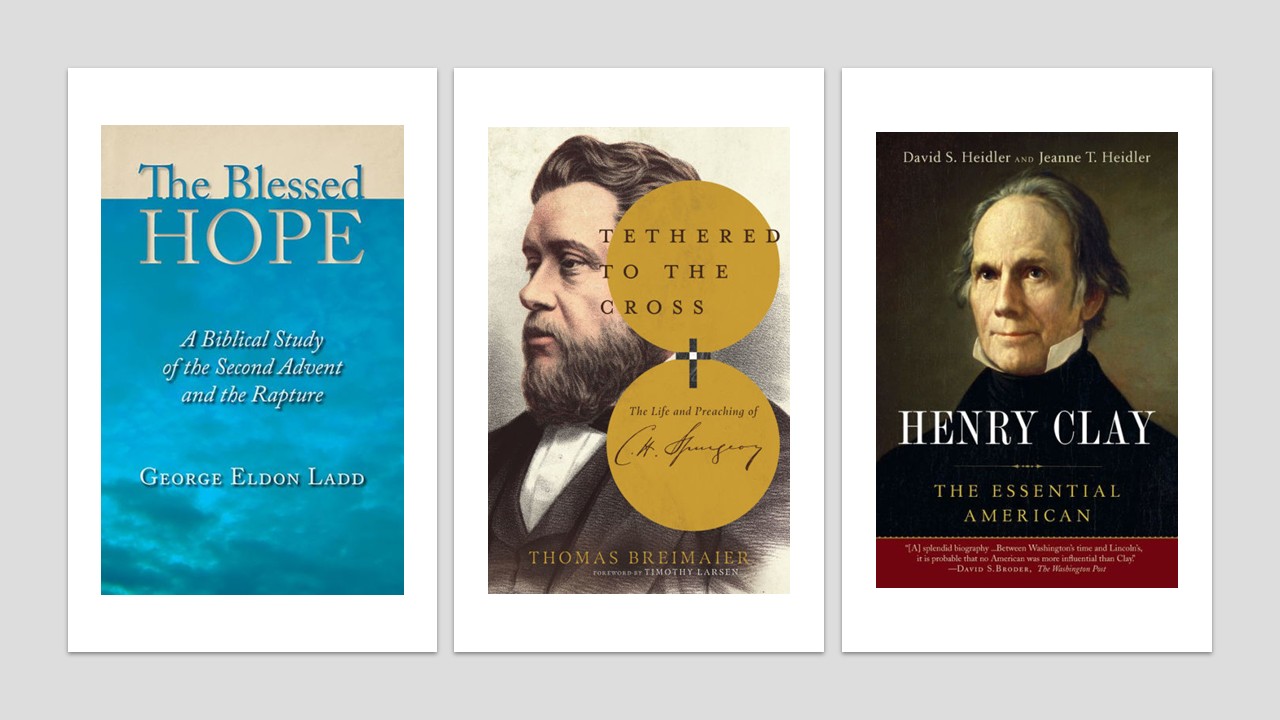
  1. Tethered to the Cross: The Life and Preaching of Charles H. Spurgeon by Thomas Briemaier

Also not quite a biography, but an examination of Spurgeon’s preaching style and substance. This is also a very helpful and enjoyable book.

  1. The Blessed Hope: A Biblical Study of the Second Advent and the Rapture by George Ladd

An outstanding critique of the pre-tribulational rapture position. I’m not saying I believe everything Ladd writes, but I am saying he presents his case very well. Ladd was a classic premillennialist, not a dispensationalist.

  1. Henry Clay: The Essential American by David Heidler and Jeanne Heidler

One of my favorite books of the year. A wonderful and well-written biography of a very important man. Truly, Clay was a man who could and should have been president. But, it never happened for him.

  1. Andrew Jackson: His Life and Times by H.W. Brands

I don’t like Jackson. And, I’m not fond of H.W. Brands’ writing. I can’t explain why I don’t like Brands, but I just get the impression that he’s not a very thorough historian–or, perhaps, he doesn’t communicate much substance. This isn’t necessarily a fair critique, but I’ve read two books by him and I get the same impression from each. Again, I also don’t like Andrew Jackson.

  1. Team of Rivals: The Political Genius of Abraham Lincoln by Doris Kearns Goodwin

I read this book shortly after it first came out, maybe 23 years ago. I read it again now. It has a well-deserved reputation as a classic. It is a substantive history of Lincoln’s presidency, with brief biographies of Lincoln and three of his principal cabinet officials along the way.

  1. The Man Who Ran Washington: The Life and Times of James A. Baker III by Peter W. Baker and Susan Glasser

This was truly one of my favorite books this year. I found Baker to be a fascinating character. From my other reading, I knew he was a key player behind the scenes in the Reagan + Bush + Bush 2.0 orbit, but I knew little about the guy. Baker was a political operative, White House Chief of Staff to Reagan and Bush, Treasury Secretary in Reagan’s second term, and Secretary of State in George H.W. Bush’s administration. A remarkable man. This is a great book.

  1. The Divider: Trump in the White House, 2017-2021 by Peter W. Baker and Susan Glasser

This book paints an accurate and unflattering portrait of Trump’s first administration. It pairs well with Bob Woodward’s books on the Trump presidency.

  1. Lincoln and his Admirals by Craig Symonds

An interesting and very helpful work from a naval historian about Lincoln and the naval war against the Confederacy.

  1. Nimitz at War: Command Leadership from Pearl Harbor to Tokyo Bay by Craig Symonds

Sort of a command biography of Nimitz. It seemed short on details and the authors summary remarks at the end of the chapters seemed a bit forced at times. But, I enjoyed it.
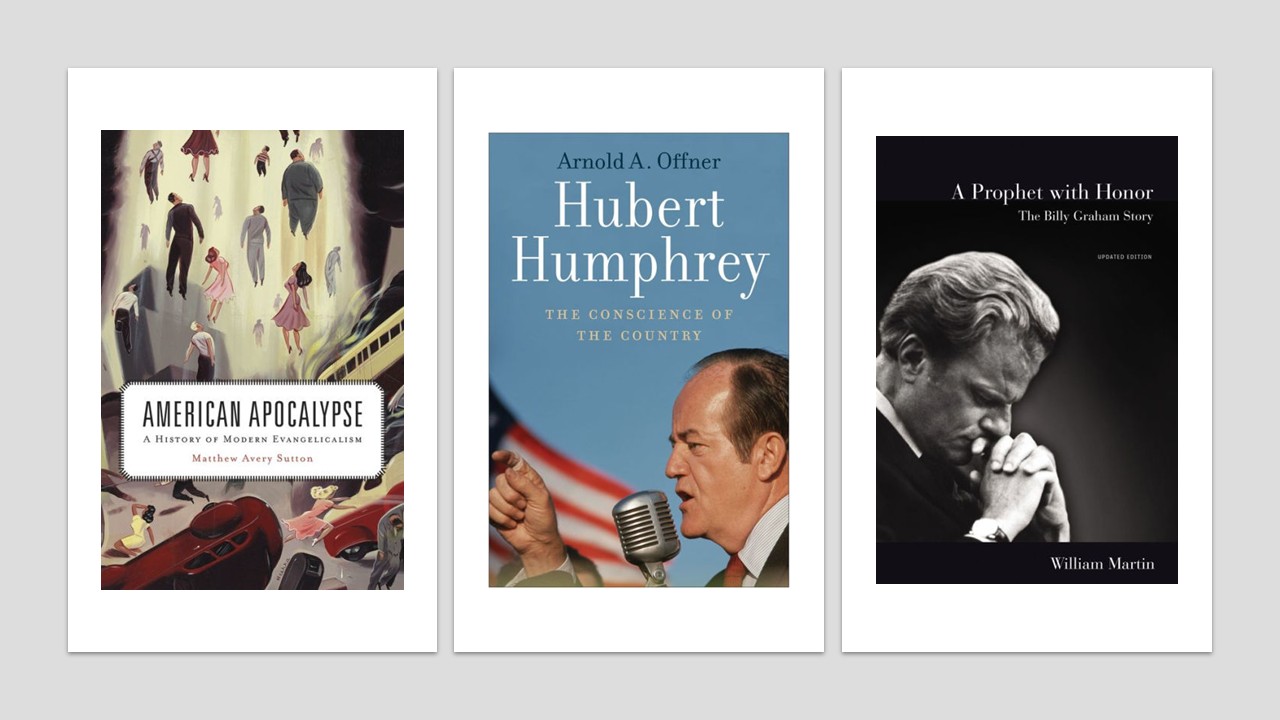
  1. Hubert Humphrey: The Conscience of the Country by Arnold Offner

A very “in the weeds” biography of the great “liberal savior” of the mid-century Democratic party. Humphrey was Johnson’s Vice President, and was defeated in his own run for the office in 1968. The book loses the reader in very wonky policy details. In that sense it’s not a true biography, because his family virtually disappears. But, because the subject is Hubert Humphrey, it’s unlikely a better biography will come around anytime soon.

  1. American Apocalypse: A History of Modern Evangelicalism by Matthew A. Sutton

This is the second time I’ve read the book. This is a good history of evangelicalism.

  1. A Prophet with Honor: The Billy Graham Story (updated edition) by William Martin

A very balanced, insightful, and enjoyable look at perhaps the most popular evangelist in the history of the Christian church. This is a definitive biography. A better one likely won’t be penned. Martin is fair in his analysis. He presents Graham as a man with a simple message; not an intellectual, but content with who he is. I believe the root explanation for Graham’s astonishing success was a special anointing by the Holy Spirit.

  1. America’s Pastor: Billy Graham and the Shaping of a Nation by Grant Wacker

This isn’t exactly a biography, but a look at how Graham impacted the nation as a whole. This is a very valuable and interesting book by a prominent historian of Christianity.

  1. The Battle of Midway by Craig Symonds

Simply the best history of the battle of Midway that’s ever been written. It pairs quite well with Jonathan Parshall and Anthony Tully’s scholarly volume Shattered Sword: The Untold Story of the Battle of Midway. This is probably my favorite book of the year.

  1. Reagan: His Life and Legend by Max Boot

A very good biography of Reagan. I believe Bob Spitz’s Reagan: An American Journey is a superior biography. My opinion of Reagan hasn’t much changed–he was a bad administrator and a kind, decent, but shallow man who could give a very good speech. If you’re interested in the hagiography that has enveloped Reagan as a patron saint of the GOP, then look elsewhere. If you’re interested in a scholarly biography that’s non-partisan but fair, then Max Boot’s volume is one of the best available.
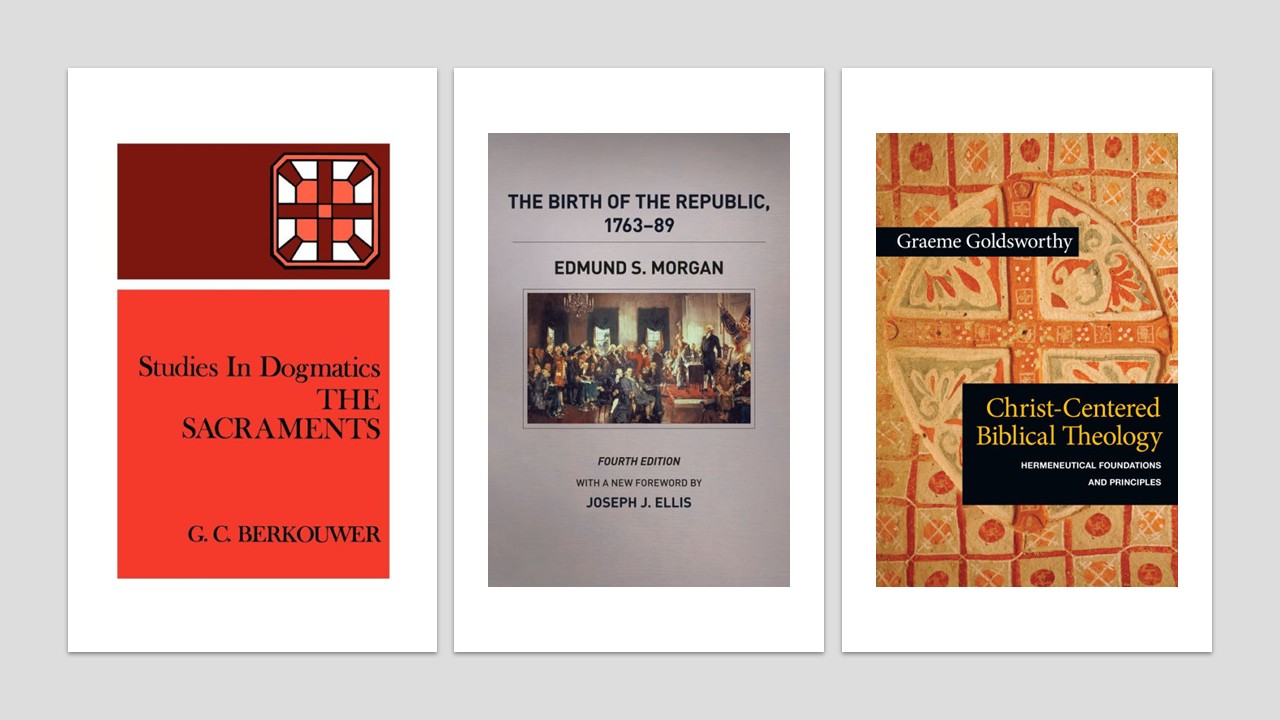
  1. The Birth of the Republic: 1763-1789 (4th ed.) by Edmund S. Morgan

A short, classic, but very boring book by a dean of Revolutionary period studies.

  1. The Sacraments by G.C. Berkhouwer

Solid and helpful book by Berkouwer. There should have been more interaction with scripture instead of creeds and confessions, but not everyone can be a Baptist!

  1. Christ-Centered Biblical Theology: Hermeneutical Foundations and Principles by Graeme Goldsworthy

This book is less a positive case for Goldworthy’s own method (though it is that), than a defense of biblical theology in general. I’m not really sold on Goldworthy’s structure for biblical theology–I think he flattens things a bit by not using the covenants as the skeleton for the bible’s story. However, I especially appreciated his emphasis on how, after Solomon’s failure, the prophets almost universally pivoted and re-capitulated the previous promises. Goldsworthy wishes away the promises to Israel far too much for my (and the bible’s) tastes, but his emphasis on Christ as the typological key to the bible’s story is well taken.
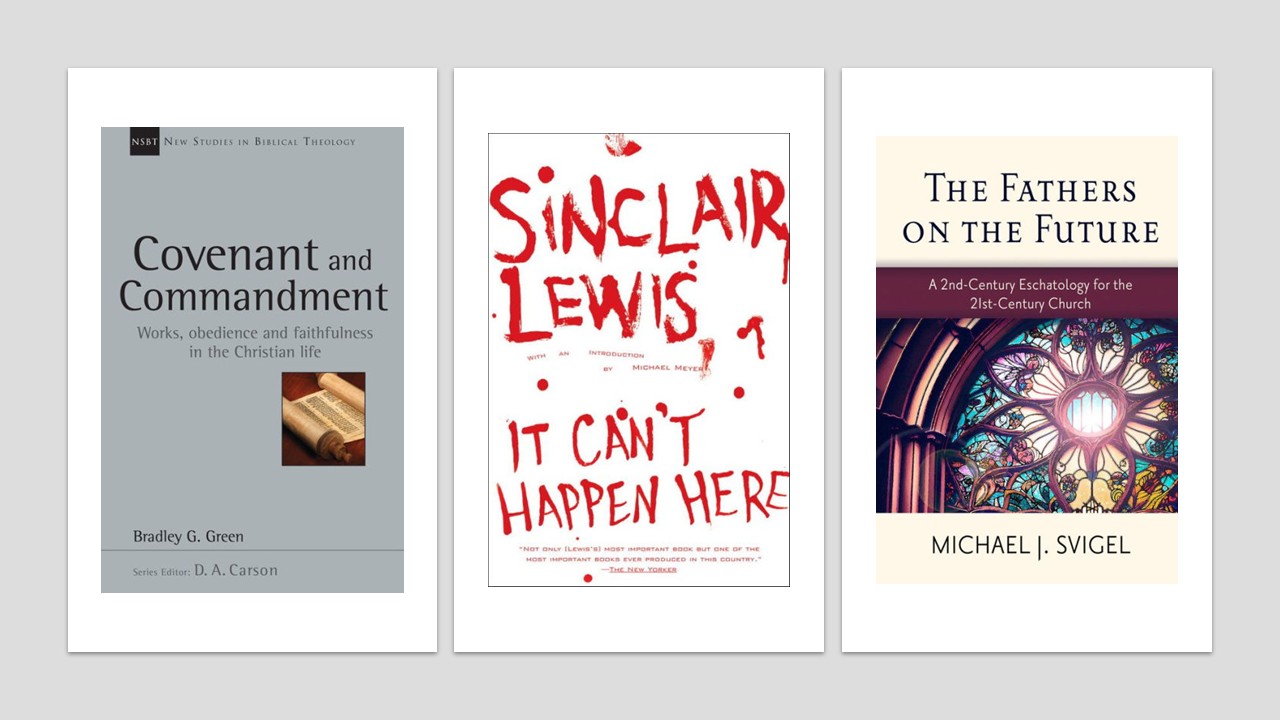
  1. Covenant and Commandment: Works, Obedience and Faithfulness in the Christian Life by Bradley Green

I’m not sure what to make of Green’s book. At the end of the whole thing, I learned nothing. Good works are the inevitable and necessary fruit of genuine salvation. I knew that before I read the book. So … the book was interesting but completely unnecessary. It might help someone who comes from a more antinomian background, or perhaps from a free grace perspective.

  1. Fathers on the Future: A 2nd Century Eschatology for the 21st Century Church by Michael Svigel

A very interesting and accessible defense of premillennialism from a scholar who teaches at Dallas Theological Seminary. I feel the publisher did Svigel wrong by forcing him to cut the meat out of the book and publish them as excurses on his own website. Svigel is a dipensationalist, but this book is really a defense of general premillennialism, using Irenaeus as his guide.

  1. It Can’t Happen Here by Sinclair Lewis

I don’t think Lewis was a good writer. His characters are thin and his writing tone is distracting. This is a classic fiction book from 1935 about America electing a fascist as president, who quickly turns the country into a police state. The evil president was clearly modeled on Huey Long. Many contemporary critics see parallels to Donald Trump, but it’s doubtful that Trump is as competent as Berzelius Windrip.

  1. The Death of American Virtue: Clinton vs. Starr by Ken Gorman

Am exhaustive, fair account of the Clinton impeachment saga. The Office of Independent Council disgusts me. I think Starr went way beyond his brief and harmed this country by pursuing a sitting President on a dumb perjury charge. I was very angry as I read the book. Starr was out of line and he disgraced himself. I think Hillary Clinton was correct about this particular “vast, right-wing conspiracy” intent on taking Bill Clinton down.

  1. Baptist Battles: Social Change and Religious Conflict in the Southern Baptist Convention by Nancy Ammerman

A sociological study of the “Baptist battles” of the conservative resurgence during the early 1980s. Very interesting.

  1. Calvin by Bruce Gordon

A great biography of John Calvin by a Yale church historian. Christians often prefer biographies of “great Christians” to be glossy, syrupy, and shallow. They often cry foul when a biography dares to document that the “great man” was, in fact, very human. This is a fair, scholarly biography of a flawed by important man. Calvin’s Institutes of the Christian Religion is a masterwork in Christian theology. Calvin was not a competent movement leader, and he ministered in a very unbiblical context in a sacral society. His chief legacy is his writings. This is a very important book about a very important man.

  1. Salvation with a Smile: Joel Osteen, Lakewood Church, and American Christianity by Phillip Sinitiere

A scholarly book about the pastor of the largest church in North America. If you want to know about Joel Osteen, don’t go to YouTube. Read this book.

  1. John Adams: A Life by John Ferling

A great John Adams biography. I don’t like John Adams. He virtually abandoned his family for years on end. He was driven by deep insecurities. All told, I view Adams as a little prig with “short man” syndrome. I don’t think he was an admirable guy, and I agree with the author that he fell short of being a “great man.”

  1. The Big Question: Why We Can’t Stop Talking About Science, Faith and God by Alister McGrath

A popular-level book by McGrath about how to integrate faith, science, and reason. It was good and interesting.

  1. Iustitia Dei: A History of the Christian Doctrine of Justification (4th ed.) by Alister McGrath

A magisterial and very helpful look at how “justification” has been understood in the Christian church down through the centuries.

  1. G-Man: J. Edgar Hoover and the Making of the American Century by Beverly Gage

One of my favorite biographies I’ve read. A great and entertaining book about a man who is poorly understood. Hoover was the ultimate bureaucrat, and not always in a bad way. A true “government man” and a master administrator.

  1. Paradise Regained by John Milton

This is the lesser-known (and much shorter) companion piece to Paradise Lost. Very interesting work.

  1. Kingdom through Covenant: A Biblical-Theological Understanding of the Covenants (2nd ed.) by Peter J. Gentry and Stephen J. Wellum

The definitive work on progressive covenantalism. I enjoyed it very much and I think the basic scheme is correct. I also believe the typology can go too far and wash away God’s promises to the nation of Israel, but I believe there is room for a premillennial vision within this larger scheme. A great book. Very insightful.

Kill the lecture! A better way for preaching?

Kill the lecture! A better way for preaching?

Abraham Kuruvilla’s A Vision for Preaching is a wonderful, refreshing book. I am aware this is at odds with my lukewarm review of his contribution to Hermeneutics and Homiletics. In fact, Kuruvilla’s essay in that volume is a precis of this book. This book is much better.

Kuruvilla’s work is an exposition of one statement:[1]

Biblical preaching, by a leader of the church, in a gathering of Christians for worship, is the communication of the thrust of a pericope of Scripture discerned by theological exegesis, and of its application to that specific body of believers, that they may be conformed to the image of Christ, for the glory of God—all in the power of the Holy Spirit.

I will focus on two aspects; (1) the thrust of the passage,[2] and (2) how to apply scripture.

The sermon—bullet or buckshot?

Like many pastors, I read Haddon Robinson’s book Biblical Preaching at seminary. In that classic tone, Robinson explained his “big idea” approach to preaching:[3]

A major affirmation of our definition of expository preaching, therefore, maintains that ‘expository preaching is the communication of a biblical concept.’ That affirms the obvious. A sermon should be a bullet, not buckshot. Ideally each sermon is the explanation, interpretation, or application of a single dominant idea supported by other ideas, all drawn from one passage or several passages of Scripture.

Kuruvilla is against this approach. The sermon, he argues, is not an argument in service to a particular “point” in the text. That is the “old” homiletic,[4] where “the point” drives the structure of the sermon:[5]

Craddock’s wry observation (noted earlier) in this regard is worth repeating: ‘The minister boils off all the water and then preaches the stain in the bottom of the cup.’ Thereby, sermons turn out to be ‘didactic devices,’ more about arguments to persuade listeners to buy into these propositions, and less about texts and what they (or their authors) are doing. All this may even imply that once one has gotten the distillate of the text, that is, the reduction of the text into one or more propositions, one can abandon the text itself.

This, Kuruvilla, insists is not the way. Instead, the sermon is about what the author is doing with the passage. The preacher is a tour guide, a docent,[6] and his role is to point out what the biblical author is doing with the text—not to re-package it into a “point” or “big idea” to be argued to the congregation.[7] The text is not a plain glass window the preacher points through towards some “big idea” beyond. Rather, it is a stained-glass window the reader must look at.[8]  

So, Kuruvilla argues, the author is doing something with the text. There is a layer behind the onion of the simple words. For example, pretend my wife says, “the trash is full!” She is indeed telling me the trash is full, but she really wants to move me to action—she wants me to take the trash out![9] So, Kuruvilla’s point is there is no “big idea” or “big argument” or “series of points.” There is only the preacher as tour guide, showing what the author is doing, in his context.

Application

This means, for Kuruvilla, application is always based on the theology of the passage.[10] “Specifically, the ‘theology’ in the “theological hermeneutic” proposed here is pericopal theology, not biblical or systematic theology.”[11] Each text has a message for God’s people. It might be more than one “big idea.” Whatever the passage communicates, whatever the author is doing with his message, that is the basis for application.[12]

Ironically, Kuruvilla manages his best explanation of his view (his “Big Idea,” perhaps!) in an academic article, not in this book:[13]

What is needed in the pulpit, then, is a creative exegesis of the text undertaken with a view to portraying for listeners what the author is doing—pericopal theology—enabling their experience of the text + theology.

The sermon is not a lecture; “my three points this morning are on the screen!” The sermon is where the pastor pulls back the curtain and show what he found behind it in his own study.[14] This is the great challenge—to structure sermons in an engaging, inductive way to let the congregation “see” the theology of the passage.

Kuruvilla’s book is a tour de force. It is a breath of fresh air from the redemptive-historical and other biblical theology approaches that seek to impose a framework for application into each text. Bryan Chapell recommends we use “gospel glasses” to see redemption in every text.[15] This is incorrect—some passages just are not about redemption, and to make them so will rip them out of context.


[1] Abraham Kuruvilla, A Vision for Preaching: Understanding the Heart of Pastoral Ministry (Grand Rapids: Baker, 2015), p. 7. 

[2] I will routinely use the phrase “passage,” whereas Kuruvilla prefers “pericope.” His definition is more expansive than normal. “Though the term is usually applied to portions of the Gospels, I use it in this work to indicate a slice of text in any genre that is utilized in Christian worship for preaching. In other words, a ‘pericope’ is simply a preaching text, regardless of genre or even size. It is through pericopes, read and exposited in congregations as the basic units of Scripture, that God’s people corporately encounter God’s word,” (Ibid, p. 116).

[3] Haddon Robinson, Biblical Preaching, 2nd ed. (Grand Rapids: Baker, 2001), p. 35. 

[4] “The modus operandi of the ‘old’ homiletic is to put the text through a grinder and then preach, in points, the pulverized propositional products that come out of the contraption,” (Kuruvilla, Vision, pp. 95-96).

[5] Ibid, p. 99. 

[6] “… we must reconceive the role of preachers. I propose the analogy of a curator or docent guiding visitors in an art museum through a series of paintings Each text is a picture, the preacher is the curator, and the sermon is a curating of the text-picture and its thrust for the congregants, gallery visitors. A sermon is thus more a demonstration of the thrust of the text than an argument validating a proposition. A creative exegesis of the text is undertaken in the pulpit with a view to portraying for listeners what the author is doing. The sermon unveils the author’s agenda. The distillation of the text into points and propositions is thereby obviated. Instead, as Long describes, the preacher is a “witness” of the text, to the text—equivalent to my analogy of the preacher being a curator of the text-picture,” (Ibid, pp. 103-104).

[7] “Thus, for the longest time, preaching has been conducted as a forensic argument that proves the putative proposition of the text for the congregation—an act of reasoning, a parceling of information, and an appeal to the cognitive faculties of listeners to bring them to a rational conviction about that proposition,” (Ibid, pp. 100-101). 

[8] Abraham Kuruvilla, “Time to Kill the Big Idea?” in JETS 61.4 (2018), 831.  

[9] This is actually Kuruvilla’s own hypothetical example from his conversation with Hershel York on York’s Pastor Well podcast. “Episode 36: Abraham Kuruvilla discusses hermeneutics and the gift of singleness,” (19 August 2019). Retrieved from https://equip.sbts.edu/podcast/episode-36-abraham-kuruvilla-discusses-hermeneutics-gift-singleness/.

[10] “What the pericope affirms in its theology forms the basis of the subsequent move to derive application,” (Kuruvilla, Vision, p. 121).  

[11] Ibid.

[12] Ibid, p. 122. 

[13] Kuruvilla, “Big Idea,” 842.  

[14] Ibid, 843.  

[15] “A preacher who asks the following basic questions takes no inappropriate liberties with a text: What does this text reflect of God’s nature that provides redemption? What does this text reflect of human nature that requires redemption?” (Bryan Chapell, “Redemptive-Historic View,” in Homiletics and Hermeneutics, ed. Scott Gibson and Matthew Kim [Grand Rapids: Baker, 2018], p. 16).

Dangerous Calling? Yes.

Dangerous Calling? Yes.

Paul Tripp’s book Dangerous Calling: Confronting the Unique Challenges of Pastoral Ministry is an invitation to pastors to examine their hearts, and it is excellent. It is what Richard Baxter wished he could he done, had he not been such a self-righteous bore. Tripp has a counseling ministry and travels regularly, seeing churches and leadership teams up close and personal nearly 40 weeks per year. Before he wrote this book, Tripp often taught these same themes at pre-conference events for pastors. He explains the genesis of this book:[1]

When I finished and came off the platform, a long line of concerned and broken pastors formed in front of me. About five pastors down the line stood a man who wept his way toward me. I think I could have set up a counseling office for two weeks, full-time, and still not have ministered to all the needs that stood before me. It was at this conference that I determined that I would speak to these issues and do all that I could to minister to my fellow pastors. This book is the result of that clear moment of calling.

Tripp’s book falls neatly into three sections; (1) pastoral culture generally, (2) forgetting who God is, and (3) forgetting who you are. He explains what he wants the book to achieve:[2]

This is a diagnostic book. It is written to help you take an honest look at yourself in the heart- and life-exposing mirror of the Word of God—to see things that are wrong and need correcting and to help you place yourself once again under the healing and transforming power of the gospel of Jesus Christ.

Throughout, Tripp offers personal anecdotes of failure and doubt to emphasize that he is not standing above the fray, sniping at busy pastors. He has been there. He has seen it. He has experienced it. He has failed. This is why his message is effective. Tripp empathizes and encourages you to be better.

This book is written to confront the issue of the often unhealthy shape of pastoral culture and to put on the table the temptations that are either unique to or intensified by pastoral ministry. This is a book of warning that calls you to humble self-reflection and change. It is written to make you uncomfortable, to motivate you toward change.[3]

Indeed, Tripp’s work is essentially a modern-day The Reformed Pastor, only his work is actually helpful. Baxter, on the other hand, sneers at you, grinds your face into the mud with a polished jackboot, then screams at you about Christ (see my review of Baxter’s The Reformed Pastor here).

This review will focus on two particularly great chapters from Tripp, and one problem that is perhaps not his fault, but still a bit jarring.

His third chapter, titled “Big Theological Brains and Heart Disease,” is outstanding. Tripp discusses people he calls “theologeeks.” These are academic pastors who have little patience to deal with real people, and prefer to revel in scholasticism. “They love the academy and would unwittingly drag the academy into the local church and preach sermons that are more theological lectures than gospel meditations.”[4]

Tripp recounts what happened during one of his practical theology courses at Westminster Theological Seminary:[5]

I was recounting my own heart struggle, when I had been asked yet again to visit a man who had already eaten up much of my pastoral time and energy, when one of my students raised his hand and blurted out, “All right, Professor Tripp, we know that we will have these projects in our churches. Tell us what to do with them so we can get back to the work of the ministry!”

There are many things to pay attention to in his statement, but notice this: he didn’t even call the struggling people, to whom we are all called to bring the gospel, “people.” To him they were projects, that is, obstructions in the way of his definition of ministry. Now, if these people are not the focus and object of ministry, then what is ministry? There was no love for people in this student’s statement, and if there was no love for people in his vision of ministry, then it is safe to conclude that there was little operational love for Christ either. He was like many other idea, technology-of-theology guys who populated so many of my classes.

This is astonishing behavior. One wonders how a young man could ever ask such a question. One immediately wonders if this man is connected to local church ministry in any meaningful way. No person who is “in the trenches” could ever dismiss real people so flippantly as “projects” who detract from “real ministry.”

Tripp goes on to lament the “systemic”[6] problem he sees in seminary training, which is an icy intellectualism. “Have we accomplished our training task if we produce generations of graduates who have big theological brains but tragically diseased hearts? Must we not hold together theological training and personal transformation?”[7]

Seminary professors used to be experienced churchmen, Tripp writes, but increasingly they are now academic specialists who beget more people just like them. “So the energy in the classroom was not cloning a new generation of pastors but cloning experts in apologetics, ethics, systematics, church history, and biblical languages. It has been a subtle but seismic change in the culture of the seminary and the kind of results it produces.”[8]

I have seen this in myself. This is actually the thing I fear most about myself; an icy intellectualism that freezes out joy. I am naturally a nerdy person, and am currently reading Emil Brunner’s Dogmatics at bedtime for fun. I think of sermons I preached years ago, and shudder. I look at sermon notes from those days, and recoil in horror. They are running commentaries, not sermons.

I also fear I compensate too much by going in the opposite direction, by not going deep enough in my preaching. I had a recent conversation with another pastor. The man spoke with joy about the chiastic structure in a psalm he would preach for an upcoming mid-week service and how Hebrew wordplay reminded him of something from Exodus. I thought of the people in the congregation where I serve and thought, “People are in debt. People have bad marriages. People are tired. On Wednesday evenings, they don’t need to care about chiastic structure. They just need God’s word to help them get through the week.” Am I wrong? Have I become subtly anti-intellectual?  

In his 12th chapter, “Self-Glory,” Tripp asks us to think about whether we are subtly worshipping ourselves. He presents a hypothetical pastor and writes:[9]

He was convinced that most of the strategic things that needed to be done would be best done by him. Fewer and fewer people were commissioned to do ministry tasks. No, fellow leaders were more and more tasked with support duties because the larger ministry duties were all done by him.

This was particularly hard hitting, because I tend to be a perfectionist. Am I this way because I think I am better than anyone else? Tripp asks, “Where do you attempt to control things that you don’t need to control? Where do you find it hard to delegate ministry to others?”[10] This introspection of mine demonstrates just how well Tripp succeeded in penning a diagnostic book for pastors.

The one grouse I have with Tripp is that he ministers in larger and wealthier context than most pastors will ever see. He exists in the realm of the megachurch, or at least the very large church. This makes his attempts to “relate” strained and artificial at times. For example, Tripp rightly criticizes pastors for phoning in mediocre sermons, then writes:[11]

… I can’t have a fresh encounter with the truths I am to communicate from a particular portion of Scripture on the week that they are to be preached. A week does not give me enough content and communication time. I work ahead to prepare to preach wherever I am called. This means that when I prepare the content of a message, it is the message that I’ll be preaching in three or four weeks. This gives time for truths to marinate in my own heart and become more deeply and practically understood. On the week that the sermon is to be preached, I preach it aloud to myself some fifteen or twenty times. As I do this, both my understanding of the passage and the creative ways it can be communicated deepen and develop.

This is a world the ordinary pastor will never experience. Tripp has apparently never had to preach or teach several times per week, help troubleshoot problems in the soundbooth, field questions about Zoom issues and work a day job … all at the same time. Tripp clearly has time on his hands, so his anecdote here is not helpful.

In another section, he introduces a hypothetical burned out pastor. Solemnly, Tripp writes “[t]he door to his office was shut more now than it had been, and he delegated more of his duties to his executive pastor.”[12]

An executive pastor? Any shepherd of a smaller, ordinary church will surely laugh out loud. Where can I find one of these “executive pastors” to whom I can delegate work!?

These quibbles aside, Tripp’s book is excellent. It fulfills its quest to be a diagnostic tool for busy pastors. It makes you think. It makes you examine your heart. It encourages. It is refreshing. Sadly, perhaps the best recommendation for this book is that James MacDonald, Joshua Harris, and Tullian Tchividjian are among the seven pastors who penned jacket endorsements. Each crashed, burned, and left his ministry since Tripp’s work was published.  


[1] Paul Tripp, Dangerous Calling: Confronting the Unique Challenges of Pastoral Ministry (Wheaton: Crossway, 2012), 32. 

[2] Ibid, p. 11. 

[3] Ibid, pp. 11-12. 

[4] Ibid, p. 44. 

[5] Ibid.  

[6] Ibid, p. 46. 

[7] Ibid, p. 52. 

[8] Ibid, p. 53. 

[9] Ibid, p. 169. 

[10] Ibid, p. 170. 

[11] Ibid, p. 149. Emphasis mine.

[12] Ibid, p. 125. 

Baxter and “The Reformed Pastor”

Baxter and “The Reformed Pastor”

Richard Baxter’s work The Reformed Pastor was first published in 1656 and is commonly considered a classic. Many seminaries recommend the book, and most pastors with graduate training are aware of it. J.I. Packer penned the introduction for the Banner of Truth edition, and after studying the work one can appreciate why Packer was forced to acknowledge the following:[1]

… Baxter was a poor performer in public life. Though always respected for his godliness and pastoral prowess, and always seeking doctrinal and ecclesiastical peace, his combative, judgmental, pedagogic way of proceeding with his peers made failure a foregone conclusion every time … his lifelong inability to see that among equals a triumphalist manner is counter-productive was a strange blind spot.

Packer called it like a fortune-teller. Some guys know how to encourage pastors. Baxter knew how to take a tomahawk to your skull and tell you he was there to help.

Baxter’s text was to be delivered at a pastor’s meeting in December 1655, but he was “disabled from going thither” and fashioned his remarks into what became The Reformed Pastor.[2]His aim was to encourage pastors to be more diligent by exposing “the sins of the ministry.” Baxter, anticipating angry howls from his peers, launched a defensive salvo by proclaiming “plain dealers will always be approved in the end; and the time is at hand when you will confess that they were your best friends.”[3] It is fair to assume Baxter did not have many Facebook friends.

Baxter’s burden was to demonstrate that pastors were generally lazy and undiligent and must become diligent. In short, he wished to consider how to stir pastors up to good works. He explained the book’s outline:[4]

I wish to propose the following method:

First, To consider what it is to take heed to ourselves. Secondly, To show why we must take heed to ourselves. Thirdly, To inquire what it is to take heed to all the flock. Fourthly, To illustrate the manner in which we must take heed to all the flock. Fifthly, To state some motives why we should take heed to all the flock. Lastly, To make some application of the whole.

This list is deceptive, however, because this “application of the whole” takes up approximately 50% of the text (pp. 133-256) and is quite tedious. Like a pastor who re-preaches his sermon during the conclusion, Baxter circles the airport like a wounded 747 and never quite “lands” his plane.

Baxter says much that is good. Unfortunately, he lacked a good editor. The book is perhaps 50% too long. Guilt trips make up perhaps 80% of the book. They are very helpful for the first 20%. Then, they get annoying. Then, they make you feel worthless. Then, one begins to really dislike Baxter.

He explains Pastors must guard their own hearts:[5]

If it be not your daily business to study your own hearts, and to subdue corruption, and to walk with God – if you will not make this a work to which you constantly attend, all will go wrong, and you will starve your hearers …

Baxter shows prophetic powers when he rails against hypocrisy. “What a difference was there between their pulpit speeches and their familiar discourse? They that were most impatient of barbarisms, solecisms, and paralogisms in a sermon, could easily tolerate them in their life and conversation.”[6] He could be referring to social media!

Pastors must look after every member of the flock, even if means downsizing or securing assistance and taking a pay cut. “If you say, that is a hard measure, and that your wife and child cannot so live, I answer, Do not many families in your parish live on less?”[7]

He warns:

We must carry on our work with patience. We must bear from many abuses and injuries from those to whom we seek to do good. When we have studied for them, and prayed for them, and exhorted them, and beseeched them with all earnestness and condescension, and given them what we are able, and tended them as if they had been our children, we must look that many of them will requite is with scorn and hatred and contempt, and account us their enemies, because we ‘tell them the truth.’

In all, the first half of Baxter’s book is ponderous but helpful. It convicts. It exhorts. It helps. Here, in this paraphrase of Baxter’s outline for “motives to the oversight of the flock,” we see a representative sample of this qualified praise:[8]

  1. Pastors are overseers of the flock
    • You must therefore take heed to the flock
    • You agreed to be a pastor, so suck it up and do your job[9]
    • You have the great honor to be an ambassador for the gospel, so go do it
    • Do not take the blessings of your pastoral position for granted
    • Be found faithful
  2. The Holy Spirit made you a pastor, so “take heed to it”
  3. How could you be unfaithful to the Church of God?
  4. Christ purchased the Church with His blood, so “shall we despise the blood of Christ?”

This cycle of (1) assertion of sin, then (2) exhortation to be faithful repeats over and over. But, by the time Baxter turns to “make some application of the whole,” the book is only halfway over. What new information does Baxter impart?

His focus is on catechizing. “I shall now proceed to exhort you to the faithful discharge of the great duty which you have undertaken, namely, personal catechizing and instructing every one in your parishes or congregations that will submit thereto.”[10] However, this emphasis is of little use to Baptist pastors who believe the New Covenant is only for regenerate believers.[11] At once, the object of his exhortations have been rendered moot for Baptist ministers, who are forced to make general application only.

Baxter begins the application section by spending 39 pages trying to convince pastors to repent of their sloth.[12] “What pains do we take to humble them, while we ourselves are unhumbled!”[13] In short, he beats a dying horse with gusto and drove this pastor to personal despair.

One is tempted to shout at the book, “Yes, I admit I’m not the best pastor ever! Leave me alone, Saint Baxter!” It is doubtful a sentient being has yet lived who would not melt under Baxter’s steely Puritan gaze. Again, a paraphrased outline makes the point:

  1. We have great pride (9 pages)
  2. We are lazy (4 pages):
    • “If we were duly devoted to our work, we should not be so negligent in our studies.”[14]
    • “If were heartily devoted to our work, it would be done more vigorously, and more seriously, than it is by most of us.”[15]
    • “If we are heartily devoted to the work of God, why do we not compassionate the poor unprovided congregations around us, and take care to help them find able ministers …?”[16]
  3. We are too worldly (6 pages):
    • We wed ourselves to whatever political party happens to be in power.
    • We do not speak the truth because it will harm our interests.
    • We hoard our money and are not charitable.
  4. We are sectarian (12 pages).
  5. We do not exercise church discipline (4 pages).

If this were not enough, after a brief discussion of how to catechize,[17] Baxter circles the airport once again in his 747 with 17 pages of “motives from the necessity of this work” and “applications” thereof, in which he largely repeats himself. These pages are filled with exhortations that have grown annoying (and worse) by their incessant repetition:

And if you pity them, will you not do this much for their salvation?[18]

Oh what a dreadful thing it is to answer for the neglect of such a charge! and what sin more heinous than the betraying of souls?[19]

What cause have we to bleed before the Lord this day, that we have neglected so great and good a work for so long …?[20]

And now, brethren, what have we to do for the time to come, but to deny our lazy flesh, and rouse up ourselves to the work before us.[21]

After continuing in this vein, Baxter summons a crescendo of 15 itemized “condemnation[s] that is like to befall negligent pastors.”[22] Baxter assures us that (among other things) our parents will condemn us, our training will condemn us, “all that Christ hath done and suffered for” will condemn us, all Scripture “will rise up and condemn us,” and all our sermons will condemn us.

Baxter is clearly a man with a burden. Unfortunately, his burden for catechizing is not applicable for Baptist ministers. Because he held to Presbyterian polity and came from a “State church” context, Baxter assumed the members of his “parish” were New Covenant members because they had been baptized. Baptists believe only believers are New Covenant members. Where Baxter wanted to catechize, Baptists would evangelize.

Also, his attempts at exhortation degenerate into guilt trips from overuse, and his entire work has a superior, snobby sort of air to it. It cannot be described. It must be experienced. To this bi-vocational pastor, it largely increased feelings of inadequacy that were already present. I will not read it again and would never recommend it. As the learned archeologist Dr. Henry Jones often remarked in a different context, “it belongs in a museum.”


[1] Richard Baxter, The Reformed Pastor (reprint; Carlisle: Banner of Truth, 2012), 10-11.  

[2] Ibid, 38.  

[3] Ibid, 39.  

[4] Ibid, 52.  

[5] Ibid, 62.  

[6] Ibid.  

[7] Ibid, 91-92.  

[8] Ibid, 124-132.  

[9] “Consider that it is by your own voluntary undertaking and engagement that all this work is laid upon you. No man forced you to be overseers of the Church. And doth not common honesty bind you to be true to your trust?” (Ibid, 127).  

[10] Ibid, 172.  

[11] Some dispensationalists believe the New Covenant has no application to the Church. I will not engage that position, here.

[12] Baxter, Reformed Pastor, 133-172.  

[13] Ibid, 133.  

[14] Ibid, 146.  

[15] Ibid, 147.  

[16] Ibid, 150.  

[17] Ibid, 172-194.  

[18] Ibid, 198.  

[19] Ibid, 199.  

[20] Ibid, 200.  

[21] Ibid, 202.  

[22] Ibid, 205-211.  

Baxter and his tomahawk

Baxter and his tomahawk

This is my quick take on Richard Baxter’s The Reformed Pastor.

Everybody says it’s great. I’m not sure how many of those people have actually read it. Baxter was a Puritan who died in 1691. He spends most of the book explaining that you’re a failure and a loser if you don’t completely dedicate yourself to pastoral ministry. That’s fine so far as it goes, but Baxter likes to make sure you get his point.

He has this gem I’ll never forget (p. 127):

Consider that it is of your own voluntary undertaking and engagement that all this work is laid upon you. No man forced you to be overseers of the Church.

Thanks, Dick. I needed that.

Guilt trips make up perhaps 80% of the book. They’re helpful for the first 20%. Then, they get annoying. Then, they make you feel worthless. Then, you begin to REALLY dislike Baxter.

The last 15% of the book are detailed instructions about how to catechize a parish of mostly unregenerate people, which is largely inapplicable in a context where you believe the New Covenant is only for actual believers.

So, what do I think about Baxter? I think he’s a depressing guy. Comes across as self-righteous, but earnest. Book was a disappointment, and I’ll never read it again. Some guys know how to encourage. Baxter knew how to take a tomahawk to your skull and tell you he’s there to help.

This is the Cliff-Notes version of the 1,500 word review I’ll be writing for my DMin class. I’m gonna keep that line about Baxter’s tomahawk …

Book Review: “The Evangelicals” by Frances Fitzgerald

Frances Fitzgerald is a Pulitzer Prize-winning journalist with a B.A. in Middle Eastern history. She has written numerous books. In 2018, she published The Evangelicals: The Struggle to Shape America (730 pgs). This book is particularly interesting for several reasons. First, Fitzgerald is a responsible journalist and historian. Second, she does not appear to be an evangelical insider, which means she may have a more objective viewpoint. Third, the issue of the “Christian right” has become very, very relevant since Donald Trump’s election as President of the United States in 2016.

So, I picked the book up at my local library. Fitzgerald explains:1

this book is not a taxonomy or attempt to describe the entirety of evangelical life, but rather a history of the white evangelical movements necessary to understand the Christian right and its evangelical opponents that have emerged in recent years.

Fitzgerald begins with the first Great Awakening and moves rapidly through the American religious scene until arriving at Jerry Falwell and the Moral Majority by page 291. The remainder of the book (340 pages of text) chronicles the Christian Right over the past 40 years.

Rather than offering a blow by blow account of the work, I’ll confine myself to some brief remarks.

Comments on the book

Fitzgerald’s survey from the Great Awakening to the mid-20th century is outstanding. Very helpful, relatively brief, but comprehensive.

It appears Fitzgerald relied heavily on secondary sources. Time and time again, I turned to the endnotes to trace a particular quote or fact, and saw a secondary source cited. For example, Fitzgerald even cited a secondary source when describing Calvinism (pg. 15)! Likewise, when I looked for primary sources for quotations from Billy Graham’s publications I found in her text, I also saw secondary sources. This is very disappointing. Fitzgerald knows better.

I found a few misspellings in the earlier part of the book. Fitzgerald also, for some bizarre reason, consistently misnamed the Southern Baptist Convention’s publisher as “Boardman & Holman” (it’s actually “Broadman and Holman”).

The chronicle of the modern Christian Right is encyclopedic. In fact, it’s rather overwhelming. Some readers might be fascinated with moment by moment accounts of James Dobson’s advocacy efforts in the 2004 election. I am not! Fitzgerald would likely have done better to survey the era with a lighter touch and save room for analysis. Robert Jones, in his The End of White Christian America, covered the same ground in a little over 30 pages.

Indeed, the book is very light on analysis. Fitzgerald has a meager 11-page epilogue where she tries to pull some threads together. Some of this analysis is very insightful. For example:2

The Christian right was an equally forceful reaction, not against liberal theology, but rather against the social revolution of the 1960s. Its dominant theme was nostalgia for some previous time in history – some quasi-mythological past – in which America was a (white) Christian nation. But which time exactly? Would its leaders have been content with reversing the Supreme Court decisions made since the 1960s? Or would they have insisted that America must be by law a Christian nation? Naturally there were differences among them, but by failing to specify how far they would go to reverse the process of separating church from state, men like Pat Robertson and James Dobson allowed their opponents to charge that they wanted a theocracy.

And this:3

In the 1990s the Christian right was a powerful movement, but mainly because of those who had lived through the Long Sixties. Later generations had absorbed some of the shocks of the women’s movement and the gay rights movement, and were less fearful and angry about them. After the turn of the century, the Christian right maintained its power largely because of the further shock of same-sex marriage. In other words, the decline of the Christian right began earlier than assumed. Then, by allying themselves with the unfortunate George W. Bush, they created a backlash among evangelicals as well as among others. Emboldened, the ‘new’ evangelicals broadened the agenda, and in a sense came full circle with a return to the reformist imperatives of the antebellum evangelicals, such as Lyman Beecher and Charles Finney. The Christian right tried to resist, but the younger generation was not with them except on abortion. the death or retirement of the older leaders was a sign of the changing regime

And this:4

Presidential election votes might seem to belie it, but evangelicals were splintering. For more than thirty years Christian right leaders had held evangelicals together in the dream of restoration and in voting for the Republican establishment and policies that favored the rich in exchange for opposition to abortion and gay rights. No more. Evangelicals no longer followed their leaders.

Fitzgerald would have immeasurably strengthened her book if she had gone lighter on the encyclopedic history, and heavier on the analysis. In that respect, she made the same error Larry Oats made in his otherwise outstanding The Church of the Fundamentalists. Lots of details, facts, names and dates. Little analysis to pull things together. The book just … ends.

The most enlightening chapter, for me, was entitled “Billy Graham and Modern Evangelicalism,” particularly Fitzgerald’s discussion of President Eisenhower’s attempts to use civil religion as a unifying force in the face of the Communist threat. I’d never heard this before. I wonder how much of the simplistic ‘Merica! rhetoric you see so much of in some evangelical circles stems from Eisenhower’s efforts?

Fitzgerald succeeded in deepening my disgust with the Christian Right as a political movement. I do not believe America is or was a “Christian nation,” though it was undoubtedly influenced by Christian thought (see Christian historian John Fea’s excellent Was America Founded as a Christian Nation?). I vehemently disagree with all flavors of American nationalism mixed with the church. I think Falwell, Dobson (et al) are kind, decent men who wasted their talents in the political realm.

The more I read about the history of Christian Right’s engagement in the public square, the better context I have to frame my heretofore unfocused distaste for political action in the name of Christ. Here, two mainline scholars have something to teach us:5

Whenever Christians think that we can support our ethic by simply pressuring Congress to pass laws or to spend tax money, we fail to do justice to the radically communal quality of Christian ethics. In fact, much of what passes for Christian social concern today, of the left or of the right, is the social concern of a church that seems to have despaired of being the church. Unable through our preaching, baptism, and witness to form a visible community of faith, we content ourselves with ersatz Christian ethical activity—lobbying Congress to support progressive strategies, asking the culture at large to be a little less racist, a little less promiscuous, a little less violent.

Falwell’s Moral Majority is little different from any mainline Protestant church that opposes him. Both groups imply that one can practice Christian ethics without being in the Christian community. Both begin with the Constantinian assumption that there is no way for the gospel to be present in our world without asking the world to support our convictions through its own social and political institutionalization. The result is the gospel transformed into civil religion.

Hauerwas and Willimon wrote their book nearly 30 years ago and explained it “could be read as an extended reflection on politics in the name of Jesus.”6 Falwell looms large in their discussion, and the book seems (in part) to be a reaction against the political activism of the Reagan years. Writing only three years ago, Robert Jones interpreted Resident Aliens (and Russell Moore’s own work Onward) as a recognition by Christians that they’d lost the culture and must re-frame expectations from “this is our world” to “we’re a people in exile.” Indeed, Jones likened Hauerwas to a “hospice chaplain, dispensing a critical palliative care theology for a mainline Protestant family struggling toward acceptance as WCA [white Christian America] faded from the scene.”7 My own thoughts are that Hauerwas and Willimon can teach evangelicals a thing or two about cultural engagement. Their vision of the church is deeper than a good deal of what I’ve read from the evangelical-fundamentalist tradition. It’s certainly a healthier alternative than the Falwell-Dobson-Robertson model.  

Fitzgerald views the “Conservative Resurgence” in the Southern Baptist Convention as a “fundamentalist uprising” (see ch. 9). This will irritate my fundamentalist brothers and sisters who still insist on applying the old, tired appellation of “neo-evangelical” to the conservative evangelicals. Nevertheless, Fitzgerald is correct. John MacArthur, Al Mohler, Mark Dever, James White, Ligonier Ministries (et al) are fundamentalists. They might not identify themselves as such, but they are. Baptist fundamentalism, in contrast, is a small and struggling movement that hasn’t deserved the title of “fundamentalist” for a long while. The conservative evangelicals are the ones who engage the culture and confront apostasy, and Fitzgerald rightly recognizes them as “fundamentalists.”

Final thoughts

Fitzgerald wrote an outstanding book. I give it 4/5 stars. Essential reading for any evangelical pastors who want to understand where their movement came from and where it’s going. We need to know history. It helps us not make the same mistakes every generation. Read it!

Notes

1 Frances Fitzgerald, The Evangelicals: The Struggle to Shape America (New York: Simon & Schuster, 2017), 3.

2 Ibid, 626.

3 Ibid.

4 Ibid, 635.

5 Stanley Hauerwas and William H. Willimon, Resident Aliens: Life in the Christian Colony, revised ed. (Nashville: Abingdon, 2014), 80-81.

6 Ibid, 7.

7 Robert P. Jones, The End of White Christian America (New York: Simon & Schuster, 2016), 214.

Book Review: “Historical Theology In-Depth” by David Beale

bealeDavid Beale, a longtime professor of historical theology at BJU Seminary, published his two-volume Historical Theology In-Depth in 2013. This is an outstanding work, and every pastor and interested Christian should use it as the “go to” text for a foundational explanation of key themes in historical theology.

It doesn’t cover everything, of course. Instead, it hits some high points of historical theology by way of 57 different essays and four detailed appendices over the course of its two volumes. The essays are roughly chronological, written at the introductory level and include helpful bibliographies and extensive citations throughout.

Volume One

The first volume begins with a summary introduction to the early church fathers (1), followed by extensive chapters on major patristic figures (2-8). Beale then moves to the Greek apologists with explanation of their worldview (9), then to a discussion of Christian apologists such as Justin, Irenaeus and others (10-13). He discusses Neo-Platonism (14), Origen and his hermeneutical school (15), Tertullian and Latin Christianity in general (16), then Cyprian and his incipient episcopal ecclesiology (17).

Beale then provides a helpful summary of the “seeds of Roman Catholicism” (18), followed by an essential and superb discussion of the ecumenical creeds from Nicaea through Constantinople III (19-25). He provides some long discussions on different aspects of Augustine’s impact on the Christian church (26-30), followed by an excursus on Manicheanism (31) then some discourses on Nicaea II, icons, and Eastern Orthodoxy and Roman Catholicism (32-33). Beale closes with a very interesting discussion on the patristic teaching on justification by faith (34), and then some brief discussions of Roman Catholicism to the Protestant Reformation (35-37).

Volume Two

The second volume opens with biographical sketches of Luther (1), Melanchthon (2), Zwingli (3) and Calvin (4) as foils to introduce the Protestant Reformation. Beale never discusses the English Reformation, or any national aspect of the Reformation outside of the four great reformers. He finishes his reformation section with a helpful discussion on Arminianism and Calvinism (5).

This is followed by a 40-page discussion on the sabbath day, an odd choice to take up fully 8% of the volume. This is an extensive discussion, but out of place and perhaps unnecessary. Beale lurches back into the reformation with a brief survey of the first-generation Anabaptists (8), then a critique of Baptist Landmarkism on historical grounds (9) and a discussion of Baptist origins and beliefs (10).

From here, Beale moves straight into colonial America and never leaves it. He provides a fascinating chronicle of the rise of Unitarianism in America (11), then the saga of the rise and fall of Harvard (12) and Yale (13-14). Indeed, these colleges are almost used as foils to describe the theological scene in colonial America. These are fascinating glimpses of early promise and zeal for God ruined by apostasy and unbelief. It’s a sober reminder that all institutions are earthly, but our triune Lord and His word alone are eternal.

Beale discussed Jonathan Edwards and the birth and incestuous growth of New Haven theology (14-16) and its impact on 19th century evangelicalism (17). He then provided a survey of apologetics and bibliology from 1800 to the present (18). He closed with a survey of pagan, Jewish and Christian attitutes towards abortion (19), and added four appendices on the shape and age of the earth, and the doctrine of creation.

Highlights

It’s very difficult to pick out the highlights from 57 essays! However, I’ll provide two examples that will illustrate how valuable Beale’s work is.

Creeds and Confessions (vol. 1, ch. 19)

Beale explains that doctrine is vital for two reasons; for the spiritual health of the church and to combat false teaching (1:208). False teachers ply their trade by doing three things; subtraction, addition or misrepresentation of the truth (1:209). He explains, “[t]he Scriptures provide protective guidelines for keeping our churches spiritually healthy and for combatting false doctrine. These guidelines constitute the basic paradigm and essentials for our own confessions of faith,” (1:209).

Beale then provides an extensive summary of the confessions of faith we find throughout the Bible (1:209-215). He clearly establishes that, from the beginning, God’s people have been interested in codifying what they believe and writing it down, so it could be passed on. Beale’s work here is very valuable in demonstrating that God’s people have always had a concrete “rule of faith.” If a Christian is troubled by the Bauer hypothesis of Christian origins, which is the theory Bart Ehrman advocates in scholarly1 and popular2 writings with evangelical fervency, then this chapter is a good place to direct him.

Creeds, Beale argues, are a good thing:

In historical theology the most permanent responses to error have been creeds and confessions. A creed can be both confessional and didactic. It can be both apologetical and polemic. It can be defensive and offensive. As a badge on the breast, created out of exposition, a creed can bring to the surface underlying truth from Scripture previously assumed but never fully defined. Like a raised sword, crafted out of conviction, a creed can militate against heresies and make them more decipherable (1:216).

Creeds are guardrails for orthodoxy. They’re “explanations rather than quotations,” (1:216). And, from the beginning of the Christian church, God’s people have been compelled to write their faith down, particularly in response to heresy. Beale then provides excerpts of several creedal statements from the early patristic era (1:217-222), then moves immediately into a long and extraordinarily helpful discussion of the ecumenical councils (chapters 20-25). This section is critical background for any pastor when teaching or studying Christology, and Beale points him to easily accessible, public domain source documents (e.g. NPNFand NPNF2) for further study.

Eternal Sonship, not Generation (vol. 2, ch. 7)

Beale doesn’t believe in the doctrine of eternal generation. To him, the doctrine “originated from the metaphysical blending of the meanings of the two New Testament words begotten and monogenes,” (2:142). The standard lexicons make it clear, he argued, that the Greek word translated begotten primarily means “to be born or conceived” (2:142). The Bible teaches Christ was conceived by the Holy Spirit. And, the word monogenes means “unique” or “one and only.” But, Beale argues, “[o]n the dubious assumption that the word monogenes derived from gennao (‘to beget’), fourth-century patristic writers depicted monogenes as ‘only begotten,’” (2:142). So, the doctrine developed based, in part, on a faulty understanding of two Greek words.

In addition, Beale insists, the very idea of “eternal generation” implies some kind of derivation of essence. Yet, he cautioned, “[a]n essential attribute of deity is self-existence. Christ’s deity inherently includes the perfection of autotheos, meaning ‘God in Himself,” (2:143). Beale quotes Calvin3 as denying eternal generation. However, I must note that, in this same section, Calvin admits “in respect of order and gradation, the beginning of divinity is in the Father.”4 Beale also quotes Warfield as saying the act of “begetting” is not an eternal act, but an eternal fact about Jesus’ eternal Sonship.5

At the Council of Constantinople, the Christian leader’s mistakes on the etymology and meaning of gennao and monogenes resulted in “the transfer of begotten from a literal-historical event into an eternal concept,” (2:145-146). Platonic philosophy unconsciously colored their thinking. Beale argues strongly that:

“[b]y definition, the concept of eternal generation highlights derivation and subordination. It obfuscates Christ’s selfexistence, which is an essential attribute of deity. It blurs his uniqueness. It is impossible even to express the concept of eternal generation without the use of terms indicative of eternal derivation and subordination,” (2:146).

Beale then provides a historical survey from Justin, to Origen, to Jerome and thence to the Nicean-Constantinople creed (2:147-166) to “show how the terms begotten and monogenes were gradually codified from the grammatical and historical into the conceptual and speculative,” (2:147). He ends the discussion by concluding, “Unfortunately, many have equated the term eternal generation with a separate and fundamental doctrine of Christianity, the eternal sonship of Christ,” (2:167).

I am torn on this. To be honest, I’ve never been comfortable with the doctrine of eternal generation, for the very reasons Beale objects to. I’ve always been more confused after reading theologians try to explain it.

Augustus Strong, as Beale warned, speaks of Christ’s sonship and eternal generation as synonymous. He explained eternal generation was,

“Not creation, but the Father’s communication of himself to the Son … not a commencement of existence, but an eternal relation to the Father … not an act of the Father’s will, but an internal necessity of the divine nature … not a relation in anyway analogous to physical derivation, but a lifemovement of the divine nature, in virtue of which Father, Son, and Holy Spirit, while equal in essence and dignity, stand to each other in an order of personality, office, and operation, and in virtue of which the Father works through the Son, and the Father and the Son through the Spirit.”6

I confess I have no idea what this means. I never have. Berkhof tries to explain …7

It is better to say that the Father generates the personal subsistence of the Son, but thereby also communicates to Him the divine essence in its entirety.

But in doing this we should guard against the idea that the Father first generated a second person, and then communicated the divine essence to this person, for that would lead to the conclusion that the Son was not generated out of the divine essence, but created out of nothing. In the work of generation there was a communication of essence; it was one indivisible act. And in virtue of this communication the Son also has life in Himself.

… but I still don’t get it. His summary definition doesn’t help, either.8 So, Beale has succeeded in really making me think deeply about some theological assumptions. He hasn’t convinced me yet, but I’ve certainly been thinking about the doctrine of eternal generation a lot lately!

Conclusion

There are some gaps in Beale’s text, which is why it isn’t really a “church history.” It’s more a series of essays chronicling key themes in historical theology (like the sub-title says!):

  • He covers the patristic era very, very well
  • The medieval church is largely ignored completely. There’s no discussion of Lombard, Anselm, the and very little of Aquinas, for example. The middle ages is a black hole here.
  • The Reformation is barely sketched. You’d do well to use something else, or refer interested folks to Carter Lindberg’s The European Reformations.
  • In America, Wesleyans and Methodists apparently don’t exist. Harvard and Yale as used as foils to chronicle the state of religion in Colonial America, followed by a quick run through bibliology from 1800 to Barth.
  • Beale’s extensive bibliographic suggestions at the end of each chapter direct the reader to more specific books for further study.

So, make no mistake; this is a series of essays on historical theology. It’s not a church history text. But, what Beale covers, he does very, very well.

In summary, this work is excellent. It belongs on every pastor’s shelf. Any Christian will benefit enormously by reading this text and growing to appreciate the rich theological and historical heritage the Christian church has. Church history didn’t start with Billy Sunday! I cannot recommend this work highly enough.

Notes

1 Bart Ehrman, The Orthodox Corruption of Scripture: The Effect of Early Christological Controversies on the Text of the New Testament, updated ed. (New York: OUP, 2011).

2 Bart Ehrman, Lost Christianities: The Battle for Scripture and the Faiths We Never Knew (New York: OUP, 2005).

3 In Historical Theology, 2:144, Beale quotes Calvin, Institutes, 1.13.29.

4 Calvin, Institutes, 1.13.24.

5 In Historical Theology, 2:144 (footnote 5), Beale quotes from Benjamin Warfield, Biblical and Theological Studies, ed. Samuel G. Craig (Philadelphia: P&R, 1968), 58-59.

6 Augustus Strong, Systematic Theology (Philadelphia: American Baptist Publication Society, 1907), 341-342.

7 Louis Berkhof, Systematic Theology (Grand Rapids: Wm. B. Eerdmans publishing co., 1938), 93–94.

8 “It is that eternal and necessary act of the first person in the Trinity, whereby He, within the divine Being, is the ground of a second personal subsistence like His own, and puts this second person in possession of the whole divine essence, without any division, alienation, or change,” (Ibid, 94).


Book Review – The Glorious Cause

middlekauffRobert Middlekauff’s tome, The Glorious Cause: The American Revolution 1763 – 1789is a worthy overview of the Revolutionary-War era. It picks up in the heady days immediately after the French and Indian War (also known as the Seven Years War), when a cash-strapped Britain decided it needed some additional revenue to pay off debt accumulated during the late war. It ends with the Constitutional Convention, in 1787, and the ratification of the new Constitution shortly afterwards.

This book is part of the esteemed Oxford History of the United States series, and it lives up to its billing. Each volume is written by a distinguished, responsible historian at the height of his powers. Middlekauff takes the reader into the halls of Parliament and into the homes of colonists in New England, the middle colonies, and the South.

  • The political context is very well framed, and any American who still thinks of the Revolutionary War in cartoonish shades of black and white will be set right, if he reads this book. I appreciate the pains Middlekauff took to frame the political and cultural context on both sides of the Atlantic. This is the best part of the book.
  • The military aspect is rushed, but adequate. The reader won’t get any meaningful, comprehensive sense of how the war went. Middlekauff discussed Lexington and Concord, vaulted to Boston, skimmed the disastrous retreat from Long Island, across to New Jersey and thence to the fateful night in Trenton in perhaps 15 pages. From there, we get a smattering of discussion about the war in the South, and a lively (but brief) discussion of the siege at Yorktown. Anybody looking for a comprehensive overview of the military aspect of the Revolution will be disappointed. But, remember, this is a survey work. However, Middlekauff does offer some insightful analysis of the logistical problems (on both sides), and a lengthy discussion on “why they fought.”
  • The time-period leading up to the Constitutional Convention is merely sketched, and the reader finds himself in Philadelphia without quite realizing how he got there! Middlekauff’s discussion about how the Constitution was drafted, and the accompanying arguments and controversies, is very well done, and I appreciated it.

Overall, in about 690 pages of text, Middlekauff managed to take us from the French and Indian War to the Constitutional Convention – and he managed to be substantive, deep, insightful and engaging. That’s not an easy thing to do! I appreciated the book, and liked it a lot. This is the best one-volume survey of the era I’ve read. I doubt I’ll find anything to top it.

More reading

I’ve done a fair amount of reading on the Revolutionary War-era. I’m not a professional historian, but I believe I’m more well-read than most on this topic. Here are few good books on various aspects of the Revolutionary War-era to supplement Middlekauff’s work: