What I read in 2024

What I read in 2024

Here, in no order, are the non-fiction books I read during 2024. I read many of my books while driving to work or running (I spent 225 hours running 1600 miles in 2024).
  1. The Run of His Life: The People v. O. J. Simpson by Jeffrey Toobin.

An exhaustive account of the entire O.J. Simpson saga. If you want a responsible journalistic account, then this is it.

  1. The Work of Christ by G.C. Berkouwer.

A solid and helpful book about just what it sounds like. Refreshingly Reformed.

  1. Nixon: The Life by John Farrell

Extraordinary biography of a very troubled and complicated man. It doesn’t bog down in political minutiae from 50 years ago, but is still substantive. One of the best Nixon biographies.

  1. The Sack of Detroit: General Motors and the End of American Enterprise by Kenneth Whyte

An entertaining story about a bygone era in American manufacturing. The same author later wrote a great biography of Herbert Hoover.

  1. A Man of Iron: The Turbulent Life and Improbable Presidency of Grover Cleveland by Troy Senik

A good biography about a forgotten president. I believe Cleveland is one of the only former presidents without a presidential library.

  1. Who Freed the Slaves?: The Fight over the Thirteenth Amendment by Leonard Richards

A detailed but dry discussion about the legislative effort to pass the 13th Amendment.
  1. William McKinley by Kevin Phillips

An incredibly boring biography. All I remember about this book is that it was really boring. I think McKinley deserves better, but I’m almost too bored to find a different biography.

  1. A Treatise on the Preparation and Delivery of Sermons by John Broadus

A classic on preaching. Good book.

  1. The Interior Castle by Teresa of Avila

Very mystical and contemplative book about prayer. It was interesting. I know a classic book such as this deserves a better write-up, but that’s what I got.

  1. The Creationists: From Scientific Creationism to Intelligent Design, Expanded Edition by Ronald Numbers

One of my favorite books of the year. An engrossing and scholarly look at the rise of scientific creationism–perhaps best represented today by Answers in Genesis and the Institute of Creation Research.

  1. Dispensational Modernisn by Brandon Pietsch

I actually read the PhD dissertation, not the book. But, they’re likely pretty much the same. I’m not sure I buy his thesis that the industrial revolution and its resulting “engineering” milieu contributed to the rise of dispensationalism. But, as a sort of historical take on dispensationalism, it was very interesting.

  1. The Making of American Liberal Theology: Imagining Progressive Religion, 1805-1900 by Gary Dorrien

A wonderful and extraordinarily learned history of the early years of theological liberalism. It’s the first of a three-volume trilogy. I found Dorrien’s definition of liberalism helpful. He sees it as a via media “between the authority-based orthodoxies of traditional Christianity and the spiritless materialism of modern atheism or deism” (xiii). Liberal theology, he charges, “is the idea that Christian theology can be genuinely Christian without being based on external authority” (xiii). Of course, scripture is not the supreme standard for truth in this scheme.
  1. Too Big to Fail: The Inside Story of How Wall Street and Washington Fought to Save the Financial System – and Themselves by Andrew R. Sorkin

If you want to know what happened during the financial crisis in 2007 to 2008, then this is the book for you. Entertaining, with well-drawn sketches of all the major players, this was a wonderfully entertaining book. I fondly recall a 17-mile run I did while listening to this audiobook.

  1. Vietnam: An Epic Tragedy, 1945-1975 by Max Hastings

Wonderful survey of the entire Vietnam war, from French colonialism to the United States exit from the country in 1973, and South Vietnam’s fall in 1975. Max Hastings is a great writer and a responsible journalist.

  1. The King Jesus Gospel: The Original Good News Revisited by Scot McKnight

A short, interesting little book. His big point is that “the gospel” is not the Romans Road. Rather, the “gospel” is the news that Jesus has come to make all the covenant promises in the Old Testament come true. McKnight wants us to use “gospel” correctly, and anchor the call for response in the larger Christian story.

  1. Days of Fire: Bush and Cheney in the White House by Peter Baker

Peter Baker and his wife, Susan Glasser, are great writers. Baker is a political reporter for the New York Times. This is an engaging survey of the entire Bush-Cheney years in the White House, and it’s very well done. The book is not partisan and is scrupulously fair.

  1. Homegrown: Timothy McVeigh and the Rise of Right-Wing Extremism by Jeffrey Toobin

Good book. McVeigh seems like a real loser, and he is receiving he just desserts of his evil deeds in hell right now.

  1. The Shattering: America in the 1960s by Kevin Boyle

A survey of “what happened” in the 1960s that made everything seem to change. Boyle examines three issues: sex, race, and war. Anyone interested in the 1960s and all it portended will find this to be a helpful book. I remember listening to this while running the Capitol City Half-Marathon in Olympia, WA in May 2024!

  1. The Kingdom, the Power, and the Glory: American Evangelicals in an Age of Extremism by Tim Alberta

This is a worthy entry into the new genre that I call “white evangelicalism sucks.” These books are typically from Christians who have been badly burned or disillusioned at what “evangelicalism” has become since the Trump years began. Alberta examines what has happened to the sub-culture of white evangelicalism in the United States and why. There is a strong (and terribly incorrect) tradition of white evangelicals letting political passions overwhelm their faith. This book is very relevant in the way it explores that issue. It pairs well with Russell Moore’s Losing Our Religion, which is another entry into the same new genre.

  1. The Story of Abortion in America: A Street-Level History, 1652-2022 by Marvin Olaskey and Leah Savas

The book is what it sounds like. Helpful and horrifying.

  1. Spurgeon the Pastor: Recovering a Biblical and Theological Vision for Ministry by Geoffrey Chang

Not quite a biography, but more an examination of Spurgeon’s ministry with some gentle lessons for today. A very good book.
  1. Tethered to the Cross: The Life and Preaching of Charles H. Spurgeon by Thomas Briemaier

Also not quite a biography, but an examination of Spurgeon’s preaching style and substance. This is also a very helpful and enjoyable book.

  1. The Blessed Hope: A Biblical Study of the Second Advent and the Rapture by George Ladd

An outstanding critique of the pre-tribulational rapture position. I’m not saying I believe everything Ladd writes, but I am saying he presents his case very well. Ladd was a classic premillennialist, not a dispensationalist.

  1. Henry Clay: The Essential American by David Heidler and Jeanne Heidler

One of my favorite books of the year. A wonderful and well-written biography of a very important man. Truly, Clay was a man who could and should have been president. But, it never happened for him.

  1. Andrew Jackson: His Life and Times by H.W. Brands

I don’t like Jackson. And, I’m not fond of H.W. Brands’ writing. I can’t explain why I don’t like Brands, but I just get the impression that he’s not a very thorough historian–or, perhaps, he doesn’t communicate much substance. This isn’t necessarily a fair critique, but I’ve read two books by him and I get the same impression from each. Again, I also don’t like Andrew Jackson.

  1. Team of Rivals: The Political Genius of Abraham Lincoln by Doris Kearns Goodwin

I read this book shortly after it first came out, maybe 23 years ago. I read it again now. It has a well-deserved reputation as a classic. It is a substantive history of Lincoln’s presidency, with brief biographies of Lincoln and three of his principal cabinet officials along the way.

  1. The Man Who Ran Washington: The Life and Times of James A. Baker III by Peter W. Baker and Susan Glasser

This was truly one of my favorite books this year. I found Baker to be a fascinating character. From my other reading, I knew he was a key player behind the scenes in the Reagan + Bush + Bush 2.0 orbit, but I knew little about the guy. Baker was a political operative, White House Chief of Staff to Reagan and Bush, Treasury Secretary in Reagan’s second term, and Secretary of State in George H.W. Bush’s administration. A remarkable man. This is a great book.
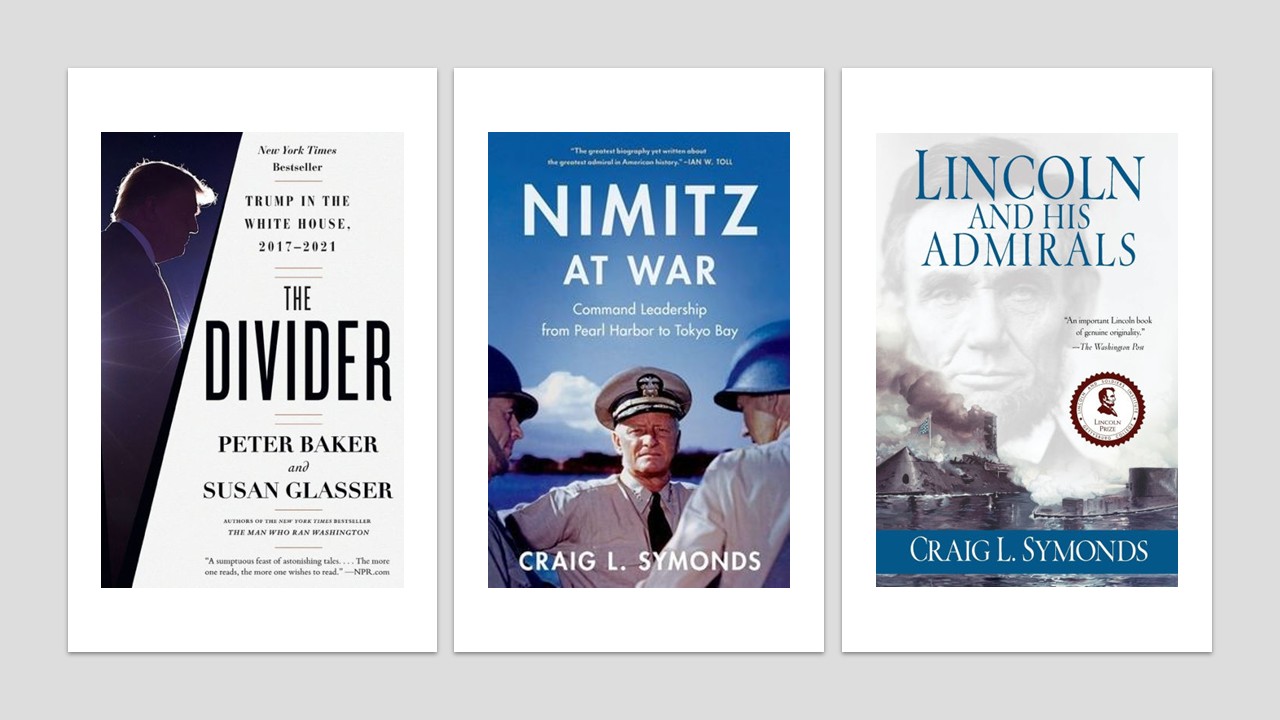
  1. The Divider: Trump in the White House, 2017-2021 by Peter W. Baker and Susan Glasser

This book paints an accurate and unflattering portrait of Trump’s first administration. It pairs well with Bob Woodward’s books on the Trump presidency.

  1. Lincoln and his Admirals by Craig Symonds

An interesting and very helpful work from a naval historian about Lincoln and the naval war against the Confederacy.

  1. Nimitz at War: Command Leadership from Pearl Harbor to Tokyo Bay by Craig Symonds

Sort of a command biography of Nimitz. It seemed short on details and the authors summary remarks at the end of the chapters seemed a bit forced at times. But, I enjoyed it.
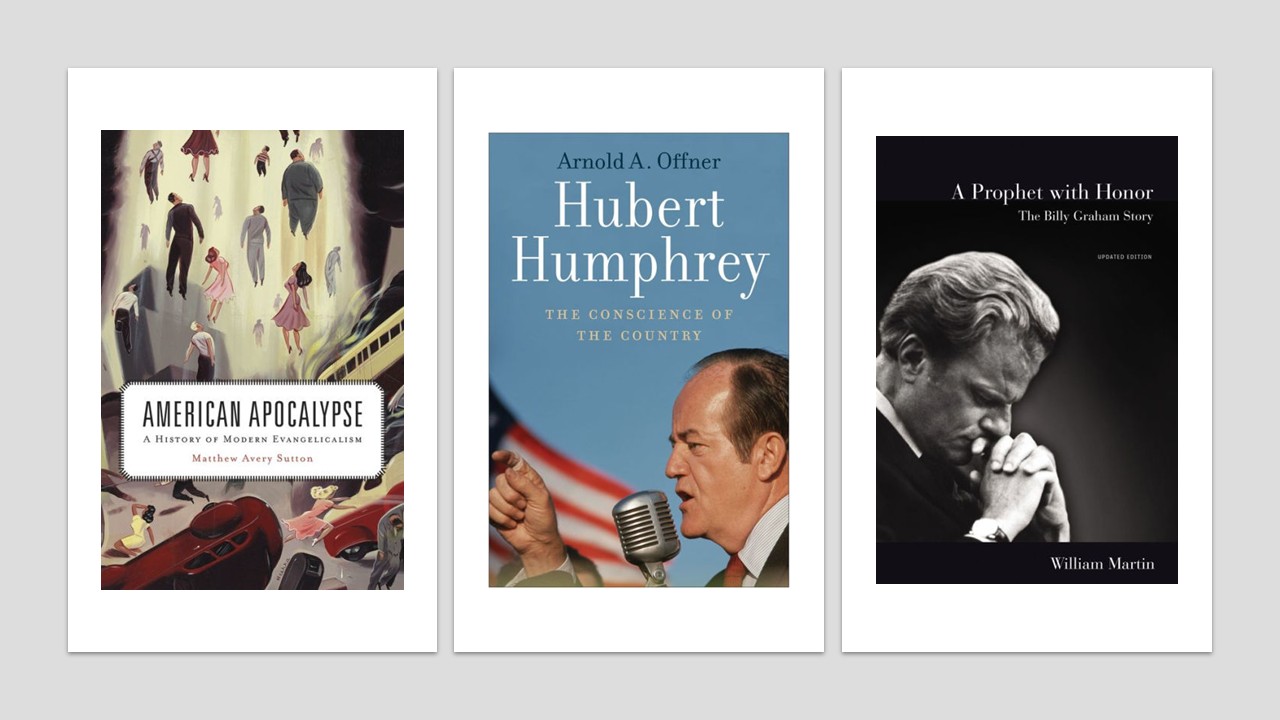
  1. Hubert Humphrey: The Conscience of the Country by Arnold Offner

A very “in the weeds” biography of the great “liberal savior” of the mid-century Democratic party. Humphrey was Johnson’s Vice President, and was defeated in his own run for the office in 1968. The book loses the reader in very wonky policy details. In that sense it’s not a true biography, because his family virtually disappears. But, because the subject is Hubert Humphrey, it’s unlikely a better biography will come around anytime soon.

  1. American Apocalypse: A History of Modern Evangelicalism by Matthew A. Sutton

This is the second time I’ve read the book. This is a good history of evangelicalism.

  1. A Prophet with Honor: The Billy Graham Story (updated edition) by William Martin

A very balanced, insightful, and enjoyable look at perhaps the most popular evangelist in the history of the Christian church. This is a definitive biography. A better one likely won’t be penned. Martin is fair in his analysis. He presents Graham as a man with a simple message; not an intellectual, but content with who he is. I believe the root explanation for Graham’s astonishing success was a special anointing by the Holy Spirit.

  1. America’s Pastor: Billy Graham and the Shaping of a Nation by Grant Wacker

This isn’t exactly a biography, but a look at how Graham impacted the nation as a whole. This is a very valuable and interesting book by a prominent historian of Christianity.

  1. The Battle of Midway by Craig Symonds

Simply the best history of the battle of Midway that’s ever been written. It pairs quite well with Jonathan Parshall and Anthony Tully’s scholarly volume Shattered Sword: The Untold Story of the Battle of Midway. This is probably my favorite book of the year.

  1. Reagan: His Life and Legend by Max Boot

A very good biography of Reagan. I believe Bob Spitz’s Reagan: An American Journey is a superior biography. My opinion of Reagan hasn’t much changed–he was a bad administrator and a kind, decent, but shallow man who could give a very good speech. If you’re interested in the hagiography that has enveloped Reagan as a patron saint of the GOP, then look elsewhere. If you’re interested in a scholarly biography that’s non-partisan but fair, then Max Boot’s volume is one of the best available.
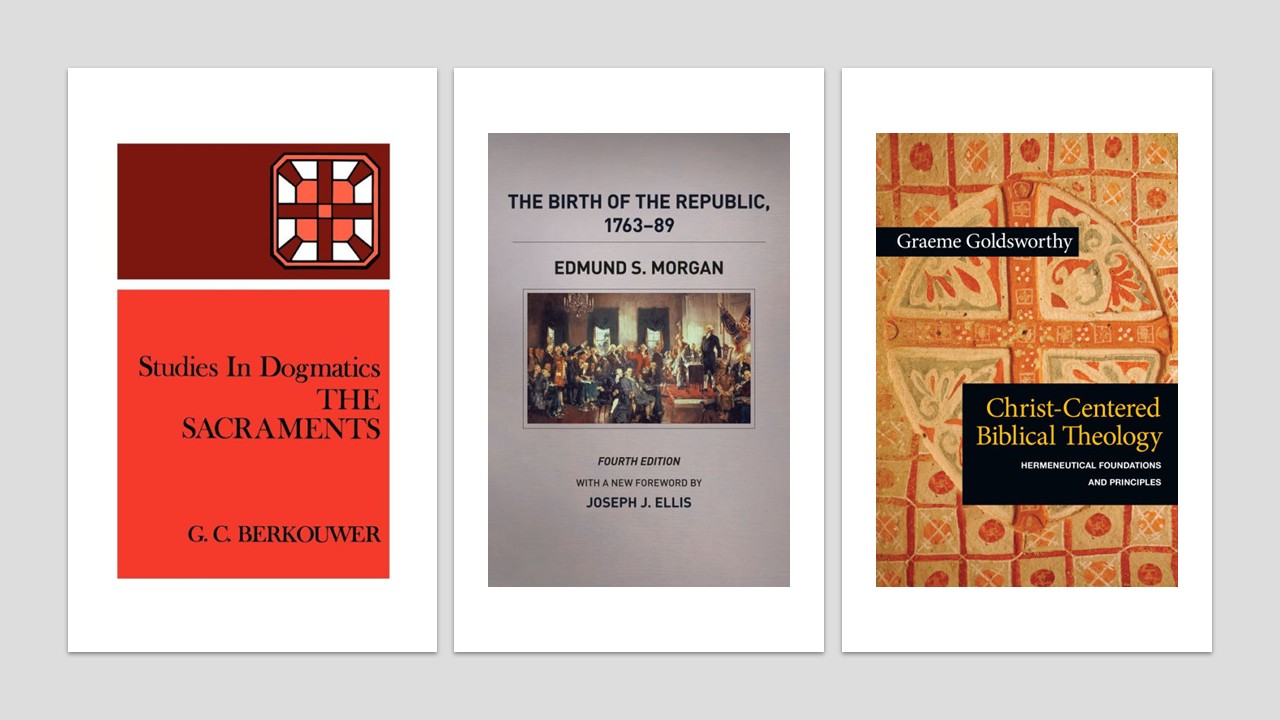
  1. The Birth of the Republic: 1763-1789 (4th ed.) by Edmund S. Morgan

A short, classic, but very boring book by a dean of Revolutionary period studies.

  1. The Sacraments by G.C. Berkhouwer

Solid and helpful book by Berkouwer. There should have been more interaction with scripture instead of creeds and confessions, but not everyone can be a Baptist!

  1. Christ-Centered Biblical Theology: Hermeneutical Foundations and Principles by Graeme Goldsworthy

This book is less a positive case for Goldworthy’s own method (though it is that), than a defense of biblical theology in general. I’m not really sold on Goldworthy’s structure for biblical theology–I think he flattens things a bit by not using the covenants as the skeleton for the bible’s story. However, I especially appreciated his emphasis on how, after Solomon’s failure, the prophets almost universally pivoted and re-capitulated the previous promises. Goldsworthy wishes away the promises to Israel far too much for my (and the bible’s) tastes, but his emphasis on Christ as the typological key to the bible’s story is well taken.
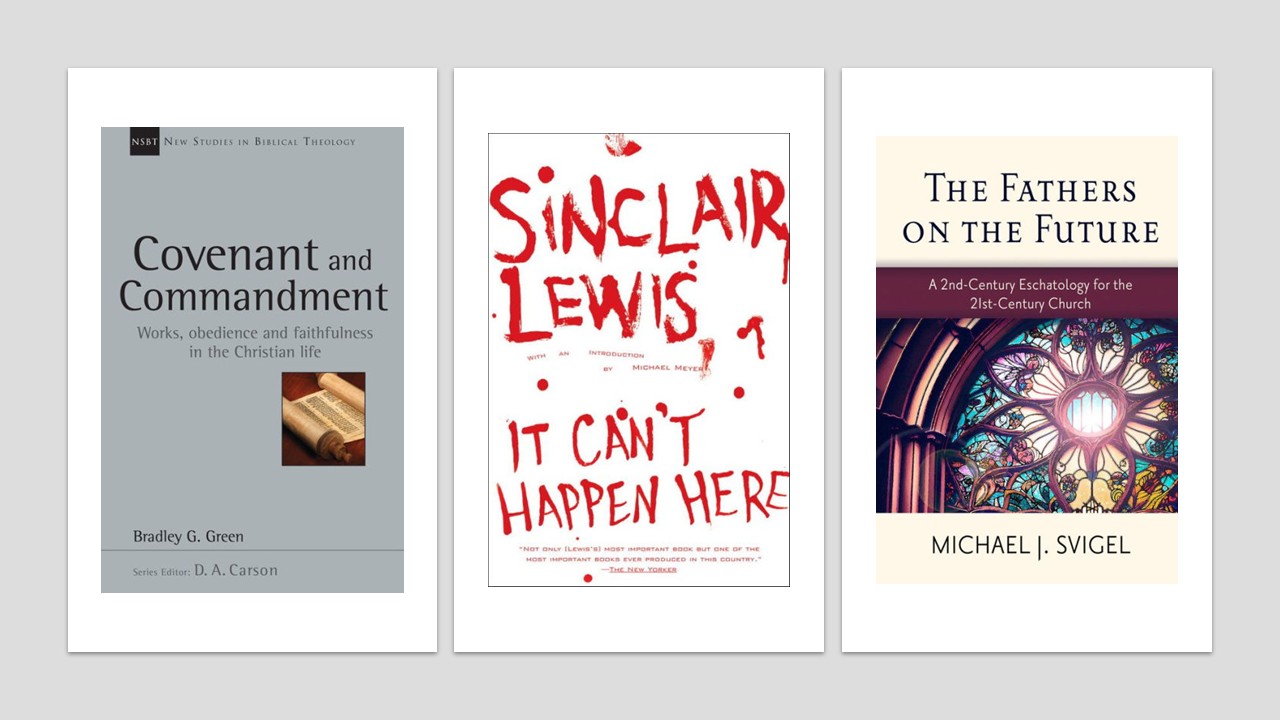
  1. Covenant and Commandment: Works, Obedience and Faithfulness in the Christian Life by Bradley Green

I’m not sure what to make of Green’s book. At the end of the whole thing, I learned nothing. Good works are the inevitable and necessary fruit of genuine salvation. I knew that before I read the book. So … the book was interesting but completely unnecessary. It might help someone who comes from a more antinomian background, or perhaps from a free grace perspective.

  1. Fathers on the Future: A 2nd Century Eschatology for the 21st Century Church by Michael Svigel

A very interesting and accessible defense of premillennialism from a scholar who teaches at Dallas Theological Seminary. I feel the publisher did Svigel wrong by forcing him to cut the meat out of the book and publish them as excurses on his own website. Svigel is a dipensationalist, but this book is really a defense of general premillennialism, using Irenaeus as his guide.

  1. It Can’t Happen Here by Sinclair Lewis

I don’t think Lewis was a good writer. His characters are thin and his writing tone is distracting. This is a classic fiction book from 1935 about America electing a fascist as president, who quickly turns the country into a police state. The evil president was clearly modeled on Huey Long. Many contemporary critics see parallels to Donald Trump, but it’s doubtful that Trump is as competent as Berzelius Windrip.

  1. The Death of American Virtue: Clinton vs. Starr by Ken Gorman

Am exhaustive, fair account of the Clinton impeachment saga. The Office of Independent Council disgusts me. I think Starr went way beyond his brief and harmed this country by pursuing a sitting President on a dumb perjury charge. I was very angry as I read the book. Starr was out of line and he disgraced himself. I think Hillary Clinton was correct about this particular “vast, right-wing conspiracy” intent on taking Bill Clinton down.

  1. Baptist Battles: Social Change and Religious Conflict in the Southern Baptist Convention by Nancy Ammerman

A sociological study of the “Baptist battles” of the conservative resurgence during the early 1980s. Very interesting.

  1. Calvin by Bruce Gordon

A great biography of John Calvin by a Yale church historian. Christians often prefer biographies of “great Christians” to be glossy, syrupy, and shallow. They often cry foul when a biography dares to document that the “great man” was, in fact, very human. This is a fair, scholarly biography of a flawed by important man. Calvin’s Institutes of the Christian Religion is a masterwork in Christian theology. Calvin was not a competent movement leader, and he ministered in a very unbiblical context in a sacral society. His chief legacy is his writings. This is a very important book about a very important man.

  1. Salvation with a Smile: Joel Osteen, Lakewood Church, and American Christianity by Phillip Sinitiere

A scholarly book about the pastor of the largest church in North America. If you want to know about Joel Osteen, don’t go to YouTube. Read this book.

  1. John Adams: A Life by John Ferling

A great John Adams biography. I don’t like John Adams. He virtually abandoned his family for years on end. He was driven by deep insecurities. All told, I view Adams as a little prig with “short man” syndrome. I don’t think he was an admirable guy, and I agree with the author that he fell short of being a “great man.”

  1. The Big Question: Why We Can’t Stop Talking About Science, Faith and God by Alister McGrath

A popular-level book by McGrath about how to integrate faith, science, and reason. It was good and interesting.

  1. Iustitia Dei: A History of the Christian Doctrine of Justification (4th ed.) by Alister McGrath

A magisterial and very helpful look at how “justification” has been understood in the Christian church down through the centuries.

  1. G-Man: J. Edgar Hoover and the Making of the American Century by Beverly Gage

One of my favorite biographies I’ve read. A great and entertaining book about a man who is poorly understood. Hoover was the ultimate bureaucrat, and not always in a bad way. A true “government man” and a master administrator.

  1. Paradise Regained by John Milton

This is the lesser-known (and much shorter) companion piece to Paradise Lost. Very interesting work.

  1. Kingdom through Covenant: A Biblical-Theological Understanding of the Covenants (2nd ed.) by Peter J. Gentry and Stephen J. Wellum

The definitive work on progressive covenantalism. I enjoyed it very much and I think the basic scheme is correct. I also believe the typology can go too far and wash away God’s promises to the nation of Israel, but I believe there is room for a premillennial vision within this larger scheme. A great book. Very insightful.

What I read in 2023

What I read in 2023

Well, I read 54 books this year. They tilt heavily towards biography and the doctrine of scripture. We shall see what 2024 brings. The books are listed in no particular order. Just because I read a book or have something nice to day about it does not mean I agree with everything in it!

1. The Twilight of the American Enlightenment by George Marsden (264 pp.; Basic, 2014).

This was a very good little book. It tells the story of how, at mid-century, the shared ethos of a generic, liberal Protestantism began to fail as an assumed ethos for ethics and public values. Marsden chronicles some efforts to grapple with the problem, and the reactions to these various solutions. In his final chapter, he advocates a “principled pluralism” largely following the outline of Abraham Kuyper’s “sphere sovereignty.” He calls for work to update Kuyper’s framework for the modern era.

2. With Malice Towards None: The Life of Abraham Lincoln by Stephen Oates (544 pp.; Harper, 2011 reprint).

This is the second time I’ve read this biography. It’s very good, long but not too long, and engaging. I highly recommend it. Oates’ volume was dogged with what appear to be baseless charges of plagiarism, which is unfortunate.

3. God, Revelation, and Authority (vol. 1) by Carl F. H. Henry (438 pp.; Crossway, 1999 reprint).

A classic. Henry has an interesting method for theology which relies heavily on logic and order. Even though he makes very good logical sense, his quest to make theology rationally credible does not do justice to the nature of biblical revelation. Bernard Ramm’s little trilogy (Special Revelation and the Word of God, The Witness of the Spirit, and The Pattern of Religious Authority) is a good antidote to Henry’s rationalism. See especially Gary Dorrien (The Remaking of Evangelical Theology) for an outsider’s assessment of Henry’s approach. I suspect that Henry’s God, Revelation, and Authority is more appreciated in a pro forma manner than actually read.

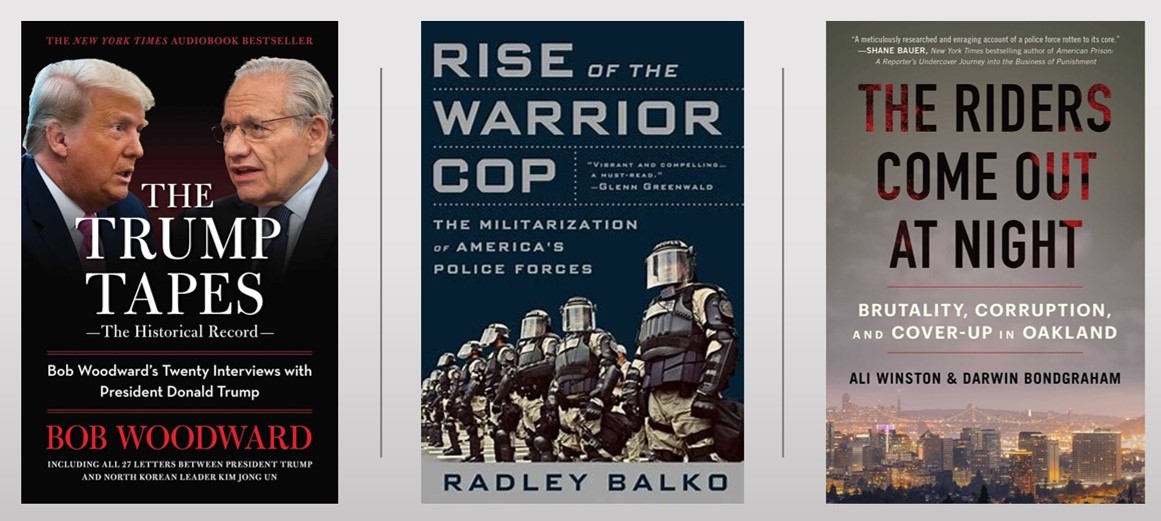
4. Rise of the Warrior Cop: The Militarization of America’s Police Forces by Radley Balko (528 pp.; PublicAffairs, 2021).

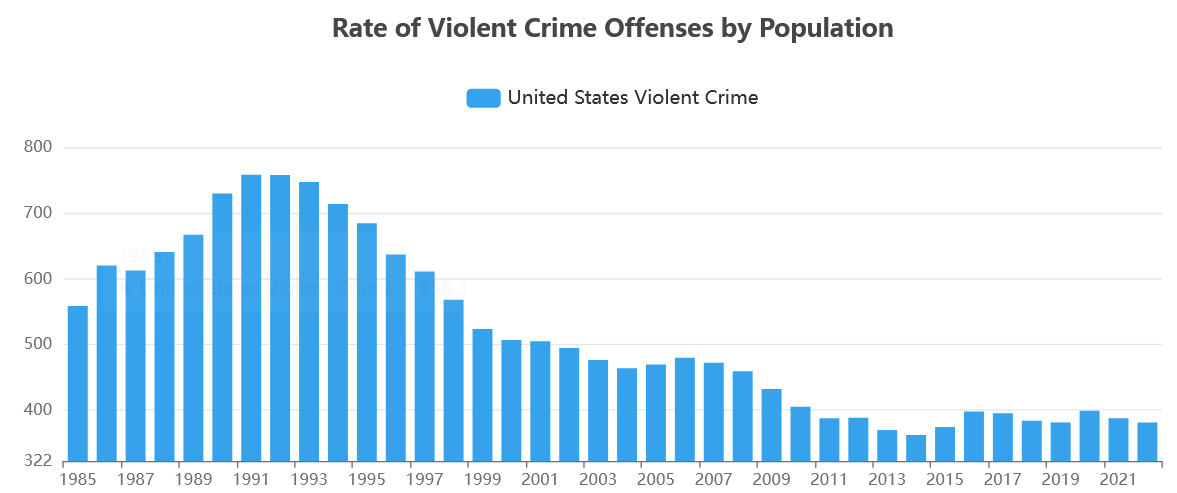
A very, very sobering book. Violent crime has in America has been halved since its apogee in 1991 to 1992. Yet, the public perception is that the streets are more dangerous than ever, that law enforcement is under siege. Officers ride around in dark vehicles with tinted windows. They dress like militarized infantry. Why? This book will provide some perspective.

Retrieved from the FBI Crime Data Explorer at http://tinyurl.com/et3b5m4k. Rate per 100,000 people, per year. Search parameters are for “all violent crimes” from 1985 to 2022.

5. The Riders Come Out at Night: Brutality, Corruption, and Cover-up in Oakland by Ali Winston and Darwin BondGraham (480 pp.; Atria, 2023).

In the same genre as Rise of the Warrior Cop, but focusing on police corruption in Oakland. Sobering and astonishing.

6. The Trump Tapes by Bob Woodward (11hrs 29 min; Simon & Schuster, 2022).

You won’t appreciate this unless you listen to the audiobook version, which is just recordings of Woodward’s 20 interviews with then-President Trump. This is perhaps the most damning series of interviews to which I’ve ever listened. From a strategic perspective, it seems the president made a mistake by giving Woodward such unfettered access. However, many of President Trump’s constituents likely do not read Woodward, so perhaps it wasn’t a mistake after all?

7. Peril by Bob Woodward and Robert Costa (512 pp.; Simon & Schuster, 2023).

The third book of Woodward’s Trump trilogy, chronicling the transition to the Biden administration with particular focus on the COVID-19 pandemic response. It’s as horrifying and important as the other two in the series.

8. Rage by Bob Woodward (580 pp.; Simon & Schuster, 2021).

The first of Woodward’s Trump trilogy. It details the Trump transition. It is frightening and paints the picture of Trump as monumentally unfit for any public office–let alone the White House.

9. Biblical Porn: Affect, Labor, and Pastor Mark Driscoll’s Evangelical Empire by Jessica Johnson.

This is a very curious book. It chronicles bits of the Mark Driscoll and Mars Hill Church saga with particular attention to the church’s propagation of a deviant strain of Christian sexuality (i.e. “biblical porn”); particularly how it leveraged its expectations in this area to produce volunteerism, commitment, and loyalty to its peculiar evangelical empire. The ground Johnson covers here overlaps in some areas with the ChristianityToday’s wildly popular “Rise and Fall of Mars Hill” podcast (Johnson published first!).

The peculiar aspect of this book is that it seems to see-saw between an engaging history and sudden esoteric discussions of sociological theory. It reads like two very different pieces melded somewhat awkwardly into one. The discussions of sociological affect seem pasted in with (in some instances) little to no transition. The jarring bit is that Johnson doesn’t really try to translate affect theory for non-specialists. Her academic peers in the same field surely appreciate her remarks along that line, but interested laypeople like me are a bit lost when she veers hard right into academic speak.

In summary, this is a very interesting and informative book that can’t decide whether it wants to be an academic treatise or a popular book for non-specialists. In contrast, it seems to me that Kristin Kobes DuMez faced a similar dilemma with Jesus and John Wayne and chose the popular route, and succeeded quite well. This doesn’t mean Johnson’s book is bad–far from it. I enjoyed it and was horrified at some of what I read. I just wish she’d had interested laypeople like me in mind when she wrote it.

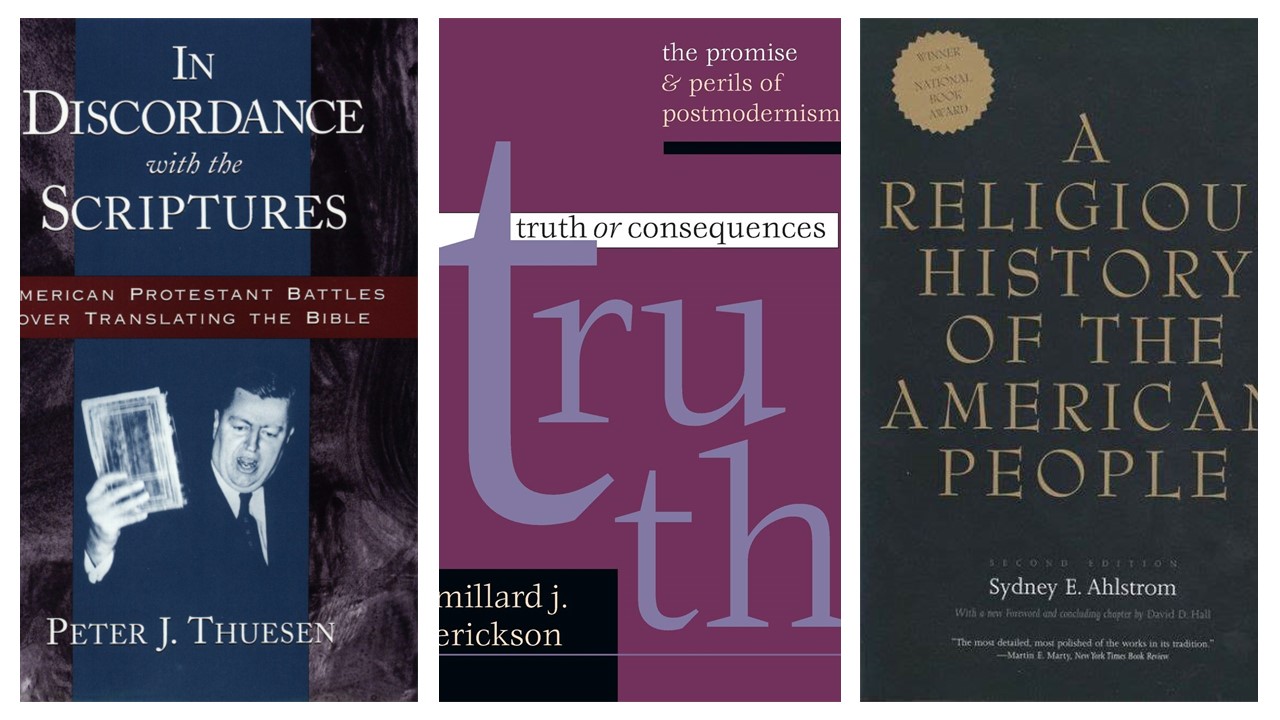
10. A Religious History of the American People (2nd ed.) by Sydney Ahlstrom (1216 pp.; Yale, 2004).

I read about 20% of this book (pp. 385-510, 731-872) while conducting research for a book I wrote on inerrancy and the doctrine of scripture. It is amazing readable, moves fast, and is rightly a classic. I doubt anything like it will come along anytime soon. Mark Noll’s History of Christianity in the United States and Canada is a fraction of this length. Historian Thomas Kidd (Midwestern Baptist Theological Seminary) has a book due out in the next year or so which covers some of the same ground, and I am looking forward to it.

11. In Discordance with the Scriptures: American Protestant Battles Over Translating the Bible by Peter Thuesen (256 pp.; Oxford, 2002).

A refreshing and very interesting book about bible translations in America, using the RSV translation’s public reception as a foil. It’s a bit out of date now, especially considering the TNIV gender-inclusive “controversy” from about 15 years ago, and the rise of the ESV.

12. Truth or Consequences: The Promise Perils of Postmodernism by Millard Erickson (335 pp.; IVP, 2001).

This book is what it sounds like–a primer on postmodernism with some of Erickson’s trademark irenic analysis. This is a very helpful book that was part of the “postmodernism is new and weird and we’ll explain it for you” wave of books that conservative Christians put out around the year 2000. Sometimes theologians try to speak outside their lane, and it shows (e.g. Wayne Grudem’s Politics According to the Bible). This doesn’t happen here. Erickson is well-credentialed to respond to postmodernism; he holds an MA in Philosophy from the University of Chicago.

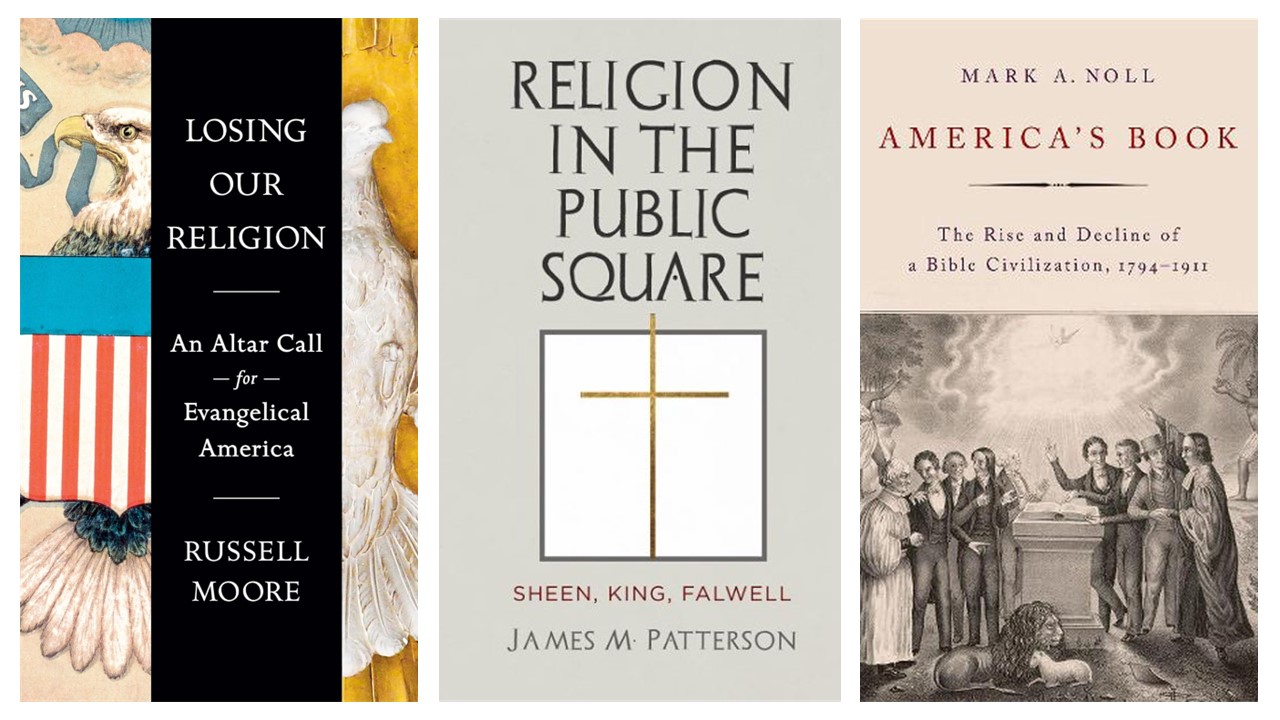
13. America’s Book: The Rise and Decline of a Bible Civilization 1784-1911 by Mark Noll (864 pp.; Oxford, 2022).

This was another book of which I read a portion (pp. 309-582) for research. It’s a very interesting and informative book about just what its title suggests.

14. Religion in the Public Square: Sheen, King, Falwell by James M. Patterson (248 pp.; University of Pennsylvania, 2018).

This was a unique book, because it examined three different paradigms for understanding religion in the public square. Patterson did this by spotlighting three very different individuals; (a) the fiery Roman Catholic radio priest Fulton J. Sheen, (b) the black Baptist preacher Martin Luther King, Jr., and (c) that quintessential representative of white, Southern-style Baptist fundamentalism–Jerry Falwell, Sr.

15. Losing Our Religion: An Altar Call for Evangelical America by Russell Moore (272 pp.; Penguin, 2023).

This is sort of a spiritual sequel to Moore’s 2015 volume Onward! He wrote this book in the aftermath of his resignation from the Southern Baptist Ethics and Religious Liberty Commission and transition to editor-in-chief of Christianity Today. You could say that Moore landed on his feet!

This book is a word of testimony—testimony of what one fellow wayfarer has learned about how to survive when the evangel and the evangelicalism seem to be saying two different things. That requires naming what we have lost—our credibility, our authority, our identity, our integrity, our stability, and, in many cases, our sanity. This book will consider all the ways evangelical America has sought these things in the wrong way—and suggests that perhaps it’s by losing our “life” that we will find it again.

Moore, Losing Our Religion, pp. 21-22

The volume reads a bit like a cathartic exercise from a good man who was deeply hurt by some very unpleasant people who are part of a very unpleasant machine.

I couldn’t help but wonder if the plot twist to the story of American conservative Christianity was that what we thought was the Shire was Mordor all along. I pretend that all of that is past me, but it lingers, in the ringing in my ears of the stress-induced tinnitus that persists to this day, and in the fact that I am still waiting for one sleep without nightmares about the Southern Baptist Convention. But here I am, an accidental exile but an evangelical after all.

Moore, Losing Our Religion, p. 9

This volume fits into a new (post-Trump + 2016) genre that I like to call “white evangelicism sucks and this is why.” It’s not that Moore’s book is bad. It’s not–it’s actually quite good. It’s just that so many people have written (and are still writing) the very same book. They say the same things, in the same way. Of course, perhaps they all say the same things because they all see the same problems. Yes, got it. Understood. I am glad Moore escaped from Southern Baptist public life and I hope he recovers in a spiritually wholesome environment. Still, I’m tired of this genre.

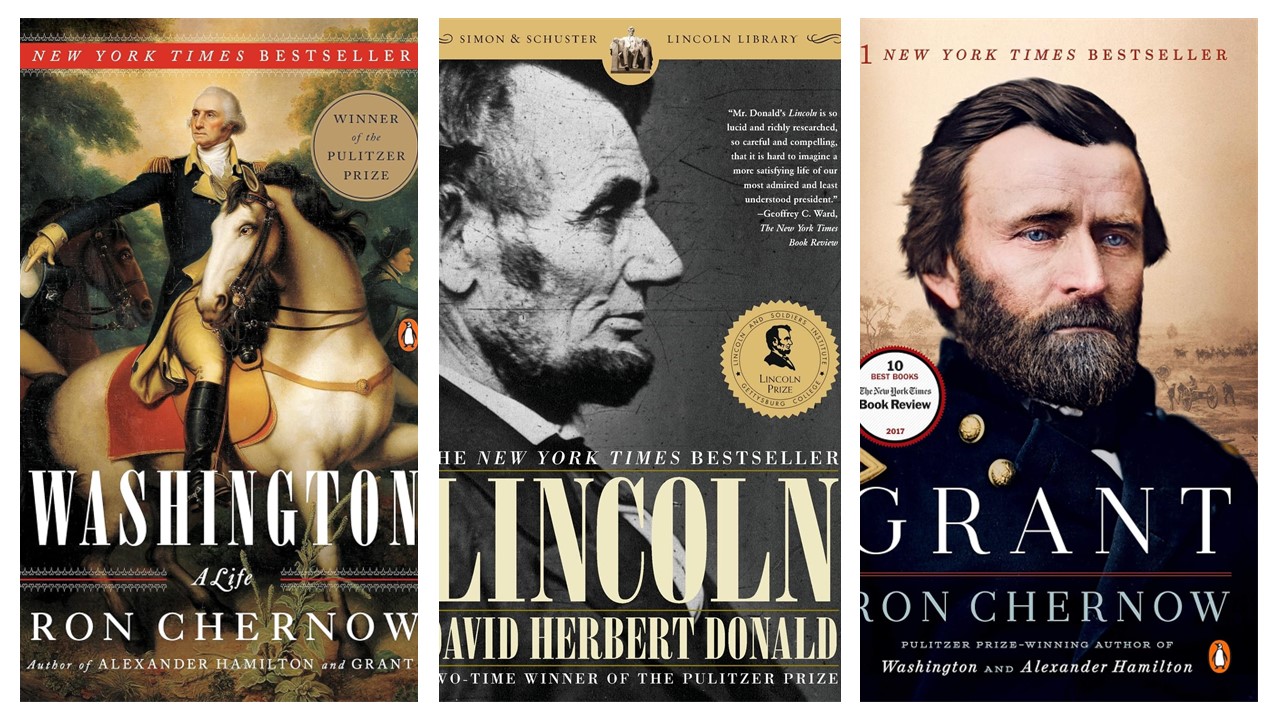
16. Grant by Ron Chernow (1104 pp.; Penguin, 2018).

It’s a biography. It’s very good. Chernow fairly addresses the persistent myth that Grant was a drunken fool. This is probably the best Grant biography in print.

17. Washington: A Life by Ron Chernow (928 pp.; Penguin, 2011).

An excellent biography.

18. Lincoln by David Herbert Donald (720 pp.; Simon & Schuster, 1996).

It’s good. I’m about Lincoln’d out. I’ve read Oates’ volume twice, and now this.

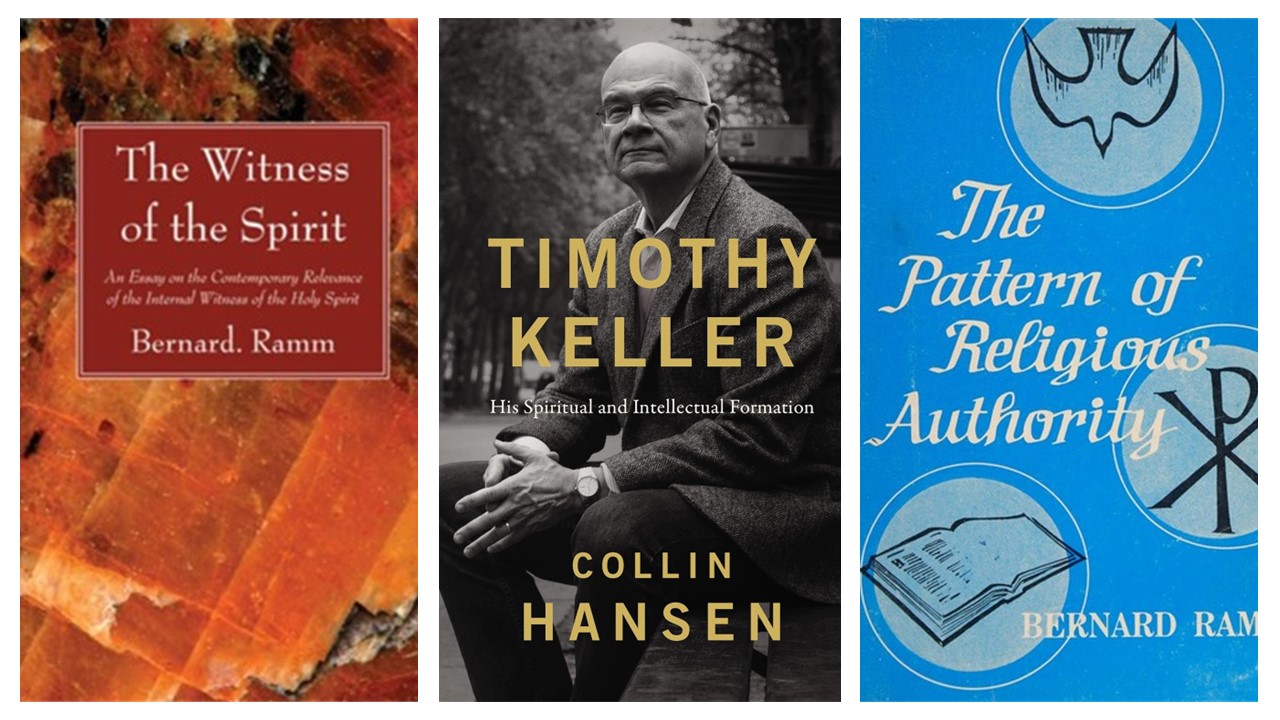
19. Timothy Keller: His Spiritual and Intellectual Formation by Collin Hansen (320 pp.; Zondervan, 2023).

This is an interesting little book. I’m not sure it’s worth the hype its received. That isn’t to say its bad. It’s an interesting sketch of the influences that made Tim Keller the unique and gifted man that he was.

20. The Pattern of Religious Authority by Bernard Ramm (117 pp.; Eerdmans, 1959).

The first volume in Ramm’s trilogy of authority in the Christian life. Ramm places great emphasis on the Spirit being the channel by which God speaks to His people. A very good and very helpful book.

21. The Witness of the Spirit by Bernard Ramm (142 pp.; Wipf and Stock, reprint, 1960).

The second volume in Ramm’s trilogy. He and Carl Henry have very different approaches. He eschews Henry’s cold rationalism and emphasizes the Spirit’s dynamic and dialogical role in the Christian life. Ramm was heavily influenced by Calvin’s own treatment on the Spirit, and it shows. I really appreciate Ramm. He is the kind of theologian I want to be when I grow up!

22. Special Revelation and the Word of God by Bernard Ramm (221 pp.; Eerdmans, 1961).

The final volume in Ramm’s trilogy. In an era before the Chicago Statement (1978) set the guardrails for the debate for a new generation, Ramm took a mediating position that was still in the conservative orbit. In the modern era, the Chicago Statement is a non-negotiable article of faith for conservative institutions and many churches. Ramm would not have fit easily into that mold.

23. The Scripture Principle by Clark Pinnock (284 pp.; Harper Collins, 1984).

Pinnock’s plea for a conservative alternative to the Chicago Statement. Well-reasoned and irenic, but firm. Modern evangelicals who assume “orthodoxy = the Chicago way or the highway” ought to read Pinnock. They might be pleasantly surprised. I cannot speak to the two revised editions of the book which Pinnock put out with a co-author. I recommend only the original, 1984 edition.

24. The Authority and Interpretation of Scripture: An Historical Approach by Jack Rogers and Donald McKim (564 pp.; Wipf and Stock, 1999 reprint).

Whenever you mention this book to conservative theologians, they will likely respond within 10 seconds with “but, did you read Woodbridge’s reply?” That tells you that Rogers/McKim stuck a nerve. This is an extraordinary work that surveys the historical data about how Christians have understood the nature of scripture. The issue of Chicago-style inerrancy lurks in the background as Rogers/McKim’s rhetorical foe–they conclude that the Chicago Statement is not the historical position of the church. I cannot agree with everything in the book, and Woodbridge gleefully documented reams of purported errors–I leave the reader to evaluate whether his criticisms are valid. Still, a must-read.

25. Preaching: Communicating Faith in an Age of Skepticism by Timothy Keller (320 pp.; Penguin, 2016).

26. The Christian Tradition: A History of the Development of Doctrine, Volume 5: Christian Doctrine and Modern Culture (since 1700) by Jaroslav Pelikan (414 pp.; University of Chicago, 1991).

A very good survey of Christian doctrine.

27. A History of Christian Thought Volume 3: From the Protestant Reformation to the 20th Century, revised ed. by Justo Gonzalez (498 pp.; Abingdom, 2009 reprint).

An excellent survey–I prefer it to Pelikan.

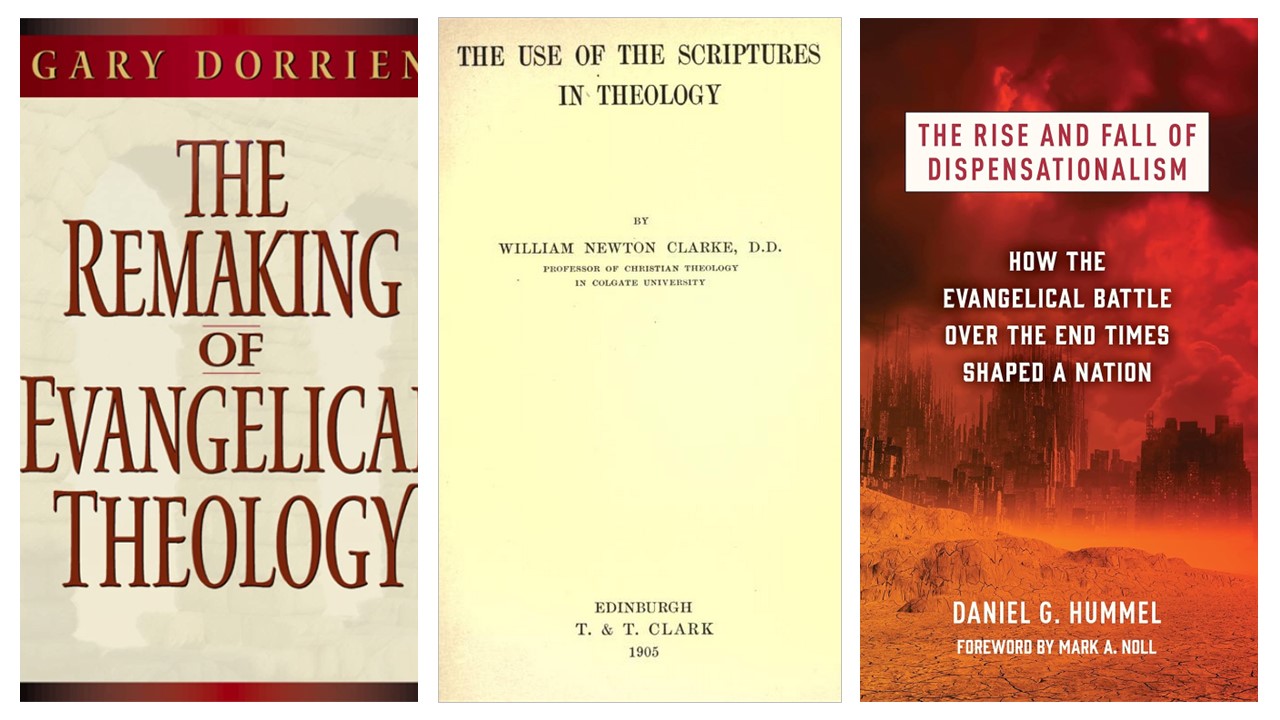
28. The Use of the Scriptures in Theology by William Newton Clarke (192 pp.; Charles Scribners, 1905).

Clarke is the poster-child for gentle, kind, 19th century Baptist liberalism. His doctrine of scripture disgraces God, but he is so kind and grandfatherly that you almost like the guy.

29. The Rise and Fall of Dispensationalism: How the Evangelical Battle over the End Times Shaped a Nation by Daniel Hummell (400 pp.; Eerdmans, 2023).

An important volume on an important topic. Dispensationalism has fallen on hard times. It has little to no scholarly influence, has no reliable academic press, has very few scholars publishing anything to advance the system, has produced precious few technical commentaries, and few substantive mid-level (e.g. NAC, Tyndale, or EBC level) commentaries. In that sense, it has indeed “fallen” from great heights. This book provides one explanation about why and how.

30. The Remaking of Evangelical Theology by Gary Dorrien (262 pp.; Westminster John Knox, 1998).

A tour-de-force survey of evangelical theology from a liberal outsider. This is one of the best books I read in 2023. His survey of theological perspectives is fair and irenic, and his footnotes will take you to valuable works from conservatives.

31. Scripture, Authority, and Interpretation by Dewey Beegle (332 pp.; Eerdmans, 1973).

Beegle’s book is another entry from the 1970s to 1980s genre which I’ll call “the Chicago Statement is wrong!” Some of his critiques of Chicago-style inerrancy are interesting, but on the whole Beegle goes off the reservation here. If you want a conservative alternative to the Chicago Statement, see Pinnock and not Beegle. F.F. Bruce wrote an endorsement!

32. The Princeton Theology 1812-1921: Scripture, Science, and Theological Method from Archibald Alexander to Benjamin Breckinridge Warfield edited by Mark Noll (344 pp.; Baker, 1983).

This is an edited volume containing lengthy excerpts from four “old Princeton” theologians on scripture, science, and theological method. Noll provides brief introductions but largely lets the authors speak for themselves. An invaluable book. Warfield and A.A. Hodge are excellent on scripture–much better than R.C. Sproul, who drafted the original 1978 Chicago Statement and somehow misunderstood the “original autograph” issue along the way–compare the Chicago Statement to Warfield’s “The Inerrancy of the Original Autographs” (1883) and you’ll see what I mean.

33. Between Faith and Criticism: Evangelicals, Scholarship, and the Bible in America (2nd ed.) by Mark Noll (284 pp.; Regent College, 2004).

This is mostly inside baseball stuff for academia, but it has some interesting insights. It explores how to reconcile faith and critical inquiry. It’s a logical sequel to the Princeton volume or Noll’s The Bible in America book.

34. The Fifth Risk by Michael Lewis (256 pp.; Norton, 2019).

A forgettable little book about how President Trump’s administration was allegedly so inept and how everything may crumble to bits at any moment. Not worth buying. Glad I checked it out from the library. It repeats the same theme in every chapter; (a) Lewis introduces the noble civil servant, then (b) in come the stupid Trump officials in 2017, then (c) the dumb Trumpian appointees threaten to ruin everything, then (d) Lewis lets the noble bureaucrat explain how dangerous the Trump appointees are, then (e) the next chapter repeats in a different government sector. Very tiresome and a bit condescending.

35. Dialogues Concerning Natural Religion by David Hume–ed. Richard Popkin, 2nd ed. (160 pp.; Hackett, 1998).

Hume annoys me.

36. “Essay VI—On Judgment,” in Essays on the Intellectual Powers of Man, by Thomas Reid, edited and abridged by A.D. Woozley (517 pp.; MacMillan, 1941).

Reid’s emphasis on common sense, on what every rational person can know by his innate faculties, is very good. Philosophers today seem to be scornful of commonsense realism, so this makes me wary. But, Reid just makes sense. I suppose one main hurdle is that Reid makes sense in a world in which one is willing to acknowledge that God has created us and given us logical faculties for reason. We don’t live in that world any longer, so I suspect that disconnect is driving some of the disagreement.

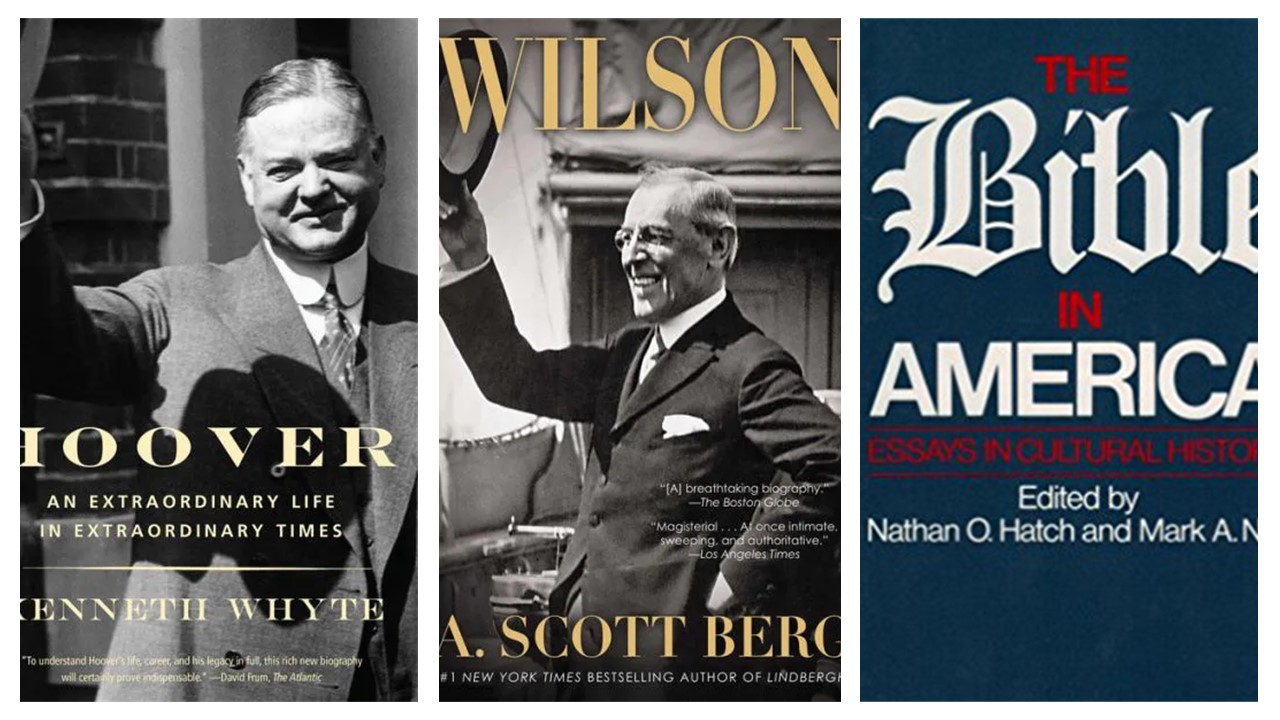
37. The Bible in America: Essays in Cultural History edited by Nathan O. Hatch and Mark A. Noll (192 pp.; Oxford, 1982).

An extraordinary series of essays from world-class historians. Not sure why it’s out of print!

38. Wilson by A. Scott Berg (880 pp.; Penguin, 2014).

A magisterial biography of a very interesting man. It made me very sad to read of Wilson’s incapacitation shortly after his second term began. I wonder what he could have accomplished if he’d retained his physical powers.

39. Hoover: An Extraordinary Life in Extraordinary Times by Kenneth Whyte (768 pp.; Knopf Doubleday, 2018).

The best book I read in 2023. Hoover was a true genius. His story is inspiring beyond words. He came from nothing, made a career as a brilliant mining engineer, then a financier of sorts in the mining world, then saved untold millions from starvation as head of a humanitarian agency (what would now be an NGO) during and after the first world war. Secretary of Commerce. Elected President. If there was any single individual in American history who could have been up to the task of combating the series of crises that we now refer to as the Great Depression, it would have been Hoover. And yet, he couldn’t get it done.

Whyte works hard to bring perspective to Hoover’s reactions to the financial crises. He argues that Hoover responded as well as could be expected, that Franklin Roosevelt cribbed several of his policies and ideas (even the infamous “nothing to fear but fear itself” line), and that the depression was on the road to recovery when Roosevelt assumed office–but that the latter refused to coordinate policy with Hoover and went his own way. Whyte notes that the depression continued until the second world war, that Roosevelt did not “solve” the depression, and that Hoover was understandably bitter about the treatment he received. Roosevelt was undeniably a superior politician, and Hoover was dealt a bad hand … not unlike Jimmy Carter nearly 50 years later.

I plan to read another Hoover biography in 2024. This man deserved better. He truly was an extraordinary man in extraordinary times.

40. Watergate: A New History by Garrett M. Graff (832 pp.; Simon & Schuster, 2023).

Anything you want to know about Watergate? You’ll find it here. This is the most up-to-date, exhaustive account of the scandal in print. An outstanding book.

41. The Struggle of Prayer by Donald Bloesch (196 pp.; Helmers & Howard, 1988).

Excellent little book.

42. Nixonland: The Rise of a President and the Fracturing of America by Rick Perlstein (896 pp.; Scribners, 2009).

Nobody would confuse Perlstein with an objective historian. This is an entertaining, exhaustively researched work of cultural history with a sarcastic tone. That isn’t to say it isn’t valuable. His quartet of books chronicling the rise of the political right from Goldwater to Reagan is essential reading, and extraordinarily entertaining.

43. American Individualism by Herbert Hoover (91 pp.; Doubleday, 1922).

Hoover published this little book while he was Secretary of Commerce. He outlines what he sees as a peculiarly American kind of individualism–a characteristic which sets America apart:

Therefore, it is not the individualism of other countries for which I would speak, but the individualism of America. Our individualism differs from all others because it embraces these great ideals: that while we build our society upon the attainment of the individual, we shall safeguard to every individual an equality of opportunity to take that position in the community to which his intelligence, character, ability, and ambition entitle him; that we keep the social solution free from frozen strata of classes; that we shall stimulate effort of each individual to achievement; that through an enlarging sense of responsibility and understanding we shall assist him to this attainment; while he in turn must stand up to the emery wheel of competition.

Hoover, American Individualism, pp. 9-10. Emphasis added.

Hoover believed we must make our own way; that we must be guaranteed equality of opportunity but not equality of outcome. The grand object of government is to (a) foster equality of opportunity without (b) throttling individual initiative:

To curb the forces in business which would destroy equality of opportunity and yet to maintain the initiative and creative faculties of our people are the twin objects we must attain. To preserve the former we must regulate that type of activity that would dominate. To preserve the latter, the Government must keep out of production and distribution of commodities and services. This is the deadline between our system and socialism. Regulation to prevent domination and unfair practices, yet preserving rightful initiative, are in keeping with our social foundations. Nationalization of industry or business is their negation.

Hoover, American Individualism, pp. 54-55

One can see glimmerings of the modern GOP here. This is a very interesting book. Well worth reading and pondering. Needless to say, Hoover despised Roosevelt’s New Deal.

44. Eisenhower in War and Peace by Jean E. Smith (976 pp.; Random House, 2013).

A good biography. It seems to lose steam once it hits Eisenhower’s presidency. And, yes–Eisenhower surely had an affair with Kay Summersby. Smith suggests that Eisenhower planned to divorce Mamie and marry Kay, but his plan was thwarted. Like a good general facing hard realities, Eisenhower then sent Kay a “Dear John” letter that is astonishingly cruel and heartless. He cut her loose like a used Kleenex. Eisenhower comes across as an amazing politician and a great leader, but a poor general. That is fair, I believe.

45. Truman by David McCullough (1120 pp.; Simon & Schuster, 1992).

This book made me love Truman. It has earned its reputation. I even bought a “The Buck Stops Here!” desk sign replica from the National Archives. I will display it on my desk at work.

46. Reagan: An American Journey by Bob Spitz (880 pp.; Penguin, 2019).

A great biography of an interesting guy. Reagan was a good man, a kind man, a decent man. He also seemed to be shallow and a bit of an empty suit.

47. Our Faith by Emil Brunner, trans. John Rilling (153 pp.; Scribners n.d.).

I love these little “this is what the Christian faith is about” books that theologians sometimes write. This is a great book.

48. The Soul of Prayer by P.T. Forsyth (109 pp.; Regent College (reprint), 2002).

A classic on prayer. Probably the most quotable book I’ve ever read.

49. Faith and Justification by G.C. Berkouwer, trans. Lewis Smedes (201 pp.; Eerdmans, 1954).

A great book on justification. It’s refreshing to read something plain and scriptural on this essential topic from the era before the new perspective on Paul clouded everything.

50. His Very Best: Jimmy Carter–A Life by Jonathan Alter (800 pp.; Simon & Schuster, 2021).

I don’t believe the “great” Carter biography has yet been written. This book more describes than explains. I don’t know why Carter is such an inflexible moralist. I don’t know why he’s a theological liberal. I don’t know why he wanted to go into politics. I don’t know much about his relationship with his kids. I don’t know how this inflexible man managed to build a coterie of professionals around him who took him to the Georgia governor’s mansion and eventually to the Presidency. I don’t know why he was such a bad and seemingly clueless politician (he famously didn’t try to remain friends with the Democratic Party). I know all these things happened, but I don’t know why. Still, Alter’s biography is informative. It’s probably the best one available to date.

51. Atonement and the Death of Christ: An Exegetical, Historical, and Philosophical Exploration by William L. Craig (328 pp.; Baylor, 2020).

An outstanding book by a world-class philosopher and theologian.

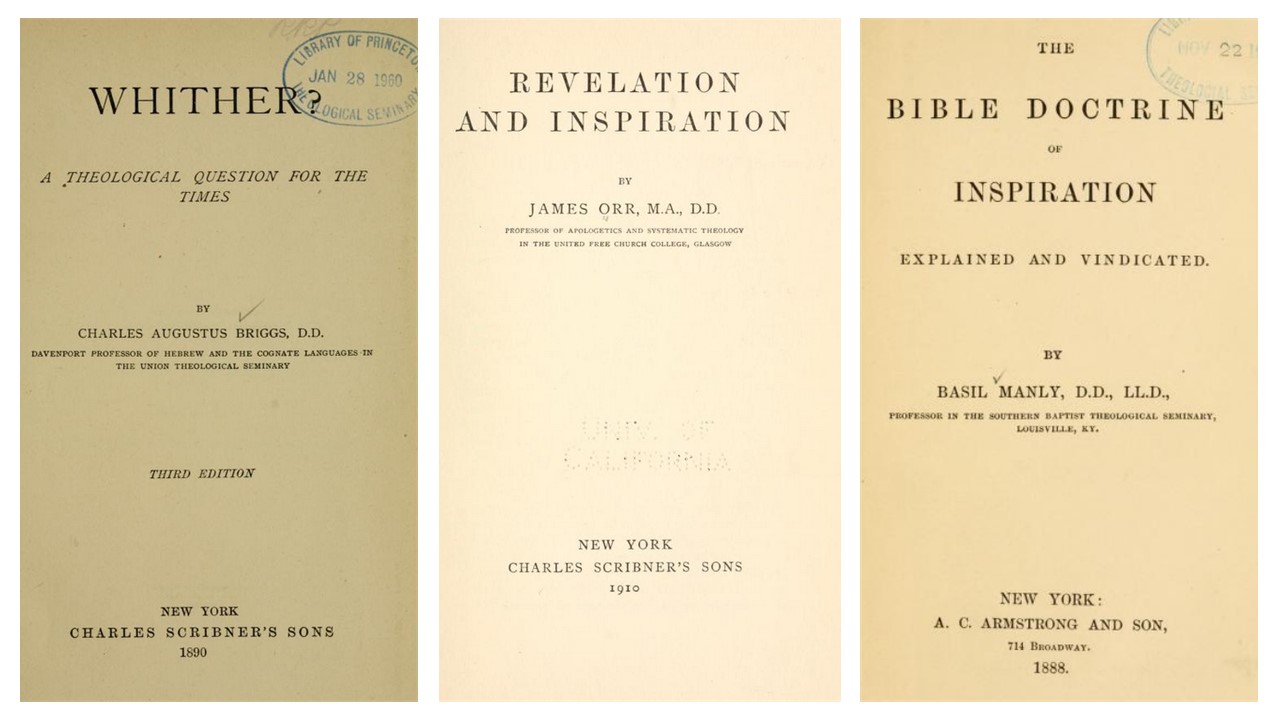
52. Whither? A Theological Question for the Times by Charles A. Briggs (334 pp.; Charles Scribner’s Sons, 1889).

Briggs wrote this book in great frustration. He had been hounded for years by conservatives within his Presbyterian denomination over his doctrine of scripture and inerrancy. He believed the Princeton school was erecting bulwarks that were impossible to hold. He disagreed vehemently with that perspective’s reading of the historical record and believed inerrancy was a recent invention by pious men who were reacting against realities they did not want to acknowledge. It deserves to be read, regardless of whether one agrees with Briggs.

53. The Bible Doctrine of Inspiration: Explained and Vindicated by Basil Manly, Jr. (278 pp.; A.C. Armstrong and Son, 1878).

A sensible and wise volume on the doctrine of inspiration from a Southern Baptist theologian. Worth reading.

54. Revelation and Inspiration by James Orr (224 pp.; Duckworth & Co., 1910).

Another wise and sensible book on the doctrine of scripture from a Scottish evangelical. Conservatives who follow the Chicago-style of inerrancy generally do not like Orr’s volume. I think it has some very good material.

What I read in 2022

What I read in 2022

I do most of my “reading” by audiobook, while driving to and from work. I read 59 books this past year. Some biography, some history, some theology, and a lot of Christian religious and social history. Here’s the list; perhaps you’ll grab some of these and find them helpful. See also my lists from 2021, 2020, 2019, 2018, and 2017.

My Top 10 Books of 2022

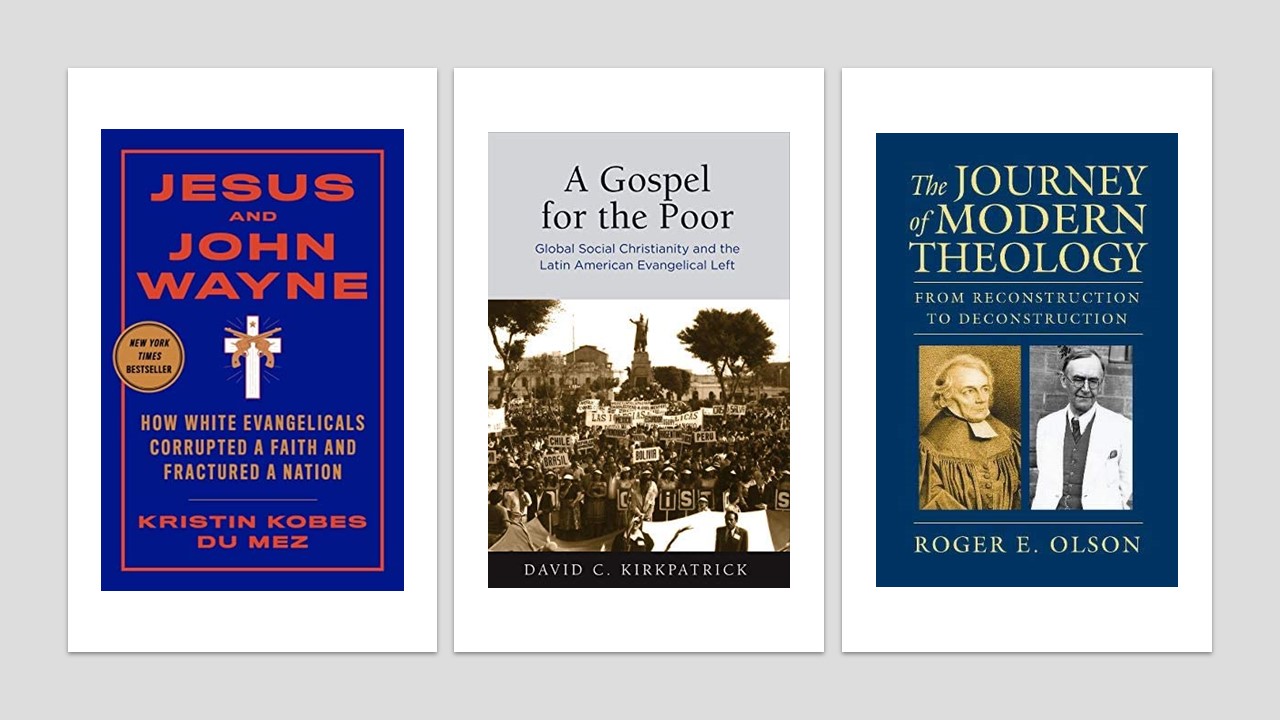
A Gospel for the Poor: Global Social Christianity and the Latin American Evangelical Left by David Kirkpatrick. An extraordinary book that opened my eyes to the Latin American wing of evangelicalism and introduced me to Rene Padilla (et al), the Lausanne Covennant, and the concept of integral mission.

The Journey of Modern Theology by Roger Olson. Olson’s magnum opus, a historical survey of modern theology. I was introduced to more thinkers in this book than I ever have from one volume. Accurate, engaging. It expands your horizons and makes you realize how small a world your particular theological tribe inhabits. Very, very helpful.

Jesus and John Wayne: How White Evangelicals Corrupted a Faith and Fractured a Nation by Kristin Kobes DuMez. I also read this in 2021, but decided to review it once more. This is an astounding book. It gave me the framework for understanding white evangelicalism as a sociological category, rather than simply a set of shared theological commitments. Very well-written, and engaging. This is a landmark book that came along at the right time.

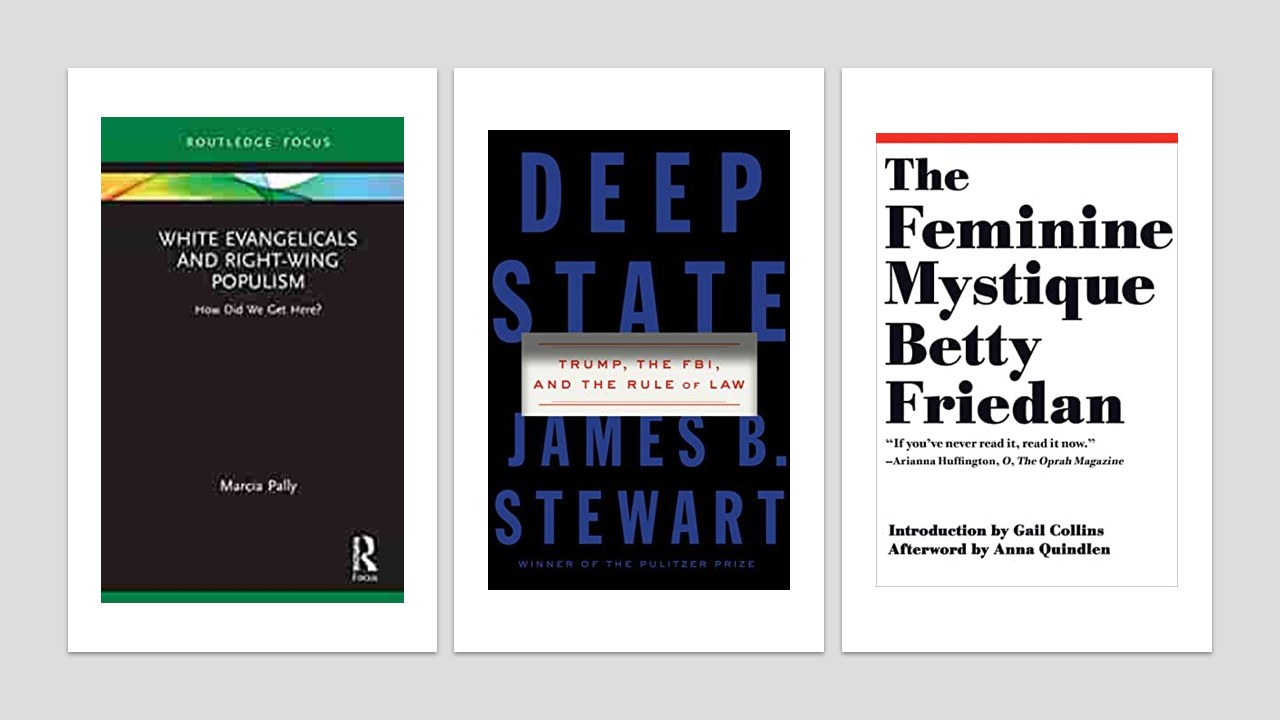
Deep State: Trump, the FBI, and the Rule of Law by James B. Stewart. An outstanding piece of journalism about the entire Trump + FBI investigation debacle. Very informative. Stewart gave a one-hour talk about this book which I found fascinating.

White Evangelicals and Right-Wing Populism by Marcia Pally. An astonishing work, short, but packing a large punch. Its value is Pally’s discussion of populism and its triggers applied to Trump and the current evangelical scene. Pally gave one of the best interviews I’ve ever heard here if you wish to get a preview of the book.

The Feminine Mystique by Betty Friedan. An earth-shattering classic. This work is generally credited with launching second-wave feminism in the United States. It examines “the problem that has no name;” the mid-century, middle-class, white housewife’s sense of loneliness, despair, and purposelessness because she was socialized to not expect or want an identity of her own–everything was subsumed into her husband and family. I see some flavors of complementarian Christianity basically want to enshrine this imaginary utopia as the Christian ideal. I say no. A truly remarkable book.

Mission Between the Times by Rene Padilla. Everything about this little collection of essays is so great. It’s like a breath of fresh air because it doesn’t come from the white, conservative evangelical world. Every pastor or thinking Christian would benefit greatly from reading this volume. Padilla focuses on our “mission between the times” of Jesus’ advents, with critiques of the Western evangelical framework and the incessant wedge it wishes to drive between social responsibility and the Gospel. He comes from Latin American evangelicalism and a completely different context, so his insights are quite refreshing. Padilla did his PhD under F.F. Bruce.

Apostles of Reason: The Crisis of Authority in American Evangelicalism by Molly Worthen. This is a book for the ages. A survey of evangelical intellectual life in the 20th century. Worthen sees evangelicalism as being shaped by a “crisis of authority,” as they tried to balance competing and contradictory emphases and forge an identity.

While they differ from one another on the details of their ideas about God and humankind, three elemental concerns unite them: how to repair the fracture between spiritual and rational knowledge; how to assure salvation and a true relationship with God; and how to resolve the tension between the demands of personal belief and the constraints of a secularized public square. These are problems of intellectual and spiritual authority. None, on its own, is unique to evangelicals. But in combination, under the pressures of Western history, and in the absence of a magisterial arbiter capable of settling uncertainties and disagreements, these concerns have shaped a distinctive spiritual community.

Worthen, Molly. Apostles of Reason (p. 4).

How to be Evangelical Without Being Conservative by Roger Olson. Everything about this little book is refreshing, correct, wholesome, and good. I cannot recommend this book highly enough. For people like me, who are somewhat disillusioned with the tradition they inherited, Olson’s project here is a breath of delightfully fresh air.

The Fifties by David Halberstam. Delightful, majestic, very impressive book. I don’t know how Halberstam did it. It’s a series of chapters of various popular figures, events, and cultural touchpoints of the 1950s. He argues that the chaos of the 1960s didn’t come from nowhere–the foundations were all laid in the 1950s, which are typically remembered in sepia as Mayberry. Without a doubt this was the most enjoyable book I read this year.

The Rest of Them from 2022

Axioms of Religion by Edgar Y. Mullins. An older book (ca. 1908) by the former President of the Southern Baptist Theological Seminary. It presents the Baptist view of Christianity in a comprehensive, winsome way that will benefit any reader. Mullins frames Christianity as a series of axioms which the Baptist ethos best supports. Likely the best apologetic for Baptist polity that I’ve yet read. It’s a shame it’s not well known, today.

The Christian View of Science and Scripture by Bernard Ramm. This was paradigm-shattering for me. Though this work is well-nigh 70 years old, it still captures the basic issues and does it very well. Ramm came out for progressive creationism in an intelligent, winsome way. If you come from a tradition which believes Ken Ham is the 13th apostle, that the Ark Encounter is a good thing, and that the Institute for Creation Research is the only faithful place where science can be done from a faithful Christian perspective, then Ramm will either enlighten you or make you really mad. His burden was to issue a call for charity and clear thinking on science and Scripture. Did he succeed? Read it and see.

Creation Revealed in Six Days by P.J. Wiseman. An interesting little book, largely forgotten to history, which I saw referenced in Ramm’s work (above). The author argues that Genesis 1-2 does not tell us how God created everything. Rather, they record that God took six days to reveal the fact of the creation. This is an attempt to reconcile science and Scripture in the late 1940s. I do not think Wiseman was a crank, and the book is well-reasoned and interesting. You can download a PDF for free at the link.

The Doctrine of the Trinity by Leonard Hodgson. A very good monograph from an Anglican theologian, adapted from a lecture series, which proposes a social theory of the Trinity. Very helpful, well-reasoned. I laughed out loud when Hodgson accurately surveyed the doctrine of eternal generation, then frankly admitted that he had no idea what people meant when they spoke about it. I sympathize and agree!

The Bible Made Impossible: Why Biblicism is Not a Truly Evangelical Reading of Scripture by Christian Smith. This is a provocative book which challenges the way certain conservative Christians read and use the Bible. I agree with much (not all) of this book, and many of Smith’s criticisms are quite accurate. This book is a very helpful prompt for serious introspection.

The Battle for the Bible by Harold Lindsell. A silly little screed from the late 1970s. This is fundamentalism at its worst. Lindsell wrote like a wounded lover lashing out at the woman who wronged him.

The Great Sex Rescue: The Lies You’ve Been Taught and How to Become What God Intended by Sheila W. Gregoire. An outstanding book which details the weirdness and stupidity of much of what conservative Christianity teaches about marriage roles. So, the authors spend much of their time analyzing the best-selling “marriage books” on the Christian market. I suppose it’s because I didn’t grow up as a Christian, but I’ve always found much of conservative Christianity’s rules about dating and marriage roles as absurd, purely cultural, and frankly stupid. The “Billy Graham rule”? Really dumb and unworkable in the modern office environment. This is a wonderful book. If I had to recommend a book for soon-to-be-married couples, I’d buy this one for them so they’d have insight into false narratives around marriage, love, and sex. For pre-marital counseling, I always use Tim and Kathy Keller’s The Meaning of Marriage.

Desperate: An Epic Battle for Clean Water and Justice in Appalacia by Kris Maher. Very entertaining and horrifying piece of journalism.

Christ in Crisis: Why We Need to Reclaim Jesus by Jim Wallis. I read this book, but remember almost nothing about it. I thought it was vague and basically “meh.”

Fundamentalism and American Culture (3rd edition) by George Marsden. A classic for a reason. You must read it. His latest updates encompass the Trump years. Here is a good interview with Marsden about this latest edition, which I enjoyed listening to.

10 Questions to Diagnose Your Spiritual Health by Donald Whitney. Breezy. Short. Good. I read it, then gave away several copies to the congregation.

The Reason for God by Tim Keller. This is a very good book to give someone who has questions about the Christian faith. Keller is a great writer, and communicates very well. We read this book at church in conjunction with the group study materials.

Towards a Recovery of Christian Belief by Carl F.H. Henry. Excellent precis of Henry’s theological program. If his seven-volume God, Revelation, and Authority is intimidating to you, then this slim little volume will give you the basics of Henry’s thought. Incidentally, Roger Olson’s discussion of Henry in his Journey of Modern Theology (above) is quite good.

A Matter of Days: Resolving a Creation Controversy (2nd expanded edition) by Hugh Ross. A winsome, very helpful book by perhaps the most well-known Christian apologist who is not a young-earth creationist. I was particularly moved by Ross’ insistence that the universe must be 14 billion (ish) years old because of the time it takes light to travel. This is very persuasive to me. I know very little about science so I am a great disadvantage when it comes to weighing these matters. Ross makes a good case and I appreciated this book.

Gospel & Law: Contrast or Continuum? The Hermeneutics of Dispensationalism and Covenant Theology by Daniel Fuller. This is an older classic. It made a great impression upon me when I read it, early in 2022. I’m at a loss now to remember much about it. I need to read it again, but I suspect I mentally ditched it when I discovered the delights of progressive covenantalism.

Den of Thieves by James B. Stewart. A fascinating look at the securities scandals of the late 1980s. This was a joy to read.

On Religion by Friedrich Schleiermacher. This is an apologetic work directed to a particular intellectual elite, at a particular time. Some of it was interesting. Much of it was forgettable. I need to read it again.

A Promised Land by Barack Obama. A beautiful memoir by an important President.

To Kill a Mockingbird by Harper Lee. This is a classic for a reason. I usually don’t include fiction books in this annual list, but I made an exception for this one. A moving book.

Principles of Expository Preaching by Merrill Unger. Meh. It’s an older book. It’s very didactic, written with no warmth, and pretty stale. It’s not bad. It’s just very basic.

Elmer Gantry by Sinclair Lewis. Another novel–an infamous satire of fundamentalism, written in 1927. It’s a very sad book, because Gantry is a terrible man. Lewis apparently saw religion as a con-game–or, perhaps better, he saw fundamentalism as a con-game. What’s astonishing is that Lewis clearly understood the fundamentalism he was criticizing. The dialogue and theological reasoning he inputs to his characters is astonishingly accurate. To truly appreciate this book, you need to understand the context of the aftermath of the fundamentalist-modernist controversy in the United States.

American Apocalypse: A History of Modern Evangelicalism by Matthew A. Sutton. A great work of history. Sutton presents the modern evangelical world as a result of an incessant apocalyptic mindset.

Grammar of Prophecy by R.B. Girdlestone. Probably the best book on prophecy I’ve ever read. I haven’t read everything on prophecy (there’s a whole lot of junk), but I’ve read a lot–and this is the best of the lot. An older book, from the late 19th century.

The Interpretation of Prophecy by Patrick Fairbairn. A longer work, just as good as Gilderstone. Great stuff. I suggest people ditch dispensational sensationalists and just read Gilderstone and Fairbairn!

Biblical Hermeneutics by Milton S. Terry. An old classic. A bit long, but a great resource full of keen insight.

Plowshares and Pruning Hooks: Rethinking the Language of Biblical Apocalyptic by D. Brent Sandy. A helpful corrective to dispensationalist interpretive excesses. Lots of common sense, here.

The Hidden Motives of Pastoral Action by Luis Segundo. I remember this book was good. Unfortunately, I don’t remember anything else about it. This is a call to action from a Latin American liberation theologian.

Truth as Encounter by Emil Brunner. A beautiful little book outlining Brunner’s conception of faith as “truth + encounter.” If you’ve read Brunner’s Dogmatics (3 vols.) then this isn’t new. But, it’s helpful to have this in one small volume. Brunner was a real treasure to the church. He is my favorite theologian.

Freedom from Fear: The American People in Depression and War 1929-1945 by David Kennedy. Great history. I loved this book.

Interpreting the Parables (2nd edition) by Craig Blomberg. Read for a class. Good book.

Stories With Intent (2nd edition) by Klyne Snodgrass. Read for a class. Too much material here. It can’t be read as a book. It’s basically an encyclopedia. Much of the info is useless for a pastor. It could be one-third the length.

Anatomy of a Revived Church by Thom Rainer. Rainer excels at very short, very quick books. This one is quite helpful. Every pastor of a small church will appreciate it.

FDR by Jean E. Smith. An epic biography that I enjoyed a lot. I have a newfound appreciation for Roosevelt and what he accomplished.

A Godly Hero: The Life of William Jennings Bryan by Michael Kazin. A good biography of an important man. Kazin is laboring under a handicap here, because he notes that the majority of Bryan’s private correspondence was destroyed. The result is that we don’t really get to understand Bryan very much. I don’t think this is Kazim’s fault. The impression I left it with is that Bryan was a bit of a dreamer, unrealistic, and not somebody I’d take very seriously were he alive today. I feel bad for having that opinion, but that’s where I’m at. For me, the most valuable aspect of this book is that Bryan is a shining example of the kind of populist American Christianity that used to exist–one that believed the Bible, was generally conservative, yet upheld social reform as a Christian imperative. What a concept!

Death in Mud Lick: A Coal Country Fight Again the Drug Companies that Delivered the Opioid Epidemic by Eric Eyre. A beautiful piece of investigative journalism. I thought it was much better than Beth Macy’s Dopesick (see below), which has received far more press.

Stained Glass Ceilings: How Evangelicals Do Gender and Practice Power by Lisa Weaver Swartz. An excellent comparative survey of how two conservative seminaries (one egalitarian the other complementarian) teach gendered roles to their students and their wider ecclesiastical orbits.

Fundamentalist U: Keeping the Faith in American Higher Education by Adam Latts. A delightful and enlightening look at how conservative Christian institutions have tried to “keep the faith” in the American higher education world in the 20th century. Very good book.

The Bible Told Them So: How Southern Evangelicals Fought to Preserve White Supremacy by J. Russell Hawkins. A good book. It gets a bit repetitive, but that’s probably because I’ve read enough along this same line that the stories begin to blur and I lose patience. If you want a great entry point to understand how sociology and culture can create systemic, structural sin, then this is a book to read.

Guaranteed Pure: The Moody Bible Institute, Business, and the Making of Modern Evangelicalism by Timothy Gloege. A delightful book that uses Moody Bible Institute as a prism to frame evangelicalism as a business venture that markets a deliberately generic product with sectarian emphases rounded off (i.e. conservative Christianity) to its constituents. It also acts as a good historical survey of Moody. Highly recommended.

Christianity and the State by Rousas Rushdoony. This is an important book because it reveals at least three key truths; (1) it helps you understand the Christian Nationalist ethos so popular nowadays–much of it is a populist and bastardized flavor of Reconstructionism, (2) it reveals that presuppositionalism as a prism for truth can take you to places where you ought not go, and (3) it proves Rushdoony was quite possibly insane.

Dopesick by Beth Macy. Repetitive. I’d already read A Death in Mud Lick, so perhaps I wasn’t in the mood to cover the same ground again. Still, I feel that book was much better.

The Case for a New Reformation Theology by William Hordern. A generally excellent little book. This was part of a trio of books which Westminster Press put out in the mid-1950s surveying (1) evangelicalism (penned by Edward Carnell as The Case for Orthodox Theology), neo-orthodoxy (this volume), and liberalism (L. Harold DeWolf). Most evangelicals from my orbit know nothing about neo-orthodoxy except that “it’s bad.” What little most people know is that neo-orthodoxy is soft on the doctrine of Scripture. I’ve read Barth on this, and Brunner, and Bloesch, and now Hordern. I don’t believe this charge is quite right. This is a good book.

Two Views on Women in Ministry, rev. ed., by James R. Beck. This is an excellent “two views” book about the ever-present flashpoint of women in ministry. Linda Belleville’s contribution (egalitarian) was particularly instructive for me.

The Last Things: An Eschatology for Laymen by George Ladd. The best little volume on eschatology yet written, that I’ve seen. Historic premillennialist in perspective.

Progressive Covenantalism: Charting a Course Between Dispensationalism and Covenant Theologies ed. Stephen Wellum and Brent Parker. A series of essays fleshing out certain key aspects of a theological system called progressive covenantalism. This is a framework that relies heavily on typology, which Bernard Ramm recommended as an interpretive grid long ago in his Protestant Biblical Interpretation. I believe this approach holds great promise, and I liked these essays.

The Great Reversal: Reconciling Evangelism and Social Concern by David O. Moberg. This classic text is a short, accessible, breezy primer for bible-believing Christians who need a guide to help them think rightly about evangelism and social concern. There was a time when Christians were at the forefront of social betterment, driven by Gospel impulses. Now, after the fundamentalist-modernist controversy, these same impulses are derided in some quarters as “social gospel,” or (more lately) as “woke.” Too often, those who toss these epithets have not read Rauschenbusch themselves, do not understand their own history, and are captive to a very particular flavor of Christian expression that has baptized its outward face in a politicio-conservative philosophy. A few of the chapters here are a bit dated, but this does not detract from the book’s value.

Models of the Kingdom by Howard Snyder. A very helpful little book that provides a taxonomy to chart the different conceptions of “the kingdom of God” that you find in the Christian family throughout the centuries. It will probably help you clarify your own thinking on this subject.

Washington’s Crossing by David H. Fischer. A definitive account of the most crucial period of the American Revolution. I’ve read this book three times now–usually once every few years.

America’s Religious History: Faith, Politics, and the Shaping of a Nation by Thomas Kidd. This seems to be an undergrad-level survey of religion in America. There’s nothing new here, but Kidd does a wonderful job sketching the landscape. If you’re not familiar with this story (like too many reporters at major news outlets are), then this is a worthy book to get.

What I Read in 2020

What I Read in 2020

See also my lists from 2017, 2018, and 2019.

I read 42 books this year. This is a bit less than in 2019, likely because I spent much less time in the car and so didn’t listen to nearly as many audiobooks. A good minority of these were assigned reading for my doctoral program. A few brief thoughts:

  • I am increasingly frustrated with theological writing that is ponderous and just plain bad. This isn’t a unique observation, but I grow weary of passive voice and bloated writing that just can’t get to the point. It was a joy to discover Jurgen Moltmann is a jewel of clarity and conciseness.
  • The books I read to better understand the racial issues in American history were profoundly moving and sobering.
  • It was refreshing and paradigm-shattering to read theologians from outside (sometimes far outside) the normal conservative evangelical bubble.

I hope you find my brief notes on the following volumes helpful. There is some very good stuff here. You may disagree with my comments on some of these volumes, and you’re certainly welcome to. Reading thoughtful people is always rewarding, even if your basic takeaway is negative!

A ho-hum book of essays of varied quality. Al Mohler contributes a workmanlike chapter on the necessity of expository preaching. J. Ligon Duncan offers up two chapters making a representative, Reformed case for the regulative principle of worship. Derek Thomas presents an often angry response to common objections to the regulative principle, full of arcane insider-baseball discussions and so many strawmen that his chapter ought to come with a disclaimer from the fire marshal.

There is nothing new here for any pastor who received training from a decent seminary.

An unnecessary and ponderous text that sets out to prove the biblical authors were aware of and expanded upon previous revelation. There is nothing new here for any pastor who believes and holds to the three Chicago Statements on inerrancy, hermenutics and application. I suspect Chou’s intended audience is a bible major undergraduate. Pretend you just read 350 pages in which the author labors to prove to you the sky looks blue, and you may begin to understand the depth of my exasperation.

See my review.

A great book. An important book. Here is a worthy review.

Kaiser’s work is a good introductory book for a new pastor or a seminary student. I think Kaiser’s preaching methodology is mechanical and artificial. See my review.

I think Alexander needs to be read with caution. He falls victim to the siren song of parallel-o-mania. But, his basic framework in this biblical theology text was helpful to me. See my review.

A very great book. Kuruvilla is the best writer I’ve yet encountered on preaching. He has helped me greatly. I can’t recommend enough! See my review.

A very helpful book comparing different homiletical styles.

Burton wrote an outstanding book about the various replacements for religion that have cropped up in recent years. Very helpful. Frightening. It helps you better understand this mad, mad world.

A good book by the now-former Roman Catholic Archbishop of Philadelphia. Like Strange Rites, it’s a cultural analysis book that helpfully frames what’s happening in the West.

A provocative book by a rebel theologian. Moltmann explodes the categories of classical theism and advocates a social, relational framework for understanding the Trinity. In short, Moltmann’s theology proper is everything the classical Reformed theologians hate.

A good book, despite the fact Tripp is a more than a bit removed from the life of a “normal” pastor and this makes some of his anecdotes more annoying than helpful. See my review.

A wonderful little book which charts the history of the American flavor of this movement. Kidd offers some excellent pushback against the evangelical machine’s obsession with politics during the last two generations.

A disappointingly weak entry in an otherwise outstanding series from Oxford. White has a thematic arrangement, rather than a chronological focus. This makes his book hard to follow. I gave up about two-thirds of the way through. Disappointed.

A very important book. Essential for gaining a well-rounded understanding of an important and tragic time in our nation’s history.

Perhaps the saddest book I’ve ever read. Absolutely horrifying.

A helpful little book.

King earned a Pulitzer for this one. Shocking. Horrifying. Beautifully written. Sobering. Probably the best book I read in 2020.

A great book from the Oxford series. I learned a lot. One of the most enjoyable books I read in 2020.

The was just the worst book ever. Terrible. I can’t describe how awful it is. Read my review, if you dare.

Like Stott’s work (above), this is a helpful little book.

A great read. Nothing new here at all, but enjoyable. Atkinson’s specialty is exhaustively documented narrative history, and he doesn’t disappoint in this first entry in his Revolutionary War trilogy.

I read this to get Gregory’s opinion on the doctrine of eternal generation. I sure got it!

Outstanding book. The best thing I’ve ever read on teleology.

Great book. Allport attempts to rescue Chamberlain a bit, and does a persuasive job of it.

Good book. A bit breezy and light, but that’s what you get when you commission a historian to take a history text up to the year 2000.

Another wonderful book from the Oxford series. Great stuff. I learned a lot.

Frightening and sobering book.

A provocative little book by Jenson, a late Lutheran theologian. Again, this guy’s theology proper makes the Reformed crowd spit fire.

It’s a classic for a reason.

A helpful book. I corresponded with the author a bit. See my review.

An inspiring, classic missionary biography.

The best book on the Trinity I’ve ever read. Erickson imbibes a non-classical theology proper and a social, relational Trinitarian frame work from Wolfhart Pannenberg, Jurgen Moltmann and Leonardo Boff, then baptizes them in the laver of evangelical orthodoxy and presents it to the Church as a gift. I read this in 2019, and re-read it again this past year.

I re-read this book this year.

Good, thought-provoking theology from a theologian outside the American evangelical bubble.

A wonderful theology. It’s fair to say Brunner does not like classical theology proper. He presents a much more relational, personal, loving God than the typical Reformed works that come from a classical perspective. His translator was superb.

Brunner’s comments on the Church and the nature of faith and belief are excellent. His eschatology falls off a cliff into mysticism.

Thought-provoking and important book. See my review.

Helpful.

Good little book.

Another good little book.

I really hated this book. See my review.

Boff presents a social, relational framework for the Trinity and uses that as a platform for church government and society. Boff is a Roman Catholic, Marxist liberation theologian.

A basic little book that I found unnecessary and ultimately unhelpful.

This is Brunner’s eschatology, which is the genesis of what he later covers in volume three of his dogmatics. As I mentioned above, Brunner falls off the cliff into mysticism here. His constant refrain runs thus: “the New Testament says xxx, but modern man can’t accept that kind of thing, so it can’t mean xxx, but I don’t really know what it means … but when Jesus returns it’ll be wonderful!” That’s cute, but it’s a bit like eating a Rice Krispie treat. It might taste ok, but it’s pretty insubstantial and might even make you sick.

What I Read in 2019

Here is my annual list of the non-fiction books I read last year. 12 of these are for a Doctor of Ministry class I was prepping for; this accounts for the unusually high total book count.

I had great fun reading this year. About half of these I actually listened to on digital audiobook, and never read. It’s a great way to redeem the time you spend in your daily commute. Who knows what books 2020 will bring …

1: God in Three Persons: A Contemporary Interpretation of the Trinity by Millard Erickson

An excellent book; the most helpful work on the Trinity I’ve read, along with Carl Beckwith’s The Holy Trinity. I reflected on some lessons Erickson’s book taught me about what to emphasize when I teach about the Trinity in a systematic, comprehensive fashion … if I ever manage to do it!

2: Autobiography of Benjamin Franklin

Great book. Franklin was truly a genius, blessed by God with many talents and abilities. It’s a shame his enlightenment context prevented him from seeing his need for salvation through Jesus Christ.

3: Was America Founded as a Christian Nation? by John Fea

I’ve never appreciated revisionist or partisan attempts to re-frame history to suit a particular narrative. Christians are very guilty of this crime. John Fea, a Christian historian at an undergraduate liberal arts institution, does an excellent job of analyzing this question from many different angles. The answer is “it depends,” and he spends the book explaining why.

This book’s chief value to me, besides the analysis of a complicated historical question, are the numerous titles in the footnotes that will lead me to further reading.

4: The Way of Improvement Leads Home: Philip Vickers Fithian and the Rural Enlightenment in Early America by John Fea

The title says it all. John Fea uses Fithian, a Revolutionary War-era Presbyterian minister from rural Pennsylvania, as a foil to discuss how the enlightenment impacted educated colonists in rural America. Good book.

5: Who’s Tampering With the Trinity? An Assessment of the Subordination Debate by Millard Erickson

This is only one of three books, that I’m aware of, that contends that the eternal functional subordinationist position with regards to Christ is a dangerous teaching. I cannot recommend this book highly enough. It’s a watershed look at a very dangerous teaching. Erickson, in his trademark way, examines the other side fairly and objectively, then presents his own analysis. He does a masterful job. Indeed, this is perhaps the last great work from one of the best conservative theologians of the 20th century.

6: American Lion: Andrew Jackson in the White House by Jon Meacham

I gave up this book halfway through. I didn’t enjoy the detailed discussions about the gossipy intrigues of Jackson’s extended family. I understand it was part of the context of Jackson’s presidency, but I still didn’t want to hear about it. I’d have preferred to read a history about Jackson “the man,” and an analysis of his accomplishments and missteps as President. If I wanted a soap opera, I’d have turned on When Calls the Heart – at least that show always has a happy ending.

7: Excellent Sheep: The Miseducation of the American Elite and the Way to a Meaningful Life by William Deresiewicz

8: No Higher Honor: A Memoir of My Years in Washington by Condoleeza Rice

9: Jesus and Pharisees by A.T. Robertson

10: The Evangelicals: The Struggle to Shape America by Frances Fitzgerald.

Good book. See my review.

11: Sketches of the Life and Character of the Rev. Lemuel Haynes, A. M.: For Many Years Pastor of a Church in Rutland, Vt., and Late in Granville, New-York by Timothy Cooley

12: A Spy Among Friends: Kim Philby and the Great Betrayal by Ben Macintyre

13: Lord Jim by Joseph Conrad

14: John Adams by David McCullough

15: The Rise and Fall of the Third Reich by William L. Shirer

16: The Korean War by Max Hastings

17: Secret Thoughts of an Unlikely Convert by Rosaria Butterfield

18: Mere Christianity by C.S. Lewis

19: The Meaning of Everything: The Story of the Oxford English Dictionary by Simon Winchester

20: Man Without a Face: The Unlikely Rise of Vladimir Putin by Masha Geesen

21: God the Father Almighty: A Contemporary Exploration of the Divine Attributes by Millard Erickson

22: The End of White Christian America by Robert Jones

Great book; see my review.

23: Resident Aliens: Life in the Christian Colony by Stanley Hauerwas and William Willimon

24: The Confessions by Augustine

25: Leading in Prayer: A Workbook for Ministers by Hughes Oliphant Old

26: Gathering: A Theology and Spirituality of Worship in the Free Church Tradition by Christopher J. Ellis

27: Catastrophe 1914: Europe Goes to War by Max Hastings

28: One in Hope and Doctrine: Origins of Baptist Fundamentalism 1870 – 1950 by Kevin Bauder and Robert Delnay.

Read this one a few years ago. Read it again, and absorbed much more. Northern Baptists need to read this book and understand their history – especially my brethren in the GARBC or one of its regional associations.

29: To the Praise of His Glory: B. Myron and Thelma M. Cederholm by Larry Oats

A short, breezy biography of the founder of Maranatha Baptist Bible College, now University. I attended Seminary here, and will forever be glad for the precious theological education I received.

For me, this book’s value was not in gaining insight into Cederholm, who I never knew and whose legacy had no impact on me. Rather, it helped augment the story of northern Baptist fundamentalism in my mind, as I’d just finished Bauder and Delnay’s One in Hope and Doctrine. That story ended in 1950, and Cederholm entered from stage right with the Conservative Baptist movement in 1947. If you view Cederholm as a foil to tell the story of the Conservative Baptists, then this book is very helpful and very nice. Truth be told, I’d likely have gone with the so-called “soft core” Conservative Baptists in the big split in the early 1960s.

Larry Oats, the former Dean of Maranatha Baptist Seminary, wrote the book and the University published it. So, it isn’t surprising to see that it’s rather hagiographic. This is not a critical look at Cederholm or the Conservative Baptist movement. It’s a light, insider view of a man who played a pivotal role in northern Baptist fundamentalism for many decades.

30: Scientism and Secularism: Learning to Respond to a Dangerous Ideology by J.P. Moreland

31: Visible Saints: The History of a Puritan Idea by Edmund S. Morgan

32: Homosexuality and the Christian: A Guide for Parents, Pastors, and Friends by Mark Yarhouse

One of the best books on the homosexual issue from a traditional perspective. See my review.

33: Slaves, Women & Homosexuals: Exploring the Hermeneutics of Cultural Analysis by William J. Webb

Excellent and insightful. See my review.

34: Those 7 References: A Study of 7 References to Homosexuality in the Bible by John Dwyer

Dwyer is a gay Episcopal priest who argues that the Biblical authors didn’t have a Biblical worldview, that all sexual relations in the ancient world were about power, lust and violence, and that all homosexual references in the Bible aren’t really saying what we think.

I emailed Dwyer about his “sex in ancient world = lust, power and violence” thesis, and asked whether Song of Solomon hurt his thesis. He didn’t respond. I wonder why …

35: Is God Anti-Gay? by Sam Allberry

No, He’s anti sin. A good book. See my review.

36: God and the Gay Christian: The Biblical Case in Support of Same-Sex Relationships by Matthew Vines

A very dangerous and very important work. A prototype of how to misinterpret and twist the Scriptures for narcissistic ends. See my review.

37: The Bible and Homosexual Practice: Texts and Hermeneutics by Robert Gagnon

38: What Does the Bible Really Teach about Homosexuality? by Kevin DeYoung

Gagnon-lite. See my review.

39: Transforming Homosexuality: What the Bible Says about Sexual Orientation and Change by Denny Burk and Heath Lambert

Perhaps the best book available on this topic. See my review.

40: Spiritual Friendship: Finding Love in the Church as a Celibate Gay Christian by Wesley Hill

An important book from a same-sex attracted Christian committed to celibacy. See my review.

41: Women, Slaves, and the Gender Debate: A Complementarian Response to the Redemptive-Movement Hermeneutic by Benjamin Reaoch

One of the most frustrating and disappointing books I’ve ever read. See my review.

42: God and the Gay Christian?: A Response to Matthew Vines ed. Albert Mohler

See my review.

43: When Harry Became Sally: Responding to the Transgender Moment by Ryan Anderson

Horrifying; see my review.

44: Onward! by Russell Moore

45: Letters to My Students: Volume 1: On Preaching by Jason Allen

Very basic. Probably won’t buy the next volume.

46: Titan: The Life of John D. Rockefeller, Sr. by Ron Chernow

Probably the most enjoyable book I read last year.

Books!

These are the books I got for Christmas:

All but two I purchased on Kindle. I have gone all-in on Kindle books. I probably won’t “read” any of these. Instead, I’ll play them via the “text-to-speech” feature on my Kindle Fire while I drive to and from work each day. It doesn’t have the polish of a professional audiobook narrator, of course, but it’s good enough. I bought a Kindle Fire on sale for $29.99, and it’s only purpose is to be an audiobook player.

A word or two on the books …

  • Systematic Theology by Robert Lethem. I bought a physical copy. I’m looking forward to referencing this new book by a well-respected Reformed scholar. I have many systematic theology texts. My go-to systematic is written by Millard Erickson, who I respect profoundly.
  • The Rise of Christianity by Rodney Stark. Looks to be a fascinating book by a Christian sociologist.
  • Impossible People by Os Guinness. Guinness is always worth reading, and is perhaps the most astute Christian thinker alive today on the practical intersections between the Church and culture.
  • Lord Jesus Christ by Larry Hurtado. The magnum opus of a legendary New Testament scholar on my favorite topic – Christology.
  • Who is an Evangelical? by Thomas Kidd. Looks to be a fascinating book. It continues a trend I began earlier this year of reading books about the evangelical movement.
  • Retro Christianity by Michael Svigel. I read this a few years ago. I want to read it again. It’s a warm exhortation to reclaiming a conservative, Catholic view of church. It challenges me to go far beyond my own fundamentalist training in a conservative, more irenic direction that appreciates the larger traditions of the Church.
  • Openness Unhindered by Rosaria Butterfield. Anything Butterfield writes is excellent.
  • Christ and Culture Revisited by D.A. Carson. Carson wrote it. Need I write more?
  • Adopted by Kelley Nikondema. An interesting-looking book on the concept of adoption by God in salvation.
  • The Care of Souls by Harold Senkbeil. Looks to be a very helpful book. I’ve seen a lot of buzz about it.