Church and State no. 2: The two kingdoms

Church and State no. 2: The two kingdoms

We continue our discussion of the relationship between the church and the state (see the series here). The previous article in this series introduced the topic of church v. state. We discussed two critical paradigm shifts with which any American Christian audience must reckon (a task in which it sometimes fails). We presented three general operating environments in which the church often operates—their boosters often see these frameworks as the preferred, ideal paradigm. I then offered a precis of the five principles which should inform any discussion of the “church v. state” problem. Now, in this piece, we’ll examine the first and most basic principle for considering this issue. Here it is …

  • There are two kingdoms; Babylon and Jerusalem. Babylon will lose.

The Apostle John paints a picture of two competing kingdoms—Babylon and Jerusalem (Rev 17-18). This contrast is the story of history and reality. We’ll sketch each kingdom, in turn.

1. Babylon is Satan’s kingdom, symbolized as a charming seductress.

John’s picture fades in on a pretty woman sitting atop a beast.

The woman was dressed in purple and scarlet, and was glittering with gold, precious stones and pearls. She held a golden cup in her hand, filled with abominable things and the filth of her adulteries.

Revelation 17:4

John tells us the woman’s name is “Babylon the great,” that she is a prostitute, and the mother of all the abominations of the earth (Rev 17:5). This woman is a figure for the beguiling ways Satan tempts us to follow him.

For all the nations have drunk the maddening wine of her adulteries. The kings of the earth committed adultery with her, and the merchants of the earth grew rich from her excessive luxuries.

Revelation 18:3

Babylon, personified as an attractive call girl, offers “wine” to the masses resulting in “adulteries,” which God often uses as a metaphor for spiritual rebellion (e.g. Hosea 1-3). The nations lust after her, buying her services, committing “adultery.” The merchants trade with her, less interested in her physical charms than in the money they can make in trade. Like the sinister villain in Stephen King’s Needful Things, Babylon offers up whatever we desire with the aim of keeping us in her embrace. She buys us all, each in our own way. “By your magic spells all the nations were led astray,” (Rev 18:23).

This passage ends with Babylon’s destruction, her ruins aflame (“the smoke from her goes up for ever and ever,” Rev 19:3). The merchants, the heads of state, and all those involved in the economic system which abets this “trade” will cry aloud in shock when they behold the end of everything they know (Rev 18:4-20)—the “kingdom” which shaped their reality has fallen.

In the bible’s storyline Babylon is, of course, the empire which conquered Judah, destroyed the first temple, and carried the flower of the southern kingdom off into exile. Beyond the purely historical reference to that specific calamity, scripture later takes “Babylon” and uses it to personify evil and all that opposes God—it’s a figure, a metaphor, a representation. The prophet Isaiah speaks darkly about the king of Babylon, yet his words seem to shade over to a deeper meaning—perhaps referring to Satan himself (Isa 14:3ff). Zechariah speaks of an angel crushing into a basket a woman who represents sin and sending her far away to the east … where Babylon lies (Zech 5).

Now, in Revelation 17-18, God has poured out all His judgments, “Babylon” has fallen, and now Jesus returns to the world He left behind on that day so long-ago outside Jerusalem (Acts 1; Rev 19). In this passage, Babylon is Satan’s kingdom; and the system, culture, world, and values that oppose God have finally crumbled to bits—destroyed from on high with sudden violence (Rev 18:21).

When Jesus returns with “the armies of heaven” (Rev 19:14), He quickly destroys the beast, the false prophet, and the entire army which they mustered. This is a cosmic clash of two opposing forces—darkness v. light. Each character is the opposite of the other on the divine playbill:

Antichrist is Satan’s delegate → Jesus is the Father’s delegate.

Antichrist has an army → Jesus has an army.

Antichrist loses → Jesus wins.

After the millennium, God releases Satan, who tries to salvage what he can from the wreckage—a Battle of the Bulge-like gamble, a last roll of the dice (Rev 20:7-10). Now the struggle isn’t between the delegates, but between the supreme players themselves—it’s God who immolates Satan from on high with a divine fireball (Rev 20:9-10).

The evil empire falls in Revelation 17-18. The coup leaders are each cast into the lake of fire (Rev 19:20; 20:10). God has meted out rewards to the righteous, and judgment to the wicked (Rev 20:4-6, 11-15). Now that God has swept the debris of Satan’s coup away, God brings about His own kingdom (Rev 21-22). Creation is remade, sin is destroyed, and God finally has the community He’s been working to re-create since our first parents made their fateful choice. “Look! God’s dwelling place is now among the people, and he will dwell with them,” (Rev 21:3)—Emmanuel, indeed (cf. Isa 7:14; Mt 1:23)!

2. Jerusalem is God’s kingdom, fighting with Babylon over the same ground.

Jesus’ parable of the wheat and the weeds tells us about His kingdom in a powerful way. He explained:

The kingdom of heaven is like a man who sowed good seed in his field. But while everyone was sleeping, his enemy came and sowed weeds among the wheat, and went away. When the wheat sprouted and formed heads, then the weeds also appeared.

Matthew 13:24-26

Jesus wants to talk about the kingdom and this parable is an allegory[1] to explain all about it. This is one of the few parables where Jesus identifies the true referent for every character in the story; you have (1) a farmer, (2) an enemy, (3) a wheat crop, and (4) a bunch of weeds. The setup is simple; a farmer sows seed but it turns out bad!

That is terrible. Something’s gotta be done …

The owner’s servants came to him and said, “Sir, didn’t you sow good seed in your field? Where then did the weeds come from?”

“An enemy did this,” he replied.

The servants asked him, “Do you want us to go and pull them up?”

Matthew 13:27-28

The field was supposed to be one thing, but now it’s a hot mess. The servants think they should go clean it up—why not go and rip out the weeds? What does Jesus think?

“No,” he answered, “because while you are pulling the weeds, you may uproot the wheat with them. Let both grow together until the harvest. At that time I will tell the harvesters: First collect the weeds and tie them in bundles to be burned; then gather the wheat and bring it into my barn.”

Matthew 13:29-30

Jesus says no. He says the field will never be cleansed until the harvest—Jesus will give orders to sort it all out then. But, for now, just leave it alone—let the weeds and the wheat all grow up together. If they try to pick out the weeds now, they’ll probably just rip out a whole bunch of wheat. Better to leave it.

In Matthew’s gospel, the writer then inserts a few other parables about the kingdom, but circles back to Jesus’ explanation of our story. This is an intriguing story, so much so that the disciples wanted to hear Jesus explain it once they had a chance to speak to Him alone (Mt 13:36).

He answered, “The one who sowed the good seed is the Son of Man. The field is the world, and the good seed stands for the people of the kingdom. The weeds are the people of the evil one, and the enemy who sows them is the devil. The harvest is the end of the age, and the harvesters are angels.”

Matthew 13:37-39

Jesus has now explained all the referents:

kingdom of heaventhis scenario of events
farmerSon of Man = Jesus
fieldworld
good seed ≈ wheatpeople of kingdom
weedspeople of evil one
stealthy enemydevil

Pay particular attention to the field—what is it? Jesus says it’s the world, and this “field” boasts two crops which are growing side by side—the “people of the kingdom” and “people of the evil one.” This battlespace is simple—two opposing kingdoms, each with its own commanding officer, each with its own followers, inhabiting the same territory. This war will resolve when the “harvesters” arrive, whom Jesus identifies as angels.

He explains:  

As the weeds are pulled up and burned in the fire, so it will be at the end of the age. The Son of Man will send out his angels, and they will weed out of his kingdom everything that causes sin and all who do evil. They will throw them into the blazing furnace, where there will be weeping and gnashing of teeth. Then the righteous will shine like the sun in the kingdom of their Father. Whoever has ears, let them hear.

Matthew 13:36-43

This “field” that is our world will remain a mess until “the end of the age.” The harvesters will fix the field when Jesus sends them. But notice that Jesus now calls the “field” the “kingdom”—He says the angels “will weed out of his kingdom everything that causes sin and all who do evil.” The field is both the world and the kingdom. This suggests Jesus sees the world—this present battlespace—as transitioning into His kingdom at the decisive moment in the future when He intervenes. It’s as if “this world” is the territory at issue throughout history, and Jesus views it as already His, and judgment is (in part) Him sweeping evil out of His lands forever.

“Then,” He promises, “the righteous will shine like the sun in the kingdom of their Father.” Why? Because the “weeds” will be gone, and the “wheat” will finally be free to flourish in the field (i.e., “the kingdom of their Father”) without an invasive species choking them.

Jesus’ kingdom is here, right now. It’s in this world in the form of a dispersed community in exile (see no. 3-4, below) in a hostile land.[2] This situation will remain that way until the end of the age (cf. the parable of the net at Mt 13:47-50)—it’s why Jesus said this whole parable, the entire state of affairs it sketched, “is like” the kingdom of heaven. As one early Christian discipleship manual said, “There are two ways, one of life and one of death, and there is a great difference between the two ways.”[3]

3. The world as the battlespace for the two kingdoms at war

This is a sketch of the battlespace we’ve occupied from the Fall to the present. This is the foundation for considering the vexing issue of church v. state. There is a kingdom of darkness called Babylon. There is also a kingdom belonging to God which the Apostle Paul refers to as “the Jerusalem that is above” (Gal 4:26; cf. Rev 21:2). These two kingdoms are the cultures, values, and societies corresponding to two quite different masters—Satan and God. Viewed the right way, we can frame the big picture of history as the story of these two kingdoms in supernatural conflict.

Babylon will lose. Jerusalem will win, and then (and only then) …

… with righteousness he will judge the needy, with justice he will give decisions for the poor of the earth. He will strike the earth with the rod of his mouth; with the breath of his lips he will slay the wicked. Righteousness will be his belt and faithfulness the sash around his waist.

Isaiah 11:4-5

From this fountainhead, other principles logically follow. We’ll turn to these in the next articles.


[1] “A story, picture, etc., which uses symbols to convey a hidden or ulterior meaning, typically a moral or political one; a symbolic representation; an extended or continued metaphor,” (s.v. “allegory,” noun, no. 2, OED Online. March 2023. Oxford University Press. https://www.oed.com/view/Entry/5230?rskey=ts99zo&result=1&isAdvanced=false (accessed May 05, 2023)).

[2] For an argument for the “already, but not yet” aspect of the kingdom, see Herman Ridderbos, The Coming of the Kingdom, trans. H. de Jongste (Phillipsburg: P&R, 1962), esp. §IV. Many Americans often turn to George Ladd when they think of “already, but not yet,” but Ridderbos published first.

For dispensationalist rejoinders to the idea of kingdom being present now, see esp. (1) Chafer, Systematic, pp. 5:333-358; 7:223-224, and (2) Alva McClain, The Greatness of the Kingdom: An Inductive Study of the Kingdom of God (reprint; Winona Lake: BMH, 2009).

[3] “Didache”1.1, in The Apostolic Fathers in English, trans. Rick Brannan (Bellingham: Lexham, 2012).

The church is a subversive society

The church is a subversive society

The president of Southern Seminary is on record as saying that government funding for religious schools is wrong, that Baptists “consistently oppose” the public reading of Scripture in public schools, and he even agonized over whether it would “subsidize religion” for churches to be tax-exempt.[1] This president is not Al Mohler, but his predecessor Edgar Mullins, writing in 1908. Some religious outsiders (and perhaps not a few Baptists) would be surprised to learn this. Yet, Mullins was no maverick—so why do his views seem so out of step with evangelical political discourse today?

Broadly speaking, church and state relations can be framed as four choices:[2]

  • Theocracy. The church controls the State. For example, Rousas Rushdoony, an architect of Christian Reconstructionism, believed the Great Commission was about the church’s mandate to remake society. He declared that focus on salvation of souls at the expense of this mandate was “heretical.”[3]
  • Constantianism. The State favors the church, which in turn accommodates itself to the government. This is a quid pro quo partnership.
  • Free church in a free state. Government leaves people alone to worship (or not) as they wish, and the church supports that aim so all can freely choose their own path—without implicit or explicit State sanction.
  • Isolation. Christians withdraw. They watch their own movies, listen to their own music, go to their own clubs, and effectively segregate themselves from society, culture, and the wider world.  

The third path is the historic Baptist position, and it is the one Mullins represented. This is a framework that can bring clarity in polarized times—and, as a bonus, it is enshrined in the 1st Amendment. The position is simple, and one can appreciate it regardless of its sectarian origins:

  1. Each person is responsible for her own relationship with God,
  2. In order to be responsible, each person must be free to make her own choice,
  3. So, the best model for church and state relations is “a free church in a free state.”     

Salvation is an individual affair. Jesus calls individuals to “repent and believe,” (Mark 1:15). The Apostle Paul tells believers to put away their old selves, and “put on” their new status as God’s children (Ephesians 4:22-23). The Scriptures speak of individual judgment (1 Corinthians 3:12-15; Revelation 20:11-15). That being the case, choosing God—loving Him with everything you have (cf. Deuteronomy 6:5; Mark 12:28-31)—cannot be based on implicit or explicit coercion. It must be a free choice, an intelligent and willful decision. You cannot force love in a marriage, nor can you compel love for Christ. God is interested in our hearts, which must be freely given. As one early Baptist wrote, “You may force men to church against their consciences, but they will believe as they did afore.”[4]

If all this is true, then it suggests Christians ought to support “a free church in a free state.” The two pillars of this position are codified in the 1st Amendment as the “free exercise” and the “establishment” clauses:

Congress shall make no law respecting an establishment of religion, or prohibiting the free exercise thereof …

Essentially, these two pillars say (1) government will not establish a religion, nor will it (2) prohibit people from freely exercising their religious beliefs. As Christians today survey the evangelical landscape and wonder what to think about the intersection of church and politics, the Baptist ethos is one worth considering. Here are some questions to make this less abstract—consider them in the context of “a free church in a free state,” and the “free exercise” and “establishment” principles.

  1. Should Christians support compulsory Christian prayer in public schools? This practice would compel all students to pray in a Christian manner, regardless of their own beliefs. This is coercion. It also violates the establishment clause. This is why Engel v. Vitale (370 U.S. 421 (1962)) went the way it did—not because “secularists” were on the march, but on principle.
  2. Ought a nativity scene be displayed on public property? Would this be favoring Christianity? What should you think if someone says, “This is a Christian nation, and while other faiths can worship as they wish, the nativity scene must go up!” If government cannot “establish” religion, then what is the solution, here?
  3. May a football coach employed by a public school be fired for engaging in prayer on a football field after a game? The Bremerton, WA school district thought this violated the establishment clause. The Supreme disagreed (Kennedy v. Bremerton School District, 597 U.S. ___ (2022)).

More examples could be given. The “free church in a free state” framework is a flexible model that eschews government coercion in matters of faith, while safeguarding a person’s right to exercise that faith. Government has struggled to fairly implement this framework in the messiness of real life; at times favoring accommodationist or separationist views to solve the muddle.[5]

The point is that there is no theocracy. There is also no church and State quid pro quo partnership. Nor is there a need to withdraw from public life and embrace isolationism. There are only houses of faith being asked to be left alone, declining special treatment, not lobbying for “access” and “power,” not pushing for an explicit or implicit establishment of Christianity—because one day the shoe may be on the other foot. It can do this because the church’s job is not to underwrite American democracy, but to be a counter-cultural community of “foreigners” waiting for the better tomorrow, witnessing for Christ and the Gospel.[6] To be this alternative community, the church must demand to be left alone—not cry out for special favors or long for sepia-toned nostalgia of a bygone de facto Christendom. This is what Howard Snyder called the “countersystem” or “subversive” model,[7] wherein the church is a community summoning people to leave the secular city and join a new society.

Thinking citizens cannot escape this sectarian discussion, because the post-Trump GOP is suffused with populist derivatives of Christian Reconstructionism. Those unfamiliar with the broader stream of Christian theology may assume Reconstructionism is Christianity. Indeed, the “free church in a free state” ethos has fallen on hard times in public discourse—especially at the hands of leaders who know better. Much of the popular uproar in evangelical circles about “losing our country” is because America has been disestablishing Christianity as its de facto civil religion for at least the past two generations.

This framework is sometimes dismissed as utopian or naïve. Somebody’s values will be legislated, why not make sure they are Christian values? There are good books which flesh out the framework I can only sketch here.[8] Suffice it to say that God’s community is not the State; “Church and State might in a perfect society coalesce into one; but meantime their functions must be kept separate.”[9] As one theologian observed, “the church is a colony, an island of one culture in the middle of another.”[10] Resident aliens never mistake a foreign country as their own.

For healthy civic discourse, to ensure a decision for Christ is freely made (whichever way it may go), so the church can be the church, and for a measure of sane pluralism in an insane world—both Christians and concerned citizens should champion the “free church in a free state” ethos.


[1] Edgar Y. Mullins, The Axioms of Religion (Philadelphia: American Baptist Publication Society, 1908), pp. 197-200.

[2] There are many helpful ways to frame this issue—this is merely one of them. 

[3] Rousas J. Rushdoony, Christianity and the State (Vallecito: Chalcedon, 1986), pp. 19, 35. 

[4] Leonard Busher, “Religion’s Peace, 1614,” from H. Leon McBeth, A Sourcebook for Baptist Heritage (Nashville, TN: B&H, 1990), p. 73. 

[5] Take the example of a nativity scene at the county courthouse. A separationist ethic would ban all religious displays at Christmas. An accommodationist view would allow any group to put up any display it wants at Christmas. 

[6] See Stanley Hauerwas and William Willimon, Resident Aliens, expended ed. (Nashville: Abingdon, 2014), ch. 2.

[7] Howard Snyder, Models of the Kingdom (Nashville: Abingdon, 1991), pp. 77-85.  

[8] See especially Hauerwas and Willimon, Resident Aliens. 

[9] Mullins, Axioms of Religion, p. 195.

[10] Hauerwas and Willimon, Resident Aliens, p. 12. 

Carl Henry and being baptist

Carl Henry and being baptist

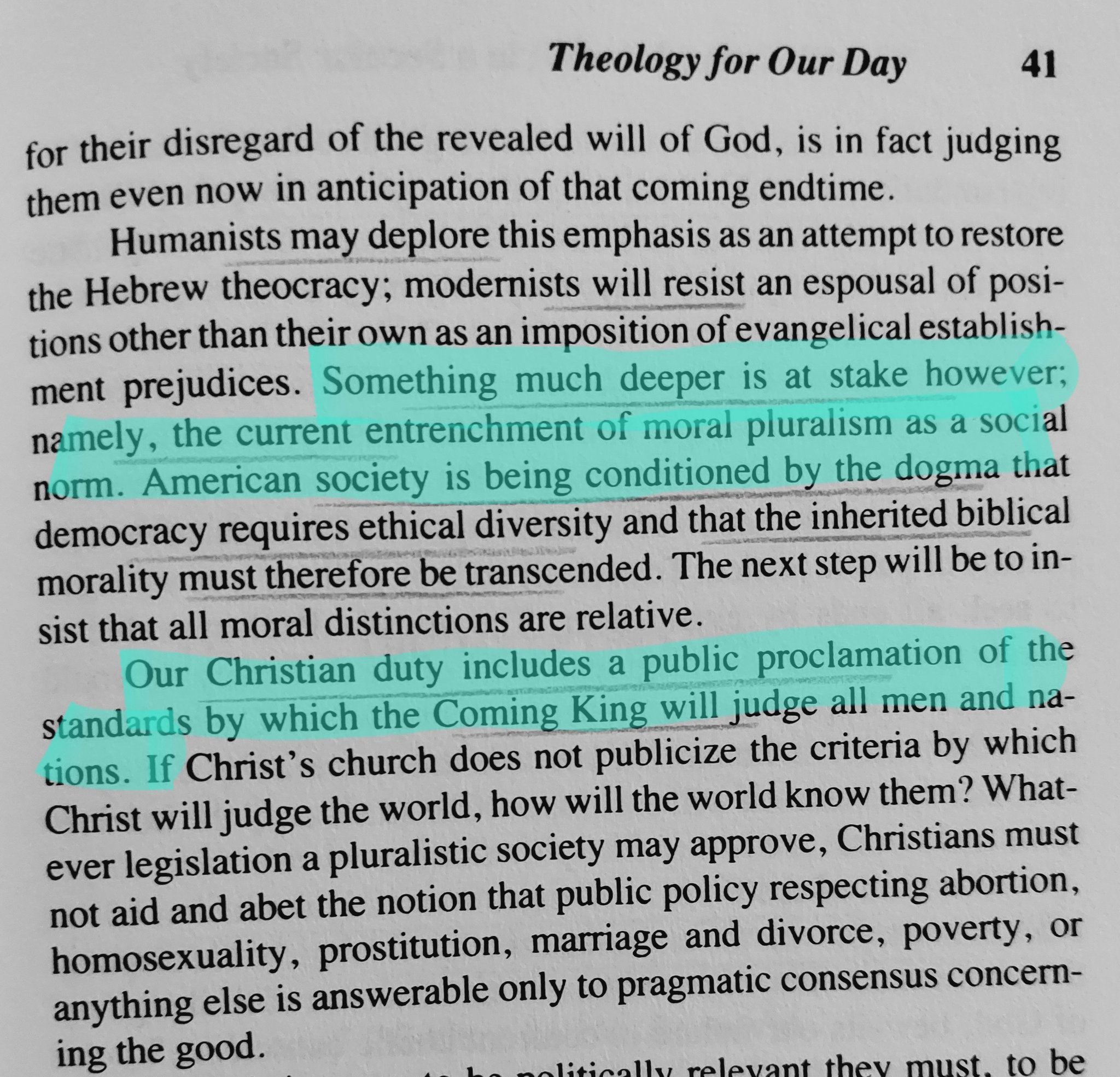
I’m reading through a little book Carl Henry wrote during the Reagan years, titled The Christian Mindset in a Secular Society. He writes something here that I felt I must share. It’s about the relationship between the Church and the State. Henry suggests that the church’s job is about more than personal evangelism. Like an occupying army, he suggests the church is to be “light and salt in a darkening and decaying society,” (p. 39). He then writes this (p. 40):

Speaking as a Baptist, should we do as Henry suggests? Should we “insist” on applying Christian ethical absolutes to national life? What is disturbing is that Henry suggests pluralism is a sham. It’s true that somebody’s values will be advanced in any piece of legislation, policy, or administrative rule. It’s also true that a key mark of the Baptist ethos is that we wish government to leave everyone alone so we can all worship as we see fit, without interference or sanction. Baptists believe this because any coercion, any outward pressure, any legal compulsion to “make” someone a Christian is both (1) a waste of time, because it won’t work, and (2) spiritual abuse. So, Baptists have not historically sought or wanted State sanction for religious activities.

Henry was a Baptist. That makes his negative remarks about pluralism (and more recent culture war moves by more modern Baptists) so puzzling. Baptists should not desire State sanction or approval for any religious speech or act, because this would implicitly or explicitly force other faith groups to accept Christian moral values. Baptists recognize that the precedent of State sanction might smile on Christians today, but what about tomorrow? We’re all for State-sponsored approval as long as it favors us. But, what if it doesn’t?

Henry continues:

Henry has doubled down. While I admit I’m not sure how to square (1) my Baptist convictions against State sanction for religion in any form, with (2) my desire to see Christ’s values advocated for in the public square, I insist that Henry’s comments here are not Baptistic in the slightest. His reasoning appears to go like this:

  1. This country was founded on Christian principles
  2. and it ain’t very Christian anymore
  3. so we gotta advocate for Christianity in our national life as part of our Gospel mission

This is incorrect. However, it’s complicated. Behold the 1st Amendment to the U.S. Constitution:

Congress shall make no law respecting an establishment of religion, or prohibiting the free exercise thereof; or abridging the freedom of speech, or of the press; or the right of the people peaceably to assemble, and to petition the Government for a redress of grievances.

See https://constitution.congress.gov/constitution/

You can’t establish a religion, can’t prohibit exercise of religion, and you can’t stop public religious speech. So much is clear. But, it’s also true that the Constitution (and its Amendments) came about in a Christian-ish milieu. The Constitution Annotated, the official “living” government publication providing context for the origin and interpretation of the U.S. Constitution, notes this:

Probably at the time of the adoption of the constitution and of the amendment to it, now under consideration, the general, if not the universal, sentiment in America was, that Christianity ought to receive encouragement from the state, so far as was not incompatible with the private rights of conscience, and the freedom of religious worship. An attempt to level all religions, and to make it a matter of state policy to hold all in utter indifference, would have created universal disapprobation, if not universal indignation.8 The object, then, of the religion clauses in this view was not to prevent general governmental encouragement of religion, of Christianity, but to prevent religious persecution and to prevent a national establishment

The Constitution Annotated, Amendment 1.1.1, Historical Background on Religion Clauses

So, it’s apparent that while America did not have an official State church, its implicit atmosphere was broadly Christian. We can see, then, why Carl Henry and others frame the Church/State relationship the way they do. Are they wrong to do so?

I fear they are indeed wrong. This does not mean I believe Christians should withdraw from society and ignore the moral problems of the day. It also does not mean Christians ought to wed themselves to a particular party, like so many barnacles to a ship. But, these are topics for another time.

I can say, however, that I don’t believe Henry’s approach here can be called Baptist.

Is pluralism a dead end?

Is pluralism a dead end?

I have come to realize a defining issue for Christians is the Church’s relationship to the State, particularly in matters of morality. The Constitution is a pluralist document. It does not go “on the record” for or against one particular religion, though Christianity certainly loomed large in the philosophical and moral shaping of the founders by dint of their culture. Instead, it guarantees religious freedom of conscience for all.

That much isn’t too controversial. The controversy comes with this question: what moral values should therefore inform legislation?

Every piece of legislation, every value judgment by the State, comes from some objective or otherwise “authoritative” and recognized moral standard. The line that “we cannot legislate morality” is both true and false. It’s true in that we can’t change people’s hearts, but every criminal law on the books in local, State and Federal jurisdictions recognizes the deterrent value in having penalties to curb otherwise “immoral” actions (e.g. murder, sexual assault, etc.). As long as there was a broad, implicit consensus about the content of morality (in America’s case, a generic Christian-ish deism), then people could reasonably be on the same page. This is no longer the case.  

Morality is legislated all the time. It certainly was in Bostock v. Clayton County, this past summer—a decision akin to Roe v. Wade for the transgender issue. The difference is we have competing and antithetical moral value judgments in our society; judgments that come from very different philosophical worlds. In this sense, I’m not certain pluralism is really tenable. It seemed like it could be if people operated from a common moral and epistemological foundation, even something as generic as a Christian ceremonial deism. But, that isn’t the case today.

Consider this excerpt from the splendid book by Gaines M. Foster, Moral Reconstruction: Christian Lobbyists and the Federal Legislation of Morality, 1865-1920. He recounts what ensued after yet another attempt by Christian lobbyists to amend the Constitution to proclaim explicit allegiance to Jesus as King in 1896 (p. 109):

For me, this is a true puzzle. I am doing research right now for a short book about the evolution of sexual mores in American society by examining key U.S. Supreme Court decisions from Roe v. Wade to Bostock v. Clayton County. I plan to examine each decision, and the accompanying transcripts of oral arguments and legal briefs, and provide a succinct analysis from a conservative Christian perspective. Of course, this means I’ll immediately come up against the Church’s relationship to the State regarding moral legislation.

I have much to read on Christian political philosophy and natural law. But, right now, these are my thoughts:

  1. Every State must identify a foundation from whence it draws its ideas about morality. After all, we will always legislate someone’s morality. We should be honest about that.
  2. Pluralism is a chimera unless the people have some shared epistemological foundation from which to argue, even if that foundation is something as generic as a Christian-ish deism.
  3. The United States used to have such a generally shared foundation, but no longer does. So, the public square arguments about morality will continue to escalate.
  4. Therefore, I am not certain an ostensible pluralism is a viable way forward in today’s Western culture, where morality is largely determined by majority consensus.
  5. But, I am uncertain what a Christian response to this environment ought to be. Here is where the concept of soul liberty clashes with the imperative to advocate for future kingdom values. Should Christians, for example, really be “for” something God hates (e.g. drag queen “story hour”) in order to uphold pluralism and religious liberty for all?

I don’t have answers to any of this. It’s some measure of comfort to me that Gaines Foster, author of Moral Reconstruction, didn’t have the answer, either. He ends his book with this line:

The fundamental tension built into the moral polity of the early republic thus persists two centuries later: a democratic republic needs a moral citizenry but cannot force its citizens to be moral.

Moral Reconstruction, p. 234

COVID, the Church, the State and a more excellent way?

COVID, the Church, the State and a more excellent way?

What to think about government public health edicts and the Church regarding COVID-19? In an outburst of representative frustration, a Southern Baptist theologian recently posted the following on Twitter in response to his Governor’s new lockdown restrictions which, among other things, forbade dancing:[1]

As the American philosopher Yosemite Sam has often remarked, “them’s fightin’ words!”

Basic principles

We begin with some principles to help us consider how to react to the latest public health directive from Governor Inslee.

  1. The Bible tells us we need community and relationship to be truly human, and the Church is God’s community.

God saves His people to join them to the brotherhood of faith so we can be in relationship with Him and with our new brothers and sisters in the faith.[2] This is why God gave us pictures of the Church as God’s bride (Hos 1-3; Ezek 16; Eph 5), His body (1 Cor 12), and His spiritual house (1 Pet 2). It means we are only complete in community and fellowship with each other. This cannot be done solely by Zoom or YouTube. Therefore, just as a marriage does not exist unless there is a spatial closeness and relationship, so the Church cannot long exist if it does not meet for corporate worship. There are reasons why long-term, long distance marriages often die!

For God’s people to not meet in community is to deliberately hinder the image of God that Father, Son and Spirit are refurbishing in our individual and corporate lives (2 Cor 3:18; cp. 1 Cor 15:49).

Therefore, the Church should close its doors only as a matter of extreme necessity, as a last resort.

  1. The Bible says God puts the government official in place.

We cannot forget this, no matter who is in office:

Daniel 2:21: “He changes times and seasons; he removes kings and sets up kings.”

John 19:11: “You would have no authority over me at all unless it had been given you from above.”

Romans 13:1-2: “Let every person be subject to the governing authorities. For there is no authority except from God, and those that exist have been instituted by God. Therefore whoever resists the authorities resists what God has appointed, and those who resist will incur judgment.”

  1. The Bible says we must obey the secular authorities.

This also cannot be wished away.

We do it because we would be disobeying God if we disobeyed the authorities. “Therefore one must be in subjection, not only to avoid, God’s wrath but also for the sake of conscience,” (Rom 13:5).

Paul told Titus to “remind them to be submissive to rulers and authorities,” (Titus 3:1).

We do it for the sake of evangelism. “Be subject for the Lord’s sake to every human institution, whether it be to the emperor as supreme, or to governors as sent by him to punish those who do evil and to praise those who do good. For this is the will of God, that by doing good you should put to silence the ignorance of foolish people,” (1 Pet 2:13-14).

  1. The Bible tells us we can disobey the authorities in certain circumstances.

The penultimate examples are Acts 4:1-22 and Acts 5:27-33. But, before we use these as the escape pod for which we have been searching, we must note three things:

  • The authorities singled the Christians out for discriminatory treatment. They treated the Church differently than other groups.
  • The State ordered the Church to not preach the Gospel. The State wanted to stop evangelism, not corporate worship.
  • The State did this maliciously and on purpose because it hated the Gospel.

We also think of Daniel and his friends who refused to compromise the way they practiced their faith—even after the State commanded them to do so (Dan 1:8). Would they have done so if there were a legitimate public health reason? Perhaps a famine, a crop failure, or something similar? We do not know. We do know the king’s order did not supersede God’s command, and Nebuchadnezzar provided no compelling reason for them to think it did. God blessed Daniel and his friends for their allegiance (Dan 1:17-21).

In non-canonical but very helpful Jewish literature from the period between Malachi and Matthew, the theme of staying loyal to God in foreign lands was also a tough issue. The Book of Tobit is set during the Assyrian exile, and it is about a man named … (you guessed it) … Tobit, who struggled to be a faithful Israelite in a strange land. He explained:

Now when I was carried away captive to Nineveh, all my brethren and my relatives ate the food of the Gentiles; but I kept myself from eating it, because I remembered God with all my heart (Tobit 1:10-12).

Like Daniel, Tobit loved God and so tried very, very hard to observe the dietary laws even in hard circumstances. As with Daniel, it was not about the dietary laws per se; it was about an honest desire to do what God ordered.[3]

What “certain circumstances,” then, allow us to disobey the State? Based on our survey, there are three triggers:

Considering COVID in Thurston County

This brings us to COVID, and Governor Inslee’s proclamation 20-25.8 of 15 November 2020.[5] These are his new directives for congregations:

Governor Inslee explained during a press conference:[6]

This spike puts us in a more dangerous a position as we were in March … And it means, unfortunately, the time has come to reinstate restrictions on activities statewide to preserve the public’s well-being, and to save lives. These were very difficult decisions that have very real consequences to people’s livelihoods. I recognize that and don’t take those impacts lightly, but we must act now and act quickly to slow the spread of this disease.

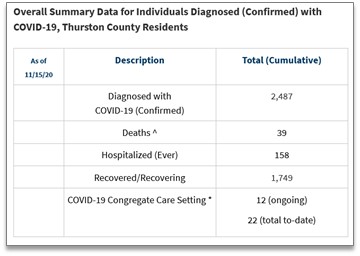
As of 15 November 2020, the Thurston County Health Department reports the following statistics:[7]

This data shows a 98.4% survival rate and indicates 6.4% of those infected have required hospitalization. The Thurston County Public Health Officer recently wrote the community[8] (p. 1, §7) that her recommendation to abandon in-person school instruction was “made based on our local patterns of transmission, rising transmission rates, hospital capacity, public health capacity, and our likely trajectory of disease going into winter.” It is reasonable to assume Governor Inslee’s proclamation is predicated on similar concerns.

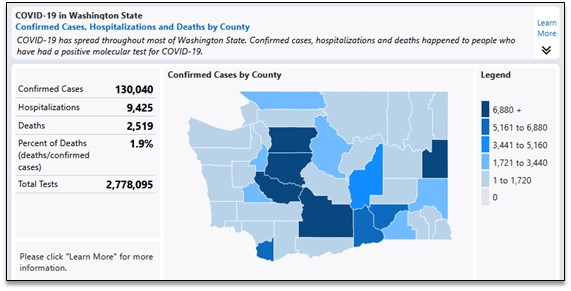
As of 15 November 2020, the cumulative data for the State of Washington is as follows:[9]

This data shows a 98.1% survival rate and demonstrates 7.3% of those infected have required hospitalization. For comparison, here are the State of WA and Thurston County datasets side by side:

COVID and basic principles

We now turn to the triggers we previously discussed which allow the Church to disobey the government. We can eliminate one of these and further explore two others, as follows:

Discrimination?

The State has not engaged in intentional discrimination. Has it engaged in defacto discrimination? In this context, to discriminate means to “make an unjust or prejudicial distinction”[10] regarding the Church. To be unjust is to not behave “according to what is morally right or fair.”[11] Something is prejudicial if it is “harmful to someone or something; detrimental.”[12] Therefore, we can summarize and say Governor Inslee’s proclamation is defacto discriminatory against the Church if it draws morally wrong or unfair distinctions between it and other organizations in society, and these distinctions cause harm.

In his proclamation 20-25.8, Governor Inslee states (p. 3, §3):

These below modifications do not apply to education (including but not limited to K-12, higher education, trade and vocational schools), childcare, health care, and courts and judicial branch-related proceedings, all of which are exempt from the modifications and shall continue to follow current guidance.

Is this distinction morally wrong? Is it unfair to allocate the Church less societal value than a daycare? Is it morally wrong to say the Church is less valuable than an undergraduate institution which runs a course about the sociology of gender, in which students read texts that advocate transgender ideology?[13]

In this context every policy decision has, at its root, a moral calculus that weighs the organization’s value to society.[14] Governor Inslee has decided public schools, universities, trade schools, childcare, health care, the courts and their associated activities are more valuable than religious community. He has conducted a moral reckoning, and he sincerely believes his conclusions are correct.

But, the fact remains he has made a distinction. Is it an immoral or unfair distinction? According to Governor Inslee, both the organizations above are more precious than the Christian church. Thus, they may operate under current guidelines and are not subject to this new proclamation. According to the scriptures, gathering in community is not optional, it harms God’s people to prohibit it, and transgender ideology is a false construct of self-identity and humanity.

Therefore, we could say Governor Inslee’s proclamation 20-25.8 is defacto discriminatory against the Church. However, he has not prohibited churches from meeting. He has set limits on the manner of worship, and he has set similar (financially) harmful limits on how other organizations conduct their operations. The State economy has been crippled and is only now beginning to recover.[15] It is safe to say this latest proclamation will rip the new scab off this wound for all manner of organizations, across all sectors. If Governor Inslee is explicitly or implicitly injuring the Church, even his foes must admit he is making a very clumsy job of it.

Evidence suggests the allegation of defacto discrimination against the Church is ambiguous and unclear.

We turn to the next issue.   

Adequate cause to change the manner of worship?

The question is about predication. In SKRBCs context, the weightiest issue from WA’s new restrictions is whether Governor Inslee has adequate cause to prohibit congregational singing in a worship service. Does he? In his press conference, Governor Inslee declared:[16]

We have a pandemic raging across the state. It is a potentially fatal disease. Left unchecked, it will assuredly result in grossly overburdened hospitals. It will keep people from receiving routine but necessary medical treatment because of the stresses our hospitals will be under.

Left unchecked, the economic devastation, long term, will be continually prolonged. And, most importantly, left unchecked, we will see continued untold numbers of death.

We will not allow these things to happen.

This brings us back to the datasets about COVID:

Just from this admittedly simple review, COVID-19 does not seem to be a serious disease. The number of WA dead (2,519) seems only to be so high because so many have been infected (130,419). And yet, this data masks the true horror of the virus. Even this seemingly modest amount of hospitalizations may overwhelm the public health sector:[17]

… in the hardest-hit areas, there are simply not enough doctors, nurses, and other specialists to staff those beds. Some health-care workers told me that COVID-19 patients are the sickest people they’ve ever cared for: They require twice as much attention as a typical intensive-care-unit patient, for three times the normal length of stay.

The article goes on:[18]

The entire state of Iowa is now out of staffed beds, Eli Perencevich, an infectious-disease doctor at the University of Iowa, told me. Worse is coming. Iowa is accumulating more than 3,600 confirmed cases every day; relative to its population, that’s more than twice the rate Arizona experienced during its summer peak, “when their system was near collapse,” Perencevich said. With only lax policies in place, those cases will continue to rise. Hospitalizations lag behind cases by about two weeks; by Thanksgiving, today’s soaring cases will be overwhelming hospitals that already cannot cope. “The wave hasn’t even crashed down on us yet,” Perencevich said. “It keeps rising and rising, and we’re all running on fear. The health-care system in Iowa is going to collapse, no question.”

In the imminent future, patients will start to die because there simply aren’t enough people to care for them. Doctors and nurses will burn out. The most precious resource the U.S. health-care system has in the struggle against COVID-19 isn’t some miracle drug. It’s the expertise of its health-care workers—and they are exhausted.

Just how difficult is it to care for a single COVID-19 patient?[19]

A typical patient with a severe case of COVID-19 will have a tube connecting their airways to a ventilator, which must be monitored by a respiratory therapist. If their kidneys shut down, they might be on 24-hour dialysis. Every day, they’ll need to be flipped onto their stomach, and then onto their back again—a process that requires six or seven people. They’ll have several tubes going into their heart and blood vessels, administering eight to 12 drugs—sedatives, pain medications, blood thinners, antibiotics, and more.

All of these must be carefully adjusted, sometimes minute to minute, by an ICU nurse. None of these drugs is for treating COVID-19 itself. “That’s just to keep them alive,” Neville, the Iowa nurse, said. An ICU nurse can typically care for two people at a time, but a single COVID-19 patient can consume their full attention. Those patients remain in the ICU for three times the length of the usual stay.

Are some Christians so insulated in their echo-chamber of favored news commentators that they do not realize how awful COVID is? One public health worker recently lamented:[20]

Health-care workers and public-health officials have received threats and abusive messages accusing them of fearmongering … They’ve pleaded with family members to wear masks and physically distance, lest they end up competing for ICU beds that no longer exist. “Nurses have been the most trusted profession for 18 years in a row, which is now bull**** because no one is listening to us,” Neville said.

Add to it that the Centers for Disease Control and Prevention now concludes COVID-19 spreads through droplets in the air:[21]

Some infections can be spread by exposure to virus in small droplets and particles that can linger in the air for minutes to hours. These viruses may be able to infect people who are further than 6 feet away from the person who is infected or after that person has left the space.

This kind of spread is referred to as airborne transmission and is an important way that infections like tuberculosis, measles, and chicken pox are spread.

There is evidence that under certain conditions, people with COVID-19 seem to have infected others who were more than 6 feet away. These transmissions occurred within enclosed spaces that had inadequate ventilation. Sometimes the infected person was breathing heavily, for example while singing or exercising.

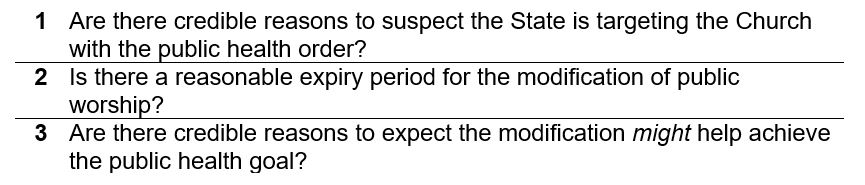
In light of this, does the Church have cause to question the State’s motives in a public health emergency? Can it responsibly ignore the recommendations of public health experts? It seems the following guidelines should apply when considering public health emergency orders:

In the State of Washington’s context, the answers to these questions are, in order, No, Yes and Yes.

Does Governor Inslee therefore lack adequate cause to restrict congregational singing? Only if the Church believes the proclamation (and others like it from other Governors) is part of a conspiracy against Christ and His Church. Such theories abound on the internet, that warm incubator for so much cold darkness.[22]

Of course, these questions do not consider that Satan disguises himself as an angel of light (2 Cor 11:14) and rarely works in an overt way. He seeks to destroy the Church (1 Pet 5:8; Rev 12:17). “For we are not ignorant of his designs,” (2 Cor 2:11). We also must consider whether the Church is the proverbial frog in the pan that slowly boils to death … and never notices. Is the burner dial turning to “MED-HIGH” even now? 

We must remember we live in two worlds: the City of God and the City of Man. This world does not like the Church, does not respect it, does not value it, and never will. We must only go along with public health decrees that re-shape our community and our worship as long as we are reasonably certain there is no explicit or implicit evil motivating them.

Is there, in this case? With Satan, we can never be sure. But the evidence suggests no.

A more excellent way?

We make a mistake when we consider COVID and the State from the perspective of Satan as the moving force in the universe. Yet, that is what we have done. It is what we have all done. We forget the most biblical way to think of COVID is as God’s judgment on the world. Examples from scripture are too numerous to list, but here is one (Jeremiah 14:11-12):

The LORD said to me: “Do not pray for the welfare of this people. Though they fast, I will not hear their cry, sand though they offer burnt offering and grain offering, I will not accept them. But I will consume them by the sword, by famine, and by pestilence.”

God brings curses on a world that rejects Him. True, the world is not Israel. But the point remains—God brings judgment so people might repent. We do not know what His specific message is, but we can be certain it has to do with repentance and allegiance to His name.

While it is necessary to focus on the Church’s obligations to the State regarding public health orders, it is perhaps best for the Church to re-double its efforts to fulfill its mission. That mission is to preach the Gospel. To build bridges to the community in service of that Good News. To be innovative, creative, and winsomely aggressive in this outreach.

That is what God would have us do.

Notes

[1] See https://twitter.com/ostrachan/status/1328413157325410304. This was posted on 16 November 2020.              

[2] See the sermon “Made for Each Other? The Bible on Marriage” (preached 01 November 2020) for an exposition of Genesis 2:18-25. This sermon is essentially about the imago dei and how it is imaged in the covenant of marriage. Retrieved from https://youtu.be/BHZaV6YwXSg.

[3] See also 1 Maccabees 1:58-64 for a similar theme. 

[4] The case of defacto discrimination is well illustrated by Pliny the Younger’s letter to Emperor Trajan querying how he ought to handle Christians. This came about after Pliny issued a general edict outlawing political associations. Christians were then caught up in this administrative dragnet. This was not an explicit, but a defacto discrimination.

[5] Retrieved from https://www.governor.wa.gov/sites/default/files/proclamations/proc_20-25.8.pdf

[6] TV Washington, “Governor Inslee Press Conference on COVID-19,” (15 November 2020). Retrieved from https://www.tvw.org/watch/?eventID=2020111099.

[7] Retrieved from Thurston County Public Health and Social Services on 15 November 2020 from https://www.thurstoncountywa.gov/phss/Pages/covid-19-data.aspx

[8] Dr. Dimyana Abdelmalek, “Letter to the Community: 10 November 2020.” Retrieved on 15 November 2020 from https://www.thurstoncountywa.gov/phss/phssdocuments/11%2010%2020%20letter%20to%20community%20FINAL.pdf

[9] WA State Department of Health, “COVID-19 Dashboard.” Retrieved on 15 November 2020 from  https://www.doh.wa.gov/Emergencies/COVID19/DataDashboard.

[10] New Oxford American Dictionary, 3rd ed. (New York: Oxford, 2010), s.v. “discriminate,” verb, 2; p. 497. 

[11] Ibid, s.v. “unjust,” p. 1893. 

[12] Ibid, s.v. “prejudicial,” p. 1378. 

[13] For example, see SOC 235 “Sociology of Gender” from South Puget Sound Community College. The assigned textbook is Lisa Wade and Myra Ferre, Gender: Ideas, Interactions, Institutions, 2nd ed. (New York: Norton, 2018).

[14] “A man who acts, makes decisions, ranks things above or below, sets a high or low value on things, is acting according to definite principles—even though theoretically he may deny these principles—and he is acting with the consciousness—although in theory he would certainly deny it—that it is right to act in such a way,” (Emil Brunner, The Divine Imperative, trans. Olive Wyon [Philadelphia: Westminster, 1947], 18). 

[15] See State of Washington Economic and Revenue Forecast Council, Economic & Revenue Update – October 15, 2020, pp. 3-5. Retrieved from https://erfc.wa.gov/sites/default/files/public/documents/publications/oct20.pdf

[16] TV Washington, “Press Conference,” 00:25 – 01:10. Retrieved from https://www.tvw.org/watch/?eventID=2020111099.

[17] Ed Yong, “‘No One Is Listening to Us,’” The Atlantic (13 November 2020). Retrieved from https://www.theatlantic.com/health/archive/2020/11/third-surge-breaking-healthcare-workers/617091/.

[18] Ibid.  

[19] Ibid.

[20] Ibid.

[21] Centers for Disease Control and Prevention, “How COVID-19 Spreads,” updated 28 October 2020. Retrieved on 16 November 2020 from https://www.cdc.gov/coronavirus/2019-ncov/prevent-getting-sick/how-covid-spreads.html. Emphasis added.

[22] These theories usually include varying amalgamations of George Soros, the World Economic Forum, Bill Gates, microchips, a belief COVID-19 is not real or is being exploited for nefarious purposes, and conviction that there exists a coordinated, multi-national cabal of political and civil service conspirators ready to execute sinister orders from on high across the globe. I believe the latest colloquial term for this conspiracy at the moment is “the Great Reset.” You can read a short, breezy article skeptical of this theory here.

A bad argument from a good man

Grace Community Church, where John MacArthur serves, has released a statement announcing its intent to defy California’s latest rollback of church gatherings due to concerns of a resurgent COVID-19.

The statement is a disaster.

If MacArthur wishes to defy the California government, he needs to do better than this. Here are some relevant excerpts:

As pastors and elders, we cannot hand over to earthly authorities any privilege or power that belongs solely to Christ as head of His church. Pastors and elders are the ones to whom Christ has given the duty and the right to exercise His spiritual authority in the church (1 Peter 5:1–4; Hebrews 13:7, 17)—and Scripture alone defines how and whom they are to serve (1 Corinthians 4:1–4). They have no duty to follow orders from a civil government attempting to regulate the worship or governance of the church. In fact, pastors who cede their Christ-delegated authority in the church to a civil ruler have abdicated their responsibility before their Lord and violated the God-ordained spheres of authority as much as the secular official who illegitimately imposes his authority upon the church.

He continues:

History is full of painful reminders that government power is easily and frequently abused for evil purposes. Politicians may manipulate statistics and the media can cover up or camouflage inconvenient truths. So a discerning church cannot passively or automatically comply if the government orders a shutdown of congregational meetings—even if the reason given is a concern for public health and safety.

MacArthur explains:

When officials restrict church attendance to a certain number, they attempt to impose a restriction that in principle makes it impossible for the saints to gather as the church. When officials prohibit singing in worship services, they attempt to impose a restriction that in principle makes it impossible for the people of God to obey the commands of Ephesians 5:19 and Colossians 3:16. When officials mandate distancing, they attempt to impose a restriction that in principle makes it impossible to experience the close communion between believers that is commanded in Romans 16:16, 1 Corinthians 16:20, 2 Corinthians 13:12, and 1 Thessalonians 5:26. In all those spheres, we must submit to our Lord.

Unfortunately, MacArthur made no substantive case, here.

In the New Covenant, without a Yahweh-mandated theocracy, we find precedent for defying the State in the Book of Acts. That volume shows the Church (1) being ordered to not preach the Gospel because the quasi-civil authorities do not like the Gospel, and (2) the Church refusing to obey (Acts 4:15-20).

In order to take advantage of this precedent, the Church must argue a local jurisdiction is acting in a way that fits the pattern. Specifically, persecution or otherwise discriminatory treatment because of religion. Of course, Luke is not on hand to take us into the minds of civil authorities, so we must use a “reasonable person” standard.

So, you must separate government directives into two broad categories of impetus for our context; (1) public health, and (2) persecution or otherwise discriminatory treatment because of religion. In order to trigger civil disobedience, a church must make a plausible case Scenario #2 is happening. In this, MacArthur has not succeeded.

He’s essentially advocating civil disobedience whenever a church disagrees with civil authorities. In fact, on his argument, why should any Christian ever obey his government? This logic is a blank cheque for anarchy, for those looking for it. I expected better from MacArthur.

What about Nevada?

Consider the situation in Nevada.

The Supreme Court (“SCOTUS”) declined last week to hear arguments from Calvary Chapel Dayton Valley alleging religious discrimination by the State of Nevada. Calvary Chapel sought to hold services with 90 people, with appropriate social distancing. However, Nevada restricts churches (and certain other institutions) to 50 people flat. But certain other public facilities, including casinos, are limited to 50% of the fire code capacity. Clearly, these are different metrics. When SCOTUS declined to hear the case, it let the lower court decision stand. In Justice Alito’s dissent, he noted:

The Constitution guarantees the free exercise of religion. It says nothing about the freedom to play craps or black-jack, to feed tokens into a slot machine, or to engage in any other game of chance. But the Governor of Nevada apparently has different priorities.

Claiming virtually unbounded power to restrict constitutional rights during the COVID–19 pandemic, he has issued a directive that severely limits attendance at religious services. A church, synagogue, or mosque, regardless of its size, may not admit more than 50 persons, but casinos and certain other favored facilities may admit 50% of their maximum occupancy—and in the case of gigantic Las Vegas casinos, this means that thousands of patrons are allowed.

That Nevada would discriminate in favor of the powerful gaming industry and its employees may not come as a surprise, but this Court’s willingness to allow such discrimination is disappointing. We have a duty to defend the Constitution, and even a public health emergency does not absolve us of that responsibility.

If I were in Nevada, I would give serious consideration to defying the State’s order. To return to California, if Grace Community Church feels it’s in an analogous situation, it should explain. Perhaps it cannot.

In short, MacArthur (et al) has made a bad argument. No doubt, some evangelicals will gleefully post it as though Christ has spoken and the matter is settled.

It is not settled.

Perhaps there is an argument to be made that churches can defy the California governor. John MacArthur just hasn’t made it. No Christian should rely on this statement as a basis for defying his State government. We must do better than this.

Return to California

In response to questions about what, precisely, has changed to warrant this reaction, Grace Community Church released a clarification appended to the original article. It reads, in part:

But we are now more than twenty weeks into the unrelieved restrictions. It is apparent that those original projections of death were wrong and the virus is nowhere near as dangerous as originally feared.

This appears to be the beginning of an argument for civil disobedience based on government incompetence. But, again, the examples from the Book of Acts show us quasi-civil authorities who order the Church to not preach the Gospel because they doesn’t like the message. We have no example of the Church disobeying civil authorities simply because it disagrees with public policy. If Grace Community Church believe otherwise, it ought to prove its case.

Still, roughly forty percent of the year has passed with our church essentially unable to gather in a normal way. Pastors’ ability to shepherd their flocks has been severely curtailed. The unity and influence of the church has been threatened. Opportunities for believers to serve and minister to one another have been missed. And the suffering of Christians who are troubled, fearful, distressed, infirm, or otherwise in urgent need of fellowship and encouragement has been magnified beyond anything that could reasonably be considered just or necessary.

To be sure, this is hard. Every pastor feels it. But, is there really nothing that can be done? A full, corporate worship service in your auditorium is the only solution to this problem? You can’t do visitation? You can’t have smaller gatherings in homes? You can’t have outdoor services?

Major public events that were planned for 2021 are already being canceled, signaling that officials are preparing to keep restrictions in place into next year and beyond. That forces churches to choose between the clear command of our Lord and the government officials. Therefore, following the authority of our Lord Jesus Christ, we gladly choose to obey Him.

If MacArthur believes California is doing this to deliberately target religious institutions, then he must provide evidence. If he has none, then he’s encouraging any Christian on earth to disobey the State whenever he disagrees or otherwise finds civil authority inconvenient. This is puzzling coming from MacArthur, who believes (rightly, in my view) there was no biblical warrant for the Colonies to revolt against the British!

This is a terrible document. Too many Christians will accept it uncritically. Some of them will do so because they’re anxious for theological cover, any cover, to justify what they already want to do. Others, perhaps some of the same, will be moved by conspiracy theories or animated by political animus. Given MacArthur’s stature in the evangelical world, the bad arguments here are particularly disappointing. Even worse, MacArthur encourages you to “add your signature to the statement,” regardless of whether California’s civil context is your own.

I shall close with a summary from Phil Johnson, of Grace Community Church, made in the context of a dispute with Mark Dever about a 9Marks article which disagreed with the decision:

This is not an argument that triggers Scenario #2. Again, I say it’s possible there is an argument to be made for civil disobedience in California’s context. MacArthur just hasn’t made it.

Read the statement here.