The Cosmic Civil War: A Palm Sunday Reflection

The Cosmic Civil War: A Palm Sunday Reflection

As Easter draws near, the Christian calendar presents us with a sequence of world-altering events—Palm Sunday, Good Friday, Easter Sunday, and later Pentecost. Each day tells a part of the greatest story ever told, and it begins with Palm Sunday: the moment Jesus Christ enters Jerusalem, hailed as a king, setting into motion the fulfillment of divine promises.

In Luke 19:28–44, we find the account of Jesus’ entry into Jerusalem. But to fully grasp what’s happening, we need to step back and understand the broader picture.

The cosmic civil war

From the beginning of Scripture, humanity has been caught in a cosmic civil war. In Genesis 1 and 2, God creates a perfect world and places humanity under his authority. But in Genesis 3, Adam and Eve reject that authority and choose to go their own way. Genesis 4 onward tells the story of how we all, by birth and by choice, follow that path.

Think of the analogy of the American civil war.

Our spiritual rebellion is something like that. Our first parents founded this “confederacy.” This means we’re each born, by default, as citizens of this confederacy. Just as the southern states illegally broke away from the federal government, we have each broken away from God. Each of us, spiritually speaking, is born a citizen of this rebellion—a fraudulent kingdom opposed to its rightful ruler.

So this is the situation:

  • We can remain in the Confederacy (which is going to lose this war), or
  • We can choose to rejoin the Union.

When Jesus’ ministry begins—when he says that the kingdom of heaven is at hand, and that everyone ought to repent and believe the gospel (Mk 1:15), he’s basically asking: “what’s it gonna be?”

When Jesus enters Jerusalem one week before Passover, his three years of ministry nearly finished, he is asking: “Here I am. I’m your king. Will you choose to love me and swear an oath of allegiance to me and end this stupid war?”

This question is much more important than the American civil war, because this is a cosmic war—your very soul is at stake.

Jesus and the donkey

The turning point comes on Palm Sunday. Jesus approaches Jerusalem from the Mount of Olives, and he tells his disciples to find a donkey. This detail might seem odd, but it’s loaded with significance. Jesus is deliberately fulfilling the prophecy from Zechariah 9:9:

Rejoice greatly, Daughter Zion! Shout, Daughter Jerusalem! See, your king comes to you, righteous and victorious, lowly and riding on a donkey … (Zech 9:9).

A donkey is not exactly the image of power and might. It emphasizes Jesus’ humility—his lowly status. He isn’t a warrior. He comes not to crush enemies but to extend a hand of grace. He is the King foretold in ancient Scripture, arriving not with overwhelming force, but with a gentle invitation. He’s come to proclaim peace to the nations, and to free prisoners from a waterless pit because of the blood-oath of the new covenant he’s come to launch (Zech 9:10-11).

The donkey is not a trivial detail. It’s Jesus’ way of showing the kind of king He is: one who offers peace, not coercion.

Jesus and the palm branches

As Jesus enters the city, people begin to respond. Crowds gather, laying their cloaks on the road and waving palm branches—an ancient sign of honor and victory. They shout:

Blessed is the king who comes in the name of the Lord! Peace in heaven and glory in the highest!” (Luke 19:38; quoting Ps 118:26).

This isn’t spontaneous enthusiasm; it’s deliberate. They’re quoting Psalm 118, a psalm used in royal processions to the Jerusalem temple. This song is a well-known cultural cue, like the national anthem may be to us. They know what it means. They know what they’re singing and why. They’re acknowledging Jesus not just as a teacher or prophet, but as the rightful King of Israel. “[T]he whole crowd of disciples began joyfully to praise God in loud voices for all the miracles they had seen” (Lk 19:37). They recall His miracles: raising Lazarus, healing the sick, casting out demons. Everything Jesus has done points to this moment. He is the Messish and the king.

But not everyone is pleased.

Jesus weeps over Jerusalem

The Pharisees, standing in the crowd, hear the chants and understand their meaning. They demand that Jesus rebuke his followers. They know what this singing means—that Jesus is the fulfillment of all prophecy, the King who brings God’s kingdom. Jesus responds: “I tell you, if they keep quiet, the stones will cry out” (Luke 19:40)

But  Jesus knows the celebration is less than honest. This same crowd is nowhere to be found later in the week, on Good Friday. So as he draws near to Jerusalem, Jesus does something unexpected: he weeps. “If you, even you, had only known on this day what would bring you peace—but now it is hidden from your eyes” (Luke 19:42).

Jesus offers peace with God. Peace for your soul. Peace for your heart. The apostle Paul wrote: “Therefore, since we have been justified through faith, we have peace with God through our Lord Jesus Christ” (Rom 5:1). This is the same peace the angels offered on Christmas morning: “Glory to God in the highest heaven, and on earth peace to those on whom his favor rests” (Lk 2:14). His favor rests on those who come in from the cold and choose to love him.

The King who comes in peace now mourns, knowing that many will reject him. Within days, the same crowds shouting “Hosanna” will yell “Crucify him!” (Mk 15:13). Though peace is within their reach, they will choose rebellion. The city that celebrates him will soon betray him.

The Cosmic Amnesty

After the American civil war, President Andrew Johnson offered amnesty to any Confederate who wanted it.

Johnson specifically says this amnesty was a pardon. His proclamation said that to suppress the rebellion, to convince people to be loyal to the true government once again, and to restore Federal authority, he was offering a pardon if you swore a particular oath and sincerely mean it. Pardon does not mean you’re innocent—it means you’re released from legal liability.

This is exactly what Jesus is offering. We’re so-called “citizens” of a fraudulent nation in rebellion against lawful authority. To suppress this rebellion, to convince people to be loyal to the true government once again, and to restore his divine authority, God is offering a pardon if you swear an oath to his Son—if you repent and believe the good news and sincerely mean it.

As Jesus looks down upon Jerusalem from the Mount of Olives, he’s making an offer: “Swear an oath of allegiance from your heart, and let’s get this done.” But it does not happen. Jerusalem will soon say: “I’ll take Option B.”

So, what will we do? You can do nothing and remain in the Confederacy (which will lose this war), or you can choose to rejoin the Union.

Listening to the Real Jesus: Insights from the Transfiguration

Listening to the Real Jesus: Insights from the Transfiguration

The story of the transfiguration is one of the most remarkable in the gospels, yet its message is pretty simple: listen to Jesus! If you call yourself a Christian, you might think, “Well, of course! That’s obvious.” But listening to Jesus is harder than we admit. Too often, we listen to a fake version of Jesus that we’ve invented—a Jesus shaped by our own preferences, desires, or cultural influences.

A relationship with God begins with love. We love Him because He first loved us. From this love flows our desire to obey him, believe rightly, and do what his Word says. But what happens if we love the wrong Jesus? Well, if we follow a Jesus of our own making instead of the one revealed in scripture, our beliefs and actions will be all wrong. That’s why it’s important to listen to the real Jesus—the Jesus who is the Son of God, not the one we or our culture have reshaped to fit our own ideals.

Why the transfiguration?

When we read what happened in the run-up to the transfiguration, we learn that it was meant to cement Jesus’ claim to absolute authority in his people’s lives. It’s as if he’s saying: “You gotta listen to me! Not well-meaning but false teachers. Not your culture. Me. I’m kind of a big deal …”

This run-up shows us Jesus having an escalating authority controversy with scribes and Pharisees everywhere he goes. The disciples see and hear all this. For sake of space, we’ll parachute into Matthew 15, where Jesus tells some Pharisees and scribes that they’re hypocrites for emphasizing purity traditions over scripture: “These people honor me with their lips, but their hearts are far from me” (Mt 15:8, quoting Isa 29:13). Jesus then privately compared them to invasive weeds his Father had not planted—the day would come when they’d be ripped out of the ground (Mt 15:13-14; cp. Mt 13:24-30, 36-43)!

We then follow Jesus as he speaks to a Canaanite woman who asks him to cast a demon out of her daughter. She calls him Lord. She recognizes him as the son of David—implicitly, as the king of Israel. He commends her faith (Mt 15:28), a huge irony because she (a non-Jewish person) should have trouble embracing the Jewish Messiah!

Jesus then miraculously feeds 4,000 people in the wilderness east of the Sea of Galilee—people who see his miracles and praise the God of Israel. These are probably not Jewish people (Mt 15:29-31; cp. Mk 7:31)! Matthew now immediately pivots to another confrontation with Jewish authorities who demand he prove his credentials by showing them a sign from heaven (Mt 16:1-4). After telling them off, Jesus warns his followers against the teaching (“the yeast”) of the scribes and Pharisees, whose doctrinal errors are like arsenic for the soul (Mt 16:5, 12).

It’s no accident that Matthew next shows us Jesus asking who people thought he was. Peter answered correctly (“You are the Messiah, the Son of the living God,” Mt 16:16), but was it an intellectual answer or a deeply held conviction? Was it a well-intentioned theory or a heart-felt reality? What did they think of these repeated authority clashes? Do they truly believe that Jesus is their authority?

These implicit questions are what the transfiguration was meant to answer.

What does the transfiguration mean?

The transfiguration tells us who Jesus truly is. They go up the mountain. Suddenly, without warning, Jesus is “transfigured” or “transformed” before their very eyes. It happens suddenly, surprisingly. Jesus’ face shines like the sun, his clothes a dazzling white. This is a terrifying metamorphosis! Moses and Elijah, representing the Law and the Prophets, suddenly appear with him, emphasizing Jesus’ fulfillment and embodiment of both (Mt 17:1-3). But the most striking moment comes when a bright cloud overshadows them, and God the Father speaks: “This is my Son, whom I love; with Him I am well pleased. Listen to Him!” (Mt 17:5).

God is saying: “Do what he says! Keep doing what he says! He is your authority. Hear him!”

Why does this matter? Because when we fail to listen to Jesus, we start listening to competing voices—false teachers, cultural narratives, or even our own misguided emotions. The transfiguration was God’s way of making it abundantly clear: Jesus is the one to whom we should listen above all else.

Why Do People Believe in Fake Jesuses?

Throughout history, people have reshaped Jesus to suit their own agendas. Sometimes this is done with good intentions, but the result is always a distortion of the truth. In Jesus’ day, culture had so re-shaped expectations that many expected a “legalistic Messiah.” In America, in the ante-bellum South, some Christians argued that chattel slavery was a good thing because God was using it as a means of evangelism to enslaved black people! Culture makes us create fakes Jesuses like playdough. It’s no accident that these fake Jesuses always follow whatever culture war battles happen to be raging at the time.

Here are a few modern examples of “fake Jesuses” that people often follow:

  1. The homosexual Jesus – The lie that says Jesus has cast aside God’s laws about sexual ethics, and that unrepentant homosexual activity is just fine for Christians.
  2. The transgender Jesus – The lie that says your body can be at odds with your soul—as if your “inner self” can be divorced from your physical body and its gender. We are a unity of body + soul, which is why the doctrine of bodily resurrection is key to the Christian story. You will be resurrected in the physical body with which you were born. There is no legitimate disconnect between your “inner self” and your body.
  3. The Nationalistic Jesus – Many in America have intertwined faith with patriotism, as if Jesus’ mission were to uphold America’s greatness instead of establishing His Kingdom.
  4. The Social Justice-Only Jesus – While Jesus absolutely cares about justice, some reduce him to merely a social activist, ignoring his central message of salvation and repentance.

You can go out today and find false churches that teach and promote each of these fake Jesuses. They’re all lies. They’re each a distortion, and when we follow them, we stop truly listening to the real Jesus. The real Jesus, as revealed in scripture, calls us to deny ourselves, take up our cross, and follow Him (Matthew 16:24). That means (among other things) surrendering our own ideas about who he should be and allowing his Word to shape our understanding.

Listening to Jesus in Everyday Life

So how do we practically listen to Jesus? It’s not just about avoiding theological errors—it’s about daily obedience in both big and small ways. Here are a few examples of what it looks like to truly listen to Jesus:

  • Caring for the sick and elderly – Choosing to honor and care for aging parents instead of neglecting them.
  • Being a faithful spouse – Responding to difficulties in marriage with love and forgiveness rather than bitterness.
  • Serving others in your local church – Helping brothers and sisters in need in your church, even when it’s inconvenient.

Jesus is not a coffee table book

What happens when we don’t listen to the real Jesus? History and personal experience show us that failing to heed his voice leads to confusion, division, and spiritual decay. When we shape Jesus in our own image, we end up walking paths that lead us further from God, not closer to him. Even well-meaning people can fall into the trap of creating a fake version of Jesus that fits their lifestyle rather than allowing the real Jesus to transform their life. The apostle Paul tells us this is an evil age (Gal 1:3-4). The apostle John likens this ruined world, with its corrupt and seductive values, to Babylon–and tells it’s all going down one day (Rev 16-19). This world’s “truth” is, in fact, a pack of lies. Jesus tells us to listen to him.

For too many Christians, Jesus is like a decorative coffee table book—nice to have around, but not something they actually engage with. The transfiguration challenges us to move beyond a passive relationship with Jesus. He’s not just a figure to admire; He’s the King of our lives. If we truly listen to Him, it will shape how we think, believe, and live.

As we reflect on the Transfiguration, let’s take God’s words to heart: Listen to him. Not to the competing voices of culture, not to our own desires, but to the true Jesus who reveals himself in Scripture. Only by listening to him can we be transformed and live out the faith we profess.

How to Be Jesus People

How to Be Jesus People

The Sermon on the Mount is one of the most well-known teachings of Jesus, guiding Christians on how to live in an unholy world. In Matthew 5:2-16, Jesus focuses on how believers are to be a countercultural people (Mt 5:2-12), living as salt and light in the world (Mt 5:13-16). But what does that mean? And how exactly are we supposed to do that?

Understanding the Christian Counterculture

Jesus emphasizes that Christians are not meant to isolate themselves from the world but rather to live differently within it. Being salt and light means standing out—not in a showy or arrogant way, but in a way that draws others to the truth of the gospel. This means engaging with the world while remaining distinct from its values.

The key question, then, is: how do we live as a countercultural people? In Mathew 5:17-20, Jesus answers this by teaching that we must obey God’s law in the right way—with the right heart and the right motives.

  • First, he explains how he fulfills the law and the prophets.
  • Then, he explains our obligations to live according to the law n light of what he’s now done.

The rest of Matthew 5 is Jesus’ illustrations of this principle through everyday examples.

Jesus Fulfills the Law

Many misunderstand Jesus’ relationship to the Old Testament law. Some think He came to replace it with something entirely new, but He clarifies: “Do not think that I have come to abolish the Law or the Prophets; I have not come to abolish them but to fulfill them” (Matthew 5:17).

But what does it mean for Jesus to “fulfill” the law? Essentially, Jesus gives the law its deeper and truer meaning. Instead of following it in a superficial, legalistic way—like the Pharisees did—Jesus calls His followers to obey it from the heart.

How Do We Read the Law Through the ‘Jesus Filter’?

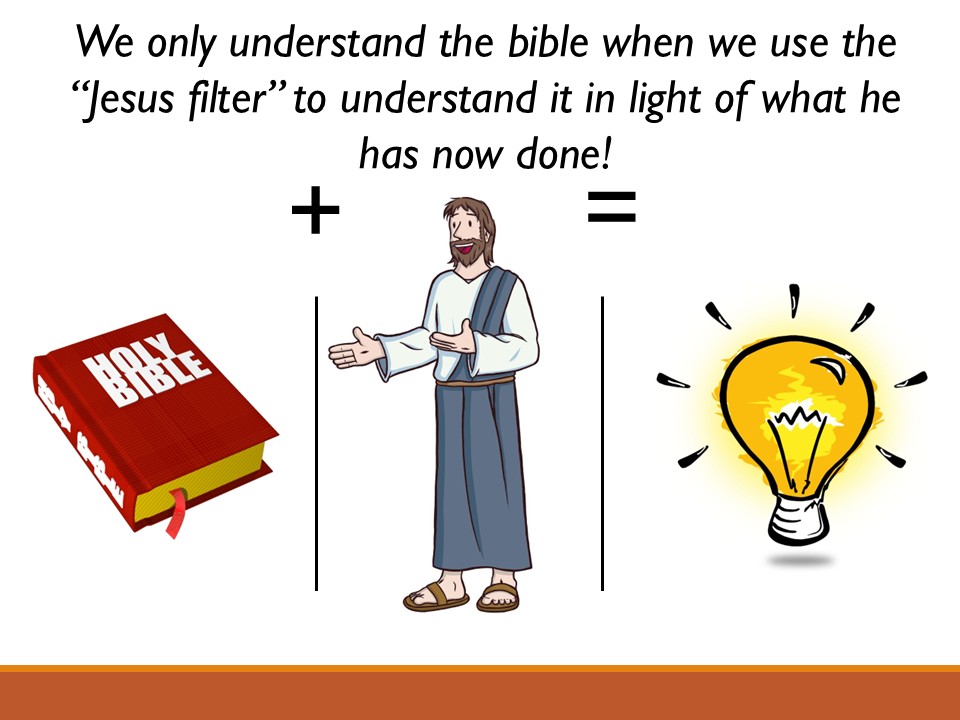
The Bible is a story with a beginning, middle, and end. When we read the Old Testament, we must do so in light of Jesus’ life, death, and resurrection. This is the “Jesus filter”—understanding that everything in Scripture points to Him.

Here is what this looks like:

For example, the sacrificial laws in Leviticus can seem tedious, but they make sense when we realize they were all pointing to Jesus, the ultimate sacrifice. Just like a child might look forward to getting a bicycle, only to later realize that a car is even better, the Old Testament sacrifices (i.e., the ceremonial laws) were placeholders until Christ, the true fulfillment, came.

Three Types of Old Testament Laws

  1. Ceremonial Laws – These included sacrifices, purity laws, and temple rituals. Jesus fulfills these laws by becoming the ultimate sacrifice. Since His death and resurrection, these laws no longer apply in a direct way.
  2. Civil Laws – These governed daily life in ancient Israel, from property disputes to social justice. Since the Old Testament kingdom no longer exists in the same way, these laws don’t directly apply today, though we can learn principles from them.
  3. Moral Laws – These include commandments about right and wrong, like prohibitions against murder, adultery, and lying. These remain in effect because they are rooted in God’s unchanging character.

Because the new covenant has fulfilled or re-shaped the first two categories of the old covenant law, Jesus now pivots in the rest of Matthew 5 to focus solely on moral laws and their relevance for today. He says: “Therefore anyone who sets aside one of the least of these commands and teaches others accordingly will be called least in the kingdom of heaven, but whoever practices and teaches these commands will be called great in the kingdom of heaven” (Mt 5:19).

What does this mean?

Obeying the Law in the Right Way

Jesus warns that it is possible to do the right thing for the wrong reasons. If we simply follow rules without love or genuine devotion, our obedience is meaningless. This was the problem with the Pharisees, who were obsessed with external appearances while missing the heart of God’s law. They wrongly saw the old covenant law as a means of salvation—“I do this for God, and he will do that for me!” This produces a very self-righteous attitude.

Jesus says, “Unless your righteousness surpasses that of the Pharisees and the teachers of the law, you will certainly not enter the kingdom of heaven” (Matthew 5:20). That doesn’t mean we need to follow even more rules than they did—it means our obedience should come from a place of love, not just obligation. We obey God because we love him and have already been made right with God, not to “get” righteousness as a reward at the end of the rainbow.

For example, the commandment: “You shall have no other gods before me” is easy to affirm in theory. But if we examined our lives, what would our actions say? Do we prioritize God above all else? Or do we let other things—our jobs, entertainment, relationships—take first place in our hearts? There is a massive difference between surface conformity and heartfelt obedience. True obedience isn’t just about external actions but about having a heart transformed by love for God.

Faith Expressing Itself Through Love

The Apostle Paul summed it up in Galatians 5:6: “The only thing that counts is faith expressing itself through love.” This means that our obedience to God should not come from fear or duty but from a genuine love for Him. Just as a heartfelt note from a loved one is more meaningful than a generic greeting card from your insurance agent, our devotion to God should be personal and sincere.

Jesus’ teachings in the rest of Matthew 5 give practical examples of this principle. He takes the external commands (like “Do not murder” and “Do not commit adultery”) and shows their deeper meaning. It’s not enough just to avoid murder—we must also guard against anger and hatred. It’s not enough just to avoid adultery—we must also keep our hearts pure.

A Call to Authentic Christianity

Being a Christian counterculture means more than just appearing religious. It means having a heart genuinely transformed by Christ. True righteousness flows from within—it’s not about keeping a checklist of rules but about loving God so deeply that obedience becomes natural.

This is the challenge Jesus sets before us. Are we simply following religious rules, or are we truly living as salt and light in the world? Do we obey because we have to, or because we want to?

Jesus calls us to follow Him from the heart, to let our love for Him shape every aspect of our lives. When we do this, we don’t just become religious people—we become a living testimony of God’s grace and truth.


May we each examine our hearts and ask God to help us live out our faith in a way that is truly countercultural—not just in appearance, but in spirit and truth.

The Illusion of Self-Righteousness

The Illusion of Self-Righteousness

This is a series of brief devotional articles on The Orthodox Catechism (“OC”),a Particular Baptist document written by Baptist pastor Hercules Collins in 1680. Read the series.

When confronted with a moral failure, our instinct is to minimize or to blame-shift. Yes, we shouldn’t have said this, but it only happened because you said that. No, we haven’t quite gotten around to fixing the car like we promised, but that’s because you keep using it every Saturday. Although these are silly little examples, the pattern holds true for the larger things.

Jesus summed up the law and the prophets under two heads; (a) love God with everything you have—heart, soul, mind, and strength—and (b) love your neighbor as yourself (Mt 22:37-40). How well do we follow these summary principles? The catechism question before us now is like a mirror that strips away all our self-righteousness. It leaves us, as it were, ashamed and defenseless, alone with the truth about ourselves:

Question 5: Can you live up to all this perfectly?

Answer 5: No. I have a natural tendency to hate God[1] and my neighbor.[2]

Now the minimizing bit comes into play.

  • Living up to all this perfectly? “Well, nobody is perfect …” we muse. But, compared to the other guy, I’m not in bad shape at all.
  • A natural tendency? Well, again, nobody is perfect.
  • Hating God and our neighbor? Hate is a strong word. I love God, and I don’t really hate anybody.

Unfortunately, the minimizing doesn’t work here. Holiness isn’t graded on a curve. In the same way that a woman either is or is not pregnant, and a man either is or is not a father, you either are or are not holy and righteous. To be “holy” is to be pure and perfect—without moral spot or blemish. To be “righteous” means to be morally upright in accordance with God’s standards. The catechism answer says you’ve missed that boat. We all have.

In what way have we missed that boat?

Because we all have a natural tendency to hate God and our neighbor. This tendency is natural because it’s innate, it’s our default setting, it isn’t a learned behavior—it’s just the way we are. The apostle Paul, a Jewish man, pointed out that even Jews had no advantage with God on this point: “Do we have any advantage? Not at all! For we have already made the charge that Jews and Gentiles alike are all under the power of sin” (Rom 3:9).

Paul’s words are important and you should read them again. We’re “under the power of” this malevolent force called sin, which is basically a contagion or disease of pervasive selfishness and narcissism. Because sin is selfishness—not simply “self-love” but more like “self-worship at all costs”[3]—it has a marvelous capacity for self-deception and self-righteousness. We think we’re fine, but we’re not. This is why God must rip the veil away from our hearts and minds so the gospel light can shine in and do its work (2 Cor 4:3-6).

Now we turn to hate. Yes, it’s a strong word. It means something like “extreme enmity” and “active hostility.”[4] Who wants to fess up to that? But lest we assume we have plenty of wiggle-room here, Jesus takes a sledgehammer to our rationalizations. God’s standards aren’t about externals—they’re about internal affections that show in an external way. This means that anger, contempt, and ridicule are the same as murder because they all come from an inner hostility and ill-will towards that other person (Mt 5:21-22). Likewise, adultery isn’t simply the sexual act but also the sexual thought (Mt 5:27-28).

What the catechism is driving at is that, in our hearts, we do not love God and our neighbor perfectly. We fail here because sin is that pervasive selfishness and narcissism that naturally reigns in our hearts and minds. And, because holiness (like pregnancy and fatherhood) is a “yes or no” status, that means we’ve each fallen short.

So, that’s where we are. It brings us round to Questions 2 and 3—the law of God tells us how great our sin and misery are. This naturally prompts a new question: why would God make us to be in such a terrible condition? If a manufacturer makes a bad product, it issues a recall and fixes the problem. Why hasn’t God issued a recall on us? Did he make a mistake with us? Is he holding us responsible for his own design flaws? We turn to these questions next time.


[1] Rom 3:9-20, 23; 1 John 1:8, 10.

[2] Gen 6:5; Jer 17:9; Rom 7:23-24, 8:7; Eph 2:1-3; Titus 3:3.

[3] Augustus H. Strong is particularly good here: “We hold the essential principle of sin to be selfishness. By selfishness we mean not simply the exaggerated self-love which constitutes the antithesis of benevolence, but that choice of self as the supreme end which constitutes the antithesis of supreme love to God” (Systematic Theology (Philadelphia: American Baptist Publication Society, 1907), 567).

[4] Merriam-Webster Collegiate Dictionary, s.v. “hate,” verb, sense 1.  

Three Steps to True Spiritual Freedom

Three Steps to True Spiritual Freedom

This is a series of brief devotional articles on The Orthodox Catechism (“OC”), a Particular Baptist document written by Baptist pastor Hercules Collins in 1680. It’s basically the Heidelberg Catechism (first ed. 1563) with Baptist flavor and a few other additions. Read the series.

If the only comfort we have in this life is that we belong—both body and soul, in life and death—to our most faithful Lord and Savior Jesus Christ (see the discussion on Q1), then …

Question 2: What must you know to live and die in the joy of this comfort?

Answer 2: Three things: first, how great my sin and misery are;[1] second, how I am set free from all my sins and misery;[2] third, how I am to thank God for such deliverance.[3]

Relationship with Christ is the most important thing in your life. Everything we accomplish or hold onto as an anchor will fade away in time. James A. Baker III was a hugely important figure in American political life, but how many today even know who he is, let alone that he helped negotiate an end to the Cold War?[4] Solomon wrote: “No one remembers the former generations, and even those yet to come will not be remembered by those who follow them,” (Ecc 1:11).

But the comfort from the Lord that you belong to him will never change. James Baker was one of former President George H.W. Bush’s best friends. The very day he died, Bush told Baker that he was looking forward to going to heaven.[5] After everything he’d accomplished in life—a decorated World War II pilot, politician, Director of the CIA, chair of the Republican National Committee, two-term Vice-President, one-term President—it all narrowed to one great longing: to go to heaven.

But how do get this comfort? How do we make it our own? Scripture teaches that we must realize and own three things:

First, that we’re in very great trouble.

We’re not righteous, which is a churchy way of saying we’re not “right” with God. We’re criminals in his eyes (“sin is lawlessness,” 1 Jn 3:4), and that’s a problem. We’re all “under the power of sin” (Rom 3:9), which means criminality infects us to the core, like so many rotten apples. This doesn’t mean we’re all cartoon serial killers, but it does mean that we’re all “criminal” in that we don’t naturally love God and so we don’t follow his law. The apostle John explained: “If we claim we have not sinned, we make him out to be a liar and his word is not in us,” (1 Jn 1:10).

So, there’s that.

Second, we must realize that God has provided the way out.

We can’t solve the sin problem, because we’re all products of “the system.” The apostle Paul depicts sin as a malevolent force that rules over us and this world. We can’t break out. So, there must be somebody from outside, somebody who isn’t captured and infected by this world, to blaze a trail and take us out of here (Rom 6:16-18). That person is Jesus. More on that later.

On the night he was betrayed, Jesus told his heavenly father that “eternal life” meant: “that they know you, the only true God, and Jesus Christ, whom you have sent,” (Jn 17:3). To “know,” in this context, means a personal relationship or friendship.[6] We must enter into relationship with God the Father, through Christ the Son, by means of the Holy Spirit. We do that by responding to the good news he has brought to the world (Mk 1:15). “Salvation is found in no one else, for there is no other name under heaven given to mankind by which we must be saved,” (Acts 4:12).

Third, we must be thankful to God for our liberation.

This means that, if God has truly rescued us from our great sin and misery, it’ll show up in our lives. There will be fruit. We show God we’re thankful by living for him (Rom 12:1-2). Our light shines in the world, so people know we belong to Christ (Mt 5:16). The apostle Paul wrote: “offer yourselves to God as those who have been brought from death to life; and offer every part of yourself to him as an instrument of righteousness. For sin shall no longer be your master, because you are not under the law, but under grace,” (Rom 6:13-14). If God has brought us from spiritual darkness and “into the light,” then we ought to live like children of the light (Eph 5:8-10)!

The apostle Peter tells us that God has chosen his people for salvation. He made us to be royal priests who represent him to the world. He’s taken believers from the four corners of the earth and given us a spiritual citizenship that eclipses our earthly passports into deep shadow. Together, we’re God’s special possession, and our job is to “declare the praises of him who called you out of darkness into his wonderful light,” (1 Pet 2:9).

If all this is true, then we prove it by the way we think and live. We have spiritual fruit. This is the concrete expression of thankfulness, and it all stems from grateful love— “We love because he first loved us,” (1 Jn 4:19).

The catechism goes on to explain each of these three things in more detail. But, know this—(a) you must know you’re in terrible trouble, (b) you must enter into a personal relationship with the Father, through the Son, by means of the Spirit, and (c) true faith is proven by a life of thankfulness to God.


[1] Romans 3:9-10; 1 John 1:10.

[2] John 17:3; Acts 4:12.

[3] Matthew 5:16; Romans 6:13; Ephesians 5:8-10; 2 Timothy 2:15; 1 Peter 2:9-10.

[4] See the book by Peter Baker and Susan Glasser, The Man Who Ran Washington: The Life and Times of James A. Baker III (New York: Doubleday, 2020).

[5] Baker and Glasser, Baker, 857.

[6] Louw-Nida, s.v. “γινώσκω,” sense. 27.18, 327; BDAG, s.v. “γινώσκω,” sense. 1b, 200.

Why Christians Find Hope in Belonging to Jesus

Why Christians Find Hope in Belonging to Jesus

A “catechism” is a question and answer book about the basics of the Christian faith. It’s useful for believers who need reminders, for new believers who need to know about their new faith, and for outsiders to learn what the Christian story is all about. The Baptist Orthodox Catechism (ca. 1680) begins with a very practical question:[1]

Question 1: What is your only comfort in life and in death?

Answer 1: That both in soul and body, [2] whether I live or die,[3] I am not my own, but belong wholly to my most faithful Lord and Savior Jesus Christ.[4]

By his most precious blood fully satisfying for all my sins,[5] he has delivered me from all the power of the devil,[6] and so preserves me,[7] that without the will of my heavenly Father not so much as a hair may fall from my head.[8]

Yes, all things must serve for my safety.[9]And so, by his Spirit also, he assures me of everlasting life,[10] and makes me ready and prepared,[11] so that from now on I may live to him.

The only comfort a Christian has is that she belongs to the Lord. It’s reassuring to know that we aren’t alone. That we are not left to fend for ourselves. That we have a heavenly Father who is all-powerful, clothed in majesty and holiness, who cares for us. No matter whether you’re alive or dead, your entire being (which is more than your physical body or your immortal soul—it’s both) belongs to your faithful Lord and rescuer Jesus Christ.

This might seem strange—why is it comforting to cede your own self-government to God’s royal authority?

Because Christians believe that Jesus has liberated from a malevolent and evil kidnapper. This isn’t a storybook fable—Jesus really and truly rescued us from the kingdom of darkness. He paid for our crimes by means of his own death as a vicarious sacrifice, delivering us from Satan’s grasp (see Q33). Jesus put it like this: “When a strong man, fully armed, guards his own house, his possessions are safe. But when someone stronger attacks and overpowers him, he takes away the armor in which the man trusted and divides up his plunder,” (Lk 11:21-22). Jesus is the stronger man. He’s tied Satan up and tossed him onto the lawn, and he’s now going through the house and setting the captives free from the dungeon inside.

This is why we love Jesus and are loyal to him in return (see Q31). This is why we worship Jesus as our king (Dan 7:11-13).[12] The scriptures are about God’s plan through the people of Israel (i.e., King Jesus) to fix the world, to fix us, and to create a family he can love and which loves him back. Jesus is the king who has come to (a) reveal to us that he’s the one has come to fulfill God’s covenant promises and make this happen, (b) to reconcile us to God, and then (c) to rule over our lives now and over all creation later. Jesus is our revealer, reconciler, and ruler.[13]

He watches over us with kindness, holiness, and justice. Nothing is beyond his control. Nothing takes him by surprise. This means we’re safe in his care. Everything that happens is for our good—whether it appears that way or not. Like any good Father, God disciples us. He trains us. He wants us to go the right way. Other times, he makes choices that are best for us even if we cannot understand all this in the here and now. More on that later (see Q26, 27).

Because we belong to King Jesus, he gives us assurance of eternal life. The true Christian responds to his kindness and grace with loving obedience—we love him because he first loved us (1 Jn 4:19).

The most basic impulse of the true Christian is to give yourself to Jesus—to trust him and follow him (see Q91-6). In other words, your only comfort in life and death is that you belong—both body and soul—to your faithful savior Jesus Christ.


[1] This is the beginning of a series of brief devotional articles on The Orthodox Catechism (“OC”),a Particular Baptist document written by Baptist pastor Hercules Collins in 1680. It’s basically the Heidelberg Catechism (first ed. 1563) with Baptist flavor and a few other additions. It is rightly famous tool for doctrinal and devotional instruction in Baptist churches. In the congregation where I serve as pastor, we discuss one question from the OC each week during the worship service.

There are many copies of the OC online, and some are better than others. You can find a true copy online here. You can buy a printed copy here.

[2] 1 Corinthians 6:19-20; 1 Thess 5:10.

[3] Romans 14:8.

[4] 1 Corinthians 3:23.

[5] 1 Peter 1:18-19; 1 John 1:7, 2:2.

[6] 1 John 3:8; Hebrews 2:14-15.

[7] John 6:39.

[8] Matthew 10:30; Luke 21:18.

[9] Romans 8:28.

[10] 2 Corinthians 1:12, 5:5; Eph 1:13-14.

[11] Romans 8:24-25.

[12] Read Daniel 2 and Daniel 7. For a brief explanation of Daniel 7, see also Tyler Robbins, “Understanding Daniel 7: The Vision and its Meaning.” 15 October 2024. https://eccentricfundamentalist.com/2024/10/15/understanding-daniel-7-the-vision-and-its-meaning/.

[13] Millard Erickson, Christian Theology, 3rd ed. (Grand Rapids: Baker, 2013), ch. 35.

Do you want to review my book?

Do you want to review my book?

Wipf & Stock is going to publish a commentary I wrote on the New Testament letter to the Galatians. If you want to be on a list to maybe receive a review copy of the book, then let me know by filling out this form!

The commentary is written for normal people who want to know what Paul is saying. There are no Greek words. There are no long paragraphs about what this scholar says v. what that scholar says. There are no rabbit-trails into questions that theologians like to ponder, but about which ordinary people don’t care and don’t need to know (e.g., did Paul write to Christians in north or south Galatia?). I keep all that stuff in the footnotes. In the text, there is only a straightforward explanation of what Paul says, as best as I understand it.

The commentary will probably end up being about 275 pages. Here is my elevator pitch for why the commentary matters:

How can people be made right with God? The book of Galatians explains. What is the absolute wrong way to try to get right with God? The book of Galatians will explain that, too. What is a real relationship with God supposed to be about? What did Jesus Christ do for us that’s so special and why does it matter to Christians so much? Why does Jesus matter? The book of Galatians talks about all of this. People have always been confused about these questions—even in those first decades of Christianity. The book of Galatians sets us straight, and asks us to trust Jesus and His message.

Here’s the form to be on the list for a review copy.

John 14:1-3 and the Rapture (Part 2)

John 14:1-3 and the Rapture (Part 2)

In the first article, we set out to study what Jesus meant at John 14:1-3. Some Christians believe this passage speaks about the pre-tribulational rapture of the church to heaven, clearing the way for the tribulation here on earth. Is that right?

We began by looking at the context around Jesus’ words, which is His long goodbye talk at John 13:33 to 16:33. In this article, we’ll finish up the context, lay out four possible ways to understand Jesus’ words at John 14:1-3, then propose a “grading scale” to weigh these options. The next two articles in this series will examine these four positions in detail.

See the other articles in the “rapture series” here. See this entire article on “John 14:1-3 and the Rapture” as a single PDF here.

1c: Convo on Phillip’s implicit question (vv. 14:8-21)

Philip, perplexed, asks to see the Father. Jesus explains that Father and Son (and Spirit) mutually indwell one another in a mysterious way (Jn 14:10-11). This interwoven nature helps explain why the one God can eternally exist as three co-equal and co-eternal Persons.[1] This is why to “see” Jesus is to “see” the Father—to be with Jesus by means of trusting His Good News is to be “in God’s presence.”

But still—Jesus is physically leaving! He must leave so He can wage His divine campaign against the kingdom of darkness from on high through us (Jn 14:12).[2] Where does this leave us, then?

Well, Jesus promises to not leave us as orphans. The Father will send “another advocate to help you and be with you forever—the Spirit of truth,” (Jn 14:16-17). Unlike those outside God’s family, we will know this Spirit because He’ll reside with us and be inside us (Jn 14:17).[3] And so He won’t abandon us as orphans: “I will come to you” (Jn 14:18). On that day—that is, the day when the Advocate comes to dwell inside us—we will participate God’s inner life because we’ll be part of this mutual indwelling. “On that day you will realize that I am in my Father, and you are in me, and I am in you,” (Jn 14:20).

1d: Convo on Judas (not Iscariot’s) question (vv. 14:22-31)

When the Spirit takes residence inside us, Father and Son come along with Him: “we will come to them and make our home with them,” (Jn 14:23).

And yet, despite all this talk about being both absent and somehow “with us” at the same time, the fact is that Jesus is physically leaving us. Sure, the Spirit will be His proxy in the interim and, as we’ve seen, Father and Son will also tag along—but there is no physical, tangible “God with us” after the ascension.

Jesus realizes this will be a problem, because He returns to the theme and says it’s best that He leaves (Jn 14:28). If they love Him (and, by extension, love the victory over sin and Satan that His ministry is all about), then they should be glad that He’s headed back to the Father’s throne room. The scriptures “show” us the three Persons who comprise the One God by highlighting the “distinct and harmonious offices in the great work of redemption”[4] that each performs. In this case, Jesus casts a spotlight on the Father’s role in planning this divine rescue plan: “the Father is greater than I” (Jn 14:28). That is, as our vicarious surrogate and representative, Jesus is carrying out the Father’s plan—and that plan has Him leaving here and returning to the Father’s personal presence. By telling them about His departure He’s simply preparing them for this physical separation beforehand, so they’ll trust Him when it happens (Jn 14:29).

1e: Convo about the divine helper (vv. 15:26 to 16:15)

Jesus casts the Spirit’s role, and He and the Father’s spiritual presence within us via the Spirit, as an aid for evangelism (Jn 15:26-27). They must understand this, or else they might fall away from the faith (Jn 16:1). Bad times are coming, and true believers must stick with Him—this is Jesus’ point throughout John 15 (see esp. Jn 15:9-10). “I have told you this, so that when their time comes you will remember that I warned you about them,” (Jn 16:4).

Jesus has carefully meted out more information over time. He didn’t mention His long absence and the community’s mission beforehand “because I was with you, but now I am going to him who sent me,” (Jn 16:4-5). This is a physical departure for another place, returning to His words at John 14:2-4.

Though both Phillip and Thomas have asked Jesus where He’s going (Jn 13:36, 14:5), Jesus knows their questions are actually grief-stricken exclamations borne of shock (Jn 16:5-6). I must go, Jesus explains, because if I don’t, then the Advocate won’t arrive and carry out His mission through you all (Jn 16:7-11). But, when the Spirit arrives, He’ll guide believers into all truth—i.e., they’ll understand it all soon enough (Jn 16:13-14).

“Jesus went on to say, ‘In a little while you will see me no more, and then after a little while you will see me,’” (Jn 16:16). His meaning is unclear, but it’s best to see Jesus as speaking about the resurrection on Easter morning and the 40 days of instruction which follow.[5]

1f: Convo about the resurrection reunion (vv. 16:16-28)

The disciples are once again confused—the concept of Jesus’ death and resurrection makes no sense to them (Jn 16:17-18).

Jesus ignores their questions about the “why” and “how” of His departure, and instead reassures them that “it’ll be worth it all” when He returns (Jn 16:20-23). Their joy at beholding Jesus’ glorified and resurrected person, coupled with the power of the Holy Spirit poured out from on high at Pentecost, will turbo-charge their zeal to take His Good News to Judea, Samaria, and to the uttermost parts of the earth. Therefore, their joy will be irrepressible and complete (Jn 16:22, 24).

During the 40 days between His resurrection and ascension, Jesus will no longer speak to them figuratively— “I will no longer use this kind of language but will tell you plainly about my Father,” (Jn 16:25). Indeed, Luke tells us: “He appeared to them over a period of forty days and spoke about the kingdom of God,” (Acts 1:3).

Jesus then ends His long farewell address by pivoting back to where the discussion began—to His long-term departure, not simply the interval between Good Friday and Easter morning: “I came from the Father and entered the world; now I am leaving the world and going back to the Father,” (Jn 16:28).

Throughout the farewell address, Jesus refers to His departure and return in at least three different contexts; (a) His physical departure to the Father’s presence and eventual physical return, (b) His physical departure to the Father and His spiritual return via the Holy Spirit, and (c) His physical departure by death and His physical return on Easter morning. He dips in and out of these contexts repeatedly; first one, then the other, then still another. This means the reader cannot assume an “obvious” reading of John 14:2-4, but must follow the train of Jesus’ thought throughout the entire farewell address to make a reliable conclusion.

2: What does Jesus mean at John 14:1-3?

This much is clear:

  • Jesus speaks of a physical departure to a place where the disciples cannot follow (Jn 13:33). He identifies His destination as “to the One who sent me,” (Jn 7:33; cp. “just as I told the Jews” at Jn 13:33). The One who sent Him was God (Jn 1:14, 18).
  • Peter asks why they cannot follow Jesus to this destination (Jn 13:36-37).
  • Jesus responds by asking the disciples to trust Him (Jn 14:1). The discussion still centers on Jesus’ physical departure.
  • His destination is the Father’s personal presence, which he figuratively refers to as “my Father’s house.” Assuming the likeness of a kindly innkeeper, Jesus says He’s headed off to prepare “rooms” for all believers and will one day return to bring Christians to His Father’s “house.”

It seems there are four possible options for understanding John 14:2-3, and they each rely on different definitions of “my Father’s house.”

Table 1

2a: A grade scale for bible study

I suggest the following grading scale to evaluate the strength of a passage’s teaching:[6]

  • Grade A: Explicit teaching. The passage either (a) makes some direct statement in proper context, or (b) directly teaches on the specific issue (e.g., justification by faith, Jesus’ resurrection, Jesus as the only way of salvation, the virgin birth, etc.). Hold closely and aggressively to doctrines with Grade A support.
  • Grade B: Implicit teaching. Though there may not be a specific statement in context, or a direct passage about the subject using the summary terms the Church has developed over time, there is only one responsible conclusion (e.g., doctrine of the Trinity, two-nature Christology, baptism of professing believers only). Hold closely and aggressively to doctrines with Grade B support.
  • Grade C: A principal or logical conclusion—an inference. The issue is the application of a general principle from scripture in context, and/or a logical conclusion or inference from the data in proper context. “Because A, then it makes sense that B, and so we have C.” It isn’t the only conclusion possible, but it is a reasonable one (e.g., presence of apostolic sign gifts today, the regulative principle of worship, music styles in worship). Agree to disagree on doctrines with Grade C support, because the evidence is not conclusive for one position or the other.
  • Grade D: A guess or speculation. No explicit or implicit scriptural support, evidence falls short of a persuasive conclusion from the data, and it’s built on shaky foundations—“because A, then it makes sense that B, and therefore it could mean C, and so D.” It’s an educated guess based on circumstantial evidence (e.g., who wrote the Book of Hebrews). Hold very loosely to issues with Grade D support—never force your guess on another believer.
  • Grade E: Poor or non-existent support. No explicit or implicit evidence, no logical conclusion or inference from data, and cannot be taken seriously even as a guess. The passage doesn’t support the issue at hand. Ditch passages with Grade E support.

In the next article, we’ll look at Option 1 from the table, above.


[1] This is called “perichoresis,” which Erickson helpfully defines as: “Indwelling or mutual interpenetration. An ancient teaching that understands the Trinity as consisting of three persons, so closely bound together that the life of each flows through each of the others,” (Concise Dictionary, s.v., “perichoresis,” p. 152).

[2] Calvin, John, p. 2:90. Alvah Hovey, Commentary on John, in American Commentary (Philadelphia: American Baptist Publication Society, 1885), p. 286.

“A very wonderful promise! But has it been fulfilled? We think it has. For if we look at the wonders of the Day of Pentecost, together with the events that followed in the rapid spread of the gospel during the apostolic age, it does not seem extravagant to regard them as greater than any which took place during the ministry of Christ. And if we compare the spiritual results of the three most fruitful years of the ministry of Paul, of Luther, of Whitefield, or of Spurgeon, with the spiritual results of Christ’s preaching and miracles for three years, we shall not deem his promise vain. And if it be urged against the latter instances that miracles are wanting, it may be replied that supernatural works in the realm of spirit are superior, rather than inferior, to those in the world of sense—that to raise a soul from death unto life is really a greater act than to raise a dead body from the grave.”

[3] Gk: ὅτι παρʼ ὑμῖν μένει καὶ ἐν ὑμῖν ἔσται.

[4] 1833 New Hampshire Confession of Faith, Article II. 

[5] This is Chrysostom’s interpretation and it’s followed by many modern interpreters (“Homily LXXIX,” in NPNF1, vol. 14, ed. Philip Schaff, trans. G. T. Stupart (New York: Christian Literature Company, 1889), p. 291).

There are two other reasonable options to understand Jn 16:16f.

First is that Jesus speaking of the coming of the Spirit—they will soon not see Him any longer, but nevertheless they will “see” Him by the illumination of the Spirit. This hinges on the two different words for “see” which John uses, and the conclusion that if John were speaking of them physically “seeing” Jesus soon, he would have used the same word for “sight” in the sentence. But he didn’t. So, there must be some distinction between the two words, and the latter can be interpreted as a mental or spiritual perception (BDAG, s.v., sense A.4). John Calvin is an eloquent champion for this view (Commentary on the Gospel According to John, vol. 2 (reprint; Bellingham: Logos, 2010), p. 147). More recently, Edward Klink advances this proposal (John, ZECNT (Grand Rapids: Zondervan, 2016; Kindle ed.), loc. 18998f). This interpretation is plausible but seems too cute by half. Jesus’ insistence on them seeing Him again and being filled with joy (Jn 16:20f) seem to indicate something more than spiritual enlightenment.

A second option is that Jesus is speaking of His second coming. But His audience never saw the second coming. It seems hollow if Jesus assured them all that they’d soon see Him, but He really meant that the Christians alive at His second coming would see Him.

[6] I am indebted to Paul Henebury’s “Rules of Affinity” as the inspiration for this grading scale. I did not use his grading scale or his descriptions, but I did take his general concept.

1 Thessalonians 4 and the Rapture

1 Thessalonians 4 and the Rapture

Many American Christians have questions about something called “the rapture.” These questions are often tied to a particular flavor of premillennialism called “dispensationalism.” According to this framework, “the rapture” means “the idea that Christ will remove the church from the world prior to the great tribulation.”[1] They believe the rapture is before the Great Tribulation, so it is “pre-tribulational.” This teaching relies heavily on 1 Thessalonians 4:13-18, along with other supporting passages. This article will evaluate whether this passage teaches a pre-tribulational rapture.

Brothers and sisters, we do not want you to be uninformed about those who sleep in death, so that you do not grieve like the rest of mankind, who have no hope (1 Thessalonians 4:13).

Paul begins a new subject at 1 Thessalonians 4:13.[2] Maybe the church had written to Paul with this question, or maybe Timothy had relayed it in person (1 Thess 3:6f). Regardless, Paul doesn’t want the church in Thessalonica to be upset and grieve, as if they had no hope.

Why are they upset? We don’t know how the issue came up, but wrong ideas seem to taken root in the congregation about Jesus’ return. This isn’t surprising, because Paul didn’t spend much time with them before he was run out of town (Acts 17:1-9).

What is this hope that ought to stop them from grieving? Paul explains:

For we believe that Jesus died and rose again, and so we believe that God will bring with Jesus those who have fallen asleep in him. (1 Thessalonians 4:14).

Paul explains[3] that, because Jesus has died and rose again, in the same way[4] God will bring with Jesus those who have died (“fallen asleep”) while in union with Him. So, anyone who believes that Jesus is the hinge upon which God’s single plan to rescue us and this world turns—that is, any believer—will be resurrected and be with Jesus forever. This means there is hope, whether the believer is alive or dead.

According to the Lord’s word, we tell you that we who are still alive, who are left until the coming of the Lord, will certainly not precede those who have fallen asleep (1 Thessalonians 4:15).

In fact, the believers who are alive when Jesus returns will not be “first in line” to see Him. The dead believers will not be left behind. What does this mean? Paul explains …[5]

For the Lord himself will come down from heaven, with a loud command, with the voice of the archangel and with the trumpet call of God, and the dead in Christ will rise first (1 Thessalonians 4:16).

The reason dead Christians won’t miss anything is because Jesus Himself will come from heaven and resurrect “the dead in Christ” first. Jesus will come very publicly, very loudly—accompanied with both a piercing battle cry[6] and the sound of a blasting trumpet. So, the dead believers will be resurrected first—but what about the believers who are still alive when Christ returns?

After that, we who are still alive and are left will be caught up together with them in the clouds to meet the Lord in the air. And so we will be with the Lord forever (1 Thessalonians 4:17).[7]

After the dead in Christ are resurrected in the same way Jesus was (i.e., miraculously), those who are still alive will be caught up, snatched, or suddenly seized away[8] into the clouds to meet Jesus in the air as He returns. The word Paul uses, which the NIV translates as “meet,” suggests an advance reception for an arriving dignitary.[9] This happens right after the resurrection of the dead believers, so that together they will meet Jesus in the air as one group. And so, Paul concludes, in this way all believers will be with the Lord for all time.

The point is that dead believers have reason to hope. They will miss nothing. So, when Paul makes his conclusion at the end of v.17, he’s drawing those strands together. He’s answering a question about whether the dead in Christ will miss out when Jesus returns. The answer is no, both dead and living believers will meet the Lord together in the air. In this manner, all believers will be with Jesus forever.

Therefore encourage one another with these words (1 Thessalonians 4:18).

So, does 1 Thessalonians 4:13-18 teach that the Lord will remove the church from the earth before the Great Tribulation? No, it does not. The passage isn’t about the rapture at all. It’s about how those who are in relationship with Jesus, whether alive or dead, always have hope that they’ll be with Him forever when He returns. To be sure, the passage contains the rapture, but that isn’t the same thing as being about the rapture.

Paul doesn’t directly answer the question about rapture timing. He doesn’t address that issue at all. He simply says that, when Jesus returns, both dead and living believers will meet Him in the air as one group and be with the Lord forever.

  • Two-stage return for Jesus. Does the group (a) then ascend back to heaven with Jesus, (b) clearing the way for the Great Tribulation on the people of Israel, and then (c) return to earth with Jesus afterwards?
  • Single return for Jesus. Or does the group simply fall in behind Jesus in the air as He continues His return—in which case this meeting is like a divine triumphal entry in which they met Him “half way”?

You must bring in other passages to make the case for a pre-tribulational rapture, which sees a two-stage return for Jesus. I’ll examine the most common support passages in follow-up articles. But the evidence in 1 Thessalonians 4:13-18 does not explicitly support any particular timing for the rapture. The closest Paul comes is the word he uses for this “meeting” with the Lord in the air (v. 17), which suggests a public welcome for Christ when He returns to His holy city.[10] In other words, there is a hint of support here for a single return for Jesus.


[1] Millard J. Erickson, The Concise Dictionary of Christian Theology, revised ed. (Wheaton: Crossway, 2001), s.v. “Rapture, Pretribulational view of the,” p. 167.

[2] The NIV omits the transitional conjunction δὲ.

[3] The conjunction at the beginning of v.14 is explanatory (γὰρ).

[4] The adverb of manner at v. 14b (οὕτως) explains that our dying and rising again will happen in the same way as Jesus.’

[5] The conjunction at the beginning of v.17 (ὅτι) is explanatory.

[6] BDAG, s.v., “κέλευσμα,” p. 538; LSJ, s.v., p. 936.

[7] Gk: ἔπειτα ἡμεῖς οἱ ζῶντες (nom. apposition) οἱ περιλειπόμενοι (nom. apposition) ἅμα σὺν αὐτοῖς ἁρπαγησόμεθα (paired with ἡμεῖς) ἐν νεφέλαις εἰς ἀπάντησιν τοῦ κυρίου εἰς ἀέρα· καὶ (conclusion) οὕτως πάντοτε σὺν κυρίῳ ἐσόμεθα.

“And then we—those who are alive and are still here—will be snatched away together with them into the clouds to meet the Lord in the air. And so, in this way we’ll be with the Lord for all time.”

[8] BDAG, s.v., “ἁρπάζω,” sense 2, p. 134; LSJ, s.v., sense 2, p. 246.

[9] See (a) BDAG, s.v. “ἀπάντησιν,” p. 97, (b) LSJ, s.v., (c) Erik Peterson, TDNT, s.v., p. 1.380–381. See also the context of the usage at Mt 25:6 and Acts 28:15.

[10] “According to 1 Th. 4:17, at the second coming of the Lord, there will be a rapture εἰς ἀπάντησιν τοῦ κυρίου εἰς ἀέρα. The word ἀπάντησις (also ὑπάντησις, DG) is to be understood as a tech. term for a civic custom of antiquity whereby a public welcome was accorded by a city to important visitors. Similarly, when Christians leave the gates of the world, they will welcome Christ in the ἀήρ, acclaiming Him as κύριος,” (Peterson, TDNT, s.v. “ἀπάντησις,”p. 1:380-381).

What is the New Perspective(s) on Paul?

What is the New Perspective(s) on Paul?

The “New Perspective on Paul” (“NPP”) is a re-calibration of the traditional Protestant understanding of “justification.” NPP has now been a force in New Testament and Pauline scholarship for nearly three generations. This article aims to present a positive statement of NPP. It is a summary, not a critique—so there will be no critical interaction.

First, we briefly sum up the traditional Protestant understanding of “justification.” Next, we survey five aspects of the NPP that differ from the traditional framework.

The Traditional Protestant Understanding of Justification

In light of the New Testament revelation, “justification is God’s declarative act by which, on the basis of the sufficiency of Christ’s atoning death, he pronounces believers to have fulfilled all of the requirements of the law that pertain to them.”[1] The person “has been restored to a state of righteousness on the basis of belief and trust in the work of Christ rather than on the basis of one’s own accomplishment.”[2]

God reckons or imputes Christ’s righteousness to the believer as a judicial declaration—communicating His righteousness to us “by some wonderous way,” transfusing its power into us.[3] For God to “justify” someone means “to acquit from the charge of guilt.”[4] This He does “not as a creditor and a private person, but as a ruler and Judge giving sentence concerning us at his bar.”[5]

One Baptist catechism explains that God “does freely endow me the righteousness of Christ, that I come not at any time into judgment.”[6] Millard Erickson writes: “it is not an actual infusing of holiness into the individual. It is a matter of declaring the person righteous, as a judge does in acquitting the accused.”[7] Union with Christ makes this possible in what Francis Turretin styled a “mystical … communion of grace by mediation. By this, having been made by God a surety for us and given to us for a head, he can communicate to us his righteousness and all his benefits.”[8]

The Baptist, 1833 New Hampshire Confession explains that justification:[9]

  1. Includes the pardon of sin, and the promise of eternal life on principles of righteousness;
  2. that it is bestowed, not in consideration of any works of righteousness which we have done, but solely through faith in the Redeemer’s blood;
  3. by virtue of which faith his perfect righteousness is freely imputed to us of God;
  4. that it brings us into a state of most blessed peace and favor with God, and secures every other blessing needful for time and eternity.

John Calvin explains that “being sanctified by his Spirit, we aspire to integrity and purity of life.”[10] In other words, good works are the fruit of salvation. Thomas Oden summarizes: “Justification’s nature is God’s pardon, its condition is faith, its ground is the righteousness of God, and its fruits are good works.”[11]

A Survey of Five Aspects of the New Perspective(s) on Paul

There is no single “new perspective,” and it is a mistake to assume that (say) N.T. Wright and James D.G. Dunn speak with one voice on NPP. What unites the new perspective isn’t so much a single consensus on Paul, but more a shared understanding of first-century Judaism.[12] “There is no such thing as the new perspective … There is only a disparate family of perspectives, some with more, some with less family likeness, and with fierce squabbles and sibling rivalries going on inside.”[13]

The NPP is not “new” because it displaces the “old” perspective. “Rather, it is ‘new’ because the dimension of Paul’s teaching that it highlights has been largely lost to sight in more contemporary expositions … The ‘new perspective’ simply asks whether all the factors that make up Paul’s doctrine have been adequately appreciated and articulated in the traditional reformulations of the doctrine.”[14] Dunn explains that the new perspective “is not opposed to the classic Reformed doctrine of justification. It simply observes that a social and ethnic dimension was part of the doctrine from its first formulation …”[15]

We will survey the NPP by looking at five related issues:[16]

  1. The new perspective on Paul arises from a new perspective on Judaism.
  2. The significance of Paul’s mission is the context for his teaching on justification.
  3. What does Paul mean when he writes about justification by faith in Christ Jesus and not works of the law?
  4. What does “justification” mean?
  5. What is the relationship between works and salvation?

The new perspective on Paul arises from a new perspective on Judaism

Judaism was not a religion of works-righteousness, but of grace. The Reformed (or “Lutheran”) perspective errs by reading the Protestant-Catholic divide back into Paul’s polemics in Galatians and Romans. “The degeneracy of a Catholicism that offered forgiveness of sins by the buying of indulgences mirrored for Luther the degeneracy of a Judaism that taught justification by works.”[17]

The NPP objects to this framework. Instead, it sees a “symbiotic relationship implicit in Israel’s religion (and Judaism) between divine initiative and human response.”[18] Israel’s obedience to the law was not about amassing good works to wipe away sin—it was simply a response to God’s covenant faithfulness.

E.P. Sanders coined the term “covenantal nomism” to describe this ethos and said it was “the view that one’s place in God’s plan is established on the basis of the covenant and that the covenant requires as the proper response of man his obedience to its commandments, while providing means of atonement for transgression.”[19]

The “righteousness of God” was saving righteousness, not judgment. Luther came to realize this, but Dunn writes that “it wasn’t a new insight for the bulk of Second Temple Judaism; it was rather an axiom that was fundamental to Judaism itself.”[20] Dunn asks whether “traditional Christian antipathy to Judaism has skewed and distorted its portrayal of the Judaism against which Paul reacted?”[21]

So, it is a mistake to read Paul as if he were reacting against crude legalism. Indeed, Paul’s “zeal for God” (Phil 3:6) was “not simply zeal to be the best that he could be,” but a zeal to attack Jews who were violating these boundary markers and thus being unfaithful to the covenant they did not realize was now obsolete.[22] Paul did not attack legalism—he attacked a now-outmoded Jewish nationalism.

The significance of Paul’s mission is the context for his teaching on justification

Paul’s great burden was to proclaim that God’s community included both Jew and Gentile—and this was unacceptable to the Judaism of his day. The Torah taught the Israelites to be different, to be set apart. Dunn says, “no passage makes this clearer than Lev 20.22-26,” which reads (in part): “You must not live according to the customs of the nations I am going to drive out before you,” (Lev 20:23).

So, Dunn argues, this “set-apartness” ethic is what motivated the agitators we read about in Galatians. It is this clash which is “evidently the theological rationale behind Peter’s ‘separation’ from the Gentiles of Antioch.”[23]

Judaism was not missionary minded. Why should it? Judaism was primarily an ethnic religion, the religion of the residents of Judea, that is, Judeans. So it was natural for Second Temple Jews to think of Judaism as only for Jews, and for non-Jews who became Jews. This was where Christianity, initially a Jewish sect, broke the established mold. It became an evangelistic sect, a missionary movement, something untoward, unheard of within Judaism.[24]

Even Jewish Christians found it difficult to fathom the Gospel going to Gentiles (see Peter at Cornelius’ home in Acts 10:27-29, 44-48). This conflict—the “who is a child of God and therefore what is required to become one?” question—drove his teaching on justification. “The social dimension of the doctrine of justification was as integral to its initial formulation as any other … A doctrine of justification by faith that does not give prominence to Paul’s concern to bring Jew and Gentile together is not true to Paul’s doctrine.”[25]

For the new perspective, the concern that Paul’s concept of justification by faith addresses is not a universal human self-righteousness instantiated in a Pelagian-like, works driven Judaism. Rather, it is a problem specific to the setting of the early church, where a dominant (Jewish) majority was attempting to force the Gentile minority into adopting the Torah-based symbols of the (Jewish) people of God in order to gain access to the (Jewish) Messiah Jesus. As such, Paul’s teaching on justification is nothing like the “center” of his theology—let alone the “article by which the Church stands or falls.”[26]

What does Paul mean when he writes about “justification by faith” in Christ Jesus and not “works of the law”?

“But, if Judaism was essentially a religion of grace, then why did Paul reject it?”[27] That is the question! To what was Paul objecting when he railed against “works of the law?”

Well, because Judaism was a religion of grace, this means legalism is not the true issue, and we are mis-reading Paul if we think it is. Because the “works of the law” are not about legalism, they must be about something else—but what? Well, the cultural wall against which Paul kept hitting his head was about whether Gentiles could come into God’s family, and what this “coming in” looked like.

The Jewish agitators believed the “coming in” meant observing certain Jewish “boundary markers” like circumcision, the Sabbath, and the laws about cleanness and uncleanness—that is, becoming Jews. God gave them to keep His people separate from the world. Dunn explains “works of the law” also included “the distinctively Jewish way of life”[28]—a sort of sociological identity to which the boundary markers pointed.

But Jesus has now come and fulfilled these good but temporary boundary markers. They no longer tag someone as “in” or “out” of the covenant—faith in Christ and indwelling of the Spirit is now the boundary marker. This is the dividing line. This is what Paul meant when he spoke against “works of the law.”

Paul taught and defended the principle of justification by faith (alone) because he saw that fundamental gospel principle to be threatened by Jewish believers maintaining that as believers in Messiah Jesus, they had a continuing obligation to maintain their separateness to God, a holiness that depended on their being distinct from other nations, an obligation, in other words, to maintain the law’s requirement of separation from non-Jews … For Paul, the truth of the gospel was demonstrated by the breaking down of the boundary markers and the wall that divided Jew from Gentile, a conviction that remained the central part of his mission precisely because it was such a fundamental expression of, and test case for, the gospel. This is the missing dimension of Paul’s doctrine of justification that the new perspective has brought back to the center of the stage where Paul himself placed it.[29]

What does “justification” mean?

Dunn explains that “justification by faith” means trusting in Jesus alone for salvation, and not relying on obsolete Jewish boundary markers as covenant preconditions for God’s acceptance (i.e., “works of the law”). Jesus is enough. According to Dunn, Paul’s target is not grace v. legalism, but grace v. outmoded nationalism.

N.T. Wright explains that righteousness is not a changed moral character, but a new declared status—acquittal.[30] The true scene is the lawcourt, not a medical clinic.[31]

It is the status of the person which is transformed by the action of “justification,” not the character. It is in this sense that “justification” “makes” someone “righteous,” just as the officiant at a wedding service might be said to “make” the couple husband and wife-a change of status, accompanied (it is hoped) by a steady transformation formation of the heart, but a real change of status even if both parties are entering the union out of pure convenience.[32]

He breaks decisively with the traditional perspective by saying that “righteousness” is not a substance which can imputed or reckoned to a believer.[33] This is dangerously close to the Roman Catholic concept of righteousness as an infusion of grace.[34] No, Wright argues, God is not “a distant bank manager, scrutinizing credit and debit sheets.”[35] Christ has not amassed a “treasury of merit” that God dispenses to believers.[36]

But “righteousness as declared status from God” is not the whole story. Wright sets his NPP framework by insisting we read all of scripture through a “God’s single plan through Israel for the world” lens. This means “righteousness” is more than acquittal, because this declared status takes place in a particular context. It is “absolutely central for Paul” that one understand “the story of Israel, and of the whole world, as a single continuous narrative which, having reached its climax in Jesus the Messiah, was now developing in the fresh ways which God the Creator, the Lord of history, had always intended.”[37]

For Wright, this is the hinge upon which everything turns. “Paul’s view of God’s purpose is that God, the creator, called Abraham so that through his family he, God, could rescue the world from its plight.”[38] He sums up this “single-plan-through-Israel-for-the-world” hinge as “covenant.”[39]

This is the prism through which we must understand (a) the nature of the law and the believing life, (b) what “works of the law” meant to Paul, and (c) the apostle’s relentless focus on the Jew + Gentile family of God.

In Paul’s day, Wright notes, Jews were not sitting around wondering what they must do to get to heaven when they die. No—they were waiting for God to act just as He said He would (i.e., to show covenant faithfulness), because they counted on being part of His single-plan-through-Israel-for-the-world.[40] They were in “exile,” and waiting for a Savior who would be faithful to God’s promises to them.[41]

The Gospel is not simply about us and our salvation. It is about God’s plan. “God is not circling around us. We are circling around him.”[42] We are making a mistake, Wright says, if we make justification the focus of the Gospel. The steering wheel on a car is surely important (critical, even!), but it is not the whole vehicle.[43] In the same way, justification is one vital component of a larger whole—God’s “single-plan-through-Israel-for-the-world” plan.

God had a single plan all along through which he intended to rescue the world and the human race, and that this single plan was centered upon the call of Israel, a call which Paul saw coming to fruition in Israel’s representative, the Messiah. Read Paul like this, and you can keep all the jigsaw pieces on the table.[44]

Because the Christian story hinges upon this covenant, Wright interprets the “righteousness of God” as God’s covenant faithfulness to do what He promised for Abraham. This faithfulness consisted of three aspects: (a) eschatology—God’s “single-plan-through-Israel-for-the-world” unfolding in time, and (b) lawcourt, and (c) covenant.

Paul believed, in short, that what Israel had longed for God to do for it and for the world, God had done for Jesus, bringing him through death and into the life of the age to come. Eschatology: the new world had been inaugurated! Covenant: God’s promises to Abraham had been fulfilled! Lawcourt: Jesus had been vindicated-and so all those who belonged to Jesus were vindicated as well! And these, for Paul, were not three, but one. Welcome to Paul’s doctrine of justification, rooted in the single scriptural narrative as he read it, reaching out to the waiting world.[45]

What is the relationship between works and salvation?

Paul declares that it is “the doers of the law who will be justified” (Rom 2:13), and that God will repay each person for what he has done (Rom 2:6). Jesus is the judge at the law-court, and “possession of Torah, as we just saw, will not be enough; it will be doing it that counts …”[46]

Wright says traditional interpretations of these passages have “swept aside” the implications of Paul’s words. Judgment is—somehow, someway—based on works. It is “a central statement of something [Paul] normally took for granted. It is base line stuff.”[47]

This “judgment” is not a reward ceremony for believers where some will get prizes and others will not. No, it is an actual judgment at which everyone (including but not limited to Christians justified by faith) must present themselves and be assessed.[48] To critics who are alarmed at Wright’s insistence on this point, he replies: “I did not write Romans 2; Paul did.”[49] Indeed, “those texts about final judgment according to works sit there stubbornly, and won’t go away.”[50]

Christians are to “do” things to please God. Joyfully, out of love. To those who accuse him of teaching believers to put their trust in something other than Jesus, Wright declares: “I want to plead guilty …”[51]

The key, Wright argues, is the Holy Spirit who sets us free from slavery and for responsibility—“being able at last to choose, to exercise moral muscle, knowing both that one is doing it oneself and that the Spirit is at work within, that God himself is doing that which I too am doing.”[52] The believer “by persistence in doing good” seeks glory and honor and immortality (Rom 2:7). It is not a matter of earning the final verdict or ever arriving at perfection. “They are seeking it, not earning it.”[53]

This seeking is by means of Spirit-filled living that is a bit of a synergistic paradox—“from one point of view the Spirit is at work, producing these fruits (Galatians 5:22-23), and from another other point of view the person concerned is making the free choices, the increasingly free (because increasingly less constrained by the sinful habits of mind and body) decisions to live a genuinely, fully human life which brings pleasure—of course it does!—to the God in whose image we human beings were made.”[54]

This is the kind of life which leads to a positive final verdict.[55]

The present verdict gives the assurance that the future verdict will match it; the Spirit gives the power through which that future verdict, when given, will be seen to be in accordance with the life that the believer has then lived.[56]    

Both Sanders and Dunn are more to the point and suggest Christianity is kinda, sorta a new flavor of covenantal nomism. Dunn writes that the Torah was both the way of life and the way to life, that we cannot play the two emphases off against one another, and that “NT teaching has the same or at least a very similar inter-relationship.”[57]

As Israel’s status before God was rooted in God’s covenant initiative, so for Paul, Christians’ status before God is rooted in the grace manifested in and through Christ. And as Israel’s continuation within that covenant relationship depended in substantial measure on Israel’s obedience of the covenant law, so for Paul the Christians’ continuation to the end depends on their continuing in faith and on living out their faith through love.[58]

The difference is that the New Covenant believer has the Spirit, and so the Christian must walk by the Spirit and “to fulfill the requirements of the law.”[59] Sanders sees Paul as more transforming old categories than dressing them in new clothes. The apostle uses “participationist transfers terms” to describe his doctrine of salvation:

The heart of Paul’s thought is not that one ratifies and agrees to a covenant offered by God, becoming a member of a group with a covenantal relation with God and remaining in it on the condition of proper behaviour; but that one dies with Christ, obtaining new life and the initial transformation which leads to the resurrection and ultimate transformation, that one is a member of the body of Christ and one Spirit with him, and that one remains so unless one breaks the participatory union by forming another.[60]

If you break the union (by defecting and not repenting), then you are out—“good deeds are the condition of remaining ‘in’, but they do not earn salvation.”[61]

What does it matter?

This matters because the NPP will interpret Galatians and Romans quite differently.

  • Judaism is a religion of grace, forgiveness, and atonement—not of legalism.
  • This means Paul is not fighting against legalists. Luther and the Reformers are wrong on this point. So is every major creed and confession the Protestant world has produced in the past 400 years. Like people staring up at the sun and assuming it orbits the earth, the traditional perspective sees but does not understand.[62]
  • Paul’s real problem is a mis-guided Jewish nationalism its agitators do not realize is now obsolete.
  • So, the “works of the law” Paul rails against are not legalist impulses but Jewish “identity markers.” Being a covenant member means an obligation to be set apart and to “live Jewishly.” The agitators do not realize this is now superseded in union with Christ. So, in this context, “justification by faith” means observing Jesus and the indwelling of the Spirit as the new boundary markers.
  • The traditional understanding of “justification” is wrong. It may mean observing these new boundary markers instead of the old (Dunn). Or, according to Wright, it might mean “covenant faithfulness,” in that God is bringing His “single-plan-through-Israel-for-the-world” to fruition (eschatology), on the basis of His declaration that Jesus acquits His people of their legal guilt (lawcourt), because He made promises to Abraham He intends to fulfill (covenant).

This alternative grid produces quite different interpretations of seemingly “obvious” passages. For example, the apostle Paul writes this about ethnic Jewish people:

For I can testify about them that they are zealous for God, but their zeal is not based on knowledge. Since they did not know the righteousness of God and sought to establish their own, they did not submit to God’s righteousness (Romans 10:2-3).

According to N.T. Wright, this “zeal … not based on knowledge” refers to the mistaken impression that Israel was not the center of the world. God intended to work not just for them, but through them for a greater plan for the world. As far as “establishing their own righteousness” goes, Paul means that “they have not recognized the nature, shape and purpose of their own controlling narrative … and have supposed that it was a story about themselves rather than about the Creator and the cosmos, with themselves playing the crucial, linchpin role.”[63]

In other words, these passages are about misguided Jewish nationalism, not legalism. Christians (especially pastors) should be familiar with the broad outlines of this newer interpretive grid. Pondering these challenges will both sharpen dull edges in our own understanding and strengthen convictions in the face of alternative challenges. It might even change some minds—the Spirit still has more to teach His church!


[1] Millard Erickson, Christian Theology, 3rd (Grand Rapids: Baker, 2013), p. 884.

[2] Millard Erickson, The Concise Dictionary of Christian Theology, revised ed. (Wheaton: Crossway, 2001), s.v. “justification by faith,” p. 108

[3] John Calvin, Institutes of the Christian Religion, trans. Henry Beveridge (reprint; Peabody: Hendriksen, 2012), 3.11.23 

[4] Calvin, Institutes, 3.11.3.

[5] Francis Turretin, Institutes of Elenctic Theology, ed. James T. Dennison Jr., trans. George Musgrave Giger, vol. 2 (Phillipsburg: P&R Publishing, 1992–1997), 16.3.2.

[6] Hercules Collins, An Orthodox Catechism: Being the Sum of Christian Religion, Contained in the Law and Gospel, ed(s). Machael Haykin and G. Stephen Weaver, Jr. (Palmdale: RBAP, 2014), A55.

[7] Erickson, Christian Theology, p. 884.

[8] Turretin, Institutes, 16.3.5.

[9] 1833 New Hampshire Confession of Faith, Art. V, quoted in Phillip Schaff, Creeds of Christendom, vol. 3 (New York: Harper & Bros., 1882), pp. 743-744.

[10] Calvin, Institutes, 3.11.1.

[11] Thomas Oden, Classical Christianity: A Systematic Theology (San Francisco: HarperOne, 2009), p. 584.

[12] James K. Bielby and Paul R. Eddy, “Justification in Contemporary Debate,” in Justification: Five Views (Downers Grove: IVP, 2011), p. 57.

[13] N.T. Wright, Justification: God’s Plan & Paul’s Vision (Downers Grove: IVP, 2009), loc. 233-234.

[14] James D. G. Dunn, “New Perspective View,” in Justification: Five Views, pp. 176, 177.

[15] Dunn, “The New Perspective on Paul: Whence, what and whither?” in The New Perspective on Paul, revised ed. (Grand Rapids: Eerdmans, 2005),p. 36.

[16] Three of these issues are from Dunn, “New Perspective View,” p. 177.

[17] Dunn, “New Perspective View,” p. 180.

[18] Dunn, “New Perspective View,” p. 181.

[19] E.P. Sanders, Paul and Palestinian Judaism, 40th anniversary ed. (Minneapolis: Fortress, 2017), p. 75.

[20] Dunn, “New Perspective View,” p. 182.

[21] Dunn, “New Perspective View,” pp. 182-183.

[22] Dunn, “Whence, what and whither?” pp. 12-13.  

[23] Dunn, “Whence, what and whither?” pp. 30-31.

[24] Dunn, “New Perspective View,” pp. 186-187.

[25] Dunn, “New Perspective View,” pp. 189.

[26] Bielby and Eddy, “Justification in Contemporary Debate,” in Justification: Five Views, p. 60.

[27] Bielby and Eddy, “Justification in Contemporary Debate,” in Justification: Five Views, p. 58.

[28] Dunn, “Whence, what and whither?,” in New Perspective, pp. 27-28.  

[29] Dunn, “New Perspective View,” p. 195.

[30] Wright, Justification, loc. 987.

[31] Wright, Justification, loc. 994.

[32] Wright, Justification, loc. 1002-1005.

[33] “If ‘imputed righteousness’ is so utterly central, so nerve-janglingly vital, so standing-and-falling-church and-falling-church important as John Piper makes out, isn’t it strange that Paul never actually came straight out and said it?” (Wright, Justification, loc. 453-454).

[34] Wright, Justification, loc. 1938.

[35] Wright, Justification, loc. 2216.

[36] Wright, Justification, loc. 2747-2748. “We note in particular that the ‘obedience’ of Christ is not designed to amass a treasury of merit which can then be ‘reckoned’ to the believer, as in some Reformed schemes of thought …”

[37] Wright, Justification, loc. 307-309.

[38] Wright, Justification, loc. 1041-1042.

[39] Wright, Justification, loc. 649f.

[40] Wright, Justification, loc. 546f.

[41] “[M]any first-century Jews thought of themselves as living in a continuing narrative stretching from earliest times, through ancient prophecies, and on toward a climactic moment of deliverance which might come at any moment … this continuing narrative was currently seen, on the basis of Daniel 9, as a long passage through a state of continuing ‘exile’ … The very same attribute of God because of which God was right to punish Israel with the curse of exile—i.e., his righteousness—can now be appealed to for covenantal restoration the other side of punishment,” (Wright, Justification, loc. 601-602, 609, 653-655).

In his Paul and the Faithfulness of God (Minneapolis: Fortress Press, 2013; Kindle ed.), Wright helpfully explains: “… the covenant, YHWH’s choice of Israel as his people, was aimed not simply at Israel itself, but at the wider and larger purposes which this God intended to fulfil through Israel. Israel is God’s servant; and the point of having a servant is not that the servant becomes one’s best friend, though that may happen too, but in order that, through the work of the servant, one may get things done. And what YHWH wants done, it seems, is for his glory to extend throughout the earth, for all nations to see and hear who he is and what he has done …

The particular calling of Israel, according to these passages, would seem to be that through Israel the creator God will bring his sovereign rule to bear on the world. Israel’s specialness would consist of this nation being ‘holy,’ separate from the others, but not merely for its own sake; rather, for the sake of the larger entity, the rest of the world,” (pp. 804-805, emphases in original).

[42] Wright, Justification, loc. 163-164.

[43] Wright, Justification, loc. 948f.

[44] Wright, Justification, loc. 326-329.

[45] Wright, Justification, loc. 1131-1134.

[46] Wright, Justification, loc. 2163-2164.

[47] Wright, Justification, loc. 2183-2184.

[48] Wright, Justification, loc. 2174.

[49] Wright, Justification, loc. 2168.

[50] Wright, Justification, loc. 2200-2201.

[51] Wright, Justification, loc. 2220.

[52] Wright, Justification, loc. 2230-2232.

[53] Wright, Justification, loc. 2266.

[54] Wright, Justification, loc. 2267-2270.

[55] “Humans become genuinely human, genuinely free, when the Spirit is at work within them so that they choose to act, and choose to become people who more and more naturally act (that is the point of ‘virtue,’ as long as we realize it is now ‘second nature,’ not primary), in ways which reflect God’s image, which give him pleasure, which bring glory to his name, which do what the law had in mind all along. That is the life that leads to the final verdict, ‘Well done, good and faithful servant!’” (Wright, Justification, loc. 2279-2282).

[56] Wright, Justification, loc. 3058-3060.

[57] Dunn, “Whence, when and whither?,” pp. 74-75.  

[58] Dunn, “New Perspective View,” pp. 199-200.

[59] Dunn, “Whence, when and whither?,” pp. 84-85.  

[60] Sanders, Paul and Palestinian Judaism, p. 513.

[61] Sanders, Paul and Palestinian Judaism, p. 517.

[62] Wright, Justification, loc. 101-114.

[63] Wright, Justification, loc. 2966-2967.