Does Revelation 3:10 Teach a Pre-Tribulation Rapture?

Does Revelation 3:10 Teach a Pre-Tribulation Rapture?

The “pre-tribulation rapture” is the belief that Jesus will remove the church (the living and the dead) from the earth before the great tribulation. Faithful Christians who believe this often cite Revelation 3:10 as a key proof for this doctrine. However, the preponderance of evidence does not support this claim.

  • The “time of testing” which from Jesus promises to protect his church is not the antichrist’s persecution against believers, but his own divine wrath against the antichrist.
  • Jesus’ promise is to the Christian congregation at Philadelphia as a collective whole, not to every believer individually. He made good on his promise because the original audience died ordinary deaths long ago. Jesus’ promise will apply equally to his worldwide church at the “time of the testing,” which is yet future.
  • In the context of Revelation 3:10, the phrase “keep/protect you from the hour of testing” probably does not mean physical removal out of a situation. Those who argue that it does mean this sometimes believe outdated and erroneous ideas about Greek grammar.
  • The bottom line is that Revelation 3:10 (by itself) does not support a pre-tribulation rapture. The preposition translated “from” is a very slender reed upon which to hitch your interpretive wagon. The doctrine may be true. But, it is likely not present in Revelation 3:10.

We’ll examine each of these, below.

What is this “time of testing”?

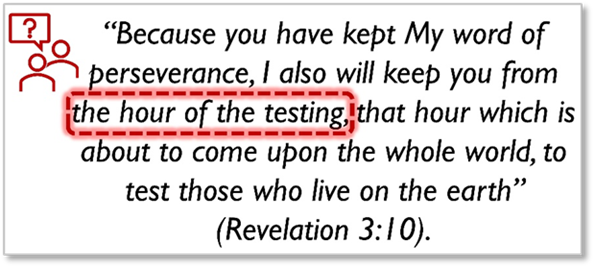
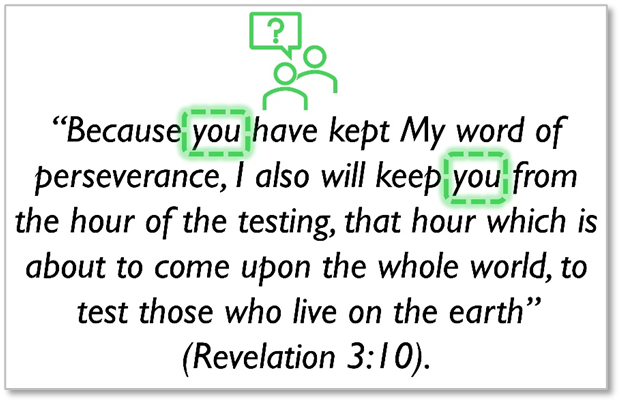
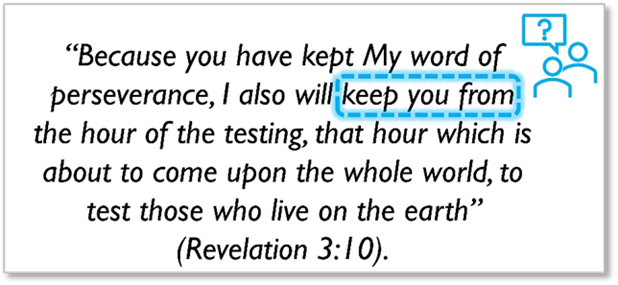
Here is our text:

The “time of testing” from which Jesus protects the church is the tail end of the great tribulation, when Jesus pours out the seven-seal judgments upon the kingdom of evil. This is a critical point. Many Christians are confused here.

  • Revelation 4-18 is not really about the antichrist’s reign of terror against believers—the “great tribulation.” Many Christians think it is about that. But they’re wrong (except for Revelation 13).
  • Instead, Revelation 4-18 is about the time at the end of this seven-year “great tribulation” when Jesus pours out the seven seals of judgment upon the kingdom of darkness.

We know this because Revelation 4-5 shows us the solemn run-up to this day of the Lord, which culminates with the slain Lamb being the only one worthy to break the seals and open the scroll which heralds the better tomorrow (Rev 5:2).

  • Because Jesus has overcome for his people, as our vicarious and righteous substitute, he alone may open the scroll and its seven seals (Rev 5:5).
  • As if to solemnize this awful but necessary time of divine wrath against evil, the angelic creatures sing: “Worthy are You to take the scroll and to break its seals; for You were slaughtered, and You purchased people for God with Your blood from every tribe, language, people, and nation” (Rev 5:9). 
  • Before Jesus can receive power, honor, glory, blessing, “and dominion forever and ever,” he must first destroy his evil counterpart and his wicked kingdom. What follows in Revelation 6-16 are the seven-sealed judgments of wrath against the antichrist and Babylon.

The horsemen, the brimstone, the incineration of one-third of the earth’s vegetation, the waters turning to blood, the mutant, demonic locust-like creatures—all the “bad stuff” we associate with Revelation is divine wrath against antichrist and his followers. The antichrist is doing none of this! Instead, Jesus is doing it to the antichrist and to his people.[1]

This means this “time of testing—the one about to come upon the whole world to test those who dwell on the earth” (Rev 3:10) is against unbelievers—against the antichrist and his followers.[2] Jesus is testing whether they will repent and choose Jesus or cling to darkness. Some translations use the word “trial” here, but this not the best because Jesus is not evaluating the faith of believers. He is testing whether unbelievers will truly continue to reject him.

This judgment ends with the Lord destroying Babylon and the antichrist’s people wailing because Jesus has smashed their world (Rev 18:9-19). “Rejoice over her, O heaven, and you saints and apostles and prophets, because God has pronounced judgment for you against her” (Rev 18:20). Now that the Lord has vanquished the kingdom of evil, John tells us: “I heard something like the voice of a great multitude and like the sound of many waters, and like the sound of mighty peals of thunder, saying, ‘Hallelujah! For the Lord our God, the Almighty, reigns’” (Rev 19:6). Jesus now returns to establish his kingdom on earth (Rev 19:11-21).

So, the “time of testing” is not the antichrist’s persecution of believers—it is Jesus’ wrath upon the kingdom of darkness. During this period, Jesus will protect his people. Before Jesus cracks open the sixth seal of judgment, he commands an angel to mark a vast number of believing Jewish people with his “seal” to protect them from the coming judgments (Rev 7:3; cp. Ezek 9:4-6; Ex 11:6-7, 12:13).

Who does Jesus protect?

Our passage is here—who is Jesus protecting and what kind of protection does he promise? He will protect his church (as a collective whole) from physical and spiritual destruction.

Because the church in Philadelphia (collectively, as a single referent)[3] is protected from this time of testing, it’s reasonable to believe that this protection applies to the entire church as a whole. The is a promise to the community, not to every single individual. So, taken collectively as a single community, Jesus will protect his church from this time of testing.

Pre-tribulational Christians go beyond the evidence when they insist that: (a) if any Christians die during the Great Tribulation then Jesus’ promise here is void, so (b) this must mean Jesus promises to physically remove the church from the scene. This does not necessarily follow.

First, as we saw, the “time of testing” is not the antichrist’s persecution of believers—it is Jesus’ wrath upon the kingdom of darkness. So, the entire objection fails.[4] Some object that, if this be true, then it’s cold comfort indeed:[5] “A whole bunch of y’all will die during the antichrist’s persecution, but don’t worry—I’ll protect the believers who are still alive when I unleash literal hell on earth. Cheers!” This is a false dilemma that demands: “What took you so long!?” One might as well criticize God for allowing the Israelites to suffer in Egypt before “finally” protecting them during the final plague (Ex 2:23-25; 12:23, 29).

Second, even if we (wrongly) conclude that Jesus does promise protection during the time of antichrist’s persecution during the last 3.5 years of his sinister reign … because Jesus’ promise is to the church as a whole, collectively, it simply means that the church will be protected during this period. That is, as an organism and a worldwide family of Jesus people, Satan shall never destroy the church because the gates of hell shall not prevail against it. Indeed, Jesus promised that he would intervene to stop this great tribulation lest no believers be left alive (Mt 24:21-22). That intervention is the judgments of the seven-sealed scroll which together destroy antichrist’s kingdom (culminating at Rev 16, re-told in Rev 17-18).

Will some believers will die during this “time of testing” when Jesus pours out the seven judgments upon the whole world? The answer is yes—but they will die at the antichrist’s hands, not Jesus’ hands. That is, the antichrist will never destroy “the church” as a whole. The Japanese killed many Americans sailors in the Pacific theater of operations in World War 2, but they never destroyed the U.S. Navy. Many Israelites died under Pharoah’s rule in Egypt (Ex 1:15-16), but “Israel” never did die.

  • John tells us about believers who have already died during the antichrist’s reign of terror before Jesus responds to the prayers by unleashing judgment upon the kingdom of darkness (Rev 6:9-10, 7:13-14). These martyrs who died during this great tribulation plead for justice upon “those living upon the earth” who killed them—the very people who are the objects of this “time of testing.”
  • After Jesus opens the fifth seal, the angels tell the great tribulation martyrs “to rest for a little while longer, until the number of their fellow servants and their brothers and sisters who were to be killed even as they had been, was completed also” (Rev 6:11).
  • But, we also see believers being sealed and protected—John highlights Jewish believers in particular who are safe from these judgments (Rev 7:3, cp. Rev 9:4).

Some may protest that it is too fantastic to believe that believers will be protected from death at a time when the first four “trumpet judgments” of the seventh seal destroy a major portion of the world (Rev 8:6-12). But, consider the plagues upon Israel before the Exodus: “But not even a dog will threaten any of the sons of Israel, nor anything from person to animal, so that you may learn how the LORD distinguishes between Egypt and Israel … The blood shall be a sign for you on the houses where you live; and when I see the blood I will pass over you, and no plague will come upon you to destroy you when I strike the land of Egypt” (Ex 11:6, 12:13).

Kept from the hour?

Here is the passage—what kind of protection is Jesus promising? Physical removal from the scene, or protection from danger during the time of testing?

Advocates for a pre-tribulation rapture expend much energy on what it means to be protected from the time of testing. Bible teachers crack open their Greek New Testaments (or fire up their bible software) and begin speaking about the preposition ἐκ (“from”), which in its most basic, original sense suggests an exit from some sort of relationship.[6] So, pre-tribulationists may argue, the idea is that Jesus will take the church away from the coming wrath.

This doesn’t necessarily follow, for a host of nerdy reasons that I’ll try to explain without making you fall asleep.

Blurred lines and prepositions

First, while the original meaning of the preposition ἐκ does indicate motion out of something, that certainly isn’t its exclusive or even primary sense in the New Testament. By then, prepositions no longer had a rigid meaning, which means you cannot say: “it must mean ONLY THIS!” Some pre-tribulation advocates do not seem to appreciate this because they sometimes rely on an outdated understanding of prepositions.[7] Language changes over time, and by the New Testament era the precise distinctions of meaning between koine Greek prepositions had now blurred and overlapped.[8]

  • For example, the preposition εἰς, in a strict sense, means “motion into a thing”[9]—you pour coffee into a cup. But, the Gospel of Mark says Jesus “was sitting on (εἰς) the Mount of Olives” (Mk 13:3).
  • If you want to insist on the classical meaning for this word, you’d translate it as “Jesus was sitting into the Mount of Olives.” Of course, that’s ridiculous—is he a mole, burrowing into the soil?
  • What’s happened is that the meaning of εἰς has blurred and overlapped with that of another preposition (ἐπί), whose “basic idea is ‘upon.’”[10]

What happens with every word is that its original sense expands into all kinds of figurative uses, and this expanded meaning eventually moves far afield of the “original,” rigid “meaning.”This is why, in English, the original meaning for the word “ball” is “a round or roundish body or mass.”[11] But, this meaning has expanded to mean a basketball, or a testicle, or a great time (“I had a ball at the park yesterday!”), or even a formal dance (“Cinderella made it to the ball!”).

With the preposition ἐκ, its basic sense of spatial movement out of something has expanded to indicate:

  • Disassociation (“Christ redeemed us from the curse of the law,” Gal 3:13).
  • Derivation (the crown was made from thorns, Mt 27:29).
  • Time (the man was blind from birth, Jn 9:1).
  • Means (a person isn’t justified by means of doing what the law requires, Gal 2:16).
  • Personal agency (people are born by the will of God, Jn 1:13).

… and more. My point is that, in Revelation 3:10, the preposition ἐκ doesn’t necessarily mean the Lord will physically remove believers out of this world, as in: “Hang on! I’m gonna get y’all outta there!”[12]

Second, regardless of that point, in Greek the sense of John’s phrase “protected from the time of testing” still doesn’t suggest physical motion out of a situation. When you have the construction like that in Revelation 3:10 of “stative verb (τηρήσω) + transitive preposition (ἐκ),” the stative verb swallows up the transitive force of the preposition.[13] In Revelation 3:10, this suggests the idea of physical (i.e., transitive) motion—spatial exit from a situation—falls away.[14] This implies we’re left with some kind of protection from the time of testing that doesn’t include physical removal from the scene.

Therefore, building on our first point, we must look beyond the original, rigid meaning of ἐκ to rightly understand the nature of Jesus’ protection—we need the context.[15]

What does “from” (ἐκ) mean in Revelation 3:10?

A normal Christian with a good English translation doesn’t have to do this—but here is what responsible nerds must do “behind the scenes” to figure out what, say, Revelation 3:10 is saying.[16]

  1. Look at the list. As we learned, every word has a range of possible meanings. Look at the preposition’s original, rigid meaning (for example,ἐκ is spatial—“out of”), then look at the range of figurative meanings common to the word. It isn’t true that a preposition has a “literal meaning.”[17] Instead, it has a range of meanings, and some (depending on context) are more likely than others.[18]
  2. Look at the word(s) the preposition modifies. In this case, “the time of testing” (τῆς ὥρας τοῦ πειρασμοῦ) is in the genitive case, whose historical function was to depict a description or a separation.[19] Usually, prepositions govern the nouns they modify.[20] In Revelation 3:10, both the preposition and the genitive case of the modified noun indicate separation from this “time of testing.”
  3. Look at the context. What does the larger paragraph tell us about what the prepositional phrase means?

Using this method, the preposition in Revelation 3:10 likely means protection from Jesus’ divine wrath which, during this “time of testing,” he will unleash upon antichrist and his kingdom:

  1. Look at the list.

Because (as we saw, above) a stative verb swallows up the transitive nature of the preposition, ἐκ likely doesn’t mean “physical removal outta here” in Revelation 3:10. Instead, it’s probably a preposition of separation by disassociation.[21] Jesus will somehow separate us from the time of testing, and the best rendering here is “protection from the time of testing.” The most logical kind of protection from something, without involving physical motion away from it, is to be guarded and protected during the event.

Elsewhere, John uses the very same construction[22] to record that Jesus prayed that the Father would “keep them from the evil one” (Jn 17:15b). That is, protect us by separating us from Satan—not isolating us from his physical presence, but protecting us from his dominating power. In a similar way, in our passage Jesus promises to protect the church from the power of this time of divine judgment upon the kingdom of evil—just as he did in Egypt before the Exodus.

  1. Look at the word(s) the preposition modifies.

As we said (above), the genitive case here suggests separation from the time of testing, which pairs nicely with the preposition which conveys the idea (in this context) of a non-physical disassociation from the time of testing.

  1. Look at the context.

Jesus tells this church in Philadelphia that he has set before them “an open door,” which probably means a “door” of ready access to him “because you have a little power, and have followed My word, and have not denied My name” (Rev 3:8). Despite their likely small numbers (“a little power”) and seeming impotence, they are faithful. The door to the Messianic kingdom remains open and ready for them, despite this church’s “unimpressive” nature.[23] He promises to deal with a specific cabal of Jewish people in the city who hate this congregation and are persecuting it.[24] These folks, Jesus declares, are not “Jews” at all—their “synagogue” actually belongs to Satan, who is tricking them (cp. Jn 8:44).

But, Jesus assures them, because they have persistently obeyed (“kept”) his message about perseverance, he will protect (“keep”) the church in Philadelphia from the time of testing—the one about to come upon the whole world to test those who dwell upon the earth (Rev 3:10). They will be protected during the time when Jesus unleashes the seven-sealed judgments onto the kingdom of evil (Rev 6-16).[25] He will return soon (“quickly”), so they must hold firmly to their faith as they endure persecution from the local “synagogue” and narrow-eyed suspicion from Roman authorities—or else they may lose their crown (Rev 3:11). In other words, keep on persevering and holding on!

Jesus will make the ones who overcome all these difficulties “a pillar in the house of my God,” and he will write his name on their foreheads to mark them as his own. He will not write his own name only, but the names of the Father and of the new Jerusalem—the celestial city (Rev 3:12).

Bottom line

The bottom line is that Revelation 3:10 (by itself) likely does not support a pre-tribulation rapture. A preposition is a very slender reed upon which to hitch your wagon.[26] It doesn’t mean a pre-tribulation rapture is wrong. It just means that Revelation 3:10 probably doesn’t teach it. I believe the preponderance of evidence here does not support a pre-tribulation rapture, but it would be a mistake for either side to be dogmatic.

  • In terms of weight of evidence, “preponderance of evidence” is the weakest–it means something is more likely than not true.
  • This is followed by “clear and convincing” evidence, which means what it says.
  • Finally, the strongest case is “beyond a reasonable doubt,” which you may be familiar with from bad police movies or TV shows.
  • My assessment about whether the pre-tribulation rapture is present in Revelation 3:10 is at the level of “preponderance of evidence.”

Jesus swears he is returning soon and, if the church perseveres in faith, he promises to protect this local church from the outpouring of his divine judgment that will one day come: “In this great trial, the servants of Christ shall be kept safe.”[27] He doesn’t explicitly say how he will protect them. But the preponderance of evidence suggests that it will be protection from the power of the divine judgments (Rev 6-16), just as God protected the Israelites from the plagues in Egypt.

Of course, Jesus did fulfill this promise to the church in Philadelphia because they died long before the antichrist’s reign—which is still future today! He did protect them from this time of divine wrath against the kingdom of evil. But ultimately, this is a promise to the entire church—to the entire Jesus family that is alive during the great tribulation. When the Lamb who was slain cracks open the seals to open the scroll (Rev 6-16), he will protect his church from the power of this time of testing against antichrist, his people, and his kingdom of evil.

Translation

ὅτι ἐτήρησας (BDAG, s.v., sense 3) τὸν λόγον τῆς ὑπομονῆς (gen. comm. content) μου, κἀγώ σε τηρήσω (BDAG, s.v., sense 2d) ἐκ (disassociation = sit. out of which someone is brought = BDAG, s.v., sense 1c) τῆς (monadic) ὥρας τοῦ πειρασμοῦ (att. gen.) τῆς μελλούσης ἔρχεσθαι (art. inf. = appositional clause) ἐπὶ τῆς οἰκουμένης ὅλης πειράσαι (anarthrous = purpose) τοὺς κατοικοῦντας ἐπὶ τῆς γῆς.

“Because you have persistently obeyed my message about perseverance, I also will protect you from the time of testing—the one about to come upon the whole world to test those who dwell on the earth.”


[1] Buist Fanning briefly states that the ones who hide from Jesus’ wrath in Revelation 6:16-17 are believers who die because of the divine judgments, but this makes no sense in context. He does not try to substantiate the claim—he just makes it in one sentence (Revelation, in ZECNT (Grand Rapids: Zondervan, 2020), 177). These people are likely unbelievers who follow the antichrist.

[2] “There the faithful are sealed with a view to their preservation from the assaults of demons, but are not thereby secured against physical death … It will be observed that the demonic trial spoken of, while worldwide, was to affect only ‘those that dwell upon the earth,’ i.e. the non-Christians” (R. H. Charles, A Critical and Exegetical Commentary on the Revelation of St. John, vol. 1, in ICC (Edinburgh: T&T Clark, 1920), 89).

[3] The referent is singular in Greek, referring to the Christian community in Philadelphia as a collective whole.

[4] For example, Jeffrey Townsend objects: “This presents an immediate problem for post-tribulationism since it holds that the church will be preserved on earth during the hour of testing. Yet verses such as Revelation 6:9–10; 7:9, 13, 14; 13:15; 14:13; 16:6; 18:24; and 20:4 present a time of unprecedented persecution and martyrdom for the saints of the tribulation period” (“The Rapture in Revelation 3:10,” in Bibliotheca Sacra, BSAC 137:547 (Jul 1980), at 153).

He is incorrect—the horrors in Revelation 6-16 are not the antichrist persecuting Christians. It is Jesus pouring out divine wrath upon the kingdom of evil.

[5] Robert L. Thomas, Revelation 1-7 (Chicago: Moody, 1992), 286. “What good does it do to be preserved from the physical consequences of divine wrath and still fall prey to a martyr’s death?”

[6] Murray J. Harris, Prepositions and Theology in the Greek New Testament (Grand Rapids: Zondervan, 2012), 103.

[7] Robert Thomas (Revelation 1-7, 284-86), Paul Feinberg (“Pre-tribulation,” in The Rapture, 63-68), and Craig Blaising (“Pre-tribulation,” in The Rapture, 38, note 67) rely heavily upon the arguments of Jeffrey Townsend, who in turn relied on A. T. Robertson’s assessment of the preposition at issue: “According to Robertson, ‘The word means ‘out of,’ ‘from within,’ not like ἀπό or παρά’” (Townsend, “Revelation 3:10,” 253).

But, as modern Greek grammars recognize, Robertson was incorrect to insist on precise, classical categories to distinguish koine Greek prepositions from one another. Townsend reflects this error when he states: “This is an untenable position because the idea of preservation in and through the hour of testing would normally have been expressed by ἐν or διά” (“Revelation 3:10,” 253). He is wrong.

Dan Wallace’s admonition is relevant here: “… too often prepositions are analyzed simplistically, etymologically, and without due consideration for the verb to which they are connected. Prepositions are often treated in isolation, as though their ontological meaning were still completely intact” (Greek Grammar Beyond the Basics (Grand Rapids: Zondervan, 1996), 359).

[8] Wallace, GGBB, 362-63; Harris, Prepositions, 34-35; Richard Young, Intermediate New Testament Greek (Nashville: B&H, 1994), 85-86.

[9] William Arndt (et al.), A Greek-English Lexicon of the New Testament and Other Early Christian Literature (Chicago: University of Chicago Press, 2000). s.v. Hereafter “BDAG.”

[10] BDAG, s.v.

[11] Merriam-Webster Collegiate Dictionary, s.v. “ball,” noun, sense 1 (Springfield: Merriam-Webster, 2026), 132.

[12] “[I]ndeed, it is now becoming more and more clearly recognized that it is a mistake to build exegetical conclusions on the notion that classical accuracy in the use of prepositions was maintained in the Koine period” (C.F.D. Moule, An Idiom Book of New Testament Greek, 2nd ed.(Cambridge: Cambridge University Press, 1959), 49).

[13] Wallace, GGBB, 358-59. “Stative verbs override the transitive force of prepositions. Almost always, when a stative verb is used with a transitive preposition, the preposition’s natural force is neutralized; all that remains is a stative idea.” Emphasis in original.

[14] This is not the case in John 17:15a, which bears a transitive verb (ἄρῃς) + a transitive preposition (our old friend ἐκ) = the sense of movement out of this world is retained. Jesus prayed: “I do not ask that you take them away from the world …” (οὐκ ἐρωτῶ ἵνα ἄρῃς αὐτοὺς ἐκ τοῦ κόσμου).

[15] “It is important to remember that prepositions are extremely flexible in meaning, and careful consideration of the literary context is essential in determining the nuance of a preposition” (Andreas J. Köstenberger; Benjamin L. Merkle; Robert L. Plummer, Going Deeper with New Testament Greek: An Intermediate Study of the Grammar and Syntax of the New Testament (Nashville: B&H, 2016; Kindle ed.), KL 10481-10482).

[16] I adapted this from Harris, Prepositions, 31. I left off his fourth step because it does not apply in this case.

[17] Erroneously, Craig Blaising wrote: “This view depends on a ‘dynamic’ interpretation of the preposition ek …” (“A Case for the Pretribulation Rapture,” in Three Views on the Rapture: Pretribulation, Prewrath, or Posttribulation, ed. Alan Hultberg (Grand Rapids: Zondervan, 2010), 38). This is incorrect and does not reflect the realities of language in general, let alone koine Greek.

[18] Young, Intermediate Greek, 86.

[19] Young, Intermediate Greek, 23.

[20] Wallace, GGBB, 360-62.

[21] BDAG, s.v., sense 1c; cp. Brill Dictionary of Ancient Greek (hereafter “GE”), ed. Franco Montanari (Leiden: Brill, 2015),s.v., sense II.A.c.

[22] Gk: τηρήσῃς αὐτοὺς ἐκ τοῦ πονηροῦ = preposition ἐκ + genitive object. “[T]he thought is quite in keeping with that of our Seer” (Charles, Revelation, 1:89-90). And, the apostle also wrote this same phrase at both John 17:15 and Revelation 3:10. This suggests it is a stylistic quirk of John’s of which we ought to take note.

[23] Robert Mounce, The Book of Revelation, in NICNT (Grand Rapids: Eerdmans, 1977), 117.

[24] Some people think this means that members of this hostile Jewish synagogue will come to believe Jesus is their Messiah. Others think Jesus refers to their eventual acknowledgment of him in a non-saving way—perhaps on the day of judgment (Rev 20). That is, “every knee will bow, and every tongue will confess …” (etc.).

[25] Some pre-tribulation advocates eagerly seize upon a distinction between (a) being kept from the danger itself, and (b) being kept from the time period of this danger. The latter, they sometimes claim, suggests a physical removal from the scene. In truth, this is a de minimis argument.

[26] For example, Paul Feinberg spent five pages discussing the preposition ἐκ as he supported the pre-tribulation rapture perspective at Revelation 3:10. If a preposition is the best you got, then your argument is very weak (“The Case for a Pre-tribulation Rapture Position,” in The Rapture: Pre, Mid, or Post-Tribulation, ed. Stanley Gundry and Gleason Archer (Grand Rapids: Zondervan, 1984), 63-68).

[27] Henry Alford, The New Testament for English Readers: A Critical and Explanatory Commentary, New Edition, vol. 2 (London; Oxford; Cambridge: Rivingtons; Deighton, Bell and Co., 1872), 969. Similarly, John Gill writes that: “it will be known who are his true churches, and pure members; and these he’ll keep close to himself, and preserve safe amidst all the distress and confusion the world will be in” (An Exposition of the New Testament, vol. 3 (London: Mathews and Leigh, 1809), 711).

What does Matthew 24 mean?

What does Matthew 24 mean?

Matthew 24 is the longest discussion we have from Jesus about how “this present evil age” (Gal 1:4) will transition to the next. It’s important. It’s also difficult to follow. This article is my best attempt to simply explain what Jesus is saying.

Three questions

The passage opens with Jesus leaving the temple complex after condemning the Pharisees for missing the entire point of true faith (Mt 23). He declares he is finished with the Jewish civil and religious leadership (Mt 23:37-39). Jesus is likely in a dark mood as he and his disciples leave the complex and “point out the temple buildings to him” (Mt 24:1). It was an impressive compound and had been under construction for decades. It was far larger than the temple building itself—more of a compound with the temple as its center.

We can imagine Jesus scowling at the whole thing before declaring that it would soon all be destroyed (Mt 24:2). This is shocking—how can this be? How will people worship YHWH? How will they have atonement for their sins? Once they climbed the hill opposite the temple mount, they asked Jesus: “Tell us, when will these things happen, and what will be the sign of Your coming, and of the end of the age?” (Mt 24:3).

The end of the age (Mt 24:4-14)

Jesus answers the third question (“when will be … the end of the age?”) first. The basic answer is at Mt 24:14: “This gospel of the kingdom shall be preached in the whole world as a testimony to all the nations, and then the end will come.” The end will only come when the whole world hears. We don’t know when this will happen. But, because it is impossible to ensure every single person hears the Gospel (after all, someone is always being born somewhere), perhaps the idea is that when the world reaches a “gospel saturation point,” then Jesus kicks off the day of the Lord.

In the meantime, as local churches do their part to be sure the world reaches this gospel saturation point, we’ll see an escalating on ramp of hostility towards Christianity.

  • Many false teachers will claim to be the Messiah, but they’re liars (Mt 24:4-5).
  • Wars, famines, and political unrest will come and go. Any historical survey of any century proves we don’t live in a peaceful or friendly world. This does not signify “the end.” It’s simply the on-ramp (Mt 24:6-8).
  • Christians will be persecuted and even executed in various places—the gospel message is not welcome. Even professing believers will betray the faith and turn on one another, perhaps out of fear (Mt 24:9-10). History tells us this ebbs and flows depending on local circumstances.
  • False prophets will lead many people astray (Mt 24:11). Believers will grow cold towards the faith, perhaps insular (Mt 24:12). But, the true believer is the one who endures or perseveres to the end (Mt 24:13).

But, of course, “the end” will not come until the world reaches its undisclosed gospel saturation point (Mt 24:14). So, in the meantime, local churches must do their part to spread the good news.

The sign of Jesus’ coming (Mt 24:15-28)

Jesus says he’ll return after a period of awful persecution. He begins by directing his readers to the prophet Daniel, who spoke of an evil figure in Jerusalem who would bring abominations upon God’s people (Dan 9:27). But the picture is complicated because Jesus speaks of two different events at the same time—the destruction of Jerusalem by the Roman armies in A.D. 70, and the destruction wrought by the forces of darkness in the last days. We know this because, while Matthew and Mark emphasize the last days, Luke describes the Romans in A.D. 70:

Matthew 24:15-16Mark 13:14Luke 21:20-21
So when you see standing in the holy place ‘‘the abomination that causes desolation,” spoken of through the prophet Daniel—let the reader understand—then let those who are in Judea flee to the mountains …When you see “the abomination that causes desolation” standing where it does not belong—let the reader understand—then let those who are in Judea flee to the mountains …When you see Jerusalem being surrounded by armies, you will know that its desolation is near. Then let those who are in Judea flee to the mountains …

We know Luke is not describing Satan or the antichrist, because they never destroy Jerusalem (see Rev 19:19; Rev 20:9). But, Luke tells us that some abomination (the Roman armies) will make Jerusalem desolate—this happened in A.D. 70. Add to it that Jesus’ declaration of the future destruction of the temple mount is what triggered this conversation, and so the evidence suggests Jesus is speaking of two events at the same time in Matthew 24:15-28. Like a polaroid that slowly fades into focus, the “A.D. 70” bit begins at Matthew 24:15 but fades away until, by Matthew 24:21, the great tribulation has taken its place.

  • When the Jews in Jerusalem see the Roman armies massing against Jerusalem during the coming First Jewish War (A.D. 66-70), they should drop everything and ruin (Mt 24:15-18). Josephus (The Jewish War, 5.1 – 7.162) tells us that the ensuing siege was awful.
  • Indeed (shading to the end of days, but still with secondary applicability to A.D. 70), Jesus tells us, “for then there will be a great tribulation, such as has not occurred since the beginning of the world until now, nor ever will again” (Mt 24:21). Surely nobody would survive if the Lord did not end it (Mt 24:22)—and he will do so by returning (Rev 19:11f).

Jesus doesn’t tell us when he’ll come back. But, it will be so obvious and so clear as to be unmistakable. Liars and charlatans will sally forth, but we should ignore them (Mt 24:23-36) because Jesus’ return will be as obvious as lightening in the sky. You see it. You hear it. You can’t miss it. It’s unmistakable. That’s how blindly obvious it will be that Jesus has returned—no persuasion will be necessary. Just as surely as you know that a gathering of vultures means there is a corpse on offer, so will Jesus’ return be just as obvious (Mt 24:27-28).

Jesus’ return (Mt 24:29-31)

Immediately after the tribulation of those days—that is, the “great tribulation” which other scriptures (e.g., Dan 9:27) tell us will be the antichrist’s brief, seven-year reign—Jesus will return. To describe this event, Jesus borrows phrases from the prophet Isaiah’s declaration about Babylon’s destruction (Isa 13:10; Mt 24:29). It’s no accident that “Babylon” is the symbol of evil and is the kingdom which the Lord destroys just before his return (Rev 16, further described in Rev 17-18).

  • Otherworldly phenomena will kick off for all to see—no sun, no moon, stars falling from the sky. There will be no natural explanation.
  • A mysterious “sign of the Son of Man will appear in the sky” (Mt 24:30). Nobody knows what this sign will be—some ancient Christians believed it will be a cross floating in the heavens, likely illuminated against a now darkened world. If so, it would surely be terrifying beyond belief.
  • All the nations of the earth will mourn and wail in horror as Jesus arrives on the clouds of heaven (Mt 24:30), just as Daniel said he would (Dan 7:14)—perhaps with the blazing cross (“the sign of the Son of Man”) backlighting him from the heavens?
  • As Jesus arrives, he’ll send out his angels who will gather his elect people from the four winds (cp. Mt 13:24-30. 36-43). This is likely the same event the apostle Paul described at 1 Thessalonians 4:13-18. Elsewhere, Paul tells us that Christ will resurrect believers “at his coming” (1 Cor 15:23), and here it is.

So, this section leaves us with Jesus having arrived in Jerusalem to inaugurate his kingdom. He has gathered his saints from the earth (the living and the dead) to be with him (cp. Rev 19:11ff).

Be ready (Mt 24:32-51)

These signs are warning lights we can recognize. Just as the fig tree telegraphs when summer is close, so too will the signs of the “great tribulation” (Mt 24:21-28) tell us when Jesus’ return is near—“right at the door” (Mt 24:32-33). Indeed, once the kick-off happens, everything will be wrapped up within one generation (Mt 24:34). This is a solemn promise (Mt 24:35).

Some good Christians believe “this generation” refers to the folks to whom Jesus is speaking. Grammatically, this is an easy option and I used to believe it. Others believe it refers to the Jewish people, but the grammatical case for this is weak (however, consider Dr. Ryan Meyer’s argument for a variation of it here). But, when you harmonize our passage with Mark 12:28-32 and Luke 21:29-33, the scenario which best fits all three accounts is that “this generation = the folks alive when the great tribulation kicks off.”

Jesus tells us that, speaking from the perspective of his human nature, he has no idea when he will return (Mt 24:37). Just as the rains and floods burst upon the earth without warning during Noah’s day (Gen 7:11-12) “and they did not understand until the flood came and took them all away; so, will the coming of the Son of Man be” (Mt 24:39). Indeed, when Jesus arrives people will suddenly disappear (Mt 24:41-41). This is the rapture of living saints, wrought at the hand of the angels whom Jesus dispatches as he arrives on the clouds of heaven (Mt 24:31; cp. Mt 13:40-43; 1 Thess 4:13-18).

So, Jesus warns, true believers must be ready for his return … and live like it. If a homeowner knew when a thief would break in, he would be ready (Mt 24:42-43)! “For this reason you must be ready as well; for the Son of Man is coming at an hour when you do not think He will” (Mt 24:44).

The parables which follow (the ten virgins (Mt 25:1-13), and the talents (Mt 25:14-30)) emphasize this point—our job is to be faithful now while we wait. It isn’t to speculate about dates, times, or to fight about the timing of the rapture. It’s to carry out the great commission—to make disciples of all nations, baptize them into Christ’s family, and teach them everything the Lord commanded us (Mt 28:19-20). Indeed, one key criterion when Jesus separates the believers from the unbelievers on the day of judgment is whether we demonstrated love to our new covenant brothers and sisters (Mt 25:31-46)—whether we’ve lived and acted like Christians.

That must be our focus, and “blessed is that slave whom his master finds so doing when he comes” (Mt 24:46).

Analogies to understand Christ’s atonement

Analogies to understand Christ’s atonement

In this article, I’ll discuss two common questions that Christians have about Christ’s atonement. By “atonement,” I mean the means by which Christ’s sacrificial death removes our guilt for wrongdoing and therefore reconciles us to God.

Atonement is a key tenet of the Christian story:

  • The prophet Isaiah spoke about a mysterious servant who would be pierced for our offenses, crushed for our wrongdoings, upon whom God would lay our punishment, by whose wounds we are healed. “[T]he Lord has laid on him the iniquity of us all” (Isa 53:7, RSV).
  • The blood sacrifice rituals of the old covenant provided atonement for the participants (Lev 4:20ff) as a living parable of Christ’s perfect sacrifice (Heb 9:9).
  • Mark, the gospel writer, says Jesus came to give his lie as a ransom for many (Mk 10:45).
  • The apostle Peter writes that Christ “suffered for sins once for all time, the just for the unjust, so that He might bring us to God …” (1 Pet 3:18).
  • John the baptizer declared that Jesus was “the Lamb of God who takes away the sin of the world!” (Jn 1:29).

Over and over, we see that somehow, someway, Jesus’ voluntary sacrificial death for his people brings about legal and personal reconciliation with God.

Christ, by his obedience and death, did fully discharge the debt of all those that are justified; and did, by the sacrifice of himself in the blood of his cross, undergoing in their stead the penalty due unto them, make a proper, real, and full satisfaction to God’s justice in their behalf (2LBCF, §11.3).

Fair enough. But here are the two questions:

  1. How, exactly, does God apply the benefits of Jesus’ death to a sinner’s account? The Christian story says it does, but can we logically explain this? How does it work?
  2. How is Jesus’ sacrificial, substitutionary death not a cruel measure? That is, how is it right or fair to punish an innocent man for crimes he did not commit?

I’ll answer these two questions with two analogies.

Question 1—How does atonement work?

The first analogy is that of a representative or delegate.

  • Your state has two U.S. Senators. These senators represent you in Washington D.C. They represent your interests, your concerns. They speak and vote on your behalf. You don’t have to go to Washington because your U.S. senators are there for you. Their actions (and votes) are imputed to you. They are you, in a sense.
  • Your state also has individuals who act as “electors” in each presidential election. We do not elect presidents by popular vote—they’re chosen by electors, who are representatives chosen by each state.

These are two common examples of “representatives” we accept in everyday life. It’s just the way it is. The application of Jesus’ atonement shouldn’t be a problem, then, because the Christian story has always worked through representatives:

  • Adam and Eve are our first parents. The apostle Paul spends much time explaining that they represent us (Rom 5:12ff, 1 Cor 15).
  • Abraham is the great patriarch from whom all true believers are descended.
  • Moses is the great representative of the old covenant—the one through whom God spoke and worked on behalf of the people.

Theologians often call this “federalism.” It means that God works through a representative whose actions set the course—good or bad—for his constituents. The two great representatives in the Christian story are Adam and Christ.

  • Adam is the bad representative. His failure to love and obey God brought sin and its penalty of death to everyone (Rom 5:12). We’re born belonging to him, by default, because God legally imputes Adam’s actions to his constituents. God does this because Adam represents us—he’s our delegate. This is bad news for us—unless we jump ship for a better deal with a better representative.
  • Jesus is that better representative. His success in loving in obeying God brings legal pardon and personal reconciliation for all who belong to him.

The apostle Paul says:

So then, as through one offense the result was condemnation to all mankind, so also through one act of righteousness the result was justification of life to all mankind. For as through the one man’s disobedience the many were made sinners, so also through the obedience of the One the many will be made righteous (Romans 5:18-19).

The question is: “How, exactly, does God apply the benefits of Jesus’ death to a sinner’s account?” The answer:

  • Because, like Adam, Jesus is a representative or delegate whose actions are reckoned or imputed to his constituents.
  • God reckons or imputes the benefits of Jesus’ perfect life and sacrificial death to everyone who trusts in him for spiritual rescue.
  • Those benefits are legal pardon and personal reconciliation with God.

If this seems too fantastic to believe, then I ask you to consider your U.S. senators—don’t you realize they act in the name of their constituents, and their actions are imputed to you? Think of your state’s electors in the 2024 presidential election—do you reject the votes they cast on behalf of your state when they chose the current president?

Jesus is the federal representative for everyone who trusts in him. That’s how and why God cheerfully applies the benefits of his eternal son’s sacrificial death to his people.

Question 2—Cruel and unusual?

The second analogy I’ll offer is that of vicarious liability.

  • Say your state’s Department of Transportation is fixing a highway. They close a lane. They set up cones and warning signs. But they don’t do a good job. A driver misses the signs, crashes into a work truck, and is horribly injured. He can sue the state for negligence and attempt to recoup monetary damages.
  • Suppose an inmate in a state prison needs urgent medical attention. He doesn’t get it. The prison doctors misdiagnosed his symptoms early on. He becomes terribly ill. By the time the prison doctors realize what’s wrong, it’s too late. The inmate dies of stomach cancer two months later. The inmate’s family can sue the state.

This makes sense, right? Nothing controversial here. Nothing outrageous. This is the principle of vicarious liability. The Department of Transportation guy is the one who messed up. The prison doctors are the ones who made the awful mistake. And yet—it is the state who is sued.

Why?

Because the state has voluntarily and willingly said: “If our guys mess up, you can hold us responsible.” It has taken on that responsibility. The state has chosen to bear the guilt of another. Of course, because the prison doctor is an agent of the state (i.e., a state employee), then in certain circumstances the state truly is responsible. But the principle of vicarious liability stands—one person is punished in place of another, as a substitute.

This is precisely what Jesus has done. He died, the just for the unjust, in order to bring us to God (1 Pet 3:18). The great difference, of course, is that we are not like the prison doctor—we aren’t agents of Jesus. He did not have to own us and our guilt, but he chose to do it anyway. “For God so loved the world, that He gave His only Son, so that everyone who believes in Him will not perish, but have eternal life” (Jn 3:16).

So, the question is: “How is Jesus’ sacrificial, substitutionary death not a cruel measure?” The answer is that:

  • Because Jesus willingly and voluntarily offers to bear the guilt of his people’s crimes,
  • God the Father makes his eternal son vicariously liable for our sins,
  • The just for the unjust, in our place, as our substitute, representative, or delegate,
  • And so, Jesus suffered and died to atone for our sins.

If this sounds absurd, then remember that the next time you read about somebody suing a government agency for negligence. I recently investigated an instance in which foster parents physically and sexually tortured a nine-year-old boy. There was one instance when the parents brandished garden shears and tried to castrate the child. Much later, after police intervened and removed him from that evil place, the boy sued the state for negligence because the state placed him in that home. Of course, the state didn’t torture the boy. But the state made the decision (in certain circumstances) to own the actions—good or bad—of the foster parents it licensed.

If you believe the boy can file suit against the state (and I suspect you do), then you also ought to believe that it’s fine for Jesus to be vicariously liable for our crimes. True, Jesus did nothing wrong (2 Cor 5:21). But that’s why vicarious liability is vicarious. It’s also why God is love (1 Jn 4:8).

Helpful?

Christians sometimes know something is good and true even if they can’t fully explain why. We know Christ died for us and his actions change our relationship with God. But the logical mechanics of how and why can be elusive. I hope these two analogies—that of a representative in the form of a U.S. senator or electoral college elector, and the legal concept of vicarious liability—help us understand Christ’s atonement a bit better.

Is the Papacy Biblical? A Look at Matthew 16

Is the Papacy Biblical? A Look at Matthew 16

Pope Francis’ recent death is an opportunity for bible-believing Christians to consider what we ought to believe about the papacy. The goal is not to dance on a dead man’s grave, but to think about who oversees Christ’s church. Is the papacy a legitimate institution? Does it have biblical warrant?

The Catechism of the Catholic Church (“CCC”) says that:

  1. Peter is the rock of the church, which is built upon him (CCC, Art(s). 881, 552).
  2. Peter has the “keys” and therefore governs the church (CCC, Art(s). 553, 881).
  3. Peter is the shepherd of the church, and priests and bishops have derivative authority under Peter.
  4. Peter is the source and foundation of the unity of the church—he has full, supreme, and universal power (CCC, Art. 882).
  5. According to the first Vatican council (Vatican I, 1869-70, Session 4), if you do not agree with Rome’s teaching about Peter, you are damned to hell.

This is all false and cannot be defended from scripture. Rome’s argument, both in the CCC and at Vatican I, centers on Matthew 16:18 and some supporting citations. My argument here focuses on the Matthew 16 passage. If you want to read more about Rome’s grave and terrible errors about the gospel, I recommend (a) James White, The Roman Catholic Controversy (Minneapolis: Bethany House, 1996), and (b) Tyler Robbins, “How Rome Distorts the Gospel—Atonement Misunderstood.”

Now—on to the papacy!

In Matthew 16:18-19, Jesus gives us two pairs of images: (a) the rock and the gates, and (b) the keys and the bonds. What do they mean? Oracles from “the Greek” won’t help you here—your bible translation is just fine. Whatever these images mean, they must make the best sense of what the passage is taking about in context.

Context—what are we talking about here?

Jesus asks his disciples who people say the Son of Man is (Mt 16:13). He refers to himself as the mysterious figure from Daniel’s famous vision (Dan 7:13-14). Public opinion says that Jesus is a prophet of some sort (Mt 16:14). Now, Jesus asks the disciples who they think he is (Mt 16:15). Peter answers: “You are the Messiah, the Son of the living God” (Mt 16:17).

The “Messiah” is the chosen and anointed one, the special divine envoy (“Son of the living God”) who will make all God’s covenant promises come true. He is God’s promise-keeper. He makes God known to us (Jn 1:18). Jesus agrees and tells Peter that his Father in heaven has revealed this precious truth (i.e., his confession about Jesus’ identity) to him.

So, as we move on to consider the first pair of images, we must get this right—this conversation is about Jesus’ identity and what it means. Any interpretation that takes a hard turn off this road to something completely different is wrong.

Imagery 1—The Rock and the Gates

Jesus says: “And I tell you that you are Peter, and on this rock I will build my church, and the gates of Hades will not overcome it” (Mt 16:18). Here we have our first pair of images.

  1. What are gates for? To keep people in or out.
  2. What is Christ’s church build on? A rock.
  3. Because Hades’ gates cannot prevail against the rock, these gates are imprisoning folks inside, and the rock smashes this gate open to set them free.

So, whatever “the rock” is …

  1. The entire family of God is built on it,
  2. and the rock is so strong, and so powerful,
  3. that Satan’s kingdom can’t withstand it!
  4. so it’s a pretty tough rock— divinely tough!

You have three options:

  1. The rock is Peter—the pope.

Rome places great stock in a Greek wordplay that Jesus uses here: “And I tell you that you are Peter (Πέτρος—petros), and on this rock (πέτρᾳ—petra) I will build my church …” This is a weak argument. Unless context suggests otherwise (and remember, the context is Jesus’ identity and what it means), there is no need to see this as anything other than a playful wordplay.

For example, my first name is Mark. Yet my parents have called me Tyler all my life, so I have no idea why they bothered to name me Mark. A similar wordplay would be if someone told me: “Your name is Mark, and mark my words that …” That is all this need be. Peter has nothing to do with this conversation—they’re talking about Jesus’ identity.

  1. The Rock is Jesus.

When he says, “and upon this rock,” he points to himself. This is weak and desperate. The pronoun translated “this” refers to something nearby in the context. This position rightly rejects Peter as the rock (because it is out of context), and to make Jesus himself “this rock,” they must make him point to himself. There is a simpler way—one that doesn’t require us to pantomime while explaining it.

  1. The rock is Peter’s confession of Jesus’ identity and what it means—his faith and trust in the Messiah.

Option 3 is the right option.[1] Christ’s church family is built on the confession that Jesus is the Messiah, the Son of the living God. You cannot be a Christian (and a member of the worldwide Jesus family) unless you trust and confess the truth about him. Again, remember the context of this passage—this whole conversation is about who Jesus is and why it matters. It is not about a disciple who Jesus is going to call “satan” in four verses. It is not about the disciple who Paul rebuked to his face in Antioch (Gal 2:11-14). It is not about the guy to whom nobody in the scripture gives special authority.

But the conversation certainly is about Jesus, the Messiah, the Son of God. This explains why the rock is so strong, and so powerful, and why the gates of Hades can’t prevail against the church—because it’s divinely tough.

The completed imagery of rock + gates is this:

  1. The rock is the confession that Jesus is the divine promise-keeper and Son of God.
  2. The gates are to Satan’s kingdom, and they can no longer imprison those who believe in the rock.
  3. Jesus (the rock) smashes these gates open—remember the divine rock which smashes the statue of pagan empires (which are really different flavors of Babylon, Satan’s kingdom) at Daniel 2:34-35, 44.

Peter cannot smash these gates open. Yet, this is what the “rock + gates” imagery would have us believe. Your safety, security, and anchor is Jesus. It wasn’t John Paul II. It wasn’t Benedict. It wasn’t Francis. It is not Leo. It’s the Messiah, the Son of the living God—just like the old song says— “On Christ the solid rock I stand. All other ground is sinking sand.”

Imagery 2—The Keys and the Bonds

Jesus continued: “I will give you the keys of the kingdom of heaven; whatever you bind on earth will be bound in heaven, and whatever you loose on earth will be loosed in heaven” (Mt 16:19).

  1. What are keys for? To control access. To let you in or out.
  2. What do bonds do? They confine you. Imprison you.

We know that Jesus has the keys of life and death (Rev 1:18), the keys that lock people into that future, or let them out to embrace a better one tomorrow.

So, whatever the keys are,

  1. They let you into the kingdom of heaven,
  2. and untie or unchain you from the bonds that you’re in,
  3. which means this is a divine power.

You have two options to understand what this means:

  1. Peter has exclusive power to govern the church (the keys), and to absolve people’s sins by a sacred power—the bonds (CCC, Art(s). 553, 881, 1592).

This makes no sense of the “key” imagery. Keys are about access (Rev 1:18, 9:1, 20:1), not governance. Scripture never says to go to Peter—or anyone else—to have your sins absolved. Nor does Peter later claim this right for himself in his two New Testament letters. Instead, the bible tells us that God forgives sins—even David knew this (Ps 51:1-2).

  1. Peter (and every other Christian) offers “the key” to freedom by preaching rescue (“the bonds”) through complete forgiveness of sins.

Option 2 is the correct one.  Again, this entire conversation is about who Jesus is and why it matters. The keys don’t belong to Peter when Jesus speaks—he says he will give them to Peter (future-tense). Later, Jesus clarifies that the entire church has the keys—he even repeats the very same words (Mt 18:18).

The “key + bonds” imagery tells us this:

  1. Jesus’ family,
  2. organized into big and small Jesus communities around the world called “churches,”
  3. are his hands and feet that offer the key to spiritual freedom,
  4. by preaching liberation, forgiveness, and reconciliation.
  5. and we untie the shackles or bonds by accepting people into the brotherhood of the faithful upon a credible profession of faith (see Acts 2:41).

Jesus, through his communities around the world, unlocks the gate to death and hades and lets his people out, just like the song says— “my chains are gone, I’ve been set free, My God, my Savior has ransomed me!”

Peter was a good guy. Peter was an important guy. Peter is a star (not the star) of Acts 1-11. But Peter was just a guy.

Jesus leads his church. Not by one old man in Rome, but by Word + Spirit in his churches around the world, under qualified leaders, through you, and me, and us. And together we build Jesus’ family—just like Peter himself told us. Jesus is the “living stone” (a synonym for “rock”) to whom we come to be built up into the spiritual household of the faithful (1 Pet 2:4-5).

Your leader is not an old man in a white robe who sits in a building financed over 500 years ago by extorting money from millions of peasants with stories of fraudulent “indulgences” that can buy them time off a purgatory that doesn’t exist, and who represents a false “gospel” that has no perfect peace—that doesn’t make you holy and perfect forever (Heb 10:10, 14). Instead, thank God (literally) that the confession and trust in Jesus is your rock. Jesus is your anchor. Jesus smashes open Hades’ gates. Jesus has the keys and loans them to his churches. Jesus, through his communities across the world, unlocks the door to death and Hades to let his people out of darkness and into the marvelous light.


[1] Many conservative Protestant scholars today believe that Peter is the rock. They often comment that Protestants only object to this interpretation because of what Rome does with the passage. See John Broadus’ wonderful commentary on the Gospel of Matthew for a representative example of this line of thinking: https://tinyurl.com/4my9e7y3.

I believe this is wrong, and I have not found the arguments convincing. The context strongly supports Option 3, and it is the best antecedent for the pronoun in ἐπὶ ταύτῃ τῇ πέτρᾳ οἰκοδομήσω μου τὴν ἐκκλησίαν. This is not an academic article, so I will leave the matter here!