In the last article in this series about Israel and the Millennium, we explained why good Christians disagree about the bible’s big story. Today, we sketch what we believe the true big story is.
The bible’s big story is God’s plan to remake the paradise that our first parents ruined in Genesis 3. It’s God’s plan to fix the world, to fix us, and to create a family he can love and which loves Him back. God promises to send His only Son, Jesus—our King—on a special mission. First, Jesus will defeat God’s great and evil adversary and schedule his destruction. Second, Jesus rescues and then transforms a special community to show and tell his Good News to the world and to themselves. Meanwhile we wait to be with him forever in his coming kingdom—when he makes all things new. We must read and interpret the bible in that light.
The simplest way to understand the bible’s big story is like a three-act play:
Paradise made (Genesis 1-2).
Paradise lost (Genesis 3).
Paradise regained (Genesis 4 to Revelation 22).
A better way to explain the bible’s story is to compare God’s covenant promises to individual “episodes” of an Amazon Prime or Netflix “season.” Together, these “episodes” string together to form a traceable and logical story—ending in a new creation paradise, where God’s people can worship him and exercise dominion over his good creation, where Satan and evil have been banished and defeated forever.
Let’s talk about these two ways to understand the bible’s story.
The “three-act play” way
At its simplest level, the bible’s “big story” in unfolds in three movements:
Paradise made. God made everything good and holy, as it was supposed to be. There was no sin, no rebellion, no imperfection. Our first parents and this world were wholesome and untainted. This is why Moses tell us: “And God saw all that He had made, and behold, it was very good” (Gen 1:31).
Paradise lost. Everything falls apart. Satan tricked Eve into eating fruit from the tree of the knowledge of good and evil, and she (in turn) persuaded her husband to do the same (Gen 3:1-7). “Our first parents, by this sin, fell from their original righteousness and communion with God.” As our representatives, their guilt was imputed and their corrupted nature conveyed to each of us—their descendants—by ordinary generation. And so, “death came upon all: all becoming dead in sin, and wholly defiled in all the faculties and parts of soul and body”[1] (see Rom 3, 5).
Paradise regained. God rescues a community of people, places them in a new land, and gives them a king to rule over them and be a blessing to all the families of the earth. Sin is banished. There is a new creation—a new heavens and a new earth, “and He will wipe away every tear from their eyes; and there will no longer be any death; there will no longer be any mourning, or crying, or pain; the first things have passed away” (Rev 21:4). Some Christians imagine eternity as a vague spiritual existence in heaven, contemplating God. The truth is that paradise is a “new creation” existence where God’s people fulfill the creation mandate that went haywire in Genesis 3. Paradise is an “Eden 2.0” that will not fail, because Satan, the antichrist, and sin itself are gone forever.
The key is to see that the story is about God fixing what has gone wrong. It culminates in a new creation paradise, on a true new earth in a truly new creation, where righteousness dwells forever. That’s the goal. That’s the plot.
The “episodes in a season” way
But that’s the quick version of the bible’s story. We get a deeper sense of the story by following the plot though its various twists and turns. We do this through the different covenants God made with his people. A “covenant” is a formal agreement God makes that has binding obligations. God always seals his covenants with an oath wherein he “solemnly swears” (as it were) to do what he promises to do. Each covenant also has a sign; a symbol that declares something about the covenant it represents. We should think of these covenants as “episodes” in God’s TV series. And, like every good show, it ends by resolving the issues that unfolded throughout the “season.”
Each covenant progressively sketches in what “paradise regained” will look like. Here’s how this deeper version of the bible “big story” shakes out:
Episode 1: The promise in the garden
Though this is not a covenant, it is the big event which follows right on the heels of “paradise lost.” God promises to send a man, descended from Eve, to destroy Satan (Gen 3:15). This descendant will be injured, but he will crush the serpent’s head. In other words, he will smash the snake and destroy the source of all evil. This promise is immediately in jeopardy when our first parent’s only two children are moved off the board—Cain murders Abel and is banished far away to the east (Gen 4). Where, then, are the children through whom this victorious son will come? God has grace and mercy to provide a new son—Seth.
Episode 2: The covenant with Noah and all creation
As generations pass, the growing human population ignores God’s special promise, and a moral darkness descends. God decides to act (Gen 6:5-8) and “reboots” creation with a dreadful flood that destroys all living creatures, except for a precious few. He orders a righteous man named Noah to build a lifeboat of sorts in which to rescue himself, his family, and various creatures (Gen 6:9-22). After this flood subsides, they exit the boat and the “reboot” begins (Gen 7-9). God makes a covenant to withhold another such judgment, so that there will be a people and a world for the Messiah to rescue (Gen 9:1-17; cp. Mt 1:21), according to the promise God made to Eve in the garden.
Episode 3: Covenant with Abraham and family
After the rebellion at Babel, God scatters men and women across the earth. He chooses one obscure man from nowhere to be the source of blessing to the world—the vehicle to make his promise in the darkness come true (Gen 12:1-3). God made three specific promises to Abraham in Genesis 12:1-3 and confirmed them by way of a covenant in Genesis 15; re-iterated in Genesis 17, and 22, and later to Isaac and Jacob.
This covenant is the fountainhead for all of God’s promises to come. It marks out the Jewish people (those descended from the Abraham-Isaac-Jacob line) as God’s special people, who are promised a specific land of Canaan in which to live, so they can be a blessing to all the families of the earth. This is why the Messiah is the son of Abraham” (Mt 1:1 This covenant is the basis for Mary’s hope (Lk 1:55) and for Zechariah’s, too (Lk 1:72-75).
The raw shape of “paradise regained” is coming into focus—a people, in a land, being a blessing to all the families of the earth.
Episode 3.5: Covenant with Israel at Mt. Sinai
The Lord rescues His special people, Abraham’s descendants, from slavery in Egypt and brings them to their new home to wait for the promise. They agree to a covenant that will teach them how to love him and live holy lives until the Messiah comes (Ex 19:1-9; Deut 18:15-19). Unlike the others, this covenant doesn’t move the story forward. Like an airplane orbiting, waiting for permission to land, God’s people were in a holding pattern waiting for Jesus to arrive. So, God tells them how to live holy lives while they’re waiting.
It established rules and boundaries. Breaking the laws, in and of themselves, did not get you kicked out of the family, but disciplined within it. This covenant taught people about themselves—that they were sinful. It taught people about God—that he is holy and righteous and punishes sin. The ceremonial laws (the sacrifices and such) were object lessons to teach us about Christ. The civil laws (statutes about everyday life) were general principles of righteousness applied to their specific kingdom context. The moral laws were a mirror to show us our true nature, a general restraint on sin, and a vehicle for nudging his people towards greater holiness.
Episode 4: Covenant with David
The conquest and occupation of the Promised Land is haphazard. Many forsake God and go their way, and the High Priest and the judges cannot hold us together. God institutes a monarchy, and prophesies about a better King who will bring true holiness and justice to us and his world (2 Sam 7:1-17; 1 Chr 17:1-15). While they waited for God’s covenant promises to be fulfilled, God gave his people a king to rule over them. He established a dynastic line through a boy named David. He said a man from this line would rule over his people and be his royal representative on earth. God said this king would be like a son to him, and he’d be like a father to the king.
Now, our shape of paradise regained is a people, in a particular land, being a blessing to all the families of the earth, ruled over by a king whose reign would never end.
Episode 5: New covenant in Christ
This is the promise of a new shape to our relationship with God, and Jesus is the one who brings this new arrangement to pass. Generations have passed. A civil war has torn God’s people in two, and the dual monarchies of Judah and Israel have betrayed God again and again. Sin abounds. Externalism reigns. Under the looming shadow of an impending exile, God sends word of a new and better hope, built on better promises—a suffering servant who will set everything right (Jer 31:31-40; Ezek 36-37; Isa 52:12-53:13).
This messenger will love God, lead the people in righteousness, and bring a new shape to God’s relationship with his people—one in which all his people have full legal pardon and an interior renovation of their hearts and minds. Our shape of “paradise regained” now looks like a people, in a particular land, being a blessing to all the families of the earth, ruled over by a king whose reign will never end—and all his people are fixed inside and out.
The polaroid analogy
The bible’s story ends in Revelation 21-22 with new people in a new world. Through Christ, God will have “reconcile[d] all things to Himself, whether things on earth or things in heaven, having made peace through the blood of His cross” (Col 1:20). The core of this are the people + land + be a blessing promises God made to Abraham, augmented by the covenant with David (an eternal king) and the new covenant about Christ (legal pardon + interior renovation). Jesus is the domino which triggers the chain reaction of these covenant promises that he fulfills by the very end of the story—a people, in a real paradise land, ruled by a king, having been cleansed by an interior renovation and been given full legal pardon for their sins.
This fulfillment fades in starting at Matthew 1:1 and concludes at Revelation 22:21 in four main stages:
Gospels. Jesus arrives and announces that he has come to fulfill all the covenant promises—this is the “good news” (Mk 1:15). The right response is to believe and trust in Jesus in order to be counted righteous by God.
This present evil age. The Jesus family, the church, declares this good news to the world and works to gather a people for him, while promising full legal pardon and interior renovation for all who repent and trust in Jesus.
Christ’s millennial reign. This is like a “spring training” version of eternal paradise, where Jesus will reign for 1,000 years. This will be a nearly paradise-like kingdom with its base in the land of Canaan, with a great nation of Jewish messengers and evangelists, who are a blessing to all the families of the earth as they preach the good news abroad, with Jesus ruling as king of the world. As we mentioned in the previous article, the millennium is a lengthy transition period between this present, evil age and the paradise to come.
Paradise regained. In which the great nation + land + be a blessing covenant promises reach their ultimate fulfillment in the one great people of God, in the land of the new creation, with Jesus the “son of Abraham” as the blessing to the nations.
These four stages are like a Polaroid that slowly develops—the image becomes clearer as time goes on:
Of course, this is not a defense of this premillennial outline; it’s just a brief statement of it. Why do we believe all this—especially the bit about the millennium and God’s promises about Israel’s role in the bible’s “big story”? In the next article, we’ll discuss some basics about how to read the bible the right way, then look at some scripture passages that speak about Israel’s role in God’s plan for paradise regained.
[1] 1689 London Baptist Confession of Faith, Art(s) 8.2, 8.3.
This is the first in a series of articles about Israel and the Millennium. Good Christians disagree about whether the people of Israel have a future in God’s plan because they have very different ways of understanding the bible’s “big story.” Many Christians believe the people of Israel are important to the bible’s story. But not all of them know why, other than to correctly declare “Israel is special” or “they’re God’s chosen people.” These are incomplete answers.
There are at least two reasons why we believe the people of Israel are a key part of the bible’s “big story.”
To be a blessing. Israel is special because God plans to use her as a vehicle to preach the gospel to the world during Jesus’ 1,000-year millennial reign. It is during the millennium that God fulfills his three big covenant promises to Abraham (Gen 12:1-3)—a great nation, in a land of their own, being a blessing to the world by spreading the gospel about King Jesus. These covenant promises are about “a geographical platform, a land of promise, to serve as a base of operations for God’s kingdom program on earth.”[1]
Millennium as a microcosm of paradise. Israel is not an end in and of itself. The millennium is a microcosm or prototype of what the Lord will do in paradise in eternity[2]—sort of the “spring training” version of the new creation paradise to come. This millennium will feature a great nation of believers, in a new and perfect land, with Jesus (“the son of Abraham,” Mt 1:1) as the penultimate Abrahamic blessing to the world.
But other Christians disagree. They believe there will be no millennium, and a very different fulfillment of those three “big promises” to Abraham. They believe Israel no longer has a unique role to play in reconciling the world to King Jesus. So, rather than seeing the great nation + land + be a blessing promises as means God will use to reach the world for the Messiah, they see them as shadows pointing to the greater realities which Christ makes real, both now and in paradise. Although these good Christians arrive at the same place—Jesus will return to punish the wicked, reward the righteous, and usher in eternity—they take a very different route to get there.
Many Christians believe the New Testament sheds new light on God’s covenant promises. They say this so-called “new light” changes what these promises mean in a way the original audience wouldn’t have understood, and in a way that violates the normal sense of the words God used to make those promises. They believe the bible does this by one thing foreshadowing another—which is when one thing points to another thing bigger than itself (this is also called “typology”).
For example, Adam (our first representative), Moses (the great prophet), and David (the king of Israel) each foreshadow Jesus in complementary ways.
The tabernacle is a figure of the real throne room in heaven.
Christ also fulfills larger old covenant events in scripture which the prophets heralded; the old Eden v. the new Eden, fall v. atonement; Exodus from Egypt v. exodus from Satan’s grasp, etc.[3]
This is a real thing in scripture. But is it a real thing when it comes to God’s covenant promises? Many Christians wrongly say it is.
Their argument is the big three covenant promises to Abraham (a great nation + in a land of their own + to be a blessing to the world; Gen 12:2-3) are signposts which point to a larger fulfillment.[4]
So, they say, God does not replace Israel. Instead, Christ fulfills her promises in a larger way.
So, these Christians interpret in a non-literal way old covenant passages that we believe plainly mean more than that. Many do this because they believe the bible’s whole story is all about God’s alleged “covenant of grace” with those chosen for salvation.[5] “In the New Testament all these types reach their fulfilment and therefore cease.”[6]
It’s true that God has a big plan to provide salvation to sinners through faith in Christ.
But it isn’t true that this means the bible’s “big story” is basically about you and your personal salvation. This viewpoint interprets everything through the lens of the gospel (Jesus’ life and death),[7] when the real “big story” is the new creation paradise God has been bringing about since Genesis 3:15. Yes, Jesus essentially defeats Satan on Easter morning, but the war is not over until Revelation 22.
This would be like interpreting the Allied victory in Europe during World War 2 entirely from the standpoint of D-Day on 06 Jun 1944. This would be a flattening of reality. Yes, D-Day was a triumph for the Allied cause that spelled the end for Nazi Germany, but the war in Europe didn’t end for another 10 months!
This popular and helpful (but incomplete) “gospel-centered” lens can lead to a tunnel-vision way of reading the bible that has the New Testament flattening many Old Testament covenant promises to fit the “Jesus and individual salvation” mold.
This is why many good Christians wrongly flatten and distort God’s covenant promises to mean only this:
Great nation = God’s people, whoever they are (1 Pet 1:9-10)
The land of Canaan = Paradise in eternity (Rev 21-22)
Israel will be a blessing = Christ will be a blessing (“son of Abraham,” Mt 1:1)
King over Israel in Canaan = Jesus over his people in paradise (Rev 21-22)
We agree that, by time we get to Revelation 21-22, all this is true—the endgame truly is paradise regained, in a new creation, with one body of believers in Christ consisting of two peoples: Israel and the church (see Rev 21:10-14).
And yet … suppose you describe the plot of the 1997 movie Titanic as being “a love story on a ship.” This is true, but very incomplete—you’ve flattened the story into a pancake. This makes Titanic= an episode of The Love Boat. What if you described Harry Potter and the Sorcerer’s Stone as “a wizard kid goes to boarding school”? Or the book of Revelation as “Jesus wins”? These are all true, but really simplistic—so crude they’re wrong even though they’re technically right!
This is why the true disagreement is about the way we think the bible’s “big story” plays out. We believe God made those “big three” promises to Abraham because he determined that Israel will play a key role in reconciling people from all over the world to Jesus, and she will do this during the 1,000-year millennium. During that time, she will be a great nation, in the land of Canaan, being a blessing to the world by spreading the good news about Jesus the King. Here is one example passage from the prophet Micah that speaks of these events:
And it will come about in the last days That the mountain of the house of the LORD Will be established as the chief of the mountains. It will be raised above the hills, And the peoples will stream to it. Many nations will come and say, “Come and let’s go up to the mountain of the LORD And to the house of the God of Jacob, So that He may teach us about His ways, And that we may walk in His paths.” For from Zion will go forth the law, And the word of the LORD from Jerusalem (Micah 4:1-2).
On our interpretation, Jesus’ millennial reign is a lengthy transition period between this present, evil age (Gal 1:4) and paradise to come. That is the disagreement about the big picture.[8] This is why good Christians often talk past one another about the end-times. The other side believes the New Testament, and the apostle Paul in particular,[9] provides new understanding of these old covenant promises, and so their shape of the bible’s “big story” does not include a future mission for the people of Israel, so they see no need for a millennium.
Again, all good Christians have the same finish line: Jesus returns, punishes the wicked, and rewards the righteous. But we have very different ideas about how the big story of the bible gets to the finish line.
In the next article, we’ll discuss how to rightly understand the bible’s “big story.”
[1] Michael Vlach, The Bible Storyline (Cary: Theological Studies Press, 2025), 101.
[2] Eugene Merrill, “A Theology of the Pentateuch,” in A Biblical Theology of the Old Testament, ed. Roy B. Zuck (Chicago: Moody, 1991), 27.
[3] See esp. Graeme Goldsworthy, Gospel-Centered Hermeneutics (Downers Grove: IVP, 2006), 58-66; 245-57. The chart at pp. 253-56 is especially excellent.
[4] “These temporal blessings did not constitute an end in themselves, but served to symbolize and typify spiritual and heavenly things” (Berkhof, Systematic, 296).
[5] Berkhof argues that the second party to the so-called “covenant of grace” are the elect in Christ (Systematic, 272-76).
[7] “[T]he gospel is the hermeneutical norm for all of reality … For the student of the Bible, the gospel becomes the norm by which the whole Old Testament and all the exhortations and other non-gospel aspects of the New Testament are to be understood” (Goldsworthy, Gospel-Centered, 63; emphasis in original).
[8] “The basic issue is the way we understand the historical plan and the goal of that plan through which God will bring eternal glory to himself” (Saucy, Progressive Dispensationalism, 19).
[9] “The best Scriptural exposition of the Abrahamic covenant is contained in Rom. 3 and 4, and Gal. 3” (Berkhof, Systematic, 295-96).
I wrote this long-form article on Matthew 24 for ordinary Christians who’d appreciate a deep but accessible dive into this important chapter. My goal is to be substantive yet engaging. Blog posts are too short, and academic articles are often not written for the church—ironically, the very community teachers are supposed to serve!
One landmine which makes this journey hazardous is knowing what to leave out. Lots of scholarly men and women have lots of good stuff to say about this passage—but you don’t need to know it all to grasp the lay of the land. This article has numerous footnotes, but feel free to ignore them if you wish. You can download this article as a PDF document here. I hope this small contribution helps Christians and serves the broader church family.
1. The Map is Not the Territory (Introduction and vv.1-3)
In 1998 Robert DeNiro starred in one of his better action movies, a film titled Ronin. It’s about a gang of mercenaries recruited by a shadowy Irish woman to steal a case intact “from several men who will be intent on preventing us.” The small team seems to be comprised of ex-military and espionage types. At one point, the team settles on a proposed ambush site. They’ve surveilled the target, mapped the area, the routes, and have a good idea of what they’re going to do. DeNiro’s character stares at a map, a cup of coffee in his hand, scowling. “The map, the map, the map …” he mutters. “The map is not the territory.”[1]
He puts the coffee down, grabs his car keys, and decides to walk around the target’s hotel. He’s tired of talking about the route, the hotel, the target. He wants to see the ground for himself. And see it he does. It’s fair to say that Ronin features some of the best car chase scenes in movie history.
My point is that while it does some good to talk about passages like Matthew 24, there is no substitute to working through it yourself—to seeing it. The map is not the territory. At some point, you must grab the keys and drive out to see the ground for yourself. Still, we have to map the issue a little bit, so we’ll talk about the passage before we dive in.
Matthew 24 is a hard passage. One Baptist theologian suggested it was “the most difficult problem in the Synoptic Gospels.”[2] So, don’t be discouraged if it seems like there’s a lot here—there is! But, if we can capture at least the broad sweep of Jesus’ message—what He wants us to do with this information, then we’ll be in good shape.
Lots of people write lots of material on prophecy. Some of it is irresponsible, much of it is too dogmatic, and a whole lot of it is click-bait. It misses the “so what” at the expense of the allegedly sensational. At the congregation where I’m a pastor, I once discovered an old book in the church library[3] in which the author declared that Saddam Hussein was re-building Babylon, hinted Hussein might be the Antichrist, and strongly suggested this event was therefore a sign of the end (cf. Rev 17-18). Of course, Saddam Hussein never recovered from the first Gulf War, he did not re-build Babylon, he was not the Antichrist (unless he springs to life sometime in the future), and the book is now an embarrassment.
We can do better.
There are three general approaches to this passage that you’ll need to understand. It’s almost impossible to come to Matthew 24 as an impartial, blank slate—what you’ve decided about other passages will influence what you do with this passage.[4] This means each of the three perspectives brings very different presuppositions to the table. It’s hard to not fall into the familiar rut of adopting the system with which you’re most familiar, dusting your hands off, and calling it a day. We should try our best to not do that!
1.1. Three Different Grids for Understanding Matthew 24
Here are the three different interpretive grids. I intend these descriptions to be broadly representative—not precise descriptions:
1.1.1. View 1–The Great Tribulation!
The first option is to say Matthew 24 is about the great tribulation, and only the great tribulation. Everything here is about the Jewish people struggling against Antichrist in the age to come. The Church is not here, because God raptured the Church away before the tribulation began. It must be this way, because the great tribulation is “a time of trouble for Jacob” (Jer 30:7)—that is, for the Jewish people specifically.[5] The Church has nothing to do with the tribulation, so Matthew 24 is not directly applicable. However, we can glean principles to apply to this Church age. This view relies heavily on the assumption that Israel and the Church are two distinct peoples of God, on parallel but separate tracks.[6]
1.1.2. View 2–AD 70 and That’s It!
Another view is that most or all of this passage is about the destruction of Jerusalem in AD 70. Some of these commentators believe Matthew 24:29-31 is not about Jesus’ second advent at all—it simply quotes the prophet Daniel and shows us Jesus being enthroned after His ascension.[7] This perspective tends to minimize data which suggests Jesus’ second coming and maximize all references to Jerusalem during the Roman siege of the city from AD 66-70.
1.1.3. View 3–Having It Both Ways
The third position is that the passage largely operates on two levels at once—(a) it’s basically about the siege and capture of Jerusalem in AD 66-70, but (b) those awful events prefigure and foreshadow the great tribulation during some unknown future time.[8] This perspective tries to have it both ways, because it sees Jesus as often speaking about two things at once.
I believe the third grid presents the fewest problems, is the best explanation for the evidence, and best comports with the rest of Scripture.
1.2. How to Weigh the Evidence? Rules of Affinity to the Rescue
The scriptures are the supreme or highest channel of religious authority;[9] the “supreme standard by which all human conduct, creeds, and opinions should be tried.”[10] This means that, while tradition, reason, and experience are important, they are not the final court of appeal. That means we need to pay attention to what Scripture says.
I’ve been an investigator for 22 years, in both Federal and State contexts. I’ve done both criminal and regulatory investigations. You may substantiate two cases, all while knowing one has better evidence than the other. It’s the same with Scripture—there are degrees of certainty based on the weight of evidence. An acquaintance of mine, Dr. Paul Henebury, has developed a system which he titled “rules of affinity” to explain how we can weigh probability of evidence in Scripture.[11] If we can correctly assign evidence a probative value, then we’ll know how dearly we ought to cling to a certain doctrine.
What’s the point?
The point is that when you come to Matthew 24, you likely arrive with preconceived ideas about what Jesus is saying. Maybe you’re right. Maybe you aren’t right. Be willing to fairly weigh the evidence, assign it a category from the rules of affinity chart, and adjust your “passion level” for your preferred interpretation accordingly. If you won’t do that, then you’ve already made up your mind and are simply after confirmation that you’re “right.” That’s the opposite of the truth.
I suggest the following grading scale to evaluate the “passion level” you assign to a subject you believe is found in a particular bible passage:[12]
Grade A: Explicit teaching. The passage either (a) makes some direct statement in proper context, or (b) directly teaches on the specific issue (e.g., justification by faith, Jesus’ resurrection, Jesus as the only way of salvation, the virgin birth, etc.). Hold closely and aggressively to doctrines with Grade A support.
Grade B: Implicit teaching. Though there may not be a specific statement in context, or a direct passage about the subject using the summary terms the Church has developed over time, there is only one responsible conclusion (e.g., doctrine of the Trinity, two-nature Christology, baptism of professing believers only). Hold closely and aggressively to doctrines with Grade B support.
Grade C: A principal or logical conclusion—an inference. The issue is the application of a general principle from scripture in context, and/or a logical conclusion or inference from the data in proper context. “Because A, then it makes sense that B, and so we have C.” It isn’t the only conclusion possible, but it is a reasonable one (e.g., presence of apostolic sign gifts today, the regulative principle of worship, music styles in worship). Agree to disagree on doctrines with Grade C support, because the evidence is not conclusive for one position or the other.
Grade D: A guess or speculation. No explicit or implicit scriptural support, evidence falls short of a persuasive conclusion from the data, and it’s built on shaky foundations—“because A, then it makes sense that B, and therefore it could mean C, and so D.” It’s an educated guess based on circumstantial evidence (e.g., who wrote the Book of Hebrews). Hold very loosely to issues with Grade D support—never force your guess on another believer.
Grade E: Poor or non-existent support. No explicit or implicit evidence, no logical conclusion or inference from data, and cannot be taken seriously even as a guess. The passage doesn’t support the issue at hand. Ditch passages with Grade E support.
Are we willing to weigh the evidence fairly? Remember this grade scale as we work our way through Matthew 24.
1.3. Some Tricky Issues
There are five key issues in Matthew 24 which need an answer. Most people will provide an answer which fits with their preferred “grid” for understanding the passage. Here are the issues, along with my answers. Justification and support for my positions will come in the commentary itself—you’ll have to wait!
Abomination that causes desolation—what is it? Jesus mentions this at Matthew 24:15. I believe it refers to the Roman army besieging Jerusalem from AD 66-70, which prefigures the great tribulation when the Antichrist will desecrate a holy space in Jerusalem at some future date.
“Let the reader understand”—what does this mean? This is also at Matthew 24:15. I believe it’s Jesus’ remark (not Matthew’s) which directs folks who read the prophet Daniel to pay close attention to the specific events which will come within the generation that was alive when Jesus spoke.
“[G]reat distress, unequaled from the beginning of the world until now”—what is this? Jesus mentions this phrase at Matthew 24:21. I believe it refers to both (a) Jerusalem’s destruction by the Romans, which squares with Jesus’ announcement of the temple’s destruction that started the entire conversation (Mt 24:1-2), and (b) the Antichrist’s brief reign as the ruler of the kingdom of darkness (Rev 13), later depicted by the Apostle John as Babylon (Rev 17-18). There is both a near and far fulfillment.
The coming of the Son of Man—when will it happen? Jesus describes this at Matthew 24:29-31. It refers to his second advent, a single-stage event wherein He returns at the end of the great tribulation to gather his elect (both alive and dead) from the four corners of the earth, destroy Babylon, and establish His kingdom (Rev 19).
“[T]his generation will certainly not pass away until all these things have happened—to what is Jesus referring? He’s talking about the destruction of Jerusalem in AD 70, which means Jesus is referring here to Matthew 24:4-26 (or possibly up to v. 28)—He isn’t talking about vv. 29-31 at all. “This generation,” then, is referring to people alive in Jesus’ day who will still be around to see the Romans destroy the temple.
One other issue that piques curiosity is the timing of the rapture—when will believers be snatched up to meet the Lord? (Mt 24:31; cp. 1 Thess 4:13-18)? I believe this passage suggests a post-tribulational rapture, and that the Apostle Paul refers to this passage when he describes that same event in 1 Thessalonians 4:15-17. I believe Paul refers to Matthew 24 when he explains his teaching about Christ’s return is “according to the Lord’s word” (1 Thess 4:15). This is a relatively unimportant issue, but I note it here because Christians often want to know about it.
1.4. Outline of the Passage
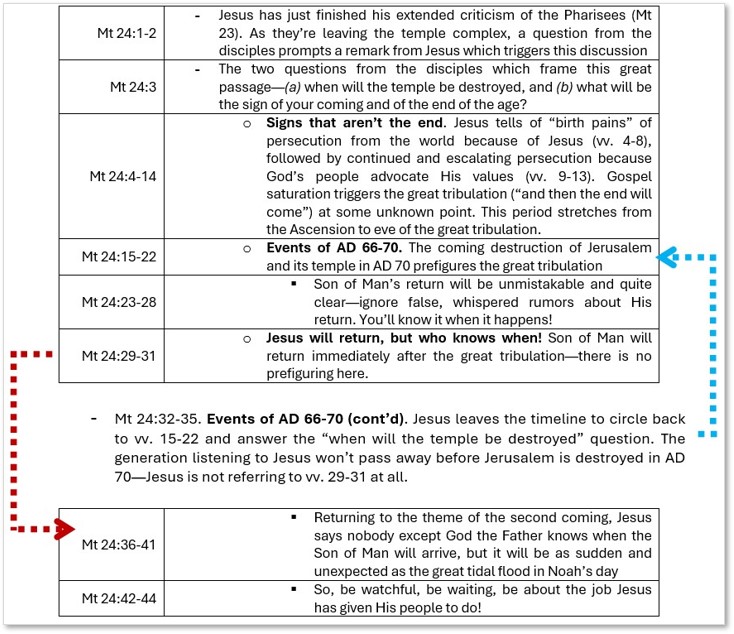
Here is an outline of the passage as I understand it.
Here is my attempt to depict the passage in graphic form, especially the foreshadowing aspect and Jesus’ focus shifting between the near (the Romans destroying Jerusalem) and the far (Antichrist and the great tribulation).
Now, at long last, because the map is not the territory, let’s get to Matthew 24.
1.5. Mic Drop in Jerusalem (vv. 1-3)
Jesus has just finished his jeremiad against the Pharisees (Mt 23). He says, “your house is left to you desolate!” (Mt 23:38). This could refer to Israel, to the temple itself, or to Jerusalem as the symbol of God’s place on earth. It’s probably a general reference encompassing lots of things, basically meaning “things as they are are gonna change.” Jesus then turns on His heels and walks away. This is likely Tuesday of Passover week, and Jesus never enters the temple again.[13]
Jesus left the temple and was walking away when his disciples came up to him to call his attention to its buildings. “Do you see all these things?” he asked. “Truly I tell you, not one stone here will be left on another; every one will be thrown down (Matthew 24:1-2).
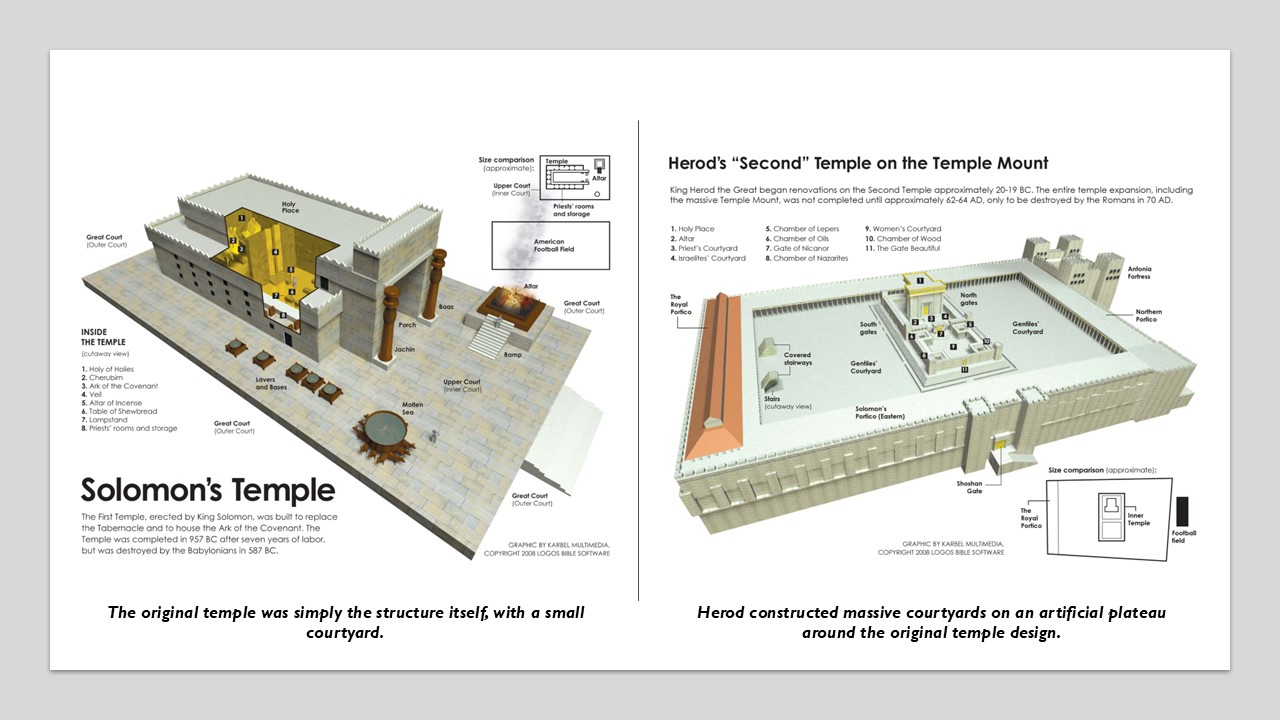
We can imagine the disciples staring at the Pharisees, an unbearable tension filling the silence. They then hurry after Jesus, anxious to escape this awkward situation. They believe Jesus is referring to the temple complex itself, which is a huge structure. It’s the size of several football fields, a massive feat of engineering. Herod the Great expanded the temple which the exiles rebuilt upon their return from captivity. He erected massive retaining walls, filling them in to create an artificial plateau. He then added numerous exterior courtyards and other odds and ends, with the original temple at the center. This ambitious project was underway for nearly 80 years. It was finished shortly before the Romans sacked the city in AD 70.
How, the disciples wonder, could this structure be left desolate?[15] They call Jesus’ attention to the buildings—just look at them! Desolate? Deserted? Really? Jesus tells them the whole thing would be rubble one day. That isn’t what they’re expecting to hear!
This is a great time for some clarification.
As Jesus was sitting on the Mount of Olives, the disciples came to him privately. “Tell us,” they said, “when will this happen, and what will be the sign of your coming and of the end of the age?” (Matthew 24:3).
The disciples have two questions; (a) when will the temple be destroyed, and (b) what will be the sign that lets us know? The “sign of your coming and of the end of the age” is one question, not two—the disciples assume they are the same event.[16] They seem to assume the two events will happen at roughly same time—the temple will be destroyed, and Jesus will return.
These two simple questions, uttered on the Mount of Olives as they stared across the Kidron Valley at the temple complex, is the impetus for one of Jesus’ most sweeping descriptions of history. He begins to answer their questions in v. 4-14.
2. Let the Bad Times Roll (vv. 4-14)
In Matthew 24:4-14 Jesus tells us to expect bad times to come, to expect opposition, to expect misunderstanding, and to expect hostility from a world that doesn’t like or understand His message. If this is the case, then why be so surprised when the bad times roll?
A host of secular media personalities and Christian influencers want you to be upset, indignant, mad at the state of the world. Mad that it no longer pretends to be Christian. Angry that un-Christian things are called good, and that good is called evil. Well, no kidding. This ought not be a surprise, so why are some Christians still so surprised?
Here is where we are in the passage:
Let’s see what Jesus has to say about the reception Christians can expect from this world.
4Jesus answered: “Watch out that no one deceives you. 5For many will come in my name, claiming, ‘I am the Messiah,’ and will deceive many. 6You will hear of wars and rumors of wars, but see to it that you are not alarmed. Such things must happen, but the end is still to come. 7Nation will rise against nation, and kingdom against kingdom. There will be famines and earthquakes in various places. 8All these are the beginning of birth pains (Matthew 24:4-8).
Jesus skips the “when will the temple be destroyed question” (but see timeline on vv. 32-35) and instead talks about what are not the “signs” of His coming. He begins with events which will start more or less immediately—dangers which lurk right at the very doors.[17]
Jesus says people will try to deceive Christians about the Messiah’s return.
He explains that general unrest and warfare will occur, but Christians shouldn’t lose hope. This will be a time of increasing disorder on the international scene (“nation shall rise against nation,” Mt 24:7). It’s possible Matthew is referring to tumultuous events in recent memory from his own day.[18] Some believers might now point to contemporary events with raised eyebrows, like the Russo-Ukraine war. But we ought to remember that the Russo-Ukraine war is the first major, sustained conventional military action in Europe since the Second World War, and perhaps only the second in the world since the Six Day War (1967) and the Yom Kippur War (1973). In short, international coalitions have been largely successful in suppressing conventional miliary conflict since 1945.
Jesus also warns that earthquakes and famines will happen with increasing frequency.
Jesus says these events won’t be the “end of the age” at all—they’ll just be birth pangs which signal or foreshadow the coming main event. In other words, this will be the normal situation in this age.[19] Wars, earthquakes, famines—these will be common and in no way suggest “the end” is nigh at hand.[20] It’s very important to not be led astray by weird speculations. Christians have always been prone to do this. One 19th century scholar chortled that a friend of his claimed the fifth kingdom in Daniel 2 was the United States of America, and that the “war in heaven” (Rev 12:7) was a prophecy of the American Civil War![21]
It’s important to note that Jesus is speaking to His disciples—to believers. Some Christians believe His words in Matthew 24 are only for Israelites, but the text says nothing about that.[22] That idea is based on an interpretive system that sees a hard distinction between Israel and the Church and therefore infers sharp breaks in audience where necessary. However, the text doesn’t support this hard break in audience to “Israel only” in Matthew 24-25. Instead, we should simply understand Jesus to be speaking to the disciples, and we should then apply His teaching to our lives directly—just as we do for countless other passages in the Gospels.
So much for the “birth pangs” which foreshadow that the end of the age is on the way. What happens next?
Then you will be handed over to be persecuted and put to death, and you will be hated by all nations because of me (Matthew 24:9).
The word which the NIV translates “then” could mean “at that time,” meaning during the time of the birth pangs. Or it could be sequential (i.e., “what happened next was …”). It’s probably sequential[23]—after the birth pangs, things get real. Nonetheless, all of vv. 4-14 is one on-ramp of escalating persecution. Oppression and martyrdom will occur. Nations hate Christians because they represent Jesus.[24]
We must not forget the importance of faithfulness—we must be salt in light in an increasingly dark world. Some Christian influencers in America operate from a default posture of outraged defensiveness. They want Mayberry (or something like it) to come back, and they’re rightly outraged at how hard and fast the cultural values have changed in the past generation. As newsman Howard Beale once declared, “I’m mad as hell, and I’m not gonna take it anymore!”[25] But, Jesus here tells us to expect to be a prophetic minority—to be hated, persecuted, despised because we represent Jesus. Nobody likes prophets who tell the truth. We ought to expect opposition, which means we shouldn’t respond with outraged defensiveness when our culture looks more like Babylon than Jerusalem. Did we expect something different?
What else will happen after these birth pangs hit?
10At that time many will turn away from the faith and will betray and hate each other, 11and many false prophets will appear and deceive many people. 12Because of the increase of wickedness, the love of most will grow cold, 13but the one who stands firm to the end will be saved (Matthew 24:10-13).
Taken together,[26] vv. 9-13 show us a time characterized by a deliberate persecution of Christians. They will be hated specifically because they represent Jesus (“because of me,” Mt 24:9). Believers can only be hated because of Jesus if they’re representing Jesus’ values, His ethics, His agenda, His program. The corollary, of course, is that to the extent your “Christianity” mirrors this world’s values and mores, the more fake it is. Think about that.
This period of time is not the tribulation, but it is the precursor to it. It’s a time during which the world’s values grow more and more hostile to Christianity. There will be an escalation of Christian persecution—imprisonment, death, defections from the faith, vicious infighting, and false teachers stalk the land. Believers will grow cold—perhaps not apathetic, but insular. Safe. Hidden. Faith will be privatized, pushed indoors where the world can’t mock it, persecute it, identify it. There will be a growing eco-system of secret Christians. The Book of Hebrews later criticized this. Only those who persevere to the end will be saved—good works, obedience, and faithfulness are essential fruits of real Christianity.[27]
Now, Jesus gives us one of the closest answers we’ll ever get to an answer for the “when” question (but see Mt 24:32-35).
And[28] this gospel of the kingdom will be preached in the whole world as a testimony to all nations, and then the end will come (Matthew 24:14).
When will “the end” come? Well, first the gospel of the kingdom must be preached throughout the whole world,[29]and then the end will come. The word here indicates “the end” is the next event in sequence once the gospel reaches the whole world. The natural question is, “well, at what point is the gospel preached throughout the whole world?” One Christian leader from the late 4th and early 5th century speculated that moment had almost arrived, “since it appears to me that there remains no nation that does not know the name of Christ.”[30] It’s safe to say he was wrong! Nor is this hyperbole from Jesus.[31]
So, what does that statement mean? It’s clear Jesus doesn’t mean “every single person must hear the Gospel,” because some people are always dying without hearing the message, and others are always being born. 100% contact is impossible.[32] It must mean something like saturation. At some point, the entire world will reach a divine “saturation level” for the Gospel, and then the end will come.[33]
Like many things in prophecy, “the end” is not a singular event. Here, it refers to the matrix of events which together comprise the end of “this present evil age,” (Gal 1:3). The “Gospel saturation level” is the trigger which kicks off this chain of events.[34] We have no idea what the saturation level is, or how to precisely measure it. What is clear is that missions (domestic and abroad) are critical. If a church is not about evangelization, then it’s derelict.
Therefore, once Gospel saturation is achieved, “the end” is triggered. What will be the opening move in this chain of events? Jesus tells us in the next section.
3. Gangsters and Abominations of Desolation (vv. 15-22)
Prophecy is powerful because it tells a story in a very impactful way. Strange images, bizarre sayings, odd symbols—it’s all there, ready to fire the imagination. The medium is so much different than a narrative like Acts, a poem like Song of Solomon, or a lawyerly argument like Romans. It captivates and draws you in, even despite yourself. What does it mean? What’s it saying?
We’re drawn to epics, myths,[35] sweeping origin stories. You might have had to read Iliad and Odyssey in high school, but have you read it since? The modern myth largely exists on film—in the multiplex or via streaming from your couch. Sagas like the Harry Potter series and the Lord of the Rings trilogy captivated an entire generation of people around the world. They’re self-contained universes that tell tales of good v. evil, of darkness v. light, of heroes and villains, and of diabolical figures vanquished by good.[36]
In these modern-day myths, there is always a climatic showdown. This is never simply an individual contest (unlike Rocky v. Ivan Drago or Luke Skywalker v. Darth Vader),[37] but rather the fulcrum of an existential struggle against the evil system. Thus, the Lord of the Rings film saga ends with the battle at Minas Tirith and then at the black gates of Mordor. The original Star Wars trilogy ended with the Battle of Endor and the destruction of the second Death Star.
The Christian story has its own epic finale, and it occurs at the end of the great tribulation. Jesus tells some of that story here, in our passage (Matthew 24:15-28). But He also tells another story—actually two at the same time; the first foreshadows the other. Star Wars does something similar.
The Rebel Alliance did indeed destroy a Death Star battle station in the original 1977 film, A New Hope. The Empire has been shattered! Surely, it won’t ever be able to replicate this fearsome weapon. Yet, the opening crawl for the 1983 film Return of the Jedi tells us that “the GALACTIC EMPIRE has secretly begun construction on a new armored space station even more powerful than the first dreaded Death Star …”
You see, that first Death Star was but a foretaste of the more fearsome second Death Star to come. It pointed to it, foreshadowed it, gave a taste of what was ‘comin ‘round the mountain. Something like that is going on here.
Here’s where we are in the passage:
Jesus speaks of two things at once; (a) some terrible ordeal which will happen soon, and (b) another, more definitive contest which occurs much later. I’ve said too much already, so I’ll let the text speak for itself from here on out.
15So when you see standing in the holy place ‘the abomination that causes desolation,’ spoken of through the prophet Daniel—let the reader understand—16then let those who are in Judea flee to the mountains (Matthew 24:15-16).
Now we’re into the difficult part of Matthew 24. Some take this whole bit (Mt 24:15-22) to refer to the sack of Jerusalem by the Romans in AD 70. Others see it as completely future, indicating the start of the great tribulation. Still others see a blending of both perspectives—usually with the former as a type for the latter. Some minimize Daniel’s context and speculate this “abomination” is a general reference to “every heresy which finds its way into the church.”[38] One scholar suggests this was the desecration of the temple by the Zealot faction during the Jerusalem siege of AD 66-70.[39]
We ought to lay out the evidence, analyze it fairly to let it speak for itself, and set systems aside when they don’t fit that evidence. Two pieces of evidence are critical here:
What Daniel said. Jesus even inserted a plea for us to read Daniel (“let the reader understand,” Mt 24:15) to get His point,[40] and
What Mark and Luke say. Either they contradict each other, or we can harmonize them together to form a complete picture.
3.1. Daniel, Jesus, and the “abomination that causes desolation”
The first thing we must do is figure out what “the abomination of desolation” is, so we can figure out what Jesus is saying. The phrase communicates two things, (a) there is a defiling and disgusting thing which (b) causes a sacred place to be abandoned. You could render it something like “the awful and blasphemous thing which causes something to be abandoned.” In his book, Daniel always uses the phrase to refer to an action which a figure of sinister evil commits. Daniel uses the phrase three times.
The first of these is in Daniel 9:24-27, where the prophet provides a broad sketch of history to come:
A period of time which the angel Gabriel identifies as “seventy sevens” is the complete span during which God’s plan will be completed (Dan 9:24).
This time is triggered by Persian’s decree to rebuild Jerusalem (“From the time the word goes out to restore and rebuild Jerusalem,” Dan 9:25). There is a dispute about when the Persians issued this decree, but that isn’t important now.
From the decree to rebuild the temple until the Anointed One (Jesus) arrives on the scene, 69 “sevens” will elapse. The temple will be rebuilt during this period, but in troublesome times (Dan 9:25).
After the 69 “sevens,” the Anointed One will be killed, and have nothing. The “people of the ruler who will come” will then destroy Jerusalem and its sanctuary. War will rage on like a flood during this time until it’s all done (Dan 9:26).
This “ruler who will come,” whose people have destroyed Jerusalem, will then confirm a covenant with many for one “seven.”
In the middle of this last “seven,” Antichrist will stop religious practices in Jerusalem and erect an idolatrous figure of some sort—an “abomination that causes desolation”—inside the temple for about three and a half years (cf. Dan 12:11-12). This will continue until the Antichrist gets his just desserts and is cast into hell (Dan 9:27; cp. Rev 19:19-20).
It’s reasonable to conclude that when Daniel refers to “an abomination which causes desolation” here (Dan 9:27), he’s referring to the intentional desecration of a sacred space by an evil figure.
Daniel mentions this phrase in two other places (Dan 11:31; 12:11). The first of these refers to a Syrian king named Antiochus IV Epiphanes, who persecuted the Jewish people terribly in the last quarter of the 2nd century BC. He erected a pagan altar inside the temple and prefigured the coming Antichrist in his cruelty and hatred (read 1 Maccabees 1). This action sparked the Jewish revolt and resulted in a quasi-independent Jewish kingdom until Rome came onto the scene. The second reference seems to leap forward and refer to the Antichrist himself.
Let’s return to our Matthew passage:
15So when you see standing in the holy place ‘the abomination that causes desolation,’ spoken of through the prophet Daniel—let the reader understand—16then let those who are in Judea flee to the mountains (Matthew 24:15-16).
So, to which “abomination of desolation” reference is Jesus referring? He’s looking forward to the future, so Antiochus IV Epiphanes is out. It seems Jesus must be referring to Antichrist, and that would mean Jesus is telling Christians to flee when the tribulation begins.
3.2. Mark, Luke, and the “abomination that causes desolation
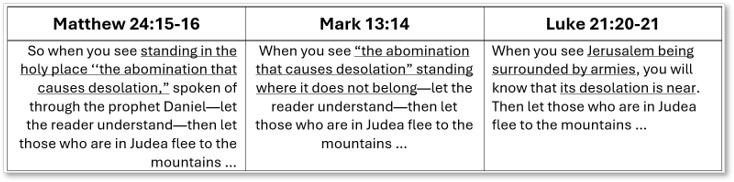
But we must now bring in evidence from Mark and Luke to see if the evidence still points that way:
Notice what Luke does. He wrote his Gospel last, and he’s apparently interpreting Matthew and Mark for his readers.[41] Luke records Jesus as meaning that the “abomination that causes desolation” was the Roman armies which surrounded Jerusalem.[42] Luke says that Jerusalem’s desolation is near when the Romans surround Jerusalem. The “abomination” would then be Roman military standards invading the city, especially the temple proper. These pennants bore the image of the Roman emperor, who claimed a divine status. This is blasphemy, of course. It is Jerusalem’s desolation to which Luke refers, and this means it’s what Mark and Matthew meant, too.[43]
Some might object that Luke could just as easily be referring to Antichrist’s armies encompassing Jerusalem to destroy it, but this event just doesn’t occur in any reasonable timeline. Antichrist does indeed gather an army to meet Jesus at his second advent but is defeated in quick order—Jerusalem is not destroyed (Rev 19:19). Likewise, Satan later raises an army to have a go where his minion failed, but he is incinerated by a divine fireball (Rev 20:9). Again, Jerusalem is untouched.
Luke said Jerusalem’s “desolation was near,” (Lk 21:20). The word means destruction of the city—it will be laid waste.[44] This is precisely what both Antichrist and Satan will later fail to accomplish, yet it is exactly what Titus accomplished in AD 70. Josephus tells us:
There was no one left for the soldiers to kill or plunder, not a soul on which to vent their fury; for mercy would never have made them keep their hands off anyone if action was possible. So Caesar now ordered them to raze the whole City and Sanctuary to the ground … [a]ll the rest of the fortifications encircling the City were so completely leveled with the ground that no one visiting the spot would believe it had once been inhabited. This then was the end to which the mad folly of revolutionaries brought Jerusalem, a magnificent city renowned to the ends of the earth.[45]
So, we’re left with the conclusion that Jesus refers to the Roman sack of Jerusalem in AD 70. It’s also more than just that, but we’ll get there in a bit.
17Let no one on the housetop go down to take anything out of the house. 18Let no one in the field go back to get their cloak. 19How dreadful it will be in those days for pregnant women and nursing mothers! 20Pray that your flight will not take place in winter or on the Sabbath (Matthew 24:17-20).
When the Romans attack Jerusalem, Jesus says everyone must run. Immediately. Get out. Don’t stop to grab some valuables. Just flee. His reference to the Sabbath supports a reference to AD 70—“Jesus clearly expects these events to take place while the strict Sabbath law is in effect.”[46] Some Jews would be reluctant to help on the sabbath, fearful of incurring religious condemnation even as Rome’s armies massed against the city.[47] Some Christians believe this “Sabbath” reference points to some future time when the temple has been re-built, but Matthew says nothing about that.
Why does Jesus say this? Why such dire warnings?
For then there will be great distress, unequaled from the beginning of the world until now—and never to be equaled again (Matthew 24:21; cp. Daniel 12:1).
This sounds pretty bad. But, God has said things like “this has never happened before” when, in fact, it had happened (cp. Josh 10:14 with Ex 8:13, Num 14:20; 2 Kgs 6:18)![48] This suggests Jesus’ words here don’t have to be literal—it may just be a colloquial way of saying “this will be really, really bad.” We do similar things when we tell someone that a certain thing was “the craziest thing I’ve ever heard.” We say that, but is it really the craziest thing? Probably not. Some interpreters suggest Jesus is using hyperbole for deliberate effect, but this is unlikely.[49]
If Jesus is primarily referring to the events of AD 66-70, when Jerusalem was destroyed, then was this really the worst period of time “from the beginning of the world until now”? The Jewish historian Josephus was present with the Roman armies at the siege of Jerusalem and tells us all about it.
It was a terrible time. Civil war had torn the city into three Jewish factions (a “suicidal strife between rival gangsters”)[50] and war broke out during Passover when the city was filled to the brim with Jewish pilgrims. One faction controlled the temple courts, while two others held the city and the larger temple complex. Josephus tells us terrified worshippers were cut down by a hail of projectiles as they ran for the sanctuary. Blood collected in pools in the courtyards. The city became “a desolate no man’s land” as guerilla warfare raged on.
The Romans did not show up as evil conquers, but arrived under the aegis of, as it were, the “Federal government” come to restore order to a city within its jurisdiction that was destroying itself. Bit by bit, the Roman general Titus conquered Jerusalem in a multi-year siege. Josephus tells of one Jewish woman named Mary, driven mad by hunger, who killed her infant son, roasted him, ate one half of him and saved the rest for later[51] (cp. Deut 28:53-57). The temple itself was destroyed by fire in a frenzy of rage by Roman legionnaires who ignored their commander’s orders.
All the prisoners taken from beginning to end of the war totalled 97,000; those who perished in the long siege 1,100,000 … No destruction ever wrought by God or man approached the wholesale carnage of this war.[52]
By all accounts Josephus wasn’t the most honorable man in the world, but he was there. He witnessed the whole thing. But can we fairly say the sack of Jerusalem was really the worst event in the world? One thinks of the German siege of Leningrad during the Second World War. For a time, the city’s only supply line to friendly Soviet forces during the brutal Russian winter was across a frozen lake. The siege lasted nearly 900 days and, by some accounts, perhaps 1,500,000 people perished. Just as during the siege of Jerusalem so many years before, it’s likely that starving citizens resorted to cannibalism—stories were whispered about children disappearing.
While Titus’ siege of Jerusalem lasted longer, we’re at least speaking of comparable tragedies. It seems reasonable to take Jesus’ words in Mt 24:21 as referring to Jerusalem’s destruction by the Romans armies.[53] But, Jesus’ pivot to His own second advent a few verses hence suggest Titus and his Romans legions don’t exhaust vv. 15-21’s meaning.[54]
In other words, Mt 24:15-21 refers to both (a) Jerusalem’s destruction by the Romans, which squares with Jesus’ announcement of the temple’s destruction that started this entire conversation (Mt 24:1-2), and(b) the Antichrist’s brief reign as the ruler of the kingdom of darkness (Rev 13), later depicted by the Apostle John as Babylon (Rev 17-18). There is both a near and far fulfillment.[55] Jesus began with (a) birth pangs of persecution against the church, then (b) told of sharply escalating hostility because the church represents Jesus, to (c) the fall of Jerusalem as a type for the coming kingdom of evil via the Antichrist. This typology is the best way to understand Jesus’ unmistakable pivot to the distant future in vv. 29-31, we we’ll soon see. But, for now, Jesus continues:
If those days had not been cut short, no one would survive, but for the sake of the elect those days will be shortened (Matthew 24:22).
Some say “those days” Jesus speaks about here refer to (a) the specific events in vv. 15-21,[56] or perhaps (b) the entire chain of events stretching from the birth pangs to the end of the Antichrist’s brief reign (vv. 4-21; cp. v. 29).[57] I believe it’s easiest to continue the typological theme and say v. 22 refers to the siege of Jerusalem in AD 66-70, which foreshadows the seven year great tribulation in the future. Jesus continues to refer to both events.
3.3. On False Alarms and Bogus Messiahs (vv. 23-28)
23At that time if anyone says to you, ‘Look, here is the Messiah!’ or, ‘There he is!’ do not believe it. 24For false messiahs and false prophets will appear and perform great signs and wonders to deceive, if possible, even the elect. 25See, I have told you ahead of time (Matthew 24:23-25).
Jesus warns that during this this awful time—that is, the Jerusalem siege of AD 66-70 which foreshadows the tribulation—everyone will surely die unless He preserves His community through it all. This suggests Christians will endure the tribulation at some point in the future. There will be false sightings of the Messiah. Charlatans and Satan-empowered teachers will lead people astray.
26So if anyone tells you, ‘There he is, out in the wilderness,’ do not go out; or, ‘Here he is, in the inner rooms,’ do not believe it. 27For as lightning that comes from the east is visible even in the west, so will be the coming of the Son of Man. 28Wherever there is a carcass, there the vultures will gather (Matthew 24:26-28)
Jesus words are just a continuation of the same, with a folksy analogy for good measure. Just as circling vultures unmistakably mark the spot of a dead creature, so too will Messiah’s coming be obvious and clear. It won’t be necessary to speculate about when Messiah will arrive, because it will be as unmistakable as lightning in the night sky. It’s no accident that Jesus refers to Himself here as “the Son of Man.” This is the figure whom the Ancient of Days crowns as eternal king in Daniel 7 just after the beast (i.e., Antichrist) is slain and tossed into the burning fire (Dan 7:7-13; cp. Rev 17:11-14). Likewise, in Jesus’ own chronology the Son of Man will appear to destroy Antichrist and establish His kingdom (Rev 19:19-21) just as the great tribulation plumbs new depths of evil. The typology or prefiguring still holds. This is advice both for the residents of Jerusalem about 40 years hence, and for believers enduring the great tribulation sometime in the distant future.
Notice again that there is nothing here about Jesus returning twice, once to rapture the Church out of this world, and again to establish the kingdom. Jesus only tells of one single return.
4. Things Just Got Real (vv. 29-31)
Darth Vader is rightly regarded as one of the best villains in movie history, in the same league as Maleficent and Hans Gruber. In the original Star Wars trilogy, his fiendishness was less a product of his skills in single combat and more about his ruthlessness and the way he killed subordinates by choking them to death with “the force.” He was more a sinister administrator than a warrior. Still, it was clear Vader was a frightening individual.
“I’m not afraid!” Luke Skywalker told Yoda at one point.
“You will be,” the Jedi Master replied cryptically. “You will be …”
Vader is not depicted as a fighter until Rogue One (the direct prequel to the 1977 film A New Hope) was released in 2015. In the climactic battle scene,[58] Vader and a force of stormtroopers disable and board a Rebel command ship which has stolen data for the first Death Star (still under construction). This information cannot fall into Rebel hands, and Vader’s goal is to personally ensure that it does not.
The Rebel sailors fall back into one portion of the ship. They point their weapons into the darkness, gasping for breath. They hear deep breathing.
Hmmmm-pusssh.
Silence.
Hmmmm-pusssh.
Then, out of the darkness a red lightsaber comes to life, illuminating Vader standing in the corridor, menacing in black.
Hmmmm-pusssh.
The sailors open fire. Vader quickly kills them all. This scene has become infamous because of the sudden, startling ferocity of Vader’s attack and the sailor’s inability to do anything about it. They fall before him like so much chaff before a bulldozer. They scream in fear, knowing they’re doomed. They fight anyway, even as they know it’s hopeless.
Something similar happens here. Jesus returns, the people of Babylon scream, panic, mourn. They fight back, but it’s all over in an instant. You’ll have to read Revelation 19 to get the full impact, but it’s all hinted at here.
Here’s where we are in the passage:
Jesus explains …
29Immediately after the distress of those days “‘the sun will be darkened, and the moon will not give its light; the stars will fall from the sky, and the heavenly bodies will be shaken.’ 30Then will appear the sign of the Son of Man in heaven … (Matthew 24:29-30; quoting Isaiah 13:10)
The timeline skews at this point—if vv. 15-28 describes the destruction of Jerusalem as a type or foreshadowing of the great tribulation to come, then how can Jesus return immediately after those days? We’re still waiting, even now!
The best answer seems to be that here, in vv. 29-31, the typology (the events of AD 70 and the tribulation) now fades. We are now squarely at the end of the great tribulation, when Jesus returns. His second advent terminates the tribulation.[59] Jesus describes this by quoting from Isaiah 13:10, which describes an otherworldly phenomenon in the atmosphere—a plain and terrifying indicator that all is not well with the world.
Some Christians believe the “sign of the Son of Man” (Mt 24:30) is a cross appearing from on high which heralds Jesus’ arrival.[60] There is merit to the idea of a sign of some sort appearing first, and then the Son of Man “coming on the clouds of heaven.”[61] We just don’t know what this “sign” is—perhaps it’s simply Jesus appearing?[62] Whatever it is, it’ll be obvious and clear to everyone.
It’s no accident that this Isaiah quotation is from a passage about judgment on Babylon—that symbol of wickedness and evil (Rev 17-18; cf. Zech 5:5-11). It is the king of Babylon who seems to double as Satan in Isaiah 14:3-20—“How you have fallen from heaven, morning star, son of the dawn!” (Isa 14:12). Now here, Jesus describes His return by quoting judgment against Babylon—precisely what the Apostle John shows us in Revelation 19, just after Babylon is fallen (Rev 17-18).
What is the unmistakable sign that the Son of Man has come?
And then all the peoples of the earth will mourn when they see the Son of Man coming on the clouds of heaven, with power and great glory (Matthew 24:30).
Jesus will arrive on the clouds of heaven—He’s alluding to His coronation scene from Daniel’s vision (Dan 7:13-14). The people who don’t belong to Jesus (the unbelievers) will be sad because they’ve already given their allegiance to another king, Jesus’ evil counterpart (as it were)—the Antichrist (Rev 17:1-8; cp. 13:1-8).
And he will send his angels with a loud trumpet call, and they will gather his elect from the four winds, from one end of the heavens to the other (Matthew 24:31).
This is the great sifting of the wicked and the righteous. The image seems to be that of Jesus arriving to earth on the clouds while sending His angels to speed on ahead to gather the saints from all corners of the earth. The Apostle John describes the same event as Jesus returning to earth with “the armies of heaven,” (Rev 19:11-17). Trumpet blasts announce His coming, as they often do when God comes to earth (see Ex 19:16; 1 Thess 4:16). It is also a divine bugle call for the faithful (Isa 27:13). The trumpet blast in Scripture is a universal signal that can mean only one thing—God has arrived!—just as when military bands play “Hail to the Chief” to welcome the U.S. President.
Earlier, Jesus spoke of this identical scene in His parable of the wheat and the weeds (Mt 13:40-43; cp. Lk 3:13), wherein “at the end of the age” the Son of Man sends forth His angels to sift the kingdom (i.e., the world, cp. Mt 13:38, 41) and sort out the righteous from the wicked. “Then the righteous will shine like the sun in the kingdom of their Father” (Mt 13:43), because the world has been cleansed of wickedness.
All told, Jesus leaves us with a basic outline which depicts:
Jesus beginning His return trip from heaven, terminating the tribulation, and fulfilling His second advent promise.
Jesus sending His angels out ahead of Him to gather the believers from all over the earth.
Then, presumably, Jesus “arriving” in Jerusalem to inaugurate His kingdom, bringing His saints along with Him.
These believers are from all over the world, because “Gospel saturation” has been achieved. These events are strikingly like what Paul describes in 1 Thessalonians 4:13-18.[63]
5. A Time for Everything (vv. 32-44)
Modern-day epics and myths have fallible heroes. The villain is always more powerful, more mighty, with more resources. Harry Potter and his friends (all of them children, really) struggle against Voldemort and his Death Eaters. The Rebels fight against the Empire, and later the First Order. The Elves, Dwarfs and the kings of men wage war against Sauron and the forces of evil from Mt. Doom. They’re each outgunned, outmatched—only their valiant hearts, their inherent goodness sees them through.
The Christian story is quite different. C.S. Lewis understood that. In his Chronicles of Narnia, Aslan is never befuddled, outmatched, or not in control of the situation. In God’s story, He is never struggling against a superior foe. To be sure, Satan is pure evil, and he is seducing and ruining people and societies across the globe. But God’s victory is never in doubt.
God controls time, sets time, manages time. One confession of faith from the early 17th century reads:[64]
We believe that the same God, after he had created all things, did not forsake them, or give them up to fortune or chance, but that he rules and governs them, according to his holy will, so that nothing happens in this world without his appointment …
This means your life has purpose, because it’s not a random series of events. So, too, this world and the course of human history is not a sequence of bizarre accidents. God is moving, directing, piloting this ship on a course He’s plotted.
This doctrine affords us unspeakable consolation, since we are taught thereby that nothing can befall us by chance, but by the direction of our most gracious and heavenly Father, who watches over us with a paternal care.
It’s this control, this providence that God exercises over the world even as it’s temporarily influenced by Satan, that makes prophecy possible. It’s why God can declare something hundreds of years beforehand, and it happens. It’s why Jesus can say what He says in this last section of our passage.
The disciples kicked off this discussion by asking two questions; (1) when will the temple be destroyed, and (2) what will be the sign of your coming and the end of the age? Jesus already explained the signs which will mark His coming (Mt 24:15-28). But He hasn’t yet addressed the first question—when will the temple be destroyed? We know it will be destroyed (see Mt 24:15-22), but when?
From the comfy vantage point of 2024, we know the answer because of the benefit of history (AD 70), but Jesus’ audience didn’t have a time machine or a crystal ball. He hasn’t yet answered “when,” but Jesus does so here. He also answers an implicit question; one the disciples didn’t ask, but about which everyone is curious—the “when will you return” question.
5.1. When Will the Temple be Destroyed? (vv. 32-35)
Here’s where we are in this passage:
Jesus explains when the temple will be destroyed.
32Now learn this lesson from the fig tree: As soon as its twigs get tender and its leaves come out, you know that summer is near. 33Even so, when you see all these things, you know that it is near, right at the door. 34Truly I tell you, this generation will certainly not pass away until all these things have happened (Matthew 24:32-34).
These few verses are hard to interpret, because by the time you arrive here you’ve already locked yourself onto a particular track that dictates the shape of your answer. Clearly Matthew 24:34 holds the key—but what does “this generation” mean?
It follows that; (a) if the generation to whom Jesus is speaking won’t pass away before “all these things have happened,” (b) and if those folks are now quite dead (and they are!), and (c) and if Jesus hasn’t yet returned (and He hasn’t!), then (d) either Jesus was wrong, or the word “generation” here doesn’t mean what we think it means, or… something.
So, at this point you have three basic tendencies among interpreters when they get to Matthew 24:34:
If you believe Matthew 24 is basically about the destruction of Jerusalem in AD 70, then you will tend to maximize those connections and become wishy-washy about seeing the second advent here. You will emphasize “this generation” and say “this means Jesus had to be talking about events from that generation.”
If you believe this passage is mostly about the second coming, you’ll be prone to minimize the evidence from vv.15-21 which suggests references to AD 70 and maximize the “second coming” data.
And some interpreters see a whole lot of foreshadowing. They’ll say, “there certainly is stuff here about AD 70 and the suffering and carnage of Jerusalem’s destruction, but all that stuff prefigures the real tribulation that’s coming one day!”
The two questions to answer here from v. 34 are (1) what are “these things,” and (2) what does “this generation” mean? There are four general answers that faithful Christians have offered:
“These things” is about the destruction of Jerusalem, which means Jesus is referring here to vv. 4-26 (or possibly up to v. 28)—He isn’t talking about vv. 29-31 at all. If that’s true, then there’s no problem with seeing “this generation” referring to people alive in Jesus’ day who will still be around to see the Romans destroy the temple.[65]
The phrase “this generation” refers to the character of people as a particular group, meaning “people like this” won’t pass from the scene before all this takes place. Some Christians believe Jesus is saying that, despite everything, the Jewish people will be preserved until Messiah returns (cp. Rom 9-11).[66]
“This generation” refers to the folks who will be alive when Jesus returns—it’s a message for that generation which will be alive in the future.[67]
Finally, there is the idea that Jesus is using typology, whereby “this generation” and “these things” primarily refers back to vv. 15-22 and the timing question about the temple’s destruction in AD 70 (Mt 24:2-3), and it also prefigures the coming calamity of the great tribulation and Jesus’ return.[68]
The second option can be made to work,[69] but it’s sketchy and kind of weak. It’s always dangerous to interpret a passage by saying, “Hey, even though every single English bible version you’ll ever see translates this word as ‘generation,’ I want you to know I know Greek, and it really means something entirely different!”
The third option seems forced, because Jesus is speaking to the very people who will see these events happen. He tells the disciples “when you see all these things, you know that it is near, right at the door,” (Mt 24:33). Note that Jesus didn’t say “when they see.” He said, “when you see.” He then says, “this generation will not pass away until all these things have happened,” (Mt 24:34). Jesus was referring to His audience (the disciples) who would see these things and know that it’s about to happen. That’s why it’s rendered “this generation” (the generation listening to Him), and not “that generation” (the one alive when He returns).[70] This option is incorrect.
The fourth option is similar to the first, but it insists on the events of AD 70 being a foreshadowing of a greater fulfillment. This produces a fuzziness about “generation” that I feel muddles things a bit. Also, Jesus couldn’t have been saying “I’ll be back within one generation” (even in a foreshadowey kind of way) because He’s about to tell us He doesn’t know when He’s coming back (v. 36)![71]
The first option seems best because it lets Jesus speak plainly,[72] and it allows “this generation” to have its natural force.
Heaven and earth will pass away, but my words will never pass away (Matthew 24:35).
Jesus is telling us, “you can trust what I’m saying!”
5.2. When is Jesus’ Second Coming? (vv. 36-41)
He continues:
But about that day or hour no one knows, not even the angels in heaven, nor the Son, but only the Father (Matthew 24:36).
This (along with v. 14) is the closest Jesus gets to answering the “when will you return” question. He answers it by saying that we won’t ever know—instead, only the Father in heaven knows the answer. Speaking from His human perspective as the representative person, even Jesus doesn’t know when “that day or hour” will happen. This suggests that any bible teacher, pastor, or Christian influencer who sets dates or speculates about the time of Christ’s return is in grave error. You should mark and avoid these people as unstable, spiritually immature, and untrustworthy.
Even though He doesn’t give us a date, Jesus does re-emphasize the motif of suddenness—He’ll come back quickly, without warning.
37As it was in the days of Noah, so it will be at the coming of the Son of Man. 38For in the days before the flood, people were eating and drinking, marrying and giving in marriage, up to the day Noah entered the ark; 39and they knew nothing about what would happen until the flood came and took them all away. That is how it will be at the coming of the Son of Man (Matthew 24:37-39).
Some people assume this reference to Noah is about moral perversity, but that’s incorrect. Jesus isn’t saying “things will be just as bad as they were in Noah’s day before I come back.” Instead, He’s emphasizing the suddenness of His return.[73]
In Noah’s day, people ignored his warnings (Heb 11:7; 2 Pet 2:5). They couldn’t care less. They went about their lives. They ate. They drank. They married. They knew nothing about what was coming. Until it happened.
“That’s the way it’ll be when I return,” Jesus says. The Noah comparison seems to suggest a picture of carefree bliss, normal life—how can this be the tribulation? We forget that the tribulation will be a terrible time for believers, but not for the unbelievers who will pursue wickedness with unprecedented abandon—see the thriving commerce, political power, and economy of Antichrist’s kingdom at Revelation 18.[74] But, it’s the suddenness, the violent, unexpected force of the overwhelming cataclysm that’s the point. That’s how the Son of Man will return—with the arresting suddenness of a tidal flood.
40Two men will be in the field; one will be taken and the other left. 41Two women will be grinding with a hand mill; one will be taken and the other left (Matthew 24:40-41).
This is a strange scene. People will suddenly disappear. There one moment, gone the next. Some Christians believe this is the pre-tribulation rapture—before the tribulation. That chronology makes little sense here—the tribulation has now ended with Christ’s return in v. 31. To see Jesus in vv. 40-41 describing the rapture of the church before the tribulation would be like inserting General Ulysses Grant into a D-Day landing craft approaching Omaha Beach.
Jesus is describing the rapture, but it’s the one that accompanies His single return at the end of the tribulation—this is a post-tribulation rapture. That’s why Jesus said to “keep watch” and referenced His return. Jesus begins His return from heaven here, sends out His angels to the four corners of the globe to call out the elect, and together with them and the armies of heaven returns to Jerusalem (see discussion at Mt 24:31).[75]
I assign my interpretation in this paper a Grade C (see §1.2, above). It isn’t the only possible interpretation, but I believe it makes the most sense. Still, it’s defensible and reasonable.
5.2. The “So What” Bit (vv. 42-44)
Jesus explains:
42Therefore keep watch, because you do not know on what day your Lord will come. 43But understand this: If the owner of the house had known at what time of night the thief was coming, he would have kept watch and would not have let his house be broken into. 44So you also must be ready, because the Son of Man will come at an hour when you do not expect him (Matthew 24:42-44).
Our tale ends here as Jesus shifts from description of the signs of the end of this age and His return, and turns to the practical implication—be ready, be watching, be faithful to do the job I’ve given you to do! That is his burden at the end of our passage here (Mt 24:42-44) and the remainder of this chapter (Mt 24:45-51), and in the parables of the ten virgins and the talents (Mt 25:1-28), and in His warning about the great sifting upon His return (Mt 25:31-46).[76]
We’re making a mistake if we make Matthew 24 (or any prophetic passage) about speculations, timelines, charts, or questions the text isn’t designed to address. We ought to understand a passage in the spirit and context in which it’s given. This is harder than it sounds, because it’s possible to (1) accurately handle words in a passage, and yet (2) draw a wrong interpretation from those words because you miss the context. For example:
1 Corinthians 7 isn’t “about” how wives must give their husbands sex. Instead, it’s a passage in which Paul corrects a misguided sexual aestheticism that had taken root in that local church.
John 5:26 isn’t “about” a so-called “eternal generation of the Son.” It’s where Jesus describes to skeptical Jewish leaders who He really is.
1 Thessalonians 4:13-18 isn’t “about” the pre-tribulational rapture. It’s about Paul assuring one local church that Christians who’ve died won’t miss out on Jesus’ return.
Genesis 11 isn’t “about” how mankind “failed” a “test,” making it necessary for God to initiate a new “dispensation” with Abraham. It’s about how a generation which came of age after the flood rebelled against God.
You may sincerely believe the texts contain these things, but in no conceivable world are they “about” those things. In the same way, Matthew 24 isn’t “about” your preferred millennial position, the rapture, the tribulation, or about you wanting to construct a timeline chart. It’s about Jesus telling us that “you also must be ready, because the Son of Man will come at an hour when you do not expect him,” (Mt 24:44).
What will Jesus find His people doing when He returns (Mt 24:46)? Jesus wants us to be doing our jobs—showing and telling the Gospel, growing in Christ, loving one another in the household of faith, being a subversive counterculture in a Babylon world, representing our King’s values and message. He rescued us because He has work for us to do (Eph 2:10)—so let’s get on with it, because we don’t know when He’s coming back.
Think about the topics that fire your imagination—what are they? Are they about any of those things? Or are they ivory-tower, speculative, abstract? If you’re a Christian, did God redeem your life from the pit, and crown you with love and compassion (Ps 103:4) so you could argue with people about when the rapture occurs? Do you know more about an alleged end-time chronology than you do about the doctrine of Christ? Does your church’s doctrinal statement have more detail about “the last things” than it does about God or the Gospel? When God asks us what we’ve done with the talents He’s given us, what will we say (see the parable of the talents, Mt 25:14-30)?
Prophecy is not information for information’s sake—it’s about moral transformation, about encouragement to persevere because a better tomorrow is coming. If we keep staring at prophecy myopically, we’ll miss the point. Scripture is a refractive lens, a telescope we look through to see and hear God, by the power of the Spirit. Let’s gaze through the telescope of Matthew 24 to the better future and let Jesus’ sure words move us to knuckle down and be good stewards while we wait. After all, Jesus says, “Heaven and earth will pass away, but my words will never pass away!” (Mt 24:35).
Bibliography
Alford, Henry. The New Testament for English Readers: A Critical and Explanatory Commentary, New Edition. London; Oxford; Cambridge: Rivingtons; Deighton, Bell and Co., 1872.
Barbieri Jr., Louis A. “Matthew,” in The Bible Knowledge Commentary, ed. J. F. Walvoord and R. B. Zuck. Wheaton: Victor Books, 1985.
Bauer, Walter, Frederick Danker (et al). Greek-English Lexicon of the New Testament, 3rd ed. Chicago: University of Chicago, 2000.
Bengel, Johann Albrecht. Gnomon of the New Testament, ed. M. Ernest Bengel and J. C. F. Steudel, trans. James Bryce. Edinburgh: T&T Clark, 1860.
Benware, Paul. Understanding End Times Prophecy: A Comprehensive Approach. Chicago: Moody, 1995.
Blomberg, Craig. Matthew, in New American Commentary, vol. 22. Nashville: Broadman & Holman, 1992.
Broadus, John. Commentary on Matthew, in American Commentary. Philadelphia: American Baptist Publication Society, 1886.
Bruce, A.B. “The Synoptic Gospels,” in Expositor’s Greek Testament, 6th ed.,vol. 1. London: Hodder and Stoughton, 1910.
Calvin, John and William Pringle. Commentary on a Harmony of the Evangelists Matthew, Mark, and Luke. Bellingham: Logos Bible Software, 2010.
Carson, D.A. Matthew, in Expositor’s Bible Commentary, vol. 8. Grand Rapids: Zondervan, 1984.
Chatraw, Joshua. Telling a Better Story: How to Talk About God in a Skeptical Age. Grand Rapids: Zondervan, 2020.
Chrysostom. “Homilies 75, 76, 77,” in Nicene and Post-Nicene Fathers, Series 1, vol. 10. New York: Christian Literature Company, 1888.
Dana, H.E. and Julius R. Mantey. Manual Grammar of the Greek New Testament. Toronto: MacMillain, 1955.
Friberg, Timothy; Barbara Friberg, and Neva F. Miller. Analytical Lexicon of the Greek New Testament. Grand Rapids: Baker, 2000.
Glasscock, Ed. Matthew, in Moody Gospel Commentary. Chicago: Moody, 1997.
Green, Bradley G. Covenant and Commandment: Works, Obedience and Faithfulness in the Christian Life. Downers Grove: IVP, 2014.
Hendriksen, William. Matthew, in New Testament Commentary. Grand Rapids: Baker, 1973.
Josephus, The Jewish War, trans. G.A. Williamson, rev. ed. New York: Penguin, 1969.
Morris, Leon. The Gospel According to Matthew, in Pillar New Testament Commentary. Grand Rapids: Eerdmans, 1992.
Osborne, Grant. Matthew, in Zondervan Exegetical Commentary on the New Testament. Grand Rapids: Zondervan, 2010.
Oxford English Dictionary (online), s.v. “myth,” noun, no. 1a (accessed March 11, 2023).
Quarles, Charles. Matthew, in Exegetical Guide to the Greek New Testament. Nashville: B&H, 2017.
Ridderbos, Herman. The Coming of the Kingdom, trans. H. de Jongste. Phillipsburg: P&R, 1962.
Robertson, A. T. A Grammar of the Greek New Testament in the Light of Historical Research. Nashville: Broadman, 1934.
———————-. Word Pictures in the New Testament (Nashville: Broadman, 1933).
Simonetti, Manlio (ed.). Matthew 14-28, vol. 1b, in Ancient Christian Commentary on Scripture. Downers Grove: IVP, 2014.
Smith, G. Abbott-Smith. A Manual Greek Lexicon of the New Testament, 3rd ed. Edinburgh: T&T Clark, 1937.
Steinfels, Peter. “Gulf War Proving Bountiful For Some Prophets of Doom,” NYTimes. 02 February 1991, pp. 1, 10.
Terry, Milton S. Biblical Hermeneutics: A Treatise on the Interpretation of the Old and New Testaments. Reprint; Grand Rapids: Zondervan, 1974.
Turner, Nigel. Grammar of New Testament Greek, Vol III: Syntax. Edinburgh: T&T Clark, 1963.
Wallace, Daniel. Greek Grammar Beyond the Basics. Grand Rapids: Zondervan, 1996.
Walvoord, John. Thy Kingdom Come: A Commentary on the First Gospel. Chicago: Moody, 1974.
Walvoord, John. The Rapture Question, revised and enlarged. Grand Rapids: Zondervan, 1979.
1619 Belgic Confession of Faith, Article 13, in Phillip Schaff (ed.), The Creeds of Christendom, vol. 3. New York: Harper & Brothers, 1882.
1833 New Hampshire Confession of Faith, Phillip Schaff (ed.), The Creeds of Christendom, vol. 3. New York: Harper & Brothers, 1882.
[1] I know this phrase did not originate with the movie Ronin, but work with me here, please …
[2] A.T. Robertson, Word Pictures in the New Testament (Nashville: Broadman, 1933), Mt 24:3. A.B. Bruce notes, “This chapter and its synoptical parallels (Mk. xiii., Lk. xxi.) present, in many respects, the most difficult problem in the evangelic records,” (“The Synoptic Gospels,” in Expositor’s Greek Testament, 6th ed., vol. 1 (London: Hodder and Stoughton, 1910), 287).
[3] Charles Dyer and Angela Hunt, Rise of Babylon: Sign of the End Times (Carol Stream: Tyndale House, 1991). See also Peter Steinfels, “Gulf War Proving Bountiful For Some Prophets of Doom,” NYTimes. 02 February 1991, 1, 10. https://nyti.ms/3KTVeCm.
[4] The answer to “when shall Christ return?” is “so comprehensive a question that each theory is in fact an entire eschatological scheme, complete with detailed exegesis and sweeping synthesis,” (D.A. Carson, Matthew, in Expositor’s Bible Commentary, vol. 8 (Grand Rapids: Zondervan, 1984), 490).
[5] See John Walvoord, The Rapture Question, revised and enlarged (Grand Rapids: Zondervan, 1979), 42-44.
[6] For a representative view of this perspective, see John Walvoord, Thy Kingdom Come: A Commentary on the First Gospel (Chicago: Moody, 1974; reprint; Grand Rapids: Kregel, 1998).
[7] R.T. France, The Gospel of Matthew, in NICNT (Grand Rapids: Eerdmans, 2007), 920f.
[8] An anonymous patristic author noted, “We never saw the destruction of the temple, nor did they see the end of the age. It was expedient therefore that they hear about the signs of the temple’s destruction and that we learn to recognize the signs of the world’s consummation,” (Manlio Simonetti (ed.), Matthew 14-28, vol. 1b, in Ancient Christian Commentary on Scripture (Downers Grove: IVP, 2014), 188).
A 19th century Baptist theologian agreed and wrote, “But if the destruction of Jerusalem was itself in one sense a coming of the Lord, why may we not suppose that the transition from this to the final coming is gradual? Then much in 24:3-36 may be taken as referring both to the former and the latter topic, while some of the expressions may refer exclusively to the one or the other,” (John Broadus, Commentary on Matthew, in American Commentary(Philadelphia: American Baptist Publication Society, 1886), 480). William Hendriksen said, “Our Lord predicts the city’s approaching catastrophe as a type of the tribulation at the end of the dispensation,” (Matthew, in New Testament Commentary (Grand Rapids: Baker, 1973), 846-847).
Perhaps the foremost Greek scholar of the 20th century, a Baptist named A.T. Robertson, suggested: “It is sufficient for our purpose to think of Jesus as using the destruction of the temple and of Jerusalem which did happen in that generation in A.D. 70, as also a symbol of his own second coming and of the end of the world or consummation of the age,” (Word Pictures, Mt 24:3).
[9] See James Leo Garrett Jr., Systematic Theology: Biblical, Historical, and Evangelical, 4th ed., vol. 1 (Eugene: Wipf & Stock, 2014), 206-209.
[10] 1833 New Hampshire Confession of Faith, Article 1—On the Scriptures, in Phillip Schaff (ed.), The Creeds of Christendom, vol. 3 (New York: Harper & Brothers, 1882), 742).
[12] I am indebted to Paul Henebury’s “Rules of Affinity” as the inspiration for this grading scale. I did not use his grading scale or his descriptions, but I did take his general concept.
[14] From Holman Book of Biblical Charts, Maps, and Reconstructions (Nashville: B&H, 1993), 153.
[15] A 3rd-century Egyptian Christian scholar named Origen suggested that the physical temple had to be destroyed so the mystical temple of holy Scripture could be erected to take its place as the locus of authority. This will preach, but it isn’t what Jesus is saying! (Simonetti, Matthew 14-28, in ACCS, 186-87).
[16] πότε (at what time) ταῦτα ἔσται (will this happen?) καὶ τί τὸ σημεῖον τῆς σῆς παρουσίας (and what will be the sign of your advent) καὶ (and—the singular “sign” comprises two events which occur at the same time) συντελείας τοῦ αἰῶνος (the end of the age?).
See also Chrysostom, “Homily 75,” in NPNF 1:10, ed. Philip Schaff, trans. George Prevost and M. B. Riddle (New York: Christian Literature Company, 1888), 450.
[17] “For neither concerning Jerusalem straightway, nor of His own second coming, did He speak, but touching the ills that were to meet them at the doors,” (Chrysostom, “Homily 75,” in NPNF 1.10, p. 451). Louis Barbieri states this entire section is about the great tribulation, but offers no textual evidence in support (“Matthew,” in Bible Knowledge Commentary, ed. J. F. Walvoord and R. B. Zuck, vol. 2 (Wheaton: Victor Books, 1985), 76).
[18] See Henry Alford, The New Testament for English Readers: A Critical and Explanatory Commentary, New Edition, vol. 1 (London; Oxford; Cambridge: Rivingtons; Deighton, Bell and Co., 1872), 1:163f.
[20] Ed Glasscock, Matthew, in Moody Gospel Commentary (Chicago: Moody, 1997), 463-64.
[21] Milton S. Terry, Biblical Hermeneutics: A Treatise on the Interpretation of the Old and New Testaments (reprint; Grand Rapids: Zondervan, 1974), 499, fn. 1. A.T. Robertson, writing in 1933, observed, “It is curious how people overlook these words of Jesus and proceed to set dates for the immediate end. That happened during the Great War and it has happened since,” (Word Pictures, Mt 24:6).
[22] Louis Barbieri, Jr. is representative when he writes, “They have nothing to do with the church, which Jesus said He would build (16:18). The church is not present in any sense in chapters 24 and 25. The disciples’ questions related to Jerusalem, Israel, and the Lord’s second coming in glory to establish His kingdom,” (“Matthew,” in Bible Knowledge, 76). Barbieri offers no support for this statement, and so it cannot be taken seriously as a conclusion drawn from Matthew 24.
[23]Contra. Alford, New Testament, 1:163; Carson Matthew, 498.
[24] Barbieri states this refers to the second half of the great tribulation but can only cite Daniel as alleged support (“Matthew,” in Bible Knowledge, 77). It is unfortunate that he fails to engage Matthew 24 on its own terms.
[25] This is a line from Peter Finch’s role in the 1976 movie Network.
[26] Matthew 24:10-13 is likely contemporaneous with 24:9 (καὶ τότε)—the NIV’s rendering of “at that time” is correct.
[27] See esp. Bradley G. Green, Covenant and Commandment: Works, Obedience ad Faithfulness in the Christian Life, in NSBT (Downers Grove: IVP, 2014), ch. 1.
[28] I believe the conjunction καὶ here is expressing contrast—as in: “nevertheless, despite the persecution, this kingdom good news will be preached …”
[29] Most English bible version disagree with the NIV’s rendering of “in the whole world.” It’s better to translate the preposition as “throughout the whole world.” See NRSV, CEB, REB, NEB, RSV, NET, NLT, ISV, ESV.
[30] This remark is from Jerome. See Simonetti, Matthew 14-28, in ACCS, 191.
[32] “It is not here said that all will be saved nor must this language be given too literal and detailed an application to every individual,” (Robertson, Word Pictures, Mt 24:14).
[33] Henry Alford remarks, “But in the wider sense, the words imply that the Gospel shall be preached in all the world, literally taken, before the great and final end come,” (New Testament, 1:164).
[34] R.T. France’s approach is to maximize evidence for a context of AD 70, so he disagrees that Jesus is referring to a worldwide evangelization during the run-up to the Antichrist’s reign. He believes “the end” is the destruction of Herod’s temple by the Roman army during the siege of AD 66-70 (Matthew, 908). I believe he is incorrect.
[35]Oxford English Dictionary (online), s.v. “myth,” noun, no. 1a, https://bit.ly/3JbZg6s (accessed March 11, 2023). “A traditional story, typically involving supernatural beings or forces, which embodies and provides an explanation, aetiology, or justification for something such as the early history of a society, a religious belief or ritual, or a natural phenomenon.”
[36] One theologian suggests the popularity of these stories is a Gospel echo from people who otherwise have no “script” into which to slot deeper human themes. See Joshua Chatraw, Telling a Better Story: How to Talk About God in a Skeptical Age (Grand Rapids: Zondervan, 2020).
[37] See Rocky IV and Return of the Jedi, respectively.
[38] This is from an anonymous commentator. See Simonetti, Matthew, in ACCS, 191-92.
[40] I think Carson is correct to see the “let the reader understand” as Jesus’ remark for folks who read Daniel to pay close attention (Matthew, 500). However, some see it as Matthew’s editorial insertion.
[41] Herman Ridderbos, The Coming of the Kingdom, trans. H. de Jongste (Phillipsburg: P&R, 1962), 492.
[42] Robertson, Word Pictures, Mt 24:15; Johann Albrecht Bengel, Gnomon of the New Testament, vol. 1, ed. M. Ernest Bengel and J. C. F. Steudel, trans. James Bryce (Edinburgh: T&T Clark, 1860), 1:420. A.B. Bruce writes, “The horror is the Roman army, and the thing to be dreaded and fled from is not any religious outrage it may perpetrate, but the desolation it will inevitably bring,” (“Synoptic Gospels,” in Expositor’s Testament, 1:292). Bruce doesn’t see the Roman military standards themselves as the desolating sacrilege, but he’s on the same basic page as me.
[43] R.T. France suggests this abomination cannot be the Roman military standards invading the temple, because by then it would be too late for people to flee (Matthew, 913). It’s unnecessary to see the abomination as being actuated the very moment the ensign enters the temple compound. It’s enough to see the phrase as referring to the general siege and conquest of the whole city.
[44] See (1) G. Abbott-Smith, A Manual Greek Lexicon of the New Testament, 3rd ed. (Edinburgh: T&T Clark, 1937), s.v. “ἐρήμωσις,” 179, (2) Timothy Friberg, Barbara Friberg, and Neva F. Miller, Analytical Lexicon of the Greek New Testament (Grand Rapids: Baker, 2000), 172, (3) Walter Bauer, Frederick Danker (et al), Greek-English Lexicon of the New Testament, 3rd ed. (Chicago: University of Chicago, 2000), 392.
[45] Josephus, The Jewish War, trans. G.A. Williamson, rev. ed. (New York: Penguin, 1969), 7:1 (361). Chrysostom suggests, “And let not any man suppose this to have been spoken hyperbolically; but let him study the writings of Josephus, and learn the truth of the sayings. For neither can any one say, that the man being a believer, in order to establish Christ’s words, hath exaggerated the tragical history,” (“Homily 76,” in NPNF 1.10, 457).
[47] See Grant Osborne, Matthew, in Zondervan Exegetical Commentary on the New Testament (Grand Rapids: Zondervan, 2010; Kindle ed.), KL 23617, and Chrysostom, “Homily 75,” in NPNF 1.10, 457.
[48] Keener, Bible Backgrounds, 108. Broadus, writing in 1886, suggests the siege of Jerusalem really was the worst thing which has ever happened (Matthew, 488).
[54] Ridderbos, Kingdom, pp. 493-497. Henry Alford remarks, “Our Lord still has in view the prophecy of Daniel (ch. 12:1), and this citation clearly shews the intermediate fulfilment, by the destruction of Jerusalem, of that which is yet future in its final fulfilment: for Daniel is speaking of the end of all things,” (New Testament, 1:166).
[55] Osborne, Matthew, KL 23639. Broadus remarks that vv.15f “apparently refers both to the destruction of Jerusalem and to the final coming of Christ,” (Matthew, 485). Glasscock, a dispensationalist, also agrees (Matthew, 468-471).
[57] D.A. Carson, Matthew, in EBC (Grand Rapids: Zondervan, 1984), 502-503; Leon Morris, The Gospel According to Matthew, in Pillar New Testament Commentary (Grand Rapids: Eerdmans, 1992), 605-606; contra. Broadus, Matthew, 488. Craig Blomberg defines this entire period as the “great tribulation.” He writes, “Far from this age being a millennium, as in traditional amillennialism, the New Testament era in which we have been living is better characterized as tribulation for believers,” (Matthew, in New American Commentary, vol. 22 (Nashville: B&H, 1992),359).
[59] Even Chrysostom now sees the events of AD 70 fading, and Jesus skipping ahead to the second coming (“Homily 76,” in NPNF 1.10, 458). Alford remarks, “From ver. 28, the lesser subject begins to be swallowed up by the greater, and our Lord’s second coming to be the predominant theme, with however certain hints thrown back as it were at the event which was immediately in question: till, in the latter part of the chapter and the whole of the next, the second advent, and, at last, the final judgment ensuing on it, are the subjects,” (New Testament, 1:162).
A.B. Bruce writes, “… it appears that the coming of the Son of Man is not to be identified with the judgment of Jerusalem, but rather forms its preternatural background,” (“Synoptic Gospels,” in Expositors Testament, 1:296).
Bengel, however, suggests “immediately” covers the period between the destruction of Jerusalem and the second advent. “We must, however, keep to our first interpretation, so indeed that the particle εὐθέως be understood to comprehend the whole space between the destruction of Jerusalem by Titus and the end of the world,” (Gnomen, 1:428).
[60] Chrysostom, “Homily 76,” in NPNF 1.10, 459. See also Alford, New Testament, 1:168.
[61] The Greek temporal adverb τότε here could indicate sequence (“and then this happened”) or contemporaneous time (“at the same time …”). Context must be the judge about whether this sign is different than the Son of Man coming on the clouds. Bengel sees this sign as “the triumphal train of the Son of man coming in His glory,” (Gnomen, 1:429-430).
[62] Hendriksen, Matthew, 864. Barbieri speculates “Some believe the sign may involve the heavenly city, New Jerusalem, which may descend at this time and remain as a satellite city suspended over the earthly city Jerusalem throughout the Millennium (Rev. 21:2–3),” (“Matthew,” in Bible Knowledge, 78). This is incorrect.
[63] Chrysostom sees Matthew 24 and 1 Thessalonians 4:13-18 as the same event (“Homily 76,” in NPNF 1.10, 1:460). Ed Glasscock is representative of dispensationalists who argue this event is not a post-tribulational rapture (Matthew, 474-75). He offers no meaningful argument himself but refers the reader to Paul Benware (475, fn. 22), whose arguments are deminimis and weak (Understanding End Times Prophecy: A Comprehensive Approach (Chicago: Moody, 1995), 209-210).
[64] 1619 Belgic Confession of Faith, Article 13, in Schaff, Creeds of Christendom, 3:397.
[66] See Hendriksen, Matthew, pp. 868-69 on the Jewish application. Henry Alford (New Testament, 1:169) doesn’t make the “Israel will be preserved” argument, but simply suggests “generation” stands for a particular type or class of people, as does Chrysostom (“Homily 75,” in NPNF 1.10, 462).
[67] Glasscock (Matthew, 475) offers a brief justification for this view. Barbieri simply asserts the position and provides no defense—something he is prone to do in his commentary (“Matthew,” in Bible Knowledge, 78).
[68] Broadus, Matthew, 491. “The difficulty is relieved by understanding a typical relation between the destruction of Jerusalem and his final parousia, on the ground of which relation v. 29-31 really points in some sense to both events.” See also (1) Morris, Matthew, 612-613, and (2) possibly John Calvin, Commentary on a Harmony of the Evangelists Matthew, Mark, and Luke, vol. 3 (Bellingham: Logos, 2010),3:151. Morris sees a double fulfillment, while also arguing that “generation” means a particular kind of person.
[69] The word translated “generation” can have a metaphorical meaning. When Jesus comes down the foothills of Mt. Hermon and is confronted with a demon-possessed boy whom the disciples couldn’t heal, He is angry. “You unbelieving generation,” Jesus replied, “how long shall I stay with you? How long shall I put up with you?” (Mk 9:19). The word here doesn’t mean “you stupid Gen X’ers!” It means something like “what’s wrong with you people?” He means “you kind of people,” “you type of people.”
[70] The Greek reads ἀμὴν λέγω ὑμῖν ὅτι οὐ μὴ παρέλθῃ ἡ γενεὰ αὕτη, which means “Truly, I say to you all that this generation will never, ever pass away until …” The demonstrative pronoun (the “this” in “this generation”) refers back to the antecedent most vividly in the author’s mind (Nigel Turner, Grammar of New Testament Greek, Vol III: Syntax (Edinburgh: T&T Clark, 1963), 44). This particular pronoun is often used “for that which is relatively near in actuality or thought,” (H.E. Dana and Julius Mantey, Manual Grammar of the Greek New Testament (Toronto: MacMillain, 1955) 127). See also Daniel Wallace, Greek Grammar Beyond the Basics (Grand Rapids: Zondervan, 1996), 325-326. A.T. Robertson goes farther and declares “οὗτος does, as a rule, refer to what is near or last mentioned and ἐκεῖνος to what is remote,” (A Grammar of the Greek New Testament in the Light of Historical Research (Nashville: Broadman, 1934), 702). The pronoun here is indeed an οὗτος.
So, what is the antecedent most vividly in Jesus’ mind? It’s the folks to whom He’s speaking, to whom He said, “when you see all these things.” So, the demonstrative pronoun should be contemporaneous (“this”), not future or remote (“that”). Jesus is therefore not referring to some future generation alive when He returns but has circled back to vv. 15-22 and the destruction of Jerusalem—He’s addressing the folks to whom He’s speaking right now. Charles Quarles agrees; “The near dem. αὕτη indicates that Jesus is referring to *his own contemporaries …” (Matthew, in Exegetical Guide to the Greek New Testament (Nashville: B&H, 2017; Kindle ed.), 290). Quarles lists both options, but his asterisk denotes this is his understanding of the pronoun (“indicates the writer’s own preference when more than one solution is given for a particular exegetical problem,” p. 1).
[72] Robertson advises the most natural way to take the “this generation” statement is to see it referring solely to the events of AD 70 (Word Pictures, Mt 24:34). A.B. Bruce agrees that the events of AD 70 are plainly in view (“Synoptic Gospels,” in Expositors Testament, 1:296).
[73] Chrysostom wrote, “… these things He spake, showing that He should come on a sudden, and unexpectedly, and when the more part were living luxuriously,” (“Homily 77,” in NPNF 1.10, 464).
[74] “If there be luxury, how is there tribulation? Luxury for them that are in a state of insensibility and peace. Therefore He said not, when there is peace, but ‘when they speak of peace and safety,’ indicating their insensibility to be such as of those in Noah’s time, for that amid such evils they lived in luxury. But not so the righteous but they were passing their time in tribulation and dejection. Whereby He shows, that when Antichrist is come, the pursuit of unlawful pleasures shall be more eager among the transgressors, and those that have learnt to despair of their own salvation. Then shall be gluttony, then revellings, and drunkenness,” (Chrysostom, “Homily 77,” in NPNF 1.10, 464).
See also the comments by an anonymous interpreter in Simonetti, Matthew, in ACCS, 208.
[75] Broadus, Matthew, 495. Glasscock (a dispensationalist) bizarrely suggests this event is “not the Rapture of the church, but the gathering of the sealed Jews and faithful Gentiles of the Tribulation,” which he stated happens at Mt 24:31 (Matthew, 476-477). He must have it that way, because he cannot interpret Mt 24:31 as a post-tribulational rapture, so he must do something with it. His solution is odd—is this a second rapture at the end of the tribulation? Presumably, he believes there are two raptures? Glasscock is hard to follow, here.
Walvoord suggests this is a judgment reference, when the wicked will be sorted from the righteous in a mysterious, lightning-fast manner (Matthew, pp. 193-194). Barbieri agrees and (as is his wont) does little but assert his position and provides no defense (“Matthew,” in Bible Knowledge, 79). The more obvious solution is to see Jesus gathering His people at His second advent, as He’d promised.
[76] “Jesus gives a half dozen parables to enforce the point of this exhortation (the Porter, the Master of the House, the Faithful Servant and the Evil Servants, the Ten Virgins, the Talents, the Sheep and the Goats),” (Robertson, Word Pictures, Mt 24:42).