The bible’s big story

The bible’s big story

In the last article in this series about Israel and the Millennium, we explained why good Christians disagree about the bible’s big story. Today, we sketch what we believe the true big story is.

The bible’s big story is God’s plan to remake the paradise that our first parents ruined in Genesis 3. It’s God’s plan to fix the world, to fix us, and to create a family he can love and which loves Him back. God promises to send His only Son, Jesus—our King—on a special mission. First, Jesus will defeat God’s great and evil adversary and schedule his destruction. Second, Jesus rescues and then transforms a special community to show and tell his Good News to the world and to themselves. Meanwhile we wait to be with him forever in his coming kingdom—when he makes all things new. We must read and interpret the bible in that light.

The simplest way to understand the bible’s big story is like a three-act play:

  • Paradise made (Genesis 1-2).
  • Paradise lost (Genesis 3).
  • Paradise regained (Genesis 4 to Revelation 22).

A better way to explain the bible’s story is to compare God’s covenant promises to individual “episodes” of an Amazon Prime or Netflix “season.” Together, these “episodes” string together to form a traceable and logical story—ending in a new creation paradise, where God’s people can worship him and exercise dominion over his good creation, where Satan and evil have been banished and defeated forever.

Let’s talk about these two ways to understand the bible’s story.

The “three-act play” way

At its simplest level, the bible’s “big story” in unfolds in three movements:

  • Paradise made. God made everything good and holy, as it was supposed to be. There was no sin, no rebellion, no imperfection. Our first parents and this world were wholesome and untainted. This is why Moses tell us: “And God saw all that He had made, and behold, it was very good” (Gen 1:31).
  • Paradise lost. Everything falls apart. Satan tricked Eve into eating fruit from the tree of the knowledge of good and evil, and she (in turn) persuaded her husband to do the same (Gen 3:1-7). “Our first parents, by this sin, fell from their original righteousness and communion with God.” As our representatives, their guilt was imputed and their corrupted nature conveyed to each of us—their descendants—by ordinary generation. And so, “death came upon all: all becoming dead in sin, and wholly defiled in all the faculties and parts of soul and body”[1] (see Rom 3, 5).
  • Paradise regained. God rescues a community of people, places them in a new land, and gives them a king to rule over them and be a blessing to all the families of the earth. Sin is banished. There is a new creation—a new heavens and a new earth, “and He will wipe away every tear from their eyes; and there will no longer be any death; there will no longer be any mourning, or crying, or pain; the first things have passed away” (Rev 21:4). Some Christians imagine eternity as a vague spiritual existence in heaven, contemplating God. The truth is that paradise is a “new creation” existence where God’s people fulfill the creation mandate that went haywire in Genesis 3. Paradise is an “Eden 2.0” that will not fail, because Satan, the antichrist, and sin itself are gone forever.

The key is to see that the story is about God fixing what has gone wrong. It culminates in a new creation paradise, on a true new earth in a truly new creation, where righteousness dwells forever. That’s the goal. That’s the plot.

The “episodes in a season” way

But that’s the quick version of the bible’s story. We get a deeper sense of the story by following the plot though its various twists and turns. We do this through the different covenants God made with his people. A “covenant” is a formal agreement God makes that has binding obligations. God always seals his covenants with an oath wherein he “solemnly swears” (as it were) to do what he promises to do. Each covenant also has a sign; a symbol that declares something about the covenant it represents. We should think of these covenants as “episodes” in God’s TV series. And, like every good show, it ends by resolving the issues that unfolded throughout the “season.”

Each covenant progressively sketches in what “paradise regained” will look like. Here’s how this deeper version of the bible “big story” shakes out:

Episode 1: The promise in the garden

Though this is not a covenant, it is the big event which follows right on the heels of “paradise lost.” God promises to send a man, descended from Eve, to destroy Satan (Gen 3:15). This descendant will be injured, but he will crush the serpent’s head. In other words, he will smash the snake and destroy the source of all evil. This promise is immediately in jeopardy when our first parent’s only two children are moved off the board—Cain murders Abel and is banished far away to the east (Gen 4). Where, then, are the children through whom this victorious son will come? God has grace and mercy to provide a new son—Seth.

Episode 2: The covenant with Noah and all creation

As generations pass, the growing human population ignores God’s special promise, and a moral darkness descends. God decides to act (Gen 6:5-8) and “reboots” creation with a dreadful flood that destroys all living creatures, except for a precious few. He orders a righteous man named Noah to build a lifeboat of sorts in which to rescue himself, his family, and various creatures (Gen 6:9-22). After this flood subsides, they exit the boat and the “reboot” begins (Gen 7-9). God makes a covenant to withhold another such judgment, so that there will be a people and a world for the Messiah to rescue (Gen 9:1-17; cp. Mt 1:21), according to the promise God made to Eve in the garden.

Episode 3: Covenant with Abraham and family

After the rebellion at Babel, God scatters men and women across the earth. He chooses one obscure man from nowhere to be the source of blessing to the world—the vehicle to make his promise in the darkness come true (Gen 12:1-3). God made three specific promises to Abraham in Genesis 12:1-3 and confirmed them by way of a covenant in Genesis 15; re-iterated in Genesis 17, and 22, and later to Isaac and Jacob.

This covenant is the fountainhead for all of God’s promises to come. It marks out the Jewish people (those descended from the Abraham-Isaac-Jacob line) as God’s special people, who are promised a specific land of Canaan in which to live, so they can be a blessing to all the families of the earth. This is why the Messiah is the son of Abraham” (Mt 1:1 This covenant is the basis for Mary’s hope (Lk 1:55) and for Zechariah’s, too (Lk 1:72-75).

The raw shape of “paradise regained” is coming into focus—a people, in a land, being a blessing to all the families of the earth.

Episode 3.5: Covenant with Israel at Mt. Sinai

The Lord rescues His special people, Abraham’s descendants, from slavery in Egypt and brings them to their new home to wait for the promise. They agree to a covenant that will teach them how to love him and live holy lives until the Messiah comes (Ex 19:1-9; Deut 18:15-19). Unlike the others, this covenant doesn’t move the story forward. Like an airplane orbiting, waiting for permission to land, God’s people were in a holding pattern waiting for Jesus to arrive. So, God tells them how to live holy lives while they’re waiting.

It established rules and boundaries. Breaking the laws, in and of themselves, did not get you kicked out of the family, but disciplined within it. This covenant taught people about themselves—that they were sinful. It taught people about God—that he is holy and righteous and punishes sin. The ceremonial laws (the sacrifices and such) were object lessons to teach us about Christ. The civil laws (statutes about everyday life) were general principles of righteousness applied to their specific kingdom context. The moral laws were a mirror to show us our true nature, a general restraint on sin, and a vehicle for nudging his people towards greater holiness.

Episode 4: Covenant with David

The conquest and occupation of the Promised Land is haphazard. Many forsake God and go their way, and the High Priest and the judges cannot hold us together. God institutes a monarchy, and prophesies about a better King who will bring true holiness and justice to us and his world (2 Sam 7:1-17; 1 Chr 17:1-15). While they waited for God’s covenant promises to be fulfilled, God gave his people a king to rule over them. He established a dynastic line through a boy named David. He said a man from this line would rule over his people and be his royal representative on earth. God said this king would be like a son to him, and he’d be like a father to the king.

Now, our shape of paradise regained is a people, in a particular land, being a blessing to all the families of the earth, ruled over by a king whose reign would never end.

Episode 5: New covenant in Christ

This is the promise of a new shape to our relationship with God, and Jesus is the one who brings this new arrangement to pass.  Generations have passed. A civil war has torn God’s people in two, and the dual monarchies of Judah and Israel have betrayed God again and again. Sin abounds. Externalism reigns. Under the looming shadow of an impending exile, God sends word of a new and better hope, built on better promises—a suffering servant who will set everything right (Jer 31:31-40; Ezek 36-37; Isa 52:12-53:13).

This messenger will love God, lead the people in righteousness, and bring a new shape to God’s relationship with his people—one in which all his people have full legal pardon and an interior renovation of their hearts and minds. Our shape of “paradise regained” now looks like a people, in a particular land, being a blessing to all the families of the earth, ruled over by a king whose reign will never end—and all his people are fixed inside and out.

The polaroid analogy

The bible’s story ends in Revelation 21-22 with new people in a new world. Through Christ, God will have “reconcile[d] all things to Himself, whether things on earth or things in heaven, having made peace through the blood of His cross” (Col 1:20). The core of this are the people + land + be a blessing promises God made to Abraham, augmented by the covenant with David (an eternal king) and the new covenant about Christ (legal pardon + interior renovation). Jesus is the domino which triggers the chain reaction of these covenant promises that he fulfills by the very end of the story—a people, in a real paradise land, ruled by a king, having been cleansed by an interior renovation and been given full legal pardon for their sins.

This fulfillment fades in starting at Matthew 1:1 and concludes at Revelation 22:21 in four main stages:

  1. Gospels. Jesus arrives and announces that he has come to fulfill all the covenant promises—this is the “good news” (Mk 1:15). The right response is to believe and trust in Jesus in order to be counted righteous by God.
  2. This present evil age. The Jesus family, the church, declares this good news to the world and works to gather a people for him, while promising full legal pardon and interior renovation for all who repent and trust in Jesus.
  3. Christ’s millennial reign. This is like a “spring training” version of eternal paradise, where Jesus will reign for 1,000 years. This will be a nearly paradise-like kingdom with its base in the land of Canaan, with a great nation of Jewish messengers and evangelists, who are a blessing to all the families of the earth as they preach the good news abroad, with Jesus ruling as king of the world. As we mentioned in the previous article, the millennium is a lengthy transition period between this present, evil age and the paradise to come.
  4. Paradise regained. In which the great nation + land + be a blessing covenant promises reach their ultimate fulfillment in the one great people of God, in the land of the new creation, with Jesus the “son of Abraham” as the blessing to the nations.

These four stages are like a Polaroid that slowly develops—the image becomes clearer as time goes on:
Of course, this is not a defense of this premillennial outline; it’s just a brief statement of it. Why do we believe all this—especially the bit about the millennium and God’s promises about Israel’s role in the bible’s “big story”? In the next article, we’ll discuss some basics about how to read the bible the right way, then look at some scripture passages that speak about Israel’s role in God’s plan for paradise regained.


[1] 1689 London Baptist Confession of Faith, Art(s) 8.2, 8.3.

Understanding Daniel’s 70 “Weeks” Prophecy (pt. 3)

Understanding Daniel’s 70 “Weeks” Prophecy (pt. 3)

We continue our look at the great prophecy of Daniel 9:24-27. Read the rest of the series.

As we march onward in our study of Daniel 9:24-27, we’ve arrived at Daniel 9:26. What happens after the 69th “seven”? That is, after Daniel 9:25? There is still one “seven” left, and a lot of stuff still to be fulfilled from the six-item list Gabriel revealed in Daniel 9:24. As the prophecy goes on, in Daniel 9:26, two key events happen:

  1. The Messiah will be “cut off,” and
  2. “the people of the prince who is to come” will destroy Jerusalem and its temple.

Let’s look at these one at a time.

Messiah and the “gap” between “weeks” 69 and 70

Then after the sixty-two weeks, the Messiah will be cut off and have nothing, and the people of the prince who is to come will destroy the city and the sanctuary. And its end will come with a flood; even to the end there will be war; desolations are determined (Daniel 9:26).

When will the Messiah be “cut off and have nothing”? What does it mean? Considering the bible’s whole story, it seems to suggest Messiah’s death:

He was despised and abandoned by men, A man of great pain and familiar with sickness; And like one from whom people hide their faces, He was despised, and we had no regard for Him … By oppression and judgment He was taken away; And as for His generation, who considered that He was cut off from the land of the living, for the wrongdoing of my people, to whom the blow was due? (Isaiah 53:3, 8).

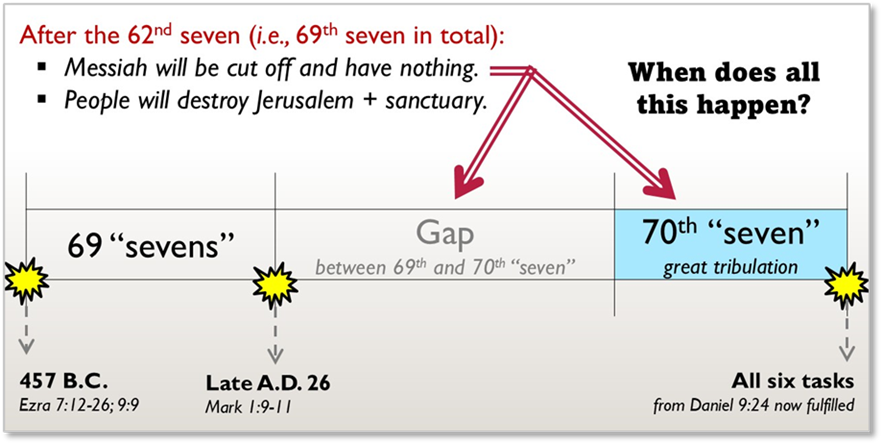
Jesus was despised, rejected, and abandoned—he had nothing. Then he was “cut off”—the Romans executed him. According to Daniel 9:26, this will occur “after the sixty-two weeks …” Remember, there are two sets of “sevens” in Daniel 9:25—(a) seven “sevens,” and then (b) 62 “sevens. The Messiah’s death happens after this second set—the 62 “sevens,” like this:

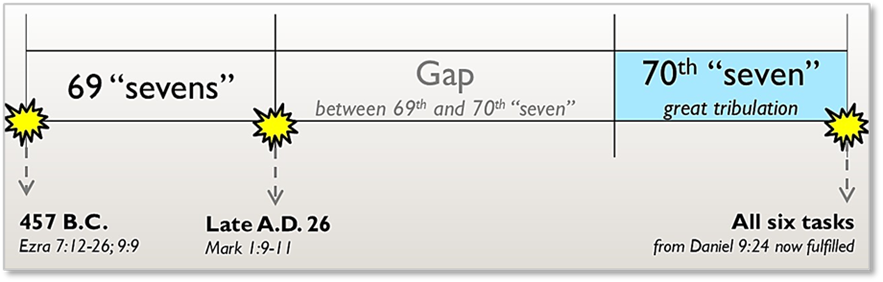
So, while the phrasing is awkward, it seems that the Messiah’s death will happen after the 62 “sevens,” which means after the 69 “sevens.[1] However, because the 70th “seven” will not begin until Daniel 9:27 (“And he will confirm a covenant with the many for one week …”) it seems there is a “gap” of time here between the 69th and 70th “seven.” If there is no gap, then the 70th “seven” happens immediately—the Messiah dies during the 70th “seven,” because it happened after the 69th “seven.

Figure 2. In which “week” does Daniel 9:26 and Messiah’s death occur?

Evidence suggests there is a gap between “weeks” 69 and 70 because of this chain of logic:

  • Because the evidence for the first 69 “sevens” suggests each “seven” is a set of seven years, we are obligated to see the 70th “seven” as also being a set of seven years.
  • Because Messiah was “cut off” after the 69th “seven,” we might assume this happened during the 70th “seven.”
  • If true, then Jesus was “cut off” at his crucifixion in ≈ A.D. 30.

But …

  • This would mean all six tasks in Daniel 9:24 (“Seventy weeks have been decreed for your people and your holy city …”) must take place within seven years of Messiah being “cut off” (A.D. 37-ish)—which must be the case if the 70th “seven” truly followed right on the heels of the 69th.

In other words, if there is no gap between the 69th and 70th seven, then …

  • Because each “seven” is seven years,
  • and the 70th “seven” begins with Jesus’ death in ≈ A.D. 30 (when he is “cut off”),
  • then the 70th “seven” would have ended in ≈ A.D. 37,
  • and so all six promises from Daniel 9:24 would have to be fulfilled by A.D. 37.

That did not happen! So, there must be a gap between the 69th and 70th “seven.” Bible-believing interpreters who do not account for this gap are left with an impossible dating problem. So, they are generally forced to take one of two options:

  • Option 1: Push the entire thing backwards and make the sinister figure at Daniel 9:27 the wicked Syrian king Antiochus Epiphanes IV, who ruled in the early 2nd century B.C. (read about him in 1 Maccabees 1).[2]
  • Option 2: Make the mysterious ruler at Daniel 9:27 be Jesus and wrap the entire prophecy up with Jesus’ ascension to heaven.

Neither of these make the best sense of a straightforward reading of the bible. The “gap” between the 69th and 70th “seven” seems to be the best solution. If true, then the 70th “seven” doesn’t begin until the events of Daniel 9:27, which is yet future. I can’t yet make a full case for the “gap theory” of the 70th “seven” until we wrestle with Daniel 9:27, and that must wait for the next article.

The mystery prince

We now turn to the second event from Daniel 9:26:

Then after the sixty-two weeks, the Messiah will be cut off and have nothing, and the people of the prince who is to come will destroy the city and the sanctuary. And its end will come with a flood; even to the end there will be war; desolations are determined (Daniel 9:26).

The word translated as “prince” means leader, ruler, or a male sovereign other thanthe ruling king (i.e., “the prince”). This means that some ruler will come along one day, whose people will destroy Jerusalem and the temple the Jewish people just re-constructed in Daniel 9:25—the tale told to us in the books of Haggai, Ezra, and Nehemiah.

Well, this makes identification pretty simple—who destroyed Jerusalem (“the city and its sanctuary”) and when did they destroy it?

Daniel says it was “the people of the prince who is to come(Dan 9:26) who will destroy Jerusalem and its sanctuary. Because the Roman army later destroyed this very city and that very temple in A.D. 70 (some ≈ 600 years after Daniel wrote this prophecy), this means our “prince” in Daniel 9:26 is somehow connected to the Roman empire—which Daniel 7 suggested will exist in three phases.[3]

  • Phase 1: The old Roman Empire under whose jurisdiction Jesus and Pontius Pilate lived (Dan 7:23).
  • Phase 2: Sometime after Jesus’ day, a splintered remnant that has divided into various pieces (the “10 horns” of the scary fourth beast, Dan 7:23-24).
  • Phase 3: A very powerful king who will arise from among the splintered bits of Phase 2 (Dan 7:24-26).

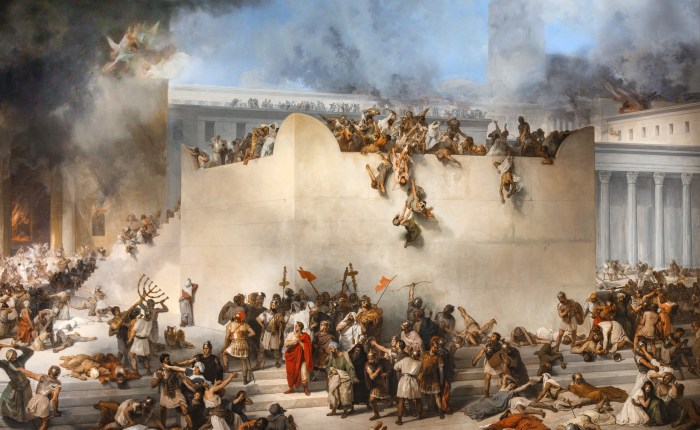
History tells that a Roman general (and later emperor) named Titus Vespasianus destroyed Jerusalem during the First Jewish War,[4] when the Roman empire was still intact in its original form (Phase 1, above). This will be a nasty finish to a brutal war. Gabriel tells Daniel: “… its end will come with a flood; even to the end there will be war; desolations are determined” (Dan 9:26). Now, on the other side of this event, we know that God brought this judgment on his people in A.D. 70 because they rejected the Messiah and Savior whom he sent to rescue them.

The Roman (and Jewish) writer Josephus tells us what happened to Jerusalem when the Romans destroyed it. He knows, because he was there that day.

There was no one left for the soldiers to kill or plunder, not a soul on which to vent their fury; for mercy would never have made them keep their hands off anyone if action was possible. So Caesar now ordered them to raze the whole City and Sanctuary to the ground … [a]ll the rest of the fortifications encircling the City were so completely leveled with the ground that no one visiting the spot would believe it had once been inhabited. This then was the end to which the mad folly of revolutionaries brought Jerusalem, a magnificent city renowned to the ends of the earth.[5]

Josephus tells of one Jewish woman named Mary, driven mad by hunger, who killed her infant son, roasted him, ate one half of him and saved the rest for later[6] (cp. Deut 28:53-57). The temple itself was destroyed by fire in a frenzy of rage by Roman legionnaires who ignored their commander’s orders.

All the prisoners taken from beginning to end of the war totalled 97,000; those who perished in the long siege 1,100,000 … No destruction ever wrought by God or man approached the wholesale carnage of this war.[7]

This must be very hard to hear and understand. We wonder what Daniel thought when he heard this news!

  • Daniel asks for assurance from God that he will set everything right (Dan 9:3-19)
  • God sends the angel Gabriel to say that he will make it right (Dan 9:20-23).
  • In fact, things will be set so right that the six-item list at Daniel 9:24 shows us paradise restored.
  • This shakes out with (a) Jerusalem being rebuilt, and then (b) Messiah the prince arriving on the scene (Dan 9:25). This will take 69 “sevens” to happen, but it’ll happen.

Everything sounds great. But then, after the 62nd “seven” (i.e., 69 “sevens” in total):

  • The Messiah will be cut off and have nothing (Dan 9:26).
  • Jerusalem and its (as yet) un-rebuilt temple will be totally destroyed (Dan 9:26)!

This is a shock. What can it mean? Why will it happen? Why this bizarre reversal? Who is this mysterious prince who is to come? At this rate, Daniel may be thinking, the glorious six-item promise list from Daniel 9:24 seems far, far away. Clearly this is a one step forward, two steps back kind of thing. What is the endgame, here?

Evidence suggests there will be a long series of events after Messiah’s arrival at his baptism at Daniel 9:25 (the end of the first 69 “sevens”), and before the 70th “seven” begins in Daniel 9:27.

  • At least one of those events will be Messiah’s seeming abandonment (“have nothing”), and his execution by Roman soldiers (“be cut off”).
  • Another event will be the destruction of the rebuilt temple and the city of Jerusalem by the people of the Roman ruler who will come on the scene (Dan 9:26)—the general Titus, who indeed razed the city in A.D. 70.
  • This “intermission” seems to best explain the “gap” between the 69th and 70th unit of seven years in the prophecy.

Nevertheless, in our next article on Daniel 9:27, the angel Gabriel tells us how God plans to make good on his six-item list of promises.


[1] John Gill: “To be reckoned from the end of the seven weeks, or 49 years, which, added to them, make 483 years” (Exposition of the Old Testament, 6:346). Stephen Miller writes: “After the reconstruction of Jerusalem in the first seven sevens (forty-nine years), another ‘sixty-two sevens’ (434 years) would pass” (Stephen R. Miller, Daniel, vol. 18, in New American Commentary (Nashville: B&H, 1994), 267).

[2] This is why Moses Stuart, an outstanding American bible scholar from the early 19th century, remarks: “The third period (one week) of course begins with the same excision of an anointed one, and continues seven years, during which a foreign prince shall come, and lay waste the city and sanctuary of Jerusalem, and cause the offerings to cease for three and a half years, after which utter destruction shall come upon him, vs. 26, 27” (Daniel, 274; emphasis added). Stuart does not consider the possibility of a gap between the 69th and 70th “seven.”

[3] Young, Daniel, 147-50. He is excellent, here.

[4] See this video for free background.

[5] Josephus, The Jewish War, trans. G.A. Williamson, rev. ed. (New York: Penguin, 1969), 7:1 (361). Chrysostom suggests, “And let not any man suppose this to have been spoken hyperbolically; but let him study the writings of Josephus, and learn the truth of the sayings. For neither can any one say, that the man being a believer, in order to establish Christ’s words, hath exaggerated the tragical history,” (“Homily 76,” in NPNF 1.10, 457).

[6] Josephus, The Jewish War, 6:199-219 (341-342). 

[7] Josephus, The Jewish War, 6:420f. See ch(s). 13-21 (i.e., 3:422 – 6:429).

Understanding Daniel’s 70 “Weeks” Prophecy (pt. 1)

Understanding Daniel’s 70 “Weeks” Prophecy (pt. 1)

This is the first of three articles about the great prophecy in Daniel 9:24-27. This prophecy is very complicated and very important. One writer called it “the key to prophetic revelation.”[1] Many good Christians disagree about how to interpret it. This bible study will not exhaustively defend its interpretation at every point against all comers. Instead, it makes a positive case for its own position and seeks to be straightforward and understandable to ordinary people.

This bible study takes a literal, futurist view[2]—meaning (a) we should interpret the passage according to the natural, ordinary manner of language in proper context (e.g., poetry is poetry, narrative is narrative, figurative language is figurative, etc.), and (b) its fulfillment lies in the future—not the past.

Prayer answered (Daniel 9:1-23)

This prophecy happens because Daniel prays to God for help. This is a beautiful prayer. Christians should study it. But it isn’t our focus here, so we won’t stay here for long.

The Babylonians conquered the southern kingdom of Judah in 586 B.C., after a lengthy period of national and spiritual decline. The Babylonians took many Jewish people far away to the east (2 Kgs 25:11). Daniel was one of them. But that was a long time ago. He’s now an old man. He’s spent his best years as a civil servant in the Babylonian and Persian bureaucracies, trapped in an exile he doesn’t want. Daniel knows God swore that he would punish Israel for 70 years before he brings his people back to the promised land (Jer 25:11-12; 29:10). These 70 years have just about come and gone.

… I, Daniel, observed in the books the number of the years which was revealed as the word of the LORD to Jeremiah the prophet for the completion of the desolations of Jerusalem, namely, seventy years. So I gave my attention to the Lord God, to seek Him by prayer and pleading, with fasting, sackcloth, and ashes (Daniel 9:2-3).

The angel Gabriel arrives on the scene with God’s reply: “so pay attention to the message and gain understanding of the vision” (Dan 9:23). This bit is especially important—Gabriel is answering Daniel’s question about when God will bringIsrael back to the promised land. Daniel wants to know when God will make good on his “70 years promise.” He begs God: “for Your sake, Lord, let Your face shine on Your desolate sanctuary …” (Dan 9:17).

Well, Gabriel has come with God’s answer. This brings us to the famous prophecy. It summarizes the entire scope of living history–the sum of God’s plan to set everything right that’s wrong in this world.

The sum of the whole thing (Daniel 9:24)

Gabriel says:

Seventy weeks have been decreed for your people and your holy city, to finish the wrongdoing, to make an end of sin, to make atonement for guilt, to bring in everlasting righteousness, to seal up vision and prophecy, and to anoint the Most Holy Place (Daniel 9:24).

The most obvious question is about these seventy “weeks.” What does this mean?

It’s complicated.

We won’t get there until the next section—sorry! But, for now I’ll say that the word means “sevens,” which is a vague time indicator. Its meaning depends on what’s happening in the passage. Your bible may translate it as “weeks” to help you out, but that’s not necessarily the most helpful gloss.

Whatever these 70 “sevens” are—and we’ll figure that out soon enough—clearly God will accomplish a bunch of things by the time they’re fulfilled. There are three bad things that God will fix, and three good things that will happen. Gabriel says these events are directed towards “your people and your holy city” (Dan 9:24).

Sometimes, God speaks directly to certain people, while at the same time speaking also to other people far in the future—sometimes in a deeper and more meaningful way. We usually only see this in light of revelation that comes later in the bible’s story. For example:

  1. God told his rebellious people he would spare them from the poisonous serpents if they looked upon the image of a bronze serpent on a pole and truly believed this act would rescue them (Num 21:4-9). So far, so simple.
  2. But, in a deeper way, this command foreshadowed that God’s people will be spared from the poisonous serpent—“the serpent of old who is called the devil and Satan” (Rev 12:9)—if they “looked upon” Jesus on his cross and truly believed this would rescue them (Jn 3:14-15).

Some of that is going on here. Yes, Gabriel speaks of the Jewish people (“your people and your holy city,” Dan 9:24), but the true reference is bigger than that.[3] Anyone who trusts in Jesus as his savior is a child of Abraham and an heir according to that covenant promise (Gal 3:26-29). After all, considering the bible’s whole story, God’s holy city is called the “new Jerusalem” (Rev 21:2; cp. Rev 21:1-4).

First, Gabriel lists three bad things that God will fix by the end of these 70 “sevens.”

  1. God will “finish[4] the transgression.” Rebellion and transgression will end. The only time in history that rebellion against God will stop is in the new paradise to come—in the better tomorrow: “there will no longer be any curse” (Rev 22:3).
  2. He will “make an end of sin.” Again, the only time in human history when God’s people will never sin is the eternity in paradise, where “the first things have passed away” (Rev 21:4).
  3. There will be made an “atonement for guilt.” In the old covenant, God did provide a way for believers to receive atonement (see Lev 4:27-31). In Leviticus 4:31, the bible says: “So the priest shall make atonement for him, and he will be forgiven.” But Christ’s atonement is different and better. According to Hebrews 10:2, the old covenant sacrifices “can never, by the same sacrifices which they offer continually every year, make those who approach perfect.” This is why Christ is the better priest, who gives his people a better reconciliation: “For by one offering He has perfected for all time those who are sanctified” (Heb 10:14).

Next, Gabriel tells us three good things God will accomplish by the end of these 70 “sevens.”

  1. He will “bring in everlasting righteousness.” This is a righteousness that will never end. The only time when everlasting righteousness will be here on the earth is in the new tomorrow, in paradise (see Rev 22:1-4).
  2. God will “seal up vision and prophecy.” This most likely means there will no longer be any need for God to speak to his people by way of visions or prophecy, because he will reveal himself to us all personally—like he did with Adam and Eve in the garden of Eden (Gen 3:8). This is when “the tabernacle of God is among the people, and He will dwell among them, and they shall be His people, and God Himself will be among them …” (Rev 21:3). 
  3. He will “anoint the Most Holy Place.” This is the satisfaction Jesus makes to God because of our sins and crimes–the personal and legal reconciliation that sets us right with him.

There are two ways to understand what “anoint a most holy” means.

  • The phrase means “holy of holies” or “a very holy thing/place/person.”
  • We’re tempted to think “holy of holies = inner chamber of the temple,” but this is not necessarily correct. The phrase just means “a really, really holy thing.” The context must tell you what this “very holy thing” is in this passage—a person (Jesus Christ) or a place (the Millennial temple)?

Because the passage is about everything wrong in this world being finally fixed at the end of the age, Gabriel is likely referring to Jesus here[5]—God will anoint a most holy person as king at his resurrection and ascension (Acts 13:22-23; cp. Ps 2:6-7). Further, in light of the bible’s whole story, Jesus literally is the new and better temple.

  • In Matthew 12:6, Jesus said that, in himself, something greater than the temple was here.
  • The apostle John says in his vision of the new Jerusalem that he sees no temple, “for the Lord God the Almighty and the Lamb are its temple” (Rev 22:22).
  • The psalmist gives us a prophecy of a king God will enthrone over creation: “I have installed My King Upon Zion, My holy mountain” (Ps 2:6). The apostle Paul explains that this passage refers to Jesus at his resurrection and ascension back to heaven (read Acts 13:32-33).

But some faithful Christian interpreters believe these six events refer to the new covenant era—to the time after Jesus’ ascension when the new covenant has launched. They say this isn’t about the last things at all—it’s all in effect right now. They believe this “everlasting righteousness” is about the righteousness from God (Rom 1:17) which he now offers to everyone who believes in Jesus.[6] To “finish the wrongdoing” and “make an end of sin” refers to Christ’s atonement for his people, etc.[7]

This is probably not right—there is surely no everlasting righteousness in our hearts, in our minds, or in this world. This world is awash in sin and temptation—the apostle Paul calls it “this present evil age” (Gal 1:4). This suggests the six great events are not yet fully accomplished. Believers (and this world) await the experiential transformation to match the legal pardon we already have (Rom 8:18-25).

So, it seems better to interpret these six momentous events as fulfilled when Jesus returns here from heaven to establish his kingdom—the “second coming.” Together, they tell us that God will fix everything that’s wrong in this world. No more transgressions, no more sin, a perfect atonement that brings personal and legal reconciliation with God, everlasting righteousness on earth as it is in heaven, no more need for vision and prophecy because all God’s people will see him as he is, and Christ anointed and ruling as king over his creation.

That’s why this prophecy matters.

How does all this good stuff shake out? We turn to that in Daniel 9:25-27, in our next two articles.


[1] John Walvoord, Daniel: The Key to Prophetic Revelation (Chicago: Moody, 1971; reprint, 1989).

[2] A free, scholarly resource that sketches my viewpoint is from Stephen R. Miller, “Interpreting Daniel’s Seventy Weeks: Dismal Swamp or Blessed Hope?” Available here.

[3] “… for all the people of God; who also were Daniel’s people and city in a spiritual sense, to which he belonged” (John Gill, An Exposition of the Old Testament, vol. 6 (London: Mathews and Leigh, 1810), 343).

[4] A very few English translations and commentators believe the phrase should be translated “restraining the transgression” (ISV translation and Edward J. Young, The Prophecy of Daniel (Grand Rapids: Eerdmans, 1949), 198). But this is almost surely incorrect.

[5] One more strike against this “very holy thing” being the Millennial Temple is that Gabriel calls the temple “the holy place” (וְהַקֹּ֜דֶשׁ) at Dan 9:26, in contrast to the more generic phrase “a most holy thing” (קֹ֥דֶשׁ קָֽדָשִֽׁים) at Dan 9:24. H.C. Leupold is especially good here (Exposition of Daniel (Colombus: Wartburg: 1949; reprint; Grand Rapids: Baker, 1969), 416), as is Young (Daniel, 201). 

[6] “This righteousness, or the Messiah who accomplishes it, was the treasure above all treasures that was most eagerly longed for by the Old Testament saints” (Leupold, Daniel, 414).

[7]  Gill, Exposition of the Old Testament, 6:344.