Why Good Christians Disagree About Israel’s Future

Why Good Christians Disagree About Israel’s Future

Good Christians disagree about whether the people of Israel have a future in God’s plan because they have very different ways of understanding the bible’s “big story.” Many Christians believe the people of Israel are important to the bible’s story. But not all of them know why, other than to correctly declare “Israel is special” or “they’re God’s chosen people.” These are incomplete answers.

There are at least two reasons why we believe the people of Israel are a key part of the bible’s “big story.”

  • To be a blessing. Israel is special because God plans to use her as a vehicle to preach the gospel to the world during Jesus’ 1,000-year millennial reign. It is during the millennium that God fulfills his three big covenant promises to Abraham (Gen 12:1-3)—a great nation, in a land of their own, being a blessing to the world by spreading the gospel about King Jesus. These covenant promises are about “a geographical platform, a land of promise, to serve as a base of operations for God’s kingdom program on earth.”[1]
  • Millennium as a microcosm of paradise. Israel is not an end in and of itself. The millennium is a microcosm or prototype of what the Lord will do in paradise in eternity[2]—sort of the “spring training” version of the new creation paradise to come. This millennium will feature a great nation of believers, in a new and perfect land, with Jesus (“the son of Abraham,” Mt 1:1) as the penultimate Abrahamic blessing to the world.

But other Christians disagree. They believe there will be no millennium, and a very different fulfillment of those three “big promises” to Abraham. They believe Israel no longer has a unique role to play in reconciling the world to King Jesus. So, rather than seeing the great nation + land + be a blessing promises as means God will use to reach the world for the Messiah, they see them as shadows pointing to the greater realities which Christ makes real, both now and in paradise. Although these good Christians arrive at the same place—Jesus will return to punish the wicked, reward the righteous, and usher in eternity—they take a very different route to get there.

Many Christians believe the New Testament sheds new light on God’s covenant promises. They say this so-called “new light” changes what these promises mean in a way the original audience wouldn’t have understood, and in a way that violates the normal sense of the words God used to make those promises. They believe the bible does this by one thing foreshadowing another—which  is when one thing points to another thing bigger than itself (this is also called “typology”).

  • For example, Adam (our first representative), Moses (the great prophet), and David (the king of Israel) each foreshadow Jesus in complementary ways.
  • The tabernacle is a figure of the real throne room in heaven.
  • Christ also fulfills larger old covenant events in scripture which the prophets heralded; the old Eden v. the new Eden, fall v. atonement; Exodus from Egypt v. exodus from Satan’s grasp, etc.[3]

This is a real thing in scripture. But is it a real thing when it comes to God’s covenant promises? Many Christians wrongly say it is.

  • Their argument is the big three covenant promises to Abraham (a great nation + in a land of their own + to be a blessing to the world; Gen 12:2-3) are signposts which point to a larger fulfillment.[4]
  • So, they say, God does not replace Israel. Instead, Christ fulfills her promises in a larger way.

So, these Christians interpret in a non-literal way old covenant passages that we believe plainly mean more than that. Many do this because they believe the bible’s whole story is all about God’s alleged “covenant of grace” with those chosen for salvation.[5] “In the New Testament all these types reach their fulfilment and therefore cease.”[6]

  • It’s true that God has a big plan to provide salvation to sinners through faith in Christ.
  • But it isn’t true that this means the bible’s “big story” is basically about you and your personal salvation. This viewpoint interprets everything through the lens of the gospel (Jesus’ life and death),[7] when the real “big story” is the new creation paradise God has been bringing about since Genesis 3:15. Yes, Jesus essentially defeats Satan on Easter morning, but the war is not over until Revelation 22.
  • This would be like interpreting the Allied victory in Europe during World War 2 entirely from the standpoint of D-Day on 06 Jun 1944. This would be a flattening of reality. Yes, D-Day was a triumph for the Allied cause that spelled the end for Nazi Germany, but the war in Europe didn’t end for another 10 months!
  • This popular and helpful (but incomplete) “gospel-centered” lens can lead to a tunnel-vision way of reading the bible that has the New Testament flattening many Old Testament covenant promises to fit the “Jesus and individual salvation” mold.

This is why many good Christians wrongly flatten and distort God’s covenant promises to mean only this:

  • Great nation = God’s people, whoever they are (1 Pet 1:9-10)
  • The land of Canaan = Paradise in eternity (Rev 21-22)
  • Israel will be a blessing = Christ will be a blessing (“son of Abraham,” Mt 1:1)
  • King over Israel in Canaan = Jesus over his people in paradise (Rev 21-22)

We agree that, by time we get to Revelation 21-22, all this is true—the endgame truly is paradise regained, in a new creation, with one body of believers in Christ consisting of two peoples: Israel and the church (see Rev 21:10-14).

And yet … suppose you describe the plot of the 1997 movie Titanic as being “a love story on a ship.” This is true, but very incomplete—you’ve flattened the story into a pancake. This makes Titanic= an episode of The Love Boat. What if you described Harry Potter and the Sorcerer’s Stone as “a wizard kid goes to boarding school”? Or the book of Revelation as “Jesus wins”? These are all true, but really simplistic—so crude they’re wrong even though they’re technically right!

This is why the true disagreement is about the way we think the bible’s “big story” plays out. We believe God made those “big three” promises to Abraham because he determined that Israel will play a key role in reconciling people from all over the world to Jesus, and she will do this during the 1,000-year millennium. During that time, she will be a great nation, in the land of Canaan, being a blessing to the world by spreading the good news about Jesus the King. Here is one example passage from the prophet Micah that speaks of these events:

And it will come about in the last days That the mountain of the house of the LORD Will be established as the chief of the mountains. It will be raised above the hills, And the peoples will stream to it. Many nations will come and say, “Come and let’s go up to the mountain of the LORD And to the house of the God of Jacob, So that He may teach us about His ways, And that we may walk in His paths.” For from Zion will go forth the law, And the word of the LORD from Jerusalem (Micah 4:1-2).

On our interpretation, Jesus’ millennial reign is a lengthy transition period between this present, evil age (Gal 1:4) and paradise to come. That is the disagreement about the big picture.[8] This is why good Christians often talk past one another about the end-times. The other side believes the New Testament, and the apostle Paul in particular,[9] provides new understanding of these old covenant promises, and so their shape of the bible’s “big story” does not include a future mission for the people of Israel, so they see no need for a millennium.

Again, all good Christians have the same finish line: Jesus returns, punishes the wicked, and rewards the righteous. But we have very different ideas about how the big story of the bible gets to the finish line.

In the next article, we’ll discuss how to rightly understand the bible’s “big story.”


[1] Michael Vlach, The Bible Storyline (Cary: Theological Studies Press, 2025), 101.

[2] Eugene Merrill, “A Theology of the Pentateuch,” in A Biblical Theology of the Old Testament, ed. Roy B. Zuck (Chicago: Moody, 1991), 27.

[3] See esp. Graeme Goldsworthy, Gospel-Centered Hermeneutics (Downers Grove: IVP, 2006), 58-66; 245-57. The chart at pp. 253-56 is especially excellent.

[4] “These temporal blessings did not constitute an end in themselves, but served to symbolize and typify spiritual and heavenly things” (Berkhof, Systematic, 296).

[5] Berkhof argues that the second party to the so-called “covenant of grace” are the elect in Christ (Systematic, 272-76).

[6] Berkhof, Systematic, 293.

[7][T]he gospel is the hermeneutical norm for all of reality … For the student of the Bible, the gospel becomes the norm by which the whole Old Testament and all the exhortations and other non-gospel aspects of the New Testament are to be understood” (Goldsworthy, Gospel-Centered, 63; emphasis in original).

[8] “The basic issue is the way we understand the historical plan and the goal of that plan through which God will bring eternal glory to himself” (Saucy, Progressive Dispensationalism, 19).

[9] “The best Scriptural exposition of the Abrahamic covenant is contained in Rom. 3 and 4, and Gal. 3” (Berkhof, Systematic, 295-96).

Understanding Daniel’s 70 “Weeks” Prophecy (pt. 5)

Understanding Daniel’s 70 “Weeks” Prophecy (pt. 5)

We continue our look at the great prophecy of Daniel 9:24-27. Read the rest of the series.

This prophecy wraps up here, in the last bit of Daniel 9:27. It is the antichrist will make a covenant. He is the one to whom Titus Vespasianus—the conqueror and destroyed of Jerusalem in A.D. 70—pointed in Daniel 9:26 (“the people of the prince who is to come”). With whom will antichrist make this covenant and for how long? How does this prophecy end, in light of other scripture passages?

The covenant—with whom and for how long?

Gabriel tells Daniel:

And he will confirm a covenant with the many for one week, but in the middle of the week he will put a stop to sacrifice and grain offering; and on the wing of abominations will come the one who makes desolate, until a complete destruction, one that is decreed, gushes forth on the one who makes desolate (Daniel 9:27).

Who are “the many” with whom this evil ruler will make this covenant? Gabriel does not explain who the “many” are. If you believe the “he” in Daniel 9:27 is Jesus, then “the many” would be believers—members of the new covenant in Christ’s blood. But we’ve seen that this isn’t the best interpretation, so we’ll leave that aside and instead assume the antichrist makes a covenant with … someone. There are two good options:

  • Option 1: Because Gabriel told us at the beginning that this prophecy was “for your people and your holy city” (Dan 9:24), we might assume the “many” here are the people of Israel—the nation.[1]
  • Option 2: However, another option is that the “many” with whom Antichrist makes a covenant are his followers—that is, the unsaved people who desire (either because of terror or by demonic conviction) to ally themselves to antichrist in a crude imitation of Jesus’ coming kingdom.[2]

Three factors tip the scales in favor of Option 1:

  • The angel Gabriel said this prophecy was “for your people and your holy city” (Dan 9:24). This suggests the Israeli people are the focus of the prophecy.
  • The antichrist’s actions in Daniel 9:27 seem to be against the people with whom he made a covenant—they are the ones against whom he moves “in the middle of the week.” It makes little sense for the Antichrist to attack and persecute the people who are already on his side.
  • Other passages very strongly suggest there will be a period of approximately seven years during which antichrist specifically persecutes Israel (Rev 11, 13). The Book of Revelation paints these events in a dramatically figurative manner with a strong Jewish flavor (see Rev 11:1-8).

So, it seems better to understand the antichrist as making some kind of covenant with the nation of Israel. We do not know what this covenant will be about—whether it will be voluntary or coerced. The covenant may not be voluntary—the word can give the sense of the evil ruler forcing it on the basis of superior strength.[3]

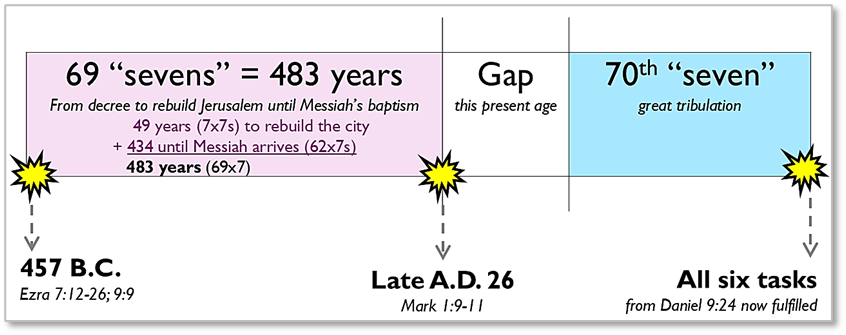
Because we already learned that each “seven” = a unit of seven years, and that the first 69 “sevens” work when interpreted this way, it’s reasonable to believe this 70th “seven” is also one unit of seven years. Remember, this 70th “seven” is the last event in Gabriel’s timeline.

The scriptures often give hints of a terrible calamity during the last days, lasting for approximately seven years.

  • Revelation 11:1-13 speaks of two special, powerful witnesses for Jesus who go about Jerusalem for 1,260 days or 42 months (≈ 3.5 years), preaching and doing miracles, before a ferocious, sinister, and evil creature kills them both—the Antichrist, empowered by a “dragon” who represents Satan.
  • This antichrist/beast figure then rules in a cruel and evil manner for 42 months (≈ 3.5 years; Rev 13:1-10).
  • Combined, this is a total of ≈ seven years, which Daniel hints is characterized by (a) one half (3.5 years) of relative peace but impending danger, and then (b) 3.5 years of abject evil.

In Daniel 9:27, in the midst or middle of this covenant that lasts seven years, we learn “he will put a stop to sacrifice and grain offering.” On face value, this makes no sense—unless there is a temple (complete with a re-launched, old covenant sacrificial system) in Jerusalem at which the antichrist can put a stop to this. Many Christians in America believe it must mean this.[4] If so, there must first occur a series of events so cataclysmic that they seem implausible today:

  1. The modern state of Israel must completely change its character and become a Jewish nationalist state. This would be a big deal. Modern Israel is a very secular country.
  2. Israel must expel all Muslim structures and worshippers from the historical site of the temple in Jerusalem. This is almost too fantastic to believe—it would have to be a miracle.
  3. Israel must have sufficient military and economic resources to pull this off in the face of determined opposition—many, many, many political stars would have to align.

With God, all things are possible. God can do this if he wishes. Many Christians believe he will—this is why so many bible teachers watch Israel and Middle East politics very closely. Unfortunately, some of these teachers make absurd speculations and are poor ambassadors for their position—and for Christianity.[5] But Daniel does not necessarily mean there will be another temple operating in Jerusalem, complete with a restoration of the sacrificial system. It may only mean that worship in general is abolished and, on that interpretation, Gabriel explains this using old covenant language.[6]

Regardless—the antichrist will forcibly stop believers from worshipping the one true God.

How does the prophecy end?

The antichrist will then do two things:

  • “On the wing of abominations will come the one who makes desolate.” This probably uses the figure of an over-spreading shadow of darkness and evil (the “wing of abominations”) filling the land. This antichrist makes Jerusalem “desolate” because he has outlawed all worship of the true God—it is now an empty shell. The apostle Paul tells us the antichrist “opposes and exalts himself above every so-called god or object of worship, so that he takes his seat in the temple of God, displaying himself as being God” (2 Thess 2:4).
  • Daniel continues: “… until a complete destruction, one that is decreed, gushes forth on the one who makes desolate.” This darkness will spread across the world until the antichrist is suddenly destroyed.

This tells us that antichrist will be completely destroyed, in accordance with a decision God made long ago. In Revelation 19:20, we learn that when Jesus returns: “… the beast was seized, and with him the false prophet who performed the signs in his presence, by which he deceived those who had received the mark of the beast and those who worshiped his image; these two were thrown alive into the lake of fire, which burns with brimstone.”

Now, once Messiah returns (i.e., “the second coming”) and casts antichrist and the false prophet into the lake of fire and locks Satan away in the abyss (Rev 20:1-4), righteousness will reign and all the promises of Daniel 9:24 will come true. The 70 “sevens” end with Christ inaugurating his 1,000-year kingdom reign on earth.

  • Immediately after this millennium (“When the thousand years are completed …” Rev 20:7), Satan will be released from prison and lead a rebellion against Jesus’ kingdom, at which point God will vaporize this wicked host with a fireball from on high (Rev 20:7-10).
  • Some may protest that, because Satan will quickly find folks to join his rebellion at the end of Christ’s millennial reign, the everlasting righteousness (etc.) Gabriel promised in Daniel 9:24 could not arrived at the beginning of the millennial kingdom.
  • But this need not follow—Satan’s rebellion is put down so swiftly and so decisively that sin and wickedness will not reign or have any impact on the world. God smacks this last gasp rebellion down immediately.

So, we are left with antichrist destroyed. Other important passages tell us this happens when Jesus returns, and at that time “THE RIGHTEOUS WILL SHINE FORTH LIKE THE SUN in the kingdom of their Father” (Mt 13:43) and there will be peace on earth. The six-item list from Daniel 9:24 will be accomplished, and the Messianic reign will begin.


[1] Barnes declares “[t]here is nothing in the word here which would indicate who they were …” (“Daniel,” 182, emphasis in original), but he surely forgets that Gabriel told Daniel (9:24) the emphasis of the prophecy was the people of Israel.

[2] See, for example, H.C. Leupold, Exposition of Daniel (Columbus: Wartburg, 1949; reprint; Grand Rapids: Baker, 1969), 431-32).

[3] Joyce Baldwin, Daniel (Downers Grove: IVP, 1978), 191. “Therefore the thought is this: That ungodly prince shall impose on the mass of the people a strong covenant that they should follow him and give themselves to him as their God” (Keil and Delitzsch, Commentary, 9:736).

[4] Walvoord, Daniel, 235.

[5] Michael Svigel, a dispensationalist scholar, writes: “For some reason, the study of eschatology tends to attract a disproportionate number of—let me be blunt—hacks and quacks. End-times hacks produce mediocre, uninformed, trite work for the purpose of self-promotion or money. They ride the end-times circuits tickling ears with sensationalistic narratives, usually resting their interpretations of Scripture on current events or far-fetched conspiracy theories. Or they flood the market with cheap paperback books with red, orange, yellow, and black covers, usually repeating the same worn-out words they used in previous editions of their end-times yarns—sometimes with updates to fit their interpretations with the latest current events. Many of these hacks can be classified as end-times quacks” (The Fathers on the Future: A 2nd-Century Eschatology for the 21st-Century Church (Peabody: Hendrickson, 2024), 24).

[6] Stephen Miller, Daniel, in NAC, vol. 18 (Nashville: B&H, 1994), 272. Leupold suggests that “all organized religion and worship as offered by the church of the Lord are to be overthrown when this prince has his day” (433).

Understanding Daniel’s 70 “Weeks” Prophecy (pt. 4)

Understanding Daniel’s 70 “Weeks” Prophecy (pt. 4)

We continue our look at the great prophecy of Daniel 9:24-27. Read the rest of the series.

We come now to the last verse of Daniel’s great prophecy. This has been a long journey. If it makes you feel better, many good teachers have struggled to rightly understand this passage. The most insane discussion of which I’m aware is from a British pastor named Andrew Willett in 1622—he devoted 96 pages to answering 89 questions about the mysterious 70 “sevens”![1]  

In Daniel 9:27, there are three key questions to consider:

  1. Who is the mysterious “he” in Daniel 9:27?
  2. With whom and for how long does this guy make a covenant?
  3. How does the prophecy end?

We’ll discuss each, in turn, to wrap up this series. This article answers the first question

Who is the mysterious guy?

The bible says:

And he will confirm a covenant with the many for one week, but in the middle of the week he will put a stop to sacrifice and grain offering; and on the wing of abominations will come the one who makes desolate, until a complete destruction, one that is decreed, gushes forth on the one who makes desolate (Daniel 9:27).

We need to figure out who this person is who will “confirm a covenant with the many for one week.” Because Gabriel doesn’t use a name in Daniel 9:27 but just says “he will put a stop …,” we must look back and identify the last notable person Gabriel mentioned in Daniel 9:26. Who is it?

It is “the people of the prince who is to come” whom Gabriel last mentioned. The guy mentioned in our verse here in Daniel 9:27 doesn’t seem very friendly. He (a) confirms a covenant of some sort for one “seven” or “week” (the 70th in this vision), and (b) he stops the sacrifices and grain offering, (c) he ushers in some sinister abomination that destroys or desecrates, and eventually (d) he himself is destroyed.

So, who is this strange man who does all this? Many good bible teachers have suggested many options. We’ll focus on three common possibilities, one of which we can dismiss immediately:

  • Option 1: The man in Daniel 9:27 is the Roman general Titus Vespasianus, whom we met in Daniel 9:26, who will destroy the temple and Jerusalem in 70 A.D. Daniel 9:27, the argument goes, is still about what happened in 70 A.D. at the end of the First Jewish War.[2]
  • Option 2: The guy is Jesus.
  • Option 3: The antichrist—the evil ruler who is to come (2 Thess 2; Rev 13).

We can dismiss Option 1 straightaway—the six-item summary of the entire prophecy at Daniel 9:24 ends with paradise regained. But Option 1 leaves us stranded at halftime with no resolution, no eternal righteousness, no removal of sin, no closure. This option is wrong.

Option 2 is more interesting. This is how the argument goes:

  • Jesus establishes or (some say) re-affirms the covenant with his church—that is, the new covenant that the prophets said would one day arrive (Ezek 36:25; Jer 31). He would establish “true religion.”[3]
  • So, they assume, Jesus “put a stop to sacrifice and grain offering” in the sense that he made the old covenant sacrifices obsolete (Heb 8:1-13; Mt 27:51).
  • And, following on from that great event, they believe the “abominations” are the manner in which the Roman armies profaned the temple sanctuary by destroying it.

Further, these same Christians also believe the “he” in Daniel 9:27 cannot be the antichrist because:

  • It is the “people of the prince who is to come” in Daniel 9:26 who will destroy the temple and its sanctuary—an event we now know happened in 70 A.D.
  • In Daniel’s day this was all in the future. The people who did this (the Romans) belonged to a particular prince or leader (the Hebrew word can mean either one). And, that leader was the Roman general Titus Vespasianus.
  • So, that whole discussion was over by the end of Daniel 9:26—that verse spoke about Titus Vespasianus, and that subject is finished.
  • So, Daniel 9:27 must be about a different guy—a guy like Jesus the Messiah.

But this is not best way to understand the passage.[4] Option 3 is the way. There are a few good reasons why:

  • First, the guy at Daniel 9:27 seems very unfriendly.
  • Second, the length of this 70th “seven” ought to match those of the other 69 “sevens.”
  • Third, the last guy Gabriel mentioned was the coming leader whose people will destroy the temple (Dan 9:26)— the Roman general Titus Vespasianus foreshadows the antichrist to come.

The two emphases are very different. The NASB (et al) sees this leader take a dark turn sometime after he confirms the covenant. The ESV (et al) just sees another event following it. There is no “right way” to render the conjunction—context must decide. But, it’s enough for you to know that many solid bible translations understand Daniel 9:27 to be describing something very bad.

Second, the length of this 70th “seven” ought to match those of the other 69 “sevens.”

  • If this last and 70th “seven” is only a symbolic number, then why does God specifically say this person will abolish the sacrificial system in the middle of the week? It is difficult to understand why God would give specifics if the time-period is symbolic.
  • Christians who take this approach really struggle to make this last “seven” make any consistent sense. One bible teacher admitted this was “the most embarrassing portion of the prophecy” because he could not find a good solution.[5]
  • There are no crazed beasts (Dan 2, 7), flying scrolls, women in pots, or storks carrying a wicked woman off to the far East here (Zech 5) that suggest this passage is figurative language. When we see that stuff elsewhere, we know it isn’t painting reality in “normal” hues. But that isn’t happening here—this is normal language. This suggests we ought to understand the language in a normal, straightforward way.
  • Also, we ought to interpret the “sevens” consistently throughout this passage. We’ve already seen that the interpretation that understands “one seven = one set of seven years” makes the best sense of the evidence. So, this “70th seven” ought also to be understood as a period of seven years. This suggests the evil leader (the antichrist) will establish a covenant that lasts seven years (i.e., the 70th “seven”).
  • John Gill, the great Baptist pastor, agreed. It cannot be the Messiah at Daniel 9:27, he argued, “for this is not for one week only, but for ever.”[6] Messiah rules forever, not for one “seven” only!

Third, the last guy Gabriel mentioned was the coming evil ruler whose people will destroy the temple (Dan 9:26), so the antichrist sounds like our guy.

  • The way language works is that we identify unnamed people, like the mysterious “he” in Daniel 9:27, by two methods: (a) identifying the most recent name just mentioned, or (b) looking back at the most prominent name featured in the paragraph or text cluster which came immediately before.
  • In this case, the most recent and prominent person is the “prince who is to come” whose people destroy Jerusalem and its sanctuary (Dan 9:26). This suggests the mysterious “he” is the Antichrist.[7]
  • There are clear bible passages that tell us that a sinister, dark figure will emerge in the last days who will demand divine worship and persecute God’s people.[8] This man of lawlessness will only be destroyed when Jesus returns (see 2 Thess 2; Rev 13; cp. Mt 24:15-31, 1 Thess 4:13-17). Because we know to expect this evil man, it makes sense to see him foretold in our passage here—this is why Jesus explicitly references Daniel 9:27 (in Mt 24:15) and tells us to pay close attention to this very prophecy!

As I mentioned, some bible teachers object that “the prince/leader” in Daniel 9:26 is clearly Titus, so it cannot be the antichrist.[9] True, the most obvious historical referent is the Roman general Titus Vespasianus in 70 A.D., but it’s reasonable to believe he just foreshadows the true evil kingdom that will come in the last days. The prophecy of the crazed, fearsome beast in Daniel 7 suggests the fourth great pagan kingdom in God’s timetable, that of “Rome,” will exist in three phases.[10]

  • Phase 1: The old Roman Empire under whose jurisdiction Jesus and Pontius Pilate lived (Dan 7:23).
  • Phase 2: Sometime after Jesus’ day, a splintered remnant that has divided into various pieces (the “10 horns” of the scary fourth beast, Dan 7:23-24).
  • Phase 3: A powerful king who will arise from among the splintered bits of Phase 2 (Dan 7:24-26).

It is this third phase which the antichrist represents. Jesus himself, in Matthew 24:15-28, seems to shade two calamitous events—the destruction of the city and temple in 70 A.D. and the antichrist’s reign of terror during the last days—together in the telling. Trustworthy bible scholars and teachers of every stripe recognize this—just look at any study bible you have lying about and see for yourself! Just as David’s life and standing is a shadowy reflection that points to Jesus, so too does Titus point to the antichrist in this sense.

If true, then (a) Titus does not exhaust the meaning of “the prince/leader who is to come” at Daniel 9:26, and (b) antichrist is just as much a leader of “Rome” as Titus—he just operates in a different phase of that pagan kingdom.

We tackle the remaining two questions about Daniel 9:27 in our next (and final) article.


[1] Andrew Willett, Hexapla in Danielem (Cambridge: Legge, 1622),264-360.

[2] This is John Gill’s argument (Exposition of the Old Testament, 6:346-47), and that of Matthew Henry, Matthew Henry’s Commentary, 6 vols. (reprint; New York: Revell, n.d.), 1094-95.

[3] Albert Barnes, “Daniel,” in Barnes’ Notes, vol. 7 (reprint; Grand Rapids: Baker, 1998), 182.

[4] “Ultimately, the question facing every expositor is what interpretation gives the most natural and intelligent exposition of the text” (John Walvoord, Daniel: The Key to Prophetic Revelation (Chicago: Moody, 1971; reprint, 1989), 234).

[5] Barnes, “Daniel,” 183. In desperation, Barnes suggests this last “seven” consists of (a) Jesus’ ≈ 3.5-year ministry, and (b) the apostle’s ministry of “about” 3.5 years (183-85). This is absurd. Does this mean that the new covenant ended 3.5 years after Jesus’ death!?

[6] Gill, Exposition of the Old Testament, 6:346 (emphasis added). I admit that Gill disagrees with my larger position, but everyone disagrees with everyone about how to interpret Daniel!

[7] Edward Young argues mightily that the true antecedent is not the prince but the people, because they are foremost in Gabriel’s mind as he relates the prophecy. This is not taken seriously by any commentator I’ve read, but it is the best attempt I’ve seen to evade the obvious in this passage and it is rhetorically persuasive.

[8] Irenaeus, Against Heresies, 5.25.

[9] Young, Daniel, 208-13. His is the best argument of which I’m aware for the “he = Christ” perspective in Daniel 9:27.

[10] Young, Daniel, 147-50. He is excellent, here.