After producing five articles and four teaching videos (see below), I’ll just summarize what on earth the angel Gabriel was talking about when he gave Daniel his infamous “70 weeks” prophecy in Daniel 9:24-27. I won’t defend this summary here (that’s why I wrote individual articles about each verse–again, see below). Instead, I’ll just state what each verse means and leave y’all to read each article and/or view the accompanying video if you want more details.
A message from God (via the angel Gabriel) to Daniel in answer to his question about when God will bring the people of Israel back to the promised land and restore the kingdom. In this verse, Gabriel gives Daniel a short summary statement, describing six great things God will accomplish by the end of 70 “sevens,” which some English bibles translate as “weeks.” By the end of this period, God will have brought an end to wrongdoing, make an end of sin, make atonement for guilt, bring in everlasting righteousness, seal up vision and prophecy, and anoint a most holy place (or person). These things will only fully happen in the paradise to come, which suggests this vision takes us from Daniel’s era to the end of “this present evil age” (Gal 1:4).
The marker of time which God uses in this prophecy is a “seven” (or, if you prefer, a “week”). There are 70 of them (see Dan 9:24). Many good Christians disagree about how to understand what a “seven” is. The best understanding is that a “seven” is one set of seven years = 490 years (i.e., 70 sets of seven years each).
In this verse, Daniel records that 69 “sevens” will elapse from (a) a decree to restore and rebuild Jerusalem, and (b) the arrival of Messiah, the leader or prince. This “one seven = one set of seven years each” interpretation fits if we understand (a) the decree to be from the Persian ruler Artaxerxes to Ezra in 457 B.C. (see Ezra 7:11-26), and (b) Messiah’s arrival being his baptism in approximately A.D. 30. This time gap is 483 years, which Daniel records as 69 “sevens,” which means each “seven” is a set of seven years (69 “sevens” times 7 years per “seven” = 483 years).
We are now well on our way to seeing God make the six great things from Daniel 9:24 happen. The Messiah will arrive at a definite time, and no doubt the good times are about to roll … right?
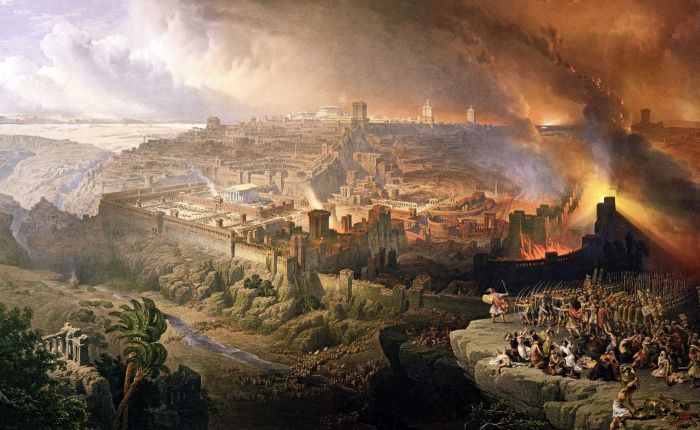
Here, things take a dark turn. Daniel tells us that, after the 62 “sevens” (that is, the second time-span which, together, comprises the total 69 “sevens” from Daniel 9:25), Messiah will be cut off and have nothing, and the prince (or, if you prefer, leader) of the people who are to come will destroy the city of Jerusalem and its sanctuary. This is terrible and puzzling news. How can the prophecy end happily (as Daniel 9:24 says it must) if things take such a horrible turn here? The Messiah dead? Jerusalem and its temple destroyed?
Because we already know each “seven” is one unit of seven years each, evidence strongly suggests that there is a gap of time between the end of the 69th and the beginning of the 70th “seven.” That is, the 70 “sevens” do not run consecutively. Because the 69th “seven” ended at Daniel 9:25, if the “sevens” did run consecutively, then the 70th (and last) “seven” would begin immediately after Messiah the prince arrived in A.D. 30 … which would have the entire prophecy end in A.D. 37.
This clearly did not happen. Instead, evidence suggests there is a gap in the prophecy between the 69th “seven” (at the end of Daniel 9:25) and the 70th “seven” in Daniel 9:27.
The teaching video on Daniel 9:26 is here:
Daniel 9:27
The two articles about Daniel 9:27 are here and here.
Here, at the end of the prophecy, Daniel tells us how God will make all the good things happen.
When the last and 70th “seven” begins, a mysterious and sinister figure will make a covenant with “the many” (likely the people of Israel) for one “seven.” This is the antichrist, who is described elsewhere at 2 Thessalonians 2 and Revelation 13. Some good Christians think the events in Daniel 9:27 are positive, and that Jesus is the man who makes a covenant. This is incorrect.
In the middle of this “seven” (that is, 3.5 years into this covenant), the antichrist will put a stop to all religious worship of the one true God. This appears to be the trigger for the time of relentless persecution against God’s people that Jesus describes in Matthew 24:15-28. Like a sinister shadow creeping across the land, Daniel tells us about a “wing of abomination” upon which will arrive one who makes desolate = the antichrist drops the mask and unveils his true self. This is the kingdom of darkness which the apostle John says will be destroyed at Revelation 16-18. This kingdom will endure until a complete destruction will pour forth on this evil leader.
At that time, when the antichrist is defeated, Jesus returns to establish his kingdom and usher in righteousness (Mt 24:29-31; Rev 19). That is when the six great events promised in Daniel 9:24 will be fully realized, and paradise will follow.
The teaching video on Daniel 9:27 is here:
I hope these articles and videos will shed some responsible light on a very important, very encouraging passage of prophecy. There is far too much irresponsible speculation about prophecy. I hope you find this work helpful.
This is the first of three articles about the great prophecy in Daniel 9:24-27. This prophecy is very complicated and very important. One writer called it “the key to prophetic revelation.”[1] Many good Christians disagree about how to interpret it. This bible study will not exhaustively defend its interpretation at every point against all comers. Instead, it makes a positive case for its own position and seeks to be straightforward and understandable to ordinary people.
This bible study takes a literal, futurist view[2]—meaning (a) we should interpret the passage according to the natural, ordinary manner of language in proper context (e.g., poetry is poetry, narrative is narrative, figurative language is figurative, etc.), and (b) its fulfillment lies in the future—not the past.
Prayer answered (Daniel 9:1-23)
This prophecy happens because Daniel prays to God for help. This is a beautiful prayer. Christians should study it. But it isn’t our focus here, so we won’t stay here for long.
The Babylonians conquered the southern kingdom of Judah in 586 B.C., after a lengthy period of national and spiritual decline. The Babylonians took many Jewish people far away to the east (2 Kgs 25:11). Daniel was one of them. But that was a long time ago. He’s now an old man. He’s spent his best years as a civil servant in the Babylonian and Persian bureaucracies, trapped in an exile he doesn’t want. Daniel knows God swore that he would punish Israel for 70 years before he brings his people back to the promised land (Jer 25:11-12; 29:10). These 70 years have just about come and gone.
… I, Daniel, observed in the books the number of the years which was revealed as the word of the LORD to Jeremiah the prophet for the completion of the desolations of Jerusalem, namely, seventy years. So I gave my attention to the Lord God, to seek Him by prayer and pleading, with fasting, sackcloth, and ashes (Daniel 9:2-3).
The angel Gabriel arrives on the scene with God’s reply: “so pay attention to the message and gain understanding of the vision” (Dan 9:23). This bit is especially important—Gabriel is answering Daniel’s question about when God will bringIsrael back to the promised land. Daniel wants to know when God will make good on his “70 years promise.” He begs God: “for Your sake, Lord, let Your face shine on Your desolate sanctuary …” (Dan 9:17).
Well, Gabriel has come with God’s answer. This brings us to the famous prophecy. It summarizes the entire scope of living history–the sum of God’s plan to set everything right that’s wrong in this world.
The sum of the whole thing (Daniel 9:24)
Gabriel says:
Seventy weeks have been decreed for your people and your holy city, to finish the wrongdoing, to make an end of sin, to make atonement for guilt, to bring in everlasting righteousness, to seal up vision and prophecy, and to anoint the Most Holy Place (Daniel 9:24).
The most obvious question is about these seventy “weeks.” What does this mean?
It’s complicated.
We won’t get there until the next section—sorry! But, for now I’ll say that the word means “sevens,” which is a vague time indicator. Its meaning depends on what’s happening in the passage. Your bible may translate it as “weeks” to help you out, but that’s not necessarily the most helpful gloss.
Whatever these 70 “sevens” are—and we’ll figure that out soon enough—clearly God will accomplish a bunch of things by the time they’re fulfilled. There are three bad things that God will fix, and three good things that will happen. Gabriel says these events are directed towards “your people and your holy city” (Dan 9:24).
Sometimes, God speaks directly to certain people, while at the same time speaking also to other people far in the future—sometimes in a deeper and more meaningful way. We usually only see this in light of revelation that comes later in the bible’s story. For example:
God told his rebellious people he would spare them from the poisonous serpents if they looked upon the image of a bronze serpent on a pole and truly believed this act would rescue them (Num 21:4-9). So far, so simple.
But, in a deeper way, this command foreshadowed that God’s people will be spared from the poisonous serpent—“the serpent of old who is called the devil and Satan” (Rev 12:9)—if they “looked upon” Jesus on his cross and truly believed this would rescue them (Jn 3:14-15).
Some of that is going on here. Yes, Gabriel speaks of the Jewish people (“your people and your holy city,” Dan 9:24), but the true reference is bigger than that.[3] Anyone who trusts in Jesus as his savior is a child of Abraham and an heir according to that covenant promise (Gal 3:26-29). After all, considering the bible’s whole story, God’s holy city is called the “new Jerusalem” (Rev 21:2; cp. Rev 21:1-4).
First, Gabriel lists three bad things that God will fix by the end of these 70 “sevens.”
God will “finish[4] the transgression.” Rebellion and transgression will end. The only time in history that rebellion against God will stop is in the new paradise to come—in the better tomorrow: “there will no longer be any curse” (Rev 22:3).
He will “make an end of sin.” Again, the only time in human history when God’s people will never sin is the eternity in paradise, where “the first things have passed away” (Rev 21:4).
There will be made an “atonement for guilt.” In the old covenant, God did provide a way for believers to receive atonement (see Lev 4:27-31). In Leviticus 4:31, the bible says: “So the priest shall make atonement for him, and he will be forgiven.” But Christ’s atonement is different and better. According to Hebrews 10:2, the old covenant sacrifices “can never, by the same sacrifices which they offer continually every year, make those who approach perfect.” This is why Christ is the better priest, who gives his people a better reconciliation: “For by one offering He has perfected for all time those who are sanctified” (Heb 10:14).
Next, Gabriel tells us three good things God will accomplish by the end of these 70 “sevens.”
He will “bring in everlasting righteousness.” This is a righteousness that will never end. The only time when everlasting righteousness will be here on the earth is in the new tomorrow, in paradise (see Rev 22:1-4).
God will “seal up vision and prophecy.” This most likely means there will no longer be any need for God to speak to his people by way of visions or prophecy, because he will reveal himself to us all personally—like he did with Adam and Eve in the garden of Eden (Gen 3:8). This is when “the tabernacle of God is among the people, and He will dwell among them, and they shall be His people, and God Himself will be among them …” (Rev 21:3).
He will “anoint the Most Holy Place.” This is the satisfaction Jesus makes to God because of our sins and crimes–the personal and legal reconciliation that sets us right with him.
There are two ways to understand what “anoint a most holy” means.
The phrase means “holy of holies” or “a very holy thing/place/person.”
We’re tempted to think “holy of holies = inner chamber of the temple,” but this is not necessarily correct. The phrase just means “a really, really holy thing.” The context must tell you what this “very holy thing” is in this passage—a person (Jesus Christ) or a place (the Millennial temple)?
Because the passage is about everything wrong in this world being finally fixed at the end of the age, Gabriel is likely referring to Jesus here[5]—God will anoint a most holy person as king at his resurrection and ascension (Acts 13:22-23; cp. Ps 2:6-7). Further, in light of the bible’s whole story, Jesus literally is the new and better temple.
In Matthew 12:6, Jesus said that, in himself, something greater than the temple was here.
The apostle John says in his vision of the new Jerusalem that he sees no temple, “for the Lord God the Almighty and the Lamb are its temple” (Rev 22:22).
The psalmist gives us a prophecy of a king God will enthrone over creation: “I have installed My King Upon Zion, My holy mountain” (Ps 2:6). The apostle Paul explains that this passage refers to Jesus at his resurrection and ascension back to heaven (read Acts 13:32-33).
But some faithful Christian interpreters believe these six events refer to the new covenant era—to the time after Jesus’ ascension when the new covenant has launched. They say this isn’t about the last things at all—it’s all in effect right now. They believe this “everlasting righteousness” is about the righteousness from God (Rom 1:17) which he now offers to everyone who believes in Jesus.[6] To “finish the wrongdoing” and “make an end of sin” refers to Christ’s atonement for his people, etc.[7]
This is probably not right—there is surely no everlasting righteousness in our hearts, in our minds, or in this world. This world is awash in sin and temptation—the apostle Paul calls it “this present evil age” (Gal 1:4). This suggests the six great events are not yet fully accomplished. Believers (and this world) await the experiential transformation to match the legal pardon we already have (Rom 8:18-25).
So, it seems better to interpret these six momentous events as fulfilled when Jesus returns here from heaven to establish his kingdom—the “second coming.” Together, they tell us that God will fix everything that’s wrong in this world. No more transgressions, no more sin, a perfect atonement that brings personal and legal reconciliation with God, everlasting righteousness on earth as it is in heaven, no more need for vision and prophecy because all God’s people will see him as he is, and Christ anointed and ruling as king over his creation.
That’s why this prophecy matters.
How does all this good stuff shake out? We turn to that in Daniel 9:25-27, in our next two articles.
[1] John Walvoord, Daniel: The Key to Prophetic Revelation (Chicago: Moody, 1971; reprint, 1989).
[2] A free, scholarly resource that sketches my viewpoint is from Stephen R. Miller, “Interpreting Daniel’s Seventy Weeks: Dismal Swamp or Blessed Hope?” Available here.
[3] “… for all the people of God; who also were Daniel’s people and city in a spiritual sense, to which he belonged” (John Gill, An Exposition of the Old Testament, vol. 6 (London: Mathews and Leigh, 1810), 343).
[4] A very few English translations and commentators believe the phrase should be translated “restraining the transgression” (ISV translation and Edward J. Young, The Prophecy of Daniel (Grand Rapids: Eerdmans, 1949), 198). But this is almost surely incorrect.
[5] One more strike against this “very holy thing” being the Millennial Temple is that Gabriel calls the temple “the holy place” (וְהַקֹּ֜דֶשׁ) at Dan 9:26, in contrast to the more generic phrase “a most holy thing” (קֹ֥דֶשׁ קָֽדָשִֽׁים) at Dan 9:24. H.C. Leupold is especially good here (Exposition of Daniel (Colombus: Wartburg: 1949; reprint; Grand Rapids: Baker, 1969), 416), as is Young (Daniel, 201).
[6] “This righteousness, or the Messiah who accomplishes it, was the treasure above all treasures that was most eagerly longed for by the Old Testament saints” (Leupold, Daniel, 414).
Daniel’s visions are endlessly fascinating to Christians.[1] So are those from Ezekiel, Zechariah, and Revelation. They stick in your mind so vividly because they’re exciting, dramatic, bizarre, otherworldly, almost fantasy-like. This is a very particular style of writing God uses to communicate hope to desperate people.[2]
Daniel and many others are prisoners in Babylon. Their homes are destroyed, family members are dead, their nation is no more, and they’re far from home. They’re tired, lonely, anxious, scared, and perhaps doubting God’s promises. God wants to give hope to His people, and for that an essay won’t do. This is why bible books containing these fantastic visions always come during times of terrible persecution and despair. So, Daniel’s visions are not fodder for timeline speculation. They’re about hope for desperate prisoners.
In Daniel 2, God’s point is that one day His kingdom will smash everything bad, everything evil, everything unholy in this world to pieces—and then there will be peace on earth. These visions and the hope they bring aren’t just for the Jews in exile in Babylon. They’re also for believers in exile in this world today who are longing for a better country—a heavenly one (Heb 11:16).
Space does not permit a detailed run-up to the vision itself. Suffice it to say that King Nebuchadnezzar was lying in bed one night when his “mind turned to things to come, and the revealer of mysteries showed you what is going to happen,” (Dan 2:29). He was not a kind or good man. He was brutal and cruel—vowing to kill his magi and their families if they failed to accurately describe the dream and what it meant (Dan 2:4-12). Daniel and three friends are caught up in this death sentence, but God reveals the dream and its explanation to them during the night (Dan 2:14-19). The next morning, they’re rushed into the king’s presence, and we hear about the vision for the first time.
The Vision
Here it is:
31Your Majesty looked, and there before you stood a large statue—an enormous, dazzling statue, awesome in appearance. 32The head of the statue was made of pure gold, its chest and arms of silver, its belly and thighs of bronze, 33its legs of iron, its feet partly of iron and partly of baked clay. 34While you were watching, a rock was cut out, but not by human hands. It struck the statue on its feet of iron and clay and smashed them. 35Then the iron, the clay, the bronze, the silver and the gold were all broken to pieces and became like chaff on a threshing floor in the summer. The wind swept them away without leaving a trace. But the rock that struck the statue became a huge mountain and filled the whole earth (Daniel 2:31-35).
This is a composite statue. The startling bit is the sudden appearance of a rock not fashioned by human hands which pulverizes the figure and turns it to dust (Dan 2:34). The rock strikes its brittle legs, which are forged from a bizarre mixture of iron and clay. Clearly, a rock will crush clay! Because this is a fantastic otherworldly vision, we need not look for absurd literalism (e.g., how can a rock crush iron?). The point is that the rock strikes with such force that the whole thing comes tumbling down and turns to powder. This rock alone now holds the field, and it gradually grows to fill the whole earth.
What the Vision Means
Daniel explains that Nebuchadnezzar represents the head of gold (Dan 2:36-38). The king and his kingdom are synonymous—each represents the other. Daniel does not name any other king or kingdom in this vision. He accurately describes the power and majesty of the king’s reign: “the God of heaven has given you dominion and power and might and glory” (Dan 2:37; cp. Dan 4). Babylon is the preeminent power player in the Ancient Near East. Yet, God is above all. This vision presses that message home forcefully, as we’ll see.
Working on down the statue, Daniel hurriedly mentions two kingdoms which will arise after Babylon passes from the scene (Dan 2:39). The second, Daniel tells Nebuchadnezzar, is “inferior to yours” (Dan 2:39) and is presumably represented by the “chest and arms of silver” (Dan 2:32). The third is “of bronze” and “will rule over the whole earth” (Dan 2:39, cp. 2:32— “belly and thighs of bronze”).
Daniel is most interested in the fourth kingdom because it is the one the mysterious rock attacks (Dan 2:34). This kingdom is incredibly strong. The “iron” composition of its legs means it will smash and destroy “all the other” kingdoms which came before (Dan 2:40). Yet, because its feet is a mixture of iron and clay (Dan 2:33), it is curiously brittle. This frailty means “the people will be a mixture and will not remain united, any more than iron mixes with clay,” (Dan 2:43).[3] Most commentators and English bible translations understand this to mean intermarriage, but the larger point seems to be a kingdom without a shared national identity. Some writers suggest the progressive inferiority of metals represents a progressive inferiority of national unity and identity from Babylon on down the line.[4]
Daniel explains that “in the time of those kings, the God of heaven will set up a kingdom that will never be destroyed, nor will it be left to another people,” (Dan 2:44). This eternal divine kingdom “will crush all those kingdoms and bring them to an end, but it will itself endure forever,” (Dan 2:44). This is surely the rock which smashes the statue.
Because the kingdoms are successive (“after you” … “next” … “finally” (Dan 2:39-40)), and because the rock smashes only the fourth kingdom which has since destroyed “all the other kingdoms” (Dan 2:40), then God’s kingdom will not come until the time of the fourth kingdom. This suggests that when Daniel says, “in the time of those kings” (Dan 2:44), he refers to the fourth kingdom—a secular “kingdom” dynasty which the divine rock suddenly pulverizes.[5] It crushes “all those kingdoms” in that the fourth realm is built upon the ruins of the first three, and when it falls so too do the remnants of the others.[6]
But, in this vision Daniel is not interested in divine timetables or in naming the kingdoms. God’s point is simple—His kingdom will win. That’s it. That’s the point of the vision. “This is the meaning of the vision of the rock cut out of a mountain, but not by human hands—a rock that broke the iron, the bronze, the clay, the silver and the gold to pieces,” (Dan 2:45).
Nebuchadnezzar had been lying on his bed at night, wondering what the future held. Well, God says, this is the future—you lose. Everyone loses. I win. My kingdom wins.[7] I’ll smash everything unholy, dark, and wicked to pieces, and there’s nothing anyone can do to stop it.
What the Vision Means Considering God’s Whole Story
Otherworldly visions like Daniel’s are hope for people who are suffering, tired, and doubtful. Every earthly kingdom is really Babylon under different cover—Revelation 17 and 18 show us the penultimate “city of darkness” falling after God’s avenging angels “pour out the seven bowls of God’s wrath on the earth,” (Rev 16:1). But, in the meantime, “Babylon” shape-shifts.
No matter which nation holds sway over the world, Daniel 2 assures us that God’s kingdom is coming, and it’ll smash everything else to pieces and fill the whole earth (Dan 2:35). All the great nations, the great empires, the great corporations in this world will become like chaff—only God’s work, God’s good news, and God’s values have eternal significance (cp. 1 Cor 3:11-15; Rev 18). Think of Rome, Spain, and Great Britain. Think of corporations like U.S. Steel, Sears, Kmart, or even Red Lobster! They all fade away, and a new kid enters the stage for its five minutes of fame.
What do you give yourself to? Is it worth your heart and soul? Is it of eternal significance? Do you give yourself to something that will be crushed one day?
God, through Daniel, says “Your King is coming!” Just as Nebuchadnezzar is the head of his mighty but temporary kingdom, so Jesus is the head of the eternal kingdom that’s now come—the one that’s smashing everything else to pieces even now as it expands throughout the world. Jesus said He was the stone which crushes His enemies (Lk 20:18), likely alluding to the divine rock from Daniel’s vision. Jesus said His miracles proved that “the kingdom of God has come upon you,” (Lk 11:20). He told the Pharisees that the kingdom of God was not an observable phenomenon, but instead “the kingdom of God is in your midst,” (Lk 17:21). One enters the kingdom of God by being born again of water and Spirit (Jn 3:3, 5).
It’s significant that the stone smashes the fourth and most fearsome kingdom, and then grows into a mountain over time (Dan 2:35).[8] Peter may have adapted this figure when he said each believer was a “living stone” and part of a spiritual house—a “rock” which was gradually growing to fill the whole earth (Acts 1:8) as Jesus people “make disciples of all nations” (Mt 28:19). One commentator explains: “The kingdom adds rock mass as God adds to it royal subjects.”[9] The kingdom is synonymous with Jesus.
Daniel 7 has more details for us about these four mysterious kingdoms, and their fate. But in our passage at Daniel 2, it’s enough to know that God promises hope if you’re suffering, if you’re tired, if you’re doubting God’s promises in the mess of everyday life. At Daniel’s place in God’s story, this vision assured God’s people: “The king will come one day!” Today, from the vantage point of the new and better covenant, Daniel’s vision tells us: “The king is already here—He said His kingdom is in our midst! And He’s coming back again soon!”
Here is a recent sermon I preached on this passage:
[1] Here are four helpful commentaries on Daniel which I recommend. First is Leon Wood, Daniel (Grand Rapids: Zondervan 1973). This is an excellent dispensational commentary—one of the best available. Second is a commentary by Lutheran scholar Andrew Steinmann, Daniel (St. Louis: Concordia, 2008). This is a wonderful commentary that will make you think outside the box. Third is the classic by Presbyterian scholar Edward J. Young, Daniel (Grand Rapids: Eerdmans, 1949). This is a formidable work that deserves to be consulted. Fourth is by 19th century, American Old Testament scholar Moses Stuart, Commentary on the Book of Daniel (Boston: Crocker & Brewster, 1850). Stuart’s work is conservative and almost unknown today. It’s available free online.
[2] See the wonderful discussion on apocalyptic literature in D. Brent Sandy and Martin G. Abegg, Jr., “Apocalyptic,” in Cracking Old Testament Codes: A Guide to Interpreting Literary Genres of the Old Testament, ed. D. Brent Sandy and Ronald L. Geise (Nashville: B&H, 1995), ch. 9.
[3] Leon Wood goes too far when he says: “Because the mixture of baked clay and iron is found only in the feet and toes, and not in the legs, it follows that this element of brittleness would be true of the Roman Empire only in its later period, rather than in its former,” (Daniel, 69). Wood is a dispensationalist and is setting the stage for a “revived Roman empire” in the latter days. This may or may not be correct, but it is not in the text of Daniel 2.
[4] Young, Daniel, 74, and C.F. Keil and Franz Delitzsch, Commentary on the Old Testament (reprint; Peabody: Hendriksen, 1996), 9:558.
[5] “Those kings must of course mean the kings that belong to the fourth dynasty, although they have not thus far been expressly named, but only by implication,” (Stuart, Daniel, 67).
Wood is correct that “the time of those kings” cannot refer to all four kingdoms (contra. Young, Daniel, 78, whose explanation seems desperate). However, he once again goes beyond the evidence when he claims “those kings” refers to the ten kings represented by the little horns of the evil fourth beast from Daniel. For support, he (like many dispensationalists) appeals to the ten toes of the image (Daniel, 71-2). However, Daniel himself does not find the toes significant.
It is a mistake to interpret apocalyptic visions by calling in bits of the image that the writer doesn’t highlight. One might as well appeal to the “two legs of iron” to support a fulfillment in the Eastern and Western Roman Empires, or the “10 fingers” on the silver hands to suggest a successor kingdom to Babylon with ten rulers. However, see Stuart’s able defense of the significance of the ten toes (Daniel, 65).
[7] “Daniel apparently wanted the king to recognize through this the final supremacy of God and his program over mankind, and accordingly be brought to a place of humility before this mighty One who had so graciously revealed these things to him,” (Wood, Daniel, 74). See also Steinmann, Daniel, 138.
I recently completed a massive project which I want to share with you all. I’ve produced a series of nine short videos explaining how to interpret biblical prophecy in a responsible way. Interpreting prophecy is hard! There’s often too much drama, too much speculation, and too much passion invested based on poor methods. This nine-part video series aims to address this problem. I’ve also written a 39-page booklet to accompany this video series, which goes into more detail.
I hope this project is of some use to Christians who are looking for a sane approach to prophecy that avoids the date-setting, “ripped from the headlines” approach which has characterized too much of the genre.
If you’re an “ordinary” Christian looking for a solid book to understand prophecy, perhaps the best I can recommend is an older work by R.B. Girdlestone, The Grammar of Prophecy: An Attempt to Discover the Method Underlying the Prophetic Scriptures. It’s a short book, and Girdlestone was an Anglican minister from an earlier era, but this is an excellent work on the subject. For my money, it’s the best thing a Christian can buy.
The videos are below, and here is the accompanying booklet. If you want more information about a subject I mention, please refer to the booklet.
This is a short exposition of 1 Corinthians 14. It’s based on notes I prepared for our adult bible study class. It doesn’t interact with the scholarly commentaries, and nobody will mistake it for a crushing blow that will lay Wayne Grudem low. Still, I believe it’s a faithful and accurate way to understand this difficult chapter. Perhaps some people will find it useful.
Tongues are useless without an interpreter (1 Cor 14:1-5).
Paul wants Christians to cultivate love in their congregation (1 Cor 13), and to especially desire the ability to prophecy. I understand this to refer to direct revelation from God, in the Old Testament sense. Some believe it refers to general teaching or preaching. This view is possible, but I disagree.
I understand “tongues” to refer to intelligible, human language. I think this agrees with the evidence from Acts 2 and makes the best sense in this chapter. Paul doesn’t exactly denigrate tongues, but he remarks over and over that this gift has limited use in a church setting. Tongues is a gift for evangelism.
The one who speaks in a foreign language during a church meeting isn’t actually speaking to the congregation, but to God – because nobody but God understands what he’s saying (1 Cor 14:2)! Instead, he’s uttering mysteries by the Holy Spirit, who gives this miraculous gift. However, the person who speaks prophecy directly from God can be understood. He can encourage and build up the congregation. The man who speaks a foreign language can’t do any of that; nobody understands him (1 Cor 14:3). Instead, he builds and encourages himself. The man who prophesies builds up the congregation (1 Cor 14:4). This is why the gift of prophecy is better for the church than tongues, unless someone is available to interpret (1 Cor 14:5).
Build up the church, not yourself (1 Cor 14:6-12)
Paul asks an obvious question; how can you understand someone who speaks a foreign language unless an interpreter is present (1 Cor 14:6)!? You can’t, of course.
If a flute doesn’t sound a clear note, nobody can understand or appreciate it. If a bugle isn’t clear, nobody can obey the call. Likewise, if a foreign language isn’t interpreted, nobody will even know what’s being said! It’s like you’re speaking into the air (1 Cor 14:7-9).
There are lots of languages in the world, and they all mean something (1 Cor 14:10). But, if you don’t understand the language, the audience and the speaker will be foreigners to one another (1 Cor 14:11). So, Christians should focus on gifts that will actually build up the congregation (1 Cor 14:12). The gift of tongues won’t do that.
How to use the gift of languages (1 Cor 14:13-19)
This is why the person who has the gift of speaking in a foreign language should pray that he has the ability to interpret (1 Cor 14:13). This implies that some people could speak foreign languages, but didn’t even understand what they were saying! In this case, I assume the Christian is somehow a passive vehicle for communicating via the Spirit. This is strange, because Acts 2 suggests the Christians understood what they were saying to the Pentecost pilgrims. Whatever the situation was, Paul suggests they not be content with being passive actors.
Our minds must be engaged in worship (1 Cor 14:14-15). If you pray or speak in a foreign language, and you yourself don’t even understand what you’re saying, how can this build up anybody (1 Cor 14:16-17)? This is why Paul would rather instruct believers than speak 10,000 words in a foreign language that doesn’t do any good for anybody (1 Cor 14:19).
What tongues (“languages”) are for (1 Cor 14:20-25)
Paul suggests the Corinthians be mature as they think about this (1 Cor 14:20). Isaiah 28:11 suggests that, one day, Gentiles will come with strange languages and teach the Israelites about Yahweh (1 Cor 14:21). Paul takes this ironic situation and applies it to his own context – the gift to speak foreign languages isn’t for believers, but for unbelievers (1 Cor 14:22). Prophecy, on the other hand, is for believers (1 Cor 14:22).
This is why, if an outsider wanders into your assembly and sees everybody speaking foreign languages to one another, he’ll think you’re all insane (1 Cor 14:23)! But, if someone enters and hears prophecy direct from the Lord, he is convicted, he’s called to account, and he’ll worship God and confess that He’s present in the church (1 Cor 14:24-25). This is because prophecy can be understood by anybody, but tongues is for evangelism (cp. Acts 2).
Orderly worship (1 Cor 14:26-32)
So, prophecy and foreign language gifts should be done decently, in order, without chaos. Everything should be for edification (1 Cor 14:26).
If someone has the gift of languages, then have no more than two or three speak in turn, and someone must be there to interpret (1 Cor 14:27). If there isn’t an interpreter, nobody should speak (1 Cor 14:28).
For prophecy, let two or three speak and have others weigh what they say (1 Cor 14:29). If one person receives a revelation from God during the meeting, others should give way to let him speak (1 Cor 14:30). The prophets should speak one by one, so everyone in the congregation can be encouraged (1 Cor 14:31). The prophets are subject to one another, to critique and “check” one another (1 Cor 14:32).
Women and prophecy (1 Cor 14:33-36)
1 Cor 14:33-36 reads:
As in all the churches of the saints, the women should keep silent in the churches. For they are not permitted to speak, but should be in submission, as the Law also says. If there is anything they desire to learn, let them ask their husbands at home. For it is shameful for a woman to speak in church.
This is the most difficult part of Paul’s letter. I believe Paul means that wives should keep silent (1 Cor 14:34) in the context of critiquing and “checking” their husbands, who have just uttered prophesies.[1] Paul can’t be saying women can’t ever speak in a public gathering, for several reasons:
it would imply women are somehow structurally inferior; contra Gal 3:28
it contradicts 1 Cor 11:5, which says women did regular prophesy in church services
it would contradict Joel’s prophesy (Joel 2:28; Acts 2:18)
it contradicts the prominent servant roles of Euodia and Syntyche (Phil 4:2-3), Priscilla (Acts 18:2; Rom 16:3; 1 Cor 16:19); Mary (Rom 16:6), Junia (Rom 16:7), Tryphaena and Tryphosa (Rom 16:12), Phoebe the deacon (Rom 16:1-2), Nympha who hosted a house church (Col 4:15)
The language of submission and shame suggest this is likely a case of women who are critiquing their husband’s prophesies during a church meeting. Indeed, Paul has just finished explaining how to handle prophecy during a church meeting, including critique or questioning afterwards. There is probably a local context to this controversy that we’ll never know. The data of other women performing prominent servant roles in various New Testament churches (see above) means this is likely a local command, for a local context, for a very specific situation.
I assume Corinth had a particular problem with some wives criticizing, critiquing or otherwise embarrassing their husbands during public church meetings. The overriding principle is that husbands and wives should not embarrass one another in public (cp. Eph 5:21ff). If the wife has concerns about her husband’s prophecy, she must ask at home – where there is no danger of embarrassment or shame.[2] In other words, rather than embarrass your husband in public, just ask in the car on the way home!
The reference “as the law also says” (1 Cor 14:34) is a general reference to the Old Covenant, likely to Gen 3:16 and the perpetual battle between the sexes in a marriage relationship in a post-fall context.
Wrapping up (1 Cor 14:36-40)
Paul concludes with some sharp, rhetorical arrows. The word of God didn’t just come to the church in Corinth, did it (1 Cor 14:36-37)!? Any true Christian should acknowledge Paul’s authority to speak on Yahweh’s behalf (1 Cor 14:37). If someone doesn’t acknowledge Paul’s authority, he shouldn’t be considered a Christian (1 Cor 14:38). Ask God for the ability to utter prophesies. Don’t forbid foreign languages in the church; just make sure everything is done decently and in order (1 Cor 14:39-40).
[1] I am following (1) David Garland, 1 Corinthians, in BECNT (Grand Rapids: Baker, 2003), 664-673 and (2) Simon Kistemaker, 1 Corinthians (Grand Rapids: Baker, 1993), 510-515.
[2] “Paul disallows speech in the assembly that would suggest that a wife is being insubordinate toward her husband, whether it is an interruption or a challenge to a prophetic utterance. The delicate relationship between husband and wife is imperiled by the wife’s public questioning, correcting, or challenging,” (Garland, 1 Corinthians, 671).
Likewise, Kistemaker observes, “[t]he Corinthian women at worship are not told to be silent in respect to praying, prophesying, and singing psalms and hymns. They are, however, forbidden to speak when the prophesies of their husbands are discussed,” (1 Corinthians, 513).







 The Eccentric Fundamentalist