Does Revelation 3:10 Teach a Pre-Tribulation Rapture?

Does Revelation 3:10 Teach a Pre-Tribulation Rapture?

The “pre-tribulation rapture” is the belief that Jesus will remove the church (the living and the dead) from the earth before the great tribulation. Faithful Christians who believe this often cite Revelation 3:10 as a key proof for this doctrine. However, the preponderance of evidence does not support this claim.

  • The “time of testing” which from Jesus promises to protect his church is not the antichrist’s persecution against believers, but his own divine wrath against the antichrist.
  • Jesus’ promise is to the Christian congregation at Philadelphia as a collective whole, not to every believer individually. He made good on his promise because the original audience died ordinary deaths long ago. Jesus’ promise will apply equally to his worldwide church at the “time of the testing,” which is yet future.
  • In the context of Revelation 3:10, the phrase “keep/protect you from the hour of testing” probably does not mean physical removal out of a situation. Those who argue that it does mean this sometimes believe outdated and erroneous ideas about Greek grammar.
  • The bottom line is that Revelation 3:10 (by itself) does not support a pre-tribulation rapture. The preposition translated “from” is a very slender reed upon which to hitch your interpretive wagon. The doctrine may be true. But, it is likely not present in Revelation 3:10.

We’ll examine each of these, below.

What is this “time of testing”?

Here is our text:
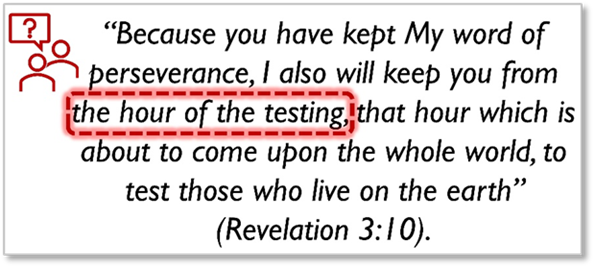
The “time of testing” from which Jesus protects the church is the tail end of the great tribulation, when Jesus pours out the seven-seal judgments upon the kingdom of evil. This is a critical point. Many Christians are confused here.

  • Revelation 4-18 is not really about the antichrist’s reign of terror against believers—the “great tribulation.” Many Christians think it is about that. But they’re wrong (except for Revelation 13).
  • Instead, Revelation 4-18 is about the time at the end of this seven-year “great tribulation” when Jesus pours out the seven seals of judgment upon the kingdom of darkness.

We know this because Revelation 4-5 shows us the solemn run-up to this day of the Lord, which culminates with the slain Lamb being the only one worthy to break the seals and open the scroll which heralds the better tomorrow (Rev 5:2).

  • Because Jesus has overcome for his people, as our vicarious and righteous substitute, he alone may open the scroll and its seven seals (Rev 5:5).
  • As if to solemnize this awful but necessary time of divine wrath against evil, the angelic creatures sing: “Worthy are You to take the scroll and to break its seals; for You were slaughtered, and You purchased people for God with Your blood from every tribe, language, people, and nation” (Rev 5:9). 
  • Before Jesus can receive power, honor, glory, blessing, “and dominion forever and ever,” he must first destroy his evil counterpart and his wicked kingdom. What follows in Revelation 6-16 are the seven-sealed judgments of wrath against the antichrist and Babylon.

The horsemen, the brimstone, the incineration of one-third of the earth’s vegetation, the waters turning to blood, the mutant, demonic locust-like creatures—all the “bad stuff” we associate with Revelation is divine wrath against antichrist and his followers. The antichrist is doing none of this! Instead, Jesus is doing it to the antichrist and to his people.[1]

This means this “time of testing—the one about to come upon the whole world to test those who dwell on the earth” (Rev 3:10) is against unbelievers—against the antichrist and his followers.[2] Jesus is testing whether they will repent and choose Jesus or cling to darkness. Some translations use the word “trial” here, but this not the best because Jesus is not evaluating the faith of believers. He is testing whether unbelievers will truly continue to reject him.

This judgment ends with the Lord destroying Babylon and the antichrist’s people wailing because Jesus has smashed their world (Rev 18:9-19). “Rejoice over her, O heaven, and you saints and apostles and prophets, because God has pronounced judgment for you against her” (Rev 18:20). Now that the Lord has vanquished the kingdom of evil, John tells us: “I heard something like the voice of a great multitude and like the sound of many waters, and like the sound of mighty peals of thunder, saying, ‘Hallelujah! For the Lord our God, the Almighty, reigns’” (Rev 19:6). Jesus now returns to establish his kingdom on earth (Rev 19:11-21).

So, the “time of testing” is not the antichrist’s persecution of believers—it is Jesus’ wrath upon the kingdom of darkness. During this period, Jesus will protect his people. Before Jesus cracks open the sixth seal of judgment, he commands an angel to mark a vast number of believing Jewish people with his “seal” to protect them from the coming judgments (Rev 7:3; cp. Ezek 9:4-6; Ex 11:6-7, 12:13).

Who does Jesus protect?

Our passage is here—who is Jesus protecting and what kind of protection does he promise? He will protect his church (as a collective whole) from physical and spiritual destruction.
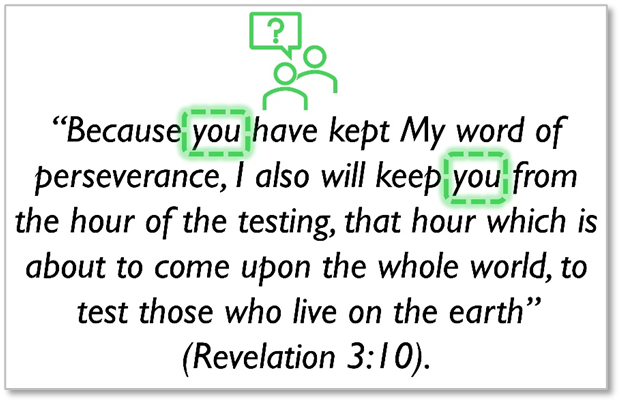
Because the church in Philadelphia (collectively, as a single referent)[3] is protected from this time of testing, it’s reasonable to believe that this protection applies to the entire church as a whole. The is a promise to the community, not to every single individual. So, taken collectively as a single community, Jesus will protect his church from this time of testing.

Pre-tribulational Christians go beyond the evidence when they insist that: (a) if any Christians die during the Great Tribulation then Jesus’ promise here is void, so (b) this must mean Jesus promises to physically remove the church from the scene. This does not necessarily follow.

First, as we saw, the “time of testing” is not the antichrist’s persecution of believers—it is Jesus’ wrath upon the kingdom of darkness. So, the entire objection fails.[4] Some object that, if this be true, then it’s cold comfort indeed:[5] “A whole bunch of y’all will die during the antichrist’s persecution, but don’t worry—I’ll protect the believers who are still alive when I unleash literal hell on earth. Cheers!” This is a false dilemma that demands: “What took you so long!?” One might as well criticize God for allowing the Israelites to suffer in Egypt before “finally” protecting them during the final plague (Ex 2:23-25; 12:23, 29).

Second, even if we (wrongly) conclude that Jesus does promise protection during the time of antichrist’s persecution during the last 3.5 years of his sinister reign … because Jesus’ promise is to the church as a whole, collectively, it simply means that the church will be protected during this period. That is, as an organism and a worldwide family of Jesus people, Satan shall never destroy the church because the gates of hell shall not prevail against it. Indeed, Jesus promised that he would intervene to stop this great tribulation lest no believers be left alive (Mt 24:21-22). That intervention is the judgments of the seven-sealed scroll which together destroy antichrist’s kingdom (culminating at Rev 16, re-told in Rev 17-18).

Will some believers will die during this “time of testing” when Jesus pours out the seven judgments upon the whole world? The answer is yes—but they will die at the antichrist’s hands, not Jesus’ hands. That is, the antichrist will never destroy “the church” as a whole. The Japanese killed many Americans sailors in the Pacific theater of operations in World War 2, but they never destroyed the U.S. Navy. Many Israelites died under Pharoah’s rule in Egypt (Ex 1:15-16), but “Israel” never did die.

  • John tells us about believers who have already died during the antichrist’s reign of terror before Jesus responds to the prayers by unleashing judgment upon the kingdom of darkness (Rev 6:9-10, 7:13-14). These martyrs who died during this great tribulation plead for justice upon “those living upon the earth” who killed them—the very people who are the objects of this “time of testing.”
  • After Jesus opens the fifth seal, the angels tell the great tribulation martyrs “to rest for a little while longer, until the number of their fellow servants and their brothers and sisters who were to be killed even as they had been, was completed also” (Rev 6:11).
  • But, we also see believers being sealed and protected—John highlights Jewish believers in particular who are safe from these judgments (Rev 7:3, cp. Rev 9:4).

Some may protest that it is too fantastic to believe that believers will be protected from death at a time when the first four “trumpet judgments” of the seventh seal destroy a major portion of the world (Rev 8:6-12). But, consider the plagues upon Israel before the Exodus: “But not even a dog will threaten any of the sons of Israel, nor anything from person to animal, so that you may learn how the LORD distinguishes between Egypt and Israel … The blood shall be a sign for you on the houses where you live; and when I see the blood I will pass over you, and no plague will come upon you to destroy you when I strike the land of Egypt” (Ex 11:6, 12:13).

Kept from the hour?

Here is the passage—what kind of protection is Jesus promising? Physical removal from the scene, or protection from danger during the time of testing?
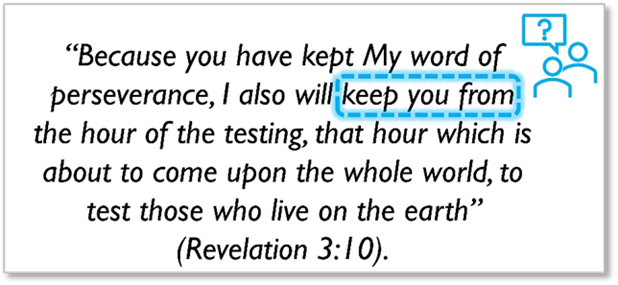
Advocates for a pre-tribulation rapture expend much energy on what it means to be protected from the time of testing. Bible teachers crack open their Greek New Testaments (or fire up their bible software) and begin speaking about the preposition ἐκ (“from”), which in its most basic, original sense suggests an exit from some sort of relationship.[6] So, pre-tribulationists may argue, the idea is that Jesus will take the church away from the coming wrath.

This doesn’t necessarily follow, for a host of nerdy reasons that I’ll try to explain without making you fall asleep.

Blurred lines and prepositions

First, while the original meaning of the preposition ἐκ does indicate motion out of something, that certainly isn’t its exclusive or even primary sense in the New Testament. By then, prepositions no longer had a rigid meaning, which means you cannot say: “it must mean ONLY THIS!” Some pre-tribulation advocates do not seem to appreciate this because they sometimes rely on an outdated understanding of prepositions.[7] Language changes over time, and by the New Testament era the precise distinctions of meaning between koine Greek prepositions had now blurred and overlapped.[8]

  • For example, the preposition εἰς, in a strict sense, means “motion into a thing”[9]—you pour coffee into a cup. But, the Gospel of Mark says Jesus “was sitting on (εἰς) the Mount of Olives” (Mk 13:3).
  • If you want to insist on the classical meaning for this word, you’d translate it as “Jesus was sitting into the Mount of Olives.” Of course, that’s ridiculous—is he a mole, burrowing into the soil?
  • What’s happened is that the meaning of εἰς has blurred and overlapped with that of another preposition (ἐπί), whose “basic idea is ‘upon.’”[10]

What happens with every word is that its original sense expands into all kinds of figurative uses, and this expanded meaning eventually moves far afield of the “original,” rigid “meaning.”This is why, in English, the original meaning for the word “ball” is “a round or roundish body or mass.”[11] But, this meaning has expanded to mean a basketball, or a testicle, or a great time (“I had a ball at the park yesterday!”), or even a formal dance (“Cinderella made it to the ball!”).

With the preposition ἐκ, its basic sense of spatial movement out of something has expanded to indicate:

  • Disassociation (“Christ redeemed us from the curse of the law,” Gal 3:13).
  • Derivation (the crown was made from thorns, Mt 27:29).
  • Time (the man was blind from birth, Jn 9:1).
  • Means (a person isn’t justified by means of doing what the law requires, Gal 2:16).
  • Personal agency (people are born by the will of God, Jn 1:13).

… and more. My point is that, in Revelation 3:10, the preposition ἐκ doesn’t necessarily mean the Lord will physically remove believers out of this world, as in: “Hang on! I’m gonna get y’all outta there!”[12]

Second, regardless of that point, in Greek the sense of John’s phrase “protected from the time of testing” still doesn’t suggest physical motion out of a situation. When you have the construction like that in Revelation 3:10 of “stative verb (τηρήσω) + transitive preposition (ἐκ),” the stative verb swallows up the transitive force of the preposition.[13] In Revelation 3:10, this suggests the idea of physical (i.e., transitive) motion—spatial exit from a situation—falls away.[14] This implies we’re left with some kind of protection from the time of testing that doesn’t include physical removal from the scene.

Therefore, building on our first point, we must look beyond the original, rigid meaning of ἐκ to rightly understand the nature of Jesus’ protection—we need the context.[15]

What does “from” (ἐκ) mean in Revelation 3:10?

A normal Christian with a good English translation doesn’t have to do this—but here is what responsible nerds must do “behind the scenes” to figure out what, say, Revelation 3:10 is saying.[16]

  1. Look at the list. As we learned, every word has a range of possible meanings. Look at the preposition’s original, rigid meaning (for example,ἐκ is spatial—“out of”), then look at the range of figurative meanings common to the word. It isn’t true that a preposition has a “literal meaning.”[17] Instead, it has a range of meanings, and some (depending on context) are more likely than others.[18]
  2. Look at the word(s) the preposition modifies. In this case, “the time of testing” (τῆς ὥρας τοῦ πειρασμοῦ) is in the genitive case, whose historical function was to depict a description or a separation.[19] Usually, prepositions govern the nouns they modify.[20] In Revelation 3:10, both the preposition and the genitive case of the modified noun indicate separation from this “time of testing.”
  3. Look at the context. What does the larger paragraph tell us about what the prepositional phrase means?

Using this method, the preposition in Revelation 3:10 likely means protection from Jesus’ divine wrath which, during this “time of testing,” he will unleash upon antichrist and his kingdom:

  1. Look at the list.

Because (as we saw, above) a stative verb swallows up the transitive nature of the preposition, ἐκ likely doesn’t mean “physical removal outta here” in Revelation 3:10. Instead, it’s probably a preposition of separation by disassociation.[21] Jesus will somehow separate us from the time of testing, and the best rendering here is “protection from the time of testing.” The most logical kind of protection from something, without involving physical motion away from it, is to be guarded and protected during the event.

Elsewhere, John uses the very same construction[22] to record that Jesus prayed that the Father would “keep them from the evil one” (Jn 17:15b). That is, protect us by separating us from Satan—not isolating us from his physical presence, but protecting us from his dominating power. In a similar way, in our passage Jesus promises to protect the church from the power of this time of divine judgment upon the kingdom of evil—just as he did in Egypt before the Exodus.

  1. Look at the word(s) the preposition modifies.

As we said (above), the genitive case here suggests separation from the time of testing, which pairs nicely with the preposition which conveys the idea (in this context) of a non-physical disassociation from the time of testing.

  1. Look at the context.

Jesus tells this church in Philadelphia that he has set before them “an open door,” which probably means a “door” of ready access to him “because you have a little power, and have followed My word, and have not denied My name” (Rev 3:8). Despite their likely small numbers (“a little power”) and seeming impotence, they are faithful. The door to the Messianic kingdom remains open and ready for them, despite this church’s “unimpressive” nature.[23] He promises to deal with a specific cabal of Jewish people in the city who hate this congregation and are persecuting it.[24] These folks, Jesus declares, are not “Jews” at all—their “synagogue” actually belongs to Satan, who is tricking them (cp. Jn 8:44).

But, Jesus assures them, because they have persistently obeyed (“kept”) his message about perseverance, he will protect (“keep”) the church in Philadelphia from the time of testing—the one about to come upon the whole world to test those who dwell upon the earth (Rev 3:10). They will be protected during the time when Jesus unleashes the seven-sealed judgments onto the kingdom of evil (Rev 6-16).[25] He will return soon (“quickly”), so they must hold firmly to their faith as they endure persecution from the local “synagogue” and narrow-eyed suspicion from Roman authorities—or else they may lose their crown (Rev 3:11). In other words, keep on persevering and holding on!

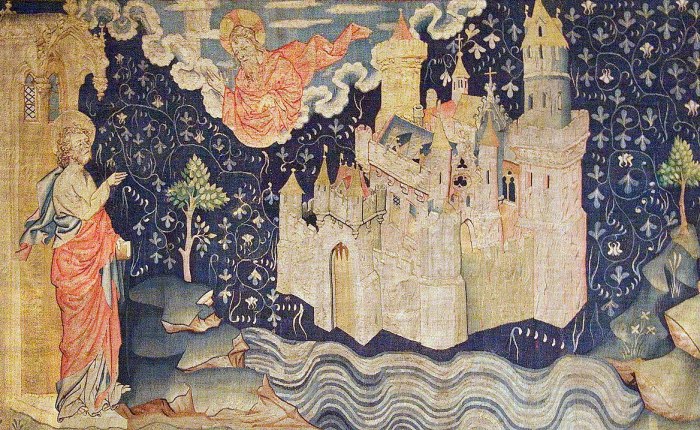
Jesus will make the ones who overcome all these difficulties “a pillar in the house of my God,” and he will write his name on their foreheads to mark them as his own. He will not write his own name only, but the names of the Father and of the new Jerusalem—the celestial city (Rev 3:12).

Bottom line

The bottom line is that Revelation 3:10 (by itself) likely does not support a pre-tribulation rapture. A preposition is a very slender reed upon which to hitch your wagon.[26] It doesn’t mean a pre-tribulation rapture is wrong. It just means that Revelation 3:10 probably doesn’t teach it. I believe the preponderance of evidence here does not support a pre-tribulation rapture, but it would be a mistake for either side to be dogmatic.

  • In terms of weight of evidence, “preponderance of evidence” is the weakest–it means something is more likely than not true.
  • This is followed by “clear and convincing” evidence, which means what it says.
  • Finally, the strongest case is “beyond a reasonable doubt,” which you may be familiar with from bad police movies or TV shows.
  • My assessment about whether the pre-tribulation rapture is present in Revelation 3:10 is at the level of “preponderance of evidence.”

Jesus swears he is returning soon and, if the church perseveres in faith, he promises to protect this local church from the outpouring of his divine judgment that will one day come: “In this great trial, the servants of Christ shall be kept safe.”[27] He doesn’t explicitly say how he will protect them. But the preponderance of evidence suggests that it will be protection from the power of the divine judgments (Rev 6-16), just as God protected the Israelites from the plagues in Egypt.

Of course, Jesus did fulfill this promise to the church in Philadelphia because they died long before the antichrist’s reign—which is still future today! He did protect them from this time of divine wrath against the kingdom of evil. But ultimately, this is a promise to the entire church—to the entire Jesus family that is alive during the great tribulation. When the Lamb who was slain cracks open the seals to open the scroll (Rev 6-16), he will protect his church from the power of this time of testing against antichrist, his people, and his kingdom of evil.

Translation

ὅτι ἐτήρησας (BDAG, s.v., sense 3) τὸν λόγον τῆς ὑπομονῆς (gen. comm. content) μου, κἀγώ σε τηρήσω (BDAG, s.v., sense 2d) ἐκ (disassociation = sit. out of which someone is brought = BDAG, s.v., sense 1c) τῆς (monadic) ὥρας τοῦ πειρασμοῦ (att. gen.) τῆς μελλούσης ἔρχεσθαι (art. inf. = appositional clause) ἐπὶ τῆς οἰκουμένης ὅλης πειράσαι (anarthrous = purpose) τοὺς κατοικοῦντας ἐπὶ τῆς γῆς.

“Because you have persistently obeyed my message about perseverance, I also will protect you from the time of testing—the one about to come upon the whole world to test those who dwell on the earth.”


[1] Buist Fanning briefly states that the ones who hide from Jesus’ wrath in Revelation 6:16-17 are believers who die because of the divine judgments, but this makes no sense in context. He does not try to substantiate the claim—he just makes it in one sentence (Revelation, in ZECNT (Grand Rapids: Zondervan, 2020), 177). These people are likely unbelievers who follow the antichrist.

[2] “There the faithful are sealed with a view to their preservation from the assaults of demons, but are not thereby secured against physical death … It will be observed that the demonic trial spoken of, while worldwide, was to affect only ‘those that dwell upon the earth,’ i.e. the non-Christians” (R. H. Charles, A Critical and Exegetical Commentary on the Revelation of St. John, vol. 1, in ICC (Edinburgh: T&T Clark, 1920), 89).

[3] The referent is singular in Greek, referring to the Christian community in Philadelphia as a collective whole.

[4] For example, Jeffrey Townsend objects: “This presents an immediate problem for post-tribulationism since it holds that the church will be preserved on earth during the hour of testing. Yet verses such as Revelation 6:9–10; 7:9, 13, 14; 13:15; 14:13; 16:6; 18:24; and 20:4 present a time of unprecedented persecution and martyrdom for the saints of the tribulation period” (“The Rapture in Revelation 3:10,” in Bibliotheca Sacra, BSAC 137:547 (Jul 1980), at 153).

He is incorrect—the horrors in Revelation 6-16 are not the antichrist persecuting Christians. It is Jesus pouring out divine wrath upon the kingdom of evil.

[5] Robert L. Thomas, Revelation 1-7 (Chicago: Moody, 1992), 286. “What good does it do to be preserved from the physical consequences of divine wrath and still fall prey to a martyr’s death?”

[6] Murray J. Harris, Prepositions and Theology in the Greek New Testament (Grand Rapids: Zondervan, 2012), 103.

[7] Robert Thomas (Revelation 1-7, 284-86), Paul Feinberg (“Pre-tribulation,” in The Rapture, 63-68), and Craig Blaising (“Pre-tribulation,” in The Rapture, 38, note 67) rely heavily upon the arguments of Jeffrey Townsend, who in turn relied on A. T. Robertson’s assessment of the preposition at issue: “According to Robertson, ‘The word means ‘out of,’ ‘from within,’ not like ἀπό or παρά’” (Townsend, “Revelation 3:10,” 253).

But, as modern Greek grammars recognize, Robertson was incorrect to insist on precise, classical categories to distinguish koine Greek prepositions from one another. Townsend reflects this error when he states: “This is an untenable position because the idea of preservation in and through the hour of testing would normally have been expressed by ἐν or διά” (“Revelation 3:10,” 253). He is wrong.

Dan Wallace’s admonition is relevant here: “… too often prepositions are analyzed simplistically, etymologically, and without due consideration for the verb to which they are connected. Prepositions are often treated in isolation, as though their ontological meaning were still completely intact” (Greek Grammar Beyond the Basics (Grand Rapids: Zondervan, 1996), 359).

[8] Wallace, GGBB, 362-63; Harris, Prepositions, 34-35; Richard Young, Intermediate New Testament Greek (Nashville: B&H, 1994), 85-86.

[9] William Arndt (et al.), A Greek-English Lexicon of the New Testament and Other Early Christian Literature (Chicago: University of Chicago Press, 2000). s.v. Hereafter “BDAG.”

[10] BDAG, s.v.

[11] Merriam-Webster Collegiate Dictionary, s.v. “ball,” noun, sense 1 (Springfield: Merriam-Webster, 2026), 132.

[12] “[I]ndeed, it is now becoming more and more clearly recognized that it is a mistake to build exegetical conclusions on the notion that classical accuracy in the use of prepositions was maintained in the Koine period” (C.F.D. Moule, An Idiom Book of New Testament Greek, 2nd ed.(Cambridge: Cambridge University Press, 1959), 49).

[13] Wallace, GGBB, 358-59. “Stative verbs override the transitive force of prepositions. Almost always, when a stative verb is used with a transitive preposition, the preposition’s natural force is neutralized; all that remains is a stative idea.” Emphasis in original.

[14] This is not the case in John 17:15a, which bears a transitive verb (ἄρῃς) + a transitive preposition (our old friend ἐκ) = the sense of movement out of this world is retained. Jesus prayed: “I do not ask that you take them away from the world …” (οὐκ ἐρωτῶ ἵνα ἄρῃς αὐτοὺς ἐκ τοῦ κόσμου).

[15] “It is important to remember that prepositions are extremely flexible in meaning, and careful consideration of the literary context is essential in determining the nuance of a preposition” (Andreas J. Köstenberger; Benjamin L. Merkle; Robert L. Plummer, Going Deeper with New Testament Greek: An Intermediate Study of the Grammar and Syntax of the New Testament (Nashville: B&H, 2016; Kindle ed.), KL 10481-10482).

[16] I adapted this from Harris, Prepositions, 31. I left off his fourth step because it does not apply in this case.

[17] Erroneously, Craig Blaising wrote: “This view depends on a ‘dynamic’ interpretation of the preposition ek …” (“A Case for the Pretribulation Rapture,” in Three Views on the Rapture: Pretribulation, Prewrath, or Posttribulation, ed. Alan Hultberg (Grand Rapids: Zondervan, 2010), 38). This is incorrect and does not reflect the realities of language in general, let alone koine Greek.

[18] Young, Intermediate Greek, 86.

[19] Young, Intermediate Greek, 23.

[20] Wallace, GGBB, 360-62.

[21] BDAG, s.v., sense 1c; cp. Brill Dictionary of Ancient Greek (hereafter “GE”), ed. Franco Montanari (Leiden: Brill, 2015),s.v., sense II.A.c.

[22] Gk: τηρήσῃς αὐτοὺς ἐκ τοῦ πονηροῦ = preposition ἐκ + genitive object. “[T]he thought is quite in keeping with that of our Seer” (Charles, Revelation, 1:89-90). And, the apostle also wrote this same phrase at both John 17:15 and Revelation 3:10. This suggests it is a stylistic quirk of John’s of which we ought to take note.

[23] Robert Mounce, The Book of Revelation, in NICNT (Grand Rapids: Eerdmans, 1977), 117.

[24] Some people think this means that members of this hostile Jewish synagogue will come to believe Jesus is their Messiah. Others think Jesus refers to their eventual acknowledgment of him in a non-saving way—perhaps on the day of judgment (Rev 20). That is, “every knee will bow, and every tongue will confess …” (etc.).

[25] Some pre-tribulation advocates eagerly seize upon a distinction between (a) being kept from the danger itself, and (b) being kept from the time period of this danger. The latter, they sometimes claim, suggests a physical removal from the scene. In truth, this is a de minimis argument.

[26] For example, Paul Feinberg spent five pages discussing the preposition ἐκ as he supported the pre-tribulation rapture perspective at Revelation 3:10. If a preposition is the best you got, then your argument is very weak (“The Case for a Pre-tribulation Rapture Position,” in The Rapture: Pre, Mid, or Post-Tribulation, ed. Stanley Gundry and Gleason Archer (Grand Rapids: Zondervan, 1984), 63-68).

[27] Henry Alford, The New Testament for English Readers: A Critical and Explanatory Commentary, New Edition, vol. 2 (London; Oxford; Cambridge: Rivingtons; Deighton, Bell and Co., 1872), 969. Similarly, John Gill writes that: “it will be known who are his true churches, and pure members; and these he’ll keep close to himself, and preserve safe amidst all the distress and confusion the world will be in” (An Exposition of the New Testament, vol. 3 (London: Mathews and Leigh, 1809), 711).

What does Matthew 24 mean?

What does Matthew 24 mean?

Matthew 24 is the longest discussion we have from Jesus about how “this present evil age” (Gal 1:4) will transition to the next. It’s important. It’s also difficult to follow. This article is my best attempt to simply explain what Jesus is saying.

Three questions

The passage opens with Jesus leaving the temple complex after condemning the Pharisees for missing the entire point of true faith (Mt 23). He declares he is finished with the Jewish civil and religious leadership (Mt 23:37-39). Jesus is likely in a dark mood as he and his disciples leave the complex and “point out the temple buildings to him” (Mt 24:1). It was an impressive compound and had been under construction for decades. It was far larger than the temple building itself—more of a compound with the temple as its center.

We can imagine Jesus scowling at the whole thing before declaring that it would soon all be destroyed (Mt 24:2). This is shocking—how can this be? How will people worship YHWH? How will they have atonement for their sins? Once they climbed the hill opposite the temple mount, they asked Jesus: “Tell us, when will these things happen, and what will be the sign of Your coming, and of the end of the age?” (Mt 24:3).

The end of the age (Mt 24:4-14)

Jesus answers the third question (“when will be … the end of the age?”) first. The basic answer is at Mt 24:14: “This gospel of the kingdom shall be preached in the whole world as a testimony to all the nations, and then the end will come.” The end will only come when the whole world hears. We don’t know when this will happen. But, because it is impossible to ensure every single person hears the Gospel (after all, someone is always being born somewhere), perhaps the idea is that when the world reaches a “gospel saturation point,” then Jesus kicks off the day of the Lord.

In the meantime, as local churches do their part to be sure the world reaches this gospel saturation point, we’ll see an escalating on ramp of hostility towards Christianity.

  • Many false teachers will claim to be the Messiah, but they’re liars (Mt 24:4-5).
  • Wars, famines, and political unrest will come and go. Any historical survey of any century proves we don’t live in a peaceful or friendly world. This does not signify “the end.” It’s simply the on-ramp (Mt 24:6-8).
  • Christians will be persecuted and even executed in various places—the gospel message is not welcome. Even professing believers will betray the faith and turn on one another, perhaps out of fear (Mt 24:9-10). History tells us this ebbs and flows depending on local circumstances.
  • False prophets will lead many people astray (Mt 24:11). Believers will grow cold towards the faith, perhaps insular (Mt 24:12). But, the true believer is the one who endures or perseveres to the end (Mt 24:13).

But, of course, “the end” will not come until the world reaches its undisclosed gospel saturation point (Mt 24:14). So, in the meantime, local churches must do their part to spread the good news.

The sign of Jesus’ coming (Mt 24:15-28)

Jesus says he’ll return after a period of awful persecution. He begins by directing his readers to the prophet Daniel, who spoke of an evil figure in Jerusalem who would bring abominations upon God’s people (Dan 9:27). But the picture is complicated because Jesus speaks of two different events at the same time—the destruction of Jerusalem by the Roman armies in A.D. 70, and the destruction wrought by the forces of darkness in the last days. We know this because, while Matthew and Mark emphasize the last days, Luke describes the Romans in A.D. 70:

Matthew 24:15-16Mark 13:14Luke 21:20-21
So when you see standing in the holy place ‘‘the abomination that causes desolation,” spoken of through the prophet Daniel—let the reader understand—then let those who are in Judea flee to the mountains …When you see “the abomination that causes desolation” standing where it does not belong—let the reader understand—then let those who are in Judea flee to the mountains …When you see Jerusalem being surrounded by armies, you will know that its desolation is near. Then let those who are in Judea flee to the mountains …

We know Luke is not describing Satan or the antichrist, because they never destroy Jerusalem (see Rev 19:19; Rev 20:9). But, Luke tells us that some abomination (the Roman armies) will make Jerusalem desolate—this happened in A.D. 70. Add to it that Jesus’ declaration of the future destruction of the temple mount is what triggered this conversation, and so the evidence suggests Jesus is speaking of two events at the same time in Matthew 24:15-28. Like a polaroid that slowly fades into focus, the “A.D. 70” bit begins at Matthew 24:15 but fades away until, by Matthew 24:21, the great tribulation has taken its place.

  • When the Jews in Jerusalem see the Roman armies massing against Jerusalem during the coming First Jewish War (A.D. 66-70), they should drop everything and ruin (Mt 24:15-18). Josephus (The Jewish War, 5.1 – 7.162) tells us that the ensuing siege was awful.
  • Indeed (shading to the end of days, but still with secondary applicability to A.D. 70), Jesus tells us, “for then there will be a great tribulation, such as has not occurred since the beginning of the world until now, nor ever will again” (Mt 24:21). Surely nobody would survive if the Lord did not end it (Mt 24:22)—and he will do so by returning (Rev 19:11f).

Jesus doesn’t tell us when he’ll come back. But, it will be so obvious and so clear as to be unmistakable. Liars and charlatans will sally forth, but we should ignore them (Mt 24:23-36) because Jesus’ return will be as obvious as lightening in the sky. You see it. You hear it. You can’t miss it. It’s unmistakable. That’s how blindly obvious it will be that Jesus has returned—no persuasion will be necessary. Just as surely as you know that a gathering of vultures means there is a corpse on offer, so will Jesus’ return be just as obvious (Mt 24:27-28).

Jesus’ return (Mt 24:29-31)

Immediately after the tribulation of those days—that is, the “great tribulation” which other scriptures (e.g., Dan 9:27) tell us will be the antichrist’s brief, seven-year reign—Jesus will return. To describe this event, Jesus borrows phrases from the prophet Isaiah’s declaration about Babylon’s destruction (Isa 13:10; Mt 24:29). It’s no accident that “Babylon” is the symbol of evil and is the kingdom which the Lord destroys just before his return (Rev 16, further described in Rev 17-18).

  • Otherworldly phenomena will kick off for all to see—no sun, no moon, stars falling from the sky. There will be no natural explanation.
  • A mysterious “sign of the Son of Man will appear in the sky” (Mt 24:30). Nobody knows what this sign will be—some ancient Christians believed it will be a cross floating in the heavens, likely illuminated against a now darkened world. If so, it would surely be terrifying beyond belief.
  • All the nations of the earth will mourn and wail in horror as Jesus arrives on the clouds of heaven (Mt 24:30), just as Daniel said he would (Dan 7:14)—perhaps with the blazing cross (“the sign of the Son of Man”) backlighting him from the heavens?
  • As Jesus arrives, he’ll send out his angels who will gather his elect people from the four winds (cp. Mt 13:24-30. 36-43). This is likely the same event the apostle Paul described at 1 Thessalonians 4:13-18. Elsewhere, Paul tells us that Christ will resurrect believers “at his coming” (1 Cor 15:23), and here it is.

So, this section leaves us with Jesus having arrived in Jerusalem to inaugurate his kingdom. He has gathered his saints from the earth (the living and the dead) to be with him (cp. Rev 19:11ff).

Be ready (Mt 24:32-51)

These signs are warning lights we can recognize. Just as the fig tree telegraphs when summer is close, so too will the signs of the “great tribulation” (Mt 24:21-28) tell us when Jesus’ return is near—“right at the door” (Mt 24:32-33). Indeed, once the kick-off happens, everything will be wrapped up within one generation (Mt 24:34). This is a solemn promise (Mt 24:35).

Some good Christians believe “this generation” refers to the folks to whom Jesus is speaking. Grammatically, this is an easy option and I used to believe it. Others believe it refers to the Jewish people, but the grammatical case for this is weak (however, consider Dr. Ryan Meyer’s argument for a variation of it here). But, when you harmonize our passage with Mark 12:28-32 and Luke 21:29-33, the scenario which best fits all three accounts is that “this generation = the folks alive when the great tribulation kicks off.”

Jesus tells us that, speaking from the perspective of his human nature, he has no idea when he will return (Mt 24:37). Just as the rains and floods burst upon the earth without warning during Noah’s day (Gen 7:11-12) “and they did not understand until the flood came and took them all away; so, will the coming of the Son of Man be” (Mt 24:39). Indeed, when Jesus arrives people will suddenly disappear (Mt 24:41-41). This is the rapture of living saints, wrought at the hand of the angels whom Jesus dispatches as he arrives on the clouds of heaven (Mt 24:31; cp. Mt 13:40-43; 1 Thess 4:13-18).

So, Jesus warns, true believers must be ready for his return … and live like it. If a homeowner knew when a thief would break in, he would be ready (Mt 24:42-43)! “For this reason you must be ready as well; for the Son of Man is coming at an hour when you do not think He will” (Mt 24:44).

The parables which follow (the ten virgins (Mt 25:1-13), and the talents (Mt 25:14-30)) emphasize this point—our job is to be faithful now while we wait. It isn’t to speculate about dates, times, or to fight about the timing of the rapture. It’s to carry out the great commission—to make disciples of all nations, baptize them into Christ’s family, and teach them everything the Lord commanded us (Mt 28:19-20). Indeed, one key criterion when Jesus separates the believers from the unbelievers on the day of judgment is whether we demonstrated love to our new covenant brothers and sisters (Mt 25:31-46)—whether we’ve lived and acted like Christians.

That must be our focus, and “blessed is that slave whom his master finds so doing when he comes” (Mt 24:46).

A Summary of Daniel’s 70 “Weeks”

A Summary of Daniel’s 70 “Weeks”

After producing five articles and four teaching videos (see below), I’ll just summarize what on earth the angel Gabriel was talking about when he gave Daniel his infamous “70 weeks” prophecy in Daniel 9:24-27. I won’t defend this summary here (that’s why I wrote individual articles about each verse–again, see below). Instead, I’ll just state what each verse means and leave y’all to read each article and/or view the accompanying video if you want more details.

Daniel 9:24

You can read the article here.

A message from God (via the angel Gabriel) to Daniel in answer to his question about when God will bring the people of Israel back to the promised land and restore the kingdom. In this verse, Gabriel gives Daniel a short summary statement, describing six great things God will accomplish by the end of 70 “sevens,” which some English bibles translate as “weeks.” By the end of this period, God will have brought an end to wrongdoing, make an end of sin, make atonement for guilt, bring in everlasting righteousness, seal up vision and prophecy, and anoint a most holy place (or person). These things will only fully happen in the paradise to come, which suggests this vision takes us from Daniel’s era to the end of “this present evil age” (Gal 1:4).

Here is a teaching video on this verse:

Daniel 9:25

The article about this verse is here.

The marker of time which God uses in this prophecy is a “seven” (or, if you prefer, a “week”). There are 70 of them (see Dan 9:24). Many good Christians disagree about how to understand what a “seven” is. The best understanding is that a “seven” is one set of seven years = 490 years (i.e., 70 sets of seven years each).

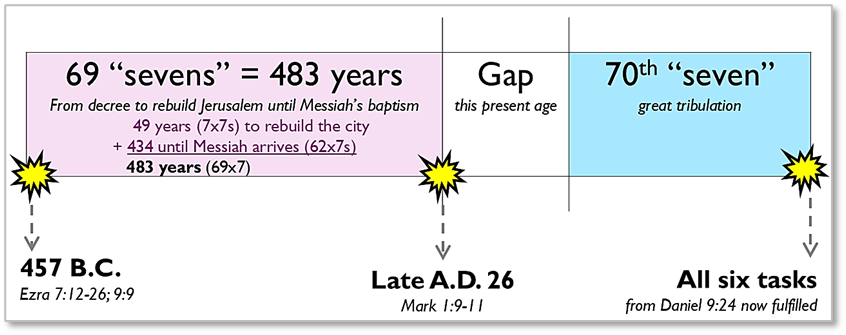
In this verse, Daniel records that 69 “sevens” will elapse from (a) a decree to restore and rebuild Jerusalem, and (b) the arrival of Messiah, the leader or prince. This “one seven = one set of seven years each” interpretation fits if we understand (a) the decree to be from the Persian ruler Artaxerxes to Ezra in 457 B.C. (see Ezra 7:11-26), and (b) Messiah’s arrival being his baptism in approximately A.D. 30. This time gap is 483 years, which Daniel records as 69 “sevens,” which means each “seven” is a set of seven years (69 “sevens” times 7 years per “seven” = 483 years).

We are now well on our way to seeing God make the six great things from Daniel 9:24 happen. The Messiah will arrive at a definite time, and no doubt the good times are about to roll … right?

The teaching video on Daniel 9:25 is here:

Daniel 9:26

The article about Daniel 9:26 is here.

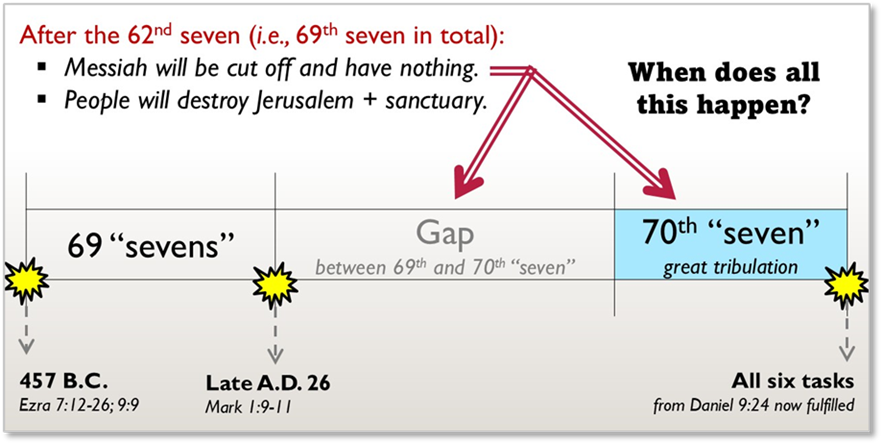
Here, things take a dark turn. Daniel tells us that, after the 62 “sevens” (that is, the second time-span which, together, comprises the total 69 “sevens” from Daniel 9:25), Messiah will be cut off and have nothing, and the prince (or, if you prefer, leader) of the people who are to come will destroy the city of Jerusalem and its sanctuary. This is terrible and puzzling news. How can the prophecy end happily (as Daniel 9:24 says it must) if things take such a horrible turn here? The Messiah dead? Jerusalem and its temple destroyed?

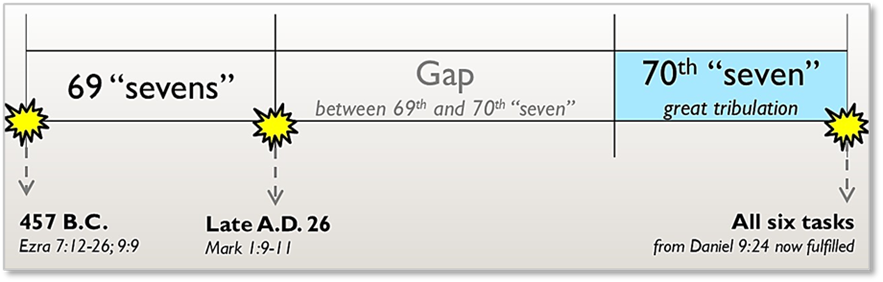
Because we already know each “seven” is one unit of seven years each, evidence strongly suggests that there is a gap of time between the end of the 69th and the beginning of the 70th “seven.” That is, the 70 “sevens” do not run consecutively. Because the 69th “seven” ended at Daniel 9:25, if the “sevens” did run consecutively, then the 70th (and last) “seven” would begin immediately after Messiah the prince arrived in A.D. 30 … which would have the entire prophecy end in A.D. 37.

This clearly did not happen. Instead, evidence suggests there is a gap in the prophecy between the 69th “seven” (at the end of Daniel 9:25) and the 70th “seven” in Daniel 9:27.

The teaching video on Daniel 9:26 is here:

Daniel 9:27

The two articles about Daniel 9:27 are here and here.

Here, at the end of the prophecy, Daniel tells us how God will make all the good things happen.

When the last and 70th “seven” begins, a mysterious and sinister figure will make a covenant with “the many” (likely the people of Israel) for one “seven.” This is the antichrist, who is described elsewhere at 2 Thessalonians 2 and Revelation 13. Some good Christians think the events in Daniel 9:27 are positive, and that Jesus is the man who makes a covenant. This is incorrect.

In the middle of this “seven” (that is, 3.5 years into this covenant), the antichrist will put a stop to all religious worship of the one true God. This appears to be the trigger for the time of relentless persecution against God’s people that Jesus describes in Matthew 24:15-28. Like a sinister shadow creeping across the land, Daniel tells us about a “wing of abomination” upon which will arrive one who makes desolate = the antichrist drops the mask and unveils his true self. This is the kingdom of darkness which the apostle John says will be destroyed at Revelation 16-18. This kingdom will endure until a complete destruction will pour forth on this evil leader.

At that time, when the antichrist is defeated, Jesus returns to establish his kingdom and usher in righteousness (Mt 24:29-31; Rev 19). That is when the six great events promised in Daniel 9:24 will be fully realized, and paradise will follow.

The teaching video on Daniel 9:27 is here:

I hope these articles and videos will shed some responsible light on a very important, very encouraging passage of prophecy. There is far too much irresponsible speculation about prophecy. I hope you find this work helpful.

Understanding Daniel’s 70 “Weeks” Prophecy (pt. 5)

Understanding Daniel’s 70 “Weeks” Prophecy (pt. 5)

We continue our look at the great prophecy of Daniel 9:24-27. Read the rest of the series.

This prophecy wraps up here, in the last bit of Daniel 9:27. It is the antichrist will make a covenant. He is the one to whom Titus Vespasianus—the conqueror and destroyed of Jerusalem in A.D. 70—pointed in Daniel 9:26 (“the people of the prince who is to come”). With whom will antichrist make this covenant and for how long? How does this prophecy end, in light of other scripture passages?

The covenant—with whom and for how long?

Gabriel tells Daniel:

And he will confirm a covenant with the many for one week, but in the middle of the week he will put a stop to sacrifice and grain offering; and on the wing of abominations will come the one who makes desolate, until a complete destruction, one that is decreed, gushes forth on the one who makes desolate (Daniel 9:27).

Who are “the many” with whom this evil ruler will make this covenant? Gabriel does not explain who the “many” are. If you believe the “he” in Daniel 9:27 is Jesus, then “the many” would be believers—members of the new covenant in Christ’s blood. But we’ve seen that this isn’t the best interpretation, so we’ll leave that aside and instead assume the antichrist makes a covenant with … someone. There are two good options:

  • Option 1: Because Gabriel told us at the beginning that this prophecy was “for your people and your holy city” (Dan 9:24), we might assume the “many” here are the people of Israel—the nation.[1]
  • Option 2: However, another option is that the “many” with whom Antichrist makes a covenant are his followers—that is, the unsaved people who desire (either because of terror or by demonic conviction) to ally themselves to antichrist in a crude imitation of Jesus’ coming kingdom.[2]

Three factors tip the scales in favor of Option 1:

  • The angel Gabriel said this prophecy was “for your people and your holy city” (Dan 9:24). This suggests the Israeli people are the focus of the prophecy.
  • The antichrist’s actions in Daniel 9:27 seem to be against the people with whom he made a covenant—they are the ones against whom he moves “in the middle of the week.” It makes little sense for the Antichrist to attack and persecute the people who are already on his side.
  • Other passages very strongly suggest there will be a period of approximately seven years during which antichrist specifically persecutes Israel (Rev 11, 13). The Book of Revelation paints these events in a dramatically figurative manner with a strong Jewish flavor (see Rev 11:1-8).

So, it seems better to understand the antichrist as making some kind of covenant with the nation of Israel. We do not know what this covenant will be about—whether it will be voluntary or coerced. The covenant may not be voluntary—the word can give the sense of the evil ruler forcing it on the basis of superior strength.[3]

Because we already learned that each “seven” = a unit of seven years, and that the first 69 “sevens” work when interpreted this way, it’s reasonable to believe this 70th “seven” is also one unit of seven years. Remember, this 70th “seven” is the last event in Gabriel’s timeline.

The scriptures often give hints of a terrible calamity during the last days, lasting for approximately seven years.

  • Revelation 11:1-13 speaks of two special, powerful witnesses for Jesus who go about Jerusalem for 1,260 days or 42 months (≈ 3.5 years), preaching and doing miracles, before a ferocious, sinister, and evil creature kills them both—the Antichrist, empowered by a “dragon” who represents Satan.
  • This antichrist/beast figure then rules in a cruel and evil manner for 42 months (≈ 3.5 years; Rev 13:1-10).
  • Combined, this is a total of ≈ seven years, which Daniel hints is characterized by (a) one half (3.5 years) of relative peace but impending danger, and then (b) 3.5 years of abject evil.

In Daniel 9:27, in the midst or middle of this covenant that lasts seven years, we learn “he will put a stop to sacrifice and grain offering.” On face value, this makes no sense—unless there is a temple (complete with a re-launched, old covenant sacrificial system) in Jerusalem at which the antichrist can put a stop to this. Many Christians in America believe it must mean this.[4] If so, there must first occur a series of events so cataclysmic that they seem implausible today:

  1. The modern state of Israel must completely change its character and become a Jewish nationalist state. This would be a big deal. Modern Israel is a very secular country.
  2. Israel must expel all Muslim structures and worshippers from the historical site of the temple in Jerusalem. This is almost too fantastic to believe—it would have to be a miracle.
  3. Israel must have sufficient military and economic resources to pull this off in the face of determined opposition—many, many, many political stars would have to align.

With God, all things are possible. God can do this if he wishes. Many Christians believe he will—this is why so many bible teachers watch Israel and Middle East politics very closely. Unfortunately, some of these teachers make absurd speculations and are poor ambassadors for their position—and for Christianity.[5] But Daniel does not necessarily mean there will be another temple operating in Jerusalem, complete with a restoration of the sacrificial system. It may only mean that worship in general is abolished and, on that interpretation, Gabriel explains this using old covenant language.[6]

Regardless—the antichrist will forcibly stop believers from worshipping the one true God.

How does the prophecy end?

The antichrist will then do two things:

  • “On the wing of abominations will come the one who makes desolate.” This probably uses the figure of an over-spreading shadow of darkness and evil (the “wing of abominations”) filling the land. This antichrist makes Jerusalem “desolate” because he has outlawed all worship of the true God—it is now an empty shell. The apostle Paul tells us the antichrist “opposes and exalts himself above every so-called god or object of worship, so that he takes his seat in the temple of God, displaying himself as being God” (2 Thess 2:4).
  • Daniel continues: “… until a complete destruction, one that is decreed, gushes forth on the one who makes desolate.” This darkness will spread across the world until the antichrist is suddenly destroyed.

This tells us that antichrist will be completely destroyed, in accordance with a decision God made long ago. In Revelation 19:20, we learn that when Jesus returns: “… the beast was seized, and with him the false prophet who performed the signs in his presence, by which he deceived those who had received the mark of the beast and those who worshiped his image; these two were thrown alive into the lake of fire, which burns with brimstone.”

Now, once Messiah returns (i.e., “the second coming”) and casts antichrist and the false prophet into the lake of fire and locks Satan away in the abyss (Rev 20:1-4), righteousness will reign and all the promises of Daniel 9:24 will come true. The 70 “sevens” end with Christ inaugurating his 1,000-year kingdom reign on earth.

  • Immediately after this millennium (“When the thousand years are completed …” Rev 20:7), Satan will be released from prison and lead a rebellion against Jesus’ kingdom, at which point God will vaporize this wicked host with a fireball from on high (Rev 20:7-10).
  • Some may protest that, because Satan will quickly find folks to join his rebellion at the end of Christ’s millennial reign, the everlasting righteousness (etc.) Gabriel promised in Daniel 9:24 could not arrived at the beginning of the millennial kingdom.
  • But this need not follow—Satan’s rebellion is put down so swiftly and so decisively that sin and wickedness will not reign or have any impact on the world. God smacks this last gasp rebellion down immediately.

So, we are left with antichrist destroyed. Other important passages tell us this happens when Jesus returns, and at that time “THE RIGHTEOUS WILL SHINE FORTH LIKE THE SUN in the kingdom of their Father” (Mt 13:43) and there will be peace on earth. The six-item list from Daniel 9:24 will be accomplished, and the Messianic reign will begin.


[1] Barnes declares “[t]here is nothing in the word here which would indicate who they were …” (“Daniel,” 182, emphasis in original), but he surely forgets that Gabriel told Daniel (9:24) the emphasis of the prophecy was the people of Israel.

[2] See, for example, H.C. Leupold, Exposition of Daniel (Columbus: Wartburg, 1949; reprint; Grand Rapids: Baker, 1969), 431-32).

[3] Joyce Baldwin, Daniel (Downers Grove: IVP, 1978), 191. “Therefore the thought is this: That ungodly prince shall impose on the mass of the people a strong covenant that they should follow him and give themselves to him as their God” (Keil and Delitzsch, Commentary, 9:736).

[4] Walvoord, Daniel, 235.

[5] Michael Svigel, a dispensationalist scholar, writes: “For some reason, the study of eschatology tends to attract a disproportionate number of—let me be blunt—hacks and quacks. End-times hacks produce mediocre, uninformed, trite work for the purpose of self-promotion or money. They ride the end-times circuits tickling ears with sensationalistic narratives, usually resting their interpretations of Scripture on current events or far-fetched conspiracy theories. Or they flood the market with cheap paperback books with red, orange, yellow, and black covers, usually repeating the same worn-out words they used in previous editions of their end-times yarns—sometimes with updates to fit their interpretations with the latest current events. Many of these hacks can be classified as end-times quacks” (The Fathers on the Future: A 2nd-Century Eschatology for the 21st-Century Church (Peabody: Hendrickson, 2024), 24).

[6] Stephen Miller, Daniel, in NAC, vol. 18 (Nashville: B&H, 1994), 272. Leupold suggests that “all organized religion and worship as offered by the church of the Lord are to be overthrown when this prince has his day” (433).

Understanding Daniel’s 70 “Weeks” Prophecy (pt. 4)

Understanding Daniel’s 70 “Weeks” Prophecy (pt. 4)

We continue our look at the great prophecy of Daniel 9:24-27. Read the rest of the series.

We come now to the last verse of Daniel’s great prophecy. This has been a long journey. If it makes you feel better, many good teachers have struggled to rightly understand this passage. The most insane discussion of which I’m aware is from a British pastor named Andrew Willett in 1622—he devoted 96 pages to answering 89 questions about the mysterious 70 “sevens”![1]  

In Daniel 9:27, there are three key questions to consider:

  1. Who is the mysterious “he” in Daniel 9:27?
  2. With whom and for how long does this guy make a covenant?
  3. How does the prophecy end?

We’ll discuss each, in turn, to wrap up this series. This article answers the first question

Who is the mysterious guy?

The bible says:

And he will confirm a covenant with the many for one week, but in the middle of the week he will put a stop to sacrifice and grain offering; and on the wing of abominations will come the one who makes desolate, until a complete destruction, one that is decreed, gushes forth on the one who makes desolate (Daniel 9:27).

We need to figure out who this person is who will “confirm a covenant with the many for one week.” Because Gabriel doesn’t use a name in Daniel 9:27 but just says “he will put a stop …,” we must look back and identify the last notable person Gabriel mentioned in Daniel 9:26. Who is it?

It is “the people of the prince who is to come” whom Gabriel last mentioned. The guy mentioned in our verse here in Daniel 9:27 doesn’t seem very friendly. He (a) confirms a covenant of some sort for one “seven” or “week” (the 70th in this vision), and (b) he stops the sacrifices and grain offering, (c) he ushers in some sinister abomination that destroys or desecrates, and eventually (d) he himself is destroyed.

So, who is this strange man who does all this? Many good bible teachers have suggested many options. We’ll focus on three common possibilities, one of which we can dismiss immediately:

  • Option 1: The man in Daniel 9:27 is the Roman general Titus Vespasianus, whom we met in Daniel 9:26, who will destroy the temple and Jerusalem in 70 A.D. Daniel 9:27, the argument goes, is still about what happened in 70 A.D. at the end of the First Jewish War.[2]
  • Option 2: The guy is Jesus.
  • Option 3: The antichrist—the evil ruler who is to come (2 Thess 2; Rev 13).

We can dismiss Option 1 straightaway—the six-item summary of the entire prophecy at Daniel 9:24 ends with paradise regained. But Option 1 leaves us stranded at halftime with no resolution, no eternal righteousness, no removal of sin, no closure. This option is wrong.

Option 2 is more interesting. This is how the argument goes:

  • Jesus establishes or (some say) re-affirms the covenant with his church—that is, the new covenant that the prophets said would one day arrive (Ezek 36:25; Jer 31). He would establish “true religion.”[3]
  • So, they assume, Jesus “put a stop to sacrifice and grain offering” in the sense that he made the old covenant sacrifices obsolete (Heb 8:1-13; Mt 27:51).
  • And, following on from that great event, they believe the “abominations” are the manner in which the Roman armies profaned the temple sanctuary by destroying it.

Further, these same Christians also believe the “he” in Daniel 9:27 cannot be the antichrist because:

  • It is the “people of the prince who is to come” in Daniel 9:26 who will destroy the temple and its sanctuary—an event we now know happened in 70 A.D.
  • In Daniel’s day this was all in the future. The people who did this (the Romans) belonged to a particular prince or leader (the Hebrew word can mean either one). And, that leader was the Roman general Titus Vespasianus.
  • So, that whole discussion was over by the end of Daniel 9:26—that verse spoke about Titus Vespasianus, and that subject is finished.
  • So, Daniel 9:27 must be about a different guy—a guy like Jesus the Messiah.

But this is not best way to understand the passage.[4] Option 3 is the way. There are a few good reasons why:

  • First, the guy at Daniel 9:27 seems very unfriendly.
  • Second, the length of this 70th “seven” ought to match those of the other 69 “sevens.”
  • Third, the last guy Gabriel mentioned was the coming leader whose people will destroy the temple (Dan 9:26)— the Roman general Titus Vespasianus foreshadows the antichrist to come.

The two emphases are very different. The NASB (et al) sees this leader take a dark turn sometime after he confirms the covenant. The ESV (et al) just sees another event following it. There is no “right way” to render the conjunction—context must decide. But, it’s enough for you to know that many solid bible translations understand Daniel 9:27 to be describing something very bad.

Second, the length of this 70th “seven” ought to match those of the other 69 “sevens.”

  • If this last and 70th “seven” is only a symbolic number, then why does God specifically say this person will abolish the sacrificial system in the middle of the week? It is difficult to understand why God would give specifics if the time-period is symbolic.
  • Christians who take this approach really struggle to make this last “seven” make any consistent sense. One bible teacher admitted this was “the most embarrassing portion of the prophecy” because he could not find a good solution.[5]
  • There are no crazed beasts (Dan 2, 7), flying scrolls, women in pots, or storks carrying a wicked woman off to the far East here (Zech 5) that suggest this passage is figurative language. When we see that stuff elsewhere, we know it isn’t painting reality in “normal” hues. But that isn’t happening here—this is normal language. This suggests we ought to understand the language in a normal, straightforward way.
  • Also, we ought to interpret the “sevens” consistently throughout this passage. We’ve already seen that the interpretation that understands “one seven = one set of seven years” makes the best sense of the evidence. So, this “70th seven” ought also to be understood as a period of seven years. This suggests the evil leader (the antichrist) will establish a covenant that lasts seven years (i.e., the 70th “seven”).
  • John Gill, the great Baptist pastor, agreed. It cannot be the Messiah at Daniel 9:27, he argued, “for this is not for one week only, but for ever.”[6] Messiah rules forever, not for one “seven” only!

Third, the last guy Gabriel mentioned was the coming evil ruler whose people will destroy the temple (Dan 9:26), so the antichrist sounds like our guy.

  • The way language works is that we identify unnamed people, like the mysterious “he” in Daniel 9:27, by two methods: (a) identifying the most recent name just mentioned, or (b) looking back at the most prominent name featured in the paragraph or text cluster which came immediately before.
  • In this case, the most recent and prominent person is the “prince who is to come” whose people destroy Jerusalem and its sanctuary (Dan 9:26). This suggests the mysterious “he” is the Antichrist.[7]
  • There are clear bible passages that tell us that a sinister, dark figure will emerge in the last days who will demand divine worship and persecute God’s people.[8] This man of lawlessness will only be destroyed when Jesus returns (see 2 Thess 2; Rev 13; cp. Mt 24:15-31, 1 Thess 4:13-17). Because we know to expect this evil man, it makes sense to see him foretold in our passage here—this is why Jesus explicitly references Daniel 9:27 (in Mt 24:15) and tells us to pay close attention to this very prophecy!

As I mentioned, some bible teachers object that “the prince/leader” in Daniel 9:26 is clearly Titus, so it cannot be the antichrist.[9] True, the most obvious historical referent is the Roman general Titus Vespasianus in 70 A.D., but it’s reasonable to believe he just foreshadows the true evil kingdom that will come in the last days. The prophecy of the crazed, fearsome beast in Daniel 7 suggests the fourth great pagan kingdom in God’s timetable, that of “Rome,” will exist in three phases.[10]

  • Phase 1: The old Roman Empire under whose jurisdiction Jesus and Pontius Pilate lived (Dan 7:23).
  • Phase 2: Sometime after Jesus’ day, a splintered remnant that has divided into various pieces (the “10 horns” of the scary fourth beast, Dan 7:23-24).
  • Phase 3: A powerful king who will arise from among the splintered bits of Phase 2 (Dan 7:24-26).

It is this third phase which the antichrist represents. Jesus himself, in Matthew 24:15-28, seems to shade two calamitous events—the destruction of the city and temple in 70 A.D. and the antichrist’s reign of terror during the last days—together in the telling. Trustworthy bible scholars and teachers of every stripe recognize this—just look at any study bible you have lying about and see for yourself! Just as David’s life and standing is a shadowy reflection that points to Jesus, so too does Titus point to the antichrist in this sense.

If true, then (a) Titus does not exhaust the meaning of “the prince/leader who is to come” at Daniel 9:26, and (b) antichrist is just as much a leader of “Rome” as Titus—he just operates in a different phase of that pagan kingdom.

We tackle the remaining two questions about Daniel 9:27 in our next (and final) article.


[1] Andrew Willett, Hexapla in Danielem (Cambridge: Legge, 1622),264-360.

[2] This is John Gill’s argument (Exposition of the Old Testament, 6:346-47), and that of Matthew Henry, Matthew Henry’s Commentary, 6 vols. (reprint; New York: Revell, n.d.), 1094-95.

[3] Albert Barnes, “Daniel,” in Barnes’ Notes, vol. 7 (reprint; Grand Rapids: Baker, 1998), 182.

[4] “Ultimately, the question facing every expositor is what interpretation gives the most natural and intelligent exposition of the text” (John Walvoord, Daniel: The Key to Prophetic Revelation (Chicago: Moody, 1971; reprint, 1989), 234).

[5] Barnes, “Daniel,” 183. In desperation, Barnes suggests this last “seven” consists of (a) Jesus’ ≈ 3.5-year ministry, and (b) the apostle’s ministry of “about” 3.5 years (183-85). This is absurd. Does this mean that the new covenant ended 3.5 years after Jesus’ death!?

[6] Gill, Exposition of the Old Testament, 6:346 (emphasis added). I admit that Gill disagrees with my larger position, but everyone disagrees with everyone about how to interpret Daniel!

[7] Edward Young argues mightily that the true antecedent is not the prince but the people, because they are foremost in Gabriel’s mind as he relates the prophecy. This is not taken seriously by any commentator I’ve read, but it is the best attempt I’ve seen to evade the obvious in this passage and it is rhetorically persuasive.

[8] Irenaeus, Against Heresies, 5.25.

[9] Young, Daniel, 208-13. His is the best argument of which I’m aware for the “he = Christ” perspective in Daniel 9:27.

[10] Young, Daniel, 147-50. He is excellent, here.

Understanding Daniel’s 70 “Weeks” Prophecy (pt. 3)

Understanding Daniel’s 70 “Weeks” Prophecy (pt. 3)

We continue our look at the great prophecy of Daniel 9:24-27. Read the rest of the series.

As we march onward in our study of Daniel 9:24-27, we’ve arrived at Daniel 9:26. What happens after the 69th “seven”? That is, after Daniel 9:25? There is still one “seven” left, and a lot of stuff still to be fulfilled from the six-item list Gabriel revealed in Daniel 9:24. As the prophecy goes on, in Daniel 9:26, two key events happen:

  1. The Messiah will be “cut off,” and
  2. “the people of the prince who is to come” will destroy Jerusalem and its temple.

Let’s look at these one at a time.

Messiah and the “gap” between “weeks” 69 and 70

Then after the sixty-two weeks, the Messiah will be cut off and have nothing, and the people of the prince who is to come will destroy the city and the sanctuary. And its end will come with a flood; even to the end there will be war; desolations are determined (Daniel 9:26).

When will the Messiah be “cut off and have nothing”? What does it mean? Considering the bible’s whole story, it seems to suggest Messiah’s death:

He was despised and abandoned by men, A man of great pain and familiar with sickness; And like one from whom people hide their faces, He was despised, and we had no regard for Him … By oppression and judgment He was taken away; And as for His generation, who considered that He was cut off from the land of the living, for the wrongdoing of my people, to whom the blow was due? (Isaiah 53:3, 8).

Jesus was despised, rejected, and abandoned—he had nothing. Then he was “cut off”—the Romans executed him. According to Daniel 9:26, this will occur “after the sixty-two weeks …” Remember, there are two sets of “sevens” in Daniel 9:25—(a) seven “sevens,” and then (b) 62 “sevens. The Messiah’s death happens after this second set—the 62 “sevens,” like this:

So, while the phrasing is awkward, it seems that the Messiah’s death will happen after the 62 “sevens,” which means after the 69 “sevens.[1] However, because the 70th “seven” will not begin until Daniel 9:27 (“And he will confirm a covenant with the many for one week …”) it seems there is a “gap” of time here between the 69th and 70th “seven.” If there is no gap, then the 70th “seven” happens immediately—the Messiah dies during the 70th “seven,” because it happened after the 69th “seven.

Figure 2. In which “week” does Daniel 9:26 and Messiah’s death occur?

Evidence suggests there is a gap between “weeks” 69 and 70 because of this chain of logic:

  • Because the evidence for the first 69 “sevens” suggests each “seven” is a set of seven years, we are obligated to see the 70th “seven” as also being a set of seven years.
  • Because Messiah was “cut off” after the 69th “seven,” we might assume this happened during the 70th “seven.”
  • If true, then Jesus was “cut off” at his crucifixion in ≈ A.D. 30.

But …

  • This would mean all six tasks in Daniel 9:24 (“Seventy weeks have been decreed for your people and your holy city …”) must take place within seven years of Messiah being “cut off” (A.D. 37-ish)—which must be the case if the 70th “seven” truly followed right on the heels of the 69th.

In other words, if there is no gap between the 69th and 70th seven, then …

  • Because each “seven” is seven years,
  • and the 70th “seven” begins with Jesus’ death in ≈ A.D. 30 (when he is “cut off”),
  • then the 70th “seven” would have ended in ≈ A.D. 37,
  • and so all six promises from Daniel 9:24 would have to be fulfilled by A.D. 37.

That did not happen! So, there must be a gap between the 69th and 70th “seven.” Bible-believing interpreters who do not account for this gap are left with an impossible dating problem. So, they are generally forced to take one of two options:

  • Option 1: Push the entire thing backwards and make the sinister figure at Daniel 9:27 the wicked Syrian king Antiochus Epiphanes IV, who ruled in the early 2nd century B.C. (read about him in 1 Maccabees 1).[2]
  • Option 2: Make the mysterious ruler at Daniel 9:27 be Jesus and wrap the entire prophecy up with Jesus’ ascension to heaven.

Neither of these make the best sense of a straightforward reading of the bible. The “gap” between the 69th and 70th “seven” seems to be the best solution. If true, then the 70th “seven” doesn’t begin until the events of Daniel 9:27, which is yet future. I can’t yet make a full case for the “gap theory” of the 70th “seven” until we wrestle with Daniel 9:27, and that must wait for the next article.

The mystery prince

We now turn to the second event from Daniel 9:26:

Then after the sixty-two weeks, the Messiah will be cut off and have nothing, and the people of the prince who is to come will destroy the city and the sanctuary. And its end will come with a flood; even to the end there will be war; desolations are determined (Daniel 9:26).

The word translated as “prince” means leader, ruler, or a male sovereign other thanthe ruling king (i.e., “the prince”). This means that some ruler will come along one day, whose people will destroy Jerusalem and the temple the Jewish people just re-constructed in Daniel 9:25—the tale told to us in the books of Haggai, Ezra, and Nehemiah.

Well, this makes identification pretty simple—who destroyed Jerusalem (“the city and its sanctuary”) and when did they destroy it?

Daniel says it was “the people of the prince who is to come(Dan 9:26) who will destroy Jerusalem and its sanctuary. Because the Roman army later destroyed this very city and that very temple in A.D. 70 (some ≈ 600 years after Daniel wrote this prophecy), this means our “prince” in Daniel 9:26 is somehow connected to the Roman empire—which Daniel 7 suggested will exist in three phases.[3]

  • Phase 1: The old Roman Empire under whose jurisdiction Jesus and Pontius Pilate lived (Dan 7:23).
  • Phase 2: Sometime after Jesus’ day, a splintered remnant that has divided into various pieces (the “10 horns” of the scary fourth beast, Dan 7:23-24).
  • Phase 3: A very powerful king who will arise from among the splintered bits of Phase 2 (Dan 7:24-26).

History tells that a Roman general (and later emperor) named Titus Vespasianus destroyed Jerusalem during the First Jewish War,[4] when the Roman empire was still intact in its original form (Phase 1, above). This will be a nasty finish to a brutal war. Gabriel tells Daniel: “… its end will come with a flood; even to the end there will be war; desolations are determined” (Dan 9:26). Now, on the other side of this event, we know that God brought this judgment on his people in A.D. 70 because they rejected the Messiah and Savior whom he sent to rescue them.

The Roman (and Jewish) writer Josephus tells us what happened to Jerusalem when the Romans destroyed it. He knows, because he was there that day.

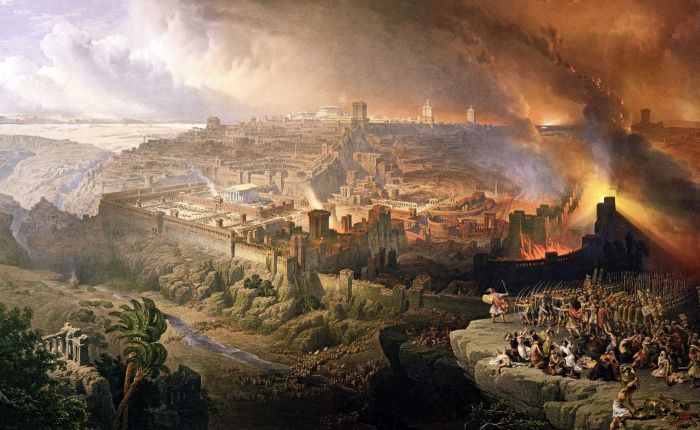
There was no one left for the soldiers to kill or plunder, not a soul on which to vent their fury; for mercy would never have made them keep their hands off anyone if action was possible. So Caesar now ordered them to raze the whole City and Sanctuary to the ground … [a]ll the rest of the fortifications encircling the City were so completely leveled with the ground that no one visiting the spot would believe it had once been inhabited. This then was the end to which the mad folly of revolutionaries brought Jerusalem, a magnificent city renowned to the ends of the earth.[5]

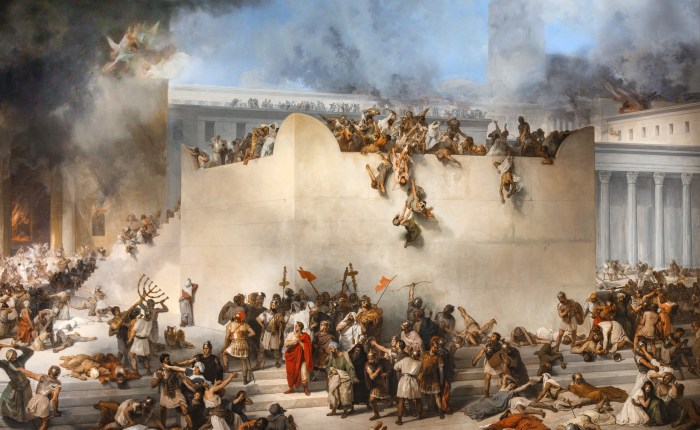
Josephus tells of one Jewish woman named Mary, driven mad by hunger, who killed her infant son, roasted him, ate one half of him and saved the rest for later[6] (cp. Deut 28:53-57). The temple itself was destroyed by fire in a frenzy of rage by Roman legionnaires who ignored their commander’s orders.

All the prisoners taken from beginning to end of the war totalled 97,000; those who perished in the long siege 1,100,000 … No destruction ever wrought by God or man approached the wholesale carnage of this war.[7]

This must be very hard to hear and understand. We wonder what Daniel thought when he heard this news!

  • Daniel asks for assurance from God that he will set everything right (Dan 9:3-19)
  • God sends the angel Gabriel to say that he will make it right (Dan 9:20-23).
  • In fact, things will be set so right that the six-item list at Daniel 9:24 shows us paradise restored.
  • This shakes out with (a) Jerusalem being rebuilt, and then (b) Messiah the prince arriving on the scene (Dan 9:25). This will take 69 “sevens” to happen, but it’ll happen.

Everything sounds great. But then, after the 62nd “seven” (i.e., 69 “sevens” in total):

  • The Messiah will be cut off and have nothing (Dan 9:26).
  • Jerusalem and its (as yet) un-rebuilt temple will be totally destroyed (Dan 9:26)!

This is a shock. What can it mean? Why will it happen? Why this bizarre reversal? Who is this mysterious prince who is to come? At this rate, Daniel may be thinking, the glorious six-item promise list from Daniel 9:24 seems far, far away. Clearly this is a one step forward, two steps back kind of thing. What is the endgame, here?

Evidence suggests there will be a long series of events after Messiah’s arrival at his baptism at Daniel 9:25 (the end of the first 69 “sevens”), and before the 70th “seven” begins in Daniel 9:27.

  • At least one of those events will be Messiah’s seeming abandonment (“have nothing”), and his execution by Roman soldiers (“be cut off”).
  • Another event will be the destruction of the rebuilt temple and the city of Jerusalem by the people of the Roman ruler who will come on the scene (Dan 9:26)—the general Titus, who indeed razed the city in A.D. 70.
  • This “intermission” seems to best explain the “gap” between the 69th and 70th unit of seven years in the prophecy.

Nevertheless, in our next article on Daniel 9:27, the angel Gabriel tells us how God plans to make good on his six-item list of promises.


[1] John Gill: “To be reckoned from the end of the seven weeks, or 49 years, which, added to them, make 483 years” (Exposition of the Old Testament, 6:346). Stephen Miller writes: “After the reconstruction of Jerusalem in the first seven sevens (forty-nine years), another ‘sixty-two sevens’ (434 years) would pass” (Stephen R. Miller, Daniel, vol. 18, in New American Commentary (Nashville: B&H, 1994), 267).

[2] This is why Moses Stuart, an outstanding American bible scholar from the early 19th century, remarks: “The third period (one week) of course begins with the same excision of an anointed one, and continues seven years, during which a foreign prince shall come, and lay waste the city and sanctuary of Jerusalem, and cause the offerings to cease for three and a half years, after which utter destruction shall come upon him, vs. 26, 27” (Daniel, 274; emphasis added). Stuart does not consider the possibility of a gap between the 69th and 70th “seven.”

[3] Young, Daniel, 147-50. He is excellent, here.

[4] See this video for free background.

[5] Josephus, The Jewish War, trans. G.A. Williamson, rev. ed. (New York: Penguin, 1969), 7:1 (361). Chrysostom suggests, “And let not any man suppose this to have been spoken hyperbolically; but let him study the writings of Josephus, and learn the truth of the sayings. For neither can any one say, that the man being a believer, in order to establish Christ’s words, hath exaggerated the tragical history,” (“Homily 76,” in NPNF 1.10, 457).

[6] Josephus, The Jewish War, 6:199-219 (341-342). 

[7] Josephus, The Jewish War, 6:420f. See ch(s). 13-21 (i.e., 3:422 – 6:429).