A Prayer for the King

A Prayer for the King

We sometimes see Jesus’ mission as just personal salvation—a golden ticket away from a sinking ship. Christmas then becomes a celebration about the ticket going on sale for those who want it. In Psalm 72, Solomon shows us a Christmas vision that includes personal salvation, but is so much bigger than that.

Solomon wrote this psalm.[1] Like many Old Testament texts about the king of Israel, it operates on two levels. First, Solomon writes a prayer for his own son, Rehoboam. That didn’t work out so well (see 1 Kgs 12; 2 Chr 10). But, on a deeper level, this is also a wish for what the real king of Israel should be like. We’ll focus on the second level in this article. The first verse captures Solomon’s plea, and the rest of the psalm is an elaboration on that wish.

Endow the king with your justice, O God, the royal son with your righteousness.

Psalm 72:1

Solomon wants the king to embody justice or right judgment—the insight to do the right thing. We like that quality. There’s a reason why politicians run as so-called “outsiders” who are “untainted” by the Washington swamp (etc., etc.). In his 1976 presidential campaign, Jimmy Carter famously pledged “I’ll never lie to you!” We like to believe in people who claim they’ll do “the right thing,” who claim to be “good people” in contrast to the “bad” folks now in power.

Of course, we all have different ideas of what the “right thing” is! So, Solomon asks God to endow His king “with your righteousness.” God’s king is all about God’s values, God’s righteousness. But, what are His values? We might be quick to answer in terms of “moral codes,” but Solomon never mentions those at all. We’ll return to this soon.

Now we see a series of prayers. When God’s people looked forward to a good king (“the royal son”), what did God teach them He’d be like?

May he judge your people in righteousness, your afflicted ones with justice.

Psalm 72:2

He’ll judge His people “in righteousness,” which means He judges the right way, all the time. He makes sure justice is done. No courts, no trials, no deliberations, no mistakes. The state of Oklahoma just released a man who served 48 years in prison for a murder he didn’t commit.[2] In contrast, the true king will judge God’s “afflicted ones with justice.”

Who are these “afflicted ones”? These are the “small people.” The hurting, the struggling, the people who are tired, at the end of themselves, without hope. This royal son—the king of the world to come—will vindicate everyone who is afflicted because of injustice (in any form). He’ll set things right—especially for the “forgotten people” of this world.

This is the first hint that Solomon’s vision of the king’s mission is bigger than individual salvation. He continues:

May the mountains bring prosperity to the people, the hills the fruit of righteousness.

Psalm 72:3

This isn’t a wish for some crude prosperity gospel, but a longing for a better time when the king fixes us and this world. The agricultural references are just a metaphor for “good times.” In 1984, President Ronald Reagan famously said it was “morning in America!”[3] Well, here Solomon says “it’ll be morning in paradise when the king is here!”

What will happen when the morning comes? What will this “new day” look like? Rather than well-meaning moralism, Solomon describes a much more comprehensive renovation:

May he defend the afflicted among the people and save the children of the needy; may he crush the oppressor.

Psalm 72:4

Eternity will not involve sitting on clouds in heaven. Instead, Solomon prays for a future in which the king does justice on a renovated earth. What would this world look like if:

  1. The king defended the afflicted? If he was on the side of those who are hurting and have no advocate? No voice? No hope? No power? Nobody caring about them once they have their vote?
  2. The king rescued (cp. LXX) the children of the poor? A local elementary school just contacted our church asking if we would help stock a food pantry of sorts it was organizing for kids who didn’t have enough food at home. One day this problem will be over.
  3. The king crushed the oppressors? These are the folks who move the levers of power in oppressive, unholy directions—not just cartoon villains, but also the faceless drones who aid and abet unholy policies that have oppressive effects downstream. God will rip them down from their lofty perches! This was Mary’s prayer as an afflicted and hurting poor woman in a rural town—she wanted the Messiah to fix the injustice in this rotten world (Lk 1:52-55).

After prayers for this king’s reign to never end and to be like water to a parched land (Ps 72:5-7), Solomon shows us the breadth of this king’s reign:

May he rule from sea to sea and from the River to the ends of the earth.

Psalm 72:8

The realm will extend over the whole earth, “from sea to sea.” Solomon assembles the most exotic cast of characters his geographic frame of reference could conjure to stress this point. Nomads from the deserts, kings from Tarshish “and of distant shores,” and heads of state from Seba and Sheba (perhaps modern-day Yemen)—they will all come to Jerusalem to pledge allegiance to the true king. They’ll “lick the dust” and prostrate themselves before Him. They’ll bring tribute and presents. They’ll bow down and serve Him (Ps 72:9-11).

The New Testament writers often focus on salvation, on personal rescue from Satan (“save yourselves from this corrupt generation!” Acts 2:40). Solomon would surely agree, but in this psalm he takes a larger view. He doesn’t mention salvation at all. So, why will the nations come to the king? Why will people from exotic, faraway lands come to worship God’s royal son as the king of the world? What’s the hook? What’s the attraction? What’s the selling point?

The answer is surprising:

For he will deliver the needy who cry out, the afflicted who have no one to help. He will take pity on the weak and the needy and save the needy from death. He will rescue them from oppression and violence, for precious is their blood in his sight.

Psalm 72:12-14

The nations will come to the king because (“for”) He rescues the weak, the needy, and the afflicted. These are likely the same people under cover of three names. They are the lowly, the poor in spirit (Mt 5:3). Not just the “lower classes,” but more “the hurting classes”—the struggling, the “little people,” the working class, the oppressed.

The nations will come because this king rescues. Because He has pity. It isn’t salvation at the barrel of a gun, or salvation by escape from this world. It’s a salvation whose draw, whose hook, whose attraction is pity for the hurting, and rescue for the oppressed. In short, a king who promises to fix us and this world. This includes personal salvation, but is also so much more than that.

Why will the king do this? Because our lives matter to Him (“for precious is their blood in his sight,” Ps 72:14). Because He cares about us. Because He wants to help us. Because He loves us—especially when we don’t love Him back.

Near the end of the psalm, Solomon exclaims “Long may he live! … May his name endure forever; may it continue as long as the sun,” (Ps 72:15, 17). He then writes this beautiful line:

Then all nations will be blessed through him, and they will call him blessed.

Psalm 72:17

This is an echo of God’s promise to Abraham and His special descendant, so long ago (Gen 12:3; cp. Gal 3:16). God swore that Abraham would somehow be the channel for God’s blessing to the whole world. But, who is it referring to here?

To Jesus.

Abraham is that channel to the world—through Jesus, His descendant (Mt 1:1; Gal 3:16). Christmas is indeed about individual salvation and rescue, but the Savior’s mission isn’t just to give us a ticket on a fast train to Georgia before this whole thing burns up. Solomon knew that. He knew that God’s true royal king would bless the nations of the world through the message He brought. A message about Himself, about rescue from prison, about liberation from Satan—the spiritual kidnapper.

When King Jesus rescues us, He gives us a place in the renovated world that’s coming. A world where justice will be done and things will be set right. Where the weak, the needy, and the afflicted will be defended, where the oppressed will see justice done, where the oppressors will be crushed and punished—all according to God’s definition of righteousness, not ours.

The third stanza of the song “O Holy Night!” reflects much of Solomon’s emphases:

Truly He taught us to love one another; His law is love and His gospel is peace. Chains shall He break, for the slave is our brother, And in His name all oppression shall cease. Sweet hymns of joy in grateful chorus raise we; Let all within us praise His holy name. Christ is the Lord! O praise His name forever! His pow’r and glory evermore proclaim! His pow’r and glory evermore proclaim!

O Holy Night! (third stanza)

‌Brotherly love. The good news of peace on earth. Broken chains. Oppression vanquished. Songs of grateful praise. It’s beautiful. Surprisingly, the song was written in 1847 by an atheist Frenchman. He wrote it as a favor to a friend who was a local priest. He did his background research by studying the Gospel of Luke.

‌I wonder if the author ever fully appreciated the beautiful truths he wrote about so movingly. It’s the same story Solomon knew, and the same one that faithful Christians still celebrate today. Christmas is the story of a Savior who has come to rescue and renovate us and our world, so that justice can be done on earth, so we can be with Him forever. And the Christmas message is that anyone who turns to God, through Christ, will be rescued and given a place in His family, and in the better tomorrow that’s coming.


[1] Or, maybe not. The LXX subscription reads “To Solomon,” which leads some to speculate that David wrote the psalm for Solomon.

[2] Jesus Jiminez, “Man Cleared of Murder After More Than 48 Years in Prison.” NY Times. 20 December 2023. https://www.nytimes.com/2023/12/20/us/glynn-simmons-exoneration-oklahoma.html?smid=url-share.

[3] See https://youtu.be/pUMqic2IcWA?si=GPPgSgaxwrzO76oD

Good book on preaching the psalms

Good book on preaching the psalms

In his splendid book, How to Preach the Psalms, Kenneth Langley’s burden is not to teach you how to interpret the psalms. Plenty of folks have already done that. Nor is it about exegesis―there are already far too many guides to what Abraham Kuruvilla maligns as a “hermeneutic of excavation.”[1] Instead, Langley’s aim is to help pastors preach the psalms as the literary treasures they are.[2]

Langley explains that, early in his ministry, he avoided preaching the psalms. They were too raw. Too emotional. Perhaps even unsuited to preaching.[3] When he tried his hand at the genre, he felt like a failure. It was flat. Stale. Cold. Something was missing. “I had been faithful to the meaning of the Psalms, but their emotion, imagination, and aesthetic appeal never quite made it into the sermon. I had not captured the poetic essence of these texts.”[4]

It is this disconnect that Langley seeks to bridge. It is a well-earned cliché that newly-minted seminary graduates will be poor preachers for several years. We may be able to discuss verbal aspect theory vs. traditional tense form. We might point with pride to our dense syntax analysis of Psalm 1. But, can we communicate truth as the psalm presents it? Or, do we deliver stale, scholastic ice for 45 minutes? “Many preachers have felt the force of this argument. We remember with embarrassment sucking the juice out of a psalm and then preaching a shriveled rind of a sermon.”[5]

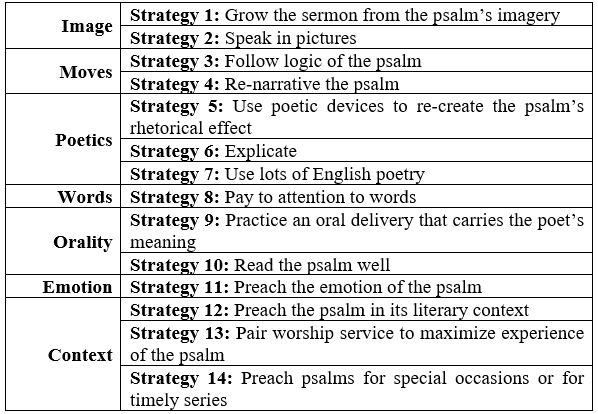
Langley divides his suggestions into seven categories encompassing 14 “strategies:”

Figure 1. Langley’s strategies for preaching psalms

Buy the Book

Each strategy is very practical; there are no ivory towers here. In style and feel, this little book greatly resembles H.B. Charles’ On Preaching.[6] The chapters are short, the advice punchy, the content extraordinarily practical.

I see two reasons why Langley’s book is needed more than ever. The first is that pastors, like many people, read less than they used to. I am skeptical one can “teach” a feel for genre, style, mood, tone, or the implicit force of a text. This knowledge only comes from years of reading fiction, history, biography, prose, poetry―from reading a lot. Aside from a curious mania for Narnia and Tolkien (both massively overrated!), too many Christians read far too little. This means their interpretive abilities are often stunted. It also means pastors may give lip-service to tone and implicit feel,while happily crushing a psalm into a didactic mold. “This sucks the life out of a poem.”[7] But, if we consciously stop, think, and make the poem real to us, there is hope we can go beyond a deductive outline.

The reason why Langley’s little book is so valuable is that it teaches pastors to interpret, frame and present poetry differently. “The psalms do not open their treasures to preachers who insist on treating them like epistles or theological arguments.”[8] This is the great tragedy―because so few of us can escape this trap. We want to excuse away Job 23, and we are uncomfortable with the raw emotion of Psalm 109. We are addicted to the “audiobook commentary” style of preaching championed by John MacArthur, who not only epitomizes the “hermeneutic of excavation,” but actually built the excavator.

Using the Book

I will illustrate this book’s usefulness by relating some anecdotes from a recent sermon I did on Psalm 113. I preach through the psalms on Wednesday evenings. We meet in people’s homes, not in the building, which means this is a cozy, intimate setting―sitting in a circle on chairs and couches, with a cat or two purring in someone’s lap. These sermonettes usually last 15 minutes, give or take.

Strategy 3 tells me to follow the logic of the psalm. I followed Fred Craddock’s advice and did not declare “the point” of the psalm at the beginning and then deductively “prove it.” I quickly advanced through vv.1-3, which is a plain vanilla declaration of praise to God. I did not linger to explain why we ought to praise Him. If I had done that, I would have robbed the psalmist, because he was about to do that for me.

The setup is in vv.4-6, which emphasizes how “high” and mighty God is. Above the nations. Above the heavens. Seated on high, gazing down on little people like us, far below. If I had read Langley before 11 November 2021, I would have stressed the gulf between heaven and earth forcefully so as to make people think, “Well, He’s too important for the likes of me and my problems!”  

The mind-blowing moment is in vv.7-9, where we see that, despite His great heights, God cares. He cares enough to notice and help the most powerless, most vulnerable people in society. There is no partiality or favoritism. The God who is so high loves to stoop so low, for His people. Now, when the psalmist repeats His command to “praise the Lord,” it really means something. The psalm is precious because it shows us that the God of Isaiah 6 cares about you― especially you.

Strategy 4 tells me to re-narrative the psalm. Christians in 2021 cannot really connect with the “poor” and the “barren woman” in the way the psalmist intended. These are the most powerless people, the most vulnerable. Who are these people, in today’s society? What about that fellow in your church who works an unskilled job for a multi-billion corporation, makes little money, is in poor health, and is in debt? He is exploited by a billion-dollar juggernaut for pathetic wages, in constant fear of losing his position to other poor unskilled workers. He is disposable, and the corporation knows it. He is the product of a cultural system that has locked him into a cycle of poverty.[9] He is the powerless believer, crushed by forces he cannot understand.

Yet, God looks down from the commanding heights, raises him from the dust and sits him alongside princes. He cares about him. He really cares. Of course, the Torah does not envision crushing debt and poverty lasting longer than seven years (Deut 15:1-11), but real life is cruel. There is perhaps a subtle rebuke here to the wickedness of a society that permanently crushes its most vulnerable members. “The preventable decimation of the people is social murder.”[10]

In this fashion, Langley’s strategies can make a psalm sing. He can help you communicate reality in Psalm 113, rather than another stale lecture about providence. It is an excellent book.


[1] Abraham Kuruvilla, A Manual for Preaching (Grand Rapids: Baker, 2019), p. 7. “[W]e preachers are consumed with what is best labeled a ‘hermeneutic of excavation’ and have been trained to shovel up loads of dirt, boulders, potsherds, arrowheads, and fishhooks. We dump it all on our desks. Everything in the text, it seems, is equally important and crucial, and there is hardly any discriminating inference or integration that leads to an understanding of what the author is doing—the theology of the pericope. Like cows at pasture, we munch on every available blade of grass, and commentaries abundantly furnish those pieces of herbage for our consumption.”

[2] Langley observed, “It seems to me that what preachers need is more of what Tom Long did in Preaching and the Literary Forms of the Bible (Fortress, 1989) and Jeffrey Arthurs did in Preaching with Variety (Kregel, 2007). Long steered preachers in the direction of genre-sensitive preaching ‘based on the relatively simple idea that the literary dynamics of a biblical text can and should be important factors in the preacher’s navigation of the distance between text and sermon.’ His chapter on Psalms is the seed from which the present book has grown …” (Kenneth Langley, How to Preach the Psalms (Dallas: Fontes, 2021), p. 13).

[3] “I was almost prepared to agree with Donald Gowan that the psalms do not want to be preached, that they are speech directed toward God and do not adapt well to speech directed toward the church,” (Langley, Psalms, p. 15).

[4] Ibid, p. 15.  

[5] Ibid, p. 16.  

[6] H.B. Charles, Jr. On Preaching: Personal & Pastoral Insights for the Preparation & Practice of Preaching (Chicago: Moody, 2014).  

[7] Langley, Psalms, p. 46.  

[8] Ibid, p. 51.  

[9] Walter Rauschenbusch writes, “Our national optimism and conceit ought not to blind us longer to the fact. Single cases of unhappiness are inevitable in our frail human life; but when there are millions of them, all running along well-defined grooves, reducible to certain laws, then this misery is not an individual, but a social matter, due to causes in the structure of our society and curable only by social reconstruction,” (Christianity and the Social Crisis (New York: MacMillan, 1907; reprint: CrossReach, n.d.), p. 63).

[10] Ibid, p. 62.  

On preaching the Psalms

On preaching the Psalms

Here’s an excerpt from Kenneth Langley, How to Preach the Psalms (Dallas: Fontes Press, 2021), p. 20:

… most of us intuitively bring this genre sensitivity to our reading of Scripture. We do not read Proverbs the same way we read the Decalogue. We do not expect narrators to argue like the book of Hebrews, or Hebrews to tell a story like Ruth. We do not interpret apocalyptic the way we do Acts, or read psalms the way we read parables. When we encounter the words, “you shall not,” or “the kingdom of God is like,” or “the word of the Lord came to me,” or “Paul, a servant of Jesus Christ,” we recognize cues that what follows is to be read as legal material, parable, oracle, and epistle. And it’s a good thing, too. We could never understand what God says in the Bible unless we had learned to read different kinds of literature differently. Genre-sensitivity is an essential part of reading competence.

Unfortunately, we do not always preach Scripture the way we read Scripture. The genre-sensitivity with which we approach the varied forms of biblical literature is shelved when we craft sermons on those forms. We make the sophomoric mistake of thinking that when you paraphrase a poem you have said the same thing in different words. What we read in the study is, “The Lord is my Shepherd.” What we say in the pulpit is, “God can be counted on to provide for his people.” And we do not realize that the sermon has not said what the text says. The affective, imaginative, and aesthetic appeal of the original line is forgotten, down the hall in our study.

What has probably happened is that we have learned to preach just one genre of sermon. We have grown comfortable with a preaching form that works well with, say, epistolary material, and then tried to make that form work for every genre of Scripture. Sermons on proverbs sound like sermons on Philippians; sermons on psalms sound like sermons on Luke. Every week it’s three main points, or problem/solution, or perhaps even a narrative structure—a welcome alternative to the older propositional preaching, but one which can all too easily become a new rut. Sunday after Sunday we cram parables and proverbs, laments and lyrics into our homiletical grinders and out comes something that tastes just like last week’s sausage. Preachers will never do justice to the psalms until we put to rest the notion that a single sermon form will fit the varied forms of biblical literature.

Delighting in God’s Law

33 Teach me, O Lord, the way of thy statutes;
    and I will keep it to the end.
34 Give me understanding, that I may keep thy law
    and observe it with my whole heart.
35 Lead me in the path of thy commandments,
    for I delight in it.
36 Incline my heart to thy testimonies,
    and not to gain!
37 Turn my eyes from looking at vanities;
    and give me life in thy ways.
38 Confirm to thy servant thy promise,
    which is for those who fear thee.
39 Turn away the reproach which I dread;
    for thy ordinances are good.
40 Behold, I long for thy precepts;
    in thy righteousness give me life!

Psalm 119:33-40 (RSV)

When is God Merciful?

Ps 51 (1-2)

The Psalms are a collections of songs, written by different people over many, many years. The Psalms have always been treasured because they express the most basic and fundamental human emotions in poetic form – they give voice to what so many of us experience in our lives. If you’ve ever had a favorite song on the radio that expresses emotions, fears, anxieties and values that particularly resonate with you, then you’ll understand why the Book of Psalms is such an important part of the Bible. These psalms do the very same thing, but from a spiritual perspective – which makes them much more valuable than the catchy song on the radio!

Psalm 51 has always had a treasured place in Christian’s hearts, because every Christian can see himself in David’s words. We can transport ourselves into David’s world, understand his fears, feel his anxieties and experience the aching shame of regret for our sin. This is the value of the psalms – they express the timelessness of human emotions towards God. It doesn’t matter when the Psalm was written; it conveys feelings and attitudes that are universal. Time does not and cannot render these emotions obsolete.

In this Psalm, King David is begging God for mercy:

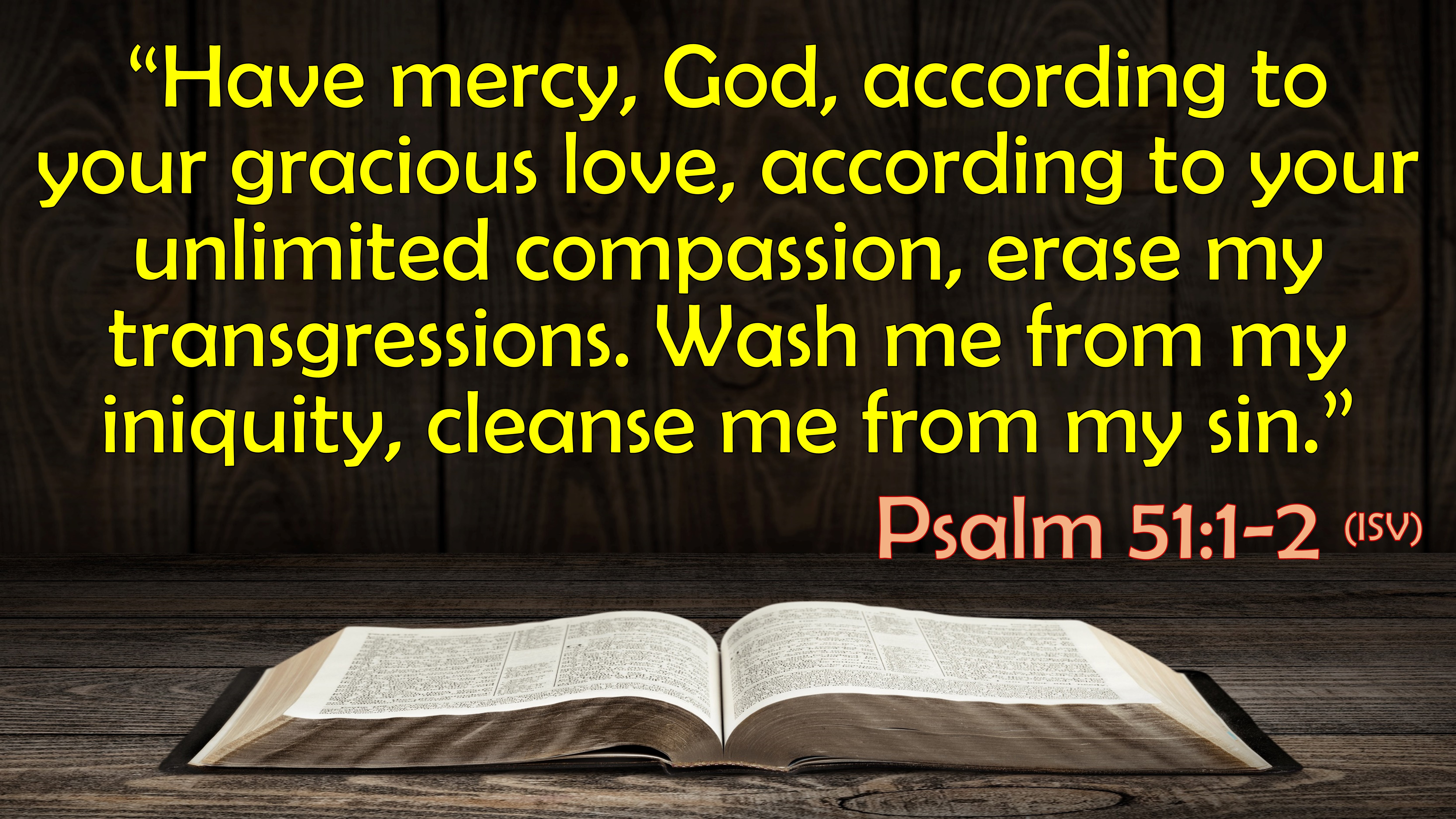
Have mercy upon me, O God, according to thy lovingkindness: according unto the multitude of thy tender mercies blot out my transgressions (Psalm 51:1)

  • Why is David asking for mercy?

He realizes that he has done something wrong, something wicked, something that God is not pleased with, something that is disgraceful to the Lord. Only somebody who belongs to the Lord by repentance and faith in Christ will actually feel ashamed of their conduct and beg for mercy.

There is none that understandeth, there is none that seeketh after God (Romans 3:11)

Now, this isn’t to say that unbelievers will never feel sorry for foolish and sinful things they do. What I mean is that it is impossible for unbelievers to feel a sense of accountability to the Lord, and a corresponding sense of shame and sorrow for their failure to serve Him. This is why the Apostle Paul warned us that, in our natural state as lost and rebellious sinners (cf. Romans 3:9-18):

  • There is nobody who is righteous
  • There is nobody who seeks God
  • Everybody is inherently worthless to God
  • There is no fear of God before anybody’s eyes

So, it’s important to realize that the only reason why David is even begging God for mercy in the first place is because he is a believer – and he therefore feels a profound and deep sense of sorrow and shame for his sins, so he begs God for mercy. Mercy is when God decides to withhold punishment that you deserve – this is what David is begging for.

  • What grounds does David have to ask God for mercy in the first place?

There two – (1) God’s lovingkindness and (2) the multitude of His tender mercies.

David can ask for mercy because he believes in God’s promise of the coming Savior – Jesus Christ. From our perspective, Jesus has already come, lived a perfect life for our sake, been tortured and executed for our sake, and rose miraculously from the dead to prove His jurisdiction, power and authority over Satan. From David’s perspective , this is all future – and he believes that God will do it. Know this – the only basis you have for begging God for mercy in the first place is if you have obeyed Jesus’ command to repent and believe the Gospel.

David is a believer in the future Messiah, Jesus Christ, and therefore has a right to lay claim to God’s lovingkindness and His tender mercy.

  • What does David ask God to do once mercy is granted?

He asks God to “blot out” out his transgressions because of the multitude of God’s “tender mercies.” If you belong to the Lord by repentance and faith in Jesus Christ, then you have a perfect forgiveness and perfect assurance of forgiveness. Only a saved person can pray this kind of prayer.

Wash me throughly from mine iniquity, and cleanse me from my sin (Psalm 51:2).


I can’t think of a more beautiful metaphor for the kind of forgiveness and mercy God shows to His adopted children. David speaks of a complete washing and cleansing from all sin, and the clear conscience that comes from knowing you’ve actually been forgiven.

If we confess our sins, he is faithful and just to forgive us our sins, and to cleanse us from all unrighteousness (1 John 1:9).

This is all present-tense, and this is the kind of forgiveness and mercy that David believes in and looks forward to – and asks God for. What Christian cannot read David’s words and reflect on his own life, his own moral failures, his own unworthiness and his own need for forgiveness, redemption, reconciliation and adoption into God’s family by Jesus Christ!?

More on Psalm 51 next time . . .