Does Revelation 3:10 Teach a Pre-Tribulation Rapture?

Does Revelation 3:10 Teach a Pre-Tribulation Rapture?

The “pre-tribulation rapture” is the belief that Jesus will remove the church (the living and the dead) from the earth before the great tribulation. Faithful Christians who believe this often cite Revelation 3:10 as a key proof for this doctrine. However, the preponderance of evidence does not support this claim.

  • The “time of testing” which from Jesus promises to protect his church is not the antichrist’s persecution against believers, but his own divine wrath against the antichrist.
  • Jesus’ promise is to the Christian congregation at Philadelphia as a collective whole, not to every believer individually. He made good on his promise because the original audience died ordinary deaths long ago. Jesus’ promise will apply equally to his worldwide church at the “time of the testing,” which is yet future.
  • In the context of Revelation 3:10, the phrase “keep/protect you from the hour of testing” probably does not mean physical removal out of a situation. Those who argue that it does mean this sometimes believe outdated and erroneous ideas about Greek grammar.
  • The bottom line is that Revelation 3:10 (by itself) does not support a pre-tribulation rapture. The preposition translated “from” is a very slender reed upon which to hitch your interpretive wagon. The doctrine may be true. But, it is likely not present in Revelation 3:10.

We’ll examine each of these, below.

What is this “time of testing”?

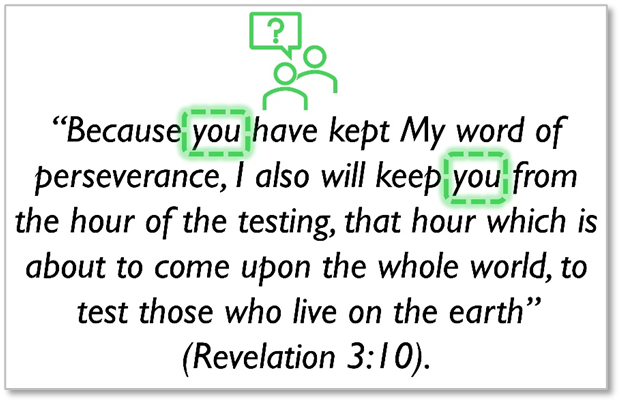
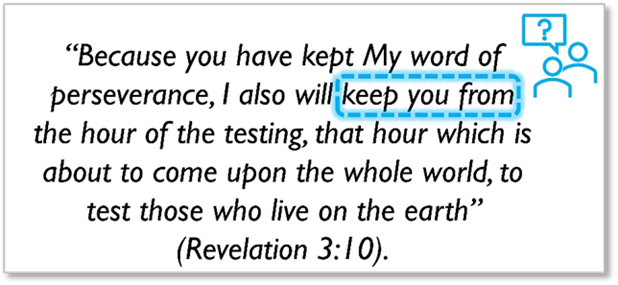
Here is our text:

The “time of testing” from which Jesus protects the church is the tail end of the great tribulation, when Jesus pours out the seven-seal judgments upon the kingdom of evil. This is a critical point. Many Christians are confused here.

  • Revelation 4-18 is not really about the antichrist’s reign of terror against believers—the “great tribulation.” Many Christians think it is about that. But they’re wrong (except for Revelation 13).
  • Instead, Revelation 4-18 is about the time at the end of this seven-year “great tribulation” when Jesus pours out the seven seals of judgment upon the kingdom of darkness.

We know this because Revelation 4-5 shows us the solemn run-up to this day of the Lord, which culminates with the slain Lamb being the only one worthy to break the seals and open the scroll which heralds the better tomorrow (Rev 5:2).

  • Because Jesus has overcome for his people, as our vicarious and righteous substitute, he alone may open the scroll and its seven seals (Rev 5:5).
  • As if to solemnize this awful but necessary time of divine wrath against evil, the angelic creatures sing: “Worthy are You to take the scroll and to break its seals; for You were slaughtered, and You purchased people for God with Your blood from every tribe, language, people, and nation” (Rev 5:9). 
  • Before Jesus can receive power, honor, glory, blessing, “and dominion forever and ever,” he must first destroy his evil counterpart and his wicked kingdom. What follows in Revelation 6-16 are the seven-sealed judgments of wrath against the antichrist and Babylon.

The horsemen, the brimstone, the incineration of one-third of the earth’s vegetation, the waters turning to blood, the mutant, demonic locust-like creatures—all the “bad stuff” we associate with Revelation is divine wrath against antichrist and his followers. The antichrist is doing none of this! Instead, Jesus is doing it to the antichrist and to his people.[1]

This means this “time of testing—the one about to come upon the whole world to test those who dwell on the earth” (Rev 3:10) is against unbelievers—against the antichrist and his followers.[2] Jesus is testing whether they will repent and choose Jesus or cling to darkness. Some translations use the word “trial” here, but this not the best because Jesus is not evaluating the faith of believers. He is testing whether unbelievers will truly continue to reject him.

This judgment ends with the Lord destroying Babylon and the antichrist’s people wailing because Jesus has smashed their world (Rev 18:9-19). “Rejoice over her, O heaven, and you saints and apostles and prophets, because God has pronounced judgment for you against her” (Rev 18:20). Now that the Lord has vanquished the kingdom of evil, John tells us: “I heard something like the voice of a great multitude and like the sound of many waters, and like the sound of mighty peals of thunder, saying, ‘Hallelujah! For the Lord our God, the Almighty, reigns’” (Rev 19:6). Jesus now returns to establish his kingdom on earth (Rev 19:11-21).

So, the “time of testing” is not the antichrist’s persecution of believers—it is Jesus’ wrath upon the kingdom of darkness. During this period, Jesus will protect his people. Before Jesus cracks open the sixth seal of judgment, he commands an angel to mark a vast number of believing Jewish people with his “seal” to protect them from the coming judgments (Rev 7:3; cp. Ezek 9:4-6; Ex 11:6-7, 12:13).

Who does Jesus protect?

Our passage is here—who is Jesus protecting and what kind of protection does he promise? He will protect his church (as a collective whole) from physical and spiritual destruction.

Because the church in Philadelphia (collectively, as a single referent)[3] is protected from this time of testing, it’s reasonable to believe that this protection applies to the entire church as a whole. The is a promise to the community, not to every single individual. So, taken collectively as a single community, Jesus will protect his church from this time of testing.

Pre-tribulational Christians go beyond the evidence when they insist that: (a) if any Christians die during the Great Tribulation then Jesus’ promise here is void, so (b) this must mean Jesus promises to physically remove the church from the scene. This does not necessarily follow.

First, as we saw, the “time of testing” is not the antichrist’s persecution of believers—it is Jesus’ wrath upon the kingdom of darkness. So, the entire objection fails.[4] Some object that, if this be true, then it’s cold comfort indeed:[5] “A whole bunch of y’all will die during the antichrist’s persecution, but don’t worry—I’ll protect the believers who are still alive when I unleash literal hell on earth. Cheers!” This is a false dilemma that demands: “What took you so long!?” One might as well criticize God for allowing the Israelites to suffer in Egypt before “finally” protecting them during the final plague (Ex 2:23-25; 12:23, 29).

Second, even if we (wrongly) conclude that Jesus does promise protection during the time of antichrist’s persecution during the last 3.5 years of his sinister reign … because Jesus’ promise is to the church as a whole, collectively, it simply means that the church will be protected during this period. That is, as an organism and a worldwide family of Jesus people, Satan shall never destroy the church because the gates of hell shall not prevail against it. Indeed, Jesus promised that he would intervene to stop this great tribulation lest no believers be left alive (Mt 24:21-22). That intervention is the judgments of the seven-sealed scroll which together destroy antichrist’s kingdom (culminating at Rev 16, re-told in Rev 17-18).

Will some believers will die during this “time of testing” when Jesus pours out the seven judgments upon the whole world? The answer is yes—but they will die at the antichrist’s hands, not Jesus’ hands. That is, the antichrist will never destroy “the church” as a whole. The Japanese killed many Americans sailors in the Pacific theater of operations in World War 2, but they never destroyed the U.S. Navy. Many Israelites died under Pharoah’s rule in Egypt (Ex 1:15-16), but “Israel” never did die.

  • John tells us about believers who have already died during the antichrist’s reign of terror before Jesus responds to the prayers by unleashing judgment upon the kingdom of darkness (Rev 6:9-10, 7:13-14). These martyrs who died during this great tribulation plead for justice upon “those living upon the earth” who killed them—the very people who are the objects of this “time of testing.”
  • After Jesus opens the fifth seal, the angels tell the great tribulation martyrs “to rest for a little while longer, until the number of their fellow servants and their brothers and sisters who were to be killed even as they had been, was completed also” (Rev 6:11).
  • But, we also see believers being sealed and protected—John highlights Jewish believers in particular who are safe from these judgments (Rev 7:3, cp. Rev 9:4).

Some may protest that it is too fantastic to believe that believers will be protected from death at a time when the first four “trumpet judgments” of the seventh seal destroy a major portion of the world (Rev 8:6-12). But, consider the plagues upon Israel before the Exodus: “But not even a dog will threaten any of the sons of Israel, nor anything from person to animal, so that you may learn how the LORD distinguishes between Egypt and Israel … The blood shall be a sign for you on the houses where you live; and when I see the blood I will pass over you, and no plague will come upon you to destroy you when I strike the land of Egypt” (Ex 11:6, 12:13).

Kept from the hour?

Here is the passage—what kind of protection is Jesus promising? Physical removal from the scene, or protection from danger during the time of testing?

Advocates for a pre-tribulation rapture expend much energy on what it means to be protected from the time of testing. Bible teachers crack open their Greek New Testaments (or fire up their bible software) and begin speaking about the preposition ἐκ (“from”), which in its most basic, original sense suggests an exit from some sort of relationship.[6] So, pre-tribulationists may argue, the idea is that Jesus will take the church away from the coming wrath.

This doesn’t necessarily follow, for a host of nerdy reasons that I’ll try to explain without making you fall asleep.

Blurred lines and prepositions

First, while the original meaning of the preposition ἐκ does indicate motion out of something, that certainly isn’t its exclusive or even primary sense in the New Testament. By then, prepositions no longer had a rigid meaning, which means you cannot say: “it must mean ONLY THIS!” Some pre-tribulation advocates do not seem to appreciate this because they sometimes rely on an outdated understanding of prepositions.[7] Language changes over time, and by the New Testament era the precise distinctions of meaning between koine Greek prepositions had now blurred and overlapped.[8]

  • For example, the preposition εἰς, in a strict sense, means “motion into a thing”[9]—you pour coffee into a cup. But, the Gospel of Mark says Jesus “was sitting on (εἰς) the Mount of Olives” (Mk 13:3).
  • If you want to insist on the classical meaning for this word, you’d translate it as “Jesus was sitting into the Mount of Olives.” Of course, that’s ridiculous—is he a mole, burrowing into the soil?
  • What’s happened is that the meaning of εἰς has blurred and overlapped with that of another preposition (ἐπί), whose “basic idea is ‘upon.’”[10]

What happens with every word is that its original sense expands into all kinds of figurative uses, and this expanded meaning eventually moves far afield of the “original,” rigid “meaning.”This is why, in English, the original meaning for the word “ball” is “a round or roundish body or mass.”[11] But, this meaning has expanded to mean a basketball, or a testicle, or a great time (“I had a ball at the park yesterday!”), or even a formal dance (“Cinderella made it to the ball!”).

With the preposition ἐκ, its basic sense of spatial movement out of something has expanded to indicate:

  • Disassociation (“Christ redeemed us from the curse of the law,” Gal 3:13).
  • Derivation (the crown was made from thorns, Mt 27:29).
  • Time (the man was blind from birth, Jn 9:1).
  • Means (a person isn’t justified by means of doing what the law requires, Gal 2:16).
  • Personal agency (people are born by the will of God, Jn 1:13).

… and more. My point is that, in Revelation 3:10, the preposition ἐκ doesn’t necessarily mean the Lord will physically remove believers out of this world, as in: “Hang on! I’m gonna get y’all outta there!”[12]

Second, regardless of that point, in Greek the sense of John’s phrase “protected from the time of testing” still doesn’t suggest physical motion out of a situation. When you have the construction like that in Revelation 3:10 of “stative verb (τηρήσω) + transitive preposition (ἐκ),” the stative verb swallows up the transitive force of the preposition.[13] In Revelation 3:10, this suggests the idea of physical (i.e., transitive) motion—spatial exit from a situation—falls away.[14] This implies we’re left with some kind of protection from the time of testing that doesn’t include physical removal from the scene.

Therefore, building on our first point, we must look beyond the original, rigid meaning of ἐκ to rightly understand the nature of Jesus’ protection—we need the context.[15]

What does “from” (ἐκ) mean in Revelation 3:10?

A normal Christian with a good English translation doesn’t have to do this—but here is what responsible nerds must do “behind the scenes” to figure out what, say, Revelation 3:10 is saying.[16]

  1. Look at the list. As we learned, every word has a range of possible meanings. Look at the preposition’s original, rigid meaning (for example,ἐκ is spatial—“out of”), then look at the range of figurative meanings common to the word. It isn’t true that a preposition has a “literal meaning.”[17] Instead, it has a range of meanings, and some (depending on context) are more likely than others.[18]
  2. Look at the word(s) the preposition modifies. In this case, “the time of testing” (τῆς ὥρας τοῦ πειρασμοῦ) is in the genitive case, whose historical function was to depict a description or a separation.[19] Usually, prepositions govern the nouns they modify.[20] In Revelation 3:10, both the preposition and the genitive case of the modified noun indicate separation from this “time of testing.”
  3. Look at the context. What does the larger paragraph tell us about what the prepositional phrase means?

Using this method, the preposition in Revelation 3:10 likely means protection from Jesus’ divine wrath which, during this “time of testing,” he will unleash upon antichrist and his kingdom:

  1. Look at the list.

Because (as we saw, above) a stative verb swallows up the transitive nature of the preposition, ἐκ likely doesn’t mean “physical removal outta here” in Revelation 3:10. Instead, it’s probably a preposition of separation by disassociation.[21] Jesus will somehow separate us from the time of testing, and the best rendering here is “protection from the time of testing.” The most logical kind of protection from something, without involving physical motion away from it, is to be guarded and protected during the event.

Elsewhere, John uses the very same construction[22] to record that Jesus prayed that the Father would “keep them from the evil one” (Jn 17:15b). That is, protect us by separating us from Satan—not isolating us from his physical presence, but protecting us from his dominating power. In a similar way, in our passage Jesus promises to protect the church from the power of this time of divine judgment upon the kingdom of evil—just as he did in Egypt before the Exodus.

  1. Look at the word(s) the preposition modifies.

As we said (above), the genitive case here suggests separation from the time of testing, which pairs nicely with the preposition which conveys the idea (in this context) of a non-physical disassociation from the time of testing.

  1. Look at the context.

Jesus tells this church in Philadelphia that he has set before them “an open door,” which probably means a “door” of ready access to him “because you have a little power, and have followed My word, and have not denied My name” (Rev 3:8). Despite their likely small numbers (“a little power”) and seeming impotence, they are faithful. The door to the Messianic kingdom remains open and ready for them, despite this church’s “unimpressive” nature.[23] He promises to deal with a specific cabal of Jewish people in the city who hate this congregation and are persecuting it.[24] These folks, Jesus declares, are not “Jews” at all—their “synagogue” actually belongs to Satan, who is tricking them (cp. Jn 8:44).

But, Jesus assures them, because they have persistently obeyed (“kept”) his message about perseverance, he will protect (“keep”) the church in Philadelphia from the time of testing—the one about to come upon the whole world to test those who dwell upon the earth (Rev 3:10). They will be protected during the time when Jesus unleashes the seven-sealed judgments onto the kingdom of evil (Rev 6-16).[25] He will return soon (“quickly”), so they must hold firmly to their faith as they endure persecution from the local “synagogue” and narrow-eyed suspicion from Roman authorities—or else they may lose their crown (Rev 3:11). In other words, keep on persevering and holding on!

Jesus will make the ones who overcome all these difficulties “a pillar in the house of my God,” and he will write his name on their foreheads to mark them as his own. He will not write his own name only, but the names of the Father and of the new Jerusalem—the celestial city (Rev 3:12).

Bottom line

The bottom line is that Revelation 3:10 (by itself) likely does not support a pre-tribulation rapture. A preposition is a very slender reed upon which to hitch your wagon.[26] It doesn’t mean a pre-tribulation rapture is wrong. It just means that Revelation 3:10 probably doesn’t teach it. I believe the preponderance of evidence here does not support a pre-tribulation rapture, but it would be a mistake for either side to be dogmatic.

  • In terms of weight of evidence, “preponderance of evidence” is the weakest–it means something is more likely than not true.
  • This is followed by “clear and convincing” evidence, which means what it says.
  • Finally, the strongest case is “beyond a reasonable doubt,” which you may be familiar with from bad police movies or TV shows.
  • My assessment about whether the pre-tribulation rapture is present in Revelation 3:10 is at the level of “preponderance of evidence.”

Jesus swears he is returning soon and, if the church perseveres in faith, he promises to protect this local church from the outpouring of his divine judgment that will one day come: “In this great trial, the servants of Christ shall be kept safe.”[27] He doesn’t explicitly say how he will protect them. But the preponderance of evidence suggests that it will be protection from the power of the divine judgments (Rev 6-16), just as God protected the Israelites from the plagues in Egypt.

Of course, Jesus did fulfill this promise to the church in Philadelphia because they died long before the antichrist’s reign—which is still future today! He did protect them from this time of divine wrath against the kingdom of evil. But ultimately, this is a promise to the entire church—to the entire Jesus family that is alive during the great tribulation. When the Lamb who was slain cracks open the seals to open the scroll (Rev 6-16), he will protect his church from the power of this time of testing against antichrist, his people, and his kingdom of evil.

Translation

ὅτι ἐτήρησας (BDAG, s.v., sense 3) τὸν λόγον τῆς ὑπομονῆς (gen. comm. content) μου, κἀγώ σε τηρήσω (BDAG, s.v., sense 2d) ἐκ (disassociation = sit. out of which someone is brought = BDAG, s.v., sense 1c) τῆς (monadic) ὥρας τοῦ πειρασμοῦ (att. gen.) τῆς μελλούσης ἔρχεσθαι (art. inf. = appositional clause) ἐπὶ τῆς οἰκουμένης ὅλης πειράσαι (anarthrous = purpose) τοὺς κατοικοῦντας ἐπὶ τῆς γῆς.

“Because you have persistently obeyed my message about perseverance, I also will protect you from the time of testing—the one about to come upon the whole world to test those who dwell on the earth.”


[1] Buist Fanning briefly states that the ones who hide from Jesus’ wrath in Revelation 6:16-17 are believers who die because of the divine judgments, but this makes no sense in context. He does not try to substantiate the claim—he just makes it in one sentence (Revelation, in ZECNT (Grand Rapids: Zondervan, 2020), 177). These people are likely unbelievers who follow the antichrist.

[2] “There the faithful are sealed with a view to their preservation from the assaults of demons, but are not thereby secured against physical death … It will be observed that the demonic trial spoken of, while worldwide, was to affect only ‘those that dwell upon the earth,’ i.e. the non-Christians” (R. H. Charles, A Critical and Exegetical Commentary on the Revelation of St. John, vol. 1, in ICC (Edinburgh: T&T Clark, 1920), 89).

[3] The referent is singular in Greek, referring to the Christian community in Philadelphia as a collective whole.

[4] For example, Jeffrey Townsend objects: “This presents an immediate problem for post-tribulationism since it holds that the church will be preserved on earth during the hour of testing. Yet verses such as Revelation 6:9–10; 7:9, 13, 14; 13:15; 14:13; 16:6; 18:24; and 20:4 present a time of unprecedented persecution and martyrdom for the saints of the tribulation period” (“The Rapture in Revelation 3:10,” in Bibliotheca Sacra, BSAC 137:547 (Jul 1980), at 153).

He is incorrect—the horrors in Revelation 6-16 are not the antichrist persecuting Christians. It is Jesus pouring out divine wrath upon the kingdom of evil.

[5] Robert L. Thomas, Revelation 1-7 (Chicago: Moody, 1992), 286. “What good does it do to be preserved from the physical consequences of divine wrath and still fall prey to a martyr’s death?”

[6] Murray J. Harris, Prepositions and Theology in the Greek New Testament (Grand Rapids: Zondervan, 2012), 103.

[7] Robert Thomas (Revelation 1-7, 284-86), Paul Feinberg (“Pre-tribulation,” in The Rapture, 63-68), and Craig Blaising (“Pre-tribulation,” in The Rapture, 38, note 67) rely heavily upon the arguments of Jeffrey Townsend, who in turn relied on A. T. Robertson’s assessment of the preposition at issue: “According to Robertson, ‘The word means ‘out of,’ ‘from within,’ not like ἀπό or παρά’” (Townsend, “Revelation 3:10,” 253).

But, as modern Greek grammars recognize, Robertson was incorrect to insist on precise, classical categories to distinguish koine Greek prepositions from one another. Townsend reflects this error when he states: “This is an untenable position because the idea of preservation in and through the hour of testing would normally have been expressed by ἐν or διά” (“Revelation 3:10,” 253). He is wrong.

Dan Wallace’s admonition is relevant here: “… too often prepositions are analyzed simplistically, etymologically, and without due consideration for the verb to which they are connected. Prepositions are often treated in isolation, as though their ontological meaning were still completely intact” (Greek Grammar Beyond the Basics (Grand Rapids: Zondervan, 1996), 359).

[8] Wallace, GGBB, 362-63; Harris, Prepositions, 34-35; Richard Young, Intermediate New Testament Greek (Nashville: B&H, 1994), 85-86.

[9] William Arndt (et al.), A Greek-English Lexicon of the New Testament and Other Early Christian Literature (Chicago: University of Chicago Press, 2000). s.v. Hereafter “BDAG.”

[10] BDAG, s.v.

[11] Merriam-Webster Collegiate Dictionary, s.v. “ball,” noun, sense 1 (Springfield: Merriam-Webster, 2026), 132.

[12] “[I]ndeed, it is now becoming more and more clearly recognized that it is a mistake to build exegetical conclusions on the notion that classical accuracy in the use of prepositions was maintained in the Koine period” (C.F.D. Moule, An Idiom Book of New Testament Greek, 2nd ed.(Cambridge: Cambridge University Press, 1959), 49).

[13] Wallace, GGBB, 358-59. “Stative verbs override the transitive force of prepositions. Almost always, when a stative verb is used with a transitive preposition, the preposition’s natural force is neutralized; all that remains is a stative idea.” Emphasis in original.

[14] This is not the case in John 17:15a, which bears a transitive verb (ἄρῃς) + a transitive preposition (our old friend ἐκ) = the sense of movement out of this world is retained. Jesus prayed: “I do not ask that you take them away from the world …” (οὐκ ἐρωτῶ ἵνα ἄρῃς αὐτοὺς ἐκ τοῦ κόσμου).

[15] “It is important to remember that prepositions are extremely flexible in meaning, and careful consideration of the literary context is essential in determining the nuance of a preposition” (Andreas J. Köstenberger; Benjamin L. Merkle; Robert L. Plummer, Going Deeper with New Testament Greek: An Intermediate Study of the Grammar and Syntax of the New Testament (Nashville: B&H, 2016; Kindle ed.), KL 10481-10482).

[16] I adapted this from Harris, Prepositions, 31. I left off his fourth step because it does not apply in this case.

[17] Erroneously, Craig Blaising wrote: “This view depends on a ‘dynamic’ interpretation of the preposition ek …” (“A Case for the Pretribulation Rapture,” in Three Views on the Rapture: Pretribulation, Prewrath, or Posttribulation, ed. Alan Hultberg (Grand Rapids: Zondervan, 2010), 38). This is incorrect and does not reflect the realities of language in general, let alone koine Greek.

[18] Young, Intermediate Greek, 86.

[19] Young, Intermediate Greek, 23.

[20] Wallace, GGBB, 360-62.

[21] BDAG, s.v., sense 1c; cp. Brill Dictionary of Ancient Greek (hereafter “GE”), ed. Franco Montanari (Leiden: Brill, 2015),s.v., sense II.A.c.

[22] Gk: τηρήσῃς αὐτοὺς ἐκ τοῦ πονηροῦ = preposition ἐκ + genitive object. “[T]he thought is quite in keeping with that of our Seer” (Charles, Revelation, 1:89-90). And, the apostle also wrote this same phrase at both John 17:15 and Revelation 3:10. This suggests it is a stylistic quirk of John’s of which we ought to take note.

[23] Robert Mounce, The Book of Revelation, in NICNT (Grand Rapids: Eerdmans, 1977), 117.

[24] Some people think this means that members of this hostile Jewish synagogue will come to believe Jesus is their Messiah. Others think Jesus refers to their eventual acknowledgment of him in a non-saving way—perhaps on the day of judgment (Rev 20). That is, “every knee will bow, and every tongue will confess …” (etc.).

[25] Some pre-tribulation advocates eagerly seize upon a distinction between (a) being kept from the danger itself, and (b) being kept from the time period of this danger. The latter, they sometimes claim, suggests a physical removal from the scene. In truth, this is a de minimis argument.

[26] For example, Paul Feinberg spent five pages discussing the preposition ἐκ as he supported the pre-tribulation rapture perspective at Revelation 3:10. If a preposition is the best you got, then your argument is very weak (“The Case for a Pre-tribulation Rapture Position,” in The Rapture: Pre, Mid, or Post-Tribulation, ed. Stanley Gundry and Gleason Archer (Grand Rapids: Zondervan, 1984), 63-68).

[27] Henry Alford, The New Testament for English Readers: A Critical and Explanatory Commentary, New Edition, vol. 2 (London; Oxford; Cambridge: Rivingtons; Deighton, Bell and Co., 1872), 969. Similarly, John Gill writes that: “it will be known who are his true churches, and pure members; and these he’ll keep close to himself, and preserve safe amidst all the distress and confusion the world will be in” (An Exposition of the New Testament, vol. 3 (London: Mathews and Leigh, 1809), 711).

John 14:1-3 and the Rapture (Part 3)

John 14:1-3 and the Rapture (Part 3)

In Part 2 of this series, we presented four options for understanding what Jesus meant at John 14:1-3:

We also suggested a grading scale for evaluating these options:

  • Grade A: Explicit teaching.
  • Grade B: Implicit teaching.
  • Grade C: A principal or logical conclusion—an inference.
  • Grade D: A guess or speculation.
  • Grade E: Poor or non-existent support.

See the other articles in the “rapture series” here. See this entire article on “John 14:1-3 and the Rapture” as a single PDF here.

Now, let’s look at Option 1:

Option 1 can only be maintained by heavily freighting John’s words with presuppositions from elsewhere. This position is almost universally proposed by dispensational premillennialists.

  • It requires Jesus to return twice; (a) once for believers to transport them to heaven, and (b) again to imprison Satan and establish His kingdom (the event historically referred to as the second coming). Unfortunately, John 14:1-3 itself does not explicitly or implicitly support a two-stage return, nor does 1 Thessalonians 4:13-18 which we already examined.
  • It requires us to see a hard distinction been (a) the ethnic people of Israel, and (b) the Jews and Gentiles which comprise “the church.” Because of this distinction, advocates read the Old Testament prophesies about the tribulation as a time of trouble specifically for the ethnic people of Israel—the “church” is not involved. Therefore, Jesus must transport the church away beforehand, and so this passage is about that escape. However, this passage and its context says nothing about that.

Option 1 advocates offer several arguments for their position:

  1. If this passage were about Jesus’ second coming, then He would have mentioned the cataclysmic events of Matthew 24,[1] so He must be talking about something else—the pre-tribulational rapture.

Jesus already discussed those events, and nobody repeats every detail of a subject whenever a topic comes up. John’s gospel is famous for covering different ground than the other three,[2] he wrote 20 or 30 years later than Matthew,[3] and John 14 occurs in a different place in the timeline of Jesus’ ministry. In short, this is a weak argument from silence.

  1. Matthew 24 never mentions “my Father’s house,” but John 14:1-3 does.[4] Therefore John 14:1-3 is about something else—the pre-tribulational rapture.

This wrongly assumes “my Father’s house” must refer to a fixed place “up there,” in heaven. It’s also another weak argument from silence, for the reasons listed above.

  1. The persecution at John 15 is not characteristic of the tribulation.[5] Therefore John 14:1-3 is about something else—the pre-tribulational rapture.

However, in John 15 Jesus is not speaking about the tribulation but a different subject entirely. This objection falls.

  1. In John 14:1-3, Jesus never mentions a return with a trumpet blast accompanied by angels who will gather the elect from the four corners of the earth (Mt 24:30-31). Therefore John 14:1-3 is about something else—the pre-tribulational rapture.[6]

Again, this argument assumes that each biblical author will repeat everything another author says about the same topic. This is not the way human communication works. There is no place in scripture where any author incorporates everything everyone else has said on a particular subject. John was not writing a prophecy encyclopedia nor was Jesus lecturing on the topic—John was memorializing Jesus’ farewell address.

  1. If John 14:1-3 is about the second coming, that means believers will endure the great tribulation. But the tribulation is for the ethnic people of Israel, not the church. Therefore John 14:1-3 is about something else—the pre-tribulational rapture.[7]

Perhaps this is true, but neither this passage nor its context says anything about that. This is an objection from complete silence. If “the church” (as dispensationalists understand it) is not snatched away from earth before the tribulation, then it will be here during this terrible time. So, one writer suggests it would have been “cruel” of Jesus to not mention the tribulation at John 14:1-3 if He intended “the church” to endure it—that, if true, Jesus had “kept” this information from them.[8] A case can be made (and has been made over the centuries) that Matthew 24 already explains everything—just not along dispensationalist lines.

Arguments from silence are weak—and so is this one.

  1. The disciples have a heavenly hope for union with Christ, not an earthly one.[9] Therefore John 14:1-3 is about something else—the pre-tribulational rapture.

This is a conclusion, not an argument. The hope of all believers is community with God—Abraham was “looking forward to the city with foundations, whose architect and builder is God,” (Heb 11:10). This is the heavenly country (that is, the “country” with heavenly attributes[10]) that arrives at Rev 21-22, which contains the city which God has prepared for all believers (Heb 11:16). Community with God in renovated physical bodies (1 Cor 15:50-55) in a new heaven and a new earth (Rev 22)—that is our future.

  1. John 14:1-3 requires the saints “to dwell for a meaningful time with Christ in His Father’s house.”[11] Therefore John 14:1-3 is about something else—the pre-tribulational rapture.

Again, this makes the mistake of assuming “my Father’s house” must be a fixed place “up there” in heaven. This is incorrect. It also overlooks the solution that Jesus in John 14:1-3 simply refers to believers being in the Father’s presence (i.e., His “house”) upon their deaths.

  1. John 14:1-3 parallels 1 Thessalonians 4:13-18, which is about the pre-tribulational rapture. Therefore, John 14:1-3 is about the pre-tribulational rapture.[12]

Unfortunately, 1 Thessalonians 4:13-18 doesn’t explicitly or implicitly teach any such thing, as I’ve discussed.  

  1. The “Father’s house” is in heaven, not on earth.[13] Therefore John 14:1-3 is about something else—the pre-tribulational rapture.

If “the Father’s house” truly cannot be here on earth, then by this logic Jesus’ parents did not find Him in His Father’s “house” when He was 12 years old (Lk 2:49), and the Christian community is not a “spiritual house” (1 Pet 2:5) or God’s “building” (1 Cor 3:9) or His “temple” (1 Cor 3:16-17), and God’s “tent” or “dwelling place” will not be here on earth with His people (Rev 21:3), and the Lord God Almighty and the Lamb will not be the new Jerusalem’s “temple” (Rev 21:22). Fortunately, the “Father’s house” is a figurative shorthand that refers to “the Father’s presence” in various contexts.

  1. John 14:1-3 is about believers going to heaven, whereas at the second coming Jesus is returning to earth. Therefore John 14:1-3 is about something else—the pre-tribulational rapture.[14]

This is a reasonable argument. However, it’s undercut by two weaknesses. First, once again “my Father’s house” is not tied to a fixed place “up there,” but is a figurative reference to God’s personal presence wherever He might be. Second, just because the text suggests Jesus transports believers away from here, it doesn’t give a blank check to a complicated two-stage return for Christ that’s dependent on speculation from elsewhere in scripture. There is a much simpler option—that believers “go to heaven” when they die.[15]

All told, evidence supports a “D” rating for John 14:1-3 being about the pre-tribulational rapture. It’s a perspective build entirely on guesswork from elsewhere. It swamps the text and freights it with a load its words cannot reasonably bear. This doesn’t mean the pre-tribulational rapture is false—it just means it isn’t in this passage.

Arguments from silence can be helpful supports that prop up explicit and implicit bible teaching from elsewhere. They’re backing vocals that ought never be trotted out to carry the entire concert. So it is with John 14:1-3.

In the next and last article, we’ll look at the other three options to understand what Jesus meant at John 14:1-3.


[1] “… the wars and rumors of wars; the famines, pestilences and earthquakes; the great tribulation; the false prophets, etc. of which there is not a word in all of the Upper Room Discourse,” (Carl Armerding, “That Blessed Hope,” in Bibliotheca Sacra, 111:142 (April 1954), p. 150).

[2] See, for example, I. Howard Marshall, New Testament Theology (Downers Grove: IVP, 2004), pp. 491f.

[3] David deSilva tentatively suggests a date in the early 70s for Matthew (An Introduction to the New Testament: Contexts, Methods & Ministry Formation, 2nd ed. (Downers Grove: IVP, 2018), p. 215). N.T. Wright and Michael Bird offer up a date between 80-100 (The New Testament in Its World (Grand Rapids: Zondervan, 2019), p. 579), while Grant Osbourne suggests a date in the mid-to-late 60s (Matthew, in ZECNT (Grand Rapids: Zondervan, 2010), pp. 43-44). John’s Gospel is typically dated in the late 90s, shading to perhaps very, very early in the second century (cp. deSilva, Introduction, pp. 343-344).

[4] Armerding, “Blessed Hope,” p. 150.

[5] Armerding, “Blessed Hope,” p. 150.

[6] Armerding, “Blessed Hope,” p. 151.

[7] Armerding, “Blessed Hope,” p. 151. “And it is this purpose which distinguishes the coming of the Lord as promised in John 14 from His coming as the Son of man as predicted in Matthew 24.”

[8] Jonathan Pratt, “The Case for the Pre-tribulational Rapture,” in Dispensationalism Revisited: A Twenty-First Century Restatement (Plymouth: Central Seminary Press, 2023), p. 251.

[9] John Walvoord, “The Future Work of Christ Part I: The Coming of Christ for His Church,” in Bibliotheca Sacra, 123:489 (January 1966), p. 13). “This was an obvious contradiction of their previous hope that Christ was going to reign on earth and quite different in its general character. It indicated that their hope was heavenly rather than earthly and that they were going to be taken out of the earth to heaven rather than for Christ to come to the earth to be with them.”

“In making the pronouncement in John 14, Christ is holding before His disciples an entirely different hope than that which was promised to Israel as a nation. It is the hope of the church in contrast to the hope of the Jewish nation. The hope of the church is to be taken to heaven; the hope of Israel is Christ returning to reign over the earth,” (Walvoord, The Rapture Question, revised and enlarged (Grand Rapids: Zondervan, 1979), p. 71).

[10] In the sentence, “heavenly” is an attributive genitive: νῦν δὲ κρείττονος ὀρέγονται τοῦτʼ ἔστιν ἐπουρανίου.

[11] Richard Mayhue, “Why A Pretribulational Rapture?” in Masters Seminary Journal, TMSJ 13:2 (Fall 2002), p. 246.

[12] Armerding, “Blessed Hope,” pp. 151-152; Mayhue, “Pretribulational Rapture,” p. 246; Pratt, “The Case for the Pre-tribulational Rapture,” in Dispensationalism Revisited, pp. 250-251.

[13] Walvoord, The Rapture Question, p. 71. “Christ returns to the earthly scene to take the disciples from earth to heaven. This is in absolute contrast to what takes place when Christ returns to establish His kingdom on earth.”

[14] Lewis S. Chafer, Systematic Theology, vol. 5 (reprint; Grand Rapids: Kregel, 1976), p. 164.  

[15] Walvoord dismisses this as “spiritualizing,” which is a common slur in the dispensationalist lexicon (Rapture Question, p. 71).

John 14:1-3 and the Rapture (Part 1)

John 14:1-3 and the Rapture (Part 1)

Many American Christians have been raised in a church culture that stresses that Jesus will return to “rapture” or snatch away “the church” before the Great Tribulation. They believe “the church” is a different people than ethnic Israel, with a complementary but distinct future.[1] Because this great tribulation is “a time of trouble for Jacob” (Jer 30:7), it is not for “the church.” Therefore, the rapture is the point where “the church” slips out the door just before this tribulation begins.

They believe this rapture will involve (a) resurrection of all believers who died since Pentecost, and (b) a simultaneous snatching away of all believers still alive, all to (c) meet the Lord in the air for transport to heaven while tribulation rages here. Later, Jesus will return from heaven with “the church” to end this great tribulation—this is the second coming.

This is part of a “pre-tribulational” (i.e., Jesus will return before the tribulation), and “premillennial” (i.e., Jesus will establish His kingdom to trigger the millennium) framework called dispensationalism.

Many of these Christians point to John 14:1-3 as proof of the rapture of “the church.” This article will consider what Jesus says at John 14:1-3. First, we’ll examine the entire context of Jesus’ farewell talk at Jn 13:33 to 16:33. Second, we’ll examine four common interpretations about what Jesus said at Jn 14:1-3. Third, we’ll propose a solution.

See the other articles in the “rapture series” here. See this entire article on “John 14:1-3 and the Rapture” as a single PDF here.

1: The long convo—Jesus says goodbye

It’s silly to interpret something without context. You watch a video clip of something that looks terrible, but the whole clip shows it in it’s true light. It’s the same with the bible. So, to get what Jesus says at John 14:1-3, we must consider everything He says during a very long talk after the last supper.

Here’s the outline—and this is “kind of a big deal” because Jesus constantly talks about different ways in which He’ll “come back” and reunite them to the Father. Skip this if you want, but you might want to refer to it later.

  • Jn 13:33-35: Jesus’ announcement about His physical departure, and therefore the necessity of brotherly love as the mark of the true Christian community
    • Jn 13:36 – 14:4: Dialogue on Peter’s question.
      • Believers must trust Jesus. He will physically return to the Father’s personal presence, and eventually bring believers into His Father’s presence, too. Yet, they already know “the way”!
    • Jn 14:5-7: Dialogue on Thomas’ question.
      • Believers are, in a real sense, in the Father’s presence right now by means of trusting in Jesus’ Good News—He is “the way” to the Father’s “house.”
    • Jn 14:8-21: Dialogue on Philip’s implicit question.
      • Jesus and the Father mutually indwell one another, and this is why when you “see” one you “see” the other. Jesus must return to the Father’s presence to direct His campaign against the kingdom of darkness from on high. Meanwhile, He sends believers the Holy Spirit so we aren’t left as orphans. Jesus will reveal Himself to (i.e., be “seen” by) those who love the Father, by means of the Spirit.
    • Jn 14:22-31: Dialogue on Judas (not Iscariot’s) question
      • Jesus will only show Himself to those who love Him, which means those who obey His teaching. The Spirit, through whom Jesus is “with us,” brings believers peace and teaches them. Jesus warns the disciples about all this beforehand, so they’re prepared for the day.
  • Jn 15-16: Jesus and the disciples “walk and talk” on the streets of Jerusalem
    • Jn 15:1-25: Be sure to stick with Jesus.
      • Fruit is the mark of a true Jesus follower, and the defining fruit is brotherly love.
    • Jn 15:26 – 16:15: The work of the Spirit in the New Covenant.
      • Jesus must physically return to the Father and “pass the baton” (as it were) to the Spirit. He will be their Advocate and teacher, and so they’ll be able to endure.
    • Jn 16:16-28: Jesus on His resurrection reunion.
      • The disciples will see Him “after a little while,” (Jn 16:16) and then their grief will turn to joy (Jn 16:20, 22). At that time, Jesus will speak plainly to them about the Father (Jn 16:25).
    • Jn 16:29-33: Farewell address ends

1a: The mic drop—Jesus says goodbye (vv. 13:33-35)

Our passage opens after Judas has bolted from the Last Supper and fled into the night. He’s on his way to betray Jesus to the Jewish authorities (Jn 13:27-30).

Jesus, perhaps taking a deep breath as He sees the walls closing in on Him, explains that both He and God will be “glorified” by what’s about to happen. It’s so certain that Jesus speaks as if His arrest, torture, and execution are already a done deal: “Now the Son of Man is glorified and God is glorified in him,” (Jn 13:31). The word “glorify” here is a churchy term, and it means to be held in honor, or clothed in splendor.[2] Basically, Jesus will be honored triumphantly,[3] and so too will God.

Jesus then explains: “My children, I will be with you only a little longer. You will look for me, and just as I told the Jews, so I tell you now: Where I am going, you cannot come,” (Jn 13:33).

Where is Jesus going? Clearly, it’s back to the Father’s side in heaven (cp. Jn 17:1ff). Now, heaven is not a physical location “up there” in the clouds. Satellites go “up there.” Manned space missions go “up there.” Heaven is not in outer space—it’s best understood as a different dimension where God dwells.[4] It’s the place from which Jesus came (Jn 3:13; 17:1f) and to which He returned at His ascension: “he entered heaven itself, now to appear for us in God’s presence,” (Heb 9:24). It’s the place where God dwells (“Our Father in heaven …” Mt 6:4). It’s the place where believer’s inheritances are kept for them (1 Pet 1:4-5; cp. Mt 6:20). Heaven is God’s throne room (Mt 5:34). Perhaps, then, we should see “the kingdom of heaven” as meaning something like “the kingdom of God’s presence” which has “come near” in Jesus (Mk 1:15)—His reign.

Because heaven in our context is God’s holy presence, then we should remember that God is not a stationary rock—He moves. In fact, the Christian story ends with this declaration: “Look! God’s dwelling place is now among the people, and he will dwell with them,” (Rev 21:3). The story moves from (a) crude representations of God’s throne room under the figures of the tabernacle (Ex 25:9), to (b) the New Testament explanation that these figures taught us in advance about Christ’s sacrifice (Heb 9:1 – 10:18), and finally (c) to Father and Son sharing a throne here on earth, in a new creation (Rev 21:1 – 22:5).

The Apostle John sees “the Holy City, the new Jerusalem, coming down out of heaven from God,” (Rev 22:12). The celestial city represents the pure community of God’s presence just as Babylon is the community of evil and wickedness (Rev 17-18), and one day it will no longer be just “the Jerusalem that is above” (Gal 4:26)—it will be here. No longer will our citizenship in “Mount Zion … the city of the living God, the heavenly Jerusalem” (Heb 12:22) be an abstraction that we can’t see and touch—it will be here.

More than a place, this “heaven” here on earth is also a state of being. There are no tears, no pain, no sorrow, no sin— “nothing impure will ever enter it … no longer will there be any curse,” (Rev 21:27; 22:3). “There will be no more death or mourning or crying or pain, for the old order of things has passed away,” (Rev 21:4). One writer says: “Heaven is the life willed for us originally in creation by God the Father, lived for us by the Son, and finally enabled by the Spirit.”[5] Isaiah speaks of a “new heavens and a new earth” with very physical and earthly descriptions of perfect fellowship in an ideal society (Isa 65:17-25). No old age, no infant mortality, endless crops of plenty, satisfaction from work, blessedness from the Lord, perfect fellowship with Him and each other—it’s all there.

Belinda Carlisle was right— “heaven” will indeed be a place on earth, because heaven is God’s personal presence which brings blessedness and community with Him. This is why the Apostle Peter, casting his mind on promises like these, wrote: “… in keeping with his promise we are looking forward to a new heaven and a new earth, where righteousness dwells,” (2 Pet 3:13).

God has long promised to re-create the fellowship and community our first parents ruined (Zech 2:10; Ezek 48:35), and by the end of the story He will have made good on that promise. This means that “heaven” is not static. New York City doesn’t move, nor does London—but “heaven” does, because “heaven” is where the Lord is.

So, what does Jesus mean in John 13:33 when He says: “Where I am going, you cannot come?” He means (a) that He’s soon returning to the Father’s personal presence (“I am coming to you now …” Jn 17:3), and that (b) the disciples cannot yet come with Him. Why not? Because they’re still alive, and so will remain here. To be absent from the physical body is to be physically present with the Lord in that other place (2 Cor 5:8). But, for now, we who are alive must wait.

1b: Convo on Peter’s question (vv. 13:36 to 14:4)

Peter and the others then ignore Jesus’ urgent pleas for them to show love to one another (Jn 13:34-35), and instead press Him about His departure (Jn 13:36-37)—what’s that all about?

Simon Peter asked him, “Lord, where are you going?”

Jesus replied, “Where I am going, you cannot follow now, but you will follow later.”

Peter asked, “Lord, why can’t I follow you now? I will lay down my life for you.”

How could He leave? What’s going on? Where is He going? After an incredulous aside to Peter (Jn 13:38), Jesus murmurs some comforting words: “Do not let your hearts be troubled. You believe in God; believe also in me,” (Jn 14:1). The word might be better translated as trust (not “believe”), but the point is that Jesus’ departure is not an abandonment.

My Father’s house has many rooms; if that were not so, would I have told you that I am going there to prepare a place for you? And if I go and prepare a place for you, I will come back and take you to be with me that you also may be where I am. You know the way to the place where I am going (John 14:2-4).[6]

This “house” is figurative imagery to express the place where the Father lives—i.e., His personal presence.[7] This is why Jesus referred to the temple, that grand and living object lesson, as “my Father’s house” (Lk 2:49; Jn 2:16)—because the Father lived inside.[8] This is why the Apostle Paul says the Christian community is God’s “house” (1 Cor 3:6; 1 Tim 3:15)—because God’s Spirit dwells in our midst. It’s why the writer of the letter to the Hebrews explained “we are his house,” (Heb 3:6). The temple is God’s “house” (Ps 69:9, cp. Jn 2:17; Lk 19:46).

But “my Father’s house” is not a physical structure anchored to a particular place. God does not live at 777 Eternity Drive. Instead, “my Father’s house” is a figurative reference to God’s personal presence. In the same way, the real throne room in heaven to which Jesus returns is “my Father’s house” because God is there.

We’ve seen that there is no physical house, and there are no real rooms. These are metaphors. Jesus is saying that He won’t abandon them. Adopting the imagery of a friendly innkeeper, Jesus promises that He’s leaving to prepare “rooms” for each one of them in the Father’s personal presence (i.e., “my Father’s house”). And one day Jesus will come back and bring them face to face with God so they can all be there with Him together. In fact,[9] they already know how to get to the Father’s house themselves (Jn 14:4).

We continue looking at Jesus’ farewell talk in the next article.


[1] See Charles Ryrie, The Basis of the Premillennial Faith (New York: Loizeaux Brothers, 1953),ch. 7. Ryrie’s book should be titled The Basis of the Dispensational Faith, because premillennialism is not necessarily dispensationalism.

C. I. Scofield wrote: “Comparing, then, what is said in Scripture concerning Israel and the Church, he finds that in origin, calling, promise, worship, principles of conduct, and future destiny—all is contrast,” (Rightly Dividing the Word of Truth (reprint; Philadelphia: Philadelphia School of the Bible, 1921), p. 11). Scofield’s student, Lewis S. Chafer, lists 24 contrasts between Israel and the Church (Systematic Theology, vol. 4 (reprint; Grand Rapids: Kregel, 1976), ch. 3)!

[2] See BDAG, s.v., sense 2; LSJ, s.v., sense 2.  

[3] Oxford English Dictionary, s.v. “glory (v.1), sense 1,” July 2023, https://doi.org/10.1093/OED/4382797103.

[4] See (a) Millard Erickson, Christian Theology, 3rd ed. (Grand Rapids: Baker, 2013), pp. 1125-1133, (b) Alvah Hovey, Biblical Eschatology (Philadelphia: American Baptist Publication Society, 1888), pp. 156-160.

[5] Thomas Oden, Life in the Spirit: Systematic Theology, vol. 3 (San Francisco, HarperCollins, 1992), p. 460.

[6] The Greek here is pretty straightforward. Any mysteries in this verse aren’t hidden here: Gk: ἐν τῇ οἰκίᾳ τοῦ πατρός μου μοναὶ πολλαί εἰσιν εἰ δὲ (emphasis) μή, εἶπον ἂν ὑμῖν ὅτι πορεύομαι ἑτοιμάσαι τόπον ὑμῖν; καὶ (additive) ἐὰν πορευθῶ καὶ ἑτοιμάσω τόπον ὑμῖν, πάλιν ἔρχομαι καὶ παραλήμψομαι ὑμᾶς πρὸς ἐμαυτόν, ἵνα (purpose + subjunctive) ὅπου εἰμὶ ἐγὼ καὶ (adjunctive) ὑμεῖς ἦτε (subjunctive = paired with ἵνα) καὶ (emphasis) ὅπου (obj. gen.) [ἐγὼ] ὑπάγω οἴδατε (intensive perfect) τὴν ὁδόν (direct obj.).

“In my Father’s house are many rooms. Surely, if this weren’t true, would I have told you all that I am leaving to prepare a place for you? And, if I am leaving to prepare a place for you all, I will come again and take you along with me, so that you will also be where I am. In fact, you already know the way to the place I am going.”

[7] BDAG, s.v., sense 1b.  

[8] Although God never indwelt the second temple, you get the point.   

[9] The NIV drops the conjunction in the phrase: καὶ ὅπου ἐγὼ ὑπάγω οἴδατε τὴν ὁδόν. The conjunction is likely ascensive or perhaps emphatic—the result is the same; the previous thought is focused and further developed.

1 Thessalonians 4 and the Rapture

1 Thessalonians 4 and the Rapture

Many American Christians have questions about something called “the rapture.” These questions are often tied to a particular flavor of premillennialism called “dispensationalism.” According to this framework, “the rapture” means “the idea that Christ will remove the church from the world prior to the great tribulation.”[1] They believe the rapture is before the Great Tribulation, so it is “pre-tribulational.” This teaching relies heavily on 1 Thessalonians 4:13-18, along with other supporting passages. This article will evaluate whether this passage teaches a pre-tribulational rapture.

Brothers and sisters, we do not want you to be uninformed about those who sleep in death, so that you do not grieve like the rest of mankind, who have no hope (1 Thessalonians 4:13).

Paul begins a new subject at 1 Thessalonians 4:13.[2] Maybe the church had written to Paul with this question, or maybe Timothy had relayed it in person (1 Thess 3:6f). Regardless, Paul doesn’t want the church in Thessalonica to be upset and grieve, as if they had no hope.

Why are they upset? We don’t know how the issue came up, but wrong ideas seem to taken root in the congregation about Jesus’ return. This isn’t surprising, because Paul didn’t spend much time with them before he was run out of town (Acts 17:1-9).

What is this hope that ought to stop them from grieving? Paul explains:

For we believe that Jesus died and rose again, and so we believe that God will bring with Jesus those who have fallen asleep in him. (1 Thessalonians 4:14).

Paul explains[3] that, because Jesus has died and rose again, in the same way[4] God will bring with Jesus those who have died (“fallen asleep”) while in union with Him. So, anyone who believes that Jesus is the hinge upon which God’s single plan to rescue us and this world turns—that is, any believer—will be resurrected and be with Jesus forever. This means there is hope, whether the believer is alive or dead.

According to the Lord’s word, we tell you that we who are still alive, who are left until the coming of the Lord, will certainly not precede those who have fallen asleep (1 Thessalonians 4:15).

In fact, the believers who are alive when Jesus returns will not be “first in line” to see Him. The dead believers will not be left behind. What does this mean? Paul explains …[5]

For the Lord himself will come down from heaven, with a loud command, with the voice of the archangel and with the trumpet call of God, and the dead in Christ will rise first (1 Thessalonians 4:16).

The reason dead Christians won’t miss anything is because Jesus Himself will come from heaven and resurrect “the dead in Christ” first. Jesus will come very publicly, very loudly—accompanied with both a piercing battle cry[6] and the sound of a blasting trumpet. So, the dead believers will be resurrected first—but what about the believers who are still alive when Christ returns?

After that, we who are still alive and are left will be caught up together with them in the clouds to meet the Lord in the air. And so we will be with the Lord forever (1 Thessalonians 4:17).[7]

After the dead in Christ are resurrected in the same way Jesus was (i.e., miraculously), those who are still alive will be caught up, snatched, or suddenly seized away[8] into the clouds to meet Jesus in the air as He returns. The word Paul uses, which the NIV translates as “meet,” suggests an advance reception for an arriving dignitary.[9] This happens right after the resurrection of the dead believers, so that together they will meet Jesus in the air as one group. And so, Paul concludes, in this way all believers will be with the Lord for all time.

The point is that dead believers have reason to hope. They will miss nothing. So, when Paul makes his conclusion at the end of v.17, he’s drawing those strands together. He’s answering a question about whether the dead in Christ will miss out when Jesus returns. The answer is no, both dead and living believers will meet the Lord together in the air. In this manner, all believers will be with Jesus forever.

Therefore encourage one another with these words (1 Thessalonians 4:18).

So, does 1 Thessalonians 4:13-18 teach that the Lord will remove the church from the earth before the Great Tribulation? No, it does not. The passage isn’t about the rapture at all. It’s about how those who are in relationship with Jesus, whether alive or dead, always have hope that they’ll be with Him forever when He returns. To be sure, the passage contains the rapture, but that isn’t the same thing as being about the rapture.

Paul doesn’t directly answer the question about rapture timing. He doesn’t address that issue at all. He simply says that, when Jesus returns, both dead and living believers will meet Him in the air as one group and be with the Lord forever.

  • Two-stage return for Jesus. Does the group (a) then ascend back to heaven with Jesus, (b) clearing the way for the Great Tribulation on the people of Israel, and then (c) return to earth with Jesus afterwards?
  • Single return for Jesus. Or does the group simply fall in behind Jesus in the air as He continues His return—in which case this meeting is like a divine triumphal entry in which they met Him “half way”?

You must bring in other passages to make the case for a pre-tribulational rapture, which sees a two-stage return for Jesus. I’ll examine the most common support passages in follow-up articles. But the evidence in 1 Thessalonians 4:13-18 does not explicitly support any particular timing for the rapture. The closest Paul comes is the word he uses for this “meeting” with the Lord in the air (v. 17), which suggests a public welcome for Christ when He returns to His holy city.[10] In other words, there is a hint of support here for a single return for Jesus.


[1] Millard J. Erickson, The Concise Dictionary of Christian Theology, revised ed. (Wheaton: Crossway, 2001), s.v. “Rapture, Pretribulational view of the,” p. 167.

[2] The NIV omits the transitional conjunction δὲ.

[3] The conjunction at the beginning of v.14 is explanatory (γὰρ).

[4] The adverb of manner at v. 14b (οὕτως) explains that our dying and rising again will happen in the same way as Jesus.’

[5] The conjunction at the beginning of v.17 (ὅτι) is explanatory.

[6] BDAG, s.v., “κέλευσμα,” p. 538; LSJ, s.v., p. 936.

[7] Gk: ἔπειτα ἡμεῖς οἱ ζῶντες (nom. apposition) οἱ περιλειπόμενοι (nom. apposition) ἅμα σὺν αὐτοῖς ἁρπαγησόμεθα (paired with ἡμεῖς) ἐν νεφέλαις εἰς ἀπάντησιν τοῦ κυρίου εἰς ἀέρα· καὶ (conclusion) οὕτως πάντοτε σὺν κυρίῳ ἐσόμεθα.

“And then we—those who are alive and are still here—will be snatched away together with them into the clouds to meet the Lord in the air. And so, in this way we’ll be with the Lord for all time.”

[8] BDAG, s.v., “ἁρπάζω,” sense 2, p. 134; LSJ, s.v., sense 2, p. 246.

[9] See (a) BDAG, s.v. “ἀπάντησιν,” p. 97, (b) LSJ, s.v., (c) Erik Peterson, TDNT, s.v., p. 1.380–381. See also the context of the usage at Mt 25:6 and Acts 28:15.

[10] “According to 1 Th. 4:17, at the second coming of the Lord, there will be a rapture εἰς ἀπάντησιν τοῦ κυρίου εἰς ἀέρα. The word ἀπάντησις (also ὑπάντησις, DG) is to be understood as a tech. term for a civic custom of antiquity whereby a public welcome was accorded by a city to important visitors. Similarly, when Christians leave the gates of the world, they will welcome Christ in the ἀήρ, acclaiming Him as κύριος,” (Peterson, TDNT, s.v. “ἀπάντησις,”p. 1:380-381).