
The “pre-tribulation rapture” is the belief that Jesus will remove the church (the living and the dead) from the earth before the great tribulation. Faithful Christians who believe this often cite Revelation 3:10 as a key proof for this doctrine. However, the preponderance of evidence does not support this claim.
- The “time of testing” which from Jesus promises to protect his church is not the antichrist’s persecution against believers, but his own divine wrath against the antichrist.
- Jesus’ promise is to the Christian congregation at Philadelphia as a collective whole, not to every believer individually. He made good on his promise because the original audience died ordinary deaths long ago. Jesus’ promise will apply equally to his worldwide church at the “time of the testing,” which is yet future.
- In the context of Revelation 3:10, the phrase “keep/protect you from the hour of testing” probably does not mean physical removal out of a situation. Those who argue that it does mean this sometimes believe outdated and erroneous ideas about Greek grammar.
- The bottom line is that Revelation 3:10 (by itself) does not support a pre-tribulation rapture. The preposition translated “from” is a very slender reed upon which to hitch your interpretive wagon. The doctrine may be true. But, it is likely not present in Revelation 3:10.
We’ll examine each of these, below.
What is this “time of testing”?
Here is our text:
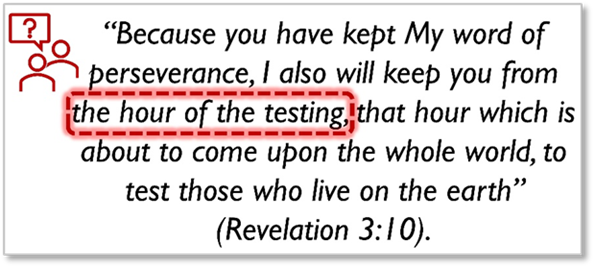
The “time of testing” from which Jesus protects the church is the tail end of the great tribulation, when Jesus pours out the seven-seal judgments upon the kingdom of evil. This is a critical point. Many Christians are confused here.
- Revelation 4-18 is not really about the antichrist’s reign of terror against believers—the “great tribulation.” Many Christians think it is about that. But they’re wrong (except for Revelation 13).
- Instead, Revelation 4-18 is about the time at the end of this seven-year “great tribulation” when Jesus pours out the seven seals of judgment upon the kingdom of darkness.
We know this because Revelation 4-5 shows us the solemn run-up to this day of the Lord, which culminates with the slain Lamb being the only one worthy to break the seals and open the scroll which heralds the better tomorrow (Rev 5:2).
- Because Jesus has overcome for his people, as our vicarious and righteous substitute, he alone may open the scroll and its seven seals (Rev 5:5).
- As if to solemnize this awful but necessary time of divine wrath against evil, the angelic creatures sing: “Worthy are You to take the scroll and to break its seals; for You were slaughtered, and You purchased people for God with Your blood from every tribe, language, people, and nation” (Rev 5:9).
- Before Jesus can receive power, honor, glory, blessing, “and dominion forever and ever,” he must first destroy his evil counterpart and his wicked kingdom. What follows in Revelation 6-16 are the seven-sealed judgments of wrath against the antichrist and Babylon.
The horsemen, the brimstone, the incineration of one-third of the earth’s vegetation, the waters turning to blood, the mutant, demonic locust-like creatures—all the “bad stuff” we associate with Revelation is divine wrath against antichrist and his followers. The antichrist is doing none of this! Instead, Jesus is doing it to the antichrist and to his people.[1]
This means this “time of testing—the one about to come upon the whole world to test those who dwell on the earth” (Rev 3:10) is against unbelievers—against the antichrist and his followers.[2] Jesus is testing whether they will repent and choose Jesus or cling to darkness. Some translations use the word “trial” here, but this not the best because Jesus is not evaluating the faith of unbelievers. He is testing whether unbelievers will truly continue to reject him.
This judgment ends with the Lord destroying Babylon and the antichrist’s people wailing because Jesus has smashed their world (Rev 18:9-19). “Rejoice over her, O heaven, and you saints and apostles and prophets, because God has pronounced judgment for you against her” (Rev 18:20). Now that the Lord has vanquished the kingdom of evil, John tells us: “I heard something like the voice of a great multitude and like the sound of many waters, and like the sound of mighty peals of thunder, saying, ‘Hallelujah! For the Lord our God, the Almighty, reigns’” (Rev 19:6). Jesus now returns to establish his kingdom on earth (Rev 19:11-21).
So, the “time of testing” is not the antichrist’s persecution of believers—it is Jesus’ wrath upon the kingdom of darkness. During this period, Jesus will protect his people. Before Jesus cracks open the sixth seal of judgment, he commands an angel to mark a vast number of believing Jewish people with his “seal” to protect them from the coming judgments (Rev 7:3; cp. Ezek 9:4-6; Ex 11:6-7, 12:13).
Who does Jesus protect?
Our passage is here—who is Jesus protecting and what kind of protection does he promise? He will protect his church (as a collective whole) from physical and spiritual destruction.
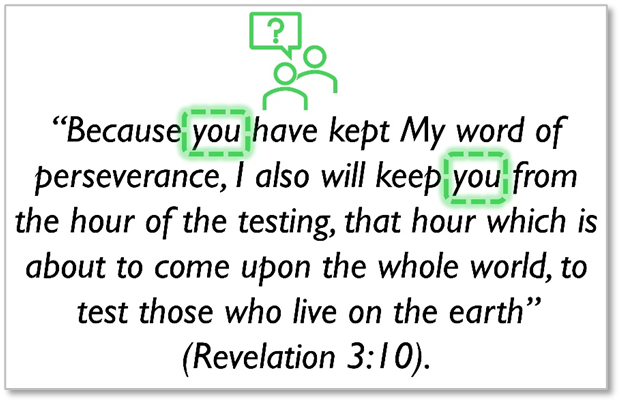
Because the church in Philadelphia (collectively, as a single referent)[3] is protected from this time of testing, it’s reasonable to believe that this protection applies to the entire church as a whole. The is a promise to the community, not to every single individual. So, taken collectively as a single community, Jesus will protect his church from this time of testing.
Pre-tribulational Christians go beyond the evidence when they insist that: (a) if any Christians die during the Great Tribulation then Jesus’ promise here is void, so (b) this must mean Jesus promises to physically remove the church from the scene. This does not necessarily follow.
First, as we saw, the “time of testing” is not the antichrist’s persecution of believers—it is Jesus’ wrath upon the kingdom of darkness. So, the entire objection fails.[4] Some object that, if this be true, then it’s cold comfort indeed:[5] “A whole bunch of y’all will die during the antichrist’s persecution, but don’t worry—I’ll protect the believers who are still alive when I unleash literal hell on earth. Cheers!” This is a false dilemma that demands: “What took you so long!?” One might as well criticize God for allowing the Israelites to suffer in Egypt before “finally” protecting them during the final plague (Ex 2:23-25; 12:23, 29).
Second, even if we (wrongly) conclude that Jesus does promise protection during the time of antichrist’s persecution during the last 3.5 years of his sinister reign … because Jesus’ promise is to the church as a whole, collectively, it simply means that the church will be protected during this period. That is, as an organism and a worldwide family of Jesus people, Satan shall never destroy the church because the gates of hell shall not prevail against it. Indeed, Jesus promised that he would intervene to stop this great tribulation lest no believers be left alive (Mt 24:21-22). That intervention is the judgments of the seven-sealed scroll which together destroy antichrist’s kingdom (culminating at Rev 16, re-told in Rev 17-18).
Will some believers will die during this “time of testing” when Jesus pours out the seven judgments upon the whole world? The answer is yes—but they will die at the antichrist’s hands, not Jesus’ hands. That is, the antichrist will never destroy “the church” as a whole. The Japanese killed many Americans sailors in the Pacific theater of operations in World War 2, but they never destroyed the U.S. Navy. Many Israelites died under Pharoah’s rule in Egypt (Ex 1:15-16), but “Israel” never did die.
- John tells us about believers who have already died during the antichrist’s reign of terror before Jesus responds to the prayers by unleashing judgment upon the kingdom of darkness (Rev 6:9-10, 7:13-14). These martyrs who died during this great tribulation plead for justice upon “those living upon the earth” who killed them—the very people who are the objects of this “time of testing.”
- After Jesus opens the fifth seal, the angels tell the great tribulation martyrs “to rest for a little while longer, until the number of their fellow servants and their brothers and sisters who were to be killed even as they had been, was completed also” (Rev 6:11).
- But, we also see believers being sealed and protected—John highlights Jewish believers in particular who are safe from these judgments (Rev 7:3, cp. Rev 9:4).
Some may protest that it is too fantastic to believe that believers will be protected from death at a time when the first four “trumpet judgments” of the seventh seal destroy a major portion of the world (Rev 8:6-12). But, consider the plagues upon Israel before the Exodus: “But not even a dog will threaten any of the sons of Israel, nor anything from person to animal, so that you may learn how the LORD distinguishes between Egypt and Israel … The blood shall be a sign for you on the houses where you live; and when I see the blood I will pass over you, and no plague will come upon you to destroy you when I strike the land of Egypt” (Ex 11:6, 12:13).
Kept from the hour?
Here is the passage—what kind of protection is Jesus promising? Physical removal from the scene, or protection from danger during the time of testing?
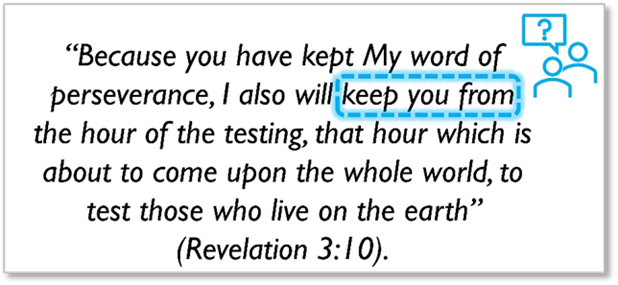
Advocates for a pre-tribulation rapture expend much energy on what it means to be protected from the time of testing. Bible teachers crack open their Greek New Testaments (or fire up their bible software) and begin speaking about the preposition ἐκ (“from”), which in its most basic, original sense suggests an exit from some sort of relationship.[6] So, pre-tribulationists may argue, the idea is that Jesus will take the church away from the coming wrath.
This doesn’t necessarily follow, for a host of nerdy reasons that I’ll try to explain without making you fall asleep.
Blurred lines and prepositions
First, while the original meaning of the preposition ἐκ does indicate motion out of something, that certainly isn’t its exclusive or even primary sense in the New Testament. By then, prepositions no longer had a rigid meaning, which means you cannot say: “it must mean ONLY THIS!” Some pre-tribulation advocates do not seem to appreciate this because they sometimes rely on an outdated understanding of prepositions.[7] Language changes over time, and by the New Testament era the precise distinctions of meaning between koine Greek prepositions had now blurred and overlapped.[8]
- For example, the preposition εἰς, in a strict sense, means “motion into a thing”[9]—you pour coffee into a cup. But, the Gospel of Mark says Jesus “was sitting on (εἰς) the Mount of Olives” (Mk 13:3).
- If you want to insist on the classical meaning for this word, you’d translate it as “Jesus was sitting into the Mount of Olives.” Of course, that’s ridiculous—is he a mole, burrowing into the soil?
- What’s happened is that the meaning of εἰς has blurred and overlapped with that of another preposition (ἐπί), whose “basic idea is ‘upon.’”[10]
What happens with every word is that its original sense expands into all kinds of figurative uses, and this expanded meaning eventually moves far afield of the “original,” rigid “meaning.”This is why, in English, the original meaning for the word “ball” is “a round or roundish body or mass.”[11] But, this meaning has expanded to mean a basketball, or a testicle, or a great time (“I had a ball at the park yesterday!”), or even a formal dance (“Cinderella made it to the ball!”).
With the preposition ἐκ, its basic sense of spatial movement out of something has expanded to indicate:
- Disassociation (“Christ redeemed us from the curse of the law,” Gal 3:13).
- Derivation (the crown was made from thorns, Mt 27:29).
- Time (the man was blind from birth, Jn 9:1).
- Means (a person isn’t justified by means of doing what the law requires, Gal 2:16).
- Personal agency (people are born by the will of God, Jn 1:13).
… and more. My point is that, in Revelation 3:10, the preposition ἐκ doesn’t necessarily mean the Lord will physically remove believers out of this world, as in: “Hang on! I’m gonna get y’all outta there!”[12]
Second, regardless of that point, in Greek the sense of John’s phrase “protected from the time of testing” still doesn’t suggest physical motion out of a situation. When you have the construction like that in Revelation 3:10 of “stative verb (τηρήσω) + transitive preposition (ἐκ),” the stative verb swallows up the transitive force of the preposition.[13] In Revelation 3:10, this suggests the idea of physical (i.e., transitive) motion—spatial exit from a situation—falls away.[14] This implies we’re left with some kind of protection from the time of testing that doesn’t include physical removal from the scene.
Therefore, building on our first point, we must look beyond the original, rigid meaning of ἐκ to rightly understand the nature of Jesus’ protection—we need the context.[15]
What does “from” (ἐκ) mean in Revelation 3:10?
A normal Christian with a good English translation doesn’t have to do this—but here is what responsible nerds must do “behind the scenes” to figure out what, say, Revelation 3:10 is saying.[16]
- Look at the list. As we learned, every word has a range of possible meanings. Look at the preposition’s original, rigid meaning (for example,ἐκ is spatial—“out of”), then look at the range of figurative meanings common to the word. It isn’t true that a preposition has a “literal meaning.”[17] Instead, it has a range of meanings, and some (depending on context) are more likely than others.[18]
- Look at the word(s) the preposition modifies. In this case, “the time of testing” (τῆς ὥρας τοῦ πειρασμοῦ) is in the genitive case, whose historical function was to depict a description or a separation.[19] Usually, prepositions govern the nouns they modify.[20] In Revelation 3:10, both the preposition and the genitive case of the modified noun indicate separation from this “time of testing.”
- Look at the context. What does the larger paragraph tell us about what the prepositional phrase means?
Using this method, the preposition in Revelation 3:10 likely means protection from Jesus’ divine wrath which, during this “time of testing,” he will unleash upon antichrist and his kingdom:
- Look at the list.
Because (as we saw, above) a stative verb swallows up the transitive nature of the preposition, ἐκ likely doesn’t mean “physical removal outta here” in Revelation 3:10. Instead, it’s probably a preposition of separation by disassociation.[21] Jesus will somehow separate us from the time of testing, and the best rendering here is “protection from the time of testing.” The most logical kind of protection from something, without involving physical motion away from it, is to be guarded and protected during the event.
Elsewhere, John uses the very same construction[22] to record that Jesus prayed that the Father would “keep them from the evil one” (Jn 17:15b). That is, protect us by separating us from Satan—not isolating us from his physical presence, but protecting us from his dominating power. In a similar way, in our passage Jesus promises to protect the church from the power of this time of divine judgment upon the kingdom of evil—just as he did in Egypt before the Exodus.
- Look at the word(s) the preposition modifies.
As we said (above), the genitive case here suggests separation from the time of testing, which pairs nicely with the preposition which conveys the idea (in this context) of a non-physical disassociation from the time of testing.
- Look at the context.
Jesus tells this church in Philadelphia that he has set before them “an open door,” which probably means a “door” of ready access to him “because you have a little power, and have followed My word, and have not denied My name” (Rev 3:8). Despite their likely small numbers (“a little power”) and seeming impotence, they are faithful. The door to the Messianic kingdom remains open and ready for them, despite this church’s “unimpressive” nature.[23] He promises to deal with a specific cabal of Jewish people in the city who hate this congregation and are persecuting it.[24] These folks, Jesus declares, are not “Jews” at all—their “synagogue” actually belongs to Satan, who is tricking them (cp. Jn 8:44).
But, Jesus assures them, because they have persistently obeyed (“kept”) his message about perseverance, he will protect (“keep”) the church in Philadelphia from the time of testing—the one about to come upon the whole world to test those who dwell upon the earth (Rev 3:10). They will be protected during the time when Jesus unleashes the seven-sealed judgments onto the kingdom of evil (Rev 6-16).[25] He will return soon (“quickly”), so they must hold firmly to their faith as they endure persecution from the local “synagogue” and narrow-eyed suspicion from Roman authorities—or else they may lose their crown (Rev 3:11). In other words, keep on persevering and holding on!
Jesus will make the ones who overcome all these difficulties “a pillar in the house of my God,” and he will write his name on their foreheads to mark them as his own. He will not write his own name only, but the names of the Father and of the new Jerusalem—the celestial city (Rev 3:12).
Bottom line
The bottom line is that Revelation 3:10 (by itself) likely does not support a pre-tribulation rapture. A preposition is a very slender reed upon which to hitch your wagon.[26] It doesn’t mean a pre-tribulation rapture is wrong. It just means that Revelation 3:10 probably doesn’t teach it. I believe the preponderance of evidence here does not support a pre-tribulation rapture, but it would be a mistake for either side to be dogmatic.
- In terms of weight of evidence, “preponderance of evidence” is the weakest–it means something is more likely than not true.
- This is followed by “clear and convincing” evidence, which means what it says.
- Finally, the strongest case is “beyond a reasonable doubt,” which you may be familiar with from bad police movies or TV shows.
- My assessment about whether the pre-tribulation rapture is present in Revelation 3:10 is at the level of “preponderance of evidence.”
Jesus swears he is returning soon and, if the church perseveres in faith, he promises to protect this local church from the outpouring of his divine judgment that will one day come: “In this great trial, the servants of Christ shall be kept safe.”[27] He doesn’t explicitly say how he will protect them. But the preponderance of evidence suggests that it will be protection from the power of the divine judgments (Rev 6-16), just as God protected the Israelites from the plagues in Egypt.
Of course, Jesus did fulfill this promise to the church in Philadelphia because they died long before the antichrist’s reign—which is still future today! He did protect them from this time of divine wrath against the kingdom of evil. But ultimately, this is a promise to the entire church—to the entire Jesus family that is alive during the great tribulation. When the Lamb who was slain cracks open the seals to open the scroll (Rev 6-16), he will protect his church from the power of this time of testing against antichrist, his people, and his kingdom of evil.
Translation
ὅτι ἐτήρησας (BDAG, s.v., sense 3) τὸν λόγον τῆς ὑπομονῆς (gen. comm. content) μου, κἀγώ σε τηρήσω (BDAG, s.v., sense 2d) ἐκ (disassociation = sit. out of which someone is brought = BDAG, s.v., sense 1c) τῆς (monadic) ὥρας τοῦ πειρασμοῦ (att. gen.) τῆς μελλούσης ἔρχεσθαι (art. inf. = appositional clause) ἐπὶ τῆς οἰκουμένης ὅλης πειράσαι (anarthrous = purpose) τοὺς κατοικοῦντας ἐπὶ τῆς γῆς.
“Because you have persistently obeyed my message about perseverance, I also will protect you from the time of testing—the one about to come upon the whole world to test those who dwell on the earth.”
[1] Buist Fanning briefly states that the ones who hide from Jesus’ wrath in Revelation 6:16-17 are believers who die because of the divine judgments, but this makes no sense in context. He does not try to substantiate the claim—he just makes it in one sentence (Revelation, in ZECNT (Grand Rapids: Zondervan, 2020), 177). These people are likely unbelievers who follow the antichrist.
[2] “There the faithful are sealed with a view to their preservation from the assaults of demons, but are not thereby secured against physical death … It will be observed that the demonic trial spoken of, while worldwide, was to affect only ‘those that dwell upon the earth,’ i.e. the non-Christians” (R. H. Charles, A Critical and Exegetical Commentary on the Revelation of St. John, vol. 1, in ICC (Edinburgh: T&T Clark, 1920), 89).
[3] The referent is singular in Greek, referring to the Christian community in Philadelphia as a collective whole.
[4] For example, Jeffrey Townsend objects: “This presents an immediate problem for post-tribulationism since it holds that the church will be preserved on earth during the hour of testing. Yet verses such as Revelation 6:9–10; 7:9, 13, 14; 13:15; 14:13; 16:6; 18:24; and 20:4 present a time of unprecedented persecution and martyrdom for the saints of the tribulation period” (“The Rapture in Revelation 3:10,” in Bibliotheca Sacra, BSAC 137:547 (Jul 1980), at 153).
He is incorrect—the horrors in Revelation 6-16 are not the antichrist persecuting Christians. It is Jesus pouring out divine wrath upon the kingdom of evil.
[5] Robert L. Thomas, Revelation 1-7 (Chicago: Moody, 1992), 286. “What good does it do to be preserved from the physical consequences of divine wrath and still fall prey to a martyr’s death?”
[6] Murray J. Harris, Prepositions and Theology in the Greek New Testament (Grand Rapids: Zondervan, 2012), 103.
[7] Robert Thomas (Revelation 1-7, 284-86), Paul Feinberg (“Pre-tribulation,” in The Rapture, 63-68), and Craig Blaising (“Pre-tribulation,” in The Rapture, 38, note 67) rely heavily upon the arguments of Jeffrey Townsend, who in turn relied on A. T. Robertson’s assessment of the preposition at issue: “According to Robertson, ‘The word means ‘out of,’ ‘from within,’ not like ἀπό or παρά’” (Townsend, “Revelation 3:10,” 253).
But, as modern Greek grammars recognize, Robertson was incorrect to insist on precise, classical categories to distinguish koine Greek prepositions from one another. Townsend reflects this error when he states: “This is an untenable position because the idea of preservation in and through the hour of testing would normally have been expressed by ἐν or διά” (“Revelation 3:10,” 253). He is wrong.
Dan Wallace’s admonition is relevant here: “… too often prepositions are analyzed simplistically, etymologically, and without due consideration for the verb to which they are connected. Prepositions are often treated in isolation, as though their ontological meaning were still completely intact” (Greek Grammar Beyond the Basics (Grand Rapids: Zondervan, 1996), 359).
[8] Wallace, GGBB, 362-63; Harris, Prepositions, 34-35; Richard Young, Intermediate New Testament Greek (Nashville: B&H, 1994), 85-86.
[9] William Arndt (et al.), A Greek-English Lexicon of the New Testament and Other Early Christian Literature (Chicago: University of Chicago Press, 2000). s.v. Hereafter “BDAG.”
[10] BDAG, s.v.
[11] Merriam-Webster Collegiate Dictionary, s.v. “ball,” noun, sense 1 (Springfield: Merriam-Webster, 2026), 132.
[12] “[I]ndeed, it is now becoming more and more clearly recognized that it is a mistake to build exegetical conclusions on the notion that classical accuracy in the use of prepositions was maintained in the Koine period” (C.F.D. Moule, An Idiom Book of New Testament Greek, 2nd ed.(Cambridge: Cambridge University Press, 1959), 49).
[13] Wallace, GGBB, 358-59. “Stative verbs override the transitive force of prepositions. Almost always, when a stative verb is used with a transitive preposition, the preposition’s natural force is neutralized; all that remains is a stative idea.” Emphasis in original.
[14] This is not the case in John 17:15a, which bears a transitive verb (ἄρῃς) + a transitive preposition (our old friend ἐκ) = the sense of movement out of this world is retained. Jesus prayed: “I do not ask that you take them away from the world …” (οὐκ ἐρωτῶ ἵνα ἄρῃς αὐτοὺς ἐκ τοῦ κόσμου).
[15] “It is important to remember that prepositions are extremely flexible in meaning, and careful consideration of the literary context is essential in determining the nuance of a preposition” (Andreas J. Köstenberger; Benjamin L. Merkle; Robert L. Plummer, Going Deeper with New Testament Greek: An Intermediate Study of the Grammar and Syntax of the New Testament (Nashville: B&H, 2016; Kindle ed.), KL 10481-10482).
[16] I adapted this from Harris, Prepositions, 31. I left off his fourth step because it does not apply in this case.
[17] Erroneously, Craig Blaising wrote: “This view depends on a ‘dynamic’ interpretation of the preposition ek …” (“A Case for the Pretribulation Rapture,” in Three Views on the Rapture: Pretribulation, Prewrath, or Posttribulation, ed. Alan Hultberg (Grand Rapids: Zondervan, 2010), 38). This is incorrect and does not reflect the realities of language in general, let alone koine Greek.
[18] Young, Intermediate Greek, 86.
[19] Young, Intermediate Greek, 23.
[20] Wallace, GGBB, 360-62.
[21] BDAG, s.v., sense 1c; cp. Brill Dictionary of Ancient Greek (hereafter “GE”), ed. Franco Montanari (Leiden: Brill, 2015),s.v., sense II.A.c.
[22] Gk: τηρήσῃς αὐτοὺς ἐκ τοῦ πονηροῦ = preposition ἐκ + genitive object. “[T]he thought is quite in keeping with that of our Seer” (Charles, Revelation, 1:89-90). And, the apostle also wrote this same phrase at both John 17:15 and Revelation 3:10. This suggests it is a stylistic quirk of John’s of which we ought to take note.
[23] Robert Mounce, The Book of Revelation, in NICNT (Grand Rapids: Eerdmans, 1977), 117.
[24] Some people think this means that members of this hostile Jewish synagogue will come to believe Jesus is their Messiah. Others think Jesus refers to their eventual acknowledgment of him in a non-saving way—perhaps on the day of judgment (Rev 20). That is, “every knee will bow, and every tongue will confess …” (etc.).
[25] Some pre-tribulation advocates eagerly seize upon a distinction between (a) being kept from the danger itself, and (b) being kept from the time period of this danger. The latter, they sometimes claim, suggests a physical removal from the scene. In truth, this is a de minimis argument.
[26] For example, Paul Feinberg spent five pages discussing the preposition ἐκ as he supported the pre-tribulation rapture perspective at Revelation 3:10. If a preposition is the best you got, then your argument is very weak (“The Case for a Pre-tribulation Rapture Position,” in The Rapture: Pre, Mid, or Post-Tribulation, ed. Stanley Gundry and Gleason Archer (Grand Rapids: Zondervan, 1984), 63-68).
[27] Henry Alford, The New Testament for English Readers: A Critical and Explanatory Commentary, New Edition, vol. 2 (London; Oxford; Cambridge: Rivingtons; Deighton, Bell and Co., 1872), 969. Similarly, John Gill writes that: “it will be known who are his true churches, and pure members; and these he’ll keep close to himself, and preserve safe amidst all the distress and confusion the world will be in” (An Exposition of the New Testament, vol. 3 (London: Mathews and Leigh, 1809), 711).



 The Eccentric Fundamentalist