Die, Dragon!

Die, Dragon!

The traditional Advent theme is that Jesus is on the way. Old covenant prophesies tell us so. Today, I offer something a bit different—a sketch of how Jesus defeats Satan.

The scripture paints this in a grand, epic style. It’s very unlike the dense legal analysis of Jonathan Edwards or Francis Turretin … or the Book of Romans. Instead of logical outlines, Revelation (and good bits of Zechariah and Daniel) tells us its story in a style beyond earthly reality. There are bizarre, otherworldly creatures, vivid pictures, symbolism, and fantastic imagery. There are women in baskets, huge flying scrolls, women with the wings of storks, a seven-headed dragon, a ten-horned beast who crawls out of the sea, a two-horned lamb who bursts out of the earth like a vengeful orc, a woman with a crown of stars, and another who is a dolled-up prostitute with pearls and jewels.

This is a world of fairy tale-like vibes that invites us to experience its message as a fantasy world. It paints in cosmic, sweeping strokes—it is often not about communicating detailed timelines—just contrast the styles of Revelation 12-13 with 2 Thessalonians 2! We know Frozen isn’t set in a “normal” world, even though it communicates real and true things, and so we instinctively re-calibrate our hearts and minds accordingly. We ought to do the same with Revelation—we can’t read it like a legal brief.

The bible paints Satan as an evil dragon who loses a series of battles in the war against God.

  • We meet a holy woman, pregnant, glowing in white, with a crown of 12 stars. She cries out, ready to give birth (Rev 12:1-2).
  • A dragon stands beside her, waiting to kill the child. He is blood red, with seven heads (Rev 12:3-4). We know this isn’t a good character. Dragons never are. Perhaps we ought to picture a hydra-like creature—if one head is chopped off, another will spring up. His evil is unkillable. We can almost see the dragon flexing his claws, snorting bursts of flame, purring madly. Waiting.
  • The child arrives but is caught up to God and his throne. This child will rule the world with a rod of iron. Of course, he is Jesus—the child born at Bethlehem on Christmas morning. The dragon has failed. The woman, who likely represents God’s covenant people from whom Jesus hails, flees to the wilderness (Rev 12:5-6).

Meanwhile, in heaven, now that the child has returned to his throne of glory (Rev 12:7-9; cp. Jn 17:5; Acts 2:22-36) the dragon and his minions are tossed down to earth—a forced eviction (cp. Lk 10:18).

  • This is like the scene from an old Western movie where the hero tosses the bully who has been terrorizing the town out of the saloon and into the dirt in the street outside. The bad guy scrambles to his feet, shakes his fist, and vows revenge. He then rides off to gather his crew and start trouble.
  • This is what happens to Satan once Jesus accomplishes his work here—he is cast down and will now flail about like a crazed, wounded beast (Rev 12:10-12). He is angry. He is furious.
  • But we know the bad man has already lost and John Wayne will surely win—just like Jesus.

Enraged, the dragon races after the holy woman to destroy her (Rev 12:13). God gives her eagles wings (Rev 12:14)—just as he did for his people in the Exodus (Ex 19:4)—and she flees to the wilderness. The dragon breathes out a tidal wave of water to drown her before she can reach safety (Rev 12:15) This is a demonic reversal of the Exodus escape—then the water was a wall of divine protection that allowed God’s people to escape death, here the water is a tsunami intended to kill.

But once again God foils the dragon’s plans. Having failed to strangle the new covenant people (whom the holy woman represents) in the cradle, the dragon storms away “to make war with the rest of her children, who keep the commandments of God and hold to the testimony of Jesus” (Rev 12:17). We are these children—in Jesus communities large and small. We come from this “woman,” who is God’s family—just as surely as the harlot of Revelation 17 represents Satan’s family.

This is the cosmic sketch of world history.

  • The dragon tries to destroy the Christ-child. He fails and is “kicked out” of the heavens above and cast down into the dirt. He is on borrowed time.
  • Enraged, he tries to kill the holy woman. He fails there, too. Once more, God carries his people on eagle’s wings away from the clutches of evil.
  • Now, more furious than ever, the hydra-dragon darts to and fro, trying to immolate the woman’s “children” with fire. Despite local successes, he cannot stamp them all out. Like a divine hydra, God’s new covenant family cannot be killed. There are too many of us.

John’s vision shifts to the dragon standing on the seashore, perhaps huffing and puffing, maybe melancholy. He has failed, but has he given up? Far from it. John shows us two frightening images of the last days, when “the great dragon … the serpent of old who is called the devil and Satan, who deceives the whole world” (Rev 12:9) rolls the dice one last time and goes all in on his wicked schemes.

  • The first horror is a seven-headed beast who crawls out of the sea, spewing blasphemy against God and his people. Mimicking Jesus, he appears to die and is revived. “And the whole earth was amazed and followed after the beast” (Rev 13:3). The dragon gives his power and authority to this ghoul, just as God the Father gives his power and authority to Jesus in the incarnation. This creature is the antichrist—Jesus’ “evil twin.”
  • The second creature bursts out of the earth as a two-horned lamb (Rev 13:11)—perhaps a deliberate mockery of Jesus, “the Lamb of God who takes away the sin of the world” (Jn 1:29). Like the Holy Spirit, he too performs miracles and points everyone to his Christ-like figure (Rev 13:12-14). The true good news, properly understood, is accepted by willing faith. The kingdom of darkness operates by terror and coercion: “he makes the earth and those who live on it worship the first beast …” (Rev 13:12).

But the apostle John does not leave us there. The wicked woman, the alluring false front for evil, will be no more (Rev 17). God destroys Babylon, the city of darkness, from on high with great violence (Rev 18). Jesus returns with the armies of heaven, clothed in a robe drenched in his own blood, to slay the two beasts and cast them into the lake of fire to burn forever (Rev 19). An angel casts Satan into prison and shuts him up for 1,000 years, then afterwards the great red dragon joins his creatures in hell (Rev 20:1-3, 7-10). Jesus reigns with his people, “married” to them in an eternal union that will never be broken again (Rev 19:7-10).

What does this have to do with Christmas? Well, this is how it all ends for the serpent from the garden.

  • Satan loses. His great creature (the antichrist), the false prophet, his evil city, and his wicked woman are gone forever—never to return. The kingdom of darkness is no more. The dragon is cast down and will burn forever.
  • God wins. His eternal Son (the real Christ) reigns forever, heaven is here on a new earth, and the “holy woman” is safe forever in covenant union with him. “There will no longer be any curse; and the throne of God and of the Lamb will be in [the city], and His bond-servants will serve Him” (Rev 22:3).

This is real prophetic history painted in fantasy hues. And it all kicks off with the Savior born in Bethlehem on Christmas morning. This is how it will all end. This is what the boy from Bethlehem will do. This is why Christmas is so beautiful. This is when the dragon’s doom is sealed—it’s the beginning of his end.

Long live the king.

Review of my Galatians commentary

Review of my Galatians commentary

I wish to thank Dr. Joel Grassi for a very kind and generous review he just published on my book Faith Working Through Love: The Message of Galatians. He writes: “I am happy to recommend it as an addition to pastors for their libraries and churches for their classroom study.”

Some highlights:

I was also very interested to read a commentary written by a man who serves as a “bi-vocational pastor.” Many use this label when in reality they are one of several on a staff of pastors, and their “day job” is teaching in Christian education or something like that. But M.T. Robbins is truly a “bi-vocational pastor,” serving as the senior pastor of Sleater Kenney Road Baptist Church in Olympia, Washington, as well as working full time as a claims investigator for the state government. We are impressed and thankful for his efforts, and can appreciate how difficult, exhausting, and often thankless this particular vein of “tent-making ministry” is.

And this…

Robbins’ work is a down to earth, practical, and straight shooting overview of the message of Galatians. He seems to have labored to express himself clearly and forthrightly, and to try to break down big concepts into understandable sentences and paragraphs, including charts and graphics spread out over 13 chapters.

And finally this:

… we are very happy to recommend this book to those who are studying the book of Galatians either in their personal Bible study or in the setting of the local body of Christ, which is the pillar and ground of the truth, the NT immersionist assembly. We trust that it will help further the Gospel of Christ, which is of grace and unto liberty, and not under the Law to bondage.

I spoke a bit about my book on Galatians here, and you can find more info here. Suffice it to say that it is only 184 pages, it is short, it is written in a normal and conversational style, it has lots of charts and pictures, I pray that it can help you understand what Paul is saying in Galatians. It’s a really important letter in the New Testament! Consider grabbing a copy, and let me know what you think. If you feel I got something wrong (because I surely have), then let me know that, too! You can find more content from Dr. Grassi (who reviewed my book) here.

Identifying and Avoiding False Teachers

Identifying and Avoiding False Teachers

False teachers are a big deal in the bible. Here, I’ll answer three important questions about them that ought to help every Christian be on guard against their tricksy ways.

Q1: What is a false teacher?

The apostle Peter has a lot to say about false teachers. So does Jude. It’s possible that Jude had Peter’s second letter and borrowed a lot of his material for his own letter. If you read them, they sound similar! What, exactly, are false teachers? What makes them “false”? Both authors sum it up very simply:

  • Peter says they “secretly introduce destructive heresies, even denying the Master who bought them …” (2 Pet 2:1).
  • Jude tells us these bad actors are “ungodly persons who turn the grace of our God into indecent behavior and deny our only Master and Lord, Jesus Christ” (Jude 4).

There you have it. A false teacher is someone who denies, disowns, repudiates, or refuses to believe the truth about Jesus. You could say that every heresy, every false teaching, every lie about the gospel always begins by denying something about who Jesus is and what he’s done for his people. People create fake Jesus in their own image. 

  • People say Jesus never really died.
  • That he is not God.
  • That he is not eternal.
  • That he is not co-equal with the Father.
  • That he was not conceived by a miracle of the Holy Spirit in Mary’s womb.
  • That he was not sinless.
  • That he did not die in our place, as our substitute.
  • That his death was not a ransom.
  • That his perfect life and willing sacrifice did not satisfy divine justice.

These lies (and others) keep coming back. Every Easter, a major newspaper trots out an article by some liberal scholar who claims to reveal “the truth” about Jesus. False teachers are alive and well. Peter said they would be: “false prophets also appeared among the [old covenant] people, just as there will also be false teachers among you” (2 Pet 2:1).

Q2: How do we know who Jesus is and what he has done?

If a false teacher is someone who denies some key truth about who Jesus is and what he has done, then what tools has God given us so that we can find out these truths? Very simple—by his message, recorded in the bible, and by the Holy Spirit. 

Peter tells us about that, too. He wants us to know, with sure conviction, that we can trust the account he’s given us. He and the other disciples didn’t follow clever fables when they told everyone about Jesus—they literally saw him in his majestic splendor (2 Pet 1:16)! They saw what happened to him on that mountain, when he transformed before them into a figure of blazing white, radiant with pure holiness and heavenly light. Peter heard the Father speak words of affirmation about his eternal Son from the heavenly cloud of glory that surrounded them on that mountaintop (2 Pet 1:17-18).

So, he reminds us, the prophecies from the old covenant have now been made surer and more certain. Events have confirmed them. These prophesies and promises are like a lamp shining in a dark place, guiding us until that day when Jesus returns to be the literal light of the world (2 Pet 1:19). So, know this first of all, Peter says: these prophesies weren’t private intuitions or ramblings people made up—they were messages given by men as they were moved by the Holy Spirit to speak (2 Pet 1:20-21)!

The scripture is the record of God’s message to us, and that message is all about Jesus. The Holy Spirit is the who confirms and interprets the scripture for us—every Christian should read John Calvin’s short explanation of this (see Book 1, ch. 7, from Calvin’s Institutes of the Christian Religion). So, to know the truth about Jesus, we must read about his message in the holy scriptures and trust the Spirit of God to help us understand it all.

Q3: How can I be sure I’m interpreting the scriptures about Jesus the right way? 

This immediately raises another important question—how do I know that I (and my church) are putting the puzzle pieces together correctly? How do we know we’re believing the right things about Jesus? How do I know I’m interpreting the scriptures the proper way? 

Here is where we must deliberately leave our American individualism behind, and make sure we’re on the same page as the untold millions of our Christian brothers and sisters who have gone before us. Jesus tells us that true believers will hear his voice and follow him (Jn 10:1-4). This means that Christians down the centuries have heard the message of the true Jesus, have followed him, and have written down Spirit-led facts and summaries about what the bible says about the true Jesus. 

We find this broad consensus about Christian doctrine in the great creeds and confessions of the early church. This doesn’t mean these documents stand atop holy scripture like an infallible filter. One Baptist scholar memorably said we ought to believe in suprema scriptura, which means the bible is the highest or supreme channel of religious authority.1 This is good—we believe that “the Holy Scripture is the only sufficient, certain, and infallible rule of all saving knowledge, faith, and obedience …” (2LBCF, 1.1). So, creeds and confessions aren’t filters that interpret the bible for us—but they are guardrails that give us assurance that we haven’t run off the road and into a ditch. 

I’m thinking especially of these documents:

  • The Nicene Creed of 325 A.D. and the Nicene-Constantinople Creed of 381 A.D. These clarified Jesus’ deity and his relationship to the Father. Is Jesus a created being? Is Jesus an angel? If Jesus is God’s “son,” then does this mean he came on the scene later than the Father? If Jesus is God, and the Father is God—are Father and Son one being/substance or two?
  • The Chalcedonian Creed of 451 A.D. What does it mean that Jesus is both divine and human? Did he stop being divine? Or was he not really a fully human person? What happened to him in the incarnation?

From there, see especially the major creedal documents that give shape to your Christian tradition. Assuming you’re a Protestant Christian, the buffet line goes a bit like this: 

  • Lutherans have the Book of Concord, which consists of the Augsburg Confession, Luther’s small and large catechisms, and some other documents.
  • Presbyterians have the Westminster Standards, which include the Westminster Confession of Faith, and the Westminster larger and smaller catechisms.
  • The Reformed have the Three Forms of Unity, which are the Belgic Confession, the Heidelberg catechism, and the Canons of Dort.
  • Baptists are cantankerous in this regard, so I’ll just select one strand of the Baptist tradition and suggest the Second London Baptist Confession (“2LBCF”) and the Orthodox Catechism.2

I don’t care which flavor of Christian you are—go to your tradition’s confession of faith and read what it says about Jesus. No matter which tradition you consult from my list, they all say the same thing about Jesus—the same truths, the same affirmations, the same Jesus. Read the 2LBCF’s explanation here—it’s not long!

Why do creeds and confessions matter? Why are they good guardrails?

Because we don’t need to reinvent the wheel every generation. God gave the same Holy Spirit to our brothers and sisters in 325 A.D. as he does today. He led them into all truth, too. They believed the gospel, read the scriptures, learned from their church leaders and from one another, and had power on high from the Spirit of God. They wrote down summary statements of the faith. We have what they wrote. We would be fools to toss all that aside and start fresh with a blank sheet of paper. 

This means that, if you and your church believe something about Jesus that no credible group has ever believed in the history of the church … then you’re probably wrong. We can consult a record of sorts because we have those creeds and confessions from centuries gone by that tell us what our brothers and sisters in Christ thought about who Jesus is and what he’s done.

How do we avoid false teachers?

They’re tricksy. They don’t wear orange jumpsuits. They preach false things about who Jesus is and what he’s done—they deny the real Jesus. So, we must read the scripture and trust the Holy Spirit to guide us. We make sure we’re on the right track by joining a local church which swims in the broad stream of Christianity that has existed from the beginning—one that doesn’t naively try to re-invent the wheel but appreciates the guardrails of the tradition of which it is a part.

Peter said to: “remember the words spoken beforehand by the holy prophets and the commandment of the Lord and Savior spoken by your apostles” (2 Pet 3:2). We give ourselves assurance that we’re interpreting the prophecies and our Savior’s words the right way if we make sure we’re not contradicting what our brothers and sisters have said for centuries!

Read your tradition’s governing documents. See what they say about Jesus—again, read the 2LBCF’s summary about him here. If your church proclaims no tradition beyond its own statement of faith or that of a niche movement with no meaningful roots in the broad Christian tradition, then you are likely at greater risk of bring tricked by false teachers.


[1] James L. Garrett, Systematic Theology: Biblical, Historical, and Evangelical, Fourth Edition, vol. 1 (Eugene: Wipf & Stock, 2014), 206.

[2] If you want to read a good, short, and learned explanation of the Baptist tradition, see Matthew Y. Emerson and R. Lucas Stamps, The Baptist Vision: Faith and Practice for a Believer’s Church (Nashville: B&H Academic, 2025). 

Loving Your Enemies

Loving Your Enemies

Matthew 5:43-48 is one of the hardest passages in the bible. People usually know two things about Jesus—that he said not to judge, and that he loved people! This is the “he loved people” bit.

The Passage

First, we have Jesus’ statement about a common idea floating around in culture at the time: “You have heard that it was said, ‘YOU SHALL LOVE YOUR NEIGHBOR and hate your enemy’” (Mt 5:43).

This is kinda right and kinda wrong. Yes, the bible does speak of loving your neighbor (Lev 19:17-18). And yes—if you squint just the right way you can twist it to support hating your enemies, too. The Psalms have some hard sayings like this: “Do I not hate those who hate You, O LORD? And do I not loathe those who rise up against You? I hate them with the utmost hatred; They have become my enemies” (Ps 139:21-22).

There is a right way and a wrong way to understand these harsh psalms—but more on that later. For now, it’s enough to know that God has never wanted us to hate and loathe our enemies. But this is where popular piety was in Jesus’ day = love your neighbor, and feel free to hate your enemies if necessary.

This is wrong. Throughout the Sermon on the Mount, Jesus has combatted a lawyerly way of reading the bible. This is an approach that always wants to minimize personal responsibility and find loopholes that make compliance easier. It’s a rules-based approach to a relationship with God. It’s the same thing the lawyer tried to pull with Jesus that prompted the parable of the Good Samaritan.

As he does throughout this sermon, Jesus continues his “you have heard … but I say to you” pattern. How does he correct this misreading of scripture? He says: “But I say to you, love your enemies and pray for those who persecute you …” (Mt 5:44).

This means what it says. There is no hidden meaning in the original Greek that can give you something easier to swallow. We’ll come back to this in a bit. For now, let’s think about why Jesus gives this command. What’s the purpose of this almost impossible task? Jesus tells us: “so that you may be sons of your Father who is in heaven …” (Mt 5:45a).

What is Jesus saying?

He’s saying that if you don’t love your enemies, you’re not one of God’s children. If you don’t pray for your enemies, you’re also not one of his children.

Why does Jesus say this? “… for He causes His sun to rise on the evil and the good, and sends rain on the righteous and the unrighteous” (Mt 5:45b). Jesus is saying that God has a common love (or common grace) for everyone—not just his adopted children. So, if we claim to be Christians, we must be the same way. We must have an authentic, baseline love for everyone, not just our covenant brothers and sisters in the faith.

Why is this important?

Jesus explains: “For if you love those who love you, what reward do you have? Even the tax collectors, do they not do the same? And if you greet only your brothers and sisters, what more are you doing than others? Even the Gentiles, do they not do the same?” (Mt 5:46-47).

Being kind and loving to people who already like you doesn’t make you a Christian. There are plenty of non-Christians who do that all the time. Nice people. Kind people. Caring people. That isn’t counter-cultural. It isn’t revolutionary. So Jesus says this isn’t enough. Being a Jesus person means more than that. A lot more.

But this is the cultural attitude Jesus is up against. When a lawyer asked Jesus what he must do to gain eternal life, Jesus recited the two commandments which summed up a believer’s whole duty—love for God and your neighbor. The lawyer agreed, then immediately tried to minimize the command to make his target smaller: “But wishing to justify himself, he said to Jesus, ‘And who is my neighbor?’” (Lk 10:29).

Jesus corrected this legalistic, lawyerly way of understanding scripture with his famous parable of the Good Samaritan. He said that your “neighbor” was anyone who was in distress—not just your covenant brother and sister.

So, Jesus sums it all up: “Therefore you shall be perfect, as your heavenly Father is perfect” (Mt 5:48). He doesn’t mean “perfect” in the sense of “without fault” (e.g., “a flawless diamond”). Nobody is without fault! Instead, Jesus means “perfect” in the sense of “meeting the highest standard” (e.g., “my birthday was just perfect!”). The standard at issue here is this baseline, common love for everyone. One British translation does a good job by translating Matthew 5:48 like this: “Therefore, just as your heavenly Father is complete in showing love to everyone, so also you must be complete” (NEB).

Does Jesus contradict scripture?

There are several Psalms that show us raw, honest, unfiltered emotion. They ask why. They ask if God cares. They demand justice for evil. They complain about harm, injury, and heartache. They’re “real.” Read Psalm 109 and see for yourself. This all seems to contradict what Jesus says in our passage. Has something changed?

The best answer is that psalms like these teach us that we can be honest and open with God when we’re hurting. We don’t have to pretend we understand. We don’t need to pretend we accept everything without question. We can ask. We can plead. We can beg for justice. We can want evildoers to be punished. These psalmists almost never beg for the opportunity for personal retribution. Instead, they ask God for justice (see Rev 6:10).

There is a very small, but important, difference between (a) praying for God’s vengeance upon your enemies, and (b) hating them. Jesus is saying we must do more than just pray for justice. We must love our enemies, too.

What does it look like to love and pray for your enemies?

Here is where we need to set aside easy and cheap answers.

  • Some people say to love your enemies means giving them the gospel. Yes, but that’s a very safe answer. It’s Christianese. We can do better than that.
  • Others say that Jesus is really talking about “enemies” who persecute the church, so we ought to pray for our brothers and sisters who die for their faith around the world. Yes, but that’s too abstract and easy. It’s a cheap answer that doesn’t ask anything from you because you don’t know the people half a world away. This is correct, but it’s not good enough.
  • Still other Christians opt for half-measures and try to be kind to everyone, but that’s perhaps the cheapest cop-out of them all. Love is not kindness or a “bless your heart” facade. Jesus is demanding a whole lot more.

“Love” means a deep affection. It’s much, much more than being polite to someone. Jesus is speaking about our attitudes. He tells us to care about and have deep affection for the people who hurt us, who do us wrong. We only wrestle with what Jesus is saying when we apply his words here to the people in our life who are hurting us. Anything else is an evasion.

Jesus says to love and pray for the people who hurt you. As he was crucified, the bible tells us: “Jesus was saying, ‘Father, forgive them; for they do not know what they are doing’” (Lk 23:34). As Stephen was being stoned to death he called out: “Lord, do not hold this sin against them” (Acts 7:60).

Set aside the cheap and easy examples. This isn’t about praying for the person who cuts you off in traffic. This is about the people who actually hurt you, harm you, and are cruel to you.

  • We can each think of these people.
  • We can hold them in our mind’s eye.
  • We can see them right now.
  • We remember what they did.
  • What they’re still doing.
  • How they hurt us.
  • How they betrayed us.
  • The ramifications of it all.

We remember it, and a sour scowl comes on our face. We shake our heads to banish them from our thoughts. Jesus says these are the people we must love and pray for.

Will we pray for them? Not a gloating sort of prayer (“Lord, I pray for Steve because he’s a no-good son of a you-know-what who needs judgment!”), but a prayer for the person’s salvation and well-bring. For us to not hate. For us to be willing to forgive.

Why does Jesus want us to do this?

So he can change you from the inside out. So people know we’re different. We sometimes forget why we’re here and disconnect Jesus’ commands from the larger picture.

  • The Christian story is about God rescuing a family, through King Jesus, to love him and be with him forever. This is the sum of Genesis 1 to Revelation 22.
  • Our job is to be a living part of a local church, which is sort of a forward operating base in hostile territory from which we sally forth to convince outsiders to join the Jesus family.
  • The Sermon on the Mount is Jesus telling us how to be countercultural—what it means to be Jesus people.

If there is no Jesus counterculture, then there is no Jesus culture at all. If that’s true, then what are we calling people to join?

  • Are we here to push truth, justice, and the American way? You don’t need the church for that. Just see the new Superman movie.
  • Is it our primary job to love immigrants, help poor people, and foster so-called “inclusion” in society? You don’t need the church for that—just go join an advocacy group.
  • Do you want to make a difference in your community? Run for city council.

It isn’t the church’s main job to do any of these things. It is the church’s job to call people to defect from Babylon and join the Jesus family, and that means being part of a Jesus counterculture which trumpets and lives out Jesus values, Jesus attitudes, and Jesus’ message.

If we claim to be Christians, then we must commit to the Jesus counterculture so his message of love and forgiveness has some teeth to it! One of the soldiers for whom Jesus prayed believed in him just after Jesus died! “When the centurion, who was standing right in front of Him, saw the way He breathed His last, he said, ‘Truly this man was the Son of God!’” (Mk 15:39).

The attitude behind everything Jesus says is in our passage: “love your enemies and pray for those who persecute you” (Mt 5:44). If we claim to be God’s children, we must try to make this our attitude, too. It isn’t easy or pleasant. But it is our duty to try.

Listening to the Real Jesus: Insights from the Transfiguration

Listening to the Real Jesus: Insights from the Transfiguration

The story of the transfiguration is one of the most remarkable in the gospels, yet its message is pretty simple: listen to Jesus! If you call yourself a Christian, you might think, “Well, of course! That’s obvious.” But listening to Jesus is harder than we admit. Too often, we listen to a fake version of Jesus that we’ve invented—a Jesus shaped by our own preferences, desires, or cultural influences.

A relationship with God begins with love. We love Him because He first loved us. From this love flows our desire to obey him, believe rightly, and do what his Word says. But what happens if we love the wrong Jesus? Well, if we follow a Jesus of our own making instead of the one revealed in scripture, our beliefs and actions will be all wrong. That’s why it’s important to listen to the real Jesus—the Jesus who is the Son of God, not the one we or our culture have reshaped to fit our own ideals.

Why the transfiguration?

When we read what happened in the run-up to the transfiguration, we learn that it was meant to cement Jesus’ claim to absolute authority in his people’s lives. It’s as if he’s saying: “You gotta listen to me! Not well-meaning but false teachers. Not your culture. Me. I’m kind of a big deal …”

This run-up shows us Jesus having an escalating authority controversy with scribes and Pharisees everywhere he goes. The disciples see and hear all this. For sake of space, we’ll parachute into Matthew 15, where Jesus tells some Pharisees and scribes that they’re hypocrites for emphasizing purity traditions over scripture: “These people honor me with their lips, but their hearts are far from me” (Mt 15:8, quoting Isa 29:13). Jesus then privately compared them to invasive weeds his Father had not planted—the day would come when they’d be ripped out of the ground (Mt 15:13-14; cp. Mt 13:24-30, 36-43)!

We then follow Jesus as he speaks to a Canaanite woman who asks him to cast a demon out of her daughter. She calls him Lord. She recognizes him as the son of David—implicitly, as the king of Israel. He commends her faith (Mt 15:28), a huge irony because she (a non-Jewish person) should have trouble embracing the Jewish Messiah!

Jesus then miraculously feeds 4,000 people in the wilderness east of the Sea of Galilee—people who see his miracles and praise the God of Israel. These are probably not Jewish people (Mt 15:29-31; cp. Mk 7:31)! Matthew now immediately pivots to another confrontation with Jewish authorities who demand he prove his credentials by showing them a sign from heaven (Mt 16:1-4). After telling them off, Jesus warns his followers against the teaching (“the yeast”) of the scribes and Pharisees, whose doctrinal errors are like arsenic for the soul (Mt 16:5, 12).

It’s no accident that Matthew next shows us Jesus asking who people thought he was. Peter answered correctly (“You are the Messiah, the Son of the living God,” Mt 16:16), but was it an intellectual answer or a deeply held conviction? Was it a well-intentioned theory or a heart-felt reality? What did they think of these repeated authority clashes? Do they truly believe that Jesus is their authority?

These implicit questions are what the transfiguration was meant to answer.

What does the transfiguration mean?

The transfiguration tells us who Jesus truly is. They go up the mountain. Suddenly, without warning, Jesus is “transfigured” or “transformed” before their very eyes. It happens suddenly, surprisingly. Jesus’ face shines like the sun, his clothes a dazzling white. This is a terrifying metamorphosis! Moses and Elijah, representing the Law and the Prophets, suddenly appear with him, emphasizing Jesus’ fulfillment and embodiment of both (Mt 17:1-3). But the most striking moment comes when a bright cloud overshadows them, and God the Father speaks: “This is my Son, whom I love; with Him I am well pleased. Listen to Him!” (Mt 17:5).

God is saying: “Do what he says! Keep doing what he says! He is your authority. Hear him!”

Why does this matter? Because when we fail to listen to Jesus, we start listening to competing voices—false teachers, cultural narratives, or even our own misguided emotions. The transfiguration was God’s way of making it abundantly clear: Jesus is the one to whom we should listen above all else.

Why Do People Believe in Fake Jesuses?

Throughout history, people have reshaped Jesus to suit their own agendas. Sometimes this is done with good intentions, but the result is always a distortion of the truth. In Jesus’ day, culture had so re-shaped expectations that many expected a “legalistic Messiah.” In America, in the ante-bellum South, some Christians argued that chattel slavery was a good thing because God was using it as a means of evangelism to enslaved black people! Culture makes us create fakes Jesuses like playdough. It’s no accident that these fake Jesuses always follow whatever culture war battles happen to be raging at the time.

Here are a few modern examples of “fake Jesuses” that people often follow:

  1. The homosexual Jesus – The lie that says Jesus has cast aside God’s laws about sexual ethics, and that unrepentant homosexual activity is just fine for Christians.
  2. The transgender Jesus – The lie that says your body can be at odds with your soul—as if your “inner self” can be divorced from your physical body and its gender. We are a unity of body + soul, which is why the doctrine of bodily resurrection is key to the Christian story. You will be resurrected in the physical body with which you were born. There is no legitimate disconnect between your “inner self” and your body.
  3. The Nationalistic Jesus – Many in America have intertwined faith with patriotism, as if Jesus’ mission were to uphold America’s greatness instead of establishing His Kingdom.
  4. The Social Justice-Only Jesus – While Jesus absolutely cares about justice, some reduce him to merely a social activist, ignoring his central message of salvation and repentance.

You can go out today and find false churches that teach and promote each of these fake Jesuses. They’re all lies. They’re each a distortion, and when we follow them, we stop truly listening to the real Jesus. The real Jesus, as revealed in scripture, calls us to deny ourselves, take up our cross, and follow Him (Matthew 16:24). That means (among other things) surrendering our own ideas about who he should be and allowing his Word to shape our understanding.

Listening to Jesus in Everyday Life

So how do we practically listen to Jesus? It’s not just about avoiding theological errors—it’s about daily obedience in both big and small ways. Here are a few examples of what it looks like to truly listen to Jesus:

  • Caring for the sick and elderly – Choosing to honor and care for aging parents instead of neglecting them.
  • Being a faithful spouse – Responding to difficulties in marriage with love and forgiveness rather than bitterness.
  • Serving others in your local church – Helping brothers and sisters in need in your church, even when it’s inconvenient.

Jesus is not a coffee table book

What happens when we don’t listen to the real Jesus? History and personal experience show us that failing to heed his voice leads to confusion, division, and spiritual decay. When we shape Jesus in our own image, we end up walking paths that lead us further from God, not closer to him. Even well-meaning people can fall into the trap of creating a fake version of Jesus that fits their lifestyle rather than allowing the real Jesus to transform their life. The apostle Paul tells us this is an evil age (Gal 1:3-4). The apostle John likens this ruined world, with its corrupt and seductive values, to Babylon–and tells it’s all going down one day (Rev 16-19). This world’s “truth” is, in fact, a pack of lies. Jesus tells us to listen to him.

For too many Christians, Jesus is like a decorative coffee table book—nice to have around, but not something they actually engage with. The transfiguration challenges us to move beyond a passive relationship with Jesus. He’s not just a figure to admire; He’s the King of our lives. If we truly listen to Him, it will shape how we think, believe, and live.

As we reflect on the Transfiguration, let’s take God’s words to heart: Listen to him. Not to the competing voices of culture, not to our own desires, but to the true Jesus who reveals himself in Scripture. Only by listening to him can we be transformed and live out the faith we profess.

How to Be Jesus People

How to Be Jesus People

The Sermon on the Mount is one of the most well-known teachings of Jesus, guiding Christians on how to live in an unholy world. In Matthew 5:2-16, Jesus focuses on how believers are to be a countercultural people (Mt 5:2-12), living as salt and light in the world (Mt 5:13-16). But what does that mean? And how exactly are we supposed to do that?

Understanding the Christian Counterculture

Jesus emphasizes that Christians are not meant to isolate themselves from the world but rather to live differently within it. Being salt and light means standing out—not in a showy or arrogant way, but in a way that draws others to the truth of the gospel. This means engaging with the world while remaining distinct from its values.

The key question, then, is: how do we live as a countercultural people? In Mathew 5:17-20, Jesus answers this by teaching that we must obey God’s law in the right way—with the right heart and the right motives.

  • First, he explains how he fulfills the law and the prophets.
  • Then, he explains our obligations to live according to the law n light of what he’s now done.

The rest of Matthew 5 is Jesus’ illustrations of this principle through everyday examples.

Jesus Fulfills the Law

Many misunderstand Jesus’ relationship to the Old Testament law. Some think He came to replace it with something entirely new, but He clarifies: “Do not think that I have come to abolish the Law or the Prophets; I have not come to abolish them but to fulfill them” (Matthew 5:17).

But what does it mean for Jesus to “fulfill” the law? Essentially, Jesus gives the law its deeper and truer meaning. Instead of following it in a superficial, legalistic way—like the Pharisees did—Jesus calls His followers to obey it from the heart.

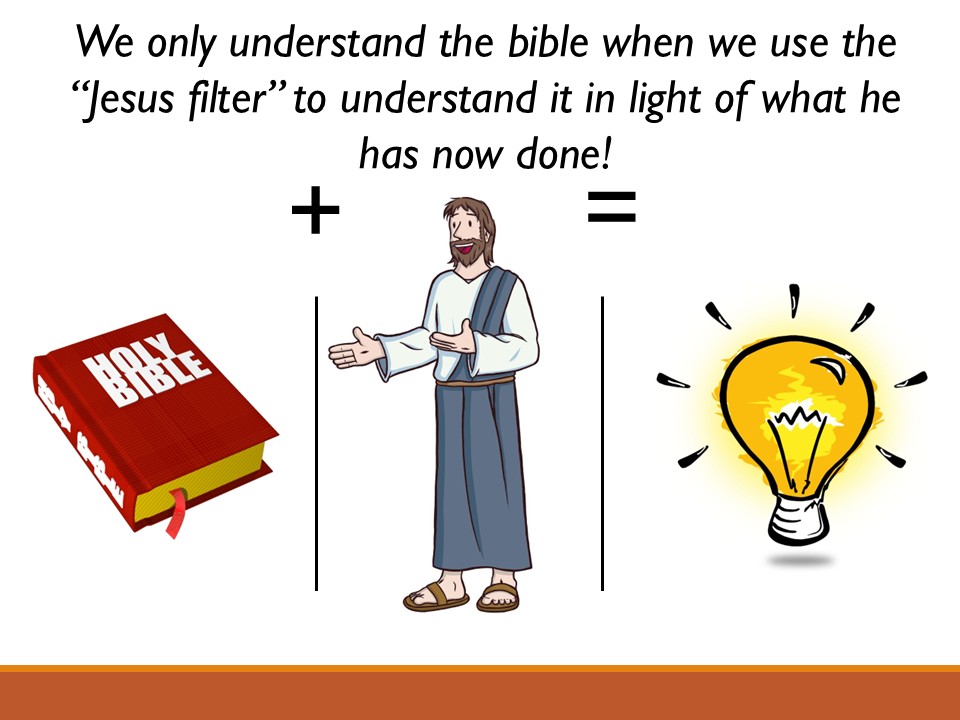
How Do We Read the Law Through the ‘Jesus Filter’?

The Bible is a story with a beginning, middle, and end. When we read the Old Testament, we must do so in light of Jesus’ life, death, and resurrection. This is the “Jesus filter”—understanding that everything in Scripture points to Him.

Here is what this looks like:

For example, the sacrificial laws in Leviticus can seem tedious, but they make sense when we realize they were all pointing to Jesus, the ultimate sacrifice. Just like a child might look forward to getting a bicycle, only to later realize that a car is even better, the Old Testament sacrifices (i.e., the ceremonial laws) were placeholders until Christ, the true fulfillment, came.

Three Types of Old Testament Laws

  1. Ceremonial Laws – These included sacrifices, purity laws, and temple rituals. Jesus fulfills these laws by becoming the ultimate sacrifice. Since His death and resurrection, these laws no longer apply in a direct way.
  2. Civil Laws – These governed daily life in ancient Israel, from property disputes to social justice. Since the Old Testament kingdom no longer exists in the same way, these laws don’t directly apply today, though we can learn principles from them.
  3. Moral Laws – These include commandments about right and wrong, like prohibitions against murder, adultery, and lying. These remain in effect because they are rooted in God’s unchanging character.

Because the new covenant has fulfilled or re-shaped the first two categories of the old covenant law, Jesus now pivots in the rest of Matthew 5 to focus solely on moral laws and their relevance for today. He says: “Therefore anyone who sets aside one of the least of these commands and teaches others accordingly will be called least in the kingdom of heaven, but whoever practices and teaches these commands will be called great in the kingdom of heaven” (Mt 5:19).

What does this mean?

Obeying the Law in the Right Way

Jesus warns that it is possible to do the right thing for the wrong reasons. If we simply follow rules without love or genuine devotion, our obedience is meaningless. This was the problem with the Pharisees, who were obsessed with external appearances while missing the heart of God’s law. They wrongly saw the old covenant law as a means of salvation—“I do this for God, and he will do that for me!” This produces a very self-righteous attitude.

Jesus says, “Unless your righteousness surpasses that of the Pharisees and the teachers of the law, you will certainly not enter the kingdom of heaven” (Matthew 5:20). That doesn’t mean we need to follow even more rules than they did—it means our obedience should come from a place of love, not just obligation. We obey God because we love him and have already been made right with God, not to “get” righteousness as a reward at the end of the rainbow.

For example, the commandment: “You shall have no other gods before me” is easy to affirm in theory. But if we examined our lives, what would our actions say? Do we prioritize God above all else? Or do we let other things—our jobs, entertainment, relationships—take first place in our hearts? There is a massive difference between surface conformity and heartfelt obedience. True obedience isn’t just about external actions but about having a heart transformed by love for God.

Faith Expressing Itself Through Love

The Apostle Paul summed it up in Galatians 5:6: “The only thing that counts is faith expressing itself through love.” This means that our obedience to God should not come from fear or duty but from a genuine love for Him. Just as a heartfelt note from a loved one is more meaningful than a generic greeting card from your insurance agent, our devotion to God should be personal and sincere.

Jesus’ teachings in the rest of Matthew 5 give practical examples of this principle. He takes the external commands (like “Do not murder” and “Do not commit adultery”) and shows their deeper meaning. It’s not enough just to avoid murder—we must also guard against anger and hatred. It’s not enough just to avoid adultery—we must also keep our hearts pure.

A Call to Authentic Christianity

Being a Christian counterculture means more than just appearing religious. It means having a heart genuinely transformed by Christ. True righteousness flows from within—it’s not about keeping a checklist of rules but about loving God so deeply that obedience becomes natural.

This is the challenge Jesus sets before us. Are we simply following religious rules, or are we truly living as salt and light in the world? Do we obey because we have to, or because we want to?

Jesus calls us to follow Him from the heart, to let our love for Him shape every aspect of our lives. When we do this, we don’t just become religious people—we become a living testimony of God’s grace and truth.


May we each examine our hearts and ask God to help us live out our faith in a way that is truly countercultural—not just in appearance, but in spirit and truth.

The Illusion of Self-Righteousness

The Illusion of Self-Righteousness

This is a series of brief devotional articles on The Orthodox Catechism (“OC”),a Particular Baptist document written by Baptist pastor Hercules Collins in 1680. Read the series.

When confronted with a moral failure, our instinct is to minimize or to blame-shift. Yes, we shouldn’t have said this, but it only happened because you said that. No, we haven’t quite gotten around to fixing the car like we promised, but that’s because you keep using it every Saturday. Although these are silly little examples, the pattern holds true for the larger things.

Jesus summed up the law and the prophets under two heads; (a) love God with everything you have—heart, soul, mind, and strength—and (b) love your neighbor as yourself (Mt 22:37-40). How well do we follow these summary principles? The catechism question before us now is like a mirror that strips away all our self-righteousness. It leaves us, as it were, ashamed and defenseless, alone with the truth about ourselves:

Question 5: Can you live up to all this perfectly?

Answer 5: No. I have a natural tendency to hate God[1] and my neighbor.[2]

Now the minimizing bit comes into play.

  • Living up to all this perfectly? “Well, nobody is perfect …” we muse. But, compared to the other guy, I’m not in bad shape at all.
  • A natural tendency? Well, again, nobody is perfect.
  • Hating God and our neighbor? Hate is a strong word. I love God, and I don’t really hate anybody.

Unfortunately, the minimizing doesn’t work here. Holiness isn’t graded on a curve. In the same way that a woman either is or is not pregnant, and a man either is or is not a father, you either are or are not holy and righteous. To be “holy” is to be pure and perfect—without moral spot or blemish. To be “righteous” means to be morally upright in accordance with God’s standards. The catechism answer says you’ve missed that boat. We all have.

In what way have we missed that boat?

Because we all have a natural tendency to hate God and our neighbor. This tendency is natural because it’s innate, it’s our default setting, it isn’t a learned behavior—it’s just the way we are. The apostle Paul, a Jewish man, pointed out that even Jews had no advantage with God on this point: “Do we have any advantage? Not at all! For we have already made the charge that Jews and Gentiles alike are all under the power of sin” (Rom 3:9).

Paul’s words are important and you should read them again. We’re “under the power of” this malevolent force called sin, which is basically a contagion or disease of pervasive selfishness and narcissism. Because sin is selfishness—not simply “self-love” but more like “self-worship at all costs”[3]—it has a marvelous capacity for self-deception and self-righteousness. We think we’re fine, but we’re not. This is why God must rip the veil away from our hearts and minds so the gospel light can shine in and do its work (2 Cor 4:3-6).

Now we turn to hate. Yes, it’s a strong word. It means something like “extreme enmity” and “active hostility.”[4] Who wants to fess up to that? But lest we assume we have plenty of wiggle-room here, Jesus takes a sledgehammer to our rationalizations. God’s standards aren’t about externals—they’re about internal affections that show in an external way. This means that anger, contempt, and ridicule are the same as murder because they all come from an inner hostility and ill-will towards that other person (Mt 5:21-22). Likewise, adultery isn’t simply the sexual act but also the sexual thought (Mt 5:27-28).

What the catechism is driving at is that, in our hearts, we do not love God and our neighbor perfectly. We fail here because sin is that pervasive selfishness and narcissism that naturally reigns in our hearts and minds. And, because holiness (like pregnancy and fatherhood) is a “yes or no” status, that means we’ve each fallen short.

So, that’s where we are. It brings us round to Questions 2 and 3—the law of God tells us how great our sin and misery are. This naturally prompts a new question: why would God make us to be in such a terrible condition? If a manufacturer makes a bad product, it issues a recall and fixes the problem. Why hasn’t God issued a recall on us? Did he make a mistake with us? Is he holding us responsible for his own design flaws? We turn to these questions next time.


[1] Rom 3:9-20, 23; 1 John 1:8, 10.

[2] Gen 6:5; Jer 17:9; Rom 7:23-24, 8:7; Eph 2:1-3; Titus 3:3.

[3] Augustus H. Strong is particularly good here: “We hold the essential principle of sin to be selfishness. By selfishness we mean not simply the exaggerated self-love which constitutes the antithesis of benevolence, but that choice of self as the supreme end which constitutes the antithesis of supreme love to God” (Systematic Theology (Philadelphia: American Baptist Publication Society, 1907), 567).

[4] Merriam-Webster Collegiate Dictionary, s.v. “hate,” verb, sense 1.  

How Rome Distorts the Gospel: Atonement Misunderstood

How Rome Distorts the Gospel: Atonement Misunderstood

This article argues that the Roman Catholic Church (“Rome”) is wrong about the sufficiency of Christ’s atonement. In fact, she is so incorrect that her teaching on this matter is grave error that distorts the gospel.

By “Christ’s atonement,” we mean the action by which Christ’s vicarious death reconciles us to God and restores fellowship with him. The dispute here is about the sufficiency of this atonement. Did Christ atone for the consequences of all our sins? Is his atonement permanent or conditional?

Some issues are “in-house” debates—things Christians disagree about “inside the family.” But, some matters are serious enough that they rise to another level because they present two different versions of the Christian faith. The sufficiency of Christ’s atonement is one of those issues. If Christ’s sacrifice does not fully purify, fully reconcile, fully satisfy divine justice for his people once for all and forever, then that means Christ does not “save forever those who come to God through him,” (Heb 7:25, NASB). The word “forever” at Hebrews 7:25 means for all time,[1]or perhaps completely and absolutely.[2] Because Jesus is a priest forever, the rescue he gives his people is total, complete, and forever.

NOTE: This article is a significant abridgement of a larger essay which you can read here. You can consult the larger article for extended discussions of each point.

The bottom line

Rome teaches that Christ’s atonement (a) does not make full satisfaction[3] for all his people’s sins, and so (b) does not make believers holy and perfect forever. Instead, Rome teaches that when a believer commits sins after baptism, a stain affixes which makes her unholy (though still in a state of grace if she has not committed mortal sin), and so she herself must make satisfaction to God for the temporal consequences of these sins. We make this satisfaction to God “through the merits of Christ.”[4]

In other words, a believer’s purity before God is conditional—it depends on our actions. For the temporal consequences of these sins, we can either pay God now by way of the sacrament of penance,[5] or we can pay him later by suffering in purgatory to make satisfaction for our sins.

On the contrary, Hebrews 6:13-10:22 teaches that Jesus is the great high priest who made one single, all-sufficient sacrifice that makes each believer holy and perfect forever. As part of the journey of progressive holiness, God does discipline believers who commit sins, but a believer’s legal purity before God is perfect and complete forever at the time of salvation.[6]

Zooming out to the bigger picture, Rome is wrong because, compared to the old covenant system, her false teaching presents us with a new covenant that isn’t better than the old one. Both consist of a sacrificial liturgy and a band of priests offering repeated sacrifices with temporary atoning effect. Therefore, Rome’s teaching on the sufficiency of Christ’s atonement is a lateral move, not a promotion, and that’s why it’s incorrect. Because the argument from Hebrews 6:13-10:22 is that the new covenant has a better high priest, who brings believers a better hope, built on better promises, who makes a better atonement for his people, Rome’s teaching about the atonement is wrong.

Different sources and methods

However, we have a roadblock to overcome. Roman Catholics and Protestants don’t answer religious questions the same way because they have different authorities.

  • Rome teaches that there is a “living transmission” from the Holy Spirit, called tradition (Catechism of the Catholic Church, “CCC,” Art. 78), that exists alongside scripture as a complementary vessel of divine revelation.
  • Protestants generally hold to what one writer has called suprema scriptura, which means “the Bible as the supreme or highest channel of religious authority.”[7] Under scripture’s authority, in an interpretive dialogue, are church tradition, reason, and personal religious experience in the divine-human encounter.[8]

The issue of authority deserves serious discussion,[9] but we will leave that for another time. For now, it’s enough to say that because Rome teaches that both scripture and tradition flow from “the same divine well-spring” (CCC, Art. 80), her teaching must find scriptural support.[10] In the matter of Christ’s atonement, it does not. I urge Roman Catholics to see if scripture squares with their church’s tradition. If it doesn’t, then you should leave Rome.

Why Rome is wrong

God has revealed his truth in revelation, and grave error is false teaching that leads people away from that revelation. Rome’s understanding of Christ’s atonement is grave error because it contradicts scriptural teaching and negatively affects your understanding of salvation and the gospel.[11] It teaches that Christ’s atonement does not fully purify believers and make them holy and perfect forever at the moment of salvation. Specifically:

  1. Rome falsely teaches that there are “temporal consequences” from sins that Christ’s sacrifice does not fully fix—debts of temporal punishment still remain for sins committed after baptism.[12] The truth is that, in the new and better covenant relationship with God by faith in Christ which began at Pentecost, God promises: “I will forgive their wickedness and will remember their sins no more,” (Heb 8:12).
  • Rome wrongly teaches that, after death, believers may need to be cleansed and purified from the temporal consequences of sins to have the holiness necessary to enter heaven. The truth is that scripture says believers have already been reconciled to God and have peace with him, because he has declared them righteous (i.e., justified) by means of faith in Jesus (Rom 5:1, 10). His “once for all” sacrifice makes us holy already (Heb 10:10).[13]
  • Rome falsely teaches a fictitious system of penance to restore the state of grace ex opere operato as a so-called “second plank of salvation,”and teaches a non-existent treasury of merit from which priests and bishops may apply merit to remit temporal punishment for sins. The truth is that “by one sacrifice [Jesus] has made perfect forever those who are being made holy,” (Heb 10:14). This means this elaborate system is un-biblical and blasphemous to the sufficiency of Christ’s work.

Eight principles from Hebrews 6:13 to 10:22

Principle 1 (Hebrews 6:13-20): Because Jesus is a different and better priest who represents his people forever, he’ll always keep the “anchor of hope” fastened to God for those he reconciles. This suggests Christ’s atonement is effective for his people forever and always.

Principle 2 (Hebrews 7:1-3): Jesus is the king of righteousness, the king of peace, and is the “Son of God” because he shares the same nature and attributes as Yahweh—just like Melchisedec. This is why he is a better priest, and therefore the new covenant relationship with God is better, too. This suggests Christ’s atonement is also better.

Principle 3 (Hebrews 7:18-19, 10:19-22): The old covenant law never made anybody perfect—it never permanently purified or cleansed believers. So, God repealed it and cleared the way for a better hope, by which every believer draws near to God. This better hope is Jesus’ better priesthood, triggered by Jesus’ better sacrifice.

Principle 4 (Heb 7:11-17, 20-28): Because Jesus is a priest forever, he rescues his people completely and permanently, and this means he always intercedes for and protects his people. Jesus’ sacrifice was “once for all” and “forever,” and its atonement needs no re-application. It’s a permanent marker, not a pencil.

Principle 5 (Hebrews 8): The old covenant is obsolete because the better covenant has come, backed by a better priest, based on a better sacrifice, bringing better promises, securing a better arrangement for God’s relationship with his people.

Principle 6 (Hebrews 9:1-15): Jesus’ sacrifice is the concrete reality to which the old covenant sacrifices pointed. He’s set his people free from sins, has already paid the full ransom price to our kidnapper Satan, and the liberation he achieves for believers is everlasting and forever.

Principle 7 (Hebrews 9:16-28): Jesus’ “once for all” sacrifice has already invalidated, annulled, and repealed the power of sin for those who trust in him. He does not repeat or re-apply his sacrifice, or it would not be “better.” It is better because it is forever.

Principle 8 (Hebrews 10:1-18): Jesus’ sacrifice has already made believers holy once for all and forever, and it has already made us perfect forever. Therefore, he will never, ever consider our sins again, and sacrifice for sins is no longer necessary. It is all finished.

The new covenant isn’t a lateral move

In the job world, a “lateral move” is one where you get a new job, but the pay and duties are similar. It isn’t a demotion, but it isn’t a promotion either. The new covenant isn’t like that. It isn’t a lateral move. It’s better.

Yet, Rome believes that Christ’s atonement is essentially a lateral move from the old covenant because it teaches (a) the conditional purification of the believer, (b) resulting in potential temporal consequences for sin which Christ’s sacrifice did not cover, (c) requiring the probable need to suffer in purgatory to satisfy and atone for these temporal punishments, and (d) the existence of indulgences which waive the temporal punishment of our sins by debiting a so-called treasury of merit.

But the bible is a story that moves forward.

  1. It begins with creation in Genesis 1-2,
  2. catalogs the fall in Genesis 3,
  3. and then to the divine rescue through Christ the king that God promised throughout the old covenant, foreshadowed in the temple liturgy and sacrifices, and fulfilled in the story of Jesus in the Gospels,
  4. and finally, it concludes with the defeat of evil and the restoration of all things in Revelation 18-22.

But Rome says that Christ’s atonement does not make satisfaction for his people’s sins once for all and forever—so where is better hope by which we draw near to God (Heb 7:18)? Rome’s system offers a new covenant that’s stuck in neutral—one that is not better than the old covenant. Her story has run aground and hasn’t moved forward. Rome has exchanged a flat Diet Coke for a stale Pepsi. It’s a lateral move, not a promotion.

Hebrews 6:13-10:22 vaporizes all this. Rome offers nothing “new” or “better” in terms of practical effects. It isn’t a promotion, and that’s the bottom-line reason why it’s false, and so Rome’s teaching about the sufficiency of Christ’s atonement fails.

The truth is that: “when this priest had offered for all time one sacrifice for sins, he sat down at the right hand of God, and since that time he waits for his enemies to be made his footstool. For by one sacrifice he has made perfect forever those who are being made holy,” (Heb 10:14).


[1] BDAG, s.v., “παντελής,” sense 2, 754; see RSV, NRSV, NASB.

[2] LSJ, s.v., “παντελής,” 1300; see NET, KJV, NIV, NEB, REB, CSB, CEB.

[3] This means “[r]eparation or compensation for a wrong or a debt incurred,” (Millard J. Erickson, The Concise Dictionary of Christian Theology, rev. ed. (Wheaton: Crossway, 2001), s.v., “satisfaction,” 176).

[4] Tanner (ed.) “Trent,” Session 14, canon 13, in Decrees, 2:713.

[5] In fact, Rome says, if we believe that our penitential works are nothing more than the faith by which we grasp that Christ has already made satisfaction for our sins, then we’re damned to hell (Tanner (ed.) “Trent,” Session 14, canon 12, in Decrees, 2:713).

[6] Augustus H. Strong’s definition of “sanctification” captures the Protestant interpretation very well: “Sanctification is that continuous operation of the Holy Spirit, by which the holy disposition imparted in regeneration is maintained and strengthened.” Strong explained: “Salvation is something past, something present, and something future; a past fact, justification; a present process, sanctification; a future consummation, redemption and glory,” (Systematic Theology (Old Tappan: Revell, 1907), 869). Emphases added.

[7] James Leo Garrett Jr., Systematic Theology: Biblical, Historical, and Evangelical, Fourth Edition., vol. 1 (Eugene: Wipf & Stock, 2014), 206.

[8] Garret, Systematic, 2.206; Thomas Oden, Life in the Spirit: Systematic Theology, vol. 1 (San Francisco: HarperOne, 1987), 330-44.

[9] For example, Bishop James Gibbons wrote: “… the Church is the divinely appointed Custodian and Interpreter of the Bible. For, her office of infallible Guide were superfluous, if each individual could interpret the Bible for himself … God never intended the Bible to be the Christian’s rule of faith, independently of the living authority of the Church,” (Faith of Our Fathers, 10th rev. ed. (New York: John Murphy & Co., 1879), 94). 

[10] One doctor of the church declared: “Holy Scripture is in such sort the rule of the Christian faith that we are obliged by every kind of obligation to believe most exactly all that it contains, and not to believe anything which may be ever so little contrary to it,” (Francis de Sales, The Catholic Controversy, in Library of Francis de Sales, vol. III, 3rd ed., trans. by Canon Mackey (London: Burns & Oats, Limited, 1909), 88 (Part II, Article 1, Ch. 1).

[11] “The concept of heresy is grounded in the conviction that there exists one revealed truth, and other opinions are intentional distortions or denials of that truth. Absent such conviction, ‘heresy’ becomes little more than bigoted persecution. But the Christian belief in revealed truth means that heresy becomes not merely another opinion, but false teaching that leads people away from God’s revelation” (Daniel J. Treier and Walter Elwell (eds.), Evangelical Dictionary of Theology, 3rd ed. (Grand Rapids: Baker, 2017), s.v. “heresy,” 377-78).

Millard Erickson offers up this definition: “A belief or teaching that contradicts Scripture and Christian theology,” (Concise Dictionary, s.v. “heresy,” 88).

[12] Norman P. Tanner, S.J. (ed)., “Trent,” Session 6, Canon 30, in Decrees of the Ecumenical Councils, vol. 2 (Washington, D.C., Georgetown University Press, 1990), 2:681.

[13] The verb is present tense-form, and it can be rendered as “are being made holy” or “have been made holy.” Either way, Jesus’ once-for-all sacrifice is the means by which (διὰ τῆς προσφορᾶς) the holiness happens.

Three Steps to True Spiritual Freedom

Three Steps to True Spiritual Freedom

This is a series of brief devotional articles on The Orthodox Catechism (“OC”), a Particular Baptist document written by Baptist pastor Hercules Collins in 1680. It’s basically the Heidelberg Catechism (first ed. 1563) with Baptist flavor and a few other additions. Read the series.

If the only comfort we have in this life is that we belong—both body and soul, in life and death—to our most faithful Lord and Savior Jesus Christ (see the discussion on Q1), then …

Question 2: What must you know to live and die in the joy of this comfort?

Answer 2: Three things: first, how great my sin and misery are;[1] second, how I am set free from all my sins and misery;[2] third, how I am to thank God for such deliverance.[3]

Relationship with Christ is the most important thing in your life. Everything we accomplish or hold onto as an anchor will fade away in time. James A. Baker III was a hugely important figure in American political life, but how many today even know who he is, let alone that he helped negotiate an end to the Cold War?[4] Solomon wrote: “No one remembers the former generations, and even those yet to come will not be remembered by those who follow them,” (Ecc 1:11).

But the comfort from the Lord that you belong to him will never change. James Baker was one of former President George H.W. Bush’s best friends. The very day he died, Bush told Baker that he was looking forward to going to heaven.[5] After everything he’d accomplished in life—a decorated World War II pilot, politician, Director of the CIA, chair of the Republican National Committee, two-term Vice-President, one-term President—it all narrowed to one great longing: to go to heaven.

But how do get this comfort? How do we make it our own? Scripture teaches that we must realize and own three things:

First, that we’re in very great trouble.

We’re not righteous, which is a churchy way of saying we’re not “right” with God. We’re criminals in his eyes (“sin is lawlessness,” 1 Jn 3:4), and that’s a problem. We’re all “under the power of sin” (Rom 3:9), which means criminality infects us to the core, like so many rotten apples. This doesn’t mean we’re all cartoon serial killers, but it does mean that we’re all “criminal” in that we don’t naturally love God and so we don’t follow his law. The apostle John explained: “If we claim we have not sinned, we make him out to be a liar and his word is not in us,” (1 Jn 1:10).

So, there’s that.

Second, we must realize that God has provided the way out.

We can’t solve the sin problem, because we’re all products of “the system.” The apostle Paul depicts sin as a malevolent force that rules over us and this world. We can’t break out. So, there must be somebody from outside, somebody who isn’t captured and infected by this world, to blaze a trail and take us out of here (Rom 6:16-18). That person is Jesus. More on that later.

On the night he was betrayed, Jesus told his heavenly father that “eternal life” meant: “that they know you, the only true God, and Jesus Christ, whom you have sent,” (Jn 17:3). To “know,” in this context, means a personal relationship or friendship.[6] We must enter into relationship with God the Father, through Christ the Son, by means of the Holy Spirit. We do that by responding to the good news he has brought to the world (Mk 1:15). “Salvation is found in no one else, for there is no other name under heaven given to mankind by which we must be saved,” (Acts 4:12).

Third, we must be thankful to God for our liberation.

This means that, if God has truly rescued us from our great sin and misery, it’ll show up in our lives. There will be fruit. We show God we’re thankful by living for him (Rom 12:1-2). Our light shines in the world, so people know we belong to Christ (Mt 5:16). The apostle Paul wrote: “offer yourselves to God as those who have been brought from death to life; and offer every part of yourself to him as an instrument of righteousness. For sin shall no longer be your master, because you are not under the law, but under grace,” (Rom 6:13-14). If God has brought us from spiritual darkness and “into the light,” then we ought to live like children of the light (Eph 5:8-10)!

The apostle Peter tells us that God has chosen his people for salvation. He made us to be royal priests who represent him to the world. He’s taken believers from the four corners of the earth and given us a spiritual citizenship that eclipses our earthly passports into deep shadow. Together, we’re God’s special possession, and our job is to “declare the praises of him who called you out of darkness into his wonderful light,” (1 Pet 2:9).

If all this is true, then we prove it by the way we think and live. We have spiritual fruit. This is the concrete expression of thankfulness, and it all stems from grateful love— “We love because he first loved us,” (1 Jn 4:19).

The catechism goes on to explain each of these three things in more detail. But, know this—(a) you must know you’re in terrible trouble, (b) you must enter into a personal relationship with the Father, through the Son, by means of the Spirit, and (c) true faith is proven by a life of thankfulness to God.


[1] Romans 3:9-10; 1 John 1:10.

[2] John 17:3; Acts 4:12.

[3] Matthew 5:16; Romans 6:13; Ephesians 5:8-10; 2 Timothy 2:15; 1 Peter 2:9-10.

[4] See the book by Peter Baker and Susan Glasser, The Man Who Ran Washington: The Life and Times of James A. Baker III (New York: Doubleday, 2020).

[5] Baker and Glasser, Baker, 857.

[6] Louw-Nida, s.v. “γινώσκω,” sense. 27.18, 327; BDAG, s.v. “γινώσκω,” sense. 1b, 200.

Why Christians Find Hope in Belonging to Jesus

Why Christians Find Hope in Belonging to Jesus

A “catechism” is a question and answer book about the basics of the Christian faith. It’s useful for believers who need reminders, for new believers who need to know about their new faith, and for outsiders to learn what the Christian story is all about. The Baptist Orthodox Catechism (ca. 1680) begins with a very practical question:[1]

Question 1: What is your only comfort in life and in death?

Answer 1: That both in soul and body, [2] whether I live or die,[3] I am not my own, but belong wholly to my most faithful Lord and Savior Jesus Christ.[4]

By his most precious blood fully satisfying for all my sins,[5] he has delivered me from all the power of the devil,[6] and so preserves me,[7] that without the will of my heavenly Father not so much as a hair may fall from my head.[8]

Yes, all things must serve for my safety.[9]And so, by his Spirit also, he assures me of everlasting life,[10] and makes me ready and prepared,[11] so that from now on I may live to him.

The only comfort a Christian has is that she belongs to the Lord. It’s reassuring to know that we aren’t alone. That we are not left to fend for ourselves. That we have a heavenly Father who is all-powerful, clothed in majesty and holiness, who cares for us. No matter whether you’re alive or dead, your entire being (which is more than your physical body or your immortal soul—it’s both) belongs to your faithful Lord and rescuer Jesus Christ.

This might seem strange—why is it comforting to cede your own self-government to God’s royal authority?

Because Christians believe that Jesus has liberated from a malevolent and evil kidnapper. This isn’t a storybook fable—Jesus really and truly rescued us from the kingdom of darkness. He paid for our crimes by means of his own death as a vicarious sacrifice, delivering us from Satan’s grasp (see Q33). Jesus put it like this: “When a strong man, fully armed, guards his own house, his possessions are safe. But when someone stronger attacks and overpowers him, he takes away the armor in which the man trusted and divides up his plunder,” (Lk 11:21-22). Jesus is the stronger man. He’s tied Satan up and tossed him onto the lawn, and he’s now going through the house and setting the captives free from the dungeon inside.

This is why we love Jesus and are loyal to him in return (see Q31). This is why we worship Jesus as our king (Dan 7:11-13).[12] The scriptures are about God’s plan through the people of Israel (i.e., King Jesus) to fix the world, to fix us, and to create a family he can love and which loves him back. Jesus is the king who has come to (a) reveal to us that he’s the one has come to fulfill God’s covenant promises and make this happen, (b) to reconcile us to God, and then (c) to rule over our lives now and over all creation later. Jesus is our revealer, reconciler, and ruler.[13]

He watches over us with kindness, holiness, and justice. Nothing is beyond his control. Nothing takes him by surprise. This means we’re safe in his care. Everything that happens is for our good—whether it appears that way or not. Like any good Father, God disciples us. He trains us. He wants us to go the right way. Other times, he makes choices that are best for us even if we cannot understand all this in the here and now. More on that later (see Q26, 27).

Because we belong to King Jesus, he gives us assurance of eternal life. The true Christian responds to his kindness and grace with loving obedience—we love him because he first loved us (1 Jn 4:19).

The most basic impulse of the true Christian is to give yourself to Jesus—to trust him and follow him (see Q91-6). In other words, your only comfort in life and death is that you belong—both body and soul—to your faithful savior Jesus Christ.


[1] This is the beginning of a series of brief devotional articles on The Orthodox Catechism (“OC”),a Particular Baptist document written by Baptist pastor Hercules Collins in 1680. It’s basically the Heidelberg Catechism (first ed. 1563) with Baptist flavor and a few other additions. It is rightly famous tool for doctrinal and devotional instruction in Baptist churches. In the congregation where I serve as pastor, we discuss one question from the OC each week during the worship service.

There are many copies of the OC online, and some are better than others. You can find a true copy online here. You can buy a printed copy here.

[2] 1 Corinthians 6:19-20; 1 Thess 5:10.

[3] Romans 14:8.

[4] 1 Corinthians 3:23.

[5] 1 Peter 1:18-19; 1 John 1:7, 2:2.

[6] 1 John 3:8; Hebrews 2:14-15.

[7] John 6:39.

[8] Matthew 10:30; Luke 21:18.

[9] Romans 8:28.

[10] 2 Corinthians 1:12, 5:5; Eph 1:13-14.

[11] Romans 8:24-25.

[12] Read Daniel 2 and Daniel 7. For a brief explanation of Daniel 7, see also Tyler Robbins, “Understanding Daniel 7: The Vision and its Meaning.” 15 October 2024. https://eccentricfundamentalist.com/2024/10/15/understanding-daniel-7-the-vision-and-its-meaning/.

[13] Millard Erickson, Christian Theology, 3rd ed. (Grand Rapids: Baker, 2013), ch. 35.