
How to Be Jesus People

How to Be Jesus People

The Sermon on the Mount is one of the most well-known teachings of Jesus, guiding Christians on how to live in an unholy world. In Matthew 5:2-16, Jesus focuses on how believers are to be a countercultural people (Mt 5:2-12), living as salt and light in the world (Mt 5:13-16). But what does that mean? And how exactly are we supposed to do that?

Understanding the Christian Counterculture

Jesus emphasizes that Christians are not meant to isolate themselves from the world but rather to live differently within it. Being salt and light means standing out—not in a showy or arrogant way, but in a way that draws others to the truth of the gospel. This means engaging with the world while remaining distinct from its values.

The key question, then, is: how do we live as a countercultural people? In Mathew 5:17-20, Jesus answers this by teaching that we must obey God’s law in the right way—with the right heart and the right motives.

  • First, he explains how he fulfills the law and the prophets.
  • Then, he explains our obligations to live according to the law n light of what he’s now done.

The rest of Matthew 5 is Jesus’ illustrations of this principle through everyday examples.

Jesus Fulfills the Law

Many misunderstand Jesus’ relationship to the Old Testament law. Some think He came to replace it with something entirely new, but He clarifies: “Do not think that I have come to abolish the Law or the Prophets; I have not come to abolish them but to fulfill them” (Matthew 5:17).

But what does it mean for Jesus to “fulfill” the law? Essentially, Jesus gives the law its deeper and truer meaning. Instead of following it in a superficial, legalistic way—like the Pharisees did—Jesus calls His followers to obey it from the heart.

How Do We Read the Law Through the ‘Jesus Filter’?

The Bible is a story with a beginning, middle, and end. When we read the Old Testament, we must do so in light of Jesus’ life, death, and resurrection. This is the “Jesus filter”—understanding that everything in Scripture points to Him.

Here is what this looks like:
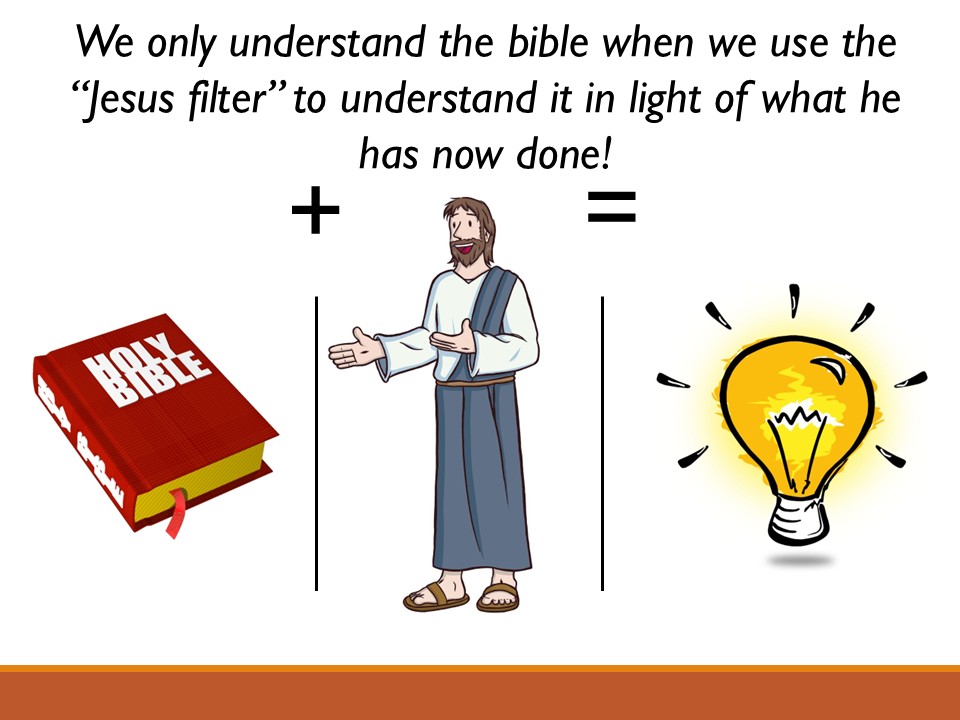
For example, the sacrificial laws in Leviticus can seem tedious, but they make sense when we realize they were all pointing to Jesus, the ultimate sacrifice. Just like a child might look forward to getting a bicycle, only to later realize that a car is even better, the Old Testament sacrifices (i.e., the ceremonial laws) were placeholders until Christ, the true fulfillment, came.

Three Types of Old Testament Laws

  1. Ceremonial Laws – These included sacrifices, purity laws, and temple rituals. Jesus fulfills these laws by becoming the ultimate sacrifice. Since His death and resurrection, these laws no longer apply in a direct way.
  2. Civil Laws – These governed daily life in ancient Israel, from property disputes to social justice. Since the Old Testament kingdom no longer exists in the same way, these laws don’t directly apply today, though we can learn principles from them.
  3. Moral Laws – These include commandments about right and wrong, like prohibitions against murder, adultery, and lying. These remain in effect because they are rooted in God’s unchanging character.

Because the new covenant has fulfilled or re-shaped the first two categories of the old covenant law, Jesus now pivots in the rest of Matthew 5 to focus solely on moral laws and their relevance for today. He says: “Therefore anyone who sets aside one of the least of these commands and teaches others accordingly will be called least in the kingdom of heaven, but whoever practices and teaches these commands will be called great in the kingdom of heaven” (Mt 5:19).

What does this mean?

Obeying the Law in the Right Way

Jesus warns that it is possible to do the right thing for the wrong reasons. If we simply follow rules without love or genuine devotion, our obedience is meaningless. This was the problem with the Pharisees, who were obsessed with external appearances while missing the heart of God’s law. They wrongly saw the old covenant law as a means of salvation—“I do this for God, and he will do that for me!” This produces a very self-righteous attitude.

Jesus says, “Unless your righteousness surpasses that of the Pharisees and the teachers of the law, you will certainly not enter the kingdom of heaven” (Matthew 5:20). That doesn’t mean we need to follow even more rules than they did—it means our obedience should come from a place of love, not just obligation. We obey God because we love him and have already been made right with God, not to “get” righteousness as a reward at the end of the rainbow.

For example, the commandment: “You shall have no other gods before me” is easy to affirm in theory. But if we examined our lives, what would our actions say? Do we prioritize God above all else? Or do we let other things—our jobs, entertainment, relationships—take first place in our hearts? There is a massive difference between surface conformity and heartfelt obedience. True obedience isn’t just about external actions but about having a heart transformed by love for God.

Faith Expressing Itself Through Love

The Apostle Paul summed it up in Galatians 5:6: “The only thing that counts is faith expressing itself through love.” This means that our obedience to God should not come from fear or duty but from a genuine love for Him. Just as a heartfelt note from a loved one is more meaningful than a generic greeting card from your insurance agent, our devotion to God should be personal and sincere.

Jesus’ teachings in the rest of Matthew 5 give practical examples of this principle. He takes the external commands (like “Do not murder” and “Do not commit adultery”) and shows their deeper meaning. It’s not enough just to avoid murder—we must also guard against anger and hatred. It’s not enough just to avoid adultery—we must also keep our hearts pure.

A Call to Authentic Christianity

Being a Christian counterculture means more than just appearing religious. It means having a heart genuinely transformed by Christ. True righteousness flows from within—it’s not about keeping a checklist of rules but about loving God so deeply that obedience becomes natural.

This is the challenge Jesus sets before us. Are we simply following religious rules, or are we truly living as salt and light in the world? Do we obey because we have to, or because we want to?

Jesus calls us to follow Him from the heart, to let our love for Him shape every aspect of our lives. When we do this, we don’t just become religious people—we become a living testimony of God’s grace and truth.


May we each examine our hearts and ask God to help us live out our faith in a way that is truly countercultural—not just in appearance, but in spirit and truth.

The Tale of the Two Builders

The Tale of the Two Builders

Recently, our family drove from Washington State to Tennessee, to drop our oldest son off at college. One day, in the wilderness of western Colorado, I spied a shiny new Corvette ahead of me. It was plodding along at about 65 mph on a stretch of interstate where the speed limit was 80 mph. Yet, there he stayed—at 65 mph.

I was driving a rented Toyota Prius, set to “eco” mode. In the fast lane travelling at 85 mph, I rapidly ate up the distance between us. I felt certain the Corvette driver wouldn’t let this happen. Yet, I passed him like he was standing still. The driver was oblivious. The wind was in his silver hair, and he had a big smile on his face. He didn’t care about me or my Prius. We left him behind, the Prius whirred onward in “eco” mode, and the shiny Corvette was soon lost to sight.

That man obviously didn’t buy the Corvette to use it. The car was eye candy, a toy to show off, not a “real” car.

Jesus says our faith isn’t eye candy, something to be pretty but not really touched—it’s a serious thing, not a hobby. The problem for too many of us is that it is external, it is eye candy, it never touches our hearts, it never renovates our lives—or it renovates only the most convenient parts of it. We build our lives on other things, while putting Jesus on our dashboard like a divine bobblehead—“I spend time with Him everyday!”

The parable

This isn’t a new thing—it’s an old, old thing. Our parable, the Tale of the Two Builders, is about this problem.

Therefore, everyone who hears these words of mine and puts them into practice is like a wise man who built his house on the rock. The rain came down, the streams rose, and the winds blew and beat against that house; yet it did not fall, because it had its foundation on the rock.

Matthew 7:24-25

This is a simple, two-point parable that basically explains itself. There is a man, a house, and its foundation. The threat is a flashflood. Will the house stand? Only if its foundation is situated on the rock. The one who does this is the one who hears Jesus’ words and does them. Jesus is the rock.

But everyone who hears these words of mine and does not put them into practice is like a foolish man who built his house on sand. The rain came down, the streams rose, and the winds blew and beat against that house, and it fell with a great crash.

Matthew 7:26-27

The same flood sweeps through, but this house is different—its foundation is built upon sand. The ground will wash away from under. Disaster looms. You either build your house on Jesus or on sand—which is anything but Him. Again, hearing Jesus’ words and doing them determines the foundation.

Well … What Did Jesus Say?

The parable is tied to the words Jesus just finished saying—the Sermon on the Mount (“SoM”). The SoM doesn’t outline “conditions of entry” for us into God’s family. Instead, it describes the inevitable fruit of salvation[1]—renovated hearts + minds = renovated lives.

This isn’t the place to discuss the SoM in any detail. It’s enough to state that it forms the context for the Tale of the Two Builders, and to fashion a sketch outline of Jesus words. There are three categories in the SoM:

MoralAdultery + lust (Mt 5:27-30)
Cheap divorce (Mt 5:31-32)[2]
Rash oaths (Mt 5:33-37)
AllegianceBe salt and light (Mt 5:13-16)
Follow commands—honest fruit (Mt 5:17-20)
Honest, quiet prayer with God (Mt 6:1-13)
Honest, quiet fasting (Mt 6:16-18)
Treasures below v. above (Mt 6:19-24)
Seek His kingdom and righteousness above treasures below (Mt 6:25-34)
Asking God for help (Mt 7:7-12)
Brotherly loveMurder + grudges (Mt 5:21-26)
Love v. retaliation (Mt 5:38-42)
Love for enemies (Mt 5:43-48)
Giving to needy quietly (Mt 6:1-4)
Forgiveness (Mt 6:14-15)
Don’t be hypocritically judgmental (Mt 7:1-5)

I’ll highlight two representative teachings:

  • Adultery + lust. Jesus went beyond externalism and emphasized that the “adultery” prohibition isn’t simply about the act, but about the heart condition which produces the action. Noting that someone is physically attractive is not the issue—lusting is![3] Sin isn’t about the letter of the law, but the spirit. Sin begins with internal premeditation—in the heart, not with overt physical action.   
  • Following commands—fruit. Jesus famously said that “anyone who sets aside one of the least of these commands and teaches others accordingly will be called least in the kingdom of heaven, but whoever practices and teaches these commands will be called great in the kingdom of heaven,” (Mt 5:1). This isn’t a statement emphasizing the impossibility of following the law. Rather, it’s noting the inevitable fruit of real salvation—loving obedience.[4] If you love God, you won’t pick and choose when to follow Him. You’ll just want to do it. This means the enigmatic statement which follows (“For I tell you that unless your righteousness surpasses that of the Pharisees and the teachers of the law, you will certainly not enter the kingdom of heaven,” Mt 5:20) isn’t irony—it’s a real statement of fact. You’ll never see the kingdom of heaven unless your righteousness exceeds the pseudo-righteousness of these “esteemed teachers.”

If you claim to be a Christian, there will be fruit. It might not be the best fruit. It might not even be edible fruit—every tree has a bad year! But, it will be recognizable fruit. This is the SoM. Hence, our parable.  

More Than a Coffee Table Faith

The SoM not just individualistic, but communal—the commands throughout are plural! The Jesus community has a mission, and we’re failing if we lose that focus. If we lose our saltiness, we’re off mission.

The challenge is that we can only perform our mission when we’re in contact with the world around us. “The church is properly understood only when it is seen as the sign of God’s universal kingdom, the firstfruits of redeemed humanity.”[5] We must be seen for what we are. We gotta be salty, which means we gotta hear and do Jesus’ words from the SoM.

There are at least three ways to view “church v. culture:”

  1. withdrawal—run for the hills, disengage, fight defensively.
  2. rule—push for a Christian Americana (e.g. Moral Majority)
  3. be a prophetic minority—“in the world but not of it” (Jn 17:14-16)

The latter is the biblical option. Prophets nettle precisely because they go against the grain. If we’re not following Jesus’ words, who are we following? What are we doing? How then can we fulfill our mission?  

The problem is that there are, right now, two kingdoms + two masters + two cultures.[6] God and Satan are building rival kingdoms in parallel and in conflict over the same space and over the same people. Satan doesn’t simply act by persecution—he acts via seduction, too.[7]

The result of his seduction may well be a “culture Christianity” that’s hermetically sealed from every aspect of your life where it could make a difference. In “culture Christianity,”[8] abstract Christian values are always more important than the Christian Gospel.[9] It often isn’t “real” Christianity, at all. Like that Corvette I passed in a Prius in western Colorado, it’s meant to be put on a shelf, to be seen and admired, never actually embraced.

In the same way, Jesus can become a figurehead to be seen, spoken about, “worshipped,” but never loved—something else has prime of place. Jesus and the Gospel are a coffee table book.

And that means a coffee table “Christianity” will get run over by a semi-truck—because it isn’t real! It’s not an accident the SoM ends with three warnings, right before our parable (Mt 7:13-23): (1) the narrow gate, (2) false teachers and fruit, and (3) true and false disciples? Why do you think our parable begins with “therefore/οὖν” (Mt 7:24)?

Jesus gives us a clue when He opens the SoM by listing those who are particularly blessed by the Good News; (1) the poor in spirit, (2) those who mourn, (3) the meek, and (4) those who hunger and thirst for righteousness.

Why these folks?

Because these are the people for whom Jesus’ counter-cultural call are most attractive, because they’re the ones who feel the injustice of this world most keenly—who are the most uncomfortable. Satan’s seduction has less to work with. So, they’re the ones who are likely the most devoted followers—the folks with their houses on a firm foundation.

Jesus spoke against materialism—the idea that life consists in the abundance of your possessions (Lk 12:14)—and said “seek first his kingdom and his righteousness, and all these things will be given to you as well,” (Mt 6:33). What does that mean?[10]

It means that we take everything else in this world, all our own values, ideals, efforts, and dreams and throw them into the shade for the sake of Jesus and His kingdom more and more as we grow more like Christ, and less like our old selves.

In this parable, Jesus takes a sledgehammer to coffee table Christianity, to the bobblehead Savior, to casual, cultural “faith” that’s designed to look pretty on a shelf, but not actually touch anything in our lives.

In this parable Jesus, in a way infinitely more powerful than if He’d just spoken plainly, says this to each of us:

You can say whatever you like, but everyone builds their life on something. And not everyone who says they love me actually knows me. So—what will happen to your house when the rains come?


[1] See especially Herman Ridderbos, The Coming of the Kingdom, trans. H. de Jongste(Phillipsburg: P&R, 1962), §29, pp. 241-255.

[2] Divorce is allowed in a number of circumstances. See Tyler Robbins, “When May Christians Divorce?” https://eccentricfundamentalist.com/2021/03/23/when-may-christians-divorce/.  

[3] See Sheila Gregoire, Rebecca Lindenbach, The Great Sex Rescue: The Lies You’ve Been Taught and How to Recover What God Intended (Grand Rapids: Baker, 2021), ch. 5.

[4] Along this line, see Ridderbos, Coming of the Kingdom, pp. 246-249.  

[5] Rene Padilla, “The Mission of the Church in Light of the Kingdom of God,” in Mission Between the Times: Essays on the Kingdom, rev. ed. (reprint; Carlisle, UK: Langham, 2010), p. 208.  

[6] Rene Padilla writes, “The purpose of the Antichrist is to destroy the church either by means of persecution from outside on the part of an anti-Christian government, or by means of enticement into error from within on the part of an anti-Christian religion. The reality of his present activity does not allow us to hold that there exists a road by which humanity can travel from history into the Kingdom of God. The pilgrimage toward the Kingdom takes place in the midst of a conflict in which the powers of darkness are constantly opposed to the fulfillment of God’s purpose in Jesus Christ. Thus there cannot be mission without suffering,” (“Christ and Antichrist in the Proclamation of the Gospel,” in Mission Between the Times, p. 138). 

[7] Padilla, “Christ and Antichrist,” in Mission Between the Times, p. 141. 

[8] On this, see especially the discussion in Padilla, “Evangelism and the World,” in Mission Between the Times, pp. 36-42. This paper was Padilla’s talk at the 1974 Lausanne Conference. 

[9] “… from the very beginning, Christian values were always more popular in American culture than the Christian gospel. That’s why one could speak of ‘God and country’ with great reception in almost any era of the nation’s history but would create cultural distance as soon as one mentioned ‘Christ and him crucified.’ God was always welcome in American culture. He was, after all, the Deity whose job it was to bless America. The God who must be approached through the mediation of the blood of Christ, however, was much more difficult to set to patriotic music or to ‘Amen’ in a prayer at the Rotary Club,” (Russell Moore, Onward: Engaging the Culture Without Losing the Gospel (Nashville: B&H, 2015), p. 6).

[10] See especially Ridderbos, Coming of the Kingdom, §32, pp. 285-292.

“It is not these values that determine the content of Jesus commandments, but quite the opposite, the Kingdom is again and again represented as the highest good, which dominates and puts into the shade all human values, interests, and ideals. The ‘righteousness’ required from his disciples by Jesus is not the ‘righteousness of the Kingdom’ because it asserts these ‘values,’ but much rather, because it demands the absolute sacrifice of all these things for the sake of the Kingdom. It is the absolutely theocentric character of the Kingdom which determines the content of Jesus commandments. Especially in their radical demands they are intended to govern the whole of life from this theocratic standpoint and to put everything in the balance for this single goal,” (p. 287; emphasis in original).