Evangelism at the Library

This past Saturday, our church did a public evangelism event at our local library. The West Coast is deservedly considered one of the more leftist areas in the United States. The Governor of Washington State recently ended an unsuccessful presidential run in which his platform consisted of climate change alarmism. Paper straws are mandated in Seattle. The homelessness crisis in urban centers along the I-5 corridor grows ever worse. Marijuana is legal. The sexual revolution is in full swing.

Olympia, WA (the state capitol) is one of the more secular areas in a very secular region. It’s a small city; not much more than 50,000 people. Together with Lacey and Tumwater, it forms a modest metro area.

My experience is that, in the Midwest, your church can grow (albeit slowly) if you (1) preach faithfully, (2) do a children’s event like VBS in the Summer, and (3) maybe a few other odds and ends. I also found that many people think they’re Christians already because they’re Americans.

Olympia is different. Really different.

I never saw urban ministry modeled in a healthy way. I come from the KJVO-flavor of Baptist fundamentalism, where “run and gun evangelism” was the order of the day. I’ve had to fiddle around and figure some things out for myself. I don’t have much figured out, but one thing I have figured is that churches need to be winsomely aggressive with evangelism in this culture.

So, that’s where the library event comes in. A few years ago, I saw a flyer in the library for some kind of “intro to Buddhist chanting” class. I thought to myself, “why don’t Christians do this kind of thing in the public square!?” I looked up the public meeting room policy, and anyone can reserve and use the rooms free of charge. You just can’t sell anything. Fair enough.

But, I’ve been busy. It hasn’t been the right time. Blah, blah. We brought on board second elder, and he’s been here for about seven months. The time had come.

So, we did it.
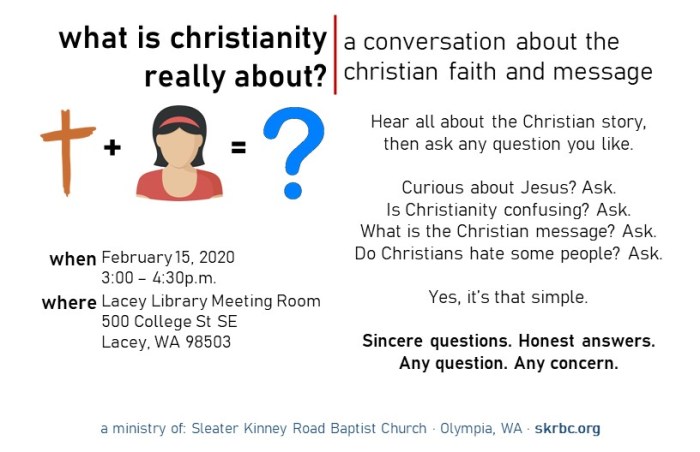
The format we used was pretty simple:

  • A 25-minute overview of the Christian faith and message.
  • A one-hour live question and answer from the audience.

We advertised heavily on FaceBook, and gave invite cards for church folks to pass out to friends and family. Newspaper advertising is dead, and it’s too expensive. With FaceBook marketing, you can tailor your ads to the gender, age, area and interest of your target demographic. It’s outstanding. For our next event, we plan to continue FaceBook ads but fool around with Pandora and Spotify ads, and perhaps YouTube, too.

We titled the event, “What is Christianity Really About?” We wanted people with real questions to come hear the Gospel outside a church building, in a neutral place. We also wanted to give people a chance to ask questions.

We tried to partner with the Bible Presbyterians across the street. The pastor there, who is also the President of the local Bible Presbyterian seminary, is a cautious guy. A good guy. He hedged his bets and attended the event, but declined to be part of the Q&A panel or have his church promote it. I think he wanted to see if we were theological wimps. If we were the William L. Craig, Mike Licona “mere Christianity” type, then he wouldn’t be interested in partnering. I think he was happy with what he saw, and we hope to partner with them at our next event in April or May.

So, what did we do?

For the “overview” section, I wanted to do more than a “1-2-3, pray after me!” presentation. I wanted to present the broad sweep of the Christian story, and attack the secular worldview I assume most of the audience had. My talk had six parts:

  1. Misunderstandings. I quickly rattled off some common misconceptions about Christianity, and explained that the Christian message is really about reconciliation. We’re not good people. We’re bad people who need to be rescued. I also explained we’re doing this public event outside the church building because this message is so important.
  2. Worldviews and scripts. I briefly explained what a worldview is, and suggested we’re all handed “scripts” about how to think and live our lives. We edit these scripts throughout our lives.
  3. Big questions of life. I suggested that not all “scripts” are true; some of them are wrong. I challenged the audience to consider whether their “scripts” for their lives made sense. I asked them to think about how they answered the so-called “big questions” of life.
  4. The Christian script. I presented the Gospel with the framework of “creation + fall + promise + redemption + restoration.” I explained how the Christian faith answered each of these “big questions” with this framework. I was able to explain the Gospel fully and completely.
  5. What’s your script? I then suggested that a secular, materialist script could not answer the “big questions” of life. I presented the implications of this worldview, and challenged people to consider whether they actually lived in light of these depressing implications. I worked in the teleological and moral arguments for the existence of God along the way.
  6. Evangelistic invitation. I then urged the audience to believe the Christian message, because it made sense of who they are and of our world. It answers questions their worldview cannot. I referenced Augustine’s City of God, and his contention that moral degeneracy destroyed the Roman Empire, and his plea for the Romans to choose Christ. I asked people there to do the same.

The overview went to 28 minutes. I was hoping for something like 20-25 minutes; preferably closer to 20. Next time, I’ll cut out some unnecessary material at the beginning and the end. But, all told, it was good enough. I’d give the presentation a B+ for content.

The live Q&A was outstanding. Our church has two pastors. We took turns fielding questions, and helping one another out. I haven’t had so much fun for a very long time. I was a bit disappointed we didn’t get any questions about homosexuality or transgenderism. I suspect people were too polite to ask. Among these present, a few interactions stand out:

  • A young Jewish woman and her friend were there. She asked about the problem of evil in Genesis, along with some other questions. I was able to discuss compatibilism, and only used examples from the Tanakh that highlight this dilemma. I suggested she read Isaiah 53 and ponder whether Jesus is the promised Messiah. I also encouraged her to get Michael Brown’s five-volume set Answering Jewish Objections to Jesus, even if she only wants to figure out how to argue with Christians!
  • One man asked about the Old Covenant law and its relationship to the New Covenant. The other pastor handled that one, and I followed up by directing him to the appropriate section in the Westminster Confession of Faith.
  • Another man, who appeared to be from the Middle East, asked what core beliefs a person must have in order to be a Christian. He also seemed to believe Christianity was a performance-based religion (i.e. you become a Christian by performing certain rituals), and I did my best to correct that. I directed him to read Romans and James.
  • Another man asked if he had to believe in the Trinity in order to be a Christian.
  • One lady, clearly a Christian, asked about how to deal with bitterness in her life in light of what Christ has done.

I’m not aware of another church doing something this aggressive in our area. There might be one; I just don’t know about it. Many churches seem to do evangelism by doing service projects. They want to let people know they’re nice. That’s good. I’m convicted that we ought to do more. Everyone else is pushing their narrative in the public square – even the Buddhists! The Christians ought to do the same. This event is one small way to do that.

All told, it was a great time. We should have advertised more. We packed the place with church folks so it didn’t look quite so dead. We had seven visitors, but they didn’t realize they were the only ones! We’ll do a few things differently next time. But, it was a great success. As we partner with other churches and pool resources, we’ll attract more people for our next event. I can’t wait!

Your church can do something like this. We aren’t a large church. By that, I mean we’re well under 100 in attendance on Sunday morning. We didn’t do PowerPoints. We just showed up and talked. We had tracts and other literature available. This was a minimalist event. It’s easy to do.

The audio for our event is below. The overview presentation goes to 28:00; the rest is the Q&A. My voice is the one you hear at the beginning; the other pastor doesn’t chime in until he opens the Q&A session after 28:00.

Peer Pressure and Darwin

Douglas Axe is a molecular biologist, and the author of Undeniable: How Biology Confirms Our Intuition That Life Is Designed. Early in his book, he explains that Charles Darwin’s evolutionary theories didn’t catch on right away. But, all of a sudden, they did!

Why?

What would cause such a sudden reversal of scientific opinion? Did a new scientific discovery appear in the late 1860s or early 1870s—potent enough to convince the skeptics that Darwin was right after all? Clearly not, as Darwin surely would have cited such a decisive finding. But if science itself wasn’t the cause of the change, then what was?

Whether he intended to or not, Darwin reveals here that peer pressure is a part of science, happening behind the scenes as the various scientific interests compete against one another for influence. If it’s a plain historical fact that the experts didn’t side with Darwin in the early 1860s, then why would he have been “much censured” by his peers for saying so?

It’s as though his colleagues wanted all mention of opposition expunged from the record now that this opposition had faded. Darwin resisted the pressure applied to him on that occasion, but what if others, perhaps under even greater pressure, were less able to resist?

Might the earlier inability of some scientists to express their support of Darwin’s theory—the silence and ambiguity of expression Darwin referred to—have been the result of peer pressure too? And if so, then might the sudden change in Darwin’s favor have been more like a change of power than a change of minds—a sudden reversal of the stream’s flow?

Douglas Axe, Undeniable (San Francisco: HarperOne, 2016; Kindle ed.), pg. 5.

A Sad Story

This week, USA Today reported about a small church in Pennsylvania that has imploded because its leaders decided to hire a pastor they knew was a convicted sex offender … and they kept this bit of information from the congregation. It’s difficult to express how foolish, destructive and unwise this decision was.

Here’s a bit from the article:

On a Sunday morning in late 2017, Oakwood Baptist Church pastor Donald Foose stood before a congregation that had been blindsided by the sudden departure of their previous head pastor.

Foose offered no answers to their lingering questions. Instead, his voice booming through the sparse sanctuary, he preached about the destructive power of gossip.

“The tongue is a fire,” Foose declared, reading from the Letter of James. He held up a piece of paper with his own name and the name of the church on it. With his other hand, he struck a match – and lit the paper ablaze.

“Look what that little fire did,” he said once the sheet had burned. “It destroyed me. It destroyed the church. It destroyed the unity of the church. And I’m amazed that I didn’t catch the place on fire.”

Within six months that sermon would seem like an attempt to smother questions leading straight to Foose’s disturbing past. The details emerged regardless.

In 2000, Foose was convicted and jailed for molesting an underage relative. He resigned from his role as principal of a Christian school, and Pennsylvania’s Department of Education stripped him of his teaching license, deeming him “a danger to the health, safety and welfare of students.” Under state law, Foose can’t even drive a school bus, and were he convicted after 2012 he would have been required by law to register as a sex offender.

But Foose still became a pastor at Oakwood, then superintendent of the Oakwood Baptist Day School. Church leaders who were aware of his past concealed it from the congregation.

The truth – exposed in 2018 after a husband and wife at the church discovered Foose’s record – fractured the tightknit, devout community of roughly 100 members. Pastors resigned, attendance fell, friendships dissolved and faith was tested. In interviews with more than a dozen current and former congregants, a portrait emerged of church leaders compounding Foose’s betrayal by twisting scripture and exploiting the concept of forgiveness to stifle questions about how the situation had been handled.

Foose resigned from Oakwood in May 2018. Soon after, the beloved pastor who had left Oakwood months before, Bob Conrad, acknowledged in a five-page letter to his former church that he and other leaders had known Foose could not pass a background check. Foose claimed to have been falsely accused, Conrad wrote, and church leaders took him at his word, failing to prevent him from having access to children even as school employees complained about his overly familiar behavior with the students.

“I pray,” Conrad wrote, “that you will find it in your hearts to forgive me for my lack in leadership and judgment.”

Read the rest of the article.

St. Augustine the Prophet

In one particular section from City of God (2:19-20), St. Augustine issues a savage takedown on Roman society and culture that could literally be written about the West in 2020:

Here, then, is this Roman republic, “which has changed little by little from the fair and virtuous city it was, and has become utterly wicked and dissolute.” It is not I who am the first to say this, but their own authors, from whom we learned it for a fee, and who wrote it long before the coming of Christ.

Augustine laments the moral chaos of the Roman world in the late 4th century. It’s a tale of virtue gone sour; of encroaching degeneracy that poisoned an empire – much like the One Ring infected the creature Gollum little by little.

You see how, before the coming of Christ, and after the destruction of Carthage, “the primitive manners, instead of undergoing insensible alteration, as hitherto they had done, were swept away as by a torrent; and how depraved by luxury and avarice the youth were.”

It was the youth who bothered Augustine.

Let them now, on their part, read to us any laws given by their gods to the Roman people, and directed against luxury and avarice. And would that they had only been silent on the subjects of chastity and modesty, and had not demanded from the people indecent and shameful practices, to which they lent a pernicious patronage by their so-called divinity. Let them read our commandments in the Prophets, Gospels, Acts of the Apostles or Epistles; let them peruse the large number of precepts against avarice and luxury which are everywhere read to the congregations that meet for this purpose, and which strike the ear, not with the uncertain sound of a philosophical discussion, but with the thunder of God’s own oracle pealing from the clouds.

There is great divide between these two worldviews. One trumpets and pleasure at any cost. The other offers moral guardrails as a revelation from the one true God.

And yet they do not impute to their gods the luxury and avarice, the cruel and dissolute manners, that had rendered the republic utterly wicked and corrupt, even before the coming of Christ; but whatever affliction their pride and effeminacy have exposed them to in these latter days, they furiously impute to our religion.

If the kings of the earth and all their subjects, if all princes and judges of the earth, if young men and maidens, old and young, every age, and both sexes; if they whom the Baptist addressed, the publicans and the soldiers, were all together to hearken to and observe the precepts of the Christian religion regarding a just and virtuous life, then should the republic adorn the whole earth with its own felicity, and attain in life everlasting to the pinnacle of kingly glory.

But because this man listens and that man scoffs, and most are enamored of the blandishments of vice rather than the wholesome severity of virtue, the people of Christ, whatever be their condition—whether they be kings, princes, judges, soldiers, or provincials, rich or poor, bond or free, male or female—are enjoined to endure this earthly republic, wicked and dissolute as it is, that so they may by this endurance win for themselves an eminent place in that most holy and august assembly of angels and republic of heaven, in which the will of God is the law.

He continues, and the parallels to the West in 2020 are stronger than ever here:

But the worshippers and admirers of these gods delight in imitating their scandalous iniquities, and are nowise concerned that the republic be less depraved and licentious.

Only let it remain undefeated, they say, only let it flourish and abound in resources; let it be glorious by its victories, or still better, secure in peace; and what matters it to us?

This is our concern:

that every man be able to increase his wealth so as to supply his daily prodigalities, and so that the powerful may subject the weak for their own purposes.

Let the poor court the rich for a living, and that under their protection they may enjoy a sluggish tranquillity; and let the rich abuse the poor as their dependants, to minister to their pride.

Let the people applaud not those who protect their interests, but those who provide them with pleasure.

Let no severe duty be commanded, no impurity forbidden.

Let kings estimate their prosperity, not by the righteousness, but by the servility of their subjects.

Let the provinces stand loyal to the kings, not as moral guides, but as lords of their possessions and purveyors of their pleasures; not with a hearty reverence, but a crooked and servile fear.

Let the laws take cognizance rather of the injury done to another man’s property, than of that done to one’s own person.

If a man be a nuisance to his neighbor, or injure his property, family, or person, let him be actionable; but in his own affairs let every one with impunity do what he will in company with his own family, and with those who willingly join him.

Let there be a plentiful supply of public prostitutes for every one who wishes to use them, but specially for those who are too poor to keep one for their private use.

Let there be erected houses of the largest and most ornate description: in these let there be provided the most sumptuous banquets, where every one who pleases may, by day or night, play, drink, vomit, dissipate.

Let there be everywhere heard the rustling of dancers, the loud, immodest laughter of the theatre; let a succession of the most cruel and the most voluptuous pleasures maintain a perpetual excitement. If such happiness is distasteful to any, let him be branded as a public enemy; and if any attempt to modify or put an end to it let him be silenced, banished, put an end to.

Let these be reckoned the true gods, who procure for the people this condition of things, and preserve it when once possessed. Let them be worshipped as they wish; let them demand whatever games they please, from or with their own worshippers; only let them secure that such felicity be not imperilled by foe, plague, or disaster of any kind.

What sane man would compare a republic such as this, I will not say to the Roman empire, but to the palace of Sardanapalus, the ancient king who was so abandoned to pleasures, that he caused it to be inscribed on his tomb, that now that he was dead, he possessed only those things which he had swallowed and consumed by his appetites while alive?

If these men had such a king as this, who, while self-indulgent, should lay no severe restraint on them, they would more enthusiastically consecrate to him a temple and a flamen than the ancient Romans did to Romulus.

History really does repeat itself. We see the West rotting from within, like an apple gone bad, and we see our own culture in Augustine’s lament.

Gems from Augustine

“The truth is that in the mysterious justice of God the wickedness of desire is given rope, as it were, for the present, while its punishment is plainly being reserved for the final judgment,” (City of God, 1.28).