Matthew 24 is the longest discussion we have from Jesus about how “this present evil age” (Gal 1:4) will transition to the next. It’s important. It’s also difficult to follow. This article is my best attempt to simply explain what Jesus is saying.
Three questions
The passage opens with Jesus leaving the temple complex after condemning the Pharisees for missing the entire point of true faith (Mt 23). He declares he is finished with the Jewish civil and religious leadership (Mt 23:37-39). Jesus is likely in a dark mood as he and his disciples leave the complex and “point out the temple buildings to him” (Mt 24:1). It was an impressive compound and had been under construction for decades. It was far larger than the temple building itself—more of a compound with the temple as its center.
We can imagine Jesus scowling at the whole thing before declaring that it would soon all be destroyed (Mt 24:2). This is shocking—how can this be? How will people worship YHWH? How will they have atonement for their sins? Once they climbed the hill opposite the temple mount, they asked Jesus: “Tell us, when will these things happen, and what will be the sign of Your coming, and of the end of the age?” (Mt 24:3).
The end of the age (Mt 24:4-14)
Jesus answers the third question (“when will be … the end of the age?”) first. The basic answer is at Mt 24:14: “This gospel of the kingdom shall be preached in the whole world as a testimony to all the nations, and then the end will come.” The end will only come when the whole world hears. We don’t know when this will happen. But, because it is impossible to ensure every single person hears the Gospel (after all, someone is always being born somewhere), perhaps the idea is that when the world reaches a “gospel saturation point,” then Jesus kicks off the day of the Lord.
In the meantime, as local churches do their part to be sure the world reaches this gospel saturation point, we’ll see an escalating on ramp of hostility towards Christianity.
- Many false teachers will claim to be the Messiah, but they’re liars (Mt 24:4-5).
- Wars, famines, and political unrest will come and go. Any historical survey of any century proves we don’t live in a peaceful or friendly world. This does not signify “the end.” It’s simply the on-ramp (Mt 24:6-8).
- Christians will be persecuted and even executed in various places—the gospel message is not welcome. Even professing believers will betray the faith and turn on one another, perhaps out of fear (Mt 24:9-10). History tells us this ebbs and flows depending on local circumstances.
- False prophets will lead many people astray (Mt 24:11). Believers will grow cold towards the faith, perhaps insular (Mt 24:12). But, the true believer is the one who endures or perseveres to the end (Mt 24:13).
But, of course, “the end” will not come until the world reaches its undisclosed gospel saturation point (Mt 24:14). So, in the meantime, local churches must do their part to spread the good news.
The sign of Jesus’ coming (Mt 24:15-28)
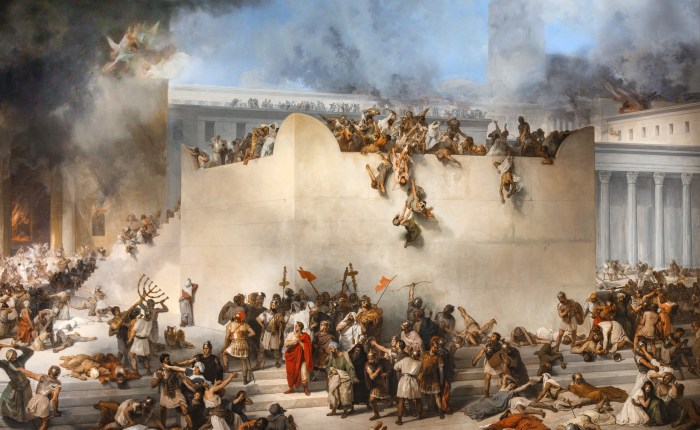
Jesus says he’ll return after a period of awful persecution. He begins by directing his readers to the prophet Daniel, who spoke of an evil figure in Jerusalem who would bring abominations upon God’s people (Dan 9:27). But the picture is complicated because Jesus speaks of two different events at the same time—the destruction of Jerusalem by the Roman armies in A.D. 70, and the destruction wrought by the forces of darkness in the last days. We know this because, while Matthew and Mark emphasize the last days, Luke describes the Romans in A.D. 70:
| Matthew 24:15-16 | Mark 13:14 | Luke 21:20-21 |
| So when you see standing in the holy place ‘‘the abomination that causes desolation,” spoken of through the prophet Daniel—let the reader understand—then let those who are in Judea flee to the mountains … | When you see “the abomination that causes desolation” standing where it does not belong—let the reader understand—then let those who are in Judea flee to the mountains … | When you see Jerusalem being surrounded by armies, you will know that its desolation is near. Then let those who are in Judea flee to the mountains … |
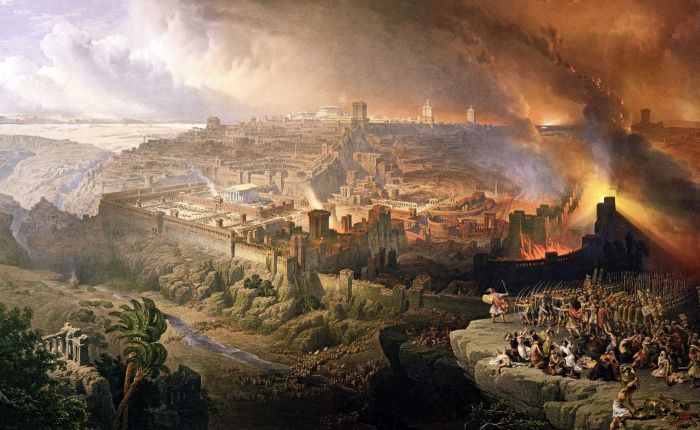
We know Luke is not describing Satan or the antichrist, because they never destroy Jerusalem (see Rev 19:19; Rev 20:9). But, Luke tells us that some abomination (the Roman armies) will make Jerusalem desolate—this happened in A.D. 70. Add to it that Jesus’ declaration of the future destruction of the temple mount is what triggered this conversation, and so the evidence suggests Jesus is speaking of two events at the same time in Matthew 24:15-28. Like a polaroid that slowly fades into focus, the “A.D. 70” bit begins at Matthew 24:15 but fades away until, by Matthew 24:21, the great tribulation has taken its place.
- When the Jews in Jerusalem see the Roman armies massing against Jerusalem during the coming First Jewish War (A.D. 66-70), they should drop everything and ruin (Mt 24:15-18). Josephus (The Jewish War, 5.1 – 7.162) tells us that the ensuing siege was awful.
- Indeed (shading to the end of days, but still with secondary applicability to A.D. 70), Jesus tells us, “for then there will be a great tribulation, such as has not occurred since the beginning of the world until now, nor ever will again” (Mt 24:21). Surely nobody would survive if the Lord did not end it (Mt 24:22)—and he will do so by returning (Rev 19:11f).
Jesus doesn’t tell us when he’ll come back. But, it will be so obvious and so clear as to be unmistakable. Liars and charlatans will sally forth, but we should ignore them (Mt 24:23-36) because Jesus’ return will be as obvious as lightening in the sky. You see it. You hear it. You can’t miss it. It’s unmistakable. That’s how blindly obvious it will be that Jesus has returned—no persuasion will be necessary. Just as surely as you know that a gathering of vultures means there is a corpse on offer, so will Jesus’ return be just as obvious (Mt 24:27-28).
Jesus’ return (Mt 24:29-31)
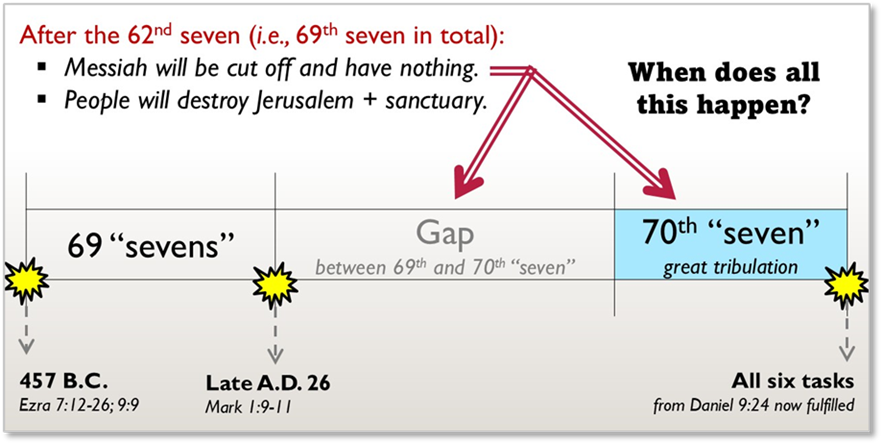
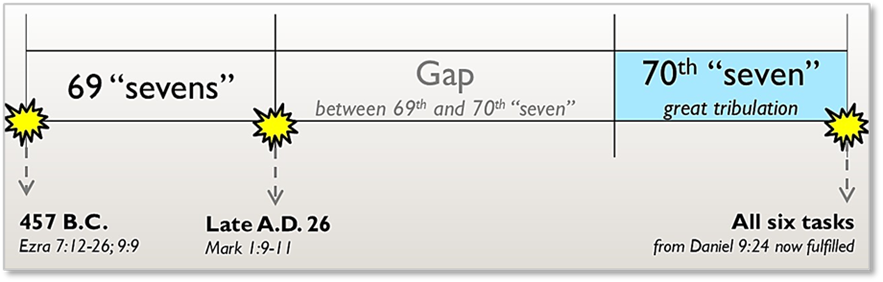
Immediately after the tribulation of those days—that is, the “great tribulation” which other scriptures (e.g., Dan 9:27) tell us will be the antichrist’s brief, seven-year reign—Jesus will return. To describe this event, Jesus borrows phrases from the prophet Isaiah’s declaration about Babylon’s destruction (Isa 13:10; Mt 24:29). It’s no accident that “Babylon” is the symbol of evil and is the kingdom which the Lord destroys just before his return (Rev 16, further described in Rev 17-18).
- Otherworldly phenomena will kick off for all to see—no sun, no moon, stars falling from the sky. There will be no natural explanation.
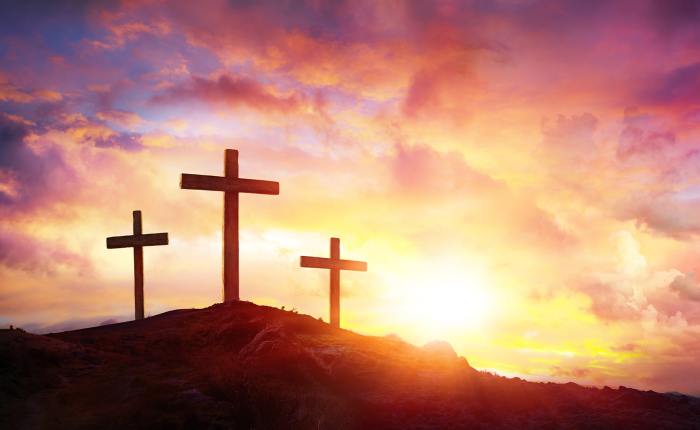
- A mysterious “sign of the Son of Man will appear in the sky” (Mt 24:30). Nobody knows what this sign will be—some ancient Christians believed it will be a cross floating in the heavens, likely illuminated against a now darkened world. If so, it would surely be terrifying beyond belief.
- All the nations of the earth will mourn and wail in horror as Jesus arrives on the clouds of heaven (Mt 24:30), just as Daniel said he would (Dan 7:14)—perhaps with the blazing cross (“the sign of the Son of Man”) backlighting him from the heavens?
- As Jesus arrives, he’ll send out his angels who will gather his elect people from the four winds (cp. Mt 13:24-30. 36-43). This is likely the same event the apostle Paul described at 1 Thessalonians 4:13-18. Elsewhere, Paul tells us that Christ will resurrect believers “at his coming” (1 Cor 15:23), and here it is.
So, this section leaves us with Jesus having arrived in Jerusalem to inaugurate his kingdom. He has gathered his saints from the earth (the living and the dead) to be with him (cp. Rev 19:11ff).
Be ready (Mt 24:32-51)
These signs are warning lights we can recognize. Just as the fig tree telegraphs when summer is close, so too will the signs of the “great tribulation” (Mt 24:21-28) tell us when Jesus’ return is near—“right at the door” (Mt 24:32-33). Indeed, once the kick-off happens, everything will be wrapped up within one generation (Mt 24:34). This is a solemn promise (Mt 24:35).
Some good Christians believe “this generation” refers to the folks to whom Jesus is speaking. Grammatically, this is an easy option and I used to believe it. Others believe it refers to the Jewish people, but the grammatical case for this is weak (however, consider Dr. Ryan Meyer’s argument for a variation of it here). But, when you harmonize our passage with Mark 12:28-32 and Luke 21:29-33, the scenario which best fits all three accounts is that “this generation = the folks alive when the great tribulation kicks off.”
Jesus tells us that, speaking from the perspective of his human nature, he has no idea when he will return (Mt 24:37). Just as the rains and floods burst upon the earth without warning during Noah’s day (Gen 7:11-12) “and they did not understand until the flood came and took them all away; so, will the coming of the Son of Man be” (Mt 24:39). Indeed, when Jesus arrives people will suddenly disappear (Mt 24:41-41). This is the rapture of living saints, wrought at the hand of the angels whom Jesus dispatches as he arrives on the clouds of heaven (Mt 24:31; cp. Mt 13:40-43; 1 Thess 4:13-18).
So, Jesus warns, true believers must be ready for his return … and live like it. If a homeowner knew when a thief would break in, he would be ready (Mt 24:42-43)! “For this reason you must be ready as well; for the Son of Man is coming at an hour when you do not think He will” (Mt 24:44).
The parables which follow (the ten virgins (Mt 25:1-13), and the talents (Mt 25:14-30)) emphasize this point—our job is to be faithful now while we wait. It isn’t to speculate about dates, times, or to fight about the timing of the rapture. It’s to carry out the great commission—to make disciples of all nations, baptize them into Christ’s family, and teach them everything the Lord commanded us (Mt 28:19-20). Indeed, one key criterion when Jesus separates the believers from the unbelievers on the day of judgment is whether we demonstrated love to our new covenant brothers and sisters (Mt 25:31-46)—whether we’ve lived and acted like Christians.
That must be our focus, and “blessed is that slave whom his master finds so doing when he comes” (Mt 24:46).


















 The Eccentric Fundamentalist