3: Explaining reality to the world

Something crystallized for me the past few days, as I read Bostock v. Clayton county. I realized that one of the Church’s missions in the modern West is to explain reality to the world. To explain how things really are. To explain what it means to be a man or a woman. To explain the weight subjective feelings should have in how you make moral value judgments. To explain how you determine “who you are.”

These things used to be taken for granted. Os Guinness has written that the West is a “cut-flower” civilization, in the sense that it’s like a withering flower ripped from the Christian worldview, slowly dying in a vase on the countertop.

No longer.

Now, the West is a dead flower civilization. Now, the Church must be the institution that stands in the gap, shakes it head sadly, and patiently and winsomely explains the facts of reality to a very confused world.

This is really an update on the old “battle of the worldviews” paradigm. The concept is the same, but the “worldview” framework isn’t quite good enough. It doesn’t capture the urgency of the Church’s task. We aren’t simply arguing for competing ways of looking at the world. We aren’t saying,

Look here! We have different ways of looking at the world, and the Christian way is better! Let me tell you why …”

It’s worse than that. It’s more urgent that that. We have to actually explain this world to the world. We have to exegete reality. We have to interpret reality for unbelievers, and pray the Spirit will thus unveil their own madness. It’s come to this, because the false religion of narcissistic humanism is not playing with a full deck.

How to do it?

Our evangelism needs to be better than rote, scripted gospel presentations. That’s been obvious for a while. It needs to engage ideas at the level of basic reality. This skeleton for this framework will look something like this:

  • Origins. How did we get here? How did the world get here? What are we?
  • Suffering. What are good and evil? Who defines these terms? Why does the world hurt people? Why do we hurt each other?
  • Hope. Is there a solution to suffering? Will there be justice? What is justice? What basis do we have to look forward to some “better day?”
  • Rescue. How is this hope, whatever it is, achieved? What are its effects? Does it bring justice? Is this redemption individual, corporate, or both?
  • The end. How will everything end? What will it be like? When will it happen? What will happen?

If you’ve read anything on worldview analysis, there isn’t anything new here. I deliberately “secularized” the categories to be more generic. But, they follow the typical Christian framework of creation, fall, promise, redemption, restoration.

How do the scriptures show God making this happen? I wrote about this a few months ago. Basically, you see God unveiling His plan through the bible’s covenants. There are five covenants. You can think of the first four as individual mile markers leading the bible reader to Jesus of Nazareth, who brings peace. It goes like this:

  • Covenant of Preservation. This covenant (Gen 8-9) didn’t solve the sin problem, but God preserved the world so He could solve it through His Son
  • Covenant with His people. God chose the Jewish people to be the vehicle for this new and permanent solution (Gen 12, 15, 17). Jesus is the descendant from Abraham who will bless people from all over the world and form a new family.  
  • Covenant of holy living. God told His people how to hold the fort, love Him, live holy lives, and maintain relationship with Him through the priests and the sacrificial system until the new solution arrives (Exodus 19:5-8; Old Covenant law). They failed; that’s why Jesus came to fulfill the terms of that covenant by being perfect for His people.
  • Covenant of the king. God chose a dynasty to represent Him, love Him, and lead people to do the same. Jesus is that king, descended as a man from David.
  • Covenant of peace. Because of His perfect life, substitutionary death, and resurrection, Jesus atones for the sins of all His people. He’ll remake us and remake this world. He’s gathering a family. The wicked will be punished. The righteous will be rewarded. There will be perfect, final covenant of peace (Heb 8).

This is the general framework Christians must use.

  • The first list is the framework for reality. It explains the most basic questions of life. It’s the well from which faithful Christian thinkers and philosophers (like Solomon) have explained reality to this world (think Ecclesiastes).
  • The second list is the story of reality. It’s how God has worked this out. It’s the saga of Him making good on all His promises. It tells us where we’re going and where we’ve been.

How to do it?

This is the difficult part. This is why I recently lamented that I felt inadequate to the task. The Church will never be able to explain reality to the world if it doesn’t understand how people in the world think. In missions contexts, missionaries are taught to study and understand the target culture so they can minister to the people. Well, the West is a missions field for the Church. It needs to understand the West.

This will be very hard.

It’ll be hard because the Church in the West, particularly its pastors, are not prepared to really understand the culture. It’s so easy to silo ourselves off in our preferred echo chambers. We rely on social media memes instead of critical thinking. We outsource the heavy lifting to our celebrity thinkers of choice (Christian or otherwise), and parrot what they say. As a culture, we have largely lost the ability to research, study and understand anything meaningful in a deep way.

So, what should the Church do? It must engage the false religion of what I now call narcissistic humanism. It must understand narcissistic humanism’s framework for reality, then attack it.

  • Origins
  • Suffering
  • Hope
  • Rescue
  • The end

How does narcissistic humanism answer these questions? Why are their answers wrong?

I’m afraid the Church will react through a prism of politics, or naivete, or anti-intellectualism. The Church can’t answer these unless it studies. And, I fear too many in the Western Church aren’t ready or able to study these issues. We think reading Wikipedia, watching our favorite partisan pundits on television, watching YouTube videos, or reading popular authors is “research.”

God help us.

The riots, the protests and the calls for justice tie directly to the framework categories of suffering, hope and rescue. If you understand the reality construct of narcissistic humanism, then you can engage with the gospel. With the truth.

It doesn’t matter that the criminal setting police cars on fire hasn’t read anything about Reconstruction. It doesn’t matter that the protester in the soon-to-be defunct Capitol Hill Autonomous Zone has never read any academic work on critical race theory, and has never heard of Robin DiAngelo.

It does matter that there be people in the Church who understand the world better than the world understands itself.

The challenges

There are several, some of which I’ve already mentioned. I’ll recap a bit and toss in a few new ones:

Know thine enemy

Pastors must find some way to understand the world and its framework for reality. One way I’m doing this is to take introductory sociology texts as foundations, then read some select specialist literature from the world’s perspective. The discussions on the theories and causes of social inequality in my two texts (here and here) are very fascinating.

You quickly realize that this is a matter of dueling realities. These sociology texts are part of the “reality mold” into which community college students are poured by our world. Once you understand how this religion of narcissistic humanism sees reality, you can fit the point at issue into the generic framework for reality (see above) and then you’ll have a roadmap.

The Church and her people can only be physicians of the soul, diagnosing terminal illnesses, if it understands the patient. You don’t have to do it my way, of course. But, you do have to do it.

Pastors need to really know theology

This isn’t anything new, but it’s important. You can’t really understand the framework for reality without it. And, that means you can’t explain the story of reality then, either.

Pastors really need to know how to study

Forget partisan sources. Don’t let your favorite teachers interpret the world for you. Read the primary sources. Want to know about intersectionality? Read about it from academics who believe it. Read basic sociology texts.

It isn’t hard. Community college students read these texts. Your 19 year old is reading these books. You can, too.

Grab a pen, take some notes, and begin to understand the culture to which you minister. You’re doing it for Christ. You’re doing it so you can be a better ambassador.

It’s all happening too fast

Who is equal to the task? It feels as though the world has gone mad, all at once. The task is daunting, but it can be manageable if we (1) identify the abstract point at issue (e.g. the Black Lives Matter [“BLM”] issue is about justice and sin, etc.), then (2) fit it into the generic framework for reality template we discussed earlier (the BLM matter fits into suffering, hope and rescue), and (3) begin to take apart the false framework for reality with the Truth, from scripture.

Pastors are wimps

Yes, it’s true. Let’s acknowledge that it’s hard to swim against the cultural tide consistently and faithfully. Let’s acknowledge that it’s tempting to sand the rough edges off the gospel. Let’s then commit to not doing it, and to being held accountable if we start doing it.

Explain the world to the Church

If pastors don’t do it, Tucker Carlson will. This means topical sermons. It means connecting current events to the scriptures. Not with stupid prophesies or conspiracy theories. I mean a sermon on Revelation 17-18, with modern culture playing the role of the prostitute. And, we all know how that ends (Rev 19:19-21). I mean a sermon about identity, focusing on 1 Peter 2:9-11.

Pastors need to re-orient themselves to a missions mindset, which means really understanding the culture so they can attack it with the Truth. Are local churches ready for the shift in mindset that’s necessary? Are seminaries?

I don’t know.

I fear many Christians (especially ministers) aren’t equipped to understand the issues sweeping our culture. I fear we’re so captured by our culture that we’re unable to stand outside of it, as strangers and exiles from a better country, and explain reality to the folks in Vanity Fair.

Ministry for the future, in the West, will be more challenging than ever.

The woman and the pastor

I just read Revelation 12-18 this afternoon, and the identity of the woman in Revelation 17-18 suddenly makes so much more sense in light of the West’s complete moral collapse. Bostock v. Clayton County is the final domino in a chain that has made me now fully realize the scope of the task for faithful pastors in the 21st century.

I knew it before, but I didn’t know it before.

The Church no longer has any common point of cultural contact left with the world. When the Church speaks the mystery of the faith to outsiders, it now speaks a foreign and hateful language. This means the Church’s job is not simply to explain the Christian faith to the world. It is that, but it’s more than that.

The Church’s task, more than ever, is now to explain and interpret reality to the world. God’s reality. This will take educated, well-read ministers who understand history in a deep and meaningful way.

  • Not in a social media meme kinda way.
  • Not in a “I watch Tucker on Fox, and he’s right!” kinda way.
  • Not in a “Watch Ben Shapiro DESTROY the libs” kinda way.

I mean real history. Real engagement with big ideas and big thinkers. A real sense of human history, and mistakes of the past. We’ll need pastors who understand culture. Who pay attention to what’s happening in the world and can interpret it for the Church and for the world. I’m actually thinking a graduate degree in liberal studies/humanities may be more important than a PhD.

Carl Trueman wrote just this morning:

If Christians do not understand the wider context, then they will continue to underestimate the true depth of the cultural problem, be perplexed at the speed of apparent change, and be disturbed by new developments. And that will make it very hard to navigate this world as both good citizens and good stewards of the gospel.

Who is equal to this task? My goodness, who can be equal to this task? When I read the transcript of oral arguments from Bostock, I feel overwhelmed. What tortured combination of forces have combined to produce the kind of moral confusion and rebellion against God that we see in those pages? It’s too much. No one person is equipped to interpret this kind of madness for the Church.

I am more well-read than many pastors. That may be hubris, but I suspect not. I am overwhelmed by the task. I feel unequal to it. There’s so much!

The woman in Revelation 17-18 represents man in community apart from God. Like a chameleon, she’s taken many different forms over the years. But, she is organized society without God. In the West, she’s secular humanism. But, I know even as I write this that it’s not quite right. It’s a religion of sorts, but one I have trouble getting my arms around. It seems to combine a narcissism unique to this digital age, abysmal ignorance of just about everything, a “God as divine butler” theology among professing Christians, critical race theory, intersectionality, and hatred of God … all combined into one toxic casserole. I don’t know what to call it.

This is why I feel overwhelmed. I almost wish I were not so bookish, so I’d be content with memes on social media and wouldn’t appreciate the depth of the challenges that lay ahead. I do know, however, that the Lord destroys the woman in Revelation 18, and returns triumphantly in the next chapter. That’s nice!

May God help the Church in the 21st century in the West; especially its elders. Especially me.

2: Bostock and the meaning of words

Read the series so far.

I have now read both the petition from Bostock and the response from Clayton County. I have not yet read the transcript of the oral arguments or the Court decision itself because I am working my way through these documents in chronological order.

The sum of the two arguments is this:

  • Bostock argues “sex” in Title VII should include “orientation” because (1) lower courts are split, and (2) you cannot consider a person’s orientation without considering his “sex.”
  • Clayton County replies that (1) lengthy precedent says “sex” does not include orientation, (2) “sex” on its face did not mean orientation in 1964 so it cannot mean it now, (3) Bostock should solve this issue via legislation, (4) his petition is a “thinly veiled” ploy to have the Court legislate because Congress will not change Title VII to include “orientation,” and (5) the entire case is pointless because the county terminated Bostock for issues unrelated to his orientation and claims it has documents to prove it.

The most important thing to do is define terms. What does “sex” mean? What does it really mean? What does “sexual orientation” mean? What about “discriminate?” We all think we know what they mean, but what do they really mean?

The Oxford English Dictionary (“OED”) is the definitive, most authoritative lexicon in the English-speaking world. You need a subscription to access it. I have one. Heh …

Cobbling together the relevant OED definitions for “sex,” “orientation” and “discriminate,” we can construct an objective definition for “discrimination because of sexual orientation” as something like this:

treating a person in an unfair or prejudicial manner (OED, s.v. “discriminate,” v., 4) because of his emotional attitude and appetite with respect to sexual partners (see OED; s.v. “orientation,” n., 3).

This is a fair and conclusive definition of the concept at issue in Bostock, whose case hinges (in large part) on proving that discrimination “because of … sex” (i.e. being male or female; OED, s.v. “sex,” n., 1a, 2) is analogous to discrimination “because of … emotional attitude with respect to sexual partners.”

Words have semantic domains or broad ranges of meaning. The right meaning of a word depends on context. Some may attempt to interpret “discriminate” in Bostock’s context as something innocuous, perhaps merely to differentiate or distinguish (OED, s.v. “discriminate,” v., 1). This will not do. The context for Title VII is to treat a person or group in an unjust or prejudicial manner, which is why I selected the definition I did (OED, s.v. “discriminate,” v., 4).

Bostock does not attempt to define “sex,” “orientation” or “discriminate.” Instead, he argues that discrimination because of orientation is as “reasonably comparable [an] evil” as discrimination because of sex, and Title VII should be interpreted broadly to include the entire spectrum of “sex-based discrimination.” This argument really hinges on definitions of words. Given that, I hope the bankruptcy of this position is becoming clear, if it ever was in doubt. “Sex” is about biology, but “sexual orientation” is about emotional attitude, belief and appetites regarding sexual partners.

You may disagree. But, you have no basis other than juvenile emotion upon which to stand. Define your words, and you define the very meaning of language. Cite your lexicon of choice to argue for different definitions of the terms at issue. I shall wait.

You can’t do it. That should mean something.

I am now starting the transcript of oral arguments …

Review of a Really Bad Book

Akin and Pace have a simple goal – to use theological categories to examine the role, requirements and responsibilities of a pastor.[1] They believe ministry will fall victim to a host of errors if it is not grounded in objective, scriptural truth.[2] To that end, they consider (1) the trinitarian foundations of ministry, (2) the doctrinal foundations, and (3) the practical considerations. They are both professors at Southern Baptist institutions, and approach their task from that perspective.

Theological foundations

In Chapter 2, the authors use God’s holiness as a pattern to describe pastoral requirements and calling. “Our personal holiness derives from God’s essence and his expectations.”[3] Next, they explore Christology as a “incarnational” model for pastoral identity and a philosophy of ministry. “A philosophy of ministry that lovingly engages people where they are, humbly sacrifices to meet their needs, and intentionally delivers the gospel, can be described as ‘incarnational.’”[4] In Chapter 4, the authors stress that the Holy Spirit works through pastors as they minister, primarily by compelling their service.

Doctrinal foundations

Chapter 5 surveys the doctrine of man as a foil to help pastors. “As pastors we must recognize the principal role of grace in our own lives, while also extending grace to others and encouraging them to grow in it.”[5] The next chapter discusses ecclesiology and emphasizes that God has a covenant people. However, “the New Testament provides the authoritative basis and instruction regarding God’s church.”[6] Akin and Pace then unpack the implications.

Chapter 7 discusses the great commission. “[I]t is clear that often we do not allow the Scriptures to drive our methods of evangelism, missions, discipleship, church growth, and church planting. We find ourselves speaking loudly about inerrancy, while undermining that same conviction by our practices.”[7]

Practical facilitation

Chapter 8 examines the role of a pastor through use of Christological metaphors. “Daily ministerial tasks find their basis in the doctrinal truths we have explored: the identity of our Shepherd/King, his example as our Shepherd/Keeper, the nature of his sheep, and the invitation to serve as his undershepherds.”[8] The next chapter presents a study of several texts to develop a philosophy of the preaching ministry. Chapter 10 is about the doctrines of marriage and family, to help the pastor balance his responsibilities.

Evaluation

Pace and Akin produced a book that has no heart and no passion. The prose is overly formal and ponderous. The precepts they draw from the doctrinal studies are obvious and unhelpful to any seasoned pastor, and thus unworthy of the reading time it took to reach them. The entire manuscript is alliterated in a distracting and artificial manner, from the section divisions in the table of contents down to the third level sub-headings within the chapters. In short, if another text is unavailable, this book would be an adequate doctrinal introduction for a freshman undergraduate taking a pastoral studies major at a Christian university.

Insofar as they provide doctrinal bases for pastoral ministry, Akin and Pace succeed in their goal. However, the book’s flaws are so spectacular that they manage to entomb the author’s modest accomplishments under an avalanche of stodgy execution.  

Pace and Akin offer not one unique or valuable insight for the experienced pastor. Not one. Everything they have to say has been said better and more concisely by others. 

The book’s structure is clumsy and laborious. Each chapter follows the pattern (1) introduction, (2) theological premise,[9] (3) biblical precepts, (4) pastoral principles, (5) conclusion.[10] Pace and Akin do not just state the premise; they set out to prove it. Then, they pivot to explain the precepts from the premise – most of which were obvious from the discussion of the premise.

Afterwards, Pace and Akin distill some principles from these precepts. However, because “precept” and “principle” are virtual synonyms,[11] the distinction is artificial and frustrating. Indeed, one suspects their fondness for alliteration drove the chapter structure more than common sense; an irony that only grows stronger in their discussion on grammatical-historical homiletics.

The result is that the prize at the end of the chapter is never worth the effort the reader expends to get there. For example, consider a representative selection of precepts and principles from the discussion on homiletics.

After surveying several texts, Akin and Pace produce precepts for pastors, and declare they must (note the alliteration, italicized for emphasis):

  1. Have the spiritual precedent to preach (Neh 8)
  2. Have the spiritual passion to preach (Ezra 7)
  3. Have a sincere prayer for preaching (1 Cor 2:1-5), and
  4. Enjoy the sacred privilege of preaching (2 Tim 3:16-4:5)

This is rather thin gruel for approximately eight pages of exposition.[12] However, that is not all. In perhaps the most unfortunate discussion in an already unfortunate book, Akin and Pace list the following principles to help pastors prepare a sermon:[13]

  1. A text-driven sermon reviews the selection of the text.
  2. A text-driven sermon requires the study of the text.
  3. A text-driven sermon reveals the substance of the text.
  4. A text-driven sermon relays the significance of the text.
  5. A text-driven sermon reflects the structure of the text.

These are shallow insights. Indeed, the thin gruel is now gone, and we are left with ditch water. No seasoned pastor will find anything of value in this guidance. A very specific philosophy of preaching, Akin and Pace declare, drives this approach:[14]

  1. God has given us the mandate to preach.
  2. God has given us the message to proclaim.
  3. God has given us the method to practice.

The entire text proceeds in this fashion. The alliteration is distracting and artificial, yet it saturates every column inch of the text. This contrived approach, like a dead cockroach in your mother’s chocolate-chip cookie dough, negates any helpful insights Akin and Pace may otherwise offer. Even their section headings of (1) theological foundation, (2) doctrinal formulation, and (3) practical facilitation are contrived. Trinitarian considerations aredoctrinal, and categories of systematic doctrine are also foundational, so the dichotomy in section headings is puzzling. If the goal was cute alliteration, however, then the puzzle is solved.

Akin and Pace, when they discuss a pastor’s calling, squander an opportunity to help ministers. They describe the calling as high, humble and holy. This is obvious and unhelpful. But, how to know if one is called to the ministry? The authors retreat to alliteration once again, and explain the calling must be authentic, must have authority, and it must be affirmed.

No faithful minister on earth would disagree with this. But, what does it mean? They explain that, in order for a pastoral call to be authentic, it “must be confirmed as God’s will for our lives through spiritual discernment within the context of our personal relationship with Christ.”[15] This is a sentence that communicates nothing.

They go on to anchor the call in a lack of fulfillment doing anything else; “if it is impossible to find true satisfaction and contentment in any other career, and the biblical criteria are met, then a pastoral call may be confirmed.”[16] This may be accurate, but it hardly helpful to anybody but a undergraduate student.

Akin and Pace’s conclusions are always commonplace and unremarkable. This does not mean they are wrong; merely that they are obvious. It is as if one read a dense tome on all the inner workings of the internal combustion engine; a work intended to help drivers operate their vehicles better. Now, pretend the book concluded with these remarks:

  1. Get into the seat.
  2. Buckle yourself securely.
  3. Insert the key into the ignition and turn clockwise slowly.
  4. Shift to “drive” safely.
  5. Check for traffic approaching your blind spot surreptitiously.
  6. Press the accelerator and ease into traffic sedately.

The reader would likely believe the effort was not worth the reward. Indeed, he did not have to read the book at all if the conclusions were as tedious as all that.

This entire book could have been a pamphlet, but its practical value for advanced students would still be meager. They simply do not have anything meaningful to say to seasoned pastors.


[1] Daniel Akin and R. Scott Pace, Pastoral Theology (Nashville: B&H, 2017; Kindle ed.), KL 480. 

[2] “When we lose sight of how theological truth forms the foundation for ministry philosophy and practice, we run the risk of several ministerial pitfalls: pragmatism, moralism, egotism, and cynicism,” (Pastoral Theology, KL 340).

[3] Pastoral Theology, KL 665.     

[4] Pastoral Theology, KL1533. 

[5] Pastoral Theology, KL 2289. 

[6] Pastoral Theology, KL 2572. 

[7] Pastoral Theology, KL 3059. 

[8] Pastoral Theology, KL 3798. 

[9] The plural of “premise” is “premises.” Akin and Pace always conclude this section with more than one premise, so this chapter sub-heading is grammatically incorrect throughout the text. 

[10] Note the alliteration in #2-4, which I will address shortly. 

[11] The Oxford American Writer’s Thesaurus, 3rd ed., compiled Christine Lindberg (New York: OUP, 2012)offers “principle” as a direct synonym for “precept,” (s.v. “precept,” 683). According to the Merriam-Webster Collegiate Dictionary, 11th ed. (Springfield: Merriam-Webster, 2003),precept means “a command or principle intended esp. as a general rule of action” (s.v. “precept,” n, 1), while principle means “a comprehensive and fundamental law, doctrine or assumption,” (s.v. “principle,” n, 1a).

[12] Pastoral Theology, KL 4174 – 4283.

[13] Pastoral Theology, KL 4344 – 4384.

[14] Pastoral Theology, KL 4283 – 4384.

[15] Pastoral Theology, KL 948. 

[16] Pastoral Theology, KL 1013.

1: Bad, bad news

Some quick thoughts about the Bostock v. Clayton County court decision that came out yesterday. The impetus for the case were three separate instances where employees were terminated for being either homosexual or transgender. The Court consolidated all three cases, and the question before it was whether the definition of “sex” under Title VII of the 1964 Civil Rights Act included the concepts of “gender identity” and “sexual orientation.” The Court held that it did. My focus here is not the employee terminations; it’s the question before the Court and its decision to re-define “sex” in anti-discrimination law.

  1. Christians who have made an idol of supporting the Republican Party because of the alleged advantage of appointing “conservative justices” now have no leg to stand on. Justice Gorsuch wrote the majority opinion, and Chief Justice Roberts concurred.
  2. Christians may have little meaningful reason to continue to support the Republican Party, except perhaps as the alleged lesser of two evils. We will likely see a wide-scale capitulation to this newest phase of the social revolution. President Trump has already figuratively shrugged his shoulders about the decision.
  3. Republican does not equal Christian. This much should have been obvious for a long time, but now it is clear as day. Christians who have looked to the Republican Party as a vehicle for achieving social change should now see the bankruptcy of this tactic. The Religious Right is dead. This is a good thing. This entire endeavor of the Church’s political activism in the service of social reform was a mistake. I have believed this for a long time. Read Stanley Hauerwas’ book Resident Aliens for a better strategy for the Church.
  4. The idea that “textualism” is a bulwark against bad legal interpretation is now dead forever. There is no way on earth legislators in 1964 would have understood “sex” to mean “gender identity” and “sexual orientation.” Yet, Justice Gorsuch wants us to read it in.
  5. Textualism is only as good as the document to which it pledges loyalty. Chief Justice Taney used “textualism” (an anachronism, I know – but it’s what he did) to defend his interpretation in Dred Scott v. Sanford. The only textualism that really matters is fidelity to scripture. Because our society no longer has any semblance of a Christian view of morality (see #7, below), textualism in service of the U.S. Constitution is not a strategy in which to place anything but deep skepticism.
  6. This decision will open a floodgate of unending litigation against every Christian institution in the country. The very concept of “sex” in the context of non-discrimination law has now been irrevocably altered. This has profound implications, because Christian universities, seminaries, organizations … and churches … will now be targeted by malicious actors. The very expression of reality in this country has now been changed.
  7. How you view the world determines how you think. The Judeo-Christian worldview used to be the philosophical foundation from which citizens understood moral values, even if wasn’t a self-conscious foundation. There used to be a residue of that worldview present in society. This Court decision signals that it is gone forever.
  8. Everybody has to identify some foundation for moral values. Once you cut yourself off from objective truth, you’re cast out onto the open sea of subjectivism. Sex means gender identity because … well, why not? Forget rationality. Forget history. Forget divine revelation. Forget biology. There are only our own subjective feelings, baptized in the laver of diagnoses from mental health professionals (the new secular priests, dispensing the sacrament on letterhead) by whose mystical incantations people are “declared” to suffer from gender dysphoria. People look to what they perceive to be an objective standard to make moral value judgments. Having rejected divine revelation, they’ll look elsewhere. Today, they often look to the sciences. The DSM-V is the Bible, and the mental health professional is the high priest dispensing pagan grace. With the diagnosis letter in hand, the doors are open to validating felt gender identity. Transgender is a valid paradigm. Why? The mental professional says! See, here’s the diagnosis letter …
  9. Employers will now have little recourse to curtail unprofessional and unacceptable workplace behavior. All the employee need do is to claim the behavior is an integral part of his “gender identity.” If you believe there will be “safeguards” in place for businesses to have reasonable leeway to enforce professional codes of conduct, you are very naive.
  10. Christians must figure out what they believe on the subjects of gender and sexual orientation. They must. There is nowhere to hide. Pastors who do not take a stand on this issue are cowards.
  11. Our nation is irrevocably broken. I am more and more inclined to advocate for the Church’s total withdrawal from public life, in the sense of political activism for the social good. The only role I now see for the Church in the public square is for evangelism. Again, see Resident Aliens and perhaps Rod Dreher’s The Benedict Option, though I have not yet read the latter.

I’m reading the Court documents, including the transcript of oral arguments and the decision itself, and will write up an analysis in the next month or so. I did the same for the Obergefell v. Hodges decision a few years back. It’ll be an analysis of the arguments and its implications from a Christian perspective. I hope to have it ready by late July.

New names for old covenants?

New names for old covenants?

I updated this article on 11 September 2022.

Just yesterday, I preached about the New Covenant. Some church traditions celebrate Covenant Thursday on the day before Good Friday, which would be 09 April this year. I chose to hold our celebration before Palm Sunday, to kick off the Easter season. This way, before the Palm Sunday, Good Friday, and Easter services … we remind ourselves what’s so special about the New Covenant.

If you come from a dispensational tradition, the New Covenant may not be important in your church tradition. It wasn’t a focus in my own seminary training. Instead, Dr. Larry Oats organized his systematic theology lectures around the dispensations. This is fine; Maranatha Seminary is a dispensationalist school. I personally think the biblical covenants are a surer foundation to form a framework for understanding God’s plan.

I decided to tackle the subject in two parts; (1) the roadmap that leads us to the New Covenant, then (2) what’s “new” about this new covenant. This sermon was one of the harder one’s I’ve ever prepared. It’s a sermon based on systematic theology, not a passage. Even worse, it’s a really big area of systematic theology. Perhaps worse still, I’m a very mild dispensationalist who believes in Old Covenant regeneration[1] and that the church is a full participant in the New Covenant, so many dispensationalist resources are of little use to me in this area.  

This brings me to the point of this little article. I believe the names of the biblical covenants are very bad. Useless. They communicate nothing. We should drop them. We should change them. These covenant names are largely theological conventions; not inspired. We don’t have to stick with them. Instead of labeling the covenants by the immediate recipient, we should label them according to their purpose.

Let me explain. I’ll briefly discuss the Noahic, Abrahamic, Mosaic, Davidic and New covenants in turn.

The covenant of preservation (Noahic)

God didn’t make a covenant with Noah. He said, “I establish my covenant with you and your offspring after you,” (Gen 9:9). In fact, the covenant was with all living creatures on the earth (Gen 9:9-10). So, if we want to label covenants by immediate recipient, we should call it the “covenant with the world.”

But, even this isn’t good enough.

In this covenant, God promised to preserve the world and His creatures intact. He promised to withhold judgment, even though after the flood He acknowledged “the intention of man’s heart is evil from his youth,” (Gen 8:21-22; 9:9-11). This covenant is the basis for common grace and the reason why a people even existed for Jesus to save.[2]

God started over knowing it would end badly (cf. Gen 9-10), and promised to withhold similar judgment indefinitely so His grace and judgment would be known for all time. He did it so Jesus could come one day and save His people from their sins (Mt 1:21).

I suggest we can communicate better with our congregations if we call this the “covenant of preservation.”

The covenant of community (Abrahamic)

After promising to preserve the world, God then promised to save it through a very special people – the Jewish people. Along with the first, this covenant is the fountainhead for all of God’s promises.

It’s true that God did establish a covenant with Abraham. But, it isn’t really about Abraham. The covenant marks out the Jewish people as His special people. They’re the vehicle that brings forth the Messiah, who will bless all the nations of the earth with His gospel (Gen 12:3). The Jewish people are the ones who will evangelize the world during the Millennium (Zech 8:20-23). This covenant is the basis for Mary’s hope (Lk 1:55), for Zechariah’s hope (Lk 1:72-75), and for God’s grace even as He foretold the failure of the next covenant (Lev 26:42).

This covenant is with Abraham, but it’s not about Abraham. It’s about choosing a special people to be the conduit for divine blessings upon the whole world. This is why we have a Jewish Messiah.

It should be called “the covenant of community.”

The covenant of holy living (Mosaic)

After choosing His people, God tells them how to live holy lives while they wait for the promises to Abraham to come true. Like an airplane orbiting, waiting for permission to land, God’s people were in a holding pattern waiting for Jesus to come. So, God tells them how to live holy lives while they’re waiting.

This is a conditional covenant; “if you will indeed obey my voice and keep my covenant,” (Ex 19:5). Like an arrangement with a troubled teenage son, it established rules and boundaries. Breaking the laws, in and of themselves, did not get you kicked out of the family but disciplined within it.

This covenant taught people about themselves – they were sinful. It taught people about God – that He is holy and righteous and punishes sin. The ceremonial laws were object lessons to teach us about Christ. The civil laws were general principles of righteousness applied to a specific context. The moral law was a mirror to show us our true nature, a general restraint on sin, and a vehicle for nudging His people towards greater holiness.

This covenant taught God’s people how to live and love Him while they waited for the promises of the previous covenant to come true. Their failure is ours, because we’d do no better. It tells us we’re not good people. It tells us that, even given divine promises with evidence, we still won’t obey. It tells us we need a permanent solution to our criminal nature. We need a divine intervention in our lives to make this happen.

Jesus is the one who came to do this.

Labeling it “the Mosaic covenant” tells Christians nothing. It ought to be called “the covenant of holy living.”

The covenant of the king (Davidic)

While they waited for God’s covenant promises to be fulfilled, God gave His people a king to rule over them. He established a dynastic line through a boy named David. He said a man from this line would rule over His people and be His royal representative on earth.

God promised David He’d subdue all his enemies (1 Chr 17:9-10), but this never happened.  But, Jesus (the “Son of David;” Mt 1:1) will do it (Ps 2, 110). He said He’d establish this dynasty through David (1 Chr 17:10), and this dynasty would last forever (1 Chr 17:11-12). But, the throne sits vacant. Jesus will fill it.

God said this king would be like a son to Him, and He’d be like a father to the king. There would be a familial closeness. Again, David’s throne is vacant and David committed many sins. His descendants were worse. Jesus is the “son of David” (Mt 1:1) who will fulfill this prophesy. Jesus isn’t God’s literal son; the “Father” and “Son” language expresses a closeness of relationship, not physical derivation.

This covenant isn’t about David. It’s about the promise of a good, perfect, eternal king descended from David who will be God’s perfect representative on earth for all eternity. That person is Jesus.

To call this the “Davidic covenant” is misleading. It’s really the “covenant of the king.”

Mile markers on the road to Jesus

In my sermon, I expressed these covenants as four, individual mile markers leading the Bible reader to Jesus of Nazareth. The fifth mile marker is Jesus.

  • preservation: it didn’t solve the sin problem, but instead God preserved the world so He could solve it through His Son
  • community God chose the Jewish people to be the vehicle for this new and permanent solution. Jesus is the descendant from Abraham who will bless people from all over the world, make it happen, and form a new family.  
  • holy living: God told His people how to hold the fort, love Him, live holy lives, and maintain relationship with Him through the priests and the sacrificial system until the new solution arrives. They failed; that’s why Jesus came to fulfill the terms of that covenant by being perfect for His people.
  • king: God chose a dynasty to represent Him, love Him, and lead people to do the same. Jesus is that king.

This all leads to Jesus, who enacts a new and better covenant based on better promises (Heb 8:6). These “better promises” are summed up with one word; peace! In the New Covenant, Jesus (1) gives His people a new and better relationship with Him, (2) has a pure covenant membership, and (3) permanently blots out their sins.[3]

For these reasons, while the “new covenant” term is biblical language, perhaps it’s best to call it “the covenant of perfect peace.”

I believe these name changes communicate better. They focus on the covenant’s purpose, rather than the immediate recipient. In this way, the new names mean something. They teach the reader. They tell a story.

The old names … not so much.

Here is the sermon. Note: I made a terrible mistake by moving the camera four feet from its normal spot and lost about 75% of the lighting. I moved it back now. Sorry for the poor lighting:


[1] But, then again, so did Rolland McCune (A Systematic Theology of Biblical Christianity, 3 vols. [Detroit: DBTS, 2006-2009], 2: 267-280). Heh, heh …

[2] Robert Letham, Systematic Theology (Wheaton: Crossway, 2019), 442-443.

[3] I am generally following F.F. Bruce here, while re-phrasing the first two points: “This new relationship would involve three things in particular: (a) the implanting of God’s law in their hearts; (b) the knowledge of God as a matter of personal experience; (c) the blotting out of their sins,” (Epistle to the Hebrews, rev. ed.,in NICNT [Grand Rapids: Eerdmans, 1990; Kindle ed.], KL 2170 – 2171).

Prophecy, Tongues and 1 Corinthians 14

Prophecy, Tongues and 1 Corinthians 14

This is a short exposition of 1 Corinthians 14. It’s based on notes I prepared for our adult bible study class. It doesn’t interact with the scholarly commentaries, and nobody will mistake it for a crushing blow that will lay Wayne Grudem low. Still, I believe it’s a faithful and accurate way to understand this difficult chapter. Perhaps some people will find it useful. 

Tongues are useless without an interpreter (1 Cor 14:1-5).

Paul wants Christians to cultivate love in their congregation (1 Cor 13), and to especially desire the ability to prophecy. I understand this to refer to direct revelation from God, in the Old Testament sense. Some believe it refers to general teaching or preaching. This view is possible, but I disagree.

I understand “tongues” to refer to intelligible, human language. I think this agrees with the evidence from Acts 2 and makes the best sense in this chapter. Paul doesn’t exactly denigrate tongues, but he remarks over and over that this gift has limited use in a church setting. Tongues is a gift for evangelism.

The one who speaks in a foreign language during a church meeting isn’t actually speaking to the congregation, but to God – because nobody but God understands what he’s saying (1 Cor 14:2)! Instead, he’s uttering mysteries by the Holy Spirit, who gives this miraculous gift. However, the person who speaks prophecy directly from God can be understood. He can encourage and build up the congregation. The man who speaks a foreign language can’t do any of that; nobody understands him (1 Cor 14:3). Instead, he builds and encourages himself. The man who prophesies builds up the congregation (1 Cor 14:4). This is why the gift of prophecy is better for the church than tongues, unless someone is available to interpret (1 Cor 14:5).

Build up the church, not yourself (1 Cor 14:6-12)

Paul asks an obvious question; how can you understand someone who speaks a foreign language unless an interpreter is present (1 Cor 14:6)!? You can’t, of course.

If a flute doesn’t sound a clear note, nobody can understand or appreciate it. If a bugle isn’t clear, nobody can obey the call. Likewise, if a foreign language isn’t interpreted, nobody will even know what’s being said! It’s like you’re speaking into the air (1 Cor 14:7-9).

There are lots of languages in the world, and they all mean something (1 Cor 14:10). But, if you don’t understand the language, the audience and the speaker will be foreigners to one another (1 Cor 14:11). So, Christians should focus on gifts that will actually build up the congregation (1 Cor 14:12). The gift of tongues won’t do that.

How to use the gift of languages (1 Cor 14:13-19)

This is why the person who has the gift of speaking in a foreign language should pray that he has the ability to interpret (1 Cor 14:13). This implies that some people could speak foreign languages, but didn’t even understand what they were saying! In this case, I assume the Christian is somehow a passive vehicle for communicating via the Spirit. This is strange, because Acts 2 suggests the Christians understood what they were saying to the Pentecost pilgrims. Whatever the situation was, Paul suggests they not be content with being passive actors.

Our minds must be engaged in worship (1 Cor 14:14-15). If you pray or speak in a foreign language, and you yourself don’t even understand what you’re saying, how can this build up anybody (1 Cor 14:16-17)? This is why Paul would rather instruct believers than speak 10,000 words in a foreign language that doesn’t do any good for anybody (1 Cor 14:19).

What tongues (“languages”) are for (1 Cor 14:20-25)

Paul suggests the Corinthians be mature as they think about this (1 Cor 14:20). Isaiah 28:11 suggests that, one day, Gentiles will come with strange languages and teach the Israelites about Yahweh (1 Cor 14:21). Paul takes this ironic situation and applies it to his own context – the gift to speak foreign languages isn’t for believers, but for unbelievers (1 Cor 14:22). Prophecy, on the other hand, is for believers (1 Cor 14:22).

This is why, if an outsider wanders into your assembly and sees everybody speaking foreign languages to one another, he’ll think you’re all insane (1 Cor 14:23)! But, if someone enters and hears prophecy direct from the Lord, he is convicted, he’s called to account, and he’ll worship God and confess that He’s present in the church (1 Cor 14:24-25). This is because prophecy can be understood by anybody, but tongues is for evangelism (cp. Acts 2).

Orderly worship (1 Cor 14:26-32)

So, prophecy and foreign language gifts should be done decently, in order, without chaos. Everything should be for edification (1 Cor 14:26).

If someone has the gift of languages, then have no more than two or three speak in turn, and someone must be there to interpret (1 Cor 14:27). If there isn’t an interpreter, nobody should speak (1 Cor 14:28).

For prophecy, let two or three speak and have others weigh what they say (1 Cor 14:29). If one person receives a revelation from God during the meeting, others should give way to let him speak (1 Cor 14:30). The prophets should speak one by one, so everyone in the congregation can be encouraged (1 Cor 14:31). The prophets are subject to one another, to critique and “check” one another (1 Cor 14:32).

Women and prophecy (1 Cor 14:33-36)

1 Cor 14:33-36 reads:

As in all the churches of the saints, the women should keep silent in the churches. For they are not permitted to speak, but should be in submission, as the Law also says. If there is anything they desire to learn, let them ask their husbands at home. For it is shameful for a woman to speak in church.

This is the most difficult part of Paul’s letter. I believe Paul means that wives should keep silent (1 Cor 14:34) in the context of critiquing and “checking” their husbands, who have just uttered prophesies.[1] Paul can’t be saying women can’t ever speak in a public gathering, for several reasons:

  1. it would imply women are somehow structurally inferior; contra Gal 3:28
  2. it contradicts 1 Cor 11:5, which says women did regular prophesy in church services
  3. it would contradict Joel’s prophesy (Joel 2:28; Acts 2:18)
  4. it contradicts the prominent servant roles of Euodia and Syntyche (Phil 4:2-3), Priscilla (Acts 18:2; Rom 16:3; 1 Cor 16:19); Mary (Rom 16:6), Junia (Rom 16:7), Tryphaena and Tryphosa (Rom 16:12), Phoebe the deacon (Rom 16:1-2), Nympha who hosted a house church (Col 4:15)

The language of submission and shame suggest this is likely a case of women who are critiquing their husband’s prophesies during a church meeting. Indeed, Paul has just finished explaining how to handle prophecy during a church meeting, including critique or questioning afterwards. There is probably a local context to this controversy that we’ll never know. The data of other women performing prominent servant roles in various New Testament churches (see above) means this is likely a local command, for a local context, for a very specific situation.

I assume Corinth had a particular problem with some wives criticizing, critiquing or otherwise embarrassing their husbands during public church meetings. The overriding principle is that husbands and wives should not embarrass one another in public (cp. Eph 5:21ff). If the wife has concerns about her husband’s prophecy, she must ask at home – where there is no danger of embarrassment or shame.[2] In other words, rather than embarrass your husband in public, just ask in the car on the way home!

The reference “as the law also says” (1 Cor 14:34) is a general reference to the Old Covenant, likely to Gen 3:16 and the perpetual battle between the sexes in a marriage relationship in a post-fall context.

Wrapping up (1 Cor 14:36-40)

Paul concludes with some sharp, rhetorical arrows. The word of God didn’t just come to the church in Corinth, did it (1 Cor 14:36-37)!? Any true Christian should acknowledge Paul’s authority to speak on Yahweh’s behalf (1 Cor 14:37). If someone doesn’t acknowledge Paul’s authority, he shouldn’t be considered a Christian (1 Cor 14:38). Ask God for the ability to utter prophesies. Don’t forbid foreign languages in the church; just make sure everything is done decently and in order (1 Cor 14:39-40).


[1] I am following (1) David Garland, 1 Corinthians, in BECNT (Grand Rapids: Baker, 2003), 664-673 and (2) Simon Kistemaker, 1 Corinthians (Grand Rapids: Baker, 1993), 510-515.

[2] “Paul disallows speech in the assembly that would suggest that a wife is being insubordinate toward her husband, whether it is an interruption or a challenge to a prophetic utterance. The delicate relationship between husband and wife is imperiled by the wife’s public questioning, correcting, or challenging,” (Garland, 1 Corinthians, 671).

Likewise, Kistemaker observes, “[t]he Corinthian women at worship are not told to be silent in respect to praying, prophesying, and singing psalms and hymns. They are, however, forbidden to speak when the prophesies of their husbands are discussed,” (1 Corinthians, 513).

Could Christ Have Sinned?

Could Christ Have Sinned?

We do a theology class for our congregation twice per month. We meet in the evenings for 90 minutes and discuss a few questions from the assigned reading. We use Grudem’s systematic theology. I’d prefer Erickson, but Grudem’s format is more user-friendly. This coming week, we’re discussing this question:

  • Do YOU think it is possible for Jesus to ever sin? If it isn’t possible, then how can Hebrews 4:14-16; 5:7-10 be true?

These are my preliminary reflections as I prepare for the class. They are not fully formed, but they point where I’m headed. To answer this question coherently, you need to competently pull together several strands of orthodox Christology. In short, this is a tough question.

First things first

We must understand two things up-front:

  1. Jesus never sinned
  2. Father, Son and Spirit decided that the incarnate Messiah would be a perfect representative man, so it is certain that He would not sin

But, if Jesus didn’t sin, can He really understand us? And if Jesus couldn’t have sinned, then isn’t the incarnation a farce?

Definitions

  1. Sin: an unholy thought (Ex 20:17; Mt 5:27-30) or action (“lawlessness,” 1 Jn 3:4).
  2. Temptation: an enticement, push or nudge to sin.1
  3. Nature: the constellation of attributes and capacities that give shape to a person; including will, mind, emotion, volition.2
  4. Person: the owner, possessor or master of a nature – the active subject of a nature. It’s the vehicle that owns and actuates a nature. 3

Two nature Christology

Jesus has eternally existed as a divine person with a divine nature. In the incarnation, Jesus added a human nature to His divine nature. So, He now eternally exists as one divine person with two natures; divine and human.

But, Jesus’ temptations aren’t like ours because His human nature is not like ours. Adam and Eve broke the mold, and our natures reflect this brokenness. However, Jesus’ human nature is like Adam and Eve’s original nature – morally neutral. This means temptation strikes us differently than it did Jesus; we’re tempted from within and Jesus was tempted from without.

This means Jesus exercised more strength and fortitude, as our representative, to withstand the temptation. A champion weightlifter understands the crushing weight of the barbell more than the man who can’t lift anything.4 So, Jesus understands temptation better than we do, because he triumphed over it while we succumb to it.

Because Jesus had a real human nature, like the original Adam and Eve, this seems to mean Jesus’ human nature is theoretically able to sin because Adam and Eve were able to sin, too. Also, Adam and Jesus are two parallel representatives for humanity, so one would expect a correspondence between their capacities.

Thankfully, we don’t have to puzzle this out on our own. Very smart Christians have already done this.

Chalcedon

The Council of Chalcedon is the high-water mark for Christology.5 Here is what it says, with some comments:

Christ must “be acknowledged in two natures, inconfusedly, unchangeably, indivisibly, inseparably …” This means the natures can never be confused or changed; as if they can be melded together or mistaken for each other. Also, Jesus’ divine and human natures can’t be disconnected from one another. In other words, they’re locked together but not mixed.

The Creed goes on, and explains, “the distinction of natures being by no means taken away by the union, but rather the property of each nature being preserved …” This means each nature remains what it is and each nature retains its constellation of attributes. Thus, the divine nature is truly divine, and the human nature is truly human (like Adam’s and Eve’s).

These two natures are “concurring in one Person and one Subsistence, not parted or divided into two persons, but one and the same Son …” So, in some unfathomable way, each nature concurs together in the God-Man.

The Calcedonian Creeds tells us several things:

  1. while the natures are not mixed, and they each retain their separate attributes,
  2. they still work in lock-step together, in some way,6 and you can’t downplay the role of either nature,
  3. therefore, to assume one nature has a controlling hold on another (as impeccability advocates often suggest) seems to go beyond Chalcedon7

The precise mechanics of this union of natures in Jesus must remain a mystery; to go any further is dangerous speculation. We can also toss in some other caveats:

  1. If Jesus is truly human, then He has a human will proper to His human nature.8 He has to make a meaningful and intelligent choice, as a man, to obey God the Father as our representative. To suggest otherwise is to impugn His humanity.
  2. However, natures cannot act. Only a person can act. This brings us back round to the metaphysical conundrum that Jesus the divine person acts; even if it’s in accordance with one nature and not the other. The Son is the acting subject of both His divine and human natures.

Scripture

Hebrews 4:14-16 tells us Jesus can sympathize9 with and understand10 our weaknesses. He can only do this because He was tempted in all points just like we are – but without sin.11 These words mean something. If the temptation does not mirror Adam and Eve’s, it’s difficult to see Jesus as a parallel representative.

Because of (οὖν) Jesus’ shared experience of suffering, the Scripture calls us to “with confidence draw near to the throne of grace, that we may receive mercy and find grace to help in time of need,” (Heb 4:16). This suggests Jesus must really have been tempted to sin the same way as the original Adam and Eve.

In Hebrews 5:7-10, we read that, “in the days of his flesh, Jesus offered up prayers and supplications, with loud cries and tears, to him who was able to save him from death, and he was heard because of his reverence.” The best example of this is Gethsemane, where Jesus genuinely wanted to be freed from what was to come – but He resolved to do His Father’s will, anyway. Jesus the divine person expressed a purely human volition through His human nature. Like on many other occasions, Jesus seems to have “walled off” or compartmentalized His divine nature at this point.

We read that “although he was a son, he learned obedience through what he suffered,” (Heb 5:8). Jesus learned experiential obedience to God by suffering and triumphing over sin. As a man, Jesus learned things. “And being made perfect, he became the source of eternal salvation to all who obey him,” (Heb 5:19). Jesus’ suffering without sinning is what “completed” Him as our representative. In Hebrews 2:10, the Bible says it’s the suffering that was the means (διὰ) of this “completeness,” realized most fully in His unjust execution.

The problem

Here’s the conundrum:

  1. to suggest Jesus, as the God-Man, is unable to sin seems to denigrate His true humanity. This position seems to make the incarnation a farce – a foregone conclusion. It implies Jesus never felt the true force of the temptations. This position is known as impeccability.
  2. but, to suggest Jesus could sin seems to denigrate His deity. This position is known as peccability.

So, what to do? The solution seems to be a qualified form of peccability, as follows:12

  1. Jesus was genuinely tempted to sin,
  2. not like us, but like the original Adam and Eve (morally neutral),
  3. so, it was theoretically possible for Him to sin,
  4. but He chose not to sin

Why this solution?

To suggest otherwise seems to denigrate His humanity and make the divine nature override the human one – contra the Chalcedonian creed, which says “the property of each nature being preserved and concurring in one Person …”

R.L. Dabney even calls the hypostatic union “an absolute shield to the lower nature, against error.”13 The human nature is somehow captive to the divine. This also seems to violate dyothelitism. Shedd argues that Jesus as a person (with both natures) could not have sinned, the divine nature controls the human.14 This is the same error as Dabney’s; it seems to absorb the humanity into the divine.15 How, then, are Jesus’ temptations not all a farce?

Charles Hodge remarked, “If from the constitution of his person it was impossible for Christ to sin, then his temptation was unreal and without effect, and He cannot sympathize with his people.”16

Anselm draws a distinction between temptation and will; the temptation may be there, but the will is not – so both options are true, in a way!17 Grudem acknowledges we can’t really understand how the two natures relate in the God-Man, but affirms Jesus as a man didn’t rely on His divinity as a backstop;18 contra Dabney and Shedd. But, he observed:19

if we are asking if it was actually possible for Jesus to have sinned, it seems that we must conclude that it was not possible. The union of his human and divine natures in one person prevented it.

This seems to violate Chalcedon. But, he concludes, rightly: “His divine nature could not be tempted with evil, but his human nature could be tempted and was clearly tempted. How these two natures united in one person in facing temptations, Scripture does not clearly explain to us.”20

This is wise advice. This is where Scripture stops. Chalcedon is the high-water mark; everything else is just tinkering. The Third Council of Constantinople fleshed some of this out a bit:21

each nature wills and performs the things that are proper to it in a communion with the other; then in accord with this reasoning we hold that two natural wills and principles of action meet in correspondence for the salvation of the human race.

But, we really can’t say precisely how the two natures communicate together. Stephen Wellum has noted, “[s]ome kind of asymmetrical relationship between the Son’s living, speaking, and acting in and through his natures must be postulated, which is probably one of the most difficult areas for us to conceive.”22

Millard Erickson explains that “while he could have sinned, it was certain that he would not. There were genuine struggles and temptations, but the outcome was always certain.”23 This is perhaps the best answer, and it touches on yet another area of genuine mystery – a compatibilist concept of God’s sovereignty:

  1. Father, Son and Spirit decreed that Jesus would be the sinless representative,
  2. so, it was certain the incarnate Christ would not sin
  3. yet Jesus, acting in accordance with his true unspoiled humanity with His human will, theoretically could have sinned
  4. even though, according to the decree, it is certain he would not sin

This is the same conundrum we have as we consider whether Judas was a truly willing agent when he betrayed the Savior (Mk 14:21). Compatibalism assigns moral responsibility to the human agent, even as it upholds God’s decree. This helps us understand how Jesus theoretically could sin, and yet could not sin.

Wrapping up

I return to the questions I posed at the beginning:

  1. If Jesus didn’t sin, can He really understand us? He theoretically could have sinned, but He didn’t, so He does understand and can sympathize with our struggles.
  2. If Jesus couldn’t have sinned, then isn’t the incarnation a farce? But, He theoretically could have sinned, so it isn’t a farce.

I pray these imperfect reflections help you think through this important question!

Notes

1 This is a variation of a definition given by Robert Letham, Systematic Theology (Wheaton: Crossway, 2019), 524.

2 See especially the discussion by Stephen Wellum, God the Son Incarnate: The Doctrine of Christ (Wheaton: Crossway, 2016), 424ff.  

3 Ibid.  

4 Wayne Grudem, Systematic Theology (Grand Rapids: Zondervan, 1994; ePub 2015), 539.

5 One of the best short discussions on the Christological controversies is by Robert Reymond, A Systematic Theology of the Christian Faith (Nashville: Thomas Nelson, 1998), 583-622. See especially 608-622.  

6 The Third Council of Constantinople explained it well; “we say that he has two natures shining forth in his one subsistence in which he demonstrated the miracles and the sufferings throughout his entire providential dwelling here, not in appearance but in truth, the differences of the natures being made known in one and the same subsistence in that each nature wills and performs the things that are proper to it in a communion with the other; then in accord with this reasoning we hold that two natural wills and principles of action meet in correspondence for the salvation of the human race,” (Norman P. Tanner (ed.), Decrees of the Ecumenical Councils, 2 vols. [Washington D.C., GUP, 1990], 1:129-130).

You cannot go further than this, perhaps the best expression of Chalcedon as applied to the will of each nature that mankind will ever formulate.

7 Even the Third Council of Constantinople, at it condemned the monothelite issue, seemed to hint at points beyond Chalcedon when it said “the two natural wills not in opposition, as the impious heretics said, far from it, but his human will following, and not resisting or struggling, rather and in fact subject to his divine and all powerful will,” (Ibid, 1:128). Yet, the Council then clarified this by a quotation of Jn 6:38, and suggested Jesus’ human nature always sought to do the will of the divine. The incident at Gethsemane certainly suggests a resistance and struggle (contra the Council, above), but nonetheless a successful submission to God’s will.

I am uncomfortable with the depths the Council went to as it suggested the human nature obeys the divine; this smacks of Nestorianism or a radical disjunction of the natures. The Oneness Pentecostals actually sound remarkably like this! This formulation seems to go too far into mystery.

8 This is dyothelitism; see the Third Council of Constantinople.  

9 Friberg defines the word here as “a disposition to help because of fellow feeling,” (25330 συμπαθέω).

10 Merriam-Webster’s Collegiate Dictionary defines “sympathy” as “the act or capacity of entering into or sharing the feelings or interests of another,” (sv. 3a).

11 Most commentators understand χωρὶς ἁμαρτίας as I interpreted it, above. These include Peter T. O’Brien (The Letter to the Hebrews, in PNTC [Grand Rapids: Eerdmans, 2010; Kindle ed.], KL 3681) and F.F. Bruce (The Epistle to the Hebrews, in NICNT [Grand Rapids: Eerdmans, 1990; Kindle ed.], KL 1392-1405) and William L. Lane (Hebrews 1-8, in WBC, vol. 47a [Dallas: Word, 1991], 114). Some commentators, such as Homer Kent (Hebrews, 92), believe the phrase refers to the manner of the testing; that is, Jesus was tempted like we are except in the manner of a sinful inclination or pull from within. This is theologically correct, but it isn’t the point the writer is making. Kent is incorrect.

12 For a good counter-argument for impeccability, see especially Robert Letham, Systematic Theology (Wheaton: Crossway, 2019), 520-526. He seems to generally follow Shedd.

13 R.L. Dabney, Systematic Theology (St. Louis: Presbyterian Publishing, 1878; reprint; Carlisle: Banner of Truth, 1996), 471.

14 “When these two natures are united in one theanthropic person, as they are in the incarnation, the divine determines and controls the human, not the human the divine,” (W.G.T. Shedd, Dogmatic Theology, ed. Alan W. Gomes, 3rd ed. [reprint; Phillipsburg: P&R, 2003], 660).

15 “Consequently, Christ while having a peccable human nature in his constitution, was an impeccable person. Impeccability characterizes the God-man as a totality, while peccability is a property of his humanity,” (Shedd, Dogmatic Theology, 661).

16  Charles Hodge, Systematic Theology (reprint; Peabody: Hendrickson, 2011), 2:457.

17 “We can therefore say of Christ that he could tell a lie, if this statement is recognized to contain the implication, ‘If it were his will’. And since he could not lie unwillingly and it could not be his will to tell a lie, it can equally be stated that he was incapable of lying. It follows that thus he both could, and could not, tell a lie,” (Why God Became Man, in Anselm of Canterbury: The Major Works [Oxford: OUP, 1998; Kindle ed.], Book 2.10).

18 Grudem, Systematic, 539. “Jesus met every temptation to sin, not by his divine power, but on the strength of his human nature alone.”

19 Ibid, 539.  

20 Ibid.

21 Norman P. Tanner (ed.), Decrees of the Ecumenical Councils, 2 vols. (Washington D.C., GUP, 1990), 1:129-130).

22 Wellum, God the Son Incarnate,  441.  

23 Millard Erickson, Christian Theology, 3rd ed. (Baker: Grand Rapids, 2013; ePub), 657.  

Evangelism at the Library

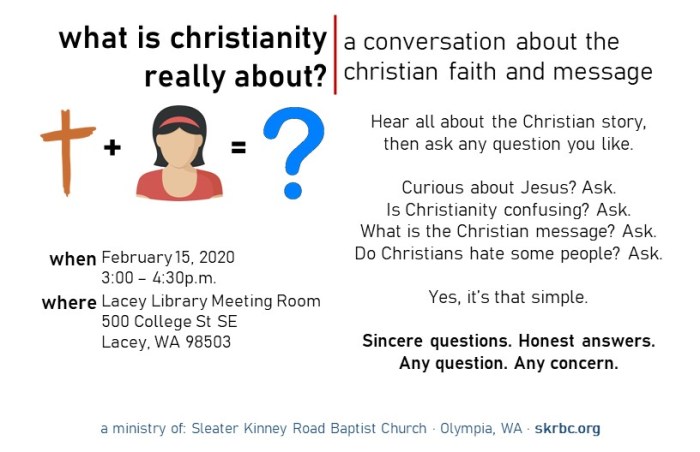
This past Saturday, our church did a public evangelism event at our local library. The West Coast is deservedly considered one of the more leftist areas in the United States. The Governor of Washington State recently ended an unsuccessful presidential run in which his platform consisted of climate change alarmism. Paper straws are mandated in Seattle. The homelessness crisis in urban centers along the I-5 corridor grows ever worse. Marijuana is legal. The sexual revolution is in full swing.

Olympia, WA (the state capitol) is one of the more secular areas in a very secular region. It’s a small city; not much more than 50,000 people. Together with Lacey and Tumwater, it forms a modest metro area.

My experience is that, in the Midwest, your church can grow (albeit slowly) if you (1) preach faithfully, (2) do a children’s event like VBS in the Summer, and (3) maybe a few other odds and ends. I also found that many people think they’re Christians already because they’re Americans.

Olympia is different. Really different.

I never saw urban ministry modeled in a healthy way. I come from the KJVO-flavor of Baptist fundamentalism, where “run and gun evangelism” was the order of the day. I’ve had to fiddle around and figure some things out for myself. I don’t have much figured out, but one thing I have figured is that churches need to be winsomely aggressive with evangelism in this culture.

So, that’s where the library event comes in. A few years ago, I saw a flyer in the library for some kind of “intro to Buddhist chanting” class. I thought to myself, “why don’t Christians do this kind of thing in the public square!?” I looked up the public meeting room policy, and anyone can reserve and use the rooms free of charge. You just can’t sell anything. Fair enough.

But, I’ve been busy. It hasn’t been the right time. Blah, blah. We brought on board second elder, and he’s been here for about seven months. The time had come.

So, we did it.

The format we used was pretty simple:

  • A 25-minute overview of the Christian faith and message.
  • A one-hour live question and answer from the audience.

We advertised heavily on FaceBook, and gave invite cards for church folks to pass out to friends and family. Newspaper advertising is dead, and it’s too expensive. With FaceBook marketing, you can tailor your ads to the gender, age, area and interest of your target demographic. It’s outstanding. For our next event, we plan to continue FaceBook ads but fool around with Pandora and Spotify ads, and perhaps YouTube, too.

We titled the event, “What is Christianity Really About?” We wanted people with real questions to come hear the Gospel outside a church building, in a neutral place. We also wanted to give people a chance to ask questions.

We tried to partner with the Bible Presbyterians across the street. The pastor there, who is also the President of the local Bible Presbyterian seminary, is a cautious guy. A good guy. He hedged his bets and attended the event, but declined to be part of the Q&A panel or have his church promote it. I think he wanted to see if we were theological wimps. If we were the William L. Craig, Mike Licona “mere Christianity” type, then he wouldn’t be interested in partnering. I think he was happy with what he saw, and we hope to partner with them at our next event in April or May.

So, what did we do?

For the “overview” section, I wanted to do more than a “1-2-3, pray after me!” presentation. I wanted to present the broad sweep of the Christian story, and attack the secular worldview I assume most of the audience had. My talk had six parts:

  1. Misunderstandings. I quickly rattled off some common misconceptions about Christianity, and explained that the Christian message is really about reconciliation. We’re not good people. We’re bad people who need to be rescued. I also explained we’re doing this public event outside the church building because this message is so important.
  2. Worldviews and scripts. I briefly explained what a worldview is, and suggested we’re all handed “scripts” about how to think and live our lives. We edit these scripts throughout our lives.
  3. Big questions of life. I suggested that not all “scripts” are true; some of them are wrong. I challenged the audience to consider whether their “scripts” for their lives made sense. I asked them to think about how they answered the so-called “big questions” of life.
  4. The Christian script. I presented the Gospel with the framework of “creation + fall + promise + redemption + restoration.” I explained how the Christian faith answered each of these “big questions” with this framework. I was able to explain the Gospel fully and completely.
  5. What’s your script? I then suggested that a secular, materialist script could not answer the “big questions” of life. I presented the implications of this worldview, and challenged people to consider whether they actually lived in light of these depressing implications. I worked in the teleological and moral arguments for the existence of God along the way.
  6. Evangelistic invitation. I then urged the audience to believe the Christian message, because it made sense of who they are and of our world. It answers questions their worldview cannot. I referenced Augustine’s City of God, and his contention that moral degeneracy destroyed the Roman Empire, and his plea for the Romans to choose Christ. I asked people there to do the same.

The overview went to 28 minutes. I was hoping for something like 20-25 minutes; preferably closer to 20. Next time, I’ll cut out some unnecessary material at the beginning and the end. But, all told, it was good enough. I’d give the presentation a B+ for content.

The live Q&A was outstanding. Our church has two pastors. We took turns fielding questions, and helping one another out. I haven’t had so much fun for a very long time. I was a bit disappointed we didn’t get any questions about homosexuality or transgenderism. I suspect people were too polite to ask. Among these present, a few interactions stand out:

  • A young Jewish woman and her friend were there. She asked about the problem of evil in Genesis, along with some other questions. I was able to discuss compatibilism, and only used examples from the Tanakh that highlight this dilemma. I suggested she read Isaiah 53 and ponder whether Jesus is the promised Messiah. I also encouraged her to get Michael Brown’s five-volume set Answering Jewish Objections to Jesus, even if she only wants to figure out how to argue with Christians!
  • One man asked about the Old Covenant law and its relationship to the New Covenant. The other pastor handled that one, and I followed up by directing him to the appropriate section in the Westminster Confession of Faith.
  • Another man, who appeared to be from the Middle East, asked what core beliefs a person must have in order to be a Christian. He also seemed to believe Christianity was a performance-based religion (i.e. you become a Christian by performing certain rituals), and I did my best to correct that. I directed him to read Romans and James.
  • Another man asked if he had to believe in the Trinity in order to be a Christian.
  • One lady, clearly a Christian, asked about how to deal with bitterness in her life in light of what Christ has done.

I’m not aware of another church doing something this aggressive in our area. There might be one; I just don’t know about it. Many churches seem to do evangelism by doing service projects. They want to let people know they’re nice. That’s good. I’m convicted that we ought to do more. Everyone else is pushing their narrative in the public square – even the Buddhists! The Christians ought to do the same. This event is one small way to do that.

All told, it was a great time. We should have advertised more. We packed the place with church folks so it didn’t look quite so dead. We had seven visitors, but they didn’t realize they were the only ones! We’ll do a few things differently next time. But, it was a great success. As we partner with other churches and pool resources, we’ll attract more people for our next event. I can’t wait!

Your church can do something like this. We aren’t a large church. By that, I mean we’re well under 100 in attendance on Sunday morning. We didn’t do PowerPoints. We just showed up and talked. We had tracts and other literature available. This was a minimalist event. It’s easy to do.

The audio for our event is below. The overview presentation goes to 28:00; the rest is the Q&A. My voice is the one you hear at the beginning; the other pastor doesn’t chime in until he opens the Q&A session after 28:00.

Peer Pressure and Darwin

Douglas Axe is a molecular biologist, and the author of Undeniable: How Biology Confirms Our Intuition That Life Is Designed. Early in his book, he explains that Charles Darwin’s evolutionary theories didn’t catch on right away. But, all of a sudden, they did!

Why?

What would cause such a sudden reversal of scientific opinion? Did a new scientific discovery appear in the late 1860s or early 1870s—potent enough to convince the skeptics that Darwin was right after all? Clearly not, as Darwin surely would have cited such a decisive finding. But if science itself wasn’t the cause of the change, then what was?

Whether he intended to or not, Darwin reveals here that peer pressure is a part of science, happening behind the scenes as the various scientific interests compete against one another for influence. If it’s a plain historical fact that the experts didn’t side with Darwin in the early 1860s, then why would he have been “much censured” by his peers for saying so?

It’s as though his colleagues wanted all mention of opposition expunged from the record now that this opposition had faded. Darwin resisted the pressure applied to him on that occasion, but what if others, perhaps under even greater pressure, were less able to resist?

Might the earlier inability of some scientists to express their support of Darwin’s theory—the silence and ambiguity of expression Darwin referred to—have been the result of peer pressure too? And if so, then might the sudden change in Darwin’s favor have been more like a change of power than a change of minds—a sudden reversal of the stream’s flow?

Douglas Axe, Undeniable (San Francisco: HarperOne, 2016; Kindle ed.), pg. 5.