Listening to the Real Jesus: Insights from the Transfiguration

Listening to the Real Jesus: Insights from the Transfiguration

The story of the transfiguration is one of the most remarkable in the gospels, yet its message is pretty simple: listen to Jesus! If you call yourself a Christian, you might think, “Well, of course! That’s obvious.” But listening to Jesus is harder than we admit. Too often, we listen to a fake version of Jesus that we’ve invented—a Jesus shaped by our own preferences, desires, or cultural influences.

A relationship with God begins with love. We love Him because He first loved us. From this love flows our desire to obey him, believe rightly, and do what his Word says. But what happens if we love the wrong Jesus? Well, if we follow a Jesus of our own making instead of the one revealed in scripture, our beliefs and actions will be all wrong. That’s why it’s important to listen to the real Jesus—the Jesus who is the Son of God, not the one we or our culture have reshaped to fit our own ideals.

Why the transfiguration?

When we read what happened in the run-up to the transfiguration, we learn that it was meant to cement Jesus’ claim to absolute authority in his people’s lives. It’s as if he’s saying: “You gotta listen to me! Not well-meaning but false teachers. Not your culture. Me. I’m kind of a big deal …”
This run-up shows us Jesus having an escalating authority controversy with scribes and Pharisees everywhere he goes. The disciples see and hear all this. For sake of space, we’ll parachute into Matthew 15, where Jesus tells some Pharisees and scribes that they’re hypocrites for emphasizing purity traditions over scripture: “These people honor me with their lips, but their hearts are far from me” (Mt 15:8, quoting Isa 29:13). Jesus then privately compared them to invasive weeds his Father had not planted—the day would come when they’d be ripped out of the ground (Mt 15:13-14; cp. Mt 13:24-30, 36-43)!

We then follow Jesus as he speaks to a Canaanite woman who asks him to cast a demon out of her daughter. She calls him Lord. She recognizes him as the son of David—implicitly, as the king of Israel. He commends her faith (Mt 15:28), a huge irony because she (a non-Jewish person) should have trouble embracing the Jewish Messiah!

Jesus then miraculously feeds 4,000 people in the wilderness east of the Sea of Galilee—people who see his miracles and praise the God of Israel. These are probably not Jewish people (Mt 15:29-31; cp. Mk 7:31)! Matthew now immediately pivots to another confrontation with Jewish authorities who demand he prove his credentials by showing them a sign from heaven (Mt 16:1-4). After telling them off, Jesus warns his followers against the teaching (“the yeast”) of the scribes and Pharisees, whose doctrinal errors are like arsenic for the soul (Mt 16:5, 12).

It’s no accident that Matthew next shows us Jesus asking who people thought he was. Peter answered correctly (“You are the Messiah, the Son of the living God,” Mt 16:16), but was it an intellectual answer or a deeply held conviction? Was it a well-intentioned theory or a heart-felt reality? What did they think of these repeated authority clashes? Do they truly believe that Jesus is their authority?

These implicit questions are what the transfiguration was meant to answer.

What does the transfiguration mean?

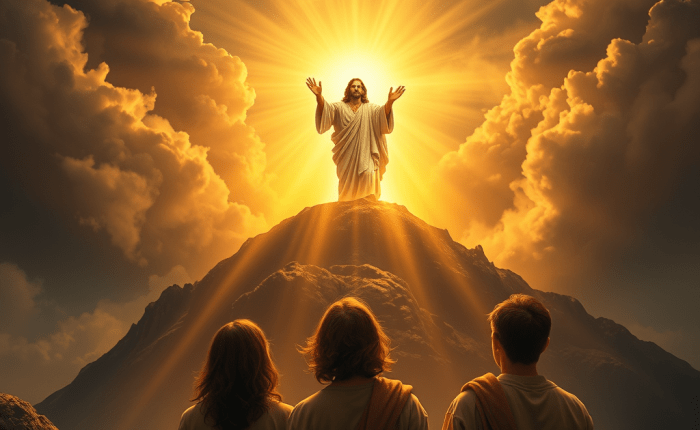
The transfiguration tells us who Jesus truly is. They go up the mountain. Suddenly, without warning, Jesus is “transfigured” or “transformed” before their very eyes. It happens suddenly, surprisingly. Jesus’ face shines like the sun, his clothes a dazzling white. This is a terrifying metamorphosis! Moses and Elijah, representing the Law and the Prophets, suddenly appear with him, emphasizing Jesus’ fulfillment and embodiment of both (Mt 17:1-3). But the most striking moment comes when a bright cloud overshadows them, and God the Father speaks: “This is my Son, whom I love; with Him I am well pleased. Listen to Him!” (Mt 17:5).

God is saying: “Do what he says! Keep doing what he says! He is your authority. Hear him!”

Why does this matter? Because when we fail to listen to Jesus, we start listening to competing voices—false teachers, cultural narratives, or even our own misguided emotions. The transfiguration was God’s way of making it abundantly clear: Jesus is the one to whom we should listen above all else.

Why Do People Believe in Fake Jesuses?

Throughout history, people have reshaped Jesus to suit their own agendas. Sometimes this is done with good intentions, but the result is always a distortion of the truth. In Jesus’ day, culture had so re-shaped expectations that many expected a “legalistic Messiah.” In America, in the ante-bellum South, some Christians argued that chattel slavery was a good thing because God was using it as a means of evangelism to enslaved black people! Culture makes us create fakes Jesuses like playdough. It’s no accident that these fake Jesuses always follow whatever culture war battles happen to be raging at the time.

Here are a few modern examples of “fake Jesuses” that people often follow:

  1. The homosexual Jesus – The lie that says Jesus has cast aside God’s laws about sexual ethics, and that unrepentant homosexual activity is just fine for Christians.
  2. The transgender Jesus – The lie that says your body can be at odds with your soul—as if your “inner self” can be divorced from your physical body and its gender. We are a unity of body + soul, which is why the doctrine of bodily resurrection is key to the Christian story. You will be resurrected in the physical body with which you were born. There is no legitimate disconnect between your “inner self” and your body.
  3. The Nationalistic Jesus – Many in America have intertwined faith with patriotism, as if Jesus’ mission were to uphold America’s greatness instead of establishing His Kingdom.
  4. The Social Justice-Only Jesus – While Jesus absolutely cares about justice, some reduce him to merely a social activist, ignoring his central message of salvation and repentance.

You can go out today and find false churches that teach and promote each of these fake Jesuses. They’re all lies. They’re each a distortion, and when we follow them, we stop truly listening to the real Jesus. The real Jesus, as revealed in scripture, calls us to deny ourselves, take up our cross, and follow Him (Matthew 16:24). That means (among other things) surrendering our own ideas about who he should be and allowing his Word to shape our understanding.

Listening to Jesus in Everyday Life

So how do we practically listen to Jesus? It’s not just about avoiding theological errors—it’s about daily obedience in both big and small ways. Here are a few examples of what it looks like to truly listen to Jesus:

  • Caring for the sick and elderly – Choosing to honor and care for aging parents instead of neglecting them.
  • Being a faithful spouse – Responding to difficulties in marriage with love and forgiveness rather than bitterness.
  • Serving others in your local church – Helping brothers and sisters in need in your church, even when it’s inconvenient.

Jesus is not a coffee table book

What happens when we don’t listen to the real Jesus? History and personal experience show us that failing to heed his voice leads to confusion, division, and spiritual decay. When we shape Jesus in our own image, we end up walking paths that lead us further from God, not closer to him. Even well-meaning people can fall into the trap of creating a fake version of Jesus that fits their lifestyle rather than allowing the real Jesus to transform their life. The apostle Paul tells us this is an evil age (Gal 1:3-4). The apostle John likens this ruined world, with its corrupt and seductive values, to Babylon–and tells it’s all going down one day (Rev 16-19). This world’s “truth” is, in fact, a pack of lies. Jesus tells us to listen to him.

For too many Christians, Jesus is like a decorative coffee table book—nice to have around, but not something they actually engage with. The transfiguration challenges us to move beyond a passive relationship with Jesus. He’s not just a figure to admire; He’s the King of our lives. If we truly listen to Him, it will shape how we think, believe, and live.

As we reflect on the Transfiguration, let’s take God’s words to heart: Listen to him. Not to the competing voices of culture, not to our own desires, but to the true Jesus who reveals himself in Scripture. Only by listening to him can we be transformed and live out the faith we profess.

How to Be Jesus People

How to Be Jesus People

The Sermon on the Mount is one of the most well-known teachings of Jesus, guiding Christians on how to live in an unholy world. In Matthew 5:2-16, Jesus focuses on how believers are to be a countercultural people (Mt 5:2-12), living as salt and light in the world (Mt 5:13-16). But what does that mean? And how exactly are we supposed to do that?

Understanding the Christian Counterculture

Jesus emphasizes that Christians are not meant to isolate themselves from the world but rather to live differently within it. Being salt and light means standing out—not in a showy or arrogant way, but in a way that draws others to the truth of the gospel. This means engaging with the world while remaining distinct from its values.

The key question, then, is: how do we live as a countercultural people? In Mathew 5:17-20, Jesus answers this by teaching that we must obey God’s law in the right way—with the right heart and the right motives.

  • First, he explains how he fulfills the law and the prophets.
  • Then, he explains our obligations to live according to the law n light of what he’s now done.

The rest of Matthew 5 is Jesus’ illustrations of this principle through everyday examples.

Jesus Fulfills the Law

Many misunderstand Jesus’ relationship to the Old Testament law. Some think He came to replace it with something entirely new, but He clarifies: “Do not think that I have come to abolish the Law or the Prophets; I have not come to abolish them but to fulfill them” (Matthew 5:17).

But what does it mean for Jesus to “fulfill” the law? Essentially, Jesus gives the law its deeper and truer meaning. Instead of following it in a superficial, legalistic way—like the Pharisees did—Jesus calls His followers to obey it from the heart.

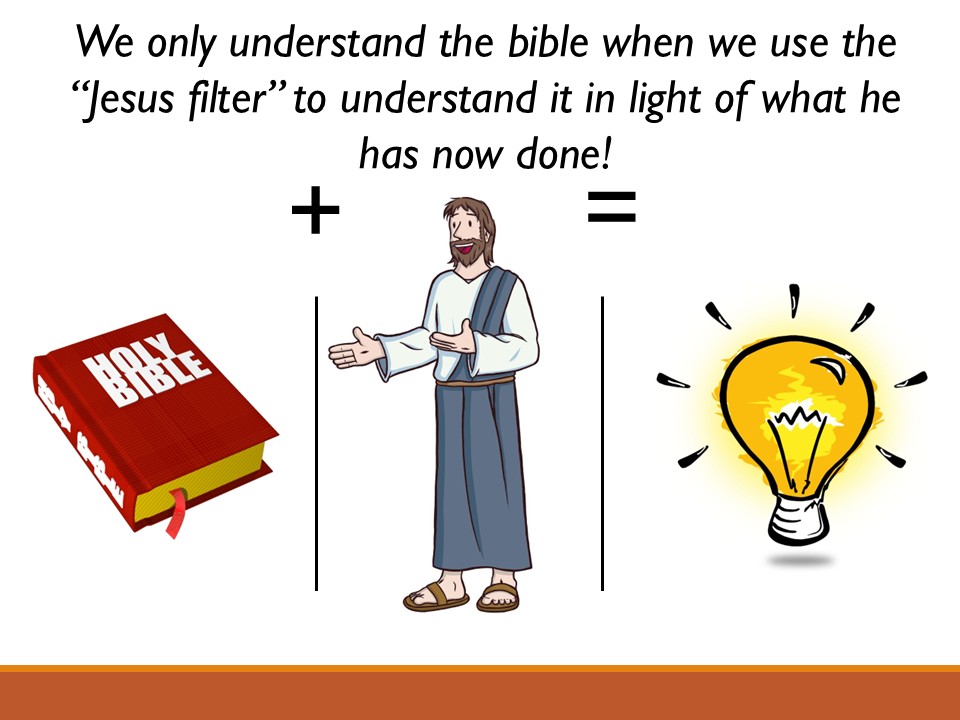
How Do We Read the Law Through the ‘Jesus Filter’?

The Bible is a story with a beginning, middle, and end. When we read the Old Testament, we must do so in light of Jesus’ life, death, and resurrection. This is the “Jesus filter”—understanding that everything in Scripture points to Him.

Here is what this looks like:

For example, the sacrificial laws in Leviticus can seem tedious, but they make sense when we realize they were all pointing to Jesus, the ultimate sacrifice. Just like a child might look forward to getting a bicycle, only to later realize that a car is even better, the Old Testament sacrifices (i.e., the ceremonial laws) were placeholders until Christ, the true fulfillment, came.

Three Types of Old Testament Laws

  1. Ceremonial Laws – These included sacrifices, purity laws, and temple rituals. Jesus fulfills these laws by becoming the ultimate sacrifice. Since His death and resurrection, these laws no longer apply in a direct way.
  2. Civil Laws – These governed daily life in ancient Israel, from property disputes to social justice. Since the Old Testament kingdom no longer exists in the same way, these laws don’t directly apply today, though we can learn principles from them.
  3. Moral Laws – These include commandments about right and wrong, like prohibitions against murder, adultery, and lying. These remain in effect because they are rooted in God’s unchanging character.

Because the new covenant has fulfilled or re-shaped the first two categories of the old covenant law, Jesus now pivots in the rest of Matthew 5 to focus solely on moral laws and their relevance for today. He says: “Therefore anyone who sets aside one of the least of these commands and teaches others accordingly will be called least in the kingdom of heaven, but whoever practices and teaches these commands will be called great in the kingdom of heaven” (Mt 5:19).

What does this mean?

Obeying the Law in the Right Way

Jesus warns that it is possible to do the right thing for the wrong reasons. If we simply follow rules without love or genuine devotion, our obedience is meaningless. This was the problem with the Pharisees, who were obsessed with external appearances while missing the heart of God’s law. They wrongly saw the old covenant law as a means of salvation—“I do this for God, and he will do that for me!” This produces a very self-righteous attitude.

Jesus says, “Unless your righteousness surpasses that of the Pharisees and the teachers of the law, you will certainly not enter the kingdom of heaven” (Matthew 5:20). That doesn’t mean we need to follow even more rules than they did—it means our obedience should come from a place of love, not just obligation. We obey God because we love him and have already been made right with God, not to “get” righteousness as a reward at the end of the rainbow.

For example, the commandment: “You shall have no other gods before me” is easy to affirm in theory. But if we examined our lives, what would our actions say? Do we prioritize God above all else? Or do we let other things—our jobs, entertainment, relationships—take first place in our hearts? There is a massive difference between surface conformity and heartfelt obedience. True obedience isn’t just about external actions but about having a heart transformed by love for God.

Faith Expressing Itself Through Love

The Apostle Paul summed it up in Galatians 5:6: “The only thing that counts is faith expressing itself through love.” This means that our obedience to God should not come from fear or duty but from a genuine love for Him. Just as a heartfelt note from a loved one is more meaningful than a generic greeting card from your insurance agent, our devotion to God should be personal and sincere.

Jesus’ teachings in the rest of Matthew 5 give practical examples of this principle. He takes the external commands (like “Do not murder” and “Do not commit adultery”) and shows their deeper meaning. It’s not enough just to avoid murder—we must also guard against anger and hatred. It’s not enough just to avoid adultery—we must also keep our hearts pure.

A Call to Authentic Christianity

Being a Christian counterculture means more than just appearing religious. It means having a heart genuinely transformed by Christ. True righteousness flows from within—it’s not about keeping a checklist of rules but about loving God so deeply that obedience becomes natural.

This is the challenge Jesus sets before us. Are we simply following religious rules, or are we truly living as salt and light in the world? Do we obey because we have to, or because we want to?

Jesus calls us to follow Him from the heart, to let our love for Him shape every aspect of our lives. When we do this, we don’t just become religious people—we become a living testimony of God’s grace and truth.


May we each examine our hearts and ask God to help us live out our faith in a way that is truly countercultural—not just in appearance, but in spirit and truth.

The Illusion of Self-Righteousness

The Illusion of Self-Righteousness

This is a series of brief devotional articles on The Orthodox Catechism (“OC”),a Particular Baptist document written by Baptist pastor Hercules Collins in 1680. Read the series.

When confronted with a moral failure, our instinct is to minimize or to blame-shift. Yes, we shouldn’t have said this, but it only happened because you said that. No, we haven’t quite gotten around to fixing the car like we promised, but that’s because you keep using it every Saturday. Although these are silly little examples, the pattern holds true for the larger things.

Jesus summed up the law and the prophets under two heads; (a) love God with everything you have—heart, soul, mind, and strength—and (b) love your neighbor as yourself (Mt 22:37-40). How well do we follow these summary principles? The catechism question before us now is like a mirror that strips away all our self-righteousness. It leaves us, as it were, ashamed and defenseless, alone with the truth about ourselves:

Question 5: Can you live up to all this perfectly?

Answer 5: No. I have a natural tendency to hate God[1] and my neighbor.[2]

Now the minimizing bit comes into play.

  • Living up to all this perfectly? “Well, nobody is perfect …” we muse. But, compared to the other guy, I’m not in bad shape at all.
  • A natural tendency? Well, again, nobody is perfect.
  • Hating God and our neighbor? Hate is a strong word. I love God, and I don’t really hate anybody.

Unfortunately, the minimizing doesn’t work here. Holiness isn’t graded on a curve. In the same way that a woman either is or is not pregnant, and a man either is or is not a father, you either are or are not holy and righteous. To be “holy” is to be pure and perfect—without moral spot or blemish. To be “righteous” means to be morally upright in accordance with God’s standards. The catechism answer says you’ve missed that boat. We all have.

In what way have we missed that boat?

Because we all have a natural tendency to hate God and our neighbor. This tendency is natural because it’s innate, it’s our default setting, it isn’t a learned behavior—it’s just the way we are. The apostle Paul, a Jewish man, pointed out that even Jews had no advantage with God on this point: “Do we have any advantage? Not at all! For we have already made the charge that Jews and Gentiles alike are all under the power of sin” (Rom 3:9).

Paul’s words are important and you should read them again. We’re “under the power of” this malevolent force called sin, which is basically a contagion or disease of pervasive selfishness and narcissism. Because sin is selfishness—not simply “self-love” but more like “self-worship at all costs”[3]—it has a marvelous capacity for self-deception and self-righteousness. We think we’re fine, but we’re not. This is why God must rip the veil away from our hearts and minds so the gospel light can shine in and do its work (2 Cor 4:3-6).

Now we turn to hate. Yes, it’s a strong word. It means something like “extreme enmity” and “active hostility.”[4] Who wants to fess up to that? But lest we assume we have plenty of wiggle-room here, Jesus takes a sledgehammer to our rationalizations. God’s standards aren’t about externals—they’re about internal affections that show in an external way. This means that anger, contempt, and ridicule are the same as murder because they all come from an inner hostility and ill-will towards that other person (Mt 5:21-22). Likewise, adultery isn’t simply the sexual act but also the sexual thought (Mt 5:27-28).

What the catechism is driving at is that, in our hearts, we do not love God and our neighbor perfectly. We fail here because sin is that pervasive selfishness and narcissism that naturally reigns in our hearts and minds. And, because holiness (like pregnancy and fatherhood) is a “yes or no” status, that means we’ve each fallen short.

So, that’s where we are. It brings us round to Questions 2 and 3—the law of God tells us how great our sin and misery are. This naturally prompts a new question: why would God make us to be in such a terrible condition? If a manufacturer makes a bad product, it issues a recall and fixes the problem. Why hasn’t God issued a recall on us? Did he make a mistake with us? Is he holding us responsible for his own design flaws? We turn to these questions next time.


[1] Rom 3:9-20, 23; 1 John 1:8, 10.

[2] Gen 6:5; Jer 17:9; Rom 7:23-24, 8:7; Eph 2:1-3; Titus 3:3.

[3] Augustus H. Strong is particularly good here: “We hold the essential principle of sin to be selfishness. By selfishness we mean not simply the exaggerated self-love which constitutes the antithesis of benevolence, but that choice of self as the supreme end which constitutes the antithesis of supreme love to God” (Systematic Theology (Philadelphia: American Baptist Publication Society, 1907), 567).

[4] Merriam-Webster Collegiate Dictionary, s.v. “hate,” verb, sense 1.  

Expanding John Broadus’ Catechism for Today

Expanding John Broadus’ Catechism for Today

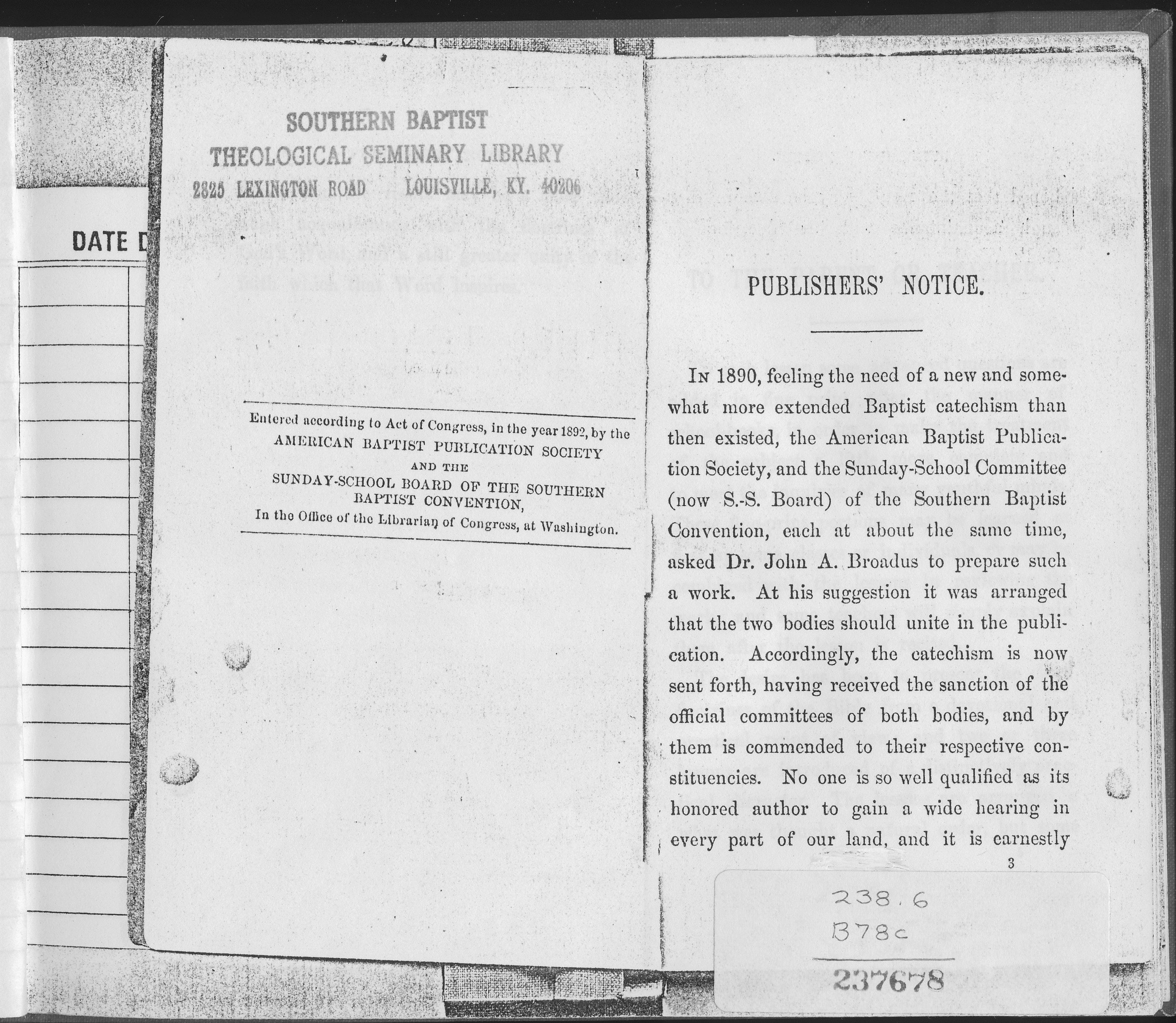
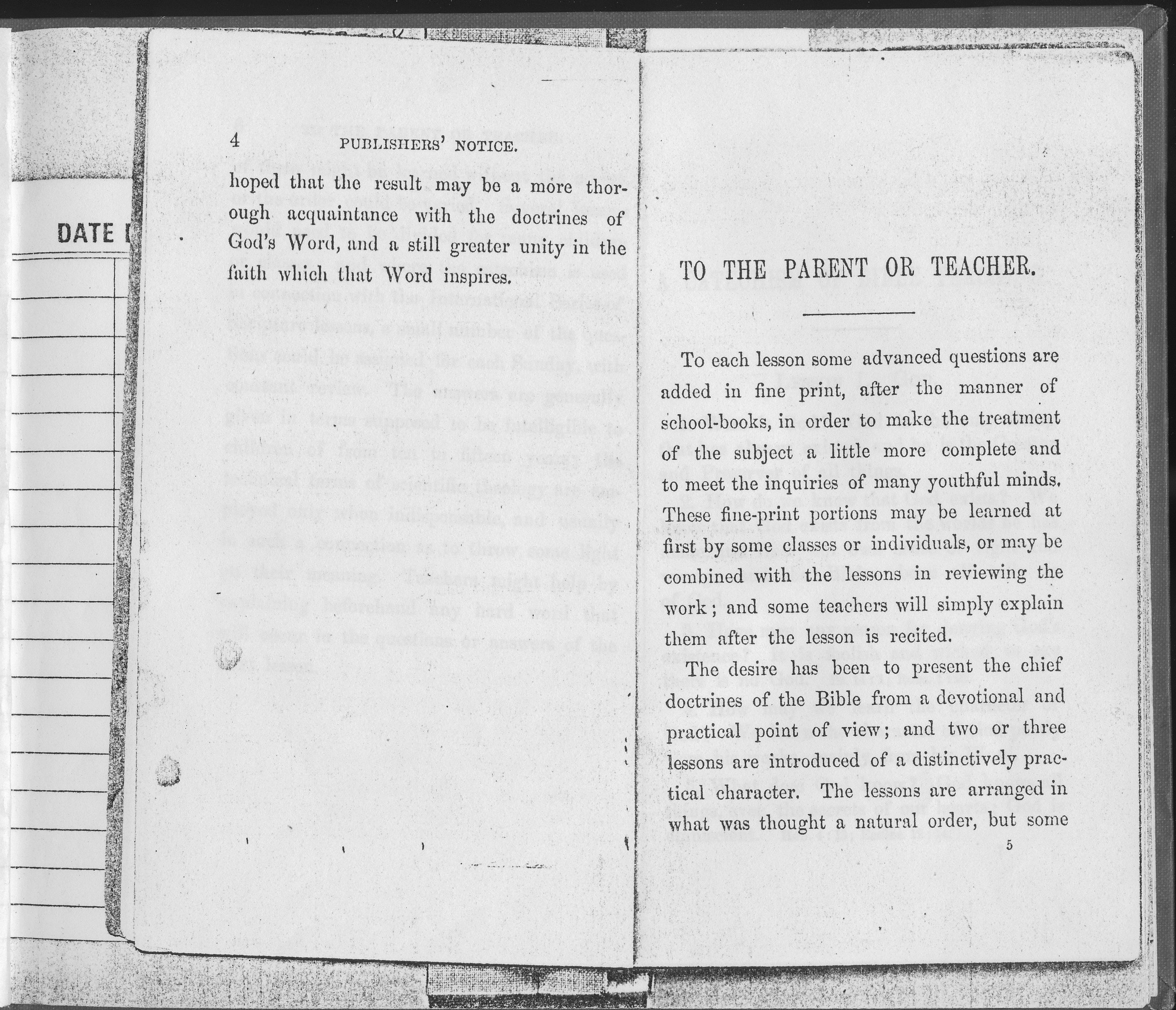
I’m well underway with my next book project–a catechism of the Christian faith based on John Broadus’ “A Catechism of Bible Teaching” from 1882. I’m using Broadus as a foundation, and expanding some of his comments and mixing in odds and ends from other classic Baptist catechisms along the way. I expect the final product to be 261 questions–enough for five questions and answers per week for one year. Pictures and charts will be sprinkled throughout. I’ll likely be self-publishing this one so I can have it for immediate use in our church and for distribution.

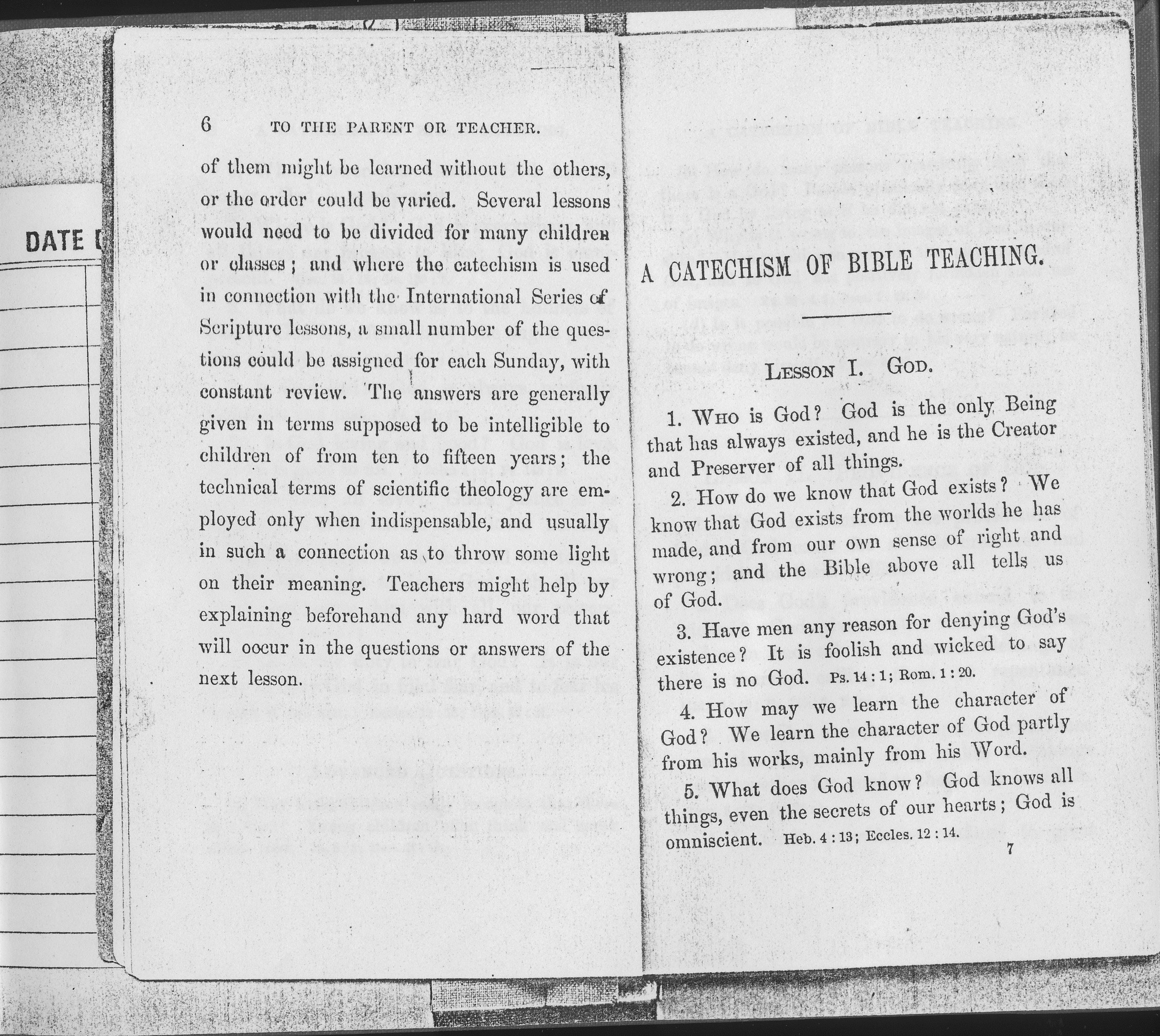
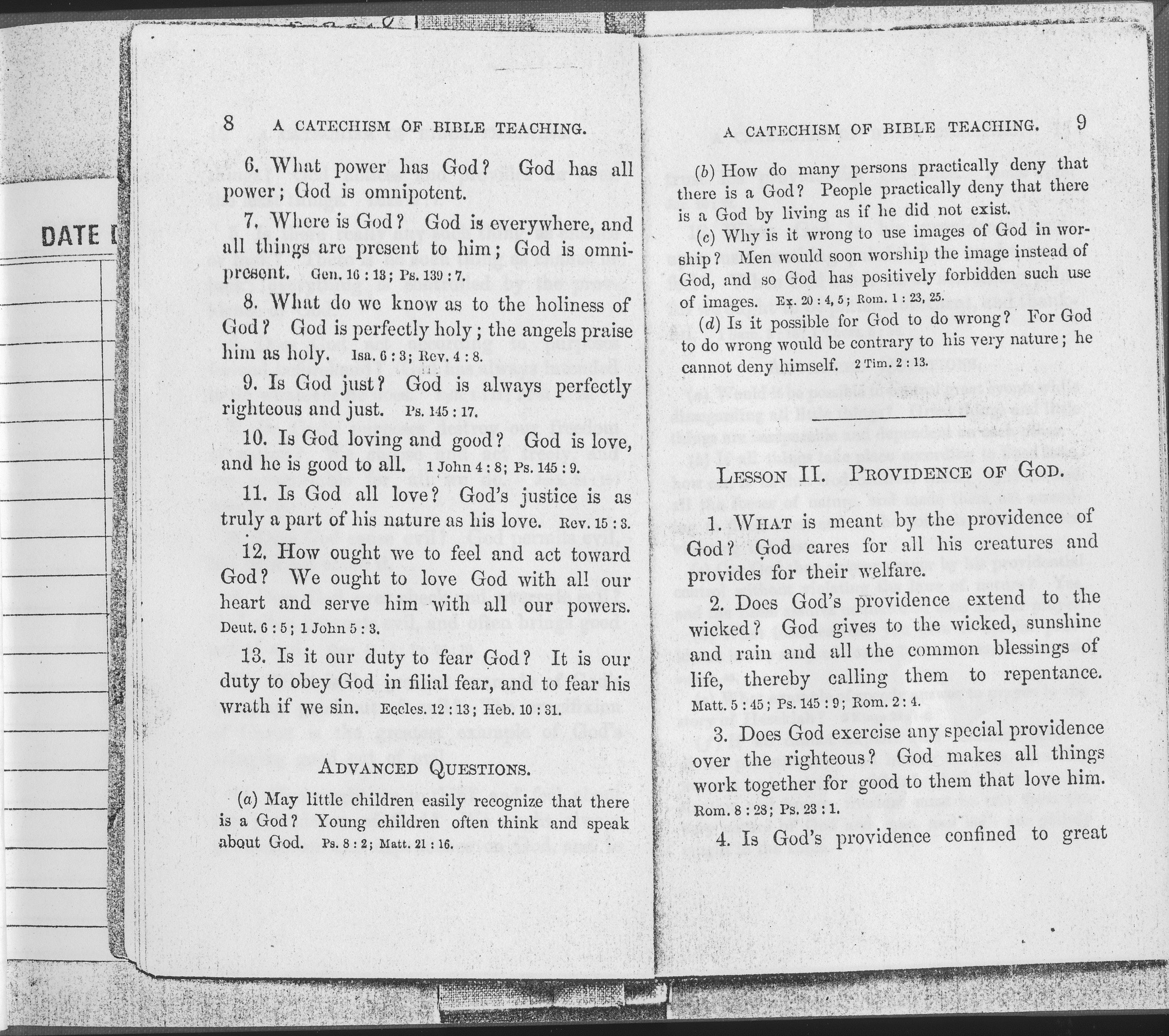
Broadus’ catechism is very, very good (so is Boyce’s), and I think every Christian would benefit from it. A preview of the original is below, and you can download a PDF scan of an original here (many thanks to the SBTS library for scanning me a copy!).

How Rome Distorts the Gospel: Atonement Misunderstood

How Rome Distorts the Gospel: Atonement Misunderstood

This article argues that the Roman Catholic Church (“Rome”) is wrong about the sufficiency of Christ’s atonement. In fact, she is so incorrect that her teaching on this matter is grave error that distorts the gospel.

By “Christ’s atonement,” we mean the action by which Christ’s vicarious death reconciles us to God and restores fellowship with him. The dispute here is about the sufficiency of this atonement. Did Christ atone for the consequences of all our sins? Is his atonement permanent or conditional?

Some issues are “in-house” debates—things Christians disagree about “inside the family.” But, some matters are serious enough that they rise to another level because they present two different versions of the Christian faith. The sufficiency of Christ’s atonement is one of those issues. If Christ’s sacrifice does not fully purify, fully reconcile, fully satisfy divine justice for his people once for all and forever, then that means Christ does not “save forever those who come to God through him,” (Heb 7:25, NASB). The word “forever” at Hebrews 7:25 means for all time,[1]or perhaps completely and absolutely.[2] Because Jesus is a priest forever, the rescue he gives his people is total, complete, and forever.

NOTE: This article is a significant abridgement of a larger essay which you can read here. You can consult the larger article for extended discussions of each point.

The bottom line

Rome teaches that Christ’s atonement (a) does not make full satisfaction[3] for all his people’s sins, and so (b) does not make believers holy and perfect forever. Instead, Rome teaches that when a believer commits sins after baptism, a stain affixes which makes her unholy (though still in a state of grace if she has not committed mortal sin), and so she herself must make satisfaction to God for the temporal consequences of these sins. We make this satisfaction to God “through the merits of Christ.”[4]

In other words, a believer’s purity before God is conditional—it depends on our actions. For the temporal consequences of these sins, we can either pay God now by way of the sacrament of penance,[5] or we can pay him later by suffering in purgatory to make satisfaction for our sins.

On the contrary, Hebrews 6:13-10:22 teaches that Jesus is the great high priest who made one single, all-sufficient sacrifice that makes each believer holy and perfect forever. As part of the journey of progressive holiness, God does discipline believers who commit sins, but a believer’s legal purity before God is perfect and complete forever at the time of salvation.[6]

Zooming out to the bigger picture, Rome is wrong because, compared to the old covenant system, her false teaching presents us with a new covenant that isn’t better than the old one. Both consist of a sacrificial liturgy and a band of priests offering repeated sacrifices with temporary atoning effect. Therefore, Rome’s teaching on the sufficiency of Christ’s atonement is a lateral move, not a promotion, and that’s why it’s incorrect. Because the argument from Hebrews 6:13-10:22 is that the new covenant has a better high priest, who brings believers a better hope, built on better promises, who makes a better atonement for his people, Rome’s teaching about the atonement is wrong.

Different sources and methods

However, we have a roadblock to overcome. Roman Catholics and Protestants don’t answer religious questions the same way because they have different authorities.

  • Rome teaches that there is a “living transmission” from the Holy Spirit, called tradition (Catechism of the Catholic Church, “CCC,” Art. 78), that exists alongside scripture as a complementary vessel of divine revelation.
  • Protestants generally hold to what one writer has called suprema scriptura, which means “the Bible as the supreme or highest channel of religious authority.”[7] Under scripture’s authority, in an interpretive dialogue, are church tradition, reason, and personal religious experience in the divine-human encounter.[8]

The issue of authority deserves serious discussion,[9] but we will leave that for another time. For now, it’s enough to say that because Rome teaches that both scripture and tradition flow from “the same divine well-spring” (CCC, Art. 80), her teaching must find scriptural support.[10] In the matter of Christ’s atonement, it does not. I urge Roman Catholics to see if scripture squares with their church’s tradition. If it doesn’t, then you should leave Rome.

Why Rome is wrong

God has revealed his truth in revelation, and grave error is false teaching that leads people away from that revelation. Rome’s understanding of Christ’s atonement is grave error because it contradicts scriptural teaching and negatively affects your understanding of salvation and the gospel.[11] It teaches that Christ’s atonement does not fully purify believers and make them holy and perfect forever at the moment of salvation. Specifically:

  1. Rome falsely teaches that there are “temporal consequences” from sins that Christ’s sacrifice does not fully fix—debts of temporal punishment still remain for sins committed after baptism.[12] The truth is that, in the new and better covenant relationship with God by faith in Christ which began at Pentecost, God promises: “I will forgive their wickedness and will remember their sins no more,” (Heb 8:12).
  • Rome wrongly teaches that, after death, believers may need to be cleansed and purified from the temporal consequences of sins to have the holiness necessary to enter heaven. The truth is that scripture says believers have already been reconciled to God and have peace with him, because he has declared them righteous (i.e., justified) by means of faith in Jesus (Rom 5:1, 10). His “once for all” sacrifice makes us holy already (Heb 10:10).[13]
  • Rome falsely teaches a fictitious system of penance to restore the state of grace ex opere operato as a so-called “second plank of salvation,”and teaches a non-existent treasury of merit from which priests and bishops may apply merit to remit temporal punishment for sins. The truth is that “by one sacrifice [Jesus] has made perfect forever those who are being made holy,” (Heb 10:14). This means this elaborate system is un-biblical and blasphemous to the sufficiency of Christ’s work.

Eight principles from Hebrews 6:13 to 10:22

Principle 1 (Hebrews 6:13-20): Because Jesus is a different and better priest who represents his people forever, he’ll always keep the “anchor of hope” fastened to God for those he reconciles. This suggests Christ’s atonement is effective for his people forever and always.

Principle 2 (Hebrews 7:1-3): Jesus is the king of righteousness, the king of peace, and is the “Son of God” because he shares the same nature and attributes as Yahweh—just like Melchisedec. This is why he is a better priest, and therefore the new covenant relationship with God is better, too. This suggests Christ’s atonement is also better.

Principle 3 (Hebrews 7:18-19, 10:19-22): The old covenant law never made anybody perfect—it never permanently purified or cleansed believers. So, God repealed it and cleared the way for a better hope, by which every believer draws near to God. This better hope is Jesus’ better priesthood, triggered by Jesus’ better sacrifice.

Principle 4 (Heb 7:11-17, 20-28): Because Jesus is a priest forever, he rescues his people completely and permanently, and this means he always intercedes for and protects his people. Jesus’ sacrifice was “once for all” and “forever,” and its atonement needs no re-application. It’s a permanent marker, not a pencil.

Principle 5 (Hebrews 8): The old covenant is obsolete because the better covenant has come, backed by a better priest, based on a better sacrifice, bringing better promises, securing a better arrangement for God’s relationship with his people.

Principle 6 (Hebrews 9:1-15): Jesus’ sacrifice is the concrete reality to which the old covenant sacrifices pointed. He’s set his people free from sins, has already paid the full ransom price to our kidnapper Satan, and the liberation he achieves for believers is everlasting and forever.

Principle 7 (Hebrews 9:16-28): Jesus’ “once for all” sacrifice has already invalidated, annulled, and repealed the power of sin for those who trust in him. He does not repeat or re-apply his sacrifice, or it would not be “better.” It is better because it is forever.

Principle 8 (Hebrews 10:1-18): Jesus’ sacrifice has already made believers holy once for all and forever, and it has already made us perfect forever. Therefore, he will never, ever consider our sins again, and sacrifice for sins is no longer necessary. It is all finished.

The new covenant isn’t a lateral move

In the job world, a “lateral move” is one where you get a new job, but the pay and duties are similar. It isn’t a demotion, but it isn’t a promotion either. The new covenant isn’t like that. It isn’t a lateral move. It’s better.

Yet, Rome believes that Christ’s atonement is essentially a lateral move from the old covenant because it teaches (a) the conditional purification of the believer, (b) resulting in potential temporal consequences for sin which Christ’s sacrifice did not cover, (c) requiring the probable need to suffer in purgatory to satisfy and atone for these temporal punishments, and (d) the existence of indulgences which waive the temporal punishment of our sins by debiting a so-called treasury of merit.

But the bible is a story that moves forward.

  1. It begins with creation in Genesis 1-2,
  2. catalogs the fall in Genesis 3,
  3. and then to the divine rescue through Christ the king that God promised throughout the old covenant, foreshadowed in the temple liturgy and sacrifices, and fulfilled in the story of Jesus in the Gospels,
  4. and finally, it concludes with the defeat of evil and the restoration of all things in Revelation 18-22.

But Rome says that Christ’s atonement does not make satisfaction for his people’s sins once for all and forever—so where is better hope by which we draw near to God (Heb 7:18)? Rome’s system offers a new covenant that’s stuck in neutral—one that is not better than the old covenant. Her story has run aground and hasn’t moved forward. Rome has exchanged a flat Diet Coke for a stale Pepsi. It’s a lateral move, not a promotion.

Hebrews 6:13-10:22 vaporizes all this. Rome offers nothing “new” or “better” in terms of practical effects. It isn’t a promotion, and that’s the bottom-line reason why it’s false, and so Rome’s teaching about the sufficiency of Christ’s atonement fails.

The truth is that: “when this priest had offered for all time one sacrifice for sins, he sat down at the right hand of God, and since that time he waits for his enemies to be made his footstool. For by one sacrifice he has made perfect forever those who are being made holy,” (Heb 10:14).


[1] BDAG, s.v., “παντελής,” sense 2, 754; see RSV, NRSV, NASB.

[2] LSJ, s.v., “παντελής,” 1300; see NET, KJV, NIV, NEB, REB, CSB, CEB.

[3] This means “[r]eparation or compensation for a wrong or a debt incurred,” (Millard J. Erickson, The Concise Dictionary of Christian Theology, rev. ed. (Wheaton: Crossway, 2001), s.v., “satisfaction,” 176).

[4] Tanner (ed.) “Trent,” Session 14, canon 13, in Decrees, 2:713.

[5] In fact, Rome says, if we believe that our penitential works are nothing more than the faith by which we grasp that Christ has already made satisfaction for our sins, then we’re damned to hell (Tanner (ed.) “Trent,” Session 14, canon 12, in Decrees, 2:713).

[6] Augustus H. Strong’s definition of “sanctification” captures the Protestant interpretation very well: “Sanctification is that continuous operation of the Holy Spirit, by which the holy disposition imparted in regeneration is maintained and strengthened.” Strong explained: “Salvation is something past, something present, and something future; a past fact, justification; a present process, sanctification; a future consummation, redemption and glory,” (Systematic Theology (Old Tappan: Revell, 1907), 869). Emphases added.

[7] James Leo Garrett Jr., Systematic Theology: Biblical, Historical, and Evangelical, Fourth Edition., vol. 1 (Eugene: Wipf & Stock, 2014), 206.

[8] Garret, Systematic, 2.206; Thomas Oden, Life in the Spirit: Systematic Theology, vol. 1 (San Francisco: HarperOne, 1987), 330-44.

[9] For example, Bishop James Gibbons wrote: “… the Church is the divinely appointed Custodian and Interpreter of the Bible. For, her office of infallible Guide were superfluous, if each individual could interpret the Bible for himself … God never intended the Bible to be the Christian’s rule of faith, independently of the living authority of the Church,” (Faith of Our Fathers, 10th rev. ed. (New York: John Murphy & Co., 1879), 94). 

[10] One doctor of the church declared: “Holy Scripture is in such sort the rule of the Christian faith that we are obliged by every kind of obligation to believe most exactly all that it contains, and not to believe anything which may be ever so little contrary to it,” (Francis de Sales, The Catholic Controversy, in Library of Francis de Sales, vol. III, 3rd ed., trans. by Canon Mackey (London: Burns & Oats, Limited, 1909), 88 (Part II, Article 1, Ch. 1).

[11] “The concept of heresy is grounded in the conviction that there exists one revealed truth, and other opinions are intentional distortions or denials of that truth. Absent such conviction, ‘heresy’ becomes little more than bigoted persecution. But the Christian belief in revealed truth means that heresy becomes not merely another opinion, but false teaching that leads people away from God’s revelation” (Daniel J. Treier and Walter Elwell (eds.), Evangelical Dictionary of Theology, 3rd ed. (Grand Rapids: Baker, 2017), s.v. “heresy,” 377-78).

Millard Erickson offers up this definition: “A belief or teaching that contradicts Scripture and Christian theology,” (Concise Dictionary, s.v. “heresy,” 88).

[12] Norman P. Tanner, S.J. (ed)., “Trent,” Session 6, Canon 30, in Decrees of the Ecumenical Councils, vol. 2 (Washington, D.C., Georgetown University Press, 1990), 2:681.

[13] The verb is present tense-form, and it can be rendered as “are being made holy” or “have been made holy.” Either way, Jesus’ once-for-all sacrifice is the means by which (διὰ τῆς προσφορᾶς) the holiness happens.

How do I know I’m in trouble?

How do I know I’m in trouble?

This is a series of brief devotional articles on The Orthodox Catechism (“OC”),a Particular Baptist document written by Baptist pastor Hercules Collins in 1680. Read the series.

No matter who you are, who your parents are, how much education you have (or don’t have), this one thing is true—God’s law tells us that we’re each in very great trouble (see Answer 3). The obvious thing is to figure out how to fix this problem.

In every trouble, there’s usually some way out. We might not like the way out, but it’s there. Money troubles? Slash the household budget to the bone (and so on). So, what does God’s law tell us we can do to fix this problem between us and God that makes our situation so miserable?

Question 4: What does God’s law require of us?

Answer 4: Christ teaches us this in summary in Matthew 22:37-40: “Love the Lord your God with all your heart and with all your soul and with all your mind and with all your strength.[1] This is the first and greatest commandment. And the second is like it: Love your neighbor as yourself.[2] All the Law and the Prophets hang on these two commandments.”

We can use the law of Moses in at least two different (and legitimate) ways.

  • The first way is for believers (including Moses’ original audience), and it’s the most natural way—we read the commandments through a prism of loving obedience. We love him because he first loved us (1 Jn 4:10, 19), so we do what he says because we love him. This is why Moses so often emphasized obedience from the heart (Deut 4:9, 5:29, 6:6, 10:12-16, 11:13, 11:18, 26:16, 29:18, 30:2, 30:6, 30:10, 30:14, 30:17).
  • The second way is for unbelievers—to hold aloft the law as a condemnatory mirror into the soul.[3] It says this, and this, and that—but you don’t do that, so what does that mean? It means you’re a criminal. It means you’re in very great trouble. It means you need to be rescued.

The apostle Paul used this second strategy in his letter to the Galatian churches to remind them that legalism is a dead end (Gal 3:10-14). If you want to try legalism, Paul suggested, then try interpreting the law that way and see how well you do! The catechism uses Jesus’ words in a similar way:

  1. You aren’t perfect, because you break his law.
  2. Because you break his law, you’re guilty of a capital crime.
  3. Because you’re guilty of a capital crime, God will sentence you appropriately.

You may object now: “What exactly have I done to break God’s law?”

Well, that’s why Jesus summed up the entire point of the Mosaic law with those two headings; (a) love God with everything you have, and (b) love your neighbor as yourself. The entire law hangs on those two commandments. You don’t have to grade your thoughts and actions on a curve. You just have to ask yourself:

  1. Do I love God with everything I have? Heart? Mind? Soul? All my might?
  2. Do I always love God with this intensity?
  3. Do I love my neighbor as much as I love myself?
  4. Do I always love my neighbors with this intensity?

Of course, the answer is no. This proves that you are indeed in very great trouble with God (Questions 2-3). You’re supposed to love God and your neighbor, but you fail. This suggests you can’t solve this problem yourself—but is that true? Is all hope lost? We’ll address that question next time.


[1] Deuteronomy 6:5.

[2] Leviticus 19:18.

[3] Calvin, Institutes, 2.7.

What I read in 2024

What I read in 2024

Here, in no order, are the non-fiction books I read during 2024. I read many of my books while driving to work or running (I spent 225 hours running 1600 miles in 2024).

  1. The Run of His Life: The People v. O. J. Simpson by Jeffrey Toobin.

An exhaustive account of the entire O.J. Simpson saga. If you want a responsible journalistic account, then this is it.

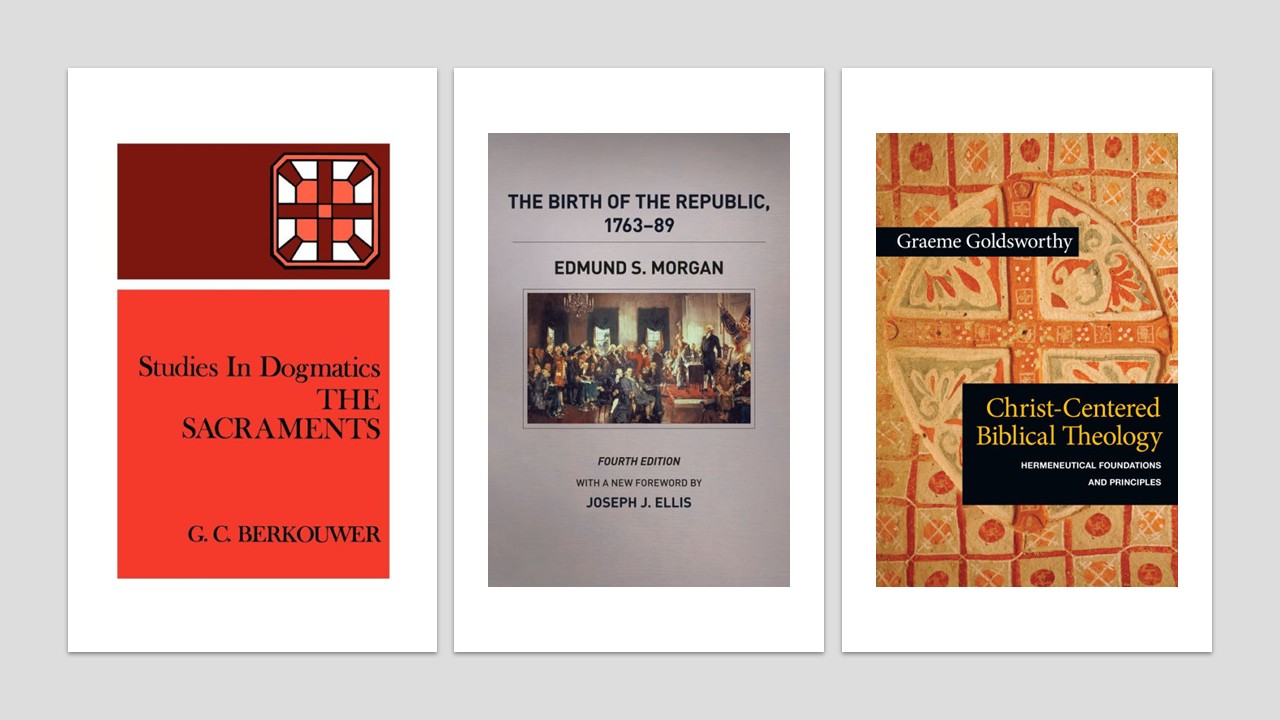
  1. The Work of Christ by G.C. Berkouwer.

A solid and helpful book about just what it sounds like. Refreshingly Reformed.

  1. Nixon: The Life by John Farrell

Extraordinary biography of a very troubled and complicated man. It doesn’t bog down in political minutiae from 50 years ago, but is still substantive. One of the best Nixon biographies.

  1. The Sack of Detroit: General Motors and the End of American Enterprise by Kenneth Whyte

An entertaining story about a bygone era in American manufacturing. The same author later wrote a great biography of Herbert Hoover.

  1. A Man of Iron: The Turbulent Life and Improbable Presidency of Grover Cleveland by Troy Senik

A good biography about a forgotten president. I believe Cleveland is one of the only former presidents without a presidential library.

  1. Who Freed the Slaves?: The Fight over the Thirteenth Amendment by Leonard Richards

A detailed but dry discussion about the legislative effort to pass the 13th Amendment.

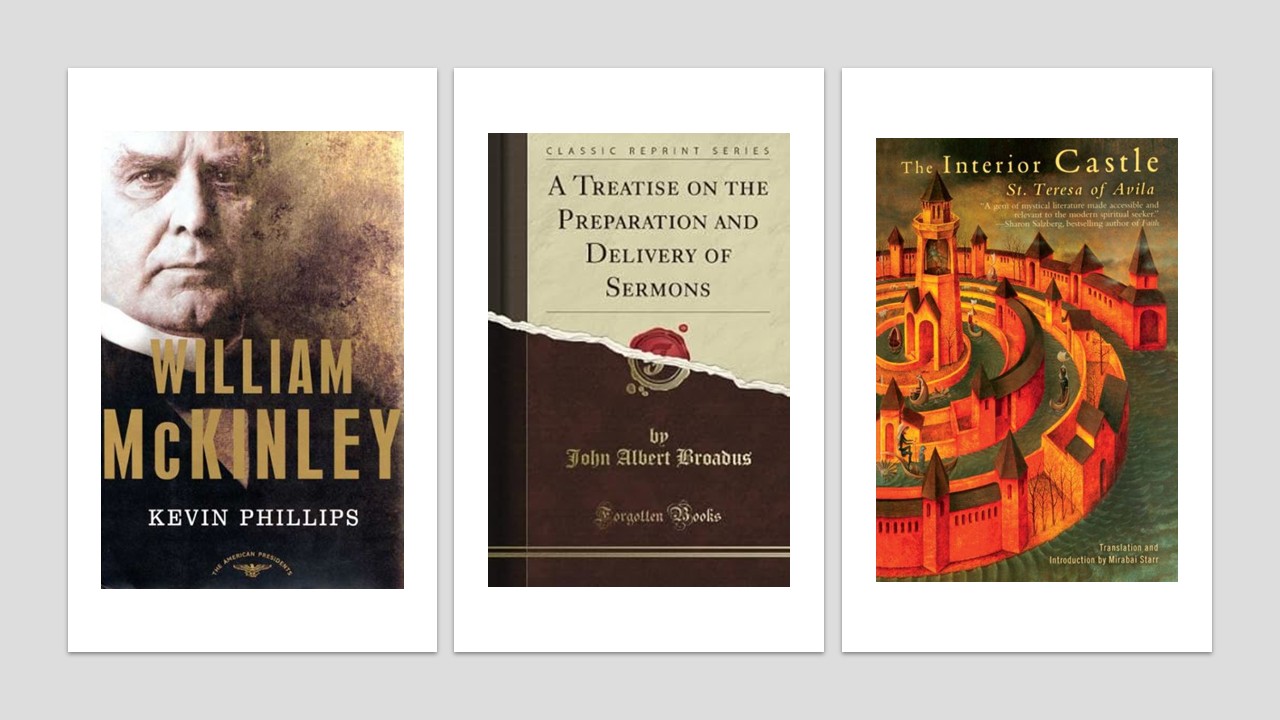
  1. William McKinley by Kevin Phillips

An incredibly boring biography. All I remember about this book is that it was really boring. I think McKinley deserves better, but I’m almost too bored to find a different biography.

  1. A Treatise on the Preparation and Delivery of Sermons by John Broadus

A classic on preaching. Good book.

  1. The Interior Castle by Teresa of Avila

Very mystical and contemplative book about prayer. It was interesting. I know a classic book such as this deserves a better write-up, but that’s what I got.

  1. The Creationists: From Scientific Creationism to Intelligent Design, Expanded Edition by Ronald Numbers

One of my favorite books of the year. An engrossing and scholarly look at the rise of scientific creationism–perhaps best represented today by Answers in Genesis and the Institute of Creation Research.

  1. Dispensational Modernisn by Brandon Pietsch

I actually read the PhD dissertation, not the book. But, they’re likely pretty much the same. I’m not sure I buy his thesis that the industrial revolution and its resulting “engineering” milieu contributed to the rise of dispensationalism. But, as a sort of historical take on dispensationalism, it was very interesting.

  1. The Making of American Liberal Theology: Imagining Progressive Religion, 1805-1900 by Gary Dorrien

A wonderful and extraordinarily learned history of the early years of theological liberalism. It’s the first of a three-volume trilogy. I found Dorrien’s definition of liberalism helpful. He sees it as a via media “between the authority-based orthodoxies of traditional Christianity and the spiritless materialism of modern atheism or deism” (xiii). Liberal theology, he charges, “is the idea that Christian theology can be genuinely Christian without being based on external authority” (xiii). Of course, scripture is not the supreme standard for truth in this scheme.

  1. Too Big to Fail: The Inside Story of How Wall Street and Washington Fought to Save the Financial System – and Themselves by Andrew R. Sorkin

If you want to know what happened during the financial crisis in 2007 to 2008, then this is the book for you. Entertaining, with well-drawn sketches of all the major players, this was a wonderfully entertaining book. I fondly recall a 17-mile run I did while listening to this audiobook.

  1. Vietnam: An Epic Tragedy, 1945-1975 by Max Hastings

Wonderful survey of the entire Vietnam war, from French colonialism to the United States exit from the country in 1973, and South Vietnam’s fall in 1975. Max Hastings is a great writer and a responsible journalist.

  1. The King Jesus Gospel: The Original Good News Revisited by Scot McKnight

A short, interesting little book. His big point is that “the gospel” is not the Romans Road. Rather, the “gospel” is the news that Jesus has come to make all the covenant promises in the Old Testament come true. McKnight wants us to use “gospel” correctly, and anchor the call for response in the larger Christian story.

  1. Days of Fire: Bush and Cheney in the White House by Peter Baker

Peter Baker and his wife, Susan Glasser, are great writers. Baker is a political reporter for the New York Times. This is an engaging survey of the entire Bush-Cheney years in the White House, and it’s very well done. The book is not partisan and is scrupulously fair.

  1. Homegrown: Timothy McVeigh and the Rise of Right-Wing Extremism by Jeffrey Toobin

Good book. McVeigh seems like a real loser, and he is receiving he just desserts of his evil deeds in hell right now.

  1. The Shattering: America in the 1960s by Kevin Boyle

A survey of “what happened” in the 1960s that made everything seem to change. Boyle examines three issues: sex, race, and war. Anyone interested in the 1960s and all it portended will find this to be a helpful book. I remember listening to this while running the Capitol City Half-Marathon in Olympia, WA in May 2024!

  1. The Kingdom, the Power, and the Glory: American Evangelicals in an Age of Extremism by Tim Alberta

This is a worthy entry into the new genre that I call “white evangelicalism sucks.” These books are typically from Christians who have been badly burned or disillusioned at what “evangelicalism” has become since the Trump years began. Alberta examines what has happened to the sub-culture of white evangelicalism in the United States and why. There is a strong (and terribly incorrect) tradition of white evangelicals letting political passions overwhelm their faith. This book is very relevant in the way it explores that issue. It pairs well with Russell Moore’s Losing Our Religion, which is another entry into the same new genre.

  1. The Story of Abortion in America: A Street-Level History, 1652-2022 by Marvin Olaskey and Leah Savas

The book is what it sounds like. Helpful and horrifying.

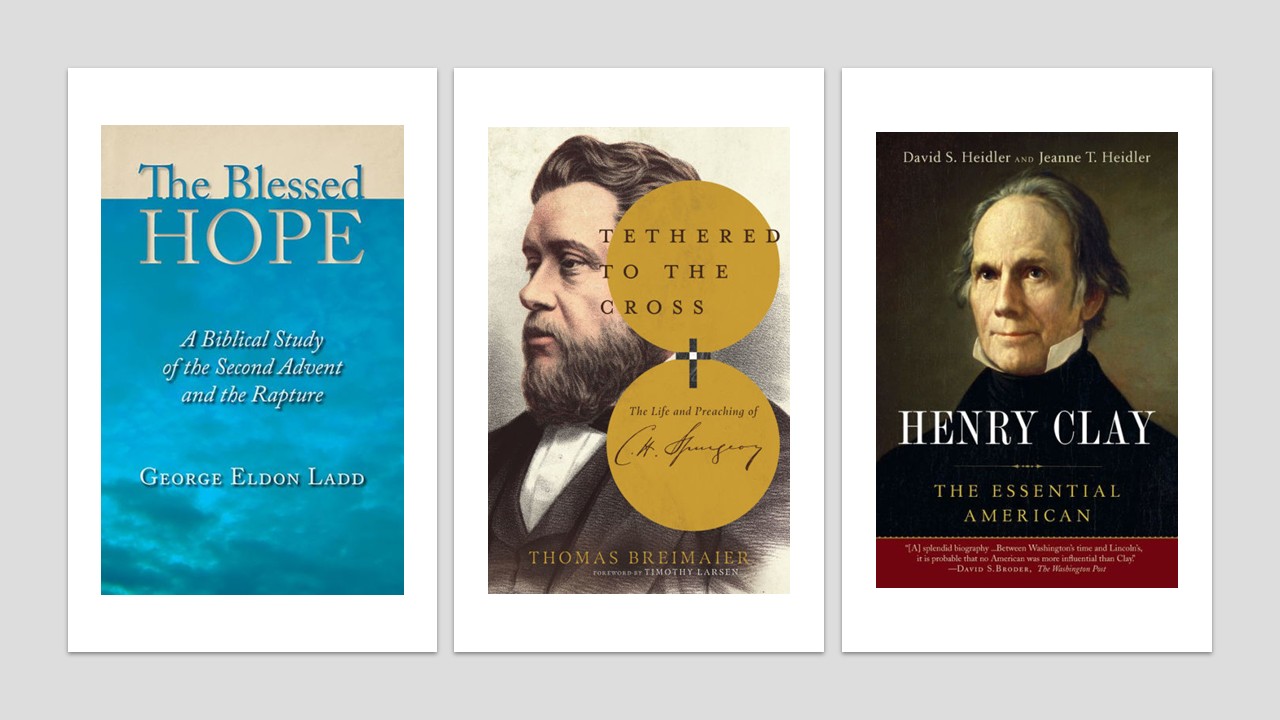
  1. Spurgeon the Pastor: Recovering a Biblical and Theological Vision for Ministry by Geoffrey Chang

Not quite a biography, but more an examination of Spurgeon’s ministry with some gentle lessons for today. A very good book.

  1. Tethered to the Cross: The Life and Preaching of Charles H. Spurgeon by Thomas Briemaier

Also not quite a biography, but an examination of Spurgeon’s preaching style and substance. This is also a very helpful and enjoyable book.

  1. The Blessed Hope: A Biblical Study of the Second Advent and the Rapture by George Ladd

An outstanding critique of the pre-tribulational rapture position. I’m not saying I believe everything Ladd writes, but I am saying he presents his case very well. Ladd was a classic premillennialist, not a dispensationalist.

  1. Henry Clay: The Essential American by David Heidler and Jeanne Heidler

One of my favorite books of the year. A wonderful and well-written biography of a very important man. Truly, Clay was a man who could and should have been president. But, it never happened for him.

  1. Andrew Jackson: His Life and Times by H.W. Brands

I don’t like Jackson. And, I’m not fond of H.W. Brands’ writing. I can’t explain why I don’t like Brands, but I just get the impression that he’s not a very thorough historian–or, perhaps, he doesn’t communicate much substance. This isn’t necessarily a fair critique, but I’ve read two books by him and I get the same impression from each. Again, I also don’t like Andrew Jackson.

  1. Team of Rivals: The Political Genius of Abraham Lincoln by Doris Kearns Goodwin

I read this book shortly after it first came out, maybe 23 years ago. I read it again now. It has a well-deserved reputation as a classic. It is a substantive history of Lincoln’s presidency, with brief biographies of Lincoln and three of his principal cabinet officials along the way.

  1. The Man Who Ran Washington: The Life and Times of James A. Baker III by Peter W. Baker and Susan Glasser

This was truly one of my favorite books this year. I found Baker to be a fascinating character. From my other reading, I knew he was a key player behind the scenes in the Reagan + Bush + Bush 2.0 orbit, but I knew little about the guy. Baker was a political operative, White House Chief of Staff to Reagan and Bush, Treasury Secretary in Reagan’s second term, and Secretary of State in George H.W. Bush’s administration. A remarkable man. This is a great book.

  1. The Divider: Trump in the White House, 2017-2021 by Peter W. Baker and Susan Glasser

This book paints an accurate and unflattering portrait of Trump’s first administration. It pairs well with Bob Woodward’s books on the Trump presidency.

  1. Lincoln and his Admirals by Craig Symonds

An interesting and very helpful work from a naval historian about Lincoln and the naval war against the Confederacy.

  1. Nimitz at War: Command Leadership from Pearl Harbor to Tokyo Bay by Craig Symonds

Sort of a command biography of Nimitz. It seemed short on details and the authors summary remarks at the end of the chapters seemed a bit forced at times. But, I enjoyed it.

  1. Hubert Humphrey: The Conscience of the Country by Arnold Offner

A very “in the weeds” biography of the great “liberal savior” of the mid-century Democratic party. Humphrey was Johnson’s Vice President, and was defeated in his own run for the office in 1968. The book loses the reader in very wonky policy details. In that sense it’s not a true biography, because his family virtually disappears. But, because the subject is Hubert Humphrey, it’s unlikely a better biography will come around anytime soon.

  1. American Apocalypse: A History of Modern Evangelicalism by Matthew A. Sutton

This is the second time I’ve read the book. This is a good history of evangelicalism.

  1. A Prophet with Honor: The Billy Graham Story (updated edition) by William Martin

A very balanced, insightful, and enjoyable look at perhaps the most popular evangelist in the history of the Christian church. This is a definitive biography. A better one likely won’t be penned. Martin is fair in his analysis. He presents Graham as a man with a simple message; not an intellectual, but content with who he is. I believe the root explanation for Graham’s astonishing success was a special anointing by the Holy Spirit.

  1. America’s Pastor: Billy Graham and the Shaping of a Nation by Grant Wacker

This isn’t exactly a biography, but a look at how Graham impacted the nation as a whole. This is a very valuable and interesting book by a prominent historian of Christianity.

  1. The Battle of Midway by Craig Symonds

Simply the best history of the battle of Midway that’s ever been written. It pairs quite well with Jonathan Parshall and Anthony Tully’s scholarly volume Shattered Sword: The Untold Story of the Battle of Midway. This is probably my favorite book of the year.

  1. Reagan: His Life and Legend by Max Boot

A very good biography of Reagan. I believe Bob Spitz’s Reagan: An American Journey is a superior biography. My opinion of Reagan hasn’t much changed–he was a bad administrator and a kind, decent, but shallow man who could give a very good speech. If you’re interested in the hagiography that has enveloped Reagan as a patron saint of the GOP, then look elsewhere. If you’re interested in a scholarly biography that’s non-partisan but fair, then Max Boot’s volume is one of the best available.

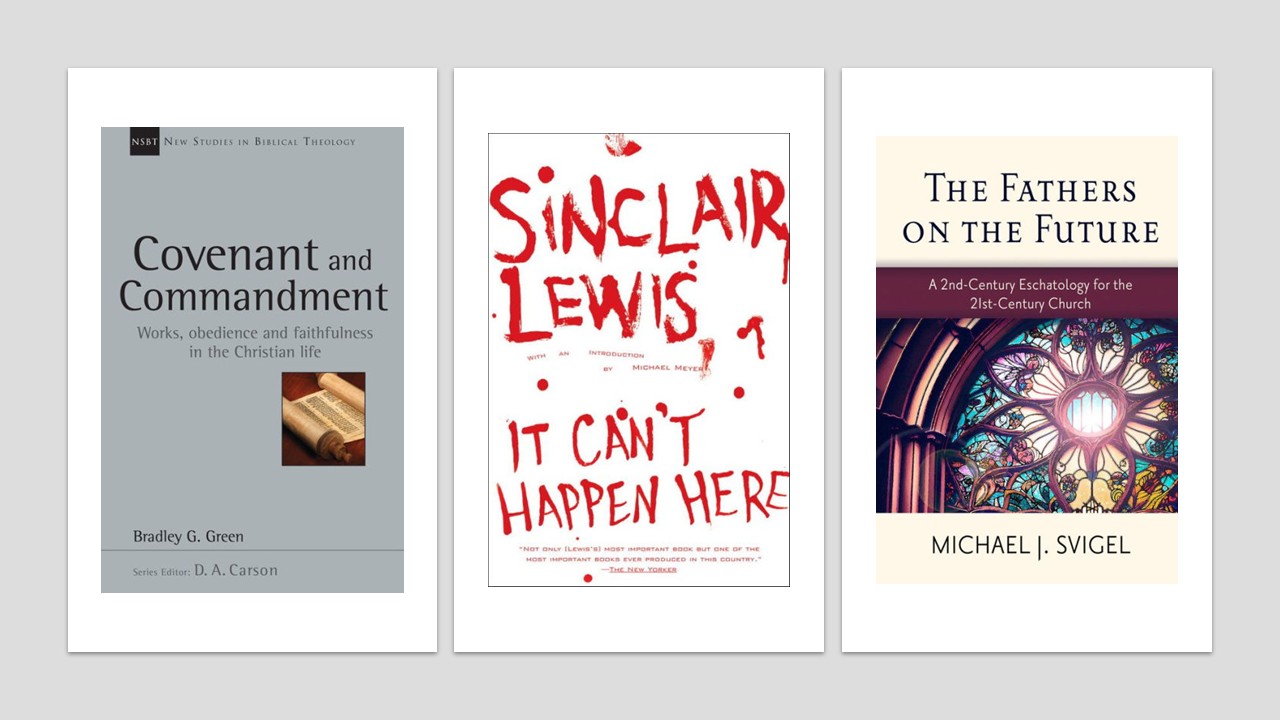
  1. The Birth of the Republic: 1763-1789 (4th ed.) by Edmund S. Morgan

A short, classic, but very boring book by a dean of Revolutionary period studies.

  1. The Sacraments by G.C. Berkhouwer

Solid and helpful book by Berkouwer. There should have been more interaction with scripture instead of creeds and confessions, but not everyone can be a Baptist!

  1. Christ-Centered Biblical Theology: Hermeneutical Foundations and Principles by Graeme Goldsworthy

This book is less a positive case for Goldworthy’s own method (though it is that), than a defense of biblical theology in general. I’m not really sold on Goldworthy’s structure for biblical theology–I think he flattens things a bit by not using the covenants as the skeleton for the bible’s story. However, I especially appreciated his emphasis on how, after Solomon’s failure, the prophets almost universally pivoted and re-capitulated the previous promises. Goldsworthy wishes away the promises to Israel far too much for my (and the bible’s) tastes, but his emphasis on Christ as the typological key to the bible’s story is well taken.

  1. Covenant and Commandment: Works, Obedience and Faithfulness in the Christian Life by Bradley Green

I’m not sure what to make of Green’s book. At the end of the whole thing, I learned nothing. Good works are the inevitable and necessary fruit of genuine salvation. I knew that before I read the book. So … the book was interesting but completely unnecessary. It might help someone who comes from a more antinomian background, or perhaps from a free grace perspective.

  1. Fathers on the Future: A 2nd Century Eschatology for the 21st Century Church by Michael Svigel

A very interesting and accessible defense of premillennialism from a scholar who teaches at Dallas Theological Seminary. I feel the publisher did Svigel wrong by forcing him to cut the meat out of the book and publish them as excurses on his own website. Svigel is a dipensationalist, but this book is really a defense of general premillennialism, using Irenaeus as his guide.

  1. It Can’t Happen Here by Sinclair Lewis

I don’t think Lewis was a good writer. His characters are thin and his writing tone is distracting. This is a classic fiction book from 1935 about America electing a fascist as president, who quickly turns the country into a police state. The evil president was clearly modeled on Huey Long. Many contemporary critics see parallels to Donald Trump, but it’s doubtful that Trump is as competent as Berzelius Windrip.

  1. The Death of American Virtue: Clinton vs. Starr by Ken Gorman

Am exhaustive, fair account of the Clinton impeachment saga. The Office of Independent Council disgusts me. I think Starr went way beyond his brief and harmed this country by pursuing a sitting President on a dumb perjury charge. I was very angry as I read the book. Starr was out of line and he disgraced himself. I think Hillary Clinton was correct about this particular “vast, right-wing conspiracy” intent on taking Bill Clinton down.

  1. Baptist Battles: Social Change and Religious Conflict in the Southern Baptist Convention by Nancy Ammerman

A sociological study of the “Baptist battles” of the conservative resurgence during the early 1980s. Very interesting.

  1. Calvin by Bruce Gordon

A great biography of John Calvin by a Yale church historian. Christians often prefer biographies of “great Christians” to be glossy, syrupy, and shallow. They often cry foul when a biography dares to document that the “great man” was, in fact, very human. This is a fair, scholarly biography of a flawed by important man. Calvin’s Institutes of the Christian Religion is a masterwork in Christian theology. Calvin was not a competent movement leader, and he ministered in a very unbiblical context in a sacral society. His chief legacy is his writings. This is a very important book about a very important man.

  1. Salvation with a Smile: Joel Osteen, Lakewood Church, and American Christianity by Phillip Sinitiere

A scholarly book about the pastor of the largest church in North America. If you want to know about Joel Osteen, don’t go to YouTube. Read this book.

  1. John Adams: A Life by John Ferling

A great John Adams biography. I don’t like John Adams. He virtually abandoned his family for years on end. He was driven by deep insecurities. All told, I view Adams as a little prig with “short man” syndrome. I don’t think he was an admirable guy, and I agree with the author that he fell short of being a “great man.”

  1. The Big Question: Why We Can’t Stop Talking About Science, Faith and God by Alister McGrath

A popular-level book by McGrath about how to integrate faith, science, and reason. It was good and interesting.

  1. Iustitia Dei: A History of the Christian Doctrine of Justification (4th ed.) by Alister McGrath

A magisterial and very helpful look at how “justification” has been understood in the Christian church down through the centuries.

  1. G-Man: J. Edgar Hoover and the Making of the American Century by Beverly Gage

One of my favorite biographies I’ve read. A great and entertaining book about a man who is poorly understood. Hoover was the ultimate bureaucrat, and not always in a bad way. A true “government man” and a master administrator.

  1. Paradise Regained by John Milton

This is the lesser-known (and much shorter) companion piece to Paradise Lost. Very interesting work.

  1. Kingdom through Covenant: A Biblical-Theological Understanding of the Covenants (2nd ed.) by Peter J. Gentry and Stephen J. Wellum

The definitive work on progressive covenantalism. I enjoyed it very much and I think the basic scheme is correct. I also believe the typology can go too far and wash away God’s promises to the nation of Israel, but I believe there is room for a premillennial vision within this larger scheme. A great book. Very insightful.

Three Steps to True Spiritual Freedom

Three Steps to True Spiritual Freedom

This is a series of brief devotional articles on The Orthodox Catechism (“OC”), a Particular Baptist document written by Baptist pastor Hercules Collins in 1680. It’s basically the Heidelberg Catechism (first ed. 1563) with Baptist flavor and a few other additions. Read the series.

If the only comfort we have in this life is that we belong—both body and soul, in life and death—to our most faithful Lord and Savior Jesus Christ (see the discussion on Q1), then …

Question 2: What must you know to live and die in the joy of this comfort?

Answer 2: Three things: first, how great my sin and misery are;[1] second, how I am set free from all my sins and misery;[2] third, how I am to thank God for such deliverance.[3]

Relationship with Christ is the most important thing in your life. Everything we accomplish or hold onto as an anchor will fade away in time. James A. Baker III was a hugely important figure in American political life, but how many today even know who he is, let alone that he helped negotiate an end to the Cold War?[4] Solomon wrote: “No one remembers the former generations, and even those yet to come will not be remembered by those who follow them,” (Ecc 1:11).

But the comfort from the Lord that you belong to him will never change. James Baker was one of former President George H.W. Bush’s best friends. The very day he died, Bush told Baker that he was looking forward to going to heaven.[5] After everything he’d accomplished in life—a decorated World War II pilot, politician, Director of the CIA, chair of the Republican National Committee, two-term Vice-President, one-term President—it all narrowed to one great longing: to go to heaven.

But how do get this comfort? How do we make it our own? Scripture teaches that we must realize and own three things:

First, that we’re in very great trouble.

We’re not righteous, which is a churchy way of saying we’re not “right” with God. We’re criminals in his eyes (“sin is lawlessness,” 1 Jn 3:4), and that’s a problem. We’re all “under the power of sin” (Rom 3:9), which means criminality infects us to the core, like so many rotten apples. This doesn’t mean we’re all cartoon serial killers, but it does mean that we’re all “criminal” in that we don’t naturally love God and so we don’t follow his law. The apostle John explained: “If we claim we have not sinned, we make him out to be a liar and his word is not in us,” (1 Jn 1:10).

So, there’s that.

Second, we must realize that God has provided the way out.

We can’t solve the sin problem, because we’re all products of “the system.” The apostle Paul depicts sin as a malevolent force that rules over us and this world. We can’t break out. So, there must be somebody from outside, somebody who isn’t captured and infected by this world, to blaze a trail and take us out of here (Rom 6:16-18). That person is Jesus. More on that later.

On the night he was betrayed, Jesus told his heavenly father that “eternal life” meant: “that they know you, the only true God, and Jesus Christ, whom you have sent,” (Jn 17:3). To “know,” in this context, means a personal relationship or friendship.[6] We must enter into relationship with God the Father, through Christ the Son, by means of the Holy Spirit. We do that by responding to the good news he has brought to the world (Mk 1:15). “Salvation is found in no one else, for there is no other name under heaven given to mankind by which we must be saved,” (Acts 4:12).

Third, we must be thankful to God for our liberation.

This means that, if God has truly rescued us from our great sin and misery, it’ll show up in our lives. There will be fruit. We show God we’re thankful by living for him (Rom 12:1-2). Our light shines in the world, so people know we belong to Christ (Mt 5:16). The apostle Paul wrote: “offer yourselves to God as those who have been brought from death to life; and offer every part of yourself to him as an instrument of righteousness. For sin shall no longer be your master, because you are not under the law, but under grace,” (Rom 6:13-14). If God has brought us from spiritual darkness and “into the light,” then we ought to live like children of the light (Eph 5:8-10)!

The apostle Peter tells us that God has chosen his people for salvation. He made us to be royal priests who represent him to the world. He’s taken believers from the four corners of the earth and given us a spiritual citizenship that eclipses our earthly passports into deep shadow. Together, we’re God’s special possession, and our job is to “declare the praises of him who called you out of darkness into his wonderful light,” (1 Pet 2:9).

If all this is true, then we prove it by the way we think and live. We have spiritual fruit. This is the concrete expression of thankfulness, and it all stems from grateful love— “We love because he first loved us,” (1 Jn 4:19).

The catechism goes on to explain each of these three things in more detail. But, know this—(a) you must know you’re in terrible trouble, (b) you must enter into a personal relationship with the Father, through the Son, by means of the Spirit, and (c) true faith is proven by a life of thankfulness to God.


[1] Romans 3:9-10; 1 John 1:10.

[2] John 17:3; Acts 4:12.

[3] Matthew 5:16; Romans 6:13; Ephesians 5:8-10; 2 Timothy 2:15; 1 Peter 2:9-10.

[4] See the book by Peter Baker and Susan Glasser, The Man Who Ran Washington: The Life and Times of James A. Baker III (New York: Doubleday, 2020).

[5] Baker and Glasser, Baker, 857.

[6] Louw-Nida, s.v. “γινώσκω,” sense. 27.18, 327; BDAG, s.v. “γινώσκω,” sense. 1b, 200.

Why Christians Find Hope in Belonging to Jesus

Why Christians Find Hope in Belonging to Jesus

A “catechism” is a question and answer book about the basics of the Christian faith. It’s useful for believers who need reminders, for new believers who need to know about their new faith, and for outsiders to learn what the Christian story is all about. The Baptist Orthodox Catechism (ca. 1680) begins with a very practical question:[1]

Question 1: What is your only comfort in life and in death?

Answer 1: That both in soul and body, [2] whether I live or die,[3] I am not my own, but belong wholly to my most faithful Lord and Savior Jesus Christ.[4]

By his most precious blood fully satisfying for all my sins,[5] he has delivered me from all the power of the devil,[6] and so preserves me,[7] that without the will of my heavenly Father not so much as a hair may fall from my head.[8]

Yes, all things must serve for my safety.[9]And so, by his Spirit also, he assures me of everlasting life,[10] and makes me ready and prepared,[11] so that from now on I may live to him.

The only comfort a Christian has is that she belongs to the Lord. It’s reassuring to know that we aren’t alone. That we are not left to fend for ourselves. That we have a heavenly Father who is all-powerful, clothed in majesty and holiness, who cares for us. No matter whether you’re alive or dead, your entire being (which is more than your physical body or your immortal soul—it’s both) belongs to your faithful Lord and rescuer Jesus Christ.

This might seem strange—why is it comforting to cede your own self-government to God’s royal authority?

Because Christians believe that Jesus has liberated from a malevolent and evil kidnapper. This isn’t a storybook fable—Jesus really and truly rescued us from the kingdom of darkness. He paid for our crimes by means of his own death as a vicarious sacrifice, delivering us from Satan’s grasp (see Q33). Jesus put it like this: “When a strong man, fully armed, guards his own house, his possessions are safe. But when someone stronger attacks and overpowers him, he takes away the armor in which the man trusted and divides up his plunder,” (Lk 11:21-22). Jesus is the stronger man. He’s tied Satan up and tossed him onto the lawn, and he’s now going through the house and setting the captives free from the dungeon inside.

This is why we love Jesus and are loyal to him in return (see Q31). This is why we worship Jesus as our king (Dan 7:11-13).[12] The scriptures are about God’s plan through the people of Israel (i.e., King Jesus) to fix the world, to fix us, and to create a family he can love and which loves him back. Jesus is the king who has come to (a) reveal to us that he’s the one has come to fulfill God’s covenant promises and make this happen, (b) to reconcile us to God, and then (c) to rule over our lives now and over all creation later. Jesus is our revealer, reconciler, and ruler.[13]

He watches over us with kindness, holiness, and justice. Nothing is beyond his control. Nothing takes him by surprise. This means we’re safe in his care. Everything that happens is for our good—whether it appears that way or not. Like any good Father, God disciples us. He trains us. He wants us to go the right way. Other times, he makes choices that are best for us even if we cannot understand all this in the here and now. More on that later (see Q26, 27).

Because we belong to King Jesus, he gives us assurance of eternal life. The true Christian responds to his kindness and grace with loving obedience—we love him because he first loved us (1 Jn 4:19).

The most basic impulse of the true Christian is to give yourself to Jesus—to trust him and follow him (see Q91-6). In other words, your only comfort in life and death is that you belong—both body and soul—to your faithful savior Jesus Christ.


[1] This is the beginning of a series of brief devotional articles on The Orthodox Catechism (“OC”),a Particular Baptist document written by Baptist pastor Hercules Collins in 1680. It’s basically the Heidelberg Catechism (first ed. 1563) with Baptist flavor and a few other additions. It is rightly famous tool for doctrinal and devotional instruction in Baptist churches. In the congregation where I serve as pastor, we discuss one question from the OC each week during the worship service.

There are many copies of the OC online, and some are better than others. You can find a true copy online here. You can buy a printed copy here.

[2] 1 Corinthians 6:19-20; 1 Thess 5:10.

[3] Romans 14:8.

[4] 1 Corinthians 3:23.

[5] 1 Peter 1:18-19; 1 John 1:7, 2:2.

[6] 1 John 3:8; Hebrews 2:14-15.

[7] John 6:39.

[8] Matthew 10:30; Luke 21:18.

[9] Romans 8:28.

[10] 2 Corinthians 1:12, 5:5; Eph 1:13-14.

[11] Romans 8:24-25.

[12] Read Daniel 2 and Daniel 7. For a brief explanation of Daniel 7, see also Tyler Robbins, “Understanding Daniel 7: The Vision and its Meaning.” 15 October 2024. https://eccentricfundamentalist.com/2024/10/15/understanding-daniel-7-the-vision-and-its-meaning/.

[13] Millard Erickson, Christian Theology, 3rd ed. (Grand Rapids: Baker, 2013), ch. 35.

Understanding Daniel 7: The Vision and Its Meaning

Understanding Daniel 7: The Vision and Its Meaning

Daniel 7 has the same message as Daniel 2. But, while Daniel 2 is more of a summary, Daniel 7 expands that message by way of more fantastic visions. It’s like how Genesis 2 expands on Genesis 1. Curiously, Daniel doesn’t write in chronological order—Daniel 7 returns us to Babylon on the eve of the Persian conquest, but the reader just finished Daniel 6 which shows us Darius the Mede after the conquest!

First, a word about how to interpret prophecy. As we sit comfortably—far removed from the anxious times in which God revealed these visions to Daniel—we can make a mistake. We can obsess over unimportant details and miss the larger point. God didn’t give us these incredible visions so we’d bog down in irrelevant questions. Some enthusiasts teach that Daniel’s visions “provide[] the most comprehensive and detailed prophecy of future events to be found anywhere in the Old Testament.”[1] Perhaps, but that isn’t Daniel’s point or God’s point. This turns Daniel into fodder for abstract speculation, which as far from the point as the east is from the west. Obsessive focus on, say, the identity of the four beasts might be interesting and profitable, but they’re not the point. God gave this vision to Daniel as hope for desperate people. So what’s the point of this vision?

Daniel’s angelic guide tells us plainly: “16So he told me and gave me the interpretation of these things: 17The four great beasts are four kings that will rise from the earth. 18But the holy people of the Most High will receive the kingdom and will possess it forever—yes, for ever and ever,” (Dan 7:16-18). The point is that God wins. He wins big. And even the most fearsome nations will fall before Him. Whatever else you take away from Daniel 7, make sure you get that right.[2]

The dream (Daniel 7:1-14)

Daniel 7 easily divides into two sections; (a) the dream (Dan 7:1-14), and (b) the interpretation (Dan 7:15-28).

First, here is the cast of characters from the vision with my identification for each:

  • Beast 1: the lion with wings. This is Babylon/Nebuchadnezzar.
  • Beast 2: the lopsided bear. This is Persia—the nation in which Esther lived, and from which Cyrus let the Jewish people return home, etc.
  • Beast 3: a leopard with four heads. This is Alexander the Great and the kingdoms belonging to the four generals who succeeded him after his death.
  • Beast 4: iron teeth + ten horns + one little horn. This is the Roman Empire in three derivative phases; (a) the historical kingdom of Jesus’ day, (b) the interim period of nations which in some way derive from the historical Roman Empire, and (c) the kingdom of antichrist of the last days, which grows from among the nations of the interim phase.[3] Some teachers think only “liberals” deny that the fourth kingdom is Rome, but this cruel and incorrect.[4]
  • Ancient of Days: God the Father.
  • Son of Man: Jesus—this is his favorite way to describe Himself.

Second, forget the first three kingdoms. Daniel is simply not interested in the first three kingdoms in this vision. He only asks the angel for clarification about the fourth (Dan 7:19-20). So, the first three kingdoms are not relevant. I believe the “four beasts” in Daniel 7 are parallel to the four-fold statue at Daniel 2, which means the first kingdom remains Babylon (Dan 2:36-28; cp. Dan 7:2-4, 17-18). A different vision addresses the second and third visions (Daniel 8), but they are not the issue here. So, this article will not address the first three kingdoms at all.

Third, focus on the fourth kingdom. The remainder of the article will do just that.

The fourth kingdom is “terrifying and frightening and very powerful.” Like the character Jaws from The Spy Who Loved Me, it has “large iron teeth.” It crushes and gobbles up everything in its path. It also has ten horns (Dan 7:7), about which the angelic guide later explains.

This focus on four kingdoms doesn’t mean they are the only four nation-states that matter in human history. Instead, it suggests there are four kingdoms that will have a particular impact on the people of Israel. God could have discussed a particular Chinese dynasty, but it would have meant nothing to Daniel. In context, this is a message of hope to the people of Israel as they’re in exile in a foreign land. China would have meant nothing to them. This indicates our interpretive options are limited to a nation which has relevance to the people of Israel.

As Daniel stares at this awful creature, pondering the meaning of the ten horns, “there before me was another horn, a little one, which came up among them; and three of the first horns were uprooted before it,” (Dan 7:8). This “little horn” emerges from among the ten—it is not an outsider. Whatever this “little horn” is, it doesn’t represent a revolution from without. Instead, it signals the gradual rise of a new power-center from within. This last horn “had eyes like the eyes of a human being and a mouth that spoke boastfully,” (Dan 7:8). The angelic guide will soon elaborate, but we get the impression of intelligence, shrewdness, and arrogance.[5]

As Daniel looks on in horror, he spies another vision in the heavens above. This one seems parallel to the rise of the fourth beast—it takes place at the same time. “[T]hrones were set in place, and the Ancient of Days took his seat,” (Dan 7:9). This is a solemn, choreographed event. The Ancient of Days has snow white hair, a flaming throne with wheels ablaze, a river of molten fire flows from the chair, and “thousands upon thousands attended him; ten thousand times ten thousand stood before him. The court was seated, and the books were opened,” (Dan 7:10). This is the same imagery Ezekiel used (Ezek 1), and that the apostle John later re-purposes (Rev 5:11, 20:11-15). In other words, the Ancient of Days is God, and the setting is a courtroom.

Then, like a person watching two screens at once, Daniel looks back to the first vision “because of the boastful words the horn was speaking,” (Dan 7:11). He keeps looking “until the beast was slain and its body destroyed and thrown into the blazing fire,” (Dan 7:11). Its doom is like the antichrist’s fate in John’s apocalypse. Jesus tosses the antichrist into the lake of fire at His second coming (Rev 19:20).

Daniel now looks back at the second “screen” depicting the heavenly courtroom. He sees “one like a son of man, coming with the clouds of heaven,” (Dan 7:13). “Son of man” is a woodenly translated phrase which means “person” or “human being.” Jesus often identifies Himself as this mysterious human figure in the context of His triumphant return to this sphere (Mt 16:27, 24:30; Lk 17:30). Once the Son of man arrives, He receives His eternal kingdom: “His dominion is an everlasting dominion that will not pass away, and his kingdom is one that will never be destroyed,” (Dan 7:14). Jesus is the rock from Daniel 2 which smashes the evil kingdom and fills the whole earth (Dan 2:34-35, 44-45).

Christians have strong opinions about when this happens—at His ascension or later? The evidence suggests both are correct.

Jesus hints that He arrives at the holy court immediately after His death (i.e., at His ascension).[6] He tells the Sanhedrin that “from now on you will see the Son of Man sitting at the right hand of the Mighty One and coming on the clouds of heaven,” (Mt 26:64). Jesus says His “arrival” to rule His kingdom will be a reality from here on out, and this “seeing” is repetitive—“from here on out, you’ll be seeing …”[7] That is, the Sanhedrin will be seeing Jesus rule and reign “from now on.” The irrefutable evidence will be that nobody can stop the good news about His kingdom. This is the comforting vision Stephen saw just before the Sanhedrin murdered him (Acts 7:55-56)—meaning it’s a reality right now.

Yet, in Daniel’s vision, the Son of man arrives in the divine courtroom to receive His kingdom after or as the terrible beast is slain—suggesting an enthronement in the last days. This is the future great arrival for which the apostle Paul waits (1 Thess 2:19, 4:16-17)—meaning it hasn’t yet happened. The apostle John refers to this Daniel passage as a future event: “Look, he is coming with the clouds …” (Rev 1:7) and pairs it with a Zechariah quotation about a divine victory over evil (Zech 12:10)—an event that closely resembles those of Revelation 19 (cp. Zech 12:10–13:6).

Evidence suggests:

  • Jesus arrives in heaven after His ascension to take the throne. He immediately makes His authority known to those on earth.
  • Yet, sometime in the future when the kingdom of darkness is at its zenith—the age of the terrible fourth beast of Daniel 7 and the fourth kingdom of Daniel 2 (cp. Rev 17:1-13)—Jesus will return here to destroy evil and establish His kingdom on earth.

The distinction is like an incident from World War 2. Admiral Chester Nimitz took over his duties as Commander-in-Chief, US Pacific Fleet in December 1941—just after the Japanese attack on the naval base at Pearl Harbor. His headquarters remained at Pearl Harbor, HI. However, as the war went on, Nimitz’s Central Pacific campaign re-took territory the Japanese had captured earlier in the war, and he became further and further removed from the center of action. Eventually, in January 1945, Nimitz moved his headquarters from Pearl Harbor, HI to Guam. He had always been the Pacific Ocean Area theater commander, but his move to the scene of action allowed him to exercise more direct and convenient control over his forces.

In a comparable way, while God declared Jesus to be His eternal Son and King at His ascension (Acts 13:32-37; cp. Ps 2, 110), the time will come when Jesus moves His headquarters from heaven to earth. Unlike Admiral Nimitz, Jesus is not hindered by distance, but the concept is similar. He wants to be with His people—it’s why one of His titles is Emmanuel (Isa 7:14, Mt 1:23). His people are here, and so when the time comes Father, Son, and Spirit will shift their flag to Jerusalem.

Daniel is confused. He asks the angel, who (as we saw earlier) gives him the bottom line: “17The four great beasts are four kings that will rise from the earth. 18But the holy people of the Most High will receive the kingdom and will possess it forever—yes, for ever and ever,” (Dan 7:17-18).

But Daniel is still troubled. The fourth beast terrifies him. Who is it? What does it mean? When will it happen? It’s so fearsome—what does it signify (Dan 7:19)?

What the dream means (Daniel 7:15-28)

Daniel is worried about the fourth beast because it’s horrifying. It has iron teeth, bronze claws, and it “crushed and devoured its victims and trampled underfoot whatever was left,” (Dan 7:19). He’s curious “about the ten horns on its head and about the other horn that came up, before which three of them fell—the horn that looked more imposing than the others and that had eyes and a mouth that spoke boastfully,” (Dan 7:20).

Daniel looks again at this image, as if the angel had paused it on a screen, and at the same time the action on the second screen replays the scene from Daniel 7:11—perhaps in slow motion. Daniel sees the “little horn” waging war against the people of the Most High and winning—until the Ancient of Days raps His gavel and puts a stop to it all. Then, God’s people possessed the kingdom (Dan 7:21-22).

What does it all mean? The angel answers in two parts; (a) the rise of the “little horn” from among the ten (Dan 7:23-25), and then (b) the little horn’s demise (Dan 7:26-27).

The rise of the “little horn” (Daniel 7:23-25)

The angel explains:

23He gave me this explanation: ‘The fourth beast is a fourth kingdom that will appear on earth. It will be different from all the other kingdoms and will devour the whole earth, trampling it down and crushing it. 24The ten horns are ten kings who will come from this kingdom. After them another king will arise, different from the earlier ones; he will subdue three kings. 25He will speak against the Most High and oppress his holy people and try to change the set times and the laws. The holy people will be delivered into his hands for a time, times and half a time (Daniel 7:23-25).

The beast represents a mighty kingdom of darkness. It’s identical to the fourth kingdom from Daniel 2, which the angel described as strong as iron—“and as iron breaks things to pieces, so it will crush and break all the others,” (Dan 2:40). We don’t know what kind of animal the fourth kingdom is. It’s teeth and claws sound dragon-like, which would fit with the dragon symbolizing Satan (cp. Rev 12-13).[8]

This fourth kingdom has three phases, each separated by large periods of time but having traceable connections.[9]

Evil Kingdom Phase 1. The historical Roman Empire. It is “different” from all the other kingdoms because of the extent and ferocity of its realm (“devour … trample … crush,” Dan 7:23).

Evil Kingdom Phase 2. This is the age between (a) Jesus and the apostles, and (b) the last days. This makes sense because the ten horns are ten kings who will come from this kingdom (Dan 7:24). They are future developments after the Evil Kingdom Phase 1 leaves the stage.[10] Many bible interpreters lose their audience trying to identify the ten kingdoms. The angel doesn’t tell us what they are, so we should drop the attempt. It is idle speculation that accomplishes nothing—no matter how ingenious it may be.

We can say these ten kings (or kingdoms—the kings in Daniel’s visions are always synonymous with their realms) are a second phase of the historical Roman Empire because one could trace their origins back to it. This line need not be direct. For example, (a) South Korea’s existence derives from Japan’s defeat in the second world war, (b) the present-day Federal Republic of Germany comes from Otto Von Bismark’s unification of 39 independent nation states into the German Confederation in the late 19th century, and (c) the United States derives from the British Empire.

Neither example is a straight line from past to present, but each nation only exists today because of its historical ancestor—the same way a Tesla derives from a Model T Ford. The “10 horns” of Evil Kingdom Phase 2 may be like that—which means they could be any nation in the Western world. The number ten may also be symbolic, which would obviously complicate quests to identify them.

Evil Kingdom Phase 3. This is the time of the antichrist and the last days. We know this because “after them [that is, after the period of the 10 kings] another king will arise, different from the earlier ones; he will subdue three kings,” (Dan 7:24). This mysterious “little horn” is the antichrist, who John later reminds us is on the way (1 Jn 2:18). The angel tells Daniel the little horn will “put down” (RSV) three of the ten nations and arise from somewhere among them (“came up from among them,” Dan 7:8).[11] He’s different from the others because (Dan 7:25):

  • First, he will speak against God. Earlier, Daniel saw that he had “a mouth that spoke boastfully,” (Dan 7:8). This is blasphemy. The apostle Paul later calls this individual “the man of lawlessness” who “will exalt himself over everything that is called God or is worshiped, so that he sets himself up in God’s temple, proclaiming himself to be God,” (2 Thess 2:4; cp. Rev 13).
  • Second, he will oppress believers. This is a long and deliberate campaign that wears believers down (NASB) or wears them out (KJV).[12] The apostle John later saw a vision of antichrist—a horrid beast which combined imagery from all four monsters from Daniel’s visions (Rev 13:1-4). “It was given power to wage war against God’s holy people and to conquer them. And it was given authority over every tribe, people, language and nation,” (Rev 13:7).
  • Third, he will try to change set times and laws. The antichrist will pervert and twist public morality, virtue, and decency into a lie.[13] Some also believe this refers to anti-religious sentiment in general—a pure secularism[14] and a “new table of religious festivals.”[15] It’s both.

God gives His people over to this evil figure’s power for a set period (“3.5 times”) that the angel doesn’t define here but is probably three-and one-half years (cp. Dan 12:5-7, 11).[16] The significance here is not the length of the evil king’s reign, but its sudden crash after a rapid acceleration.[17] It speeds up quickly (“a time, times …”), and then hits a wall and crashes with no warning (“half a time”).

The little horn’s fall (Daniel 7:26-27)

Why does antichrist’s kingdom crash and burn so suddenly?

Because, the angel explains, “the court will sit, and [antichrist’s] power will be taken away and completely destroyed forever,” (Dan 7:26). This is an elaboration on Daniel 7:14. We know the evil empire’s fall will be sudden and violent—remember the stone that smashes the statue from Daniel 2? The apostle John tells of an angel picking up a huge boulder and throwing it into the sea: “With such violence the great city of Babylon will be thrown down, never to be found again,” (Rev 18:21). This is when God avenges the blood of His servants, and the heavenly chorus sings: “Hallelujah! The smoke from her goes up for ever and ever,” (Rev 19:2-3).

Daniel’s vision is the divine courtroom where the Ancient of Days declares: “Enough is enough!” John’s apocalypse tells us that, as antichrist’s evil kingdom smolders in ruins, Jesus the King returns to this sphere with the armies of heaven to do battle with His sinister counterpart. “He is dressed in a robe dipped in blood, and his name is the Word of God,” (Rev 19:13). This is the blood of God’s enemies, tramped and splattered like so many grapes in a vat. The prophet Isaiah explained: “I trampled the nations in my anger; in my wrath I made them drunk and poured their blood on the ground” (Isa 63:6). John warns that Christ “treads the winepress of the fury of the wrath of God Almighty,” (Rev 19:15).

Then, the angelic guide tells Daniel, “His kingdom will be an everlasting kingdom, and all rulers will worship and obey him,” (Dan 7:27).

What does all this mean?

Daniel’s vision tells us six things:

  1. A singularly evil figure will rise from a nation which derives, in some way, from the historical Roman Empire.
  2. This antichrist will then subdue three nations which stem from the historical Roman Empire.
  3. He will persecute God’s people, twisting public decency and morality against everything God says is good—a program of pure secularism that is rabidly anti-religious.
  4. Antichrist will rise rapidly then experience a sudden and spectacular crash (“time, times, and half a time,” Dan 7:25). Revelation 18-19 tells us this “crash” is God’s violent overthrow of Babylon (Rev 18:21-24) and Jesus’ second coming (Rev 19:11-21).
  5. Antichrist will be “slain and his body destroyed and thrown into the blazing fire,” (Dan 7:11; cp. Rev 19:19-21).
  6. The Son of Man will take His seat as King and make all things new (Dan 7:13-14, 28; cp. Rev 21-22). “Then the righteous will shine like the sun in the kingdom of their Father,” (Mt 13:43).

To Daniel and the exiles then, God’s message was: “The kingdoms of this world will surely fall, and I’ll judge them, and I’ll make everything right.”

To churches great and small today, God makes the same promises—even as we’re now several episodes further along in His story. His truth is still marching on. No matter what is happening in your life, in your country, and in your world—God will win. Babylon will lose. And Jesus’ “dominion is an everlasting dominion that will not pass away, and his kingdom is one that will never be destroyed,” (Dan 7:14). God wanted Daniel and the people of Israel to believe that as they lived in exile in an unholy land. He wants us to believe it too.

Here is a recent sermon I preached on this passage:


[1] John Walvoord, Daniel, rev. by Charles Dyer and Philip Rawley (Chicago: Moody, 2012), 181.

[2] Walvoord represents the dispensationalist habit to favor prophetic timelines instead of the author’s point. He devotes two pages to defending the historicity of Daniel’s statements at Daniel 7:16-18, yet never stresses that this is the very point of the whole vision (Daniel, 211-12).

[3] I am following Edward J. Young, The Prophecy of Daniel: A Commentary (Grand Rapids: Eerdmans, 1949), 147-50.

For a very compelling argument from a conservative that the fourth beast is the kingdom of the Syrian madman Antiochus Epiphanes, see Moses Stuart, A Commentary on the Book of Daniel (Boston: Crocker & Brewster, 1850), 205-11. For the old saw about the fourth kingdom being the papacy, Albert Barnes does an excellent job (“Daniel,” in Barnes Notes, vol. 7 (reprint; Grand Rapids: Baker, 1998), 76-99). Leon Wood’s wonderful commentary advocates the dispensational perspective of a “revived Roman Empire,” (A Commentary on Daniel (Grand Rapids: Eerdmans, 1973), ch. 7).

[4] Walvoord does this (Daniel, 7), and so does Andrew Steinmann (Daniel (St. Louis: Concordia Publishing House, 2008), 145).

[5] See Barnes, Daniel, 58.

[6] See especially Steinmann, Daniel, 359-60.

[7] Gk: πλὴν (contrasting conjunction) λέγω ὑμῖν ἀπʼ ἄρτι (temporal preposition + temporal adverb = marks the time at which something changes) ὄψεσθε (iterative future) τὸν υἱὸν τοῦ ἀνθρώπου. “But I’ll tell you all this—from here on out you’ll all be seeing the Son of Man … arriving on heaven’s clouds.”

[8] John Goldingay declares the fourth beast has no dragon-like qualities, and bizarrely suggests it may be a war elephant! (Daniel, vol. 30, in WBC (Dallas: Word, 1989), 163, 186).

[9] Young, Daniel, 147-50.

[10] Barnes, “Daniel,” 56. Wood (Daniel, 188, 200) and Stephen R. Miller believe the ten will be contemporaneous with each other. “They reign contemporaneously as one empire since all exist together, and this fact is expressly stated in Rev 17:12–13. Daniel was predicting that out of the old Roman Empire will arise ten kings (or kingdoms) that will constitute a new phase of that empire at the end of the age,” (Miller, Daniel, vol. 18, NAC (Nashville: B&H, 1994), 213). This may well be the case. The citation from Revelation 17 is a strong one.

[11] Again, Miller makes a good point about these ten kingdoms: “Coming ‘after them’ signifies that the empire will already have been formed by the first ten kings when Antichrist rises to his position of dominance over them. The text does not mean that the new king (Antichrist) will originate from a separate nation from those symbolized by the ten horns, for the empire seems to remain a confederacy of ten after he comes to power,” (Daniel, 213).

[12] Steinmann, Daniel, 374.

[13] Wood, Daniel, 201.

[14] Barnes, “Daniel,” 72-3; Peter Steveson, Daniel (Greenville: BJU Press, 2008), 137. “Denying religious liberty is characteristic of dictators (e.g., Antiochus IV, Nero, Domitian, Stalin, Hitler, and others), but Antichrist will go beyond what anyone has done before in his attempt to create a thoroughly secular world. Even now there are those seeking to rid society of all vestiges of religion,” (Miller, Daniel, 214).

Stuart believes it refers to the Mosaic law because he sees the fourth kingdom as being that of Antiochus Epiphanes (Daniel, 222-3). Steinmann goes beyond the evidence by declaring that antichrist seeks to destroy justification by faith by substituting another gospel (Daniel, 374).

[15] Joyce Baldwin, Daniel, in TOTC (Downers Grove: IVP, 1978), 162.

[16] On the three- and one-half years, see Wood, Daniel, 201-2; Stuart, Daniel, 222-4, and Miller, Daniel, 214. For a rejoinder, see Steinmann, Daniel, 375-6. Barnes takes a middle road and says both figurative and literal senses are well supported (“Daniel,” 72-5).

[17] Keil and Delitzsch, 9:652; Baldwin, Daniel, 162. Dispensationalists often miss this.