A Prayer for the King

A Prayer for the King

We sometimes see Jesus’ mission as just personal salvation—a golden ticket away from a sinking ship. Christmas then becomes a celebration about the ticket going on sale for those who want it. In Psalm 72, Solomon shows us a Christmas vision that includes personal salvation, but is so much bigger than that.

Solomon wrote this psalm.[1] Like many Old Testament texts about the king of Israel, it operates on two levels. First, Solomon writes a prayer for his own son, Rehoboam. That didn’t work out so well (see 1 Kgs 12; 2 Chr 10). But, on a deeper level, this is also a wish for what the real king of Israel should be like. We’ll focus on the second level in this article. The first verse captures Solomon’s plea, and the rest of the psalm is an elaboration on that wish.

Endow the king with your justice, O God, the royal son with your righteousness.

Psalm 72:1

Solomon wants the king to embody justice or right judgment—the insight to do the right thing. We like that quality. There’s a reason why politicians run as so-called “outsiders” who are “untainted” by the Washington swamp (etc., etc.). In his 1976 presidential campaign, Jimmy Carter famously pledged “I’ll never lie to you!” We like to believe in people who claim they’ll do “the right thing,” who claim to be “good people” in contrast to the “bad” folks now in power.

Of course, we all have different ideas of what the “right thing” is! So, Solomon asks God to endow His king “with your righteousness.” God’s king is all about God’s values, God’s righteousness. But, what are His values? We might be quick to answer in terms of “moral codes,” but Solomon never mentions those at all. We’ll return to this soon.

Now we see a series of prayers. When God’s people looked forward to a good king (“the royal son”), what did God teach them He’d be like?

May he judge your people in righteousness, your afflicted ones with justice.

Psalm 72:2

He’ll judge His people “in righteousness,” which means He judges the right way, all the time. He makes sure justice is done. No courts, no trials, no deliberations, no mistakes. The state of Oklahoma just released a man who served 48 years in prison for a murder he didn’t commit.[2] In contrast, the true king will judge God’s “afflicted ones with justice.”

Who are these “afflicted ones”? These are the “small people.” The hurting, the struggling, the people who are tired, at the end of themselves, without hope. This royal son—the king of the world to come—will vindicate everyone who is afflicted because of injustice (in any form). He’ll set things right—especially for the “forgotten people” of this world.

This is the first hint that Solomon’s vision of the king’s mission is bigger than individual salvation. He continues:

May the mountains bring prosperity to the people, the hills the fruit of righteousness.

Psalm 72:3

This isn’t a wish for some crude prosperity gospel, but a longing for a better time when the king fixes us and this world. The agricultural references are just a metaphor for “good times.” In 1984, President Ronald Reagan famously said it was “morning in America!”[3] Well, here Solomon says “it’ll be morning in paradise when the king is here!”

What will happen when the morning comes? What will this “new day” look like? Rather than well-meaning moralism, Solomon describes a much more comprehensive renovation:

May he defend the afflicted among the people and save the children of the needy; may he crush the oppressor.

Psalm 72:4

Eternity will not involve sitting on clouds in heaven. Instead, Solomon prays for a future in which the king does justice on a renovated earth. What would this world look like if:

  1. The king defended the afflicted? If he was on the side of those who are hurting and have no advocate? No voice? No hope? No power? Nobody caring about them once they have their vote?
  2. The king rescued (cp. LXX) the children of the poor? A local elementary school just contacted our church asking if we would help stock a food pantry of sorts it was organizing for kids who didn’t have enough food at home. One day this problem will be over.
  3. The king crushed the oppressors? These are the folks who move the levers of power in oppressive, unholy directions—not just cartoon villains, but also the faceless drones who aid and abet unholy policies that have oppressive effects downstream. God will rip them down from their lofty perches! This was Mary’s prayer as an afflicted and hurting poor woman in a rural town—she wanted the Messiah to fix the injustice in this rotten world (Lk 1:52-55).

After prayers for this king’s reign to never end and to be like water to a parched land (Ps 72:5-7), Solomon shows us the breadth of this king’s reign:

May he rule from sea to sea and from the River to the ends of the earth.

Psalm 72:8

The realm will extend over the whole earth, “from sea to sea.” Solomon assembles the most exotic cast of characters his geographic frame of reference could conjure to stress this point. Nomads from the deserts, kings from Tarshish “and of distant shores,” and heads of state from Seba and Sheba (perhaps modern-day Yemen)—they will all come to Jerusalem to pledge allegiance to the true king. They’ll “lick the dust” and prostrate themselves before Him. They’ll bring tribute and presents. They’ll bow down and serve Him (Ps 72:9-11).

The New Testament writers often focus on salvation, on personal rescue from Satan (“save yourselves from this corrupt generation!” Acts 2:40). Solomon would surely agree, but in this psalm he takes a larger view. He doesn’t mention salvation at all. So, why will the nations come to the king? Why will people from exotic, faraway lands come to worship God’s royal son as the king of the world? What’s the hook? What’s the attraction? What’s the selling point?

The answer is surprising:

For he will deliver the needy who cry out, the afflicted who have no one to help. He will take pity on the weak and the needy and save the needy from death. He will rescue them from oppression and violence, for precious is their blood in his sight.

Psalm 72:12-14

The nations will come to the king because (“for”) He rescues the weak, the needy, and the afflicted. These are likely the same people under cover of three names. They are the lowly, the poor in spirit (Mt 5:3). Not just the “lower classes,” but more “the hurting classes”—the struggling, the “little people,” the working class, the oppressed.

The nations will come because this king rescues. Because He has pity. It isn’t salvation at the barrel of a gun, or salvation by escape from this world. It’s a salvation whose draw, whose hook, whose attraction is pity for the hurting, and rescue for the oppressed. In short, a king who promises to fix us and this world. This includes personal salvation, but is also so much more than that.

Why will the king do this? Because our lives matter to Him (“for precious is their blood in his sight,” Ps 72:14). Because He cares about us. Because He wants to help us. Because He loves us—especially when we don’t love Him back.

Near the end of the psalm, Solomon exclaims “Long may he live! … May his name endure forever; may it continue as long as the sun,” (Ps 72:15, 17). He then writes this beautiful line:

Then all nations will be blessed through him, and they will call him blessed.

Psalm 72:17

This is an echo of God’s promise to Abraham and His special descendant, so long ago (Gen 12:3; cp. Gal 3:16). God swore that Abraham would somehow be the channel for God’s blessing to the whole world. But, who is it referring to here?

To Jesus.

Abraham is that channel to the world—through Jesus, His descendant (Mt 1:1; Gal 3:16). Christmas is indeed about individual salvation and rescue, but the Savior’s mission isn’t just to give us a ticket on a fast train to Georgia before this whole thing burns up. Solomon knew that. He knew that God’s true royal king would bless the nations of the world through the message He brought. A message about Himself, about rescue from prison, about liberation from Satan—the spiritual kidnapper.

When King Jesus rescues us, He gives us a place in the renovated world that’s coming. A world where justice will be done and things will be set right. Where the weak, the needy, and the afflicted will be defended, where the oppressed will see justice done, where the oppressors will be crushed and punished—all according to God’s definition of righteousness, not ours.

The third stanza of the song “O Holy Night!” reflects much of Solomon’s emphases:

Truly He taught us to love one another; His law is love and His gospel is peace. Chains shall He break, for the slave is our brother, And in His name all oppression shall cease. Sweet hymns of joy in grateful chorus raise we; Let all within us praise His holy name. Christ is the Lord! O praise His name forever! His pow’r and glory evermore proclaim! His pow’r and glory evermore proclaim!

O Holy Night! (third stanza)

‌Brotherly love. The good news of peace on earth. Broken chains. Oppression vanquished. Songs of grateful praise. It’s beautiful. Surprisingly, the song was written in 1847 by an atheist Frenchman. He wrote it as a favor to a friend who was a local priest. He did his background research by studying the Gospel of Luke.

‌I wonder if the author ever fully appreciated the beautiful truths he wrote about so movingly. It’s the same story Solomon knew, and the same one that faithful Christians still celebrate today. Christmas is the story of a Savior who has come to rescue and renovate us and our world, so that justice can be done on earth, so we can be with Him forever. And the Christmas message is that anyone who turns to God, through Christ, will be rescued and given a place in His family, and in the better tomorrow that’s coming.


[1] Or, maybe not. The LXX subscription reads “To Solomon,” which leads some to speculate that David wrote the psalm for Solomon.

[2] Jesus Jiminez, “Man Cleared of Murder After More Than 48 Years in Prison.” NY Times. 20 December 2023. https://www.nytimes.com/2023/12/20/us/glynn-simmons-exoneration-oklahoma.html?smid=url-share.

[3] See https://youtu.be/pUMqic2IcWA?si=GPPgSgaxwrzO76oD

What I read in 2023

What I read in 2023

Well, I read 54 books this year. They tilt heavily towards biography and the doctrine of scripture. We shall see what 2024 brings. The books are listed in no particular order. Just because I read a book or have something nice to day about it does not mean I agree with everything in it!

1. The Twilight of the American Enlightenment by George Marsden (264 pp.; Basic, 2014).

This was a very good little book. It tells the story of how, at mid-century, the shared ethos of a generic, liberal Protestantism began to fail as an assumed ethos for ethics and public values. Marsden chronicles some efforts to grapple with the problem, and the reactions to these various solutions. In his final chapter, he advocates a “principled pluralism” largely following the outline of Abraham Kuyper’s “sphere sovereignty.” He calls for work to update Kuyper’s framework for the modern era.

2. With Malice Towards None: The Life of Abraham Lincoln by Stephen Oates (544 pp.; Harper, 2011 reprint).

This is the second time I’ve read this biography. It’s very good, long but not too long, and engaging. I highly recommend it. Oates’ volume was dogged with what appear to be baseless charges of plagiarism, which is unfortunate.

3. God, Revelation, and Authority (vol. 1) by Carl F. H. Henry (438 pp.; Crossway, 1999 reprint).

A classic. Henry has an interesting method for theology which relies heavily on logic and order. Even though he makes very good logical sense, his quest to make theology rationally credible does not do justice to the nature of biblical revelation. Bernard Ramm’s little trilogy (Special Revelation and the Word of God, The Witness of the Spirit, and The Pattern of Religious Authority) is a good antidote to Henry’s rationalism. See especially Gary Dorrien (The Remaking of Evangelical Theology) for an outsider’s assessment of Henry’s approach. I suspect that Henry’s God, Revelation, and Authority is more appreciated in a pro forma manner than actually read.

4. Rise of the Warrior Cop: The Militarization of America’s Police Forces by Radley Balko (528 pp.; PublicAffairs, 2021).

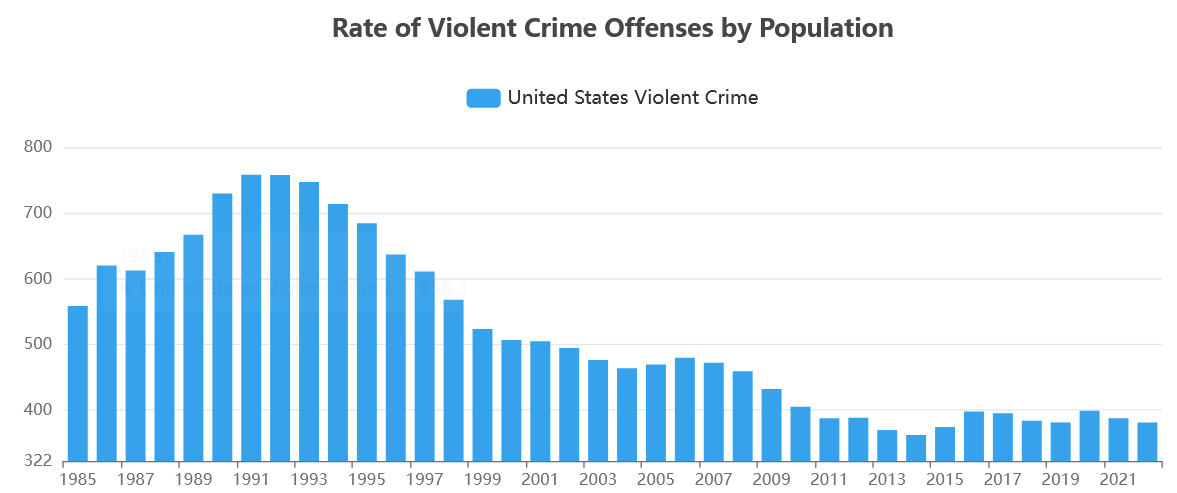
A very, very sobering book. Violent crime has in America has been halved since its apogee in 1991 to 1992. Yet, the public perception is that the streets are more dangerous than ever, that law enforcement is under siege. Officers ride around in dark vehicles with tinted windows. They dress like militarized infantry. Why? This book will provide some perspective.

Retrieved from the FBI Crime Data Explorer at http://tinyurl.com/et3b5m4k. Rate per 100,000 people, per year. Search parameters are for “all violent crimes” from 1985 to 2022.

5. The Riders Come Out at Night: Brutality, Corruption, and Cover-up in Oakland by Ali Winston and Darwin BondGraham (480 pp.; Atria, 2023).

In the same genre as Rise of the Warrior Cop, but focusing on police corruption in Oakland. Sobering and astonishing.

6. The Trump Tapes by Bob Woodward (11hrs 29 min; Simon & Schuster, 2022).

You won’t appreciate this unless you listen to the audiobook version, which is just recordings of Woodward’s 20 interviews with then-President Trump. This is perhaps the most damning series of interviews to which I’ve ever listened. From a strategic perspective, it seems the president made a mistake by giving Woodward such unfettered access. However, many of President Trump’s constituents likely do not read Woodward, so perhaps it wasn’t a mistake after all?

7. Peril by Bob Woodward and Robert Costa (512 pp.; Simon & Schuster, 2023).

The third book of Woodward’s Trump trilogy, chronicling the transition to the Biden administration with particular focus on the COVID-19 pandemic response. It’s as horrifying and important as the other two in the series.

8. Rage by Bob Woodward (580 pp.; Simon & Schuster, 2021).

The first of Woodward’s Trump trilogy. It details the Trump transition. It is frightening and paints the picture of Trump as monumentally unfit for any public office–let alone the White House.

9. Biblical Porn: Affect, Labor, and Pastor Mark Driscoll’s Evangelical Empire by Jessica Johnson.

This is a very curious book. It chronicles bits of the Mark Driscoll and Mars Hill Church saga with particular attention to the church’s propagation of a deviant strain of Christian sexuality (i.e. “biblical porn”); particularly how it leveraged its expectations in this area to produce volunteerism, commitment, and loyalty to its peculiar evangelical empire. The ground Johnson covers here overlaps in some areas with the ChristianityToday’s wildly popular “Rise and Fall of Mars Hill” podcast (Johnson published first!).

The peculiar aspect of this book is that it seems to see-saw between an engaging history and sudden esoteric discussions of sociological theory. It reads like two very different pieces melded somewhat awkwardly into one. The discussions of sociological affect seem pasted in with (in some instances) little to no transition. The jarring bit is that Johnson doesn’t really try to translate affect theory for non-specialists. Her academic peers in the same field surely appreciate her remarks along that line, but interested laypeople like me are a bit lost when she veers hard right into academic speak.

In summary, this is a very interesting and informative book that can’t decide whether it wants to be an academic treatise or a popular book for non-specialists. In contrast, it seems to me that Kristin Kobes DuMez faced a similar dilemma with Jesus and John Wayne and chose the popular route, and succeeded quite well. This doesn’t mean Johnson’s book is bad–far from it. I enjoyed it and was horrified at some of what I read. I just wish she’d had interested laypeople like me in mind when she wrote it.

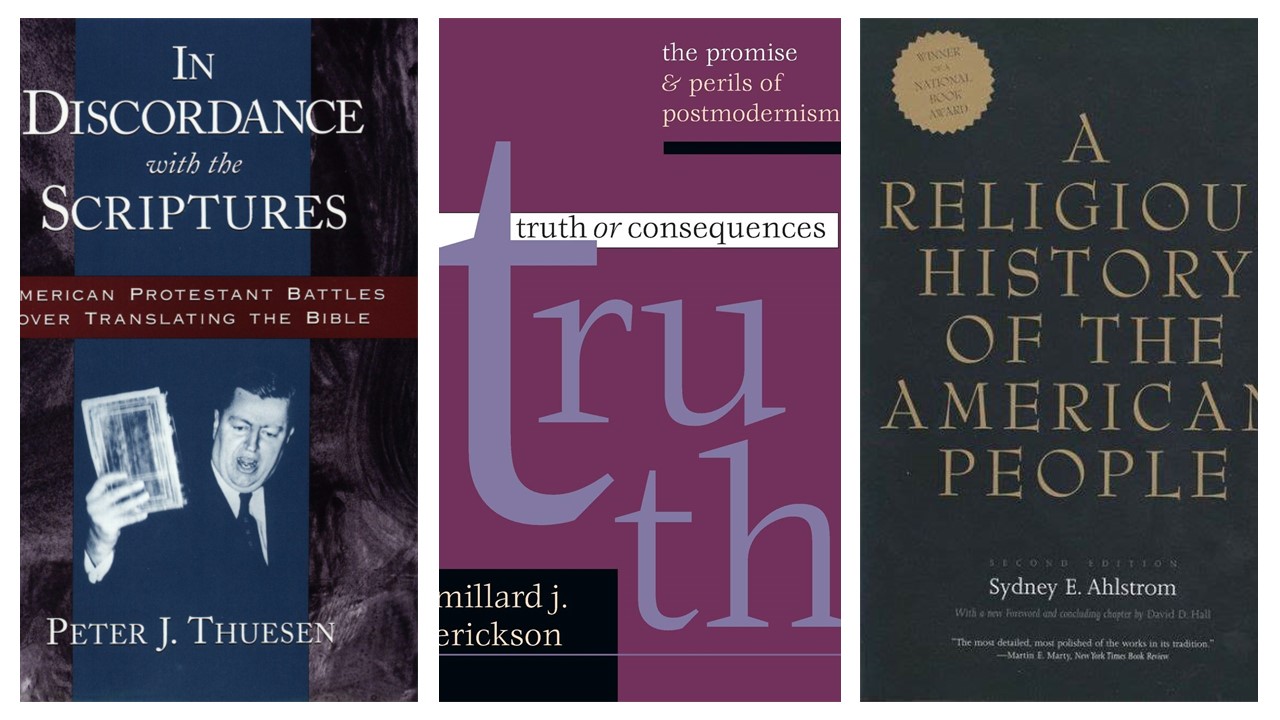
10. A Religious History of the American People (2nd ed.) by Sydney Ahlstrom (1216 pp.; Yale, 2004).

I read about 20% of this book (pp. 385-510, 731-872) while conducting research for a book I wrote on inerrancy and the doctrine of scripture. It is amazing readable, moves fast, and is rightly a classic. I doubt anything like it will come along anytime soon. Mark Noll’s History of Christianity in the United States and Canada is a fraction of this length. Historian Thomas Kidd (Midwestern Baptist Theological Seminary) has a book due out in the next year or so which covers some of the same ground, and I am looking forward to it.

11. In Discordance with the Scriptures: American Protestant Battles Over Translating the Bible by Peter Thuesen (256 pp.; Oxford, 2002).

A refreshing and very interesting book about bible translations in America, using the RSV translation’s public reception as a foil. It’s a bit out of date now, especially considering the TNIV gender-inclusive “controversy” from about 15 years ago, and the rise of the ESV.

12. Truth or Consequences: The Promise Perils of Postmodernism by Millard Erickson (335 pp.; IVP, 2001).

This book is what it sounds like–a primer on postmodernism with some of Erickson’s trademark irenic analysis. This is a very helpful book that was part of the “postmodernism is new and weird and we’ll explain it for you” wave of books that conservative Christians put out around the year 2000. Sometimes theologians try to speak outside their lane, and it shows (e.g. Wayne Grudem’s Politics According to the Bible). This doesn’t happen here. Erickson is well-credentialed to respond to postmodernism; he holds an MA in Philosophy from the University of Chicago.

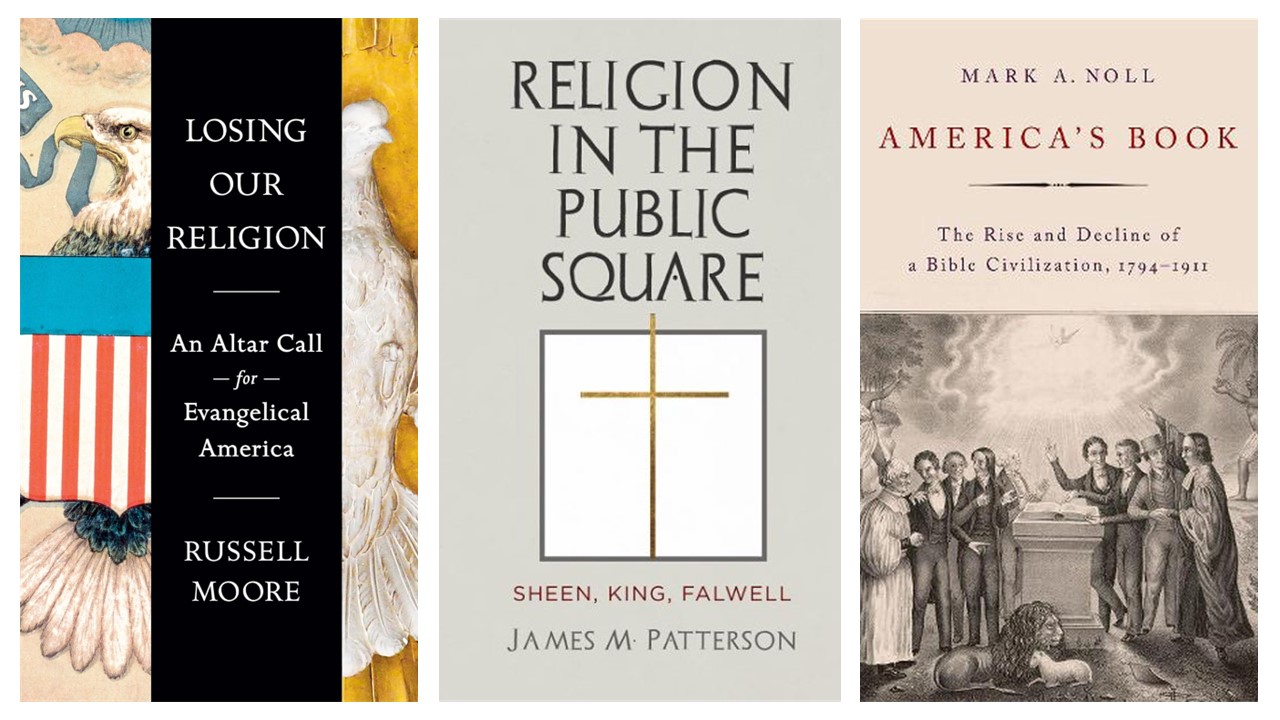
13. America’s Book: The Rise and Decline of a Bible Civilization 1784-1911 by Mark Noll (864 pp.; Oxford, 2022).

This was another book of which I read a portion (pp. 309-582) for research. It’s a very interesting and informative book about just what its title suggests.

14. Religion in the Public Square: Sheen, King, Falwell by James M. Patterson (248 pp.; University of Pennsylvania, 2018).

This was a unique book, because it examined three different paradigms for understanding religion in the public square. Patterson did this by spotlighting three very different individuals; (a) the fiery Roman Catholic radio priest Fulton J. Sheen, (b) the black Baptist preacher Martin Luther King, Jr., and (c) that quintessential representative of white, Southern-style Baptist fundamentalism–Jerry Falwell, Sr.

15. Losing Our Religion: An Altar Call for Evangelical America by Russell Moore (272 pp.; Penguin, 2023).

This is sort of a spiritual sequel to Moore’s 2015 volume Onward! He wrote this book in the aftermath of his resignation from the Southern Baptist Ethics and Religious Liberty Commission and transition to editor-in-chief of Christianity Today. You could say that Moore landed on his feet!

This book is a word of testimony—testimony of what one fellow wayfarer has learned about how to survive when the evangel and the evangelicalism seem to be saying two different things. That requires naming what we have lost—our credibility, our authority, our identity, our integrity, our stability, and, in many cases, our sanity. This book will consider all the ways evangelical America has sought these things in the wrong way—and suggests that perhaps it’s by losing our “life” that we will find it again.

Moore, Losing Our Religion, pp. 21-22

The volume reads a bit like a cathartic exercise from a good man who was deeply hurt by some very unpleasant people who are part of a very unpleasant machine.

I couldn’t help but wonder if the plot twist to the story of American conservative Christianity was that what we thought was the Shire was Mordor all along. I pretend that all of that is past me, but it lingers, in the ringing in my ears of the stress-induced tinnitus that persists to this day, and in the fact that I am still waiting for one sleep without nightmares about the Southern Baptist Convention. But here I am, an accidental exile but an evangelical after all.

Moore, Losing Our Religion, p. 9

This volume fits into a new (post-Trump + 2016) genre that I like to call “white evangelicism sucks and this is why.” It’s not that Moore’s book is bad. It’s not–it’s actually quite good. It’s just that so many people have written (and are still writing) the very same book. They say the same things, in the same way. Of course, perhaps they all say the same things because they all see the same problems. Yes, got it. Understood. I am glad Moore escaped from Southern Baptist public life and I hope he recovers in a spiritually wholesome environment. Still, I’m tired of this genre.

16. Grant by Ron Chernow (1104 pp.; Penguin, 2018).

It’s a biography. It’s very good. Chernow fairly addresses the persistent myth that Grant was a drunken fool. This is probably the best Grant biography in print.

17. Washington: A Life by Ron Chernow (928 pp.; Penguin, 2011).

An excellent biography.

18. Lincoln by David Herbert Donald (720 pp.; Simon & Schuster, 1996).

It’s good. I’m about Lincoln’d out. I’ve read Oates’ volume twice, and now this.

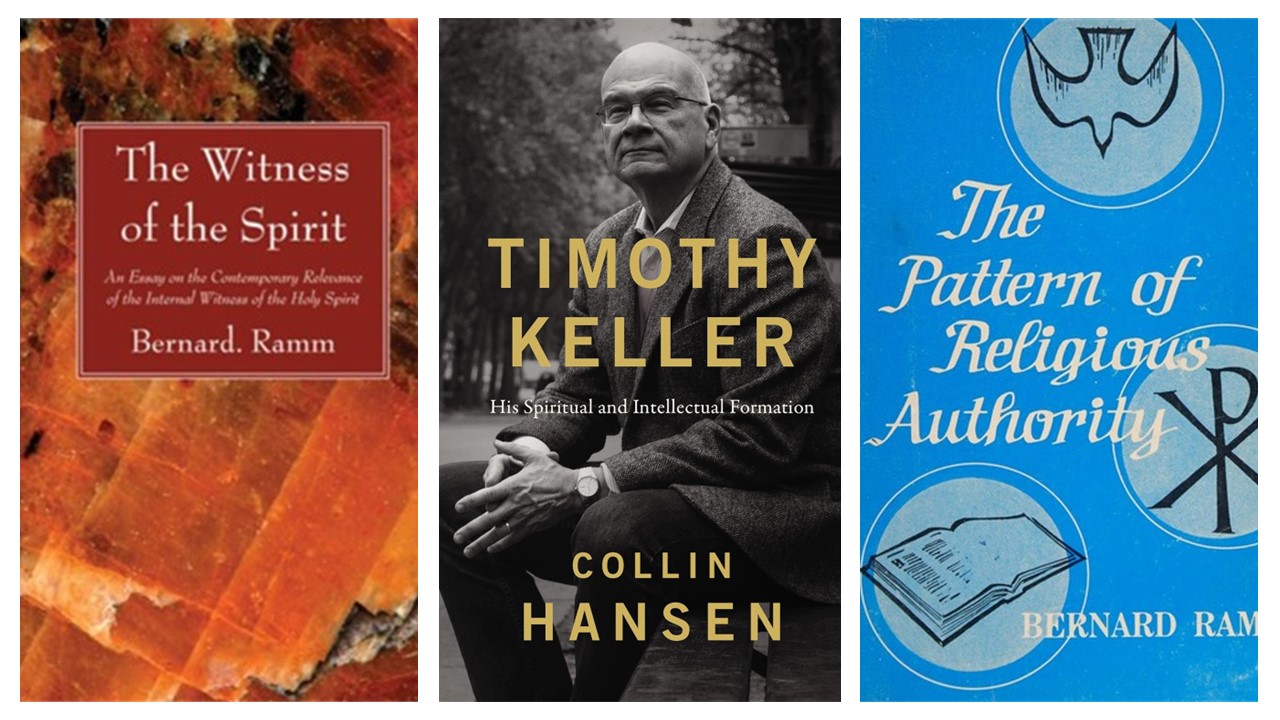
19. Timothy Keller: His Spiritual and Intellectual Formation by Collin Hansen (320 pp.; Zondervan, 2023).

This is an interesting little book. I’m not sure it’s worth the hype its received. That isn’t to say its bad. It’s an interesting sketch of the influences that made Tim Keller the unique and gifted man that he was.

20. The Pattern of Religious Authority by Bernard Ramm (117 pp.; Eerdmans, 1959).

The first volume in Ramm’s trilogy of authority in the Christian life. Ramm places great emphasis on the Spirit being the channel by which God speaks to His people. A very good and very helpful book.

21. The Witness of the Spirit by Bernard Ramm (142 pp.; Wipf and Stock, reprint, 1960).

The second volume in Ramm’s trilogy. He and Carl Henry have very different approaches. He eschews Henry’s cold rationalism and emphasizes the Spirit’s dynamic and dialogical role in the Christian life. Ramm was heavily influenced by Calvin’s own treatment on the Spirit, and it shows. I really appreciate Ramm. He is the kind of theologian I want to be when I grow up!

22. Special Revelation and the Word of God by Bernard Ramm (221 pp.; Eerdmans, 1961).

The final volume in Ramm’s trilogy. In an era before the Chicago Statement (1978) set the guardrails for the debate for a new generation, Ramm took a mediating position that was still in the conservative orbit. In the modern era, the Chicago Statement is a non-negotiable article of faith for conservative institutions and many churches. Ramm would not have fit easily into that mold.

23. The Scripture Principle by Clark Pinnock (284 pp.; Harper Collins, 1984).

Pinnock’s plea for a conservative alternative to the Chicago Statement. Well-reasoned and irenic, but firm. Modern evangelicals who assume “orthodoxy = the Chicago way or the highway” ought to read Pinnock. They might be pleasantly surprised. I cannot speak to the two revised editions of the book which Pinnock put out with a co-author. I recommend only the original, 1984 edition.

24. The Authority and Interpretation of Scripture: An Historical Approach by Jack Rogers and Donald McKim (564 pp.; Wipf and Stock, 1999 reprint).

Whenever you mention this book to conservative theologians, they will likely respond within 10 seconds with “but, did you read Woodbridge’s reply?” That tells you that Rogers/McKim stuck a nerve. This is an extraordinary work that surveys the historical data about how Christians have understood the nature of scripture. The issue of Chicago-style inerrancy lurks in the background as Rogers/McKim’s rhetorical foe–they conclude that the Chicago Statement is not the historical position of the church. I cannot agree with everything in the book, and Woodbridge gleefully documented reams of purported errors–I leave the reader to evaluate whether his criticisms are valid. Still, a must-read.

25. Preaching: Communicating Faith in an Age of Skepticism by Timothy Keller (320 pp.; Penguin, 2016).

26. The Christian Tradition: A History of the Development of Doctrine, Volume 5: Christian Doctrine and Modern Culture (since 1700) by Jaroslav Pelikan (414 pp.; University of Chicago, 1991).

A very good survey of Christian doctrine.

27. A History of Christian Thought Volume 3: From the Protestant Reformation to the 20th Century, revised ed. by Justo Gonzalez (498 pp.; Abingdom, 2009 reprint).

An excellent survey–I prefer it to Pelikan.

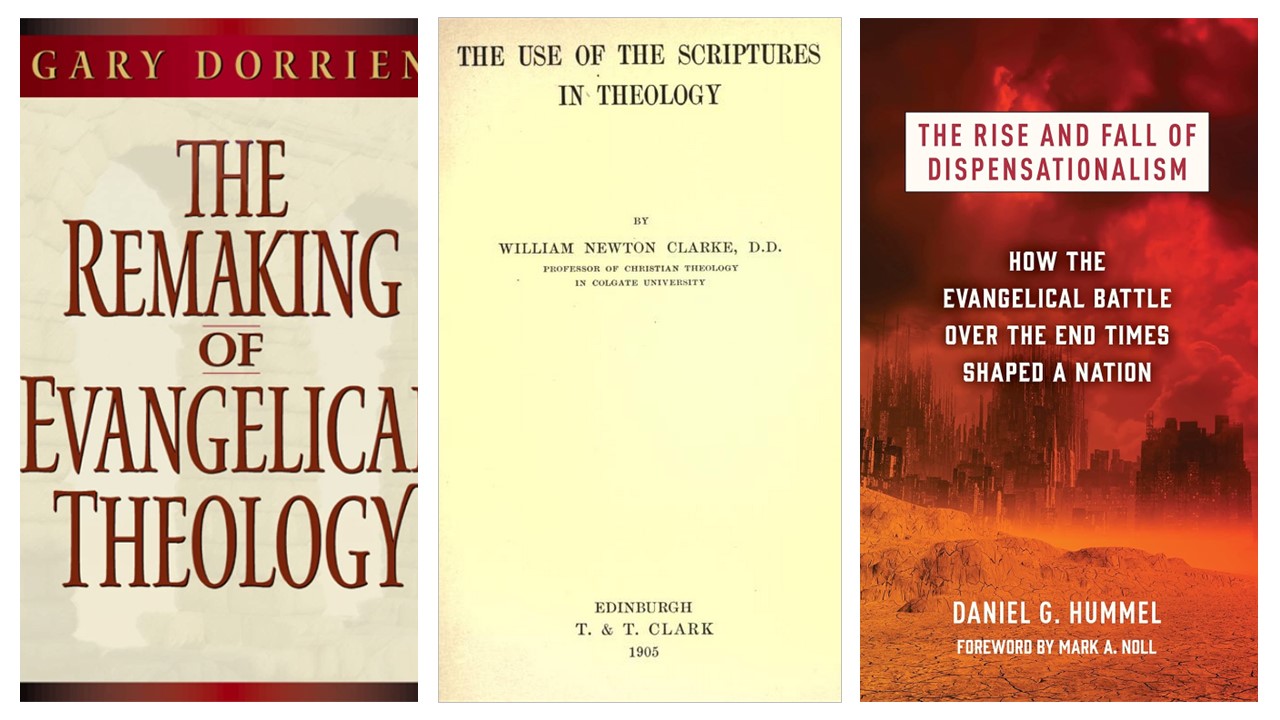
28. The Use of the Scriptures in Theology by William Newton Clarke (192 pp.; Charles Scribners, 1905).

Clarke is the poster-child for gentle, kind, 19th century Baptist liberalism. His doctrine of scripture disgraces God, but he is so kind and grandfatherly that you almost like the guy.

29. The Rise and Fall of Dispensationalism: How the Evangelical Battle over the End Times Shaped a Nation by Daniel Hummell (400 pp.; Eerdmans, 2023).

An important volume on an important topic. Dispensationalism has fallen on hard times. It has little to no scholarly influence, has no reliable academic press, has very few scholars publishing anything to advance the system, has produced precious few technical commentaries, and few substantive mid-level (e.g. NAC, Tyndale, or EBC level) commentaries. In that sense, it has indeed “fallen” from great heights. This book provides one explanation about why and how.

30. The Remaking of Evangelical Theology by Gary Dorrien (262 pp.; Westminster John Knox, 1998).

A tour-de-force survey of evangelical theology from a liberal outsider. This is one of the best books I read in 2023. His survey of theological perspectives is fair and irenic, and his footnotes will take you to valuable works from conservatives.

31. Scripture, Authority, and Interpretation by Dewey Beegle (332 pp.; Eerdmans, 1973).

Beegle’s book is another entry from the 1970s to 1980s genre which I’ll call “the Chicago Statement is wrong!” Some of his critiques of Chicago-style inerrancy are interesting, but on the whole Beegle goes off the reservation here. If you want a conservative alternative to the Chicago Statement, see Pinnock and not Beegle. F.F. Bruce wrote an endorsement!

32. The Princeton Theology 1812-1921: Scripture, Science, and Theological Method from Archibald Alexander to Benjamin Breckinridge Warfield edited by Mark Noll (344 pp.; Baker, 1983).

This is an edited volume containing lengthy excerpts from four “old Princeton” theologians on scripture, science, and theological method. Noll provides brief introductions but largely lets the authors speak for themselves. An invaluable book. Warfield and A.A. Hodge are excellent on scripture–much better than R.C. Sproul, who drafted the original 1978 Chicago Statement and somehow misunderstood the “original autograph” issue along the way–compare the Chicago Statement to Warfield’s “The Inerrancy of the Original Autographs” (1883) and you’ll see what I mean.

33. Between Faith and Criticism: Evangelicals, Scholarship, and the Bible in America (2nd ed.) by Mark Noll (284 pp.; Regent College, 2004).

This is mostly inside baseball stuff for academia, but it has some interesting insights. It explores how to reconcile faith and critical inquiry. It’s a logical sequel to the Princeton volume or Noll’s The Bible in America book.

34. The Fifth Risk by Michael Lewis (256 pp.; Norton, 2019).

A forgettable little book about how President Trump’s administration was allegedly so inept and how everything may crumble to bits at any moment. Not worth buying. Glad I checked it out from the library. It repeats the same theme in every chapter; (a) Lewis introduces the noble civil servant, then (b) in come the stupid Trump officials in 2017, then (c) the dumb Trumpian appointees threaten to ruin everything, then (d) Lewis lets the noble bureaucrat explain how dangerous the Trump appointees are, then (e) the next chapter repeats in a different government sector. Very tiresome and a bit condescending.

35. Dialogues Concerning Natural Religion by David Hume–ed. Richard Popkin, 2nd ed. (160 pp.; Hackett, 1998).

Hume annoys me.

36. “Essay VI—On Judgment,” in Essays on the Intellectual Powers of Man, by Thomas Reid, edited and abridged by A.D. Woozley (517 pp.; MacMillan, 1941).

Reid’s emphasis on common sense, on what every rational person can know by his innate faculties, is very good. Philosophers today seem to be scornful of commonsense realism, so this makes me wary. But, Reid just makes sense. I suppose one main hurdle is that Reid makes sense in a world in which one is willing to acknowledge that God has created us and given us logical faculties for reason. We don’t live in that world any longer, so I suspect that disconnect is driving some of the disagreement.

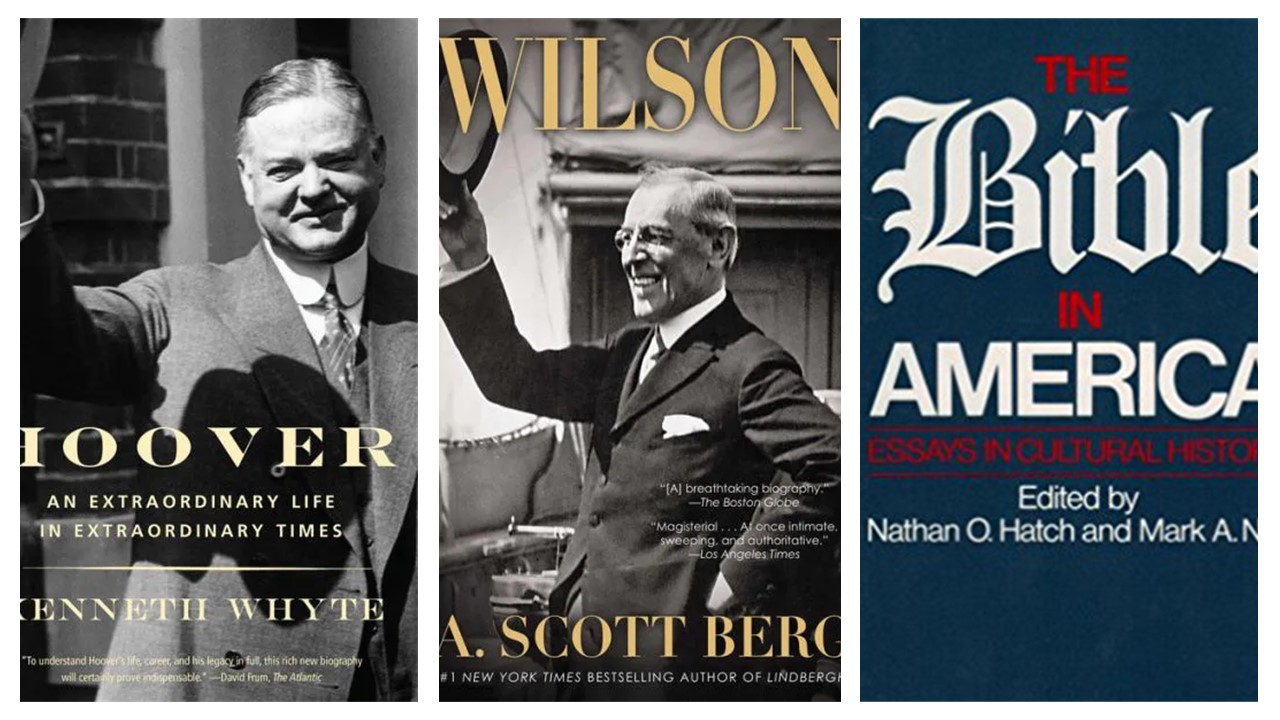
37. The Bible in America: Essays in Cultural History edited by Nathan O. Hatch and Mark A. Noll (192 pp.; Oxford, 1982).

An extraordinary series of essays from world-class historians. Not sure why it’s out of print!

38. Wilson by A. Scott Berg (880 pp.; Penguin, 2014).

A magisterial biography of a very interesting man. It made me very sad to read of Wilson’s incapacitation shortly after his second term began. I wonder what he could have accomplished if he’d retained his physical powers.

39. Hoover: An Extraordinary Life in Extraordinary Times by Kenneth Whyte (768 pp.; Knopf Doubleday, 2018).

The best book I read in 2023. Hoover was a true genius. His story is inspiring beyond words. He came from nothing, made a career as a brilliant mining engineer, then a financier of sorts in the mining world, then saved untold millions from starvation as head of a humanitarian agency (what would now be an NGO) during and after the first world war. Secretary of Commerce. Elected President. If there was any single individual in American history who could have been up to the task of combating the series of crises that we now refer to as the Great Depression, it would have been Hoover. And yet, he couldn’t get it done.

Whyte works hard to bring perspective to Hoover’s reactions to the financial crises. He argues that Hoover responded as well as could be expected, that Franklin Roosevelt cribbed several of his policies and ideas (even the infamous “nothing to fear but fear itself” line), and that the depression was on the road to recovery when Roosevelt assumed office–but that the latter refused to coordinate policy with Hoover and went his own way. Whyte notes that the depression continued until the second world war, that Roosevelt did not “solve” the depression, and that Hoover was understandably bitter about the treatment he received. Roosevelt was undeniably a superior politician, and Hoover was dealt a bad hand … not unlike Jimmy Carter nearly 50 years later.

I plan to read another Hoover biography in 2024. This man deserved better. He truly was an extraordinary man in extraordinary times.

40. Watergate: A New History by Garrett M. Graff (832 pp.; Simon & Schuster, 2023).

Anything you want to know about Watergate? You’ll find it here. This is the most up-to-date, exhaustive account of the scandal in print. An outstanding book.

41. The Struggle of Prayer by Donald Bloesch (196 pp.; Helmers & Howard, 1988).

Excellent little book.

42. Nixonland: The Rise of a President and the Fracturing of America by Rick Perlstein (896 pp.; Scribners, 2009).

Nobody would confuse Perlstein with an objective historian. This is an entertaining, exhaustively researched work of cultural history with a sarcastic tone. That isn’t to say it isn’t valuable. His quartet of books chronicling the rise of the political right from Goldwater to Reagan is essential reading, and extraordinarily entertaining.

43. American Individualism by Herbert Hoover (91 pp.; Doubleday, 1922).

Hoover published this little book while he was Secretary of Commerce. He outlines what he sees as a peculiarly American kind of individualism–a characteristic which sets America apart:

Therefore, it is not the individualism of other countries for which I would speak, but the individualism of America. Our individualism differs from all others because it embraces these great ideals: that while we build our society upon the attainment of the individual, we shall safeguard to every individual an equality of opportunity to take that position in the community to which his intelligence, character, ability, and ambition entitle him; that we keep the social solution free from frozen strata of classes; that we shall stimulate effort of each individual to achievement; that through an enlarging sense of responsibility and understanding we shall assist him to this attainment; while he in turn must stand up to the emery wheel of competition.

Hoover, American Individualism, pp. 9-10. Emphasis added.

Hoover believed we must make our own way; that we must be guaranteed equality of opportunity but not equality of outcome. The grand object of government is to (a) foster equality of opportunity without (b) throttling individual initiative:

To curb the forces in business which would destroy equality of opportunity and yet to maintain the initiative and creative faculties of our people are the twin objects we must attain. To preserve the former we must regulate that type of activity that would dominate. To preserve the latter, the Government must keep out of production and distribution of commodities and services. This is the deadline between our system and socialism. Regulation to prevent domination and unfair practices, yet preserving rightful initiative, are in keeping with our social foundations. Nationalization of industry or business is their negation.

Hoover, American Individualism, pp. 54-55

One can see glimmerings of the modern GOP here. This is a very interesting book. Well worth reading and pondering. Needless to say, Hoover despised Roosevelt’s New Deal.

44. Eisenhower in War and Peace by Jean E. Smith (976 pp.; Random House, 2013).

A good biography. It seems to lose steam once it hits Eisenhower’s presidency. And, yes–Eisenhower surely had an affair with Kay Summersby. Smith suggests that Eisenhower planned to divorce Mamie and marry Kay, but his plan was thwarted. Like a good general facing hard realities, Eisenhower then sent Kay a “Dear John” letter that is astonishingly cruel and heartless. He cut her loose like a used Kleenex. Eisenhower comes across as an amazing politician and a great leader, but a poor general. That is fair, I believe.

45. Truman by David McCullough (1120 pp.; Simon & Schuster, 1992).

This book made me love Truman. It has earned its reputation. I even bought a “The Buck Stops Here!” desk sign replica from the National Archives. I will display it on my desk at work.

46. Reagan: An American Journey by Bob Spitz (880 pp.; Penguin, 2019).

A great biography of an interesting guy. Reagan was a good man, a kind man, a decent man. He also seemed to be shallow and a bit of an empty suit.

47. Our Faith by Emil Brunner, trans. John Rilling (153 pp.; Scribners n.d.).

I love these little “this is what the Christian faith is about” books that theologians sometimes write. This is a great book.

48. The Soul of Prayer by P.T. Forsyth (109 pp.; Regent College (reprint), 2002).

A classic on prayer. Probably the most quotable book I’ve ever read.

49. Faith and Justification by G.C. Berkouwer, trans. Lewis Smedes (201 pp.; Eerdmans, 1954).

A great book on justification. It’s refreshing to read something plain and scriptural on this essential topic from the era before the new perspective on Paul clouded everything.

50. His Very Best: Jimmy Carter–A Life by Jonathan Alter (800 pp.; Simon & Schuster, 2021).

I don’t believe the “great” Carter biography has yet been written. This book more describes than explains. I don’t know why Carter is such an inflexible moralist. I don’t know why he’s a theological liberal. I don’t know why he wanted to go into politics. I don’t know much about his relationship with his kids. I don’t know how this inflexible man managed to build a coterie of professionals around him who took him to the Georgia governor’s mansion and eventually to the Presidency. I don’t know why he was such a bad and seemingly clueless politician (he famously didn’t try to remain friends with the Democratic Party). I know all these things happened, but I don’t know why. Still, Alter’s biography is informative. It’s probably the best one available to date.

51. Atonement and the Death of Christ: An Exegetical, Historical, and Philosophical Exploration by William L. Craig (328 pp.; Baylor, 2020).

An outstanding book by a world-class philosopher and theologian.

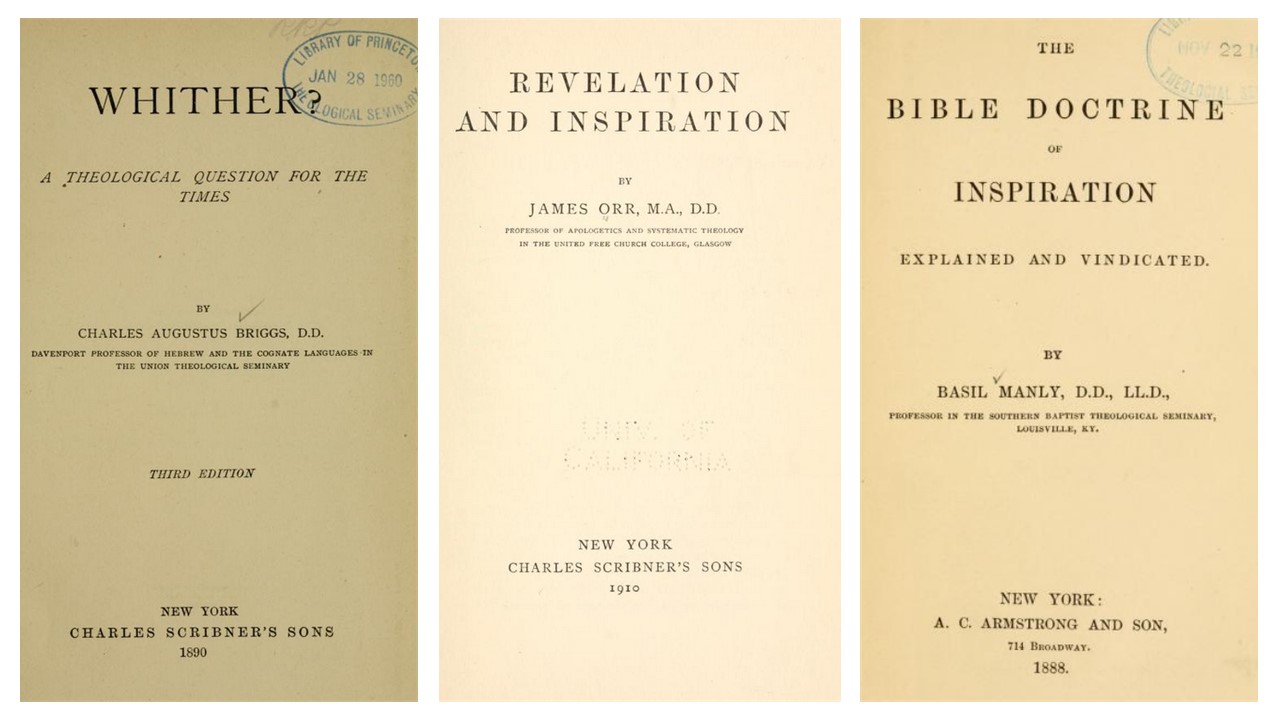
52. Whither? A Theological Question for the Times by Charles A. Briggs (334 pp.; Charles Scribner’s Sons, 1889).

Briggs wrote this book in great frustration. He had been hounded for years by conservatives within his Presbyterian denomination over his doctrine of scripture and inerrancy. He believed the Princeton school was erecting bulwarks that were impossible to hold. He disagreed vehemently with that perspective’s reading of the historical record and believed inerrancy was a recent invention by pious men who were reacting against realities they did not want to acknowledge. It deserves to be read, regardless of whether one agrees with Briggs.

53. The Bible Doctrine of Inspiration: Explained and Vindicated by Basil Manly, Jr. (278 pp.; A.C. Armstrong and Son, 1878).

A sensible and wise volume on the doctrine of inspiration from a Southern Baptist theologian. Worth reading.

54. Revelation and Inspiration by James Orr (224 pp.; Duckworth & Co., 1910).

Another wise and sensible book on the doctrine of scripture from a Scottish evangelical. Conservatives who follow the Chicago-style of inerrancy generally do not like Orr’s volume. I think it has some very good material.

Church and State no. 2: The two kingdoms

Church and State no. 2: The two kingdoms

We continue our discussion of the relationship between the church and the state (see the series here). The previous article in this series introduced the topic of church v. state. We discussed two critical paradigm shifts with which any American Christian audience must reckon (a task in which it sometimes fails). We presented three general operating environments in which the church often operates—their boosters often see these frameworks as the preferred, ideal paradigm. I then offered a precis of the five principles which should inform any discussion of the “church v. state” problem. Now, in this piece, we’ll examine the first and most basic principle for considering this issue. Here it is …

  • There are two kingdoms; Babylon and Jerusalem. Babylon will lose.

The Apostle John paints a picture of two competing kingdoms—Babylon and Jerusalem (Rev 17-18). This contrast is the story of history and reality. We’ll sketch each kingdom, in turn.

1. Babylon is Satan’s kingdom, symbolized as a charming seductress.

John’s picture fades in on a pretty woman sitting atop a beast.

The woman was dressed in purple and scarlet, and was glittering with gold, precious stones and pearls. She held a golden cup in her hand, filled with abominable things and the filth of her adulteries.

Revelation 17:4

John tells us the woman’s name is “Babylon the great,” that she is a prostitute, and the mother of all the abominations of the earth (Rev 17:5). This woman is a figure for the beguiling ways Satan tempts us to follow him.

For all the nations have drunk the maddening wine of her adulteries. The kings of the earth committed adultery with her, and the merchants of the earth grew rich from her excessive luxuries.

Revelation 18:3

Babylon, personified as an attractive call girl, offers “wine” to the masses resulting in “adulteries,” which God often uses as a metaphor for spiritual rebellion (e.g. Hosea 1-3). The nations lust after her, buying her services, committing “adultery.” The merchants trade with her, less interested in her physical charms than in the money they can make in trade. Like the sinister villain in Stephen King’s Needful Things, Babylon offers up whatever we desire with the aim of keeping us in her embrace. She buys us all, each in our own way. “By your magic spells all the nations were led astray,” (Rev 18:23).

This passage ends with Babylon’s destruction, her ruins aflame (“the smoke from her goes up for ever and ever,” Rev 19:3). The merchants, the heads of state, and all those involved in the economic system which abets this “trade” will cry aloud in shock when they behold the end of everything they know (Rev 18:4-20)—the “kingdom” which shaped their reality has fallen.

In the bible’s storyline Babylon is, of course, the empire which conquered Judah, destroyed the first temple, and carried the flower of the southern kingdom off into exile. Beyond the purely historical reference to that specific calamity, scripture later takes “Babylon” and uses it to personify evil and all that opposes God—it’s a figure, a metaphor, a representation. The prophet Isaiah speaks darkly about the king of Babylon, yet his words seem to shade over to a deeper meaning—perhaps referring to Satan himself (Isa 14:3ff). Zechariah speaks of an angel crushing into a basket a woman who represents sin and sending her far away to the east … where Babylon lies (Zech 5).

Now, in Revelation 17-18, God has poured out all His judgments, “Babylon” has fallen, and now Jesus returns to the world He left behind on that day so long-ago outside Jerusalem (Acts 1; Rev 19). In this passage, Babylon is Satan’s kingdom; and the system, culture, world, and values that oppose God have finally crumbled to bits—destroyed from on high with sudden violence (Rev 18:21).

When Jesus returns with “the armies of heaven” (Rev 19:14), He quickly destroys the beast, the false prophet, and the entire army which they mustered. This is a cosmic clash of two opposing forces—darkness v. light. Each character is the opposite of the other on the divine playbill:

Antichrist is Satan’s delegate → Jesus is the Father’s delegate.

Antichrist has an army → Jesus has an army.

Antichrist loses → Jesus wins.

After the millennium, God releases Satan, who tries to salvage what he can from the wreckage—a Battle of the Bulge-like gamble, a last roll of the dice (Rev 20:7-10). Now the struggle isn’t between the delegates, but between the supreme players themselves—it’s God who immolates Satan from on high with a divine fireball (Rev 20:9-10).

The evil empire falls in Revelation 17-18. The coup leaders are each cast into the lake of fire (Rev 19:20; 20:10). God has meted out rewards to the righteous, and judgment to the wicked (Rev 20:4-6, 11-15). Now that God has swept the debris of Satan’s coup away, God brings about His own kingdom (Rev 21-22). Creation is remade, sin is destroyed, and God finally has the community He’s been working to re-create since our first parents made their fateful choice. “Look! God’s dwelling place is now among the people, and he will dwell with them,” (Rev 21:3)—Emmanuel, indeed (cf. Isa 7:14; Mt 1:23)!

2. Jerusalem is God’s kingdom, fighting with Babylon over the same ground.

Jesus’ parable of the wheat and the weeds tells us about His kingdom in a powerful way. He explained:

The kingdom of heaven is like a man who sowed good seed in his field. But while everyone was sleeping, his enemy came and sowed weeds among the wheat, and went away. When the wheat sprouted and formed heads, then the weeds also appeared.

Matthew 13:24-26

Jesus wants to talk about the kingdom and this parable is an allegory[1] to explain all about it. This is one of the few parables where Jesus identifies the true referent for every character in the story; you have (1) a farmer, (2) an enemy, (3) a wheat crop, and (4) a bunch of weeds. The setup is simple; a farmer sows seed but it turns out bad!

That is terrible. Something’s gotta be done …

The owner’s servants came to him and said, “Sir, didn’t you sow good seed in your field? Where then did the weeds come from?”

“An enemy did this,” he replied.

The servants asked him, “Do you want us to go and pull them up?”

Matthew 13:27-28

The field was supposed to be one thing, but now it’s a hot mess. The servants think they should go clean it up—why not go and rip out the weeds? What does Jesus think?

“No,” he answered, “because while you are pulling the weeds, you may uproot the wheat with them. Let both grow together until the harvest. At that time I will tell the harvesters: First collect the weeds and tie them in bundles to be burned; then gather the wheat and bring it into my barn.”

Matthew 13:29-30

Jesus says no. He says the field will never be cleansed until the harvest—Jesus will give orders to sort it all out then. But, for now, just leave it alone—let the weeds and the wheat all grow up together. If they try to pick out the weeds now, they’ll probably just rip out a whole bunch of wheat. Better to leave it.

In Matthew’s gospel, the writer then inserts a few other parables about the kingdom, but circles back to Jesus’ explanation of our story. This is an intriguing story, so much so that the disciples wanted to hear Jesus explain it once they had a chance to speak to Him alone (Mt 13:36).

He answered, “The one who sowed the good seed is the Son of Man. The field is the world, and the good seed stands for the people of the kingdom. The weeds are the people of the evil one, and the enemy who sows them is the devil. The harvest is the end of the age, and the harvesters are angels.”

Matthew 13:37-39

Jesus has now explained all the referents:

kingdom of heaventhis scenario of events
farmerSon of Man = Jesus
fieldworld
good seed ≈ wheatpeople of kingdom
weedspeople of evil one
stealthy enemydevil

Pay particular attention to the field—what is it? Jesus says it’s the world, and this “field” boasts two crops which are growing side by side—the “people of the kingdom” and “people of the evil one.” This battlespace is simple—two opposing kingdoms, each with its own commanding officer, each with its own followers, inhabiting the same territory. This war will resolve when the “harvesters” arrive, whom Jesus identifies as angels.

He explains:  

As the weeds are pulled up and burned in the fire, so it will be at the end of the age. The Son of Man will send out his angels, and they will weed out of his kingdom everything that causes sin and all who do evil. They will throw them into the blazing furnace, where there will be weeping and gnashing of teeth. Then the righteous will shine like the sun in the kingdom of their Father. Whoever has ears, let them hear.

Matthew 13:36-43

This “field” that is our world will remain a mess until “the end of the age.” The harvesters will fix the field when Jesus sends them. But notice that Jesus now calls the “field” the “kingdom”—He says the angels “will weed out of his kingdom everything that causes sin and all who do evil.” The field is both the world and the kingdom. This suggests Jesus sees the world—this present battlespace—as transitioning into His kingdom at the decisive moment in the future when He intervenes. It’s as if “this world” is the territory at issue throughout history, and Jesus views it as already His, and judgment is (in part) Him sweeping evil out of His lands forever.

“Then,” He promises, “the righteous will shine like the sun in the kingdom of their Father.” Why? Because the “weeds” will be gone, and the “wheat” will finally be free to flourish in the field (i.e., “the kingdom of their Father”) without an invasive species choking them.

Jesus’ kingdom is here, right now. It’s in this world in the form of a dispersed community in exile (see no. 3-4, below) in a hostile land.[2] This situation will remain that way until the end of the age (cf. the parable of the net at Mt 13:47-50)—it’s why Jesus said this whole parable, the entire state of affairs it sketched, “is like” the kingdom of heaven. As one early Christian discipleship manual said, “There are two ways, one of life and one of death, and there is a great difference between the two ways.”[3]

3. The world as the battlespace for the two kingdoms at war

This is a sketch of the battlespace we’ve occupied from the Fall to the present. This is the foundation for considering the vexing issue of church v. state. There is a kingdom of darkness called Babylon. There is also a kingdom belonging to God which the Apostle Paul refers to as “the Jerusalem that is above” (Gal 4:26; cf. Rev 21:2). These two kingdoms are the cultures, values, and societies corresponding to two quite different masters—Satan and God. Viewed the right way, we can frame the big picture of history as the story of these two kingdoms in supernatural conflict.

Babylon will lose. Jerusalem will win, and then (and only then) …

… with righteousness he will judge the needy, with justice he will give decisions for the poor of the earth. He will strike the earth with the rod of his mouth; with the breath of his lips he will slay the wicked. Righteousness will be his belt and faithfulness the sash around his waist.

Isaiah 11:4-5

From this fountainhead, other principles logically follow. We’ll turn to these in the next articles.


[1] “A story, picture, etc., which uses symbols to convey a hidden or ulterior meaning, typically a moral or political one; a symbolic representation; an extended or continued metaphor,” (s.v. “allegory,” noun, no. 2, OED Online. March 2023. Oxford University Press. https://www.oed.com/view/Entry/5230?rskey=ts99zo&result=1&isAdvanced=false (accessed May 05, 2023)).

[2] For an argument for the “already, but not yet” aspect of the kingdom, see Herman Ridderbos, The Coming of the Kingdom, trans. H. de Jongste (Phillipsburg: P&R, 1962), esp. §IV. Many Americans often turn to George Ladd when they think of “already, but not yet,” but Ridderbos published first.

For dispensationalist rejoinders to the idea of kingdom being present now, see esp. (1) Chafer, Systematic, pp. 5:333-358; 7:223-224, and (2) Alva McClain, The Greatness of the Kingdom: An Inductive Study of the Kingdom of God (reprint; Winona Lake: BMH, 2009).

[3] “Didache”1.1, in The Apostolic Fathers in English, trans. Rick Brannan (Bellingham: Lexham, 2012).

Church and State no. 1: A tricky question in a muddled world

Church and State no. 1: A tricky question in a muddled world

This essay (see the series) aims to help ordinary Christians rightly consider the relationship between the church and the state. This is important because Christians receive many contradictory messages about this issue. Some Christian influencers call for believers to “take America back for God.” Others just want good, old-fashioned Christian values to influence society, and they feel marginalized because Mayberry is gone and isn’t coming back. Still others just want the church to have nothing to do with politics—perhaps to the extent that their churches neglect to speak truth to a decadent culture.

So, there’s good reason to consider the “church v. state” issue with some fresh eyes—to go back to basics. I won’t address everything about this large topic, but I hope to establish a foundation for thinking about this issue the right way. This essay consists of six articles, of which this is the first.

In this introductory article I’ll sketch two paradigm shifts which impact any discussion along this line from an American context, introduce three common operating environments in which churches often operate, and provide a preview of this essay’s conclusions. Then, I’ll spend the bulk of the essay discussing five foundational principles that will help us work through the “church v. state” issue. I labored to ground these principles firmly in the biblical storyline, rather than in creeds, confessions, or political theology. This doesn’t mean I don’t value tradition; it just means first principles on important issues ought to be explicitly or implicitly scriptural.

Paradigm shift no. 1—the death of “Christendom” and the like

In the 20 centuries (and counting) since Jesus’ first advent, Christians in the West have often operated in an environment that assumed a church and state nexus. Since the time of Constantine, the church had presumed it would have the support of the state and of the culture around it. The tremors of the Enlightenment cracked this wide open.

But, even after this earthquake, the church still occupied a position of unquestioned influence and status in many nations—a defacto Christian-ish ethos pervaded. For example, as late as 1952 the National Council of Churches launched a $500,000 advertising blitz to promote the Revised Standard Version translation of the bible and publicly presented President Harry Truman with his own copy[1]—this is unthinkable in 2023.

Figure 1. Excerpt from Peter Thuesen, In Discordance with the Scriptures (New York: OUP, 1999), p. 70.

This situation began to change rapidly in the mid-20th century, when for perhaps the first time in its history the church in the Western world began to grapple with how to understand its role vis-à-vis the state as a minority community in a self-consciously secular world.[2] Some flavors of the American church have long responded to this with a defensive impulse which stems from its memory of a different time, when “while the state was not officially Christian, society seemed to promote values that were deemed essentially Christian.”[3] Whether this idyllic reality existed at meaningful scale outside of 1950s television sets is open to question.[4] However, that era is gone, secularism is here, the church has a minority status, and one theologian aptly likened this new world to an airplane flying blind without instruments, not knowing where it is or where it’s going.[5]

Certain American believers sometimes react by trying to re-Christianize society on a superficial level—to recapture a largely imaginary lost glory. One Christian historian described Victorian-era America as having “a veneer of evangelical Sunday-school piety” that amounted to “a dime-store millennium.”[6] It’s still common to hear older believers complain about the demise of compulsory prayer and bible reading in public schools. This ghost of a so-called “Christian nation” is a monkey some flavors of the American church have trouble shaking off its back—it often lurks in the background in the guise of a Christian-ish American exceptionalism or super-patriotism. 

Paradigm shift no. 2—Christianity shifts to the global south

The second paradigm shift for the church v. state issue is that many, many Christians now live in an environment that never knew Christianity as a civil religion[7] and are not handicapped by that cultural memory. Over the past 120 years, Christianity has at last become a truly global phenomenon. For many centuries, since the Arab conquest of the Mediterranean basin in the early 7th century, Christianity had been largely a Western religion.[8] But, as one church historian has noted, the period between 1815 to 1914 (the great age of missions) “constituted the greatest century which Christianity had thus far known.”[9] This missions movement produced a church that is now global and no longer beholden to the patronage of Western benefactors. These so-called “younger churches” are hungry, energetic, and often far outpace the enthusiasm and vitality of their Western “parents.”

There were now new centers in every continent, resulting in a map of Christianity that, rather than seeing it as having its base in the West, and from there expanding outward, sees Christianity as a polycentric reality, where many areas that had earlier been peripheral have become new centers … the new map of Christianity does not have one center, but many. Financial resources are still concentrated in the North Atlantic, as are educational and other institutions. But, theological creativity is no longer limited to that area.[10]

Indeed, most Christians now live nowhere near Europe or North America.

In 1900, 82% of Christians lived in the North. By 2020 this figure had dropped dramatically to just 33% … The future of World Christianity is largely in the hands of Christians in the global South, where most Christians practice very different kinds of the faith compared to those in the North. Christianity has shifted from a tradition that was once majority global North to one that is majority global South.[11]

Many of these Christians did not grow up in a “Christianized” culture, and so their thinking of the church and the state isn’t colored by sepia-toned memories of a bygone age. We can learn from these brothers and sisters and better appreciate the limitations of our own situation. So, for example, when an Argentine theologian critiques the culture Christianity of the “American Way of Life,” the American church ought to listen to its brother:

Christian salvation is, among other things, liberation from the world as a closed system, from the world that has room only for a God bound by sociology, from the “consistent” world that rules out God’s free, unpredictable action … The gospel, then, is a call not only to faith but also to repentance, to a break with the world. And it is only in the extent to which we are free from this world that we are able to serve our fellow men.[12]

This is a call to, among other things, divorce oneself from secular values and allegiances—including political ones. Perhaps because the author doesn’t come from a context where Christianity has been a civil religion, he can read the New Testament without explicitly or unwittingly conflating church and state—and that makes him (and others) worth listening to.

Three common operating environments for the church

Broadly speaking, churches operate in one of these three operating environments:

  1. Church in alliance with the state. In this arrangement the church and the state are generally bound together. Legislation and public policy will allegedly be informed by purportedly Christian values. This can take various forms. Theonomy envisions the church as the state (basically a theocracy);[13] the populist rhetoric from what is sometimes misleadingly labeled as “Christian nationalism” is downstream from some aspects of this theory. Constantinianism refers to the state controlling the church—when the Roman Emperor Constantine converted to faith he made Christianity the state religion and presided over councils about Christian doctrine as both the head of state and as the alleged head of the church. In Western Europe, many nations still retain the emaciated shell of a state church—even though that influence is now largely symbolic. Or, in a softer version of the same, varieties of American exceptionalism[14] advocate for America’s special role in God’s providence and its resulting obligation to honor God in all it does, or at least America’s role as “a communal paragon of justice, freedom, and equality.”
  2. Pluralism. This is also known as a “free church in a free state.” The idea is that government’s role is to preserve law and order and provide freedom for citizens to pursue their own religious path or none at all. The state is more of a neutral arbiter or policeman who keeps order.[15] The first amendment to the U.S. Constitution embodies this ethos in its “free exercise” and “establishment” clauses—the government cannot establish a religion or prohibit its free exercise.[16] The 1948 United Nations Universal Declaration of Human Rights also reflects this perspective.[17] Baptist churches which understand their heritage (and not all do) have always been champions of this ethos.
  3. Isolation. In its milder forms, this means Christians create their own alternative subcultures for reality (think about the movie The Village). Or, it can mean a church deliberately never speaks of “political issues” and chooses to not teach believers how to engage these topics as responsible citizens. Or, in perhaps its most extreme form, it can take the form of monasticism.[18] 

Many Americans Christians of a certain age and subculture are probably most comfortable with some version of American exceptionalism. On the other hand, some Christians are sick of it all and don’t want any hint of “politics” in the church. Other Christians believe church and state ought to stay separate, each minding their own business—their interests may overlap but their roles and functions are different.[19] Still others are theonomists who want a Christian America. Even more aren’t quite sure what they want and are falling prey to populist, bastardized variations of theonomy-ish talk from right-wing politicians who may or may not actually believe what they say.

What do the scriptures say? Do they provide a way out of this confusing maze?

Five principles—a preview of coming attractions

Here are a preview of the five foundational principles that I believe provide a solid, biblical basis for considering the “church v. state” question. These come from an unapologetically Baptist milieu, and some readers will spot this fairly quickly. Here they are, with a brief description.

  1. There are two kingdoms, Babylon and Jerusalem. Babylon will lose. This is the most fundamental truth about human history, the biblical story, and reality.
  2. God’s kingdom is distinct from every nation state. If we conflate America (or any nation) with the kingdom, we’re making a terrible mistake. “The church is the community of God’s people rather than an institution, and must not be identified with any particular culture, social or political system, or human ideology.”[20]
  3. A Christian’s core identity is as a child of God and a kingdom citizen, and so her principal allegiance must be to God’s kingdom (“Jerusalem”) and not to a nation state. If you’re a Christian, then God doesn’t much care that you’re an American. You now have a kingdom passport, kingdom citizenship, and a kingdom mandate. To the extent our most basic identity is rooted in America rather than God’s kingdom, then we are traitors.
  4. The church’s job is to be a kingdom embassy; a subversive and countercultural society calling outsiders to defect from Babylon and pledge allegiance to Jerusalem. “We argue that the political task of Christians is to be the church rather than to transform the world … The church exists today as resident aliens, an adventurous colony in a society of unbelief.”[21]
  5. Set apart, yet not isolated. The analogy of “church v. state” compared to “home v. work” is helpful. Christians must approach political and social issues as self-conscious outsiders with a kingdom agenda—to tell God’s truth to Babylon. A pluralist operating environment is the best operating environment for a local church.

I hope this brief sketch of the church v. state issue is helpful for you and provides a sure foundation for considering a question that will only get trickier in the coming years. Future articles in this series will discuss each of these five principles in detail.


[1] Peter Thuesen, In Discordance with the Scriptures (New York: OUP, 1999), pp. 4, 90. 

[2] This is an important caveat, because the long Baptist struggle for religious liberty took place within a Christian-ish milieu. What I’m referring to is the church as a minority community in an overtly secular world.  

[3] Justo Gonzalez, Christian Thought Revisited: Three Types of Theology, rev ed. (New York: Orbis, 1999), p. 128.

[4] See especially David Halberstam, The Fifties (New York: Fawcett Columbine, 1993), ch. 34. 

[5] See Carl F.H. Henry, Toward a Recovery of Christian Belief (Wheaton: Crossway, 1990), ch. 1. 

[6] George Marsden, Understanding Fundamentalism and Evangelicalism (Grand Rapids: Eerdmans, 1991) p. 10.

[7] A civil religion is “a religion, or a secular tradition likened to a religion, which serves (officially or unofficially) as a basis for national identity and civic life,” (s.v. “civil,” see s.v. under “compounds,” OED Online. March 2023. Oxford University Press. https://www.oed.com/view/Entry/33575?redirectedFrom=civil+religion (accessed May 08, 2023)). I’m distinguishing this from “Christendom” in which an alleged Christianity has an external and superficial role as a traditional religion (s.v. “christendom,” noun, no. 3c, OED Online. March 2023. Oxford University Press. https://www.oed.com/view/Entry/32437?redirectedFrom=christendom (accessed May 09, 2023). For example, many Latin American countries have a “Christendom” background because of their Roman Catholic heritage, but it’s not necessarily a basis for national identity or civic life—read the Latin American liberation theologians.

[8] Justo Gonzalez, The Story of Christianity, vol. 1, rev. ed. (San Francisco: HarperOne, 2010), pp. 288-294. See also Kenneth S. Latourette, A History of Christianity, vol. 1, rev. ed. (New York: Harper & Row, 1975), pp. 286-291. 

[9] Kenneth S. Latourette, A History of Christianity, vol. 2, revised ed. (New York: Harper & Row, 1975), p. 1063.

[10] Justo Gonzalez, The Story of Christianity, vol. 2, revised ed. (San Francisco: Harper One, 2010), pp. 525, 526.

[11] Gina Zurlo, Global Christianity: A Guide to the World’s Largest Religion from Afghanistan to Zimbabwe (Grand Rapids: Zondervan Academic, 2022), pp. 3-4.

[12] Rene Padilla, Mission Between the Times: Essays on the Kingdom, revised ed. (Carlisle: Langham, 2010), p. 42; emphasis in original. This essay is the presentation Padilla gave at the 1974 Lausanne Conference.

[13] On “theocracy,” I mean “[d]omination of the civil power by the ecclesiastical,” (John MacQuarrie, s.v. “theocracy,” in The Westminster Dictionary of Christian Ethics, ed(s). James Childress and John MacQuarrie (Philadelphia: Westminster, 1986), p. 622).

On theonomy, see Rousas Rushdoony, Christianity and the State (Vallecito: Chalcedon, 1986). “A Christian theology of the state must challenge the state’s claims of sovereignty or lordship. Only Jesus Christ is lord or sovereign, and the state makes a Molech of itself when it claims sovereignty (Lev. 20:1-5). The church of the twentieth century must be roused out of its polytheism and surrender. The crown rights of Christ the King must be proclaimed,” (p. 10). Emphasis added. Theonomists often insist they do not endorse sacralism and want God-ordained institutions to remain in their own spheres of authority. Yet, one of the church’s jobs is to insist that “every sphere of life [including the government] must be under the rule of God’s word and under the authority of Christ the King,” (Christianity and the State, p. 9). Thus, they would argue this is not a church and state alliance at all. I believe this is a distinction without a meaningful difference.

[14] I’m drawing from John Wilsey’s discussions of “closed” and “open” American exceptionalism, respectively (American Exceptionalism and Civil Religion: Reassessing the History of an Idea (Downers Grove: IVP Academic, 2015), pp. 18-19).

[15] See especially Raymond Plant, s.v. “pluralism,” in Westminster Dictionary of Christian Ethics, pp. 480-481.

[16] For a trustworthy, plain language discussion of the historical context and legal interpretation of the religion clauses, see Congressional Research Service, “First Amendment Fundamental Freedoms,” in Constitution Annotated, https://constitution.congress.gov/browse/amendment-1/ (accessed 08 May 2023).

[17] Article 18: “Everyone has the right to freedom of thought, conscience and religion; this right includes freedom to change his religion or belief, and freedom, either alone or in community with others and in public or private, to manifest his religion or belief in teaching, practice, worship and observance.” https://www.un.org/en/about-us/universal-declaration-of-human-rights.

[18] On monasticism, see Kenneth S. Latourette, A History of Christianity, vol. 1 (San Francisco: Harper & Row, 1975), pp. 221-235.

[19] “Church and State might in a perfect society coalesce into one; but meantime their functions must be kept separate,” (Edgar Y. Mullins, The Axioms of Religion (Philadelphia: American Baptist Publication Society, 1908), p. 195).

[20] Lausanne Covenant, Article 6. 

[21] Stanley Hauerwas and William Willimon, Resident Aliens: Life in the Christian Colony, expanded ed. (Nashville: Abingdon, 2014), pp. 39, 48.

The “new creation” or bust

The “new creation” or bust

This article is part of a commentary series through the Book of Galatians. This article covers Galatians 6:11-18. You can find the rest of the series (so far) here: Galatians 3:1-6, and Galatians 3:7-14, and Galatians 3:15-22, and Galatians 3:23 – 4:7, and Galatians 4:12-20, and Galatians 4:21 – 5:12, Galatians 5:13-26, and Galatians 6:1-10.

Paul now presses a few reminders and offers his assessment of the Judaizer’s motives. This is really a postscript; a closing line or two summing up the matter and issuing a broadside or two against his opponents. What’s quite clear is Paul’s genuine worry about the Christians in Galatia. The situation is so dire—believing in a false version of the “gospel”—that Paul is compelled to once more speak very plainly to press home his remarks.

See what large letters I use as I write to you with my own hand!

Galatians 6:11

Paul often uses a secretary to transcribe his letters (cf. Rom 16:22). But here, at the end of this unpleasant but necessary communique, Paul takes the pen from his secretary’s hand and writes the last bit himself. The Christians in Galatia who handled the letter would immediately see the different handwriting and hopefully be touched by the gesture.[1] In a letter with contains so many stern rebukes, a loving and personal touch like this is a nice gesture.

Paul reveals that this isn’t an honest dispute between two parties who have a theological disagreement.

Those who want to impress people by means of the flesh are trying to compel you to be circumcised. The only reason they do this is to avoid being persecuted for the cross of Christ.

Galatians 6:12

The Judaizers are pushing for “converts” in order to avoid persecution. Paul says this is the “only” reason they’re doing what they’re doing.[2] We don’t know the precise situation. Many believe the Judaizers fear persecution from the larger Jewish community—and that may well be the issue.[3] Another possibility is that they fear local Roman authorities who may have little patience for what they perceive to be an exclusivist cult.[4] Here is a sketch of the situation to help us figure out the battlespace.[5]

First, the Roman Empire was a syncretistic society.

All sorts of religions flourished and were tolerated to some degree. All that was asked in return by Jesus’ day was a sort of mega-pluralism—a respect and homage to the cult of the emperor.

Second, the Jews were generally not loved but tolerated. Yes, they had their invisible God who couldn’t be represented by images or idols, and they had a fanaticism about their God being the “only one.” Yes, it was weird and exclusivist. But, for all that, Jews were a known quantity. They were understood, acknowledged, and tolerated within limits. They’d carved out a precarious place for themselves in the Roman world.[6]

Third, the Christians were a different story.

At first, the Romans saw them as a Jewish cult and so “the Way” initially had some measure of quasi-legitimacy. But the movement was rapidly being recognized as a “new thing.” This “new thing” got no love from the Roman authorities, who didn’t know or understand what it was about. A new, exclusivist cult that pronounced that this man Jesus was the true king? A martyr whose death was stirring unrest in various places throughout the Mediterranean basin? This was trouble.

It makes sense that anxious Jews who were attracted to Christianity might seek shelter from potential Roman persecution by hiding under a Jewish umbrella—hence the very Jewish flavor of their “gospel.” However, as Jewish unrest grew in Judea from the mid-50s AD onward culminating in the revolt of 66-70, the wisdom of aligning oneself with that party would be increasingly open to question.

On the other hand, fourthly, the Christian movement was also the target of repeated Israelite attacks, most infamously at the very hands of the apostle Paul!

The apostle’s later persecution by and incessant trouble with outraged Jews throughout the Mediterranean proves the depth of hostility that Christianity provoked in their community. This reaction operated on two levels. On the one hand were the theological conservatives, characterized by the Pharisee party among the Sanhedrin, who believed Christianity was leading good Jews into apostasy. Christians were therefore dangerous and subversive heretics who must be stopped—now. On the other hand, we have the more populist reactions from officials and laypeople in the provincial synagogues—the people from whom Paul encountered such opposition during his missionary travels.

Either way, the Jews saw “the Way” as a heretical cult and Judaism had a long tradition of bringing a sledgehammer to a fistfight when stirred to action and fueled by religious fervor. Phineas was celebrated for killing an Israelite as the blackguard cavorted with a Moabite prostitute (Num 25:1-13). Centuries later, Mattathias struck down a fellow Israelite who offered pagan sacrifice in obedience to the Seleucid king, thereby sparking the Maccabean Rebellion (1 Macc 2:15f).

Ironically, Paul himself was later this same group’s arch-foe. Paul spoke movingly about the persecutions he suffered (Gal 5:11), and the Book of Acts is all the testimony one needs to see that his main foe were the pious Jews who thought they were doing the Lord’s work by taking Paul off the board. To quote Joseph Stalin, “Death solves all problems. No man, no problem!” (cf. Jn 11:49-50). Indeed, it was enraged Jews whose hysterical reaction at seeing their nemesis in the flesh resulted in Paul’s arrest (Acts 21:27f). They then engineered more than one hare-brained plot to kill him while he remained in Roman custody—a conspiracy involving no less than certain key members of the Sanhedrin and perhaps 40 fanatics who pledged to not eat or drink until Paul was slain (Acts 23:12-15; 25:1-3).

Fifth, in between Paul and full-blown Judaism were the Jewish-flavored Christians, represented by the hardliners in the Jerusalem congregation who were always suspicious of Paul (Acts 23:17-24) and very uneasy with Peter’s forays into Gentile evangelism (Acts 11:1-18).

It was this party that pressured Peter, whom they always considered “their man,” to stop fraternizing with Gentiles (Gal 2:11f). It was these same people that sent emissaries out to Antioch to pressure the new believers there to add “obedience to Moses’ law” as a condition of salvation (Acts 15:1-4). It was the Jerusalem community which had earlier sent Barnabas to Antioch after hearing word that a large group of Gentiles had converted and joined the church there (Acts 11:22). Barnabas was likely on orders to “scout out” the situation, not because the Jerusalem leaders were overjoyed about new converts, but because these new believers were Gentiles.

The Book of Acts depicts James as trying to desperately hold the Gentile and Jewish constituencies together in the Jerusalem congregation; even securing a concession from Paul to placate the hardliners in their midst (Acts 21:22-24). Much earlier, this same congregation struggled with hostility among both the Jewish hardline and the more “worldly” widows among them (Acts 6:1). Not unlike the way regional prejudices colored the practical outworking of the Gospel in the Jim Crow south, these Jewish Christians were officially “fine” but functionally very uneasy with full Gentile participation in the Jesus community. It is people from this group who are the Judaizers stirring up trouble among the Galatian congregations.

So, sixthly, the Christians found themselves in a difficult spot by the mid-50s AD.

Despised by the Jews as an apostate cult on the one hand, whilst on the other they were scrutinized with increasingly furrowed brows by local Roman authorities of varying competence and quality. Pilate himself was a mid-level civil servant of modest abilities whose weakness was obvious to the wily Annas and his son-in-law, Caiaphas.

The question now is—what do these Judaizers fear the most? Do they fear persecution from provincial Roman authorities, or from increasingly fundamentalist Jewish (non-Christian) hardliners? On balance, the evidence favors the second option. The gossip is that Paul (and, by extension, his converts) lead Jews away from the Torah and convince them to forsake Jewish customs (Acts 21:21). This is kinda true, though not for the reasons they think. But nuance has never been sexy. In every age, those who shout the loudest have a remarkable ability to carry a larger, more passive bloc along with them. This is why a few partisans could whip a crowd into a frenzy when they spotted Paul in the temple courtyard (Acts 21:27-28).

And so the more Jewish-oriented Christians who “were not bold enough to defy the prejudices of their unconverted fellow-countrymen”[7] sought cover from the Jewish hardliners.

The rival mission considered Paul’s activity as a threat to the larger group (the Jewish people), which had to be preserved. These teachers were also acutely aware that apostates could be persecuted by the zealous (as Paul himself had done prior to his conversion; Gal 1:13-14, 23). It would have been in everyone’s best interests, they would have thought, to make it clear to both non-Christian and Christian Jews that the Jesus movement was in no way a movement that promoted apostasy.

By reinforcing Jewish (Christian) adherence to the Torah, and all the more by bringing Gentiles to the light of the law, the rival teachers could save themselves, the church in Judea, and the churches in the Diaspora where Jewish communities were strong, from the intramural persecution that perceived apostasy could invite.[8]

If you’re a Jewish person who is attracted to Christianity (for whatever reason), what is one way to (a) escape the wrath of the Jewish fundamentalist hardliners who have hounded Paul from one end of the eastern Mediterranean to the other, and (b) still retain Jesus-ish teachings? One possibility is to combine Judaism with Jesus. First, you emphasize the fraudulent heritage of works righteousness to which the true Old Covenant religion had degenerated—the rally-cry[9] of Acts 15:1; “Unless you are circumcised, according to the custom taught by Moses, you cannot be saved!” This is the tradition which Paul earlier labeled “a different gospel” (Gal 1:6). Second, you just add “Jesus as Messiah” into the mix. Be a good Jew … and believe Jesus is the Messiah, then keep doing both.

This is a desperate tertium quid—a “third thing” that will likely please nobody. But, by hiding under the Old Covenant cloak, these Judaizers hope to “avoid being persecuted for the cross of Christ,” (Gal 6:12). They fear the stigma of identifying themselves with Jesus, His message, and all this implies.[10] This means “the cross of Christ” has some hold on them, which suggests (a) they either are professing Christians already, or (b) they’re intrigued enough by the Christian story to be tagged as being Christians—which is essentially the same thing in the eyes of suspicious Jewish communities at home and abroad. Either way, the Jewish emphasis of their teaching—the entire point at issue in Paul’s letter—is to some extent a front.

Perhaps some would think it presumptuous of Paul to say this—has he become a mind reader? How does he know what their motives really are? But, the fact is that Paul is the most experienced missionary in the Christian community. He has experience. He knows the ground. He knows the players. He knows the motives. He speaks with the sure confidence of a man who knows his job very, very well. It’s the same kind of experience that enables a professional in any field to hear the bare facts of a situation and then pronounce an opinion that seems clairvoyant and telepathic—especially when it’s proven right.

“How did you know that!” we ask. Experience, that’s how.

Not even those who are circumcised keep the law, yet they want you to be circumcised that they may boast about your circumcision in the flesh.

Galatians 6:13

Nobody can keep the law—not even the Judaizers. Yet, they want people to buy in on a system that had twisted the Old Covenant into a relationship with God based on good works. And why? So they could use them as cover for being “Jewish,” to escape the taint of being Christian. What a ridiculous situation! They claim the cross of Christ, yet spend all their time denigrating it—boasting about their convert’s circumcision—in order to escape suspicion by the local authorities![11] With “believers” like that, who needs enemies?

May I never boast except in the cross of our Lord Jesus Christ, through which the world has been crucified to me, and I to the world.

Galatians 6:14

Paul has a different focus. The world is dead to him. Babylon is dead to him. The harlot atop the beast, with all her charms and wiles and beauty, is dead to him (Rev 17). The world has been crucified to him. Of course, no mortal human is totally dead to the world, and Paul has told us about his own struggles to stay faithful to Jesus (Rom 7:7f). But, we get the idea. Paul has made the decision to follow Jesus and boast in “the cross,” to not knuckle under and look for some cover to shield himself from the Roman authorities. He crossed that bridge a long time ago and then burnt it behind him.[12]

The cross is the means or instrument which has brought about this new reality.[13] Paul is very fond of metaphysical language to describe spiritual realities (see Rom 6). In an unseen but extraordinarily real way, Christ’s death on a cross, His burial, and His resurrection have significance far beyond their physical implications for His own body. When we pledge allegiance to Jesus, we somehow participate, are amalgamated into, are united with Him and His death, burial, and resurrection—and nothing is ever the same.

Jesus is crucified → Our “old person” is crucified

Jesus dies → Our “old person” dies

Jesus is buried and gone → Our “old person” is buried and gone

Jesus raises from the dead to new life → We’re “born again” and have spiritual life

This isn’t typology—it’s real. This is why the cross is literally the instrument which crucifies Paul to the world, that makes it dead and gone to him. But this “crucifixion” goes both ways—it makes the world dead to him, and him dead to the world. The bridge has been taken out. There is no path back for either party—for Paul or the world. Neither can return. The die has been cast. Quite literally, Paul says, “we’re both dead to each other.”

A great sea change has happened, triggered by a divine encounter with Christ by way of the Holy Spirit. Reality has changed, life has changed—his mind and heart has changed. This is why Paul can never do what his opponents do—to boast in so-called “converts” as a cover to escape persecution. He can only boast in the cross of Christ because it’s what changed everything. For the Christian, it’s not simply an event we look back on with a sweet smile. It’s the engine which triggered an entirely new reality—the true and real reality.

Because of Jesus and the new and better relationship that comes along with the new and better covenant, Paul can sum up the whole matter with this:

Neither circumcision nor uncircumcision means anything; what counts is the new creation.

Galatians 6:15

This is the grand summary of the whole issue in this letter.[14] Are you a Christian? Have you had an encounter with Jesus via the Holy Spirit? Has the Lord opened your heart to understand the things of God? Has the Spirit lifted aside that Satanic veil so the Gospel can shine in (2 Cor 4:3f)? Have you been born again? Do you have spiritual life? These questions are all getting at the same idea—have you been made new in relationship with Jesus Christ?

… if anyone is in Christ, the new creation has come: The old has gone, the new is here! All this is from God, who reconciled us to himself through Christ and gave us the ministry of reconciliation: that God was reconciling the world to himself in Christ, not counting people’s sins against them. And he has committed to us the message of reconciliation. We are therefore Christ’s ambassadors, as though God were making his appeal through us. We implore you on Christ’s behalf: Be reconciled to God!

2 Corinthians 5:17-20

In Christ, we’re changed. Reconciliation triggers moral and spiritual renovation in our hearts and minds. The “ministry of reconciliation” of which Paul speaks is the good news that triggers this divine renovation. This is the Christian community’s mission, its ethos, its telos. We’re ambassadors who represent the new Jerusalem in kingdom outposts scattered hither and yon across rural and urban Babylon. We show and tell about Jesus so people would choose to be reconciled to God.

Against that mission, what exactly is circumcision? It’s nothing. The Judaizers want external rites to be the main thing, but they are not—it’s the new creation which is the first principle. “Political laws, human traditions, church ceremonies, and even the law of Moses are without Christ; therefore, they do not bring us righteousness before God. We may use them as things both good and necessary, in their place and time; but if we talk of the matter of justification, they do not help but harm very much.”[15]

The new creation is the issue, and it’s the only issue that matters. Circumcision, uncircumcision—it doesn’t matter. Legalists always focus on these things because it’s what they think God wants. They think relationship with God is about “doing the right things” (orthopraxy), and so they think it’s really important to identify the right things so we can all do them. Paul says no—all that’s pointless. It’s downstream of the first principle, which is “are you a new creation in relationship with Jesus?”  

Who are the people who follow this rule? Who are the folks who really get that this “new creation” business is the hinge upon which everything turns?

Peace and mercy to all who follow this rule—to the Israel of God.

Galatians 6:16

True believers are the ones who understand all this—ones who aren’t defined by outmoded covenant markers, but by the inward love that comes from being a new creation in union with Christ. The “true” Israelites are the ones whose hearts are marked with God’s covenant sign (Rom 2:28-29)—who’ve been “branded” (as it were) by the Holy Spirit. The true child of Abraham is person (whether she be Jewish or whatever) who has the same faith and trust in God that Abraham displayed (Rom 4:16; cp. Gal 3:7). In union with Jesus Christ, we are all children of God through faith (Gal 3:26). Paul explained earlier that, “If you belong to Christ, then you are Abraham’s seed, and heirs according to the promise,” (Gal 3:29).

And by ‘the Israel of God’ he means without doubt the true Israel, those who are sons of God through faith in his Son, whether of Jewish or Gentile descent after the flesh.[16]

Some Christians believe Paul refers to two group; (a) Gentiles who follow the rule of “new creation or bust,” and (b) the Jewish folks who do likewise. This is grammatically possible, but contextually unlikely.[17] In this letter Paul simply isn’t concerned about a future for Israel—turn to Romans 9-11 if you want to see that discussion. In a context in which he’s combatting legalist Judaizer posers, the very last thing the apostle would do would be to toss out onto the table a reference to ethnic Israel as a bloc.[18] No—his focus here is on real believers, no matter who they are.   

The “true circumcision,” Paul declared elsewhere, are “we who serve God by his Spirit, who boast in Christ Jesus, and who put no confidence in the flesh,” (Phil 3:3). When Jesus rescues us, He marks us with an invisible “circumcision” (so to speak) on our heart that declares us to be His (Col 2:11). This marker is a beacon saying that we’re now alive with Christ.

So, in that vein, the “true Israel” are those people (Jewish, Canadian, Azeri, Chilean, or whatever) who understand that the new creation is the only thing that matters for relationship with God, because it’s the only thing that establishes this relationship! [19]

From now on, let no one cause me trouble, for I bear on my body the marks of Jesus. The grace of our Lord Jesus Christ be with your spirit, brothers and sisters. Amen.

Galatians 6:17-28

Paul concludes with what one commentator called an “impatient grumpiness,”[20] but this seems a bit unfair. It more about exasperation, a dusting off the hands with an “I’m done with this!” sort of attitude. It’s not directed at the Judaizers, but at the Galatians believers.[21] “Forget those people,” he says. “Don’t cause me anymore trouble by letting them confuse you about the Gospel again. I’m done with them, and you should be, too!” Paul has suffered for Christ—literally suffered. He’s been beaten, left for dead, imprisoned, and bears real scars and real marks on his body that testify to his dedication for Christ.

Again, he asks, “what is ‘circumcision v. uncircumcision’ when compared to the love, forgiveness, and reconciliation that God offers through His dear Son?” In a 2023 American context, we might ask, “what is ‘Republican v. Democrat’ when compared to Christ?” If a local church puts any external rite, habit, tradition, or so-called “essential” in front of the Gospel, as a prerequisite, then run away. Fast.

The late pastor John Stott wrote this about the scandal of the cross of Christ:

Every time we look at the cross Christ seems to say to us, ‘I am here because of you. It is your sin I am bearing, your curse I am suffering, your debt I am paying, your death I am dying.’ Nothing in history or in the universe cuts us down to size like the cross. All of us have inflated views of ourselves, especially in self-righteousness, until we have visited a place called Calvary. It is there, at the foot of the cross, that we shrink to our true size.[22]

This is what Paul wanted the Galatians to see. It’s what he wants us all to see. I hope we do.


[1] For a representative analysis along this line which doesn’t attribute Paul’s “large letters” to poor eyesight, see Longenecker, Galatians, pp. 289-290. The old Scofield Reference Bible is representative of the tradition that sees great significance in Paul’s handwriting here: “But now, having no amanuensis at hand, but urged by the spiritual danger of his dear Galatians, he writes, we cannot know with what pain and difficulty, with his own hand, in the ‘large letters’ his darkened vision compelled him to use,” (Scofield Reference Bible (New York; London; Toronto; Melbourne; Bombay: Oxford University Press, 1917), Gal 6:11, p. 1248).

[2] The Greek is clear: μόνον ἵνα τῷ σταυρῷ τοῦ Χριστοῦ μὴ διώκωνται. The ἵνα + subjunctive, combined with the negation, tells us they are doing this for the purpose of escaping persecution. Paul clarifies that their sole motive (μόνον) is this objective.

Dunn (and others) suggest Paul is exaggerating the “only” part for rhetorical effect (Galatians, p. 336), but I disagree. I don’t believe we must suppose that the Judaizers quite literally had no other motive, thought, or quest in mind but using them as a cloak for persecution. But, Paul surely states this was the most important, controlling, dominating motive.

[3] On the theory that the Judaizers don’t so much fear the Romans, but sanctions from their own Jewish communities, see (1) Hendriksen, Galatians, pp. 242-243; (2) Ridderbos, Galatians, pp. 242-244; and (3) Barnes, Notes on Galatians, pp. 397-398. This is only a representative sample—most commentators take this view.

[4] Bengel observes that either option is possible; persecution might come “from the Jews, or even from the Gentiles, who now bore more easily with the antiquity [antiquated usages] of the Jews, than with the supernatural novelty [new doctrine and rule] of the Christian faith,” (Gnomen, p. 4.57).

[5] For a reliable survey of this period, see esp. Grant, Jews in the Roman World, parts III and IV. See also F.F. Bruce, New Testament History (reprint; New York: Doubleday, 1980), ch(s). 21-22.   

[6] Michael Grant observed that it was “an emphatic principle of Roman rule that every community should, as far as possible, be allowed to maintain its national customs, including the worship of its own gods in its own way. Pagan cults, after all, tolerated one another; religious exclusiveness was regarded as weird. And so, paradoxically, the Roman authorities issued tolerant dispensations in favour of the intolerant Jewish God,” (Jews in the Roman World (London: Weidenfeld & Nicholson, 1973; Kindle ed.), p. 60). 

[7] Lightfoot, Galatians, p. 302.  

[8] David deSilva, An Introduction to the New Testament: Contexts, Methods and Ministry Formation, 2nd ed. (Downers Grove: InterVarsity Press, 2018), p. 436.

[9] Stott, Galatians, p. 176.

[10] Dunn, Galatians, in Black’s New Testament Commentary (London: Continuum, 1993), p. 336f.

[11] John Calvin remarks, “It is the usual practice of ambitious men meanly to fawn on those from whose favour they hope to derive advantage, and to insinuate themselves into their good graces, that, when better men have been displaced, they may enjoy the undivided power,” (Galatians and Ephesians, p. 182).

[12] “What Paul means is that every rationale for individual and corporate existence which is independent of God (as in Rom. 1:21–2), together with its system of beliefs and values and corresponding life-style, has been condemned and put to death so far as he is concerned; and that he himself has likewise been rendered inoperative so far as the attractions of such rationales, belief and value systems and life-styles are concerned,” (Dunn, Galatians, pp. 340-341).

[13] In the phrase διʼ οὗ ἐμοὶ κόσμος ἐσταύρωται κἀγὼ κόσμῳ, the preposition expresses means, and the relative pronoun refers back to the cross(τῷ σταυρῷ τοῦ κυρίου ἡμῶν Ἰησοῦ Χριστοῦ) and not to Jesus.The pronoun ἐμοὶ is a dative of reference, expressing that the world has been crucified in reference to him or so far as he is concerned. Not only that, but Paul adds that “I have been crucified with reference to the world” (κἀγὼ κόσμῳ).

[14] Longenecker, Galatians, p. 296. “… Paul uses it to climax all of his arguments and exhortations in 1:6 – 5:12 with respect to the Judaizing threat.”

[15] Luther, Galatians, p. 301. 

[16] Hovey, Galatians, in American Commentary, p. 78. Lightfoot observes, “It stands here not for the faithful converts from the circumcision alone, but for the spiritual Israel generally, the whole body of believers whether Jew or Gentile; and thus kai is epexegetic, i.e. it introduces the same thing under a new aspect …” (Galatians, p. 305).

[17] See esp. Hendriksen, Galatians, pp. 246-247.  

[18] Longenecker is especially on the mark here (Galatians, p. 298).  

[19] In the phrase καὶ ἐπὶ τὸν Ἰσραὴλ τοῦ θεοῦ, the conjunction is ascensive and hones in on the “them” and explains who they are. It’s essentially appositional. The genitive in Ἰσραὴλ τοῦ θεοῦ is subjective—God’s Israel, which basically means “God’s people.” This suggests it could be a possessive genitive, but that usage is generally for personal property, not people in a relationship. We have a translation conundrum here, because the true force of “Israel” in this context is to emphasize the “real believers.” A more colloquial rendering (and perhaps a more accurate one) would be something like “… peace and mercy to them—the true believers.”

On my interpretation of “Israel of God,” see (1) Alford, New Testament, p. 2.360; (2) DeSilva, Galatians: A Handbook on the Greek Text, p. 145, (3) Stott, Galatians, in BST, p. 180, (4) esp. Schreiner, Galatians, p. 381f, (5) Luther, Galatians, p. 303, and (6) the NLT, RSV, NIV, REB. For a contrary view which sees two groups (Gentiles + Jews), see Fung, Galatians, in NICNT, loc. 3730f.

[20] Dunn, Galatians, p. 346.

[21] See Fung, Galatians, loc. 3771.  

[22] Stott, Galatians, p. 179.

On brotherly love and reaping the whirlwind

On brotherly love and reaping the whirlwind

Many believers use an alternate code-language I call “Christianese.” It’s a special language that perhaps only folks from an American Christian subculture will understand. For example, we don’t leave a congregation because we don’t like the pastor; we leave because we “aren’t being fed.” We don’t decline to help in a certain ministry because we hate the idea of it. No, we decline because “God isn’t calling me to that, right now” or because “I don’t have peace about that.” A pastor doesn’t leave a congregation because he had an affair. Instead, he had a “moral failure.” We’re at a loss for words, so we promise to “pray for” someone—and sometimes we might even mean it! Christianese is but one sometimes funny idiosyncrasy in the American evangelical ecosystem.

Every culture has its loopholes; byways and back alleys that lead nowhere good but can be a cloak for bad behavior. Christianity is no different. We have a thirst for self-promotion. Before we’re Christians, we like to exalt in our achievements—we like to feed our pride, to feel superior. After we become Christians, we know that’s “bad” and so we cloak our pride in a veneer of piety.

The fruits of the Spirit aren’t a theoretical thing. They’re real, and never more so than in our everyday life with other people. So, Paul gets down to brass tacks here and explains how this fruit should work and show itself every day. But … that’s when we start to lose people. It’s easy to say something in church, to nod your head or intellectually agree. It’s something else to do it.

Paul said we must always march in step with the Spirit (Gal 5:25), because we live in union—in relationship—with the Spirit. Then he warns us against being conceited, which means to be proud for no reason.[1] We like to make performance an idol. We like to compare ourselves to others. We like to silently judge other people. This produces a tepid legalism[2] that only grows stronger if we don’t work to crush it. We can get like that without even noticing. The apostle knows this—it’s why he’s talking about it here.

The tell is simple—legalists never glory in the fruits of the Spirit. This is because those are virtues, which means they’re about character, attitude, demeanor, the heart. A legalist (or a legalist apprentice) will never boast about the fruits of the Spirit—she’ll always boast about something external, something measurable, something at which it’s easier and cheaper to point. Never forget that.

This article is part of a commentary series through the Book of Galatians. This article covers Galatians 6:1-10. You can find the rest of the series (so far) here: Galatians 3:1-6, and Galatians 3:7-14, and Galatians 3:15-22, and Galatians 3:23 – 4:7, and Galatians 4:12-20, and Galatians 4:21 – 5:12, and Galatians 5:13-26.

So, it’s no accident that when Paul wants to discuss the error of arrogance, pride, and vain-glory—to explain how to avoid 5:26—he turns to external things. If we could hear his voice, we would know his tone, and know how to read this passage better. Is this written in a forceful and confrontational tone, or is it more a warning from a worried friend? I see the tone as “affectionate disappointment”—the frustrated urgency that characterized the first four chapters can’t have faded too far into the background. I interpret the apostle’s tone here as, “I fear for you, that somehow I have wasted my efforts on you,” (Gal 4:11).

Brothers and sisters, if someone is caught in a sin, you who live by the Spirit should restore that person gently.

Galatians 6:1

How do we know if someone is failing to “keep in step” with the Spirit? Easy—look for a moral failure. A believer is caught in the act. He stands ashamed. He didn’t plan it, but it happened, and now what to do? How should Christians react? It’s easy to cloak a cruel and harsh spirit with a religious gloss. So, Paul detonates that bridge by declaring that if someone is caught in a sin—something that isn’t premeditated, but perhaps overtakes the believer by surprise or by way of a sinful impulse[3]—then the folks who are truly spiritual should restore that person with a spirit of gentleness, of friendliness.

The NIV tries to help by rendering “you all who are spiritual” as “you who live by the Spirit.” This is right, but perhaps it helps too much. It’s an adjective. It describes the true Christian—she is spiritual, she has the fruits of the Spirit (Gal 5:22f). In other words, Paul says, show the fruits of the spirit in real life, towards real people, in a real situation.[4] Living in union and relationship with the Spirit isn’t an abstract thing, an idea that exists on paper as a nice utopia. It’s real. We can make it real. We must make it real. That starts with not being legalists towards one another when we sin.

The apostle does not say in what manner this is to be done; but it is usually to be done doubtless by affectionate admonition, by faithful instruction, and by prayer. Discipline or punishment should not be resorted to until the other methods are tried in vain.[5]

Paul continues:

But watch yourselves, or you also may be tempted.

Galatians 6:1

The legalist doesn’t like to contemplate this scenario, because he already “knows”he’s better, faster, stronger, and smarter than everyone else. “Well,” Paul says, “you’d better check your ego, because you aren’t any of those things.”

Carry each other’s burdens, and in this way you will fulfill the law of Christ.

Galatians 6:2

Paul keeps pressing the fruits of the Spirit because this is where the rubber meets the road. This is Christianity.[6] If you love your covenant brothers and sisters, then you won’t cast them aside when they’re overtaken in a transgression. If you have joy, your focus will be more on God’s love and grace and less on a cold disapproval of others. If you have peace, you can be patient with other people because your own status isn’t dependent on measuring yourself favorably against others. If you have kindness and goodness, then you have a tender-hearted, sweet, and gentle disposition that is eager to forgive.

If you’re faithful, then you’ll show loyalty towards your brothers and sisters by wanting to help them. If we have gentleness, then we’ll want to be kind friends towards others. In short, the opposite of a Pharisee. And, if we live in relationship with the Spirit, we’ll pray for self-control so we don’t do things we ought not do—which means we sympathize when our brothers and sisters fail in that goal, just as we do, too. “… one of the ways in which He bears these burdens of ours is through human friendship.”[7]

We each have burdens, sins, temptations, struggles. We can either be islands, or we can carry these for one another. Help each other. Pray for one another. Be understanding. Be kind and good. “Anyone who claims to be in the light but hates a brother or sister is still in the darkness,” (1 Jn 2:9).[8]

What will we do? What does the law of Christ say?

It says to love your neighbor as you love yourself (Gal 5:14; cf. Lev 19:18, Mk 12:28f)—this is what James later called the “royal law” (Jas 2:8). Again, this doesn’t mean Jesus and Moses are at odds. It means this has been God’s heart all along, and the majestic intensity of the Spirit’s work in the lives of New Covenant believers makes this possible. Not a spirit of eager condemnation, but of loving correction (see Jn 7:53-8:11). The Old Covenant law was never an end in and of itself, nor was it ever intended as a vehicle to achieve righteousness in God’s eyes. Obedience was always predicated on love for God (Deut 6:4-5), and Paul is saying that now—as the story has progressed further along into the New Covenant—the Mosaic law is explicitly interpreted Christocentrically.[9]

If anyone thinks they are something when they are not, they deceive themselves.

Galatians 6:3

The truth is that you’re nothing. I’m nothing. We are nothing. We’re only haters rescued by grace. That means we must not be so quick to condemn, to throw people away, to say “Aha!” If you are in a Christian community where there is a deficit of love, of patience, of understanding—no fruits of the Spirit applied to real people, in real life, in real situations—then you should flee.

Again it is apparent, as in Galatians 5:26, that our conduct to others is governed by our opinion of ourselves. As we provoke and envy other people when we have self-conceit, so when we think we are ‘something’ we decline to bear their burdens.[10]

Life in relationship with the Spirit—in step with Him (Gal 5:26)—isn’t a polite mission statement, a vision poster, or some bumper sticker. Love is the animating force that binds Father, Son, and Spirit together into one society of persons, one constellation, one compound being—God literally is love (1 Jn 4:8). Part of being restored to the image of God (cf. 2 Cor 3:18) is the renovation of love as that animating force that binds us to God, and to one another in the believing family. The fruits of the Holy Spirit are the crop, the harvest the Gospel reaps in your life from the fountainhead that is God’s love (Jn 3:16). A harvest isn’t theoretical—it’s either there or it’s not. These are virtues because they come from within and so cannot be consistently faked.

A legalist will not like any of this. She’ll equivocate. She’ll talk about holiness (1 Pet 1:15-16). She’ll talk about standards. She’ll get exasperated when one mentions love, patience, kindness, goodness—as if these are Pollyanna ideals for naïve folks who hail from Mayberry. Paul takes a sledgehammer to this lie; “You are nothing, so don’t think you’re something. You’re no better than him.”

Instead, they ought to do something completely different.[11]

Each one should test their own actions. Then they can take pride in themselves alone, without comparing themselves to someone else, for each one should carry their own load.

Galatians 6:4-5

There’s a movie starring Paul Newman and Robert Redford titled The Sting. Both men play con-artists running a swindle on a gangster played by Robert Shaw. One scene takes place on a train. Newman and Redford are preparing for the first act in this long-running con game. This particular hook involves poker. Newman’s character must successfully cheat during a game to set Shaw up.

Newman sits at a table, shuffling cards like a virtuoso. He does several cute little card tricks, and then he fumbles the deck and cards go flying everywhere. Redford stares at him, horrified. Can Newman get it together? Will he fumble the thing when it counts, too? Newman scowls, gathers the cards, and says to Redford, “Just worry about your end, kid.”

In other words, “You worry about your part. I’ll take care of mine!”

That’s what the apostle Paul is saying here. Worry about yourself. Weigh and judge your own actions. Do self-reflection, rather than judgmental condemnation. Then, you can have pride in your own holiness rather than tut-tutting about everyone else’s alleged lack of that virtue. This isn’t a license for self-righteousness, but a call to find grounding and foundation for peace in your own fruit of the Spirit, which is the harvest of God in your soul. After all, the day is coming when the Lord will assess the quality of what each believer has built upon the foundation that is the Gospel—we’ll be graded according to our own fruit (1 Cor 3:10-15).[12]

Don’t compare yourself with Pastor Jim or Deacon Smith or Sister Jones. God wants you to bring your own life before the open pages of his Holy Word. Are you more loving and patient than you were this time last year? How do you gauge your gentleness and self-control, your kindness and faithfulness? No one who honestly brings his or her life before God in this kind of way is going to have any interest in “comparing himself to somebody else.”[13]

A legalist finds peace by comparing himself first to a standard and then to others, graded on a curve. A Christian boasts and glories in what the Spirit is doing in his life. So, each believer must “carry their own load” in the sense that we worry about our end—we focus on the Spirit’s renovation project in our own lives, rather than comparing ourselves to others. The true believer need not fear hellfire—that isn’t even on the table here—but we should serve the Lord with an eye towards being acknowledged as good and faithful children when Jesus returns.

Nevertheless, the one who receives instruction in the word should share all good things with their instructor.

Galatians 6:6

This is a little aside from Paul that has no real connection to what’s come before, or what comes next.[14] The NIV tries to make a connection but the word it translates “nevertheless” can also mark a quick transition and be rendered “now” or something colloquial like “by the way …” This is a throwaway comment that’s almost spontaneous. It’s about how a teacher in the congregation deserves to be compensated. Perhaps all this talk about people worrying about their own selves, focusing on their own fruit of the Spirit, has spurred the idea to quickly remind people that their teachers in the congregations (who hopefully talk about this stuff) deserve some love![15]

Do not be deceived: God cannot be mocked. A man reaps what he sows.

Galatians 6:7

This comment reminds us of Hosea (Hos 10:12-13). Our actions are the seed we plant. The consequences of those actions are the crop, the fruit, the harvest. When we say one thing and do another, we’re hypocrites. When we say we love God, and don’t love one another, and don’t show the fruits of the Spirit towards brothers and sisters who are overtaken in a transgression, then we’re ridiculing God. We’re insulting Him. We’re mocking Him. “To their loss they are crucifying the Son of God all over again and subjecting him to public disgrace,” (Heb 6:6). Alvah Hovey remarks, “Contemptuous treatment of him is sure to bring evil on those who are guilty of it.”[16]

It’s so easy to fool ourselves. Christians have been doing it since the beginning of time. The Israelites in Amos’ day were so cocksure that they longed for the day of the Lord—yet they were the evil ones (Amos 5:18)! Down south in Judah, her leaders, priests, and prophets were as corrupt as can be, yet they honestly blustered “Is not the LORD among us? No disaster will come upon us!” (Mic 3:11). In post-Civil War America, some Christians began pushing a “biblical” polygenesis—an allegedly scriptural perspective that taught that black people were a separate species from white people.[17] We do evil and are so blind that we see everyone else’s faults but our own. We think we’re holy when we’re actually quite evil. “Don’t be deceived!” Paul warns.

Whoever sows to please their flesh, from the flesh will reap destruction; whoever sows to please the Spirit, from the Spirit will reap eternal life.

Galatians 6:8

Again, life in union with Christ doesn’t mean works-righteousness, of which legalism is a symptom. Nor does it mean lawlessness; a “we can do whatever we want!” ethos. It means marching in union—in relationship—with the Holy Spirit. Relationship produces observable fruit; either for God or for a very different master (1 Jn 3:7-10). What fruit are we bearing? What’s our “harvest”? More specifically, what seeds are we planting that generate this fruit? The answer tells us all we need to know about the crop to which we belong when Christ sends forth the harvesters at the end of the age to bring in the sheaves (Mt 13:30, 40-43).

Let us not become weary in doing good, for at the proper time we will reap a harvest if we do not give up. Therefore, as we have opportunity, let us do good to all people, especially to those who belong to the family of believers.

Galatians 6:9-10

The beloved apostle closes this section by implying an equation that suffuses the whole letter:

Alvah Hovey observed:

… the apostle simply reiterates the teaching of his Lord. His exhortation is but the statement, in another and practical form, of the Saviour’s ‘new commandment,’ which was, at the same time, as old as the spiritual nature of man … The extraordinary love of the early Christians to one another was a surprise to the heathen, and was, in many cases, the principal thing which recommended the new religion to their attention, and compelled them to see in it a beneficent power.[18]

We don’t know when the time of harvest will come, but we must do our bit while we wait. This means those virtues—that fruit of the Spirit—applied in real life to real people. To all people, of course, but especially to those in the household of faith. Christ’s family is a global community. What kind of crop will we have to show Jesus when He returns to gather in the harvest?


[1] LSJ, s.v. “κενόδοξος,” p. 938. The word only occurs once in the New Testament, and once in the apostolic fathers. The CEB has “arrogant” and the NIrV offers up “proud.”

[2] A “legalist” is someone who adheres to “legalism,” which is “attribution of great importance to law or formulated rule; strict adherence to the letter rather than the spirit of law.” In a Christian context, it means “adherence among Christians to the Mosaic law or to a similar system of laws, as opposed to the gospel expounded in the New Testament; the doctrine of justification by works; teaching resembling that doctrine,” (OED, s.v. “legalism,” senses 1 and 2, July 2023. https://doi.org/10.1093/OED/1042018082).

[3] See (1) Friberg, Analytical Lexicon, s.v. “προλαμβάνω,” p. 330, (2) Abbott-Smith, Lexicon, s.v., p. 381, and (3) Gerhard Delling, s.v., in TDNT. Albert Barnes captures the spirit of the matter: “hurried on by his passions or temptations to commit a fault,” (Barnes’ Notes, vol. 11 (reprint; Grand Rapids: Baker, 1998), p. 390). See also Schreiner, Galatians, p. 357. The idea is that there is no premeditation, no “high-handed” or defiant sin (Num 15:30f). This is essentially the distinction between the “unintentional” and “deliberate” sins from the Mosaic law (Lev 4:1-6:7; cp. Num 15:22-29 vs. Num 15:30f).

Alvah Hovey (Galatians, in American Commentary (Philadelphia: American Baptist Publication Society, 1890), p. 72) and A.T. Robertson (Word Pictures, Gal 6:1) believe the proper sense is that the individual has been “caught in the act” or “surprised” during the commission of sin.

The main feature of the Greek is that the verb is passive—the guy is surprised, or detected, or discovered, or overtaken by something. Ἀδελφοί ἐὰν καὶ προλημφθῇ ἄνθρωπος ἔν τινι παραπτώματι = “Now, brothers and sisters, if someone has been overtaken in reference to a transgression …” This doesn’t help us discern which option is best, but it really doesn’t touch my main point—this is not a “defiant” or “high-handed” (KJV) sin in the sense of Num 15:30. It’s not premeditated, defiant, or contemptuous of God. It’s the sin of a believer who just screws up—plain and simple.

[4] “A proud or contentious spirit would utterly disqualify one for the service contemplated by the apostle in this exhortation,” (Hovey, Galatians, p. 72).

[5] Barnes, Notes, p. 391. 

[6] In his commentary, Timothy George helpfully draws out “four important truths about practical Christian living” from Paul’s command in Galatians 6:2 (Galatians, p. 413), but I believe the apostle’s focus is on our attitudes and actions towards other people. So, I won’t dwell on personal implications here because Paul’s focus is on practical outworking towards others.

[7] John R. W. Stott, The Message of Galatians, in The Bible Speaks Today (Downers Grove: InterVarsity Press, 1986), p. 157.  

[8] Hovey observes, “Though the Fourth Gospel was not yet written, it is evident that Paul knew the substance of the Lord’s sweet and wonderful command to his disciples,” (Galatians, p. 73). Timothy George writes, “the work of restoration should be done with sensitivity and consideration and with no hint of self-righteous superiority,” (Galatians, p. 411).

[9] “The law, according to Paul, must be interpreted christocentrically, so that it comes to its intended completion and goal in Christ. The ‘law of Christ’ is equivalent to the law of love (5:13–14), so that when believers carry the burdens of others, they behave as Christ did and fulfill his law. In this sense Christ’s life and death also become the paradigm, exemplification, and explanation of love,” (Schreiner, Galatians, pp. 360-361). See also J. Louis Martyn, Galatians: A New Translation with Introduction and Commentary, vol. 33A, Anchor Yale Bible (New Haven; London: Yale University Press, 2008), p. 548.

[10] Stott, Galatians, p. 159.  

[11] The NIV drops the adversative conjunction at the beginning of Gal 6:4, which should be rendered as something like “instead” or “but.” The phrase can be translated something like, “Instead, each one must examine their own work …” (τὸ δὲ ἔργον ἑαυτοῦ δοκιμαζέτω ἕκαστος). See the ESV, NASB, KJV, RSV.

[12] Schreiner notes that the verb here (“then they can take pride in themselves …”) is future, and so interprets vv. 4-5 as referring to the judgment of believers (Galatians, pp. 361-362). He is correct, but I want to emphasize the present-day implications too. 

[13] George, Galatians, pp. 417-418. Also Stott: “In other words, instead of scrutinizing our neighbour and comparing ourselves with him, we are to test our ‘own work’ for we will have to bear ‘our own load’. That is, we are responsible to God for our work and must give an account of it to Him one day,” (Galatians, p. 159).

[14] Ridderbos, Galatians, pp. 216-217. 

[15] Martyn speculates that Paul must have left competent teachers in the Christian communities in Galatia, and that the congregations are intent on dismissing these folks due to sinister influence from the enemies of the Gospel Paul criticizes throughout the letter, and so Paul reminds them of their duties to these teachers (Galatians, p. 552). Who knows! Martyn’s proposal makes good sense, but we just have no idea.

[16] Hovey, Galatians, p. 74.  

[17] Mark A. Noll, America’s Book: The Rise and Decline of a Bible Civilization 1794-1911 (New York: Oxford University Press, 2022), pp. 482-485.  

[18] Hovey, Galatians, p. 75. 

On freedom and Paul’s “third way”

On freedom and Paul’s “third way”

Freedom rings out again. It’s a big thing with Paul. The problem in the Old Covenant was externalism. After the return from exile, God’s people gradually overcorrected into legalism by the time of Jesus and the Apostles—an ossified, frigid works righteousness. This target is Paul’s rhetorical foe through the letter. Almost always, when Paul refers to slavery, the law, or freedom, he’s referring to the perverted form of “the faith” that had developed by his day—a system so crusted over with the barnacles of tradition that it wasn’t the Old Covenant religion anymore. “You have let go of the commands of God and are holding on to human traditions,” (Mk 7:8).

This article is part of a commentary series through the Book of Galatians. This article covers Galatians 5:13 – 26. You can find the rest of the series (so far) here: Galatians 3:1-6, and Galatians 3:7-14, and Galatians 3:15-22, and Galatians 3:23 – 4:7, and Galatians 4:12-20, and Galatians 4:21 – 5:12.

It’s this backdrop that helps us understand what the apostle says now:

You, my brothers and sisters, were called to be free. But do not use your freedom to indulge the flesh; rather, serve one another humbly in love.

Galatians 5:13

So, when Paul reminds the Christians in Galatia that “you were called to be free,” he means something like “free from the legalism and false religion the Jewish establishment is peddling.” Not free from relationship with God. Not free from partaking in the faith that Abraham had—but free from the false system that had developed atop the Old Covenant and crusted over it. But, if they’re free from that—and from the Old Covenant framework entirely—then what was their matrix of authority? What was the new law? How did God regulate His people?

Christian have always struggled with how authority ought to work. Some say “the church” decides—this is the outsourcing option. Others say the bible alone is the answer—this is individualism and (if church history is any indication) a potential road to apostasy.[1] Others say we ought to primarily rely on the Holy Spirit—but this is the potential road to subjective mysticism. The true pattern of authority is the Holy Spirit speaking in and through the scriptures.[2] The scriptures are but one link in an integrated revelatory chain which goes like this:

Father and Son → Spirit → Scriptures → Christian community

There have always been some in the Christian community who abuse God’s love and grace. Perhaps they wouldn’t put it quite so crudely, but there it is nonetheless. It’s folks like this who may be creeping around the churches in Galatia, whispering that, because the Old Covenant is abolished, we’re now free to do whatever we want. “Not so!” Paul declares. Don’t use your freedom from legalism as an excuse, a pretext, as an absurd justification.[3] The NIrV renders this as, “don’t use your freedom as an excuse to live in sin,” and the NEB reads, “do not turn your freedom into licence for your lower nature.”

For the entire law is fulfilled in keeping this one command: “Love your neighbor as yourself.” If you bite and devour each other, watch out or you will be destroyed by each other.

Galatians 5:14-15

The key, Paul says, is to read and interpret the law through a prism of love—through relationship.[4] This isn’t a new thing—it was there in the Old Covenant all along—but it’s become a new thing in light of Jesus’ authoritative interpretation and application of that first covenant. After all, didn’t Leviticus (of all places!) say that we must love our neighbor (Lev 19:18)? Isn’t that what Jesus said was the sum of the Old Covenant law (Mk 12:28-34)? Isn’t that what even a scribe figured out from his own study of the Torah(Mk 12:32-34)? That’s why Paul said elsewhere that love was the fulfillment of the law (Rom 13:10).

So, what to do with this sudden freedom from crushing legalism, freedom from the weight of all the external expectations of “right behavior,” freedom from the cold scrutiny of religious leaders anxious to condemn you? The solution isn’t to run wild and party. It isn’t to rip up the Torah and burn it in celebration. It’s to retain the Torah (Paul and Jesus both quoted Leviticus, after all!), but interpret it the real way—through a paradigm of covenant love for God and for one another. Without love, all the New Covenant community will do is destroy itself with infighting and selfish dealing (cp. Micah 2:1-5; 3:1-8). Paul illustrates this with an analogy of animals biting and eating one another. Real Christianity expresses itself in loving service to each other (cp. Acts 2:42-47).

When Paul says “serve one another in love,” he means the manner, the way, the inner disposition which prompts the service.[5] We don’t need a book or a podcast to teach us how to love one another—all we need to do is ask ourselves how we would wish to be treated. Your own heart is your teacher![6] Emil Brunner wrote persuasively about how brotherly love is the necessary witness of the church’s life in union with Christ.

The Spirit who is active in the Ekklesia expresses Himself in active love of the brethren and in the creation of brotherhood, of true fellowship. Thus the Ekklesia has to bear a double witness to Christ, through the Word that tells of what He has bestowed upon it, and through the witness of its life, through its being, which points to Him as its vital source.[7]

But, how to “be free,” be holy, and yet still live without legalism? The answer is a conjunction of Word + Spirit. Remember, the same Apostle Paul elsewhere said that the scripture had two jobs; (1) to bring people to faith in Christ, and (2) to teach us how we ought to live as children of the King (2 Tim 3:14-17). This is the tail end of that organic “revelatory chain” we mentioned earlier. Jesus promised He would continue to make His Father known to Christians “in order that the love you have for me may be in them and that I myself may be in them,” (Jn 17:26). This suggests an ever-present communication between Jesus and His people—but how? Through the Spirit (Jn 14:26-27; 16:12-15). How does the Spirit speak to us? Primarily through God’s message, His story recorded in scripture—it’s the Spirit’s sword, after all (Eph 6:17)!

So I say, walk by the Spirit, and you will not gratify the desires of the flesh.

Galatians 5:16

Paul says we must live a certain way—that’s what the “walk” metaphor means. How, then, shall we live? In union with the Holy Spirit, in relationship with Him.[8] Instead of incessant reference to laws and traditions (e.g. “can I do this on the Sabbath?”), a New Covenant believer lives in personal relationship with the Spirit of God. This is warmth, not frigid rules. Again—and this cannot be stressed enough—love for God was always the basis of a proper Old Covenant relationship (cp. Deut 10:12-22). But, after the return from exile a creeping legalism set in amongst the community that gradually ossified this love ethic into a works-righteousness that rescued nobody.

Now, in the New and better covenant, Jesus ups the ante (as it were) on love as the hinge for Christian life, doctrine, and practice—it’s love which fulfills the whole purpose of the Old Covenant law.[9] Jesus’ relentless focus on this love ethic is why the apostle John is so fixated on love (see 1 Jn 3). It’s also why Paul emphasizes freedom from a works-righteousness ethic in favor of a live lived in loving relationship with God via the Holy Spirit—remember that revelatory chain we mentioned earlier by which Jesus promised to never leave us alone (Jn 17:26; cf. Jn 14:26-27; 16:12-15)?

Father and Son → Spirit → Scriptures → Christian community

Live in union with the Spirit! This is a bit loose for people who prefer lists, categories, and a catalog of rules. But, if taken too far that’s the road to a new legalism, and they just broke free from all that. So, we keep the Torah but read it in dialogue with God’s message from the scriptures, by the power of the Spirit.

This isn’t a rote promise that “if you do this, you’ll never sin!” It’s a general truism, like many sayings in Proverbs. Paul is just saying that, to the extent you live in real union and relationship with the Spirit (in conjunction with the scriptures), then you will not be controlled by your own lusts. His wording in Greek is as emphatic as possible; it could be rendered something like “… you will never ever carry out the lusts of the flesh.”

For the flesh desires what is contrary to the Spirit, and the Spirit what is contrary to the flesh. They are in conflict with each other, so that you are not to do whatever you want. But if you are led by the Spirit, you are not under the law.

Galatians 5:17-18

God is changing us from who we are into who He wants us to be. “And we all, who with unveiled faces contemplate the Lord’s glory, are being transformed into his image with ever-increasing glory,” (2 Cor 3:18). This means there is an ongoing, internal struggle as this renovation happens. Our “old person” doesn’t want to fade to black, and our “new person” must struggle to assert itself in our hearts and minds (cp. Eph 4:22-24). We win this battle to the extent we’re led by the Spirit—and to that extent, we’re free from legalism, self-righteousness, and the crushing weight of meeting impossible standards. To the extent we allow the Holy Spirit to lead and energize us, we’re free from the “law” of works-righteousness.  

Basically, Paul’s audience is situated in a culture that presents two different authorities for the Christian life:

  1. The Judaizers are offering “Jesus + obey all the Mosaic Law.” This is externalism. It’s legalism. It’s a bad option.
  2. Other folks are offering a “do whatever you want” vibe.

Both these options are unacceptable, and so Paul offers a third way[10]—a life lived according to God’s will as expressed in the scriptures, interpreted through a prism of love for God and neighbor, by the power of the Spirit. To be led by the Spirit (Gal 5:18) is to be guided, to be led towards some goal[11]—to be shepherded. In the Christian faith, that goal is Christ-likeness—to be renovated from who you were and guided and led into the image of God’s dear Son (2 Cor 3:18).

So, we have a choice to make. Paul now compares the fruit of two paths—the flesh v. the Spirit. The “flesh” means our bodies, but more specifically our lusts, our sinful desires. It means the appetites and passions that characterize who we used to be (and partly still are),[12] rather than the “mind of Christ” which is the prototype and pattern for our moral renovation in process.

The acts of the flesh are obvious: sexual immorality, impurity and debauchery;  idolatry and witchcraft; hatred, discord, jealousy, fits of rage, selfish ambition, dissensions, factions and envy; drunkenness, orgies, and the like. I warn you, as I did before, that those who live like this will not inherit the kingdom of God.

Galatians 5:19-21

These contrasting lists are rightly famous. They’re not exhaustive (Paul ends the list with “and the like”), but they’re representative enough to get the point across. A tree is known by its fruit (Lk 6:43-45). God’s people have His “seed” planted within them, and God’s seed always generates recognizable fruit (1 Jn 3:9). Perhaps a Christian’s fruit isn’t all it should be, but the point is that it’s recognizable. You might have a pitiful apple tree in your backyard, and even if it only produces a few sorry apples each year, you still recognize them as apples. So it is with Christians … and with those who serve a very different master. “This is how we know who the children of God are and who the children of the devil are: Anyone who does not do what is right is not God’s child, nor is anyone who does not love their brother and sister,” (1 Jn 3:10).

There are four general categories in this list. This doesn’t mean everything “bad” in this life should be situated in these categories; it’s just how this particular list shakes out:

  1. Sexual crimes. Sexual immorality, impurity, and debauchery.
  2. Spiritual adultery. Idolatry and witchcraft.
  3. Love of self. Hatred, discord, jealousy, fits of rage, selfish ambition, dissensions, factions and envy.
  4. Drunkenness. Drunkenness is just what it sounds like, and what the NIV translates as “orgies” means the general sort of “carrying on” that happens at alcohol-saturated parties.

Because this is rotten fruit, people who practice these things—whose lives show a pattern of rotten fruit—will not gain possession of the kingdom of God.[13] Their actions make it clear to which master they really belong. Because Paul says these rotten fruits “are obvious,” I’ll only remark on a few of them here:

  • Sexual immorality. As the incarnate Messiah (the divine person with a human nature), as a Jewish man whose mission involved perfectly obeying the Old Covenant law in our place, as our substitute (cf. 2 Cor 5:21), Jesus’ frame of reference to define sexual ethics was Leviticus 18. As the eternal Son within the one Being who is God, Jesus gave Leviticus to Moses.[14] This means the sexual boundaries depicted there are still in effect—all of them.
  • Impurity. This literally means “dirty.” It’s figurative here, meaning activity that morally pollutes you. How do we know what these activities are? Well, that’s why you have the scriptures! Again, Paul isn’t saying we burn the Old Covenant and start from scratch—he’s appealing to God’s moral laws as standards of behavior loving children should want to do. We love God because He first loved us (1 Jn 4:19), and this love produces fruit. The opposite of that is to live a polluted, morally filthy life.

The apostle now shares the other side of the coin—the fruit of a Spirit-referenced and led life:

But the fruit of the Spirit is love, joy, peace, forbearance, kindness, goodness, faithfulness, gentleness and self-control. Against such things there is no law.

Galatians 5:22-23

There are all virtues, or what some would call moral qualities.[15] They come from within. They aren’t measurable. They can’t be quantified or plotted on a chart. They’re inner character qualities which flow from a heart disposition. The word “fruit” can also be translated as crop or harvest. Paul’s talking about the product of your heart; the “crop” which the Gospel has yielded in your life.No believer’s life is perfect. But, would an impartial observer seethis fruit in your life—no matter how underdeveloped it might be? Do they flow from your heart, habits, and appetites?

Love. Jesus is the paradigm for love, which is unearned and undeserved (see Hosea 1-3). This means we love others especially if they don’t deserve it. This is hard to do, obviously, but it’s clear that a “get off my lawn!” vibe is not a fruit of the Spirit—but quite the opposite.

How many Christians are curmudgeons? Are bitter? How many of us sing “They’ll Know We Are Christians” and then leave the church building and ignore everything we just sang? How many of us do anything at all to make love the defining virtue of our lives? Take any steps to make that a reality? How many of us have prayed, “God, make me love you more, so I’ll love people more?” How many conservative Christians in America are more passionate about Donald Trump, who personifies corruption and debauchery, than about Jesus of Nazareth—who personifies love, kindness, and grace?   

In Christ there is no East or West, 
In Him no South or North, 
But one great Fellowship of Love 
Throughout the whole wide earth[16]

Would that our goal would be make this true in our hearts and lives!

Joy. This is a spirit of pure delight, or great pleasure and happiness.[17] It’s an inner glow that comes from experiencing the joy of union and relationship with the Father, through the Son, by the power of the Spirit. It’s what the angel Gabriel said Elizabeth would experience when she gave birth to their son John (Lk 1:14). It’s what the angels in heaven do when just one sinner repents (Lk 15:7). Jesus told the disciples that, when they saw Him alive after His impending death, “no one will take away your joy,” (Jn 16:22).

Are you a happy person? If you’re a Christian, and your outlook is more about misery and gloom than joy, then perhaps there’s a problem? Of course, life is difficult and we all go through seasons of drought. But, overall, do you have joy, happiness, and delight in your life because of your salvation? Pray for God to give you joy. Pray the Psalms. Ask God for a joyful disposition. Ask him to change your mindset—to see the world through new eyes. Ask Him to teach you to love life in the Spirit. Pray all that before you read the scriptures.

Oh the sheer joy of it! 
Living with Thee, 
God of the universe, 
Lord of a tree, 
Maker of mountains, 
Lover of me!

Oh the sheer joy of it!
Breathing thy air;
Morning is dawning,
Gone every care,
All the world’s singing,
“God’s everywhere.”[18]

Peace. This means an inner tranquility, a trouble-free spirit or conviction because “we have peace with God through our Lord Jesus Christ, through whom we have gained access by faith into this grace in which we now stand,” (Rom 5:1-2). It speaks of security, of safety, of a certainty that all will be well, because you have “peace that transcends all understanding,” (Phil 4:7). Jesus is our peace (Eph 2:14). The Apostle Paul apparently didn’t write these virtues in any particular order, but if he had then “peace” would have gone before “joy,” because the first produces the second.

O what a happy soul am I! 
Although I cannot see, 
I am resolved that in this world 
Contended I will be;

How many blessings I enjoy
That other people don’t!
To weep and sigh because I’m blind,
I cannot, and I won’t.[19]

Forbearance. This means we put up with things—“love covers over all wrongs,” (Prov 10:12; cp. 1 Pet 4:8). The Pharisees didn’t like forbearance because their idea of relationship with God was an unwitting legalism—an adoption dependent on performance. When what we do is the basis of relationship, there is little tolerance for failure. Real grace isn’t that way at all. A honest thirst for personal holiness is a non-negotiable fruit of real faith (1 Pet 1:15-16), but that doesn’t create relationships. Grace does. Love does. Unearned mercy does.

That has implications for our relationships—we have patience. How willing are we to give in? To not insist on our own way? To listen to other voices? To be patient? To be understanding? Think of how much God has put up with from you—has He lost patience yet? It could also mean a kind of patience as the world falls apart around us, and in that sense it’s basically the same as peace. We’ll only want to cultivate forbearance in our lives if we truly appreciate God’s patience with us—seen most clearly in Christ’s voluntary death for us, in our place, as our substitute. The “Cross + Resurrection + Ascension” trilogy is the prism for seeing and living real life.

Whenever there is silence around me
By day or by night—
I am startled by a cry.
It came down from the cross—
The first time I heard it.
I went out and searched—
And I found a man in the throes of crucifixion
And I said, “I will take you down,”
And I tried to take the nails out of his feet.
But he said, “Let them be
For I cannot be taken down
Until every man, every woman, and every child
Come together to take me down.”
And I said, “But I cannot hear you cry.
What can I do?”
And he said, “Go about the world—
Tell everyone that you meet—
There is a man on the cross.”[20]

Kindness. The word sometimes means a kind of “moral uprightness” (cp. Rom 3:12), but it can also mean an interpersonal kind of goodness that’s almost a synonym for love.[21] It’s difficult to draw a hard line between these virtues, because they shade over into one another. The idea here seems to be a softness of heart, a kindness, a loving disposition towards other people. It’s this same “kindness” that describes Jesus’ mission to rescue us (Rom 2:4; Tit 3:4).

If we walk in union with the Spirit—in living relationship with Him—then kindness should always threaten to overflow from our hearts and into real life. Some of us have problems with kindness. I’m not talking about being an introvert or being shy, and perhaps being misinterpreted as unkind. I’m asking whether, if we could open your heart, “kindness” would be stamped inside. Do you have a desire to be kind, to be loving, to be tender-hearted? Or, are you a quarrelsome person? Do you only show kindness to select people?

God changes us to be more like Christ over the course of time. Is kindness gradually working its way into the overflow of your heart and mind? If we have God’s “seed” within us, then His fruit will come. Pray and ask God to give you kindness, as you ponder how kind Christ has been to you.

If I speak in the tongues of men or of angels, but do not have love, I am only a resounding gong or a clanging cymbal. If I have the gift of prophecy and can fathom all mysteries and all knowledge, and if I have a faith that can move mountains, but do not have love, I am nothing. If I give all I possess to the poor and give over my body to hardship that I may boast, but do not have love, I gain nothing.

1 Corinthians 13:1-3

Goodness. The idea here is quite close to kindness, but perhaps shading more to sweetness and gentleness. It’s not exactly the moral uprightness of an external act (“he always does good!”), but more of an inward disposition, a virtue, a character that’s suffused with goodness, sweetness, tenderness.[22] St. Paul said he was convinced the Christians in Rome were “full of goodness,” (Rom 15:14). That didn’t mean they “always did good” (though perhaps they did), but it seems to indicate something like “you’re all good people—sweet and gentle people!” Paul prayed that God would grant to the Christians in Thessalonica their “every desire for goodness” (2 Thess 1:11), which again suggests an inward virtue rather than the moral quality of an outward action.

Pretend you’re at a funeral and someone says, “he was a good man!” What does that mean? It doesn’t mean so much that he did good things, but instead it refers to character. Not character in the sense of “his good outweighed the bad”—erase all imagery of doing things from your mind at this point. The focus is character, attitude, demeanor, disposition—you’re saying the guy was kind, sweet, gentle, nice, tender-hearted.  

We’re selfish people. We want to look out for ourselves. We weren’t made that way, but we’ve become that way because of the Fall (see Gen 3). Part of “being made in the image of God” is that we alone among God’s creatures have the capacity to know God, to receive and acknowledge His love, and to love Him back in return. There’s a “I-Thou” connection with God ready to be wired up—one that no cat or dog will ever have. God is relational. Father, Son, and Spirit are “one” in the sense that their mutual love is the reality that (as it were) binds them together into one society of persons, one constellation, one compound being. It’s the inward circularity of divine life that explains the mutual indwelling language that Jesus used (see Jn 14-16, passim).

When God restores this “image” through salvation, part of what that means is that He renovates our capacity for relationship as it was meant to be—on both the vertical (us to God) and horizontal (us to others) planes. We can now begin the work of patching up our relationships so they better reflect the nature of the triune God whose image we mirror. That means these virtues Paul keeps pressing—kindness, goodness, gentleness—are possible … if we have union with Christ.

Let me live in my house by the side of the road—
It’s here the race of men go by.
They are good, they are bad, they are weak, they are strong
Wise, foolish—so am I; 
Then why should I sit in the scorner’s seat,
Or hurl the cynic’s ban?
Let me live in my house by the side of the road
And be a friend to man.[23]

Faithfulness. Paul means loyalty, trustworthiness, and reliability. To whom? To God, and to covenant brothers and sisters. It’s not just a “when I give my word, I mean it!” kind of vibe, but the more wholistic idea of “she’s such a loyal friend—I can always trust her!”

Faith is often a synonym for “trust,” and that’s what it means to “believe in Jesus”—it means to trust His representations about who He is and what He’s done for us. We trust God. We’re loyal. We’ve pledged allegiance to Him. We’re the same way towards our brothers and sisters in the believing community. These virtues interpenetrate one another, build upon each other. We’re loved by God, so we have peace, and so we have joy, and kindness, and goodness, and patience, and faithfulness to God and to one another. And, of course, we can be faithful like this because God has first been faithful to us in Jesus.

Thou hast given so much to me, 
Give one thing more—a grateful heart:
Not thankful when it pleaseth me,
As if thy blessings had spare days,
But such a heart whose Pulse may be
Thy praise.[24]

Gentleness. This is “a spirit of gentle friendliness.”[25] It’s a mild-mannered kind of disposition. The apostle isn’t declaring everyone must try to be Mr. Rogers, but he is saying that a “gentle friendliness” ought to characterize our interactions with others.  

Self-control. Paul means a mastery over one’s emotions and desires. We get better at this as the person we were gradually fades into the background to be replaced by the person we now are in union with Christ. The question to ask is, “am I getting better at suppressing the old me?” This isn’t a matter of sheer willpower, but a character renovation the Holy Spirit works from the inside out. Self-control is one of the virtues that the apostle Peter said “will make you useful and fruitful as you get to know our Lord Jesus Christ better,” (2 Pet 1:8, NIrV).

God changes us so we can honor Him with our life and work. Self-control is part of the harvest the Spirit reaps from within our hearts from that change. The question, of course, is whether we pray for change, for self-control, for greater holiness. Or, whether we remain on autopilot.

Thy way, not mine, O Lord,
However dark it be!
Lead me by thine own hand,
Choose out the path for me.

Smooth let it be or rough,
It will still be the best;
Winding or straight, it leads
Right onward to thy rest.

I dare not choose my lot;
I would not, if I might;
Choose thou for me, my God;
So I shall walk aright.[26]

This all seems like a tall order. What we must never forget is that Paul isn’t talking about a transaction, a “do this for God, and He’ll do this for you” arrangement. That would be legalism and works-righteousness. You must always read every single command from scripture in light of Christ and His Good News; as the fruit of trusting that message, owning it—as the natural harvest which comes from a personal encounter with Jesus of Nazareth, by the power of the Holy Spirit (2 Cor 4:3-6). These aren’t the fruit of hard work, but the fruit of the Spirit.

Paul continues:

Those who belong to Christ Jesus have crucified the flesh with its passions and desires. Since we live by the Spirit, let us keep in step with the Spirit. Let us not become conceited, provoking and envying each other.

Galatians 5:24-26

Hopefully you haven’t literally crucified yourself! Paul is employing the same metaphors he uses in the letter to the church in Rome (“for we know that our old self was crucified with Him,” Rom 6:6, passim)—if you’re in union with Christ, then your old person is dead and gone. Your flesh and bones remain, but your spirit, your soul, your heart, your mind have changed. Spiritual birth has occurred, a God-seed has been planted, and things will never be the same again.

We can walk away. God has given us the power to walk away—to be led by the Spirit instead of our flesh. Instead of remaining unwitting slaves to our own lusts and ultimately to Satan, we’ve been set free. Jesus defeated Satan (Heb 2:14-15) and killed death itself for all who trust Him and His message (1 Cor 15:54-57). In return, He’s given the Holy Spirit to His brothers and sisters so He and the Father can teach us, communicate with us, mold us into the Son’s image. We must make a conscious, everyday choice to live with incessant reference to the Spirit.

Paul uses a military metaphor here which the NIV rightly keeps[27]—we must “keep in step” with the Spirit, “march in step” (NIrV) with Him. The Spirit “calls the cadence” in that we live in union—in relationship—with Him[28] (“we live by the Spirit”), and so we can and must choose to march in tune to His call. We can do that because we’re now free from both a false legalism and from Satan.

The danger is that it’s possible to fool ourselves; to become conceited and arrogant while maintaining an unwittingly fraudulent front of piety. We can do “good things” and even produce some fruit—tellingly, in this context the “fruit” will rarely be a virtue or a moral quality like those Paul listed. In short, we can become Pharisees. It’s to that danger that Paul now turns.


[1] Some Christians—especially those from the free church tradition—may be confused at this point. One key emphasis from the Protestant Reformation was suprema scriptura—that scripture was the supreme or highest channel of authority for Christian faith and life—not the only channel, but the final one. This is most often called sola scriptura, but supreme scriptura is a better term (see esp. James Leo Garrett Jr., Systematic Theology: Biblical, Historical, and Evangelical, 4th ed., vol. 1 (Eugene: Wipf & Stock, 2014), p. 206). This doesn’t mean “the bible alone,” but rather that the scriptures are the supreme channel; the yardstick by which everything must be measured.

[2] Bernard Ramm, The Pattern of Religious Authority (Grand Rapids: Eerdmans, 1958), p. 28. 

[3] See LSJ, s.v. “ἀφορμή,” sense no. 2, p. 292.

[4] “In this entire summary, Paul’s purpose is both to let the law come into its own proper validity in the life of believers; and to graft its fulfillment upon a different principle from that of human self-vindication through works—namely, the salvation brought by Christ. For the love, in which the law has its fulfillment, is the fruit of faith (verse 6),” (Ridderbos, Galatians, in NICNT, p. 201).

[5] The preposition in ἀλλὰ διὰ τῆς ἀγάπης δουλεύετε ἀλλήλοις could refer to personal agency (“serve one another by love”) but this option is typically for active and personal agents, not attributes or virtues. It could be instrumental means (“serve one another by means of love” or “with love”). I believer manner is best—Paul is describing the way we ought to serve one another.  

[6] Martin Luther, Galatians, in Crossway Classic Commentaries, ed. Alister McGrath and J.I. Packer (Wheaton: Crossway, 1998), p. 265. 

[7] Emil Brunner, The Christian Doctrine of the Church, Faith, and the Consummation, trans. David Cairns and T.H.L. Parker (Philadelphia: Westminster, 1960), p. 134.

[8] I take the dative in πνεύματι περιπατεῖτε to be a dative of association. Most commentors opt for a dative of agency (“by the Sprit”), but in this circumstance the agent usually performs the action of the verb (in this case, the Holy Spirit, if the dative truly expresses agency), whereas in our text Paul is telling Christians to perform the action. Daniel Wallace dismisses dative of agency and suggests means (GGBB, pp. 165-166), but this is quite difficult to explain in exposition. Another option is manner, which answers the implicit “how” of the verb. But, on balance, I believe a dative of association is the best option. Regardless of the syntactical category one chooses, the root idea is that we cannot live without the influence, leading, and direction of the Spirit.     

[9] “So it is love—love that responds to Christ’s love and that expresses a new existence in Christ (cf. 2:20)—that motivates the ethical life of a Christian, with the results of that love ethic fulfilling the real purport of the Mosaic law,” (Longenecker, Galatians, p. 243).  

[10] Fung, Galatians, in NICNT, loc. 3057.

[11] LSJ s.v. “ἄγω,” sense no. II.2.

[12] “[T]he flesh, as the seat of the affections and lusts, fleshly nature …” (LSJ, s.v. “σάρξ,” no. II, p. 1585).

[13] The phrase is ἃ προλέγω ὑμῖν καθὼς προεῖπον ὅτι οἱ τὰ τοιαῦτα πράσσοντες βασιλείαν θεοῦ οὐ κληρονομήσουσιν. It can be rendered, “I am warning you beforehand, just as said previously, that the ones who are practicing such things will not gain God’s kingdom.” The key word is πράσσοντες, which in this context means “to practice,” (LSJ, s.v. “πράσσω,” no. IV, p. 1460).

[14] Leviticus 18 begins with “The LORD said to Moses …” (Lev 18:1). We know this is the triune God speaking, because the divine name of Yahweh is always signified by a capital “LORD” in our English bibles.

[15] Oxford English Dictionary, s.v. “virtue,” noun, sense I.1.a, July 2023. https://doi.org/10.1093/OED/2971758024.

[16] John Oxenham, “No East or West,” in The Treasury of Religious Verse, ed. Donald T. Kauffman (Westwood: Revell, 1962), p. 322.  

[17] See (1) LSJ, s.v. “χᾰρά,” p. 1976, and (2) Abbott-Smith, s.v., p. 479.

[18] Ralph Cushman, “Sheer Joy,” in Treasury of Religious Verse, p. 209. 

[19] Fanny Crosby (at age 8), “Blind But Happy,” in Treasury of Religious Verse, p. 211.  

[20] Elizabeth Cheney, “There is a Man on the Cross,” in Treasury of Religious Verse, p. 143.

[21] See (1) Ceslas Spicq and James D. Ernest, Theological Lexicon of the New Testament (Peabody: Hendrickson Publishers, 1994), s.v. “χρηστεύομαι, χρηστός, χρηστότης,” p. 511f, and (2) Abbott-Smith, Lexicon, s.v., p. 484.

[22]  Spicq, Lexicon, s.v. “ἀγαθοποιέω, ἀγαθωσύνη,” p. 1.

[23] Excerpt from Sam Walter Foss, “The House by the Side of the Road,” in Treasury of Religious Verse, p. 244.  

[24] George Herbert, “A Heart to Praise Thee,” in Treasury of Religious Verse, p. 256. 

[25] Friberg, s.v. “πραΰτης,” Analytical Lexicon, p. 326.

[26] Horatius Bonar, “Thy Way, Not Mine,” in Treasury of Religious Verse, p. 219.  

[27] See (1) LSJ, s.v. “στοιχέω,” p. 1647, (2) Abbott-Smith, s.v., p. 418.

[28] Once again, I believe this is a dative of association (contra. NIV and most EVV). The military metaphor further supports this usage over against agency or means. We are, as it were, marching in step with the Spirit which means we have to “stay with Him.”  

Book review: “Biblical Porn” by Jessica Johnson

Book review: “Biblical Porn” by Jessica Johnson
Biblical Porn: Affect, Labor, and Pastor Mark Driscoll’s Evangelical Empire by Jessica Johnson (Durham: Duke University Press, 2018), 218pp.

This is a very curious book. It chronicles bits of the Mark Driscoll and Mars Hill Church saga with particular attention to the church’s propagation of a deviant strain of Christian sexuality (i.e. “biblical porn”); particularly how it leveraged its expectations in this area to produce volunteerism, commitment, and loyalty to its peculiar evangelical empire. The ground Johnson covers here overlaps in some areas with ChristianityToday’s wildly popular “Rise and Fall of Mars Hill” podcast (Johnson published first!). But, its burden isn’t to provide a straight history. Johnson explains (Biblical Porn, p. 7):

The peculiar aspect of this book is that it seems to see-saw between an engaging history and sudden esoteric discussions of sociological theory. It reads like two very different pieces melded somewhat awkwardly into one. The discussions of sociological affect seem pasted in with (in some instances) little to no transition. The jarring bit is that Johnson doesn’t really try to translate affect theory for non-specialists. Her academic peers in the same field surely appreciate her remarks along that line, but interested laypeople like me are a bit lost when she veers hard right into academic speak.

In summary, this is a very interesting and informative book that can’t decide whether it wants to be a academic treatise or a popular book for non-specialists. In contrast, it seems to me that Kristin Kobes DuMez faced a similar dilemma with Jesus and John Wayne and chose the popular route, and succeeded quite well. This doesn’t mean Johnson’s book is bad–far from it. I enjoyed it and was horrified at some of what I read. I just wish she’d had interested laypeople like me in mind when she wrote it.

What to think of Driscoll? The sexual ethics that he pushed (and is still pushing?) are perverse and disgusting. Johnson focuses less on the Mars Hill phenomenon than on how “biblical porn” acted as a tool for leveraging volunteerism in service of an allegedly good cause. In that respect, it’s a horrifying look at what a militant, hyper-sexualized “bro culture” approach to sexual ethics within Christian community can do.

It’s easy to forget how scandalous and polarizing Driscoll’s teaching about sexuality were–Mars Hill Church closed nine years ago and some readers may have little to no idea who Driscoll is. The intriguing thing about Driscoll is that he swam in complementarian waters and his teaching was notable less for its deviancy from that perspective (see, for example, Tim Challies very polite negative review of Real Marriage), but more for the macho and unfiltered crudity of his framing.

  • Driscoll made crude sexual jokes during sermons.
  • He repeatedly spoke about how wives needed to make themselves sexually available for their husbands.
  • He spoke about how a church planter pastor’s wife most important job was to sleep with her husband.
  • He encouraged wives to perform oral sex on their husbands.
  • And much, much more.

I appreciated much (not all) of Rachel Held Evans’ review of Driscoll’s Real Marriage book from back in the day. If you’re interested in a substantive, accessible look at Driscoll, then listen to ChristianityToday’s very helpful “Rise and Fall of Mars Hill” podcast series. As a companion piece to understand the terrible errors of the Christian purity culture to which some of this drek is tied, I highly recommend the book by Sheila Gregoire and her daughter titled The Great Sex Rescue: The Lies You’ve Been Taught and How to Recover What God Intended.

Killing Death

Killing Death

This Easter, I preached about Jesus destroying death (1 Cor 15:12-26). This has always been a difficult topic for me–how do you describe something like death being “destroyed”? The concept is abstract and hard to grasp. But, I gave it my best shot.

I hit upon a different way to describe the substitutionary nature of Jesus’ condemnation and execution–which I labeled (respectively) as indictment and punishment. I tried to show how Jesus’ resurrection secures His people’s hope of victory over death. I was able to do the sermon in less than 30 minutes, which is my goal nowadays.

Here is the video and audio from the sermon:

On Two Ladies and Their Two Jerusalems

On Two Ladies and Their Two Jerusalems

Henry Knox personifies the perennial American virtues of dependability and ingenuity.[1] He was George Washington’s chief artillery commander during much of the Revolutionary War. Knox was nobody’s version of a dashing soldier. A 1784 portrait shows a chubby, round-faced man with at least two chins. His shoulders slope downward as if he’s slouching for the portrait—one can just imagine the belly that must be there, despite being over six feet tall.

Knox had no formal military training. He was a bookseller who liked to read, and devoured tomes on military history and eventually artillery. Washington promoted him to the post over the head of an older, much more experienced professional soldier. He must have seen something in the guy.

One of Knox’s greatest feats was to seize 55 artillery pieces from captured Fort Ticonderoga, at the southern end of Lake Champlain, and transport them to Cambridge, MA to participate in the siege of Boston. This is a distance of approximately 220 miles on modern roads, and Knox’s achievement was “one of the most impressive examples of perseverance and ingenuity in the war.”[2]

Artillery pieces in that day were extraordinarily heavy—Knox’s 55 guns weighted over 60 tons. He and his team successfully hauled this captured artillery across waterways, over hills and down into valleys and lost not a one.

Knox later served in Washington’s first administration as Secretary of War. This is an extraordinary, self-made man—a guy who taught himself his own profession and helped win the Revolutionary War. He was a guy who “made it happen,” and his successful capture and transport of 60 tons of artillery pieces to the outskirts of Boston one cold winter is exhibit no. 1.

In that brief description, I took a historical figure and made him represent something bigger, something beyond himself. Does Henry Knox really embody dependability and ingenuity to the nth degree? Perhaps nobody really can, but that one incident surely illustrates the point.

This article is part of a commentary series through the Book of Galatians. This article covers Galatians 4:21 – 5:12. You can find the rest of the series here: Galatians 3:1-6, and Galatians 3:7-14, and Galatians 3:15-22, and Galatians 3:23 – 4:7, and Galatians 4:12-20, and Galatians 5:13 – 26.

Paul does something similar, in Galatians 4:21 – 5:12. He grabs a historical incident and says, “this is a great illustration for something deeper—something important.” He hopes this will make an impression on the Christians in Galatia, because it’s important they get this. He explains …

Tell me, you who want to be under the law, are you not aware of what the law says?

Galatians 4:21

Now, in a tone of exasperation—like that of a frustrated person to a particularly dense friend—Paul asks if they’re really aware of what it means to put oneself under a system of works righteousness. This echoes what he’s mentioned earlier, in Galatians 3:7-14. “You really want to go that way?” he asks. “I’m not sure you understand what you’re doing!”

Anytime you add something to Jesus’ “repent and believe” (Mk 1:15), you destroy the Gospel. False teachers are claiming the equation is “Jesus + obey the Mosaic law = salvation.” This is why some of these “foolish Galatians” (Gal 3:1) want to “be under the law.” They’ve been fooled to believe in that false equation.

“Do you not listen to the law?” Paul asks.[3] He explains what he means …

For it is written that Abraham had two sons, one by the slave woman and the other by the free woman. His son by the slave woman was born according to the flesh, but his son by the free woman was born as the result of a divine promise.

Galatians 4:22-23

“This is what I mean,” Paul says,[4] and then lays it out. He grabs an incident from the book of Genesis (ch. 16) to make his point. He uses allegory, which basically means one thing is really a symbol for some hidden other thing.[5] This means the point he’s about to make doesn’t come right from Genesis, but he uses the incident from Genesis 16 as an illustration for something else. It’s a capstone to the same long argument he’s been making since Galatians 3.

For as painting is an ornament to set forth and garnish an house already builded, so is an allegory the light of a matter which is already otherwise proved and confirmed.[6]

You’ll have to read Genesis 16 to understand what Paul’s about to say—why don’t you do it right now?

There are two children from Abraham: Ishmael and Isaac. One was born to a slave woman, Hagar—whose mistress was Abraham’s wife Sarah. The other was Sarah’s child, whom they named Isaac.

Ishmael was born because Abraham and Sarah tried to fix things their own way. God had promised them more offspring than could ever be counted—that Abraham would be the genesis of all God’s people. Well, the years passed, and no child came. We gotta do something, they figured. Gotta take matters into our own hands. So, Sarah declared, “The LORD has kept me from having children. Go, sleep with my slave; perhaps I can build a family through her,” (Gen 16:2). Abraham was only too happy to oblige and slept with Hagar. Thus Ishmael was conceived.

Isaac, on the other hand, was born according to God’s promise. Sarah conceived a child in her old age, and they had a new baby boy of their own.  

This contrast—going your own way vs. going God’s way—is what Paul highlights throughout the example. Hagar represents “going your own way,” when Abraham and Sarah decided to solve the problem “according to the flesh.” Sarah represents “going God’s way,” and so she is a “free woman.”

This “according to the flesh” (Ishmael) vs. “as a result of a divine promise” (Isaac) suggests two very different paths:[7]

Children of the flesh → Ishmael → focus on human effort → unbeliever

Children of the divine promise → Isaac → focus on God’s grace → believer

Paul continues …

These things are being taken figuratively: The women represent two covenants. One covenant is from Mount Sinai and bears children who are to be slaves: This is Hagar. Now Hagar stands for Mount Sinai in Arabia and corresponds to the present city of Jerusalem, because she is in slavery with her children. But the Jerusalem that is above is free, and she is our mother.

Galatians 4:24-26

These two women and the two very different paths they represent stand for two covenants. These are the Old and New Covenants,[8] symbolized by two cities, and two women, and two very different “children.”

Old Covenant from the Old Jerusalem → Hagar → slave children

New Covenant from the New Jerusalem → Sarah → free children

Paul’s language is a bit shocking—he compares the Old Covenant to slavery! Did Jesus think that way? Did the man who wrote Psalm 119 think that way (“Your statutes are my delight; they are my counselors,” (Ps 119:24))?

They didn’t.

So, in what way are the “children” from the present Jerusalem “in slavery”? Paul must again be referring to the wrong interpretation of the Old Covenant that he’s been arguing against all along. That’s the best explanation.[9] The Mosaic law isn’t oppressive or evil (“Direct me in the path of your commands, for there I find delight,” (Ps 119:35)). It is not a tool for slavery—“I will walk about in freedom, for I have sought out your precepts,” (Ps 119:45)). Nor is it a vehicle for salvation—it has nothing to do with that.

This suggests it can only be compared to slavery if it’s twisted into something it’s not meant to be. The Mosaic law can become a form of “slavery” if you twist it into a means of salvation. “For if keeping the law could make us right with God, then there was no need for Christ to die!” (Gal 2:21, NLT).

You have a choice of two “mothers,” each corresponding to a particular path:

Go your own way → Hagar as “mother” → slavery

Go God’s way → Sarah as “mother” → freedom

Paul now quotes a passage from Isaiah to strengthen his point:

For it is written: “Be glad, barren woman, you who never bore a child; shout for joy and cry aloud, you who were never in labor; because more are the children of the desolate woman than of her who has a husband.”

Galatians 4:27 (quoting from Isa 54:1-3)

In Isaiah’s book, this follows right on the heels of the great prophecy about the Lord’s suffering servant (Isa 52:13 – 53:12). In that passage, God promised that His servant would justify many people, and would see His “offspring,” who are the true believers whom He’ll rescue. After that assurance, Isaiah then says the bit which Paul quotes here in our text—the “barren woman” who has been longing to bear “children” will have her wish, but not in the normal fashion. She won’t bear the children or ever suffer labor pains, nonetheless this “desolate woman” will have multitudes of them.

This is poetry, metaphor—it hints about something deeper. God often refers to his community as a woman (Isa 61:10; Isa 62:4-5; Jer 3:14; Eph 5:25-27)—sometimes an unfaithful woman (see Ezek 16, Hos 1-3). So, this woman to whom God speaks is likely Israel—His covenant family. She is “barren” because the glittering promise from Mt. Sinai (“… you will be my treasured possession … a kingdom of priests and a holy nation,” (Ex 19:5-6)) seems to be nothing but a pipe dream when compared to the crucible of reality—a fantasy.

Children are a sign of God’s blessing—but where are her “children”? Well, God promises that she’ll have them. God’s community will one day be complete, made whole, elevated to that splendor she never really achieved. Isaiah looks forward to the new covenant, when Jesus will make all those promises to Abraham come true.

Why does Paul quote this passage? He connects the “good mother” with Sarah, who waited upon God even through apparent barrenness. Sarah will have more children than the “other woman,” Hagar.[10] The Galatian Christians are children of the free woman, symbolized by the new Jerusalem (“she is our mother,” Gal 4:26)—they’re Israel’s “children.” Anyone who shares Abraham’s faith is a child of Abraham, and an heir in God’s family (Rom 4:16-17; Gal 3:26-29). Every new believer is a precious “child” given to that barren woman, Israel, who once thought she’d blown it and would never have offspring.

Now you, brothers and sisters, like Isaac, are children of promise. At that time the son born according to the flesh persecuted the son born by the power of the Spirit. It is the same now.

Galatians 4:28-29

Christians who trust Jesus, through the simple Good News He preached, belong to Sarah and are “children of promise.” What happened between Isaac and Ishmael? Ishmael harassed his younger stepbrother (Gen 21:9). “It is the same now,” in that the other “children” (those who belong to the slave woman—the Old Jerusalem) harass the true children who are free.

Children of promise → free → true believers

Children of the flesh → slaves → false believers

These “slave children” are the false teachers and all who believe in the equation “Jesus + something else = salvation.” Some bible teachers believe they are the Jews and the Old Covenant, but this is wrong—the Old Covenant (properly interpreted) isn’t evil and doesn’t produce slavery. Instead, Paul has been arguing against the “works righteousness” crowd and he continues that here.

But what does Scripture say? “Get rid of the slave woman and her son, for the slave woman’s son will never share in the inheritance with the free woman’s son.”

Galatians 4:30

When Ishmael harassed Isaac, Sarah told her husband to send Hagar away. “She has no part in any of this!” What’s the connection to the situation in Galatia? Well, just as Sarah (the “mother” of freedom in this analogy) sent away Hagar (the “mother” of slavery), so too should the Christians in Galatia “get rid of” these false teachers and everyone else who believes in that fraudulent salvation equation. They have no share in Abraham’s inheritance. They aren’t children of the free woman—they belong to someone else entirely. Send them packing, and don’t fall for their tricks!  

Therefore, brothers and sisters, we are not children of the slave woman, but of the free woman.

Galatians 4:31

And there it is.

It is for freedom that Christ has set us free. Stand firm, then, and do not let yourselves be burdened again by a yoke of slavery.

Galatians 5:1

By accepting Christ, the Galatian Christians escaped from slavery. They were in bondage to the “elemental spiritual forces” of works righteousness (Gal 4:3, 8-10), but that’s all in the past. Paul spoke of Sarah and “freedom.” Well, it was for freedom that Christ has set us free. So, don’t go back to prison!     

Mark my words! I, Paul, tell you that if you let yourselves be circumcised, Christ will be of no value to you at all. Again I declare to every man who lets himself be circumcised that he is obligated to obey the whole law.

Galatians 5:2-3

If they decide to go down the “Jesus + Mosaic law = salvation” road, then they’re spitting in Christ’s face. We can’t be perfect, and so that’s why Christ came. But if, knowing that, you still want to try to obey the Mosaic law as if it were a way of salvation then Christ is worthless to you. If you want to go that way, then you’d better be willing to be perfect and obey the entire law.

Good luck with that.

Again, Paul is arguing against the common misunderstanding of the Mosaic law that the false teachers are peddling—the same confusion that Jesus dealt with. The Mosaic law was never intended as a vehicle for salvation—it was simply a code for holy living while God’s people waited for the Messiah. Centuries of tradition had crusted over top of the Old Covenant and turned it into a burdensome thing—a yoke of bondage.

You who are trying to be justified by the law have been alienated from Christ; you have fallen away from grace.

Galatians 5:4

The word which the NIV renders as “have been alienated from Christ” means to be “parted from” or to “abolish.”[11] This is a moment of cosmic significance. If you choose that false equation of “Jesus + something else = salvation,” then you’ve chosen a false message. That means you’ve been parted from Christ, separated from Him. The union that once was is severed, abolished.

The people don’t do the severing—God does it. The text (and the Greek words behind it) don’t read “you’ve alienated yourselves from Christ.” It reads “you’ve been alienated/parted from Christ.” Why has this happened? Why has God cut them loose from Christ? Because they “have fallen from grace.”[12]

Some Christians today might interrupt and ask, “is Paul saying they’ve lost their salvation?” The answer is that Paul’s not addressing that question here, and we shouldn’t pretend he did—even in the interests of theological tidiness.[13] He’s issuing a frustrated warning. In real life we know we must balance one statement with another. Say your husband tells your child, “I’ve had it with you and your phone. All you do is stare at it. You don’t do anything else all day!” Should you then wonder, “Does my husband hate telephones? Will he sell his phone? Will I have to buy him a retro pager, instead?” The truth is that your husband isn’t really talking about telephones at all. He just thinks your son spends too much time staring at it. He’s worried about him and spoke harshly to get his point across.

Paul is doing something similar—he isn’t addressing salvation, he’s just issuing a harsh warning. If you choose that wrong route, you’ve fallen from grace and God will sever you from relationship with Jesus—because that’s the choice you made. This is very dangerous. Stop it now and come to your senses! He says all this to make them reflect, to think about what they’re doing (see v. 10).

For through the Spirit we eagerly await by faith the righteousness for which we hope. For in Christ Jesus neither circumcision nor uncircumcision has any value. The only thing that counts is faith expressing itself through love.

Galatians 5:5-6

This passage should probably begin with “but” (see the New Living Translation here) because it’s expressing a contrast—you can either choose works righteousness and thus fall from grace, or you can eagerly await final righteousness through the Spirit. Y’all can do that, but we will do this (etc.).

Jesus is all that matters. Not circumcision. Not tithing. Not your job. Not your automobiles. Not your family pedigree. Not your education. Not how smart you are. In union with Christ, all of that is now useless (see Ecc 1-2)—all that really matters is faith proven by love (see 1 Cor 13). “If I had the gift of prophecy, and if I understood all of God’s secret plans and possessed all knowledge, and if I had such faith that I could move mountains, but didn’t love others, I would be nothing,” (1 Cor 13:2, NLT).

You were running a good race. Who cut in on you to keep you from obeying the truth? That kind of persuasion does not come from the one who calls you.

Galatians 5:7-8

What happened to you all? You used to understand. You used to get it. You used to know the truth. Where did you go wrong? This teaching didn’t come from Jesus—it came from someone else.  

“A little yeast works through the whole batch of dough.” I am confident in the Lord that you will take no other view.

Galatians 5:9-10

Paul quotes a line from one of his letters to the church in Corinth (1 Cor 5:6). Just a little yeast will make the entire loaf of bread rise. In the same way, just a little bit of falsehood will ruin the entire Christian message. But, he says, I’m confident that you’ll correct your course, come to your senses, and tell those troublemakers to, “Hit the road, Jack—and don’t you come back no more, no more, no more, no more …”[14]

The one who is throwing you into confusion, whoever that may be, will have to pay the penalty.

Galatians 5:10

Paul reminds us that troublemakers will pay, in the end. “The LORD examines the righteous, but the wicked, those who love violence, he hates with a passion,” (Ps 11:5).

Brothers and sisters, if I am still preaching circumcision, why am I still being persecuted? In that case the offense of the cross has been abolished.

Galatians 5:11

Verse 11 is difficult. The best explanation seems to be that these false teachers are spreading lies about Paul, suggesting he really preaches “Jesus + Mosaic law = salvation” elsewhere, but has abridged his message to them for sinister reasons.[15] This doesn’t make any sense, Paul says, because he’s hated and persecuted everywhere by these same people! If he preached the false message, the Judaizers would have much less of a problem. Christianity’s great offense is that it requires people to admit, “I’ve been wrong about everything, and nothing I do myself can ever fix my relationship with God!”

There’s a reason why Jesus’ death makes people so angry—because it means we’re criminals and that Jesus was executed in our place. Our salvation hinges on us admitting this to God and choosing to love Him rather than ourselves. It asks us to admit that we’re no good, but that Jesus was voluntarily indicted and executed in our place, for our crimes, as our substitute. That’s what the Christian story says as soon as someone looks at the cross and asks, “why did that have to happen?” It makes us humble ourselves and exalt Him. That offends us, and so the cross makes people angry. We don’t naturally want this, and that’s why in order for anyone to respond to the truth, God must first remove that dark veil so the Gospel light can shine in (2 Cor 4).    

As for those agitators, I wish they would go the whole way and emasculate themselves.

Galatians 5:12

These people are so obsessed with circumcision, why don’t they just cut their penises off? “What could be more fitting?” Paul chortles. Prove the depth of your commitment to God—off with the penis! Nobody can suggest Paul lacked a sense of humor.

In the next part of the letter to the Christians in Galatia, he explains how to properly use this “freedom” from legalism.


[1] The account which follows is largely from John Ferling, Almost a Miracle: The American Victory in the War of Independence (New York, OUP, 2007), pp. 101-104. 

[2] Robert Middlekauff, The Glorious Cause: The American Revolution, 1763-1789, revised ed., in Oxford History of the United States (New York: OUP, 2005; Kindle ed.), p. 314.   

[3] This is literally what he asks in Greek; the NIV tries to smooth it out. 

[4] The conjunction is explanatory, and need not be a formal “for,” like the NIV renders it. 

[5] “The use of symbols in a story, picture, etc., to convey a hidden or ulterior meaning, typically a moral or political one; symbolic representation,” (Oxford English Dictionary, s.v. “allegory,” noun, no. 1. OED Online. March 2023. https://bit.ly/402jNkx (accessed April 14, 2023)).

[6] Luther, Galatians, p. 416. 

[7] Hendriksen, Galatians and Ephesians, pp. 180-181. In a similar vein, Martin Luther wrote, “Therefore the children of the flesh (saith he) are not the children of God, but the children of the promise, &c. And by this argument he mightily stoppeth the mouths of the proud Jews, which gloried that they were the seed and children of Abraham: as also Christ doth in the third of Matthew, and in the eighth of John,” (Commentary on Galatians (Oak Harbor: Logos Research Systems, Inc., 1997), p. 415).

[8] It could well be the Old Covenant and the Abrahamic Covenant, but the latter is the well-spring from which the New Covenant springs. I prefer Old and New Covenants, but I don’t see how it really matters, one way or the other. It’s not worth arguing about. 

[9] Ronald Fung explains that Hagar and the present Jerusalem “stands by metonymy for Judaism, with its trust in physical descent from Abraham and reliance on legal observance as the way of salvation,” (Galatians, in NICNT, KL 2571-2572).

John Calvin notes, “What, then, is the gendering to bondage, which forms the subject of the present dispute? It denotes those who make a wicked abuse of the law, by finding in it nothing but what tends to slavery. Not so the pious fathers, who lived under the Old Testament; for their slavish birth by the law did not hinder them from having Jerusalem for their mother in spirit,” (Commentaries on the Epistles of Paul to the Galatians and Ephesians (Bellingham: Logos, 2010), p. 138).

[10]  Paul’s analogy breaks down when you try to connect too many dots (Hagar was not married), but his point stands. It’s an imperfect allegory to make a point, and we should take the point and not quibble over tidiness.

[11] See (1) LSJ, s.v. “καταργέω,” no. II, p. 908, (2) Louw-Nida, Lexicon,s.v. 13.100, and (3) Abbott-Smith, Manual Greek Lexicon, s.v. “καταργέω,” p. 238.

[12] This particular phrase is epexegetical, meaning it explains a statement just made. “You have been severed from Christ, you all who want to be justified by the law—you have fallen from grace!” (κατηργήθητε ἀπὸ Χριστοῦ, οἵτινες ἐν νόμῳ δικαιοῦσθε τῆς χάριτος ἐξεπέσατε).

[13] “We should not try to diminish the force of these words, in the interest, perhaps, of this or that theological presupposition,” (Hendriksen, Galatians and Ephesians, p. 196). 

[14] See https://www.youtube.com/watch?v=uSiHqxgE2d0

[15] See Richard Longenecker, Galatians, in WBC (Nashville: Word, 1990), pp. 232-233.