Cold as Ice …

Cold as Ice …

Elliot Johnson’s book, Expository Hermeneutics (Grand Rapids, Academie, 1990), is a frigid text. There is no Spirit, no warmth, no piety—only the cold technician fretting over his syllogisms. Johnson says nothing other authors have not said better, clearer, more succinctly. A few examples will suffice.

Single, Unified Meaning

Johnson declares a text has a “single, unified meaning.”[1] He quotes J.I. Packer, who likens the interplay of divine and human authorship to the incarnation.[2] He rejects sensus plenior[3] (contra. Thomas[4]). The human author expresses the divine author’s single meaning—even if the human author is unaware of a deeper meaning.

Thomas rightly throws in the towel and admits there are many instances where the New Testament author “goes beyond the grammatical-historical sense in using a passage.”[5] However, Johnson seeks refuge in exegesis to justify “trouble passages.”[6] He writes: “… the shared single meaning of the text is the basis of and has control over any related fuller sense and reference.”[7]

This is unsatisfactory. Paul applied quotations from Hosea, out of context, to make a case for Gentile inclusion (Rom 9:25-26; cf. Hos 2:23, 1:10)—a technique which contradicts Johnson’s thesis.[8]

The “Meaning” of a Text

Here we have the great divide. What does a text “mean”? Johnson says significance is from the interpreter’s point of view based on his needs, while meaning is the Author’s perspective.[9] Significance is true if the interpreter has reasoned in a valid fashion, from the meaning, to derive application.[10] “[T]he message of the author/Author should determine the limits in the content of the principles to be applied.”[11]

Where is the Spirit? He does not seem to  exist in Johnson’s world[12]—even when referenced, He is merely depicted as a tool in service of rationalism.[13] Donald Bloesch suggests a better way: a distinction between (1) historical, and (2) revelatory meaning in a text—the Spirit brings significance of the text to bear on us in a personal way.[14] Scripture is the vehicle or channel thru which God speaks, by the Spirit[15]—reading Scripture by faith is a truth event.[16] For Johnson, however, meaning and significance are merely logical, rational—can it be critically defended?[17]

He speculates about probability determinations to validate meaning. In contrast, the Scripture suggests illumination is necessary (Ps 119:18; cf. Calvin, Institutes, 2.2.21)—a concept that has always been distasteful to rationalists,[18] which they give it lip-service or not.

Four Normative Acts

Regarding application, Johnson declares “a textual message may be applied in and to the extent that it expresses aspects of God’s normative acts toward the accomplishment of his purposes …”[19] These “normative acts” are (1) tragedy, (2) judgment, (3) salvation, and (4) blessing. “Based on these normative aspects, the textual message now continues to speak.”[20] He provides no justification for these categories, which are as shapeless as Jello. Ascension Sunday is five days hence—where would such a sermon application fit into this artificial rubric?

Summary

There is a horrid artifact from 1976 by Tim and Beverly LeHaye titled The Act of Marriage[21]—a Christian sex manual, complete with anatomical charts. It describes in mortifying detail the mechanics of intercourse on the wedding night, with topic headers like “the great unveiling,” “foreplay,” and “culmination.” It distills a very personal act into a series of prescribed moves. One imagines the unfortunate couple lying together, the book open before them like an illicit IKEA manual.

My point is that this is not lovemaking, and Johnson’s book is not hermeneutics. It’s mechanical. It’s cold. It has no heart. The Spirit has flown.  

This is an unhelpful text. Any alternative would be more useful.


[1] Elliot Johnson, Expository Hermeneutics (Grand Rapids: Academie, 1990), p. 52. 

[2] Elliot Johnson, Expository Hermeneutics, p. 52.

[3] Elliot Johnson, Expository Hermeneutics,p. 32.

[4] Robert Thomas, Evangelical Hermeneutics: The New Versus the Old (Grand Rapids: Kregel, 2002), pp. 241—253. 

[5] Ibid, p. 241. 

[6] Elliot Johnson, Expository Hermeneutics, p. 53; cf. Parts 2-3. For a more modern attempt to do the same, see Abner Chou, The Hermeneutics of the Biblical Writers (Grand Rapids: Kregel, 2018). 

[7] Elliot Johnson, Expository Hermeneutics,p. 53. Emphasis added. 

[8] Alva McClain’s argument that the object of Paul’s quotations at Romans 9:25-26 referred to Jews is unpersuasive (The Gospel of God’s Grace (reprint; Winona Lake: BMH, 2010), p. 183). See (1) John Murray, The Epistle to the Romans, vol. 2, in NICNT (Grand Rapids: Eerdmans, 1965), p. 38, and (2) Douglas J. Moo, The Epistle to the Romans (Grand Rapids: Eerdmans, 1996), pp. 612-614.   

[9] Elliot Johnson, Expository Hermeneutics,p. 228.

[10] Elliot Johnson, Expository Hermeneutics,p. 228.

[11] Elliot Johnson, Expository Hermeneutics,p. 237.

[12] Indeed, according to the index, Johnson only discusses illumination by the Spirit four times in this text, and each instance is pro forma.

[13] “As a believer can know that I know through Spirit-directed consistency of thought in interpretation,” (p. 284). The Spirit exists to ensure we think logically. There is no direction, here. No guidance. Johnson actually dares to suggest God must limit Himself to our forms of hermeneutical logic if He wishes to communicate to us (Expository Hermeneutics, p. 55). As Inspector Gadget used to say, “Wowzers!”

[14] Donald Bloesch, Holy Scripture (Downers Grove: IVP, 1994), pp. 188-192. See also the discussion by Henry Virkler and Karelynne Ayayo, Hermeneutics, 2nd ed.(Grand Rapids: Baker, 2007), pp. 27-29.

[15] “This object is the not the text in and of itself but the text as an instrument of the Spirit, in whose hands it becomes a mirror of the divine wisdom,” (Bloesch, Holy Scripture, p. 178).

[16] Bloesch, Holy Scripture, pp. 48-50. Millard Erickson suggests something similar, while issuing caveats against a neo-orthodox view of Scripture (Christian Theology, 3rd, pp. 220-222).

[17] Johnson, Expository Hermeneutics, p. 274. 

[18] Johnson would likely agree with Hodge that the Spirit is merely a guide to the text. “Although the inward teaching of the Spirit, or religious experience, is no substitute for an external revelation, and is no part of the rule of faith, it is, nevertheless, an invaluable guide in determining what the rule of faith teaches,” (Hodge, Systematic, 1:16).

[19] Elliot Johnson, Expository Hermeneutics,p. 216.

[20] Elliot Johnson, Expository Hermeneutics,p. 217.

[21] Tim and Beverly LeHaye, The Act of Marriage (Grand Rapids: Zondervan, 1976; Kindle ed.). 

Romans 1 isn’t “about” homosexuality

Romans 1 isn’t “about” homosexuality

Christian brothers and sisters often read Scripture in very different ways. I suspect it goes back to two things; (1) what theologians call “prolegomena”—how we “do” theology, and (2) what Scripture is—its nature. The latter will often inform the former.

Is Scripture a yet-to-be systematized “code book of theological ordinances?”[1] A “store-house of facts”[2] or a “transcript from God”[3] waiting to be classified by inductive reasoning?  Christian Smith calls this the “handbook model” of interpretation,[4] where the Scriptures are a compendium of teachings on an endless array of subjects—romance, politics, the 2nd Amendment, economics, and even dieting.

Did God give us the Bible so we could distill from it advice for dieting? Alternative medicine? Cooking? Gardening with biblical plants? Politics? I hope we can agree not. Still, some interpreters insist we can cull disparate facts from our store-house of Scripture and discern God’s thoughts on various topics.

This is an unwise approach. At best, it makes God “say” things out of context. At worst, it makes God “say” things He actually never said—like tips on “biblical strategies” for financial freedom.

This article will provide one example—is Romans 1 “about” homosexuality? To be sure, it discusses and condemns sexual deviancy, but is that what it’s “about”? Surely not. Yet, many Christians disagree because they have an implicit “handbook” or “store-house” view of Scripture. So, Romans 1 is “about” homosexuality, and 1 John 2:2 is “about” the atonement! 

What Romans 1 is really about

Take a stroll through Romans 1-3 with me, and I’ll show you what I mean. I’ll begin at Romans 1:18 …

God is upset at everyone who rejects Him, no matter who they are—we all “silence the truth with injustice” (Rom 1:18). Why the anger? Because we ought to know God is there, that He exists, and that must mean He holds us responsible for ignoring the markers in nature that point us to Him. Who made this? Who sustains it? How did this all get here? God’s invisible qualities—His eternal power and Godhead—“have been clearly seen, because they are understood through the things God has made,” (Rom 1:20). We can catch glimmers of God from creation. So, we’re all without excuse.

The problem is that we don’t care, and so our “foolish hearts were darkened,” (Rom 1:21). Just like Fleetwood Mac, we go our own way. A spiritual incompetence and degeneracy sets in, growing ever worse with the passage of time. We worship other things—absurd things (Rom 1:23). “So, God abandoned them to their heart’s desires,” which results in a further spiral down the moral abyss (Rom 1:24).

God made us to be a certain way—to find purpose and solace in (1) our vertical relationship with Him and then, as the fruit of this communion, (2) in proper relationship with one another. The problem is that, when our vertical relationship with God is twisted (the most basic foundation for reality), then our most precious horizontal relationships with one another will be twisted, too (Rom 1:24).  

This is why God abandons us to our “degrading lust” (Rom 1:26, restating v. 24)—because we chose to worship things of this world rather than God (Rom 1:25). What happens is that we twist even our closest, most precious relationships—love and sexual union—out of all bounds (Rom 1:26b-27). Just as we didn’t acknowledge God, so God chooses in some circumstances to not acknowledge us (Rom 1:28)—to stop restraining our evil impulses, to walk away and leave us to destroy ourselves, as it were.

What results is akin to abandoning a garden for two seasons—a real mess (Rom 1:29-31). In all this, Paul has been describing the same consequence (not a compounding one)—we ignore God, so He lets us go our own way. Sexual deviancy is the penultimate fruit of that sad equation. There are others—all of which damage or destroy our relationships with one another. This is a knowing and willful insurgency, at least on some level (Rom 1:32; cf. Psalm 2:1-3).

So much for the “outsiders,” those who weren’t entrusted with God’s revelation. Surely “insiders” are in a much better state?

This is where Paul launches a broadside against proud externalism—against the same kind of glib smugness that Jesus criticized so powerfully (Lk 18:9-14). Gentiles are so awful, so degenerate, so messy in their sin—who can stand it? Some might be tempted to say (in their hearts, even if not aloud), “Thank God we Christians aren’t like those LGBTQ kooks!”

Well, Paul says, we so-called “insiders” aren’t necessarily better off at all. Don’t judge others when you commit some of the same crimes (Rom 2:1). See, for example, Ted Haggard. God’s love is meant to lead to repentance—to a real change in heart and life (Rom 2:4). After all, God will repay everyone according to their works (Rom 2:6; cf. Ps 62:12). This is the same warning John the Baptist gave (Lk 3:1-14). God can make even stones into children of Abraham—He wants loving obedience, not dead externalism.

Being an insider, being an Israelite, is meaningless in and of itself (Rom 2:7-10). “God does not have favorites,” (Rom 2:11). It’s the ones who actually do the law who are counted as righteous (Rom 2:13), and that means merely being “an insider” gets you no points. In fact, Paul suggests “insiders” will be judged more severely in the end because they had more information (Rom 2:12).

So, he declares, if you’re an “insider” who is an awful hypocrite and an embarrassment to God, you actually have nothing (Rom 2:17-23). “As it is written, ‘The name of God is discredited by the Gentiles because of you,’” (Rom 2:24; cf. Isa 52:5 LXX). The external marks of “membership” in God’s family are pointless in and of themselves—“circumcision is an advantage if you do what the law says,” (Rom 2:25; emphasis mine). In fact, if an ethnic “outsider” loves God by doing what He says, he is a truer believer than a fake “insider” (Rom 2:26).   

Paul says being “in the family” has nothing at all to do with being an Israelite. An “outward circumcision” that doesn’t touch the heart, the spirit, the affections, is nothing (Rom 2:28). “Instead, it is the person who is a Jew inside, who is circumcised in spirit, not literally” (Rom 2:29) who is a true “Jew,” that is, a true member of God’s family, a true child of Abraham (Gal 3:26-29). 

“So, what’s the advantage of being a Jew? Or what’s the benefit of circumcision?” (Rom 3:1). Paul knows Israelites will be tempted to scoff and demand answers. What’s the advantage, then? Well, plenty! Jews were trusted to be custodians of God’s truth (Rom 3:2). But, God’s faithfulness doesn’t evaporate because of an insider’s unfaithfulness (Rom 3:3-4). This doesn’t mean our faithfulness doesn’t matter, of course (Rom 3:5-9).

“So, what are we saying?” Paul asks (Rom 3:9). This is the heart of his message—the destination he’s been working towards since the first chapter of the letter—“both Jews and Greeks are all under the power of sin,” (Rom 3:9). Romans 1 isn’t “about” sexual deviancy. Romans 2 isn’t “about” pride and externalism. The letter condemns both in the strongest terms. But, Romans 1-3 is about something much simpler—no matter who you are (a homosexual, a trans individual, a proud Baptist, or an adulterous hypocrite), you’re a slave to sin right now unless you trust in Jesus. There is no “inside track” to salvation. No such thing as a “beyond the pale” outsider. We’re all born as outsiders (homosexuals, trans people, proud Methodists, and angry drunks alike), and we each need Jesus to rescue us from our own private hells.  

Paul then produces a catena of quotations from Psalm 14 and 53 to show this to us—“there is no righteous person, not even one,” (Rom 3:10). The law shows this to us, it unveils who we really are, it breaks us and makes us admit to ourselves (if nobody else) that we cannot be good enough (Rom 3:19-20).

So, we’re left with a problem—how shall this breach between us and God be reconciled? As the Dread Pirate Roberts once remarked, “if there can be no arrangement, then we are at an impasse …” But, God has made an arrangement. Righteousness doesn’t come from the law at all. It comes “through the faithfulness of Jesus Christ for all who have faith in Him. There’s no distinction,” (Rom 3:22).

This is the context for those famous words so many believers memorize: “All have sinned and fall short of God’s glory, but all are treated as righteous freely by his grace because of a ransom that was paid by Christ Jesus,” (Rom 3:23-24). Most English translations have “redemption” for the CEB’s “ransom,” but that’s a word choice that’s lost its power and become “churchy” and safe. The word means liberation from slavery, from a kidnapper, after a price has been paid. In this way, through the liberation Jesus effects, God both demonstrates He didn’t “forgive and forget” about all the sins we committed in times past (cf. Heb 9:15), or the one’s we commit now. Thus “he treats the one who has faith in Jesus as righteous,” (Rom 3:25-26).

Bragging has no place among God’s children, because our righteousness is predicated on faith in Jesus, not on “keeping” the law (Rom 3:27-28). Adoption into God’s family isn’t a Jewish thing—it’s for any and everyone. “Yes, God is also the God of the Gentiles,” (Rom 3:29). Whether you’re an “insider” or an “outsider,” God can make you righteous if you have faith in Jesus (Rom 3:30). Whoever you are, your only hope is to trust in Jesus. Not in your ancestry. Not in your head knowledge of the Scriptures. But, in Jesus.

This is what Romans 1:18-3:30 is “about.” Not sexual deviancy. It contains a discussion on sexual deviancy, but only in service of a more basic point—we’ve all (every one of us—“insider” or “outsider”) sinned and fallen short of God’s glory, and only Jesus can make us righteous. Ironically, when Christians cry “Romans 1” in frustration and disgust, and shake their heads sadly at “what’s happening to our country,” they may well run afoul of Paul’s warnings from Romans 2—our own sins of hypocrisy or priggish self-righteousness may render us just as guilty

Can we do better than this?

This article is not a veiled proclamation of my own “deconstruction.” It’s an example of what I believe is a better way to read Scripture. It considers the text in its context, not as a repository of data to be molded according to taste into an a la carte buffet of categories. There are other examples:

  • 1 Corinthians 7 isn’t “about” how wives must give their husbands sex.
  • John 5:26 isn’t “about” eternal generation.
  • 1 Thessalonians 4:13-18 isn’t “about” the rapture.
  • Genesis 10 isn’t “about” how mankind “failed” a “test,” making it necessary for God to initiate a new “dispensation” with Abraham.

You may sincerely believe the texts contain these things, but in no conceivable world are they “about” those subjects. And, if that’s true, then should we wrench these passages out of Hodge’s “store-house” to add them to a systematic casserole we’re cooking up to answer a question the writer wasn’t addressing, in that context?

No, we should not.   

Space is fleeting, so I’ll toss out some grenades for thought and retire into the night.

  1. It seems to me that the Wesleyan Quadrilateral is a more fruitful approach to doing theology. It guards against the frigid scholasticism Horace Bushnell warned about so passionately in his 1848 address “Dogma and Spirit.”[5] The Quadrilateral tempers a frigid rationalism and dogmatism with spiritual experience, reason, and historical theology. It promotes an evangelical catholicity, which I well know is not always reckoned as a virtue.
  2. Donald Bloesch is representative of a method which sees revelation as “truth + event.” We cognitively receive truth from Scripture, then God communicates and confronts us by the Spirit. “Revelation happened in a final and definitive form in the apostolic encounter with Jesus Christ. But revelation [in the sense of truth + Spirit-directed encounter-event] happens again and again in the experience of the Spirit in Christ.”[6] There is a conjunction between (1) the Word of God, and (2) sacred Scripture, (3) by the action of the Spirit.[7]
  3. In contrast, Hodge declares the Spirit has no true revelatory role; He only illuminates the bible.[8] Revelation is only static—an objective truth that is “there” on the page. There is no dynamic interplay of “truth + event,” where Scripture is the channel for God to speak.
  4. Many evangelical systematics follow Hodge’s “store-house” approach (e.g. Millard Erickson).[9] For example, Carl F.H. Henry declares that revelation is the (sole?) source for all truth, that we can only recognize that truth by exercising reason, that “logical consistency” and “coherence” (which I take together to basically mean “credible systemization”) are our truth tests, and that “[t]he task of Christian theology is to exhibit the content of biblical revelation as an orderly whole.”[10]

The “store-house” view of Scripture will produce a “Romans 1 is about homosexuality!” result. As you ponder that, remember this—Acts 15 is “about” Baptist polity, too!


[1] Alister McGrath, A Passion for Truth: The Intellectual Coherence of Evangelicalism (Downers Grove: IVP, 1996), p. 170. Quoted in Roger Olson, The Journey of Modern Theology (Downers Grove: IVP, 2013), p. 632. McGrath was criticizing Carl F.H. Henry.

[2] Charles Hodge, Systematic Theology, 1:10. 

[3] Donald Bloesch, Holy Scripture: Revelation, Inspiration & Interpretation (Downers Grove: IVP, 1994), p. 65.

[4] Christian Smith, The Bible Made Impossible: Why Biblicism Is Not a Truly Evangelical Reading of Scripture (Grand Rapids: Brazos, 2012), p. 5. 

[5] See the anthology titled Horace Bushnell, ed. H. Shelton Smith (New York: Oxford, 1965), pp. 43-68.  

[6] Bloesch, Holy Scripture, p. 50.  

[7] Bloesch, Holy Scripture, p. 58.  

[8] “Although the inward teaching of the Spirit, or religious experience, is no substitute for an external revelation, and is no part of the rule of faith, it is, nevertheless, an invaluable guide in determining what the rule of faith teaches,” (Hodge, Systematic, 1:16).

[9] Erickson, Christian Theology, 3rd (Grand Rapids: Baker, 2013), pp. 53-65.

[10] Henry, God, Revelation, and Authority, vol. 1 (Waco: Word, 1976), p. 215.

When is a Church Not a Church?

When is a Church Not a Church?

I want to talk about what “the church” is. This will be a high-level discussion, not a defense of a particular kind of church (Baptists v. Methodists, etc.). I want to talk about this because I fear we forget just how important it is to get this right. As sectarian battles light up social media and the news (with no end in sight), this deceptively simple issue deserves some consideration. 

There are different ways we use the word “church:”

  1. The building where the congregation meets. This is common language, and I get it, but it’s wrong.
  2. In a wholistic sense, considering the entire congregation of the faithful throughout the world. We’ll begin with this.
  3. In an institutional sense—a local place that exists somewhere. This is the sense which we’ll spend most of our time pondering.[1]

Wholistic Sense—Church as Brotherhood of Christ-followers

Three strikingly different theologians offer up similar definitions for “the church” in a wholistic sense.

Emil Brunner says the church is “a brotherhood resulting from faith in Christ,” and every “church” (viewed denominationally or singly) is but one instrument, vessel, or shell of that brotherhood that spreads that message of redemption.[2] I think this is a beautiful description.

Beth Felker Jones explains a church is “the community that rejoices in God’s gracious salvation … the church is the people of God, called out to bear visible witness, in the body and as a body, to the free and transformative gift of grace we have received in the death and resurrection of Jesus Christ.”[3] Again, simple and beautiful—especially the first portion.

Wayne Grudem writes “[t]he church is the community of all true believers for all time.”[4]

No matter what other sectarian loyalties we’re ready to defend, we must get this right—and these good definitions help us. God’s plan is to gather a community, through Jesus the King, to be with Him in His coming kingdom—forever. He’s been building that community since the Fall, adding to it all the while, across all that space and time. So, God’s congregation (i.e. assembly) is the community of all true believers for all time.

This is important, but now to something more specific—how do you know if you’re in a “good” local church, or a “bad” one?

Individual Sense—Ethos Pentagon + Tyler Heptagon

What I’m really asking is—how much has to change (i.e. go wrong) before “a thing” is no longer “that thing?” We’ll discuss the individual church by looking at it from two different angles:

  1. Ethos ≈ mood, characteristics, feel (etc.) of the church, and
  2. Practice—what does the congregation actually do? What are they about?

The Ethos Pentagon

This is a modification of the classic “four marks” of the church, which I’ll call the “Ethos Pentagon.” The Nicene-Constantinople Creed (381 A.D.) set the guardrails for “the church” a long, long time ago. Untold millions of Christians have found it helpful, so we ought to, also: “I believe in one holy, catholic, and apostolic church.”[5] Perhaps the most helpful controlling passage that expresses this ethos is Ephesians 4:1-5.

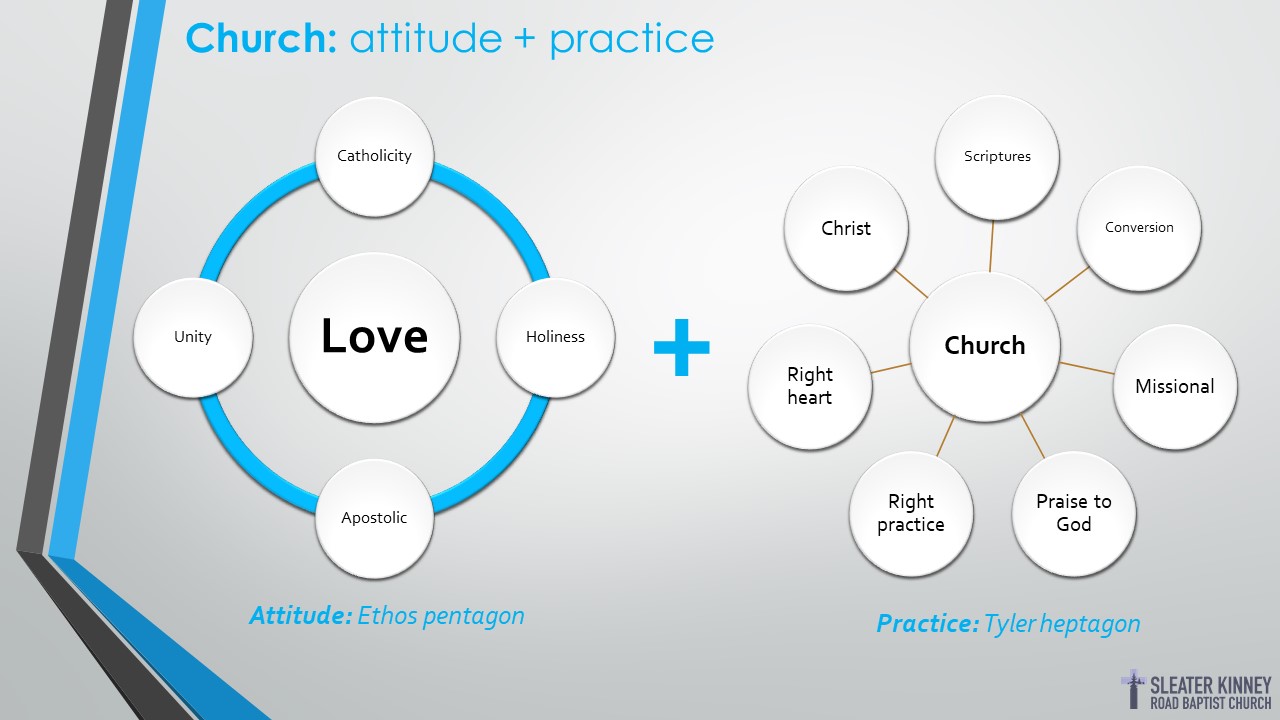
I’m adding “brotherly love” (inspired by Emil Brunner[6]) as the animating force which drives the four classic marks from Nicaea (cf. 1 Jn 3-4). So, we’re left with a pentagon that looks like this:[7]

Love. This is most clearly seen in 1 John 3-4, which I don’t have space to discuss in detail. “The person who doesn’t love does not know God, because God is love,” (1 Jn 4:8). If this ethos doesn’t animate everything a church does, then it’s nothing, worthless, a fraud (1 Cor 13:1-3; see also Col 3:8-17 (cf. Eph 4:1-5)). Love the fundamental mark of Christianity.[8] Emil Brunner writes:

The Spirit who is active in the Ekklesia expresses Himself in active love of the brethren and in the creation of brotherhood, of true fellowship.[9]

The one thing, the message of Christ, must have the other thing, love, as its commentary. Only then can it be understood and move people’s hearts. True, the decisive thing is the Word of witness to what God has done. But this Word of witness does not aim merely to teach, but also to move the heart.[10]

The song “Proof of Your Love” (by for KING & COUNTRY) sums up this “brotherly love” ethos that should drive the classic four Nicene marks.

A church is only a true church to the extent its attitude, mood, and vibe is one of love for one another, and for the lost. This suggests a congregation with a consistently pugilistic, angry, outraged face towards the world may not even be a “church” at all.

Oneness ≈ Unity. This is an attitude—all Christ-followers are part of the same community, the same brotherhood! Christ is the Head of one body, one community, one congregation—this is why the biblical references are sometimes to one particular congregation, or to all the scattered congregations considered as a whole.

The Church is “one” because Father, Son, and Spirit are One. The Church shares the same faith (Eph 4:5). The Church partakes of the same “loaf” of bread, and the same “cup of blessing” at the Lord’s Supper (1 Cor 10:16-17; Eph 4:5). The Church shares in the same baptism (Eph 4:5). Perhaps it’s helpful to see Christ’s congregation as “one” in the sense that every true church or denomination is a distinct branch of the one tree that is Christ’s body.[11]

You only have a true church to the extent that it recognizes other groups of genuine Christ-followers as brothers and sisters in the same family. This suggests that, to the extent that your congregation is exclusivist, it may well be a false church.

Holiness. We want to “keep Christianity weird” by obeying God’s laws because we love Him. This means we think, live, and act differently than the world around us, because we’re guided by God’s values. Though it’s an anachronism to impute this to Nicaea, we’re essentially talking about the doctrine of separation (rightly understood). Christ wants His church to be pure when He returns (Eph 5:25-27).

A church is only a true church to the extent that it, as a local fellowship, shows God’s love to the world by the transformed lives of its members![12] If a church does not push an ethos of personal and corporate holiness—doing what His word says!—then it may be a false “church.”

Catholic. God’s family is bigger than your tribe—His community has existed since Adam and Eve, across space and time, encompassing millions of men, women, boys, girls—even today! See Revelation 5:9-10 and 1 Corinthians 12:12-27.

We learn from one another, across man-made geo-political, racial, cultural, and gender boundaries because we’re all part of the same family, with gifts to bring to the table! It also means this brotherhood in Christ is meant for the whole world—to be spread everywhere, not ghettoized in a particular area.[13]

Beth Felker Jones writes that we ought to:[14]

  1. Recognize that no one part of the church is the whole body of Christ.
  2. Rejoice in the shared doctrine and practice that belong to the whole church.
  3. Allow differences to flourish, without seeing it as a threat to unity.
  4. Humbly listen to and be willing to learn from other parts of the body.
  5. Look for and rejoice in God’s active work in the whole world.

You only have a true church to the extent that it learns from other genuine Christ-followers and works together to spread God’s message. If you believe only your tribe is a “true church,” no matter how finely you try to finesse it, then your “church” may be a false church.   

Apostolic. This means holding fast to the true and apostolic teaching about the Gospel and Christian life—Jesus and Peter wouldn’t think your message was crazy.[15] A continuity of belief with the past—built upon the apostles and prophets. Christianity has content—it isn’t playdough (Jude 3; Eph 2:20).

You only have a true church to the extent that it believes, teaches, and lives out what Jesus and the apostles taught. So, for example, the lower your church’s doctrines of major concern rank on Paul Henebury’s Rules of Affinity, the less “true” your church may be.

Who cares? A Methodist and an Anglican will tell us why. Beth Felker Jones explains:[16]

  1. Unity: in a world of strife, we show God’s love by our love for one another, and mirror God’s own unity.
  2. Holiness: we show the world the alternative to brokenness and wrongness—God’s holiness.
  3. Catholic: in a world with emptiness and despair, we invite anyone to the table to share in God’s goodness so we can learn from each other and grow, together—treasuring particularity and differences.
  4. Apostolic: in a world full of lies, we tell the truth about God and His message of love and forgiveness.

Michael Bird notes the following:[17]

Practice—The Tyler Heptagon

Now, what about practice? I’ve never felt the Nicene marks (even augmented by “love”) was enough to capture what a “true church” ought to be about. So, I’ve gradually developed what I call the “Tyler Heptagon” as a general descriptor for a faithful local church:[18]

The components are not difficult to follow:

  1. Christ life + death + resurrection: these must be major emphases!
  2. Scriptures: they’re given by God and are our supreme authority.
  3. Conversion: emphases on repent + believe + grow.
  4. Missional: Gospel message and its fruit expressed in a “conscience of the kingdom” ethos in society. This is a major failing for too many local churches. If you have no practice of evangelism, your church is derelict in its duties. I’m not referring to fruit per se—I’m talking about effort. Are you doing anything, or is evangelism a passive wish?
  5. Praise to God: this must be a major emphasis!
  6. Right practice: a reformation, “always reforming” mindset—not a faith expression and doctrine set in immobile concrete.[19] Whatever you might say, if your every reaction to anything “new” or “other” as related to your faith tradition is immediate hostility and a “run away!” mindset, your feet are set in concrete.
  7. Right heart and motivations: These are affections—an honest love for God must be behind everything we say and do … or else we get everything wrong.

What Does This Mean?

When you consider both ethos and practice, to the extent these things aren’t there, or are weak, your church is unhealthy or maybe even false. In a shadowy but indefinable way, at some point if enough of these things are weak or missing altogether, you don’t have a true church at all.

Think about it this way—at what point is a car a junker? When the seatbelt won’t buckle unless you slam it really hard? When the sliding doors on the minivan won’t open, anymore? When it won’t start consistently? In isolation, these aren’t deal-breakers. But, when they’re all persistently there, at some point you stand back and admit, “yeah … this car is a piece of junk!” You didn’t realize it until that moment, and maybe you can’t pin down the exact moment the car became a piece of junk. But, still … now you wake up and realize you drive a piece of junk car.

As you consider ethos and practice, it’s the same with a local church. The state of a church—at what point it “becomes” unhealthy or perhaps even false—is a totality of the circumstances assessment, and a number of factors could push it across the line. Perhaps these two metrics, ethos and practice, will help as you consider how to make your own church healthier.

Our churches will never be perfect. But, they can all be better. Let love inform your ethos. Doctrine without love is nothing. Purity without love is nothing. A church that doesn’t evangelize is derelict. A rigid dogmatism without heart is death. A closedmindedness to further reformation is no virtue. Let’s make our churches be more about Jesus than a reflection of our sectarian battlelines.


[1] Emil Brunner doesn’t like to consider the church from an institutional perspective, preferring instead to speak in a wholistic sense of a brotherhood of all who share faith in Christ. To him, the institutional church is the shell or instrument of the ecclesia. I get what he’s saying, but when it gets down to brass tacks, out of the clouds, people need to know when they’re in a true, bona fide, legitimate local assembly. We must speak of the church on the local, institutional basis, too. So, here I stand.

[2] Brunner, The Christian Doctrine of the Church, Faith, and the Consummation, p. 128ff. 

[3] Beth Felker Jones, Practicing Christian Doctrine: An Introduction to Thinking and Living Theologically (Grand Rapids: Baker, 2014), p. 195.

[4] Grudem, Systematic, p. 853.

[5] Πιστεύομεν … εἰς μίαν ἁγίαν καθολικὴν καὶ ἀποστολικὴν ἐκκλησίαν.

[6] See my article “Brotherly Love and the Church.” 23 October 2020. https://bit.ly/3qhLzdy

[7] For my discussion of the four marks, I’m generally following Michael Bird as a base unless I specifically note otherwise (Evangelical Theology: A Biblical and Systematic Introduction (Grand Rapids: Zondervan, 2020),pp. 833-842.

[8] The Cape Town Commitment (2010) reads: “The people of God are those from all ages and all nations whom God in Christ has loved, chosen, called, saved and sanctified as a people for his own possession, to share in the glory of Christ as citizens of the new creation. As those, then, whom God has loved from eternity to eternity and throughout all our turbulent and rebellious history, we are commanded to love one another. For ‘since God so loved us, we also ought to love one another,’ and thereby ‘be imitators of God…and live a life of love, just as Christ loved us and gave himself up for us.’ Love for one another in the family of God is not merely a desirable option but an inescapable command. Such love is the first evidence of obedience to the gospel, the necessary expression of our submission to Christ’s Lordship, and a potent engine of world mission,” (Article 1.9, https://lausanne.org/content/ctc/ctcommitment#p1-9).

[9] Brunner, Church, Faith, and Consummation, p. 134. 

[10] Brunner, Church, Faith, and Consummation, p. 136. 

[11] This is what Alister McGrath calls the “biological approach” to oneness (Christian Theology: An Introduction, 3rd ed. (Malden: Blackwell, 2001), p. 497). 

[12] “When the church is holy, we bear visible and material witness to God’s love for the world,” (Jones, Christian Doctrine, p. 201).

[13] Brunner, Church, Faith, and Consummation, pp. 122-123. 

[14] Jones discussed this under a “ecumenical” heading in the introduction to her systematic theology (Christian Doctrine, pp. 4-9), but I co-opted it as a great shorthand to describe the catholic ethos a church ought to have. Hopefully, she’ll forgive me! This is quoted nearly verbatim—it isn’t my paraphrase.

[15] Michael Svigel helpfully suggests seven teachings that summarize the Christian message:  (1) the triune God as Creator and Redeemer, (2) the fall and resulting depravity, (3) the person and work of Christ, (4) salvation by grace through faith, (5) inspiration and authority of Scripture, (6) redeemed humanity incorporated into Christ, and (7) the restoration of humanity and creation (RetroChristianity: Reclaiming the Forgotten Faith (Wheaton: Crossway, 2012), pp. 175-176).

[16] Jones, Christian Doctrine, pp. 203-204. What follows are my summaries of Jones’ comments—they aren’t quotes.

[17] Bird, Evangelical Theology, p. 842.

[18] This began life as my own re-phrase of what I call the “Stackhouse hexagon,” which was itself inspired by David Bebbington (John Stackhouse, “Generic Evangelicalism,” in Four Views on the Spectrum of Evangelicalism, ed. Andrew Naselli and Collin Hansen (Grand Rapids: Zondervan, 2011), pp. 123-124). However, it’s been colored by so much reading, and I’ve added and subtracted and modified so much, that I feel free to give it my own label, at this point. Stackhouse (and Bebbington) used their models as theological descriptors of evangelicalism. In my modification, I use it as a model for a “generically faithful local church.”

[19] See especially Roger Olson on the perils of a “conservative” mindset that, in functional practice, believes the Spirit has nothing new to teach the church to better live out the Christian faith as revealed in Scripture (How to be Evangelical Without Being Conservative (Grand Rapids: Zondervan, 2008), pp. 13-42).

A Blast from the Fundamentalist Past!

A Blast from the Fundamentalist Past!

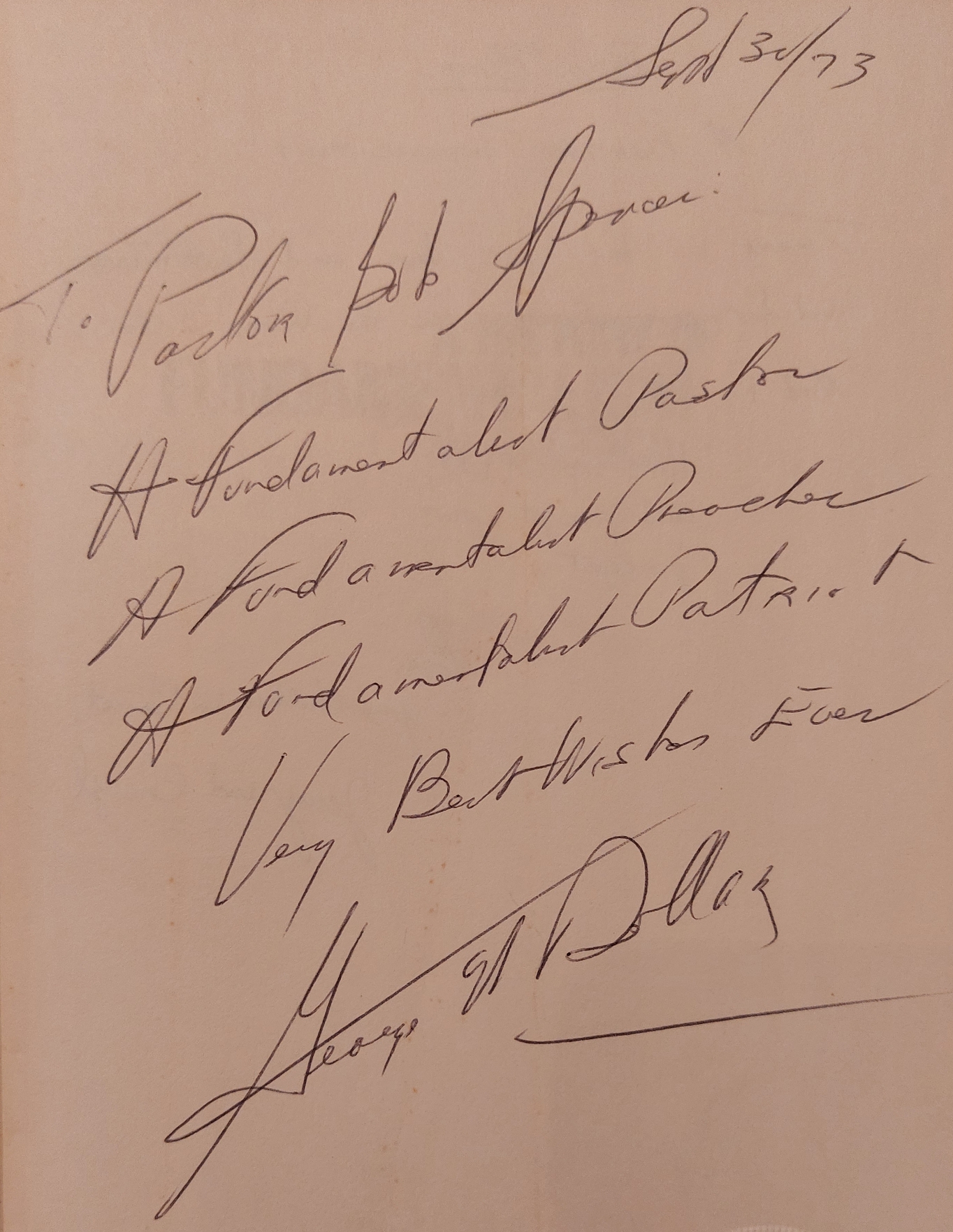
When a used book arrived in the mail yesterday, I realized I had accidentally struck gold. It was George Dollar’s A History of Fundamentalism in America (Greenville: BJU Press, 1973). It was autographed by the author. It looks like it has sat on a shelf, unread and untouched, lo these past 49 years.

Tucked inside the inside flap of the dust jacket were two sparkling diamonds. First was a long list of “Influential Leaders in Contemporary Christendom,” compiled by Archer Weniger, a hard line Baptist fundamentalist leader of yesteryear. This list reflects the northern Baptist fundamentalist emphasis on secondary separation. You must categorize people and organizations, so you know from whom to separate. Note especially a category labeled “Blacks.”

Finally, I found a short pamphlet updated and published by Dollar in 1983 titled “Facts for Fundamentalists.” It provides a taxonomy of fundamentalist organizations, schools, radio ministries, camps, etc. The rationale for its existence is the same as Weniger’s list.

This is a fascinating and truly amazing time capsule into a flavor of Christianity that has largely passed away. Pockets of it still exist; you can find representative echoes of it in some corners of the Foundations Baptist Fellowship International.

Here are some pictures of these documents. Clearer, PDF versions of the same are at the hyperlinks, above.

Much Ado About Something: A New Christian Fundamentalism for 2022

Much Ado About Something: A New Christian Fundamentalism for 2022

A new fundamentalism has arrived on the scene in the evangelical world. It’s kinda like legacy fundamentalism, but also kinda not. I believe the various evangelical scenes are on the precipice of a newer fundamentalist-modernist split. In this video essay, I review components of generic, faithful Christianity, define and give examples of second-stage legacy Baptist fundamentalism, then make some observations of and connections to the 2022 evangelical scene.

If you don’t want to watch the video, you can find the notes from my discussion here. They include a bit more nuance than what I managed to convey in the video.

  • 0:00 – 00:45: Introduction
  • 00:45 – 03:57: Generic, bible-believing Christianity. The “Stackhouse hexagon”
  • 03:57 – 11:32: Brief survey of second-stage, “legacy fundamentalism”
  • 11:32 – 14:52: Introducing “fundamentalistic evangelicals”
  • 14:53 – 21:27: Pressures that have created this new fundamentalism
  • 21:28 – 26:07: Hamilton’s “political quadrilateral” and its implications
  • 26:08 – 28:07: The shifted battlespace for fundamentalism compared to 1920
  • 28:08 – 35:56: Observations about this new fundamentalism
  • 35:57 – 43:26: Sketching part of the new fundamentalist landscape
  • 43:27 – 45:23: A “convergence” between elements of legacy fundamentalism and the new?
  • 45:24 – 51:03: Why you should care

For the podcast version of this video, see here. The song “The Proof of Your Love” (by For King & Country) captures my fears about the danger of a militant ethos coloring the Christian faith—where is the love of Christ?

Questions and Answers … about Scripture

Questions and Answers … about Scripture

I’m writing a short book about what Christians believe by doing an exposition of the 1833 New Hampshire Confession of Faith. This is a beautiful Baptist confession that’s the basis for the GARBC Articles of Faith, and the SBC’s Baptist Faith and Message 2000, among others. My audience is the ordinary, interested Christian. I explain the Confession by asking a series of questions of each Article. Here’s the first section …

Article 1

We believe that the Holy Bible was written by men divinely inspired, and is a perfect treasure of heavenly instruction;[1] that it has God for its author, salvation for its end,[2] and truth without any mixture of error for its matter;[3] that it reveals the principles by which God will judge us;[4] and therefore is, and shall remain to the end of the world, the true centre of Christian union,[5] and the supreme standard by which all human conduct, creeds, and opinions should be tried.[6]

1833 New Hampshire Confession of Faith, Article 1

1.1. What does it mean that the men who wrote the Scriptures were “divinely inspired?”

The Apostle Paul said all scripture was “inspired by God” (2 Timothy 3:16), which means He gives it life, animates it, creates it. It means the Holy Spirit guided the authors to write just what He wanted, down to the level of individual word choice, while still retaining each author’s unique personality, style, and voice. God makes us as we are—shaping us from birth, molding our personalities and gifts. This means when He used, say, the Apostle John or Moses to write scripture, He was using special people He’d been preparing for a long time. The Apostle Peter explained spoken prophecy a similar way when he wrote that the Holy Spirit “led” people to speak for God (2 Peter 1:21).

So, this isn’t dictation, as if God seized the Apostle Peter’s hand and guided him like a robot, the way the rat Remy directed the hapless boy Linguini to cook, in the movie Ratatouille. Instead, it seemed to be an almost unconscious partnership, where God provided thoughts and impressions to people, who wrote what He wanted them to write, which is what He’d planned all along.[7] The Holy Spirit worked on people’s hearts and minds, moving them to remember and understand God’s truth, and to record it as He wanted.[8] This is why Luke tells us the Holy Spirit spoke through David (Acts 1:16), and the Apostle Peter referred to the Book of Deuteronomy and said, “God spoke long ago through his holy prophets,” (Acts 3:21).

1.2. In what way is Scripture a “perfect treasure” for us?

Because it has everything we need for life and godliness (2 Peter 1:3). A long time ago, one Baptist theologian wrote “[t]he Bible is the collection of writings which explains to him the life he has found in Christ.”[9] Like a fantasy epic, it slowly unfolds the true story of reality. It tells us how creation began, who we are, why we’re here, what’s wrong in this world, what’s wrong with us, how we find hope, and how this world will end. In this way, it’s a perfect treasure of heavenly instruction.

It is important to note that scripture does nothing in and of itself—it’s simply a vehicle for God to work. In order for this “perfect treasure of heavenly instruction” to work on us, we need a divine encounter + the message of the scripture + an honest reception and acknowledgment by a believing heart. In other words, the bible isn’t an IKEA instruction manual. You can’t read John 3, do what it says by rote, and “be all good.”

There must be an initial divine encounter. God must confront you for salvation in the person of Jesus Christ, through the Holy Spirit. He then confronts you for growth as you grow in the faith and read the scripture, applying the message to your life, enabling your heart to receive and be instructed by that message.  

1.3. What does it mean that the Bible has “salvation for its end”?

It means the Bible’s purpose is to tell us about the salvation God offers through Jesus Christ. There are many ways to sum up the Bible’s message. But, the basic “story” is that God is choosing and rescuing a special people to be with Him forever in His future kingdom community. Why is God saving or “rescuing” people? John 3:16 doesn’t exist for its own sake—it’s in aid of something more … something like a kingdom community. Revelation 21-22 shows us this.

Here is one way to picture the Bible’s story of “salvation for community” as an eight-episode mini-series:

1.4. Truth without any mixture of error? Is the Bible without error?

Solomon said God’s words were “tried and true, a shield for those who take refuge in Him,” (Prov 30:5). His promises are pure (Ps 12:6). The first thing to know about God’s word is that it’s true (Ps 119:160). Jesus said His word is truth (Jn 17:17). The Apostle Paul declared that God must be true, even if every person on earth is a liar (Rom 3:4).

Some Christians prefer to say the Scriptures have no errors and are therefore “inerrant.” But, as the passages above suggest, it’s more helpful to say the Scriptures are totally truthful in all they affirm, and are therefore His safe and reliable guide for His adopted children. This is more helpful because you’re framing it in a positive manner. You could say your child is “never bad.” But, it’s better to say “Peter is a nice, sweet boy.” It’s the same way with God’s word—it’s totally truthful and reliable.

The Scriptures came to us from many writers over 1,500 years. Each book came from the unique personality of its writer, each book uses the culture of its own time as the vehicle for revelation, and the writers used very different genres or styles.[10] This means we must take very good care to be sure we’re understanding it correctly, according to those personalities, cultures, and genre.[11]

For example, regarding personality, the Apostle Paul was a very educated man, which is why he wrote the Letter to the Romans and Peter did not. On culture, you’ll find it difficult to understand the prophet Hosea’s thunderous denunciation of the Northern Kingdom unless you know that he wrote it during Jeroboam II’s reign, when that kingdom was at its secular and economic zenith. When it comes to genre, if you understand that, say, Zechariah and Revelation were written in an apocalyptic style that’s intended to paint large, abstract pictures with startling imagery using figures that made sense to their own authors, in their own time … then you won’t spend time “decoding” the color of horses (Zech 1:7-17) or looking for a woman on top of a seven-headed monster (Rev 17:3f).  

The problem is when people confuse their interpretation of the Bible with the Bible itself. If you do that, when you find someone who has a different interpretation, you might say, “he doesn’t believe the Bible!” Maybe. Or, maybe not! You must always remember two things; (1) your interpretation is not always the same thing as the Bible, and (2) some questions are really hard, and scriptural evidence may indicate more than one reasonable conclusion.

Finally, remember that the scriptures aren’t an encyclopedia, a geology book, or an astronomy text. They’re a collection of books which tell us how we got here, what went wrong, how God can rescue us, and what His plans are. God could have given us inspired texts about biology, physics, chemistry, and more. But, He didn’t. He gave us revelation that is “a perfect treasure of heavenly instruction” which has “salvation for its end.” Evaluate its total truthfulness in that light.  “We must let the Bible tell us its own story and not hold it to false standards and tests.”[12]

1.5. What are the principles by which God will judge us all, one day?

There are two great questions every person will face: (1) have you repented and believed the Gospel, and if so, (2) have you served Christ with your life since your conversion?

You can think of the first question as a screening process—those who do not pledge loyalty to Christ don’t get the second question. The first question determines eternal destiny. The second question is about your faithfulness as Christ’s servant during the rest of your earthly life—your life will show what’s in your heart (Mt 12:33-35, 15:16-20, 16:24-25).

Jesus was clear about the first question. He told people to repent and believe His good news (Mk 1:15). His Gospel was about more than individual salvation; it was the promise to bring justice to a new society and liberate the oppressed (Isa 11:1-12; esp. v.4; Ps 72:4), to kill the wicked (Isa 11:4), to reverse the curse of the Fall (Isa 35:5-6; Mt 11:2-6)—all on the condition of loyalty, allegiance, of faith. It was the promise to fix this world and to fix each of us—everyone who comes for rescue. If you don’t believe the Son, God’s angry judgment remains on you (Jn 3:36).

The second great principle is about what a Christians builds atop the foundation of Jesus Christ (1 Cor 3:10-15). You’re a Christian—now what? What kind of “house” are you building on that foundation; a cheap one or a quality one? Do you use the cheapest materials, like wood, grass or hay? Or, do you use the finest ones—gold, silver, precious stones?

Christians often want to know what these “gold, silver, and precious stones” are! This isn’t the place to make a list, but surely things like (1) reading God’s word, (2) prayer, (3) a life of repentance, (4) a thirst for God to gradually change your heart, mind, and life to reflect Christ’s image, (5) membership in and service to your church community, and (6) sharing the Good News (which can take a whole lot of forms) must be on the list.

The scriptures tell us about all of this, in so many ways. It reveals these two great principles by which Christ will judge us.

1.6. What does it mean that the Bible is the “true center of Christian union?”

Christians can theoretically be on the same page, because we have the same book. The Apostle Paul said, “I encourage you, brothers and sisters, in the name of our Lord Jesus Christ: Agree with each other and don’t be divided into rival groups. Instead, be restored with the same mind and the same purpose,” (1 Cor 1:10). How do we overcome rivalries? By bowing down, together, under the authority of God through the scriptures. By evaluating our denominational traditions and habits through the filter of the Word.

In another place, Paul wrote this:

… make an effort to preserve the unity of the Spirit with the peace that ties you together. You are one body and one spirit, just as God also called you in one hope. There is one Lord, one faith, one baptism, and one God and Father of all, who is over all, through all, and in all.

Ephesians 4:3-6

How can Christians from different traditions not see themselves as enemies, but as family? How to preserve unity? By remembering that we’re each part of one body, because God called us by the same hope. There is one, triune Lord to love, one faith in Christ to confess, one baptism by the Spirit that changes our hearts, and one God the Father of us all. Where do we learn about all this, so we can be brought back to these truths? In the scriptures. This is why the Bible is the true center of Christian union. It’s the reference point for all matters of faith and life.

The question inevitably comes—why, then, are there so many Christian denominations? Well, because we disagree about interpretations of that faith and life. These are inter-family disputes that don’t change the fact that all true Christians are family. It’s a sad thing that some believers forget that.

The next question—who is a true Christian? How do we know who is inside the family, so we know with whom we ought to seek union? If a person has repented, believed the Gospel, and has Christian fruit in her life as a mark of the new birth, then she is a Christian.  

1.7. Says who? The Bible as the “supreme standard.”

Teachers are good. Pastors are called by God. Books are a blessing. But, the only infallible source of authority for the Christian life are the scriptures. This is why the bible is the “supreme standard” by which you measure anything else.


[1] 2 Tim. 3:16, 17; 2 Pet. 1:21; 2 Sam. 23:2; Acts 1:16; 3:21; John 10:35; Luke 16:29–31; Psa. 119:111; Rom. 3:1. 2.

[2] 2 Tim. 3:15; 1 Pet. 1:10–12; Acts 11:14; Rom. 1:16; Mark 16:16; John 5:38, 39.

[3] Prov. 30:5, 6; John 17:17; Rev. 22:18, 19; Rom. 3:4.

[4] Rom. 2:12; John 12:47, 48; 1 Cor. 4:3, 4; Luke 10:10–16; 12:47, 48.

[5] Phil. 3:6; Eph. 4:3–6; Phil. 2:1, 2; 1 Cor. 1:10; 1 Pet. 4:11.

[6] 1 John 4:1; Isa. 8:20; 1 Thess. 5:21; 2 Cor. 13:5; Acts 17:11; 1 John 4:6; Jude 3:5; Eph. 6:17; Psa. 119:59, 60; Phil. 1:9–11.

[7] See Augustus H. Strong’s discussion of the “dynamic theory” of scriptural inspiration, in Systematic Theology (Philadelphia: American Baptist Publication Society, 1907), pp. 196, 211f. 

[8] Alvah Hovey, Manual of Christian Theology, 2nd ed. (New York: Silver, Burdett and Co., 1900), p. 63.  

[9] Edgar Y. Mullins, The Christian Religion in its Doctrinal Expression (Philadelphia: Roger Williams Press, 1917), p. 153.

[10] For more on this, see especially Bernard Ramm, Protestant Biblical Interpretation, 3rd ed. (Grand Rapids: Baker, 1970), pp. 201-214. For specific principles at the intersection of science and scripture, see Ramm, The Christian View of Science and Scripture (Grand Rapids: Eerdmans, 1954), pp. 17-117, 347-351.

[11] Donald Bloesch wrote, “The truthfulness of the Bible resides in the divine author of Scripture who speaks in and through the words of human authors, who ipso facto reflect the limitations and ambiguities of their cultural and historical milieu,” (Holy Scripture: Revelation, Inspiration & Interpretation (Downers Grove: IVP, 1994), p. 37).

[12] Mullins, Christian Religion, p. 153. Blosech makes a similar point, “The biblical text is entirely truthful; when it is seen in relation to its divine center, God’s self-revelation in Jesus Christ,” (Holy Scripture, p. 37).

Jesus v. Moses: a translation conundrum

Jesus v. Moses: a translation conundrum

At the end of Paul’s sermon in Pisidian Antioch, he makes a curious statement (Acts 13:38-39). It’s hard to figure out what he means. There’s no way a translation can be neutral, here. You have to interpret stuff to make it coherent. What does Paul say? I’ll quote the Common English Bible for a good, representative translation–pay attention to the areas I underline, because that’s where the question marks are:

Therefore, brothers and sisters, know this: Through Jesus we proclaim forgiveness of sins to you. From all those sins from which you couldn’t be put in right relationship with God through Moses’ Law, through Jesus everyone who believes is put in right relationship with God

Acts 13:38-39, Common English Bible

The two questions are this:

  1. What do the two words mean that the CEB translated as “be put in right relationship with God?” Your English version probably has “justified” or “made righteous.” What do they mean, in this context?
  2. Next, what exactly is Paul referring to when he refers to “Moses’ law”?

These questions don’t have obvious answers. I’ll briefly explain why and provide my own conclusions, in reverse order.

What is Moses’ law in Acts 13:38-39?

How is Paul seeing “Moses’ law,” here? There seem to be at least three options:

  1. If Paul is taken literally, then there was no salvation before Christ. If true, then Abraham wasn’t justified—but that is false (Gen 15:6, Rom 4:3)—Old Covenant saints were justified by faith. This option is incorrect.
  2. If Paul is obliquely referring to the perversion of the law under which so many Jews groaned (cf. his own experience—Rom 7—that the law was the vehicle for righteousness), then it could make sense because Jesus fulfilled the law’s demands and taught a correct view of it (R.J. Knowling, Acts, in Expositor’s Greek Testament, p. 297; F.F. Bruce, Acts, in NICNT, pp. 278-279; Simon Kistemaker, Acts, p. 488; John Calvin, Acts, p. 572).
  3. Or, if Paul is referring Jesus making the final atonement and granting perfect peace in heart and mind (Schnabel, Acts, in ZECNT, p. 584), this could also make sense.

The second sense seems to be best because, as Bruce notes, that’s the way Paul frames the matter in his epistles! This is perhaps the most difficult bit of Paul’s argument to follow in Romans and Galatians. Paul generally didn’t argue against the Old Covenant law as it really was. Instead, he argued against the perverted form of it that was common in his day. Unless you get that, I don’t believe you’ll get his discussions of the law v. gospel in his epistles. This has been the source of endless confusion among both pastors and church members. The law was never a vehicle for becoming righteous. It was a prescribed code to regulate an existing saving relationship, and to bring awareness of your own sinfulness–so you’ll embrace the Messiah when he comes to fulfill the law’s demands in your place. Your children don’t do their chores in order to become part of your family. They do their chores because they already are part of your family, and are simply meeting obligations of that relationship.

So, I believe we should assume both that (1) Luke captured the sense of Paul’s words correctly (contra. C. K. Barrett, Acts, in ICC, 1:650), and (2) that Paul was consistent in the way he framed the law and the Gospel when he spoke to Jewish audiences. When he said Jesus could free them from the sins which the Mosaic Law couldn’t, he was in essence saying “you were taught you’d be made righteous by following the law, but you can’t do it right, and your sins always remind you of that! But, guess what? Anyone who believes in Jesus is set free from that never-ending treadmill of failure, that unending quest to earn salvation!”

What do those two words mean?

Look at your bible. What can Jesus do, that Moses’ law (properly understood) could not do? English translations vary. Here are some different usages (I paraphrase the sense but keep their word choices):

  1. ESV, NASB, RSV: Moses’ law couldn’t free you, but Jesus will free you.
  2. ISV: Moses’ law couldn’t justify you, but Jesus will justify and free you.
  3. NLT: Jesus will make you right, but Moses’ law couldn’t.
  4. NET, KJV, Jay Adams, CSB: Jesus can justify you, but Moses’ law could not.
  5. NEB, REB: Jesus can acquit you, but Moses’ law couldn’t.
  6. NIV: Jesus will set you free, which is a justification Moses’ law couldn’t achieve.
  7. Phillips: Jesus can absolve you, whereas Moses’ law couldn’t set you free.
  8. CEB: Jesus will put you into right relationship with God, whereas Moses’ law couldn’t put you into right relationship with God.
  9. N.T. Wright: Jesus can set you right, but Moses’ law couldn’t set you right (the same sense as CEB, above, but with different words).

As far as what on earth δικαιωθῆναι and δικαιοῦται mean (our two words), the most logical sense is “freedom” from the perversion of the law that Judaism too often championed. That is, freedom from the error that Moses’ law was a vehicle for salvation. That idea is wrong; it was never a means of “being made right” before God. Rather, it was the prescribed shape for one’s already existing relationship with God by faith in the promised Messiah! This is the same “freedom” Paul championed in Romans and Galatians.

I believe that, in his conclusion at Acts 13:38-39, Paul is calling them to believe in Jesus as Messiah and obliquely pushing against their false idea of salvation at the same time. He doesn’t stop to explain why their perverted view of Moses’ law was wrong. He assumes they hold this wrong view (he’s speaking during a synagogue service!), and that assumption is behind his statement that Jesus can free them from the weight of perfection they assume they must meet, according to their wrong view of Moses’ law.

As far as translation goes, here are my thoughts:

  1. You must strike a balance between translation and exposition. That is, if your translation veers off too far into explaining what it means, then you’ve lost your balance. That means a translation has to be willing to leave some ambiguity on difficult subjects, or it won’t be a translation. That’s why commentaries and sermons exist–to explain and apply.
  2. The renderings “justify” and “made righteous” are of little value. They communicate nothing to unbelievers. I think we ought to freshen the concepts up by setting these words aside, and choosing words that actually communicate.
  3. There are two good options for translating these words. First, it could carry the sense of being declared to be conformed to God’s will in purpose, thought, and action (Abbott-Smith, Manual Lexicon, p. 116), or to be acquitted or cleared in a legal sense (Mounce, Expository Dictionary, p. 1125; cf. BDAG, p. 249, ¶2). Another possibility is that of freedom or release from a claim that no longer has any hold over you (BDAG, p. 249, ¶3; cf. Barrett, Acts, 1:650; Phillips trans.).
  4. If you choose the sense of acquittal, you mean that Moses’ law could never do that for you, but Jesus can. But, the Bible doesn’t teach that Moses’ law was ever meant to do that, so you’ll have to assume that Paul is implicitly referring to the wrong version of Moses’ law that was common at the time. This is possible.
  5. If you go for the “freedom from *****” scenario, you’re basically saying the same thing, but you’re framing it more as a welcome escape from an impossible burden–“I can’t follow the law perfectly, so I’m always gonna be a failure, so how do I escape this unending cycle!?” So, Paul says, “freedom is here, and it’s in Christ!”

With either option, you have to assume a great deal about what Paul means when he speaks about Moses’ law. You can only get that from his epistles, primarily Galatians and Romans. This isn’t the place to “prove” a position on that score, so I’ll simply conclude with that. My answers to the two initial questions are:

  1. Both words give the sense of “freedom or release from a claim or obligation that no longer has any hold.”
  2. When Paul refers to Moses’ law, he means the wrongheaded interpretation of Moses’ law that was common at the time–that the law was a vehicle for achieving a right relationship with God.

After all that, here is my translation of Acts 13:38-39:

γνωστὸν οὖν ἔστω ὑμῖν ἄνδρες ἀδελφοί ὅτι διὰ τούτου ὑμῖν ἄφεσις ἁμαρτιῶν καταγγέλλεται καὶ ἀπὸ πάντων ὧν οὐκ ἠδυνήθητε ἐν νόμῳ Μωϋσέως δικαιωθῆναι ἐν τούτῳ πᾶς ὁ πιστεύων δικαιοῦται

So, understand this,[1] brothers and sisters: forgiveness of sins is announced to you right now,[2] through[3] Jesus,[4] and[5] from all those sins from which you weren’t able to be set free[6] by Moses’ law—by Jesus[7] everyone who believes is set free!


[1] This is very odd grammar. In γνωστὸν οὖν ἔστω ὑμῖν, there seems to be an implied imperative subject (which could be rendered as “let this”), of which γνωστὸν is the predicate nominative. The result is something like “Therefore, let this be known to you …” I made it more colloquial.

[2] I take καταγγέλλεται to be a descriptive present, picturing an event unfolding at the time of speaking. The wording “right now” tries to capture that flavor. It’s very tempting to ditch the passive voice and render it as a present (e.g. CEB), but I resisted the urge.  

[3] The preposition expresses personal agency.  

[4] Jesus is the pronoun’s antecedent.  

[5] This is καὶ, in an additive sense (cf. Tyndale; N.T. Wright, Kingdom New Testament). It could be ascensive (Barrett, Acts, 1:650), but I decided it was best as additive.  

[6] δικαιωθῆναι is a simple infinitive, complementing οὐκ ἠδυνήθητε. The word here, commonly translated “righteous,” carries the sense of being declared to be conformed to God’s will in purpose, thought, and action (Abbott-Smith, Manual Lexicon, p. 116), or to be acquitted or cleared in a legal sense (Mounce, Expository Dictionary, p. 1125; cf. BDAG, p. 249, ¶2). Another possibility is that of freedom or release from a claim that no longer has any hold over you (BDAG, p. 249, ¶3; cf. Barrett, Acts, 1:650; Phillips trans.).

[7] I take ἐν τούτῳ to be depicting personal agency (“by/through Jesus”), but it could be the object of the verb (“everyone who believes in Jesus,” cf. Barrett, Acts, 1:651).

A kingdom without borders

A kingdom without borders

This Sunday, I preached on Epiphany, which is when the Church around the world celebrates the revelation of the Gospel to the Gentiles, often in the person of the magi who came from the East to worship the Christ child in Bethlehem. This precious event shows us that God’s kingdom is one without borders, where anyone who thirsts for righteousness can enter in.

Here, I’ll provide the sermon, along with the introduction and concluding exhortation.

Same song, different day

Picture three scenes. They have very different contexts, but they each have something in common. Try to figure out what that is:

Scene 1: A.D. 57:[1] Paul is arrested in Jerusalem, charged with bringing Gentiles into the inner courtyard (Acts 21:27-36)—this “crime” doesn’t exist in the Old Covenant!

Scene 2: A resolution from the Clarendon Baptist Church, in Alcolu, SC, in October 1957, in the wake of cultural backlash against the Brown v. Board of Education decision:[2]

We believe that integration is contrary to God’s purposes for the races, because: (1) God made men different races and ordained the basic differences between races; (2) Race has a purpose in the Divine plan, each race having a unique purpose and distinctive mission in God’s plan; (3) God meant for people of different races to maintain their race purity and racial indentity [sic] and seek the highest development of their racial group. God has determined “the bounds of their habitation

Scene 3: Post 9/11 America. Conservative evangelical Christians ramped up their anti-Muslim rhetoric.[3] You hear repeated statements about how Islam is bloodthirsty, a religion of hate. Jerry Vines, a former president of the Southern Baptist Convention, declared Muhammad was a “demon-possessed pedophile.” A church member gave me a book that argued that the antichrist will be a Muslim. There arose a cottage industry of evangelical charlatans who claimed they were former terrorists who knew “the truth” about Islam. I heard a missionary’s wife refer angrily to Muslims as “bastards of Islam.

What do these three scenes have in common?

The urge to exclude people “not like us” (whatever that “us” might be, it doesn’t matter what) from God’s kingdom—implicitly or explicitly:

  • Scene 1. There is no biblical warrant for a physical barrier between Court of Gentiles and the temple proper.
  • Scene 2. No biblical warrant for segregation in God’s family based on race.[4]
  • Scene 3. The implicit (and often explicit) message was, “Muslims are dangerous, Muslims will kill you, and President Obama is likely a Muslim who wants to impose sharia law.”

What does God say about this urge, this tendency of ours, that’s common to every culture? Who can join God’s kingdom?

Our passage today, from Matthew 2:1-12, tells us all about that. We’ll tackle it in two movements–(1) the foreigners arrive in Jerusalem, and (2) the foreigners arrive in Bethlehem.

Greek translation nerdiness

I translated two portions of the passage. I put that info here, just because I can’t think of another place they ought to go. If you know Koine Greek, and you’re interested in my translation and my syntax notes, then read on. Otherwise, skip this section.

Matthew 2:1-2 translation

Now, after[5] this Jesus[6] was born in Judean[7] Bethlehem in the days of Herod the King—listen to this, now![8]astrological scholars [9] from the East arrived in Jerusalem. They were asking everyone, [10] “Where is the newborn King of the Jews?[11] We[12] saw his star from[13] the East and we’ve come to worship him!”[14]

Matthew 2:9-11 translation

Now, after they heard from the king, they went out—and look![15]the star they’d seen in the East led them onward, until it came to rest over the place where the child was. When[16] they saw the star, they rejoiced with an unspeakable joy.[17] They went[18] into the house and saw the child with Mary,  his mother, and they fell on their knees[19] and worshiped[20] the boy. Then, they opened up their strongboxes and presented the child with gifts[21]—gold, worship incense,[22] and fragrant ointment.

Exhortation

Why did God bring these Eastern scholars to Bethlehem, that night?[23] Because the angels made the same announcement to them, that they made to the shepherds up to two years before, at the same time—it just took them nearly two years to get there!

Contrast that with what passed for the “Jewish nation,” at the seat of power in Jerusalem:

  • a dying, homicidal king—with delusions of grandeur!—who hatches a plan to kill the Messiah
  • scribes who are the worst example of civil servants = they can tell the scholars how to find the Messiah, but can’t be bothered to worship Him themselves![24]

Why did nobody else follow that star that dark night outside Jerusalem, to see what it meant? It’s possible these scholars from the East will rise up in judgment with the Queen of Sheba and the people of Nineveh (Mt 12:41-42)—because they believed when they had so little revelation. But the folks who ought to have known best … didn’t believe a word of it, or were too occupied with their lives to care

What is God teaching us?

  • That His kingdom has never had nationalist borders—it’s always been open to anyone who worships and obeys Christ. 
  • That sometimes the people who “know God” don’t Him at all.

What does God want us to do with what He’s saying—how can this make us more like Christ?

  • The church must accept anyone … if they come to worship and obey Christ. The shape of truth application depends on context. In Jesus’ cultural context, it meant non-Jews could actually be part of God’s family.
  • In a 2022 American context, it could mean many things. Think of a type of person (a cultural “other,” a true believer) with whom you’d be “uncomfortable” worshiping God on a Sunday morning, and then resolve to shove your discomfort aside.
  • Gentiles in Israel, black Christians in white churches, Muslims in American churches—who will be the next?

Epiphany teaches us that the only borders around God’s kingdom should be:

  • do I believe Christ is Lord and King?
  • have I bowed before Him in worship?   

And now, here is the sermon:


[1] My date here is from F.F. Bruce, Paul: Apostle of the Heart Set Free (Grand Rapids: Eerdmans, 1973), p. 475.

[2] Quoted in J. Russell Hawkins, The Bible Told Them So: How Southern Evangelicals Fought to Support White Supremacy (New York: Oxford, 2021), p. 45.

[3] See Laurie Goldstein, “Seeing Islam as ‘Evil’ Faith, Evangelicals Seek Converts,” in New York Times. 27 May 2003. https://nyti.ms/3HO1M0A. “Evangelicals have always believed that all other religions are wrong, but what is notable now is the vituperation.” See also FBFI Resolution 02.02 “Concerning Islam.”

[4] On the sociological role of this issue as early as the antebellum era, Mark Noll has written: “It was no coincidence that the biblical defense of slavery remained strongest in the United States, a place where democratic, anti-traditional, and individualistic religion was also strongest. By the nineteenth century, it was an axiom of American public thought that free people should read, think, and reason for themselves. When such a populace, committed to republican and democratic principles, was also a Bible-reading populace, that proslavery biblical case never lacked for persuasive resources,” (The Civil War as a Theological Crisis (Chapel Hill: University of North Carolina Press, 2006), p. 34).

[5] The participle γεννηθέντος is temporal.

[6] The article with Jesus in Τοῦ δὲ Ἰησοῦ anaphoric. John Broadus notes, “Literally, the Jesus, the one just mentioned; ‘this Jesus’ would be too strong a rendering, but it may help to show the close connection,” (Gospel of Matthew, in American Commentary, ed. Alvah Hovey (Philadelphia: American Baptist Publication Society, 1886), p. 15).

[7] A subjective genitive. There is more than one Bethlehem in the ancient world; e.g. Bethlehem of Zebulun (Josh 19:15). This “Judean Bethlehem” simply clarifies where Jesus was born.

[8] The particle ἰδοὺ is meant to draw attention to what follows. It’s a deliberate interjection to arrest the reader’s attention (BDAG, p. 468). Most EVV don’t translate it, which I think is a mistake. It might not make for smooth literature per se, but it’s what Matthew wrote, and we need to do something to catch the reader’s ear, in the same way.

[9] The terms “wise men” and “magi” communicate nothing. The term has its origins in the court magicians of the East (e.g. in the Babylon of Daniel’s era) who were experts in astrology, interpretations of dreams and visions, and other occult arts (BDAG, p. 608, 1). Later, into the NT era, the term broadened and referred to refer to a wide variety of men interested in dreams, magic, books, astrology, etc. (Carson, Matthew, p. 85).

It’s this last sense that fits best, here. “Matthew is probably using the word in a more general sense for the learned court advisers of Mesopotamia or Persian whose work involved studying ancient and sacred texts, as well as watching for movements of planets and stars that might be interpreted as divine messages,” (Mark Krause, “Wise Men, Magi,” in Lexham Bible Dictionary, ed. John D. Barry et al. (Bellingham: Lexham Press, 2016). The term could also refer to actual sorcerers or occultists, like the pre-conversion Simon (Acts 8) or the unfortunate Elymas (Acts 13). That is not likely, here.

So, I went with astrological scholars, because of the influence of the star. I could shorten it to “astrologers,” but that makes them sound a bit like New Age kooks.

[10] The participle λέγοντες is present-tense, and the context suggests they were asking repeatedly. Herod only “heard this,” they didn’t ask him directly. Herod sought them out. He could only have heard about their quest if they’d been asking many people, repeatedly. So, I translated this with an iterative flavor. It is attendant circumstance, contra. Quralles (EGGNT, Mt 2:1), whose preference for a purpose participle here would lead to an over-translated mess.

[11] A more literal rendering would be: “where is the one who was born king of the Jews?” (ποῦ ἐστιν ὁ τεχθεὶς βασιλεὺς τῶν Ἰουδαίων). The participle is the subject (Christ), and “king” is a predicate nominative, denoting an attribute the infant had from birth.  

[12] I dropped the explanatory γὰρ completely. 

[13] The preposition is spatial. 

[14] On “worship,” see the discussion at v. 9. Why hadn’t Jerusalem and Bethlehem embraced the boy as the Messiah, in light of the shepherd’s testimonies (cf. Lk 2:17-18)? It’d been two years, after all! Probably for the same reason some Christians today are extremely skeptical at reports that God still performs miracles. For example, few people have heard about Ed Wilkenson and his son, Brad, whom God miraculously healed of an atrial septal defect, with two holes in his heart. The boy and his father prayed for deliverance, and even had special intercession from their church, but all seemed hopeless as the boy went in for surgery. They determined the holes had disappeared, which had not been the case on x-rays done just the day before. The doctors were flabbergasted, and had no explanation. Brad is still fine, is now an adult, and played baseball later that same week. There was no surgery. See the account, with footnotes from personal interviews and review of medical documentation, in Craig Keener, Miracles: The Credibility of the New Testament Accounts, 2 vols. (Grand Rapids: Baker, 2011), 1:430-432.

What were these ramblings from these loser shepherds, anyway? Meh. Where’s the video evidence!? Away with them!

[15] Again, we have the particle of interjection, and it must be translated. “[L]ooking up to heaven as

they set out on their journey, they once more behold their heavenly guide,” (A.B. Bruce, The Synoptic Gospels, in Expositors Greek Testament (6th ed.), ed. W. Robertson Nicole (London: Hodder and Stoughton, 1910), p. 73.

[16] ἰδόντες is an adverbial, temporal participle, contra. Charles Quarles, who believes it is causal (Matthew, in EGGNT, Mt 2:10).  

[17] A literal translation would read something like “they were filled with very great joy” (ἐχάρησαν χαρὰν μεγάλην σφόδρα). The verb is passive, which is curious. It’s well-nigh impossible to replicate a passive sense of ἐχάρησαν, so in English we do an end-run around by changing the verb to something like “were filled,” or we drop the passive sense and do “they rejoiced.”

[18] ἐλθόντες is an attendant circumstance, following along after the exquisite joy they felt when they at last reached their destination, contra, Quarles (EGGNT, Mt 2:10), who thinks it’s temporal.  

[19] Πεσόντες is also attendant circumstance. 

[20] The word means “to express in attitude or gesture one’s complete dependence on or submission to a high authority figure,” (BDAG, p. 882; see also Abbott-Smith, p. 386). It could refer to reverence and submission to a human authority figure with no implication of deity (cf. Mt 20:20). However, the context here is worship to the child as the Messianic King—this is their self-proclaimed mission (Mt 2:2), and Herod and his court know it (Mt 2:3-8). One could quibble whether worship to Christ as divine is in view, or merely as “the king.” Most EVV use “worship,” except for the NEB, REB (“paid homage”) and the CEB (“honored him”). Broadus preferred “do homage,” because the scholars appeared to only honor him as king, not as deity (Matthew, p. 18).

[21] The three gifts which follow are accusatives of apposition, explaining what these gifts are—hence the em-dash.

[22] Λίβανον is a balsamic gum from the Boswellia sacra tree, native to southern Arabia and northern Somaliland. When the material hardened, it produced exquisite resin which was typically used for burning incense in religious ceremonies—including temple liturgy (e.g. Ex 30:34; see James Knox, “Frankincense, in Lexham Bible Dictionary). It is better to render it as “pure incense” or something similar; cf. Jay Adams, John Phillips = “incense,” and Julian Anderson = “fine, sweet-smelling incense.”

[23] I believe we have a solid circumstantial to argue that (1) angels announced the Savior’s birth to these Eastern scholars at the same time as they did to the shepherds in the field (cf. Lk 2:8-20), (2) that they followed the star to find the boy, (3) the star acted as a divine GPS and was not a natural phenomenon, and (4) they just now arrived after perhaps two years journey, to worship the boy. This accounts for (1) how they found out about Christ’s birth, and (2) why their knowledge (i.e. a newborn king of the Jews, born somewhere near Jerusalem) comports so well with the announcement the angels made to the shepherds.

Speculation regarding the star is generally absurd, and Broadus sums it up rather well (for the argument seems to have advanced nowhere since his day!): “Taking Matthew’s language according to its obvious import, we have to set aside the above explanations, and to regard the appearance as miraculous; conjecture as to its nature will then be to no profit. The supernatural is easily admitted here, since there were so many miracles connected with the Saviour’s birth, and the visit of the Magi was an event of great moral significance, fit to be the occasion of a miracle,” (Matthew, p. 17).

[24] Broadus: “The scribes should be a warning to all religious teachers, in the pulpit, the Sunday-school, the family; they told others where to find the Saviour, but did not go to him themselves,” (Matthew, p. 21).

Edgar Mullins’ Axioms and 2022 America

Edgar Mullins’ Axioms and 2022 America

Edgar Mullins was the fourth president of the Southern Baptist Theological Seminary. I recently finished his classic The Axioms of Religion: A New Interpretation of the Baptist Faith (Philadelphia: American Baptist Publication Society, 1908). His is a refreshingly simple exposition of Baptist Christianity. I’ll provide a sketch of Mullin’s position here, and note some of its implications and possible rebukes for modern Baptists in 2022 America.

Kingdom Principles and Polity

Mullins begins by presenting four principles for the Kingdom of God as guardrails for a biblical polity. They are:

Figure 1.

Christianity is not about rote obedience, but a relationship between God and man. Because God is our Father, that personal relationship shapes how we respond to His laws—not as frightened slaves, but as obedient sons and daughters. “Those in the kingdom call God Father, and those who call God Father are swayed and molded by the laws which are of the essence of the kingdom.”[1] All this presupposes we can know God, He can communicate and we can understand Him—revelation is possible. That revelation is in Christ, through the Scriptures:

The soul cannot thrive on abstract notions about God, just as a bird cannot fly in a vacuum, or a tree root itself in a bank of mist, or as a vine cannot climb a moonbeam. Christ made the idea of God concrete. Christ is God’s message to man. It is at this point that the authoritativeness and regulative value of the Scriptures come into view. The Scriptures alone enable us to maintain contact with the Christ of history.[2]

This all implies a revelation and a response, without the interposition of priests or efficacious sacraments. Christianity is a personal religion which asks for our faith:

Not faith in the sense of blind acceptance of hidden mysteries; not implicit faith in the sense of acceptance of the total body of teachings of an infallible church, but faith in the biblical sense of an intelligent response to the revelation of truth from person to person. This faith arouses the entire being, the intellect, the emotions, the will, and the moral nature.[3]

Polity matters, because the way we organize ourselves based on this common faith betrays what we think about the kingdom. After all, the church is “the social expression of the spiritual experiences common to a number of individuals.”[4] So, the church must mirror the kingdom—and the kingdom is characterized by God’s Fatherhood, Christ as the only mediator, individual and independent capacity for God, and personal relationships. “The local church is like a leaf on the tree of the kingdom of God. As such it must reproduce in its own measure the outlines of the kingdom.”[5]

Mullins distills seven implications, or “laws” which he declared “must be respected in any and every ecclesiastical polity which can in any sense lay claim to biblical warrant …”[6]

Figure 2.

The reader can consult Mullins for more detail. Relevant implications are (1) there is no caste system in the church, (2) Scripture is the vehicle for sanctification, not sacraments, (3) a church cannot interpose between the Christian and his Father, (4) dogmatism about a particular form of worship is fallacious,[7] (5) and “nothing is more terrible in Christ’s teachings than his arraignment of merely ceremonial righteousness and empty orthodoxy.”[8]

This all leads to Mullins’ point—soul competency is the controlling principle of the Baptist faith. Everything else is a spoke around the soul competency hub. It is the sugar that sweetens the espresso. The leaven that makes the bread rise. Choose whichever metaphor you fancy—soul competency is “the thing.” It’s “the comprehensive truth” that encapsulates (1) the intellectual freedom of the Renaissance, (2) the principle of individualism, and (3) the Reformation emphasis on justification by faith.[9]

Mullins explained:

The competency of the regenerated individual implies that at bottom his competency is derived from the indwelling Christ. Man’s capacity for self-government in religion is nothing more than the authority of Christ exerted in and through the inner life of believers, with the understanding always, of course, that he regulates that inner life in accordance with his revealed word …[10]

Individualism is the watchword. Because man has free intellect, because he is personally accountable, then his salvation, his relationship with God, his faith community, his sanctification—all of it coalesces around soul competency:

The biblical significance of the Baptists is the right of private interpretation and obedience to the Scriptures. The significance of the Baptists in relation to the individual is soul freedom. The ecclesiastical significance of the Baptists is a regenerated church-membership and the equality and priesthood of believers. The political significance of the Baptists is the separation of Church and State.[11]

Thus, we come to Mullins’ axioms of religion, which are his apologetic for the Baptist expression of Christianity:[12]

Figure 3.

Soul Competency or Bust

Baptists should agree, in principle, that the State mustn’t force religion on its subjects. The civic axiom (above), which Mullins labeled “Religio-Civic,” means “the State has no ecclesiastical and the Church no civic function.”[13] This rule “has never parted company” with Baptist doctrine[14]—“there has never been a time in their history” when Baptist have capitulated on that score.[15] Toleration is different than liberty—they are “poles apart.”[16] Freedom means men are left alone to worship (or not) as they see fit.

What of the idea that government exists for moral ends? Mullins summarizes that argument:

If the government is for moral ends it is closely akin to religion in its function and purpose. Religion indeed is the best instrument for the realization and accomplishment of moral ends. Hence Church and State should be one, with the church subordinate as a part of the larger whole.[17]

To leap forward to 2022, should government promote or discourage abortion? A psychological basis for gender identity? Governments make and enforce criminal law, and those laws presuppose moral values—but whose values?

Mullins dismisses the very idea that Church and government ought to coalesce for moral values. “Americans do not deny that the ends for which government exists are moral, but they do deny that those ends are religious.”[18] The two spheres are different, and they cannot formally touch. Mullins acknowledges that the U.S. Constitution is “grounded in essential moral principles,” and that government “is the expression of moral relations which necessarily exist in human society and created by God.”[19] However, that doesn’t mean the Church has a role to play in legislating that morality.

It does not follow, however, that because an institution is the expression of moral relations in one sphere that it is meant to promote moral ends in all spheres. Church and State might in a perfect society coalesce into one; but meantime their functions must be kept separate.[20]

Each body has its specialization, and it ought to remain that way. The Church deals with souls, and the government with laws. The church is a voluntary society, and once the church becomes the government it becomes coercive—it is no longer voluntary.[21] So, for example:

  1. Religious educational institutions must never accept funds from the government—it would be a “flagrant violation.”[22]
  2. Compulsory bible reading in school is wrong, because Baptists “respect the consciences of all others.”[23]

Mullins, writing in a bygone age, admits that schools have a duty to instill moral values but insists that morality can be taught without reference to religion “within certain limits.” He reasons, “[m]oral teaching is not objectionable even to atheists.”[24]

Questions for 2022 America

If we follow Mullins, as he wrote in 1908, these are but a few of the implications:

  1. Baptists must not advocate for Christianity as an established religion. This kneecaps the ethos of at least 80 years of patriotically infused Christian expression in certain corners of American evangelicalism.
  2. Baptists cannot advocate for explicitly Christian morality. It is unjust to force religious values on other people—else they would not be free.
  3. Baptist churches and schools must never accept Federal funds. It is doubtful many such institutions would survive. Churches which accepted government monies during the pandemic are in grave error.
  4. Baptists must stop all efforts to teach creationism in public schools.
  5. Baptist must cease all textbook wars and critical race theory fights with local school boards.

In short, Baptists must largely withdraw from public advocacy for Christian values. I’m not saying this. I’m saying Edgar Mullins said this.

And yet, Mullins also wrote that changing circumstances always force Christians to dig into Scriptures and find what had been there all along, to address current threats:

Christianity is like a knife of many blades and other devices to be used in turn as need arises. There is this difference however. In Christianity many of the blades are concealed from view until new emergencies bring to light their presence and use. Every interpretation of Scripture assumes, or should assume, the divinely adapted fitness of Scripture to human need. History reacts upon and explains exegesis in many ways, just as the growth of a tree reveals what was lying potent in the seed, and as the progress of a building sheds light on the preliminary plans of the architect. Thus we are slowly obtaining an exposition of our exegesis.[25]

So, in 2022 America, is the Baptist principle of soul liberty in the civic sphere outmoded? Can Mullins be laid to rest on a dusty shelf; a quaint relic from a more innocent age? If the implications I noted are correct (and perhaps they aren’t), then how should that force convictional Baptists to re-evaluate their stance vis-à-vis the State?

Kevin Bauder, in a modern treatise on Baptist polity, has advanced far beyond Mullins because he lives in a modern context. He suggests Baptists appeal to “natural order”, and not the scriptures. “When they enter the public square … they are obligated to justify civil laws by some appeal to natural order. This takes hard thinking and careful argument. That failure to do this thinking and to make these arguments is a species of intellectual laziness.”[26] He explains “[t]he New Testament never charges Christ’s church with the duty of establishing righteousness through legislation …” The existence of a natural order means common decency is possible, and “Christians are not obligated to impose more than that level of decency within the public square.”[27]

Bauder does not specify whether he refers to natural law, or a general call to “the way things are.” It is likely the former. Is such a tactic still persuasive and effective, in our 2022 context? Is that tactic “not enough?”

Baptists have framed soul competency in opposition to a State church, yet Mullins wrote during a time when, as George Marsden notes, America still blessed an emerging secularism with Christian symbolism.[28] A Christian ethos was “the State,” in a manner of speaking. The “convictional glue”[29] of society is no longer “Christian,” but something else entirely. Because the foe now is not an imposed flavor of “Christianity,” but a religion altogether different, does the soul competency wine need a new wineskin?

It is clear Baptists have a “complicated” relationship with soul competency, the State, and moral legislation. Baptist individuals, churches, and institutions which follow partisan political impulses in 2022 America are acting less like Baptists, and more like Americans. To a Baptist, that can’t be a good thing.


[1] Edgar Mullins, The Axioms of Religion: A New Interpretation of the Baptist Faith (Philadelphia: American Baptist Publication Society, 1908), p. 29.

[2] Ibid, p. 30.

[3] Ibid, p. 33.

[4] Ibid, p. 35.  

[5] Ibid, p. 36.  

[6] Ibid, p. 38.  

[7] Regarding the “freedom of worship” law, which Mullins labeled “Worship: Freedom of intercourse between the Father in heaven and the child,” he explained, “[t]his excludes of course the limiting of acceptable worship to particular places, or through human mediators, or by means of physical appliances,” (Ibid, p. 38).

[8] Ibid, p. 41.  

[9] Ibid, p. 57.  

[10] Ibid, p. 55.

[11] Ibid, pp. 56-57.  

[12] “These six simple propositions are as six branches from that one trunk of New Testament teaching. Let us come, then, to the axioms …” (Ibid, p. 73).

[13] Ibid, p. 185.  

[14] Ibid, p. 188.  

[15] Ibid, p. 189.  

[16] Ibid, p. 49.

[17] Ibid, p. 193.  

[18] Ibid, p. 194.  

[19] Ibid, p. 195.  

[20] Ibid, p. 195.

[21] “The Church is a voluntary organization, the State compels obedience. One organization is temporal, the other spiritual. Their views as to penal offenses may be quite different, that being wrong and punishable in the Church which the State cannot afford to notice. The direct allegiance in the Church is to God, in the State it is to law and government. One is for the protection of life and property, the other for the promotion of spiritual life. An established religion, moreover, subverts the principle of equal rights and equal privileges to all which is a part of our organic law. Both on its political and on its religious side the doctrine of the separation of Church and State holds good. Civil liberty and soul liberty alike forbid their union,” (Ibid, p. 196).

[22] Ibid, p. 197.  

[23] Ibid, p. 197.  

[24] Ibid, p. 198.

[25] Ibid, p. 13.

[26] Kevin Bauder, Baptist Distinctives and New Testament Church Order (Schaumberg: Regular Baptist Press, 2012), p. 141.

[27] Ibid, p. 141.  

[28] George Marsden, Fundamentalism and American Culture, 2nd ed. (New York: Oxford, 2006), p. 49.

[29] “Every culture and society exudes a certain convictional glue, an undergirding outlook on life and reality that preserves its cohesiveness. When that adhesive bond deteriorates, the sense of shared community tends to come apart at the seams,” (Carl F. H. Henry, God, Revelation, and Authority, vol. 1 (Waco: Word, 1976), p. 44.

What I Read in 2021

What I Read in 2021

I read 68 non-fiction books in 2021. Most were social history and the rest were theology. This year was marked by (1) a broadening of my own horizons about the church’s mission and its responsibility to society, (2) a realization that the Council on Biblical Manhood and Womanhood is not a trustworthy organization, (3) a deeper exploration of the more unpleasant side of American evangelicalism, and (4) a study of American social history and its nexus to American evangelicalism over the past 100 years.

My top six

I don’t chose these because they’re “the best.” I chose them because they influenced me the most, or made me think deeply. Too many people (pastors and theologians) only read the same people, saying the same things, in the same way. The conclusions are foregone. Why bother? Don’t read your 800th book on justification by faith written by a guy from the same Reformed sub-culture that produced the other 799 books you read. Break out of the bubble, man!

So, here are my top six for 2021:

One Nation Under God: How Corporate America Invented Christian America by Kevin Kruse. A very, very good book about the origins of the Religious Right. This was a watershed book for me. Perhaps the best book I read in 2021.

At heart this book seeks to challenge Americans’ assumptions about the basic relationship between religion and politics in their nation’s history. For decades now, liberals and conservatives have been locked in an intractable struggle over an ostensibly simple question: Is the United States a Christian nation? This debate, largely focused on endless parsing of the intent of the founding fathers, has ultimately generated more heat than light. Like most scholars, I believe the historical record is fairly clear about the founding generation’s preference for what Thomas Jefferson memorably described as a wall of separation between church and state, a belief the founders spelled out repeatedly in public statements and private correspondence.

This scholarly consensus, though, has done little to shift popular opinion. If anything, the country has more tightly embraced religion in the public sphere and in political culture in recent decades. And so this book begins with a different premise. It sets aside the question of whether the founders intended America to be a Christian nation and instead asks why so many contemporary Americans came to believe that this country has been and always should be a Christian nation.

One Nation Under God, KL 240

Before the Storm: Barry Goldwater and the Unmaking of the American Consensus by Rick Perlstein. This is a truly essential book. The preface and the first chapter will always stay with me. Here’s an excerpt:

It is hard, now, to grasp just how profoundly the tectonic plates of American politics have shifted between 1964 and today. Think of a senator winning the Democratic nomination in the year 2000 whose positions included halving the military budget, socializing the medical system, re-regulating the communications and electrical industries, establishing a guaranteed minimum income for all Americans, and equalizing funding for all schools regardless of property valuations—and who promised to fire Alan Greenspan, counseled withdrawal from the World Trade Organization, and, for good measure, spoke warmly of adolescent sexual experimentation. He would lose in a landslide. He would be relegated to the ash heap of history. But if the precedent of 1964 were repeated, two years later the country would begin electing dozens of men and women just like him. And not many decades later, Republicans would have to proclaim softer versions of these positions just to get taken seriously for their party’s nomination. The analogy wouldn’t be exaggerating what has happened since 1964 too much. It might even be underplaying it …

Before the Storm, KL 83.

And one more:

Scratch a conservative today—a think-tank bookworm at Washington’s Heritage Foundation or Milwaukee’s Bradley Foundation (the people whose studies and position papers blazed the trails for ending welfare as we know it, for the school voucher movement, for the discussion over privatizing Social Security) ; a door-knocking church lady pressing pamphlets into her neighbors’ palms about partial-birth abortion; the owner of a small or large business sitting across the table from a lobbyist plotting strategy on how to decimate corporate tax rates; an organizer of a training center for aspiring conservative activists or journalists; Republican precinct workers, fund-raisers, county chairs, state chairs, presidential candidates, congressmen, senators, even a Supreme Court justice—and the story comes out. How it all began for them: in the Goldwater campaign.

It was something more than just finding ideological soul mates. It was learning how to act: how letters got written, how doors got knocked on, how co-workers could be won over on the coffee break, how to print a bumper sticker and how to pry one off with a razor blade; how to put together a network whose force exceeded the sum of its parts by orders of magnitude; how to talk to a reporter, how to picket, and how, if need be, to infiltrate—how to make the anger boiling inside you ennobling, productive, powerful, instead of embittering. How to feel bigger than yourself. It was something beyond the week, the year, the campaign, even the decade; it was a cause. You lost in 1964. But something remained after 1964: a movement. An army. An army that could lose a battle, suck it up, regroup, then live to fight a thousand battles more. Did You Ever See a Dream Walking?—that was how William F. Buckley entitled an anthology of conservative writings in 1970. Later that year, his brother won a Senate seat from New York with the backing of the state’s Conservative Party. The dream was walking. Maybe it wasn’t even just an army. Maybe it was a moral majority.

Before the Storm, KL 127-136. Emphases added.

The Making of Biblical Womanhood: How the Subjugation of Women Became Gospel Truth by Beth Allison Barr. See my review. See also my article critiquing the often vicious pushback she and Kristen Du Mez continue to receive from white, male theologians associated with the Council on Biblical Manhood and Womanhood.

For me, Barr’s book is more than the sum of its parts. I believe her attempts to tie the inerrancy movement to “patriarchy,” and her failure to define “patriarchy” anywhere in the book were mistakes. Yet, it’s value to me is that it was an introduction to critiques of complementarianism. For that, I’ll always be grateful.

For all my adult life, I had served in ministry with my husband, remaining in complementarian churches even as I grew more and more skeptical that “biblical womanhood” as we had been taught matched what the Bible taught. I kept telling myself that maybe things would change—that I, as a woman who taught and had a career, was setting a positive example. I kept telling myself that complementarianism (the theological view that women are divinely created as helpers and men are divinely created as leaders) wasn’t at its root misogynistic. I kept telling myself that no church was perfect and that the best way to change a system was by working from within it. So I stayed in the system, and I stayed silent.

I stayed silent when a woman who worked at a Southern Baptist church and attended seminary alongside my husband was paid less by that church because she wasn’t ordained. Ironically, the reason she wasn’t ordained was because the church was Southern Baptist.

I stayed silent when a newly married woman whose job carried the family insurance quit that job after attending a retreat with women from our church—a retreat that featured a hardline complementarian speaker who convinced this woman that her proper place was in the home. Her decision, from what I heard, caused tension within the family, including financial. She stopped coming to church. I have no idea what happened to her.

I stayed silent when, after our pastor preached a sermon on gender roles, a married couple gave their testimony. The wife encouraged women to verbally agree to what their husbands suggested, even if they really disagreed. God would honor their submission.

I stayed silent when I wasn’t allowed to teach youth Sunday school because the class included teenage boys. I led discussions with special permission when no one else was available.

I stayed silent.

It wasn’t until that Sunday, three months after the worst had happened, that I realized the hard truth. By staying silent, I had become part of the problem. Instead of making a difference, I had become complicit in a system that used the name of Jesus to oppress and harm women.

And the hardest truth of all was that I bore greater responsibility than most in our church because I had known that complementarian theology was wrong.

Making of Biblical Womanhood, pp. 3-5

A Manual for Preaching by Abraham Kuruvilla. He is the best preaching teacher working in the United States, today. You need his books.

Christianity and the Social Crisis Walter by Walter Rauschenbusch. This might be one of the most paradigm-shifting books I’ve ever read. Very convicting and very good criticism of the “just preach the Gospel” flavor of Christianity. There are clear affinities here with the liberation theologies from Latin American that came to the fore about 50 years later. Though Rauschenbusch is hetero-orthodox in some places, he is a must-read. Your teachers and theological gate-keepers may tell you to stay away from him and his “social gospel.” Ignore that advice. Chew the meat and spit out the bones. There are some big bones, here. But, there’s also a lot of meat. Read it.

As long as a man sees in our present society only a few inevitable abuses and recognizes no sin and evil deep-seated in the very constitution of the present order, he is still in a state of moral blindness and without conviction of sin. Those who believe in a better social order are often told that they do not know the sinfulness of the human heart. They could justly retort the charge on the men of the evangelical school. When the latter deal with public wrongs, they often exhibit a curious unfamiliarity with the forms which sin assumes there, and sometimes reverently bow before one of the devil’s spider-webs, praising it as one of the mighty works of God.

Regeneration includes that a man must pass under the domination of the spirit of Christ, so that he will judge of life as Christ would judge of it. That means a revaluation of social values. Things that are now “exalted among men” must become “an abomination” to him because they are built on wrong and misery. Unless a man finds his judgment at least on some fundamental questions in opposition to the current ideas of the age, he is still a child of this world and has not “tasted the powers of the coming age.” He will have to repent and believe if he wants to be a Christian in the full sense of the world.

Christianity and the Social Crisis, p. 88

The Hospital: Life, Death, and Dollars in a Small American Town by Brian Alexander. One of the best books I read in 2021. Sobering. Eye-opening. Engaging. It provides a snapshot of America’s “health care system” through the prism of a small, private, rural hospital in Bryan, Ohio.

A lot had changed in Bryan, though you couldn’t tell at first glance. From his office high up on the hospital’s fourth floor, Ennen could see across High Street to the white water tower with the big blue BRYAN on it, the letters leaning forward as if to announce that the “Fountain City” had momentum. He could see the Spangler Candy Company plant—the Dum Dums lollipop people—sprawled below the water tower. The company had been there for over a hundred years. He could see the railroad tracks beyond and the freight cars headed east and west, day and night, and the trees in their winter nakedness and the flat farm fields to the north, raked by the wind that never seemed to stop. If, as a boy, he had walked up to the top of the county courthouse and looked out of the tower, the picture would have been the same.

Bryan didn’t look different, but it was. Up High Street toward Main, and on the other side of Main, there was the trouble. There were about 36,800 preternaturally homogenous people spread over Williams County’s 421 square miles of tiny villages, fields, and lakes, but there could be as much as eight years’ difference in average life expectancy from one part of the county to the next, and even from one part of tiny Bryan to the next.

Such disparities played out in Ennen’s hospital every day. It was playing out three floors below him right then. He’d attended Bryan High with Marc Tingle. Their paths were already diverging as teenagers, and would diverge even more over the coming decades, until the village contractor with the dentures and the bad heart found himself dying in the CEO’s hospital.

As it happened, what was true in Williams County was true all over America, including places with huge healthcare systems and giant universities with medical schools. America had spent a century arguing about medical care but had not settled a thing. After all that time, all that arguing, and all that money, America was sick, and getting sicker and dying earlier with every passing year. Ennen and his shop were supposed to do something about that, but what—especially when the hospital was struggling to stay afloat? And what had created those differences in the first place? Could a hospital, even a financially secure one, intervene in any meaningful way? In many cases, CHWC was a Band-Aid station, though not the kind its local detractors implied. It was a battlefield clinic in an amorphous and mutating social and economic war that was killing people.

The weapons used against the people CHWC cared for were as deadly as any disease: Both the Ohio and the federal minimum wages were less than they were forty years before, after adjusting for inflation. Pensions had disappeared. Unions had been driven out of workplaces. As they were, wages fell and more of the nation’s wealth flowed to its richest people. Consolidated industries and financial engineers ruled the lives of employees. And as inequality spiked, health insurance evolved into an unaffordable, often useless racket. The hospital took in the casualties, patched them up, and released them back into what had become a one-sided conflict.

The Hospital, pp. 8-10

The rest of ’em

This doesn’t mean these books aren’t good. I enjoyed most of them, liked many, and loved some. Here they are:

Jesus and John Wayne: How White Evangelicals Corrupted a Faith and Fractured a Nation by Kristin Du Mez. A giant sledgehammer to the knees of the conservative evangelical sub-culture. A great book. Don’t listen to the gatekeepers who tell you it’s dangerous or wrong, or who say “yeah, but …” There are not “buts.” Buy it. Read it. Don’t be like these Christians.

The Civil War as a Theological Crisis by Mark Noll. An informative monograph on the interpretive morass that resulted when competing cultural narratives used the scriptures to justify their positions. I need to read it again.

The Art of Preaching Old Testament Narrative by Steve Mathewson. See my review. I didn’t like this book.

The Christian and Social Responsibility by Charles Ryrie. I remember think this book was interesting, but I remember next to nothing about it. Make of that what you will! Ryrie advocates that the church eschew social issues and focus on the Gospel. It’s short. If you come from a white, conservative evangelical background, Ryrie is likely where you’re coming from.

Empire: The Rise and Demise of the British World Order and the Lessons for Global Power by Niall Ferguson. Entertaining. It was cotton-candy history. Light survey on key themes with “lessons” for today. Nothing deep. Just enough to make you feel a little morally superior for having read it!

The History of Christianity: Beginnings to 1500 by Kenneth Latourette. Masterful. Fascinating. A real tour de force, if you’re into history. Latourette was a true Renaissance man in the Christian history field. I read this book slowly, in the evenings, over perhaps four months. It gave me great appreciation for Christian traditions not my own, and broadened my horizons along that line in many intangible ways.

A fundamentalist I am familiar with dismissed Latourette as “a liberal,” which means Latourette wasn’t precisely the same flavor of Christian as he. Well, I say that’s a good thing! Latourette’s text used to be the standard Christian history survey at many seminaries, but has largely been displaced by Justo Gonzalez (and others). Well worth reading.

Christus Victor: An Historical Study of the Three Main Types of the Idea of Atonement by Gustaf Aulen. Ground breaking. Paradigm shattering. I had never seriously considered the Christus Victor theory of atonement before, though I believed it. I think it complements penal, substitutionary atonement quite well. I preached the 2021 Easter sermon on Christus Victor.

A Holy Baptism of Fire and Blood: The Bible & the American Civil War by James P. Byrd. An eye-opening study of the ways both sides used (and twisted) Scripture to make it say what suited their purposes, during the Civil War. This is a grave cautionary tale for leaders today who wish to use God’s word to magically justify their own position, seemingly oblivious to the need for any introspection. Wayne Grudem’s Politics According to the Bible is a case in point.

Divorce and Remarriage in the Church by David Instone-Brewer. Very helpful study that conludes Christians may indeed divorce, under certain circumstances. I used it extensively when I wrote my long position statement on Christian divorce, earlier this year.

Believe Me: The Evangelical Road to Donald Trump by John Fea. Indispensible. Evangelicals must read this book. They’ll recognize a lot.

The Minister as Diagnostician by Paul Pruyser. An interesting little book. I purchased it to give me some insight for counseling. I thought it was helpful.

On Liberty by John Stuart Mills. Very, very interesting. Mills essentially says everyone ought to be allowed to do anything he wishes, unless it infringes on someone else’s liberty. An enlightening discussion on political theory … and a cautionary tale about how folks consider morality and the public square without a revelation from God.

As One Without Authority by Fred Craddock. A good book on preaching.

Solving Marriage Problems by Jay Adams. Helpful. Adams is always to the point and full of good counseling advice for pastors.

What Happens When We Worship by Jonathan Cruse. An unhelpful book by a neo-Puritan. It drips with venom, contempt, and scorn for anyone who isn’t like him. Read my review.

Recalling the Hope of Glory: Biblical Worship from the Garden to the New Creation by Allan Ross. A good overview of worship throughout the Scriptures.

Protestant Biblical Interpretation (3rd) by Bernard Ramm. Very good discussion on hermeneutics.

The Problem of the Old Testament by Duane Garrett. An outstanding book. Garrett’s discussion of a via media between covenant theology and dispensationalism as regards the relationship of Israel and the Church was groundbreaking, for me.

Natural Law: A Brief Introduction and Defense by David Hanies and Andrew Fulford. It is what it says. I wrote an article after reading this little book.

Without Precedent by Joel Paul. A biography of John Marshall.

Stalin: Breaker of Nations by Robert Conquest. A great biography of a truly evil man.

The Invisible Bridge: The Fall of Nixon and the Rise of Reagan by Ron Perlstein. Perhaps the most stunning work of history I’ve ever read. This was my entree to Perlstein’s quartet history of the modern conservative movement.

Reaganland: America’s Right Turn 1976 – 1980 by Rick Perlstein. The same.

With Reverence and Awe by D.G. Hart and John Meuther. A truly awful book written by neo-Puritan, worship fundamentalists who disdain anyone who isn’t like them. The most wretched book on worship I’ve ever read. I considered burning it after reading, because I got the impression the authors would gladly do the same to me. I wrote an article on a related topic.

Worship in Song by Scott Aniol. A helpful perspective on worship.

The Conservative Church by David DeBruyn. Meh.

Anatomy of Hymnody by Austin Lovelace. I understood nothing the author said. Literally nothing.

With God on Our Side: The Rise of the Religious Right in America by William Martin. A great history of the Religious Right. Outstanding work.

The Gospel-Driven Church by Jared Wilson. A good book. Wilson’s target appears to be younger pastors who are disillusioned with the shallow, hipster version of attractional Christianity. That isn’t me, but I still appreciated his book.

Christ-Centered Worship by Bryan Chapell. Probably the most helpful book on worship a pastor can own.

Empire of Liberty: A History of the Early Republic (1789 – 1815) by Gordon Wood. Part of the Oxford History of the United States series. A good book.

Engaging with God by David Peterson. A very, very good book on worship that goes beyond arguments about the regulative or normative principles.

Your God is Too Small by J.B. Phillips. Very powerful little book.

From Every People and Nation: A Biblical Theology of Race by J. Daniel Hays. An eye-opening and revolutionary look at what the bible says about race. Moses’ second wife was black!

The Blue Parakeet: Rethinking How You Read the Bible by Scot McKnight. This is a very provocative little book that will challenge any Christian. McKnight’s burden is to make us realize that we all read the Scriptures through our own interpretive lenses, and we ought to know that, admit it, and account for it so we can read the Bible the right way. He has a long discussion on women in ministry, as an example of how we often do this. McKnight is an egalitarian, and that may offend some readers.

What I learned was an uncomfortable but incredibly intriguing truth: Every one of us adopts the Bible and (at the same time) adapts the Bible to our culture. In less appreciated terms, I’ll put it this way: Everyone picks and chooses. I know this sounds out of the box and off the wall for many, but no matter how hard we try to convince ourselves otherwise, it’s true. We pick and choose. (It’s easier for us to hear “we adopt and adapt,” but the two expressions amount to the same thing.) I believe many of us want to know why we pick and choose. Even more importantly, many of us want to know how to do this in a way that honors God and embraces the Bible as God’s Word for all times.

The Blue Parakeet, p. 13

A Vision for Preaching by Abraham Kuruvilla. Buy it. Read it. Do it.

“Theology of the Pentateuch” by Eugene Merrill, in Biblical Theology of the Old Testament, edited by Roy Zuck. An extremely good, insightful discussion.

Introducing Liberation Theology by Leonardo Boff and Clodovis Boff. Short, accessible, thought-provoking introduction to a very important topic. There is much to learn, here.

How to Preach the Psalms by Kenneth Langley. A good little book.

The Impending Crisis: America Before the Civil War 1848-1861 by David M. Potter. If you want to know the context that lead to the Civil War, then you need this book.

Nixonland: The Rise of a President and the Fracturing of a Nation by Rick Perlstein. Slower moving than Perlstein’s other books in the quartet. He paints a very dark, very bleak picture of America in the early 1970s.

White Flight: Atlanta and the Making of Modern Conservatism by Kevin Kruse. A horrifying, eye-opening look at a very evil issue. One of the best books I read in 2021. Christians should be shocked.

The Second Founding: How Civil War and Reconstruction Remade the Constitution by Eric Foner. To paraphrase Gandalf the Grey, “I have no memory of this book.” I remember nothing about it, but I do know I read it.

The Ordeal of Thomas Hutchinson by Bernard Bailyn. I’ve felt sorry for poor Hutchinson ever since I tread about how a mob destroyed his home, way back in my community college days. This is a good biography of a staid, intelligent civil servant who found himself outdone by events he couldn’t understand.

Second Treatise on Civil Government by John Locke. Very interesting reading.

Christian Democracy: Principles and Policy-making. A position paper on the Christian Democrat philosophy, from Germany. This is the brand of political philosophy I most align with. The American version of this perspective is the American Solidarity Party.

Last Best Hope: America in Crisis and Renewal by George Packer. A thoughtful book. It’s four-fold taxonomy of the spectrum of “different America’s” is very good. I will use it as a framework for some time to come. If you want to read a short book about “how we got to where we are” in America, you can’t do better than this. This is not a partisan screed.

10 Questions to Diagnose Your Spiritual Health by Donald Whitney. It’s a classic for a reason. I will use it for a book study at church, in 2022.

The Meaning of Marriage by Tim and Kathy Keller. The most helpful, balanced boo on marriage I’ve seen. I use this for marriage studies in a variety of contexts.

Leadership in Christian Ministry by James Means. A good, older book on pastoral leadership. Good reminders, in here.

Lovin’ on Jesus: A Concise History of Contemporary Worship by Swee Hong Lim & Lester Ruth. A great, short history of a topic that’s controversial in some circles.

Jerry Falwell and the Rise of the Religious Right: A Brief History with Documents by Matthew A. Sutton. It’s what it sounds like. A good, short overview of the Religious Right by Sutton, followed by well-chosen and enlightening primary source documents on various aspects of the movement. A great resource.

The Making of a Battle Royal: The Rise of Liberalism in Northern Baptist Life 1870-1920 by Jeffrey P. Straub. If you want a good primer on the context for the fundamentalist-modernist controversies, this book will do it. A good book.

O Come, Let Us Worship: Corporate Worship in the Evangelical Church by Robert G. Rayburn. A wonderful book; right up there with Bryan Chapell’s book.

Thoughtful Christianity: Alvah Hovey and the Problem of Authority within the Context of Nineteenth-Century Northern Baptists by Matthew C. Shrader. A thoughtful and engaging history of a towering, very influential but rarely studied Baptist leader in the mid-to-late 19th century.

Interpreting the Psalms: An Exegetical Handbook by Mark Futato. Read this today, for an upcoming DMin class. Very basic. Read something very similar at seminary, years ago. Probably why I found it so unhelpful. Not bad, just really “ho, hum.” Like a flat, warm Diet Coke. Not author’s fault. It’s just basic.

Quiverfull: Inside the Christian Patriarchy Movement by Kathryn Joyce. A sobering look at the hard-core edge of the American complementarian spectrum. I believe the CMBW-flavor of compartmentarianism is hetero-orthodox at points, and that Christian patriarchy is even more troubling.

Glass House: The 1% Economy and the Shattering of an All-American Town by Brian Alexander. If you want to understand the hopelessness that pervades too many small towns in America, this is the book to read. The description:

In 1947, Forbes magazine declared Lancaster, Ohio the epitome of the all-American town. Today it is damaged, discouraged, and fighting for its future. In Glass House, journalist Brian Alexander uses the story of one town to show how seeds sown 35 years ago have sprouted to give us Trumpism, inequality, and an eroding national cohesion.

The Anchor Hocking Glass Company, once the world’s largest maker of glass tableware, was the base on which Lancaster’s society was built. As Glass House unfolds, bankruptcy looms. With access to the company and its leaders, and Lancaster’s citizens, Alexander shows how financial engineering took hold in the 1980s, accelerated in the 21st Century, and wrecked the company. We follow CEO Sam Solomon, an African-American leading the nearly all-white town’s biggest private employer, as he tries to rescue the company from the New York private equity firm that hired him. Meanwhile, Alexander goes behind the scenes, entwined with the lives of residents as they wrestle with heroin, politics, high-interest lenders, low wage jobs, technology, and the new demands of American life: people like Brian Gossett, the fourth generation to work at Anchor Hocking; Joe Piccolo, first-time director of the annual music festival who discovers the town relies on him, and it, for salvation; Jason Roach, who police believed may have been Lancaster’s biggest drug dealer; and Eric Brown, a local football hero-turned-cop who comes to realize that he can never arrest Lancaster’s real problems.

Preaching with Variety by Jeffrey Arthurs. It was ok.

Interpreting the Parables (2nd ed.) by Craig Blomberg. Outstanding guide. I am persuaded the parables are allegory.

The Wisdom of Proverbs, Job, and Ecclesiastes by Derek Kidner. Disappointing.

The Parables of Jesus by Dwight Pentecost. If you’re a dispensationalist who wants eisigetical comfort food, this book is for you.

Stories With Intent: A Comprehensive Guide to the Parables of Jesus by Klyne Snodgrass. An exhaustive, dictionary-like resource on the parables.

Privilege the Text! A Theological Hermeneutic for Preaching by Abraham Kuruvilla. Buy it. Read it. Do it.