Obergefell v. Hodges – An Analysis of the “Gay Marriage” Supreme Court Decision

courtOn Friday, June 26, 2015, the Supreme Court of the United States issued a landmark ruling about same-sex marriage. Here is what it determined:

The Fourteenth Amendment requires a State to license a marriage between two people of the same sex and to recognize a marriage between two people of the same sex when their marriage was lawfully licensed and performed out-of-State.[1]

What does the 14th Amendment to the U.S. Constitution state? Here is Section 1, which is the portion relevant to this discussion:

All persons born or naturalized in the United States, and subject to the jurisdiction thereof, are citizens of the United States and of the State wherein they reside. No State shall make or enforce any law which shall abridge the privileges or immunities of citizens of the United States; nor shall any State deprive any person of life, liberty, or property, without due process of law; nor deny to any person within its jurisdiction the equal protection of the laws.[2]

What exactly did this Supreme Court decision determine? What were the legal arguments both for and against the point at issue? This article will introduce these issues and present the legal arguments, from both sides, strictly from the court decision itself.

What was this case about?

This case was an amalgamation of several individual cases from Michigan, Kentucky, Ohio, and Tennessee – all States which define marriage as a union between one man and one woman. The petitioners were 14 same-sex couples and two men whose same-sex partners are deceased. The respondents were officials from the States in question. The petitioners claim the respondents (i.e. the respective States) violated the 14th Amendment by denying them the right to marry or by not recognizing their same-sex marriages which had been lawfully performed in another State.[3]

The petitioners argued they were being denied the right to “life, liberty, or property, without due process of law,” and that they were being denied the “equal protection of the laws,” specifically with regard to the legal benefits traditional married couples enjoyed.

What questions did the court rule on?

Each District Court in each State denied the petitioner’s claims, and dismissed the cases. Each petitioner then appealed to the United States Court of Appeals for the Sixth Circuit, which promptly reversed the District Courts and consolidated all the cases together. The individual States appealed this decision, and the Supreme Court agreed to hear arguments related to two critical questions. These questions are what the Supreme Court decided, and they are:[4]

  1. Does the 14th Amendment require a State to license a marriage between two people of the same sex?
  2. Does the 14th Amendment require a State to recognize a same-sex marriage licensed and performed in a State which does grant that right?

The Supreme Court answered “Yes!” to both questions – a moral evolution so profound that President Obama remarked that it was “justice that arrive[d] like a thunderbolt!”[5] Each State in this country is now (1) required to license same-sex marriages, and (2) required to recognize same-sex marriages from other States.

The court on traditional marriage

There is a worldview issue here which cannot be ignored. Is there an objective definition of marriage to turn to, or are we left with social mores? The Christian turns to God’s revealed word. The secularist turns to the shifting winds of culture. In the majority opinion, Justice Kennedy revealed he has no concrete definition of marriage.[6] He acknowledges that supporters of traditional marriage will be horrified at the Court’s decision, but assures us that the respondents do not seek to demean the institution at all – indeed, they seek to honor it:

To the contrary, it is the enduring importance of marriage that underlies the petitioners’ contentions. This, they say, is their whole point. Far from seeking to devalue marriage, the petitioners seek it for themselves because of their respect—and need—for its privileges and responsibilities. And their immutable nature dictates that same-sex marriage is their only real path to this profound commitment.[7]

Kennedy went on to state that “new dimensions of freedom become apparent to new generations.”[8] It is obvious Kennedy views the widespread secular acceptance of same-sex marriage with satisfaction, a righteous reversal from a bygone era when homosexuals were not allowed to have “dignity in their own distinct identity” and “a truthful declaration by same-sex couples of what was in their hearts had to remain unspoken.”[9]

In his dissent, Chief Justice Roberts cut right to the heart of the matter; “The real question in these cases is what constitutes ‘marriage,’ or—more precisely—who decides what constitutes ‘marriage’”?[10] Roberts believed that it is certainly “no historical coincidence”[11] that human society, across millennia and across cultures, has always recognized marriage as being a union between one man and one woman. He appears genuinely befuddled by this moral revolution, observing “the premises supporting [the traditional] concept of marriage are so fundamental that they rarely require articulation.”[12] He tied marriage to procreation, and observed that it is a basic fact that:

  1. humans must procreate to survive,
  2. this procreation occurs when a male and female have sexual intercourse,
  3. children’s prospects are immeasurably strengthened when the parents form a lasting bond, and
  4. society has recognized that bond as “marriage.”[13]

Individual states, Roberts reminded us, always defined marriage in the traditional, biological way until about a dozen years ago.[14] He fired back at Kennedy’s statement that marriage is an institution of both “continuity and change” by observing that not one Court decision related to marriage in this country’s history has ever redefined the “core meaning” of the institution itself – until now.[15]

The court on its role in society

Is it the Supreme Court’s role to interpret the law as it currently is, or to determine what it ought to be? This was the basic question Chief Justice Roberts asked,[16] and it is really the crux of the matter between the two parties on the Court. What is the role of the Court? The democratic process has been thwarted, he warns: “Five lawyers have closed the debate and enacted their own vision of marriage as a matter of constitutional law.”[17] He believes the Court is confused about its role, and sees no legal grounds for the majority decision. The Court is not a legislative body which enacts policy.[18]

Roberts believes the Court dangerously overreached on this decision, and most of his ire is directed at this point. Indeed, his entire dissent is not about the validity of same-sex marriage per se; it is about what he believes is a very dangerous overreach of authority by the Court:

Understand well what this dissent is about: It is not about whether, in my judgment, the institution of marriage should be changed to include same-sex couples. It is instead about whether, in our democratic republic, that decision should rest with the people acting through their elected representatives, or with five lawyers who happen to hold commissions authorizing them to resolve legal disputes according to law. The Constitution leaves no doubt about the answer.[19]

The Court’s rationale for this “overreach” is chilling. Justice Kennedy acknowledged that “democracy is the appropriate process for change.”[20] However, “when the rights of persons are violated, ‘the Constitution requires redress by the courts,’ notwithstanding the more general value of democratic decision-making.”[21] It is the Court’s job, Kennedy believes, to take the fundamental issue of human dignity and rights out of the capricious hands of legislatures, elected officials and majorities, away from the “vicissitudes of political controversy” and establish them as legal precedent.[22] In effect, Kennedy believes in an activist Court. Apparently, so does the majority of the U.S. Supreme Court.

This decision makes it clear the Court is deeply divided not only over issues of morality, but over its basic role in American society.

Roberts’ arguments are both laudable and depressing. They’re laudable in the sense that he points out the absurdity of this wholesale re-definition of a sacred institution:

[T]he Court invalidates the marriage laws of more than half the States and orders the transformation of a social institution that has formed the basis of human society for millennia, for the Kalahari Bushmen and the Han Chinese, the Carthaginians and the Aztecs. Just who do we think we are?[23]

Yet, Roberts’ dissent is also depressing because it betrays the bankruptcy of secular morality, even “traditional” morality. His entire argument is from history, from the “way things have always been.” He has no positive argument to make beyond the issue of procreation. Like Kennedy, Roberts has no objective standard to turn to. Socially-constructed mores function by inertia; they may endure for a long time, but when the brakes are removed nothing can stop it from moving. It may teeter and wobble a bit in its original position for a time, but it will topple sooner or later.

In this country, the God-given definition of marriage has toppled, and conservatives like Roberts who have no objective foundation for morality are left befuddled, frustrated and speechless. Ultimately, Roberts has no answers. All he has is a secular, allegedly “outdated” cultural construct of morality that America in 2015 has left behind.

The court’s legal justification for this ruling

The Court justified its ruling requiring States to both license and recognize same-sex unions on four pillars. They are:[24]

  1. individual autonomy
  2. a two-person union is important to individuals
  3. it safeguards children and families
  4. it safeguards social order

These arguments, and the dissenting opinion, are analyzed below.

Pillar #1 – individual autonomy and liberty

Justice Kennedy’s argument on this point is remarkable because it is not a legal argument at all; he simply made blanket statements as though they were brute facts. “The right to personal choice regarding marriage is inherent in the concept of individual autonomy.”[25] His entire argument here, which quite literally consists of three short paragraphs, is that people must be allowed to do what makes them happy. He makes it a point to use the word “freedom,” possibly to establish a subtle link to the concept of “liberty” from the text of the 14th Amendment:

The nature of marriage is that, through its enduring bond, two persons together can find other freedoms, such as expression, intimacy, and spirituality. This is true for all persons, whatever their sexual orientation.[26]

The question is – who gets to determine whether a given construct of “happiness” is socially acceptable? Kennedy anticipates this objection and has no answer. He merely states, “There is dignity in the bond between two men or two women who seek to marry and in their autonomy to make such profound choices.”[27] The Court has decreed that homosexual relationships are dignified, therefore they are. Kennedy does not explain why this is a dignified pursuit and provides no legal rationale for supposing it is one. As Chief Justice Roberts observed, the Court’s decision is a more of a policy statement than a legal document.

Roberts tore into this “freewheeling notion of individual autonomy.”[28] The Court’s position on this is smoke and mirrors, a rhetorical gloss with no legal substance. The Court’s decision is nothing more than a statement of moral philosophy, a naked quest for policy preferences. He marveled that “nobody could rightly accuse the majority of taking a careful approach.”[29]

The truth is that today’s decision rests on nothing more than the majority’s own conviction that same-sex couples should be allowed to marry because they want to.[30]

Roberts’ issue is that no legal argument was actually presented for the redefinition of marriage. No “right to marry” case ever heard before the Court, whether it concerned inter-racial couples, individuals with child-support debts, or incarcerated prisoners,[31] has ever re-defined the institution itself. Every “right to marry” case presupposed the traditional definition of marriage. To Roberts, this is the death blow to the Court’s majority opinion. “None of the laws at issue in those cases purported to change the core definition of marriage as the union of a man and a woman.”[32]

Thus, there is simply no legal precedent for the sweeping claim to personal autonomy championed by the Court. The personal accounts of the homosexual petitioners were “compelling,” Roberts admitted. “As a matter of constitutional law, however, the sincerity of petitioners’ wishes is not relevant.”[33] There is simply no legal basis for a constitutional right to redefine the entire institution of marriage in the name of individual autonomy. “None exists, and that is enough to foreclose their claim.”[34]

 Pillar #2 – a two-person union is “important” to people

Kennedy continues his quest for individual autonomy; “this Court’s jurisprudence is that the right to marry is fundamental because it supports a two-person union unlike any other in its importance to the committed individuals.”[35] In essence, Kennedy’s argument here is as follows:

  1. Homosexual marriage is important to the petitioners,
  2. to deny what is important to the petitioners infringes upon liberty and autonomy,
  3. to infringe upon personal liberty and autonomy violates the “due-process” clause of the 14th Amendment,
  4. therefore homosexual marriage must be sanctioned

Couples wish to define themselves by their commitment to each other, and homosexual couples are entitled to the “right to marry” because this is how they define reality.

Marriage responds to the universal fear that a lonely person might call out only to find no one there. It offers the hope of companionship and understanding and assurance that while both still live there will be someone to care for the other.[36]

It is not enough to merely de-criminalize homosexual acts, as the Court did in the case of Lawrence v. Texas; Kennedy believes homosexual couples are entitled to the “full promise of liberty.”[37] That full promise means legally sanctioned marriage, because it’s what makes them happy.

Pillar #3 – it safeguards children and families

This is the pillar which will probably surprise Christians. What basis does the Court have to rule that legalizing same-sex marriages actually safeguards children and families? Kennedy offers a handful of reasons:

  1. By granting official recognition and legal standing to homosexual parents, their children can now “understand the integrity and closeness” of their family.[38]
  2. This recognition offers “permanency and stability important to children’s best interests.”[39]
  3. If their homosexual “parents” are not allowed to marry, “their children suffer the stigma of knowing their families are somehow lesser.”[40]
  4. Likewise, such children will suffer “significant material costs” because of a “difficult and uncertain family life.”[41]

Kennedy hangs his hat on a quote from Zablocki v. Redhail , which stated, “[T]he right to ‘marry, establish a home and bring up children’ is a central part of the liberty protected by the Due Process Clause.”[42] Kennedy chose a particularly flimsy hook to hang his judicial hat on. Here is the argument:[43]

  1. Homosexual couples exist
  2. They already establish homes
  3. They already adopt and raise children
  4. Because the right to marry, establish a home, and bring up children have each been considered as a “unified whole,”[44] the Court therefore has precedent to extend the “right to marry” to homosexual couples.

This weak and vacuous argument goes far beyond special pleading. Kennedy betrays a pitiful willingness to grasp at any straw, any legal precedent – not matter how tenuous the link is. The Court actually advanced the argument that (1) because homosexual couples already establish homes, and (2) already adopt and raise children, that (3) they should be granted the “right to marry” because these three privileges have been interpreted as being part of a “unified whole” in previous “right to marry” court decisions! The Court missed Roberts’ entire point – no “right to marry” case has ever sought to re-define the institution itself!

Again, the reader is left with the impression that this is not a legal document; it is a poor man’s attempt at moral philosophy. In that light, Roberts’ warnings about judicial overreach are particularly relevant:

Stripped of its shiny rhetorical gloss, the majority’s argument is that the Due Process Clause gives same-sex couples a fundamental right to marry because it will be good for them and for society. If I were a legislator, I would certainly consider that view as a matter of social policy. But as a judge, I find the majority’s position indefensible as a matter of constitutional law.[45]

Pillar #4 – marriage maintains social order

If a society does not pledge to both protect and support married couples, then a critical “building block of our national community”[46] is threatened. If American society withholds formal legal status from same-sex couples, they are “denied the constellation of benefits that the States have linked to marriage.”[47] Basically, society harms homosexual couples by withholding that right from them. By harming them, society thereby damages itself.

Same-sex couples are consigned to an instability many opposite-sex couples would deem intolerable in their own lives. As the State itself makes marriage all the more precious by the significance it attaches to it, exclusion from that status has the effect of teaching that gays and lesbians are unequal in important respects. It demeans gays and lesbians for the State to lock them out of a central institution of the Nation’s society. Same-sex couples, too, may aspire to the transcendent purposes of marriage and seek fulfillment in its highest meaning.[48]

The Court is well aware of Roberts’ objection – no previous “right to marry” case ever sought to re-define the meaning of the institution itself. That, Kennedy argued, is missing the point. The question is not, “Do they have the right to marry?” The question is, “Why don’t they have the right to marry?”[49] This brings us full circle to the historical argument for traditional marriage, which Kennedy brushes aside with breath-taking arrogance. Definitions change, society changes, and “rights come not from ancient sources alone. They rise, too, from a better informed understanding of how constitutional imperatives define a liberty that remains urgent in our own era.”[50]

In the end, Kennedy is a good secularist who believes that morality is a shifting target. He personally feels homosexual couples are being denied a fundamental right and “it would disparage their choices and diminish their personhood to deny them this right.”[51] On that note, Chief Justice Roberts warns us, “allowing unelected federal judges to select which un enumerated rights rank as ‘fundamental’—and to strike down state laws on the basis of that determination—raises obvious concerns about the judicial role.”[52]

These four pillars are the sum of the Court’s legal opinion. Kennedy summarized as follows:

It is now clear that the challenged laws burden the liberty of same-sex couples, and it must be further acknowledged that they abridge central precepts of equality . . . The imposition of this disability on gays and lesbians serves to disrespect and subordinate them. And the Equal Protection Clause, like the Due Process Clause, prohibits this unjustified infringement of the fundamental right to marry.[53]

Conclusion – moral revolution?

The Court’s decision on 26JUN15 has only raised more questions.

An activist court

There is no doubt that the Court has bought into a purely secular view of morality, which fueled its activist stance in this case. The Court acted out of what it perceived to be a moral duty, one that could not afford to wait for the democratic process. Chief Justice Roberts was horrified at the Court’s activist stance in this case, especially the cavalier way it simply brushed aside the definition of marriage a millennia in the making. While Kennedy points to referenda, legislative debates, grassroots campaigns, studies, papers, books, and “more than 100 amici[54] as proof that this issue has been debated long enough, Roberts couldn’t disagree more about the Court’s “extravagant conception of judicial supremacy.”[55]

The fact is that five lawyers on the Court personally believed that homosexual marriage is a fundamental right, and ruled accordingly. It was their duty to rule the way they did – justice demanded it. “Of course, the Constitution contemplates that democracy is the appropriate process for change, so long as that process does not abridge fundamental rights.”[56]

What other activist decision can the American people expect, on the basis of some perceived “moral imperative” from a few lawyers in Washington D.C.? As Roberts observed, “there is indeed a process due the people on issues of this sort—the democratic process.”[57]

The legal “slippery slope”

Many observers have warned about the “slippery-slope” the Court’s decision has opened up. What about plural marriages? What about polyamory? The Court has slipped badly here, jettisoning all vestiges of tradition and history, “preferring to live only in the heady days of the here and now.”[58] Chief Justice Roberts recognized this, and warned:

If the majority is willing to take the big leap, it is hard to see how it can say no to the shorter one . . . It is striking how much of the majority’s reasoning would apply with equal force to the claim of a fundamental right to plural marriage.[59]

The petitioner’s counsel betrayed his own moral bankruptcy when he was asked, during oral arguments, whether his position opened the door to plural marriages. Counsel dismissed the idea out of hand by stating that no State had such an institution. Roberts then observed that this was precisely his point – no State at issue in this case had an institution of same sex marriage either, and yet the Petitioner was arguing to force them to adopt one![60]

Tax-exempt status for churches and para-church organizations

Chief Justice Roberts wrote, “Unfortunately, people of faith can take no comfort in the treatment they receive from the majority today.”[61] This is quite true, and it is rather horrifying to see how little thought or care the Solicitor General had given to this potential landmine at the time of oral arguments. I will let the following exchange from the oral arguments speak for itself:[62]

JUSTICE ALITO: “Well, in the Bob Jones case, the Court held that a college was not entitled tax-exempt status if it opposed interracial marriage or interracial dating.  So would the same apply to a university or a college if it opposed same­sex marriage?”

GENERAL VERRILLI: “You know, I ­­ I don’t think I can answer that question without knowing more specifics, but it’s certainly going to be an issue. I ­­… I don’t deny that.  I don’t deny that, Justice Alito.  It is … ­ it is going to be an issue.”

Going forward, the Court’s ruling has created an atmosphere of immense uncertainty among Bible-believing Christians in the United States. It will take the next several years, and likely decades, to appreciate the full impact of this decision. It also brings to mind the old arguments over what the local church’s role is in political life. Is it legitimate to attempt to “impose” Christian values on a secular state? Should Christians continue to try to have a voice in the political arena, or should local churches simply preach the Bible, keep their heads down and “mind their own business”?

None of these questions are new, but the Court’s decision has given them a new impetus. All these questions will be debated now, and for years to come because of this decision.

Notes

[1] “Syllabus,” in Obergefell et al v. Hodges. Supreme Court of the United States. Retrieved from http://goo.gl/urIhon. 26JUN15. Pg. 1.

[2] “Constitution of the United States – Amendments 11-27,” from archives.gov. Retrieved from http://goo.gl/BST2fT. 27JUN15.

[3] “Opinion of the Court,” in Obergefell et al v. Hodges, 2.

[4] “Opinion of the Court,” 2-3.

[5] The White House, “Remarks by the President on the Supreme Court Decision on Marriage Equality.” Retrieved from https://goo.gl/K6CDO0. 27JUN15.

[6] “The history of marriage is one of both continuity and change. That institution—even as confined to opposite-sex relations—has evolved over time,” (“Opinion of the Court,” 6).

[7] “Opinion of the Court,” 4.

[8] “Opinion of the Court,” 7.

[9] “Opinion of the Court,” 7.

[10] “Dissenting Opinion,” in Obergefell et al v. Hodges, 4.

[11] “Dissenting Opinion,” 4.

[12] “Dissenting Opinion,” 5.

[13] “Dissenting Opinion,” 5.

[14] “Dissenting Opinion,” 6.

[15] “Dissenting Opinion,” 8.

[16] “But this Court is not a legislature. Whether same-sex marriage is a good idea should be of no concern to us. Under the Constitution, judges have power to say what the law is, not what it should be,” (“Dissenting Opinion,” 2).

[17] “Dissenting Opinion,” 2.

[18] “Although the policy arguments for extending marriage to same-sex couples may be compelling, the legal arguments for requiring such an extension are not,” (“Dissenting Opinion,” 2).

[19] “Dissenting Opinion,” 3.

[20] “Opinion of the Court,” 24.

[21] “Opinion of the Court,” 24.

[22]  “The Nation’s courts are open to injured individuals who come to them to vindicate their own direct, personal stake in our basic charter. An individual can invoke a right to constitutional protection when he or she is harmed, even if the broader public disagrees and even if the legislature refuses to act,” (“Opinion of the Court,” 24).

[23] “Dissenting Opinion,” 3.

[24] “Opinion of the Court,” 12-17.

[25] “Opinion of the Court,” 12.

[26] “Opinion of the Court,” 13.

[27] “Opinion of the Court,” 13.

[28] “Dissenting Opinion,” 19.

[29] “Dissenting Opinion,” 19.

[30] “Dissenting Opinion,” 19.

[31] These cases are, respectively, Loving v. Virginia, Zablocki v. Redhail and Turner v. Safley.

[32] “Dissenting Opinion,” 16.

[33] “Dissenting Opinion,” 15.

[34] “Dissenting Opinion,” 17.

[35] “Opinion of the Court,” 13.

[36] “Opinion of the Court,” 14.

[37] “Opinion of the Court,” 14.

[38] “Opinion of the Court,” 15.

[39] “Opinion of the Court,” 15.

[40] “Opinion of the Court,” 15.

[41] “Opinion of the Court,” 15.

[42] “Opinion of the Court,” 14.

[43] It’s worth noting that Kennedy’s legal argument is so vague and badly written that he never actually defends it. He simply states it in an off-hand way in one single sentence before waxing eloquent about the harm being done to children of same-sex couples. His entire legal argument for this pillar is here: “A third basis for protecting the right to marry is that it safeguards children and families and thus draws meaning from related rights of childrearing, procreation, and education. See Pierce v. Society of Sisters, 268 U. S. 510 (1925); Meyer, 262 U. S., at 399. The Court has recognized these connections by describing the varied rights as a unified whole: “[T]he right to ‘marry, establish a home and bring up children’ is a central part of the liberty protected by the Due Process Clause,” (“Opinion of the Court, 14).

[44] “Opinion of the Court,” 14.

[45] “Dissenting Opinion,” 10.

[46] “Opinion of the Court,” 16. “For that reason, just as a couple vows to support each other, so does society pledge to support the couple, offering symbolic recognition and material benefits to protect and nourish the union.”

[47] “Opinion of the Court,” 17.

[48] “Opinion of the Court,” 17.

[49] “Rather, each case inquired about the right to marry in its comprehensive sense, asking if there was a sufficient justification for excluding the relevant class from the right,” (“Opinion of the Court,” 18).

[50] “Opinion of the Court,” 18-19.

[51] “Opinion of the Court,” 19.

[52] “Dissenting Opinion,” 11.

[53] “Opinion of the Court,” 27.

[54] “Opinion of the Court,” 23.

[55] “Dissenting Opinion,” 25.

[56] “Opinion of the Court,” 24.

[57] “Dissenting Opinion, 22.

[58] “Dissenting Opinion,” 22.

[59] “Dissenting Opinion,” 20.

[60] “Dissenting Opinion,” 21.

[61] “Dissenting Opinion,” 28.

[62] Oral Transcript of 14-556, Question #1, pg. 38. Supreme Court of the United States. Retrieved from http://goo.gl/PPtV1U. 27JUN15.

Sinking Sand – Living in a World Without Objective Morality

flowerThe Western world is in a curious position. In centuries past, countries in the West generally relied on a set of shared Judeo-Christian moral values to underpin criminal laws, and enforce public decency and freedom of conscience. You see, everybody has a moral foundation, whether we admit it or not.

Why is it bad to kill somebody, beat up old ladies, or listen to Brittany Spears? Why does virtually every society, in any corner of the world, agree on these three issues (and more)? Does it have something to do with evolution? Are these just generally agreed-upon values, with no objective moral weight? Is there no concrete standard to appeal to?

The law written on our hearts

Christians have always believed men and women are made in the image of God. Among other things, this means God designed, created and fashioned us to be in relationship with Him. This means we’re hard-wired with an innate sense of right and wrong. To be sure, as a result of Adam and Eve’s willful rebellion, we’ve all been ruined by sin, and this isn’t the perfect world God created way back when, in the beginning. But, we all have some residual glimmerings which betray our true Creator, Maker and Sustainer.

This law, which the Bible tells us has been written on our hearts (Romans 2:15), tells each one of us what is right and wrong. This is why everybody knows it’s wrong to cheat on your wife, molest little children, or “like” Michael Bolton on your Pandora app.

The problem

So, who cares? Well, in our new “enlightened” age, it’s not “appropriate” to acknowledge our debt to this God-given law. We must pretend it doesn’t exist because, as you know, God and His law have no rightful place in the global public square anymore.

How do courts make laws, when they don’t have an objective moral standard to appeal to, any longer? How do legislatures legislate, when they can’t appeal to any concrete foundation as the basis for the moral principles which undergird laws? Without an objective standard, all you’re left with are the shifting winds of cultural subjectivism. And we how that turns out …

In short, Western society is like a cut flower. We’ve cut ourselves off from the only real moral standard and benchmark there is, and we have no meaningful ability to legislate or interpret laws in a sane matter any longer. We saw this in the recent U.S. Supreme Court case involving homosexual marriage, Obergefell v. Hodges. And, as I’ll discuss later this week, we’ll likely see in another case before the Supreme Court; Masterpiece Cakeshop, Ltd. v. Colorado Civil Rights Commission.

Os Guinness, in his book The Global Public Square: Religious Freedom and the Making of a World Safe for Diversity, made some profound remarks along this line:

The willful neglect of this foundational freedom is a serious problem, and unless it is addressed, it will prove consequential to the future of free and open societies. But it has been compounded by an even deeper problem. The Western world, which has been the pioneer and champion of the human rights revolution, is experiencing a grand moral and philosophical confusion over how human rights are to be grounded and justified at all.

At first glance it would seem that human rights need no grounding. Cited on all sides and on a thousand occasions, they are today’s self-evident truths to many people—as obvious and logical as two plus two makes four, as powerful as belief in God in the great ages of faith, and the instinctive resort of all who face injustice or feel hard done by. Indeed, the human rights revolution has become for many a religion in itself. But that blind belief is naive.

Human rights can no more be taken for granted today than belief in God in a senior common room in a modern university. Take the three core notions that many modern people still consider self-evident and unassailable: human dignity, liberty and equality. Along with a whole range of beliefs in the modern world, there is confusion as to how they are to be understood and a yawning chasm as to how they are to be grounded.

Originally pioneered in the West and grounded in Jewish and Christian beliefs, human dignity, liberty and equality are now often left hanging without agreement over their definition and their foundation. There is a cold logic to the present quandary. If the original Jewish and Christian foundations of human dignity, liberty and equality are to be rejected, the ideas themselves need to be transposed to a new key or eventually they will wither. The Western world now stands as a cut-flower civilization, and such once-vital convictions have a seriously shortened life (pg. 65).

Indeed. 

The Two Ways to Live

forkA few days ago, I shared some … unique allegorical insights from an early 2nd century Christian work, entitled The Epistle of Barnabas. Today, I wanted to share something positive and uplifting from that old letter. In the decades immediately following the death of the apostles, it was apparently common to frame the issue of salvation and allegiance to Christ as “the two ways to live.”

One very early Christian text, which may have been in circulation before the Apostle John even wrote the Book of Revelation, discusses these “two ways,” and remarks, “There are two ways, one of life and one of death, and there is a great difference between the two ways,” (Didache 1.1). In The Epistle of Barnabas, the author went into great detail and contrasted the way of salvation and the way of continued rebellion and allegiance to Satan. It’s excellent stuff, and it’ll still preach today …

The way of light

Here is what the letter reads (Barnabas 19). The author describes what a faithful, believing life in submission and allegiance to Christ as Lord actually looks like:

Therefore, the way of light is this: if anyone desires to travel along the way to the appointed place, let him be diligent in his works. Therefore the knowledge which was given to us to walk in it is as follows.

You shall love the one who made you, fear the one who created you, and glorify the one who redeemed you from death. You shall be sincere in heart and rich in spirit. You shall not be joined with those who walk in the way of death. You shall hate everyone who is not pleasing to God. You shall hate all hypocrisy. You shall never forsake the commandments of the Lord.

You shall not exalt yourself, but shall be humble in all things. You shall not take glory upon yourself. You shall not plot an evil plan against your neighbor. You shall not permit arrogance in your soul.

You shall not commit sexual immorality, you shall not commit adultery, you shall not corrupt children. The word of God shall not go out from you with anyone impure. You shall not show favoritism. when correcting someone concerning sin. You shall be gentle. You shall be quiet. You shall tremble at the words which you have heard. You shall not bear a grudge against your brother.

Do not be double minded, whether it will happen or not. Do not take the name of the Lord in vain. You shall love your neighbor more than your own life. You shall not murder a child by abortion, and again, you shall not kill the just-born one. Do not withhold your hand from your son or from your daughter, but you shall teach them from youth the fear of God.

You shall not yearn after the things of your neighbor. You shall not be greedy, you shall not be joined by your soul with the haughty, but be associated with the humble and righteous. The activity that happens to you accept it as good, knowing that nothing takes place without God.

You will be neither double-minded nor glib of tongue. You will be subject to your master as a copy of God, in modesty and fear. Do not command your male slave or female slave in bitterness, who are hoping in the same God, lest they cease to fear the God over you both, because he does not come to call with partiality, but to whom the Spirit prepares.

You shall share in all things with your neighbor and you shall not say it is your own. For if you are sharers in the incorruptible, how much more in the corruptible? You shall not be quick to speak, for the mouth is a snare of death. To the degree that you are able, you shall be pure for the sake of your soul.

Do not reach out your hand first to receive, only to pull back from giving. You shall love as the apple of your eye everyone who speaks the word of the Lord to you. You shall remember the day of judgment night and day, and you shall seek out every day the presence of the saints, either by laboring in word and going out to encourage and striving to save a soul by the word, or with your hands doing work as a ransom for your sins.

You shall not hesitate to give nor grumble while giving, but you will come to know who is the good paymaster of the reward. You shall guard what you have received, neither adding to nor taking away from. You shall utterly detest the evil one. You shall judge justly.

You shall not cause division, but make peace by bringing together those who fight. You shall make confession for your sins. You shall not come to prayer with an evil conscience. This is the way of light.

The way of darkness

But, what about the other path? The letter continues (Barnabas 20):

But the way of the Black One is crooked and filled with cursing, for it is the way of eternal death with punishment, in which are the things which destroy their soul: idolatry, arrogance, arrogance in an influential position, hypocrisy, acts of duplicity, adultery, murder, robbery, pride, transgression, deceit, malice, stubbornness, use of potions, magic, greediness, lack of fear of God; persecutors of the good, hating the truth, loving the lie, not knowing the reward of righteousness, not joining the good, not judging righteously, not being concerned about the widow and orphan, not caring in the fear of God but for what is evil, from whom gentleness and endurance are inseparably removed, loving what is worthless, pursuing reward, not having mercy on the poor, not toiling for the downtrodden, prone to slander, not knowing the one who made them, murderers of children, corrupters of the creatures of God, rejectors of the needy ones, oppressors of the afflicted, defenders of the rich, lawless judges of the poor, people steeped in sin.

This is good stuff. It’s still convicting today. Some things never change.

Notes

Both excerpts were quoted from The Apostolic Fathers in English, translated Rick Brannan (Bellingham, WA: Lexham Press, 2012).


God Loves Frauds, Too …

starHere, in Micah 5:2-4, the prophet gave us probably the best-known passage in his book, and one of the most precious promises of the coming Christ. It’s a beautiful prophesy, and full of hope. Many Christians quote it this time of year, but fewer consider the real context of this prophesy.

If you picture God sitting before a crackling fire, passing around hot apple cider and chocolate truffles, telling the Israelites the wonderful story of the Coming King with a twinkle in his eye, tears of tender love flowing down His cheeks and a warm, fuzzy feeling in his heart … then you’re wrong!

In reality, God is promising all this to them even though (by and large) they’re complete religious hypocrites who hate God and hate His law. Let me say this plainly, because it’s the same message God sent Micah to preach to these Israelites, and it’s the same context in which he preached this prophesy of the Messiah:

If you don’t repent and believe, then this prophesy of the King from Bethlehem isn’t Good News for you – it’s bad news. Listen below for more. The sermon notes are here.

The Man from Uz – Part 3

job 3(11)Job has lost his ten children, all his property, and even his own wife had advised him to just “curse God, and die!” (Job 2:9). He responded with a theologically correct statement (“shall we receive good at the hand of God, and shall we not receive evil?” Job 2:10) that makes us both wonder at his faith, and become suspicious about false piety. Almost despite ourselves, we’re tempted to be skeptical:

  • Can a man in Job’s position really just ascribe everything to God’s providence? Is this a realistic response? Would you respond this way?

I don’t think this is false piety, or a pathetic show of “simple faith” in the face of a ruined life. As we’ll see, Job quickly loses the ability to say the “right things” and degenerates into a man who accuses Yahweh of uncaring fatalism:

It is all one; therefore I say,
he destroys both the blameless and the wicked.
When disaster brings sudden death,
he mocks at the calamity of the innocent.
The earth is given into the hand of the wicked;
he covers the faces of its judges—
if it is not he, who then is it? (Job 9:22-24)

Even worse, he later seems almost eager to stand before God to plead his case, even as he resigns himself to death:

Behold, he will slay me; I have no hope;
yet I will defend my ways to his face (Job 13:15)


He even rehearses the questions he plans to demand that God answer:

Behold, I have prepared my case;
I know that I shall be vindicated (Job 13:18)

He continues:

How many are my iniquities and my sins?
Make me know my transgression and my sin.
Why dost thou hide thy face,
and count me as thy enemy?
Wilt thou frighten a driven leaf
and pursue dry chaff? (Job 13:23-25)

We’ll look at all this in the chapters to come. But, for now, I think we can dismiss all notions that Job is putting on a false front. He truly believes what he said:

… the LORD gave, and the LORD has taken away; blessed be the name of the LORD, (Job 1:21).

He knows God is there, God is sovereign, and God controls the course of human history – including the details of our own small lives. He knows he belongs to God through faith; “This will be my salvation, that a godless man shall not come before him,” (Job 13:16). And, he actually believes God has the right to give and take away from His children, and that He must have a good and holy reason for doing it.

Job’s first statement

But, for Job, all that is more theoretical right now. It’s not so much disbelieved, but rather pushed far into the background. Basically, Job wants to die.

Let the day perish wherein I was born,
and the night which said,
‘A man-child is conceived.’
Let that day be darkness!
May God above not seek it,
nor light shine upon it (Job 3:3-4)

He wishes he hadn’t been born, or even conceived. But Job’s motivation is rather different than poor old George Bailey’s, from the classic film It’s a Wonderful Life. In the film, George finds himself in a sticky financial situation after his uncle misplaced $8,000. But, this is really just the final straw in George’s increasingly bitter and disillusioned view of his life.

George wishes he’d never been born because he’s feeling sorry for himself. Job wishes the same thing, but for a very different reason – he’s tired of the pain.

Why did I not die at birth,
come forth from the womb and expire?
Why did the knees receive me?
Or why the breasts, that I should suck?
For then I should have lain down and been quiet;
I should have slept; then I should have been at rest,
with kings and counselors of the earth
who rebuilt ruins for themselves,
or with princes who had gold,
who filled their houses with silver (Job 3:11-15)

If Yahweh had ended his life before birth, then Job could have been at rest, and skipped the difficulties of “real life.” There is no injustice, no pain, no toil – the grave is a place of rest, where all people wait for their final judgment (cf. Job 14:7-17):

There the wicked cease from troubling,
and there the weary are at rest.
There the prisoners are at ease together;
they hear not the voice of the taskmaster.
The small and the great are there,
and the slave is free from his master (Job 3:17-19).

Consider this:

  • Have you ever felt the same way? Have you ever felt so beaten down by life that you longed for death?

One thing the Book of Job does is give us an “everyman” whose own struggles echo our own. We understand Job’s pain, because some of our lives have been turned upside down, too. We feel the force of Job’s questions, because we’ve asked them, also. They’re our questions, because they’re real questions.

Even more interestingly, the author doesn’t bother to answer these questions now. Like Job, we’re left to ponder the answer. We know the Lord allowed this to happen. We also know His character, and that means we know He had a good and holy reason for doing this. Why did the Apostle Peter tell Christians to submit themselves to all human authorities (1 Pet 2:13-17)? Why did he tell Christian slaves that God had called to salvation to do right and endure hardship while suffering unjustly (1 Pet 2:18-25)? Why did he counsel Christian wives to not leave their pagan husbands, but to stay in the hopes they’d become Christians, too – even in the face of hostility (1 Pet 3:1-6)?

The truth is that God’s people are not called to a life of leisure and comfort. God calls us to Himself, gives us salvation, and puts us in specific place, in particular circumstances, to be witnesses for Him throughout our lives, in whatever way He decides we should be.

The Belgic Confession says this about God’s providence (Article 13):

We believe that this good God, after he created all things, did not abandon them to chance or fortune but leads and governs them according to his holy will, in such a way that nothing happens in this world without his orderly arrangement.

Yet God is not the author of, nor can he be charged with, the sin that occurs. For his power and goodness are so great and incomprehensible that he arranges and does his work very well and justly even when the devils and wicked men act unjustly.

We do not wish to inquire with undue curiosity into what he does that surpasses human understanding and is beyond our ability to comprehend. But in all humility and reverence we adore the just judgments of God, which are hidden from us, being content to be Christ’s disciples, so as to learn only what he shows us in his Word, without going beyond those limits.

This doctrine gives us unspeakable comfort since it teaches us that nothing can happen to us by chance but only by the arrangement of our gracious heavenly Father. He watches over us with fatherly care, keeping all creatures under his control, so that not one of the hairs on our heads (for they are all numbered) nor even a little bird can fall to the ground without the will of our Father.

In this thought we rest, knowing that he holds in check the devils and all our enemies, who cannot hurt us without his permission and will.

And yet, Job isn’t in the mood for deep theological reflection just now. He gave the “correct” answer to his wife, earlier (Job 2:10) – and he believed it, too. But, there are times when we’re tempted to put the theological treatises away and ask questions we often assume we “shouldn’t” ask. Job isn’t accusing God of anything yet, but he’s on his way. And, to be honest, do you blame him?

In a backhanded way, he accuses God of being unfair (Job 3:23). Yahweh has “hedged” us all in and set us on a particular path, so why does He continue to “give light” (i.e. life) to His people after they endure all the pain, sorrow and misery He Himself determined they’d suffer?

Indeed, the very thing Job has feared the most (destruction from the Lord) has come to pass (Job 3:25-26). But, like his three friends, Job has always tied personal calamity to God’s displeasure. If you do what God wants, life is good. If you fall short, life will be bad. This is incorrect. There seems to be no room in Job’s world for the concept that God may have a holy purpose for our own sufferings; a purpose beyond our limited perspective to understand. This idea is distasteful to many people (sadly, even to some Christians), because we don’t want to admit our perspective is very, very small.

We’re like slobbering babies, flailing around in our cribs, drooling on ourselves, helpless to understand the wider world. Yet, so many of us are indignant at the very idea that Yahweh, the Creator, Sustainer and Governor of all creation, may have a holy purpose for our own discomfort which is beyond our ability to understand.

A 6-month old doesn’t understand why he has to go down for a nap, and Job doesn’t understand why this has happened to him. The issue is perspective. Presumably, the parent has a good reason for putting her baby to down for a nap. Likewise, we know the Lord has a good reason for putting one of His children through trials and tribulations.

Job’s friends aren’t buying any of this; their perspective is very simple:

  1. Job is suffering
  2. God disciplines His children when they sin,
  3. So, Job must be a sinner
  4. Therefore, Job must repent

They’re are both wrong and right. We’ll chat about this next time.

How Can We Know God?

booksMore wisdom from the Belgic Confession (1619), about how we can know who God is (Article 2):

We know him by two means: first, by the creation, preservation, and government of the universe; which is before our eyes as a most elegant book, wherein all creatures, great and small, are as so many characters leading us to contemplate the invisible things of God, namely, his eternal power and Godhead, as the Apostle Paul saith (Rom. 1:20). All which things are sufficient to convince men, and leave them without excuse.

Secondly, he makes himself more clearly and fully known to us by his holy and divine Word; that is to say, as far as is necessary for us to know in this life, to his glory and our salvation.

Somebody created the universe. Somebody preserves the universe to keep it intact. Somebody also governs it, by establishing and upholding it day by day. I particularly like the description of the creation as “a most elegant book.” We can look at creation, and tell something of our Maker and Sustainer.

To be sure, this world isn’t the way Yahweh originally made it. But, even though marred and ruined by the Fall, it still reveals His glory, goodness, grace and kindness each and every day. This is enough to “convince men, and leave them without excuse” that He exists, and it tells us something about His “eternal power and Godhead.” This general knowledge doesn’t tell us how to know God, who He really is, or what has gone so wrong with our world (and with us). It doesn’t even tell us His name! But, it does tell us He is there, He is powerful, and He is Almighty.

From there, God “makes himself more clearly and fully known to us by his holy and divine Word,” which another confession of faith calls “a perfect treasure of heavenly instruction,” (1833 New Hampshire Confession of Faith, Article 1). The Bible doesn’t tell us everything there is to know about Him. But, it does tell us everything “as far as is necessary for us to know in this life, to his glory and our salvation.”

So, if you want to know God – look at the world around you, see the evidence of His presence in creation, and His goodness and grace in sustaining that creation. Then, look to His Holy Word, and read about who He is, and what He sent His eternal Son to do so long ago.

Start with one of the Gospel accounts, like Mark.

Read a summary of the Good News. Go through this short presentation. Contact me, if you wish.

Called to Suffer?

Whatever else this quote means, this much is certain – the Apostle Peter presents a Christianity that’s much more serious and much more God-centered than the typical “Gospel + church” pitch we’re used to seeing in the United States.

1 pet 2(20)

Some Advice About Church Fights

angry smileyIn this article, I’m posting an excerpt from a letter written around 96 A.D. It’s the earliest letter we have from Christians outside of the New Testament. Though it is traditionally titled “1 Clement,” it was really written from the congregation in Rome to the congregation in Corinth. Of course, Paul had written at least two (and probably more) letters to that unfortunate church about 50 years previously. Now, however, a new problem had cropped up.
The congregation in Corinth had apparently dismissed its pastors at the instigation of a few troublemakers in the congregation. It’s both encouraging and depressing to know that this has been a perennial problem. Politics, power struggles and infighting characterize every organization – and it’s always particularly depressing when it happens in a congregation which allegedly confesses allegiance in the same Lord, the same faith, and has the same baptism of the Spirit which has placed them into the New Covenant!

Read this excerpt, and consider how relevant it is for today. It could describe some churches in 2017 . . .

Clement’s advice

You are contentious, brethren, and zealous for the things which lead to salvation. You have studied the Holy Scriptures, which are true, and given by the Holy Spirit. You know that nothing unjust or counterfeit is written in them. You will not find that the righteous have been cast out by holy men.

The righteous were persecuted; but it was by the wicked. They were put in prison; but it was by the unholy. They were stoned by law-breakers, they were killed by men who had conceived foul and unrighteous envy. These things they suffered, and gained glory by their endurance.

For what shall we say, brethren? Was Daniel cast into the lions’ den by those who feared God? Or were Ananias, Azarias, and Misael shut up in the fiery furnace by those who ministered to the great and glorious worship of the Most High? God forbid that this be so. Who then were they who did these things?

Hateful men, full of all iniquity, were roused to such a pitch of fury, that they inflicted torture on those who served God with a holy and faultless purpose, not knowing that the Most High is the defender and protector of those who serve his excellent name with a pure conscience, to whom be glory for ever and ever. Amen.

But they who endured in confidence obtained the inheritance of glory and honour; they were exalted, and were enrolled by God in his memorial for ever and ever. Amen.

We also, brethren, must therefore cleave to such examples.  For it is written,

Cleave to the holy, for they who cleave to them shall be made holy.

And again in another place it says,

With the innocent man thou shalt be innocent, and with the elect man thou shalt be elect, and with the perverse man thou shalt do perversely.

Let us then cleave to the innocent and righteous, for these are God’s elect. Why are there strife and passion and divisions and schisms and war among you? Or have we not one God, and one Christ, and one Spirit of grace poured out upon us? And is there not one calling in Christ?

Why do we divide and tear asunder the members of Christ, and raise up strife against our own body, and reach such a pitch of madness as to forget that we are members one of another? Remember the words of the Lord Jesus; for he said,

Woe unto that man: it were good for him if he had not been born, than that he should offend one of my elect; it were better for him that a millstone be hung on him, and he be cast into the sea, than that he should turn aside one of my elect.

Your schism has turned aside many, has cast many into discouragement, many to doubt, all of us to grief; and your sedition continues!

Take up the epistle of the blessed Paul the Apostle. What did he first write to you at the beginning of his preaching? With true inspiration he charged you concerning himself and Cephas and Apollos, because even then you had made yourselves partisans. But that partisanship entailed less guilt on you; for you were partisans of Apostles of high reputation, and of a man approved by them.

But now consider who they are who have perverted you, and have lessened the respect due to your famous love for the brethren. It is a shameful report, beloved, extremely shameful, and unworthy of your training in Christ, that on account of one or two persons the stedfast and ancient church of the Corinthians is being disloyal to the presbyters.

And this report has not only reached us, but also those who dissent from us, so that you bring blasphemy on the name of the Lord through your folly, and are moreover creating danger for yourselves.

Let us then quickly put an end to this, and let us fall down before the Master, and beseech him with tears that he may have mercy upon us, and be reconciled to us, and restore us to our holy and seemly practice of love for the brethren.

Notes

This excerpt is from “1 Clement 45:1 – 48:1,” in The Apostolic Fathers, ed. Kirsopp Lake, vol. 1, The Loeb Classical Library (Cambridge MA; London: Harvard University Press, 1912–1913), 85–91.

Real Christian Life . . . and the Government (Part 6)

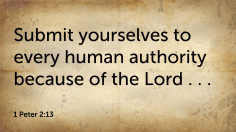
1 peter 2 (13)The audio from the latest Sunday School is below. As always, all audio and teaching notes can be found here.

Peter tells Christians we’re supposed to submit ourselves to every human authority because of the Lord. He says we must do this because it’s God’s will that, by doing right, we’d silence the ignorant slander of foolish men. We’re supposed to consider ourselves as slaves who’ve been freed from the kingdom of darkness and transferred to the kingdom of God’s dear Son.

In Acts 4-5, the Apostle Peter left us an example of how to draw the line between obeying secular laws, and God’s laws. In short, Peter taught us that, no matter what we decide to do in a tricky situation, we must:

  1. Always be respectful
  2. Always tell them why (“we must obey God rather than men,” Acts 5:29)
  3. Always explain why (i.e. the Gospel)

The goal, of course, is to glorify God and be a testimony for Christ. We have to realize that God wants us to submit ourselves to every human authority so that, by doing right, we’d silence the ignorant slander of foolish men (1 Pet 2:15); so that they’ll see our good deeds and glorify God on the day when He returns to judge the world (1 Pet 2:13).

But, it’s often very difficult to know where to draw the line, and how to draw it. So, today, we discussed two difficult situations from American history to make this command “real” for us. Here they are:

Civil War-era fugitive slave laws

If you were a Christian, living in America in the pre-Civil War era, would you have ignored the Federal fugitive slave laws?

The U.S. Constitution (Article 4, Section 2) made it mandatory for a fugitive slave to be delivered up to his owner if he escapes and makes his way to another state. The Constitution doesn’t say how this should be done.

Eventually, a system developed where “kidnappers” (so labeled by anti-slavery advocates in the North) deployed forth in search of fugitive slaves, apprehended them, and simply brought them back South – with no legal recourse.This set up a terrible clash between pro-slavery and anti-slavery factions. The former demanded the federal government assist slaveowners in re-capturing escaped slaves who crossed state lines. The latter factions in several anti-slavery states lobbied their legislatures and successfully passed “personal liberty” laws, which gave fugitive slaves who crossed into their states certain rights (e.g. habeas corpus, testimony, trial by jury) and imposed criminal punishments on kidnappers.

In 1837, the U.S. Supreme Court overturned Pennsylvania’s “personal liberty” laws and, in one stroke, invalidated all such laws throughout the country. Even later, in the 1856 Dred Scott v. Sanford decision, the U.S. Supreme Court declared slaves were not “citizens,” as defined by the Constitution, and had no legal standing to petition for freedom.

What should devout Christians do in this environment?

  • If you’re a Christian, and
  • you live in Pennsylvania, and
  • Peter says you must submit yourselves to the civil authorities for the Lord’s sake, and
  • the Federal government says it’s unconstitutional to interfere with slave-owners trying to re-claim their “property” in the North

. . . then what should you do about it? How do you balance this? How do you do what Peter says, here (1 Pet 2:13-17)?

Oregon’s House Bill 3391

The State of Oregon recently passed House Bill 3391, which is widely acknowledged to be the most progressive and aggressive abortion law in this country. The bill (just signed into law this past Fall) requires all insurers in the State of Oregon to cover a large range of “reproductive services” (i.e. abortion) to anyone in the state.[1] More significantly, the bill allows a woman to get an abortion without any restriction, for any reason. 

Because insurers are forbidden to pass these costs along to the consumers, the State of Oregon will be contributing about $10,000,000 to offset the proposed costs for the 2017 – 2019 biennium. This cost is expected to grow to over $14,000,000 for 2019-2021.[2] This means, if you’re an Oregon resident, your tax-dollars will be used to reimburse insurers for abortion procedures – and the costs will only go up each biennium!

What should a Christian do in this environment?

Join us as we discuss these tricky issues, and consider how real and practical Peter’s letter is for our life today.

Notes

[1] See the text of HB 3391, Section 2(3).

[2] See the State of Oregon’s fiscal analysis of HB 3391.

Christless Christianity?

hortonI believe a troubling proportion of what passes as “Christianity” in contemporary American evangelicalism is at best sub-biblical, and at worst completely un-Christian. This isn’t necessarily true of the smaller churches scattered hither and yon throughout our fair land, amongst the amber waves of grain, in the shadow of purple mountain majesties. But, I believe it is generally true of the evangelical industrial complex in general, and celebrity ministers in particular.

To be sure, much of this pseudo-Christianity retains the same words, liturgies, creeds, confessions and outward form of orthodox Christianity. But, internally, it bears little resemblance to the true faith. Does this mean most pastors are wicked men, out to lead their flock to the flames of hell? Not necessarily; but make no mistake – such men do exist. I think this situation is more the result of a series of compounding problems:

  1. A drive to become “relevant” to the secular world will result in a subtle, then increasingly deliberate “softening” of the Christian message to avoid “offense.” Thus, the Gospel is increasingly buried under an avalanche of “love.” See my description of evangelism and “the church that’s ashamed of the gospel,” here.
  2. Our cultural climate is producing men in ministry who are timid. Such men are well-intentioned and quite pleasant people. But, they’re often weak, vacillating, hesitant, indecisive, and afraid.
  3. Our society is totally consumer-oriented, and this has filtered down to the churches. Many Christians shop for a church out of convenience and with a mercenary sense of entitlement. They view church like Wal-Mart, and they’ll hit the road or the Safeway down the street if you make them mad. This influences weak pastors to further round the rough edges off their ministries and Gospel presentations.

The end result of these (and other) problems is that you eventually end up with a “faith” that isn’t even Christian at all. God is somebody who just wants to bless. Jesus is the cosmic butler who lives to serve. The Spirit is there to make you feel warm and fuzzy inside. The church exists to fill your needs.

Nearly a decade ago, a sociologist named Christian Smith observed five defining factors which summed up the defacto “creed” of modern “religious” teenagers in the United States, from many different faiths:

  1. A God exists who created and orders the world and watches over human life on earth.
  2. God wants people to be good, nice, and fair to each other, as taught in the Bible and by most world religions.
  3. The central goal of life is to be happy and to feel good about oneself.
  4. God does not need to be particularly involved in one’s life except when he is needed to resolve a problem.
  5. Good people go to heaven when they die.

Basically, young people would take these propositions, and fit them into whichever faith system they happened to be associated with. The result, of course, is a syncretic stew of blasphemy which has no objective content whatsoever.

If you know somebody who is “religious,” and they’re not grounded and schooled in a very conservative version of their faith tradition, then I’m betting you right now that they’d sum up their religious outlook with some or all of these five propositions. You know somebody who is “religious,” but doesn’t take it seriously. You’re thinking of her right now, aren’t you? You know exactly who you can ask. Try it. You’ll see . . .

This isn’t a modern phenomenon, of course. The Israelites perfected this technique, and repeatedly gave God lip-service with empty cultic rituals, while worshipping pagan gods. They viewed Yahweh as a spiritual 911 operator; somebody they had in their back pocket for a rainy day, but didn’t want to chat with otherwise. For example, consider this (Jeremiah 2:26-28):

As a thief is shamed when caught,
so the house of Israel shall be shamed:
they, their kings, their princes,
their priests, and their prophets,
who say to a tree, ‘You are my father,’
and to a stone, ‘You gave me birth.’
For they have turned their back to me,
and not their face.
But in the time of their trouble they say,
‘Arise and save us!’
But where are your gods
that you made for yourself?
Let them arise, if they can save you,
in your time of trouble;
for as many as your cities
are your gods, O Judah.


I suggest you read the book Christless Christianity by Michael Horton. It’s about, well . . . a “Christianity” which has taken Christ off the cross and made Him a cosmic butler. He writes:[1]

My concern is that we are getting dangerously close to the place in everyday American church life where the Bible is mined for “relevant” quotes but is largely irrelevant on its own terms; God is used as a personal resource rather than known, worshiped, and trusted; Jesus Christ is a coach with a good game plan for our victory rather than a Savior who has already achieved it for us; salvation is more a matter of having our best life now than being saved from God’s judgment by God himself; and the Holy Spirit is an electrical outlet we can plug into for the power we need to be all that we can be.

As this new gospel becomes more obviously American than Christian, we all have to take a step back and ask ourselves whether evangelicalism is increasingly a cultural and political movement with a sentimental attachment to the image of Jesus more than a witness to “Jesus Christ and him crucified” (1 Cor. 2:2). We have not shown in recent decades that we have much stomach for this message that the apostle Paul called “a stone of stumbling, and a rock of offense,” “folly to Gentiles” (Rom. 9:33; 1 Cor. 1:23).

Far from clashing with the culture of consumerism, American religion appears to be not only at peace with our narcissism but gives it a spiritual legitimacy.

Harsh words. I think they’re warranted.

Notes

[1] This excerpt is from Michael Horton, Christless Christianity: The Alternative Gospel of the American Church (Grand Rapids, MI: Baker, 2008), 19-20.