Jesus and the Paralytic

jesus-and-paralyticWhy did the paralyzed man want to come to Jesus? This account is in each of the synoptic Gospels (Mt 9:1-8; Mk 2:1-12, Lk 5:17-26). It is a famous story. Many people assume the man came simply to be healed. This is what I believed, too. I remember preaching it this way in teen Sunday School, years ago. But, I was never very comfortable with this interpretation. Like Cinderella’s glass slipper on the ugly step-sister, it really didn’t fit.

I am working through the Gospel of Luke for our family devotions, and I came across this passage again last night. As I read it, the thought occurred to me. The man didn’t come to be healed per se – he came because he wanted to hear the Good News from the Messiah.

Matthew does not cover the passage in great detail, but Mark and Luke do. Here is the first portion of the passage:

Mark 2:1-5

Luke 5:17-20

And when he returned to Capernaum after some days, it was reported that he was at home. And many were gathered together, so that there was no longer room for them, not even about the door; and he was preaching the word to them.

And they came, bringing to him a paralytic carried by four men. And when they could not get near him because of the crowd, they removed the roof above him; and when they had made an opening, they let down the pallet on which the paralytic lay.

And when Jesus saw their faith, he said to the paralytic, “My son, your sins are forgiven.”

On one of those days, as he was teaching, there were Pharisees and teachers of the law sitting by, who had come from every village of Galilee and Judea and from Jerusalem; and the power of the Lord was with him to heal.

And behold, men were bringing on a bed a man who was paralyzed, and they sought to bring him in and lay him before Jesus; but finding no way to bring him in, because of the crowd, they went up on the roof and let him down with his bed through the tiles into the midst before Jesus.

And when he saw their faith he said, “Man, your sins are forgiven you.”

Notice what Jesus is doing in Capernaum. He “is teaching.” He is “preaching the word to them.” The article is important. Jesus didn’t preach “a word,” He preached “the word” (τὸν λόγον).

Jesus is preaching the word or message of the Good News of the coming Messianic Kingdom, and commanding people to repent and believe (cf. Mk 1:14-15 ). He is preaching about liberation from spiritual bondage, and recovery of sight to the spiritually blind through repentance and faith in Himself (cf. Lk 4:16-21; Isa 61:1-2). The immediate context in both Mark and Luke’s account is the coming Messianic Kingdom. In Luke, Jesus explicitly identified Himself as the agent who will accomplish this, in God’s stead.

If this is what Jesus is doing (and it is), and if this is the focus of both Gospel accounts (and it is), then perhaps we ought to re-consider why the paralytic asked his friends to bring him to see Christ.

Here are some observations:

  • There is no room to hear Jesus teach – not even at the door. Luke tells us why; “there were Pharisees and teachers of the law sitting by, who had come from every village of Galilee and Judea and from Jerusalem.” The focus is on the teaching, not the miracles.
  • People often assume the paralytic wanted to be near Jesus so he could be healed. Why not assume the man simply wanted to hear Jesus preach “the word?”
  • Jesus sees the corporate faith of all five men (τὴν πίστιν αὐτῶν), and tells the paralyzed fellow, “Man, your sins are forgiven you.” Mark records something a bit more personal (“Son”), which is likely an addition from Peter, who was there.
  • If the man simply came to be healed, then (1) what, exactly, was the content of the man’s faith, and (2) what about this faith warranted forgiveness of his sins?

Only Luke observes that “the power of the Lord was with him to heal.” This doesn’t mean the man wasn’t interested in healing, of course. But, it should give us a hint that he doesn’t see Jesus as simply a miracle-man. It is safe to assume the man had two motivations:

  1. He wanted to hear the Good News of the coming Messianic Kingdom, and
  2. He believed Jesus was the Messiah, and was thus capable of healing him, if He chose to do so

Therefore:

  1. Jesus saw the man’s faith, and pronounced his sins forgiven on that basis
  2. This suggests the man believed Jesus was the Messiah, and Jesus recognized his desperate struggle to come hear the message of the Messianic Kingdom

The entire focus of the rest of this story is on the charge of blasphemy against Christ, something which will become the key charge against Him throughout His ministry and at His trial. The focus was never on the healing. The healing was incidental, done to prove a point.

I think the man came for the message, not the healing.

Commentary on Romans 8:1-4

This is a short commentary I wrote after doing some exegetical work on Romans 8:1-4. That detailed work can be found on my “Bible & Creed Translations” page. This is not a terse, exegetical commentary. It has been deliberately written for normal people, but it is based on some thorough exegetical work.

—————————-

1

Therefore, [there is] now no punishment to those in union with Christ Jesus,

Paul begins the passage by drawing an overarching conclusion (“therefore”) from everything which has come before. In light of:

  1. the fact that “since we have been declared righteous by faith, we have peace with God through Jesus Christ our Lord,” (Rom 5:1),
  2. the fact that through Jesus “we have obtained access by faith into this grace in which we stand,” (Rom 5:2),
  3. the fact that “the love of God has been poured out in our hearts through the Holy Spirit who was given to us,” (Rom 5:5),
  4. the fact that “God demonstrates his own love for us, in that while we were still sinners, Christ died for us,” (Rom 5:8),
  5. God reconciled sinners to Himself despite the fact “we were enemies,” (Rom 5:10),
  6. the fact that those who have repented and believed the Gospel have been reconciled to God (Rom 5:11),
  7. the fact that, just as sin entered the world by one single transgression, “so too through the one righteous act came righteousness leading to life for all people, for just as through the disobedience of the one man many were made sinners, so also through the obedience of one man many will be made righteous,” (Rom 5:18-19),
  8. the fact that those in union with Christ have been freed from slavery to sin, and have been made slaves for righteousness (Rom 6:17-18),
  9. and despite the fact that every single Christian who has ever lived still struggles with sin every day of his life (Rom 7),

something fundamental has forever changed in a person’s life once they become an adopted son or daughter of God. Maybe the best way to understand “therefore” here is to understand Paul writing something like, “therefore, the conclusion of the whole matter is this!”

This is the sum of the matter – “there is now no punishment to those in union with Christ Jesus.” Something has changed. There used to be punishment in store for you, but now there is not. There used to be the promise from the Lord that He would mete out flaming fire upon you, who refused to obey the Gospel of our Lord Jesus (2 Thess 1:8), but now there is not.

If you are a Christian, it means your name was written in the Lamb’s book of life from before the foundation of the world. You were elected, selected and chosen by God, for reasons only He knows, to be a recipient of His great mercy, love, grace and kindness.  You have been united to Him by repentance and faith in Christ. You are in union with Christ, and therefore there is now no punishment for you.

Why not?

2

Because the law of the life-giving Spirit, in union with Christ Jesus, has liberated you from the law of sin and death.

This “law of the life-giving Spirit” is a rule of life which governs your heart and mind. It is the divine influence and help from on high, in the Person of the Holy Spirit, who rules in a Christian’s heart and mind now that the kingdom of darkness has been banished from within you (cf. 2 Cor 4:3-4).

This is in complete contrast to the “law of sin and death” which used to rule and war in your body, controlling your thoughts and actions, motivating and impelling you to do nothing but seek after your own lusts and desires. You used to present your body to sin as an instrument to be used for unrighteousness (Rom 6:13); now that has all been changed and flipped on its head.

For just as you once presented your members as slaves to impurity and lawlessness leading to more lawlessness, so now present your members as slaves to righteousness leading to sanctification (Rom 6:19).

Your entire being has changed. You have changed. You have been given spiritual life. You have God’s Holy Spirit within you, and your heart of unyielding stone has been replaced by a soft heart of flesh (Eze 36:24ff); a heart sensitive to the things of God, motivated and impelled by His holiness and driven by a thirst for righteousness. You love God, and therefore seek to keep His commandments (Jn 14:15).

This rule of life comes from the “life-giving Spirit.” It is He who brings life to the spiritually dead. But, He does not do it alone. He does it “in union with Christ Jesus.” All three Divine Persons of the Trinity work together to accomplish a sinner’s salvation, sanctification and eternal glorification. It is the Apostle Peter who proclaimed to the crowds on Pentecost that Christ dispenses the Spirit to His brethren;

 This Jesus God raised up, and we are all witnesses of it. So then, exalted to the right hand of God, and having received the promise of the Holy Spirit from the Father, he has poured out what you both see and hear (Acts 2:32-33).

Think about the word “liberation.” It implies that you were enslaved to someone or something. You were powerless to fight against it. It dominated you. It controlled you. It consumed you. It exercised unrelenting control and mastery over your heart, soul and mind. Now, Paul is not speaking about actual slavery in a worldly sense. But, if you go one step further to the spiritual sphere, things are suddenly very clear.

People are born enslaved to their lusts, desires and wickedness impulses. People are, by nature, children of wrath (Eph 2:3). People belong to the kingdom of darkness, and must be transferred to the kingdom of God’s dear Son (Col 1:13). When a sinner repents and believes the Gospel, he does so only because the life-giving Spirit, in union with Christ Jesus, has liberated him from the law or rule of sin and death in his life.

The Spirit is the One who performed the action here. He liberated you. You did nothing. It is an act which was accomplished at a specific point in time, and as a result, you entered into a new state. There is now no punishment for you. You have been liberated from the law of sin and death. The Spirit did this, dispensed by the Son, according to the good pleasure of the Father’s will. The Spirit and the Son did it all, because it was predestined by the Father. Salvation is liberation from the domain of darkness.

How have Christians been set free?

3

For [God did what] the law could not ever do, because it was weakened by the flesh. God sent His own Son as like a sinful man and, regarding sin, He imposed judgment against the sin while He was in the flesh,

Because God acted while we were helpless. Because God had determined to act in eternity past, despite knowing every wicked and sinful thing you have done, are doing, or ever will do.

But God, being rich in mercy, because of his great love with which he loved us, even though we were dead in transgressions, made us alive together with Christ – by grace you are saved! – and he raised us up with him and seated us with him in the heavenly realms in Christ Jesus, to demonstrate in the coming ages the surpassing wealth of his grace in kindness toward us in Christ Jesus (Eph 2:4-7).

In short, “[God did what] the law could not ever do, because it was weakened by the flesh.” The law could never perfect anybody; it could only prove our own weakness. The law could never atone for sins; it could only forgive, as it were, on credit in light of the coming Messiah who would taste death for every man (Heb 2:9). As Paul wrote elsewhere,

 I do not set aside God’s grace, because if righteousness could come through the law, then Christ died for nothing! (Gal 2:21).

The law, while inherently holy and good, was weakened by our sinful flesh. Therefore, God acted. He sent His own Son in the state or condition of being like a sinful man. Christ was not a sinful man, but He was made in the form or likeness of one. He was conceived by a miracle of the Holy Spirit specifically so He would not be contaminated by the curse of sin.

As the chief angel Gabriel told Mary, “Therefore [that is, in light of Jesus’ miraculous conception] the child to be born will be holy; he will be called the Son of God,” (Lk 1:35). Jesus is holy precisely because He is not tainted by sin, yet the Scriptures still affirm “for we do not have a high priest incapable of sympathizing with our weaknesses, but one who has been tempted in every way just as we are, yet without sin,” (Heb 4:15).

It should also go without saying that, if God sent Jesus in the form or likeness of sinful flesh, to be as like sinful flesh and identify with all the frailties and limitations of wicked men, that the Son was pre-existent. He did not spring into being at His birth in Bethlehem.

What did Jesus do? Simple. “[R]egarding sin, He imposed judgment against the sin while He was in the flesh.” While He was in the flesh; that is, while Jesus was incarnate on this earth as the God-Man, He imposed judgment against “the sin.” He defeated sin. He conquered sin. “God made the one who did not know sin to be sin for us, so that in him we would become the righteousness of God,” (2 Cor 5:21).

What is “the sin”? Many English translations do not translate the article “the,” because many times it is not necessary to do so. In this case, however, it is important. In this case, “the sin” is basically a synonym for “the curse.” Jesus imposed judgment against “the curse” of sin and death, against the penalty of the fall, against the sentence which God imposed on all humanity in the Garden of Eden so long ago. That curse has been broken, rent in two, and shattered into thousands of pieces. Jesus imposed judgment against the very curse, against the very “sin” which has bound men, women, boys and girls from all over the globe into slavery to the law of sin and death since the events from Genesis 3.

Jesus did this. You did nothing, you do nothing and you cannot do anything. He performed the action of this verb, and He did it at a particular point in time in the past. He did it during the incarnation, through His perfect and holy obedience to the law and His voluntary and willing torture and death for His people’s sake. This is what theologians call the active and passive obedience of Christ. He actively obeyed the law and fulfilled God’s perfect standards of righteousness and holiness for His elect. He also passively allowed Himself to be arrested, tried, tortured and then executed for His children’s crimes, in their place, as their true substitute.

Jesus did this. He imposed judgment against “the sin” while He was in the flesh. Praise the Lord for the Son’s faithfulness! But, why did He do it? What was the purpose?

4

so that the requirement of the law would be fulfilled among us who are not living according to the flesh, but according to the Spirit.

Jesus did this for a very specific reason; “so that the requirement would be fulfilled . . .” What requirement is Paul talking about? He’s talking about the requirement that Christ be perfect and holy in our place, as our substitute. Remember, if righteousness could come by the law, then Christ died for nothing. Paul also wrote:

 yet we know that no one is justified by the works of the law but by the faithfulness of Jesus Christ. And we have come to believe in Christ Jesus, so that we may be justified by the faithfulness of Christ and not by the works of the law, because by the works of the law no one will be justified (Gal 2:16).

So, Jesus, the Son of God, fulfilled the requirement of the law perfectly, and He did it for all the ones whom God has given to Him. If you are a Christian, then Jesus did this for you. If you are not a Christian, but you repent of your sins and believe the Good News He suffered and bled and died to bring to you, then He did it for you, too.

This requirement is not fulfilled among everybody. It is only “fulfilled among us who are not living according to the flesh, but according to the Spirit.” Paul is not saying that we fulfill the requirement by living our lives according to the Spirit, as if this was a statement about a Christian’s obligation.[1] He is stating a fact, not a condition. Here is what Paul is saying:

  1. if you have repented of your sins and believed the Gospel,
  2. then there is now no punishment in your future, because you are in union with Christ Jesus
  3. this is because the law of the life-giving Spirit, together with Christ Jesus, has liberated you from the law or rule of sin and death in your heart, soul and mind. How is this possible?
  4. It is possible because God did what the law could never do, because its usefulness was weakened by the flesh. Therefore, God sent His own Son in the very likeness of sinful man and, concerning sin, His Son imposed judgment against the curse of sin and death while He was in the flesh!
  5. Jesus did this so the requirement of the law would be fulfilled among those who live according to the Spirit – but what does it mean to be living according to the Spirit?
  6. It means to be controlled, governed by, ruled over by and influenced by God Almighty, who sent Jesus to live a perfect life, die a sacrificial death, and rise again to defeat and impose judgment on the curses of sin and death, and who then sent the Spirit to give you new life.

In short, Paul is saying Jesus fulfilled the requirement of the law for those who are controlled and governed by the Spirit, who are Christians. This is a statement about status; “those who are living according to the Spirit” = those who are saved. Jesus did this for the elect; for those whom God has given to Him.[2]

The verb is passive here, which in this instance means the action is done to the recipient. The recipient does nothing at all. The recipients of this grace are “us . . . who are living according to the Spirit.”

Notes

[1] For example, William Hendrickson wrote, “The purpose and result of Christ’s work of redemption was that His people, by means of the operation of the Holy Spirit in their hearts and lives, should strive, are striving, to fulfill the law’s righteous requirement. Out of gratitude for and in response to, the outpouring of God’s love, they now love God and their neighbor,” (Romans 1-8 [Grand Rapids, MI: Baker, 1980], 248).

See also Leon Morris, The Epistle to the Romans, in PNTC (Grand Rapids, MI: Eerdmans, 1988), 303-304. Douglas Moo, The Epistle to the Romans, in NICNT (Grand Rapids, MI: Zondervan, 1996), 404-405 also seems to take this view.

[2] John Calvin observed, “They who understand that the renewed, by the Spirit of Christ, fulfil the law, introduce a gloss wholly alien to the meaning of Paul; for the faithful, while they sojourn in this world, never make such a proficiency, as that the justification of the law becomes in them full or complete. This then must be applied to forgiveness; for when the obedience of Christ is accepted for us, the law is satisfied, so that we are counted just,” (Commentary on the Epistle of Paul the Apostle to the Romans [Bellingham, WA: Logos Bible Software, 2010], 283).

Christ’s Armies

Who will return with Christ when He comes to establish His kingdom? Dispensationalists usually have a simple, pat answer – the church. End. Of. Discussion. Maybe not.

Here is one excerpt from the crucial passage:

Then I saw heaven opened and here came a white horse! The one riding it was called ‘Faithful’ and ‘True,’ and with justice he judges and goes to war. His eyes are like a fiery flame and there are many diadem crowns on his head. He has a name written that no one knows except himself. He is dressed in clothing dipped in blood, and he is called the Word of God. The armies that are in heaven, dressed in white, clean, fine linen, were following him on white horses. From his mouth extends a sharp sword, so that with it he can strike the nations. He will rule them with an iron rod, and he stomps the winepress of the furious wrath of God, the All-Powerful. He has a name written on his clothing and on his thigh: ‘King of kings and Lord of lords,’ (Revelation 19:11-16).

Which people comprise these “armies?” The standard dispensational interpretation is this is the corporate church, the figurative “bride of Christ.” I am not convinced. There are many reasons, but one in particular stands out – people who become Christians and die for their faith during the great tribulation are said to be with the Lord in heaven, dressed identically to these “armies” who will return with Christ:

After these things I looked, and here was an enormous crowd that no one could count, made up of persons from every nation, tribe, people, and language, standing before the throne and before the Lamb dressed in long white robes, and with palm branches in their hands. They were shouting out in a loud voice, ‘Salvation belongs to our God, who is seated on the throne, and to the Lamb!’ (Revelation 7:9-10).

Who are these people? The Bible tells us:

Then one of the elders asked me, ‘These dressed in long white robes—who are they and where have they come from?’ So I said to him, ‘My lord, you know the answer.’ Then he said to me, ‘These are the ones who have come out of the great tribulation. They have washed their robes and made them white in the blood of the Lamb!’ (Revelation 7:13-14).

So, I am not at all convinced only “the church” returns with Christ. Some will object; “but . . . but, the only people who have resurrected bodies yet are Christians from the church!” Yes, but so what? The Bible just told us tribulation martyrs are wearing white robes, yet have not been reunited with their glorified bodies.

Are we to believe the corporate church heads off with Christ to war, while every single other believer from every age simply stays behind in heaven? Like impatient husbands waiting for their wives in the Michael’s parking lot?

I am tempted to see every believer from every age as returning with Christ to defeat the antichrist and the false prophet. I could be wrong. If I am, let me know why . . .

Goodbye, Cruel World

t2-poster
He’ll be bach . . .

The Bible is serious about the last days. Serious in a sober sort of way. Not in a Left Behind kind of way. Not in a John “Blood Moon” Hagee sort of way. Certainly not in a FaceBook meme sort of way. We can learn a whole lot about God, the depths of our own sinfulness, and His holiness if we paid more attention to the Book of Revelation in a serious way. Consider these words:

Revelation 19:1-5 After these things I heard what sounded like the loud voice of a vast throng in heaven, saying, “Hallelujah! Salvation and glory and power belong to our God, because his judgments are true and just. For he has judged the great prostitute who corrupted the earth with her sexual immorality, and has avenged the blood of his servants poured out by her own hands!” Then a second time the crowd shouted, “Hallelujah!” The smoke rises from her forever and ever. The twenty-four elders and the four living creatures threw themselves to the ground and worshiped God, who was seated on the throne, saying: “Amen! Hallelujah!” Then a voice came from the throne, saying: “Praise our God all you his servants, and all you who fear Him, both the small and the great!”

Verse 1

The Apostle John has just described God’s wrath being poured out onto this wicked world. The capitol city of wickeness and evil, personified by the figure of the lecherous and decandent “woman” (cf. Rev 17:4ff), has been destroyed. In the last days, this world will be awash in a sea of wickedness and excess which boggles the mind.

Satan will have his brief period of autonomy (“for he knows that he only has a little time,” Rev 12:12). He will establish his own kingdom on the earth, patterned after the Lord’s, but every bit as evil as Yahweh’s is holy. Satan will install his own man on the throne, just as God will do with Christ. But, this man will be everything Christ is not. He will be the anti-Christ.

This shadow kingdom of doom and debauchery will not last long. God will destroy it.

Revelation 16:17-19 Finally the seventh angel poured out his bowl into the air and a loud voice came out of the temple from the throne, saying: “It is done!” Then there were flashes of lightning, roaring, and crashes of thunder, and there was a tremendous earthquake – an earthquake unequaled since humanity has been on the earth, so tremendous was that earthquake. The great city was split into three parts and the cities of the nations collapsed. So Babylon the great was remembered before God, and was given the cup filled with the wine made of God’s furious wrath.

Immediately after this event in chronology, we have our small little passage from Revelation 19. What is happening here? We hear a great chorus in heaven. It could be either angels or redeemed men and women. We don’t know. But, we do know what they’re saying.

They’re praising God. That’s what “Hellelujah” means. Is it strange that they’re praising God as thousands upon thousands of people lie dead on earth? Why is this happening? Why did God give John this vision, and move him to record it for us?

They praise God because salvation, honor and power belongs to Him:

  • The right to bestow salvation.
  • The right to author salvation.
  • To right to grant salvation to whomever He wishes.
  • Honor is due to him
  • Honor is demanded by Him
  • Honor will be granted to Him and to His Son (cf. Phil 2:10-11)
  • Power belongs to Him
  • This world is run by Him, governed by Him, controlled by Him, and His laws and commandments are the rule of the land.

Verse 2:

Why do they praise God? There are three reasons, and they’re all clearly set out in the Greek text by the word we translate “because” (ὅτι) and by one conjunction:

  1. because His judgments are true and righteous. God will judge this world, and He’ll be right to do it. People will die. Women will die. Men will die. Cute kittens will die. FaceBook will die. Even Waldo will be found out. Have you ever considered why this kind of devestation and destruction is worthy of praise? Does this disgust you? Does it go against the image you have of God, and His beloved Son, Jesus of Nazareth, the Messiah? It shouldn’t. Read Psalm 2 or Psalm 110. Think about it.
  2. because God has judged Satan’s world system, culture and false religion of rebellion, selfishness, wickedness and dark debauchery – personified by this “great prostitute who corrupted the earth with her sexual immorality,” (Rev 19:2). Every single person who will die on this terrible day will hate God, hate His Messiah, and love sin. They’ll deserve to die. God’s judgments are true because they’ll be poured out upon those who hate Him – their creator and sustainer.
  3. and because God is avenging His adopted children, whose blood has been poured out by this world’s wicked hands. God will avenge His own.

Verses 3-4:

The praise team isn’t done quite yet. Another “Hallelujah” issues from above. Now we have a description; “the smoke rises from her forever and ever.” Smoke from what? From the city which has been destroyed. From the bodies of those who have been slain. From the ruined ashes of Satan’s pitiful rebellion. And the chorus in heaven is praising God for this. Consider that the next time you’re tempted to reduce God to a nice, senile, doddering old grandfather in the sky. His love is never at the expense of His holiness.

To use a colloquial term, things are “gonna get real” one day. And God’s people and His angels (“the twenty-four elders and four living creatures”) will praise and worship Him for it.

Verse 5

A voice calls out from the throne. Is Yahweh’s voice? Probably not (“our”), but it’s a voice we ought to listen to. The voice commands praise to God. From whom? From His slaves and those who fear Him, whether great or small.

God is holy. God is serious about His holiness. This world is His creation. It’s governed by His laws, His commandments, His power and by His rules. God is longsuffering, but that patience has a limit. If a parent never exercises discipline, then he isn’t a parent – he’s a loser. God isn’t a loser. Discipline is coming. Judgment is coming. That judgment will be worthy of praise, because it will be right and true.

God is bigger than we often give Him credit for. This little passage demonstrates that. Goodbye, cruel world. Judgment Day is coming, and it won’t be at the hands of Arnold or the T-1000. It will be worse, and it will be just. Praise God.

God’s Plan and You

In church this morning, I happened on James 1:18. No, I wasn’t day-dreaming. The Pastor was actually preaching James 1:12-18! I read from my English translation:

  • James 1:18 By his sovereign plan he gave us birth through the message of truth, that we would be a kind of firstfruits of all he created.

I immediately latched onto the rendering “sovereign plan.” I suspected this was a bit of an interpretative gloss, so I reached for my tablet to look at what the Greek text had to say. Unfortunately, I had forgotten to charge the battery, and I had no sooner found the text than the whole thing died. Drat. I plan to ditch the tablet and bring my hardbound UBS-5 to church from now on.

But, that doesn’t matter and you don’t care anyway. What does matter is what on earth James 1:18 is saying, and what that ought to mean for your life, if you’re a Christian. Because I’m an incurable nerd, I came home and translated the verse straightaway. It’s interesting, to say the least.

Here is my pitiful translation, and below are some thoughts I had on this verse:

Approaching the Throne of Grace

numUnder the Old Covenant, the covenant community had to stay away from God. He lived in their midst, first in the tabernacle and later in the temple. He dwelt in the inner compartment, the Holy of Holies. Yet, only certain chosen men had very limited and prescribed access to Him:
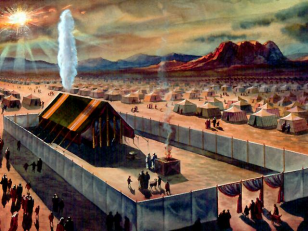
  • Only the High Priest could enter the Holy of Holies, and then only once per year (Leviticus 16).
  • Only the Levites could enter into the outer compartment to trim the lamps, arrange the bread of the presence, and perform other duties

The rest of the community could not enter at all. In fact, they were commanded to stay away from the tabernacle altogether:

Numbers 18:22 No longer may the Israelites approach the tent of meeting, or else they will bear their sin and die.

Think about this. Under the Old Covenant, God was kept at arms-length. He lived among His chosen people, but could not be approached directly. He made Himself known through intermediaries. Yahweh was personally unapproachable. A believer could not dare to even approach Him in His dwelling-place.

We could draw a whole lot of implications here, but one thing is particularly clear – God is holy, and in our sinful and criminal state, we are not fit to approach Him. Under the temporary arrangements of the Old Covenant, God’s people had to come to Him through intermediaries, expressing their thankfulness, love, repentance and worship through a series of sacrificial offerings, via an ordained priesthood.

Is this the way it was meant to be forever? Being promised certain death if you dared to draw near to God in reverent worship? Being kept at arms-length by God Almighty? Only offering praise, thanksgiving, repentance and worship through an intermediary? Not at all! Today, all who are “partakers of the heavenly calling” (Heb 3:1), who have repented and believed the Gospel, enjoy the blessings of Jesus’ superior ministry, based on a better covenant complete with better promises.

What a change from this dire warning

Numbers 18:22 No longer may the Israelites approach the tent of meeting, or else they will bear their sin and die.

to this glorious exhortation?

Hebrews 4:14-16 Therefore since we have a great high priest who has passed through the heavens, Jesus the Son of God, let us hold fast to our confession. For we do not have a high priest incapable of sympathizing with our weaknesses, but one who has been tempted in every way just as we are, yet without sin. Therefore let us confidently approach the throne of grace to receive mercy and find grace whenever we need help.

Instead of being warned to stay far away from Yahweh, Christians are now commanded to confidently approach the very throne of grace! Figuratively speaking, Christians are invited to march right up to the heavenly tabernacle, walk right through the first compartment, fling the veil to the Holy of Holies aside, and kneel before the very mercy seat on the ark of the covenant itself. There is no need for a censer of incense to mask yourself from the divine presence. There is no command to “stay back!” Instead, there is a warm invitation to “confidently approach the throne of grace to receive mercy and find grace whenever we need help.”

The New Covenant is better. The New Covenant is what the object lessons of the Old were always pointing to. The New Covenant is ours now, and will be Israel’s later. Perhaps now, this bit from the Book of Hebrews begins to make a little more sense:

Hebrews 10:19-22: Therefore, brothers and sisters, since we have confidence to enter the sanctuary by the blood of Jesus, by the fresh and living way that he inaugurated for us through the curtain, that is, through his flesh, and since we have a great priest over the house of God,  let us draw near with a sincere heart in the assurance that faith brings, because we have had our hearts sprinkled clean from an evil conscience and our bodies washed in pure water.

If you have repented of your sins and believed the Gospel message, then you will join the angels in heaven as they sing praises to Jesus the Christ. If you continue in criminal rebellion against Him, Jesus will break you with His iron scepter and smash you like a potter’s jar (cf. Ps 2:9). I pray you’ll join God’s family, so you, too, can have access to the throne of grace to find mercy and help in time of need.

No Respect!

tentMoses is an important prophet. Aaron and Miriam forgot that once. They probably didn’t forget again. God struck Miriam with leprosy for her sedition and rebellion against Moses, His appointed prophet and leader of His covenant people. Behold! Here is the passage (Numbers 12:1-10):
Then Miriam and Aaron spoke against Moses because of the Cushite woman he had married (for he had married an Ethiopian woman). They said, “Has the LORD only spoken through Moses? Has he not also spoken through us?” And the LORD heard it. (Now the man Moses was very humble, more so than any man on the face of the earth.)

The LORD spoke immediately to Moses, Aaron, and Miriam: “The three of you come to the tent of meeting.” So the three of them went. And the LORD came down in a pillar of cloud and stood at the entrance of the tent; he then called Aaron and Miriam, and they both came forward.

The LORD said, “Hear now my words: If there is a prophet among you, I the LORD will make myself known to him in a vision; I will speak with him in a dream. My servant Moses is not like this; he is faithful in all my house. With him I will speak face to face, openly, and not in riddles; and he will see the form of the LORD. Why then were you not afraid to speak against my servant Moses?”

The anger of the LORD burned against them, and he departed. When the cloud departed from above the tent, Miriam became leprous as snow. Then Aaron looked at Miriam, and she was leprous!”

Aaron and Miriam didn’t like Moses’ wife. It’s even possible the phrase they used to refer to her (“Cushite woman”) was a racist, derogatory term. But, their problem wasn’t really her – it was Moses and the unique position he had.

“Are you really that special?” they asked. “Does God really only speak through you? What about us!?”

God heard what they said. God hears everything you say. He knows everything you think. He understands what you’re plotting. He knows what you’ve done, what you are doing, and what you will do. I wonder how far sin would go if each Christian paused before doing something wicked and stupid, and thought about this:

  • “And the Lord heard it.”
  • “And the Lord saw it.”
  • “And the Lord knew it.”

Yikes.

God calls for a meeting. He isn’t happy. I want to spend the rest of our time considering what God says about Moses.

God speaks to prophets in visions; in dreams. We get this. Daniel had visions. The Apostle John had visions. Ezekiel had visions. The Holy Spirit moved these men (and others) to write down their prophetic messages in books. We have those books today. They’re hard books, full of hard sayings. This is why the pop-prophesy industry will always be busy churning out slop for the gullable masses who throng the Christian bookstores. Yesterday it was silliness about blood moons. Perhaps vanilla locusts are next!

With Moses, however, things are different. God speaks to him plainly, simply, forthrightly. This is why John Hagee will never write a pop prophesy volume about the Book of Numbers. Never happen. It’s too plain, too clear, too . . . open. God said:

Numbers 12:8 With him I will speak face to face, openly, and not in riddles; and he will see the form of the LORD. Why then were you not afraid to speak against my servant Moses?”

God speaks to Moses face to face. He doesn’t use riddles or difficult sayings. He’s plain, clear, concise, direct. Moses even saw the form of the Lord. He didn’t see Yahweh in His unveiled glory, of course, but he came much closer than any man has ever come to that glory (Ex 33:22-23) – until perhaps Peter, James and John (cf. Mk 9:2-3).

Why, then, are Aaron and Miriam not afraid to rebel against Moses, their appointed leader? This is a rhetorical question; the kind of thing your mother asked you before she “corrected” you. This is a serious matter. They just rebelled against the jurisdiction and authority of the only man in human history since Adam whom God has ever spoken to openly, plainly, face to face with. What happened next couldn’t have been very comforting:

Numbers 12:9 The anger of the LORD burned against them, and he departed.

Not a good sign.

In many ways, Moses is a shadow of the promised Messiah, Jesus. Remember what Moses prophesied, and consider how clear it is when compared to, say, Revelation 12!

Deuteronomy 18:15 The LORD your God will raise up for you a prophet like me from among you – from your fellow Israelites; you must listen to him.

Deuteronomy 18:18-19 I will raise up a prophet like you for them from among their fellow Israelites. I will put my words in his mouth and he will speak to them whatever I command. I will personally hold responsible anyone who then pays no attention to the words that prophet speaks in my name.

Here is what Moses told the Israelites a very, very long time ago:

  • God will raise up another prophet
  • This prophet will be like Moses – having the same kind of personal, close and direct relationship with God Almighty
  • This prophet will be an Israelite (“from among you”)
  • The Israelites will have to listen to him
  • This prophet will communicate God’s message perfectly
  • Everybody will be held responsible to listen to and obey this coming prophet, who will speak in God’s name

Who is this prophet? Read the Book of Acts and see the inspired, inerrant answer (Acts 3:21-23, 7:37). It is Jesus, the Messiah. The Christ.

Think about this. If you do not listen to Jesus and obey His command to repent and believe the Gospel, God will essentially ask you the same question; “Why then were you not afraid to speak against my servant?” What will you say? Were you busy? Tied up? Didn’t care? Don’t fool yourself. Remember what the Scripture says: “And the LORD heard it.”

If Aaron and Miriam were punished for rebelling against Moses, how much more will rebellious, criminal sinners be punished for their continued hatred of God and His annointed One, Jesus?

Read the Gospel. Repent and believe the Gospel. Listen to the angel from the Book of Revelation:

Revelation 14:7 Fear God and give him glory, because the hour of his judgment has arrived, and worship the one who made heaven and earth, the sea and the springs of water!

Don’t be a fool.

  • You’re worthless to God (Rom 3:12).
  • You’ll never be good enough for Him. If it were possible to be good enough, then Christ died for nothing (Gal 2:21).
  • Jesus willingly and voluntarily emptied Himself, left heaven and came here for His children’s sake.
  • He lived the perfect, sinless, holy, righteous and lawful life you can never live.
  • He was tortured and murdered, suffering the penalty for the crimes you deserve to pay for.
  • He died, was put in a tomb, and rose from the dead three days later to defeat the curses of sin and death for you, in your place. When He rose from the dead, He defeated Satan for you, too.
  • He was seen by hundreds of eyewitnesses, and ascended back to heaven where He is seated beside the Father, interceding and working on behalf of all His children, all those who are “partakers of the heavenly calling,” (Heb 3:1).

Why are you not afraid to speak against God’s servant, Jesus? To echo the words of the learned philosopher Rodney Dangerfield, why does Jesus “get no respect” from you?

If you repent and believe the Good News He came, lived, died, and rose again to bring to you, then you will be reconciled to God, perfectly and completely forgiven. God’s anger against you will be gone. You’ll be adopted into His family.

Of course, you don’t have to obey Jesus’ command (Mk 1:15) to repent and believe the Gospel. There’s always this alternative:

Numbers 12:9 The anger of the LORD burned against them, and he departed.

The Blessed Man and the Gospel

Because I’ve been too busy to write much lately, I thought I’d make a short video, instead! I recently spoke to a group of young boys at our local Trail Life USA troop. I spoke briefly, but was able to share the Gospel from Psalm 32. In this video, I offer some important thoughts about King David’s words, and why they matter for you today:

Watching out for One Another

lev 5(1)Christians are supposed to act like Christians. Christians are commanded to gather together in local churches, wherever they happen to live, and worship the Lord as part of a congregation. If Christians within that congregation don’t act like, well . . . Christians, then the Lord expects God’s people to police themselves like adults.

Now, of course, the New Testament gives us specific guidelines about how to do this the right and proper way. The Lord Jesus Himself talked about how to handle disputes between brethren (Mt 18:15-17). The Apostle Paul gave very specific instructions for how a congregation should handle a case of known, obvious and public sin  (1 Cor 5).

This isn’t a popular topic in churches today. Our culture encourages softness and timidity. The one unpardonable sin is to be certain about anything, and many Christians today would rather tolerate blatant sin under the mushy and ethereal banner of “love” than actually try and do anything about it.

Pastors don’t do church discipline. Christians don’t expect church discipline. People gasp in horror at the very idea of actually holding other Christians accountable for their behavior within a local congregation.

Once, in the midst of a very unfortunate church discipline process, a woman scolded me, saying, “Kicking somebody out of a church is a Catholic doctrine!!” Sure, and the sky is neon green and Elvis still lives . . . But, the point is that the concept of Christians lovingly holding each other accountable to, well . . . act like Christians is a scandalous idea in churches today.

This is where a well-rounded, whole-Bible approach to individual and corporate conduct can help us out. Behold this tidbit from the long section in the Book of Leviticus on sin and trespass offerings to the Lord:

Leviticus 5:1 (NET) When a person sins in that he hears a public curse against one who fails to testify and he is a witness (he either saw or knew what had happened ) and he does not make it known, then he will bear his punishment for iniquity.

Consider what this means:

  1. If an Israelite is aware that a particular sin occurred in the congregation,
  2. and this Israelite is a witness to that sin and has knowledge of it,
  3. and the Israelite knows he has a legal duty to cough up what he knows
  4. and he doesn’t say anything about it (i.e. “I know NOTHING!!!“)
  5. then this Israelite will be punished by God

In other words, if you don’t speak up when you know sin is in the congregation, then you’re guilty, too. Ouch. Yikes. This is pretty harsh and direct.

The Old Covenant has been replaced by the New and better covenant. But, several key principles carry right over – because they transcend temporary covenant arrangements and reflect how God has always dealt with His people. This is one of these key principles:

  • God elects and saves each of His people
  • God expects His people to walk worthy of their new heavenly citizenship
  • God expects His people to want to do this because they love Him, and are eternally grateful
  • This means God’s people will have an honest, heartfelt desire for personal holiness and corporate holiness – today, that means local congregations should want to be holy as a collective group
  • Part of this honest desire for personal holiness means God’s people police one another for their own individual and corporate good

God’s people don’t police each other out of a spirit of malice or pettiness (e.g. “I’m gonna git somethin’ on ole’ Mrs. Smith this time!!”). If you do this, you’re a fool. But, the fact remains that God’s people have always been expected to police each other for both (1) the offender’s own good, and (2) the corporate good of the entire congregation. Let me offer an application for today:

  1. If a Christian is a member of a local congregation (and the New Testament presupposes this),
  2. and that Christian is aware of an unrepentant, deliberate sin another member is committing, in that he either witnessed it or has knowledge of it,
  3. and the Christian knows he has a legal duty (both from Scripture and, very likely, his local church covenant) to lovingly confront that brother or sister,
  4. and that Christian doesn’t say anything about it and pretends everything is great,
  5. then that Christian is being deliberately disobedient to God’s word and will likely be cursed (i.e. God will discipline him through a variety of different means)

Read Leviticus 5:1 for yourself, and consider how easy this is to swallow in the modern American church. It probably wouldn’t go over too well. When I was a Pastor, I had planned to tackle Leviticus in about six sermons or so; to do a short survey so I could at least expose the congregation to this important book and all the insight it gives us into Jesus Christ and how God expects His people to live their daily lives. I regret that I wasn’t able to get to it.

I wish more Pastors would tackle this wonderful book, and help Christians understand why it matters to read it and understand it.