All About the Book of Esther! (Pt. 1)

Esther

I preached a short 12-sermon series through the Book of Esther a while back. I really enjoyed the study, and I hope at least a few of the folks in my church did, too! I’ll be re-producing that study in a series of posts on this blog.[1]

The Book of Esther was written by an unknown Jew in Persia around 400-450 B.C.[2], and it is set during the time of the Medo-Persian Empire (in modern-day Iran). It takes place from roughly 483–464 B.C. Many Christians are very fuzzy on their Old Testament History (and the entire Old Testament in general!), so let me give you some dates so you know how Esther and Mordecai found themselves in their situation:

  • 722 B.C. – the Northern Kingdom of Israel was conquered by the Assyrians
  • 586 B.C. – the Assyrians, and the Southern Kingdom of Judah, were conquered by the Babylonians
  • 538 B.C. – the Babylonians were conquered by the Medo-Persians

Incidentally, the rise and fall of both the Babylonian and Medo-Persian Empires were prophesied by Daniel (Dan 2:36-45; 7:17-28).

As a direct result of the Babylonian’s victory over Judah, there is a large Jewish population in Babylon – descendants of the untold tens of thousands deported by the Babylonians. Their tactic was to conquer an area, then deport all but the poorest people, thereby ripping them from their homes, religion and heritage. The idea was that, within a generation or two, they would simply assimilate into their culture and forget about their national heritage. This is exactly what has happened to the Jews in Esther’s day in the Persian Empire – many of them didn’t bother to return to the Promised Land when they had a chance to, because they liked their lives in Babylon.[3]

The first wave of exiles returned to the Promised Land from Babylon from 537-538 B.C. the Book of Ezra tells us all about it:

Ezra 1:1-4 Now in the first year of Cyrus king of Persia, that the word of the LORD by the mouth of Jeremiah might be fulfilled, the LORD stirred up the spirit of Cyrus king of Persia, that he made a proclamation throughout all his kingdom, and put it also in writing, saying, Thus saith Cyrus king of Persia, The LORD God of heaven hath given me all the kingdoms of the earth; and he hath charged me to build him an house at Jerusalem, which is in Judah. Who is there among you of all his people? his God be with him, and let him go up to Jerusalem, which is in Judah, and build the house of the LORD God of Israel, (he is the God,) which is in Jerusalem. And whosoever remaineth in any place where he sojourneth, let the men of his place help him with silver, and with gold, and with goods, and with beasts, beside the freewill offering for the house of God that is in Jerusalem.

Isn’t it amazing that God used a pagan king to return His chosen people to their land, to prepare them for the coming of the Messiah in about 538 years!? Almost 50,000 (Ezra 2:64-65) Jews returned, less than 60 years after the Babylonians destroyed the Southern Kingdom. This gives you an idea of how many Jews lived in this area.

The second waves of exiles returned to the Promised Land from exile Babylon in 457 B.C.

Ezra 7:11-13 Now this is the copy of the letter that the king Artaxerxes gave unto Ezra the priest, the scribe, even a scribe of the words of the commandments of the LORD, and of his statutes to Israel. Artaxerxes, king of kings, unto Ezra the priest, a scribe of the law of the God of heaven, perfect peace, and at such a time. I make a decree, that all they of the people of Israel, and of his priests and Levites, in my realm, which are minded of their own freewill to go up to Jerusalem, go with thee.

This time, only 1500 men returned (generously figuring wives and three children for each, you still only have 6000!).

The third wave of exiles returned to the Promised Land in 444 B.C.

Nehemiah 2:4-6 Then the king said unto me, For what dost thou make request? So I prayed to the God of heaven. And I said unto the king, If it please the king, and if thy servant have found favour in thy sight, that thou wouldest send me unto Judah, unto the city of my fathers’ sepulchres, that I may build it. And the king said unto me, (the queen also sitting by him,) For how long shall thy journey be? and when wilt thou return? So it pleased the king to send me; and I set him a time.

Why are these dates necessary? Why should you care? The events from the Book of Esther took place approximately 51 years after the first wave of exiles returned to Israel. It’s important you know that any Jew in Esther’s day, living in the old Babylonian (now Medo-Persian) Empire, could have returned to the Promised Land if he had wanted to![4].

The temple was being re-built. The priesthood was being re-instituted. God was being worshipped at Jerusalem, which was what the Old Testament commanded! And yet . . . Esther and Mordecai didn’t go – they voluntarily cut themselves off from the divinely-appointed way of worshipping and serving God! This is very similar to a modern Christian, who claims to love God, but never joins a local church in his life, and moreover, never attends church, either! You wouldn’t necessarily say such a person isn’t a Christian without more information. What you could say, immediately, is that such a person isn’t a very good, very dedicated or very obedient Christian.

This leads us to draw some brief sketches of the main characters, which may be a bit shocking, because Esther and Mordecai are usually given very high marks for spirituality that they don’t deserve.[5]

More on that next time . . .


[1] Substantive commentaries on Esther are surprisingly hard to find. The best are (1) John Whitcomb (Esther: The Triumph of God’s Sovereignty [Chicago, IL: Moody, 1979], (2) Joyce Baldwin (Esther, vol. 12, TOTC [Downers Grove, IL: InterVarsity Press, 1984], and (3) Karen H. Jobes (Esther, NIV Application Commentary [Grand Rapids, MI: Zondervan, 1999; reprint, Kindle, 2010).

[2] Gleason L. Archer, A Survey of Old Testament Introduction, revised and expanded (Chicago, IL: Moody, 2007), 395-396. Whitcomb observes that the author betrays a first-hand knowledge of King Ahasuerus’ temple at Susa, which was destroyed in 435 B.C. This goes even further to pin down the date of composition (Esther, 13).

[3] The following dates for the various exilic returns are taken from Leon Wood (History, 333-338).

[4] See especially Whitcomb (Esther, 22ff). “There seems to be no evidence that Mordecai or Esther harbored any desire to relate to the heart of God’s theocratic program by journeying to Jerusalem, offering the prescribed Mosaic sacrifices on the altar through Levitical priests, and praying to Jehovah in His holy Temple. Nor is there any evidence given that they were in any way prevented from going.”

[5] Charles Smith observed, “Their triumph over Haman is their single great achievement. How much honor does it shed upon them? Let us give them all the credit they possibly deserve! To Mordecai, astuteness, statesmanship, courage, leadership; to Esther, fortitude, prompt action, the power of beauty, queenliness, patriotism. But does either touch the high level of prophet or saint? Is Mordecai a David, a Daniel, a Zerubbabel? Is Esther a Deborah, or a Ruth? By no means. We can admire her as a superior woman, who, at a critical moment, acted with promptness and good judgment so as to save her own life and that of many others. But she was not a champion of God’s righteousness, or a savior of souls. Her success was in that lower realm where success or failure does not seem, in the long run, a matter of much importance,” (“The Book of Esther,” Bibliotheca Sacra 082:328 [Oct 1925], 400-401).

Why Should Christians be Separate From the World? What Does This Mean!? (1 Peter 2:11-12)

Separation
Click the picture to hear this sermon!

If you read the New Testament, you’ve read that Christians are supposed to be different from the world around us. Why does Peter tell us to be separate from the world? What’s the point? Are Christians somehow “better” than everyone else? Are unbelievers somehow inferior people, folks not worthy to be around? Is that what Peter is talking about? Not at all, that is silly and ridiculous reasoning. I hope you don’t believe that. Peter certainly didn’t!

Today, we’ll take a very honest and important look at why Christians are supposed to be separate from the world.

WE’RE SUPPOSED TO BE SEPARATE FROM THE WORLD (v.11):


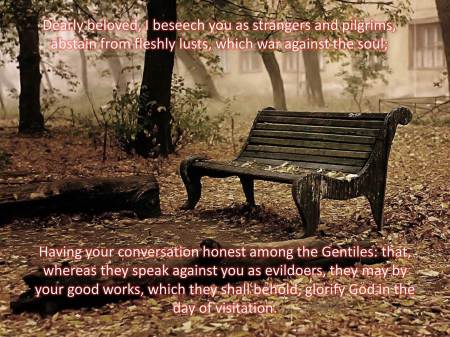
11 Dearly beloved, I beseech you as strangers and pilgrims, abstain from fleshly lusts, which war against the soul;


Peter starts out on a sympathetic, friendly note. He writes, “Dearly beloved, I beseech you . . .” I want to point out how Peter is motivating his readers to live Christian lives. He doesn’t just issue commands, like some kind of dictator. He could have done that, but he didn’t. He just appeals to his readers, and us, to do what we already know is right.[1] As Christians, let’s be very honest – we already know we’re obligated to live holy lives as best we can. We just don’t do it. Peter is telling them to remember who they are, so that they’ll be stirred up to actually live like it. So, what are we as believers? 

Peter says that all believer are “as strangers and pilgrims . . .” We don’t have citizenship in this world; if we’re children of God we have heavenly citizenship. That’s why God’s people have always considered themselves different from the world around them. God’s people have always failed when they allowed the influences of this world (which Scripture says is energized and influenced by Satan [Ephesians 2:1-3]) to direct their thoughts, attitudes and actions. We see this after the Fall, when the descendants of Seth intermingled with the Cainite apostates are corrupted the entire earth (Gen 6:1-5). King David also understood this. Read his words here: 

“Hear my prayer, O LORD, and give ear unto my cry; hold not thy peace at my tears: for I am a stranger with thee, and a sojourner, as all my fathers were,” (Psalm 39:12).

David confessed that he was stranger on the earth, a wanderer who was passing through this world! The writer of Hebrews says that all the Old Testament saints had this mindset: 

“These all died in faith, not having received the promises, but having seen them afar off, and were persuaded of them, and embraced them, and confessed that they were strangers and pilgrims on the earth. For they that say such things declare plainly that they seek a country. And truly, if they had been mindful of that country from whence they came out, they might have had opportunity to have returned. But now they desire a better country, that is, an heavenly: wherefore God is not ashamed to be called their God: for he hath prepared for them a city,” (Hebrews 11:13-16).

Think about how zealous we are about being patriotic Americans in this country. However, we ought to be even more patriotic and zealous about our real citizenship in God’s kingdom. Are we? How do we show our Godly patriotism? Peter begs us that, because we are strangers and pilgrims here in this sin-cursed world, we must “abstain from fleshly lusts, which war against the soul.

I want to re-read something I just quoted about the Old Testament believers from the Book of Hebrews: 

“But now they desire a better country, that is, an heavenly: wherefore God is not ashamed to be called their God: for he hath prepared for them a city,” (Hebrews 11:16).

Do you see that because these folks lived as though they were citizens of God’s kingdom (rather than the world) . . . God wasn’t ashamed of them? Do we realize that God is ashamed of us when we don’t act like His children? We show our patriotism for our real country (the heavenly country we’re citizens of) when we don’t act like the world. Think about it – how do you know a foreigner when you’ve seen one? Because they look different! They look different. They talk different. They dress different. They think different. Everything about them is different!

What happens to a foreigner who lives in this country (or anywhere) for long enough? They assimilate. They “go native.” They lose their rough edges and start to fit in and adapt to their new culture and surroundings. Eventually, you won’t be able to tell they’re foreigners at all.

They may still have accents and be a little bit different, but they adapt to their culture. You definitely won’t be able to tell their kids are foreigners! For all intents and purposes, they’ll be Americans.

Peter says we’re foreigners in this world and we ought to act like it. Peter says that God doesn’t want us to assimilate. He doesn’t want us to “go native.” We live here, love here and die here – but we don’t belong here. We don’t bleed red, white and blue – we bleed Christ. God wants us to keep the distinctive speech, attitudes, actions and demeanor that comes with being a Christian and a citizen of God’s Kingdom. We can’t lose any of that; no, Peter says we have to retain that identity as we live in this fallen world.

We’re commanded to not partake of, stay away from and abstain from “fleshly lusts, which war against the soul.” The danger is from within ourselves. It’s our sin that wants to burst out and take control of our lives. Peter says that these desires war against our soul! There is a civil war going on inside our hearts, and Peter says we have the ability to overcome our sin. The Devil doesn’t make a believer do anything. He tempts us and we make a decision to act wrongly

Peter says we’re supposed to act like citizens of God, not citizens of this world.[2] We get upset when people disrespect military members (e.g. elitists who have never served), our national heritage or our country in general. Why do we get upset? Because it’s unpatriotic. It’s “un-American.” It’s arrogant! God gets upset when we have the same attitude about our citizenship in His heavenly country!

HERE’S WHY (v.12):

Here’s why we have to act like citizens of God’s kingdom:


12 Having your conversation honest among the Gentiles: that, whereas they speak against you as evildoers, they may by your good works, which they shall behold, glorify God in the day of visitation.


Peter says (1) we live holy and honest, Christ-like lives, so that (2) even though unbelievers might slander and speak evil of us, (3) they see our witness and testimony, and (4) that can be a major factor in that person getting saved! God can, and does, use our testimony to lead somebody to the Lord. We’re supposed to be separate from the world (live, think and act differently) so that we’re a testimony for God – more than that, so that we prove all the lies spread about Jesus Christ and Christianity wrong!

Did you know that in the early years of Christianity, there were a whole lot of misconceptions, lies and gossip spread about Christianity that weren’t true? For example;

  1. There were wild accusations that Christians engaged in sexual orgies and incest when they met for worship![3] They based this on the fact that believers called one another “brother” and “sister.” They also misinterpreted the command to love one another as Christ loved them (Jn 13:34-35). This was what unbelievers thought went on at their church meetings. Large doses of lies, gossip, innuendo and hearsay helped these ridiculous charges spread rapidly.
  2. There were rumors that Christians were cannibals! This misunderstanding was based on Jesus’ words, “Except ye eat the flesh of the Son of man, and drink his blood, ye have no life in you,” (John 6:53). There were even scandalous rumors that Christians sacrificed small children during the Lord’s Supper, and drank their blood and ate their flesh![4]
  3. Some unbelievers also believed that Christians were atheists! In a world that only worshipped physical, visible gods, Christians were seen as bizarre because they worshipped an invisible God![5] Unbelievers though to themselves, “at least the Jews worshipped at a temple – you guys don’t even do that!”[6]

Now, all of these are silly, slanderous lies that can easily be proven wrong! Peter says one of the reasons we have to act like Godly people is so that we do prove lies about our Savior wrong. People see us on the one hand, and the accusation on the other, and say to themselves, “no, that can’t be true. So and so would never do that!”

This means that God calls us to be separate from the world, not isolated from the world. We aren’t supposed to go up into the mountains, build communes, bake bread together and build tall, thick walls to keep the world out like modern-day monks. We know that’s wrong because Peter said that the unbelieving world will see how we act and how we live.

CONCLUSION:

God doesn’t want us to be separate from the world because we’re better than everyone else (e.g. “holier than thou,” etc.). He wants us to live like Christians in an unbelieving world so that, by our own example, we can be a light for Christ. It actually would have been easier if God did want us to be monks who isolated ourselves from everybody else! No – what God wants us to do is much harder. He wants us to live each and every day in the world, surrounded by sin and temptation – and to rise above it all and be holy. That’s a lot harder.

God didn’t give us this responsibility to be in the world, but not of the world, to torture us. He’s given us the wonderful responsibility to be a part of His plan of salvation!

—————————————————————–

Footnotes:

[1] “Peter did not command his readers; he appealed to their own sense of what is right. As those who have been born again, he knows that they are able to do what he asks. True holiness is not procured by the application of a compelling external authority, but by awakening and strengthening the personal desire and will of those appealed to,” (D. Edmond Hiebert, 1 Peter, revised ed. [Chicago, IL: Moody, 1992; reprint, Winona Lake, IN: BMH, 2008], 154).

[2] “Called as children of the light, Christians are free. Their freedom, however, binds them to their calling. They are free in bondage to God,” (Edmund Clowney, The Message of 1 Peter, The Bible Speaks Today [Downer’s Grove, IL: IVP, 1988; reprint, Kindle edition, 2014], Kindle Location 1394).

[3] For example, in the writings of Minucius Felix from approximately 201 A.D., he relates the charge of a non-Christian who claimed:

“Everywhere also there is mingled among them a certain religion of lust, and they call one another promiscuously brothers and sisters, that even a not unusual debauchery may by the intervention of that sacred name become incestuous: it is thus that their vain and senseless superstition glories in crimes . . .  On a solemn day they assemble at the feast, with all their children, sisters, mothers, people of every sex and of every age. There, after much feasting, when the fellowship has grown warm, and the fervour of incestuous lust has grown hot with drunkenness, a dog that has been tied to the chandelier is provoked, by throwing a small piece of offal beyond the length of a line by which he is bound, to rush and spring; and thus the conscious light being overturned and extinguished in the shameless darkness, the connections of abominable lust involve them in the uncertainty of fate. Although not all in fact, yet in consciousness all are alike incestuous, since by the desire of all of them everything is sought for which can happen in the act of each individual,” (“The Octavius of Minucius Felix,” Chapter 9, Ante-Nicene Fathers, 10 vols., ed. Alexander Roberts, James Donaldson, and A. Cleveland Coxe, trans. Robert Ernest Wallis [Buffalo, NY: Christian Literature Company, 1885], 4:177, 178).

[4] Felix once again records the same accuser:

“An infant covered over with meal, that it may deceive the unwary, is placed before him who is to be stained with their rites: this infant is slain by the young pupil, who has been urged on as if to harmless blows on the surface of the meal, with dark and secret wounds. Thirstily—O horror!—they lick up its blood; eagerly they divide its limbs. By this victim they are pledged together; with this consciousness of wickedness they are covenanted to mutual silence. Such sacred rites as these are more foul than any sacrileges,” (“Minucius Felix,” Chapter 9, ANF 4:177, 178).

[5] “For why do they endeavour with such pains to conceal and to cloak whatever they worship, since honourable things always rejoice in publicity, while crimes are kept secret? Why have they no altars, no temples, no acknowledged images?” (“Minucius Felix,” Chapter 10, ANF 4:178).

[6] “The lonely and miserable nationality of the Jews worshipped one God, and one peculiar to itself; but they worshipped him openly, with temples, with altars, with victims, and with ceremonies; and he has so little force or power, that he is enslaved, with his own special nation, to the Roman deities. But the Christians, moreover, what wonders, what monstrosities do they feign!—that he who is their God, whom they can neither show nor behold, inquires diligently into the character of all, the acts of all, and, in fine, into their words and secret thoughts; that he runs about everywhere, and is everywhere present,” (“Minucius Felix,” Chapter 10, ANF 4:178).

It’s Not About You! (1 Peter 2:4-10)

Bible and a crucifix
Click this picture to hear the sermon!

The last several weeks have been part of one long statement Peter has been making, and they’re all inter-connected:

  1. We’re supposed to be holy because God is holy (1 Pet 1:13-16)
  2. We’re supposed to reckon Christ’s sacrifice as worth the cost of denying ourselves (1 Pet 1: 17-21). He redeemed us with His blood, not with something worthless. If we take His grace for granted, we’re basically calling His sacrifice worthless.
  3. Part of being holy means to love one another (your fellow believers in this church), with a pure heart, fervently (1 Pet 1:22-25).
  4. That means we each have to take action in our lives (1 Pet 2:1-3). We confess and forsake sin that stops us from accomplishing all this. We desire to be corrected by the sincere milk of the Word, so we grow – tossing away sinful behavior, and replacing it with Godly behavior.

So, what’s the point? We usually have tunnel-vision on our individual walk as Christians. We forget that we’re part of a group of people whom God has saved, individually and specifically, for a reason. Today, Peter will tell us why God saved you, what your most basic job is, and why we need to try our best to be a holy people. Peter wants to get us to look beyond ourselves, and understand that all believers are part of a greater Christian community. It’s not about us at all.

Peter is going to use a very simple and familiar example to help us see where we each fit into God’s plan for this age – and why it matters. He’s going to use the idea of a temple. He’s going to mention Christ as the chief corner stone, the foundation block, for this temple. He’s going to say that believers are the individual stones and building blocks which make up this temple. Let’s see what Peter has to tell us:


4 To whom coming, as unto a living stone, disallowed indeed of men, but chosen of God, and precious,
5 Ye also, as lively stones, are built up a spiritual house, an holy priesthood, to offer up spiritual sacrifices, acceptable to God by Jesus Christ.


We’ll spend a little time unpacking what this verse tells us:

First:

Peter writes that all believers continually come to Christ, who is the “living stone.” Why is Christ specifically called a “living stone?” Because we don’t worship a dead Savior. We do celebrate our Savior’s death – because of what that death bought for us. However, we also celebrate His resurrection – because His victory over the grave means our victory over the grave – if we believe in who He is and what He did for us! We worship a Risen and Living Savior – One Who sits at the Father’s side in heaven right now! He’s not dead, He’s alive! He is the foundation stone our faith is built on, but our Savior isn’t a pile of bones on a hillside outside Jerusalem – He’s alive![1]

Second: 

Christ was rejected (“disallowed”) by men, but chosen by God and precious to Him. It’s so easy to skim over those words without a second thought. We ought to realize that Peter was killed for his faith shortly after he wrote this letter. Peter wrote the letter to remind folks who are really suffering about the grace of God – to encourage them about who Christ is (not was) and what He did for them.

We aren’t quite sure when Peter was killed, but it may well have been during Nero’s reign. A man wrote about the terrible persecution against Christians during Nero’s reign:

“Accordingly, an arrest was first made of all who pleaded guilty; then, upon their information, an immense multitude was convicted, not so much of the crime of firing the city, as of hatred against mankind. Mockery of every sort was added to their deaths. Covered with the skins of beasts, they were torn by dogs and perished, or were nailed to crosses, or were doomed to the flames and burnt, to serve as a nightly illumination, when daylight had expired.”[2]

That’s why Peter wrote this in the same letter:

“Beloved, think it not strange concerning the fiery trial which is to try you, as though some strange thing happened unto you: But rejoice, inasmuch as ye are partakers of Christ’s sufferings; that, when his glory shall be revealed, ye may be glad also with exceeding joy. If ye be reproached for the name of Christ, happy are ye; for the spirit of glory and of God resteth upon you: on their part he is evil spoken of, but on your part he is glorified. But let none of you suffer as a murderer, or as a thief, or as an evildoer, or as a busybody in other men’s matters. Yet if any man suffer as a Christian, let him not be ashamed; but let him glorify God on this behalf,” (1 Peter 4:12-16).

People who read this letter could be faced with death for not denying Christ. Peter didn’t want them to deny Christ, and he reminded them about these precious truths as much as possible.

Third:

God is building us up,[3] because we’re living stones, too! Why are we living stones? Because we’ve been born again, raised from death to life. We’ve been spiritually resurrected just as surely as Christ was physically resurrected! What is God building all believers today up into?

Fourth:

We’re a spiritual house – a temple! The church (in a corporate, in-prospect sense) is made up of individual building blocks – people. You and I are the building blocks that are built around the foundation stone of Jesus Christ:[4] 

“For through him we both have access by one Spirit unto the Father. Now therefore ye are no more strangers and foreigners, but fellowcitizens with the saints, and of the household of God; And are built upon the foundation of the apostles and prophets, Jesus Christ himself being the chief corner stone; In whom all the building fitly framed together groweth unto an holy temple in the Lord: In whom ye also are builded together for an habitation of God through the Spirit,” (Ephesians 2:18-22).

As we’re going to see, this means Lone Ranger-type Christianity is un-Biblical. You are each part of a local church (or ought to be), a building block that’s vital to your church. What do we do as a church? We’re being built up by God into a spiritual house (a temple) to do . . . what?

Fifth:

We’re each priests before God! We don’t just make up this temple – we serve in it! There are two basic things a priest does:

  1. A priest is somebody who has access to God in a way that ordinary people don’t
  2. A priest is also somebody who represents God to other people

Each believer is a priest before God in this age! Here is why:[5]

  1. By repenting and believing in Christ, you have direct access to God yourself – you don’t need to rely on anyone to speak to God for you:

“For we have not an high priest which cannot be touched with the feeling of our infirmities; but was in all points tempted like as we are, yet without sin. Let us therefore come boldly unto the throne of grace, that we may obtain mercy, and find grace to help in time of need,” (Hebrews 4:15-16).

  1. The Great Commission commands every believer to go tell others about the Gospel – you live holy lives and give God’s message of salvation to a lost world!

So, we’re each individual priests in this temple, the church – but what are our jobs? The priests in the OT brought sacrifices before God – it was one of their main jobs. That is our job today, also.

Sixth:

Our job is to bring spiritual sacrifices to God – not physical ones! What are spiritual sacrifices? They’re the work we do for the Lord. They’re us using our God-given talents, gifts and abilities for Him wherever He’s planted us. It’s us saying, “You’ve saved me, God, and here is me showing my love and devotion to you . . .” [6]Look at what the Scripture has to say:

“I beseech you therefore, brethren, by the mercies of God, that ye present your bodies a living sacrifice, holy, acceptable unto God, which is your reasonable service,” (Romans 12:1).

“Forasmuch then as Christ hath suffered for us in the flesh, arm yourselves likewise with the same mind: for he that hath suffered in the flesh hath ceased from sin; That he no longer should live the rest of his time in the flesh to the lusts of men, but to the will of God,” (1 Peter 4:1-2).

That’s why we’re supposed to be holy. That’s why we’re supposed to love fellow believers in your church with a pure heart, fervently. That’s why Peter says that we’re priests together in this temple that is the Church. We’re all individual stones, being added to the structure that is the temple of God. We’re all based on the living stone, Christ, the cornerstone! We belong to Him – as a group. 

Seventh:

We’re only acceptable to God because of (“through”) Jesus Christ. He gives us access to God. His death washed us clean and atoned for all our sin. He’s the reason we are priests who can approach God and worship Him by offering spiritual sacrifices!

Now that he’s said all this and made so many amazing statements, Peter goes back to the Old Testament to prove his point:


6 Wherefore also it is contained in the scripture, Behold, I lay in Sion a chief corner stone, elect, precious: and he that believeth on him shall not be confounded.


Peter basically says “that’s why Isaiah wrote this,” and quotes from Isaiah 28:16. Indeed, Christ is the chief cornerstone. He is chosen for the task of redemption and self-sacrifice. He is precious. Whoever believes in (1) who He is and (2) what He came to do will never be put to shame!


7 Unto you therefore which believe he is precious: but unto them which be disobedient, the stone which the builders disallowed, the same is made the head of the corner,


That’s why Christ is precious to us who are believers! Peter quotes from the Old Testament again from Psalm 118:22-23. He uses the picture of a building to make the point. The very stone that the builders rejected as worthless and unfit, ironically, is the one that God placed as the cornerstone in the entire foundation of the church. The Jewish leaders who were supposed to be teaching the people to worship God in spirit and truth were the very ones who looked at Christ and rejected Him as useless. Remember what Isaiah wrote over 700 years before Christ’s virgin birth:

“Who hath believed our report? and to whom is the arm of the LORD revealed? For he shall grow up before him as a tender plant, and as a root out of a dry ground: he hath no form nor comeliness; and when we shall see him, there is no beauty that we should desire him. He is despised and rejected of men; a man of sorrows, and acquainted with grief: and we hid as it were our faces from him; he was despised, and we esteemed him not,” (Isaiah 53:1-3).


8 And a stone of stumbling, and a rock of offence, even to them which stumble at the word, being disobedient: whereunto also they were appointed.


To unbelievers, Christ is literally a stumbling-stone, a rock of offense. They don’t want to be joined to Christ. They don’t want to be priests before God – nothing could be more repulsive! They don’t want to offer spiritual sacrifices to God – that means they’d have to deny themselves and make Him Lord of their life. Unbelievers don’t want to go near God and serve Him. They want God to stay in a galaxy far, far away and to leave them alone.

But, Peter reminds us, that’s not our attitude!


9 But ye are a chosen generation, a royal priesthood, an holy nation, a peculiar people; that ye should shew forth the praises of him who hath called you out of darkness into his marvellous light:


If you’re a believer today, Peter wants to remind you of a few things:[7]

  1. That you’re part of a chosen people – the Church
  2. You’re part of a royal priesthood. You’re not a Lone Ranger Christian out on your own. You’re an integral part of this temple God is building up!
  3. You’re part of a holy nation of believers. We don’t worship the American flag; we worship the cross of Christ – we’re His people
  4. You’re His special (“peculiar”) people
  5. Your job is to be a testimony for Him in everything we do, because God is the One who called us out of darkness and into the light that is Christ (Jn 8:12)


10 Which in time past were not a people, but are now the people of God: which had not obtained mercy, but now have obtained mercy.


Gentiles didn’t used to be the people of God – the Jews were.[8] Now Gentiles are fellow-heirs in the church. Non-Jews didn’t have the mercy of God before – the Jews had been entrusted with the message of salvation: 

“That at that time ye were without Christ, being aliens from the commonwealth of Israel, and strangers from the covenants of promise, having no hope, and without God in the world: But now in Christ Jesus ye who sometimes were far off are made nigh by the blood of Christ,” (Ephesians 2:12-13).

Now we do have that mercy in the Gospel of Jesus Christ!

CONCLUSION:

God called you and saved you. He joined you, as a building block, to the Church – the temple He’s building person by person. Because we’ve been given the responsibility and privilege of serving Him and approaching Him directly, we ought to take our job seriously. Peter says our job is to show God to other people – to unbelievers. We can’t do that if we’re not fighting against sin in our lives! That’s why we need to do our very best to be a holy people. It’s not about just us. We serve in the church. We’re part of a holy group of people God has elected and called to salvation. It’s not about you. It’s about Christ and His church.

———————————————————–

FOOTNOTES:

[1] Edmund Clowney observes, “Peter identifies the cornerstone with Christ. He calls him a living Stone; he would not have us think of his Lord as inert marble! Christ is the living Stone, however, not just because he is a living person, but because he is alive from the dead as the risen Lord. God set his cornerstone in place by the resurrection,” (The Message of 1 Peter, The Bible Speaks Today [Downer’s Grove, IL: IVP, 1988; reprint, Kindle edition, 2014], Kindle Locations 1163-1165).

[2] Tacitus, Annals 15.44. Retrieved from http://goo.gl/etSkSM.

[3] D. Edmond Hiebert makes a point of noting that we are not building ourselves; it is God who is calling us out as individuals and making us a part of His church (1 Peter, revised ed. [Chicago, IL: Moody, 1992; reprint, Winona Lake, IN: BMH, 2008], 132).

[4] Roger Raymer has an intriguing observation:  “Believers are identified with Christ, for He is the living Stone and they are like living stones. And as they become more like Him, further conformed to His image, they are being built into a spiritual house. Jesus told Peter, ‘On this rock I will build My church’ (Matt. 16:18). Now Peter (1 Peter 2:4–5) clearly identified Christ as the Rock on which His church is built,” (1 Peter, in The Bible Knowledge Commentary, ed. J. F. Walvoord and R. B. Zuck, vol. 2 [Wheaton, IL: Victor Books, 1985], 845).

I am not quite convinced that it’s worth drawing that comparison, but it would be worth further study.

[5] “In this building, the Church, we are to offer ‘spiritual sacrifices’ as a ‘holy priesthood.’ The Church has no formal priesthood but is a priesthood. Our sacrifices are the various ministries we perform as we exercise our spiritual gifts. Our priestly duties involve  mediating between God and the world in our mission to the world,” (William Baker, James & First and Second Peter, 21st Century Biblical Commentary Series, ed. Mal Couch and Ed Hindson [Chattanooga, TN: AMG, 2004], 120).

[6] “They are offerings befitting a spiritual priesthood that is prompted by the Spirit and that reflects His nature and essence. They are not sacrifices offered to make expiation for sins nor to procure personal merit before God. Such sacrifices have no place in the Christian church because the perfect sacrifice of Christ on the cross has fulfilled the shadows and symbols of the Old Testament sacrifices (Gen 8:1-10:18). The sacrifices Peter mentions are expressions of worship by the redeemed, offered in gratitude and self-surrender,” (Hiebert, 1 Peter, 134).

[7] I decided to not segue into a discussion on how God applied these same terms to the nation of Israel. I don’t think it’s necessary to delve into that topic for this particular sermon. It will distract from the flow of thought I’m establishing, and it is too weighty a topic to discuss appropriately here. I feel that even a brief mention of the issue will unnecessarily distract from the point of the sermon.

[8] Peter deliberately uses Hosea 1:9-10; 2:23 to make this point. Advocates for replacement theology are quick to seize on this point, and claim that God has applied to promises from Hosea directly to the NT Church. This is not correct; the context of both citations from Hosea will not allow this interpretation. It is far more logical, however, to conclude that Peter used these citations to illustrate his point.

Hiebert agrees, and remarks, “In glancing back over the last two verses, one cannot escape the impression that Peter clearly intended to establish a parallel between Israel and the church . . . It does not naturally follow from the parallel between Israel and the church that Peter believed that the church has permanently replaced Israel, and that the latter will not again enjoy a separate existence under the favor of God,” (1 Peter, 147).

Raymer observes, “Peter just used similar terms to point up similar truths. As Israel was a ‘chosen people, a royal priesthood, a holy nation, a people belonging to God,’ so too believers today are chosen, are priests, are holy, and belong to God. Similarity does not mean identity,” (1 Peter, 846).

Solve Your Problems With Fellow Believers – Now! (1 Peter 2:1-3)

bible
Click the picture to listen to this sermon!

Peter has talked in generalities so far about personal holiness and all that entails:

  • “Don’t act like you used to before you were saved! Be holy, because the God who called you to salvation is holy . . .” (1 Peter 1:13-16).
  • “Don’t cheapen the salvation God has given you . . .” (1 Peter 1:17)
  • “Christ died to redeem you from your sins today . . .” (1 Peter 1:18-19)
  • “Love fellow believers with a pure heart fervently . . .” (1 Peter 1:22-25)

All of this is good, Biblical and correct; it’s also general and a little bit vague. What does change look like? How is it done? What are the first steps toward making it happen? It’s easy to sit here and nod our heads, but how do actually go about doing something?!

Peter has some very practical advice for us on how to make everything he’s spoken about (1 Pet 1:13-26)[1] happen. He’s specifically zeroing in, like a smart bomb, on our conduct towards other believers – on loving one another with a pure heart fervently. Let’s see how we can each start to make this happen in our lives!

 FIRST – REPENT (v.1):


1 Wherefore laying aside all malice, and all guile, and hypocrisies, and envies, and all evil speakings,


What do you think it means to “lay aside” all these sins? It means to repent! If you lay something aside, you pick it up, put it down and walk away from it. You aren’t engaged with it anymore. You aren’t toying with it. You aren’t sneaking a little bit of it when you have a chance. You’ve walked away from it.

We did an entire series on growth in Christ, and one sermon very specifically about repentance earlier this year in my church.[2] The clearest and plainest teaching from Scripture I know of that captures what real repentance looks like was written by Solomon: 

“He that covereth his sins shall not prosper: but whoso confesseth and forsaketh them shall have mercy,” (Proverbs 28:13).

Think about what this means. If you try to cover up your sin from God, you will not prosper spiritually at all. Your walk with God will be horrible. You will not have peace with God. Whoever confesses their sin to God, and forsakes (e.g. walks away from) their sin will have mercy from God. This means:

  • You don’t just admit you were wrong
  • You stop the behavior
  • You lay it aside
  • You walk away
  • You abandon it
  • You leave it behind

Don’t ever separate confession and forsaking sin – they’re an inseparable part of real repentance! So, in a general sense, every believer has a duty to (1) ferret out and identify sin in their life, (2) confess that it’s wrong and contrary to God’s Word, and (3) lay it aside and walk away.

Let’s get down to brass tacks – Peter has been talking about holiness. Part of that holiness means we love fellow believers in this local church with a pure heart, fervently (1 Pet 1:22). How do we make that happen? How do we leave the ivory tower behind and see where the rubber meets the road? Here’s how:

  • First, confess and forsake the sin of malice towards other believers in your church. This includes ill-will, nasty thoughts or wishes.[3] It doesn’t have to be malevolent, like wishing for their death! It can be more subtle, but still pretty cruel. You could intentionally ignoring their prayer requests, being intentionally nasty or icy in attitude or demeanor, making it clear you don’t care for them, and much more.
  • Second, confess and forsake the sin of guile towards other believers in your church. This is being two-faced, deceitful, tricky and slimy in any way towards.[4]
  • Third, confess and forsake the sin of hypocrisy towards other believers in your church. Do you act pious and spiritual on the outside, but spend your energy trying to hurt other people?
  • Fourth, confess the sin of envy towards other believers in your church. This means to want, desire or be jealous of something someone else has. It could be envy about a bigger house, better car, higher paying job, nicer family, etc. “A sound heart is the life of the flesh: but envy the rottenness of the bones,” (Proverbs 14:30).
  • Fifth, confess and forsake the sin of evil speaking towards other believers in your church. Do you engage in gossip, slander, or in general talk behind somebody’s back? How many times do we cloak our gossip and back-biting in a “prayer request” to a friend?

All of this presupposes the fact that we’re actually convicted about our sin towards other believers. Conviction is an inner acknowledgement of guilt. It’s when we know we’ve done wrong, because the Holy Spirit has brought it to our attention very directly![5] We can be convicted all we want, but that’s not the same as actually doing anything about it.

Something that Peter has said over the past few weeks may have convicted you. Conviction is meaningless without action – without repentance. Repentance means to confess and forsake their specific sin. It means to (1) admit to God that you’re wrong and to (2) lay that sin(s) down (“lay aside . . .”) and walk away from it.

After we put off the old person and actions we used to be before we were saved, we’re supposed to replace those old ways of life with a Godly way of life (Eph 4:17-32):

“That ye put off concerning the former conversation the old man, which is corrupt according to the deceitful lusts; And be renewed in the spirit of your mind; And that ye put on the new man, which after God is created in righteousness and true holiness,” (Ephesians 4:22-24).

How do we do this?

SECOND – LET THE BIBLE CORRECT YOU (vv.2-3):


2 As newborn babes, desire the sincere milk of the word, that ye may grow thereby:


We let the Bible correct us! Just like a newborn baby desires milk, we (as believers) ought to desire the pure, sincere and uncorrupted milk of the Word of God – the Scriptures.[6] Why is that? Because that’s how we grow – by the Word of God! We grow by systematically getting rid of sin and replacing it with Godly behavior. It’s a perpetual exchange system; bad for good; sinful for holy

Growth will not happen unless we sincerely want to change. Our repentance has to be genuine. That means it has to be based on real conviction. Peter says we ought to desire the Word of God just as enthusiastically as a little baby desires milk. Other versions translate that as to “crave” or “yearn” for the sincere milk of the Word, so that we’ll grow.[7] Do we have a desire to actually change any of these sinful attitudes and actions towards fellow believers, if you have any? What have we been growing on recently? We’re supposed to desire the sincere, pure and undiluted Word of God so that we’ll grow.

Have we been making do spiritual milk that’s diluted, impure and basically a cheap-knock off? How can a baby grow with diluted milk? Likewise, how can a Christian grow by only following the convenient parts of God’s Word? How can we dilute God’s revelation and expect to be a holy people?[8]


3 If so be ye have tasted that the Lord is gracious.


This is a quote from the OT, where the Psalmist wrote, “O taste and see that the LORD is good: blessed is the man that trusteth in him,” (Psalm 34:8). This is an intentional poke by Peter, designed to convict us and gently shame us if we’re getting upset at God’s commands.[9] It’s as if Peter was saying: 

  • “Repent of all these horrible sins that ruin the fellowship in your local church! Malice, guile, hypocricy, envy and evil speaking – repent of all of it!”
  • “Get rid of it, and replace it with Godly behavior. Crave and desire the Word of God, so that you’ll grow!”
  • “That is, if you really are saved and have tasted the salvation Christ provided, and know how gracious He is . . .”


Have you experienced and tasted the salvation of the Lord?[10] Have you been resurrected from spiritual death from spiritual life by the Word of God (Jn 11:38-44; Jas 1:18)? Have you tasted how good salvation is? Have you tasted how pure and good the sincere milk of the Word is? Then why don’t we make a firm commitment to stop letting sin keep us from loving one another with a pure heart, fervently? Repent of your sin towards fellow believers in your church, and make a determination to forsake those sins and replace them with Godly behavior. It’s not a suggestion; it’s a command.

——————————————————————————-

Footnotes:

[1] This is clearly the context for Peter’s exhortation (1 Pet 2:1-3). He says “wherefore,” which is meant to connect what follows to what has come before (1 Pet 1:13-25). For some bizarre reason, Thomas Schreiner restricts the “wherefore” to the reality of the new birth in Christ; “[t]he ‘therefore’ (oun) is understood by some to reach all the way back to 1:13–25, and this is a possibility. But it seems more likely that it relates to what has just preceded, namely, the new life that believers enjoy by God’s grace,” (1, 2 Peter, Jude, vol. 37, The New American Commentary [Nashville: Broadman & Holman Publishers, 2003], 97). This is too restrictive; Peter’s exhortation to lay aside specific sins seems to clearly tied to (1) holiness in general and (2) conduct towards fellow believers specifically.

[2] See also an entire sermon series about Growth in Christ, and a sermon about repentance specifically, preached on 12JAN14. PDF notes and audio are available at the link.

[3] This is not malice in a vague, general sense – it is very specifically targeted at malice towards fellow believers, the very folks Peter has just commanded us to love with a pure heart, fervently (1 Pet 1:22). “In the context, the term seems to have a more specific meaning: it refers to the basic attitude of ill will toward others,” (D. Edmond Hiebert, 1 Peter, revised ed. [Chicago, IL: Moody, 1992; reprint, Winona Lake, IN: BMH, 2008], 121).

[4] “So it comprehends flattery, falsehood, and delusion, which is a crafty imposing upon another’s ignorance or weakness, to his damage,” (Matthew Henry, Commentary on the Whole Bible [Peabody: Hendrickson, 1994], 2425). “It is the selfish, ‘two-faced’ attitude that deceives and hurts others for personal gain,” (Hiebert, 1 Peter, 122).

[5] See Rolland McCune, A Systematic Theology of Biblical Christianity, 3 vols. (Detroit, MI: DBTS, 2009), 2:304. “The Holy Spirit does not merely accuse men of sin but brings an inescapable sense of guilt. The Holy Spirit is God’s prosecuting attorney presenting God’s case against the sinner.”

[6] The reference to newborn babies desiring milk is not negative and derogatory, as it is with Paul (1 Cor 3:1-4). See Hiebert (1 Peter, 123).

[7] “Christians must be addicted to the Bible,” (Edmund P. Clowney, The Message of 1 Peter, The Bible Speaks Today [Downer’s Grove, IL: IVP, 1988; reprint, Kindle edition, 2014], Kindle Locations 1091-1092).

[8] Jay Adams remarks, “Under the label of pure milk every sort of mixture is offered on the supermarket shelf. Peter wants his readers to be sure that what they drink will promote, rather than stunt, Christian growth . . . Peter wants, rather, to emphasize the importance of (1) developing a desire (craving) for God’s truth over against his former desires for the devil’s lies, and (2) the need to be aware that not all that goes for milk is pure (much has been adulterated),” (Trust and Obey [Greenville, SC: A Press, 1988], 58).

[9] Hiebert writes that Peter’s comment “does not imply doubt – it assumes the reality of the past experience of God’s amazing goodness and compassion in Christ. But the conditional construction is an implied invitation to the readers to self-examination on the matter,” (1 Peter, 126).

[10] Clowney observes, “[w]hat quickens our desire for the life-giving word of God? Peter answers that we know the taste. Our culture makes the image clear; advertisers spend millions to promote the taste of a cola. Reading the Bible is addictive when we begin to get the taste. What we taste in Scripture is not simply the variety and power of the language. What we taste is the Lord,” (1 Peter, Kindle Locations 1130-1133).

Love One Another (1 Peter 1:22-25)

Click the picture to listen to the sermon

I made the point last week that God didn’t just die to give us eternal life with Him. He also died to save us from the “vain conversation” (worthless way of life) we were in before we were called by the Holy Spirit.[1] He died to redeem you from your sins right now, not only in the next life. We were created in the image of God. That image was ruined and scarred by sin. Once we’re saved, we’re commanded to grow in our faith and grow into Christlikeness: 

“But now ye also put off all these; anger, wrath, malice, blasphemy, filthy communication out of your mouth. Lie not one to another, seeing that ye have put off the old man with his deeds; And have put on the new man, which is renewed in knowledge after the image of him that created him,” (Colossians 3:8-10).

When we become children of God, that perfect, harmonious and sweet relationship with both (1) God and (2) other people that we were created to enjoy can slowly be re-fashioned and reformed.[2]

Peter has already talked about us fighting our way to holiness in our thoughts, attitudes and actions: 

“Wherefore gird up the loins of your mind, be sober, and hope to the end for the grace that is to be brought unto you at the revelation of Jesus Christ; As obedient children, not fashioning yourselves according to the former lusts in your ignorance: But as he which hath called you is holy, so be ye holy in all manner of conversation; Because it is written, Be ye holy; for I am holy,” (1 Peter 1:13-16).

We’ve looked at this already – Peter was referring to our conduct in general and how that impacts our relationship with God. He’s holy; He saved us; our obligation is to be holy, too! Today, Peter has another implication for us about our relationship to fellow believers in our local church – even this one. It’s that we’re commanded to actually love one another. Not to pretend or put on a fake face – but to actually love the other believers in your church – in this church.


22 Seeing ye have purified your souls in obeying the truth through the Spirit unto unfeigned love of the brethren, see that ye love one another with a pure heart fervently:


We’re born dirty – our souls are polluted and filthy. Without the saving work of Christ in our lives, our souls are as rotten and putrid and unacceptable to God as Lazarus’ rotting, maggot-infested flesh in that tomb in Bethany. I know unbelievers don’t accept that, because the Bible says they don’t. I also know that many Christians don’t believe that about themselves. We’ve been told since we were children that we ought to think a whole lot of ourselves and have a good opinion of ourselves. “There is no fear of God before their eyes,” (Romans 3:18).

But, Peter is writing to believers. He writes that because your souls have been purified by the Spirit[3] (we’re called, our heart is changed, we repent and believe), you ought to do something very specific – you ought to love your fellow believers! Not just in a general sense where you can say, “I love all Christians!” I mean very specifically – you are commanded to love the people who fellowship with you in your own church![4] What does this love look like? 

Peter said, “see that ye love one another with a pure heart fervently.” Christ redeemed you and cleansed you so that you would love the brethren in this church fervently. This means this love isn’t fake. You don’t think to yourself, “I’ll smile at you and pray for you, but I really don’t like you at all!” No, real love for your fellow church members comes out of a pure heart.

Let’s go back to the image of God. If sin hadn’t ruined God’s perfect creation: 

  • We’d all worship God in spirit and truth
  • We’d all live in peace with one another – the first thing that happened after the Fall was a murder!

Now that you’re saved, you’re commanded to worship God in spirit and in truth, and you have the Holy Spirit to make that happen. Also, Peter commands you to love one another. We’re commanded to grow closer to Christ and be renewed in His image (Col 3:10). Our Christian life now is supposed to be a little preview of the glory to come, where (1) we actually do worship God in spirit and in truth, and (2) we actually do love fellow believers fervently, with a pure heart.


23 Being born again, not of corruptible seed, but of incorruptible, by the word of God, which liveth and abideth for ever.


You’ve been born again, redeemed and made a new creation by the word of God – the Gospel. That means that believers ought to have real brotherly love among one another. There’s enough backbiting, backstabbing, gossip and slander going on out in the world; this should never be named among Christians. Peter is reminding us of what God did for us, so that we admit what our own responsibilities are – to love one another with a pure heart, fervently!

If you say you can’t love one another, you’re saying God is a liar – period.[5] Because you’ve been born again by the word of God – it’s possible! You may object: 

  • “Yeah, but God doesn’t know Mr. Smith! God didn’t see him coming!”
  • “He’s a really unlovable, mean guy! You know it’s been three weeks since he shook my hand!”
  • “He smells sometimes and his wife didn’t even come to the last ladies meeting!”

Let me respond: 

  • God does know Mr. Smith
  • God did see Mr. Smith coming – Scripture says that God decided to save him, individually and specifically, before the foundation of the world (e.g. Eph 1:4-6)
  • Smith may not be the nicest guy in the world – have you prayed for him? Have you make an effort to be-friend him?
  • Smith might smell sometimes, just stand upwind from him!
  • Maybe his wife was worried and burdened with something, and wasn’t trying to snub you – maybe she needs prayer, too!


24 For all flesh is as grass, and all the glory of man as the flower of grass. The grass withereth, and the flower thereof falleth away:
25 But the word of the Lord endureth for ever. And this is the word which by the gospel is preached unto you.


God saved you from the worthless way of life you were imprisoned in – a way of life that might look and sound great for a time, but would rot away and die in the blink of an eye, like dying grass or a fading flower. God’s word endures forever, and it was this word that was preached to you when you repented and believed. He redeemed you to live for Him. Living for Him means holiness. Paul told the believers in Thessalonica that they should “walk worthy of God, who hath called you unto his kingdom and glory,” (2 Thessalonians 2:12). Part of that means we love fellow believers everywhere, but particularly in this local church, fervently out of a pure heart.

If there is a fellow-believer somebody in this church specifically, or in your life generally, who you despise or dislike . . .

  • Have you prayed for the love and kindness God commands you to have?
  • Have you prayed that God would soften your heart and wipe pettiness and sin away?
  • Have you prayed that He would do the same for that other person?
  • Are you even willing to do that? If not, why not? It’s a commandment from the Word of God?

It’s possible to love fellow believers – Peter says it’s our obligation. More than that, he says it should be the logical and inevitable result of our salvation. We should want to love fellow believers in our local church! Are we willing to submit to this?

——————————————————-

Footnotes:

[1]The design of Christ in shedding his most precious blood was to redeem us, not only from eternal misery hereafter, but from a vain conversation in this world. That conversation is vain which is empty, frivolous, trifling, and unserviceable to the honour of God, the credit of religion, the conviction of unbelievers, and the comfort and satisfaction of a man’s own conscience,” (Matthew Henry, Commentary on the Whole Bible [Peabody: Hendrickson, 1994], 2424). Emphasis mine.

[2] Millard Erickson writes: “God’s creation was made for definite purposes. The human was intended to know, love, and obey God, and live in harmony with other humans, as the story of Cain and Abel indicates . . . The image itself is that set of qualities that are required for these relationships and this function to take place. They are those qualities of God which, reflected in human beings, make worship, personal interaction, and work possible,” (Millard J. Erickson, Christian Theology, 2nd ed. [Grand Rapids, MI: Baker, 1998], 532-533).

This image can only be “realized” through the new birth which results in salvation through Jesus Christ. Only in Christ can we begin to realize the fulfillment of our horizontal relationships with others of faith, and our vertical relationship with God.

[3] The entire context of 1 Peter 1 supports this view. It seems that only Wayne Grudem argues that Peter refers to progressive sanctification, not positional sanctification. Grudem writes, “this ‘purification’ is something the readers have themselves done (‘having purified your souls’), but Christians are never in the New Testament said to be active agents in God’s initial cleansing of their souls at conversion. On the other hand, they are said to be active in the progressive work of sanctification,” (1 Peter, vol. 17, Tyndale New Testament Commentaries [Downers Grove, IL: InterVarsity Press, 1988], 93). The sticking point for Grudem is that the Peter suggests that we have purified ourselves. This is an unduly pessimistic viewpoint; who would deny that men and women make free and voluntary decisions to repent and believe? The fact that people only believe because of the work of the Spirit is irrelevant. Not every reference to the Gospel is meant to be a treatise on the compatibilist view of God’s sovereignty and man’s free will. The greatest, most succinct statement on this tension with regards to salvation is found in Article 6 of the 1833 New Hampshire Confession of Faith:

“We believe that in order to be saved, we must be regenerated or born again; that regeneration consists in giving a holy disposition to the mind; and is effected in a manner above our comprehension or calculation, by the power of the Holy Spirit, in connection with divine truth, so as to secure our voluntary obedience to the Gospel; and that its proper evidence is found in the holy fruit which we bring forth to the glory of God,” (from William Lumpkin, Baptist Confessions of Faith, revised ed. [Valley Forge, PA: Judson, 1969], 364-365). Emphasis mine.

Grudem’s arguments aren’t convincing; see Thomas Schreiner for a rebuttal (1, 2 Peter, Jude, vol. 37, The New American Commentary [Nashville: Broadman & Holman Publishers, 2003], 92–93).

[4] In some sense, we could see this as another example of how impractical it is to talk of the (1) church in prospect, instead of (2) the local church.

[5] Jay Adams wrote, “Peter makes a play on this common word and says in effect, ‘Now what people have talked about can really take place,’  . . . Christian counselees who deny the possibility of loving another Christian can be faced with this passage. ‘Either it is possible,’ they may be told, ‘or you deny your own salvation. Christ cleansed us for this purpose,’” (Trust and Obey [Greenville, SC: A Press, 1988], 49-50).

  1. Edmond Hiebert concurred, “Peter well knew that such a life of mutual love should be rooted in a new nature. The new birth makes possible and demands such a life,” (1 Peter, revised ed. [Chicago, IL: Moody, 1992; reprint, Winona Lake, IN: BMH, 2008], 114).

Why Should We Be Holy? (1 Peter 1:17-21)

Click the picture to listen to this sermon

Peter told us last week that we ought to be Holy, because God is holy. Today he tells us why it’s so important – why He cares about it so much. Last week, we saw that Peter said: 

“Wherefore gird up the loins of your mind, be sober, and hope to the end for the grace that is to be brought unto you at the revelation of Jesus Christ; As obedient children, not fashioning yourselves according to the former lusts in your ignorance: But as he which hath called you is holy, so be ye holy in all manner of conversation; Because it is written, Be ye holy; for I am holy,” (1 Peter 1:13-16).

Today, he continues . . .


17 And if ye call on the Father, who without respect of persons judgeth according to every man’s work, pass the time of your sojourning here in fear:


Peter basically says we should never take God’s mercy and salvation for granted. He writes,“if you call upon the Father” (e.g. if you’re saved and a believer) then pass your temporary stay here on this earth with fear!” Why does Peter say this? Peter tells us “because God judges every man according to His deeds, and doesn’t play favorites!”

Peter is telling us we should have a loving respect and fear for God. Not the fear a dog shows to a cruel master, but the kind of loving fear and respect a small child has for his father.[1] Fear and respect not based on threat of punishment, but based on not wanting to disappoint or upset our Heavenly Father. If we have this fear, and we ought to have it, we’ll never take His grace for granted. I don’t think anybody would be ok with taking a gift from a friend while stabbing him in the back at the same time. In the exact same manner, no Christian should ever think it’s acceptable to claim to be a Christian while at the same time deliberately living in sin and not caring – being unrepentant about it. That’s more than hypocritical – it’s sinful

You may wonder, what does Peter mean when he says that God doesn’t play favorites when He judges? After all, Jesus said that if we’ve been called by God, drawn by the Holy Spirit and saved, that nobody can pluck us out of His hand! 

“My sheep hear my voice, and I know them, and they follow me: And I give unto them eternal life; and they shall never perish, neither shall any man pluck them out of my hand. My Father, which gave them me, is greater than all; and no man is able to pluck them out of my Father’s hand,” (John 10:27-29).

Is Peter saying that if we don’t live like holy people, we’ll be damned? Scripture doesn’t lie or contradict itself, so it’s not saying that! But, Scripture does say that if God has to discipline so that we grow, He’ll do it:[2]

“Ye have not yet resisted unto blood, striving against sin. And ye have forgotten the exhortation which speaketh unto you as unto children, My son, despise not thou the chastening of the Lord, nor faint when thou art rebuked of him: For whom the Lord loveth he chasteneth, and scourgeth every son whom he receiveth. If ye endure chastening, God dealeth with you as with sons; for what son is he whom the father chasteneth not? But if ye be without chastisement, whereof all are partakers, then are ye bastards, and not sons. Furthermore we have had fathers of our flesh which corrected us, and we gave them reverence: shall we not much rather be in subjection unto the Father of spirits, and live? For they verily for a few days chastened us after their own pleasure; but he for our profit, that we might be partakers of his holiness,” (Hebrews 12:4-10).

A whole lot was said here – let’s focus on just a few of them. First, we’re wayward children who have been saved from hell. Second, God is our Heavenly Father. Third, what kind of Father would He be if He didn’t discipline His children? No father should let his kids run around like wild animals – a good father teaches, rebukes and trains his kids!

So far so good, but what’s the point of God’s discipline? To be mean? To be petty? To get a few laughs? Not at all; we just saw the writer of Hebrews compare our earthly fathers with our Heavenly Father; “[f]or they verily for a few days chastened us after their own pleasure; but he for our profit, that we might be partakers of his holiness,” (Hebrews 12:10). This means that God disciplines believers to help us grow and make us a holier people. The writer of Hebrews went on: 

“Now no chastening for the present seemeth to be joyous, but grievous: nevertheless afterward it yieldeth the peaceable fruit of righteousness unto them which are exercised thereby. Wherefore lift up the hands which hang down, and the feeble knees; And make straight paths for your feet, lest that which is lame be turned out of the way; but let it rather be healed. Follow peace with all men, and holiness, without which no man shall see the Lord,” (Hebrews 12:11-14).

God trains us by discipline. He tells us to pursue holiness – to strive after it, day in and day out. The writer of Hebrews’ point, and Peter’s point, is that if we don’t take our obligation for personal holiness seriously, then we’re making a big mistake. God will discipline us, like disobedient children. If we have this flippant, “who cares” attitude, then we’re in serious spiritual danger. Peter tells us that everybody who calls on the Father should pass their temporary time here on earth in loving, reverential fear – trying our best to please our God and Savior, not wanting to disappoint Him!

That leads us to another question or two (or three!):

  1. Why is it so bad to disappoint God?
  2. Doesn’t He know we’re sinful?
  3. Isn’t He willing and waiting to forgive us when we fall short?
  4. Is Peter trying to tell us that we have to be perfect? Who’s perfect, anyway!?

God doesn’t expect you to be sinless and perfect. God does expect you to get up every day and try your best to fight against sin and temptation because you love Him. He’s saved you, given you the gift of the Holy Spirit (your new Helper), and given you a goal-post to shoot for – to be like Christ! He will not accept the fact that we’re sinful people as an excuse for keeping unrepentant sin in your life. Keep struggling, and keep on struggling until we die or Christ returns to take believers home, whichever comes first.


18 Forasmuch as ye know that ye were not redeemed with corruptible things, as silver and gold, from your vain conversation received by tradition from your fathers;
19 But with the precious blood of Christ, as of a lamb without blemish and without spot:


Peter’s going to remind us of something very important to make his point. If you’re a believer, you’ve been redeemed by Christ – it was His sacrifice and death on the Cross that paid the price for your own sin. His blood was precious, because Christ is God, and that blood was shed for you. He entered into His own creation and lived a sinless life. An animal brought for sacrifice to atone for sins in the OT had be perfect. Christ was sinless and perfect, and was sacrificed like a lamb without blemish and without spot – for you. You weren’t redeemed by worthless things like silver or gold, but by Christ’s death.

What does this mean? What does this have to do with why we ought to try to be holy people? It’s simply this – Christ has set you free from sin, so why are you tolerating unrepentant sin in your life? 

“What? know ye not that your body is the temple of the Holy Ghost which is in you, which ye have of God, and ye are not your own? For ye are bought with a price: therefore glorify God in your body, and in your spirit, which are God’s,” (1 Corinthians 6:19-20).

If you’ve been set free from sin, and given the gift of the Holy Spirit (and if you’re saved, you have!) . . .

  1. Then why do we tolerate sin in our lives?
  2. Why don’t we dedicate time and effort to actually changing the way we live our lives to be more Christ-like?
  3. Why are we so lazy?

Peter says you were redeemed “from your vain conversation received by tradition from your fathers . . .” We were rescued and bought by Christ’s blood from the road to hell we were on. He’s talking to Gentiles who never knew God or the Hebrew Scriptures, and he’s telling them, “you were redeemed from the worthless actions and attitudes you learned from your parents!” If we’ve been redeemed and set free from something, then we ought to act like that’s true.

  • Do you realize that you’ve been set free from the sin that weighs you down?
  • Do you realize that you can have victory over it?

God calls us to be holy people, He’s set us free from sin and death by Christ’s sacrifice, and given us a Helper in the Holy Spirit. We can overcome sin. It takes daily discipline and effort. It takes a real conviction, real repentance, real daily instruction in righteousness and real determination. But, we’ve been redeemed by Christ Himself, and we can do it. I challenge you to make a list of things you need to change in your life. I want you to realize that Christ died to set you free from those sins.  I want you to realize that, by the grace of God and the power of the Holy Spirit, you can have victory over those sins.


20 Who verily was foreordained before the foundation of the world, but was manifest in these last times for you,
21 Who by him do believe in God, that raised him up from the dead, and gave him glory; that your faith and hope might be in God.


Christ’s sacrifice in your place, for your sins, as your substitute was foreordained (planned and determined) before the world even began, and He came, died and was resurrected in these days for your sakes! He didn’t just die to accomplish something when you die, so you be reconciled to God and spend eternity with Him. No, Christ died to redeem you from the “vain conversation” you were in bondage to.[3] “Vain conversation” is “worthless conduct;” the empty and useless things you used to live for and do before you were called by the Holy Spirit for salvation. Christ died to redeem you from that unholy way of life.

Shame on all of us who don’t seize on that freedom He provided us, and continue to live unholy lives, knowing our responsibility to be holy, but not caring to even try. If you’re struggling to be holy, to have victory over a specific sin in your life – then praise God and keep on fighting today, tomorrow and forever. You were set free from this sin, and you can have victory over it by God’s grace!

———————————————————–

Footnotes:

[1] “The attitude advocated is not the craven, cringing dread of a slave before an offended master, but the reverential awe of a son toward a beloved and esteemed father, the awe that shrinks from whatever would displease and grieve him,” (D. Edmond Hiebert, 1 Peter, revised ed. [Chicago, IL: Moody, 1992; reprint, Winona Lake, IN: BMH, 2008], 100).

[2] This seems to be the sense of “who without respect of persons judgeth according to every man’s work.” It is in the present tense, which indicates that God judges believers in the here and now in some fashion. Discipline (e.g. Heb 12:12:4-14) seems to be Peter’s point. For example, Jay Adams writes, “[i]t does speak of the final judgment of God among His people, but it also refers to the on-going judgment of God by which He trains and governs the members of His family (the verb is in the present tense). And, at times when He deems it necessary (because of the disgrace it brings on His name), that Fatherly judgment can be quite severe,” (Trust and Obey: A Practical Commentary on First Peter [Greenville, SC: A Press, 1988], 41-42).

Although the thrust of the passage could be referring to the judgment of believer’s works in the last days (e.g. 1 Cor 3:11-15), that really doesn’t seem to be what Peter is driving at. Wayne Grudem observes, “. . . the phrase is better understood to refer primarily or even exclusively to present judgment and discipline in this life,” (1 Peter, vol. 17, Tyndale New Testament Commentaries [Downers Grove, IL: InterVarsity Press, 1988], 86). “Peter’s primary reference is to God’s present dealings with His saints in the development of holiness in their lives,” (Hiebert, 1 Peter, 99).

[3]The design of Christ in shedding his most precious blood was to redeem us, not only from eternal misery hereafter, but from a vain conversation in this world. That conversation is vain which is empty, frivolous, trifling, and unserviceable to the honour of God, the credit of religion, the conviction of unbelievers, and the comfort and satisfaction of a man’s own conscience,” (Matthew Henry, Commentary on the Whole Bible [Peabody: Hendrickson, 1994], 2424). Emphasis mine.

Be Holy! (1 Peter 1:13-16)

INTRODUCTION AND CONTEXT:


If you’re a believer, Peter just spent a lot of time reminding you of several things believers ought to be thankful for. If you’re a Christian, you have a lot to be happy about. So smile! You ought to smile. I’ll re-state it all for you in case you forgot:

  1. God has given you a home!
  2. God chose to save you – individually and personally!
  3. Your salvation is eternal and secure because it’s based on God’s grace, not your own merit
  4. Because you have the New Testament and understand the finished work of Christ, you can know more about God than David, Moses or any Old Testament saint ever could!
  5. All this means you can keep struggling while you wait for Christ to return for you!

But, now that Peter has reminded us of all the things God has done for us, it’s time to look at our obligations in light of all this. What does it mean to be holy, because God is holy? What does Peter mean? Let’s take a look!

TEXT:


13 Wherefore gird up the loins of your mind, be sober, and hope to the end for the grace that is to be brought unto you at the revelation of Jesus Christ;


Because all these things are true – we’re commanded to live our lives and act a certain way. Peter writes, “Wherefore gird up the loins of your mind . . .” That means to get ready, to steel yourselves, to prepare yourselves. It means to get your mind ready for action. Have you ever known something terrible is coming, and you had to psych yourself up and prepare for it?

I was in the U.S. Navy Security Forces for 10 years. I started as a military policeman and did standard patrol work, and ended my time in the service as a Criminal Investigator. When I was on patrol, I had to carry what is usually called “pepper spray.” In order to carry this, you had to be sprayed by it first and demonstrate you can still function while your face felt like it was melting! I wasn’t looking forward to being pepper sprayed – nobody was! I had to mentally prepare myself for this awful event, and I was very glad when it was over!

In Peter’s day, when a man “girded up” his robe, everybody knew that meant he was getting ready for some kind of physical activity. If I’m wearing a suit and a tie, and I take oof my suit jacket and loosen my tie, you immediately know that I’m about to do something physical and I don’t want my suitcoat and tie to get in the way. Peter is saying that we have to get our minds ready for battle in the Christian life – we have to gird up our minds.

Peter says we ought to be pretty serious about our Christian life, how we live our lives, what we think, what we watch, what we do. This isn’t a picture of somebody casually drifting through life in a lackadaisical, uncommitted way – this is serious! He says we have to “be sober.”

To be sober means to be serious. It also means to not be drunk, but Peter doesn’t mean that here. We’re commanded to be serious about our walk with God. That means we take His word seriously and let Him rule our lives. That doesn’t mean we become a bunch of stiffs who look down our noses every time somebody laughs or smiles, and who seem to hate life! It just means we’re serious about our faith, and we allow it to shape our entire outlook. We don’t get lazy[1]

“And these are they which are sown among thorns; such as hear the word, And the cares of this world, and the deceitfulness of riches, and the lusts of other things entering in, choke the word, and it becometh unfruitful,” (Mark 4:18-19).

There’s a reason why the Holy Spirit moved the authors of the sacred Scripture to warn Christians so much about persevering, about struggling forward, looking to Jesus Christ the author and finisher of our faith – because God doesn’t want us to get distracted and lose focus! Let’s be serious and sober about the Christian life, and not let the cares of this world distract us

“If ye then be risen with Christ, seek those things which are above, where Christ sitteth on the right hand of God. Set your affection on things above, not on things on the earth. For ye are dead, and your life is hid with Christ in God,” (Colossians 3:1-3).

Does Christ take a backseat in our lives to our own ambitions, dreams and hobbies? If it wasn’t a possibility that we needed to watch out for, then Paul wouldn’t have warned us about it!

“Love not the world, neither the things that are in the world. If any man love the world, the love of the Father is not in him. For all that is in the world, the lust of the flesh, and the lust of the eyes, and the pride of life, is not of the Father, but is of the world. And the world passeth away, and the lust thereof: but he that doeth the will of God abideth for ever,” (1 John 2:15-17).

These are harsh words! We’re strangers and pilgrims in this world, and while we enjoy the blessings, family and stuff God has given us – we ought to be looking for that heavenly country that we’re actual citizens of, where Christ has prepared a place for us!

Peter goes on, and writes that Cristians are to “hope to the end for the grace that is to be brought unto you at the revelation of Jesus Christ.” There it is again – the idea of perseverance. Because of everything Christ has done for us (vv.1-12), we can keep on keepin’ on in the here and now. Peter has told us that we ought to get ready for battle and be serious about our Christian life, but what does that actually mean!?


14 As obedient children, not fashioning yourselves according to the former lusts in your ignorance:


It means to not act like we used to before we were saved. Peter tells us to be like “obedient children.” God is our Heavenly Father. We are the children who are under training and discipline. When we’re in glory and our life is over, that training is over, we’re free from sin, temptation and everything evil or wrong. Until then, we’re in training, and we need to be obedient children of God. A real Christian life is characterized by action and determination, and by the power of the Holy Spirit we can resists sin and temptation and not be the way we used to be today, tomorrow or the day after.

If Peter had wanted to give an exhaustive list of what “un-Christian behavior” is, then he’d still be writing today. Instead, he repeats a very simple and profound truth from Leviticus . . .


15 But as he which hath called you is holy, so be ye holy in all manner of conversation;
16 Because it is written, Be ye holy; for I am holy.


Holiness is the complete opposite of evil:

“And the LORD spake unto Moses, saying, Speak unto all the congregation of the children of Israel, and say unto them, Ye shall be holy: for I the LORD your God am holy,” (Leviticus 19:1-2).

God commands us that we do our very best to purge evil and sin out of every aspect of our lives:

“Having therefore these promises, dearly beloved, let us cleanse ourselves from all filthiness of the flesh and spirit, perfecting holiness in the fear of God,” (2 Corinthians 7:1).

The idea of “cleansing ourselves” means we’re dirty and filthy, somehow:

“And you, that were sometime alienated and enemies in your mind by wicked works, yet now hath he reconciled In the body of his flesh through death, to present you holy and unblameable and unreproveable in his sight,” (Colossians 1:22-23).

We were alienated from God and His enemies before we were saved because of what was in our minds, which expressed itself by our actions. We were saved from darkness, now we’re commanded to walk worthy of God – so that, as much as we’re able, we’re ready to meet Christ at a moment’s notice without regret or sorrow.

When my wife goes out shopping and leaves me alone to watch the children, I know that it’s my responsibility to make sure the house is clean when she comes back. I have to make sure the kids clean up the mess they’ve made before Mommy gets home. I can’t lose track of time, or else I’ll be in trouble when she comes home. Usually, I do a decent job at this. Sometimes, however, I completely lose track of time. I hear my wife’s key in the door upstairs, and my heart sinks. I know the house is a disaster. I know the kids are running wild. I know I’m going to be in trouble. Grimacing, I head upstairs to face the music! In an infinitely more important way, we should not be caught unprepared when our Savor comes back for us!

I want you to think about the Old Testament Priest and the Temple.

  1. Priests were sinful people
  2. God dwelt in the temple
  3. If priests just blundered on into the temple to offer a sacrifice to God, they would die
  4. They had to atone for their own sins before they brought any offering for another Israelite. Just read Leviticus 8-10 if you want to get a sense of the preparations priests had to go through to actually approach God

Now, let’s make the New Covenant contrast. There isn’t a literal temple anymore where God dwells on earth – He lives in our hearts because all believers have the Holy Spirit. That means our bodies are temples of God: 

“Know ye not that ye are the temple of God, and that the Spirit of God dwelleth in you? If any man defile the temple of God, him shall God destroy; for the temple of God is holy, which temple ye are,” (1 Corinthians 3:16-17).

When you think about the extremely detailed, meticulous preparation OT priests had to go through to even approach God in the temple . . . what should that mean for us, if our bodies are temples of God today? 

“What? know ye not that your body is the temple of the Holy Ghost which is in you, which ye have of God, and ye are not your own? For ye are bought with a price: therefore glorify God in your body, and in your spirit, which are God’s,” (1 Corinthians 6:19-20).

God commands us to be holy people. It’s up to each and every one of us to examine our own lives and consider whether our lives could be called “holy.” Because God:

  1. Saved us,
  2. Prepared a home for us in eternity
  3. Will never let us lose our salvation, and
  4. Has given us more info about Him than Moses, David or Abraham ever had

. . . then is it really so much to ask that we should honor Him and try our very best to live holy lives for Him, because He’s holy? We’re commanded, not asked, to be obedient children for our Heavenly Father – to be holy in everything we do. Let’s make a decision to obey that command today, tomorrow and every day.

———————————————————-

Footnotes:

[1] “He knows how easily Christians can lose their spiritual concentration through ‘mental intoxication’ with the things of this world (cf. Mark 4:19; Col. 3:2–3; 1 John 2:15–17). We today might well consider the dangers presented by such inherently ‘good’ things as career, possessions, recreation, reputation, friendships, scholarship, or authority,” (Wayne A. Grudem, 1 Peter, vol. 17, Tyndale New Testament Commentaries [Downers Grove, IL: InterVarsity Press, 1988], 81).

“There is a way of living that becomes dull to the reality of God, that is anesthetized by the attractions of this world. When people are lulled into such drowsiness, they lose sight of Christ’s future revelation of himself and concentrate only on fulfilling their earthly desires,” (Thomas R. Schreiner, 1, 2 Peter, Jude, vol. 37, The New American Commentary [Nashville: Broadman & Holman Publishers, 2003], 79).

Why Should Christians Be Happy? (1 Peter 1:1-12)

This is the start of a series of messages through the Books of 1 & 2 Peter. These are essentially sermon notes that have been expanded for a reading audience. I hope these messages will be helpful!

————————————————–

INTRODUCTION AND CONTEXT:

In the military, everybody’s favorite duty station is always (1) the place they’re heading to, or (2) the place they just left from. You might get shipped to a pretty horrible duty station in the military, but you know that it won’t last forever – because eventually you’ll get on that plane and go back home. I can still remember the joy I felt whenever I came home in leave when I was stationed overseas in the U.S. Navy. I looked forward to that magic moment when I would step off the plane and see Starbucks waiting for me in the terminal!

From a spiritual standpoint, I can get really down sometimes because I forget that, just like when I was in the military, I’ll be transferred to glory one day – because I’m a child of God! I forget to take the long view. I forget what’s waiting for me at the finish line and get caught up feeling sorry for myself in my problems – whatever they may be.

I’m not minimizing whatever you may be going through or have gone through. This is a world filled with sin, ruined by the Fall, and bad things happen. What I want to do is encourage you today about some very basic truths about the Christian life, and why you ought to smile and be happy today – no matter what kind of valley you’re in the middle of right now! So, here are some reasons from Peter why Christians ought to be happy . . .

crazed smiley

#1 – BECAUSE GOD HAS GIVEN YOU A HOME! (V.1):


1 Peter, an apostle of Jesus Christ, to the strangers scattered throughout Pontus, Galatia, Cappadocia, Asia, and Bithynia,


Peter wrote this letter to the “strangers” who are scattered all around Asia Minor (what we know as Turkey). Did you know that the Bible says that Christians[1] are “strangers and pilgrims” in this world? Jesus said that He was going to prepare a place for us in heaven (Jn 14:2-3). The writer of Hebrews said that all the Old Testament believers counted themselves as strangers and pilgrims who looked forward to being citizens of a heavenly country. While they were alive they didn’t see this heavenly country, but they sure looked forward to it! 

“These all died in faith, not having received the promises, but having seen them afar off, and were persuaded of them, and embraced them, and confessed that they were strangers and pilgrims on the earth. For they that say such things declare plainly that they seek a country. And truly, if they had been mindful of that country from whence they came out, they might have had opportunity to have returned. But now they desire a better country, that is, an heavenly: wherefore God is not ashamed to be called their God: for he hath prepared for them a city,” (Hebrews 11:13-16).

Think of the border crisis. Think of a legal alien, who has a green card. What do aliens and foreigners in the U.S. have to endure? They don’t have the same rights, privileges or comforts of citizens. They can’t vote, can’t be elected to office, can’t bring family members to the U.S., and can’t get government jobs! Why not? Because they’re not citizens!

If we’re just strangers and pilgrims here, that means this world isn’t our permanent home!

  • No matter what evil or wickedness we endure in this world . . .
  • No matter what people do to us or say to us . . .
  • No matter how hard or depressing our circumstances can be . . .

We have this sure promise – we’re heavenly citizens and we have a room waiting for us there right now![2]


#2 – BECAUSE GOD CHOSE TO SAVE YOU (VV.2-3):


2 Elect according to the foreknowledge of God the Father, through sanctification of the Spirit, unto obedience and sprinkling of the blood of Jesus Christ: Grace unto you, and peace, be multiplied.
3 Blessed be the God and Father of our Lord Jesus Christ, which according to his abundant mercy hath begotten us again unto a lively hope by the resurrection of Jesus Christ from the dead,


I want you to know that the fact that God saved you means that you’re special to Him! Every single Person of the Godhead was personally involved in your salvation and rescue from hell:[3]

  1. You were individually chosen (“elect”) by God the Father before the world even began
  2. You were made holy (“sanctified”) by the Spirit when you were born again – your heart was made clean and washed
  3. Your punishment was paid by Christ when He died for you in your place; His blood atoned for your sin. In the Old Covenant, a priest had to take the blood of your sacrificial animal and sprinkle it on the altar to atone for your sins. Christ took His own blood and sacrificed Himself to atone for all our sins[4]

You are special to God, and I think we sort of lose sight of that fact in our day to day life. You ought to praise God for your salvation![5] Peter says that it’s because of His “abundant mercy” that you were born again. “Mercy” means that God took pity on us when we didn’t deserve it. You have a living (“lively”) hope in eternal life. Just like Christ was resurrected and went to heaven to be with God the Father, so will you . . . and it’s all due to God!

“To God be the glory, great things He hath done! So loved He the world that He gave us His Son!”

#3 – YOUR SALVATION IS SECURE! (V.4-5):


4 To an inheritance incorruptible, and undefiled, and that fadeth not away, reserved in heaven for you,
5 Who are kept by the power of God through faith unto salvation ready to be revealed in the last time.


Your inheritance in God’s Kingdom . . . 

  • Is incorruptible. It won’t rot and wither away like a piece of fruit
  • Is undefiled. It’s pure; it doesn’t become contaminated by anything we do
  • Doesn’t fade away. The freshest flower will fade away and die – your inheritance in God’s Kingdom won’t. Christ has prepared a place for you; it’s got your name on it, and it’s waiting for you!


#4 – ALL THIS IS WHY YOU CAN KEEP GOING (VV.6-9):


6 Wherein ye greatly rejoice, though now for a season, if need be, ye are in heaviness through manifold temptations:


God saved you. The Holy Spirit helps you every day through life. Jesus promised to come back for you. That means you can keep on fighting each and every day, living Christ-like lives while you wait for God to make good on His promises. Why? Because you’re going to transfer home one day – Jesus has promised to prepare a place for you.

Peter knew what it was to suffer persecution; so did all these early Christians. Peter is writing this letter from Rome, where the insane Emperor Nero was on the throne! This idea of looking towards the end as a way to get through the present wasn’t some pie-in-the-sky idea to him, and it shouldn’t be to you, either! Peter told them to rejoice in what God has done and will do for them, as they struggled through problems, persecutions and everyday temptations.[6] Look past your struggles, whatever they are, and know that God has an eternity of rest waiting for you.


7 That the trial of your faith, being much more precious than of gold that perisheth, though it be tried with fire, might be found unto praise and honour and glory at the appearing of Jesus Christ:
8 Whom having not seen, ye love; in whom, though now ye see him not, yet believing, ye rejoice with joy unspeakable and full of glory:
9 Receiving the end of your faith, even the salvation of your souls.


One thing God does is allow trials to challenge and grow our faith. Peter compares it to gold. One method to refine gold is to melt it and use some kind of gaseous chlorine to attract all the impurities, which float to the top. The impurities are skimmed off, and you have 99.5% pure gold. Peter says, like gold, we go through bad times and suffer through terrible events, and all the while our faith is being strengthened.[7] We see things in our Christian walk we need to fix. Impurities, bad attitudes and un-Christian mindsets are skimmed off, leaving a more authentic and real faith behind; a refined and stronger faith and a more pure faith. The gold is never destroyed by this process; it only removes the impurities.

Through it all, we keep going so we can glorify the God who saved us from hell and has done so much for us. Every single time we persevere through any struggle with our testimony and our faith intact and even strengthened – we bring praise, honor and glory to our great God and Savior, Jesus Christ![8] When He returns for us we’re finished struggling, and we can say we’ve done our part in honoring Him!

And again – what is our motivation? Peter reminds us that we haven’t even seen Christ, but we:

  1. Love Him
  2. We love Him and what He did for us
  3. That means we can rejoice with “joy unspeakable and full of glory!”


“I have found that hope so bright and clear, living in the realm of grace!”

“Oh, the Savior’s presence is so near, I can see His smiling face . . .!”

“It is joy unspeakable and full of glory . . . Oh, the half has never yet been told!”


I think this is worth being happy about!


#5 – YOU KNOW MORE THAN DAVID AND MOSES DID (VV.10-12):


You know more about Christ, salvation, heaven and God than anyone in the Old Testament ever did:

“For verily I say unto you, That many prophets and righteous men have desired to see those things which ye see, and have not seen them; and to hear those things which ye hear, and have not heard them,” (Matthew 13:17).

This is a reason to be happy! You have more of God’s word than they ever did.

“Now faith is the substance of things hoped for, the evidence of things not seen. For by it the elders obtained a good report,” (Hebrews 11:1-2).

This isn’t blind faith, as though Abraham just took a running, blind leap out into space. He knew what salvation was. He knew how good God was – God took care of Him. God fulfilled His promises. So, Abraham believed God when He said what He would do, based on what He had done. And, as we look back on the great faith of Abraham, do you realize that we can know about God than Abraham? You have more of God’s Word! The Old Testament saints didn’t have the Gospels, Paul’s letters, Peter’s letters or any other New Testament writing. If we can know so much more about God than the Old Testament saints ever did, because we have so much more of God’s Word, doesn’t that mean that we ought to be even more joyful than Moses or David?

David wrote: “I will meditate in thy precepts, and have respect unto thy ways. I will delight myself in thy statutes: I will not forget thy word,” (Psalm 119:15-16). A lot of the Psalms were written by him, and this was a man who didn’t know the details about Christ that we know now: 

  • He didn’t have the Holy Spirit living inside him
  • He didn’t have a perfect, finished sacrifice
  • He didn’t have the direct and personal, constant access to God that we do now
  • He didn’t have the details about the end-times
  • He didn’t have the details about the new heavens and the new earth
  • He didn’t have the details about eternity in the New Jerusalem, walking in streets of gold


10 Of which salvation the prophets have inquired and searched diligently, who prophesied of the grace that should come unto you:


Daniel, Jeremiah, Hosea – all the prophets asked and searched and wondered about the Messiah who would come and set everything right.They wanted to know what we know now – it’s all the New Testament! How many Bibles do we have in our homes? How easy is it to go to Biblegateway.com, look on Kindle or go anywhere on the internet and find the New Testament – which has the answers the men in the Old Testament could only dream of having access to! We have it. You have it. You can know more about God than they did.


11 Searching what, or what manner of time the Spirit of Christ which was in them did signify, when it testified beforehand the sufferings of Christ, and the glory that should follow.


They didn’t know how everything fit together.[9] They saw that Messiah would be sent from God. He would rule and reign, and His throne and kingdom would last forever. And yet, He would suffer and die . . . How did all this fit together? The Holy Spirit moved them to write the Scripture, but how could they make sense of it all!?


12 Unto whom it was revealed, that not unto themselves, but unto us they did minister the things, which are now reported unto you by them that have preached the gospel unto you with the Holy Ghost sent down from heaven; which things the angels desire to look into.


They didn’t know how or when all the murky details about Christ would come to pass. They figured it wouldn’t be for them to know, but for the folks who were living when it happened:

“And these all, having obtained a good report through faith, received not the promise: God having provided some better thing for us, that they without us should not be made perfect,” (Hebrews 11:39-40).

The believers in the OT looked forward to the promise of Christ and believed in it by faith – even though they never saw Christ or read His words in the Gospels. We have something better than they did – we look back on what Christ already did!


CONCLUSION:


If you’re a Christian, you have lots of reasons to be happy. We’re all going through something – we may be going through different things, but we’re all struggling with something. There are some people who I’d never be friends with unless we both weren’t Christians! We’re not all sitting here today because we’re from the same town, went to the same school, have the same interests or even work at the same place. What ties us together is that we’re all Christians. We can all grab hold of these simple truths:

  • God has given you a home in heaven that’s waiting for you
  • God decided to save you – specifically and individually
  • Your salvation is secure; it’s incorruptible, undefiled and will never fade away
  • You have more of God’s Word, and can know more about God than any man or woman from the OT
  • Because all this is true, stay happy, and keep on keepin’ on through whatever you’re dealing with – God’s promises are real and true

Do your best to live a Christ-like life, walking worthy of our great God and Savior, while we wait for orders to ship out back home to heaven – where Christ has a place waiting for you!

———————————————————

Footnotes:

[1] Some argue that Peter was writing to Jewish Christians. After all, Peter was an apostle to the Jews and his epistles are saturated with OT references and allusions. However, I follow D. Edmond Hiebert in assuming that Peter is just writing to Christians in general: “[i]t seems more natural to understand Peter’s use of the term metaphorically, as a picture of Christians scattered in various areas as minority groups in a non-Christian world,” (1 Peter, revised ed. [Chicago, IL: Moody, 1992; reprint, Winona Lake, IN: BMH, 2008], 47).

[2] “Peter is writing a travellers’ guide for Christian pilgrims. He reminds them that their hope is anchored in their homeland. They are called to endure alienation as strangers, but they have a heavenly citizenship and destiny,” (Edmund P. Clowney, The Message of 1 Peter, The Bible Speaks Today [Downer’s Grove, IL: IVP, 1988; Kindle edition, 2014], Kindle Locations 471-472).

[3] “To describe what God has done to bring about his great design, Peter refers to the Holy Spirit and to Jesus Christ. God’s choosing of his people is applied to them through the sanctifying work of the Spirit, for obedience to Jesus Christ and sprinkling by his blood (1: 2). It is by the Spirit that God ‘has given us new birth’ (1: 3), and it is by Christ’s blood that we are cleansed and redeemed (1: 18– 19). The triune God, Father, Son, and Holy Spirit, accomplishes our salvation,” (Clowney, 1 Peter, Kindle Locations 438-442).

[4] I disagree with particular redemption.

[5] Peter’s point is not to write a theological treatise or to systematically explain soteriology. “The opening characterization of the readers as elect was meant to strengthen and encourage them in their affliction. The doctrine of election is a ‘family truth’ intended to foster the welfare of believers,” (Hiebert, 1 Peter, 46).

[6] “Peter will describe the political and social duties of the Christian pilgrim. But first the pilgrim must know his calling. It is not to pursue the mirage of humanistic hope. Neither is it to bow down to worship the imperial images of totalitarian power. It is to obey Jesus Christ until the day of his appearing,” (Clowney, 1 Peter, Kindle Locations 570-572).

[7] “God sends trials to strengthen our trust in him so that our faith will not fail. Our trials keep us trusting; they burn away our self-confidence and drive us to our Saviour. The fires of affliction or persecution will not reduce our faith to ashes. Fire does not destroy gold: it only removes combustible impurities,” (Clowney, 1 Peter, Kindle Locations 709-711).

[8] Hiebert suggests that we will be awarded praise, honor and glory by Christ at our glorification (1 Peter, 68-69). I am not comfortable with this idea. Everything we do is for the glory of God. Believers surely will receive crowns for their faithful service, and we will be glorified, but I am very reluctant to ascribe any glory and honor to us. “If we receive crowns of glory, it will be our joy to cast them at the feet of the Saviour,” (Clowney, 1 Peter, Kindle Location 729).

[9] I see the searching and inquiring by the OT prophets as being about how all the pieces would fit together, not about when. This is a major bone of contention. It also touches on the issue of the content of saving faith before the explicit revelation of Christ in the New Covenant. “The words search and inquiry imply a lack of knowledge about how the prophesies would be fulfilled, not about what they meant,” (William Baker, James & First and Second Peter, 21st Century Biblical Commentary Series, ed. Mal Couch and Ed Hindson [Chattanooga, TN: AMG, 2004], 108).

The prophets were concerned with the time of the Messiah’s explicit advent, of course, but they were worried about more than that. It wasn’t just the timing, but the manner of His appearance and the characteristics of His ministry that concerned them. John Calvin observes,

“There was a difference between the law and the gospel, a veil as it were being interposed, that they might not see those things nearer which are now set before our eyes. Nor was it indeed proper, while Christ the Sun of righteousness was yet absent, that the full light should shine as at mid-day. And though it was their duty to confine themselves within their prescribed limits, yet it was no superstition to sigh with a desire of having a nearer sight. For when they wished that redemption should be hastened, and desired daily to see it, there was nothing in such a wish to prevent them patiently to wait as long as it pleased the Lord to defer the time,” (Commentaries on the Catholic Epistles [Bellingham, WA: Logos Bible Software, 2010], 38–39). Calvin went on to say that “[m]oreover, to seek as to prophecies the particular time, seems to me unprofitable; for what is spoken of here is not what the prophets taught, but what they wished,” (Catholic Epistles, 39).

Not everyone agrees. Hiebert says the prophets sought only the timing (1 Peter, 75-76). So dies Tom Schreiner; “Peter’s point, of course, was that the prophets predicted these matters but did not know when they would be fulfilled, and they hoped upon hope that they would be fulfilled in their days,” (1, 2 Peter, Jude, vol. 37, The New American Commentary [Nashville: Broadman & Holman Publishers, 2003], 73).

They are wrong. The confusion the disciples showed during Christ’s first advent, and the sudden flash of understanding after the baptism of the Holy Spirit at Pentecost seen to decisively tilt the argument in favor of how the prophesies about the Messiah would be fulfilled. The core issue, perhaps, is what exactly the prophets understood about Christ in the OT. I am in full agreement with Dallas Theological Seminary’s statement on this matter: “We believe also that they did not understand the redemptive significance of the prophecies or types concerning the sufferings of Christ (1 Pet. 1:10–12); therefore, we believe that their faith toward God was manifested in other ways as is shown by the long record in Hebrews 11:1–40.”
Legalism (Mark 7:14-23)

In this sermon, preached on Sunday morning in my church, I completed the account on legalism which spans from Mark 7:1-23. Here, Jesus answers the Pharisees’ accusation about why His disciples ate food with hands that were “defiled.” The Pharisees, in a misguided attempt to preserve their Jewishness in a culture and time that was not Jewish any longer, had built up an oppressive edifice of oral traditions that had come to almost take the place of the law.

The point of this account is that the Pharisees were concerned with external appearance, with cultic, ritual purity. They was no emphasis on internal purity of heart. The admonitions of Moses to love the Lord with all their heart, soul and might had been seemingly forgotten (Deut 6:5). The exhortation to be an Israelite in heart, not merely in outward show, was not being obeyed. God desired a not merely an external circumcision (Gen 17:11), but an inward circumcision of the heart as well (Deut 10:16). The outward conformity was supposed to be the fruit of an inward love for God.

Christ makes it very clear in this account that it is what comes out of a man’s heart that defiles him, not what comes from the outside (Mk 7:15). Our hearts prove that we are all morally unclean, and no matter what we do on the outside to try to clean ourselves up in the eyes of men, the very thoughts (let alone actions) of our own hearts betrays our sin and our moral “uncleanness.”

The inevitable conclusion here, left unsaid but Christ but implicit in His instruction, is that we are all morally unclean! We cannot make ourselves clean – we do not possess that power. We can only be cleansed by Jesus Christ, upon sincere repentance from sin and saving faith in Him (Mk 1:15).

The legalistic society of the Pharisees was perhaps as far from the love of God as it is possible to get. I spend a few minutes giving a handful of cursory examples of  just how legalistic normal life was like in Inter-testamental Judaism. The bottom line is that it was not a happy life. There was no love for God, no happiness or joy in serving Him. How could there be, in such an oppressive, tradition-bound society such as this!? A quotation from Emil Schurer makes the point pretty clearly;

Nothing was left to free personality, everything was placed under the bondage of the letter. The Israelite, zealous for the law, was obligated at every impulse and movement to ask himself, what is commanded? At every step, at the work of his calling, at prayer, at meals, at home and abroad, from early morning till late evening, from youth to old age, the dead, the deadening formula followed him. A healthy moral life could not flourish under such a burden, action was nowhere the result of inward motive, all was, on the contrary, weighed and measured. Life was a continual torment to the earnest man, who felt at every moment that he was in danger of transgressing the law; and where so much depended on external form, he was often left in uncertainty whether he had really fulfilled its requirements. On the other hand, pride and conceit were almost inevitable for one who had attained to mastership in the knowledge and treatment of the law. He could indeed say that he had done his duty, had neglected nothing, and had fulfilled all righteousness. But all the more certain it is, that this righteousness of the scribes and Pharisees which looked down with proud thanks to God upon the sinner, and pompously displayed its works before the eyes of the world, was not that true righteousness which was well-pleasing to God.[1]


[1] Emil Schurer, A History of the Jewish People in the Time of Jesus Christ, 2nd division, vol. 2 (Peabody, MS: 2012), 125.

Discerning God’s Will for Our Lives

gdswl

This message is directly specifically at teenagers, but just for kicks, I’ll post it here anyway! It was preached for teen Sunday School at my church this morning. 

There are three basic, looming decisions facing any Christian teenager as their high school days come to a close and they face the prospect of escaping from home (at last!) and starting life on their own.

  • Am I a Christian? Do I live out my own faith or have I just been borrowing from my parents?
  • What career will I choose?
  • Who and when will I get married?

For a Christian teenager seeking to be true to God, each of these life-altering decisions are (hopefully) seen in the context of what God’s will for his life is. Questions such as these will naturally swirl through the mind:

  • What God want me to do?
  • Should I go to college? Which college?
  • Who does God have for me to marry?
  • Will I ever get married? 

We all probably remember wrestling with these issues in our own lives. In this lesson, I take a brief look at what a passage of Scripture has to say about (1) God’s universal will for every Christian and (2) discerning God’s will for our individual lives. The important takeaway is this:

  1. God’s specific will for our lives is predicated on His universal will for Christians. Basically, if we aren’t interested in fulfilling our most basic responsibility as Christians and walking worthy of God, then we’re wasting our time praying to God and asking for guidance and help on specific issues. First things first, after all!
  2. God does not reveal His specific will for our lives in a comprehensive, direct revelation. We frequently can only see God’s providential hand in our lives after the fact, years later, as we look back on life events. He does not provide us with a PDF instruction booklet outlining His specific plan for our lives! We have to make important decisions day by day as we (1) search the Scriptures, (2) pray earnestly for guidance, (3) weigh the counsel of other Christians we respect and finally (4) simply doing what we believe is best in light of all these factors. God will work through these situations to work things together for good.

We may not always appreciate or like what God has in store for us! However, if we can truly call ourselves children of God who have repented of our sins and trusted in Christ as Savior, we can trust God and live by faith as we await His glorious return!

I honestly wish I had much more time to flesh this out. Hopefully it was a blessing to our teens in church, and perhaps even to you. The Gospel of Mark continues next week.

Sermon notes