Grace

I adapted this article from a sermon I preached this past Sunday.

When you read the Gospels, and you get past Jesus’ triumphal entry into Jerusalem on Palm Sunday, and you read about the last week of His incarnation – how often do you wonder about how the absolute demoralization Jesus must be experiencing?

Then Judas Iscariot, who was one of the twelve, went to the chief priests in order to betray him to them. And when they heard it, they were glad and promised to give him money. And he sought an opportunity to betray him (Mk 14:10-11).

We often skip over Jesus’ feelings in our minds because we know He’s divine. We assume He’s just fine with treachery. We assume He can take betrayal. We assume He can deal with being double-crossed.

More than that, we can sometimes assume Jesus isn’t bothered by this; the worst kind of backstabbing imaginable. It’s almost as if we see Jesus as a stoic philosopher, a rock which can’t be moved. But, He was also human! In the incarnation, He added a human nature to His divine nature. He’s one divine Person, with two natures. And, because He’s a flesh and blood person, betrayal hurts; being stabbed in the back hurts; being forsaken by a guy you’ve trained for three years hurts.

Think about it.

Jesus left heaven to come here. He trained Judas for three years. He poured His heart and soul into him, all while knowing in advance Judas is going to betray Him to be killed. And, Jesus still sincerely trained this guy and all the others anyway. He didn’t go through the motions; He continued to preach, train and equip Judas and the others.

Jesus deliberately chose Judas, knowing what would happen (Mk 3:14; cf. Jn 2:24-25, 5:42, 6:64). Judas was one of the 12 who had divine power to heal the sick and conduct exorcisms – to have power over demons! Judas preached the Gospel with a partner throughout Galilee. Judas was one of the guys who came back from their mini-missionary tour in Galilee, excited, and telling Jesus everything that had happened (Mk 6:30)

Jesus has done so much for the 12. He picked each of these guys. He trained them. He taught them. He coached them. He corrected them. He rebuked them. He orchestrated the heavenly preview of the Kingdom at His transfiguration, complete with the Father speaking from heaven (Mk 9:1-9).

He let Lazarus die a terrible death on purpose, so He could go raise him from the dead (Jn 11:4, 11-14), so it could be another proof for the disciples that He was the divine Son of Man (Jn 11:41).

The disciples don’t even confess He’s the Messiah until Mk 8:27-30! Now, by the time Judas hatches his plot, it’s two days before the crucifixion and the disciples are still as clueless as can be, and one of the 12 has deliberately plotted to betray Him … and that has to hurt bad.

Jesus knew all this would happen, and He kept on keeping on. He even spoke about His struggles:

“Now is my soul troubled. And what shall I say? ‘Father, save me from this hour’? But for this purpose I have come to this hour. Father, glorify your name.” Then a voice came from heaven: “I have glorified it, and I will glorify it again,” (Jn 12:27-28).

The Father spoke to reassure the Son, and to testify to the crowd who listened – but more to reassure Jesus. This is why Jesus can sympathize with you, because He understands what it’s like to be discouraged, abandoned, forsaken, betrayed, stabbed in the back, and even killed.

He understands injustice. He understands unfairness. He’s been there – and unlike you, He won’t let it cripple Him from doing God’s will.

But why, in the face of all this, did Jesus even bother? Why didn’t He pack His bags and go home? Why didn’t He “sense God calling Him elsewhere?” Why did Jesus know this was how it was going to end, and still come here anyway? Why does Jesus bother with people like us?

He did it because of grace:

He was despised and rejected by men, a man of sorrows and acquainted with grief; and as one from whom men hide their faces, he was despised, and we esteemed him not (Isa 53:3).

Jesus knew this would happen. Isaiah wrote all about it 700 years before, and Jesus still came to live and die for His people. As we move forward, to the account of the last supper, think about the grace and love inherent in Jesus’ actions, even as He knew how this night would end.

Judas, like a hungry dog, is actively looking for an opportunity to betray Jesus (Mk 14:11). Wherever it happens, it has to be somewhere out of the way and quiet. The Sanhedrin doesn’t want a disturbance at Passover. Judas is one of the 12 who come to Him, eager to figure out where they’ll celebrate Passover (Mk 14:12). As Jesus gives the answer, Judas is likely figuring out if this is a suitable ambush site.

The disciples prepare Passover meal (Mk 14:16). The location isn’t secluded enough for Judas’ purposes. So, still plotting, Judas actualy helps to prepare the Passover; perhaps the supreme irony. Passover celebrates God rescuing His people from slavery and bringing them to the promised land. Jesus is the “new Moses” (cf. Deut 18:15-19) who rescues His people from spiritual slavery and leads them to the figurative promised land in eternity (Heb 3-4). But Judas helps prepares the Passover, all while plotting to kill the prophet who inaugurates the New Covenant!

As they prepare to observe the festival, Jesus explains, “I have earnestly desired to eat this Passover with you before I suffer. For I tell you I will not eat it until it is fulfilled in the kingdom of God,” (Lk 22:25-26). Jesus means this; it isn’t an act. Judas listens, perhaps even smiles and nods, and he’s probably already decided on Gethsemane as the ambush site.

Then, Jesus teaches a lesson on humility and service in the covenant community – and He washes Judas’ feet (Jn 13:10-11).

Jesus announces someone at the table is going to betray Him (Mk 14:18-19). They each (including Judas!) look at one another, astonished, and ask if they’re the culprit (cf. Mt 26:22; Jn 13:22)! Jesus explains He has to die, because Scripture prophesied His death. But, the man who betrays Him still bears personal responsibility.

Jesus then challenges Judas:

Jesus answered, “It is he to whom I will give this morsel of bread when I have dipped it.” So when he had dipped the morsel, he gave it to Judas, the son of Simon Iscariot. Then after he had taken the morsel, Satan entered into him. Jesus said to him, “What you are going to do, do quickly,” (Jn 13:26-27).

I can picture them locking eyes. Jesus’ words are a direct challenge (“are we gonna do this, or not?”). They look at each other, as Judas holds the piece of bread on his hand . Then, Judas makes his decision; “So, after receiving the morsel of bread, he immediately went out. And it was night,” (Jn 13:30).

Even though one his closest students, a guy He’s known for three years, has run out the door to betray Him – Jesus calmly continues the meal and explains why He came:

And he said to them, “This is my blood of the covenant, which is poured out for many. Truly, I say to you, I will not drink again of the fruit of the vine until that day when I drink it new in the kingdom of God,” (Mk 14:24-25).

The Old Covenant was inaugurated by blood; an object lesson that taught penal, substitutionary atonement. The New Covenant is inaugurated the same way; with Jesus’ blood. It’s a covenant that’s infinitely better, built on better promises. It’s efficacious to anyone who repents and believes the Gospel. Jesus’ remark about a future Kingdom reunion signals His death isn’t the end.  

Yet it was the will of the Lord to crush him; he has put him to grief; when his soul makes an offering for guilt, he shall see his offspring; he shall prolong his days; the will of the Lord shall prosper in his hand. Out of the anguish of his soul he shall see and be satisfied; by his knowledge shall the righteous one, my servant, make many to be accounted righteous, and he shall bear their iniquities (Isa 53:10-11).

I would have given up and walked out a long time ago, and so would you! Jesus stayed anyway, and He did it so that whoever believes in Him wouldn’t perish, but have everlasting life (Jn 3:16).

I’d be just as clueless as Peter, James and John, and so would you! Jesus knows all about your cluelessness and your sins. He even taught Judas, gave Him supernatural gifts, and commissioned him to preach the Gospel. He even washed Judas’ feet! He let Judas betray Him to be tortured and executed.

And He did all that, to rescue people from this present, evil age (Gal 1:4); people from every nation, culture and color. Jesus let Himself be abandoned, in order to save the people who betrayed Him. He didn’t simply die for “really bad” people like Nero, Hitler, Stalin or Caiaphas. He died for the sins of the very guys and gals who’ve followed Him around Galilee, Samaria and Judea for three years. He died to atone for my sins, and yours.

He died to atone for our sins; for Hitler, for Stalin, for Caiaphas, and for you. Let’s remember what Jesus endured for His people, and remember His grace that’s greater than all our sins.

Christ and Sonship

I’m working on a catechism that I intend to self-publish. It’ll be an amalgamation of the Heidelberg Catechism, the Westminster Larger Catechism, Spurgeon’s catechism (itself an edited, not original, work), Keach’s catechism and a few odds and ends from me.

I intend to give it away to new members who join the congregation where I minister, and to have it available as a cheap, inexpensive resource I can point people towards. I self-published my last book, and I am very happy with Amazon’s self-publishing options. They produce a quality trade paperback that’s quite a bargain if you have the patience to do your own editing and layout.

I’m using the Heidelberg Catechism as my base, lightly editing some of the questions and answers as I go. Occasionally, I’m adding significant portions of material. One of them is regarding Christ and His Sonship. Compare the original material and my revisions, below:

Original

Q: Why is he called God’s “only begotten Son” when we also are God’s children?

A: Because Christ alone is the eternal, natural Son of God. We, however, are adopted children of God—adopted by grace through Christ.

My revision

Q: Why is He called God’s one and only (or “begotten”) Son, since Christians also are children of God?

A: Christ is not God’s “Son” in a biological sense, but in a different sense. It means He has the same nature as the Father, which means the same power, glory majesty and honor. Thus, Luke calls Barnabas a “son of encouragement,” which means he has an encouraging nature. This is the way in which Jesus is God’s “Son;” He is equal.  

Christians, however, are children of God by adoption, through grace, for Christ’s sake. We do not naturally belong to Him. Instead, He wrests sinners from Satan’s grasp, brings us into His family and clothes us in His Son’s perfect righteousness.

Differences

The original kept the unfortunate rendering “only begotten,” which really means “unique” or “one and only.” So, I changed it.

It also, I believe, retained a wrong idea of what “sonship” means. I don’t believe in the doctrine of eternal generation, and I don’t believe most people (even theologians) can really explain what it means in normal language without conveying the idea of derivation. I am certainly not alone here; no less a theologian than Millard Erickson (see his excellent Who’s Tampering with the Trinity?) criticizes the doctrine. See especially David Beale’s discussion of eternal generation’s doctrinal development (Historical Theology In-Depth, 2 vols. [Greenville: BJU Press, 2013], 2:142-170).

So, I don’t believe Christ’s sonship has anything to do with an eternal generation from the Father. The very idea smacks of some kind of derivation. I believe Christ’s sonship refers primarily to His equality with the Father, and I made sure to bring this out.

Book Review: “The Evangelicals” by Frances Fitzgerald

Frances Fitzgerald is a Pulitzer Prize-winning journalist with a B.A. in Middle Eastern history. She has written numerous books. In 2018, she published The Evangelicals: The Struggle to Shape America (730 pgs). This book is particularly interesting for several reasons. First, Fitzgerald is a responsible journalist and historian. Second, she does not appear to be an evangelical insider, which means she may have a more objective viewpoint. Third, the issue of the “Christian right” has become very, very relevant since Donald Trump’s election as President of the United States in 2016.

So, I picked the book up at my local library. Fitzgerald explains:1

this book is not a taxonomy or attempt to describe the entirety of evangelical life, but rather a history of the white evangelical movements necessary to understand the Christian right and its evangelical opponents that have emerged in recent years.

Fitzgerald begins with the first Great Awakening and moves rapidly through the American religious scene until arriving at Jerry Falwell and the Moral Majority by page 291. The remainder of the book (340 pages of text) chronicles the Christian Right over the past 40 years.

Rather than offering a blow by blow account of the work, I’ll confine myself to some brief remarks.

Comments on the book

Fitzgerald’s survey from the Great Awakening to the mid-20th century is outstanding. Very helpful, relatively brief, but comprehensive.

It appears Fitzgerald relied heavily on secondary sources. Time and time again, I turned to the endnotes to trace a particular quote or fact, and saw a secondary source cited. For example, Fitzgerald even cited a secondary source when describing Calvinism (pg. 15)! Likewise, when I looked for primary sources for quotations from Billy Graham’s publications I found in her text, I also saw secondary sources. This is very disappointing. Fitzgerald knows better.

I found a few misspellings in the earlier part of the book. Fitzgerald also, for some bizarre reason, consistently misnamed the Southern Baptist Convention’s publisher as “Boardman & Holman” (it’s actually “Broadman and Holman”).

The chronicle of the modern Christian Right is encyclopedic. In fact, it’s rather overwhelming. Some readers might be fascinated with moment by moment accounts of James Dobson’s advocacy efforts in the 2004 election. I am not! Fitzgerald would likely have done better to survey the era with a lighter touch and save room for analysis. Robert Jones, in his The End of White Christian America, covered the same ground in a little over 30 pages.

Indeed, the book is very light on analysis. Fitzgerald has a meager 11-page epilogue where she tries to pull some threads together. Some of this analysis is very insightful. For example:2

The Christian right was an equally forceful reaction, not against liberal theology, but rather against the social revolution of the 1960s. Its dominant theme was nostalgia for some previous time in history – some quasi-mythological past – in which America was a (white) Christian nation. But which time exactly? Would its leaders have been content with reversing the Supreme Court decisions made since the 1960s? Or would they have insisted that America must be by law a Christian nation? Naturally there were differences among them, but by failing to specify how far they would go to reverse the process of separating church from state, men like Pat Robertson and James Dobson allowed their opponents to charge that they wanted a theocracy.

And this:3

In the 1990s the Christian right was a powerful movement, but mainly because of those who had lived through the Long Sixties. Later generations had absorbed some of the shocks of the women’s movement and the gay rights movement, and were less fearful and angry about them. After the turn of the century, the Christian right maintained its power largely because of the further shock of same-sex marriage. In other words, the decline of the Christian right began earlier than assumed. Then, by allying themselves with the unfortunate George W. Bush, they created a backlash among evangelicals as well as among others. Emboldened, the ‘new’ evangelicals broadened the agenda, and in a sense came full circle with a return to the reformist imperatives of the antebellum evangelicals, such as Lyman Beecher and Charles Finney. The Christian right tried to resist, but the younger generation was not with them except on abortion. the death or retirement of the older leaders was a sign of the changing regime

And this:4

Presidential election votes might seem to belie it, but evangelicals were splintering. For more than thirty years Christian right leaders had held evangelicals together in the dream of restoration and in voting for the Republican establishment and policies that favored the rich in exchange for opposition to abortion and gay rights. No more. Evangelicals no longer followed their leaders.

Fitzgerald would have immeasurably strengthened her book if she had gone lighter on the encyclopedic history, and heavier on the analysis. In that respect, she made the same error Larry Oats made in his otherwise outstanding The Church of the Fundamentalists. Lots of details, facts, names and dates. Little analysis to pull things together. The book just … ends.

The most enlightening chapter, for me, was entitled “Billy Graham and Modern Evangelicalism,” particularly Fitzgerald’s discussion of President Eisenhower’s attempts to use civil religion as a unifying force in the face of the Communist threat. I’d never heard this before. I wonder how much of the simplistic ‘Merica! rhetoric you see so much of in some evangelical circles stems from Eisenhower’s efforts?

Fitzgerald succeeded in deepening my disgust with the Christian Right as a political movement. I do not believe America is or was a “Christian nation,” though it was undoubtedly influenced by Christian thought (see Christian historian John Fea’s excellent Was America Founded as a Christian Nation?). I vehemently disagree with all flavors of American nationalism mixed with the church. I think Falwell, Dobson (et al) are kind, decent men who wasted their talents in the political realm.

The more I read about the history of Christian Right’s engagement in the public square, the better context I have to frame my heretofore unfocused distaste for political action in the name of Christ. Here, two mainline scholars have something to teach us:5

Whenever Christians think that we can support our ethic by simply pressuring Congress to pass laws or to spend tax money, we fail to do justice to the radically communal quality of Christian ethics. In fact, much of what passes for Christian social concern today, of the left or of the right, is the social concern of a church that seems to have despaired of being the church. Unable through our preaching, baptism, and witness to form a visible community of faith, we content ourselves with ersatz Christian ethical activity—lobbying Congress to support progressive strategies, asking the culture at large to be a little less racist, a little less promiscuous, a little less violent.

Falwell’s Moral Majority is little different from any mainline Protestant church that opposes him. Both groups imply that one can practice Christian ethics without being in the Christian community. Both begin with the Constantinian assumption that there is no way for the gospel to be present in our world without asking the world to support our convictions through its own social and political institutionalization. The result is the gospel transformed into civil religion.

Hauerwas and Willimon wrote their book nearly 30 years ago and explained it “could be read as an extended reflection on politics in the name of Jesus.”6 Falwell looms large in their discussion, and the book seems (in part) to be a reaction against the political activism of the Reagan years. Writing only three years ago, Robert Jones interpreted Resident Aliens (and Russell Moore’s own work Onward) as a recognition by Christians that they’d lost the culture and must re-frame expectations from “this is our world” to “we’re a people in exile.” Indeed, Jones likened Hauerwas to a “hospice chaplain, dispensing a critical palliative care theology for a mainline Protestant family struggling toward acceptance as WCA [white Christian America] faded from the scene.”7 My own thoughts are that Hauerwas and Willimon can teach evangelicals a thing or two about cultural engagement. Their vision of the church is deeper than a good deal of what I’ve read from the evangelical-fundamentalist tradition. It’s certainly a healthier alternative than the Falwell-Dobson-Robertson model.  

Fitzgerald views the “Conservative Resurgence” in the Southern Baptist Convention as a “fundamentalist uprising” (see ch. 9). This will irritate my fundamentalist brothers and sisters who still insist on applying the old, tired appellation of “neo-evangelical” to the conservative evangelicals. Nevertheless, Fitzgerald is correct. John MacArthur, Al Mohler, Mark Dever, James White, Ligonier Ministries (et al) are fundamentalists. They might not identify themselves as such, but they are. Baptist fundamentalism, in contrast, is a small and struggling movement that hasn’t deserved the title of “fundamentalist” for a long while. The conservative evangelicals are the ones who engage the culture and confront apostasy, and Fitzgerald rightly recognizes them as “fundamentalists.”

Final thoughts

Fitzgerald wrote an outstanding book. I give it 4/5 stars. Essential reading for any evangelical pastors who want to understand where their movement came from and where it’s going. We need to know history. It helps us not make the same mistakes every generation. Read it!

Notes

1 Frances Fitzgerald, The Evangelicals: The Struggle to Shape America (New York: Simon & Schuster, 2017), 3.

2 Ibid, 626.

3 Ibid.

4 Ibid, 635.

5 Stanley Hauerwas and William H. Willimon, Resident Aliens: Life in the Christian Colony, revised ed. (Nashville: Abingdon, 2014), 80-81.

6 Ibid, 7.

7 Robert P. Jones, The End of White Christian America (New York: Simon & Schuster, 2016), 214.

Jesus’ Prophesy

This is my sermon from this past Sunday, from Mark 10:32-34. In this passage, Mark shows us the third time Jesus prophesies about the manner of His own death. To appreciate this prophesy, we look at what Jesus’ favorite title “Son of Man” means, and what it means in light of the prophesy of His own betrayal, execution and resurrection. Finally, we consider the comfort that fulfilled prophesy gives Christians as we consider promises that have yet to be fulfilled.

For the downloadable audio and sermon notes, see the sermon on the Sleater Kinney Road Baptist website. This sermon is part of a larger series on the Gospel of Mark.

Book

In addition to being an Investigations Manager for a Washington State agency, I’m also a pastor at my church. So, I’m pretty busy – which is why I haven’t written much here for the past year or so. But, having said that, this past March, I self-published a book about Baptist polity.

Why did I do this, and what do I have to say that’s worth reading? Fair enough. Here are some short answers:

  1. I wrote the book in a deliberately low-key, conversational style. I tried to avoid using an academic tone. Basically, my target reader is an interested, “ordinary” Christian of any denominational stripe.
  2. I frame the matter as a contrast between the members of the Old and New Covenants. If you’re a dispensationalist, this is a unique way of putting things. Basically, I argue like a Reformed Baptist.
  3. I argue for open communion; that is, anybody who confesses Christ as Savior and claims to be a member of the New Covenant may partake of the Lord’s Supper.
  4. I argue that believer’s baptism isn’t a prerequisite for participation in the Lord’s Supper, and interact at length with the arguments against this position.
  5. I argue for immersion as the correct mode of baptism by a very thorough look at the relevant passages. But, I’m also honest enough to admit the case isn’t a “slam-dunk.” It’s an inference from good principles. I’d give immersion a C+/B- on a grading scale, but I think it’s the best way.
  6. The book isn’t polemical. I love and respect other ecclesiastical traditions, and interact with them fairly. I just think they’re wrong!

I wrote the book for ordinary church members. Most books about polity are written for pastors by theologians. Mine is written for ordinary Christians by a pastor. The only recent book with similar aims is one by Kevin Bauder, a theologian at Central Baptist Theological Seminary in Minneapolis. But, Bauder writes from a dispensational framework and his audience is Baptist fundamentalists.

I tried my best to present a winsome, irenic and positive case for the Baptist way to “do church.” If you’d like to check the book out, here it is (in trade paperback and Kindle):

William L. Craig on Ben Shapiro Show

Ben Shapiro, the conservative commentator who is the darling of the Republican internet and who sells, among other things, insulated beverage cups with “leftist tears” emblazoned on the front, just released an outstanding Sunday special interview with William L. Craig.

Craig is a Christian philosopher, and is perhaps the most prolific and public face of intellectual Christian apologetics today. His theology seems to trend Wesleyan, he is not a fan of Reformed soteriology, and he isn’t keen to defend the doctrine of inerrancy. Nevertheless, he is a true Christian believer. More than that he’s a conservative Christian believer.

God has (and is) using Craig in a remarkable way in Christian academia and in presentations to students in the academy. In short, Craig is a brilliant ambassador for Christ in a context many of us don’t have access to. Perhaps his most accessible book for “normal” Christians is On Guard: Defending Your Faith with Reason and Precision.

In his interview with Shapiro, Craig discusses some common apologetic arguments for the existence of God, why he believes the Christian God is the God of the universe, and even provides his own salvation testimony. This is an excellent interview, and Craig does a wonderful job of representing Christ for a worldwide audience. I can’t recommend it highly enough:

Thoughts About the Trinity

The doctrine of the Trinity is hard to teach, because there are so many ancient heresies to guard against and because, well … it’s complicated. But, the Scriptures present God as triune. That means we need to teach about Him. We need to teach Christians to know Him and love Him as He is; and He’s triune.

I’ve spent a lot of time reading about the doctrine of the Trinity; probably more than most pastors. That, and Christology, are my own hobby horses. Some people find joy in making complicated end-times charts. Others find fulfillment in being a Baptist fundamentalist. Still other Christians find their religious self-identity in a particular view of the doctrine of salvation. I like to study about who God is, and how He’s revealed Himself.

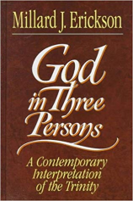
I just finished Millard Erickson’s God in Three Persons: A Contemporary Interpretation of the Trinity. It’s a very good book, but probably not the most engaging thing for the “average” Christian to read. It presupposes a lot of theological training. Erickson’s book is one of the most helpful works on the Trinity I’ve read. On balance, I’d say Carl Beckwith’s The Holy Trinity may have had a more formative influence on me, but this might be because I read it first. Beckwith is a good Lutheran, and Erickson is a irenic conservative Baptist, but they’ve both produced very fine works on this most important of doctrines.

As I think on the doctrine now, here is a non-exhaustive list of things (in no particular order) I think need to be emphasized if one wishes to teach the Trinity in a comprehensive way.

1: The “three foundations” James White mentioned in his excellent book The Forgotten Trinity

  • Monotheism; there is only one God
  • There are three divine persons
  • Each person is co-equal and co-eternal

I think the best way to do this is to walk through several passages of Scripture that support each foundation. The trick is to be comprehensive without being exhaustive.

2: The definitions of “Being” and “Person”

Both these terms have baggage, and were fought over during the Christological controversies of the 4th and 5th centuries. We need to consider how the great creeds seem to use these terms, but we shouldn’t be slaves to, for example, 4th century expressions of theological categories. In other words, just because the 4th century creeds may not have intended to convey a more modern concept of “personhood” which includes self-consciousness, this does not mean this modern definition of “personhood” is wrong!

The terms “being” and “person” are good; but their proper definitions must always comport with Scripture. I am concerned with a kind of rote confessionalism that encourages an almost slavish devotion to old formulations of eternal doctrine. This isn’t a call to jettison historical theology; it’s simply a call to not be a slave to it.

3: The Trinity as a society of persons

This is Erickson’s term, and I like it. He wrote, “The Godhead is a complex of persons. Love exists within the Godhead as a binding relationship of each of the persons to each of the others,” (221). He explained:

… the fundamental characteristic of the universe is personal … The supreme person is indeed a person, with identity, thought, will and personality, with whom it is possible to have a relationship, conscious to both parties. This supreme being, however, was not content to remain solitary. He acted to create reality external to himself. This involved the creation of the material universe and all physical objects within it. It also involved bringing into existence other selves besides himself. These persons, to a large extent, exist for relationship with the creating and originating God. If, then, the most significant members of the creation are persons in relationship, then reality is primarily social. This means that the most powerful binding force in the universe is love.

Erickson, God in Three Persons, 220-221.

This is good, but I think he could have brought more of the holiness attribute into play. God’s love is defined by His holiness. It doesn’t exist apart from it. I buy that God didn’t have to create creation (and, particularly, human beings), so clearly He desired worship and social interaction, so clearly He is social.

But, is “love” the best way to get this across? Probably. I struggle to express this without having to toss in caveats about how this isn’t narcissism on God’s part. He didn’t want us because of who we are; He wants us to worship Him because of who He is. In other words, we aren’t doing God any favors by being believers! God isn’t a harried middle-manager who’s “so happy to have us on the team,” so to speak.

4: Perichoresis as the guard against tritheism

I never heard about this doctrine at seminary; or, at least, I don’t remember. I first came across it in Carl Beckwith’s volume. Erickson echoes it here. Briefly, Erickson explains, “[p]erichoresis means that not only do the three members of the Trinity interpenetrate one another, but all three are intimately involved in all the works of God,” (235).

This is perhaps most clearly seen in Jesus’ promise about the coming of the Spirit, in John 14-16. In a recent sermon on that same passage, I described this interpenetration as an eternal, divine union between Persons. I was happy to see Erickson echo my own thoughts and state, “[t]he Godhead is to be thought of as less as a unity, in the sense of oneness of simplicity, than as a union, involving three persons, Father, Son and Holy Spirit,” (264).

The generic, conservative expressions of the Trinity (even in some theological texts) is often a functional tritheism. This doctrine of perichoresis was revolutionary to my own thinking, and I think it’s rightly the key to avoiding the charge of tritheism.

5: Analogies can be useful

There are lots of really bad Trinity analogies. Some theologians believe we should cast aside all attempts to make analogies, because they each inevitably fall short. Erickson disagrees, and sees them as useful symbols for pointing to a larger reality. Erickson explains:

It is simply not possible to explain it [the doctrine of the Trinity]unequivocally. What must be done is to offer a series, a whole assortment of illustrations and analogies, with the hope that some discernment will take place. We must approach the matter from various angles, ‘nibbling at the meaning’ of the doctrine, as it were.

Erickson, God in Three Persons, 268.

What I’ve taken away from this is that some analogies are useful to get at different aspects of the doctrine of the Trinity.

  • for the idea of a composite union forming one entity, Erickson suggests the analogy of the brain, the heart and the lungs forming distinct but integral parts of a human body. Each is quite useless on its own, and by itself each could never be called “human.” But, combined together, we have a human being. Thus it is with the Persons of the Trinity; they do not exist and have never existed without each other. They are more than the sum of their parts.
  • for the concept of interpenetration as closeness of relationship, Erickson suggests a marriage.

6: There is no eternal subordination of function or nature

Most conservative evangelical pastors are taught that there is an eternal subordination of function in the Godhead. That is, Father, Son and Spirit are equal in power, glory, honor (etc.), but they have different roles in accordance with their functions. The Father is always “in charge,” as it were, because He has a particular role to play. This is why the Son always obeys the Father, etc.

Advocates for this position often reach to the analogy of complementarian marriage; men and women are equal before God, but the husband is in charge because he’s been assigned a superior role. There is equality in essence, but subordination in function.

I couldn’t agree less. I think this idea, variously called eternal functional subordination (EFS) or eternal subordination of the son (ESS), is terribly misguided. I disagree with EFS wholeheartedly. I’ve read Bruce Ware’s Father, Son and Holy Spirit (EFS) and I’ve read Erickson’s book against EFS. As far as I’m aware, only Erickson, Kevin Giles and D. Glenn Butner have written book-length works against EFS – the rest of the generically conservative evangelical folks seem to tilt towards EFS.

The issue of eternal generation is tied up with EFS; it’s advocates generally don’t hold to eternal generation. Interestingly, Erickson opposes EFS and dislikes eternal generation. J. Oliver Buswell Jr., who didn’t address the issue (‘cuz it wasn’t an issue in his day), presents Christ’s functional subordination as temporary and strongly suggests we get rid of eternal generation altogether. David Beale, a theologian and historian much closer to home, dedicated perhaps 30 pages of his historical theology to arguing against eternal generation. 

Speaking for myself, I don’t understand eternal generation and have never read an account by a theologian who seemed to understand it, either (including Beckwith, who is otherwise excellent). I think Shedd came close, but I forgot his reasoning one day after reading it – it’s very convoluted. It smacks of some kind of ontological subordination to me, no matter which way you slice it – and it doesn’t seem tied to the text.

Erickson writes:

I would propose that there are no references to the Father begetting the Son or the Father (and the Son) sending the Spirit that cannot be understood in terms of the temporal role assumed by the second and third persons of the Trinity, respectively. They do not indicate any intrinsic relationship among the three. Further, to speak of one of the persons as unoriginate and the others as eternally begotten or proceeding from the Father is to introduce an element of causation or origination that must ultimately involve some kind of subordination among them …

There is no permanent distinction of one from the others in terms of origination. While the Father may be the cause of the existence of the Son and the Spirit, they are also mutually the cause of his existence and the existence of one another. There is an eternal symmetry of all three persons.

Erickson, God in Three Persons, 309-310.

Erickson unpacked this at great length in his book examining EFS, Who’s Tampering With the Trinity, which I recently read and agreed with.

Now what?

I want to teach the Trinity in church one day, unpacking these concepts in a way average, ordinary Christians can understand. These concepts, mentioned briefly above, will likely form the backbone of what this teaching series will eventually look like. The problem, again, is how to be comprehensive without being exhaustive. I don’t think I can do that, right now.

So, for now, I nibble around the edges a bit, emphasizing what I can as the text suggests it. Right now, I preach a sermon on either the Trinity, or Father, Son and Spirit each time we observe the Lord’s Supper, which is monthly. In this manner, I’ll likely cover all of this eventually but I’d like to bring it all together in two sermon or two, one day. I don’t know if I can do that!

But, I can at least say that I’ve read (and continue to read) widely on the subject, and I’ve gotten to a point where I can accurately sketch out where I need to go. The latest three watershed revelations for me are that (1) the concept of perichoresis is extraordinarily helpful and biblical, (2) EFS is quite dangerous, and (3) the doctrines of eternal generation and the Spirit’s procession (i.e. some sort of taxis with the Godhead) are likely extra-biblical and can be dropped.

I plan to order Erickson’s book on God’s attributes, and his tome on the incarnation soon. It may not come as a great surprise that Erickson is my favorite theologian! I need to read Beckwith’s book again, and I plan to see what Moltmann and Brunner have to say about the Trinity, too. I also need to delve into the patristic authors more. There’s always more to read, but it’s always fun.

Orphans, Widows, the Poor … and Justice

God wants His people to live a certain way. To act a certain way. To have certain honest motivations. He wants His people to love one another, and to prove it by their actions.

The fruit of real salvation is moral and spiritual reformation, because you love God. You don’t “clean yourself up” to gain favor with God; that’s not possible. Instead, because God has already changed your heart and mind and given you spiritual life, you reform your life with His help. Part of that means you love your fellow believers.

Well-meaning Christians often cite biblical commands to care for the poor, the widows and orphans, and try to apply these to mercy ministries. Douglas Moo, a conservative commentator, is representative of this trend when he applies one of these passages (James 1:27) in a generic way to society at large. He implies James is issuing a call to mercy ministries in the context of evangelism:

Christians whose religion is pure will imitate their Father by intervening to help the helpless. Those who suffer from want in the third world, in the inner city; those who are unemployed and penniless; those who are inadequately represented in government or in law—these are the people who should see abundant evidence of Christians’ ‘pure religion’.

Douglas J. Moo, James, vol. 16, Tyndale New Testament Commentaries (Downers Grove: InterVarsity Press, 1985), 90.

This is all true, but it isn’t what James meant. That passage, and others like it, don’t teach this. Instead, they teach Christians to care for one another, to love one another, to watch out for one another. To be sure, it’s a wonderful evangelistic strategy to couple mercy ministries with Gospel proclamation. You can win a hearing for the Gospel by helping people. But, that’s not what these passages are about.

Who’s the audience?

When Jesus summarized the entire thrust of the Old Covenant law (Mk 12:28-34), He said it had two foundations:

  1. to love God with everything you had (Deut 6:4-5), and
  2. to love your neighbor as much as you love yourself (Lev 19:18).

If you look at both these citations, who was the audience? They were both addressed to Old Covenant members. They weren’t for unbelievers. They were for believers.

Regarding the first citation (Deut 6:4-5), Moses preached the Book of Deuteronomy to explain the Old Covenant to the people as they prepared to invade the Promised Land (“Moses undertook to explain this law …” Deut 1:5). As for the second, the context in Leviticus shows it was written for believers, too. But, beyond that, take a look at the context around the citation to “love your neighbor.” It tells us quite a bit:

  • Israelites had to leave some of their harvest from vineyards and crops for the poor and needy in their covenant community; their believing community (Lev 19:9-10)
  • They couldn’t steal or lie to one another. They also couldn’t bear false witness against one another (Lev 19:11-12)
  • They couldn’t oppress or rob one another; that is, they had to compensate one another fairly. They had to pay wages on time. They couldn’t take advantage of the blind or deaf. Why? Because Yahweh is Lord, and they should fear His wrath for disobedience (Lev 19:13)
  • They had to uphold justice and righteousness in legal matters (Lev 19:15)
  • They couldn’t slander one another (Lev 19:16)
  • They had to settle disputes among themselves, rather than let hate simmer in their hearts. There was no room for grudges or plots of vengeance; rather, they had to love one another (Lev 19:17-18).

What’s behind all this? What’s the concept undergirding all these commands? Simple: God’s people ought to love each other. They ought to care about each other. They should want to prove it by their actions. God expects His people to live His way, and part of that is to love fellow believers.

If you can understand this, then you can understand the references in the Bible to the widow, the orphan and the poor. You can understand who those commands are directed to.

Proving the point

The rest is pretty easy. Here are some representative examples from Scripture:

When Moses said this:

You shall not oppress a hired worker who is poor and needy, whether he is one of your brothers or one of the sojourners who are in your land within your towns.

Deuteronomy 24:14

He was referring to fellow covenant members; either native born Israelites or proselytes who had joined the community. He was referring to how God’s people should interact with each other. This echoes the commands from Leviticus 19.

Moses meant the same thing when he continued, and wrote this:

You shall not pervert the justice due to the sojourner or to the fatherless, or take a widow’s garment in pledge, but you shall remember that you were a slave in Egypt and the LORD your God redeemed you from there; therefore I command you to do this.

Deuteronomy 24:17-18

This speaks for itself, and so does the audience.

One of the condemnations the prophet Ezekiel brought against nation of Judah was their moral wickedness; specifically, the way they mistreated one another. Ezekiel wrote:

Father and mother are treated with contempt in you; the sojourner suffers extortion in your midst; the fatherless and the widow are wronged in you.

Ezekiel 22:7

You should read the entire paragraph for context, but Ezekiel’s point here is very clear. Part of their sin is their mistreatment of one another, especially those who deserve special respect – parents, proselytes who have joined the community, and the most vulnerable in the covenant society.

This was the same sentiment the Apostle John had when he wrote, “Little children, let us not love in word or talk but in deed and in truth,” (1 Jn 3:18). His observation was borne out of the same worldview that Ezekiel had, that Moses had, that Jesus had. God’s people should love one another, and show it.

In Zechariah’s day, as he and Haggai struggled to encourage the returned exiles to rebuild the temple, he reminded them of their father’s mistakes:

Thus says the LORD of hosts, “Render true judgments, show kindness and mercy to one another, do not oppress the widow, the fatherless, the sojourner, or the poor, and let none of you devise evil against another in your heart.” But they refused to pay attention hand turned a stubborn shoulder and stopped their ears that they might not hear.

Zechariah 7:8-11

Before the Northern Kingdom fell to the Assyrians, before the Babylonians crushed Judah, God was angry with His people for how they mistreated one another.

Even Amos, who wrote during the secular glory days of the Northern Kingdom, had the same message:

Thus says the Lord:

“For three transgressions of Israel,
    and for four, I will not revoke the punishment,
because they sell the righteous for silver,
    and the needy for a pair of sandals—

Amos 2:6

What does this mean? It’s difficult to nail down precisely, but it’s clear the rich and powerful in Israelite society were oppressing the vulnerable. You get the picture of them accepting bribes to sell out the righteous for silver, or for material possessions. He continued:

those who trample the head of the poor into the dust of the earth
    and turn aside the way of the afflicted

Amos 2:7

You get the image of those in power smashing the faces of the poor into the dirt, and turning away those who are afflicted and helpless. This is a perversion of the society God commanded the Israelites to model.

And, finally, we come to James:

Religion that is pure and undefiled before God the Father is this: to visit orphans and widows in their affliction, and to keep oneself unstained from the world.

James 1:27

James is talking to Christians about what their faith should look like. The fruit it ought to bear. What is the mark of a true Christian, of true religion? Well, simple! This command is really an inversion of Jesus’ summary. James says we must (1) love fellow believers, and (2) keep ourselves free from this evil world, which really means an all-consuming love for God.

What about the parable of the good Samaritan?

This is a good question. Why did Jesus give the parable? What prompted Him to employ it? He had a reason, didn’t He? Here’s the context:

And behold, a lawyer stood up to put him to the test, saying, “Teacher, what shall I do to inherit eternal life?”

Luke 10:25

The 72 disciples have just returned, and given an ecstatic report of their ministry success (“I saw Satan fall like lightning from heaven …” Lk 10:18). Jesus rejoiced with them; “Blessed are the eyes that see what you see!” (Lk 10:23). He is glad God has revealed His plan to these simple men.

And, on the heels of this great event, the lawyer stands up and asks Jesus the question. He isn’t sincere; he wants to “put him to the test.” Jesus asks the man about the Old Covenant law, and he correctly responds by summarizing it the same way Jesus has done (Lk 10:26-28).

But, the man wants more. He’s “desiring to justify himself,” (Lk 10:29). He wants to limit his responsibilities as much as possible. He responds just like a stereotypical lawyer. Define “love.” Define “neighbor.” If he can narrow his target as much as possible, it’ll make his obligations so much easier to meet!

Think about it; would your spouse accept this kind of logic? What would you think if, at the altar on your wedding day, your husband halted the ceremony and said, “Now, I agree with all the lovey stuff, in theory. But, let’s clarify a few things. Define ‘until death.’ Define ‘love.’ Define ‘cherish.’ Let’s get this down on paper before we go any further!”

Are these the actions of a loving, would-be husband? I don’t think so! This is a guy who’s not serious. A guy who’s looking to do as little as possible. It’s the same with the lawyer. Jesus knows this; it’s why he tells the parable.

The Samaritan was a “good neighbor” because he didn’t care about legalistic qualifications, or legal definitions, or his strict scope of responsibilities. He saw a need, and he met it. That man is the good neighbor. That man fulfills the intent of the Old Covenant law, because he showed mercy.

What’s the point? The point is that a good neighbor is someone who shows mercy, not someone who seeks to do as little as possible in order to justify himself in his own mind. That’s why Jesus told the parable.

Wrapping up

The Old and New Covenant commands to care for widows, orphans and the poor are to believers, and their primary application is to widows, orphans and the poor within the believing community. True faith and Christian religion won’t seek to minimize this responsibility or shirk it; it will prove itself by genuine mercy and kindness to fellow believers in need.  

Mercy ministries to the general public are outstanding vehicles for evangelism. They just aren’t what these “justice” passages are talking about.

Abortion and the Christian

This past Sunday, I preached perhaps the most depressing sermon of my life, entitled, “What Should a Christian Think About Abortion?” It was depressing to study and prepare for, and even more depressing to deliver. It’s necessary to talk about this topic, because it is act of terrible wickedness. However, God is rich in mercy and grace, and can forgive anyone of any sin – including abortion. That was an important focus of my sermon, as I said here:

Today, both legislative houses in the State of New York passed a bill entitled the “Reproductive Health Act.” You can find a good article on this issue, here. But, the best place to go is the source. And, the excerpt of the new law I want you to see is this:

§  2599-aa.  Policy and purpose. The legislature finds that comprehensive reproductive health care is a fundamental component of every individual’s health, privacy and equality. Therefore, it is the policy of the state that:

The term “reproductive health care” is often a polite euphemism for “abortion.” As you read this new law, think about how the horror of the language’s meaning is clouded by the boring, bureaucratic prose. The law continues:

1. Every individual has the fundamental right to choose or refuse contraception or sterilization.

There is no argument, here. The crux is in what comes next …

2.  Every individual who becomes pregnant has the fundamental right to choose to carry the pregnancy to term, to give birth to a child, or to have an abortion, pursuant to this article.    

In my sermon, I mentioned there were two principles that formed the philosophical foundation that makes the pro-abortion mindset possible. To be sure, not every woman who has an abortion actually buys into this mindset wholeheartedly. But, I submit these two sinful principles certainly help provide moral justification for the act of abortion.

These principles are: (1) a denial that the unborn child is a “person” with a corresponding right to life, and (2) an insatiable demand for personal autonomy, to deny you’re under the authority of God, your creator.

You can see that with this language. The law declares, without any justification, that every person who becomes pregnant “has the fundamental right … to have an abortion.”

Says who? You can only buy into this idea if you (1) don’t believe the unborn child is a human being with rights, and (2) you’ve wholeheartedly bought the idea that you’re a law unto yourself. Both these ideas are sinful, wrong, and at odds with the Christian faith.

In my sermon, I talked about the why Christians should see human life is sacred, because people are made “in the image of God:”

I then spoke about the Christian definition of “personhood:”

3. The state shall not discriminate against, deny, or interfere with the exercise of the rights set forth in this section in the regulation or provision of benefits, facilities, services or information.

If you deny the statement in #2 (above), then you “discriminate.”

§ 2599-bb. Abortion. 

1.  A  health care practitioner licensed, certified, or authorized under title eight of the education law, acting within his or her lawful scope of practice, may perform  an abortion when, according to the practitioner’s reasonable and good faith professional judgment based on the facts of the patient’s case: the patient is within twenty-four weeks from the commencement of pregnancy, or there is an absence  of fetal viability, or the abortion is necessary to protect the patient’s life or health.   

This law expands who may perform an abortion. Now, in the State of New York, any “health care practitioner” can conduct one. A “health care practitioner” can be a physician, midwife, or even a physician’s assistant.

When can an abortion be done? There are three circumstances:

First, the abortion can be conducted at any time up to 24 weeks (6 months). This up to the cusp of the third trimester. By this time, the baby has unique fingerprints, can grasp things with its hands, can smile, has visible sex organs, has vocal cords, the mother can feel movement, and the baby even has a bit of hair. Babies born at the 24 week mark have survived.

At this point, it’s likely one of these abortion procedures I described on Sunday will be used:

Second, the abortion can be conducted if there is reason to believe the baby will not survive to term.

Third, and this is the most chilling of all, an abortion may be performed if it’s “necessary to protect the patient’s life or health.” Who determines this? As quoted above, it depends “on the practitioner’s reasonable and good faith professional judgment based on the facts of the patient’s case.” This is purposely vague language; you can make this mean whatever you want. Judgment based on what? The law doesn’t say, which means there’s a hole big enough to drive a Mack truck through. This is likely the point.

Here is a video clip from Planned Parenthood, documenting the spontaneous cheers which erupted in the New York legislature when this evil bill passed:

https://platform.twitter.com/widgets.js

Abortion is a terrible evil that has plagued our land. Christians have a duty to speak out compassionately and forcefully, emphasizing both God’s condemnation of this wicked act, and His mercy, grace, love and kindness to forgive any and everyone who comes to Him in repentance and faith.

Today, one Christian theologian said it best:


https://platform.twitter.com/widgets.js

Amen.

What Does it Mean to Follow Jesus?

This article is adapted from a sermon I preached on 13 January 2019, entitled “Following the Leader.” Video and audio may be found here.

Peter has just made an important confession; that Jesus was the Christ, the Messiah, the Anointed One (Mk 8:27-33). How do you sum up what this office means?[1] It’s common to see Christ as the prophet, priest and king. Millard Erickson shifts the emphasis from office to function, and presents Jesus as the revealer, ruler and reconciler.[2]

Because Jesus does these things; because He reveals God’s message, will rule over all creation and reconciles any and everyone who comes to God through Him, how should you follow Jesus? That’s what this passage (Mk 8:34 – 9:1) is all about.

Then, after Jesus summoned the crowd, along with His disciples, He said to them, (Mk 8:34).

Jesus’ lessons on discipleship aren’t just for “super Christians.” Jesus invited apostles and the crowd to listen. If you’re a Christian, this message is for you!

If someone wishes to be following me, he must deny himself, then pick up his cross, then keep on following me (Mk 8:34).

If you’re a Christian, what does Jesus say a faithful life looks like? What do you have to do to be the kind of Christian Jesus can smile at?

Here it is:

  • Deny yourself
  • Pick up your cross
  • Keep on following Jesus; don’t turn back!

What do these mean!?

Deny yourself

This mean God is on the throne in your life; not you. It means you aren’t in charge of your life, God is. Your life isn’t your own (1 Cor 3:16; 6:19-20). If you’re a Christian, then Christ is your Lord (Rom 14:8-9); do you live like it? The issue is motivation and drive; what gives your life meaning and purpose – your status in union with Christ, or something else?

Christ died so that “those who live might no longer live for themselves but for him who for their sake died and was raised,” (2 Cor 5:15). Do you live your life in service to Jesus? The point is that your purpose in life isn’t to please yourself, or to pursue your own goals – it’s to please God!

Does that mean that, in order to be a faithful Christian, you have to sell everything you have and move to Antarctica and preach the Gospel to penguins? Or, does it mean you have to live on top of a mountain alone, with your wi-fi, so you can be close to God?

No! You don’t need to become a monk; you just need to view your life in the proper perspective. What give your life purpose and meaning? This is a question that goes to motivation, and only you and God know what motivates and energizes your life. If you’re a Christian, it ought to be God. If you’re a Christian, your overriding drive should be to please Him, and serve Him with your life – wherever He’s put you. You aren’t your own, He bought you with a price – do you live for yourself, or for the One who for your sake died and was raised?

Does this mean your job is pointless? No! It just means you need to have the proper perspective about your job. There’s honor in working hard to provide for your family, and God gave you the gifts to do the job you do – it’s not an accident you have the job you do, or that you’ll get the next job you’ll get! It just means your job isn’t your life; it doesn’t define you – your relationship with Jesus Christ defines you (1 Pet 2:9-10). That’s the inspired blueprint for how you ought to think of yourself, if you’re a Christian. You’re a priest for God, saved so you can show and tell the message of the Gospel to the people God has put you around.

Who is on the throne in your life?

You must pick up your cross

This was the cruelest, worst form of capitol punishment in the Roman world. People took hours to die. They were often left to die on their crosses along the roadsides, as a warning to others, where birds and dogs would eat and pick at them as they died! So, what did Jesus mean by this?

He meant you had to be ready to be considered the worst of the worst by the same people who would kill Him (Jn 15:18-19). Condemned prisoners were made to carry the cross-beam of their own crucifixion cross to the execution site (Mk 15:21); Jesus meant you had to be willing to figuratively pick up your cross and march to your own death, if need be (1 Pet 4:12-13).

The Roman Emperor Nero infamously blamed Christians for a massive fire in the city of Rome. Contemporary accounts tell us Nero crucified and burnt Christians alive in Rome. These are the same people Mark probably wrote his Gospel to.

Real faith means that, if necessary, you’re willing to suffer and die for your Savior, for the sake of the Gospel. That means Jesus and His Gospel ought to be the most important things; everything else (including your life) fades far into the background (Phil 3:8).

Who is on the throne in your life?

You must keep on following Jesus!

The Christian faith isn’t a once and done event; it’s not something that stops. A faith that isn’t living, active, and bearing fruit is a faith that’s either in serious trouble, or non-existent (read 1 John). You need to keep on denying yourself. You need to keep on carrying your cross

Why does Jesus say all this?

Because, if he keeps desiring to save his life, he’ll lose it. But, if a person would lose his life for my sake and the Gospel’s, he’ll save it (Mk 8:35).

If a person keeps trying to “save his life,” it means Jesus and the Gospel aren’t the most important things in his life. If that’s you, it means your own desires are more important. You’d rather save your life, then potentially lose it by following Jesus. It means everything about the “here and now” is more serious and more important than the great God and Savior, Jesus Christ

If that’s you, then you’re actually losing your life. You have no spiritual resurrection, the wrath of God abides on you (Jn 3:36), and one day your chance for salvation is gone. One psalmist asked, “what man can live and never see death? Who can deliver his soul from the power of Sheol,” (Ps 89:48)?

The answer is that God can, through Jesus, and you frittered it away because you valued the things of this world over the things of eternity; the temporary over the permanent, the fleeting over the transcendent.

Is this you? Do you desire to save your life? Solomon said everything in this world is transitory, momentary, fleeting, impermeant – there’s of lasting significance there to hold onto! Wisdom, great possessions, sex, money, living for pleasure, your work and career – all of them are fleeting and transitory. Whatever you’re hold onto instead of Jesus, whatever you’re not willing to let go of for Jesus, that thing will not be there for you in the end.

The only way you can save your soul is to be willing to lose it for Jesus and His Good News. If you’re a Christian, this means your rescue from sin your reconciliation with God, Jesus’ perfect, substitutionary life and death, His miraculous resurrection, your adoption into God’s family from the kingdom of darkness, your status as a brother or sister whom Jesus is not ashamed to call by name – all of these should be the most important things in the world to you. How can wisdom, sex, possessions, money, living for pleasure, or the idol of a career compare to these things?

Whose stamp do you bear and what’re you going to do about it?[3] Is your faith the driving, motivating factor in your life, the thing that gives you purpose and fuels you? Or, is it an add-on; something affixed to the tail-end of your life with dollar store scotch-tape?

Who is on the throne in your life?

For, how does it benefit a man to be gaining the whole world and be losing his life!? (Mk 8:36)

It doesn’t!

After all, what would a man give in exchange for his life (Mk 8:37)?

Everything! Anything! The moon! So, have you? Have you made the decision to deny yourself? Have you made the decision that Jesus and the Gospel are worth picking up your cross for? Have you made the decision to keep on following Jesus, day by day, week by week, month by month, year by year?

These aren’t things you do to get salvation; they’re things a genuine Christian will want to do because of salvation; they’re the fruit of spiritual life. Apple tree produce apples. Orange tree produce oranges. Mexican restaurants produce nachos. A Christian likewise ought to do the things Jesus said

Now, Jesus backs up and lays it all out for us:

This is what I mean – if someone is embarrassed about me and my words in this adulterous and sinful age, then the Son of Man will be ashamed of him when He comes in the Father’s glory, [and] with the holy angels,” (Mk 8:38).

What does this mean? Here’s what it means:

  • If you won’t deny yourself for Jesus,
  • If you won’t take up your figurative cross and be prepared to suffer and die for His sake and the Gospel’s sake,
  • If you won’t keep on following Him, or at least have the honest desire to keep on following Him for the remainder of your life  

Then Jesus looks at you and says:

  • This guy is embarrassed about me!
  • This guy is ashamed of me!
  • This guy is embarrassed about my message, about what I said!
  • This guy is ashamed about my message and what I said!

It means Jesus looks at you and says:

  • This guy isn’t ashamed about his greed, but he is ashamed about me!
  • This guy isn’t ashamed about his loving his career more than anything in the world, but he is embarrassed about how nobody comes to the Father, but through me
  • This guy isn’t ashamed of the Gospel, as long as it stays a secret part of his life

If that’s you:

  • Jesus says, “I’ll be ashamed of you when I come back, full of power and glory, along with the holy angels, to set everything right”
  • He’ll look at you and say, “I never knew you!”
  • He’ll look at you and say, “I don’t know who you are!”
  • He’ll look at you and think, “This is sinful guy; a criminal!”
  • He’ll look at you and think, “This guy is unfaithful to the God who created him, just like so many other people – he’s a spiritual adulterer!”
  • He’ll look at you and say, “I’m embarrassed that you claim to belong to me!”
  • He’ll look at you and think, “I’m ashamed of this guy!”

Consider the contrast. A life lived for yourself, for your own ends, for your own transitory dreams, all so it can go into the trashcan at the end of your life? Or, a life lived in service to God through repentance and faith in Jesus Christ, using and channeling your gifts and abilities for His glory, having (perhaps) that same career, but with the right motivations, having (perhaps) the same money, but with the proper perspective, willing to suffer loss and perhaps die for the sake of the Gospel, and seeing Jesus return in power, glory and honor, and welcoming you with open arms and a great smile, by saying, “Well done, good and faithful servant. You have been faithful over a little; I will set you over much. Enter into the joy of your master,” (Mt 25:21).

Jesus will return one day, with power and glory, accompanied by the holy angels – and what value will “whatever else” be for you, then?

Then Jesus said to them, “I’m telling you the solemn truth, that there are some people standing here who will not taste death until they see God’s kingdom coming in power,” (Mk 9:1).

As a way to encourage His disciples to take the longer view, to have the proper perspective, to see Him as he really is and (thus) to count everything as loss compared to Him, Jesus will lift the curtain a bit and show them a taste of His glory, power and honor … in the next passage (Mk 9:2-8)!

If Christian churches expected people to follow Jesus with the same passion and fervor He told us to have, then churches would be smaller, and the people left would be more zealous for Christ and the Gospel. If you’re a Christian, you need to follow Jesus with the same all-consuming passion He said you must have!

Who is on the throne in your life?

Choose to follow Jesus. Choose to put Him on the throne in your life. Choose to keep on following Him, just like He said


Notes

[1] I addressed this issue in a sermon from Mark 8:27-33, preached on 30 December 2018, entitled “Jesus is the Christ, But What Does That Mean?” You can find the audio, video and sermon notes at https://bit.ly/2R0IZt0

[2] Millard J. Erickson, Christian Theology, 2nd ed. (Grand Rapids: Baker, 1998), 780ff. 

[3] See Ignatius, Epistle to the Magnesians, 5:1-5.