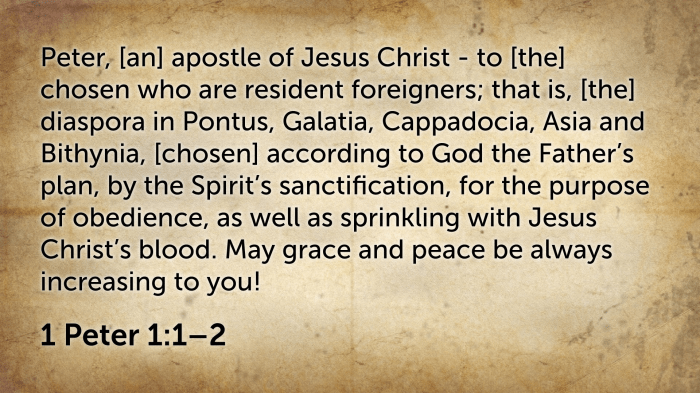
Questions for 1 Peter 1:1-2

I’m preparing to work through 1 Peter 1:1-2 this coming Sunday, for Bible study. The best way to teach through a book is to outline the entire thing to understand the flow of the argument, and then teach those units of thought individually. In my own outline, I kept 1 Peter 1:1-2 separate from vv. 3-9. Here are some good questions to ponder from this passage:

1 pet 1 (1-2)

  1. What is the overall point of 1 Peter 1:1-9? Why do you think Peter spends so much time emphasizing God’s grace in salvation? Is he trying to teach systematic doctrine, or does he have another point?
  2. What does Peter mean by “chosen?” How does this tie into his main point in the next section (1 Peter 1:3-9)? What difference does this make for your life?
  3. What does Peter mean by “resident foreigners . . . the diaspora” How does this tie into his main point in the next section (1 Peter 1:3-9)? What difference does this make for your life?
  4. Why does Peter emphasize Christians are “chosen according to God the Father’s plan?” Is he specifically trying to teach doctrine, or does he have another reason?
  5. How does God actually carry out His plan of choosing? Who is the agent who gets this done?
  6. What does Peter mean when he wrote that you are chosen “by the Spirit’s sanctification?” What is sanctification? How does this tie into his main point in the next section (1 Peter 1:3-9)? What difference does this make for your life?
  7. What are the two purposes, or results, of God’s choosing His people? That is, once the Spirit sanctifies a person, what happens next?
  8. What obedience is Peter talking about? How does this tie into his main point in the next section (1 Peter 1:3-9)? What difference does this make for your life?
  9. What “sprinkling” is Peter talking about? What does he mean? How does this tie into his main point in the next section (1 Peter 1:3-9)? What difference does this make for your life?

The translation above is mine; here are the detailed notes. No matter which Bible translation you use, you’ll still be able to answer these questions!

Almighty and eternal God, so draw our hearts to thee, so guide our minds, so fill our imaginations, so control our wills, that we may be wholly thine, utterly dedicated unto thee, and then use us, we pray thee, as thou wilt, and always to thy glory and the welfare of thy people; through our Lord and Savior Jesus Christ. Amen.

From The Book of Common Prayer (New York, NY: Oxford University Press, 2007), 832-833.

All About the Book of 1 Peter

1 Peter was written for this reason:

To remind and encourage Christians what God has done for them, and in light of that, encourage them to trust God, grow and live Godly lives in the midst of trials and sufferings, which all Christians have been called to endure for good and holy reasons.

This is a book for real people, living real lives, facing real problems, in a society and culture that really hated Christ and everything His Gospel stands for. Peter is a very practical man:

  • He wrote 1 Peter to tell us why trials and suffering comes our way, and how to deal with them.
  • He wrote 2 Peter to tell us why false teachers and deceivers come our way, and how to deal with them.

Peter gives us a Christianity completely different from the glossy, pop-Christian shallowness that largely characterizes the evangelical world in the West. Peter lives in a world that is very hostile to Christ and the Gospel. So do the people he writes to.

This background informs the way he writes, what he emphasizes, and the warnings he gives. Peter is a very serious man, a very sober man, a very concerned man – and he says all Christians should be, too

This seriousness, this soberness, this practical and “real” mindset is the worldview, the lens, through which he views the world and the faith. It should be ours, too.

Here are my detailed notes for an introduction to 1 Peter.

Below is the audio from the Sunday School lesson:

How to Study the Bible (Part 2)

Read the series so far.

How to Begin

Studying the Bible isn’t hard. I promise. You just need to have a plan. This is how the plan begins – you pick a topic.

Genius, isn’t it!?

What Not To Do

Remember, the Bible isn’t a cookbook of individual verses. The verse numbers are made up. They aren’t there in Greek or Hebrew. Some printer in the 16th century inserted verse numbers in the text during a carriage ride. That’s not a joke. The chapters also aren’t original. Chapter and verse numbers are just a easy way for us to find and reference things in the Bible, but they sometimes stop us from seeing the context.

So, before we go any further, know this:

  • Don’t study the Bible by compiling a bunch of verses from all over the place
  • Don’t study the Bible by looking for a particular word in a concordance
  • Don’t. Do. It. Please. I. Am. Begging. You.
  • Instead, study the Bible by reading passages. More on this later.

Pick a Topic

What do you want to study? Think about it. Be specific with your question. Narrow things down a little bit. A question that is too broad (e.g. “why did Christ come?”) will probably take a while to study. If you whittle your question down a bit (e.g. “what did Christ accomplish for sinners?”), then everything becomes much easier.

Not So Fast!

I suggest you do a few things before you dive right in to gathering data.

Talk to your pastor

Ask your Pastor for his answer. Don’t just bum-rush the poor guy 30 seconds after he finishes his sermon. Schedule a time for a brief chat, and tell him what you want to talk about. Have your talk. Take some notes.

Look at your church’s doctrinal statement

This will give you a lot of food for thought. It will also give you references to didactic (i.e. teaching) passages where your church believes this is all taught. Copy the passages down. Read them. Take notes. Pray. Think. Repeat.

Look at old creeds and confessions

Look at some confessions of faith from the past, to see what other Christians from days gone by have thought about this same question. Yes, there were Christians smarter than us who lived long ago, who already pondered all of this, and already wrote down their thoughts. You can read what they thought, and learn a few things.

I’m a Baptist, so here are three Baptist confessions I’d check out, along with two others:

The 1833 New Hampshire Confession is short, punchy and very, very helpful. It’s a good place to go for a quick baseline read on what conservative Baptists have believed. This confession is the basis for the Southern Baptist Convention’s statement of faith, and the General Association of Regular Baptist Church’s articles of faith, too. It has been a bedrock confession for conservative Baptists in America for nearly two centuries. Take a look at it.

The GARBC’s Articles of Faith are, as I said before, based on the 1833 NHCF. But, it has been updated and expanded. It is clearly premillennial and dispensational. It is the confession which best aligns with my own beliefs.

The 1689 London Baptist Confession is very, very long. This is deep theology, in a lot of detail, with a lot of Scripture passage references. You definitely want to see what this document has to say.

The Belgic Confession was produced by Reformed Christians in the Netherlands. It is also long, very detailed, and full of Scripture references. It is a good reference document. The man who wrote it died as a martyr.

The Second Helvetic Confession was produced by the Swiss Reformed church in the 16th century, and was adopted by a whole host of national churches in Europe during and after the Reformation Era. This is a very thorough, very helpful document.

Remember this – you don’t have to agree with everything you read in these creeds and confessions. Nobody will ever agree on everything. But, you should read the pertinent sections where your question is addressed, and give serious thought to what they say.

Do you still need to look further?

Maybe your question has been answered. Maybe, after:

  • Talking to your Pastor for 30 minutes,
  • Reading your church’s doctrinal statement and reading the passages it cites,
  • then reading some historic creeds and/or confessions about your topic

your questions have all disappeared! After all, you should work smarter, not harder.

Example

You want to know how Adam was originally created. He wasn’t perfect, obviously! But, he also wasn’t like us. So, what was he like?

You meet with your Pastor, and even buy him a coffee because you’re such a nice person. He tells you Adam was not like us. Adam was innocent. He was made “very good.” Unlike us, he was “kind of morally neutral,” and had the free choice to obey God or reject Him. Adam didn’t have a sin nature, and wasn’t drawn or pulled by the temptation to sin like we are. In fact, this is so strange to us that we can’t even imagine what this must have been like!

You go away, energized and ready for more. Your church doctrinal statement reads:

We believe that man was created in the image and likeness of God, but that in Adam’s sin the human race fell, inherited a sinful nature, and became alienated from God; and, that man is depraved, and, of himself, utterly unable to remedy his lost condition (Gen. 1:26-27; Rom. 3:22-23; 5:12; 6:23; Eph. 2:1-3; 4:17-19).

This tells you . . . nothing. Thanks a lot.

Next, you turn to the confessions. The Belgic Confession reads, in part:

We believe that God created man from the dust of the earth and made and formed him in his image and likeness– good, just, and holy; able by his own will to conform in all things to the will of God.

But when he was in honor he did not understand it and did not recognize his excellence. But he subjected himself willingly to sin and consequently to death and the curse, lending his ear to the word of the devil.

For he transgressed the commandment of life, which he had received, and by his sin he separated himself from God, who was his true life, having corrupted his entire nature.

This is good stuff. This suggests Adam was good and holy. Unimpeded by a sin nature, Adam truly has a choice to follow God or listen to Satan and rebel against God. He deliberately decided to sin, and thus ruined himself and all of creation, too.

This is a little different from what you Pastor said, but it’s still in the same ballpark. In this confession, Adam isn’t neutral – he’s inclined to good and to righteousness.

The Second Helvetic Confession reads, in part:

In the beginning, man was made according to the image of God, in righteousness and true holiness, good and upright. But when at the instigation of the serpent and by his own fault he abandoned goodness and righteousness, he became subject to sin, death and various calamities. And what he became by the fall, that is, subject to sin, death and various calamities, so are all those who have descended from him.

This says the same thing. Adam was good and upright, and he had every advantage one could wish for. But, at Satan’s suggestion, he made his own decision to “abandon goodness and righteousness.”

What saith the 1689 London Baptist Confession? I’m glad you asked:

Although God created man upright and perfect, and gave him a righteous law, which had been unto life had he kept it, and threatened death upon the breach thereof, yet he did not long abide in this honor;  Satan using the subtlety of the serpent to subdue Eve, then by her seducing Adam, who, without any compulsion, did willfully transgress the law of their creation, and the command given to them, in eating the forbidden fruit, which God was pleased, according to His wise and holy counsel to permit, having purposed to order it to His own glory.

It says the same thing. What about more modern stuff?

The 1833 New Hampshire Confession of Faith reads:

We believe that man was created in holiness, under the law of his Maker; but by voluntary transgression fell from that holy and happy state; in consequence of which all mankind are now sinners, not by constraint, but choice; being by nature utterly void of that holiness required by the law of God, positively inclined to evil; and therefore under just condemnation to eternal ruin, without defense or excuse.

Same thing. It’s almost as though there’s a pattern here!

The GARBC Articles of Faith read:

We believe that mankind was created in innocence (in the image and likeness of God) under the law of his Maker, but by voluntary transgression Adam fell from his sinless and happy state, and all human beings sinned in him, in consequence of which all human beings are totally depraved, are partakers of Adam’s fallen nature, and are sinners by nature and by conduct, and therefore are under just condemnation without defense or excuse.

I told you this confession is derived from the 1833 NHCF. Notice it’s pretty much the same, but they dropped “holiness” for “innocence.” I think they’re trying to get the idea across that Adam wasn’t “holy” in the sense of “divine.”

I could go on, but you get the idea. Here is your data, so far:

  • Your Pastor says Adam had an innocent, holy nature, and was morally neutral
  • Your church doctrinal statement says nothing.
  • All four confessions you’ve looked at, spanning from 1564 – 2017, agree that Adam was made holy and/or innocent, but made the deliberate decision to rebel against God.
  • If Adam was holy and innocent, then temptation exerted no internal pull, tug or struggle within him. It was an external thing, and the draw for Adam wasn’t that he would gratify himself. The draw was that, by eating from the tree, he would free himself from God’s rule and be like Him. Interesting stuff. Makes you want to go back and re-read Genesis 1-3!
  • You’ve studied the Scripture references your Pastor and the confessions have given you

At this point, you need to ask yourself – do I still have questions? No worries. If you do, we go onto the next step . . . next time!

Jesus and the Sad, Angry Little Men (Mark 3:1-6)

man with handI originally wrote this article for SharperIron.org. Reprinted with permission.

This is a sad little story, because we see sad little men rejecting their great God and Savior, Jesus Christ. They have made void the word of God through their tradition (cf. Mk 7:13). In the Gospel of Mark, Jesus’ early confrontations with the Pharisees come quickly, one after the other. This particular account is where the water boils over.

Mounting Opposition

First, they questioned why Jesus shares a meal with such “worldly” and “disreputable” people (2:15-17). They don’t ask Jesus; they ask His disciples (Mk 2:16). We’re not sure why the Pharisees don’t approach Jesus directly. But we can guess, knowing ourselves, that they’re a bit tentative and unsure of themselves. Perhaps, they thought, it’ll be better to take the indirect route and cast doubt on His credentials to His followers.

Jesus, ever the polite diplomat, answers immediately with a burst of sarcasm. “Those who are well have no need of a physician, but those who are sick; I came not to call the righteous, but sinners,” (Mk 2:17). This is a warning shot across the bow, and it’s the first direct contact Jesus has with the Pharisees in Mark’s gospel. This is clearly an adversarial relationship from the very beginning. Jesus didn’t mince words when it came to self-righteous and blasphemous legalism. Matthew preserved another bit of the story, in which Christ verbally backhanded the Pharisees (“Go and learn what this means . . .” Mt 9:13) with a quote from Hosea 6:6.

The next episode follows right on the heels of this discussion (2:18-22). The Pharisees[1] demand to know why Jesus’ disciples don’t fast. Jesus responded and prophesied His own death (2:19-20). He then explained the Old Covenant (the old garment) cannot be patched up like an old sweater, or jerry-rigged to accommodate the New Covenant; “new wine is for fresh wineskins,” (2:22). We’re not sure how much of this the Pharisees understood, and Mark didn’t tell us. But, I doubt it was a pleasant conversation.

The final episode is the alleged Sabbath violation (2:23-28). Jesus cited a Scriptural precedent for violating the strict letter of the law under emergency circumstances (2:25-26). He then claimed a divine and Messianic title (“son of man”) and declared He was “lord even of the sabbath,” (2:28).

Mark gives us these incidents one after the other, and the reader is left almost reeling as this freight train of hostility and opposition springs forth from seemingly nowhere. This early enmity comes to a crescendo with the Pharisees storming out of the synagogue and colluding with their enemies to kill Jesus (3:6).

The Confrontation in the Synagogue

Again he entered the synagogue, and a man was there who had a withered hand. And they watched him, to see whether he would heal him on the sabbath, so that they might accuse him (Mk 3:1-2).

Again, Mark doesn’t tell us who “they” are, but the context assures us it is the Pharisees.[2] Why is the man there? Is this a coincidence? We know the Pharisees are watching all the time,[3] waiting, their little black notebooks at the ready, cellphone cameras on standby – anxious to gather evidence against Jesus. It is tempting to see the man as a prop, a poor sucker planted there as bait. We don’t know whether that is the case. But, we do know Jesus is being set up. If the Pharisees didn’t plant the poor man there, we can be sure they were at least “pleased” he was there.

Ironically, the Pharisees deny Jesus the right to do good on the Sabbath, while they actively plot to do evil![4]

This little episode is about more than proof for Jesus’ divinity. It is about this single miracle as one of a series of signs and wonders which announced the kingdom of God to those who had ears to hear. The prophets wrote that, when God returned for His people, the blind would receive sight, the deaf would hear, the lame will leap for joy and “the ransomed of the Lord shall return, and come to Zion with singing,” (Isa 35:5-6, 10). Christ appealed to these texts as proof that He was, indeed, the Messiah who had come to bring His people into the figurative promised land of eternal rest (Lk 4:16-21; 7:18-23; cf. Heb 4:1-11).

Rather than ponder the implications of Jesus’ teaching coupled with these signs and wonders, the Pharisees lie in wait in the synagogue like impotent little spiders, weaving a pathetic web of trickery. The man with the withered hand may have been a plant, or just somebody who happened to be there, but one thing is certain – the Pharisees didn’t care about him at all. He was a prop. He was nothing. They didn’t care if Jesus did heal him; they just wanted the evidence for a trial. Like serial killers who take genuine civic pride in obeying the speed limit, these legalists have it all backward.

And he said to the man who had the withered hand, “Come here.” And he said to them, “Is it lawful on the sabbath to do good or to do harm, to save life or to kill?” But they were silent (Mk 3:3-4).

Jesus knew everything (cf. Jn 2:24-25; Lk 5:6-7; Lk 6:8, etc.). He knew what the Pharisees were up to. He did not run away to fight another day. He felt discretion was no valor at all. He asked an open and rhetorical question designed to unmask their legalistic and blasphemous tradition about the Sabbath. This is the only time in Mark’s Gospel that Jesus initiates a healing without being approached. Clearly, He decided to make a decisive stand here.[5]

Nobody answered. Nobody said a word. Why not? Jesus had what we now call “command presence.” People listened to Him. He taught with authority (Mk 1:27). I suspect the Pharisees couldn’t have spoken even if they’d wanted to. Mark recorded another, similar incident later in his Gospel (Mk 12:34). They are speechless before this teacher who had such passion, such presence and such intrinsic authority.

What does Jesus mean by asking, “to save life or to kill?” Some commentators believe Jesus was referring to the Pharisees’ own intentions towards Him (cf. 3:6).[6] If that is so, no wonder they dared not answer. “While Jesus is preparing to do good, they are plotting his death! Which is the real Sabbath violation?”[7]

And he looked around at them with anger, grieved at their hardness of heart, and said to the man, “Stretch out your hand.” He stretched it out, and his hand was restored (Mk 3:5).

This is an instantaneous healing, and a true miracle. Jesus does not appeal to God for healing; He simply performs the action Himself. This is very, very different than what the OT prophets did (cf. 1 Kgs 13:6). Jesus is a prophet, but He is as qualitatively different from His Old Covenant counterparts as a glowworm is from a floodlight. He is divine. They were not.

What about the Pharisees’ hearts upset Jesus so much? Their inability to answer His question? Their callousness by using this poor man as a prop for their own wicked ends? Their inability and unwillingness to face the implications of His own teaching and the signs and wonders He performed? Perhaps it was all of this.

The word is usually rendered as “hardness” or “stubbornness” here. Hardness implies they are spiritually insensitive (e.g. Tyndale, “blindness”). Stubbornness gives the sense of stiff-necked inflexibility; they are wilfully rebellious. The NEB translates it as “obstinate stupidity,” which is a delightfully appropriate phrase!

Yes, this miracle is more proof for Jesus’ divinity. But, that is not why Mark wrote it. His didactic purpose is to highlight the scribes’ and Pharisees’ growing opposition in the face of Jesus’ explicit preaching, teaching and divine signs. These miracles are proof that “the kingdom of God is come unto you,” (Mt 12:28). People are healed. Demons are cast out. Jesus, by the Spirit of God, has bound Satan and is plundering his house (Mk 3:27). What must this mean!?

The Pharisees don’t care what it means. They have their evidence. The healed man is irrelevant. He’s served his purpose. Away with him! They ignore him, like some men would ignore a filthy dog (cf. Jn 9:34). Jesus is all that matters; not the implications of His teaching, but the evidence for His alleged “blasphemy.”

Throughout His ministry, Jesus shows a deliberate contempt for the oral tradition which “fenced” the Old Covenant law. The Pharisees feel this is a fundamental betrayal of orthodoxy, and act in fury out of righteous indignation. They are sincere, but they are sincerely wrong. Jesus, however, is not moved by pettiness or or self-righteousness. He is filled with righteous anger.

The Pharisees went out, and immediately held counsel with the Herodians against him, how to destroy him (Mk 3:6).

The “Herodians” were widely castigated as liberal compromisers.[8] They were not devout. It says something that the Pharisees sought to form an alliance with these men – all in order to kill the Lord of glory. This is their furious response to a whole host of escalating confrontations.[9] Their blood is up. Jesus is a blasphemer who despises the traditions of the fathers. He has now violated the Sabbath twice, and they have the evidence to prove it! Jesus must be destroyed – the law demands it (Ex 31:14-17)! Surely, they reason, God agrees with their zeal . . .

They Did Not Recognize Him . . .

So, off they go, in a huff. Jesus has righteous anger, these Pharisees have self-righteous resentment.[10] The Kingdom of God has broken into human history. The proof is here – behold the signs and wonders! The Messiah is here – behold His teaching! The legalistic externalism of the Pharisees is condemned. True worship flows from the heart and is proven by devoted action (cf. 1 Sam 15:22-23).

This little miracle proves Jesus’ deity, but it is a sad account. Confronted with their Savior, the Pharisees plot His death. The Apostle Paul was right:

For those who live in Jerusalem and their rulers, because they did not recognize him nor understand the utterances of the prophets which are read every sabbath, fulfilled these by condemning him (Acts 13:27).

Notes

[1] The Greek doesn’t specify who came to Jesus; it is simply a third-person plural verb (ἔρχονται). The closest antecedent are the scribes of the Pharisees (2:17). It is reasonable to conclude the Pharisees asked Jesus this question.

[2] See Walter W. Wessel (Mark, in EBC, vol. 8 [Grand Rapids, MI: Zondervan, 1984], 639) and Mark Strauss (Mark, in ZECNT [Grand Rapids, MI: Zondervan, 2014], 147).

[3] The verb here is imperfect (παρετήρουν αὐτὸν), which gives the general sense of an unfolding, continual action in the past. I think the NASB did well to render it as a descriptive imperfect (“they were watching Him . . .”).

[4] Mark Edwards, The Gospel According to Mark, in PNTC (Grand Rapids, MI: Eerdmans, 2002), 98.

[5] Strauss (Mark, 147).

[6] Edwards (Mark, 100) and William Hendriksen, Mark (Grand Rapids, MI: Baker, 1975), 116.

[7] Strauss (Mark, 148).

[8] For more on the Herodians, see H. W. Hoehner, “Herodian Dynasty,” 5, in Dictionary of the New Testament: Backgrounds, ed. Craig Evans and Stanley Porter (Downers Grove, IL: IVP, 2000), 493-494.

[9] See William L. Lane, The Gospel of Mark, in NICNT (Grand Rapids, MI: Eerdmans, 1974), 121-122.

[10] Hendriksen (Mark, 117).

The Marks of a Church (Part 1)

churchWhen it a church not a church? It’s an important question.
What are the essential, non-negotiable elements which must be present, in order for a religious group to be considered a Christian church? These elements have historically been called the “marks of a church.”


  • How many marks are there?
  • What does the New Testament tell us?
  • Do each of these marks have to be present?
  • Can a few be absent?
  • If so, how many can be missing before a church is no longer a church?

This might seem like silly, ivory tower nit-picking. After all, who cares as long as you love Jesus, right?

Wrong.

Imagine this scenario:

  • A group of eager, young Christians gather at a local Starbucks every Sunday for a bible study – at 1100 sharp!
  • A different “leader” takes a turn every week reading a passage of Scripture and explaining it. The group always has a wonderful discussion. “The Spirit is, like, really moving in our lives,” one attender explains, eyes alight with joy.
  • Once per month or so (“whenever we feel the Spirit leading us”), they observe the Lord’s Supper together. But, they like being different. So, the group usually observes the ordinance with Cheese-Its and Diet Coke. They tried pita crackers and milk once. It didn’t go over so well. It was . . . gross.

One attender explains he doesn’t feel the need to go to a “traditional church.”

It’s, like, so confining. I used to go to a ‘normal’ church, but it just became, like, way too much. All the rules. All the stuff that just, you know, like, gets in the way. I like coming here better. It’s like we’re getting back to the, you know, the  . . . the purity that Jesus always talked about. Here, we just keep it simple. No rules. No judgment. Just the Word and the Spirit. I’ve grown in Christ more here than I ever did in a traditional church. When the Spirit is working, who am I to judge or criticize, ya know?

Does this young man go to a “church”? Is his Starbucks fellowship a church? Why, or why not? You see? It does matters what a “church” really is, and what it isn’t. And for that, we must turn to the New Testament.

Baptist theologian Kevin Bauder explained this dilemma pretty well:

An analogy may be helpful. A dog by definition is (among other things) a quadruped. If it loses a leg, does it cease to be a dog, or is it simply a damaged dog? How many appendages can it lose before it can no longer be called a dog? Eventually, if one lops off enough parts, the dog dies. The same principle applies to churches. How many characteristics can be lost before a church can no longer be called a church? Baptists do not have a single, straightforward answer to this question.[1]

For the foreseeable future, I’ll be systematically working my way from Acts – Revelation, trying to answer:

  1. What are the marks of a church?
  2. Can any of these marks be missing?

As I finish my review of each New Testament book, I’ll post my thoughts here. I’m not sure how long this will take, but it will surely be fun!

For now, here are some thoughts from a smart, dead guy on this matter:

When we say that the pure ministry of the word and pure celebration of the sacraments is a fit pledge and earnest, so that we may safely recognise a church in every society in which both exist, our meaning is, that we are never to discard it so long as these remain, though it may otherwise teem with numerous faults.

Nay, even in the administration of word and sacraments defects may creep in which ought not to alienate us from its communion. For all the heads of true doctrine are not in the same position. Some are so necessary to be known, that all must hold them to be fixed and undoubted as the proper essentials of religion: for instance, that God is one, that Christ is God, and the Son of God, that our salvation depends on the mercy of God, and the like.

Others, again, which are the subject of controversy among the churches, do not destroy the unity of the faith; for why should it be regarded as a ground of dissension between churches, if one, without any spirit of contention or perverseness in dogmatising, hold that the soul on quitting the body flies to heaven, and another, without venturing to speak positively as to the abode, holds it for certain that it lives with the Lord?

The words of the apostle are, “Let us therefore, as many as be perfect, be thus minded: and if in any thing ye be otherwise minded, God shall reveal even this unto you,” (Phil. 3:15.)

Does he not sufficiently intimate that a difference of opinion as to these matters which are not absolutely necessary, ought not to be a ground of dissension among Christians? The best thing, indeed, is to be perfectly agreed, but seeing there is no man who is not involved in some mist of ignorance, we must either have no church at all, or pardon delusion in those things of which one may be ignorant, without violating the substance of religion and forfeiting salvation.

Here, however, I have no wish to patronise even the minutest errors, as if I thought it right to foster them by flattery or connivance; what I say is, that we are not on account of every minute difference to abandon a church, provided it retain sound and unimpaired that doctrine in which the safety of piety consists, and keep the use of the sacraments instituted by the Lord.

Meanwhile, if we strive to reform what is offensive, we act in the discharge of duty. To this effect are the words of Paul, “If any thing be revealed to another that sitteth by, let the first hold his peace,” (1 Cor. 14:30.) From this it is evident that to each member of the Church, according to his measure of grace, the study of public edification has been assigned, provided it be done decently and in order.

In other words, we must neither renounce the communion of the Church, nor, continuing in it, disturb peace and discipline when duly arranged[2]

Notes

[1] Kevin Bauder, Baptist Distinctives and New Testament Church Order (Schaumberg, IL: Regular Baptist Press, 2012), 217.

[2] John Calvin, Institutes of the Christian Religion, trans. Henry Beveridge (reprint; Peabody, MA: Hendrickson, 2008), 4.1.12.

Jesus and Sin

sinRead the series so far.

We’ve talked about sin. We’ve learned it is:

  1. an action which violates God’s law,
  2. an internal thought or desire which is contrary to God’s law, and
  3. it is also a status, a condition, a state of being.

If you think of “sin” as merely an outward action, then you’re terribly wrong. We’re all born in the status, condition and state of rebellion against God. We’re born as sinners, the fruit of the poisonous tree which was ruined by Adam so long ago, and has been passed down from generation to generation ever since. Because that is true, the result is that we think evil and wicked thoughts all the time. And, sometimes, we act on those sinful thoughts and intents of our hearts.

What is at the bottom of all this? What is at the heart of this status and condition of lawlessness, which results in wicked thoughts and actions? It is a desire for autonomy, for independence from God. When you get right down to it, sin is about a desire to overthrow God (who is your Creator and sustainer) and govern yourself.

Now we come to the really interesting question. We all know Jesus has never sinned, and we certainly know He didn’t sin in the incarnation. But what, exactly, does that even mean?

Here is a key text

Since then we have a great high priest who has passed through the heavens, Jesus, the Son of God, let us hold fast our confession. For we have not a high priest who is unable to sympathize with our weaknesses, but one who in every respect has been tempted as we are, yet without sin. Let us then with confidence draw near to the throne of grace, that we may receive mercy and find grace to help in time of need (Heb 4:14-16).

He Was Tested Just Like We Are

We can’t understand what on earth the writer is saying here unless we first understand the context. In this passage, the writer of Hebrews is picking up his previous train of thought, which ended in Hebrews 3:6:

  • Jesus, God’s son, created all things, sustains all things, came here to make purification for sins, then returned to the Father’s side in heaven above (Heb 1:1-4)
  • Jesus is far superior to any of the angels (Heb 1:5-14), therefore everybody “must pay the closer attention to what we have heard, lest we drift away from it,” (Heb 2:1).
  • The world to come will be subject to Christ, so we must obey His message. The world now is not subject to Him, but instead we see Jesus, “who for a little while was made lower than the angels, crowned with glory and honor because of the suffering of death, so that by the grace of God he might taste death for every man,” (Heb 2:9).
  • The children Christ came to save partook of flesh and blood, therefore “he himself likewise partook of the same nature, that through death he might destroy him who has the power of death, that is, the devil, and deliver all those who through fear of death were subject to lifelong bondage,” (Heb 2:14-15).
  • Because Jesus was made like us in every single way, He is a merciful and faithful high priest. “For because he himself has suffered and been tempted, he is able to help those who are tempted,” (Heb 2:18).
  • The writer then called these Jewish Christian to “consider Jesus, the apostle and high priest of our confession,” (Heb 3:1). Jesus was faithful to God, just like Moses, but Jesus is far better than Moses, and has been counted worthy of far more glory (Heb 3:2-4)! You are part of God’s household, if you hold fast to your confidence and pride in the hope of eternal life (Heb 3:6).

At this point, the writer went on a brief excursus about rebellious Israelites after the exodus, and warned his readers to not make that same mistake (Heb 3:7 – 4:13).

Now, we come to our text:

Since then we have a great high priest who has passed through the heavens, Jesus, the Son of God, let us hold fast our confession. For we have not a high priest who is unable to sympathize with our weaknesses, but one who in every respect has been tempted as we are, yet without sin. Let us then with confidence draw near to the throne of grace, that we may receive mercy and find grace to help in time of need (Heb 4:14-16).

Because all these things about Jesus are true (Heb 1:1 – 3:6):

  • because Jesus was made a little lower than the angels to be just like we are,
  • because He tasted death for every man,
  • because He has been crowned with glory and honor because of His suffering and death,
  • because He has made purification for sins,
  • because He has returned to the Father and “has passed through the heavens,”
  • because He is the co-eternal and co-equal Son of God

the author commands Christians to “hold fast,” or seize “the confession.” Some English translations add “our confession.” That is not in the Greek text. It is “the confession.”

What is that confession? What I just outlined, above! But, what are the grounds for this confidence? Why does the writer exhort them to “seize” the confession and cling to it for spiritual life? It is because Jesus understands your struggles, and, because He understands, He can save you from them.

Jesus is a high priest who sympathizes with your weaknesses. He is not a cold, aloof and ivory-tower Savior who dispenses God’s mercy, grace, love and kindness from an antiseptic, pure abode in heaven. In every respect, Jesus has been tempted and tested just like we are. Yet, Jesus did not sin.[1]

Jesus Christ deliberately and voluntarily set His divine status and privileges aside during the entire course of His earthly ministry. As a real flesh and blood man who didn’t use any of those divine powers as a crutch, He took on everything Satan threw at Him – and He succeeded where Adam, Eve, you and I will always fail. He’s been touched with the real weight and feeling of the same weaknesses you’re suffering through – He’s been there!

All this makes Jesus qualified to be a perfect, merciful and faithful High Priest:

  • because He knows first-hand how powerful Satan is
  • because He knows how powerful temptation is
  • because He knows what it’s like to be poor
  • because He knows what it’s like to be tired and exhausted
  • because He knows what’s like to know what God wants you to do, and at the same time to be too exhausted and frightened to go forward without divine help
  • because He knows what it’s like to rely completely and totally on the Lord
  • because He knows what it’s like to feel alone and abandoned by friends
  • because He knows what it’s like to be persecuted by the authorities

Most of all, though – Christ knows what it’s like to be handicapped by all these difficulties, and yet He still perfectly overcame them and defeated Satan anyway. And yet, Jesus can sympathize, be merciful and show such a depth of compassion precisely because He’s been in our shoes! His compassion is a real one, not an intellectual one. He knows everything you’re going through now, or will ever go through – because He’s been there and defeated your problems firsthand.

Making Application

Let’s return to our definition of sin:

  1. an action which violates God’s law,
  2. an internal thought or desire which is contrary to God’s law,
  3. it is also a status, a condition, a state of being
  4. at the heart of it, sin is rejection of God’s jurisdiction and authority over your life – it is a lust for autonomy and independence from His rule

This is what Jesus did in the incarnation:

  1. Jesus did not violate God’s law
  2. Jesus did not have an internal thought or desire contrary to God’s law
  3. Jesus was never touched by sin, and the virgin conception ensured He was born untainted by that curse
  4. at the heart of it, in His incarnate state, Jesus never rejected His Father’s jurisdiction and authority over His life – He never lusted for autonomy and independence from His rule.

The First and Last Adam

The contrast is seen most clearly in Jesus’ temptation and testing by Satan in the wilderness (Lk 4:1-13); specifically, the temptation of autonomy. Satan promised Jesus all the kingdoms of the world, in exchange for overthrowing God and in favor of Satan. This goes right to the heart of the matter. Will Jesus violate the Father’s will? Will Jesus short-circuit the Cross, and spare Himself the pain and agony of death? Here, Jesus proved His superiority to Adam:

  • Satan tested Adam, who failed.
  • Satan tested Jesus, who triumphed.

Yet, the question remains – did Jesus feel temptation in the same way we do? Did he feel an internal tug, pull and urge to commit a sinful action? The answer is an emphatic, “No!” Sin, as we’ve seen, encompasses the thoughts and intents of the heart. Jesus never experienced any thought or intent which was contrary to God’s law, because He was not born with a sin-nature. Jesus was not conceived by sinful human beings; He was conceived by a miracle of the Holy Spirit.

We must always remember that Jesus did not defeat Satan as a sinful, fallen human being.[2] He defeated Satan as a sinless, holy, morally innocent man. His human nature was identical to Adam’s – He was Adam 2.0. As one Baptist confession reads:

We believe that man was created in holiness, under the law of his Maker; but by voluntary transgression fell from that holy and happy state . . .”[3]

Jesus, too, was “created in holiness” in the sense that He took on an innocent, morally pure human nature – just like the one Adam had. Jesus was not tempted from within; there was no sin nature to tempt! Just like Adam, He was tempted from without. As a morally innocent, sinless and holy man, he was tested and tempted just like Adam was, and triumphed.

So What?

  • We always commit sinful actions which violate God’s law. Jesus did not.
  • We always think wicked, evil thoughts which violate God’s law. Jesus did not.
  • We were born into a state of sin, with the status as sinful criminals. Jesus was not.
  • We exercise this status, and prove our desire for independence and autonomy from God every single day. Jesus never did.

What are the implications for the Christian today, looking back to Jesus’ perfect life, sacrificial death, and miraculous resurrection? We’ll look at that next time . . .

Notes

[1] There is an exegetical debate over how to translate the last bit of the sentence (χωρὶς ἁμαρτίας). Does it mean (1) Jesus was tempted in every single way we are, and yet He did not commit sin? Or, does it mean (2) Jesus was tempted in every single way we are, apart from the temptation to sin? I don’t have the time to delve into this particular issue. It is very interesting.

[2] Lewis S. Chafer is usually pigeon-holed as a dispensational theologian, and dismissed. That is very, very unfair. It is true that he represents classical dispensationalism, a type of dispensationism which is not as popular as it once was.  Yet, his entire systematic is outstanding. I am routinely moved and challenged by his insights. His comments on Christ’s temptation is the best of the usual bunch, more helpful than Berkhof and Strong. He wrote, “. . . in all the discussion respecting His impeccability the truth is often ignored that Christ was wholly free from a sin nature and all that the sin nature generates,” (Systematic Theology, 8 vols. [reprint; Grand Rapids, MI: Kregel, 1976), 5:76.

[3] 1833 New Hampshire Confession of Faith, Article 3. See my own comments on this article here.

Every Man Who Believes is Justified

I’ll be preaching from Acts 13:13-43 next Sunday. This is perhaps the longest of Paul’s sermons that God preserved and recorded for us. It is a summary of God’s grace and mercy toward the nation of Israel, Jesus’ advent, ministry, rejection, execution and resurrection.

It concludes with a stirring call for everybody (Jew or Gentile) to repent and believe in the Gospel. Paul promised that any person who does believe will be justified by God, set free from slavery to sin, adopted into God’s family and declared righteous in His eyes.

Here is my own translation of Paul’s conclusion:

acts-1338

If you are still rejecting the Gospel, please read and learn about it here.

How to Study the Bible (Part 1)

big-beautiful-stack-of-books-231x300How should Christians study the Bible in a responsible way? Christians love God’s Word. It’s His special revelation to us. The 1833 New Hampshire Confession of Faith states the Bible is “a perfect treasure of heavenly instruction.”[1] Another Baptist confession states,

[T]he rule of this knowledge, faith and obedience, concerning the worship and service of God and all other Christian duties, is not the opinions, devices, laws or constitutions of men, but the written word of the everlasting God, contained in the canonical books of the Old and New Testament.[2]

The Bible is important to Christians. We want to know what it teaches, and we want to study it. The problem is that many Christian don’t study the Bible very responsibly. Consider these basic questions, each of which are common flesh-points among conservative Christians:

  1. What natural, innate capacity do men, women, boys and girls have to positively respond to the Gospel? Can you say that, because Jesus commanded people to repent and believe the Gospel (Mk 1:14-15), everybody has the natural capacity to do this?
  2. Why are some men saved, and others not? That is, what is the doctrine of election? The Apostle Peter wrote that all the foreigners scattered around Asia Minor were “elect,” (1 Pet 1:1), so can we conclude “election” is a group or corporate concept?
  3. When God sent His unique Son into the world, did He do so with the deliberate intent of saving only the elect, or all men? Can you really solve this problem by quoting Hebrews 2:9, and calling it a day? Is this a responsible way to handle the text?
  4. Does the Holy Spirit call and draw only certain people to salvation? Or, does the Spirit call everybody to a moral neutral point, so everybody can make their own independent decision to repent and believe the Gospel – and thus be held individually accountable? Jesus said, “I, when I am lifted up from the earth, will draw all men to myself,” (Jn 12:32). Does this teach the second option? Have we solved this dilemma?
  5. Can Christians lose their salvation? Peter wrote that certain false teachers actually knew “the way of righteousness” (2 Pet 2:21), but then turned back to their idolatry. Does this settle the matter?

In each of these examples, I took a single text (or a portion of one) completely out of context and used it in a way the author never intended. This is an example of how not to study the Bible. So, how do we study the Bible in a responsible way?

Here is a list I adapted from Millard Erickson, a systematic theology professor.[3] A normal person might not have the time or courage to do everything on this list, but it is an excellent road-map to correct Biblical interpretation:

  1. Pick a Topic for Study
  2. Collect Data
  3. Harmonize the Data (i.e. What Does All the Data Say!?)
  4. What Does the Data Actually Mean?
  5. What Have Christians from the Past Thought About This Topic?
  6. What Do Christians from Different Traditions Say About This Topic?
  7. How Does This Doctrine Apply Today?
  8. Where Does This Doctrine Rank in Importance?

This list probably sounds ridiculous. You have a life. You don’t have time for this. I understand. You don’t have to sit down with this list and your Bible tomorrow morning. But, you should at least know this is the responsible way to interpret the Scriptures.

  • This process could take as little or as long as you wish, but it should be followed.
  • The more time and energy you invest in diligent study, the more informed you’ll be.
  • There are good, simple (and cheap!) tools which can help you along.
  • This isn’t as hard as it might seem.

Throughout this series, I’ll briefly explain each step of the process, and give examples of how it can be done. I’ll recommend good, simple and reliable tools which can help you along the way. Hopefully, it’ll help you in a practical way.

I’ll leave you with this thought:

  • Real Bible study isn’t quick, it isn’t easy, and it isn’t flashy. But, there is nothing better than the settled assurance and conviction you get after studying a particular topic, and actually knowing what you believe and why you believe it.

Notes

[1] 1833 NHCF, Article 1.

[2] “A True Confession” (1596), in William L. Lumpkins, Baptist Confessions of Faith, revised ed. (Valley Forge, PA: Judson, 1969), 84, Article 7. This confession is one of the earliest English-Separatist documents, and it is thoroughly Reformed (to put it mildly!).

[3] Millard J. Erickson, Christian Theology, 2nd ed. (Grand Rapids, MI: Baker, 1998), 62-84. I’ve changed some of his titles, and added a few items to the list.

On the Fall of Man

books2Read the series on the 1833 New Hampshire Confession of Faith so far.

How do Christians learn doctrine? Hopefully, they learn it in church. But, how should a church teach doctrine? Should you pass around copies of systematic theology texts, announce a new and “exciting” Sunday School series, and dig out some extra chairs for the sell-out crowd that is sure to come?

Well, that is one way to do it. Another way is to teach basic doctrine by using the creeds and confessions. Or, better yet – use your local church’s statement of faith.

  • They’re short and manageable
  • They’re comprehensive
  • They’ve stood the test of time
  • They’re not as intimidating as Louis Berkhof

Towards that end, this little series is a brief exposition of each article of the 1833 New Hampshire Confession of Faith. Like many confessions, it packs a whole lot into a short paragraph. Today, I’m covering Article 3 – Of the Fall of Man:

We believe that man was created in holiness, under the law of his Maker;[1] but by voluntary transgression fell from that holy and happy state;[2] in consequence of which all mankind are now sinners,[3] not by constraint, but choice;[4] being by nature utterly void of that holiness required by the law of God, positively inclined to evil; and therefore under just condemnation to eternal ruin,[5] without defense or excuse.[6]

What It Means . . .

Here are my thoughts:

We believe that man was created in holiness, under the law of his Maker;

God created man in His image. Theologians have spent a lot of time puzzling over what on earth this means. The confession sums it up nicely – Adam and Eve were created in holiness. They were perfect. They were “very good,” (Gen 1:31). In short, God made Adam and Eve more than a bit like Himself.[7] They were “created in holiness,” in the sense that His “marks of resemblance” were impressed upon them at creation.[8]

Adam and Eve were created “upright,” (Ecc 7:29). They had every advantage, every incentive and every reason to love their Creator. They were not morally “neutral.” They were positively holy, and were under the loving and just law of God, their Maker.

This sounds like pious “churchy talk,” but it simply means that Adam and Eve were happy living in God’s creation, under His rules. Obedient children love their parents, and don’t look at the “rules of the house” as some sinister burden to be borne until “freedom” comes. The law was God’s, therefore the law was good, and so Adam and Eve were made in a state of holiness to live and thrive under that law.

But, that holiness was untested. What would Adam and Eve do when temptation struck?

but by voluntary transgression fell from that holy and happy state;

They decided to rebel. There is no nice way to put this. They broke God’s law. They broke the rules of the house. They did it on purpose. They wanted to do it. They planned to do it. They did it. They were guilty. To be blunt, Adam and Eve became criminals. By way of their “voluntary” sin, they “fell from that holy and happy state.”

Again, this original arrangement which God declared “very good” (and He would know, wouldn’t He!?) was not a state of malicious slavery. They were happy. Life was perfect. They knew precisely what they could do, and exactly what they could not do. But, they chose rebellion. They chose treason. They chose death.

in consequence of which all mankind are now sinners, not by constraint, but choice

Adam and Eve’s sin broke the mold. This first couple, the prototype, ruined themselves and thus brought ruin and damnation on the entire creation. Here is an office analogy – they are the original document defaced with pen, and all copies (i.e. descendants) bear their marks. Adam and Eve became sinners, and they passed this status along to all their descendants – all the way to you and I today. They are the poisonous root which produced poisonous people. Everybody is now born as a child of wrath (Eph 2:3), actively hating God and rebelling against His law, His Son, and the Good News He suffered and bled and died to bring.

People are not forced to be sinners. They were made sinners by Adam and Eve, who broke that perfect mold so long ago, and each man, women, boy and girl voluntarily and enthusiastically acts on and proves this status as soon as they’re able.[9]

being by nature utterly void of that holiness required by the law of God

Because of what Adam and Eve did, they poisoned themselves with the infection and festering sore of sin. Their status changed from “holiness” to “sinfulness.” That poison was passed on, generation to generation. The result is that we are not holy anymore. Adam and Eve ruined us, and we each do our very best to continue that ruin by the way we live, what we think, what we do, and what we wish we could do.

God is holy, and we cannot ever be holy in our own power. That was all over long ago. There is no bridge which can be built, no ladder which can be ordered and no escape pod which can safely transport us off this doomed ship. You are not good enough for God. There is nothing you can ever do to be good enough. You are doomed. You are a criminal, and you are “void of that holiness required by the law of God.”

positively inclined to evil

You want to do evil. You want to be a criminal. You want to cut the cords which bind you to the Father and Son’s authority, jurisdiction and power. You do not want God. You do not want Jesus. You do not want salvation. You do not want anything but more rebellion.

This means nobody “cries out to God” unless the Holy Spirit is already calling that person to salvation. People don’t like the Gospel. People don’t want the Gospel. People don’t want Jesus and His Good News. It is a fundamentally counter-cultural message.

This world is under the power and influence of Satan, and the Gospel brings light into that darkness. Cockroaches don’t like darkness – they flee from it. We are born sinners, criminals, traitors, “sovereign citizens” in rebellion against the King. We are cockroaches who flee from the Gospel. God, in His grace, changes some of our minds and draws us to the light, saving us despite ourselves.

and therefore under just condemnation to eternal ruin

We deserve to be punished. This escapes most people, even many Christians. God owes you nothing. He doesn’t owe you mercy, love, grace or kindness. He owes you nothing at all. He should crush you, like man crushes a spider. You deserve to be crushed. You deserve to be punished. You have broken God’s laws, and we all know criminals deserve an appropriate punishment. Because we’re all born as sinners:

  • not by constraint but by choice,
  • utterly void of that holiness required by the law of God
  • positively inclined to evil

we deserve to suffer the just and appropriate punishment for our crimes. You choose to reject God every day. You are not good enough for God. You want to do evil, and you act on those desires every day. You deserve the worst punishment possible.

without defense or excuse

You have no excuse. God exists. He has made Himself known by His creation, and by His own moral law which is written on your heart. You are still made in His image, and reflect His own character and qualities. He has given us a sacred Book, in which are hidden all the treasures of heavenly wisdom.

  • It tells you about yourself.
  • It tells you about God’s holiness, and about his love.
  • It tells about His mercy.
  • It tells about Jesus; the perfect substitutionary life he led, and the penal substitutionary death He died.
  • It tells about His resurrection and triumph over the power of Satan, and the curses of sin and death.
  • It tells you that Jesus was seen by hundreds of eyewitnesses, and ascended back to the Father’s side.
  • It tells you that He is coming again, to judge the living and the dead – the righteous to everlasting life, and the unjust to everlasting damnation.

Now that Jesus has come and His work was finished so very long ago, you no longer have any pretense of an excuse. You no longer have any cloak for your sin. You are without defense or excuse.

This is the truth about man. This is who you are. This is why the Jesus came – to save you from yourself, in spite of yourself.

Questions for Study and Reflection – answers must be defended from Scripture!

  1. What does it mean that “man was created in holiness?”
  2. What does it mean to be created in the “image of God?”
  3. What does it mean that Adam and Eve were “under the law” of their Maker, God?
  4. What was Adam and Eve’s “voluntary transgression?” Beyond the act itself, what was at the heart of their sin?
  5. What does it mean that Adam and Eve’s state before the fall was “holy and happy?”
  6. How did Adam and Eve’s sin impact the human race? How is their sin imputed to us?
  7. Why is it important that we are all sinners “not by constraint, but by choice?”
  8. What does it mean that we are, by nature, “utterly void of that holiness required by the law of God?”
  9. Why does God require holiness?
  10. What can a person do to become holy, to regain what was lost by Adam?
  11. What does it mean to be “positively inclined to evil?”
  12. Who decides what “evil” is, and where do you find that definition?
  13. How does being made in the “image of God” relate to knowing what is “good” and “evil?”
  14. Why are we all “under just condemnation to eternal ruin?”
  15. What is “just condemnation?”
  16. What is “eternal ruin?”
  17. How is it fair to say that everybody is under God’s condemnation? Is God unfair here?
  18. Why are we “without defense or excuse?” That is, how does God make Himself known to us so that we are all truly without excuse?

Notes

[1] Gen. 1:27; 1:31; Eccles. 7:29; Acts 16:26; Gen. 2:16.

[2] Gen. 3:6–24; Rom. 5:12.

[3] Rom. 5:19; John 3:6; Psa. 51:5; Rom. 5:15–19; 8:7.

[4] Isa. 53:6; Gen. 6:12; Rom. 3:9–18.

[5] Eph. 2:1–3; Rom. 1:18; 1:32; 2:1–16; Gal. 3:10; Matt. 20:15.

[6] Ezek. 18:19, 20; Rom. 1:20; 3:19; Gal. 3:22.

[7] “The simple declaration of the Scripture is that man at his creation was like God,” (Charles Hodge, Systematic Theology, 3 vols. [reprint; Peabody, MA: Hendrickson, 2011], 2:96).

[8] See John Calvin, Institutes of the Christian Religion, trans. Henry Beveridge (reprint; Peabody, MA: Hendrickson, 2008), 1.15.3.

[9] For the nerds who read this, I hold to a Natural Headship view of imputation.