The periodic table of Biblical books!
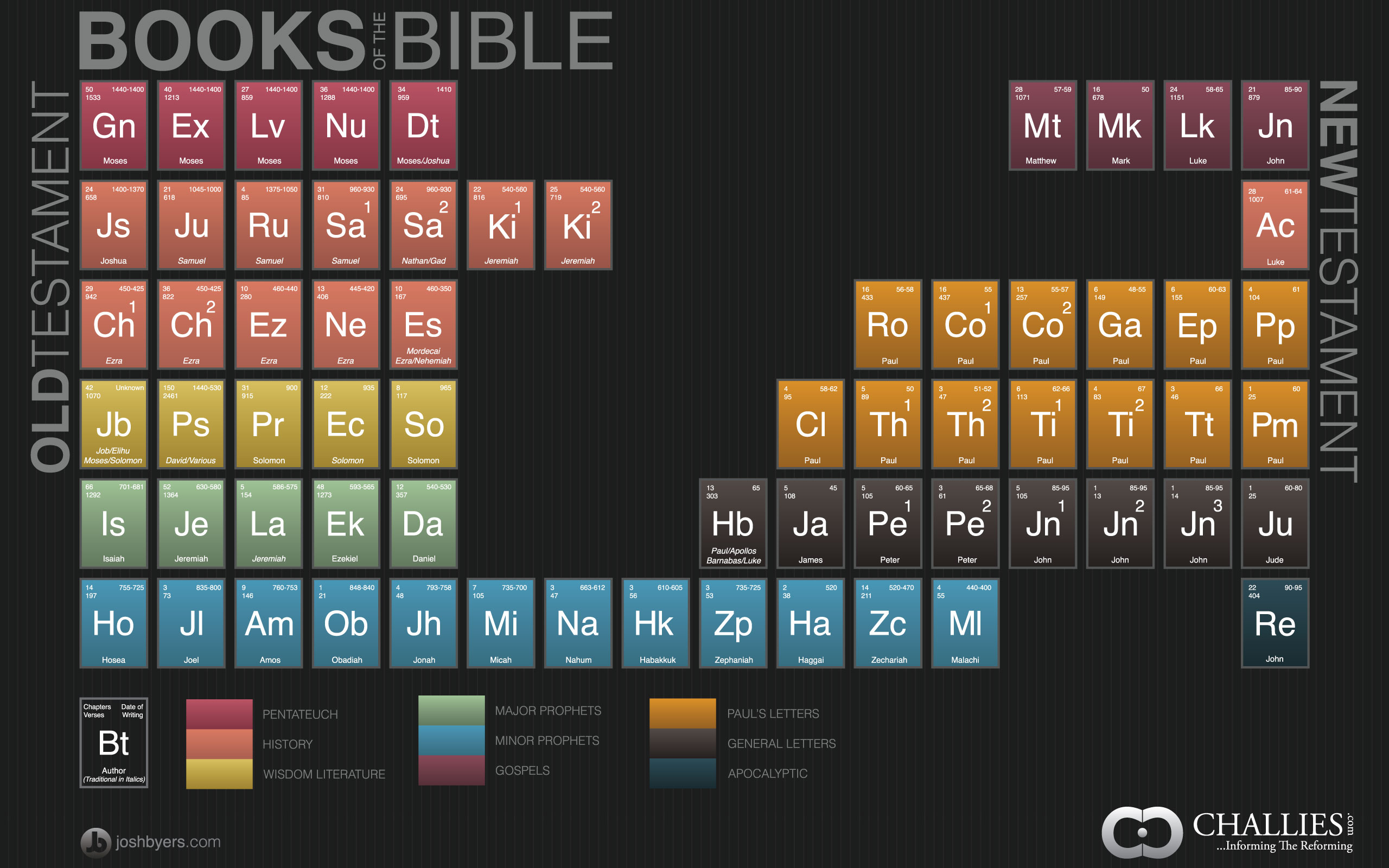
The periodic table of Biblical books!

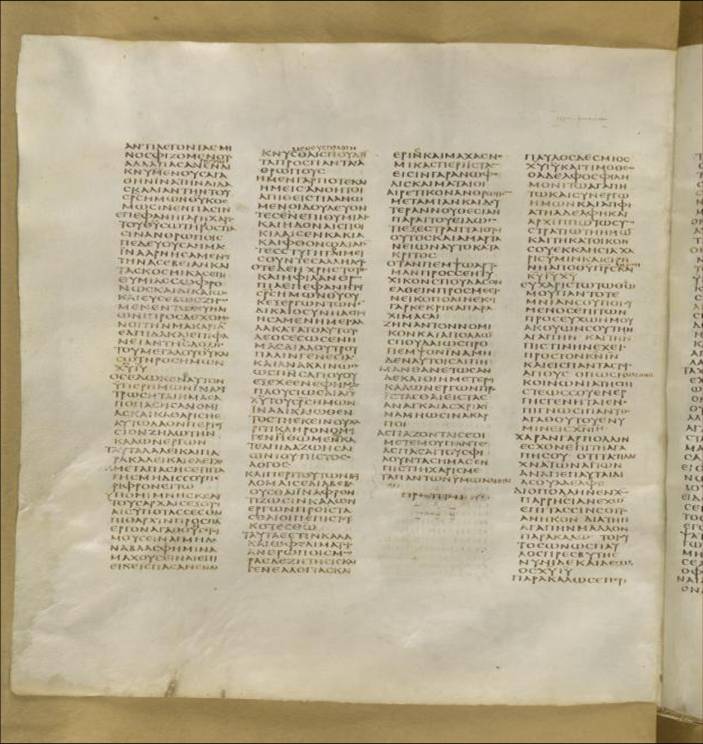
When considering the issue of the preservation of the Scriptures, sadly, tempers will sometimes become heated as heretofore sacred theories are challenged on Biblical and historical grounds. I haven’t “officially” begun my series on the subject, but I wanted to jump start it once more by correcting a piece of Christian folklore you may have heard about an important manuscript copy we possess – Codex Sinaiticus.
This document is the oldest complete copy of the New Testament we have. It specifically contains “parts of the Old Testament, the New Testament complete, and in addition, the Epistle of Barnabas and a part of the Pastor of Hermas.”[1]
The folklore story is that this precious document was found in a trashcan, soon to be burned in the fire. How ridiculous, the legend goes, to believe God would preserve His word in a document which was regarded as nothing more than trash!
Here is a typical argument in this vein from a proponent:[2]
Question: Was the Sinaiticus Codex actually rescued from a wastepaper basket? What is your evidence for this?
Answer: Yes, it was. It was deposited with lots of other paper, in the desire to burn it and bring warmth to the monastery. This story comes from many sources, including someone who knew the facts and examined the evidence for himself, and Tischendorf, the man who acquired the Sinaiticus. There are many sources for the Sinaiticus story, that it was found after being deposited in a kindling bin at St. Catherine’s monastery. Please remember: it gets COLD in monasteries! They needed to burn whatever they had to make themselves warm.
I have no desire to get involved in a protracted, heated discussion on text types or textual criticism. I have very modest goals with this post – to allow Constantine Tischendorf himself to give his own account of how he discovered the manuscript. Bottom line – it was not discovered in the trash.
While visiting the a monastery in search of old manuscript copies of the New Testament, Tischendorf saw old, mouldered and useless leaves from the manuscript about to be burnt. He showed enthusiastic interest in them and the monks became suspicious, allowing him to cart off some 45 of the leaves but refusing to tell him anything about where they came from. Some years later, on a third visit to the monetary, Tischendorf was shown the complete manuscript. It had been carefully wrapped in cloth and kept in a monk’s room.
Don’t take my word for it – read Tischendorf’s own words, in context, on the matter. Those who disagree with the plain historical record of the man who found the document are in clear error. They must reckon with Tischendorf’s own account. I pray that they do so: [3]
 I here pass over in silence the interesting details of my travels—my audience with the pope, Gregory XVI., in May, 1843—my intercourse with Cardinal Mezzofanti, that surprising and celebrated linguist—and I come to the result of my journey to the East. It was in April, 1844, that I embarked at Leghorn for Egypt. The desire which I felt to discover some precious remains of any manuscripts, more especially Biblical, of a date 28which would carry us back to the early times of Christianity, was realized beyond my expectations. It was at the foot of Mount Sinai, in the convent of St. Catherine, that I discovered the pearl of all my researches. In visiting the library of the monastery, in the month of May, 1844, I perceived in the middle of the great hall a large and wide basket full of old parchments; and the librarian, who was a man of information, told me that two heaps of papers like this, mouldered by time, had been already committed to the flames. What was my surprise to find amid this heap of papers a considerable number of sheets of a copy of the Old Testament in Greek, which seemed to me to be one of the most ancient that I had ever seen. The authorities of the convent allowed me to possess myself of a third of these parchments, or about forty-five sheets, all the more readily as they were destined for the fire. But I could not get them to yield up possession of the remainder. The too lively satisfaction which I had displayed, had aroused their suspicions as to the value of this manuscript. I transcribed a page of the text of Isaiah and Jeremiah, and enjoined on the monks to take religious care of all such remains which might fall in their way.
On my return to Saxony there were men of learning who at once appreciated the value of the treasure which I brought back with me. I did not divulge the name of the place where I had found it, in the hopes of returning and recovering the rest of the manuscript. I handed up to the Saxon government my rich collection of oriental manuscripts in return for the payment of all my travelling expenses. I deposited in the library of the university of Leipzig, in the shape of a collection which bears my name, fifty manuscripts, some of which are very rare and interesting. I did the same with the Sinaitic fragments, to which I gave the name of Codex Frederick Augustus, in acknowledgment of the patronage given to me by the king of Saxony; and I published them in Saxony in a sumptuous edition, in which each letter and stroke was exactly reproduced by the aid of lithography.
But these home labors upon the manuscripts which I had already safely garnered, did not allow me to forget the distant treasure which I had discovered. I made use of an influential friend, who then resided at the court of the viceroy of Egypt, to carry on negotiations for procuring the rest of the manuscript. But his attempts were, unfortunately, not successful. “The monks of the convent,” he wrote to me to say, “have, since your departure, learned the value of these sheets of parchment, and will not part with them at any price.”
I resolved, therefore, to return to the East to copy this priceless manuscript. Having set out from, Leipzig in January, 1853, I embarked at Trieste for Egypt, and in the month of February I stood, for the second time, in the convent of Sinai. This second journey was more successful even than the first, from the discoveries that I made of rare Biblical manuscripts; but I was not able to discover any further traces of the treasure of 1844. I forget: I found in a roll of papers a little fragment which, written over on both sides, contained eleven short lines of the first book of Moses, which convinced me that the manuscript originally contained the entire Old Testament, but that the greater part had been long since destroyed.
On my return I reproduced in the first volume of a collection of ancient Christian documents the page of the Sinaitic manuscript which I had transcribed in 1844, without divulging the secret of where I had found it. I confined myself to the statement that I claimed the distinction of having discovered other documents—no matter whether published in Berlin or Oxford—as I assumed that some learned travellers who had visited the convent after me had managed to carry them off.
The question now arose how to turn to use these discoveries. Not to mention a second journey which I made to Paris in 1849, I went through Germany, Switzerland, and England, devoting several years of unceasing labor to a seventh edition of my New Testament. But I felt myself more and more urged to recommence my researches in the East. Several motives, and more especially the deep reverence of all Eastern monasteries for the emperor of Russia, led me, in the autumn of 1856, to submit to the Russian government a plan of a journey for making systematic researches in the East. This proposal only aroused a jealous and fanatical opposition in St. Petersburg. People were astonished that a foreigner and a Protestant should presume to ask the support of the emperor of the Greek and orthodox church for a mission to the East. But the good cause triumphed. The interest which my proposal excited, even within the imperial circle, inclined the emperor in my favor. It obtained his approval in the month of September, 1858, and the funds which I asked for were placed at my disposal. Three months subsequently my seventh edition of the New Testament, which had cost me three years of incessant labor, appeared, and in the commencement of January, 1859, I again set sail for the East.
I cannot here refrain from mentioning the peculiar satisfaction I had experienced a little before this. A learned Englishman, one of my friends, had been sent into the East by his government to discover and purchase old Greek manuscripts, and spared no cost in obtaining them. I had cause to fear, especially for my pearl of the convent of St. Catherine; but I heard that he had not succeeded in acquiring any thing, and had not even gone as far as Sinai; “for,” as he said in his official report, “after the visit of such an antiquarian and critic as Dr. Tischendorf, I could not expect any success.” I saw by this how well advised I had been to reveal to no one my secret of 1844.
By the end of the month of January I had reached the convent of Mount Sinai. The mission with which I was intrusted entitled me to expect every consideration and attention. The prior, on saluting me, expressed a wish that I might succeed in discovering fresh supports for the truth. His kind expression of good will was verified even beyond his expectations.
After having devoted a few days in turning over the manuscripts of the convent, not without alighting here and there on some precious parchment or other, I told my Bedouins, on the 4th of February, to hold themselves in readiness to set out with their dromedaries for Cairo on the 7th, when an entirely unexpected circumstance carried me at once to the goal of all my desires. On the afternoon of this day, I was taking a walk with the steward of the convent in the neighborhood, and as we returned towards sunset, he begged me to take some refreshment with him in his cell. Scarcely had he entered the room when, resuming our former subject of conversation, he said, “And I too have read a Septuagint, i. e., a copy of the Greek translation made by the Seventy;” and so saying, he took down from the corner of the room a bulky kind of volume wrapped up in a red cloth, and laid it before me. I unrolled the cover, and discovered, to my great surprise, not only those very fragments which, fifteen years before, I had taken out of the basket, but also other parts of the Old Testament, the New Testament complete, and in addition, the Epistle of Barnabas and a part of the Pastor of Hermas. Full of joy, which this time I had the self-command to conceal from the steward and the rest of the community, I asked, as if in a careless way, for permission to take the manuscript into my sleeping-chamber, to look over it more at leisure. There by myself, I could give way to the transport of joy which I felt. I knew that I held in my hand the most precious Biblical treasure in existence—a document whose age and importance exceeded that of all the manuscripts which I had ever examined during twenty years’ study of the subject. I cannot now, I confess, recall all the emotions which I felt in that exciting moment, with such a diamond in my possession. Though my lamp was dim and the night cold, I sat down at once to transcribe the Epistle of Barnabas. For two centuries search has been made in vain for the original Greek of the first part of this epistle, which has been only known through a very faulty Latin translation. And yet this letter, from the end of the second down to the beginning of the fourth century, had an extensive authority, since many Christians assigned to it and to the Pastor of Hermas a place side by side with the inspired writings of the New Testament. This was the very reason why these two writings were both thus bound up with the Sinaitic Bible, the transcription of which is to be referred to the first half of the fourth century, and about the time of the first Christian emperor.
Early on the 5th of February, I called upon the steward, and asked permission to take the manuscript with me to Cairo, to have it there transcribed from cover to cover; but the prior had set out only two days before also for Cairo, on his way to Constantinople, to attend at the election of a new archbishop, and one of the monks would not give his consent to my request. What was then to be done? My plans were quickly decided. On the 7th, at sunrise, I took a hasty farewell of the monks, in hopes of reaching Cairo in time to get the prior’s consent. Every mark of attention was shown me on setting out. The Russian flag was hoisted from the convent walls, while the hillsides rang with the echoes of a parting salute, and the most distinguished members of the order escorted me on my way as far as the plain. The following Sunday I reached Cairo, where I was received with the same marks of good-will. The prior, who had not yet set out, at once gave his consent to my request, and also gave instructions to a Bedouin to go and fetch the manuscript with all speed. Mounted on his camel, in nine days he went from Cairo to Sinai and back, and on the 24th of February the priceless treasure was again in my hands. The time was now come at once boldly and without delay to set to work to a task of transcribing no less than a hundred and ten thousand lines, of which a great many were difficult to read, either on account of later corrections or through the ink having faded, and that in a climate where the thermometer, during March, April, and May, is never below 77º Fahrenheit in the shade. No one can say what this cost me in fatigue and exhaustion.
The relation in which I stood to the monastery gave me the opportunity of suggesting to the monks the thought of presenting the original to the emperor of Russia, as the natural protector of the Greek orthodox faith. The proposal was favorably entertained, but an unexpected obstacle arose to prevent its being acted upon. The new archbishop, unanimously elected during Easter week, and whose right it was to give a final decision in such matters, was not yet consecrated, or his nomination even accepted by the Sublime Porte. And while they were waiting for this double solemnity, the patriarch of Jerusalem protested so vigorously against the election, that a three months’ delay must intervene before the election could be ratified and the new archbishop installed. Seeing this, I resolved to set out for Jaffa and Jerusalem.
Just at this time the grand-duke Constantine of Russia, who had taken the deepest interest in my labors, arrived at Jaffa. I accompanied him to Jerusalem. I visited the ancient libraries of the holy city, that of the monastery of Saint Saba, on the shores of the Dead sea, and then those of Beyrout, Ladikia, Smyrna, and Patmos. These fresh researches were attended with the most happy results. At the time desired I returned to Cairo; but here, instead of success, only met with a fresh disappointment. The patriarch of Jerusalem still kept up his opposition; and as he carried it to the most extreme lengths, the five representatives of the convent had to remain at Constantinople, where they sought in vain for an interview with the sultan, to press their rights. Under these circumstances, the monks of Mount Sinai, although willing to do so, were unable to carry out my suggestion.
In this embarrassing state of affairs, the archbishop and his friends entreated me to use my influence on behalf of the convent. I therefore set out at once for Constantinople, with a view of there supporting the case of the five representatives. The prince Lobanow, Russian ambassador to Turkey, received me with the greatest good-will; and as he offered me hospitality in his country-house on the shores of the Bosphorus, I was able the better to attend to the negotiations which had brought me there. But our irreconcilable enemy, the influential and obstinate patriarch of Jerusalem, still had the upper hand. The archbishop was then advised to appeal himself in person to the patriarchs, archbishops, and bishops, and this plan succeeded; for before the end of the year the right of the convent was recognized, and we gained our cause. I myself brought back the news of our success to Cairo, and with it I also brought my own special request, backed with the support of Prince Lobanow.
On the 27th of September I returned to Cairo. The monks and archbishops then warmly expressed their thanks for my zealous efforts in their cause; and the following day I received from them, under the form of a loan, the Sinaitic Bible, to carry it to St. Petersburg, and there to have it copied as accurately as possible.
I set out for Egypt early in October, and on the 19th of November I presented to their imperial majesties, in the Winter Palace at Tsarkoe-Selo, my rich collection of old Greek, Syriac, Coptic, Arabic, and other manuscripts, in the middle of which the Sinaitic Bible shone like a crown. I then took the opportunity of submitting to the emperor Alexander II. a proposal of making an edition of this Bible worthy of the work and of the emperor himself, and which should be regarded as one of the greatest undertakings in critical and Biblical study.
I did not feel free to accept the brilliant offers that were made to me to settle finally, or even for a few years, in the Russian capital. It was at Leipzig, therefore, at the end of three years, and after three journeys to St. Petersburg, that I was able to carry to completion the laborious task of producing a fac-simile copy of this codex in four folio volumes.
In the month of October, 1862, I repaired to St. Petersburg to present this edition to their majesties. The emperor, who had liberally provided for the cost, and who approved the proposal of this superb manuscript appearing on the celebration of the Millenary Jubilee of the Russian monarchy, has distributed impressions of it throughout the Christian world; which, without distinction of creed, have expressed their recognition of its value. Even the pope, in an autograph letter, has sent to the editor his congratulations and admiration. It is only a few months ago that the two most celebrated universities of England, Cambridge and Oxford, desired to show me honor by conferring on me their highest academic degree. “I would rather,” said an old man, himself of the highest distinction for learning—“I would rather have discovered this Sinaitic manuscript than the Koh-i-noor of the queen of England.”
But that which I think more highly of than all these flattering distinctions is, the conviction that Providence has given to our age, in which attacks on Christianity are so common, the Sinaitic Bible, to be to us a full and clear light as to what is the word written by God, and to assist us in defending the truth by establishing its authentic form.
[1] Constantine Tischendorf, When Were Our Gospels Written? An Argument by Constantine Tischendorf with a Narrative Discovery of the Sinaitic Manuscript (New York, NY: American Tract Society, 1866), 34. Retrieved electronically from the Christian Classics Etheral Library (CCEL) – http://www.ccel.org/ccel/tischendorf/gospels.ii.iii.html.
[2] David W. Daniels, “Bible Versions: Your Questions Answered” (Ontario, CA: Chick, 2002). Retrieved electronically from http://www.chick.com/ask/articles/wastebasket.asp. Interestingly, this author discounts Constantine Tischendorf’s own testimony of how he discovered the manuscript and relies upon the second-hand account of another man instead!
[3] This is not even Tischendorf’s full account. There is a larger back-story where he recounts his travels around Europe and the East on a quest for New Testament manuscripts. I didn’t include that here. Feel free to visit the link in the previous footnote and read the entire matter for yourself.

I’ll be starting a series on the preservation of the scriptures soon. In preparation for this, I thought I’d share this neat infographic with you. The bottom line is that we have a huge amount of copies of the New Testament. It is by far the most well-attested book from all of antiquity. This series will focus on God’s providential preservation of His word for His people. In the meantime, this picture illustrates just how many copies of the various New Testament documents we have in comparison to copies of other ancient works.
Find other outstanding infographics at Visual Unit.


This is the final article on my series of the scriptures being the sole, infallible authority for Christian faith and practice. The entire series is attached as a PDF here.
The question is whether the Scriptures are sufficient. Are they the sole, infallible authority for Christian faith and life, or is something more needed?
First, it has been shown the Scriptures themselves are very clear that neither Christ nor His apostles tolerated or sanctioned the use of tradition for religious faith and life.
Second, Matthew, Luke, Paul, Peter and Jude relied on Scripture alone for their theology. As Armitage stated, “Christ and his Apostles always appeal directly to the Law, the Prophets, and the Psalms, and to their co-relative sentiments, facts and precedents, where they are applicable; and where they are not applicable, a new revelation was granted.”[1]
Third, an exposition of several critical Scripture passages demonstrate that (1) Christ condemned the use of tradition, even if derived from Scripture, (2) Scripture is divinely inspired by God and profitable to make the man of God complete, (3) Scripture is the very product of the Spirit of God.
Fourth, the New Testament alone is the only source of authority for church polity
Fifth, in summary, “it is clear that Jesus, his disciples, and the Jewish people in general presupposed Scripture to be not only the infallible record of God’s revelatory acts, but the authoritative, objective link between the prophetic nature of revelation and its fulfillment.”[2]
[1] Thomas Armitage, A History of the Baptists (Roger Williams Heritage Archives, 1886), 116.
[2] King, “Holy Scripture,” 42.

This is a short interview with Dr. Michael Kruger, author of Canon Revisited, a wonderful book I recommend. He also maintains a very helpful website, Canon Fodder. In this video, Dr. Kruger briefly discusses why Christians can trust the books of the New Testament. It’s only 8:00 long, so watch it if you have a moment or two . . .


This piece can honestly be viewed separately from the larger series on the sufficiency of the Scriptures as the sole, infallible authority for Christian faith and life. Here, I’ll briefly expound on the historical Baptist distinctive of the New Testament as the sole, infallible authority for church polity.
What in the world is “church polity!”, you ask? It basically means “how you do church.” The way you conduct services, make rules, choose Pastors, discipline current members, accept new members and determine what Christian ordinances are (among other things) is called “polity.” Baptists have historically believed the New Testament is the “manual” for church polity.
——————————————————————-
The New Testament is the progressive fulfillment of the Old. It introduced an entirely new arrangement for God’s rule over the earth, and corresponding new responsibilities for man.[1] If God has introduced a new arrangement and revelation for mankind, as He has done in the past (Heb 1:1), then it is clear man’s authority for proper worship during this period is that new revelation.
Man’s responsibility in any dispensation is to worship God in the way He commands by (1) an authentic, heartfelt response which takes (2) the appropriate form. The genuine response of the believer has always been an unchanging requirement. Rolland McCune observed; “faith in God’s revelation was required not only for redemption from sin but also for fulfilling one’s dispensational obligations,” (Gen 15:6).[2] The form of that response, however, has changed throughout human history as God periodically alters the method of His rule and gives new revelation. That form of response changed with the ministry of Christ; therefore the Baptist position is that the New Testament is the sole, infallible authority governing church matters.
From this basic principle, every other Baptist distinctive flows.[3] It is precisely because the New Testament alone is the sole authority for church matters that Baptists have traditionally held to the following doctrines:
Regenerated and immersed church membership. The Old Testament knows nothing of regenerated membership, for Israelites were born into the covenant family, but “not all who are descended from Israel belong to Israel,” (Rom 9:6b). Likewise, the concept of believer’s baptism after confession of sin in the manner of John (Mt 3:6) was foreign to OT.[4]
Autonomy of the local church. The church itself was a mystery to the OT, a new entity revealed by Christ (Gal 1:12; Eph 3:1-13). The very concept of an autonomous local assembly (“church”) worshipping Jesus Christ as Messiah is blasphemous in an OT context of corporate worship; hence the persecutions the early Christians suffered at the hands of the Jews as a “sect.”
Priesthood of the believer. Christ is our High Priest, who intercedes for us (Heb 9:24). We have direct access to God the Father through Christ our mediator (1 Tim 2:5) and advocate (1 Jn 2:1). Christ’s role is only foreshadowed in the OT; the office of the Levite priestly function was “symbolic for the present age,” (Heb 9:9).
Soul liberty. As a member of a local, autonomous church body, man is responsible and accountable to God alone for his faith and practice (Rom 14:5, 12). “When a Baptist shall rob one man of soul-liberty, by statute, penalty and sword, he will cease to be a Baptist for that reason.[5]
Immersion and the Lord’s Supper. These two ordinances of the New Testament local church are utterly unknown to the Hebrew Scriptures.
Separation. The concept of being set-apart and separate for the Lord in accordance with divine revelation is not a new one (Lev 18:24-19:2). The New Testament, however, has new revelation and doctrine for this present age which was unknown to the prophets of old. Biblical separation, in this or any dispensation, is grounded on the foundation of the holiness of God (1 Pet 1:15-16).
Baptists have always held the Scriptures to be the sole authority for Christian faith and life. They have implicitly held the New Testament alone to be the source for church polity, although historically this has apparently not been a distinction worth making.
John Smythe, who founded what is generally considered to be the first General Baptist church in history in 1609,[6] wrote merely that,
the Scriptures of the old Testament are commanded to the Church, as also the Scriptures of the new Testament . . . the Holy Scriptures are the fountayne of all truth . . . they are the ground and foundation of our faith . . . by them all doctrynes & every Spiritt is to be judged.[7]
The 1689 London Baptist Confession observes, “the Holy Scripture is the only sufficient, certain, and infallible rule of all saving Knowledge, Faith and Obedience.”[8] The 1833 New Hampshire Baptist Confession speaks of only the “Holy Scriptures” as a whole.[9] The 1834 Confession of Free-Will Baptists speaks of both the Old and New Testaments, and asserts, “they are a sufficient and infallible guide in religious faith and practice.[10]
A number of 19th century Baptists made the explicit claim that the New Testament alone is the source for church government:
The fact that Baptist churches alone consistently adhere to the New Testament as an absolute and complete guide, in matters of practice as well as in matters of doctrine, is freely and heartily admitted by many of the ablest defenders of other systems.[11]
Baptists differ fundamentally from Pedobaptists in practically adhering to the New Testament as the sufficient, the exclusive, and the absolute rule of faith and practice. The soul of Baptist churches is submission and conformity to the New Testament.[12]
The reasons behind this explicit stand are unclear, but a covenantal hermeneutic appeared drive at least one 19th century Baptist to this position. Francis Weyland wrote that he “believes the New Testament to be the standard by which the precepts and teachings of the former revelation are to be judged, and that, thus, it is our only rule of faith and practice.[13]
More recently, Richard Weeks elevated the explicit use of the New Testament alone for church polity to a Baptist distinctive in his own writings.[14] Several fundamental Baptist contemporaries from the latter half of the 20th century did not make this hard and fast distinction and continued to speak generically of “the Scriptures” to govern church polity.[15]
Weeks’ formulation of the New Testament as the explicit, sole rule of faith and practice in church polity was correct and unusually precise, much more so than the numerous creeds and confessions which had come before. It accords perfectly well with Thomas Armitage’s statement:
This fact is perfectly clear, namely: That the New Testament contains all that entered into the faith and practice of the Apostolic Churches. Whether it contains little or much, it covers all that they had, and all that we have, which has any claim on the Churches of Christ. It is the only revealed record of Christian truth. [16]
[1] Renald Showers’ definition of a “dispensation” is particularly appropriate here: “A dispensation is a particular way God administers His rule over the world as He progressively works out His purpose for world history.” Renald Showers, There Really is a Difference! (Bellmayr, NJ: Friends of Israel, 1990), 30.
[2] Rolland McCune, A Systematic Theology of Biblical Christianity, 3 vols. (Detroit: MI, DBTS, 2009), 1:125.
[3] William B. Johnson, “The Gospel Developed,” in Polity: Biblical Arguments on How to Conduct Church Life, ed. Mark Dever (Washington, D.C.: Center for Church Reform, 2011), 168. Johnson, writing in 1846, clearly laid out the Baptist distinctive in his article:
“The denomination to which I have the honor to belong, holds the true fundamental principles of the gospel of Christ. These are, the sovereignty of God in the provision and application of the plan of salvation, the supreme authority of the scriptures, the right of each individual to judge for himself in his views of truth as taught in the scriptures, the independent, democratical, Christocratic form of church government, the profession of religion by conscious subjects only, and the other principles of scripture truth growing out of these or intimately connected with them.”
[4] Leon Morris, The Gospel According to Matthew (Grand Rapids, MI: Kregel, 1992), 56. “The Jews employed baptism in admitting Gentiles as proselytes, but the sting in John’s practice was that he applied it to Jews!”
[5] Thomas Armitage, Baptist Faith and Practice (Roger Williams Heritage Archives, 1890), 37.
[6] Leon MacBeth, A Sourcebook for Baptist Heritage (Nashville, TN: Broadman, 1990), 13.
[7] Ibid, 17.
[8] CCEL.org. The 1677/89 London Baptist Confession of Faith. http://www.ccel.org/creeds/bcf/bcf.htm.
[9] Philip Schaff, The Creeds of Christendom, with a History and Critical Notes, Volume III: The Evangelical Protestant Creeds, with Translations (New York: Harper & Brothers, 1882), 742.
[10] Ibid, 749.
[11] Albert H. Newman, “Baptist Churches Apostolical,” Baptist Doctrines, ed. C.A. Jenkens (Watertown, WI: Roger Williams Heritage Archives, 1890), 236–237.
[12] Thomas Pritchard, “The Difference Between a Baptist Church and All Other Churches,” Baptist Doctrines, ed. C.A. Jenkens (Watertown, WI: Roger Williams Heritage Archives, 1890), 309.
[13] Francis Wayland, Notes on the Principles and Practices of Baptist Churches (Roger Williams Heritage Archives, 1857), 92.
[14] David Saxon, “Maranatha is Baptist,” Maranatha Baptist Theological Journal MBTJ 01:1 (Spring 2011), 20-21.
[15] For example, see Monroe Parker, “Baptists and Evangelism,” Central Bible Quarterly CENQ 04:3 (Fall 1961), 43: “in all matters true Baptists point to the Bible as the only rule of faith and practice.” See also Warren Vanhetloo, “Convicted Conservative Baptist Beliefs,” Central Bible Quarterly CENQ 04:1 (Spring 1961), 25: He lists the Baptist distinctives and states Baptists believe “in the Bible as the only rule of faith and practice.”
[16] Thomas Armitage, A History of the Baptists (Roger Williams Heritage Archives, 1886), 117.

In this sermon, preached on Sunday morning in my church, I completed the account on legalism which spans from Mark 7:1-23. Here, Jesus answers the Pharisees’ accusation about why His disciples ate food with hands that were “defiled.” The Pharisees, in a misguided attempt to preserve their Jewishness in a culture and time that was not Jewish any longer, had built up an oppressive edifice of oral traditions that had come to almost take the place of the law.
The point of this account is that the Pharisees were concerned with external appearance, with cultic, ritual purity. They was no emphasis on internal purity of heart. The admonitions of Moses to love the Lord with all their heart, soul and might had been seemingly forgotten (Deut 6:5). The exhortation to be an Israelite in heart, not merely in outward show, was not being obeyed. God desired a not merely an external circumcision (Gen 17:11), but an inward circumcision of the heart as well (Deut 10:16). The outward conformity was supposed to be the fruit of an inward love for God.
Christ makes it very clear in this account that it is what comes out of a man’s heart that defiles him, not what comes from the outside (Mk 7:15). Our hearts prove that we are all morally unclean, and no matter what we do on the outside to try to clean ourselves up in the eyes of men, the very thoughts (let alone actions) of our own hearts betrays our sin and our moral “uncleanness.”
The inevitable conclusion here, left unsaid but Christ but implicit in His instruction, is that we are all morally unclean! We cannot make ourselves clean – we do not possess that power. We can only be cleansed by Jesus Christ, upon sincere repentance from sin and saving faith in Him (Mk 1:15).
The legalistic society of the Pharisees was perhaps as far from the love of God as it is possible to get. I spend a few minutes giving a handful of cursory examples of just how legalistic normal life was like in Inter-testamental Judaism. The bottom line is that it was not a happy life. There was no love for God, no happiness or joy in serving Him. How could there be, in such an oppressive, tradition-bound society such as this!? A quotation from Emil Schurer makes the point pretty clearly;
Nothing was left to free personality, everything was placed under the bondage of the letter. The Israelite, zealous for the law, was obligated at every impulse and movement to ask himself, what is commanded? At every step, at the work of his calling, at prayer, at meals, at home and abroad, from early morning till late evening, from youth to old age, the dead, the deadening formula followed him. A healthy moral life could not flourish under such a burden, action was nowhere the result of inward motive, all was, on the contrary, weighed and measured. Life was a continual torment to the earnest man, who felt at every moment that he was in danger of transgressing the law; and where so much depended on external form, he was often left in uncertainty whether he had really fulfilled its requirements. On the other hand, pride and conceit were almost inevitable for one who had attained to mastership in the knowledge and treatment of the law. He could indeed say that he had done his duty, had neglected nothing, and had fulfilled all righteousness. But all the more certain it is, that this righteousness of the scribes and Pharisees which looked down with proud thanks to God upon the sinner, and pompously displayed its works before the eyes of the world, was not that true righteousness which was well-pleasing to God.[1]
[1] Emil Schurer, A History of the Jewish People in the Time of Jesus Christ, 2nd division, vol. 2 (Peabody, MS: 2012), 125.

Bethlehem. The bright cross shaped Church of the Nativity dominates Manger Square, the site of the birth of Jesus Christ. “The most sacred place on earth”, as St. Jerome wrote. On the right stands the Church of St. Catherine with its red-tiled roof.
– Hanan Isachar and Hedva Canetti, Images of the Holy Land (St Louis, MO: Concordia, 2004).


This is Part #3b on my series about the absolute sufficiency of the Scriptures as the sole, infallible authority for Christian faith and life. Part #1 set the stage. Parts #2a and #2b examined what several books in the New Testament had to say on the subject. Part #3a, along with this post, examine several critical passages which teach the doctrine of sola scriptura.
In this passage, Peter shows great concern that Christians “confirm their calling and election,” (2 Pet 1:10). He listed several traits (2 Pet 1:5-7) which should be the practical outworking of a fruitful life in Christ (2 Pet 1:8). Peter endeavored to constantly remind Christians of these points (2 Pet 1:12-15), and then set out to demonstrate the validity of the truth he preached.
Peter made it very clear that he and the other apostles “did not follow cleverly devised myths” when they preached of the second coming of Christ, and reminded his readers he was an eyewitness of His majesty! (2 Pet 1:16). Once again, deviation from a concrete, propositional truth is a negative thing to the NT evangelists. Peter is stressing the legitimacy of the doctrine he preached, and he did so by affirming that it was truthful and in accordance with actual events. Peter recounted what he saw on the Mount of Transfiguration, when he saw the glorified Christ and heard the voice of God the Father issuing His seal of approval on His Son’s ministry. His Second Coming will happen. Peter assures his audience he knows this to be true because he witnessed God’s approval on His Son (2 Pet 1:18).
Implicitly, then, the whole of the Gospel message is also true and correct. Peter makes this very connection when he remarks, “and we have the prophetic word more fully confirmed,” (2 Pet 1:19a). Peter’s eyewitness testimony confirms the validity, accuracy and above all the sufficiency of the OT Scriptures – the transfiguration confirms the eventual fulfillment of the prophesies.[1] Peter uses the authority of the OT Scriptures alone to confirm the new mystery of the church age and the Gospel of Christ. This is progressive revelation once again; the new revelation in perfect accord with the old.
Meanwhile, as Christians wait for that blessed day (Titus 2:13), Peter calls his readers back to the sacred Scriptures, encompassing both the Hebrew Scriptures and the new revelation of the apostles. He tells them to “pay attention” to them, “as to a lamp shining in a dark place, until the day dawns and the morning star arises in your hearts,” (2 Pet 1:19b). “As a light, God’s word has validity and authority.”[2]
It is significant that Peter directs his readers only to God’s unshakable word for comfort and guidance in Christian life. Calvin remarked,
His object only was to teach us that the whole course of our life ought to be guided by God’s word; for otherwise we must be involved on every side in the darkness of ignorance; and the Lord does not shine on us, except when we take his word as our light.[3]
Peter continued onward and emphasized the source of Scripture; “no prophesy of Scripture comes from someone’s own interpretation,” (2 Pet 1:20). Again, it is not a cunningly devised fable. It is divinely inspired. It is propositional truth. No true prophesy “was ever produced by the will of man, but men spoke from God as they were carried along by the Holy Spirit,” (2 Pet 1:21). “To bear” or “to guide” translates the Greek word phero.[4] As Scripture authors penned their works, they were impelled, borne along and guided by the Spirit. “The metaphor here is of Prophets raising their sails, the Holy Spirit filling them and carrying their craft along in the direction He wished.”[5] This, along with 2 Tim 3:16-17, is clear testimony to the divine nature, authority and absolute sufficiency of the Scriptures.
[1] Edwin A. Blum, 2 Peter, vol. 12, The Expositor’s Bible Commentary, ed. Frank Gaebelein (Grand Rapids, MI: Zondervan, 1981), 274.
[2] Roger M. Raymer, 2 Peter, in The Bible Knowledge Commentary, ed. J.F. Walvoord and R. Zuck (Wheaton, IL: Victor, 1983), 868.
[3] John Calvin and John Owen, Commentaries on the Catholic Epistles (Bellingham, WA: Logos Bible Software, 2010), 388.
[4] The Lexham Analytical Lexicon to the Greek New Testament. Logos Bible Software, 2011.
[5] King, Holy Scripture, 95.


This message is directly specifically at teenagers, but just for kicks, I’ll post it here anyway! It was preached for teen Sunday School at my church this morning.
There are three basic, looming decisions facing any Christian teenager as their high school days come to a close and they face the prospect of escaping from home (at last!) and starting life on their own.
For a Christian teenager seeking to be true to God, each of these life-altering decisions are (hopefully) seen in the context of what God’s will for his life is. Questions such as these will naturally swirl through the mind:
We all probably remember wrestling with these issues in our own lives. In this lesson, I take a brief look at what a passage of Scripture has to say about (1) God’s universal will for every Christian and (2) discerning God’s will for our individual lives. The important takeaway is this:
We may not always appreciate or like what God has in store for us! However, if we can truly call ourselves children of God who have repented of our sins and trusted in Christ as Savior, we can trust God and live by faith as we await His glorious return!
I honestly wish I had much more time to flesh this out. Hopefully it was a blessing to our teens in church, and perhaps even to you. The Gospel of Mark continues next week.

 The Eccentric Fundamentalist