We are increasingly living a world that (1) denies there are standards for anything, and (2) is Biblically illiterate. Join us as we watch the Apostle Paul deal with these very same issues on Mar’s Hill.
* This video and the accompanying notes were originally produced for an apologetics class I teach at my church, hence the opening and closing credits! I pray this modest study will be of use to some of you . . .
The Gospel of Judas is a fragmented Coptic (Egyptian)-language text that portrays Judas in a far more sympathetic light than did the gospels that made it into the Bible. In this version of the story, Judas turns Jesus over to the authorities for execution upon Jesus’ request, as part of a plan to release his spirit from his body. In the accepted biblical version of the tale, Judas betrays Jesus for 30 pieces of silver.
First, the document dates to 280 A.D., which is approximately 250 years after Jesus’ ministry, death, burial and resurrection.
Second, the author assumes a great deal about the canonization of the New Testament. There were good reasons why the Gospel of Judas was not accepted as authentic, inspired scripture by the early Christian community.
Third, this is not a tale. The Biblical account of Jesus’ ministry is a historical, objective fact.
Fourth, Jesus did not die on the cross “as part of a plan to release his spirit from his body.” This seems a bit mystical to me, and consistent with other false, Gnostic “gospels” the media and theological liberals like to trumpet from the rooftops.
Criteria
Briefly, these were the criteria for Scripture to be considered authentic in the early years of Christianity:
(1) It had to have been written by an actual Apostle of Christ (Mk 3:13-21) or a disciple
The New Testament was written by these men who walked with Christ and were taught by Him personally. It was written in their own lifetimes. The copy of this spurious “Gospel of Judas” was written 250 years later and conflicts with contemporary accounts. Not too trustworthy!
To place this in a modern context, say I suddenly produced a letter entitled, “The Memoirs of General Fred Hillbilly – Confederate General Extraordinaire.” Suppose in this letter, I claimed that General Robert E. Lee actually didn’t fight at Gettysburg at all – his army was routed while in camp and all his soldiers were asleep. Men were bayoneted in their tents, shot out of hand and all prisoners were hung without trial and tossed into mass, unmarked graves. It was a cold-blooded massacre, and the myth of Picket’s charge on the Union lines was invented to protect the reputation of the Union Army and President Lincoln. This is obviously ridiculous revisioist history, not to be taken seriously by any thinking person. This is precisely what this “Gospel of Judas” is to Christian history.
(2) It had to reflect the common, orthodox body of teaching received by the apostles and disciples
The Gospel of Judas did not reflect this teaching. Documents which did not reflect the accurate, corporate teaching of Christ and the apostles was given little weight. For example, “The Memoirs of General Fred Hillbilly – Confederate General Extraordinaire,” does not reflect accurate history. Likewise, the “Gospel” of Judas does not mesh with contemporary source documents – including Scripture. Never let anybody tell you Scripture cannot be trusted because it is “religious.”
(3) It has to have divine qualities – it testifies of itself
Inspired Scripture will speak to those who are genuinely saved and have the indwelling Holy Spirit (1 Cor 2:6-16). To those who have not been saved by the grace of God, it will be virtually incomprehensible. The whole weight of Scripture testifies to the authenticity of the Biblical account of Jesus’ betrayal at Judas’ hands. Satan was working in Judas’ heart, tempting him to betray Christ (Jn 13:2). Jesus stated one of the disciples would betray Him (Jn 13:21), and identified Judas as the man (Jn 13:26). Judas then fled into the night (Jn 13:27). This account is also given in Mt 26:14-16, Mk 14:10-11 and Lk 22:3-6. A false “gospel” which posits that the purpose of Christ’s death was to “release His spirit from His body” does not gel with the body of faith, or corporate teaching, of the rest of the New Testament.
When people think of “choosing the canon of Scripture,” they inevitably conjure up images of men sitting around a conference table, picking which books belong in the New Testament and which one’s don’t. It did not work this way! Those books which had the marks of authenticity, described above, grew in popularity and prominence and were gradually adopted over time by the great majority of the Christian churches in the first three hundred years or so after Christ’s death, burial, resurrection and ascension. In short, by the time lists of “orthodox” books began to circulate, the church fathers were not arbitrarily picking some to keep and some to toss in the trash –they were merely codifying what had already happened in the larger Christian community.
There is no reason to take this silly “gospel” seriously. Please force unbelievers and theological liberals to use these same standards of reasoning and apply them to undisputed historical figures – they will see the amazing double standard at work. Would anybody be willing to give “The Memoirs of General Fred Hillbilly – Confederate General Extraordinaire” the time of day? Then don’t give the “Gospel of Judas” the time of day either.
Ever wonder why some Christian writings are in the Bible and others aren’t? Have you ever heard about “lost” Gospels that never made it into the canon? Why didn’t they?
We’ll take a look at this in the video, and respond to Dr. Bart Ehrman’s implication that writings the church considered “heretical” might deserve a place in the Bible. Even if you don’t care about Dr. Ehrman’s charge and just want to know the criteria for canonicity, this is a helpful video. Enjoy!
This is a brief look at a very important issue for Christians. I’ll add some written commentary to accompany this video sometime in the future! I originally put this video together for my church, hence the introductory credits! I pray it will benefit the corporate Body of Christ in some small fashion . . .
This article is a work in progress. More information may be added as I conduct more research. As it stands now, this modest article is a very brief history of the Christian fundamentalist movement in the late 19th and early 20th centuries.
In this article, I’ll very briefly outline what historic fundamentalism is; specifically American fundamentalism. I cannot hope to discuss the genesis of the movement in a comprehensive fashion here, but hopefully it is helpful to the fundamentalist community at large, both as an all-too brief summary introduction to the movement or as a refresher to faithful warriors still on the field of battle!
This material will be old-hat to many of you. Some may never even read it because it may tread the same ground you’ve trod many times before. I believe it is important, however, to remind ourselves of how fundamentalism started, and visit old battlefields of the past periodically. We cannot understand our movement unless we grasp how it all began.
This is the first in a three part series examining, in sequence, (1) the historic roots of fundamentalism, (2) the historic roots of evangelicalism and (3) the idea of secondary separation.
What is Fundamentalism?
Just what in the world is fundamentalism? Numerous authors have provided their own definitions throughout the years.
George Marsden writes,
“A fundamentalist is an evangelical who is angry about something. That seems simple and is fairly accurate. . . . A more precise statement of the same point is that an American fundamentalist is an evangelical who is militant in opposition to liberal theology in the churches or to changes in cultural values or mores, such as those associated with ‘secular humanism.’ In either the long or the short definitions, fundamentalists are a subtype of evangelicals and militancy is crucial to their outlook. Fundamentalists are not just religious conservatives; they are conservatives who are willing to take a stand and to fight,” (4).
William Ayer observes,
“Fundamentalism represents a resurgence of ancient practices, which began not with Martin Luther but at Pentecost. Fundamentalism is apostolic, and the doctrine of justification goes back to Paul. That branch from which the fundamentalist movement sprang lived obscurely through the ages and had never been completely silenced even in the Dark Ages. . . . What fundamentalism did was to awaken the slumbering apostolicism from lethargy. The theme of the Reformation, like the cry of the fundamentalists today, was ‘back to the Bible and the Apostles,’ with no mediator between men and God except Christ. Fundamentalists are in the direct line of succession to those preaching this same message (2-3).
David O. Beale, in his excellent history of fundamentalism, gives perhaps the best definition of the movement:
“Ideally, a Christian Fundamentalist is one who desires to reach out in love and compassion to people, believes and defends the whole Bible as the absolute, inerrant, and authoritative Word of God, and stands committed to the doctrine and practice of holiness. . . . Fundamentalism is not a philosophy of Christianity, or is it essentially an interpretation of the Scriptures. It is not even a mere literal exposition of the Bible. The essence of Fundamentalism goes much deeper than that – it is the unqualified acceptance of and obedience to the Scriptures” (3).
Fundamentalism is not denominational centric. It is authentic and historic Christianity in action. Theological liberals may scoff and sneer at this “quaint” theology, but forget they have departed from historic Christian traditions. Beale quoted an opponent of fundamentalism as stating, “fundamentalism is . . . survival of a theology which was once universally held by all Christians . . . The Fundamentalist may be wrong; I think that he is. But it is we who have departed from the tradition, not he (4).
Broadly, the historic fundamentalist distinctives are these (Moritz 46):
– The inerrancy of Scripture
– The virgin birth of Christ
– The substitutionary atonement of Christ
– The bodily resurrection of Christ
– The authenticity of miracles
Genesis
Fundamentalism as an identifiable movement can be traced to a reaction against liberal theology coming out of Europe in the latter part of the 19th century – Ernest Pickering matter-of-factly called this “the poison from Europe!” (1). The corporate church was confronted with a number of critical issues, all of which had a profound effect on the entire theological landscape:
1. Philosophers began to elevate reason and materialism above the objective revelation of the Bible. Where it had once been considered the handmaiden of theology, philosophy now began to stand in opposition to Scripture.
2. Naturalistic science rejected the traditional biblical concepts of the world and humanity
3. Historical and literary criticism as systems began to reinterpret traditional Christianity by the new parameters of the Enlightenment.
4. Higher criticism, typified by the works of Friedrich Schleiermacher, sought to re-interpret Scripture. There was a distinct emphasis on humanism, elevating man rather than God. Revelation was “not an in-breaking of God, but an upsurging of divine humanity (Schleiermacher 50). Religion was not an objective truth, but more of a subjective feeling.
Schleiermacher wrote:
Schleiermacher
Religion is an immediate, or original, experience of the self-consciousness in the form of feeling. It is immediate, in that it is not derived from any other experience or exercise of the mind, but is inseparable from self-consciousness; and it is feeling, in that it is subjective experience and not objective idea, and in this respect it is identical with the self-consciousness, Religion is not an act of knowledge nor the result of a process of knowing. If it were the former, its source would lie in human activity. If it were the latter, its content would be doctrine, dependent upon prior processes of the intellect, and subject to all the uncertainties which pertain to scientific investigation. The measure of knowledge would be the measure of piety; religion would be a mere acquirement or possession and no essential element of human nature . . . Religion, then, as consisting in feeling, denotes a state of our being, and hence in religion man is not primarily active but receptive (Theology 119-120).
Under such pressure, Christian doctrine was adjusted in some denominations to accommodate the conclusions of science (thus ruling out creation), philosophy and criticism. Orthodox Christian were alarmed at this onslaught against precious Biblical truths. It was into this theological abyss that “fundamentalism” was born. It was an orthodox, Biblical reaction to distinctly un-Biblical theology.
The way fundamentalists react to this liberal theology, both historically and currently, adds another two other distinctive aspects to the five historic points above – militant and separatist. “It’s common basis is a set of biblical doctrines and beliefs, and its esprit is principally its militant separatism. Fundamentalism is a movement, not an attitude of belligerence, ugliness, or a negative mentality as often depicted” (McCune 16).
As theological liberalism made inroads into orthodox seminaries and mainline denominations, an inevitable conflict arose between those who advocated the “new thought” coming out of Europe and those who resisted such change and stuck to Biblical orthodoxy. McCune is careful to observe this was not merely a clash with secular culture; “the controversy concerned the truth-claims and belief-system of fundamental Christianity versus an essentially new religion. It was a fight over the retention and control of denominations, mission agencies, colleges, and seminaries” (18).
Prior to 1930, Fundamentalists practiced Biblical separation by attempting to purge their denominations of liberal theology; they tried to preach the liberals out of the denominations (Beale 8). I would also add they tried to write them out of the denominations too; the publication of The Fundamentals illustrates this point. The authors hoped The Fundamentals (published 1910-1915) would win over those sitting atop the theological fence and convince the liberals of the error of their ways. This series is viewed as the starting point of fundamentalism as an identifiable movement. It was a series of twelve books, filled with many articles. The authors were mostly fundamentalist Presbyterians and Baptists; the writers were interdenominational in their perspectives. Historic fundamentalism is therefore cross-denominational in scope.
After 1930, to the present day, Fundamentalists have instead practiced separation by separating themselves from liberal and apostate churches and denominations (Beale 9). The movement had re-grouped around new leaders. Many familiar organizations and schools today are the result of this practice of Biblical separation, including Westminster Theological Seminary, Grace Theological Seminary, Bob Jones and the GARBC, to name but a very few.
McCune included an excerpt from a contemporary, liberal Christian newspaper in his text which is well worth reproducing here:
Two worlds have crashed, the world of tradition and the world of modernism. The God of the fundamentalist is one God; the God of the modernist is another. The Christ of the fundamentalist is one Christ; the Christ of modernism is another. The Bible of the fundamentalist is one Bible; the Bible of modernism is another. The church, the kingdom, the salvation, the consummation of all things – these are one thing to the fundamentalists and another thing to modernists. But that the issue is clear and that the inherent incompatibility of the two worlds has passed the stage of mutual tolerance is a fact concerning which there hardly seems room for any one to doubt (“Fundamentalism and Modernism” 5-6).
The Bottom Line
1. Historic fundamentalism has its roots in Biblical separation from clear-cut, apostate, false teaching.
2. Historic fundamentalism evinces a willingness to stand fast and actually fight against false teaching and for Biblical truth.
3. Historic fundamentalism is an inter-denominational movement.
It remains to be seen how fundamentalism differs from evangelicalism, and what “false teaching” and secondary separation actually consists of in the context of the fundamentalist movement. We’ll examine these issues in another article.
Works Cited
Ayer, William Ward, speech to the National Association of Evangelicals, April 1956, quoted in Louis Gasper, The Fundamentalist Movement, 1930–1956 (Grand Rapids: Baker, 1981), 2–3
Beale, David O, In Pursuit of Purity: American Fundamentalism Since 1850 (Greenville, SC: BJU, 1986), 3.
McCune, Rolland, Promise Unfulfilled: The Failed Strategy of Modern Evangelicalism (Greenville, SC: Ambassador International, 2004), 16.
Morrison, Charles C. “Fundamentalism and Modernism, Two Religions,” The Christian Century (Jan 3, 1924), 5-6. Quoted from McCune, Promise Unfulfilled, 18.
Pickering, Ernest, The Tragedy of Compromise: The Origin and Impact of the New Evangelicalism (Greenville, SC: BJU, 1994), 1.
Schleiermacher, Friedrich, The Christian Faith, 50
—————— The Theology of Schleiermacher, ed. George Cross (Chicago, IL: University of Chicago, 1911), 119-120. Emphasis mine.
[1] For an excellent summary on this issue, see Ernest Pickering, Biblical Separation: The Struggle for a Pure Church (Schaumberg, IL: Regular Baptist Press, 1979), 93-111, or McCune, Promise Unfulfilled, 3-26.
“One area in which the New Evangelicals are united is the willingness to compromise for the sake of fellowship. This spirit could possibly be identified as the genius of the movement. Allowing varying opinions in nearly every field of doctrine, they are united in a willingness to sacrifice conviction for fellowship. Evidence of this spirit is seen in a statement by E, J. Carnell, “Since love is higher than law, the organization is servant of the fellowship…Christ alone would rule the church. Laws are made for the unrighteous. Here is the final norm: Polity is good or bad to the degree that it promotes or hinders fellowship.” This statement obviously subordinates doctrine to love, or fellowship,” (1961, 17).
Harold Ockenga, a leading figure in the new evangelical movement, observed:
“New-evangelicalism was born in 1948 in connection with a convocation address which I gave in the Civic Auditorium in Pasadena. While reaffirming the theological view of fundamentalism, this address repudiated its ecclesiology and its social theory. It differed from fundamentalism in its repudiation of separatism and its determination to engage itself in the theological dialogue of the day. It had a new emphasis upon the application of the gospel to the sociological, political, and economic areas of life,” (1976, 11).
Contemporary, critical cartoon by Donald Pfaffe (1959):
George Dollar remarked:
“This new type of evangelical thought and attitude has many virtues—many of them having descended from historic Fundamentalism and others arising from an honest attempt to correct some glaring weaknesses within . . . The areas which it has sought to correct include those of academic integrity, social betterment, discussions with non-Fundamentalists, and journalistic excellence in order to attract the religious, the respectable, and the intellectuals whatever their doctrinal convictions. Another area of study has been that of cooperation with all existing religious bodies, denominations, and groups for the purposes of infiltration, not separation. In fact many prominent men in this movement openly advocate closer ties with those whom old-time Fundamentalism tagged apostates and Liberals,” (1962, 21-22).
A New Mood
During the first half of the twentieth century, ― “fundamentalist” and “evangelical” meant roughly the same things. People might use either name to describe those who preserved and practiced the revivalist heritage of soul winning and maintained a traditional insistence on orthodoxy. After the Fundamentalist-Modernist controversies, however, fundamentalism became increasingly prone to fracture. Pickering (1994) observes that evangelicalism was born with a particular “mood.” This particular mood was a marked dissatisfaction with a militant ministry philosophy. Pickering remarked that the militant excesses of some fundamentalists “disheartened younger men, and . . . propelled them toward a softer and broader position,” (7-8).
The National Association of Evangelicals (NAE), founded in 1942, admits their organization was formed in response to a consensus that a new course must be charted, one that did not perpetuate the mistakes of excessive militantism:
“Evangelical Christianity, while remaining outside the cultural mainstream, established a thriving subculture, centered around engaging personalities and independent institutions. The downside to this emerging popular movement was that many radio preachers, Christian college presidents, and pulpiteers tended to speak and act independently with seeming little regard for the big picture. Instead of acting like brothers, they acted like rivals, weakening the possibilities of meaningful Christian witness” (“History”).
The schism was never over doctrines of the so-called “fundamentals.” The clashes between fundamentalism and evangelicalism frequently centered around the biblical parameters of ecclesiastical and personal separation. Most self-proclaimed fundamentalists today could sign the NAE creed! (“Statement of Faith”). It is not about doctrine, it is about a particular philosophy of ministry.
Specific Causes of Schism
Rolland McCune (2004, 27-52) and Ernest Pickering (1994, 7-11) have both outlined their own views of the cause of this split. There is considerable overlap in their analysis;
There is simply no space to adequately cover all of these issues, but a brief survey of some of them will be attempted here.
Unity or Separation?
There was a general impetus to present the fundamentals of the faith in a positive, not simply defensive, way (McCune, 29). Evangelicals were more willing to forgive doctrinal differences for the sake of the Gospel. The NAE was formed in 1942, according to its formal history, “when a modest group of 147 people met in St. Louis with the hopes of reshaping the direction of evangelical Christianity in America.” Ockenga challenged Christians to put aside denominational differences for the sake of a more consolidated witness for Christ (NAE, “History”).
Well-known fundamentalist leaders such as John R. Rice and Bob Jones Sr. and Jr. initially supported the NAE, but eventually left over the organization’s different philosophy of separation. “These departures consolidated the leadership of the NAE in the hands of those with less restrictive convictions who wanted a softer stand and a far less militant direction,” (McCune, 31).
Fundamentalists could not bring themselves to endorse ecclesiastical unity to the same extent. The philosophy of evangelicalism seemed to be, “Be positive, not negative!” Pickering (1994) astutely observed, “while this statement has an emotional appeal to many, it is not a Biblical philosophy. Scripture is both positive and negative – it is for some things and against others,” (8).
These men continued to reject and oppose liberalism, but dropped militancy as a primary aspect of their identity. George Marsden argued that, “aspiring to be a broad coalition of theologically conservative Protestants, they usually tolerated some other theological differences, including Pentecostalism. Evangelism, as epitomized by Billy Graham, remained their central activity, although the forms of presentation now sometimes avoided accentuation of the offensiveness of the Gospel,” (as cited in Pickering, 1994, 11).
The Social Issue
Carl F. H. Henry penned a book in 1947, The Uneasy Conscience, in which he decried the lack of social involvement in fundamentalism.
“If the Bible believing Christian is on the wrong side of social problems such as war, race, class, labor, liquor, imperialism, etc., it is time to get over the fence to the right side. The church needs a progressive Fundamentalist with a social message (xx).
“Fundamentalism is the modern priest and Levite, by-passing suffering and humanity . . . by and large, the Fundamentalist opposition to societal ills has been more vocal than actual,” (2-3).
McCune argues that an anti-dispensational bias was at the root of this call for social consciousness (36). It would be over-reaching to suggest that dispensationalism was virtually synonymous with fundamentalism – it was not (McCune, 1996, 179-180). However, McCune argues that theology was the root of this renewed social activism; posttribulationism “emancipated them from dispensational pessimism and gave their societal activism biblical legitimacy,” (2004, 36-37, see especially footnote #42). Pickering agreed with McCune and tied evangelical theology directly to a repudiation of separation; “new evangelicals were not separatists and hence resisted the inevitable conclusions brought about by the acceptance of dispensational thought,” (1994, 17).
George Dollar (1962) argued for an altogether different philosophy of ministry;
“It is true that Fundamentalists have never turned their pulpits into forums for discussion of racism, labor, and slum clearance. It is true that most Fundamentalists have not made startling pronouncements on how to have world peace, how to integrate the races, and how to promote brotherhood in the midst of discord. The Fundamentalist has directed his attention to the salvation and sanctification of the individual—and indirectly to the alleviation of societal injustices,” (30).
This anti-dispensational bias converged with a general dissatisfaction with a militant philosophy – thus social activism came to typify evangelicalism as a movement.
Scholarship
Disenchanted fundamentalists also reacted against a perceived anti-intellectual bias among their brethren. “Narrow-mindedness” was repudiated. A contemporary critic, Douglas Walton, noted “the absence of intellectual respectability was a very sore spot . . . the result has been a striving to attain that status,” (1961, 26).
Pickering, in a 1964 review of a work by Ronald Nash advocating new evangelicalism, took issue with Nash’s pursuit to “recapture a place of respectability in the modern religious and academic world.” Contemporary critics seem to be unanimous in decrying the new evangelical’s quest for scholarship and prestige. Dollar wrote, “it would seem that the major prerequisite for joining the evangelical elite is the number of degrees one can brandish, the impressive list of schools attended, and the staggering account of authors read and quoted,” (1962, 26).
It is a profound mistake to suggest fundamentalism is anti-intellectual. Admittedly, there are some among us who espouse this view and they are certainly wrong. It is also incorrect to impugn the motives of evangelicals who are scholars. The problem arises when Christian scholarship stops being about serving the Church and starts being about respectability and prestige in the eyes of men. The new evangelicalism explicitly sought this prestige and therefore drew swift condemnation from contemporary fundamentalists.
Bottom Line
An article appeared in the magazine Christian Life in March, 1956. It was a collaboration between many prominent advocates of the new evangelicalism. Entitled “Is Evangelical Theology Changing?,” it enumerated eight points about their new movement (Crum, et al. 16-19);
A friendly attitude toward science
A re-evaluation of the work of the Holy Spirit
A move away from dispensationalism
A more tolerant attitude toward varying views on eschatology
Renewed emphasis on scholarship
Renewed emphasis on social responsibility
Re-examination of Biblical inspiration
Willingness to dialogue with liberal theologians
Above all, this groundbreaking article advocated an altogether different philosophy of ministry. There was, initially, broad agreement on essentials of the faith, but new evangelicalism was different. It was a negation of “embarrassing” militancy for the sake of evangelism. “That’s why to the man on the street fundamentalism got to be a joke. As an ignorant, head-in-the-sand, contentious approach to the Christian faith, it seemed as out-dated as high-button shoes,” (16).
The roots of historic evangelicalism emphasized unity over separation and sought to engage in the theological dialogue of the day. It had a distinctly different “attitude” or “mood” than fundamentalism. Any thinking Christian simply must grasp this point – it is not doctrine which separates the two camps; it is a philosophy of ministry.
The next article in this series will examine the concept of secondary separation, surveying the views of a variety of fundamentalists on the issue.
Works Cited
Crum, T.B., Erb, P., Grounds, V., Henry, C.F.H., Horton, S.M., Kalland, L., Kantzer, K., . . . Young, W.C. Is Evangelical Theology Changing? Christian Life (March 1956), 16-19.
Dollar, George W. Dangers in New Evengelicalism. Central Bible Quarterly, CNEQ 05:2 (Summer 1962), 21-32.
Henry, Carl F. H. (1947). The Uneasy Conscience of Modern Fundamentalism. Grand Rapids, MI: Eerdmans.
McCune, Rolland. Doctrinal Non-Issues in Historic Fundamentalism. Detroit Baptist Theological Journal 1 (Fall 1996), 171-185. http://www.dbts.edu/journals/1996_2/nonissue.pdf. Accessed 18APR13.
McCune, Rolland. (2004). Promise Unfulfilled: The Failed Strategy of Modern Evangelicalism. Greenville, SC: Ambassador.
This article is a work in progress. It was originally a paper for Seminary. Much work remains to be done. This article will be updated as new material is added. As it stands now, it is a brief Biblical Theology of homosexuality from the New Testament.
Introduction
The Scriptures expressly state that homosexuality is a sin; however, all-too often this issue is reduced to proof-texting and exhaustive parsing of words in the original languages.[1] While this is certainly necessary and a worthy endeavor, the issue goes far deeper than exegeting words. It goes beyond proof-texting and strikes at the heart of what it means to be a Christian and part of God’s family.
Some unrepentant homosexuals who claim the title of “Christian” justify their behavior on the basis of biology – “God made me this way, so you must accept me.” Such a position is not grounded on faithful exegesis but on a secular benchmark for morality. “The growing attempt to provide a niche for the homosexual lifestyle in society is part of a much bigger problem that reflects the death of moral absolutes.”[2] Scripture teaches a very different paradigm.
At the outset, one thing must be made perfectly clear – homosexuality is but one grievous sin among many which men commit. Running from the issue, or holding homosexuals at arm’s length is not the answer. Jesus Christ is the answer, for this or any other sin men struggle with. Too many Christians have such a visceral reaction to the sin that it impedes evangelism of a group of folks who sorely need the Gospel.
This paper will argue for two basic principles from Scripture regarding homosexuality.
(1) Homosexuality is explicitly characterized as a sin in Scripture.
(2) Scriptures expressly state Christians are to lead holy lives. God has certain standards and expectations of His people – expectations which are rooted in His intrinsic holiness. We are to die to the flesh and grow in Christ (1 Cor 5:17). Christians are commanded to lead holy lives, acceptable before God. This necessarily precludes, by God’s own standard, unrepentant homosexual activity .
The paper will present a Biblical Theology of this issue, following the NT in chronological fashion and tracing the development of these two themes from the Gospels onward.
The author holds several presuppositions from the OT text which cannot be argued for, given the necessary scope of this paper. They are as follows;
(1) God created man and woman in His own image (Gen 1:26-27).
(2) Men and woman were created specifically by God, who gave them the breath of life (Gen 2:7), as His special creatures to have dominion over all others (Gen 1:26b).
(3) God appointed man as a vice-regent or royal steward over His creation (Gen 1:26, 28; 2:5,15) and made woman to be man’s special helper in this appointed task (Gen 2:18, 20b).
(4) The only sanctioned sexual activity for mankind is between one man and one woman in marriage (Gen 2:21-24). This union is a covenant relationship, clearly monogamous, and is rooted in God’s command for men to procreate and subdue the earth (Gen 1:28).[3]
The Gospels
Jesus did not deal with homosexuality specifically, but He did clearly call men to two very specific commands; (1) repentance from sins, and (2) belief in the Gospel (Mk 1:14-15). Christ uttered these words in his initial ministry to the Jews, who were certainly quite familiar with the OT law regarding sexual immorality and righteous living (Lev 18:22; 19:2). Christ certainly did not have half-measures in mind; “repentance and belief cannot be applied to certain areas of life but not to others; rather, they lay claim to the total allegiance of believers.”[4]
Holiness and purity of life are a vital components to lifestyle evangelism (Mt 5:13-16). Christians are to be a light to the world, in the same fashion the Israelites were commanded to be a kingdom of priests, drawing all nations to themselves and ultimately God (Mt 5:13-16; Ex 19:5-6).
The dispensation of the law was still binding at the time Christ spoke those words. Christ called His Jewish listeners to meet this standard; the same one God gave to Moses so long ago. His audience could not fail to recognize that Christ was calling them to repent of their sins, believe He was their Messiah, the fulfillment of the Mosaic law, and draw all nations to God by their own example. The law included clear prohibitions against homosexuality (Lev 18:22). Christ’s admonitions to “let your light so shine before others” (Mt 5:16), when understood in the context of His Jewish audience, clearly prohibited homosexual activity. If they could not fulfill the calling to be a testimony for Him, “they were useless as far as God’s purposes are concerned.”[5]
Christ had the same idea in mind when he identified the two “greatest commandments” which characterized Israel’s responsibility before God. (1) Love God with all your heart, soul and mind, and (2) love your neighbor as yourself (Mt 22:37-39; Deut 6:5; Lev 19:34). These two commandments summed up the entire corpus of the Mosaic law (Mt 22:40). Christ was telling the Pharisees that a willing, all-encompassing love for God was essential; He echoed Moses’ words to Israel – God sought a circumcision of the heart (Deut 10:16). This necessarily entailed a whole-hearted commitment to the Mosaic law, including prohibitions against homosexuality and all other forms of immorality.
If Christ, in His early ministry to the Jews, was calling them to repent and conform to the Mosaic law out of love for Him, He surely condemned homosexual behavior.
The Pauline Epistles
Paul was emphatic about both the sin of homosexuality in general and God’s expectation that Christians live holy lives for the God who saved them.
Grace and apostleship in Jesus Christ will bring about obedience for those who are called to faith in Christ (Rom 1:5). Apparently, Christ intends to achieve a specific goal in the lives of the elect – namely, obedience of faith.
Dishonoring of Their Bodies
All men willfully suppress the truth about God in unrighteousness – this makes God very wrathful and angry precisely because natural revelation testifies to His power and glory. Men are left without excuse for rejecting Him (Rom 1:18-20). Nevertheless, men willfully dishonor the God who created them and creation itself. Men imagined God did not exist; they became vain in their imaginations and their foolish hearts were darkened. Their worldly wisdom was really folly and they exchanged worship of the one true God for worldly objects with no power or worth whatsoever (Rom 1:21-23).
It was for this very reason that God gave them over to sexual perversion, the “dishonoring of their bodies before themselves,” (Rom 1:24b). Paul provides specifics about this sexual perversion shortly (v. 26-28), but it is critical to note that God did not impel rebellious sinners to do these evil deeds. He simply removed His divine restraint on man’s sinful, fallen lusts and allowed them to go their own way – “God actively let people go.”[6] Men dishonored their bodies, which Paul repeatedly referred to as a temple of God in other epistles, by abusing them in a fashion dishonoring to God and His image which they bear in the flesh. They reject God and worship the creature more than the creator. “It is not that men grant God a relative honor in their devotion, but none at all. They have wholly rid themselves of Him.”[7]
These “dishonorable passions” (Rom 1:26) God gave them over to clearly included homosexual acts. Both women and men exchanged natural relations for those which are contrary to nature and were “consumed with passion for one another” (Rom 1:27). The basis for the term “dishonorable passions” is that the only natural sexual relationship the Bible recognizes is distinctly heterosexual between married men and women (Gen 2:21-24; Mt 19:4-6).
Once again men were allowed to pursue their sinful desires as the consequence of God’s wrath for their willful rebellion (Rom 1:26); “God simply took His hands off and let willful rejection of Himself produce its ugly results in human life.”[8] God abandoned men to their lusts (Rom 1:28). This removal of divine restraint produced all manner of wicked behavior, homosexuality being only one among many defiling acts (Rom 1:29-31). Attempts by some commentators to claim that Paul merely imposed cultural standards on his audience fail at this point. Paul was not addressing basing his condemnation of homosexual behavior on cultural mores of the time, “he addressed same-sex relations from the transcultural perspective of God’s created order.”[9]
Paul reminds us that men are entirely without excuse and know “God’s righteous decree that those who practice such things deserve to die,” (Rom 1:32a). All men have God’s law written on their heart (Rom 2:14-15) because they are created in His very image. Yet still, men willfully and intelligently reject God and not only commit such evil acts, but positively approve of them (Rom 1:32b).
Holiness Expected
Christ is the only possible object of saving faith (Acts 4:12). Christians, including those who condone an unrepentant homosexual lifestyle, cannot lay a foundation which is not built upon Christ (1 Cor 3:11). He is the only foundation. Paul went on to state that God’s temple is holy, and Christians are that temple (1 Cor 3:17). This is very important – Christ is the only foundation and Christians have an inherent obligation to live holy lives. “Do you not know that youare God’s temple and that God’s Spirit dwells in you?” (1 Cor 3:16). If anyone destroys God’s temple, God will destroy them (1 Cor 3:17). “God in His justice and holiness cannot allow part of His holy work to be damaged without bringing retribution.”[10] Because of what God did for them, Christians are called to conform to God’s standard – not their own. There are consequences for violating this standard.
God’s standard for sexual morality is enforced repeatedly throughout the Pauline Epistles. Any sexual behavior outside the established boundaries is unacceptable in the sight of God. Paul condemned a Corinthian Christian for sexual relations with his mother (1 Cor 5:1). The man was unrepentant and arrogant, and Paul recommended the offender be removed from fellowship (1 Cor 5:2,5). Christians should never even associate with believers involved in sexual immorality of any kind, necessarily including homosexuality (1 Cor 5:11). Paul even ordered the “evil person” be put out from among the fellowship of believers (1 Cor 5:13).
A Christian stands with Christ and judges the entire world at the end of days, including angels! (1 Cor 6:2; 2 Pet 2:4; Jude 6). Yet, Paul accused the Corinthians of being incompetent to perform this task because of their sin (1 Cor 6:2). The wicked eill not inherit the Kingdom of God precisely because of their sin (1 Cor 6:9), but the saints were acting no differently. Neither homosexuals or the sexually immoral will ever inherit the Kingdom of God (1 Cor 6:9-10).
A Christian saved by God’s grace belongs to the Lord; his body is not his own (1 Cor 6:13b-20; 2 Cor 6:16-18). “The body is not meant for sexual immorality, but for the Lord, and the Lord for the body,” (1 Cor 16:13b). Paul went on to state plainly “flee from sexual immorality” (1 Cor 6:18a). How can a Christian fulfill the command to “do all to the glory of God” and walk in a manner worthy of Him (1 Cor 10:31; Col 1:10; 2 Thes 2:12) if he dishonors God by abusing the temple of his body by homosexual behavior?
Sanctification cannot come about with unrepentant sin, including homosexuality. Paul wrote we “are being transformed into the same image from one degree of glory to another,” (2 Cor 3:18). Sanctification is progressive; “Christlikeness is the goal of the Christian walk.”[11] As one commentator observed, the goal of Christlikeness and the means to Christlikeness mutually inform each other.[12] Homosexuality is in conflict with God’s standard – sanctification cannot occur with the barrier of unrepentant homosexual sin in place.
Christians must give up self-rule, or autonomy, and submit to have God as the authority over their life. Submission to God has necessary implications for lifestyle and holiness. Jesus Christ is Lord, and Christians are His servants (2 Cor 4:5b) This is not popular doctrine; the original sin of Adam and Eve, a desire for autonomy from God and His standards, lives on even today.
Those whom God, in His grace, saves from hell are a new creation. The old nature has passed away (2 Cor 5:17). This new nature, this regeneration should produce a desire for positive change towards God and His standards of holiness. “The new life of devotion to Christ means that one has new attitudes and actions.”[13] Absent a repentant heart and a desire to conform sexual behavior to God’s standards, a man is not regenerated and does not have saving faith in Christ.
Paul continues the theme of holiness demanded of the Christian in the epistle to the Ephesians. A Christian’s election, by God’s grace before the world was even created, is predicated on the expectation that “we should be holy and blameless before him,” (Eph 1:4). Prior to regeneration, men are dead in trespasses and sins in a world energized and influenced by Satan (Eph 2:1-2). God, in His mercy, made some alive in Christ to demonstrate His unending grace (Eph 2:4-7). Paul concludes this passage by reminded Christians of their obligations to God; “for we are his workmanship, created in Christ Jesus for good works, which God prepared beforehand, that we should walk in them,” (Eph 2:10). Salvation is intended to produce the good works that attest their reality; therefore Christians will prove their faith by works.[14] Shameless homosexuality [AH10] does indeed prove faith, but certainly not faith in Christ. Paul covered precisely the same ground later in the same letter (Eph 4:18-23), and drives the point home unequivocally;
But that is not the way you learned Christ!— assuming that you have heard about him and were taught in him, as the truth is in Jesus, to put off your old self, which belongs to your former manner of life and is corrupt through deceitful desires, and to be renewed in the spirit of your minds, and to put on the new self, created after the likeness of God in true righteousness and holiness (Eph 4:20-23).
Christians have an inherent responsibility to conform, to the best of their sinful ability, to the image of the God who created them. “Believers are new people in Christ, and hence they can no longer live as Gentiles live.”[15] There is a command to move towards God and all that entails, not remain separated from Him. Indeed, Christians must imitate God;
Therefore be imitators of God, as beloved children. And walk in love, as Christ loved us and gave himself up for us, a fragrant offering and sacrifice to God. But sexual immorality and all impurity or covetousness must not even be named among you, as is proper among saints (Eph 5:1-3).
Homosexuality is incompatible with the basic conception of what it means to be a holy people. Sexual immorality is not proper among the saints. Scripture recognizes no middle ground on this issue. Paul exhorted Christians to “let your manner of life be worthyof the gospel of Christ” (Phil 1:27a). This is the duty of every Christian, and implicit in this command is the recognition that certain, specific standards exist which are “worthy” of the gospel. Homosexuality and all other manner of sexual immorality are not worthy of God or His holiness.
Christians are to be “blameless and innocent, children of God without blemish in the midst of a crooked and twisted generation, among whom you shine as lights in the world” (Phil 2:15). Blameless simply means “above reproach.”[16] They must align themselves with God’s values instead of their own, so the world cannot accuse them. They must seek things above, not on things on the earth. Earthly passions, including all sexual immorality, must be put to death. It is because of this sin that the wrath of God is coming upon mankind (Col 3:5-6).
Paul wrote joyfully to the Thessalonians, and wished the Lord would “establish your hearts blameless in holiness before our God and Father, at the coming of our Lord Jesus with all his saints,” (1 Thess 3:13). The theme of progressive sanctification has re-surfaced; the goal is holiness before God – always looking forward to the glorious appearance of Christ.
Paul, writing to his disciple Timothy, plainly labeled homosexuality as contrary to sound doctrine, which alone is compatible with God (1 Tim 1:10-11). “Paul’s yardstick for measuring what is and is not sound teaching . . . was the message of God’s great news in Christ.”[17] Any serious Christian would agree that God’s revelation is the only yardstick for holy living.
Paul urged Timothy to soldier on in the faith. He warned Timothy against false teachers and against irrelevant babble and exclaimed, “Let everyone who names the name of the Lord depart from iniquity,” (2 Tim 2:19). If Timothy kept and cleansed himself from what was dishonorable, he would be a vessel to the Lord for honorable use; “set apart as holy, useful to the master of the house, ready for every good work,” (2 Tim 2:21b). This holds true for all Christians; to be used by God one must be vessels fit for honorable use. Homosexuality is dishonorable and incompatible with God’s holiness.
The prohibitions against sin are commandments from God, and if Christians love God His commandments are never grievous (1 Jn 5:3, KJV). Paul, in his epistle to Titus, taught him about the role of God’s grace in producing Godly behavior in a Christian’s life (Titus 2:11-14). There are several important principles to glean from this text.
The Gospel itself, as the message of the grace of God (Titus 2:11) teaches Christians to say “no” to ungodliness and worldly passions – necessarily including homosexuality. It teaches Christians to live self-controlled, upright and godly lives while they await Christ’s return (Titus 2:12-13). This upright lifestyle is rooted in God’s holiness and thus, by definition, diametrically opposed to homosexual behavior.
Christ’s sacrifice, sufficient for all but efficient for only those who believe, was made for a specific purpose – to redeem the elect from lawlessness and purify a people for His possession who are zealous for good works (Titus 2:14). In a manner characteristic of the covenant with Israel at Sinai (Ex 19:5-6), God is faithful to keep His portion of the agreement. Are Christians?
A holy people was His purpose in paying such a fearful price. Therefore, knowing what all He has done and why He has done it, a Christian who truly loves Christ and looks forward to His return will pay any price to bring his life into conformity with his beloved Lord’s will.[18]
Disregarding God
Paul encouraged the Thessalonians to continue their growth in Christ. The very will of God, to aid them in sanctification, is that they explicitly abstain from sexual immorality (1 Thess 4:3). “To a Christian the will of God is clear: holiness and sexual immorality are mutually exclusive. No appeal to Christian liberty can justify fornication.”[19] Christians must control their own body, which Paul has repeatedly called the temple of God, in holiness and honor, in a manner unlike those who do not know God (1 Thess 4:4-5).
Paul went on to justify, once again, the reasoning behind the prohibition against sexual immorality – God’s holiness. “For God has not called us for impurity, but in holiness,” (1 Thess 4:7). Unrepentant sin in a Christian’s life goes against God’s calling for His elect people. “A holy life demonstrates God’s supernatural power at work overcoming what is natural, and it glorifies God.”[20] Sin does not.
This is not a suggestion or merely helpful advice – it is a command from God. Paul minces no words in his conclusion on the matter; “therefore whoever disregards this, disregards not man but God, who gives his Holy Spirit to you,” (1 Thess 4:8). Sexual purity is nothing more than a practical application of God’s calling to holiness.[21] Paul did not invent this decree; they were the logical consequences of divine revelation. To reject God’s standards for His elect people is to reject God Himself. God gave the Holy Spirit to believers as a helper after Christ’ ascension (Jn 14:16; 17:7-11). Christians will have help in their struggle against sin; but they must have a desire to change. That desire only comes as a product of a regenerated heart in a true follower of Christ.
Other Epistles
James
James does not discuss homosexuality explicitly, but he did demand Christians live holy lives. He called friendship with the world adultery against God. More than mere adultery, they are enemies of God! (Jas 4:4). God is opposed to people who lift themselves up and are filled with pride, but He gives grace to the humble (Jas 4:5-6). Christians cannot be double-minded about sin and worldliness – they must be cleansed inwardly and outwardly (Jas 4:8b). Homosexuality cannot be part of a Christian’s lifestyle; true desire change comes about from a repentant heart. Outward conformity flows naturally from a God-given inward regeneration of the heart.
Peter
Peter gave the most explicit command in the NT for Christians to live holy lives (1 Pet 1:13-16). He called Christians to be serious and prepare their minds for action, looking forward to the return of Christ. “Rather than being controlled by outside circumstances, believers should be directed from within.”[22]
Christians, just like obedient children, should not be conformed to their former passions (Rom 1:24-26). Rather, they must be holy in all their conduct (1 Pet 1:14-15). This echoes the same sentiments Paul wrote to the Romans (Rom 12:2a). There is a very clear command for a lifestyle change as a result of regeneration.
Peter’s justification is found in God’s expectations from OT Israel; “since it is written, ‘You shall be holy, for I am holy,’” (1 Pet 1:16; Lev 19:2). Again, the same theme is repeated. Christians must imitate God to the best of their fallen ability; the mark they press towards is God’s own standard – complete holiness.
A Christian cannot demonstrate love for his neighbor unless he first loves God with all his heart, soul and might. These two imperatives are the commandments the law and prophets are built upon (Mt 22:34-40). One cannot love God and be engaged in unrepentant homosexual behavior at the same time; sin and holiness are at odds with each other. One is a wicked product of a fallen world, the other an attribute of the Holy God who rules over all creation.
Peter went on to tie the believer’s responsibilities back to the Mosaic Covenant once again;
But you are a chosen race, a royal priesthood, a holy nation, a people for his own possession, that you may proclaim the excellencies of him who called you out of darkness into his marvelous light. Once you were not a people, but now you are God’s people; once you had not received mercy, but now you have received mercy (1 Pet 2:9-10; Ex 19:5-6).
Elsewhere, Peter specifically labeled the homosexual sin of Sodom and Gomorrah as an example of what would happen to the ungodly (2 Pet 2:6).[23] It is clear Peter was not sympathetic to homosexuality; it is a sin of the ungodly and unregenerate.
John
John was very blunt about the same double-mindedness that James spoke against. “If we say we have fellowship with him while we walk in darkness, we lie and do not practice the truth,” (1 Jn 1:6). Christians will be known by their fruit. The polar opposites of “darkness” and “light” are used repeatedly throughout Scripture to signify Satan and God, respectively. Somebody who claims Christ but who participates in homosexuality and other lusts of the flesh is a liar. God’s people must walk in the light, and the blood of Christ will cleanse His people from all sin, including homosexuality (1 Jn 1:7).
John wrote that love of the world is the mark of an unregenerate heart (1 Jn 2:15). All sinful desires, lusts of the flesh and the eyes, are from the world (1 Jn 2:16). Elsewhere, Paul clearly identified sexual immorality as a work of the flesh (Gal 5:19). The world, along with all its desires, is perishing but God’s people will stand forever (1 Jn 2:17).
John was not suggesting a Christian will never struggle with sin (1 Jn 1:6), but rather, those who make a deliberate, unrepentant practice of sinning are not God’s children.
Whoever makes a practice of sinning is of the devil, for the devil has been sinning from the beginning. The reason the Son of God appeared was to destroy the works of the devil. No one born of God makes a practice of sinning, for God’s seed abides in him, and he cannot keep on sinning because he has been born of God. By this it is evident who are the children of God, and who are the children of the devil: whoever does not practice righteousness is not of God, nor is the one who does not love his brother (1 Jn 3:8-10).
John is very clear; love for the world and all that entails (including homosexuality), is opposed to God in every respect. Christians still struggle with sin such as homosexuality in this “vile body” (Phil 3:21) but their whole bent of life will be away from sin.[24] A true love for God will produce a desire to keep his commandments (1 Jn 5:2; 2 Jn 6).
Jude
Jude, like Peter, made a specific reference to Sodom and Gomorrah. He wrote of God’s faithfulness to judge and condemn false teachers who “pervert[ed] the grace of our God into sensuality and deny our only Master and Lord, Jesus Christ,” (Jude 4b). These unbelievers, masquerading as Christians, turned God’s marvelous grace into a license to do whatever their sinful lusts desired (Rom 1:24-26; Gal 5:19-21). God, Jude asserted, is always faithful to judge those who rebel against Him (Jude 5-6).
It is in this context, that of the perversion of God’s grace into sensuality, that homosexuality is condemned;
“Even as Sodom and Gomorrha, and the cities about them in like manner, giving themselves over to fornication, and going after strange flesh, are set forth for an example, suffering the vengeance of eternal fire,” (Jude 7).
The wicked sin of homosexuality is an explicit example of who will suffer the vengeance of eternal fire. Not homosexuals only, but all who follow their sinful passions and continue to willfully reject God (Rom 1:18).
Summary
The entire NT testifies to two very basic facts; (1) Christians are called to lead holy lives before God, and (2) Homosexuality is a sin, and therefore incompatible with the holiness of God. The thesis has been demonstrated both by Christ and the written epistles of His disciples throughout the entire NT.
Jesus preached conformity to the Mosaic law, which explicitly condemned homosexual behavior. This conformity to the law, itself based on God’s eternal attribute of holiness, was predicated on an all-encompassing love for Him. The apostles had a unified message on this point which upholds the thesis quite directly. Homosexuality and the holiness of God are mutually exclusive – they cannot co-exist.
One commentator wrote poignantly about the church’s responsibility to the homosexual;
The church does the homosexual no favor when it condones his behavior based on some ingenious interpretation or on some sentimental relationship it has with him. Homosexuals do not deserve a weakened spirituality, much less a sentimental pity. They need raw honesty from the church about their doomed state unless they come to repentance and faith in Christ.[25]
Along with honesty, Christian love is sorely needed. Nobody would advocate ministering to alcoholics by deriding them, barring the church doors to them or calling them “lushes” from the pulpit. Yet, some Christians would not hesitate to shout the word “sodomite” from the pulpit, almost relishing the chance to condemn this particular sin. It does need to be condemned, in no uncertain terms, but if we’re being deliberately spiteful while we’re doing it we achieve precisely nothing.
Homosexuals are not arbitrarily condemned to the flames as an exclusive group; rather, all sinners who continue to willfully reject Christ and prefer self-rule to God’s rule will justly suffer eternal damnation. God, by His grace, softens the hearts of sinners and changes their disposition away from Satan and towards Himself. Homosexuals are no exception, and the Gospel is the only cure for this and any other sin in a fallen world.
BIBLIOGRAPHY
Constable, Thomas L. “Thessalonians,” vol. 2, The Bible Knowledge Commentary, ed. John Walvoord and Roy Zuck. Wheaton: Victor, 1983.
Edwards, James R. The Gospel of Mark. Grand Rapids: Eerdmans, 2002.
Haas, Guenther. “Hermeneutical Issues In The Use Of The Bible To Justify The Acceptance Of Homosexual Practice,” Global Journal of Classical Theology 01:2 (Feb 1999): no page numbers.
Harrison, Everett F. “Romans,” vol. 10, The Expositors Bible Commentary, ed. Frank E. Gaebelein. Grand Rapids: Zondervan, 1976.
Hodges, Zane C. “1 John,” vol. 2, The Bible Knowledge Commentary, ed. John Walvoord and Roy Zuck. Wheaton: Victor, 1983.
Hoehner, Harold W. “Ephesians,” vol. 2, The Bible Knowledge Commentary, ed. John Walvoord and Roy Zuck. Wheaton: Victor, 1983.
Holloman, Henry W. “The Relation of Christlikeness to Spiritual Growth,” Michigan Theological Journal 05:1 (Spring 1994): 57-85.
Lightner, Robert P. “Philippians,” vol. 2, The Bible Knowledge Commentary, ed. John Walvoord and Roy Zuck. Wheaton: Victor, 1983.
Litfin, A. Duane. “1 Timothy,” The Bible Knowledge Commentary, ed. John Walvoord and Roy Zuck. Wheaton: Victor, 1983.
Litfin, A. Duane. “Titus,” vol. 2, The Bible Knowledge Commentary, ed. John Walvoord and Roy Zuck. Wheaton: Victor, 1983.
Lowery, David K. “2 Corinthians,” vol. 2, The Bible Knowledge Commentary, ed. John Walvoord and Roy Zuck. Wheaton: Victor, 1983.
Malik, David E. “The Condemnation of Homosexuality in Romans 1:26-27,” Bibliotheca Sacra 150:599 (Jul 1993): 327-340.
Matthews, Kenneth A. “Genesis 1-11:26,” vol. 1a, The New American Commentary, ed. Roy Clendenen. Nashville: B&H, 1996.
Montoya, Alex D. “Homosexuality and The Church,” The Masters Seminary Journal 11:2 (Fall 2000): 155-168.
Raymer, Roger M. “1 Peter,” vol. 2, The Bible Knowledge Commentary, ed. John Walvoord and Roy Zuck. Wheaton: Victor, 1983.
Toussaint, Stanley. Behold the King. Grand Rapids: Kregel, 1980.
Witmer, John A. “Romans,” vol. 2, The Bible Knowledge Commentary, ed. John Walvoord and Roy Zuck. Wheaton: Victor, 1983.
Wood, A. Skevington. “Ephesians,” vol. 11, The Expositors Bible Commentary, ed. Frank E. Gaebelein. Grand Rapids: Zondervan, 1981.
[1]. For an analysis of common pro-homosexual exegesis of Scripture, see Guenther Haas, “Hermeneutical Issues In The Use Of The Bible To Justify The Acceptance Of Homosexual Practice,” Global Journal of Classical Theology 01:2 (Feb 1999), no page numbers.
[2]. Sherwood O. Cole, “Biology, Homosexuality and the Biblical Doctrine of Sin,” Bibliotheca Sacra 157:627 (Jul 2000), 350.
[3]. Kenneth A. Matthews, “Genesis 1-11:26,” vol. 1a, The New American Commentary, ed. Roy Clendenen (Nashville, TN: B&H, 1996), 222-225.
[4]. James R. Edwards, The Gospel of Mark (Grand Rapids, MI: Eerdmans, 2002), 46.
[5]. Stanley Toussaint, Behold the King (Grand Rapids, MI: Kregel, 1980), 98.
[6]. John A. Witmer, “Romans,” vol. 2, The Bible Knowledge Commentary (Wheaton, IL: Victor, 1983), 443.
[7]. Everett F. Harrison, “Romans,” vol. 10, The Expositors Bible Commentary (Grand Rapids, MI: Zondervan, 1976), 25.
[22]. Roger M. Raymer, “1 Peter,” vol. 2, The Bible Knowledge Commentary (Wheaton, IL: Victor, 1983), 843.
[23]. It is beyond the scope of this paper to engage the more liberal charge that homosexuality was not the sin of that wicked city. The author will assume, for the purposes of this NT study, that homosexuality was the defining sin of Sodom and Gomorrah.
[24]. Zane C. Hodges, “1 John,” vol. 2, The Bible Knowledge Commentary (Wheaton, IL: Victor, 1983), 894.
[25] Alex D. Montoya, “Homosexuality And The Church,” The Masters Seminary Journal 11:2 (Fall 2000), 166
I purchased a copy of Richard Dawkins’ The God Delusion the other day. I teach an apologetics class at my church, and I wanted to actually read what one of the so-called “Four Horseman of New Atheism” has to say on the matter. My wife was horrified when I opened the package and held the tome aloft – she accused me of enriching a Godless heretic who seems content to remain on a path leading inevitably to the fires of hell. I suppose she has a point, so I retreated to pragmaticism – how can I know what the man says unless I buy the book? My wife reluctantly agreed but was still suspicious, and ordered me to banish the text to a faraway bookshelf, far from the reaches of our children.
Reading the first few chapters, I stumbled across a disturbing passage written by a well-meaning but ill-informed Christian to Albert Einstein. The missive was a response to a paper Einstein wrote in 1940 about why he did not believe in God. Dawkins evidenced contempt and scorn for this little letter, and I must agree he is justified in doing so. Here it is;[1]
We respect your learning, Dr. Einstein; but there is one thing you do not seem to have learned: that God is a spirit and cannot be found through the telescope or microscope, no more than human thought or emotion can be found by analyzing the brain. As everyone knows, religion is based on Faith, not knowledge. Every thinking person, perhaps, is assailed at times with religious doubt. My own faith has wavered many a time. But I never told anyone of my spiritual aberrations for two reasons: (1) I feared that I might, by mere suggestion, disturb and damage the life and hopes of some fellow being; (2) because I agree with the writer who said, “There is a mean streak in anyone who will destroy another’s faith.” … I hope, Dr Einstein, that you were misquoted and that you will yet say something more pleasing to the vast number of the American people who delight to do you honor.
This is a sad, pitiful little letter. Dawkins observed, “every sentence drips with intellectual and moral cowardice.”[2] What struck me was the astounding Biblical illiteracy displayed by the writer. We often look back on the pre-1960s era as a better, more noble time – a time when Christian values flourished and God was worshipped in spirit and in truth. People knew their Bibles, preachers stood for the truth, and everything was simply grand! This illusion is shattered by this letter, which could have been penned by the average Christian today. Dawkins hit the nail right on the head – it literally oozes with intellectual and moral cowardice.
God is a spirit and cannot be found through the telescope or microscope, no more than human thought or emotion can be found by analyzing the brain.
What about the glories of God in general revelation? Has the writer never read Psalm 8, where David extolls the glory of God and marvels that He condescended to even notice man and care for him? Or has he ever contemplated David’s statement from Psalm 19:1; “the heavens declare the glory of God, and the sky above proclaims his handiwork.” Has the author never considered that all common blessings which God bestows on the just and unjust alike, this common grace, testifies to the glory of God? Christians can look round about them and see evidence for God everywhere; indeed, God’s common grace common to all testifies to both His existence and character (Acts 14:14-17).
Paul observed that his readers presumed “on the riches of his kindness and forbearance and patience, not knowing that God’s kindness is meant to lead you to repentance,” (Rom 2:4). This statement is even more powerful because it directly follows his masterful exposition of man’s true state before God – all men are in willful rebellion and utterly without excuse (Rom 1:18-32). This principle is not confined to the New Testament; God’s humbling of King Nebuchadnezzar (Dan 4) over his refusal to give glory to God for Babylon’s successes is the most definitive example of common grace I’ve read in Scripture. Likewise, in Hosea, God equates Israel with an adultress who leaves her husband for the promise of trinkets and luxury in the arms of another lover. “And she did not know that it was I who gave her the grain, the wine, and the oil, and who lavished on her silver and gold, which they used for Baal,” (Hos 2:8).
The longsuffering and grace of God is truly impossible to fathom – and we haven’t even reached the Gospel yet! We’re just looking out at the world and making some random observations from Scripture on God’s goodness toward mankind in general!
“But wait,” the chorus cries, “you’re in ministry. It’s your job to know things like this!”
Wrong. Dead wrong. The man who penned this unfortunate letter typifies the average Christian from nearly 80 years ago. He is a window into the state of Biblical literacy during the halcyon days of Roosevelt, Churchill and The Maltese Falcon. I fear, however, that the average Christian in these days of Obama, Cameron and No Strings Attached lags far behind even this poor example.
I agree with the writer who said, “There is a mean streak in anyone who will destroy another’s faith
The watchword of Christian apologetics is 1 Pet 3:15b, “always being prepared to make a defense to anyone who asks you for a reason for the hope that is in you; yet do it with gentleness and respect.” This command is prefaced by a vital precondition that too many Christians hew off; perhaps considering it irrelevant, which itself is a rather damning testimony to serious Christianity. The preface is “but in your hearts honor Christ the Lord as holy,” (1 Pet 3:15a).
The letter writer, along with the seeming majority of contemporary Christian apologists, misses the point that there is one, single objective truth – God is real. In our quest for tolerance, too many well-meaning Christians embrace de facto religious pluralism out of a fear not to “offend anybody.” If Christ is truly sanctified in our hearts as Lord, the practical outworking of this sanctification is a willingness to stand in the gap and proclaim, “Jesus is the way, and the truth, and the life. No one comes to the Father except through Him.” That a man, 80 years ago, would display an unwillingness to “offend” someone by proclaiming God is real and all pretenders are false is sad. Things have not improved since then.
Dawkins is quite right to sneer contemptuously at this silly, sad dispatch from days gone by. It is intellectually and morally cowardly. However, how many Christians today would write a similar letter? How many believers are too unenlightened about their faith to fashion a response to a “God doesn’t exist” challenge? How many Christians are too timid or wary to take a stand for the Truth, however small and seemingly “insignificant” it may be?
The feeble recourse of referring all “deeper” questions to our Pastors seems noble, but is ultimately pitiful and betrays a startlingly dangerous spiritual apathy. Knowing our faith is the responsibility of every believer. “For we are his workmanship, created in Christ Jesus for good works, which God prepared beforehand, that we should walk in them,” (Eph 2:10). We were each individually redeemed for a purpose – a specific purpose. Part of our reasonable service is to sanctify Christ in our hearts so that we may be able to give an answer for the hope that is within us, wherever we may be in the world and whenever the opportunity arises. It is not simply the Pastor’s job to be Biblically literate – it is every Christian’s job.
God chose to allow sinful men and women like you and me to participate in His unfolding plan to redeem His creation; how seriously do we take this privilege?
[1] Richard Dawkins, The God Delusion (New York, NY: Mariner, 2008), 38.
The concept and practice of secondary separation is a divisive issue within fundamentalism. It is appropriate now, more than ever, to examine the matter in light of Scripture. What follows is an all-too brief survey of several respected fundamentalist leaders of the past 50 years on this very matter. Their views are briefly presented and analyzed, and some conclusions will be drawn at the end. Hopefully, this modest study will edify the body and exhort fundamentalists to be captive to the Scriptures, wherever it may lead.
At the outset, a brief definition of fellowship must be offered so we’re all on the same page going forward. Loosely, “fellowship” is defined as a union for spiritual purposes. More precisely, a partnering of individuals, churches, organizations or any other group for the purpose of promoting Biblical truth, based on a common spiritual foundation. Therefore, when we discuss a separation among brethren, we are really pondering the question, “With whom or what can I legitimately enter into a spiritual partnership with?” (Oats)
What in the World is “Secondary Separation?”
Ernest Pickering
“A secondary separatist would be one who will not cooperate with (1) apostates; or (2) evangelical believers who aid and abet the apostates by their continued organizational or cooperative alignment with them; or, as employed by some (3) fundamentalists who fellowship with those in the previous category,” (1979, 217).
Rolland McCune:
“Secondary separation” is the refusal to cooperate with erring and disobedient Christians who do not adhere to primary separation and other vital doctrines,” (2004, 146).
Douglas McLachlan:
“Familial separation is the unfortunate necessity of functional severance from members of the family who are true Christians, when doctrinal or ethical compromise creeps into their lives or ministries,” (1993, 132).
John R. Rice:
“Do you see that since this secondary separation is an artificial, man-made doctrine, in every case it must depend on one’s personal, variable judgment? How much better to follow the simple rules in the Bible. Since there is no clear-cut Bible teaching on the question, secondary separation is a manufactured doctrine that leads to great confusion. And, sad to say, it also leads to passing judgment on Christian brethren, judging people’s motives, and this leads to division and strife among people who really are serving the same Saviour, who believe the same Bible, who preach the same Gospel, and both seek to win souls. That is unfortunate and, I think, unscriptural,” (1974, 228).
After seeing what respected fundamentalist leaders have had to say on the matter, my own working definition of so-called “secondary separation” is therefore offered:
“A secondary separatist is a Christian who will not cooperate with apostates, (2) true Christians who aid and abet the apostates by their continued organizational or cooperative alignment with them, or (3) true Christians, when a Scripturally defensible claim of doctrinal or ethical compromise creeps into their lives or ministries.”
This is a very concise definition, and one all fundamentalists would do well to adopt. Many would disagree, and I believe they are wrong. John R. Rice, as we will see, draws his circle of fellowship around the fundamentals of the faith and allows very wide latitude within this boundary. His views will surprise many, especially fundamentalists of the Sword of the Lord vintage.
John R. Rice
Rice was strongly against secondary separation. His primary focus was revivals and soul-winning, and his theology on separation reflects this. For Rice, the threshold of orthodoxy was the fundamentals of the faith – period. Rice would accept any Christian so long as he espoused (182, 224):
1. Faith and salvation in Christ
2. The Bible
3. The virgin birth
4. Blood atonement
5. The deity, and
6. Bodily resurrection of Christ
I have chosen to spend a great deal of time on Rice because I believe he speaks for a great many frustrated fundamentalists on this matter.
“The important thing is, is a man for Christ and the Bible? If he is, and he makes no divisive issues and strife, then fellowship with him. So the Scripture teaches. That means I can fellowship with some who fellowship with some they ought not to fellowship with,” (182).
“[W]e have an obligation to have brotherly love and kindness and charity toward those who are weak in the faith, but just so they are ‘in the faith,’ ” (224).
Rice would likely separate from fundamentalists who were in favor of secondary separation, citing Rom 14:1 as support.
“Listen, you are not to run with anybody if it means quarreling and strife and division and hair pulling and hell raising. Say to that one, ‘God bless you, but go your way, and I will go mine.’ If there is going to be strife and no real unity and no real heartfelt joy and results for God, then sometimes we cannot cooperate with Christians who make strife over minor issues. They are weak in the faith and they make an insistent division over it,” (184).
Rice decried undue obsession with division at the expense of evangelism. Fighting modernism was not Rice’s main priority – evangelism was.
“The tendency to go to extremes appears in the matter of defending the faith and standing up for Christ and the Bible. Those of us who would defend the faith and expose false prophets are constantly urged to attack good Christians, to spend our time and energy in fighting good Christians who may not agree with us on some matters or may be wrong on lesser matters but are born-again, Bible-believing, soul-winning Christians. We have followed a simple course down through the years. We are against infidels and false teachers. We are for good Christians,” (196).
Rice’s most passionate plea was for Christians to have perspective. The great division, he warned, is between those who are saved and those who are lost. “Let us face it honestly: Are we going to fight for God’s people and against Satan’s people? That is what we ought to be,” (197).
Rice’s Critique of Secondary Separation
Rice’s guiding verses on this matter were Ps 119:63 and Rom 14:1 (221). He outright denied that Scripture teaches separation from brethren. “No, there is nothing in the Bible like that,” (224). He saw separation as an “all or nothing” proposition. He did not allow for the different “levels” of separation that Ernest Pickering wrote about, which we will examine shortly. Rice defined the doctrine as follows:
“But what is called ‘secondary separation’ means not only must the Christian be separated from liberals, modernists, unbelievers, but he is to separate from anybody who does not separate enough from unbelievers,” (218).
Rice charged that Christians are commanded to fellowship and love other Christians (Jn 13:34-35), and this very love, not division, should guide Christians in this matter. Fractious, subjective battles among real Christians divide the body and hinder the cause of Christ.
“But still the weight of the Scripture here is tremendous. We should love other Christians as Christ loved us. Our love for others ought to be such an obvious fact that people will know Christians are different. So only a very serious matter ought ever hinder the fellowship of good Christians who love each other,” (222).
Most fundamentalists who uphold separation from brethren point to 2 Thess 3:6-15 as support. Their arguments will be presented shortly, but I ask Christians to examine the passage for themselves and reach their own conclusions. Rice expressly denied that 2 Thess 3:6-15 teaches secondary separation, labeling this “a clearly biased interpretation,” (226). He maintained it merely taught that the disorder in question was eating without working (224-225).
Going back to his call for unity for the sake of evangelism, Rice protested that secondary separation resulted in arbitrary decisions. “Where can one draw the line? Unless he takes the plain Bible position of separation from the unsaved and the restrained fellowship with Christians who live in gross sin, one will make subjective decisions according to his own preference,” (226-228). Fred Moritz (1994) dismisses such objections as a “smokescreen,” and calls for biblical discernment on the matter (84).
Finally, Rice appealed to examples of other Godly fundamentalists to bolster his case, men who did participate in inter-denominational fellowship for the sake of the Gospel, including Moody, Billy Sunday, R.A. Torrey, Bob Jones, Sr., H.A. Ironside, W.B. Riley, Bob Schuler and J. Frank Norris (228-234).
Rice’s work on separation was published in the midst of his very public falling out with Bob Jones, Jr. Any honest Christian will admit that views change with perspective, as hard-won knowledge, wisdom and experience are brought to bear upon tough issues. Perhaps Rice would have taken a harder line on separation earlier in his ministry. Regardless, a position must be evaluated in light of Scripture.
Rice’s plea for unity is appealing, but incorrect. He errs by failing to acknowledge different levels of fellowship and ignores Scripture which clearly teach separation from brethren. In this respect, Rice epitomized a particular fundamentalist mindset which is antithetical to militant separatism. George Marsden (1991) remarked;
“Antedating fundamentalist antimodernism was the evangelical revivalist tradition out of which fundamentalism had grown. The overriding preoccupation of this tradition was the saving of souls. Any responsible means to promote this end was approved,” (67).
Rice’s was a “big tent” fundamentalism, and given the nature of his revivalist ministry, perhaps it is understandable Rice was so inclusive about doctrine. He was still mistaken.
Is There Such Thing as “Secondary Separation?”
There is a remarkable consensus that the phrase “secondary separation” is un-Biblical. Moritz maintains the grounds of any separation are principles based upon the holiness of God (72). McCune (2004) likewise repudiates the concept of “degrees” of separation (147). Charles Woodbridge (1971) was particularly offended by the term; he called any distinction of degrees of separation a “deadly menace,” (12).[1]To him, separation extended to any relationship in which disobedience to God is involved (10).
“The Bible knows nothing whatever about “degrees” of separation from evil! The Christian is to remove himself as far as it is humanly possible from all forms of evil, whether they be peripheral, pivotal or relatively ancillary. To hate evil means to hate it in all its forms–its ancestry, its immediate presence and its progeny!” (11).
What is a Disobedient Brother?
This is the very heart of the matter, isn’t it? Woodbridge (15) declared, “churches or schools which have become “theologically unclean” must be separated from! (2 Cor 6:17). Well, what is the definition of a disobedient brother? McCune, following Mark Sidwell (1998, 56) has perhaps the best definition:
“A professing Christian who deliberately refuses to change some aspect of his conduct to the clear teaching of Scripture is a disobedient brother,” (148).[2]
McLachlan (132-133) echoes this point, noting we can differ over matters of preference, but not divide. Issues must not be superficial. “If there is no clear cut, ‘Thus saith the Lord,’ we shouldn’t judge and neither should we separate (Rom 14:10-13).” Fred Moritz has produced perhaps the most compact, yet comprehensive analysis of this matter from Scripture. All Christians should examine the texts below for themselves to reach their own conclusions. Moritz’s broad categories of disobedient brethren are as follows:
The Sinning Brother – Mt 18:15-17 (74-75):
The grounds for any separation is sin, not some trite issue. Christ does not differentiate between classes of sin. Separation is a last resort, and only then when reconciliation has failed. Moritz also cites Gal 5:19-21, specifically separation from brethren who indulge in doctrinal or moral heresy (81).
Paul instructed the Corinthian church to separate from Christian brethren engaged in specific classes of sin (1 Cor 5:10). “[T]his passage commands separation from a disobedient brother on both theological and moral grounds,” (76-77).
The principle of separation from Christian brethren is precisely the same as it is with unbelievers. “Should a fellow Christian insist on remaining unequally yoked in such a way, the local church or believer must separate from him,” (77). Sin is the threshold, and God’s holiness the principle, of separation from brethren. “The local church is to be holy in doctrine and lifestyle,” (77).
The Lazy and Disobedient Brother – 2 Thess 3:6-15 (77-80):
The “tradition received” from Paul included the body of faith, specifically the entire contents of 1 Thess, of which “work” is only one issue (79). Moritz appeals to the example of 1 Cor 5, where Paul uses the pressing issue of sexual immorality to expand the application of separation to all manner of sins.
The disobedient brother’s lifestyle reflects poorly on the holiness of God (80). “This passage clearly teaches separation from brethren in Christ who are openly and willfully disobedient to the written, revealed Word of God and is not limited in its application to the lazy brother only,” (79). McLachlan agrees; “The passage does not restrict us to such a narrow or limited application. The particular event in this chapter may be indolence in view of Christ’s coming, but the general principle is disobedience to the whole of the Christian message as revealed in Scripture,” (135-136).
McLachlan is quick to emphasize that reconciliation is the goal of this separation. It is disgraceful in flavor (2 Thess 3:6, 14). Christians must withdraw from a disobedient brother, but never with a spirit of superiority. “This kind of shaming is designed to humble him, disgrace him, and hopefully alert him to the catastrophic consequences of refusal to pay heed to the Word of God . . . So while the immediate flavor is disgraceful the ultimate objective is beneficial,” (135).
The separation is gentle in its spirit. Christians must be relentless to defend the Word, but never heartless. “There are always those who are overly zealous to point out the faults of others and who seem to relish drastic responses,” (135).
The Divisive Brother – Titus 3:9-11 (Moritz, 80).
This includes separation from brethren who promote division. Moritz explained that the Greek behind the KJV translation “heretick” in Titus 3:10 refers to a self-willed opinion which is substituted for submission to the power of the truth. “Paul identifies the divisive man who, after the pattern of Acts 20:30 and 3 Jn 9, seeks for prominence in order to gain a following.” A heretic promotes a peculiar doctrine and is divisive in doing it. William Mounce (2000) referring to this divisive doctrine as “vacuous,” (453).
Parameters of Fellowship
Moritz remarked, “All ecclesiastical separation in the NT is on the local church level. It involves the church not working with unbelievers (2 Jn 8, 9) or separating from professing believers in sin (1 Cor 5). It must extend to personal fellowship between professing believers and application on the inter-church and interdenominational levels,” (personal communication, 15MAY13). In this vein, Ernest Pickering’s concept of different “levels” of fellowship is simply excellent, and a great help to any separatist (218). They are:
Personal Christian fellowship between individual believers
Local church fellowship
Inter-church fellowship
Interdenominational fellowship
We each engage in these types of fellowship regularly, but there are obvious limits to cooperative fellowship depending who we’re talking to. “It is impossible to have harmonious, working fellowship with all believers at all of these levels. Doctrinal considerations govern certain types of fellowship,”(219).
McLachlan asks us to consider whether a brother’s deviation is an isolated event or a continual pattern. “All of us, I think, would prefer to be judged by the ebb and flow of our lives and ministries rather than by the eddies, which seem at times to move against the main current,” (133).
McLachlan poses numerous questions for the separatist to consider (133):
Is the position shift permanent or transient?
Is the shift a major change in direction or a fleeing moment of experimentation?
Is it an appeal for a new and un-Biblical theology, or merely an attempt at discovering a new and functional methodology, which might on the surface appear unconventional but is not unnecessarily un-Biblical?
Separation is a necessary complement to evangelism. Christians are commanded to be holy (Lev 19:2; 1 Pet 1:16) in order to show Christ to a lost world. It is this concern which informs Scriptural principles of separation from brethren.
“If the purity of the bride of Christ is not at stake, then we shall have to discipline ourselves against judgmental or pharisaical attitudes and actions toward our brothers with whom we disagree. On the other hand, if a specific behavioral pattern or belief system has the potential to defile the bride, then we shall have to love our brother enough to confront him Biblically . . . so that Christ’s cause does not suffer loss before the watching world,” (McLachlan, 133).
A Subjective Sinkhole?
Critics frequently charge so-called “secondary separation” with being little more than a subjective sinkhole. Moritz is quite correct to dismiss this as a smokescreen. Pickering’s words are particularly relevant here:
“First of all, it is very clear that no direct scriptural teaching will cover every problem we face. As in so many areas of Christian thought and life, we must determine our practice by the application of doctrines, principles and emphases that are found in the Bible. The exercise of personal judgment, in the light of known divine truths, is required. It is this element of separatism which non-separatists often attack . . . Yes, it is dangerous in the sense that not all will come up with the right answers and make the right judgments. Some will go to extremes. Nevertheless, it is a privilege given by God to each believer – the right of private judgment and soul liberty in things divine,” (222-223).
There is indeed an element of subjectivism at work. How could there not be? However, it is not nearly the sinkhole critics like John Rice claim it is. The chart below may assist brethren in making some practical applications in this regard (Oats):
The Bottom Line
Edward Hiscox (1893), in his enduring work on Baptist polity, had this to say:
“Nothing can be considered a just and reasonable cause for the withdrawal of fellowship, and exclusion of the Church, except it be clearly forbidden in, or manifestly contrary to, the Scriptures, and what would have prevented the reception of the individual into the Church had it existed at the time and been persisted in,” (180).
Hiscox’s was writing about ecclesiastical separation in the context of local church discipline, but his words are perfectly applicable here. A faithful, Biblical separatist considering separation from a Christian brother must subject an issue to the following litmus tests:
1. Is the Christian brother aiding or abetting apostates by continued organizational or cooperative alignment with them? If so, the faithful Christian must separate.
2. Is there a Scripturally defensible claim of doctrinal or ethical compromise in the life or ministry of the Christian brother? Let the honest separatist consider the following:
3. Is the issue at hand an explicit teaching, an implicit teaching, a principle or a mere personal preference from Scripture?
Separation complements evangelism; it is done to glorify God and obey His command to imitate His holiness in our lives (Eph 5:1; 1 Pet 1:14-16). The faithful Christian must prayerfully consider whether separation is truly warranted if the issue is not an explicit or implicit teaching of Scripture. Christians will inevitably differ on application of certain issues; some may even shift positions upon reflection. It is never easy to re-evaluate heretofore sacred “flash point” issues, particularly in light of Scripture. It occasionally goes against ingrained expectations. A fundamentalist, however, cannot forsake this responsibility and remain a Biblical separatist.
Bibliography
Hiscox, Edward. Principles and Practices for Baptist Churches. Grand Rapids: Kregel, 1893. Reprinted with no date.
Marsden George M. Understanding Fundamentalism and Evangelicalism. Grand Rapids: Eerdmans, 1991.
McCune, Rolland. Promise Unfulfilled: The Failed Strategy of Modern Evangelicalism.Greenville: Ambassador International, 2004.
[1] Charles Woodbridge, Biblical Separation (Halifax, Canada: People’s Gospel Hour, 1971), 12. Retrieved electronically without page numbers – the pagination here is mine.
[2] McCune’s quotation from Sidwell is longer than the one I included here.







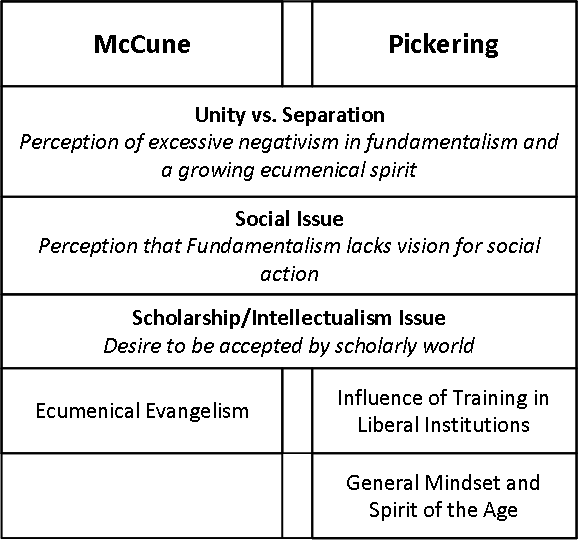





 The Eccentric Fundamentalist