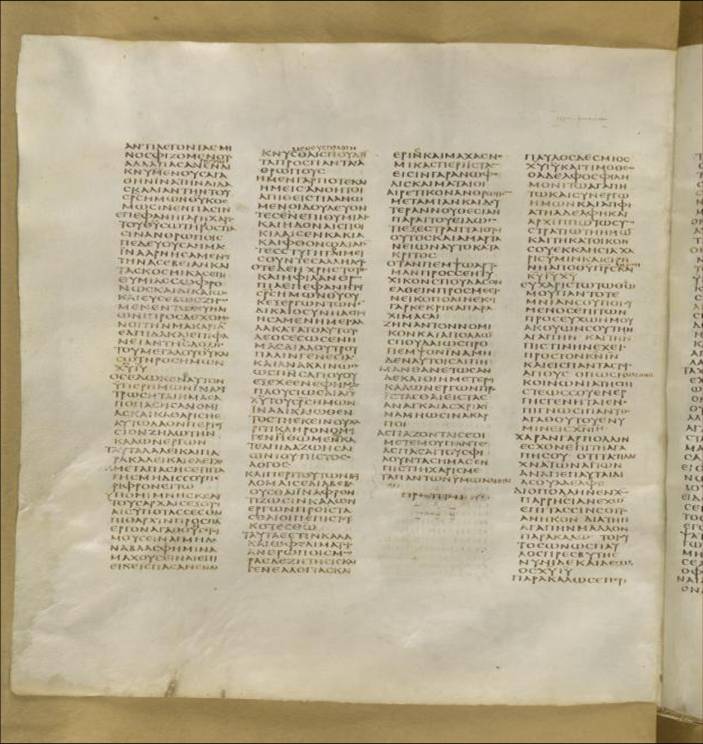
Was Codex Sinaiticus Really Found in the Trash?

Titus, 2:9 - 3:15 / Philemon, 1:1 - 1:10
Titus, 2:9 – 3:15 / Philemon, 1:1 – 1:10

When considering the issue of the preservation of the Scriptures, sadly, tempers will sometimes become heated as heretofore sacred theories are challenged on Biblical and historical grounds. I haven’t “officially” begun my series on the subject, but I wanted to jump start it once more by correcting a piece of Christian folklore you may have heard about an important manuscript copy we possess – Codex Sinaiticus.

This document is the oldest complete copy of the New Testament we have. It specifically contains “parts of the Old Testament, the New Testament complete, and in addition, the Epistle of Barnabas and a part of the Pastor of Hermas.”[1]

The folklore story is that this precious document was found in a trashcan, soon to be burned in the fire. How ridiculous, the legend goes, to believe God would preserve His word in a document which was regarded as nothing more than trash!

Here is a typical argument in this vein from a proponent:[2]

Question: Was the Sinaiticus Codex actually rescued from a wastepaper basket? What is your evidence for this?

Answer: Yes, it was. It was deposited with lots of other paper, in the desire to burn it and bring warmth to the monastery. This story comes from many sources, including someone who knew the facts and examined the evidence for himself, and Tischendorf, the man who acquired the Sinaiticus. There are many sources for the Sinaiticus story, that it was found after being deposited in a kindling bin at St. Catherine’s monastery. Please remember: it gets COLD in monasteries! They needed to burn whatever they had to make themselves warm.

I have no desire to get involved in a protracted, heated discussion on text types or textual criticism. I have very modest goals with this post – to allow Constantine Tischendorf himself to give his own account of how he discovered the manuscript. Bottom line – it was not discovered in the trash.

While visiting the a monastery in search of old manuscript copies of the New Testament, Tischendorf saw old, mouldered and useless leaves from the manuscript about to be burnt. He showed enthusiastic interest in them and the monks became suspicious, allowing him to cart off some 45 of the leaves but refusing to tell him anything about where they came from. Some years later, on a third visit to the monetary, Tischendorf was shown the complete manuscript. It had been carefully wrapped in cloth and kept in a monk’s room.

Don’t take my word for it – read Tischendorf’s own words, in context, on the matter. Those who disagree with the plain historical record of the man who found the document are in clear error. They must reckon with Tischendorf’s own account. I pray that they do so: [3]

Excerpt from Tischendorf’s Own Account

tischendorfI here pass over in silence the interesting details of my travels—my audience with the pope, Gregory XVI., in May, 1843—my intercourse with Cardinal Mezzofanti, that surprising and celebrated linguist—and I come to the result of my journey to the East. It was in April, 1844, that I embarked at Leghorn for Egypt. The desire which I felt to discover some precious remains of any manuscripts, more especially Biblical, of a date 28which would carry us back to the early times of Christianity, was realized beyond my expectations. It was at the foot of Mount Sinai, in the convent of St. Catherine, that I discovered the pearl of all my researches. In visiting the library of the monastery, in the month of May, 1844, I perceived in the middle of the great hall a large and wide basket full of old parchments; and the librarian, who was a man of information, told me that two heaps of papers like this, mouldered by time, had been already committed to the flames. What was my surprise to find amid this heap of papers a considerable number of sheets of a copy of the Old Testament in Greek, which seemed to me to be one of the most ancient that I had ever seen. The authorities of the convent allowed me to possess myself of a third of these parchments, or about forty-five sheets, all the more readily as they were destined for the fire. But I could not get them to yield up possession of the remainder. The too lively satisfaction which I had displayed, had aroused their suspicions as to the value of this manuscript. I transcribed a page of the text of Isaiah and Jeremiah, and enjoined on the monks to take religious care of all such remains which might fall in their way.

On my return to Saxony there were men of learning who at once appreciated the value of the treasure which I brought back with me. I did not divulge the name of the place where I had found it, in the hopes of returning and recovering the rest of the manuscript. I handed up to the Saxon government my rich collection of oriental manuscripts in return for the payment of all my travelling expenses. I deposited in the library of the university of Leipzig, in the shape of a collection which bears my name, fifty manuscripts, some of which are very rare and interesting. I did the same with the Sinaitic fragments, to which I gave the name of Codex Frederick Augustus, in acknowledgment of the patronage given to me by the king of Saxony; and I published them in Saxony in a sumptuous edition, in which each letter and stroke was exactly reproduced by the aid of lithography.

But these home labors upon the manuscripts which I had already safely garnered, did not allow me to forget the distant treasure which I had discovered. I made use of an influential friend, who then resided at the court of the viceroy of Egypt, to carry on negotiations for procuring the rest of the manuscript. But his attempts were, unfortunately, not successful. “The monks of the convent,” he wrote to me to say, “have, since your departure, learned the value of these sheets of parchment, and will not part with them at any price.”

I resolved, therefore, to return to the East to copy this priceless manuscript. Having set out from, Leipzig in January, 1853, I embarked at Trieste for Egypt, and in the month of February I stood, for the second time, in the convent of Sinai. This second journey was more successful even than the first, from the discoveries that I made of rare Biblical manuscripts; but I was not able to discover any further traces of the treasure of 1844. I forget: I found in a roll of papers a little fragment which, written over on both sides, contained eleven short lines of the first book of Moses, which convinced me that the manuscript originally contained the entire Old Testament, but that the greater part had been long since destroyed.

On my return I reproduced in the first volume of a collection of ancient Christian documents the page of the Sinaitic manuscript which I had transcribed in 1844, without divulging the secret of where I had found it. I confined myself to the statement that I claimed the distinction of having discovered other documents—no matter whether published in Berlin or Oxford—as I assumed that some learned travellers who had visited the convent after me had managed to carry them off.

The question now arose how to turn to use these discoveries. Not to mention a second journey which I made to Paris in 1849, I went through Germany, Switzerland, and England, devoting several years of unceasing labor to a seventh edition of my New Testament. But I felt myself more and more urged to recommence my researches in the East. Several motives, and more especially the deep reverence of all Eastern monasteries for the emperor of Russia, led me, in the autumn of 1856, to submit to the Russian government a plan of a journey for making systematic researches in the East. This proposal only aroused a jealous and fanatical opposition in St. Petersburg. People were astonished that a foreigner and a Protestant should presume to ask the support of the emperor of the Greek and orthodox church for a mission to the East. But the good cause triumphed. The interest which my proposal excited, even within the imperial circle, inclined the emperor in my favor. It obtained his approval in the month of September, 1858, and the funds which I asked for were placed at my disposal. Three months subsequently my seventh edition of the New Testament, which had cost me three years of incessant labor, appeared, and in the commencement of January, 1859, I again set sail for the East.

I cannot here refrain from mentioning the peculiar satisfaction I had experienced a little before this. A learned Englishman, one of my friends, had been sent into the East by his government to discover and purchase old Greek manuscripts, and spared no cost in obtaining them. I had cause to fear, especially for my pearl of the convent of St. Catherine; but I heard that he had not succeeded in acquiring any thing, and had not even gone as far as Sinai; “for,” as he said in his official report, “after the visit of such an antiquarian and critic as Dr. Tischendorf, I could not expect any success.” I saw by this how well advised I had been to reveal to no one my secret of 1844.

By the end of the month of January I had reached the convent of Mount Sinai. The mission with which I was intrusted entitled me to expect every consideration and attention. The prior, on saluting me, expressed a wish that I might succeed in discovering fresh supports for the truth. His kind expression of good will was verified even beyond his expectations.

After having devoted a few days in turning over the manuscripts of the convent, not without alighting here and there on some precious parchment or other, I told my Bedouins, on the 4th of February, to hold themselves in readiness to set out with their dromedaries for Cairo on the 7th, when an entirely unexpected circumstance carried me at once to the goal of all my desires. On the afternoon of this day, I was taking a walk with the steward of the convent in the neighborhood, and as we returned towards sunset, he begged me to take some refreshment with him in his cell. Scarcely had he entered the room when, resuming our former subject of conversation, he said, “And I too have read a Septuagint, i. e., a copy of the Greek translation made by the Seventy;” and so saying, he took down from the corner of the room a bulky kind of volume wrapped up in a red cloth, and laid it before me. I unrolled the cover, and discovered, to my great surprise, not only those very fragments which, fifteen years before, I had taken out of the basket, but also other parts of the Old Testament, the New Testament complete, and in addition, the Epistle of Barnabas and a part of the Pastor of Hermas. Full of joy, which this time I had the self-command to conceal from the steward and the rest of the community, I asked, as if in a careless way, for permission to take the manuscript into my sleeping-chamber, to look over it more at leisure. There by myself, I could give way to the transport of joy which I felt. I knew that I held in my hand the most precious Biblical treasure in existence—a document whose age and importance exceeded that of all the manuscripts which I had ever examined during twenty years’ study of the subject. I cannot now, I confess, recall all the emotions which I felt in that exciting moment, with such a diamond in my possession. Though my lamp was dim and the night cold, I sat down at once to transcribe the Epistle of Barnabas. For two centuries search has been made in vain for the original Greek of the first part of this epistle, which has been only known through a very faulty Latin translation. And yet this letter, from the end of the second down to the beginning of the fourth century, had an extensive authority, since many Christians assigned to it and to the Pastor of Hermas a place side by side with the inspired writings of the New Testament. This was the very reason why these two writings were both thus bound up with the Sinaitic Bible, the transcription of which is to be referred to the first half of the fourth century, and about the time of the first Christian emperor.

Early on the 5th of February, I called upon the steward, and asked permission to take the manuscript with me to Cairo, to have it there transcribed from cover to cover; but the prior had set out only two days before also for Cairo, on his way to Constantinople, to attend at the election of a new archbishop, and one of the monks would not give his consent to my request. What was then to be done? My plans were quickly decided. On the 7th, at sunrise, I took a hasty farewell of the monks, in hopes of reaching Cairo in time to get the prior’s consent. Every mark of attention was shown me on setting out. The Russian flag was hoisted from the convent walls, while the hillsides rang with the echoes of a parting salute, and the most distinguished members of the order escorted me on my way as far as the plain. The following Sunday I reached Cairo, where I was received with the same marks of good-will. The prior, who had not yet set out, at once gave his consent to my request, and also gave instructions to a Bedouin to go and fetch the manuscript with all speed. Mounted on his camel, in nine days he went from Cairo to Sinai and back, and on the 24th of February the priceless treasure was again in my hands. The time was now come at once boldly and without delay to set to work to a task of transcribing no less than a hundred and ten thousand lines, of which a great many were difficult to read, either on account of later corrections or through the ink having faded, and that in a climate where the thermometer, during March, April, and May, is never below 77º Fahrenheit in the shade. No one can say what this cost me in fatigue and exhaustion.

The relation in which I stood to the monastery gave me the opportunity of suggesting to the monks the thought of presenting the original to the emperor of Russia, as the natural protector of the Greek orthodox faith. The proposal was favorably entertained, but an unexpected obstacle arose to prevent its being acted upon. The new archbishop, unanimously elected during Easter week, and whose right it was to give a final decision in such matters, was not yet consecrated, or his nomination even accepted by the Sublime Porte. And while they were waiting for this double solemnity, the patriarch of Jerusalem protested so vigorously against the election, that a three months’ delay must intervene before the election could be ratified and the new archbishop installed. Seeing this, I resolved to set out for Jaffa and Jerusalem.

Just at this time the grand-duke Constantine of Russia, who had taken the deepest interest in my labors, arrived at Jaffa. I accompanied him to Jerusalem. I visited the ancient libraries of the holy city, that of the monastery of Saint Saba, on the shores of the Dead sea, and then those of Beyrout, Ladikia, Smyrna, and Patmos. These fresh researches were attended with the most happy results. At the time desired I returned to Cairo; but here, instead of success, only met with a fresh disappointment. The patriarch of Jerusalem still kept up his opposition; and as he carried it to the most extreme lengths, the five representatives of the convent had to remain at Constantinople, where they sought in vain for an interview with the sultan, to press their rights. Under these circumstances, the monks of Mount Sinai, although willing to do so, were unable to carry out my suggestion.

In this embarrassing state of affairs, the archbishop and his friends entreated me to use my influence on behalf of the convent. I therefore set out at once for Constantinople, with a view of there supporting the case of the five representatives. The prince Lobanow, Russian ambassador to Turkey, received me with the greatest good-will; and as he offered me hospitality in his country-house on the shores of the Bosphorus, I was able the better to attend to the negotiations which had brought me there. But our irreconcilable enemy, the influential and obstinate patriarch of Jerusalem, still had the upper hand. The archbishop was then advised to appeal himself in person to the patriarchs, archbishops, and bishops, and this plan succeeded; for before the end of the year the right of the convent was recognized, and we gained our cause. I myself brought back the news of our success to Cairo, and with it I also brought my own special request, backed with the support of Prince Lobanow.

On the 27th of September I returned to Cairo. The monks and archbishops then warmly expressed their thanks for my zealous efforts in their cause; and the following day I received from them, under the form of a loan, the Sinaitic Bible, to carry it to St. Petersburg, and there to have it copied as accurately as possible.

I set out for Egypt early in October, and on the 19th of November I presented to their imperial majesties, in the Winter Palace at Tsarkoe-Selo, my rich collection of old Greek, Syriac, Coptic, Arabic, and other manuscripts, in the middle of which the Sinaitic Bible shone like a crown. I then took the opportunity of submitting to the emperor Alexander II. a proposal of making an edition of this Bible worthy of the work and of the emperor himself, and which should be regarded as one of the greatest undertakings in critical and Biblical study.

I did not feel free to accept the brilliant offers that were made to me to settle finally, or even for a few years, in the Russian capital. It was at Leipzig, therefore, at the end of three years, and after three journeys to St. Petersburg, that I was able to carry to completion the laborious task of producing a fac-simile copy of this codex in four folio volumes.

In the month of October, 1862, I repaired to St. Petersburg to present this edition to their majesties. The emperor, who had liberally provided for the cost, and who approved the proposal of this superb manuscript appearing on the celebration of the Millenary Jubilee of the Russian monarchy, has distributed impressions of it throughout the Christian world; which, without distinction of creed, have expressed their recognition of its value. Even the pope, in an autograph letter, has sent to the editor his congratulations and admiration. It is only a few months ago that the two most celebrated universities of England, Cambridge and Oxford, desired to show me honor by conferring on me their highest academic degree. “I would rather,” said an old man, himself of the highest distinction for learning—“I would rather have discovered this Sinaitic manuscript than the Koh-i-noor of the queen of England.”

But that which I think more highly of than all these flattering distinctions is, the conviction that Providence has given to our age, in which attacks on Christianity are so common, the Sinaitic Bible, to be to us a full and clear light as to what is the word written by God, and to assist us in defending the truth by establishing its authentic form.


[1] Constantine Tischendorf, When Were Our Gospels Written? An Argument by Constantine Tischendorf with a Narrative Discovery of the Sinaitic Manuscript (New York, NY: American Tract Society, 1866), 34. Retrieved electronically from the Christian Classics Etheral Library (CCEL) –  http://www.ccel.org/ccel/tischendorf/gospels.ii.iii.html.

[2] David W. Daniels, “Bible Versions: Your Questions Answered” (Ontario, CA: Chick, 2002). Retrieved electronically from http://www.chick.com/ask/articles/wastebasket.asp. Interestingly, this author discounts Constantine Tischendorf’s own testimony of how he discovered the manuscript and relies upon the second-hand account of another man instead!

[3] This is not even Tischendorf’s full account. There is a larger back-story where he recounts his travels around Europe and the East on a quest for New Testament manuscripts. I didn’t include that here. Feel free to visit the link in the previous footnote and read the entire matter for yourself.

An Embarrassment of Riches – The Reliability of the New Testament

I’ll be starting a series on the preservation of the scriptures soon. In preparation for this, I thought I’d share this neat infographic with you. The bottom line is that we have a huge amount of copies of the New Testament. It is by far the most well-attested book from all of antiquity. This series will focus on God’s providential preservation of His word for His people. In the meantime, this picture illustrates just how many copies of the various New Testament documents we have in comparison to copies of other ancient works.

Find other outstanding infographics at Visual Unit.

nt_reliability1

Why You Can Rely on the Canon

This is a short interview with Dr. Michael Kruger, author of Canon Revisited, a wonderful book I recommend. He also maintains a very helpful website, Canon Fodder. In this video, Dr. Kruger briefly discusses why Christians can trust the books of the New Testament.  It’s only 8:00 long, so watch it if you have a moment or two . . .

Discerning God’s Will for Our Lives

gdswl

This message is directly specifically at teenagers, but just for kicks, I’ll post it here anyway! It was preached for teen Sunday School at my church this morning. 

There are three basic, looming decisions facing any Christian teenager as their high school days come to a close and they face the prospect of escaping from home (at last!) and starting life on their own.

  • Am I a Christian? Do I live out my own faith or have I just been borrowing from my parents?
  • What career will I choose?
  • Who and when will I get married?

For a Christian teenager seeking to be true to God, each of these life-altering decisions are (hopefully) seen in the context of what God’s will for his life is. Questions such as these will naturally swirl through the mind:

  • What God want me to do?
  • Should I go to college? Which college?
  • Who does God have for me to marry?
  • Will I ever get married? 

We all probably remember wrestling with these issues in our own lives. In this lesson, I take a brief look at what a passage of Scripture has to say about (1) God’s universal will for every Christian and (2) discerning God’s will for our individual lives. The important takeaway is this:

  1. God’s specific will for our lives is predicated on His universal will for Christians. Basically, if we aren’t interested in fulfilling our most basic responsibility as Christians and walking worthy of God, then we’re wasting our time praying to God and asking for guidance and help on specific issues. First things first, after all!
  2. God does not reveal His specific will for our lives in a comprehensive, direct revelation. We frequently can only see God’s providential hand in our lives after the fact, years later, as we look back on life events. He does not provide us with a PDF instruction booklet outlining His specific plan for our lives! We have to make important decisions day by day as we (1) search the Scriptures, (2) pray earnestly for guidance, (3) weigh the counsel of other Christians we respect and finally (4) simply doing what we believe is best in light of all these factors. God will work through these situations to work things together for good.

We may not always appreciate or like what God has in store for us! However, if we can truly call ourselves children of God who have repented of our sins and trusted in Christ as Savior, we can trust God and live by faith as we await His glorious return!

I honestly wish I had much more time to flesh this out. Hopefully it was a blessing to our teens in church, and perhaps even to you. The Gospel of Mark continues next week.

Sermon notes

Sufficiency of the Scriptures (Part #1)

open-bible

A critical issue in our increasingly post-modern times is the sufficiency of the Scriptures. Both Roman Catholics with their sacred tradition and Charismatics with their emphasis on continuing revelation via the Holy Spirit give lip-service to the Holy Scriptures. However, to these groups, the Scriptures are not the sole authority for Christian faith and life. This is a significant dividing line, one with profound theological ramifications. Consider the results of a 1980 Gallup poll which sought to determine Christian’s opinions on religious authority. The question was, “If you, yourself, were testing your religious beliefs, which ONE of these four religious authorities would you turn to first?” The results are sobering, even more so when one acknowledges the statistics are 33 years old:[1]

table

The sufficiency of the Scriptures has fallen upon hard times. This series will examine what Scripture itself has to say on the matter. First, some brief statements from both orthodox Christians and Roman Catholics on the sufficiency of Scripture will be provided to set the stage, so to speak. Second, a biblical theology of books by several New Testament writers will be presented and their particular views on the sufficiency of Scripture analyzed in context. Third, an exposition will be presented on several critical passages relating to the sufficiency of the Scriptures. Fourth, the distinctly Baptist (and biblical) position of the New Testament being the sole authority for church polity is presented. Fifth, conclusions will be drawn. It will be demonstrated that the Scriptures alone are the only infallible authority for Christian faith and life.

Brief Statements

The objective principle of Protestantism maintains that the Bible, as the inspired record of revelation, is the only infallible rule of faith and practice.[2]

Scripture alone is the inerrant, infallible record of God’s revelation to mankind. But Scripture is more than the record of God’s revelation; it is itself the only infallible, inspired revelation from God that exists today. This is not to say that Scripture is equivalent to the sum total of all revelation that God has been pleased to disclose (Jn 20:30-31; 21:25). But it is to say that Scripture alone constitutes and conveys all that is necessary for God’s glory, man’s salvation, faith and life.[3]

The Reformers did recognize a Christian tradition, but only a Christian tradition based on, and derived from, Scripture, and not one that equaled or even surpassed it in authority.[4]

Roman Catholic theologians recognize two well-springs of divine authority; Scripture and Tradition.

Sacred tradition and sacred Scripture, then, are bound closely together, and communicate one with the other. For both of them, flowing out from the same divine well-spring, come together in some fashion to form one thing, and move towards the same goal . . . Hence, both Scripture and Tradition must be accepted and honored with equal feelings of devotion and reverence.[5]

James Cardinal Gibbons, a 19th century Catholic theologian, wrote:[6]

Now, the Scripture is the great depository of the Word of God. Therefore, the Church is the divinely appointed Custodian and Interpreter of the Bible. For, her office of infallible Guide were superfluous if each individual could interpret the Bible for himself.

The Catholic Church correctly teaches that our Lord and His Apostles included certain important duties of religion which are not recorded by the inspired writers (Jn 21:25) . . . We must conclude that the Scriptures alone cannot be a sufficient guide and rule of faith because they cannot, at any time, be within the reach of every inquirer; because they are not of themselves clear and intelligible even in matters of the highest importance, and because they do not contain all the truths necessary for salvation.

The next post will be a biblical theology of several books of the New Testament on the matter.


[1] Mike Willis, “The Unread Bible,” Truth Magazine, May 1, 1980, 291-292. http://www.truthmagazine.com/the-unread-bible.

[2] Philip Schaff, History of the Christian Church, 7 vols. (Peabody, MS: Hendrickson, 2011), 7:16.

[3] David T. King, Holy Scripture: The Ground and Pillar of Our Faith, 3 vols. (Battle Ground, WA: Christian Truth, 2001), 1:43.

[4] Louis Berkhof, Systematic Theology, vol. 1, combined ed. (Grand Rapids, MI: Eerdmans, 1996), 169.

[5] Vatican Council II: The Conciliar and Post Conciliar Documents, Austin Flannery, O.P., general editor (Boston: St. Paul Editions, 1980), 754-755. Quoted in King, Holy Scripture, 50.

[6] James C. Gibbons, The Faith of Our Fathers, ch. 2. http://www.cathcorn.org/foof/8.html

The Necessity of Theology

It is all too common for preachers, especially some of my brethren in fundamental Baptist circles, to ridicule learning and diligent study of theology. The concept of Seminary is sneered at by some of these men. “You don’t need all that higher learning,” they scoff. “You just need the word of God!”

Charles Spurgeon had a few words for those who, in his day, echoed similar sentiments:

Be well instructed in theology, and do not regard the sneers of those who rail at it because they are ignorant of it. Many preachers are not theologians, and hence the mistakes which they make. It cannot do any hurt to the most lively evangelist to be also a sound theologian, and it may often be the means of saving him from gross blunders. Nowadays, we hear men tear a single sentence of Scripture from its connection, and cry “Eureka! Eureka!” as if they had found a new truth; and yet they have not discovered a diamond, but a piece of broken glass.… Let us be thoroughly well acquainted with the great doctrines of the Word of God.

Charles Haddon Spurgeon, Lectures to My Students (Grand Rapids: Zondervan, 1945), 196.

Nominal Christianity?

Picture1

The phenomena of “cultural Christianity” is not a new one. The label “carnal Christian” has been bandied about regularly in literature and in the blogosphere. Christians of every theological stripe know “carnal” or “cultural” Christians. Pick whichever label you like best, or even invent your own – you know these people. They claim repentance from sin and salvation through Christ alone. They come to church more or less regularly . . . sort of! They sit more or less attentively in the pews and may even tithe faithfully. They go through the motions. And yet . . . there is no discernable joy of Christ in their lives. There is no growth. To borrow a phrase from Paul Tripp (2008), there is a “gospel gap” in their lives. Their FaceBook pages abound with worldliness; perhaps you’ve even secretly hid them from your news feed! Their children walk and talk like everybody else. There is no concept of separation, holiness or imitation of God in their lives. They are indistinguishable from normal, everyday, unsaved “good people.”

These folks are legion. Some are undoubtedly saved, others are undoubtedly not. I’m not interested in debating that issue right now. What is significant is that too many Christians have little conception of who Christ is, what they were saved from and what their calling as Christians is. We’ll look at what Paul had to say on this very matter:

We Were Once Dead (Eph 2:1-3)

Christians sometimes seem to lose sense of both (1) what they were saved from and, (2) the grace of God in performing this marvelous work. We lose focus on the gift of salvation and our attentions turn inward, to temporal matters. Paul, writing to the faithful saints at Ephesus (Eph 2:1), emphasized the grace of God in salvation in very powerful, stark terms.

Christians were once dead in the trespasses and sins they walked in (Eph 2:1-2). This is a spiritual death, a sinful nature we all inherited from Adam (Rom 5:12). In this sinful state, there is absolutely nothing meritorious in us that God can find pleasure in or accept as grounds for salvation.

“Now in this dreadful disordered condition, are all of us brought into the world: for as the root is, such must the branches be. Accordingly we are told, “That Adam beget a son in his own likeness;” or, with the same corrupt nature which he himself had, after he had eaten the forbidden fruit. And experience as well as scripture proves, that we also are altogether born in sin and corruption; and therefore incapable, whilst in such a state, to hole communion with God. For as light cannot have communion with darkness, so God can have no communion with such polluted sons of Belial,” (Whitefield).

Paul went on to describe the nature of this spiritual death, observing that we followed the “course of this world, following the prince of the power of the air, the spirit that is now at work in the sons of disobedience,” (Eph 2:2). We were completely different prior to salvation by Christ. We served a different master, as it were, and that master was Satan. We once lived as “sons of disobedience,” mimicking the ways of our former master.

“. . . carrying out the desires of the body and the mind, and were by nature children of wrath, like the rest of mankind,” (Eph 2:3).

We were by nature the children of wrath (see also Jn 3:36). Paul paints a very frank picture of a Christian’s former state. “These verses picture the hopeless unbeliever as a part of the world system, controlled by Satan, indulging the flesh, and destined to experience God’s wrath,” (Constable, 2013, 28). This is what we were saved from and, moreover, it is what we deserve. God was not obligated to save anybody. He chose to.

We are transferred from the realm of Satan to the realm of God upon repentance of our sins and saving faith in Christ. We did belong to Satan but now belong to God. The chain which once bound us to sin has been broken!

Now We Are Alive! (Eph 2:4-9)

God is rich in mercy because of the “great love” He has for us. Even while we were yet dead in our trespasses and sins, He made us alive together with Christ (Eph 2:4-5). The initiative here is clearly with God, underscoring our complete inability to come to Him on our own or claim merit in any fashion. We are saved by grace, or unmerited favor (Eph 2:5). He has given us heavenly citizenship (Eph 2:6). This was done so that, in the coming ages, He might demonstrate the immeasurable riches of His grace and kindness in Christ Jesus (Eph 2:7). The supreme demonstration of this grace is salvation, which is “not your own doing” (Eph 2:8). Paul wrote that this salvation was “not a result of works, so that no one may boast,” (Eph 2:9). The entire thrust of this passage is the surpassing grace of God in salvation.

What’s the Point? (Eph 2:10)

We were saved for a purpose, not to glory in our own election and while away our lives in idleness. This is the root of the issue with nominal Christians – they claim but Christ but display no urgency to live for Him in any discernable way! There is no power of the Gospel in their lives. It is merely a cultural thing.

I like baseball. I like the Blackhawks. I like CSI: New York. I’m a Christian. God Bless America.

Too many Christians have lost any real sense of what it actually means to be a Christian. They have no Christian identity. How different this is from what Paul wrote:

“For we are his workmanship, created in Christ Jesus for good works, which God prepared beforehand, that we should walk in them,” (Eph 2:10).

Christians who have been saved in ages past, are being saved today and will be saved tomorrow are His workmanship. This election to salvation is not a call to privilege but a choosing of service to God (Rom 12:1-2). We were created in Christ Jesus specifically for good works. There is no way to get around this statement from Paul. A fervent desire to serve the Lord should be the practical outworking and fruit of our salvation. If we Christians can wrap our heads around this fact, then Paul’s call to present ourselves as “living sacrifices” takes on a whole new significance. It should change our lives. It should compel us to serve Christ in whichever way we can, in accordance with the various talents, gifts and abilities He has seen fit to bestow upon us. Too many Christians are not fulfilling their calling but are on spiritual autopilot.

We know these people. They are our friends and neighbors. They worship together with us in church. Perhaps they were once living for the Lord, but have fallen on hard times. Maybe they were always nominal and tentative in their faith. Regardless of the circumstance, we have a duty to exhort and encourage our brothers and sisters in the faith, stirring them up to love and good works (Heb 10:24-25). God is not pleased by lukewarm Christians (Rev 3:16).

We all need to grasp what the “grace of God” really means, and allow the Holy Spirit to teach us to renounce ungodliness and worldly passions, and to live self-controlled, upright, and godly lives in the present age as we wait for Christ’s return (Titus 2:12-13). There is no place in our lives for a complacent Christianity. Let us resolve to not allow this complacency and nominalism to characterize our own lives, and to encourage and exhort our brethren to not allow it to come to pass in theirs either.

“Hail, happy saints! For your heaven is begun on earth: you have already received the first fruits of the Spirit, and are patiently waiting till that blessed change come, when your harvest shall be complete. I see and admire you, though, alas! at so great a distance from you: your life, I know, is hid with Christ in God. You have comforts, you have meat to eat, which a sinful, carnal, ridiculing world knows nothing of. Christ’s yoke is not become easy to you, and his burden light. You have passed through the pangs of the new birth, and now rejoice that Christ Jesus is spiritually formed in your hearts. You know what it is to dwell in Christ, and Christ in you. Like Jacob’s ladder, although your bodies are on earth, yet your souls and hearts are in heaven: and by your faith and constant recollection, like the blessed angels, you do always behold the face of your Father which is in heaven,” (Whitefield).

Works Cited:

Constable, Thomas. Ephesians. Dallas: Soniclight, 2013.

Whitefield, George. Marks of Having Received the Holy Ghost. Sermon. Retrieved from http://www.reformed.org/documents/index.html?mainframe=/documents/Whitefield/WITF_042.html.

Tripp, Paul D. and Timothy Lane. How People Change. Greensboro: New Growth, 2008.

Apologetics Resource – Mormons

I wanted to pass along some apologetics resources on Mormonism. The gentleman in the videos below is apologist James White, an elder in a Reformed Baptist church in Phoenix, AZ and Director of Alpha & Omega Ministries. He has a very wide-ranging apologetics ministry which has focused in recent years on Islam.

In addition to these videos, I would encourage you to grab a copy of his books on Mormonism, Letters to a Mormon Elder and Is the Mormon My Brother? You can view other video and audio products on Mormonism from his ministry here.


Marks of Having Received the Holy Ghost (George Whitefield)

This is another sermon by the great George Whitefield (1714-1770), an evangelist from the Great Awakening

———————————————————–

“Have ye received the Holy Ghost since ye believed?” (Acts 19:2)

Two different significations have been given of these words. Some have supposed, that the question here put, is, Whether these disciples, whom St. Paul found at Ephesus, had received the Holy Ghost by imposition of hands at confirmation? Others think, these disciples had been already baptized into John’s baptism; which not being attended with an immediate effusion of the Holy Spirit, the Apostle here asks them, Whether they had received the Holy Ghost by being baptized into Jesus Christ? And upon their answering in the negative, he first baptized, and then confirmed them in the name of the Lord Jesus.

Which of these interpretations is the most true, is neither easy nor very necessary to determine. However, as the words contain a most important inquiry, without any reference to the context, I shall from them,

First

  • Show who the Holy Ghost here spoken of, is; and that we must all receive him, before we can be stiled true believers.

Secondly

  • I shall lay down some scripture marks whereby we may know, whether we have thus received the Holy Ghost or not. And

Thirdly

  • By way of conclusion, address myself to several distinct classes of professors, concerning the doctrine that shall have been delivered.

First:

I am to show who the Holy Ghost spoken of in the text, is; and that we must all receive him before we can be stiled true believers.

By the Holy Ghost is plainly signified the Holy Spirit, the third Person in the ever-blessed Trinity, consubstantial and co-eternal with the Father and the Son, proceeding from, yet equal to them both. He is emphatically called Holy, because infinitely holy in himself, and the author and finisher of all holiness in us.

This blessed Spirit, who once moved on the face of the great deep; who over-shadowed the blessed Virgin before that holy child was born of her; who descended in a bodily shape, like a dove, on our blessed Lord, when he came up out of the water at his baptism; and afterwards came down in fiery tongues on the heads of all his Apostles at the day of Pentecost: this is the Holy Ghost, who must move on the faces of our souls; this power of the Most High, must come upon us, and we must be baptized with his baptism and refining fire, before we can be stiled true members of Christ’s mystical body.

Thus says the Apostle Paul, “Know ye not that Jesus Christ is in you, (that is, by his Spirit) unless you are reprobates?” And, “If any man hath not the Spirit of Christ, he is none of his,” And again, says St. John, “We know that we are his, by the Spirit that he hath given us.”

It is not, indeed, necessary that we should have the Spirit now given in that miraculous manner, in which he was at first given to our Lord’s Apostles, by signs and wonders, but it is absolutely necessary, that we should receive the Holy Ghost in his sanctifying graces, as really as they did: and so will it continue to be till the end of the world.

For this stands the case between God and man: God at first made man upright, or as the sacred Penman expresses it, “In the image of God made he man;” that is, his soul was the very copy, the transcript of the divine nature. He, who before, by his almighty fiat, spoke the world into being, breathed into man the breath of spiritual life, and his soul was adorned with a resemblance of the perfections of Deity. This was the finishing stroke of the creation: the perfection both of the moral and material world. And so near did man resemble his divine Original, that God could not but rejoice and take pleasure in his own likeness: And therefore we read, that when God had finished the inanimate and brutish part of the creation, he looked upon it, and beheld it was good; but when that lovely, God-like creature man was made, behold it was very good.

Happy, unspeakably happy must man needs be, when thus a partaker of the divine nature. And thus might he have still continued, had he continued holy. But God placed him in a state of probation, with a free grant to eat of every tree in the garden of Eden, except the tree of knowledge of good and evil: the day he should eat thereof, he was surely to die; that is, not only to be subject to temporal, but spiritual death; and consequently, to lose that divine image, that spiritual life God had not long since breathed into him, and which was as much his happiness as his glory.

These, one would imagine, were easy conditions for a finite creature’s happiness to depend on. But man, unhappy man, being seduced by the devil, and desiring, like him, to be equal with his Maker, did eat of the forbidden fruit; and thereby became liable to that curse, which the eternal God, who cannot lie, had denounced against his disobedience.

Accordingly we read, that soon after Adam had fallen, he complained that he was naked; naked, not only as to his body, but naked and destitute of those divine graces which, before decked and beautified his soul. The unhappy mutiny, and disorder which the visible creation fell into, the briars and thorns which not sprung up and overspread the earth, were but poor emblems, lifeless representations of that confusion and rebellion, and those divers lusts and passions which sprung up in, and quite overwhelmed the soul of man immediately after the fall. Alas! he was now no longer the image of the invisible God; but as he had imitated the devil’s sin, he became as it were a partaker of the devil’s nature, and from an union with, sunk into a state of direct enmity against God.

Now in this dreadful disordered condition, are all of us brought into the world: for as the root is, such must the branches be. Accordingly we are told, “That Adam beget a son in his own likeness;” or, with the same corrupt nature which he himself had, after he had eaten the forbidden fruit. And experience as well as scripture proves, that we also are altogether born in sin and corruption; and therefore incapable, whilst in such a state, to hole communion with God. For as light cannot have communion with darkness, so God can have no communion with such polluted sons of Belial.

Here then appears the end and design why Christ was manifest in the flesh; to put an end to these disorders, and to restore us to that primitive dignity in which we were at first created. Accordingly he shed his precious blood to satisfy his Father’s justice for our sins; and thereby also he procured for us the Holy Ghost, who should once more re- instamp the divine image upon our hearts, and make us capable of living with and enjoying the blessed God.

This was the great end of our Lord’s coming into the world; nay, this is the only end why the world itself is now kept in being. For as soon as a sufficient number are sanctified out of it, the heavens shall be wrapped up like a scroll, the elements shall melt with fervent heat, the earth, and all that therein is, shall be burnt up.

This sanctification of the Spirit, is that new birth mentioned by our blessed Lord to Nicodemus, “without which we cannot see the kingdom of God.” This is what St. Paul calls being “renewed in the spirit of our minds;” and it is the spring of that holiness, without which no man shall see the Lord.

Thus then, it is undeniably certain, we must receive the Holy Ghost ere we can be stiled true members of Christ’s mystical body.

Second

I come in the Second place to lay down some scriptural marks, whereby we may easily judge, whether we have thus received the Holy Ghost or not.

And the First I shall mention, is, our having received a spirit of prayer and supplication; for that always accompanies the spirit of grace.

No sooner was Paul converted, but “behold he prayeth.” And this was urged as an argument, to convince Ananias that he was converted. And God’s elect are also said to “cry to him day and night.”

And since one great work of the Holy Spirit is to convince us of sin, and to set us upon seeking pardon and renewing grace, through the all- sufficient merits of a crucified Redeemer, whosoever has felt the power of the world to come, awakening him from his spiritual lethargy, cannot but be always crying out, “Lord, what wouldst thou have me to do?” Or, in the language of the importunate blind Bartimeus, “Jesus, thou Son of David, have mercy upon me.”

The blessed Jesus, as he received the Holy Ghost without measure, so he evidenced it by nothing more, than his frequent addresses at the throne of grace. Accordingly we read, that he was often alone on the mountain praying; that he rose a great while before day to pray: nay, that he spent whole nights in prayer. And whosoever is made partaker of the same Spirit which the holy Jesus, will be of the same mind, and delight in nothing so much, as to “draw nigh unto God,” and lift up holy hands and hearts in frequent and devout prayer.

It must be confessed, indeed, that this spirit of supplication is often as it were sensibly lost, and decays, for some time, even in those who have actually received the Holy Ghost. Through spiritual dryness and barrenness of soul, they find in themselves a listlessness and backwardness to this duty of prayer; but then they esteem it as their cross, and still persevere in seeking Jesus, though it be sorrowing: and their hearts, notwithstanding, are fixed upon God, though they cannot exert their affections so strongly as usual, on account of that spiritual deadness, which God, for wise reasons, has suffered to benumb their souls.

But as for the formal believer, it is not so with him: no; he either prays not at all, or if he does enter into his closet, it is with reluctance, out of custom, or to satisfy the checks of his conscience. Whereas, the true believer can no more live without prayer, than without food day by day. And he finds his soul as really and perceptibly fed by the one, as his body is nourished and supported by the other.

A Second scripture mark of our having received the Holy Ghost, is, Not committing sin.

“Whosoever is born of God, (says St. John) sinneth not, neither can he sin, because his seed remaineth in him.” Neither can he sin. This expression does not imply the impossibility of a Christian’s sinning: for we are told, that “in many things we offend all:” It only means thus much: that a man who is really born again of God, doth not willfully commit sin, much less live in the habitual practice of it. For how shall he that is dead to sin, as every converted person is, live any longer therein?

It is true, a man that is born again of God, may, through surprise, or the violence of a temptation, fall into an act of sin: witness the adultery of David, and Peter’s denial of his Master. But then, like them, he quickly rises again, goes out from the world, and weeps bitterly; washes the guilt of sin away by the tears of sincere repentance, joined with faith in the blood of Jesus Christ; takes double heed to his ways for the future, and perfects holiness in the fear of God.

The meaning of this expression of the Apostle, that “a man who is born of God, cannot commit sin,” has been fitly illustrated, by the example of a covetous worldling, to the general bent of whose inclinations, liberality and profuseness are directly opposite: but if, upon some unexpected, sudden occasion, he does play the prodigal, he immediately repents him of his fault, and returns with double care to his niggardliness again. And so is every one that is born again: to commit sin, is as contrary to the habitual frame and tendency of his mind, as generosity is to the inclinations of a miser; but if at any time, he is drawn into sin, he immediately, with double zeal, returns to his duty, and brings forth fruits meet for repentance. Whereas, the unconverted sinner is quite dead in trespasses and sins: or if he does abstain from gross acts of it, through worldly selfish motives, yet, there is some right eye he will not pluck out; some right- hand which he will not cut off; some specious Agag that he will not sacrifice for God; and thereby he is convinced that he is but a mere Saul: and consequently, whatever pretensions he may make to the contrary, he has not yet received the Holy Ghost.

A Third mark whereby we may know, whether or not we have received the Holy Ghost, is, Our conquest over the world.

“For whosoever is born of God, (says the Apostle) overcometh the world.” By the world, we are to understand, as St. John expressed it, “all that is in the world, the lust of the eye, the lust of the flesh, and the pride of life:” And by overcoming of it, is meant, our renouncing these, so as not to follow or be led by them: for whosoever is born from above, has his affections set on things above: he feels a divine attraction in his soul, which forcibly draws his mind heavenwards; and as the hart panteth after the water-brooks, so doth it make his soul so long after the enjoyment of his God.

Not that he is so taken up with the affairs of another life, as to neglect the business of this: No; a truly spiritual man dares not stand any day idle; but then he takes care, though he laboreth for the meat which perisheth, first to secure that which endureth to everlasting life. Or, if God has exalted him above his brethren, yet, like Moses, Joseph, and Daniel, he, notwithstanding, looks upon himself as a stranger and pilgrim upon earth: having received a principle of new life, he walks by faith and not by sight; and his hopes being full of immortality, he can look on all things here below as vanity and vexation of spirit: In short, though he is in, yet he is not of the world; and as he was made for the enjoyment of God, so nothing but God can satisfy his soul.

The ever-blessed Jesus was a perfect instance of overcoming the world. For though he went about continually doing good, and always lived as in a press and throng; yet, wherever he was, his conversation tended heavenwards. In like manner, he that is joined to the Lord in one spirit, will so order his thoughts, words, and actions, that he will evidence to all, that his conversation is in heaven.

On the contrary, an unconverted man being of the earth, is earthy; and having no spiritual eye to discern spiritual things, he is always seeking for happiness in this life, where it never was, will, or can be found. Being not born again from above, he is bowed down by a spirit of natural infirmity: the serpent’s curse becomes his choice, and he eats of the dust of the earth all the days of his life.

A Fourth scripture mark of our having received the Holy Ghost, is, Our loving one another.

“We know (says St. John) we are passed from death unto life, because we love the brethren.” “And by this (says Christ himself) shall all men know that ye are my disciples, if ye have love one towards another.” Love is the fulfilling of the gospel, as well as of the law: for “God is love; and whosoever dwelleth in love, dwelleth in God.”

But by this love we are not to understand a softness and tenderness of mere nature, or a love founded on worldly motives (for this a natural man may have); but a love of our brethren, proceeding from love towards God: loving all men in general, because to their relation to God; and loving good men in particular, for the grace we see in them, and because they love our Lord Jesus in sincerity.

This is Christian charity, and that new commandment which Chris gave to his disciples. New, not in its object, but in the motive and example whereon it is founded, even Jesus Christ. This is that love which the primitive Christians were so renowned for, that it became a proverb, see how these Christians love one another. And without this love, though we should give all our goods to feed the poor, and our bodies to be burnt, it would profit us nothing.

Further, this love is not confined to any particular set of men, but is impartial and catholic: A love that embraces God’s image wherever it beholds it, and that delights in nothing so much as to see Christ’s kingdom come.

This is the love wherewith Jesus Christ loved mankind: He loved all, even the worst of men, as appears by his weeping over the obstinately perverse; but wherever he saw the least appearance of the divine likeness, that soul he loved in particular. Thus we read, that when he heard the young man say, “All these things have I kept from my youth,” that so far he loved him. And when he saw any noble instance of faith, though in a Centurion and a Syrophonecian, aliens to the commonwealth of Israel, how is he said to marvel at, to rejoice in, speak of, and commend it? So every spiritual disciple of Jesus Christ will cordially embrace all who worship God in spirit and in truth, however they may differ as to the appendages of religion, and in things not essentially necessary to salvation.

I confess, indeed, that the heart of a natural man is not thus enlarged all at once; and a person may really have received the Holy Ghost, (as Peter, no doubt, had when he was unwilling to go to Cornelius) though he be not arrived to this: but then, where a person is truly in Christ, all narrowness of spirit decreases in him daily; the partition wall of bigotry and party zeal is broken down more and more; and the nearer he comes to heaven, the more his heart is enlarged with that love, which there will make no difference between any people, nation, or language, but we shall all, with one heart, and one voice, sing praises to him that sitteth upon the throne for ever.

But I hasten to a Fifth scripture mark, Loving our enemies.

“I say unto you, (says Jesus Christ) Love your enemies, bless them that curse you, do good to those that hate you, ad pray for them that despitefully use you and persecute you.” And this duty of loving your enemies is so necessary, that without it, our righteousness does not exceed the righteousness of the Scribes and Pharisees, or even of Publicans and sinners: “For if you do good to them only, who do good to you, what do you more than others?” What do you extraordinary? “Do not even the Publicans the same?” And these precepts our Lord confirmed by his own example; when he wept over the bloody city; when he suffered himself to be led as a sheep to the slaughter; when he made that mile reply to the traitor Judas, “Judas, betrayest thou the Son of man with a kiss?” and more especially, when in the agonies and pangs of death, he prayed for his very murderers, “Father, forgive them, for they know not what they do.”

This is a difficult duty to the natural man; but whosoever is made partaker of the promise of the Spirit, will find it practicable and easy: for if we are born again of God, we must be like him, and consequently delight to be perfect in this duty of doing good to our worst enemies in the same manner, though not in the same degree as he is perfect: He sends his rain on the evil and the good; causeth his sun to shine on the just and unjust; and more especially commended his love towards us, that whilst we were his enemies, he sent forth his Son, born of a woman, made under the law, that he might become a curse for us.

Many other marks are scattered up and down the scriptures, whereby we may know whether or not we have received the Holy Ghost: such as, “to be carnally minded, is death, but to be spiritually minded is life and peace.” “Now the fruits of the Spirit are joy, peace, long-suffering, meekness,” with a multitude of texts to the same purpose. But as most, if not all of them, are comprehended in the duties already laid down, I dare affirm, whosoever upon an impartial examination, can find the aforesaid marks on his soul, may be as certain, as though an angel was to tell him, that his pardon is sealed in heaven.

As for my own part, I had rather see these divine graces, and this heavenly temper stamped upon my soul, than to hear an angel from heaven saying unto me, Son, be of good cheer, thy sins are forgiven thee.

These are infallible witnesses; these are Emmanuel, God with and in us; these make up that white stone, which none knoweth, saving he who hath receiveth it; these are the earnests of the heavenly inheritance in our hearts: In short, these are glory begun, and are that good thing, that better part, and which if you continue to stir up this gift of God, neither men nor devils shall ever be able to take from us.

Third

I proceed, as was proposed, in the Third place, to make an application of the doctrine delivered, to several distinct classes of professors. And

First

I shall address myself to those who are dead in trespasses and sins. And, O how could I weep over you, as our Lord wept over Jerusalem? For, alas! how distant must you be from God? What a prodigious work have you to finish, who, instead of praying day and night, seldom or never pray at all? And, instead of being born again of God, so as not to commit sin, are so deeply sunk into the nature of devils, as to make a mock at it? Or, instead of overcoming the world, so as not to follow or be led by it, are continually making provision for the flesh, to fulfill the lusts thereof. And, instead of being endued with the god-like disposition of loving all men, even your enemies, have your hearts full of hatred, malice, and revenge, and deride those who are the sincere followers of the lowly Jesus. But think you, O sinners, that God will admit such polluted wretches into his sight? Or should he admit you, do you imagine you could take any pleasure in him? No; heaven itself would be no heaven to you; the devilish dispositions which are in your hearts, would render all the spiritual enjoyments of those blessed mansions, ineffectual to make you happy. To qualify you to be blissful partakers of that heavenly inheritance with the saints in light, there is a meetness required: to attain which, ought to be the chief business of your lives.

It is true, you, as well as the righteous, in one sense, shall see God; (for we must all appear before the judgment-seat of Christ) but you must see him once, never to see him more. For as you carry about in you the devil’s image, with devils you must dwell: being of the same nature, you must share the same doom. “Repent, therefore, and be converted, that your sins may be blotted out.” See that you receive the Holy Ghost, before you go hence: for otherwise, how can you escape the damnation of hell?

Secondly

Let me apply myself to those who deceive themselves with false hopes of salvation. Some, through the influence of a good education, or other providential restraints, have not run into the same excess of riot with other men, and they think they have no need to receive the Holy Ghost, but flatter themselves that they are really born again.

But do you show it by bringing forth the fruits of the Spirit? Do you pray without ceasing? Do you not commit sin? Have you overcome the world? And do you love your enemies, and all mankind, in the same manner, as Jesus Christ loved them?

If these things, brethren, be in you and abound, then may you have confidence towards God; but if not, although you may be civilized, yet you are not converted: no, you are yet in your sins. The nature of the old Adam still reigneth in your souls; and unless the nature of the second Adam be grafted in its room, you can never see God.

Think not, therefore, to dress yourselves up in the ornaments of a good nature, and civil education, and say with Agag, “surely the bitterness of death is past;” For God’s justice, notwithstanding that, like Samuel, shall hew you to pieces. However you may be highly esteemed in the sight of men, yet, in the sight of God, you are but like the apples of Sodom, dunghills covered over with snow, mere whited sepulchers, appearing a little beautiful without, but inwardly full of corruption and of all uncleanness: and consequently will be dismissed at the last day with a “Verily, I know you not.”

But the word of God is profitable for comfort as well as correction.

Thirdly

Therefore I address myself to those who are under the drawings of the Father, and are exercised with the Spirit of bondage, and not finding the marks before mentioned, are crying out, Who shall deliver us from the body of this death?

But fear not, little flock; for notwithstanding your present infant state of grace, it shall be your father’s good pleasure to give you the kingdom. The grace of God, through Jesus Christ, shall deliver you, and give you what you thirst after: He hath promised, he will also do it. Ye shall receive the spirit of adoption, that promise of the Father, if you faint not: only persevere in seeking it; and determine not to be at rest in you soul, till you know and feel that you are thus born again from above, and God’s Spirit witnesseth with your spirits that you are the children of God.

Fourthly

and Lastly, I address myself to those who have received the Holy Ghost in all his sanctifying graces, and are almost ripe for glory.

Hail, happy saints! For your heaven is begun on earth: you have already received the first fruits of the Spirit, and are patiently waiting till that blessed change come, when your harvest shall be complete. I see and admire you, though, alas! at so great a distance from you: your life, I know, is hid with Christ in God. You have comforts, you have meat to eat, which a sinful, carnal, ridiculing world knows nothing of. Christ’s yoke is not become easy to you, and his burden light. You have passed through the pangs of the new birth, and now rejoice that Christ Jesus is spiritually formed in your hearts. You know what it is to dwell in Christ, and Christ in you. Like Jacob’s ladder, although your bodies are on earth, yet your souls and hearts are in heaven: and by your faith and constant recollection, like the blessed angels, you do always behold the face of your Father which is in heaven.

I need not exhort you to press forward, for you know that in walking in the Spirit there is a great reward. Rather will I exhort you, in patience to possess your souls yet a little while, and Jesus Christ will deliver you from the burden of the flesh, and an abundant entrance shall be administered to you, into the eternal joy and uninterrupted felicity of his heavenly kingdom.

Which God of his infinite mercy grant, through Jesus Christ our Lord: To whom, with the Father, and the Holy Ghost, three Persons and one God, be ascribed all honor, power, and glory, for ever and ever.

Patterning the Kingdom – An Exposition of the Lord’s Prayer

Introduction

The Lord’s Prayer is one of the most famous portions of Scripture. It is known throughout the world, and can perhaps be counted along with Jn 3:16 as one of the handful of Biblical passages that non-Christians will recognize. It is also a very misunderstood passage. Some take it as a literal prayer that should be repeated verbatim periodically. This author, as a newly saved Christian, recited the Lord’s Prayer every night for several weeks, and felt closer to God as a result!

There are any numbers of ways to interpret the Sermon on the Mount. This paper takes the interim approach, which sees it as an ethic for believers before the inauguration of the kingdom.[1] The original audience were Jews who expected Christ to establish His millennial reign, as He had been preaching (Mk 1:14-15). The fact that His kingdom was not inaugurated at that time does not negate the Sermon as a whole; it merely means it is still applicable to Christians today who still await the kingdom God promised Israel (2 Sam 7:16). “The sermon is primarily addressed to disciples exhorting them to a righteous life in view of the coming kingdom.”[2]

It may more properly be termed “The Disciples’ Prayer!” If any prayer may be associated with Jesus Christ, surely it is John 17. It is not a literal prayer, but a model prayer. Christ teaches Christians how to pray, how to approach our Holy God and the proper heart attitude a believer must have before participating in the marvelous honor of intercessory prayer.

False Prayer

And when you pray, you must not be like the hypocrites. For they love to stand and pray in the synagogues and at the street corners, that they may be seen by others. Truly, I say to you, they have received their reward.


Christ presupposes His disciples will pray. “And when you pray,” not “and if you pray.” This tells us that prayer is an assumed component of the Christian life. Matthew Henry’s observation is a pointed rebuke to all Christians who reject this vital element of worship; “You may as soon find a living man that does not breathe, as a living Christian that does not pray . . . If prayerless, then graceless.”[3]

Prayer must be entered into with the right attitude. Christians seek to glorify their Father in heaven and never themselves (1 Cor 10:31). The triune Godhead planned and decreed everything in eternity past (Ps 139; Eph 1:11, 3:11), created the heavens and the earth (Gen 1; Col 1:16; Heb 1:2), died for the sins of wicked men (Jn 3:16) and is at work convicting humanity of sin and His own righteousness even now (Jn 16:7-11). He alone is deserving of praise, honor and worship.

Prayer, and all worship in general, is an issue of the heart (Deut 10:16). “True worshipers will worship the Father in spirit and truth, for the Father is seeking such people to worship him,” (Jn 4:23).

Authentic Prayer

But when you pray, go into your room and shut the door and pray to your Father who is in secret. And your Father who sees in secret will reward you.


Prayer is an intimate conversation, between the believer and his Lord. There is no place for ostentation here. It is a private worship where sinful men can bring their cares, worries and petitions before the Holy God who saved them from sin and darkness.

Christ was not literally instructing His disciples to find themselves a convenient closet. This author ministered to well-meaning teenagers who returned from a “mission’s institute” of questionable reputation and doctrine, where they were instructed to actually pray for hours in closets or darkened rooms!

The Greek for room, ταμεῖον, means chamber, closet or a place of retirement and privacy.[4] It also means inner room.[5] The word itself is used to denote a small storeroom attached to a Jewish house. The context here does not suggest Christ wanted His disciples to seek out unoccupied storerooms; it merely suggests privacy – the very opposite of ostentation. As one scholar explained, “it would have been the only room provided with a door, and at least one commentator observes that it had become almost a proverbial expression for a place where one could go and not be seen.”[6]

It is not the location of the prayer offered; it is the heart of the humble petitioner who offers the prayer that Christ was concerned with. Believers have the privilege of working with God through intercessory prayer; it is shameful to come before Him with anything less than a humble and contrite spirit. Those who pray more often in public than in private before the Holy God are typically less interested in God’s approval than human praise. Frequently, prayers and petitions are offered in public worship services. There is nothing wrong with public prayer, (it is encouraged!), but when aspirations for flattery gain ascendency over a heart-felt petition before God a Christian is in trouble.

“All display should be avoided in devotion: He who addresses God must be wholly engrossed with thoughts of his own wants, and of Him whose grace he entreats. Such abstraction will convert the most public place into a ταμεῖον.”[7] As John Phillips noted, “since God is omnipresent, we can transform any corner into a cathedral and pray.”[8]

A Christian who prays for the vain glory and honor of men will receive little to no reward. God abhorred the sacrifices and offerings of sinful Israel, because their heart was absent (Isa 1:10-20). Even the Israelites’ prayers were in vain (Isa 1:15). God’s people are characterized by a circumcision of the heart (Deut 10:16; Rom 2:29). Christians who pray in this spirit will be rewarded according to His sovereign will. Those who seek the praise of men will not be. God’s people must keep their hearts set on Him (Pr 4:23), for “what will it avail us to have the good word of our fellow-servants, if our Master do not say, Well done?[9]

Vain Repetitions

And when you pray, do not heap up empty phrases as the Gentiles do, for they think that they will be heard for their many words. Do not be like them, for your Father knows what you need before you ask him.


God knows His children’s struggles and needs, yet He granted His people the honor of working with Him anyway. Prayer does not become more efficacious with fancy phraseology or eloquent speech. Rote formalism and false piety are nothing more than unnecessary and “empty phrases.”

Blomberg suggests Christ is cautioning against endless repetitions of the same prayers; “God wants to give us good gifts; therefore, we need not badger him with our requests.”[10] This is not the case. Rather than discouraging “excessive” prayer, Christ is discouraging the wrong approach to prayer – one characterized by false eloquence and flowery speech, as if God would be moved by such feeble piety.

The word for “empty phrases” or the more familiar “vain repetitions” is βαττολογεω, which means to babble.[11] It also means to prattle, speak much, or use many words.[12] Therefore, when Christ tells His followers to not “heap up empty phrases,” he is referring to vain and endless prayers – prattling done with the intent to be heard more. Again, this is a heart issue. “His point is that His disciples should avoid meaningless, repetitive prayers offered under the misconception that mere length will make prayers efficacious.”[13] Prayer need not be a prescribed length, done in a prescribed place or be fashioned from prescribed words – it simply needs to be heartfelt and honest. With the right heart, “the effectual fervent prayer of a righteous man availeth much,” (Jas 5:16b, KJV). There is no such thing as “excessive prayer” uttered in the correct spirit before God.

Reverence for God

9 Pray then like this: “Our Father in heaven, hallowed be your name.


Christ was not demanding a recitation of this prayer, but offered it as a model for prayer. The KJV (“After this manner therefore pray ye”) and NASB (“Pray, then, in this way”) seem to capture the force of this meaning more clearly than the ESV. Carson explained that Christ meant, “this is how [not what] you should pray.”[14] The context itself demonstrates the prayer was never meant to be repeated literally, especially in light of Christ’s admonition against vain repetitions and empty phrases (Mt 6:7-8).

The first thing Christ teaches Christians is an awareness of who they are speaking to. Believers ought to speak honestly with God but always remember they are speaking to God. Prayers must never be offered with careless informality, as though He were merely a friend. At the same time, the privilege of knowing God and addressing Him as “Father” implies relationship, familiarity and trust. There is a fine line between a relationship with God through honest prayer, as a child to their heavenly Father, and the careless familiarity and contempt of presumptuous prayer. God is a friend who sticks closer than a brother (Pr 18:24). “The phrase ‘in heaven; balances this intimacy with an affirmation of God’s sovereignty and majesty.”[15]

God’s name will be hallowed in the end, when He receives all the worship due His name. Indeed, this entire model prayer forces Christians to put things into the proper perspective of the kingdom that is to come. “There can be no doubt that the first request looks to the time when all nations shall worship God in the millennial age.”[16]

Submission to God

10 Your kingdom come, your will be done, on earth as it is in heaven.


Our attitude in prayer, indeed in all things, must be humility and submissiveness to God. His kingdom will come. His will shall be done. Are Christians willing to see His will done? Are Christians keen to offer themselves as living sacrifices for His work (Rom 12:1)? Are believers trusting in the grace of God to train them to “renounce ungodliness and worldly passions, and to live self-controlled, upright, and godly lives in the present age, waiting for our blessed hope, the appearing of the glory of our great God and Savior Jesus Christ? (Titus 2:12-14). Do God’s children fully appreciate that their salvation was done with a specific purpose? “For we are his workmanship, created in Christ Jesus for good works, which God prepared beforehand, that we should walk in them,” (Eph 2:10).

It is a privilege to be used of God in His unfolding plan for His kingdom. Christ was emphasizing the vital necessity of a submissive spirit, anchored on the foundational truth that God is sovereign. Prayer to Him simply must reflect this; “prayer is to include the request that His will be accomplished today on earth as it is being accomplished in heaven, that is, fully and willingly.”[17]

This verse, like the last, is clearly eschatological. All God’s people struggle in this present, evil world all while waiting for their blessed hope, the appearing of the glory of our great God and Savior Jesus Christ (Titus 2:13). Meanwhile, He is purifying believers for His own possession who are zealous for good works (Titus 2:14).

“We make Christ but a titular Prince, if we call him King, and do not do his will: having prayed that he may rule us, we pray that we may in everything be ruled by him.”[18] Prayers must reflect a humility and reverence for God’s program for the ages.

Physical Provision

11 Give us this day our daily bread


Too often, requests for physical provision occupy an unbalanced proportion of a Christian’s prayer life. Christ’s model prayer contains but one small verse on this issue; He expands on this principle later in the chapter (Mt 6:25-34). John Phillips’ point here is especially illuminating;

Analysis of our own prayers will often reveal preoccupation with the material side of life; we pray mostly about how we are to be fed, where we are to live, what we are to wear, Aunt Suzy’s illness, Uncle Joe’s need for a better job. We should not stop praying for these topics. The Lord taught us to include them in our prayers; but material requests are to be kept in their right place and proportion.[19]

Christ also teaches His children that all daily provisions are from God. It is easy to become complacent, comfortable and lazy in prayer. All blessings are from God. “It is a lesson easily forgotten when wealth multiples and absolute self-sufficiency is portrayed as a virtue.”[20]

Imitators of God

12 and forgive us our debts, as we also have forgiven our debtors. 14 For if you forgive others their trespasses, your heavenly Father will also forgive you, 15 but if you do not forgive others their trespasses, neither will your Father forgive your trespasses.


It is “natural,” in man’s fallen, sinful condition to harbor anger, bitterness and ill will towards others. However, Paul specifically called believers to shed the old way of life and put on the new self, created in the likeness of God.

But that is not the way you learned Christ!—assuming that you have heard about him and were taught in him, as the truth is in Jesus, to put off your old self, which belongs to your former manner of life and is corrupt through deceitful desires,and to be renewed in the spirit of your minds, and to put on the new self, created after the likeness of God in true righteousness and holiness (Eph 4:20-24).

So often, however, the exact opposite is true. How can men approach the Holy God, who forgave and continues to forgive the sins of His elect, while at the same time refusing to forgive others for real or perceived wrongs? Christians are called to be imitators of God (Eph 5:1). Christ commands Christians to have the right spirit when they pray. His words here act as a subtle rebuke to all believers, past, present and future. He presupposes His children will come before Him with a clear conscience, holding ill will toward nobody.

There are clear eschatological overtones here. “It is impossible for one to be in fellowship with God as long as he harbors ill will in his heart. The disciples were to be always spiritually prepared for the coming of the kingdom.”[21] God’s standards for conduct have always been predicated on His holiness (Lev 19:2; 1 Pet 1:16). The kingdom is not yet here, and Christians cannot somehow inaugurate the kingdom through a pattern of holy, righteous living. Rather, all believers are commanded to live holy lives as a witness for Him in this present age, while waiting patiently for Christ to return. Disciples must pattern the kingdom in their own individual lives as a light for the lost (Mt 5:14-16). This carries over to prayer life.

Dependence

13 And lead us not into temptation, but deliver us from evil.


If Christians are not talking with God, they will not stick with God! “Walk by the Spirit, and you will not gratify the desires of the flesh,” (Gal 5:16). Men cannot stand against Satan alone; they need the help of the only One who resisted Satan’s temptations (Mk 1:12-13; Mt 4:1-11). He accomplished what Adam and Eve could not – He triumphed over Satan when tempted.

God cannot tempt anybody with evil (Jas 1:13); but He is sovereign over all. He sends false teachers, “who long ago were designated for this condemnation,” (Jude 4) to test believers. Moses also warned Israel that false teachers assess true love for God; “For the Lord your God is testing you, to know whether you love the Lord your God with all your heart and with all your soul,” (Deut 13:3b). This touches on the distinction between God’s direct and indirect providence in working His will in believer’s lives.[22]

“God is faithful, and he will not let you be tempted beyond your ability, but with the temptation he will also provide the way of escape, that you may be able to endure it,” (1 Cor 10:13). He will not allow Christians to be tempted above what they are able to bear. Trials bring about a positive change in character (Jas 1:2-4). Strength to endure these trials and grow in the grace and knowledge of Christ is possible only through Christ. Believers are commanded to pray for their walk with the Lord; for strength to resist the devil (Jas 4:7b), for courage to avoid temptation and perseverance to struggle daily – to discipline their bodies (1 Cor 9:24-27). Only by steadfast prayer can Christians overcome the temptations of Satan.

It is easy to forget this is a spiritual battle, not a physical one (Eph 6:12). In this context of dependence on God, Paul spoke movingly of his own struggles;

So to keep me from becoming conceited because of the surpassing greatness of the revelations, a thorn was given me in the flesh, a messenger of Satan to harass me, to keep me from becoming conceited. Three times I pleaded with the Lord about this, that it should leave me. But he said to me, “My grace is sufficient for you, for my power is made perfect in weakness.” Therefore I will boast all the more gladly of my weaknesses, so that the power of Christ may rest upon me (1 Cor 12:7-9).

God allowed this trial, this “thorn in the flesh,” to harass Paul so as to keep him humble (2 Cor 12:7a). It was a teaching tool, part of His purifying a peculiar people for Himself (Titus 2:14). God is magnified and exalted in His children’s weakness (2 Cor 12:9). As Thomas Constable noted, “[i]t refers not so much to solicitation to evil, as to trials that test the character.”[23]

Christians are not alone; when they sin they have an advocate with God the Father (1 Jn 2:1). Believers are elect according to the foreknowledge of God, chosen from before the foundations of the world (1 Pet 1:2; Eph 1:4; Jn 6:65). They are saved by faith in the substitutionary atonement of Jesus Christ in their stead (Jn 3:16) and convicted of sin and righteousness by the Holy Spirit (Jn 16:8). The whole of the triune Godhead is active in every aspect of our lives; as John Frame observed, the Father plans, the Son executes and the Spirit applies.[24]Taking refuge in this glorious truth, Christ teaches believers to not lean on their own understanding and power in this present world, but to lean on the everlasting arms of God instead. His model prayer teaches believers to reflect this reality in their own prayers to God – all too often it does not.

Conclusion

The Lord’s Prayer teaches Christians many things, each of them vital to a successful prayer life.

  1. It presupposes that believers will pray, as a practical component of the Christian life (Mt 6:5a).
  2. God does not honor or accept false prayer, characterized by hypocrisy and vain, empty repetitions in an attempt to impress God or men (Mt 6:5, 7-8).
  3. He desires heart-felt, authentic communication with His children (Mt 6:6).
  4. Christians must approach God with reverence in prayer (Mt 6:9).
  5. Christians must have a submissive spirit to God’s will in prayer (Mt 6:10).
  6. Physical provision should be a matter of prayer, but in due proportion. God has promised to take care of His children (Mt 6:11, 25-34).
  7. Christians must be imitators of God and forgive others, just as God forgave them.
  8. Christians must cultivate a dependence on God and pray for deliverance from evil, which is the only way to have victory over any sin.

In every respect, Christians are to pattern Christ’s kingdom on earth before an unbelieving world. I shall repeat something I mentioned earlier:

The kingdom is not yet here, and Christians cannot somehow inaugurate the kingdom through a pattern of holy, righteous living. Rather, all believers are commanded to live holy lives as a witness for Him in this present age, while waiting patiently for Christ to return. Disciples must pattern the kingdom in their own individual lives as a light for the lost (Mt 5:14-16). This carries over to prayer life.

Prayer is a critical, vital part of the victorious Christian life. Christ’s model prayer illustrates just how crucial proper prayer is for all believers; in past times, today and in the days to come until Christ establishes His kingdom.

BIBLIOGRAPHY

Barbieri, Louis Jr. “Matthew,” vol. 2, The Bible Knowledge Commentary, ed. John Walvoord and Roy Zuck. Wheaton: Victor, 1985.

Blomberg, Craig. “Matthew,” vol. 22, The New American Commentary. Nashville: Broadman & Holman Publishers, 1992.

Carson, D.A. “Matthew,” vol. 8, The Expositors Bible Commentary. Grand Rapids: Zondervan, 1985.

Constable, Thomas. Matthew.Dallas: Soniclight, 2013.

Frame, John. The Doctrine of God. Phillipsburg: P&R, 2002.

Henry, Matthew. Matthew Henry’s Commentary on the Whole Bible: Complete and Unabridged in One Volume. Peabody: Hendrickson, 1994.

Horton, Michael. The Christian Faith: A Systematic Theology for Pilgrims on the Way. Grand Rapids: Zondervan, 2011.

Kittel, Gerhard, Geoffrey W. Bromiley and Gerhard Friedrich, eds. Theological Dictionary of the New Testament, vol. 1, electronic ed. Grand Rapids: Eerdmans, 1964.

Lange, John Peter and Philip Schaff. A Commentary on the Holy Scriptures: Matthew. Bellingham: Logos Bible Software, 2008.

Logos Bible Software. The Lexham Analytical Lexicon to the Greek New Testament. OakHarbor: Logos Bible Software, 2011.

Mounce, William. Expository Dictionary of Old and New Testament Words. Grand Rapids: Zondervan, 2006.

Newman, Barclay Moon and Philip C. Stine. A Handbook on the Gospel of Matthew. UBS Handbook Series. New York: United Bible Societies, 1992.

Phillips, John. Exploring the Gospel of Matthew. Grand Rapids: Kregel, 1999.

Swanson, James. Dictionary of Biblical Languages With Semantic Domains: Greek (New Testament), electronic ed. OakHarbor: Logos Research Systems, Inc., 1997.

Toussaint, Stanley. Behold the King: A Study of Matthew. Grand Rapids: Kregel, 1980.


[1]. See Stanley Toussaint, Behold the King: A Study of Matthew (Grand Rapids, MI: Kregel, 1980), 85-94 for a comprehensive discussion on the various views of interpreting the Sermon on the Mount.

[2]. Toussaint, Behold the King, 94.

[3]. Matthew Henry, Matthew Henry’s Commentary on the Whole Bible: Complete and Unabridged in One Volume (Peabody: Hendrickson, 1994), Mt 6:5–8.

[4]. William Mounce, Expository Dictionary of Old and New Testament Words (Grand Rapids, MI: Zondervan, 2006), 1287-1288.

[5]. The Lexham Analytical Lexicon to the Greek New Testament, Logos Bible Software, 2011.

[6]. Barclay Moon Newman and Philip C. Stine, A Handbook on the Gospel of Matthew, UBS Handbook Series (New York: United Bible Societies, 1992), 164.

[7]. John Peter Lange and Philip Schaff, A Commentary on the Holy Scriptures: Matthew (Bellingham, WA: Logos Bible Software, 2008), 123.

[8]. John Phillips, Exploring the Gospel of Matthew (Grand Rapids, MI: Kregel, 1999), 111.

[9]. Henry, Commentary, Mt 6:5–8.

[10]. Craig Blomberg, vol. 22, Matthew, The New American Commentary (Nashville: Broadman & Holman Publishers, 1992), 118.

[11]. Gerhard Kittel, Geoffrey W. Bromiley and Gerhard Friedrich, eds., Theological Dictionary of the New Testament, vol. 1, electronic ed. (Grand Rapids, MI: Eerdmans, 1964-), 597.

[12]. James Swanson, Dictionary of Biblical Languages With Semantic Domains: Greek (New Testament), electronic ed. (Oak Harbor, WA: Logos Research Systems, Inc., 1997).

[13]. D.A. Carson, “Matthew,” vol. 8, The Expositors Bible Commentary (Grand Rapids, MI: Zondervan, 1985), 166.

[14]. Ibid, 169.

[15]. Blomberg, Matthew, 119.

[16]. Stanley Toussaint, Behold the King: A Study of Matthew (Grand Rapids, MI: Kregel, 1980), 108.

[17]. Louis Barbieri, Jr., “Matthew,” vol. 2, The Bible Knowledge Commentary, ed. John Walvoord and Roy Zuck (Wheaton, IL: Victor, 1985), 32.

[18]. Henry, Commentary, Mt 6:9–15.

[19]. Phillips, Matthew, 114.

[20]. Carson, Matthew, 172.

[21]. Toussaint, Matthew, 111.

[22]. See Michael Horton, The Christian Faith: A Systematic Theology for Pilgrims on the Way (Grand Rapids, MI: Zondervan, 2011), 356-362. Horton’s entire Chapter 7 on God’s providence is simply excellent.

[23] Thomas Constable, Matthew (Dallas, TX: Soniclight, 2013), 116.

[24]. John Frame, The Doctrine of God (Phillipsburg, NJ: P&R, 2002), 694.