On “Real Children” and British Spies

On “Real Children” and British Spies

I recently watched a detective show. One character sat in a restaurant next to a British spy, a senior MI-6 official, who happened to be a traitor. A gun half concealed in his pocket, he asked the Brit why he’d done it. The spy calmly ate his food and smirked at the weapon as only British spies can do.

He explained that MI-6 was populated by posh types—the sort who went to the right schools, the best universities, who had the right connections. “I came up hard,” the spy rasped, resentment smoldering in his eyes. “They let me in the club, you see, but never fully …”

Unfortunately, it didn’t turn out so well for the Brit. He was murdered by the NSA, as a result of a deal brokered by the other guy, who was framed for murder by the British guy, who was secretly working for the Iranians … It’s complicated! But, we can understand the British spy’s resentment. Americans often don’t like social class as a status marker. We like to believe anyone can earn a place at the table if he works hard. These two paths, class vs. merit, seem contradictory.

And yet, in a strange way, the dominant religious context in Israel in Jesus’ day held that both social class and hard work were paths to righteousness. If you were a Jew, then you were born with immense privilege. The popular sentiment was to really hate the Gentiles as the other, the inferior. The poor MI-6 spy wouldn’t have approved. And yet, the New Testament also shows us that former Pharisees kept pushing a “obey the Mosaic Law + Jesus” formula as the path for Gentile salvation (Acts 15:1-2; Gal 2:11-21). Secular Americans might appreciate this—if you work hard, you get your reward!

In this section, Paul tells us this is all a lie. Who is a child of God? The one who is born into the right class? Or, maybe the one who works hardest? Neither. I’ll let him explain …

This is part of a commentary series through the Book of Galatians. This article covers Galatians 3:23 – 4:7. You can find the rest of the series here: Galatians 3:1-6, and Galatians 3:7-14, and Galatians 3:15-22, and Galatians 4:8-20, and Galatians 4:21 – 5:12, and Galatians 5:13 – 26.

Before the coming of this faith, we were held in custody under the law, locked up until the faith that was to come would be revealed.

Galatians 3:23

The NIVs translation might give the impression that, before Jesus came, believers were imprisoned by the Mosaic Law. It sounds negative, harsh—a terrible burden to be endured. But, we can also translate both phrases here (“held in custody” and “locked up”) in a positive sense (see the NLT translation here). If so, we have a statement that reads something like “… we were guarded by the law—hemmed in until the faith that was to come …”

Because Paul doesn’t see the Mosaic Law as an evil thing (when properly understood), he’s probably writing in a positive sense. The Mosaic Law was a guardrail that hemmed us in until the Messiah arrived with the New and better Covenant in hand. It was a positive thing, a protective shield.

  • Its ceremonial laws told us how to maintain relationship with God, teaching us about Jesus’ coming sacrifice by way of repeated, living object lessons.
  • Its moral laws codified principles of right and wrong.
  • Its civil laws helped maintain social order in the messiness of real life.

In Galatians 3:22 (“Scripture has locked up everything under the control of sin”) we saw Paul refer to Scripture in general as teaching no hope for “righteousness by works.” But here, he’s talking about something different.[1] He’s saying that, because we can’t be good enough to earn salvation ourselves (cp. Gal 2:21), God gave us a guardian, a watcher, a custodian to protect us while we waited for the Messiah. That custodian was the Mosaic Law.

So, the law didn’t lock us away for a millennium while we pined away for Jesus to set us free—the Psalmist certainly didn’t feel that way (“the precepts of the LORD are right, giving joy to the heart,” Ps 19:8)!

What did the law do, then?

Well, just like parents do with their own children, our Heavenly Father set boundaries and standards to govern our lives until the time came for our childhood to end. It ended when Jesus revealed Himself and His mission—“until the faith that was to come would be revealed,” (Gal 3:23). Now, “faith in God” means faith in Jesus Christ and everything He came to accomplish.

It wasn’t a new thing in the sense of being a “bolt from the blue.” No—it was simply the fulfillment of all the old promises. This is why Jesus didn’t start at the beginning (“Hi. My name is Jesus. There is only one God, and lemme tell you about Him …”). He didn’t have to explain as if He were a Martian who crash landed in a flying saucer. Instead, He assumed His audience would understand Him when He said, “The kingdom of heaven has come near. Repent and believe the good news!” (Mk 1:15).

So the law was our guardian until Christ came that we might be justified by faith. Now that this faith has come, we are no longer under a guardian.

Galatians 3:24-25

The faith about Jesus has now been revealed. The law used to be our guardian, but its time has now passed. The word for “guardian” here was often used to describe a servant who led a boy to and from school—a watcher and guide. That was the Mosaic Law’s purpose—not a vehicle for salvation, but a set of guardrails to keep our brothers and sisters from the Old Covenant headed the right way “until Christ came.” It “kept us under discipline, lest we should slip from his hands.”[2] This guardian’s purpose[3] was to make us long for a better way to deal with our sinfulness, a permanent solution. And, “now that this faith has come,” the law can be put away.

We’d be wrong to think “this faith” means salvation as we know it didn’t exist before, or that “justification by faith” was a new concept. This is just Paul’s shorthand way of saying “explicit faith in Jesus as the agent of salvation,” (cp. Simeon’s words in Luke 2:30). Abraham was justified by faith, too (Genesis 15:6)! But, God has filled in the details about“this faith” more and more as the bible’s storyline has gone along.   

Now that Paul has clarified what the Mosaic Law’s purpose was (to be a guide, a watcher, a guardian for us), he explains the implications of the New Covenant.  

So in Christ Jesus you are all children of God through faith, for all of you who were baptized into Christ have clothed yourselves with Christ.

Galatians 3:26-27

If you are in union with Christ Jesus—bonded to Him, joined together by faith—then you are a child of God. Not just you, but you and everyone else who has done the same. As we saw earlier, Paul loves this metaphorical picture of “union,” and he deploys it in many ways. Now, he asks us to picture a baptism, an immersion under water, a submersion which joins us to Christ. It’s as if, by faith, we’re fused to Christ by way of this baptism which plunges us beneath the waves and joins us to Him. Now, as we emerge from these metaphorical waters, we’re clothed with Christ Himself. He is us and we are Him. We’ve been made new. Paul will elaborate at length about this same picture in Romans 6.

There is neither Jew nor Gentile, neither slave nor free, nor is there male and female, for you are all one in Christ Jesus.

Galatians 3:28

In Christ’s new covenant family, this world’s ethnic, socio-cultural, and gender barriers are breached and torn down. This doesn’t mean those distinctions cease to exist in real life. It just means the corrupted value markers these distinctions represent in our fallen world have no cachet in God’s kingdom family.

  • If you’re a Jew who believes Jewish people are inherently superior, then you’re wrong. This was a common prejudicial assumption by some in Jesus’ day—but no more![4] Babylon’s culture is upended in Christ’s kingdom family.
  • If you’re a slave who believes you’re somehow less than a free brother or sister, Paul wants you to know that’s all wrong. Those class markers are obliterated—God doesn’t care about them at all.
  • If you’re a woman who is told patriarchal[5] norms are the way things are supposed to be, then Paul says this is all wrong. Those cultural prejudices are gone—men and women are equal in God’s family.[6]

The Judaizers would have the Galatians become their (wrong) kind of Old Covenant Christian as a pre-condition for entering the family—a “Jews vs. everyone else” kind of attitude. Paul says, “No!” For good measure, he tosses the socio-cultural and gender categories into the mix and says they’re also fake preconditions. The only thing which makes you a child of God is faith in Jesus—“the work of God is this: to believe in the one he has sent,” (John 6:29). And, once a child of God, the racial, economic, and gender distinctions which this world abuses so much are relativized into proper proportion.

We are all one in Christ Jesus. Our collective diversity isn’t abolished but relativized and integrated into the one mosaic that is Christ’s family. “In other words, it is a oneness, because such differences cease to be a barrier and cause of pride or regret or embarrassment, and become rather a means to display the diverse richness of God’s creation and grace, both in the acceptance of the ‘all’ and in the gifting of each.”[7]

In short, Paul shows us a radically re-shaped social world. “The unavoidable inference from an assertion like this is, that Christianity did alter the condition of women and slaves.”[8]

If you belong to Christ, then you are Abraham’s seed, and heirs according to the promise.

Galatians 3:29

Who is a true child of Abraham? The one who belongs to Christ—the penultimate son of Abraham (Mt 1:1). Anyone who says Jewish people are the “real” children of Abraham are wrong. This has never been a genetic identity marker, but an ideological one—the true believer is the real son or daughter of Abraham and an heir according to the promise.

What promise is this? It’s the covenant with Abraham summed up as a single “promise bundle.” Once again, here they are:

Paul is saying that anyone who belongs to Christ is a child of Abraham and therefore an heir to all these promises. “So in Christ Jesus you are all children of God through faith,” (Gal 3:26). There is no Jew v. Gentile distinction, now or forever. Elsewhere, Paul said a mystery that has since been revealed is that “Gentiles are heirs with Israel, members of one body, and sharers together in the promise of Christ Jesus,” (Eph 3:6). Jesus has made these two groups into one, creating “one new humanity out of the two,” (Eph 3:14, 19). Gentiles are “no longer foreigners and strangers, but fellow citizens with God’s people and also members of his household,” (Eph 3:19).

Why is Paul saying this? Because he wants his audience to know how wrong the Judaizers are. They don’t understand what the Mosaic Law is about. It was a guardian, a guide, a guardrail to keep God’s people true until the Messiah arrived.

What I am saying is that as long as an heir is underage, he is no different from a slave, although he owns the whole estate. The heir is subject to guardians and trustees until the time set by his father.

Galatians 4:1-2

Jesus has now come and gone, and so the training wheels can be put away. The time set by our heavenly Father has arrived—that’s what Jesus said (“the time has come!” Mk 1:15)! Any believer is a child of Abraham, an heir according to the promise, and it’s all by trust in Jesus—not by a legalist “checklist” view of the Mosaic Law.

So also, when we were underage, we were in slavery under the elemental spiritual forces of the world.

Galatians 4:3

The analogy is easy—an underage heir might be an heir, but he doesn’t have any of the rights until he actually inherits the estate. But, when he does inherit, the guardians go away. So far, so good.

Paul says it’s similar with us before Christ saved us. But, what he says here is hard to understand. It’s difficult enough that I’ll spill a few ounces of ink spelling it out. What does the phrase behind the NIVs translation “elemental spiritual forces of the world” mean? The word means “the basic components of something.”[9] This could refer to anything—the physical world, physics, Star Wars, a decent espresso. It could also refer to the transcendent powers that control this world. So, for example:

  • Paul warns the church at Colosse to not be fooled by hollow and deceptive philosophy, “which depends on human tradition and the elemental spiritual forces,” (Col 2:8). This seems to mean the components which make up the false teaching from which they ought to run away. Or, it could refer to the demonic forces which rule this present evil age.
  • The person who wrote to the letter to the Hebrews said that by now they ought to be able to teach others about the faith, but instead “you need someone to teach you the elementary truths of God’s word all over again,” (Heb 5:12). Here, the word means the ABCs of the Gospel—the rudimentary first principles they should have mastered long ago.
  • Peter said that one day, when the day of the Lord arrives, “the heavens will disappear with a roar; the elements will be destroyed by fire …” (2 Pet 3:10). This means the components of the natural world will melt away to make way for the new creation.

But, what does Paul mean here? Because Paul hasn’t spoken about evil spiritual forces at all in this section, it probably means the “basic components” of some kind of teaching or doctrine. He’s been talking about the Mosaic Law[10]—warning against a false understanding of it. His audience is the Christians in the various churches in Galatia—some are Jewish and others are Gentile. He seems to be talking to both ethnic groups as one body (see Gal 4:8). So, it’s probably best to see the NIVs “elemental spiritual forces of the world” as referring to the false teaching, axioms, and principles we believed in before we come to Christ.

As we see it, the passage has reference to definite principles or axioms, according to which men lived before Christ, without finding redemption in them … And since the apostle speaks of being held in bondage under these rudiments, we shall probably have to think of the prescriptions and ordinances to which religious man outside of Christ surrendered himself, and by means of which he tried to achieve redemption.[11]

For the Jewish people, that false teaching was that wrong view of the Mosaic Law—the idea that God gave it as a vehicle for salvation. For Gentiles, it was whatever “spirit of the age” we followed. There are many teachings like this floating about today. Be true to yourself! Live your truth! Don’t let anybody tell you who you really are, inside! You do you! The times change, but the song remains the same.

So, Paul basically says (referring here to Jewish Christians like himself who have since seen the light), “so also, when we were underage, we were in slavery to this wrongheaded ‘follow the Law to earn salvation’ idea …”

For, even though the law itself was of divine origin, the use that men made of it was wrong. Those who lived under the law in this unwarranted way lived in the same condition of bondage as that under which the Gentiles, for all their exertion, also pined.[12]

But now, Christ has come and set the record straight. He’s the light which brings revelation to the Gentiles, and glory to Israel (Lk 2:30-31)—sweeping aside all false teaching and wrong ideas and drawing a line in the sand. He’s made these two groups into one, “for through him we both [i.e. both groups] have access to the Father by one Spirit,” (Eph 2:18).

But when the set time had fully come, God sent his Son, born of a woman, born under the law, to redeem those under the law, that we might receive adoption to sonship.

Galatians 4:4-5

The time came. Jesus arrived on Christmas morning. He was born under the authority of the Mosaic Law to rescue us from the law’s curse. The word “redeem” here means liberation from captivity in a slave market context. The idea is something like “rescued us from slavery for a really steep price.” Earlier, Paul said Christ had “redeemed us from the curse of the law,” (Gal 3:13). He means the same thing here. Christ came to set us free—all of us, Jew and Gentile—from the penalty of capital punishment that the Mosaic Law imposed because of our sinfulness. Jesus did this so we’d be adopted as sons and daughters in God’s family. Again, adoption has nothing to do with who your parents are. It has to do with faith in Jesus.

Because you are his sons, God sent the Spirit of his Son into our hearts, the Spirit who calls out, “Abba, Father.” So you are no longer a slave, but God’s child; and since you are his child, God has made you also an heir.

Galatians 4:6-7

If you’re indwelt by the Holy Spirit, you’re a son or daughter of the King. You’re not a “slave” or underage heir waiting for title to the estate (see the analogy at Gal 4:1-2). Now you’re God’s child. The adoption metaphor is beautiful—an adopted child isn’t born into a family; she’s simply brought into it because the parents decide to show love. This is what God has done with we who are His children—we’re each adopted from Satan’s orphanage. And, because you’re His child, you’re also an heir—no matter who you are or where you’re from.

The Judaizers are peddling such a different message! They say, “do this, do that, follow these traditions, and you’ll be saved!” That’s why Paul called it “a different gospel,” (Gal 1:6). Our MI-6 spy might be confused, but he’s dead so I suppose it doesn’t matter. It’s not by merit or class that you enter God’s family. It’s simply by faith.


[1] Galatians 3:22 refers to the Scripture as being condemnatory, but in Galatians 3:23 Paul depicts the Mosaic Law as supervisory (Richard Longenecker, Galatians, in Word Biblical Commentary, vol. 41 (Waco: Word, 1990), p. 145). This observation is more inspired by Longenecker than a direct attribution—he saw Galatians 3:22 as referring to the Mosaic Law (Galatians, p. 144), whereas I disagree and believe it is Scripture in general.  

[2] Bengel, Gnomen, p. 4:30. 

[3] The Greek is a purpose clause (ἵνα ἐκ πίστεως δικαιωθῶμεν), explaining why the guardian was what it was. 

[4] If you’re interested in more about this attitude and how it shaped the actions of the religious leaders in Jesus’ day and the time period from the Book of Acts, see Alfred Edersheim, Sketches of Jewish Social Life in the Days of Christ (New York: Hodder & Stoughton, 1876), ch. 2 (https://bit.ly/3Y4hmxH). There are more up to date and scholarly books available, but this one is available for free to anyone with an internet connection, is short, and is accurate.  

[5] I mean “patriarchy” in this sense: “The predominance of men in positions of power and influence in society, with cultural values and norms favouring men,” (Oxford English Dictionary, s.v. “patriarchy,” noun, no. 3). 

[6] Paul’s statement has obvious social implications for how Christian men and women ought to relate to one another in marriage, in the New Covenant family, and in a Babylon society. However, Paul does not elaborate on that here, so neither will I.

[7] James D. G. Dunn, The Epistle to the Galatians, in Black’s New Testament Commentary (London: Continuum, 1993), p. 208.

[8] Henry Alford, The New Testament for English Readers: A Critical and Explanatory Commentary, New Edition., vol. 2 (London; Oxford; Cambridge: Rivingtons; Deighton, Bell and Co., 1872), p. 343.

[9] See (1) Walter Bauer, Frederick Danker (et al), A Greek-English Lexicon of the New Testament and Other Early Christian Literature, 3rd ed. (Chicago: University of Chicago, 2000), s.v. “στοιχεῖον,” p. 946, (2) Henry George Liddell (et al.), A Greek-English Lexicon (Oxford: Clarendon Press, 1996), p. 1647; (3) Timothy Friberg, Barbara Friberg, and Neva F. Miller, Analytical Lexicon of the Greek New Testament (Grand Rapids: Baker Books, 2000), p. 357.

[10] “… certainly what Paul has primarily in view here is the law, and that as an instrument of spiritual bondage,” (Ronald Y. K. Fung, The Epistle to the Galatian, in NICNT (Grand Rapids: Eerdmans, 1988; Kindle ed.), KL 2263).

[11] Herman Ridderbos, The Epistle of Paul to the Churches of Galatia, in NICNT (Grand Rapids: Eerdmans, 1953), pp. 153-154. See also (1) Henriksen, Galatians and Ephesians, p. 157, and (2) Hovey, Galatians, p. 52.

[12] Ridderbos, Galatians, p. 154. 

On Lady Tremaine and God’s Promise

On Lady Tremaine and God’s Promise

The stepdaughter was essentially a slave in her own home. But, what could she do? Her father had died, and the cold and cruel stepmother wasted no time in forwarding the prospects of her own two homely daughters. And so, bit by bit, the poor stepdaughter became no better than a servant—forced to sweep, clean, cook, and tend to the very home in which she had known such joy and carefree light when she was a little girl.

I’m speaking, of course, about Cinderella. There is a moment early in the film when word comes from on high that there was to be a royal ball in honor of the Prince. The boy hadn’t yet married and so the King and the Grand Duke had decided enough was enough—“it’s high time he married and settled down!”

The stepmother, Lady Tremaine, saw her chance. What an opportunity for her daughters! If she could marry one of them off to the Prince, her life’s work would be nearly complete! Cinderella, lurking in the corner, sidled over bravely and declared she could go to the ball, too! Her stepsisters mocked her. How ridiculous! Never!

But Lady Tremaine, never one to miss an opportunity to twist the knife into the odd back, said she could go. “I see no reason why you can’t go… if you get all your work done.”

Cinderella is ecstatic, and rushes away to dig out an old dress from a closet. The stepdaughters descend upon their mother, aghast. How could she agree to such a thing! Outrageous! Didn’t she realize what she’d just said? Lady Tremaine smiled like an evil cat and purred, “Of course. I said, ‘if.’”

There is a moment of silence. Then, they all begin cackling. Cinderella won’t go to the ball—not if they can help it! They’ll make sure she doesn’t get her work done.

Lady Tremaine and her schemes are a helpful way to picture Paul’s point in our passage (Gal 3:15-22). God made a promise to Abraham—a promise based on faith and trust, not merit. Jesus is the ultimate “child of Abraham,” the one who makes all these promises come true. So, who partakes in these promises? It’s the ones who believe in the true “son of Abraham,” Jesus.

The alternative is to see God as a bit like Lady Tremaine, putting a theoretical “if you do this, then I give you that” out there all while knowing we can’t pull it off. This is basically what the Judaizers are proposing (see Gal 3:1-6). It’s a warped twisting of the Old Covenant, and it doesn’t lead anywhere. Cinderella wouldn’t have made it to the ball without a divine intervention from the Fairy Godmother, because she was trapped in a cycle she couldn’t break. So too, we can never complete a “follow these rules and I’ll give you salvation” program—it’s an escape room from hell from which we won’t ever find our way out.

Paul says there is a different way—a better way. The way it was supposed to be from the beginning. A way Abraham understood. He wants us to understand that, so he begins with an analogy about Abraham.

This article is part of a commentary series through the Book of Galatians. This article covers Galatians 3:15 – 22. You can find the rest of the series here: Galatians 3:1-6, and Galatians 3:7-14, and Galatians 3:23 – 4:7, and Galatians 4:8-20, and Galatians 4:21 – 5:12, and Galatians 5:13-26.

Let’s see what Paul has to say.

Brothers and sisters, let me take an example from everyday life. Just as no one can set aside or add to a human covenant that has been duly established, so it is in this case (Galatians 3:15).

Galatians 3:15

Sometimes it’s helpful to put things in everyday terms. Suppose you have a contract or some other legal arrangement.[1] We all know that, once the signatures are on the dotted line, then the deed is done. It’s sealed. You can’t add to or delete anything. It is what it is. Well, Paul says, it’s the same in this case with God and His arrangements with us!

“How so?” you ask. Paul answers …

The promises were spoken to Abraham and to his seed. Scripture does not say “and to seeds,” meaning many people, but “and to your seed,” meaning one person, who is Christ.

Galatians 3:16, quoting Genesis 12:7; 13:15; 24:7

God made a promise—an irrevocable contract—with Abraham and his descendant. But Paul points out something pretty curious. The promise was to Abraham and his descendant—singular. It wasn’t to all Abraham’s offspring, but to one descendant in particular, who is Christ.  

What does this mean?

If you’re a believer, then you’re metaphysically fused with Christ—made one with Him on an invisible level. Your bible translation probably has the phrase “in Christ” a lot in Paul’s letters, because it’s one of his favorite expressions. We’re “baptized into Christ,” “buried with Him through baptism into death,” “crucified with Him,” and “alive to God in Christ Jesus,” (Rom 6:1-11). All this language is expressing that, when we trust in Jesus, we’re made one with him in an unseen way. Perhaps the closest thing I can compare it to is a marriage; there’s a oneness that happens in marriage that’s unseen, hidden, but very real. What Paul is saying is these promises were to Abraham and His crowning descendent, Jesus—along with everyone else who has been made one with Him (see Gal 3:29).

God made several promises to Abraham (see Genesis 22:17-18), and all of them are fulfilled through Christ—including the promise of the land. Paul wrote, “Scripture does not say ‘and to seeds,’ meaning many people, but ‘and to your seed,’ meaning one person, who is Christ,” (Galatians 3:16). This “and to your seed” quotation is from the Greek version of Genesis 17:8, which refers to that land promise. Paul is saying that all the promises to Abraham—even the one about “the whole land of Canaan” (Gen 17:8)—are fulfilled by Christ as the representative son of Abraham (Mt 1:1).

This suggests that Abraham and his physical descendants are a foreshadowing of Jesus and His spiritual brethren.[2] If so, then we can understand all the precious promises to Abraham as shadows of a greater fulfillment—maybe something like this:

So, back to the point.

Paul is saying that, if God made unbreakable promises to Abraham and his descendant—a promise based on faith and trust—then God certainly hasn’t changed the terms of the promise later on. “It was not through the law that Abraham and his offspring (singular—Jesus) received the promise that he would be heir of the world, but through the righteousness that comes by faith,” (Romans 4:13). So, the Judaizers who are peddling the “work to earn your salvation” message are wrong. They have to be wrong. If they’re right, then God changed the terms of the agreement.

Darth Vader once said, “I’m altering the deal! Pray I don’t alter it any further …”[3] Well, God doesn’t alter deals. Unlike Vader, he’s trustworthy.   

What I mean is this: The law, introduced 430 years later, does not set aside the covenant previously established by God and thus do away with the promise. For if the inheritance depends on the law, then it no longer depends on the promise; but God in his grace gave it to Abraham through a promise.

Galatians 3:17-18

The Mosaic law didn’t change the terms of the deal. If we have faith like Abraham, then we’re children according to the promise. Things didn’t change at Mt. Sinai. Instead, it’s the wrong ideas of relationship with God that has warped the common understanding of the Mosaic law by Jesus’ day, and Paul’s, too. Inheritance of the promise isn’t based on effort, but on faith.

Why, then, was the law given at all?

Galatians 3:19

That’s a fair question. If the Mosaic law was never a vehicle for salvation, then what was it?

It was added because of transgressions until the Seed to whom the promise referred had come.

Galatians 3:19

Notice that all the promises to Abraham are summed up as one package (“the promise”—singular), and that Paul attributes this whole bundle to one representative “seed”—Jesus (see the same at Romans 4:13).[4] The Mosaic Law was a tool to hem us in until Christ would come. It told us how to live, how to act, how to maintain loving relationship with God and with each other. It told us how to be God’s people, for a particular time in a particular place, until Christ would arrive on the scene. Picture God’s people from the Exodus to Pentecost as being in a plane, circling the airport, waiting on clearance to land. They know they’ll land, but they aren’t yet there.

So, God told us how to live until He “landed the plane.” We break the law, we feel guilt, we confess our sin and perform the ritual to atone for that sin. We go on. It’s in this way that the Mosaic law “hems us in” and keeps us on the right track, until the Messiah arrives in the First Advent.

The law was given through angels and entrusted to a mediator. A mediator, however, implies more than one party; but God is one.

Galatians 3:19-20

The Mosaic law was entrusted to a mediator—Moses. But this new arrangement, this new covenant, is different. Now, there’s only one party. God Himself makes the contract and obligates Himself to carry it out. There is a straight line starting from (1) when God chose His people by promise with Abraham, (2) connecting right to His promise to David of a perfect king, and from there (3) on to God’s pledge of perfect peace through a new and better arrangement. Along this track, the Mosaic law is just a guardrail keeping us on the trail. It isn’t a different trail at all.

Is the law, therefore, opposed to the promises of God? Absolutely not! For if a law had been given that could impart life, then righteousness would certainly have come by the law. But Scripture has locked up everything under the control of sin, so that what was promised, being given through faith in Jesus Christ, might be given to those who believe.

Galatians 3:21-22

So, then, what does the Law have to do with God’s promises to Abraham? Well, first, if righteousness could have come by way of following the law, then it would have (cf. Gal 2:21). But, in the second place—and here is the crux of it all—the Mosaic law showed us our sin, reminded us of it all the time, so that we’d be ever more ready to embrace the permanent solution Christ offered when He came.

Paul uses a strange phrase. He says the Scripture “locked up everything under the control of sin,” (Gal 3:22). He seems to mean that, although it’s theoretically possible that a perfect person could come along, obey the law in every respect, and receive righteousness as a reward—it’ll never happen. Why not? Because Scripture (the entire Old Covenant canon) shows us we’re not that good. We never will be. It shows us that everything is “locked up” under sin’s power.[5] The original imagery is that of a school of fish swept up in a fisherman’s net—caught! We’re all trapped, as if the door of a great dungeon has swung shut on us.[6] So, that “perfect person” won’t ever come along in this world … unless that person comes from outside the bubble.

When we see God’s rules, then consider our own constant failure to live up to them, then we’re driven to put faith and trust in the promised Savior—the One who loved God perfectly and obeyed the law completely, in our place, as our substitute.[7] That dungeon swings shut … but why? “So that what was promised, being given through faith in Jesus Christ, might be given to those who believe,” (Gal 3:22). “It was to make them understand their real inner life, their alienation from himself, and their need of his grace.”[8]

All those promises to Abraham—which Paul once more sums up as one bundle of blessings (“what was promised”)—are given to those who believe and have faith in Jesus Christ. Once more Abraham, his physical descendants, and the literal promises in the land corresponded to and prefigured something much better.

That was the Law’s purpose. It wasn’t a vehicle for salvation. It was tool to make us look forward to the Messiah so Abraham’s offspring—the true offspring (cf. Luke 3:8)—would recognize Him when He came.  


[1] The Greek word here is the same one we often translate as “covenant,” and some translators assume Paul is referring to a will. It doesn’t matter—Paul just wants you to imagine a legal contract in your mind. 

[2] See especially Thomas R. Schreiner, Galatians, in ZECNT (Grand Rapids: Zondervan, 2010), at Galatians 3:16a-d.

“… if the blessing promise includes a reconstituting of the “seed” with a global identity in Christ, then one should be cautious to separate the land promise from this same transformation. Indeed, within the argument of Galatians 3, the eschatological fulfillment of the land promise appears to stand behind Paul’s argument,” (Jason DeRouchie, “Counting Stars With Abraham And The Prophets: New Covenant Ecclesiology In OT Perspective, in JETS 58:3 (Sep 2015), p. 480)

[3] See https://www.youtube.com/watch?v=3D8TEJtQRhw

[4] For the typological implications of Paul’s declaration that Abraham and his offspring would receive the promise (singular) that he would be heir of the world, see especially (1) Douglas Moo, The Epistle to the Romans, in NICNT (Grand Rapids: Eerdmans, 1996), pp. 273-274; (2) John Murray, Epistle to the Romans, combined ed. (Grand Rapids: Eerdmans, 1968), pp. 141-142; and (3) Emil Brunner, The Letter to the Romans (Philadelphia: Westminster, 1959), pp. 36-40.

[5] The preposition in this statement conveys authority: ἀλλὰ συνέκλεισεν ἡ γραφὴ τὰ πάντα ὑπὸ ἁμαρτίαν.

[6] A.T. Robertson, Word Pictures in the New Testament (Nashville: Broadman, 1931), Gal 3:22. Johann Albrecht Bengel, Gnomon of the New Testament, ed. M. Ernest Bengel and J. C. F. Steudel, trans. James Bryce, vol. 4 (Edinburgh: T&T Clark, 1860), p. 29.

[7] “But, with the help of the Holy Spirit, the prisoners’ very consciousness of their galling bondage and of their total inability to burst their chains, causes them to yearn for a divine Deliverer and to shout for joy when they hear his approaching footsteps,” (William Hendriksen, Galatians and Ephesians, combined ed. (Grand Rapids: Baker, 1979), p. 144).

[8] Alvah Hovey, Commentary on the Epistle to the Galatians, in American Commentary (Philadelphia: American Baptist Publication Society, 1890), p. 48.  

On Samantha Stephens and Salvation

On Samantha Stephens and Salvation

Samantha Stephens is a witch who fell in love with an advertising executive. Such was the depth of their love that Samantha is ready to cast aside spells, sorcery, and other dark arts to become a sweet suburban housewife. Her mother disapproved—how could her darling daughter marry a mortal man? She visited Samantha on her wedding night, as her anxious husband waited outside to consummate this blessed union, and tried to convince her daughter to see reason. But, Samantha wouldn’t budge. So, the happy couple started a life together.

The first installment of Bewitched featured the mother-in-law’s absurd attempts to ruin their wedding night and Samantha’s magical revenge upon catty guests at a dinner party. The episode closed with Samantha casting a spell upon the dinner dishes to clean themselves while she and her husband adjourned to the bedroom.

Samantha’s bewitching powers were benign, silly. They make us laugh. The idea, of course, is that an otherworldly force is at work to trick, to deceive. Samantha deploys this sinister force by twitching her nose. The Apostle Paul uses the idea in the same way, but in an infinitely darker context—the word he uses in his language conjured up images of “the evil eye.” Bad people have tricked the Christians in Galatia, to the point that Paul sarcastically suggests they’re under a spell of some sort. It’s the nature of this error that occupies Paul’s time throughout ch(s). 3-4.

This is a tricky issue, and it’s the heart of Paul’s message in this letter. But, there is a key—a simple question one can ask which will unlock the whole thing. It’s a question for which every reader of Galatians must have an opinion. How you answer this question will determine whether you rightly or wrongly understand this letter. Here is the question:

  • Did God intend the Mosaic Law to be a way of salvation?

That’s it. That’s the question. If you can answer it, then you’ve unlocked the key to this letter. No matter what happens, if you continually ask yourself this question and remind yourself of the answer, then you can understand this book. If you don’t ask the question, then you’ll likely go wrong. If you answer it wrongly, then you’ll take a bad turn pretty quick. I’ll explain by and by—let’s dive into the heart of this letter.

This article is part of a commentary series through the Book of Galatians. This article covers Galatians 3:1-6. You can find the rest of the series here: Galatians 3:7-14, and Galatians 3:15-22, and Galatians 3:23 – 4:7, and Galatians 4:8-20, and Galatians 4:21 – 5:12, and Galatians 5:13-26.

First, here are some presuppositions of mine, up front, so the reader can know the lay of the land:

  1. Paul is not arguing against the Mosaic Law as it was. He was arguing against the perverted understanding of the Mosaic Law that was common in his day (and Jesus’ day, too).
  2. The Mosaic Law is not a vehicle for salvation, and it was never intended to be one.
  3. The Law was given to teach God’s people (a) how to worship Him rightly, which includes instructions about forgiveness of sins (moral cleanness) and ritual uncleanness, (b) to have a written moral code that is fairly comprehensive, but not exhaustive, and (c) to live as brothers and sisters in a particular society for a particular time.
  4. The Law is a tool for holy living, a guardian to keep people in a holy “holding pattern” while the plane circled the airport, waiting for Jesus’ first advent so it could “land.”
  5. It is incorrect to believe the shape of a believer’s relationship with God has ever been about anything other than wholehearted love, which ideally produces loving obedience (Mk 12:28-32; cf. Deut 6:4-6; Lev 19).
  6. Some flavors of pop dispensationalism have done incalculable damage by confusing Christians about the relationship between the Mosaic Law and the Gospel.

Now, to the text!

You foolish Galatians! Who has bewitched you? Before your very eyes Jesus Christ was clearly portrayed as crucified. I would like to learn just one thing from you: Did you receive the Spirit by the works of the law, or by believing what you heard?

Galatians 3:1-2

They’ve been tricked. Fooled. Hoodwinked. They know the truth, but they’ve been convinced otherwise. Paul preached the truth to them—they saw him explain with their own eyes, heard with their own ears. They know better than this. As Paul asks his question in v.2, we should picture him holding up his hand to forestall any heated objection from his audience.

“No!” he says. “You listen! Lemme ask you one thing—did you receive the Spirit by doing things to gain God’s favor, or by just believing what you heard? Which one!?”

The question is rhetorical. They know the answer. They know what Paul taught them. There’s nothing to say. The Spirit is tied to salvation, and that has never been by works—by doing things from the Mosaic Law.

Are you so foolish? After beginning by means of the Spirit, are you now trying to finish by means of the flesh?

Galatians 3:4

Paul is deliberately provocative, here. To miss the Gospel and wander off into Jewish legalism is a terrible mistake. He’ll explain just how big a mistake it is, later (Gal 4:8-10). But, for now, he presses the point home with another rhetorical question. If they admit they did receive the Holy Spirit by simply believing the truth about Jesus (not by working to curry favor), then do they really suppose they have to add “things” to Jesus, to seal the deal? Add works? Add rules?

Rules are fine. Rules are good. God has standards of conduct. But, these flow from a true love for God—not the other way around. This is the great tragedy of Judaism in Jesus’ day, and in Paul’s. It’s why Jesus was so unhappy with the religious establishment. It’s why they were so angry at Him. They spoke different languages, as it were—they had different faiths. They had a different God.

The Jewish establishment had a God of legalism, where relationship was predicated on right conduct (orthopraxy). To have a relationship with God, you gotta follow the rules. So, for example:[1]

  • A beggar who reaches inside a home on the Sabbath to receive a food gift has committed sin. The act of reaching inside the window makes it so.[2]
  • If you search your clothes for fleas on the Sabbath, you have sinned.[3]
  • On the Sabbath, you must only roast meat if there is time for a crust to form on the surface, during the daytime. If you fail in this, you have sinned.[4]
  • If you rise to extinguish a lamp because you’re afraid of Gentiles or thugs, don’t worry—it isn’t a sin![5]
  • God kills women in childbirth because they are insufficiently reverent when preparing the dough offering.[6]

I could go on. But, it’s clear there is little love in this kind of relationship. Where is the love? There can’t be loving obedience under this kind of system. This is why Jesus said, “They tie up heavy, cumbersome loads and put them on other people’s shoulders …” (Mt 23:4). One writer summed up this “other Gospel” pretty well:

Nothing was left to free personality. Everything was placed under the bondage of the letter. The Israelite, zealous for the law, was obliged at every impulse and movement to ask himself, what is commanded. At every step, at the work of his calling, and prayer, at meals, at home and abroad, from early morning till late in the evening, from youth to old age, the dead, the deadening formula followed him. A healthy moral life could not flourish under such a burden, action was nowhere the result of inward motive, all was, on the contrary, weighed and measured. Life was a continual tournament to the earnest man, who felt at every moment that he was in danger of transgressing the law; and where so much depended on the external form, he was often left in uncertainty whether he had really fulfilled its requirements.[7]

So, yes—it’s foolish to fall for this. To believe this is a real relationship with God. To believe the false teachers who are peddling this nonsense. That’s why Paul is upset.

Have you experienced so much in vain—if it really was in vain? So again I ask, does God give you his Spirit and work miracles among you by the works of the law, or by your believing what you heard?

Galatians 3:4-5

Is everything they’ve accepted about Christ pointless? Was it all worthless? For nothing? Paul repeats his question under a different cover with the same point—do we work to be rewarded with salvation’s blessings, or do we simply believe what we hear about Christ?

So also Abraham “believed God, and it was credited to him as righteousness.”

Galatians 3:6

This question is also rhetorical. The answer is “we believed what we heard about Christ.” Good! They’re in great company, then—because Abraham also simply believed God, and was counted righteous. We should all follow Abraham’s example! He had the right idea before the Mosaic Law became twisted up in knots and perverted by the Jewish establishment. So, Paul suggests, let’s go back to Abraham and see what he can teach us about real faith.

We’ll turn to this, next time.


[1] The Mishnah dates from approximately A.D. 200. But, it is a generally accurate compendium of tradition and rules that were around in Jesus’ day. We see a strong resemblance of its Sabbath regulations in Mark 7. Even if one wishes to quibble about the precise applicability of a compiled book ca. 170 years after Jesus’ death, it still captures the flavor and ethos of the relationship this system imagines God has with His people.   

[2] Shabbat 1:1, in Jacob Neusner, The Mishnah: A New Translation (New Haven: Yale University Press, 1988), 178–179.  

[3] Shabbat 1:3, in Mishnah.  

[4] Shabbat 1:10, in Mishnah.  

[5] Shabbat 2:5, in Mishnah.  

[6] Shabbat 2:6, in Mishnah.  

[7] Emil Schurer, A History of the Jewish People in the Time of Jesus Christ, second division, vol. 2 (Edinburgh: T&T Clark, 1890; reprint; Peabody: Hendrickson, 2012), p. 125. See all of §28.  

The Invasion

The Invasion

This is my 2020 Christmas Eve sermon. The video follows this text, below.

We don’t like intrusions into our world from outside. It makes us nervous. It makes us insecure. It makes us scared!

It’s why UFOs fascinate so many of us. Is it true? Could it be real? Is there actually life “out there?”

It’s why movies about Martians and aliens are so sinister. They always have better technology. They always want to hurt us, and they always scare us.

Those Martian movies are always variations on the same theme:

  1. The arrival—dark, mysterious, sinister, and especially scary music! What does it mean!?
  2. The confrontation—they present their demands, often at the point of a ray-gun, and their demands are usually evil. What do they want, and do they plan to hurt us!?
  3. The struggle—we reject their demands, and war begins. Will the invaders win?

In short, those Martian and alien narratives are pretty simple. We’re the good ones, and the extra-terrestrials are the evil ones. So … shall evil triumph over good? Of course not!

The Christmas story is also about an invasion from another world—but the script we’re used to has been flipped all upside down.

Jesus is that visitor from outside this system who’s come to our alien world. It didn’t used to be an alien world, but it’s become one because we’ve neglected it. We’ve ruined it. We and our world are like a garden that was once beautiful 500 years ago, but is now an overgrown mess of thorns, nettles, garbage and rats.

The bible tells us about Jesus’ arrival:

And in the same region there were shepherds out in the field, keeping watch over their flock by night. And an angel of the Lord appeared to them, and the glory of the Lord shone around them, and they were filled with great fear. 

And the angel said to them, “Fear not, for behold, I bring you good news of great joy that will be for all the people. For unto you is born this day in the city of David a Savior, who is Christ the Lord. And this will be a sign for you: you will find a baby wrapped in swaddling cloths and lying in a manger.”

And suddenly there was with the angel a multitude of the heavenly host praising God and saying, “Glory to God in the highest, and on earth peace among those with whom he is pleased!”

Luke 2:8-14

This arrival isn’t dark, mysterious or sinister. There are no spaceships landing in dark cornfields or hovering over city skylines. No explosions. No otherworldly creatures. No exotic technology. And, no frightening music. There’s only an angelic choir, singing to shepherds in their fields at night about a special visitor from the world beyond. And there’s no mystery about what it means—God has come to bring perfect peace to those with whom He’s pleased!

Not just in its arrival, but also in its confrontation, God’s invasion is different from our expectations. Instead of entering this world and making demands at the point of a ray-gun, God has sent His Son to hold out His hand and say, “I’ve come to rescue you from yourself! Won’t you come with me?”

The script we’re so used to has been flipped because our roles are actually different than we think:

Though you wash yourself with lye, and use much soap, the stain of your guilt is still before me, declares the Lord GOD

Jeremiah 2:22

What God’s telling us is that we’re the ones who’ve gone rogue. We’re the ones who have the problem. We’re the ones who have invaded and taken over His world. We are the bad guys, and nothing we can do will ever wash that stain away from our hearts, souls and minds.

Think of an intervention. An intervention is when you, family and friends gather to tell someone you love the truth. To shake him out of his stupor and make him really see how he’s destroying himself and hurting those he loves.

This confrontation at Christmas is God’s intervention in all of our lives—in the world’s consciousness. To shake us awake. To make us see how we’re destroying ourselves. Jesus is the One who’s come to sit down on our couches, in our living rooms, to have this difficult conversation with every single one of us. And Christmas is when His journey to our couches and living rooms began.

  1. You’re not ok. You’re unclean and your guilt is like permanent marker on your souls—not a scarlet “A” but a black “C” for “criminal.”
  2. God’s intervention is when His Son came here to live and die for people who hate Him, and to cleanse us from all unrighteousness.
  3. His Resurrection breaks the chain that binds you to Satan, and shines a light to us in darkness to lead us onto the path of perfect peace. It’s when He asks us, “you can be free, so won’t you come with me?”
  4. Pledge allegiance to Him by repenting and believing His message, and He’ll be a perfect and merciful Savior.

What will we do once we hear the message?  

In those Martian movies, the struggle is never quite one-sided. You have better technology wielded by soulless, faceless enemies from another world versus the heart and grit of real, ordinary people … and we somehow always win—against all odds! The enemy gets into his spaceship and flies away, never to be seen again.

But, in God’s eyes, we’re the bad guys and the struggle is one-sided. This isn’t a struggle or a war, because the outcome isn’t in doubt. It’s God lovingly reaching into His ruined world, telling everyone this Good News which is for all the people (ἔσται παντὶ τῷ λαῷ), beckoning them to come to Him and then plucking the millions of people who do come (whom He’s chosen) out of this world and into something better.

How does He do it?

I will sprinkle clean water on you, and you shall be clean from all your uncleannesses, and from all your idols I will cleanse you.

Ezekiel 36:25

God’s spin cycle is the best spin cycle! We can’t scrub ourselves clean, but God can make us clean. He gives us His Son’s perfect righteousness. He renovates us; spiritually gutting us like a shabby house and then fixing us all up again.

And I will give you a new heart, and a new spirit I will put within you. And I will remove the heart of stone from your flesh and give you a heart of flesh.

Ezekiel 36:26

A new heart, a new spirit—something better than that cheap, defective stock model we came with from the factory. God doesn’t renovate us so He can turn around and flip us to the highest bidder. He does it so He can keep us for Himself.

And I will put my Spirit within you, and cause you to walk in my statutes and be careful to obey my rules.

Ezekiel 36:27

He’ll change us so we’ll love Him and want to do what He says. He makes us new—born again, from above (γεννηθῇ ἄνωθεν; Jn 3:3).

When the men came from the East following the star, they dealt with Herod the Great that night when they passed through Jerusalem, so many years ago. Over 50 years later, the Apostle Paul told Herod’s great-grandson Agrippa II that God intended this Good News about His Son to open people’s eyes, so that they might turn from darkness to light—from the power of Satan to God, that they might receive forgiveness of sins and a place among those who have purified[1] by faith and allegiance in Him (Acts 26:18).

That’s still God’s plan—and in His Son’s invasion, He really does “come in peace!” Repent and turn to God—His intervention is for your own good. Believe His message—we’re the bad guys, and He’s the one who’s come to rescue us despite ourselves. And then rejoice—“Glory to God in the highest, and on earth peace among those with whom he is pleased!”


Here is the Christmas Eve sermon:


[1] The participle τοῖς ἡγιασμένοις is the perfect tense-form, and ought to be translated that way (NASB, Jay Adams). Most EVV render it as a present of perfect state, as though there had been no antecedent action. Contextually, this is dubious. God moves new believers into his family so that (τοῦ λαβεῖν) they would receive a share or portion (κλῆρον) among those (ἐν) who have been purified (τοῖς ἡγιασμένοις).

The Most Boring Sermon Ever – Jesus and the Burnt Offering

You haven’t read the Book of Leviticus lately … have you? Don’t be shy; I understand! This is a confusing and mysterious book to many Christians, but it doesn’t have to be. The book is about the moral, ceremonial and civil laws that God’s people had to follow under the Old Covenant. It’s full of lots of details, and lots and lots of blood.

Lots of blood.

It may not be a spell-binding page-turner of a book, but it’s one of best resources God gave us for understanding who His Son is. When we compare the elaborate sacrificial rituals from the Book of Leviticus to what Christ did for sinners once for all, we see a beautiful object lesson. That’s what the sacrificial system is; God’s object lesson to prepare His people to understand and accept the need for a final, perfect atonement for sin and rebellion.

That’s what I preached about this past Sunday morning; how “Christ also died for sins once for all, the righteous for the unrighteous, that he might bring us to God,” (1 Pet 3:18).

Here’s the sermon (below):

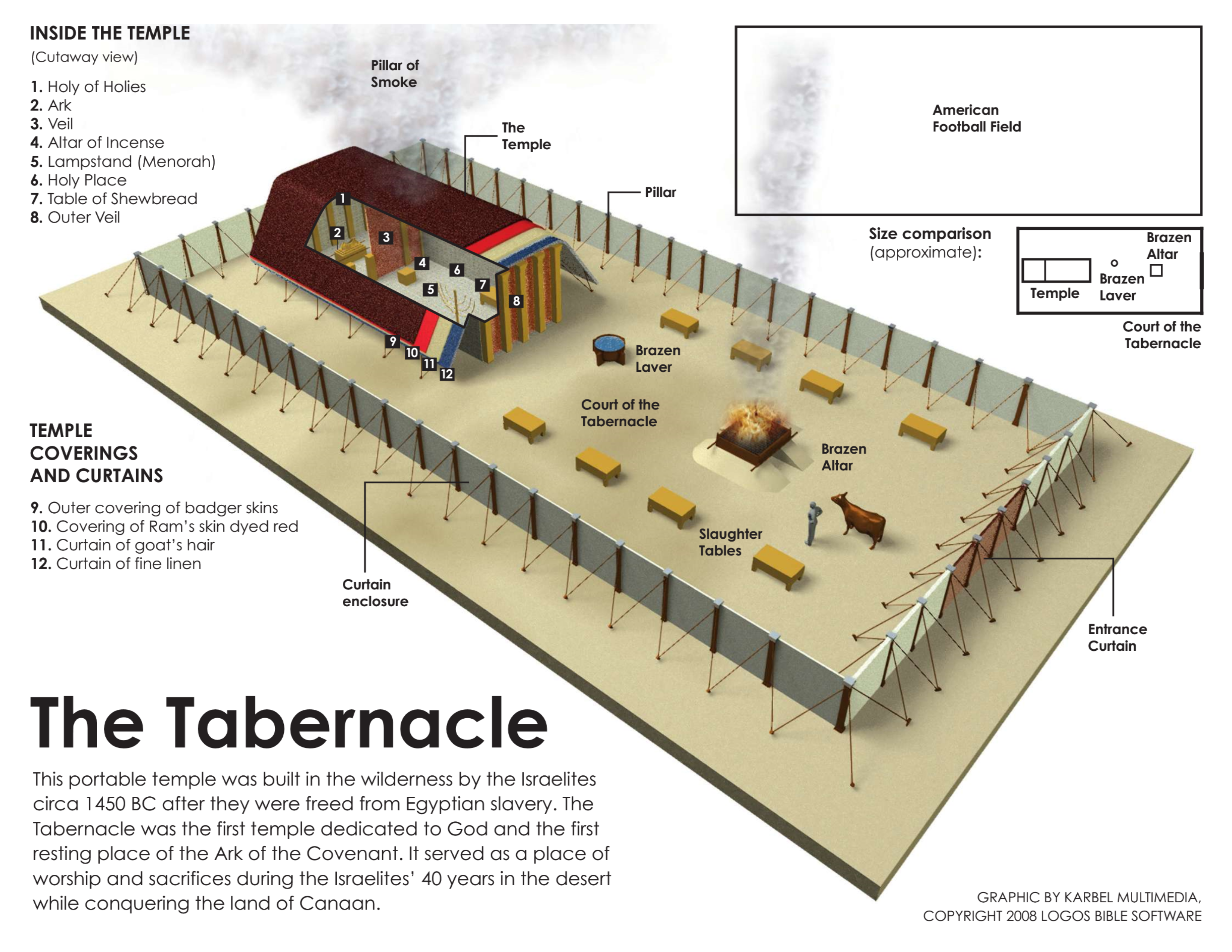
For reference, here’s the graphic I referenced throughout the sermon, which depicts the Old Covenant tabernacle, as described in the Book of Exodus:

tabernacle

Sermon – The Coming King (Zechariah 9)

Zech 9The sermon audio is below. Actually, this is a Sunday School lesson. But, the title has been published, so I can’t change it now!
The Book of Zechariah is a neglected book. At 14 chapters, it’s the longest of the so-called Minor Prophets. It’s an obscure book, tucked away in an even more obscure part of the Christian Bible – that wasteland after the Book of Daniel, before the New Testament.

And yet …

This book has perhaps more direct prophesies per column inch about the coming Messiah than any other book in the Bible. It promises a glorious future for the distressed Israelites, a new and better leader who’ll rule over the world in peace and righteousness, promises a new and better covenant, a new and better High Priest, and vows that Israel will be ashamed for betraying and rejecting her Savior. It’s a thrilling book, and a close reading (with a good commentary even closer at hand) will encourage even the most cynical Christian.

This is also the book which prophesies how the Messiah will reveal Himself to the world as King. That prophesy is found in Zechariah 9:9-11 (and following), and it’s what I taught about this morning. It’s a prophesy which bookmarks the start of God’s fulfillment of everything He’s promised to His people, ever since the Garden of Eden.

Every Man Who Believes is Justified

I’ll be preaching from Acts 13:13-43 next Sunday. This is perhaps the longest of Paul’s sermons that God preserved and recorded for us. It is a summary of God’s grace and mercy toward the nation of Israel, Jesus’ advent, ministry, rejection, execution and resurrection.

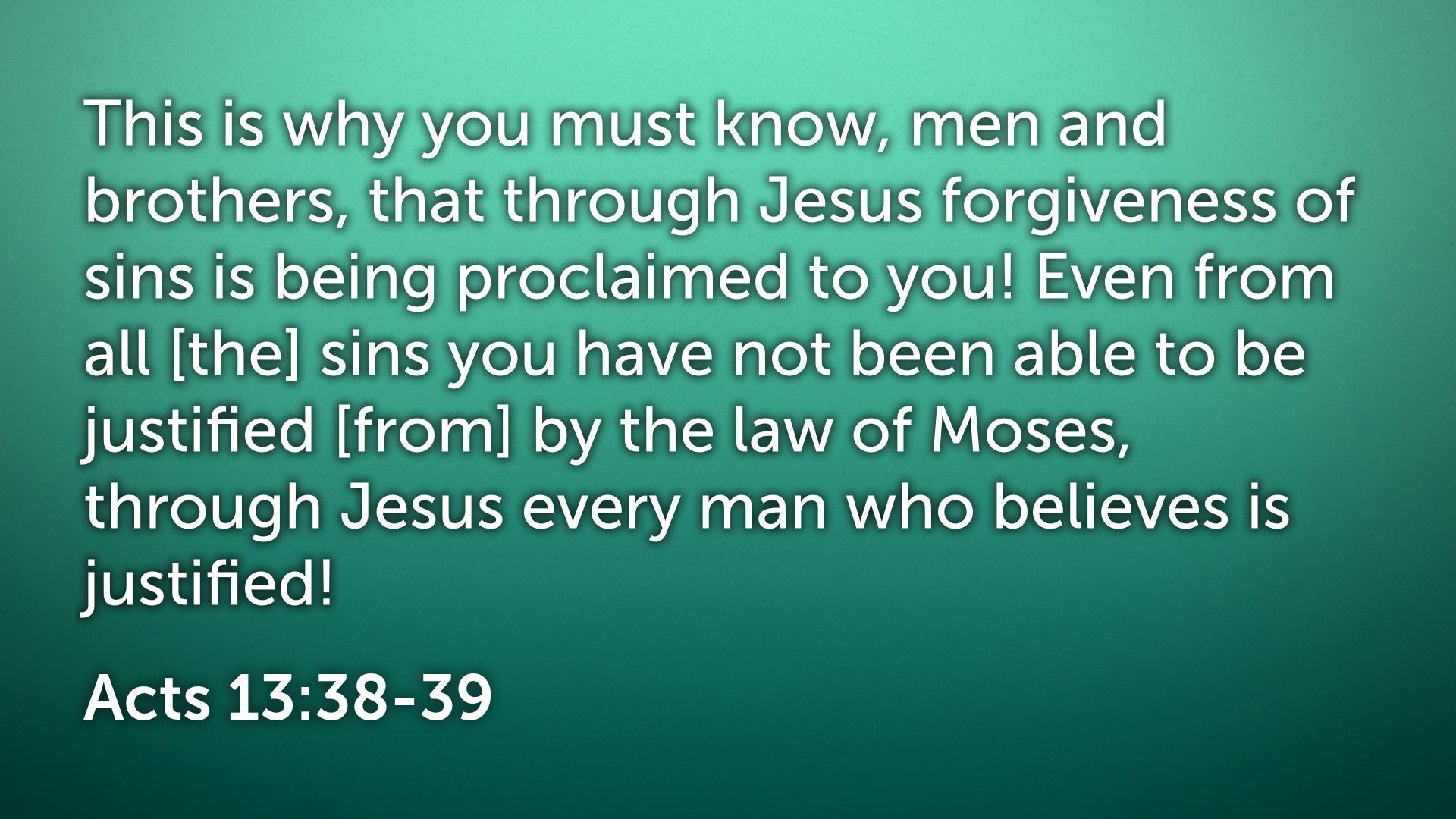
It concludes with a stirring call for everybody (Jew or Gentile) to repent and believe in the Gospel. Paul promised that any person who does believe will be justified by God, set free from slavery to sin, adopted into God’s family and declared righteous in His eyes.

Here is my own translation of Paul’s conclusion:

acts-1338

If you are still rejecting the Gospel, please read and learn about it here.

Gospel or Good News?

dictionaryIs the Word “Gospel” Gospel?

The English word “Gospel” has a tortured and convoluted history. I don’t know this because I’m a genius. I know this because I looked at the Oxford English Dictionary. Behold where it comes from:

  • It started out as the Greek εὐαγγέλιον
  • Then it morphed into the Latin evangelium
  • Then Old English translated this as “godspel”
  • We now have it as “gospel”

Why should you care? Well, it matters when you read Jesus saying something like this:

Mark 1:15 He said, “The time is fulfilled and the kingdom of God is near. Repent and believe the gospel!”

The word almost all English translation translate as “gospel” here is the Greek τῷ εὐαγγελίῳ, or “the gospel.” What does this word mean?

Hopefully, you can see the rendering “Gospel” really doesn’t tell you anything at all. The word is useless, in and of itself. It descended from the Old English rendering of the Latin, which in turn was descended from the Greek. The only place in this chain where we really have primary contact with the true definition is in the Greek – because the Old English, Latin and Modern English renderings are just derivatives from the Greek, not the actual definition itself.

So, what on earth did Jesus mean when he commanded everybody to believe in τῷ εὐαγγελίῳ? He meant they must believe the “good news.”

Who Cares?

If we translate terms consistently throughout the Bible, you can see connections easier. I stumbled across a perfect example this evening during my Bible reading:

Isaiah 52:7-10 How delightful it is to see approaching over the mountains the feet of a messenger who announces peace, a messenger who brings good news, who announces deliverance, who says to Zion, “Your God reigns!” Listen, your watchmen shout; in unison they shout for joy, for they see with their very own eyes the LORD’s return to Zion. In unison give a joyful shout, O ruins of Jerusalem! For the LORD consoles his people; he protects Jerusalem. The LORD reveals his royal power in the sight of all the nations; the entire earth sees our God deliver.

The Israelites will go into exile because of their sin. Life will be terrible. It will be hard. They’ll be punished for their sins. But, all hope is not lost. God will deliver them. Enemies will be vanquished and trampled in the mud. The tables will be turned. Because of the new and better covenant, peace, justice, holiness and righteousness will reign in all God’s people and on all the earth. The Israelites will be rescued from their exile, and led back to their own Promised Land by Yahweh Himself.

In our passage, Isaiah gives us a picture of a special messenger from God. The messenger races over the mountains toward them. He has news! He has a message! What is he bringing?

He is bringing good news.

We just saw that phrase somewhere before, didn’t we!? Interesting. How do you suppose the Greek translation of the Old Testament which Jesus and the apostles used translated this word for “good news?”

I’ll bet you can’t guess it! They translated it as εὐαγγελιζόμενος, which is the exact same Greek word (in different form) which Jesus used in Mark 1:15, when He commanded Israelites to believe in the “good news.”

Connecting the Dots

Jesus is called elsewhere the “messenger of the covenant” (Mal 3:1). He is the messenger who will bring word about God’s new and better covenant. In Isa 52:7, He is also the “messenger” who will race across mountains to the Israelites bearing the message of peace (compare the angel’s Christmas message to the shepherds). He comes preaching “good news.”

Coincidence? I think not. Now do you see why “good news” might be a better translation than “gospel?”

A Word from the Apostle John

Then the seventh angel blew his trumpet, and there were loud voices in heaven saying:

“The kingdom of the world has become the kingdom of our Lord and of his Christ, and he will reign for ever and ever.”

Then the twenty-four elders who are seated on their thrones before God threw themselves down with their faces to the ground and worshiped God with these words:

“We give you thanks, Lord God, the All-Powerful, the one who is and who was, because you have taken your great power and begun to reign. The nations were enraged, but your wrath has come, and the time has come for the dead to be judged, and the time has come to give to your servants, the prophets, their reward, as well as to the saints and to those who revere your name, both small and great, and the time has come to destroy those who destroy the earth.”

Revelation 11:15-18 (NET)

Repent and believe the Gospel.

Seeing God in Creation

hubble1
Carina Nebula (Courtesy of NASA)

We live in a created world. You can look at this world and see that it was planned, designed, created and is being sustained by an intelligent being. That Being has revealed Himself to us in the pages of the Old and New Testaments. He spoke to us by the prophets of old, like Moses, Isaiah, Jeremiah, Zechariah, David and Noah. In these last days, He has spoken to us through His Son, Jesus Christ (Hebrews 1:1).

That phrase, “Jesus Christ,” is both a name and a title. “Jesus” is the Greek rendering for the the Hebrew name translated as “Joshua,” which means “God is salvation.” That is His name – Jesus, Joshua, God is salvation. What a fitting name for the Son of God! The word “Christ” is a title, not a last name. It means “Messiah” or “Anointed One.” It means Jesus is the promised descendant from Eve who will crush Satan once and for all (Gen 3:15). He is the Suffering Servant whom Isaiah prophesied about (Isaiah 52:13-53:12). He is the true and great High Priest, clothed in fine garments (Zechariah 3). He is the Israelite prophet like Moses, whom all people are obligated to listen to (Deuteronomy 18:15ff). He is the One who King David prophesied about, whom the Lord will never allow to remain in the grave and see corruption (Psalm 16:10; Acts 2:27-31, 13:35-38). He is the one who is righteous and just, who came on the scene in a meek and lowly manner bearing the glorious message of salvation, reconciliation, forgiveness and adoption for all those who repent and believe His Good News (Zechariah 9:9).

This is who Jesus Christ is; the Anointed and Chosen One sent by God, who is God, who is salvation, who bears the message of salvation, who offers the refreshing and life-giving waters of eternal life (John 4:14) to sinners who are dead in their own trespasses and sins (Ephesians 2:1). He is the One who is co-equal and co-eternal with God the Father, who voluntarily and willingly left the Father’s throne room in heaven and came here to live a perfect and sinless life, and to die a sacrificial and substitutionary death for men, women, boys and girls from every tribe, language, people and nation on earth (cf. Revelation 5:9).

If you’re a Christian, it is He “who has qualified you to share in the saints’ inheritance in the light. He delivered us from the power of darkness and transferred us to the kingdom of the Son he loves, in whom we have redemption, the forgiveness of sins,” (Colossians 1:12b-14). If you’re not a Christian, then you have no cloak or pathetic pretense (cf. John 15:22ff) for your continued rebellion and insurgency against Him. The Apostle Peter said,

He commanded us to preach to the people and to warn them that he is the one appointed by God as judge of the living and the dead. About him all the prophets testify, that everyone who believes in him receives forgiveness of sins through his name (Acts 10:42-43).

Peter also warned,

But the things God foretold long ago through all the prophets – that his Christ would suffer – he has fulfilled in this way. Therefore repent and turn back so that your sins may be wiped out, so that times of refreshing may come from the presence of the Lord, and so that he may send the Messiah appointed for you – that is, Jesus. This one heaven must receive until the time all things are restored, which God declared from times long ago through his holy prophets.

Moses said, ‘The Lord your God will raise up for you a prophet like me from among your brothers. You must obey him in everything he tells you. Every person who does not obey that prophet will be destroyed and thus removed from the people.’

And all the prophets, from Samuel and those who followed him, have spoken about and announced these days. You are the sons of the prophets and of the covenant that God made with your ancestors, saying to Abraham, ‘And in your descendants all the nations of the earth will be blessed.’ God raised up his servant and sent him first to you, to bless you by turning each one of you from your iniquities (Acts 3:18-26).

You’re reading these words from a device which was deliberately engineered and designed by professionals to work just like it’s working right now. It is the same with this world we’re living in. The obvious intelligent design of the world around us tells us that God exists.

The heavens declare the glory of God; the sky displays his handiwork. Day after day it speaks out; night after night it reveals his greatness. There is no actual speech or word, nor is its voice literally heard. Yet its voice echoes throughout the earth; its words carry to the distant horizon. In the sky he has pitched a tent for the sun. Like a bridegroom it emerges from its chamber; like a strong man it enjoys running its course. It emerges from the distant horizon, and goes from one end of the sky to the other; nothing can escape its heat (Psalm 19:1-6)

Yet, all too often, we ignore the plain evidence of God in creation. We pass by the world around us without a second glance.

Bright, however, as is the manifestation which God gives both of himself and his immortal kingdom in the mirror of his works, so great is our stupidity, so dull are we in regard to these bright manifestations, that we derive no benefit from them. For in regard to the fabric and admirable arrangement of the universe, how few of us are there who, in lifting our eyes to the heavens, or looking abroad on the various regions of the earth, ever think of the Creator? Do we not rather overlook Him, and sluggishly content ourselves with a view of his works? And then in regard to supernatural events, though these are occurring every day, how few are there who ascribe them to the ruling providence of God—how many who imagine that they are casual results produced by the blind evolutions of the wheel of chance? Even when, under the guidance and direction of these events, we are in a manner forced to the contemplation of God, (a circumstance which all must occasionally experience,) and are thus led to form some impressions of Deity, we immediately fly off to carnal dreams and depraved fictions, and so by our vanity corrupt heavenly truth (John Calvin, Institutes of the Christian Religion, trans. Henry Beveridge [reprint; Peabody, MA: Hendrickson, 2008], 1.5.12).

This knowledge is meant to drive us to know more about God, and it is His dear Son, Jesus Christ, who reveals the Father to us, tells us who we are, where we stand with God, and what we must do to be reconciled, redeemed, forgiven, adopted into God’s family. It drives us to the Messiah, to the Christ, who in turn drives us to the Gospel.