Decoding Matthew 24: Meaning and Implications

Decoding Matthew 24: Meaning and Implications

I wrote this long-form article on Matthew 24 for ordinary Christians who’d appreciate a deep but accessible dive into this important chapter. My goal is to be substantive yet engaging. Blog posts are too short, and academic articles are often not written for the church—ironically, the very community teachers are supposed to serve!

One landmine which makes this journey hazardous is knowing what to leave out. Lots of scholarly men and women have lots of good stuff to say about this passage—but you don’t need to know it all to grasp the lay of the land. This article has numerous footnotes, but feel free to ignore them if you wish. You can download this article as a PDF document here. I hope this small contribution helps Christians and serves the broader church family.

1. The Map is Not the Territory (Introduction and vv.1-3)

In 1998 Robert DeNiro starred in one of his better action movies, a film titled Ronin. It’s about a gang of mercenaries recruited by a shadowy Irish woman to steal a case intact “from several men who will be intent on preventing us.” The small team seems to be comprised of ex-military and espionage types. At one point, the team settles on a proposed ambush site. They’ve surveilled the target, mapped the area, the routes, and have a good idea of what they’re going to do. DeNiro’s character stares at a map, a cup of coffee in his hand, scowling. “The map, the map, the map …” he mutters. “The map is not the territory.”[1]

He puts the coffee down, grabs his car keys, and decides to walk around the target’s hotel. He’s tired of talking about the route, the hotel, the target. He wants to see the ground for himself. And see it he does. It’s fair to say that Ronin features some of the best car chase scenes in movie history.

My point is that while it does some good to talk about passages like Matthew 24, there is no substitute to working through it yourself—to seeing it. The map is not the territory. At some point, you must grab the keys and drive out to see the ground for yourself. Still, we have to map the issue a little bit, so we’ll talk about the passage before we dive in.

Matthew 24 is a hard passage. One Baptist theologian suggested it was “the most difficult problem in the Synoptic Gospels.”[2] So, don’t be discouraged if it seems like there’s a lot here—there is! But, if we can capture at least the broad sweep of Jesus’ message—what He wants us to do with this information, then we’ll be in good shape.

Lots of people write lots of material on prophecy. Some of it is irresponsible, much of it is too dogmatic, and a whole lot of it is click-bait. It misses the “so what” at the expense of the allegedly sensational. At the congregation where I’m a pastor, I once discovered an old book in the church library[3] in which the author declared that Saddam Hussein was re-building Babylon, hinted Hussein might be the Antichrist, and strongly suggested this event was therefore a sign of the end (cf. Rev 17-18). Of course, Saddam Hussein never recovered from the first Gulf War, he did not re-build Babylon, he was not the Antichrist (unless he springs to life sometime in the future), and the book is now an embarrassment.

We can do better.

There are three general approaches to this passage that you’ll need to understand. It’s almost impossible to come to Matthew 24 as an impartial, blank slate—what you’ve decided about other passages will influence what you do with this passage.[4] This means each of the three perspectives brings very different presuppositions to the table. It’s hard to not fall into the familiar rut of adopting the system with which you’re most familiar, dusting your hands off, and calling it a day. We should try our best to not do that!

1.1. Three Different Grids for Understanding Matthew 24

Here are the three different interpretive grids. I intend these descriptions to be broadly representative—not precise descriptions:

1.1.1. View 1–The Great Tribulation!

The first option is to say Matthew 24 is about the great tribulation, and only the great tribulation. Everything here is about the Jewish people struggling against Antichrist in the age to come. The Church is not here, because God raptured the Church away before the tribulation began. It must be this way, because the great tribulation is “a time of trouble for Jacob” (Jer 30:7)—that is, for the Jewish people specifically.[5] The Church has nothing to do with the tribulation, so Matthew 24 is not directly applicable. However, we can glean principles to apply to this Church age. This view relies heavily on the assumption that Israel and the Church are two distinct peoples of God, on parallel but separate tracks.[6]

1.1.2. View 2–AD 70 and That’s It!

Another view is that most or all of this passage is about the destruction of Jerusalem in AD 70. Some of these commentators believe Matthew 24:29-31 is not about Jesus’ second advent at all—it simply quotes the prophet Daniel and shows us Jesus being enthroned after His ascension.[7] This perspective tends to minimize data which suggests Jesus’ second coming and maximize all references to Jerusalem during the Roman siege of the city from AD 66-70.

1.1.3. View 3–Having It Both Ways

The third position is that the passage largely operates on two levels at once(a) it’s basically about the siege and capture of Jerusalem in AD 66-70, but (b) those awful events prefigure and foreshadow the great tribulation during some unknown future time.[8] This perspective tries to have it both ways, because it sees Jesus as often speaking about two things at once.

I believe the third grid presents the fewest problems, is the best explanation for the evidence, and best comports with the rest of Scripture.

1.2. How to Weigh the Evidence? Rules of Affinity to the Rescue

The scriptures are the supreme or highest channel of religious authority;[9] the “supreme standard by which all human conduct, creeds, and opinions should be tried.”[10] This means that, while tradition, reason, and experience are important, they are not the final court of appeal. That means we need to pay attention to what Scripture says.

I’ve been an investigator for 22 years, in both Federal and State contexts. I’ve done both criminal and regulatory investigations. You may substantiate two cases, all while knowing one has better evidence than the other. It’s the same with Scripture—there are degrees of certainty based on the weight of evidence. An acquaintance of mine, Dr. Paul Henebury, has developed a system which he titled “rules of affinity” to explain how we can weigh probability of evidence in Scripture.[11] If we can correctly assign evidence a probative value, then we’ll know how dearly we ought to cling to a certain doctrine.

What’s the point?

The point is that when you come to Matthew 24, you likely arrive with preconceived ideas about what Jesus is saying. Maybe you’re right. Maybe you aren’t right. Be willing to fairly weigh the evidence, assign it a category from the rules of affinity chart, and adjust your “passion level” for your preferred interpretation accordingly. If you won’t do that, then you’ve already made up your mind and are simply after confirmation that you’re “right.” That’s the opposite of the truth.

I suggest the following grading scale to evaluate the “passion level” you assign to a subject you believe is found in a particular bible passage:[12]

  • Grade A: Explicit teaching. The passage either (a) makes some direct statement in proper context, or (b) directly teaches on the specific issue (e.g., justification by faith, Jesus’ resurrection, Jesus as the only way of salvation, the virgin birth, etc.). Hold closely and aggressively to doctrines with Grade A support.
  • Grade B: Implicit teaching. Though there may not be a specific statement in context, or a direct passage about the subject using the summary terms the Church has developed over time, there is only one responsible conclusion (e.g., doctrine of the Trinity, two-nature Christology, baptism of professing believers only). Hold closely and aggressively to doctrines with Grade B support.
  • Grade C: A principal or logical conclusion—an inference. The issue is the application of a general principle from scripture in context, and/or a logical conclusion or inference from the data in proper context. “Because A, then it makes sense that B, and so we have C.” It isn’t the only conclusion possible, but it is a reasonable one (e.g., presence of apostolic sign gifts today, the regulative principle of worship, music styles in worship). Agree to disagree on doctrines with Grade C support, because the evidence is not conclusive for one position or the other.
  • Grade D: A guess or speculation. No explicit or implicit scriptural support, evidence falls short of a persuasive conclusion from the data, and it’s built on shaky foundations—“because A, then it makes sense that B, and therefore it could mean C, and so D.” It’s an educated guess based on circumstantial evidence (e.g., who wrote the Book of Hebrews). Hold very loosely to issues with Grade D support—never force your guess on another believer.
  • Grade E: Poor or non-existent support. No explicit or implicit evidence, no logical conclusion or inference from data, and cannot be taken seriously even as a guess. The passage doesn’t support the issue at hand. Ditch passages with Grade E support.

Are we willing to weigh the evidence fairly? Remember this grade scale as we work our way through Matthew 24.

1.3. Some Tricky Issues

There are five key issues in Matthew 24 which need an answer. Most people will provide an answer which fits with their preferred “grid” for understanding the passage. Here are the issues, along with my answers. Justification and support for my positions will come in the commentary itself—you’ll have to wait!

  1. Abomination that causes desolation—what is it? Jesus mentions this at Matthew 24:15. I believe it refers to the Roman army besieging Jerusalem from AD 66-70, which prefigures the great tribulation when the Antichrist will desecrate a holy space in Jerusalem at some future date.
  2. “Let the reader understand”—what does this mean? This is also at Matthew 24:15. I believe it’s Jesus’ remark (not Matthew’s) which directs folks who read the prophet Daniel to pay close attention to the specific events which will come within the generation that was alive when Jesus spoke.
  3. “[G]reat distress, unequaled from the beginning of the world until now”—what is this? Jesus mentions this phrase at Matthew 24:21. I believe it refers to both (a) Jerusalem’s destruction by the Romans, which squares with Jesus’ announcement of the temple’s destruction that started the entire conversation (Mt 24:1-2), and (b) the Antichrist’s brief reign as the ruler of the kingdom of darkness (Rev 13), later depicted by the Apostle John as Babylon (Rev 17-18). There is both a near and far fulfillment.
  4. The coming of the Son of Man—when will it happen? Jesus describes this at Matthew 24:29-31. It refers to his second advent, a single-stage event wherein He returns at the end of the great tribulation to gather his elect (both alive and dead) from the four corners of the earth, destroy Babylon, and establish His kingdom (Rev 19).
  5. “[T]his generation will certainly not pass away until all these things have happened—to what is Jesus referring? He’s talking about the destruction of Jerusalem in AD 70, which means Jesus is referring here to Matthew 24:4-26 (or possibly up to v. 28)—He isn’t talking about vv. 29-31 at all. “This generation,” then, is referring to people alive in Jesus’ day who will still be around to see the Romans destroy the temple.

One other issue that piques curiosity is the timing of the rapture—when will believers be snatched up to meet the Lord? (Mt 24:31; cp. 1 Thess 4:13-18)? I believe this passage suggests a post-tribulational rapture, and that the Apostle Paul refers to this passage when he describes that same event in 1 Thessalonians 4:15-17. I believe Paul refers to Matthew 24 when he explains his teaching about Christ’s return is “according to the Lord’s word” (1 Thess 4:15). This is a relatively unimportant issue, but I note it here because Christians often want to know about it.

1.4. Outline of the Passage

Here is an outline of the passage as I understand it.
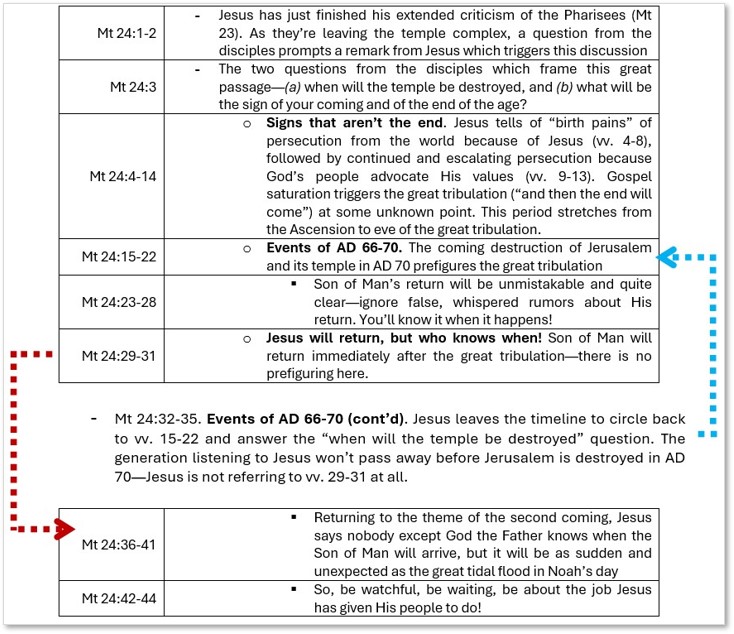
Here is my attempt to depict the passage in graphic form, especially the foreshadowing aspect and Jesus’ focus shifting between the near (the Romans destroying Jerusalem) and the far (Antichrist and the great tribulation).

Now, at long last, because the map is not the territory, let’s get to Matthew 24.

1.5. Mic Drop in Jerusalem (vv. 1-3)

Jesus has just finished his jeremiad against the Pharisees (Mt 23). He says, “your house is left to you desolate!” (Mt 23:38). This could refer to Israel, to the temple itself, or to Jerusalem as the symbol of God’s place on earth. It’s probably a general reference encompassing lots of things, basically meaning “things as they are are gonna change.” Jesus then turns on His heels and walks away. This is likely Tuesday of Passover week, and Jesus never enters the temple again.[13]

Jesus left the temple and was walking away when his disciples came up to him to call his attention to its buildings. “Do you see all these things?” he asked. “Truly I tell you, not one stone here will be left on another; every one will be thrown down (Matthew 24:1-2).

We can imagine the disciples staring at the Pharisees, an unbearable tension filling the silence. They then hurry after Jesus, anxious to escape this awkward situation. They believe Jesus is referring to the temple complex itself, which is a huge structure. It’s the size of several football fields, a massive feat of engineering. Herod the Great expanded the temple which the exiles rebuilt upon their return from captivity. He erected massive retaining walls, filling them in to create an artificial plateau. He then added numerous exterior courtyards and other odds and ends, with the original temple at the center. This ambitious project was underway for nearly 80 years. It was finished shortly before the Romans sacked the city in AD 70.


Herod’s temple.[14]

How, the disciples wonder, could this structure be left desolate?[15] They call Jesus’ attention to the buildings—just look at them! Desolate? Deserted? Really? Jesus tells them the whole thing would be rubble one day. That isn’t what they’re expecting to hear!

This is a great time for some clarification.

As Jesus was sitting on the Mount of Olives, the disciples came to him privately. “Tell us,” they said, “when will this happen, and what will be the sign of your coming and of the end of the age?” (Matthew 24:3).

The disciples have two questions; (a) when will the temple be destroyed, and (b) what will be the sign that lets us know? The “sign of your coming and of the end of the age” is one question, not two—the disciples assume they are the same event.[16] They seem to assume the two events will happen at roughly same time—the temple will be destroyed, and Jesus will return.

These two simple questions, uttered on the Mount of Olives as they stared across the Kidron Valley at the temple complex, is the impetus for one of Jesus’ most sweeping descriptions of history. He begins to answer their questions in v. 4-14.

2. Let the Bad Times Roll (vv. 4-14)

In Matthew 24:4-14 Jesus tells us to expect bad times to come, to expect opposition, to expect misunderstanding, and to expect hostility from a world that doesn’t like or understand His message. If this is the case, then why be so surprised when the bad times roll?

A host of secular media personalities and Christian influencers want you to be upset, indignant, mad at the state of the world. Mad that it no longer pretends to be Christian. Angry that un-Christian things are called good, and that good is called evil. Well, no kidding. This ought not be a surprise, so why are some Christians still so surprised?

Here is where we are in the passage:

Let’s see what Jesus has to say about the reception Christians can expect from this world.

4Jesus answered: “Watch out that no one deceives you. 5For many will come in my name, claiming, ‘I am the Messiah,’ and will deceive many. 6You will hear of wars and rumors of wars, but see to it that you are not alarmed. Such things must happen, but the end is still to come. 7Nation will rise against nation, and kingdom against kingdom. There will be famines and earthquakes in various places. 8All these are the beginning of birth pains (Matthew 24:4-8).

Jesus skips the “when will the temple be destroyed question” (but see timeline on vv. 32-35) and instead talks about what are not the “signs” of His coming. He begins with events which will start more or less immediately—dangers which lurk right at the very doors.[17]

Jesus says people will try to deceive Christians about the Messiah’s return.

He explains that general unrest and warfare will occur, but Christians shouldn’t lose hope. This will be a time of increasing disorder on the international scene (“nation shall rise against nation,” Mt 24:7). It’s possible Matthew is referring to tumultuous events in recent memory from his own day.[18] Some believers might now point to contemporary events with raised eyebrows, like the Russo-Ukraine war. But we ought to remember that the Russo-Ukraine war is the first major, sustained conventional military action in Europe since the Second World War, and perhaps only the second in the world since the Six Day War (1967) and the Yom Kippur War (1973). In short, international coalitions have been largely successful in suppressing conventional miliary conflict since 1945.

Jesus also warns that earthquakes and famines will happen with increasing frequency.

Jesus says these events won’t be the “end of the age” at all—they’ll just be birth pangs which signal or foreshadow the coming main event. In other words, this will be the normal situation in this age.[19] Wars, earthquakes, famines—these will be common and in no way suggest “the end” is nigh at hand.[20] It’s very important to not be led astray by weird speculations. Christians have always been prone to do this. One 19th century scholar chortled that a friend of his claimed the fifth kingdom in Daniel 2 was the United States of America, and that the “war in heaven” (Rev 12:7) was a prophecy of the American Civil War![21]

It’s important to note that Jesus is speaking to His disciples—to believers. Some Christians believe His words in Matthew 24 are only for Israelites, but the text says nothing about that.[22] That idea is based on an interpretive system that sees a hard distinction between Israel and the Church and therefore infers sharp breaks in audience where necessary. However, the text doesn’t support this hard break in audience to “Israel only” in Matthew 24-25. Instead, we should simply understand Jesus to be speaking to the disciples, and we should then apply His teaching to our lives directly—just as we do for countless other passages in the Gospels.

So much for the “birth pangs” which foreshadow that the end of the age is on the way. What happens next?

Then you will be handed over to be persecuted and put to death, and you will be hated by all nations because of me (Matthew 24:9).

The word which the NIV translates “then” could mean “at that time,” meaning during the time of the birth pangs. Or it could be sequential (i.e., “what happened next was …”). It’s probably sequential[23]after the birth pangs, things get real. Nonetheless, all of vv. 4-14 is one on-ramp of escalating persecution. Oppression and martyrdom will occur. Nations hate Christians because they represent Jesus.[24]

We must not forget the importance of faithfulness—we must be salt in light in an increasingly dark world. Some Christian influencers in America operate from a default posture of outraged defensiveness. They want Mayberry (or something like it) to come back, and they’re rightly outraged at how hard and fast the cultural values have changed in the past generation. As newsman Howard Beale once declared, “I’m mad as hell, and I’m not gonna take it anymore!”[25] But, Jesus here tells us to expect to be a prophetic minority—to be hated, persecuted, despised because we represent Jesus. Nobody likes prophets who tell the truth. We ought to expect opposition, which means we shouldn’t respond with outraged defensiveness when our culture looks more like Babylon than Jerusalem. Did we expect something different?

What else will happen after these birth pangs hit?

10At that time many will turn away from the faith and will betray and hate each other, 11and many false prophets will appear and deceive many people. 12Because of the increase of wickedness, the love of most will grow cold, 13but the one who stands firm to the end will be saved (Matthew 24:10-13).

Taken together,[26] vv. 9-13 show us a time characterized by a deliberate persecution of Christians. They will be hated specifically because they represent Jesus (“because of me,” Mt 24:9). Believers can only be hated because of Jesus if they’re representing Jesus’ values, His ethics, His agenda, His program. The corollary, of course, is that to the extent your “Christianity” mirrors this world’s values and mores, the more fake it is. Think about that.

This period of time is not the tribulation, but it is the precursor to it. It’s a time during which the world’s values grow more and more hostile to Christianity. There will be an escalation of Christian persecution—imprisonment, death, defections from the faith, vicious infighting, and false teachers stalk the land. Believers will grow cold—perhaps not apathetic, but insular. Safe. Hidden. Faith will be privatized, pushed indoors where the world can’t mock it, persecute it, identify it. There will be a growing eco-system of secret Christians. The Book of Hebrews later criticized this. Only those who persevere to the end will be saved—good works, obedience, and faithfulness are essential fruits of real Christianity.[27]

Now, Jesus gives us one of the closest answers we’ll ever get to an answer for the “when” question (but see Mt 24:32-35).

And[28] this gospel of the kingdom will be preached in the whole world as a testimony to all nations, and then the end will come (Matthew 24:14).

When will “the end” come? Well, first the gospel of the kingdom must be preached throughout the whole world,[29] and then the end will come. The word here indicates “the end” is the next event in sequence once the gospel reaches the whole world. The natural question is, “well, at what point is the gospel preached throughout the whole world?” One Christian leader from the late 4th and early 5th century speculated that moment had almost arrived, “since it appears to me that there remains no nation that does not know the name of Christ.”[30] It’s safe to say he was wrong! Nor is this hyperbole from Jesus.[31]

So, what does that statement mean? It’s clear Jesus doesn’t mean “every single person must hear the Gospel,” because some people are always dying without hearing the message, and others are always being born. 100% contact is impossible.[32] It must mean something like saturation. At some point, the entire world will reach a divine “saturation level” for the Gospel, and then the end will come.[33]

Like many things in prophecy, “the end” is not a singular event. Here, it refers to the matrix of events which together comprise the end of “this present evil age,” (Gal 1:3). The “Gospel saturation level” is the trigger which kicks off this chain of events.[34] We have no idea what the saturation level is, or how to precisely measure it. What is clear is that missions (domestic and abroad) are critical. If a church is not about evangelization, then it’s derelict.

Therefore, once Gospel saturation is achieved, “the end” is triggered. What will be the opening move in this chain of events? Jesus tells us in the next section.

3. Gangsters and Abominations of Desolation (vv. 15-22)

Prophecy is powerful because it tells a story in a very impactful way. Strange images, bizarre sayings, odd symbols—it’s all there, ready to fire the imagination. The medium is so much different than a narrative like Acts, a poem like Song of Solomon, or a lawyerly argument like Romans. It captivates and draws you in, even despite yourself. What does it mean? What’s it saying?

We’re drawn to epics, myths,[35] sweeping origin stories. You might have had to read Iliad and Odyssey in high school, but have you read it since? The modern myth largely exists on film—in the multiplex or via streaming from your couch. Sagas like the Harry Potter series and the Lord of the Rings trilogy captivated an entire generation of people around the world. They’re self-contained universes that tell tales of good v. evil, of darkness v. light, of heroes and villains, and of diabolical figures vanquished by good.[36]

In these modern-day myths, there is always a climatic showdown. This is never simply an individual contest (unlike Rocky v. Ivan Drago or Luke Skywalker v. Darth Vader),[37] but rather the fulcrum of an existential struggle against the evil system. Thus, the Lord of the Rings film saga ends with the battle at Minas Tirith and then at the black gates of Mordor. The original Star Wars trilogy ended with the Battle of Endor and the destruction of the second Death Star.

The Christian story has its own epic finale, and it occurs at the end of the great tribulation. Jesus tells some of that story here, in our passage (Matthew 24:15-28). But He also tells another story—actually two at the same time; the first foreshadows the other. Star Wars does something similar.

The Rebel Alliance did indeed destroy a Death Star battle station in the original 1977 film, A New Hope. The Empire has been shattered! Surely, it won’t ever be able to replicate this fearsome weapon. Yet, the opening crawl for the 1983 film Return of the Jedi tells us that “the GALACTIC EMPIRE has secretly begun construction on a new armored space station even more powerful than the first dreaded Death Star …”

You see, that first Death Star was but a foretaste of the more fearsome second Death Star to come. It pointed to it, foreshadowed it, gave a taste of what was ‘comin ‘round the mountain. Something like that is going on here.

Here’s where we are in the passage:

Jesus speaks of two things at once; (a) some terrible ordeal which will happen soon, and (b) another, more definitive contest which occurs much later. I’ve said too much already, so I’ll let the text speak for itself from here on out.

15So when you see standing in the holy place ‘the abomination that causes desolation,’ spoken of through the prophet Daniel—let the reader understand—16then let those who are in Judea flee to the mountains (Matthew 24:15-16).

Now we’re into the difficult part of Matthew 24. Some take this whole bit (Mt 24:15-22) to refer to the sack of Jerusalem by the Romans in AD 70. Others see it as completely future, indicating the start of the great tribulation. Still others see a blending of both perspectives—usually with the former as a type for the latter. Some minimize Daniel’s context and speculate this “abomination” is a general reference to “every heresy which finds its way into the church.”[38] One scholar suggests this was the desecration of the temple by the Zealot faction during the Jerusalem siege of AD 66-70.[39]  

We ought to lay out the evidence, analyze it fairly to let it speak for itself, and set systems aside when they don’t fit that evidence. Two pieces of evidence are critical here:

  1. What Daniel said. Jesus even inserted a plea for us to read Daniel (“let the reader understand,” Mt 24:15) to get His point,[40] and
  2. What Mark and Luke say. Either they contradict each other, or we can harmonize them together to form a complete picture. 

3.1. Daniel, Jesus, and the “abomination that causes desolation”

The first thing we must do is figure out what “the abomination of desolation” is, so we can figure out what Jesus is saying. The phrase communicates two things, (a) there is a defiling and disgusting thing which (b) causes a sacred place to be abandoned. You could render it something like “the awful and blasphemous thing which causes something to be abandoned.” In his book, Daniel always uses the phrase to refer to an action which a figure of sinister evil commits. Daniel uses the phrase three times.

The first of these is in Daniel 9:24-27, where the prophet provides a broad sketch of history to come:

  1. A period of time which the angel Gabriel identifies as “seventy sevens” is the complete span during which God’s plan will be completed (Dan 9:24).
  2. This time is triggered by Persian’s decree to rebuild Jerusalem (“From the time the word goes out to restore and rebuild Jerusalem,” Dan 9:25). There is a dispute about when the Persians issued this decree, but that isn’t important now.
  3. From the decree to rebuild the temple until the Anointed One (Jesus) arrives on the scene, 69 “sevens” will elapse. The temple will be rebuilt during this period, but in troublesome times (Dan 9:25).
  4. After the 69 “sevens,” the Anointed One will be killed, and have nothing. The “people of the ruler who will come” will then destroy Jerusalem and its sanctuary. War will rage on like a flood during this time until it’s all done (Dan 9:26).
  5. This “ruler who will come,” whose people have destroyed Jerusalem, will then confirm a covenant with many for one “seven.”
  6. In the middle of this last “seven,” Antichrist will stop religious practices in Jerusalem and erect an idolatrous figure of some sort—an “abomination that causes desolation”—inside the temple for about three and a half years (cf. Dan 12:11-12). This will continue until the Antichrist gets his just desserts and is cast into hell (Dan 9:27; cp. Rev 19:19-20).

It’s reasonable to conclude that when Daniel refers to “an abomination which causes desolation” here (Dan 9:27), he’s referring to the intentional desecration of a sacred space by an evil figure.

Daniel mentions this phrase in two other places (Dan 11:31; 12:11). The first of these refers to a Syrian king named Antiochus IV Epiphanes, who persecuted the Jewish people terribly in the last quarter of the 2nd century BC. He erected a pagan altar inside the temple and prefigured the coming Antichrist in his cruelty and hatred (read 1 Maccabees 1). This action sparked the Jewish revolt and resulted in a quasi-independent Jewish kingdom until Rome came onto the scene. The second reference seems to leap forward and refer to the Antichrist himself.

Let’s return to our Matthew passage:

15So when you see standing in the holy place ‘the abomination that causes desolation,’ spoken of through the prophet Daniel—let the reader understand—16then let those who are in Judea flee to the mountains (Matthew 24:15-16).

So, to which “abomination of desolation” reference is Jesus referring? He’s looking forward to the future, so Antiochus IV Epiphanes is out. It seems Jesus must be referring to Antichrist, and that would mean Jesus is telling Christians to flee when the tribulation begins.

3.2. Mark, Luke, and the “abomination that causes desolation

But we must now bring in evidence from Mark and Luke to see if the evidence still points that way:
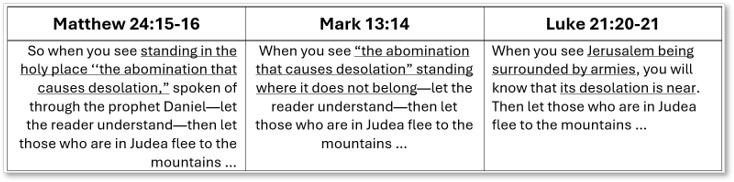
Notice what Luke does. He wrote his Gospel last, and he’s apparently interpreting Matthew and Mark for his readers.[41] Luke records Jesus as meaning that the “abomination that causes desolation” was the Roman armies which surrounded Jerusalem.[42] Luke says that Jerusalem’s desolation is near when the Romans surround Jerusalem. The “abomination” would then be Roman military standards invading the city, especially the temple proper. These pennants bore the image of the Roman emperor, who claimed a divine status. This is blasphemy, of course. It is Jerusalem’s desolation to which Luke refers, and this means it’s what Mark and Matthew meant, too.[43]  

Some might object that Luke could just as easily be referring to Antichrist’s armies encompassing Jerusalem to destroy it, but this event just doesn’t occur in any reasonable timeline. Antichrist does indeed gather an army to meet Jesus at his second advent but is defeated in quick order—Jerusalem is not destroyed (Rev 19:19). Likewise, Satan later raises an army to have a go where his minion failed, but he is incinerated by a divine fireball (Rev 20:9). Again, Jerusalem is untouched.

Luke said Jerusalem’s “desolation was near,” (Lk 21:20). The word means destruction of the city—it will be laid waste.[44] This is precisely what both Antichrist and Satan will later fail to accomplish, yet it is exactly what Titus accomplished in AD 70. Josephus tells us:

There was no one left for the soldiers to kill or plunder, not a soul on which to vent their fury; for mercy would never have made them keep their hands off anyone if action was possible. So Caesar now ordered them to raze the whole City and Sanctuary to the ground … [a]ll the rest of the fortifications encircling the City were so completely leveled with the ground that no one visiting the spot would believe it had once been inhabited. This then was the end to which the mad folly of revolutionaries brought Jerusalem, a magnificent city renowned to the ends of the earth.[45]

So, we’re left with the conclusion that Jesus refers to the Roman sack of Jerusalem in AD 70. It’s also more than just that, but we’ll get there in a bit.

17Let no one on the housetop go down to take anything out of the house. 18Let no one in the field go back to get their cloak. 19How dreadful it will be in those days for pregnant women and nursing mothers! 20Pray that your flight will not take place in winter or on the Sabbath (Matthew 24:17-20).

When the Romans attack Jerusalem, Jesus says everyone must run. Immediately. Get out. Don’t stop to grab some valuables. Just flee. His reference to the Sabbath supports a reference to AD 70—“Jesus clearly expects these events to take place while the strict Sabbath law is in effect.”[46] Some Jews would be reluctant to help on the sabbath, fearful of incurring religious condemnation even as Rome’s armies massed against the city.[47] Some Christians believe this “Sabbath” reference points to some future time when the temple has been re-built, but Matthew says nothing about that.

Why does Jesus say this? Why such dire warnings?

For then there will be great distress, unequaled from the beginning of the world until now—and never to be equaled again (Matthew 24:21; cp. Daniel 12:1).

This sounds pretty bad. But, God has said things like “this has never happened before” when, in fact, it had happened (cp. Josh 10:14 with Ex 8:13, Num 14:20; 2 Kgs 6:18)![48] This suggests Jesus’ words here don’t have to be literal—it may just be a colloquial way of saying “this will be really, really bad.” We do similar things when we tell someone that a certain thing was “the craziest thing I’ve ever heard.” We say that, but is it really the craziest thing? Probably not. Some interpreters suggest Jesus is using hyperbole for deliberate effect, but this is unlikely.[49]

If Jesus is primarily referring to the events of AD 66-70, when Jerusalem was destroyed, then was this really the worst period of time “from the beginning of the world until now”? The Jewish historian Josephus was present with the Roman armies at the siege of Jerusalem and tells us all about it.

It was a terrible time. Civil war had torn the city into three Jewish factions (a “suicidal strife between rival gangsters”)[50] and war broke out during Passover when the city was filled to the brim with Jewish pilgrims. One faction controlled the temple courts, while two others held the city and the larger temple complex. Josephus tells us terrified worshippers were cut down by a hail of projectiles as they ran for the sanctuary. Blood collected in pools in the courtyards. The city became “a desolate no man’s land” as guerilla warfare raged on.

The Romans did not show up as evil conquers, but arrived under the aegis of, as it were, the “Federal government” come to restore order to a city within its jurisdiction that was destroying itself. Bit by bit, the Roman general Titus conquered Jerusalem in a multi-year siege. Josephus tells of one Jewish woman named Mary, driven mad by hunger, who killed her infant son, roasted him, ate one half of him and saved the rest for later[51] (cp. Deut 28:53-57). The temple itself was destroyed by fire in a frenzy of rage by Roman legionnaires who ignored their commander’s orders.

All the prisoners taken from beginning to end of the war totalled 97,000; those who perished in the long siege 1,100,000 … No destruction ever wrought by God or man approached the wholesale carnage of this war.[52]

By all accounts Josephus wasn’t the most honorable man in the world, but he was there. He witnessed the whole thing. But can we fairly say the sack of Jerusalem was really the worst event in the world? One thinks of the German siege of Leningrad during the Second World War. For a time, the city’s only supply line to friendly Soviet forces during the brutal Russian winter was across a frozen lake. The siege lasted nearly 900 days and, by some accounts, perhaps 1,500,000 people perished. Just as during the siege of Jerusalem so many years before, it’s likely that starving citizens resorted to cannibalism—stories were whispered about children disappearing.

While Titus’ siege of Jerusalem lasted longer, we’re at least speaking of comparable tragedies. It seems reasonable to take Jesus’ words in Mt 24:21 as referring to Jerusalem’s destruction by the Romans armies.[53] But, Jesus’ pivot to His own second advent a few verses hence suggest Titus and his Romans legions don’t exhaust vv. 15-21’s meaning.[54]

In other words, Mt 24:15-21 refers to both (a) Jerusalem’s destruction by the Romans, which squares with Jesus’ announcement of the temple’s destruction that started this entire conversation (Mt 24:1-2), and (b) the Antichrist’s brief reign as the ruler of the kingdom of darkness (Rev 13), later depicted by the Apostle John as Babylon (Rev 17-18). There is both a near and far fulfillment.[55] Jesus began with (a) birth pangs of persecution against the church, then (b) told of sharply escalating hostility because the church represents Jesus, to (c) the fall of Jerusalem as a type for the coming kingdom of evil via the Antichrist. This typology is the best way to understand Jesus’ unmistakable pivot to the distant future in vv. 29-31, we we’ll soon see. But, for now, Jesus continues:

If those days had not been cut short, no one would survive, but for the sake of the elect those days will be shortened (Matthew 24:22).

Some say “those days” Jesus speaks about here refer to (a) the specific events in vv. 15-21,[56] or perhaps (b) the entire chain of events stretching from the birth pangs to the end of the Antichrist’s brief reign (vv. 4-21; cp. v. 29).[57] I believe it’s easiest to continue the typological theme and say v. 22 refers to the siege of Jerusalem in AD 66-70, which foreshadows the seven year great tribulation in the future. Jesus continues to refer to both events.

3.3. On False Alarms and Bogus Messiahs (vv. 23-28)

23At that time if anyone says to you, ‘Look, here is the Messiah!’ or, ‘There he is!’ do not believe it. 24For false messiahs and false prophets will appear and perform great signs and wonders to deceive, if possible, even the elect. 25See, I have told you ahead of time (Matthew 24:23-25).

Jesus warns that during this this awful time—that is, the Jerusalem siege of AD 66-70 which foreshadows the tribulation—everyone will surely die unless He preserves His community through it all. This suggests Christians will endure the tribulation at some point in the future. There will be false sightings of the Messiah. Charlatans and Satan-empowered teachers will lead people astray.

26So if anyone tells you, ‘There he is, out in the wilderness,’ do not go out; or, ‘Here he is, in the inner rooms,’ do not believe it. 27For as lightning that comes from the east is visible even in the west, so will be the coming of the Son of Man. 28Wherever there is a carcass, there the vultures will gather (Matthew 24:26-28)

Jesus words are just a continuation of the same, with a folksy analogy for good measure. Just as circling vultures unmistakably mark the spot of a dead creature, so too will Messiah’s coming be obvious and clear. It won’t be necessary to speculate about when Messiah will arrive, because it will be as unmistakable as lightning in the night sky. It’s no accident that Jesus refers to Himself here as “the Son of Man.” This is the figure whom the Ancient of Days crowns as eternal king in Daniel 7 just after the beast (i.e., Antichrist) is slain and tossed into the burning fire (Dan 7:7-13; cp. Rev 17:11-14). Likewise, in Jesus’ own chronology the Son of Man will appear to destroy Antichrist and establish His kingdom (Rev 19:19-21) just as the great tribulation plumbs new depths of evil. The typology or prefiguring still holds. This is advice both for the residents of Jerusalem about 40 years hence, and for believers enduring the great tribulation sometime in the distant future.

Notice again that there is nothing here about Jesus returning twice, once to rapture the Church out of this world, and again to establish the kingdom. Jesus only tells of one single return.

4. Things Just Got Real (vv. 29-31)

Darth Vader is rightly regarded as one of the best villains in movie history, in the same league as Maleficent and Hans Gruber. In the original Star Wars trilogy, his fiendishness was less a product of his skills in single combat and more about his ruthlessness and the way he killed subordinates by choking them to death with “the force.” He was more a sinister administrator than a warrior. Still, it was clear Vader was a frightening individual.

“I’m not afraid!” Luke Skywalker told Yoda at one point.  

“You will be,” the Jedi Master replied cryptically. “You will be …”

Vader is not depicted as a fighter until Rogue One (the direct prequel to the 1977 film A New Hope) was released in 2015. In the climactic battle scene,[58] Vader and a force of stormtroopers disable and board a Rebel command ship which has stolen data for the first Death Star (still under construction). This information cannot fall into Rebel hands, and Vader’s goal is to personally ensure that it does not.

The Rebel sailors fall back into one portion of the ship. They point their weapons into the darkness, gasping for breath. They hear deep breathing.

Hmmmm-pusssh.

Silence.

Hmmmm-pusssh.

Then, out of the darkness a red lightsaber comes to life, illuminating Vader standing in the corridor, menacing in black.

Hmmmm-pusssh.

The sailors open fire. Vader quickly kills them all. This scene has become infamous because of the sudden, startling ferocity of Vader’s attack and the sailor’s inability to do anything about it. They fall before him like so much chaff before a bulldozer. They scream in fear, knowing they’re doomed. They fight anyway, even as they know it’s hopeless.

Something similar happens here. Jesus returns, the people of Babylon scream, panic, mourn. They fight back, but it’s all over in an instant. You’ll have to read Revelation 19 to get the full impact, but it’s all hinted at here.

Here’s where we are in the passage:

Jesus explains …

29Immediately after the distress of those days “‘the sun will be darkened, and the moon will not give its light; the stars will fall from the sky, and the heavenly bodies will be shaken.’ 30Then will appear the sign of the Son of Man in heaven … (Matthew 24:29-30; quoting Isaiah 13:10)

The timeline skews at this point—if vv. 15-28 describes the destruction of Jerusalem as a type or foreshadowing of the great tribulation to come, then how can Jesus return immediately after those days? We’re still waiting, even now!

The best answer seems to be that here, in vv. 29-31, the typology (the events of AD 70 and the tribulation) now fades. We are now squarely at the end of the great tribulation, when Jesus returns. His second advent terminates the tribulation.[59] Jesus describes this by quoting from Isaiah 13:10, which describes an otherworldly phenomenon in the atmosphere—a plain and terrifying indicator that all is not well with the world.

Some Christians believe the “sign of the Son of Man” (Mt 24:30) is a cross appearing from on high which heralds Jesus’ arrival.[60] There is merit to the idea of a sign of some sort appearing first, and then the Son of Man “coming on the clouds of heaven.”[61] We just don’t know what this “sign” is—perhaps it’s simply Jesus appearing?[62] Whatever it is, it’ll be obvious and clear to everyone.

It’s no accident that this Isaiah quotation is from a passage about judgment on Babylon—that symbol of wickedness and evil (Rev 17-18; cf. Zech 5:5-11). It is the king of Babylon who seems to double as Satan in Isaiah 14:3-20—“How you have fallen from heaven, morning star, son of the dawn!” (Isa 14:12). Now here, Jesus describes His return by quoting judgment against Babylon—precisely what the Apostle John shows us in Revelation 19, just after Babylon is fallen (Rev 17-18).

What is the unmistakable sign that the Son of Man has come?

And then all the peoples of the earth will mourn when they see the Son of Man coming on the clouds of heaven, with power and great glory (Matthew 24:30).

Jesus will arrive on the clouds of heaven—He’s alluding to His coronation scene from Daniel’s vision (Dan 7:13-14). The people who don’t belong to Jesus (the unbelievers) will be sad because they’ve already given their allegiance to another king, Jesus’ evil counterpart (as it were)—the Antichrist (Rev 17:1-8; cp. 13:1-8).

And he will send his angels with a loud trumpet call, and they will gather his elect from the four winds, from one end of the heavens to the other (Matthew 24:31).

This is the great sifting of the wicked and the righteous. The image seems to be that of Jesus arriving to earth on the clouds while sending His angels to speed on ahead to gather the saints from all corners of the earth. The Apostle John describes the same event as Jesus returning to earth with “the armies of heaven,” (Rev 19:11-17). Trumpet blasts announce His coming, as they often do when God comes to earth (see Ex 19:16; 1 Thess 4:16). It is also a divine bugle call for the faithful (Isa 27:13). The trumpet blast in Scripture is a universal signal that can mean only one thing—God has arrived!—just as when military bands play “Hail to the Chief” to welcome the U.S. President.

Earlier, Jesus spoke of this identical scene in His parable of the wheat and the weeds (Mt 13:40-43; cp. Lk 3:13), wherein “at the end of the age” the Son of Man sends forth His angels to sift the kingdom (i.e., the world, cp. Mt 13:38, 41) and sort out the righteous from the wicked. “Then the righteous will shine like the sun in the kingdom of their Father” (Mt 13:43), because the world has been cleansed of wickedness.

All told, Jesus leaves us with a basic outline which depicts:

  1. Jesus beginning His return trip from heaven, terminating the tribulation, and fulfilling His second advent promise.
  2. Jesus sending His angels out ahead of Him to gather the believers from all over the earth.
  3. Then, presumably, Jesus “arriving” in Jerusalem to inaugurate His kingdom, bringing His saints along with Him.    

These believers are from all over the world, because “Gospel saturation” has been achieved. These events are strikingly like what Paul describes in 1 Thessalonians 4:13-18.[63]

5. A Time for Everything (vv. 32-44)

Modern-day epics and myths have fallible heroes. The villain is always more powerful, more mighty, with more resources. Harry Potter and his friends (all of them children, really) struggle against Voldemort and his Death Eaters. The Rebels fight against the Empire, and later the First Order. The Elves, Dwarfs and the kings of men wage war against Sauron and the forces of evil from Mt. Doom. They’re each outgunned, outmatched—only their valiant hearts, their inherent goodness sees them through.

The Christian story is quite different. C.S. Lewis understood that. In his Chronicles of Narnia, Aslan is never befuddled, outmatched, or not in control of the situation. In God’s story, He is never struggling against a superior foe. To be sure, Satan is pure evil, and he is seducing and ruining people and societies across the globe. But God’s victory is never in doubt.

God controls time, sets time, manages time. One confession of faith from the early 17th century reads:[64]

We believe that the same God, after he had created all things, did not forsake them, or give them up to fortune or chance, but that he rules and governs them, according to his holy will, so that nothing happens in this world without his appointment …

This means your life has purpose, because it’s not a random series of events. So, too, this world and the course of human history is not a sequence of bizarre accidents. God is moving, directing, piloting this ship on a course He’s plotted.

This doctrine affords us unspeakable consolation, since we are taught thereby that nothing can befall us by chance, but by the direction of our most gracious and heavenly Father, who watches over us with a paternal care.

It’s this control, this providence that God exercises over the world even as it’s temporarily influenced by Satan, that makes prophecy possible. It’s why God can declare something hundreds of years beforehand, and it happens. It’s why Jesus can say what He says in this last section of our passage.

The disciples kicked off this discussion by asking two questions; (1) when will the temple be destroyed, and (2) what will be the sign of your coming and the end of the age? Jesus already explained the signs which will mark His coming (Mt 24:15-28). But He hasn’t yet addressed the first question—when will the temple be destroyed? We know it will be destroyed (see Mt 24:15-22), but when?

From the comfy vantage point of 2024, we know the answer because of the benefit of history (AD 70), but Jesus’ audience didn’t have a time machine or a crystal ball. He hasn’t yet answered “when,” but Jesus does so here. He also answers an implicit question; one the disciples didn’t ask, but about which everyone is curious—the “when will you return” question.

5.1. When Will the Temple be Destroyed? (vv. 32-35)

Here’s where we are in this passage:

Jesus explains when the temple will be destroyed.

32Now learn this lesson from the fig tree: As soon as its twigs get tender and its leaves come out, you know that summer is near. 33Even so, when you see all these things, you know that it is near, right at the door. 34Truly I tell you, this generation will certainly not pass away until all these things have happened (Matthew 24:32-34).

These few verses are hard to interpret, because by the time you arrive here you’ve already locked yourself onto a particular track that dictates the shape of your answer. Clearly Matthew 24:34 holds the key—but what does “this generation” mean?

It follows that; (a) if the generation to whom Jesus is speaking won’t pass away before “all these things have happened,” (b) and if those folks are now quite dead (and they are!), and (c) and if Jesus hasn’t yet returned (and He hasn’t!), then (d) either Jesus was wrong, or the word “generation” here doesn’t mean what we think it means, or… something.

So, at this point you have three basic tendencies among interpreters when they get to Matthew 24:34:

  1. If you believe Matthew 24 is basically about the destruction of Jerusalem in AD 70, then you will tend to maximize those connections and become wishy-washy about seeing the second advent here. You will emphasize “this generation” and say “this means Jesus had to be talking about events from that generation.
  2. If you believe this passage is mostly about the second coming, you’ll be prone to minimize the evidence from vv.15-21 which suggests references to AD 70 and maximize the “second coming” data.
  3. And some interpreters see a whole lot of foreshadowing. They’ll say, “there certainly is stuff here about AD 70 and the suffering and carnage of Jerusalem’s destruction, but all that stuff prefigures the real tribulation that’s coming one day!”

The two questions to answer here from v. 34 are (1) what are “these things,” and (2) what does “this generation” mean? There are four general answers that faithful Christians have offered:

  1. “These things” is about the destruction of Jerusalem, which means Jesus is referring here to vv. 4-26 (or possibly up to v. 28)—He isn’t talking about vv. 29-31 at all. If that’s true, then there’s no problem with seeing “this generation” referring to people alive in Jesus’ day who will still be around to see the Romans destroy the temple.[65]
  2. The phrase “this generation” refers to the character of people as a particular group, meaning “people like this” won’t pass from the scene before all this takes place. Some Christians believe Jesus is saying that, despite everything, the Jewish people will be preserved until Messiah returns (cp. Rom 9-11).[66]
  3. “This generation” refers to the folks who will be alive when Jesus returns—it’s a message for that generation which will be alive in the future.[67] 
  4. Finally, there is the idea that Jesus is using typology, whereby “this generation” and “these things” primarily refers back to vv. 15-22 and the timing question about the temple’s destruction in AD 70 (Mt 24:2-3), and it also prefigures the coming calamity of the great tribulation and Jesus’ return.[68]

The second option can be made to work,[69] but it’s sketchy and kind of weak. It’s always dangerous to interpret a passage by saying, “Hey, even though every single English bible version you’ll ever see translates this word as ‘generation,’ I want you to know I know Greek, and it really means something entirely different!”

The third option seems forced, because Jesus is speaking to the very people who will see these events happen. He tells the disciples “when you see all these things, you know that it is near, right at the door,” (Mt 24:33). Note that Jesus didn’t say “when they see.” He said, “when you see.” He then says, “this generation will not pass away until all these things have happened,” (Mt 24:34). Jesus was referring to His audience (the disciples) who would see these things and know that it’s about to happen. That’s why it’s rendered “this generation” (the generation listening to Him), and not “that generation” (the one alive when He returns).[70] This option is incorrect.

The fourth option is similar to the first, but it insists on the events of AD 70 being a foreshadowing of a greater fulfillment. This produces a fuzziness about “generation” that I feel muddles things a bit. Also, Jesus couldn’t have been saying “I’ll be back within one generation” (even in a foreshadowey kind of way) because He’s about to tell us He doesn’t know when He’s coming back (v. 36)![71]

The first option seems best because it lets Jesus speak plainly,[72] and it allows “this generation” to have its natural force.

Heaven and earth will pass away, but my words will never pass away (Matthew 24:35).

Jesus is telling us, “you can trust what I’m saying!”

5.2. When is Jesus’ Second Coming? (vv. 36-41)

He continues:

But about that day or hour no one knows, not even the angels in heaven, nor the Son, but only the Father (Matthew 24:36).

This (along with v. 14) is the closest Jesus gets to answering the “when will you return” question. He answers it by saying that we won’t ever know—instead, only the Father in heaven knows the answer. Speaking from His human perspective as the representative person, even Jesus doesn’t know when “that day or hour” will happen. This suggests that any bible teacher, pastor, or Christian influencer who sets dates or speculates about the time of Christ’s return is in grave error. You should mark and avoid these people as unstable, spiritually immature, and untrustworthy.

Even though He doesn’t give us a date, Jesus does re-emphasize the motif of suddenness—He’ll come back quickly, without warning.

37As it was in the days of Noah, so it will be at the coming of the Son of Man. 38For in the days before the flood, people were eating and drinking, marrying and giving in marriage, up to the day Noah entered the ark; 39and they knew nothing about what would happen until the flood came and took them all away. That is how it will be at the coming of the Son of Man (Matthew 24:37-39).

Some people assume this reference to Noah is about moral perversity, but that’s incorrect. Jesus isn’t saying “things will be just as bad as they were in Noah’s day before I come back.” Instead, He’s emphasizing the suddenness of His return.[73]

In Noah’s day, people ignored his warnings (Heb 11:7; 2 Pet 2:5). They couldn’t care less. They went about their lives. They ate. They drank. They married. They knew nothing about what was coming. Until it happened.

“That’s the way it’ll be when I return,” Jesus says. The Noah comparison seems to suggest a picture of carefree bliss, normal life—how can this be the tribulation? We forget that the tribulation will be a terrible time for believers, but not for the unbelievers who will pursue wickedness with unprecedented abandon—see the thriving commerce, political power, and economy of Antichrist’s kingdom at Revelation 18.[74] But, it’s the suddenness, the violent, unexpected force of the overwhelming cataclysm that’s the point. That’s how the Son of Man will return—with the arresting suddenness of a tidal flood.

40Two men will be in the field; one will be taken and the other left. 41Two women will be grinding with a hand mill; one will be taken and the other left (Matthew 24:40-41).

This is a strange scene. People will suddenly disappear. There one moment, gone the next. Some Christians believe this is the pre-tribulation rapture—before the tribulation. That chronology makes little sense here—the tribulation has now ended with Christ’s return in v. 31. To see Jesus in vv. 40-41 describing the rapture of the church before the tribulation would be like inserting General Ulysses Grant into a D-Day landing craft approaching Omaha Beach.

Jesus is describing the rapture, but it’s the one that accompanies His single return at the end of the tribulation—this is a post-tribulation rapture. That’s why Jesus said to “keep watch” and referenced His return. Jesus begins His return from heaven here, sends out His angels to the four corners of the globe to call out the elect, and together with them and the armies of heaven returns to Jerusalem (see discussion at Mt 24:31).[75]

I assign my interpretation in this paper a Grade C (see §1.2, above). It isn’t the only possible interpretation, but I believe it makes the most sense. Still, it’s defensible and reasonable.

5.2. The “So What” Bit (vv. 42-44)

Jesus explains:

42Therefore keep watch, because you do not know on what day your Lord will come. 43But understand this: If the owner of the house had known at what time of night the thief was coming, he would have kept watch and would not have let his house be broken into. 44So you also must be ready, because the Son of Man will come at an hour when you do not expect him (Matthew 24:42-44).

Our tale ends here as Jesus shifts from description of the signs of the end of this age and His return, and turns to the practical implication—be ready, be watching, be faithful to do the job I’ve given you to do! That is his burden at the end of our passage here (Mt 24:42-44) and the remainder of this chapter (Mt 24:45-51), and in the parables of the ten virgins and the talents (Mt 25:1-28), and in His warning about the great sifting upon His return (Mt 25:31-46).[76]

We’re making a mistake if we make Matthew 24 (or any prophetic passage) about speculations, timelines, charts, or questions the text isn’t designed to address. We ought to understand a passage in the spirit and context in which it’s given. This is harder than it sounds, because it’s possible to (1) accurately handle words in a passage, and yet (2) draw a wrong interpretation from those words because you miss the context. For example:

  • 1 Corinthians 7 isn’t “about” how wives must give their husbands sex. Instead, it’s a passage in which Paul corrects a misguided sexual aestheticism that had taken root in that local church.
  • John 5:26 isn’t “about” a so-called “eternal generation of the Son.” It’s where Jesus describes to skeptical Jewish leaders who He really is.
  • 1 Thessalonians 4:13-18 isn’t “about” the pre-tribulational rapture. It’s about Paul assuring one local church that Christians who’ve died won’t miss out on Jesus’ return.
  • Genesis 11 isn’t “about” how mankind “failed” a “test,” making it necessary for God to initiate a new “dispensation” with Abraham. It’s about how a generation which came of age after the flood rebelled against God.

You may sincerely believe the texts contain these things, but in no conceivable world are they “about” those things. In the same way, Matthew 24 isn’t “about” your preferred millennial position, the rapture, the tribulation, or about you wanting to construct a timeline chart. It’s about Jesus telling us that “you also must be ready, because the Son of Man will come at an hour when you do not expect him,” (Mt 24:44).

What will Jesus find His people doing when He returns (Mt 24:46)? Jesus wants us to be doing our jobs—showing and telling the Gospel, growing in Christ, loving one another in the household of faith, being a subversive counterculture in a Babylon world, representing our King’s values and message. He rescued us because He has work for us to do (Eph 2:10)—so let’s get on with it, because we don’t know when He’s coming back.

Think about the topics that fire your imagination—what are they? Are they about any of those things? Or are they ivory-tower, speculative, abstract? If you’re a Christian, did God redeem your life from the pit, and crown you with love and compassion (Ps 103:4) so you could argue with people about when the rapture occurs? Do you know more about an alleged end-time chronology than you do about the doctrine of Christ? Does your church’s doctrinal statement have more detail about “the last things” than it does about God or the Gospel? When God asks us what we’ve done with the talents He’s given us, what will we say (see the parable of the talents, Mt 25:14-30)?

Prophecy is not information for information’s sake—it’s about moral transformation, about encouragement to persevere because a better tomorrow is coming. If we keep staring at prophecy myopically, we’ll miss the point. Scripture is a refractive lens, a telescope we look through to see and hear God, by the power of the Spirit. Let’s gaze through the telescope of Matthew 24 to the better future and let Jesus’ sure words move us to knuckle down and be good stewards while we wait. After all, Jesus says, “Heaven and earth will pass away, but my words will never pass away!” (Mt 24:35).

Bibliography

Alford, Henry. The New Testament for English Readers: A Critical and Explanatory Commentary, New Edition. London; Oxford; Cambridge: Rivingtons; Deighton, Bell and Co., 1872.

Barbieri Jr., Louis A. “Matthew,” in The Bible Knowledge Commentary, ed. J. F. Walvoord and R. B. Zuck. Wheaton: Victor Books, 1985.

Bauer, Walter, Frederick Danker (et al). Greek-English Lexicon of the New Testament, 3rd ed. Chicago: University of Chicago, 2000.

Bengel, Johann Albrecht. Gnomon of the New Testament, ed. M. Ernest Bengel and J. C. F. Steudel, trans. James Bryce. Edinburgh: T&T Clark, 1860.

Benware, Paul. Understanding End Times Prophecy: A Comprehensive Approach. Chicago: Moody, 1995.

Blomberg, Craig. Matthew, in New American Commentary, vol. 22. Nashville: Broadman & Holman, 1992.

Broadus, John. Commentary on Matthew, in American Commentary. Philadelphia: American Baptist Publication Society, 1886.

Bruce, A.B. “The Synoptic Gospels,” in Expositor’s Greek Testament, 6th ed.,vol. 1. London: Hodder and Stoughton, 1910.

Calvin, John and William Pringle. Commentary on a Harmony of the Evangelists Matthew, Mark, and Luke. Bellingham: Logos Bible Software, 2010.

Carson, D.A. Matthew, in Expositor’s Bible Commentary, vol. 8. Grand Rapids: Zondervan, 1984.

Chatraw, Joshua. Telling a Better Story: How to Talk About God in a Skeptical Age. Grand Rapids: Zondervan, 2020.

Chrysostom. “Homilies 75, 76, 77,” in Nicene and Post-Nicene Fathers, Series 1, vol. 10. New York: Christian Literature Company, 1888.

Dana, H.E. and Julius R. Mantey. Manual Grammar of the Greek New Testament. Toronto: MacMillain, 1955.

Friberg, Timothy; Barbara Friberg, and Neva F. Miller. Analytical Lexicon of the Greek New Testament. Grand Rapids: Baker, 2000.

Glasscock, Ed. Matthew, in Moody Gospel Commentary. Chicago: Moody, 1997.

Green, Bradley G. Covenant and Commandment: Works, Obedience and Faithfulness in the Christian Life. Downers Grove: IVP, 2014.

Hendriksen, William. Matthew, in New Testament Commentary. Grand Rapids: Baker, 1973. 

Josephus, The Jewish War, trans. G.A. Williamson, rev. ed. New York: Penguin, 1969.

Keener, Craig. IVP Bible Background Commentary: New Testament, 2nd ed. Downers Grove: IVP, 2014.

Morris, Leon. The Gospel According to Matthew, in Pillar New Testament Commentary. Grand Rapids: Eerdmans, 1992.

Osborne, Grant. Matthew, in Zondervan Exegetical Commentary on the New Testament. Grand Rapids: Zondervan, 2010.

Oxford English Dictionary (online), s.v. “myth,” noun, no. 1a (accessed March 11, 2023).

Quarles, Charles. Matthew, in Exegetical Guide to the Greek New Testament. Nashville: B&H, 2017.

Ridderbos, Herman. The Coming of the Kingdom, trans. H. de Jongste. Phillipsburg: P&R, 1962.

Robertson, A. T. A Grammar of the Greek New Testament in the Light of Historical Research. Nashville: Broadman, 1934.

———————-. Word Pictures in the New Testament (Nashville: Broadman, 1933).

Simonetti, Manlio (ed.). Matthew 14-28, vol. 1b, in Ancient Christian Commentary on Scripture. Downers Grove: IVP, 2014.

Smith, G. Abbott-Smith. A Manual Greek Lexicon of the New Testament, 3rd ed. Edinburgh: T&T Clark, 1937.

Steinfels, Peter. “Gulf War Proving Bountiful For Some Prophets of Doom,” NYTimes. 02 February 1991, pp. 1, 10.

Terry, Milton S. Biblical Hermeneutics: A Treatise on the Interpretation of the Old and New Testaments. Reprint; Grand Rapids: Zondervan, 1974.

Turner, Nigel. Grammar of New Testament Greek, Vol III: Syntax. Edinburgh: T&T Clark, 1963.

Wallace, Daniel. Greek Grammar Beyond the Basics. Grand Rapids: Zondervan, 1996.

Walvoord, John. Thy Kingdom Come: A Commentary on the First Gospel. Chicago: Moody, 1974.

Walvoord, John. The Rapture Question, revised and enlarged. Grand Rapids: Zondervan, 1979.

1619 Belgic Confession of Faith, Article 13, in Phillip Schaff (ed.), The Creeds of Christendom, vol. 3. New York: Harper & Brothers, 1882.

1833 New Hampshire Confession of Faith, Phillip Schaff (ed.), The Creeds of Christendom, vol. 3. New York: Harper & Brothers, 1882.


[1] I know this phrase did not originate with the movie Ronin, but work with me here, please …

[2] A.T. Robertson, Word Pictures in the New Testament (Nashville: Broadman, 1933), Mt 24:3. A.B. Bruce notes, “This chapter and its synoptical parallels (Mk. xiii., Lk. xxi.) present, in many respects, the most difficult problem in the evangelic records,” (“The Synoptic Gospels,” in Expositor’s Greek Testament, 6th ed., vol. 1 (London: Hodder and Stoughton, 1910), 287).

[3] Charles Dyer and Angela Hunt, Rise of Babylon: Sign of the End Times (Carol Stream: Tyndale House, 1991). See also Peter Steinfels, “Gulf War Proving Bountiful For Some Prophets of Doom,” NYTimes. 02 February 1991, 1, 10. https://nyti.ms/3KTVeCm.

[4] The answer to “when shall Christ return?” is “so comprehensive a question that each theory is in fact an entire eschatological scheme, complete with detailed exegesis and sweeping synthesis,” (D.A. Carson, Matthew, in Expositor’s Bible Commentary, vol. 8 (Grand Rapids: Zondervan, 1984), 490).  

[5] See John Walvoord, The Rapture Question, revised and enlarged (Grand Rapids: Zondervan, 1979), 42-44. 

[6] For a representative view of this perspective, see John Walvoord, Thy Kingdom Come: A Commentary on the First Gospel (Chicago: Moody, 1974; reprint; Grand Rapids: Kregel, 1998). 

[7] R.T. France, The Gospel of Matthew, in NICNT (Grand Rapids: Eerdmans, 2007), 920f.

[8] An anonymous patristic author noted, “We never saw the destruction of the temple, nor did they see the end of the age. It was expedient therefore that they hear about the signs of the temple’s destruction and that we learn to recognize the signs of the world’s consummation,” (Manlio Simonetti (ed.), Matthew 14-28, vol. 1b, in Ancient Christian Commentary on Scripture (Downers Grove: IVP, 2014), 188).

A 19th century Baptist theologian agreed and wrote, “But if the destruction of Jerusalem was itself in one sense a coming of the Lord, why may we not suppose that the transition from this to the final coming is gradual? Then much in 24:3-36 may be taken as referring both to the former and the latter topic, while some of the expressions may refer exclusively to the one or the other,” (John Broadus, Commentary on Matthew, in American Commentary(Philadelphia: American Baptist Publication Society, 1886), 480). William Hendriksen said, “Our Lord predicts the city’s approaching catastrophe as a type of the tribulation at the end of the dispensation,” (Matthew, in New Testament Commentary (Grand Rapids: Baker, 1973), 846-847).

Perhaps the foremost Greek scholar of the 20th century, a Baptist named A.T. Robertson, suggested: “It is sufficient for our purpose to think of Jesus as using the destruction of the temple and of Jerusalem which did happen in that generation in A.D. 70, as also a symbol of his own second coming and of the end of the world or consummation of the age,” (Word Pictures, Mt 24:3).

[9] See James Leo Garrett Jr., Systematic Theology: Biblical, Historical, and Evangelical, 4th ed., vol. 1 (Eugene: Wipf & Stock, 2014), 206-209.

[10] 1833 New Hampshire Confession of Faith, Article 1—On the Scriptures, in Phillip Schaff (ed.), The Creeds of Christendom, vol. 3 (New York: Harper & Brothers, 1882), 742).

[11] See Paul Henebury, “The ‘Rules of Affinity’ Simplified.” 27 July 2021. https://drreluctant.wordpress.com/2021/07/27/the-rules-of-affinity-simplified-repost/

[12] I am indebted to Paul Henebury’s “Rules of Affinity” as the inspiration for this grading scale. I did not use his grading scale or his descriptions, but I did take his general concept.

[13] Broadus, Matthew, 479.

[14] From Holman Book of Biblical Charts, Maps, and Reconstructions (Nashville: B&H, 1993), 153.

[15] A 3rd-century Egyptian Christian scholar named Origen suggested that the physical temple had to be destroyed so the mystical temple of holy Scripture could be erected to take its place as the locus of authority. This will preach, but it isn’t what Jesus is saying! (Simonetti, Matthew 14-28, in ACCS, 186-87).

[16] πότε (at what time) ταῦτα ἔσται (will this happen?) καὶ τί τὸ σημεῖον τῆς σῆς παρουσίας (and what will be the sign of your advent) καὶ (and—the singular “sign” comprises two events which occur at the same time) συντελείας τοῦ αἰῶνος (the end of the age?).

See also Chrysostom, “Homily 75,” in NPNF 1:10, ed. Philip Schaff, trans. George Prevost and M. B. Riddle (New York: Christian Literature Company, 1888), 450.

[17] “For neither concerning Jerusalem straightway, nor of His own second coming, did He speak, but touching the ills that were to meet them at the doors,” (Chrysostom, “Homily 75,” in NPNF 1.10, p. 451). Louis Barbieri states this entire section is about the great tribulation, but offers no textual evidence in support (“Matthew,” in Bible Knowledge Commentary, ed. J. F. Walvoord and R. B. Zuck, vol. 2 (Wheaton: Victor Books, 1985), 76).

[18] See Henry Alford, The New Testament for English Readers: A Critical and Explanatory Commentary, New Edition, vol. 1 (London; Oxford; Cambridge: Rivingtons; Deighton, Bell and Co., 1872), 1:163f.

[19] Craig Keener, IVP Bible Background Commentary: New Testament, 2nd ed. (Downers Grove: IVP, 2014), 107.

[20] Ed Glasscock, Matthew, in Moody Gospel Commentary (Chicago: Moody, 1997), 463-64. 

[21] Milton S. Terry, Biblical Hermeneutics: A Treatise on the Interpretation of the Old and New Testaments (reprint; Grand Rapids: Zondervan, 1974), 499, fn. 1. A.T. Robertson, writing in 1933, observed, “It is curious how people overlook these words of Jesus and proceed to set dates for the immediate end. That happened during the Great War and it has happened since,” (Word Pictures, Mt 24:6).

[22] Louis Barbieri, Jr. is representative when he writes, “They have nothing to do with the church, which Jesus said He would build (16:18). The church is not present in any sense in chapters 24 and 25. The disciples’ questions related to Jerusalem, Israel, and the Lord’s second coming in glory to establish His kingdom,” (“Matthew,” in Bible Knowledge, 76). Barbieri offers no support for this statement, and so it cannot be taken seriously as a conclusion drawn from Matthew 24.  

[23] Contra. Alford, New Testament, 1:163; Carson Matthew, 498.

[24] Barbieri states this refers to the second half of the great tribulation but can only cite Daniel as alleged support (“Matthew,” in Bible Knowledge, 77). It is unfortunate that he fails to engage Matthew 24 on its own terms.

[25] This is a line from Peter Finch’s role in the 1976 movie Network.  

[26] Matthew 24:10-13 is likely contemporaneous with 24:9 (καὶ τότε)—the NIV’s rendering of “at that time” is correct.

[27] See esp. Bradley G. Green, Covenant and Commandment: Works, Obedience ad Faithfulness in the Christian Life, in NSBT (Downers Grove: IVP, 2014), ch. 1.

[28] I believe the conjunction καὶ here is expressing contrast—as in: “nevertheless, despite the persecution, this kingdom good news will be preached …”

[29] Most English bible version disagree with the NIV’s rendering of “in the whole world.” It’s better to translate the preposition as “throughout the whole world.” See NRSV, CEB, REB, NEB, RSV, NET, NLT, ISV, ESV. 

[30] This remark is from Jerome. See Simonetti, Matthew 14-28, in ACCS, 191. 

[31] Contra. Broadus, Matthew, 485. 

[32] “It is not here said that all will be saved nor must this language be given too literal and detailed an application to every individual,” (Robertson, Word Pictures, Mt 24:14).

[33] Henry Alford remarks, “But in the wider sense, the words imply that the Gospel shall be preached in all the world, literally taken, before the great and final end come,” (New Testament, 1:164).

[34] R.T. France’s approach is to maximize evidence for a context of AD 70, so he disagrees that Jesus is referring to a worldwide evangelization during the run-up to the Antichrist’s reign. He believes “the end” is the destruction of Herod’s temple by the Roman army during the siege of AD 66-70 (Matthew, 908). I believe he is incorrect. 

[35] Oxford English Dictionary (online), s.v. “myth,” noun, no. 1a, https://bit.ly/3JbZg6s (accessed March 11, 2023). “A traditional story, typically involving supernatural beings or forces, which embodies and provides an explanation, aetiology, or justification for something such as the early history of a society, a religious belief or ritual, or a natural phenomenon.”

[36] One theologian suggests the popularity of these stories is a Gospel echo from people who otherwise have no “script” into which to slot deeper human themes. See Joshua Chatraw, Telling a Better Story: How to Talk About God in a Skeptical Age (Grand Rapids: Zondervan, 2020). 

[37] See Rocky IV and Return of the Jedi, respectively. 

[38] This is from an anonymous commentator. See Simonetti, Matthew, in ACCS, 191-92. 

[39] Alford, New Testament, 1:165.

[40] I think Carson is correct to see the “let the reader understand” as Jesus’ remark for folks who read Daniel to pay close attention (Matthew, 500). However, some see it as Matthew’s editorial insertion. 

[41] Herman Ridderbos, The Coming of the Kingdom, trans. H. de Jongste (Phillipsburg: P&R, 1962), 492. 

[42] Robertson, Word Pictures, Mt 24:15; Johann Albrecht Bengel, Gnomon of the New Testament, vol. 1, ed. M. Ernest Bengel and J. C. F. Steudel, trans. James Bryce (Edinburgh: T&T Clark, 1860), 1:420. A.B. Bruce writes, “The horror is the Roman army, and the thing to be dreaded and fled from is not any religious outrage it may perpetrate, but the desolation it will inevitably bring,” (“Synoptic Gospels,” in Expositor’s Testament, 1:292). Bruce doesn’t see the Roman military standards themselves as the desolating sacrilege, but he’s on the same basic page as me.

[43] R.T. France suggests this abomination cannot be the Roman military standards invading the temple, because by then it would be too late for people to flee (Matthew, 913). It’s unnecessary to see the abomination as being actuated the very moment the ensign enters the temple compound. It’s enough to see the phrase as referring to the general siege and conquest of the whole city.

[44] See (1) G. Abbott-Smith, A Manual Greek Lexicon of the New Testament, 3rd ed. (Edinburgh: T&T Clark, 1937), s.v. “ἐρήμωσις,” 179, (2) Timothy Friberg, Barbara Friberg, and Neva F. Miller, Analytical Lexicon of the Greek New Testament (Grand Rapids: Baker, 2000), 172, (3) Walter Bauer, Frederick Danker (et al), Greek-English Lexicon of the New Testament, 3rd ed. (Chicago: University of Chicago, 2000), 392.

[45] Josephus, The Jewish War, trans. G.A. Williamson, rev. ed. (New York: Penguin, 1969), 7:1 (361). Chrysostom suggests, “And let not any man suppose this to have been spoken hyperbolically; but let him study the writings of Josephus, and learn the truth of the sayings. For neither can any one say, that the man being a believer, in order to establish Christ’s words, hath exaggerated the tragical history,” (“Homily 76,” in NPNF 1.10, 457).

[46] Carson, Matthew, 501. 

[47] See Grant Osborne, Matthew, in Zondervan Exegetical Commentary on the New Testament (Grand Rapids: Zondervan, 2010; Kindle ed.), KL 23617, and Chrysostom, “Homily 75,” in NPNF 1.10, 457. 

[48] Keener, Bible Backgrounds, 108. Broadus, writing in 1886, suggests the siege of Jerusalem really was the worst thing which has ever happened (Matthew, 488).

[49] France, Matthew, 915.

[50] From G.A. Williamson’s introduction to Josephus, The Jewish War, trans. G.A. Williamson, rev. ed. (New York: Penguin, 1969), 7. 

[51] Josephus, The Jewish War, 6:199-219 (341-342). 

[52] Josephus, The Jewish War, 6:420f. See ch(s). 13-21 (i.e., 3:422 – 6:429).

[53] Broadus, Matthew, 486.  

[54] Ridderbos, Kingdom, pp. 493-497. Henry Alford remarks, “Our Lord still has in view the prophecy of Daniel (ch. 12:1), and this citation clearly shews the intermediate fulfilment, by the destruction of Jerusalem, of that which is yet future in its final fulfilment: for Daniel is speaking of the end of all things,” (New Testament, 1:166).

[55] Osborne, Matthew, KL 23639. Broadus remarks that vv.15f “apparently refers both to the destruction of Jerusalem and to the final coming of Christ,” (Matthew, 485). Glasscock, a dispensationalist, also agrees (Matthew, 468-471).

[56] Osborne, Matthew, KL 23639.

[57] D.A. Carson, Matthew, in EBC (Grand Rapids: Zondervan, 1984), 502-503; Leon Morris, The Gospel According to Matthew, in Pillar New Testament Commentary (Grand Rapids: Eerdmans, 1992), 605-606; contra. Broadus, Matthew, 488. Craig Blomberg defines this entire period as the “great tribulation.” He writes, “Far from this age being a millennium, as in traditional amillennialism, the New Testament era in which we have been living is better characterized as tribulation for believers,” (Matthew, in New American Commentary, vol. 22 (Nashville: B&H, 1992),359).

[58] See https://youtu.be/9Z8mgkqjq90.  

[59] Even Chrysostom now sees the events of AD 70 fading, and Jesus skipping ahead to the second coming (“Homily 76,” in NPNF 1.10, 458). Alford remarks, “From ver. 28, the lesser subject begins to be swallowed up by the greater, and our Lord’s second coming to be the predominant theme, with however certain hints thrown back as it were at the event which was immediately in question: till, in the latter part of the chapter and the whole of the next, the second advent, and, at last, the final judgment ensuing on it, are the subjects,” (New Testament, 1:162).

A.B. Bruce writes, “… it appears that the coming of the Son of Man is not to be identified with the judgment of Jerusalem, but rather forms its preternatural background,” (“Synoptic Gospels,” in Expositors Testament, 1:296).

Bengel, however, suggests “immediately” covers the period between the destruction of Jerusalem and the second advent. “We must, however, keep to our first interpretation, so indeed that the particle εὐθέως be understood to comprehend the whole space between the destruction of Jerusalem by Titus and the end of the world,” (Gnomen, 1:428).

[60] Chrysostom, “Homily 76,” in NPNF 1.10, 459. See also Alford, New Testament, 1:168.

[61] The Greek temporal adverb τότε here could indicate sequence (“and then this happened”) or contemporaneous time (“at the same time …”). Context must be the judge about whether this sign is different than the Son of Man coming on the clouds. Bengel sees this sign as “the triumphal train of the Son of man coming in His glory,” (Gnomen, 1:429-430).

[62] Hendriksen, Matthew, 864. Barbieri speculates “Some believe the sign may involve the heavenly city, New Jerusalem, which may descend at this time and remain as a satellite city suspended over the earthly city Jerusalem throughout the Millennium (Rev. 21:2–3),” (“Matthew,” in Bible Knowledge, 78). This is incorrect.

[63] Chrysostom sees Matthew 24 and 1 Thessalonians 4:13-18 as the same event (“Homily 76,” in NPNF 1.10, 1:460). Ed Glasscock is representative of dispensationalists who argue this event is not a post-tribulational rapture (Matthew, 474-75). He offers no meaningful argument himself but refers the reader to Paul Benware (475, fn. 22), whose arguments are deminimis and weak (Understanding End Times Prophecy: A Comprehensive Approach (Chicago: Moody, 1995), 209-210). 

[64] 1619 Belgic Confession of Faith, Article 13, in Schaff, Creeds of Christendom, 3:397.

[65] See (1) Blomberg, Matthew, 364; (2) Carson, Matthew, 507; (3) A.T. Robertson, Word Pictures, Mt 24:34; (4) Bengel, Gnomen, 1:432; (5) Osborne, Matthew, KL 23984.  

[66] See Hendriksen, Matthew, pp. 868-69 on the Jewish application. Henry Alford (New Testament, 1:169) doesn’t make the “Israel will be preserved” argument, but simply suggests “generation” stands for a particular type or class of people, as does Chrysostom (“Homily 75,” in NPNF 1.10, 462).

[67] Glasscock (Matthew, 475) offers a brief justification for this view. Barbieri simply asserts the position and provides no defense—something he is prone to do in his commentary (“Matthew,” in Bible Knowledge, 78). 

[68] Broadus, Matthew, 491. “The difficulty is relieved by understanding a typical relation between the destruction of Jerusalem and his final parousia, on the ground of which relation v. 29-31 really points in some sense to both events.” See also (1) Morris, Matthew, 612-613, and (2) possibly John Calvin, Commentary on a Harmony of the Evangelists Matthew, Mark, and Luke, vol. 3 (Bellingham: Logos, 2010),3:151. Morris sees a double fulfillment, while also arguing that “generation” means a particular kind of person.

[69] The word translated “generation” can have a metaphorical meaning. When Jesus comes down the foothills of Mt. Hermon and is confronted with a demon-possessed boy whom the disciples couldn’t heal, He is angry. “You unbelieving generation,” Jesus replied, “how long shall I stay with you? How long shall I put up with you?” (Mk 9:19). The word here doesn’t mean “you stupid Gen X’ers!” It means something like “what’s wrong with you people?” He means “you kind of people,” “you type of people.”

[70] The Greek reads ἀμὴν λέγω ὑμῖν ὅτι οὐ μὴ παρέλθῃ ἡ γενεὰ αὕτη, which means “Truly, I say to you all that this generation will never, ever pass away until …” The demonstrative pronoun (the “this” in “this generation”) refers back to the antecedent most vividly in the author’s mind (Nigel Turner, Grammar of New Testament Greek, Vol III: Syntax (Edinburgh: T&T Clark, 1963), 44). This particular pronoun is often used “for that which is relatively near in actuality or thought,” (H.E. Dana and Julius Mantey, Manual Grammar of the Greek New Testament (Toronto: MacMillain, 1955) 127). See also Daniel Wallace, Greek Grammar Beyond the Basics (Grand Rapids: Zondervan, 1996), 325-326. A.T. Robertson goes farther and declares “οὗτος does, as a rule, refer to what is near or last mentioned and ἐκεῖνος to what is remote,” (A Grammar of the Greek New Testament in the Light of Historical Research (Nashville: Broadman, 1934), 702). The pronoun here is indeed an οὗτος.

So, what is the antecedent most vividly in Jesus’ mind? It’s the folks to whom He’s speaking, to whom He said, “when you see all these things.” So, the demonstrative pronoun should be contemporaneous (“this”), not future or remote (“that”). Jesus is therefore not referring to some future generation alive when He returns but has circled back to vv. 15-22 and the destruction of Jerusalem—He’s addressing the folks to whom He’s speaking right now. Charles Quarles agrees; “The near dem. αὕτη indicates that Jesus is referring to *his own contemporaries …” (Matthew, in Exegetical Guide to the Greek New Testament (Nashville: B&H, 2017; Kindle ed.), 290). Quarles lists both options, but his asterisk denotes this is his understanding of the pronoun (“indicates the writer’s own preference when more than one solution is given for a particular exegetical problem,” p. 1).

[71] Morris, Matthew, 594. 

[72] Robertson advises the most natural way to take the “this generation” statement is to see it referring solely to the events of AD 70 (Word Pictures, Mt 24:34). A.B. Bruce agrees that the events of AD 70 are plainly in view (“Synoptic Gospels,” in Expositors Testament, 1:296).

[73] Chrysostom wrote, “… these things He spake, showing that He should come on a sudden, and unexpectedly, and when the more part were living luxuriously,” (“Homily 77,” in NPNF 1.10, 464).

[74] “If there be luxury, how is there tribulation? Luxury for them that are in a state of insensibility and peace. Therefore He said not, when there is peace, but ‘when they speak of peace and safety,’ indicating their insensibility to be such as of those in Noah’s time, for that amid such evils they lived in luxury. But not so the righteous but they were passing their time in tribulation and dejection. Whereby He shows, that when Antichrist is come, the pursuit of unlawful pleasures shall be more eager among the transgressors, and those that have learnt to despair of their own salvation. Then shall be gluttony, then revellings, and drunkenness,” (Chrysostom, “Homily 77,” in NPNF 1.10, 464).

See also the comments by an anonymous interpreter in Simonetti, Matthew, in ACCS, 208.

[75] Broadus, Matthew, 495. Glasscock (a dispensationalist) bizarrely suggests this event is “not the Rapture of the church, but the gathering of the sealed Jews and faithful Gentiles of the Tribulation,” which he stated happens at Mt 24:31 (Matthew, 476-477). He must have it that way, because he cannot interpret Mt 24:31 as a post-tribulational rapture, so he must do something with it. His solution is odd—is this a second rapture at the end of the tribulation? Presumably, he believes there are two raptures? Glasscock is hard to follow, here.

Walvoord suggests this is a judgment reference, when the wicked will be sorted from the righteous in a mysterious, lightning-fast manner (Matthew, pp. 193-194). Barbieri agrees and (as is his wont) does little but assert his position and provides no defense (“Matthew,” in Bible Knowledge, 79). The more obvious solution is to see Jesus gathering His people at His second advent, as He’d promised.

[76] “Jesus gives a half dozen parables to enforce the point of this exhortation (the Porter, the Master of the House, the Faithful Servant and the Evil Servants, the Ten Virgins, the Talents, the Sheep and the Goats),” (Robertson, Word Pictures, Mt 24:42). 

The Rock That Crushes: Understanding Daniel 2

The Rock That Crushes: Understanding Daniel 2

Daniel’s visions are endlessly fascinating to Christians.[1] So are those from Ezekiel, Zechariah, and Revelation. They stick in your mind so vividly because they’re exciting, dramatic, bizarre, otherworldly, almost fantasy-like. This is a very particular style of writing God uses to communicate hope to desperate people.[2]

Daniel and many others are prisoners in Babylon. Their homes are destroyed, family members are dead, their nation is no more, and they’re far from home. They’re tired, lonely, anxious, scared, and perhaps doubting God’s promises. God wants to give hope to His people, and for that an essay won’t do. This is why bible books containing these fantastic visions always come during times of terrible persecution and despair. So, Daniel’s visions are not fodder for timeline speculation. They’re about hope for desperate prisoners.

In Daniel 2, God’s point is that one day His kingdom will smash everything bad, everything evil, everything unholy in this world to pieces—and then there will be peace on earth. These visions and the hope they bring aren’t just for the Jews in exile in Babylon. They’re also for believers in exile in this world today who are longing for a better country—a heavenly one (Heb 11:16).

Space does not permit a detailed run-up to the vision itself. Suffice it to say that King Nebuchadnezzar was lying in bed one night when his “mind turned to things to come, and the revealer of mysteries showed you what is going to happen,” (Dan 2:29). He was not a kind or good man. He was brutal and cruel—vowing to kill his magi and their families if they failed to accurately describe the dream and what it meant (Dan 2:4-12). Daniel and three friends are caught up in this death sentence, but God reveals the dream and its explanation to them during the night (Dan 2:14-19). The next morning, they’re rushed into the king’s presence, and we hear about the vision for the first time.

The Vision

Here it is:

31Your Majesty looked, and there before you stood a large statue—an enormous, dazzling statue, awesome in appearance. 32The head of the statue was made of pure gold, its chest and arms of silver, its belly and thighs of bronze, 33its legs of iron, its feet partly of iron and partly of baked clay. 34While you were watching, a rock was cut out, but not by human hands. It struck the statue on its feet of iron and clay and smashed them. 35Then the iron, the clay, the bronze, the silver and the gold were all broken to pieces and became like chaff on a threshing floor in the summer. The wind swept them away without leaving a trace. But the rock that struck the statue became a huge mountain and filled the whole earth (Daniel 2:31-35).

This is a composite statue. The startling bit is the sudden appearance of a rock not fashioned by human hands which pulverizes the figure and turns it to dust (Dan 2:34). The rock strikes its brittle legs, which are forged from a bizarre mixture of iron and clay. Clearly, a rock will crush clay! Because this is a fantastic otherworldly vision, we need not look for absurd literalism (e.g., how can a rock crush iron?). The point is that the rock strikes with such force that the whole thing comes tumbling down and turns to powder. This rock alone now holds the field, and it gradually grows to fill the whole earth.

What the Vision Means

Daniel explains that Nebuchadnezzar represents the head of gold (Dan 2:36-38). The king and his kingdom are synonymous—each represents the other. Daniel does not name any other king or kingdom in this vision. He accurately describes the power and majesty of the king’s reign: “the God of heaven has given you dominion and power and might and glory” (Dan 2:37; cp. Dan 4). Babylon is the preeminent power player in the Ancient Near East. Yet, God is above all. This vision presses that message home forcefully, as we’ll see.

Working on down the statue, Daniel hurriedly mentions two kingdoms which will arise after Babylon passes from the scene (Dan 2:39). The second, Daniel tells Nebuchadnezzar, is “inferior to yours” (Dan 2:39) and is presumably represented by the “chest and arms of silver” (Dan 2:32). The third is “of bronze” and “will rule over the whole earth” (Dan 2:39, cp. 2:32— “belly and thighs of bronze”).

Daniel is most interested in the fourth kingdom because it is the one the mysterious rock attacks (Dan 2:34). This kingdom is incredibly strong. The “iron” composition of its legs means it will smash and destroy “all the other” kingdoms which came before (Dan 2:40). Yet, because its feet is a mixture of iron and clay (Dan 2:33), it is curiously brittle. This frailty means “the people will be a mixture and will not remain united, any more than iron mixes with clay,” (Dan 2:43).[3] Most commentators and English bible translations understand this to mean intermarriage, but the larger point seems to be a kingdom without a shared national identity. Some writers suggest the progressive inferiority of metals represents a progressive inferiority of national unity and identity from Babylon on down the line.[4]

Daniel explains that “in the time of those kings, the God of heaven will set up a kingdom that will never be destroyed, nor will it be left to another people,” (Dan 2:44). This eternal divine kingdom “will crush all those kingdoms and bring them to an end, but it will itself endure forever,” (Dan 2:44). This is surely the rock which smashes the statue.

Because the kingdoms are successive (“after you” … “next” … “finally” (Dan 2:39-40)), and because the rock smashes only the fourth kingdom which has since destroyed “all the other kingdoms” (Dan 2:40), then God’s kingdom will not come until the time of the fourth kingdom. This suggests that when Daniel says, “in the time of those kings” (Dan 2:44), he refers to the fourth kingdom—a secular “kingdom” dynasty which the divine rock suddenly pulverizes.[5] It crushes “all those kingdoms” in that the fourth realm is built upon the ruins of the first three, and when it falls so too do the remnants of the others.[6]

But, in this vision Daniel is not interested in divine timetables or in naming the kingdoms. God’s point is simple—His kingdom will win. That’s it. That’s the point of the vision. “This is the meaning of the vision of the rock cut out of a mountain, but not by human hands—a rock that broke the iron, the bronze, the clay, the silver and the gold to pieces,” (Dan 2:45).

Nebuchadnezzar had been lying on his bed at night, wondering what the future held. Well, God says, this is the future—you lose. Everyone loses. I win. My kingdom wins.[7] I’ll smash everything unholy, dark, and wicked to pieces, and there’s nothing anyone can do to stop it.

What the Vision Means Considering God’s Whole Story

Otherworldly visions like Daniel’s are hope for people who are suffering, tired, and doubtful. Every earthly kingdom is really Babylon under different cover—Revelation 17 and 18 show us the penultimate “city of darkness” falling after God’s avenging angels “pour out the seven bowls of God’s wrath on the earth,” (Rev 16:1). But, in the meantime, “Babylon” shape-shifts.

No matter which nation holds sway over the world, Daniel 2 assures us that God’s kingdom is coming, and it’ll smash everything else to pieces and fill the whole earth (Dan 2:35). All the great nations, the great empires, the great corporations in this world will become like chaff—only God’s work, God’s good news, and God’s values have eternal significance (cp. 1 Cor 3:11-15; Rev 18). Think of Rome, Spain, and Great Britain. Think of corporations like U.S. Steel, Sears, Kmart, or even Red Lobster! They all fade away, and a new kid enters the stage for its five minutes of fame.

What do you give yourself to? Is it worth your heart and soul? Is it of eternal significance? Do you give yourself to something that will be crushed one day?

God, through Daniel, says “Your King is coming!” Just as Nebuchadnezzar is the head of his mighty but temporary kingdom, so Jesus is the head of the eternal kingdom that’s now come—the one that’s smashing everything else to pieces even now as it expands throughout the world. Jesus said He was the stone which crushes His enemies (Lk 20:18), likely alluding to the divine rock from Daniel’s vision. Jesus said His miracles proved that “the kingdom of God has come upon you,” (Lk 11:20). He told the Pharisees that the kingdom of God was not an observable phenomenon, but instead “the kingdom of God is in your midst,” (Lk 17:21). One enters the kingdom of God by being born again of water and Spirit (Jn 3:3, 5).

It’s significant that the stone smashes the fourth and most fearsome kingdom, and then grows into a mountain over time (Dan 2:35).[8] Peter may have adapted this figure when he said each believer was a “living stone” and part of a spiritual house—a “rock” which was gradually growing to fill the whole earth (Acts 1:8) as Jesus people “make disciples of all nations” (Mt 28:19). One commentator explains: “The kingdom adds rock mass as God adds to it royal subjects.”[9] The kingdom is synonymous with Jesus.

Daniel 7 has more details for us about these four mysterious kingdoms, and their fate. But in our passage at Daniel 2, it’s enough to know that God promises hope if you’re suffering, if you’re tired, if you’re doubting God’s promises in the mess of everyday life. At Daniel’s place in God’s story, this vision assured God’s people: “The king will come one day!” Today, from the vantage point of the new and better covenant, Daniel’s vision tells us: “The king is already here—He said His kingdom is in our midst! And He’s coming back again soon!”

Here is a recent sermon I preached on this passage:


[1] Here are four helpful commentaries on Daniel which I recommend. First is Leon Wood, Daniel (Grand Rapids: Zondervan 1973). This is an excellent dispensational commentary—one of the best available. Second is a commentary by Lutheran scholar Andrew Steinmann, Daniel (St. Louis: Concordia, 2008). This is a wonderful commentary that will make you think outside the box. Third is the classic by Presbyterian scholar Edward J. Young, Daniel (Grand Rapids: Eerdmans, 1949). This is a formidable work that deserves to be consulted. Fourth is by 19th century, American Old Testament scholar Moses Stuart, Commentary on the Book of Daniel (Boston: Crocker & Brewster, 1850). Stuart’s work is conservative and almost unknown today. It’s available free online.

[2] See the wonderful discussion on apocalyptic literature in D. Brent Sandy and Martin G. Abegg, Jr., “Apocalyptic,” in Cracking Old Testament Codes: A Guide to Interpreting Literary Genres of the Old Testament, ed. D. Brent Sandy and Ronald L. Geise (Nashville: B&H, 1995), ch. 9.

[3] Leon Wood goes too far when he says: “Because the mixture of baked clay and iron is found only in the feet and toes, and not in the legs, it follows that this element of brittleness would be true of the Roman Empire only in its later period, rather than in its former,” (Daniel, 69). Wood is a dispensationalist and is setting the stage for a “revived Roman empire” in the latter days. This may or may not be correct, but it is not in the text of Daniel 2.

[4] Young, Daniel, 74, and C.F. Keil and Franz Delitzsch, Commentary on the Old Testament (reprint; Peabody: Hendriksen, 1996), 9:558.

[5] “Those kings must of course mean the kings that belong to the fourth dynasty, although they have not thus far been expressly named, but only by implication,” (Stuart, Daniel, 67).

Wood is correct that “the time of those kings” cannot refer to all four kingdoms (contra. Young, Daniel, 78, whose explanation seems desperate). However, he once again goes beyond the evidence when he claims “those kings” refers to the ten kings represented by the little horns of the evil fourth beast from Daniel. For support, he (like many dispensationalists) appeals to the ten toes of the image (Daniel, 71-2). However, Daniel himself does not find the toes significant.

It is a mistake to interpret apocalyptic visions by calling in bits of the image that the writer doesn’t highlight. One might as well appeal to the “two legs of iron” to support a fulfillment in the Eastern and Western Roman Empires, or the “10 fingers” on the silver hands to suggest a successor kingdom to Babylon with ten rulers. However, see Stuart’s able defense of the significance of the ten toes (Daniel, 65).

[6] Stuart, Daniel, 67.

[7] “Daniel apparently wanted the king to recognize through this the final supremacy of God and his program over mankind, and accordingly be brought to a place of humility before this mighty One who had so graciously revealed these things to him,” (Wood, Daniel, 74). See also Steinmann, Daniel, 138.

[8] Steinmann, Daniel, 136.

[9] Steinmann, Daniel, 138.

Jesus is always faithful

Jesus is always faithful

This is my translation of 2 Timothy 2:11-14, which is the text I’m using for a memorial service sermon tomorrow. I never use my own translations while preaching, but the act of translating really helps me understand what the passage says. This is a very beautiful passage.

Some teachers believe v. 13 is a warning about the cost of rejecting the Gospel. I disagree–I think it’s an encouraging word about how, even as we fail to be as trustworthy, reliable, and dependable as we ought to be, Jesus is always faithful.

Romans 11 and the parable of the olive tree

Romans 11 and the parable of the olive tree

In Romans 11, Paul finally answers the question he’s been dancing around since ch. 9: what is God’s plan for the people of Israel?

  • He’s defended God against false accusations (Rom 9:6-29).
  • He’s told us the nations have obtained righteousness from God, even though they didn’t pursue it. However, the people of Israel have come up empty. “But Israel, chasing after law as the means of righteousness, didn’t achieve that goal. Why not? Because they’re chasing righteousness not by means of faith, but as if by means of works,” (Rom 9:31-32; my translation).
  • Paul explained: “… because they don’t know the special righteousness which God offers and are trying to set up their own righteousness, they haven’t submitted themselves to this one-of-a-kind righteousness from God,” (Rom 10:3; my translation).[1]

So, in Romans 11, Paul at last answers the question. But we’re making a mistake if we reduce this to an academic question about “Israel.” The real question is: “how will God’s divine rescue plan come together?” Christians sometimes have incomplete ideas about this—they either ignore His promises to the people of Israel or maximize those promises and lose sight of the whole. So, how will God’s plan come together, and what will it look like when it’s finished?

1. God hasn’t rejected the people of Israel (vv. 11:1-6)

God has not rejected His people.[2] Perhaps a better translation is “repudiate,”[3] which gives the idea of to thrust or drive away[4]—to cast off, disown, to refuse to be associated with.[5] How could God have disowned His people if Paul himself is a native Israelite (Rom 11:1)? God has known the people of Israel for a long time[6]—He has a relationship with them (Rom 11:2). It is not over for them.

So, what’s happening, then? Why have the people of Israel not accepted Jesus as their Messiah? Does God intend to rescue (a) all the people of Israel, or (b) a group from within the larger number?

Paul explains that, for the moment, God is working through a remnant. Just as He reserved a small core of people for Himself during the prophet Elijah’s day, “[s]o too, at the present time there is a remnant chosen by grace,” (Rom 11:5). And, then and now, these are people God has reserved for Himself—salvation is ultimately the result of God’s specific grace(Rom 11:4).[7] Whatever God is up to, for right now He’s only rescuing a smaller group of Jewish people.

This rescue is by means of grace, not by means of works[8]—or else it wouldn’t be called “grace” (Rom 11:6). This is what the people of Israel had missed (Rom 9:30 – 10:4). If I owe you money, when I pay you it’s not an expression of love or friendship—it’s a business transaction. With God, His divine favor and love is a gift, not a business transaction.

2. Instead, God is punishing the people of Israel (vv. 11:7-10)

So, if God hasn’t repudiated the people of Israel, what is He doing with them?

The people of Israel had chased after righteousness but missed the boat. The chosen ones among them had made it, “but the others were hardened,” (Rom 11:7). The idea here is a divine blinding, a veil of sorts, a darkening of the mind—a mental block that makes them “not get it.”[9]

This is a punishment which follows the failed chase—“God permits them to become entangled in their own No.”[10] If God is God, then He has the power to act upon our hearts and minds so that we make real, voluntary decisions, but in the manner He wants (cp. Jn 12:39-40). God channels our desires towards the goal He’s determined. This is not a new thing:

  • When Moses preached to the people of Israel on the eastern banks of the Jordan River, he recounted Israel’s long and sad tale of disobedience. Paul quotes Moses here in support: “God gave them a spirit of stupor, eyes that could not see and ears that could not hear, to this very day,” (Rom 11:8; quoting Deut 29:4).
  • King David called out to God in misery and asked for judgment on his enemies: “May the table set before them become a snare; may it become retribution and a trap. May their eyes be darkened so they cannot see, and their backs be bent forever,” (Rom 11:9-10; quoting Ps 69:22-23).

Paul says the same thing has happened to the people of Israel. God hasn’t repudiated or disowned them—He’s punishing them.

3. What’s the point of God’s punishment? (vv. 11:11-32)

Paul writes:

So, I’m asking: “they didn’t stumble and ruin themselves, did they?” May it never be! Instead, because of their false step, the divine rescue [goes] to the nations, so that it will make the people of Israel jealous.[11]

Romans 11:11; my translation

There you have it. Israel’s “false step” or “trespass—their rejection of Christ as the long-promised prophet, rescuer, and king—triggers God’s pivot to the nations. God is making the people of Israel jealous, envious (cp. Rom 10:19). Interestingly, Paul’s focus is not the nations per se. Instead, he frames the people of Israel as the hinge upon which God’s whole rescue plan turns.[12] The idea is that the people of Israel will see God showing love + grace to the nations, become jealous, re-evaluate, then choose divine rescue through Jesus.

This obviously hasn’t yet happened. Right now, the people of Israel either (a) don’t care, or (b) reject Christ. The people of Israel will never become jealous unless they first agree that Jesus is their Messiah. For example, one kid won’t be jealous of the other’s cookie unless they both agree the cookie is worth having! I’m not jealous if my wife eats plain Lays potato chips, because I don’t like plain Lay’s potato chips.

So, when will God change their minds and make the people of Israel jealous, so they’ll want Jesus as their king, too? During the Millennium (see Zech 12:10ff). But Paul ignores this question—he homes in on “the nations” who will read his letter. He deploys a sort of parable to explain God’s divine rescue plan.

3.1. The parable of the olive tree (vv. 11:13-24)

Paul is the apostle to the nations. But, along the way, he hopes to “somehow arouse my own people to envy and save some of them,” (Rom 11:14). Remember that, for the moment, God is saving a remnant of the people of Israel and Paul aims to scoop some of them up as he goes along. He declares “if the root is holy, so are the branches” (Rom 11:16). That is, if the people of Israel are the channel for all the covenants, the patriarchs, the promises (Rom 9:3-5)—i.e., “the root” of the Christian family—then surely the “branches” downstream of the patriarchs (the people of Israel alive in this present age) have a future, too.[13] Their restoration will be like a resurrection from the dead (Rom 11:16)!

Paul now segues into the olive tree parable:

If some of the branches have been broken off, and you, though a wild olive shoot, have been grafted in among the others and now share in the nourishing sap from the olive root, do not consider yourself to be superior to those other branches.

Romans 11:17-18

God has broken some of these downstream Israelite “branches” off, and grafted non-native “olive shoots” into the tree. They “now share in the nourishing sap from the olive root.” This is not a substitution or a replacement—it is an unexpected addition. Both (a) the native branches which remain, and (b) the non-native branches which God has added to the tree, partake of the same nutrients from the same root. “The Gentiles nourish themselves on the rich root of the patriarchal promise”[14] because, as the apostle writes elsewhere, “if you belong to Christ, then you are Abraham’s seed, and heirs according to the promise,” (Gal 3:29).

Because these new “olive shoots” are non-native, they mustn’t become arrogant. “You will say then, ‘Branches were broken off so that I could be grafted in,’” (Rom 11:19). This is true, but the people of Israel were “hardened” or “blinded” (i.e., branches cut off from the tree) because of their unbelief. In contrast, the nations (i.e., the non-native olive shoots) only remain “in” this tree and stand firm because of faith. Faith is the determining factor, so “[d]o not be arrogant, but tremble,” (Rom 11:20).

If you ever get to the point that you think your relationship with God is because of who you are, what you’ve done, what you bring to the table—that it’s about something other than faith + trust in Jesus (Rom 11:20)—then you’ll be cut out of the tree just as surely as the people of Israel have been (Rom 11:22).

The players in the parable are now clear:

One olive tree → One family of God

Two types of branches on this tree → Two different people groups within God’s family

There is (a) one family of God, (b) from two different places, (c) drawing on the same Lord, the same faith, the same baptism (Eph 4:5; i.e., the same sap). There is one flock, governed by the same shepherd and king. There is the same divine rescue, the same love, the same grace, the same forgiveness. This is the secret or mystery which has now been revealed by the Holy Spirit to God’s apostles and prophets: “the secret is that, through the Good News, the nations are fellow-heirs, and united in one family, and sharers together in God’s promise in relationship with Christ Jesus,” (Eph 3:6, my translation).

  • Jesus spoke of “other sheep” that were not native to His flock: “I must bring them also. They too will listen to my voice, and there shall be one flock, and one shepherd,” (Jn 10:16).
  • John wrote that the high priest Caiphas spoke better than he knew when he suggested it would be for the greater good if they killed the troublesome Jesus: “[H]e prophesied that Jesus would die for the Jewish nation, and not only for that nation but also for the scattered children of God, to bring them together and make them one,” (Jn 10:51-52). This refers to the nations.
  • The prophet Isaiah records the words of the mysterious “suffering servant” as he recalls Yahweh’s instructions. It wasn’t enough for the Servant to just rescue the people of Israel: “I will also make you a light for the Gentiles, that my salvation may reach to the ends of the earth,” (Isa 49:6).

This means Paul’s olive tree parable is a restatement of an old promise in new clothes. And to be sure, it’s not over for the people of Israel (cp. Rom 11:11)—“if they do not persist in unbelief, they will be grafted in, for God is able to graft them in again,” (Rom 11:23).

3.2. This parable means the people of Israel have a future (vv. 11:25-32)

Paul is using the parable of the olive tree to explain God’s rescue plan—how does the tree come to its finished form? It will be a three-step process:

I do not want you to be ignorant of this mystery, brothers and sisters, so that you may not be conceited: Israel has experienced a hardening in part until the full number of the Gentiles has come in, and in this way all Israel will be saved.[15]

Romans 11:25-26

It’s never been a secret that God plans to rescue His people. What has been a secret is the specific way this rescue plan happens. Paul doesn’t want the nations to be in the dark any longer, else they might become arrogant and think themselves wiser than they are. Here, Paul writes, is the mystery:

  • First, the most people of Israel do not believe God’s good news of righteousness as a gift, by means of faith. Instead, they choose to pursue it by means of “resume-ism.” So, this majority of Israelites are the branches whom God has “broken off” and to whom He’s temporarily sent “blindness” and “hardness of heart”—a dullness of spirit.
  • So, second, God has now pivoted to the nations and to the Jewish remnant—the “wild olive shoots” are being grafted into the tree. This present stage of God’s rescue plan will last “until the full number of the nations have entered in” and joined God’s kingdom family, at which time God lifts the divine “blindness” and rescue operations will proceed for the people of Israel.
  • And so, third, this is how “all Israel will be rescued.”

The “all Israel” refers to the ethnic Jewish people who are alive at the time God moves to the third stage, after the full number of the nations have entered the family.[16]

  • It cannot mean “every Jewish person who ever lived.” God isn’t a universalist (even at the sub-category level), and it would be absurd to suppose Caiphas will be walking the streets of glory.
  • Paul isn’t referring to a re-defined “Israel” consisting of all true believers (cp. Gal 3, 6:16; Rom 4). His focus here in Romans 9-11 is ethnic Jewish people.
  • He isn’t referring to all “true” ethnic Jewish people from all time, because Paul’s burden in Romans 9-11 is to explain what’s happening to the people of Israel right now in relation to His divine timetable.

But, through it all, it’s still the same Jesus, the same king, the same divine rescue mission. Two people groups merged into the same family, the same tree, partaking of the same “sap.” God has not pushed away the people of Israel—there is (a) the remnant which can meanwhile choose to pursue God by means of faith, and (b) the entire number of Jewish people who will embrace Jesus as Messiah after the full number of the nations have come in. The people of Israel “are loved on account of the patriarchs, for God’s gifts and his call are irrevocable,” (Rom 11:28-29).

This three-stage rescue plan, culminating in God rescuing all the ethnic people of Israel then alive when Christ returns, is just what scripture foretold (“as it is written,” Rom 11:26). The prophet Isaiah tells us that one day the Lord looked about and saw the human situation was hopeless—that He Himself must enter the arena to set things right. “So his own arm achieved salvation for him, and his own righteousness sustained him,” (Isa 59:16). And so the Redeemer would one day come to Zion—“to those in Jacob who repent of their sins” (Isa 59:20). The covenant Yahweh swore to make with His people would take away their sins, because “My Spirit, who is on you, will not depart from you,” (Isa 59:21). The apostle quotes the former citation and paraphrases the latter as support for a future for the people of Israel (Rom 11:26b-27).

4. One God and father of all

Paul never again probed so far behind the divine curtain. The see-saw of God’s rescue plan—Israel, then the nations, then Israel again (Rom 11:12, 30-32)—overwhelms him. “How unsearchable his judgments, and his paths beyond tracing out!” (Rom 11:33).

Commentators have spilt gallons of ink and gigabytes of megapixels on interpreting this passage—especially Romans 11:25-26. What is clear is that the people of Israel have a future. It’s not a “blank cheque” future which encourages a laissez-faire life of spiritual fakery. Nor is it a “I’ll never get tickets to the show!” kind of defeatism that one has when trying to purchase Taylor Swift concert tickets. There will be more than a “lucky few” Israelites grafted back into God’s olive tree! It is a real future—(a) the remnant chosen by grace now, followed by (b) “all Israel” present here when Christ returns later.

Yes, God has unfinished business with Israel during the Millennium, but that is merely the last stop before journey’s end. The “Israel maximizers” make a mistake if they hop off the train here,[17] because there is yet one more stop to go. The train decommissions in Revelation 22, when there will be one family, one tree, “one God and Father of all, who is over all and through all and in all,” (Eph 4:6). God will restore Eden, and the tree of life will be available to all “for the healing of the nations” (Rev 22:1-5).

Of course, Paul doesn’t discuss that here. But the people of Israel will be there … along with all the other nations who are blessed through Abraham (Gal 3:8) and have become His offspring.


[1] Gk: ἀγνοοῦντες (adverbial, causal) γὰρ (explanatory) τὴν (monadic) τοῦ θεοῦ (gen. source) δικαιοσύνην καὶ τὴν ἰδίαν (δικαιοσύνην) ζητοῦντες (adverbial, causal—paired with ἀγνοοῦντες) στῆσαι (BDAG, s.v., sense 3; anarthrous, complementary), τῇ δικαιοσύνῃ (monadic) τοῦ θεοῦ (gen. source) οὐχ ὑπετάγησαν (passive w/middle sense, constative).

[2] The fact that the people of Israel are “his people” (τὸν λαὸν αὐτοῦ; Rom 11:1) is significant.

[3] BDAG, s.v. “ἀπωθέω,” sense 2; p. 126.

[4] LSJ, s.v. “ἀπωθέω,” senses 1, 2; p. 232.

[5] OED, s.v. “repudiate,” senses 1a, 2a.

[6] It goes too far to plead that “foreknow” here (προέγνω) means something like “to choose beforehand.” The word can bear that meaning (e.g. 1 Pet 1:20), but the more common use is just “to know beforehand or in advance” (BDAG, s.v., sense 1, p. 966) or to “foreknow” (LSJ, s.v., sense 3). Reformed exegetes who wish to carry water for unconditional single election will find fertile ground elsewhere in scripture, but Romans 11:2 is not the place to plant that flag.

[7] The 1833 New Hampshire Confession explains: “… regeneration consists in giving a holy disposition to the mind; that it is effected in a manner above our comprehension by the power of the Holy Spirit, in connection with divine truth, so as to secure our voluntary obedience to the gospel,” (Article VII).

[8] Gk: εἰ δὲ χάριτι (dative of means), οὐκέτι ἐξ (means) ἔργων.

[9] See BDAG, s.v. “πωρόω,” and LSJ, s.v., sense 3.

[10] Emil Brunner, The Epistle to the Romans, trans. H.A. Kennedy (Philadelphia: Westminster, 1959), p. 94.

[11] Λέγω οὖν, μὴ ἔπταισαν (fig. for “sin”) ἵνα πέσωσιν (result clause; BDAG, s.v., sense 2b); μὴ γένοιτο· ἀλλὰ τῷ αὐτῶν (dir. obj) παραπτώματι (dat. reason) ἡ σωτηρία (monadic article) τοῖς ἔθνεσιν (implied verb of “going,” dir. obj.) εἰς τὸ παραζηλῶσαι (purpose clause) αὐτούς (dir. obj. of infinitive—refers to people of Israel).

[12] John Murray, The Epistle to the Romans, vol. 2 (Grand Rapids: Eerdmans, 1965), p. 76.

[13] Leon Morris, The Epistle to the Romans (Grand Rapids: Eerdmans, 1988), pp. 411-412.

[14] Brunner, Romans, p. 96.

[15] Gk: Οὐ γὰρ θέλω ὑμᾶς ἀγνοεῖν, ἀδελφοί, τὸ μυστήριον τοῦτο (dir. obj.), ἵνα μὴ ἦτε (purpose clause) παρʼ ἑαυτοῖς φρόνιμοι. ὅτι (appositional—explains the mystery) πώρωσις ἀπὸ μέρους (paired to τῷ Ἰσραὴλ) τῷ Ἰσραὴλ (dative of reference) γέγονεν ἄχρι οὗ τὸ πλήρωμα τῶν ἐθνῶν (partitive) εἰσέλθῃ 26 καὶ (conclusion) οὕτως (adverb of manner) πᾶς Ἰσραὴλ σωθήσεται, καθὼς γέγραπται.

“Now, I don’t want you all to be in the dark about this secret, brothers and sisters, so that you won’t think you’re wiser than you are. The secret is that a dullness of spirit has come upon some of the people of Israel until the full number of the nations have entered in. And so, that is how all Israel will be rescued …”

[16] “… Paul speaks of a future salvation of ethnic Israel near or at the return of Jesus Christ,” (Tom Schreiner, Romans, in BECNT, 2nd ed. (Grand Rapids: Baker, 2018), pp. 598ff). See also Douglas Moo, The Epistle to the Romans, in NICNT (Grand Rapids: Eerdmans, 1996), p. 723.

[17] Tom Schreiner rightly warns: “The purpose of this revelation is not to titillate the interest of the church or to satisfy their curiosity about future events. The mystery is disclosed so that the gentiles will not fall prey to pride …” (Romans, p. 595).

Romans 10 and going the wrong way

Romans 10 and going the wrong way

Plenty of people are zealous for God, but their zeal is based on bad information. They actually don’t know God at all. This is Israel’s problem.

In Romans 9 to 11, the apostle Paul segues from his theological musings about salvation to a question no Christian can ignore—what about Israel? He spends most of Romans 9 defending God from accusations of failure (9:6-13), unjustness and cruelty (9:14-18), and unfairness (9:19-21). God dispenses mercy and hardness of heart as He sees fit (Rom 9:14, 18). The clay has no right to object to the potter’s decision (Rom 9:20-21).

These matter-of-fact observations from behind the divine curtain seem rather cold. But, Paul then pivots to emphasize personal responsibility. He sums the matter up (“what then shall we say?” Rom 9:30) by placing blame on Israel. They’re chasing after the Mosaic law as the means of righteousness, but haven’t reached that goal. Why not? Because they’re chasing righteousness not by means of faith, but as if by means of works (Rom 9:32).[1]

‌It seems the problem is about where to find truth—has God given us His message? If so, where is it? Or has He left us to figure it out on our own?

Passionate but clueless (vv. 10:1-4)

The tragedy is that Paul bears witness that the people of Israel do have passion for God, but it’s based on wrong ideas, wrong information (Rom 10:2).[2] Where do we get the right ideas? The right information? We get it from (a) the scriptures, by means of (b) the illumination and application of the Holy Spirit, while (c) in community with God’s people. Paul will spend much of Romans 10 demonstrating that the people of Israel have all the information they need—they just ignored it.

Paul explains that, because the people of Israel don’t know the special righteousness which God offers and are trying to set up their own righteousness, they haven’t submitted themselves to this one-of-a-kind righteousness from God (Rom 10:3).[3] God offers His own righteousness as a gift (Rom 1:17).[4] Instead, the people of Israel do what many of us do—they want to bring their resumes to God, instead.

We know how resumes work. We see a job posting. We’re interested. We scan the desired and required qualifications. We then tailor our resumes to show how we meet these requirements. We submit the application and hope for the interview. The resume is our credential which says, “I’m qualified! Pick me!” This is what the people of Israel are doing—they’re trying to set up their own righteousness, rather than accepting the special righteousness which God offers. So, they don’t submit to God’s righteousness, which would mean shredding their resumes and accepting His righteousness as a gift.

The people of Israel are mistakenly using the law as a vehicle for salvation, but that isn’t its job. The law has no power to grant life (Gal 3:21).[5] Instead, the law was a protective guardian for us until Christ arrived. Now that He’s arrived, we’re no longer under the protective guardian’s authority (Gal 3:24-25).[6]

This makes the people of Israel’s failure so frustrating. Christ is the very purpose of the law. The law shows us ourselves as if in a mirror, telling us that we need a permanent solution to our moral brokenness. The law points beyond itself to the One who will fix us, and that One is Christ. Because He is the purpose of the law, Christ brings righteousness to all who believe (Rom 10:4).[7]

Righteousness by … what? (vv. 10:5-13)

But, the path the people of Israel have chosen is to pervert the Mosaic law from a regulatory guardrail into a vehicle for salvation. They support this falsehood by a misinterpretation of texts like Leviticus 18:5—an error Paul refers to as “righteousness by means of the law” (Rom 10:5; cp. Gal 3:12).[8]

This error is absurd, because Israel has the right information. There is no mystery. They’re without excuse. Long ago, when Moses preached to the people on the east bank of the Jordan River, he begged them to love God, to serve Him from their heart, to stay faithful. At the end of his sermon, Moses said: “Now, what I am commanding you today is not too difficult for you or beyond your reach,” (Deut 30:11). Why not? Because they already have what they need (cp. 2 Pet 1:3). They don’t need to go to heaven to find the answer. They don’t need to cross oceans to search for a magic solution from an exotic land. “No, the word [perhaps better as “message,” see NLT] is very near you; it is in your mouth and in your heart so you may obey it,” (Deut 30:14).

All they have to do is trust and obey. Paul quotes Moses’ words and parallels them to Christ (Rom 10:6-8). The people of Israel ought to know this. Paul takes Moses’ “mouth + heart” equation and applies it to the new covenant: “If you declare with your mouth, ‘Jesus is Lord,’ and believe in your heart that God raised him from the dead, you will be saved,” (Rom 10:9).

This is the way. Righteousness comes by means of faith, not works. Isaiah knew this—he said: “Anyone who believes in him will never be put to shame,” (Rom 10:11; quoting Isa 28:16 LXX).[9] The prophet Joel was on the same page: “Everyone who calls on the name of the Lord will be saved,” (Joel 2:32). It’s clear that the Old Covenant prophets didn’t believe righteousness came by means of works! Why, then, are the people of Israel so confused?

Talking to a wall (vv. 10:14-21)

A series of things must happen to tell people about God’s good news; (a) missionaries must be sent, (b) so people can hear, (c) so they can believe, (d) and then call out to Jesus for salvation (Rom 10:14-15). And yet, it’s clear that the people of Israel don’t believe, cannot hear the truth, and don’t want to understand.

Why not?

First, Paul writes, unbelief in Israel is nothing new. Even Isaiah asked, “Lord, who has believed our message?” (Rom 10:16, quoting Isa 53:1). So, to combat the disbelief which accompanies the Gospel, people need to actually hear, and that happens by means of the message about Christ (Rom 10:17).

So, have the people of Israel heard? Of course. Paul quotes a passage about how God reveals Himself even in creation itself—the voices of the heavens and the skies go out into all the earth as witnesses to His eternal power and divine nature (Rom 10:18, quoting Rom 19:4; cp. Rom 1:18). Paul seems to apply the concept to the Gospel, which is going out into all the world. It’s known—even notorious: “These men who have turned the world upside down have come here also …” (Acts 17:6, RSV).

They’ve heard, but have they understood? Paul drives a stake into that dodge, too. They do understand about God—they just reject Him. He quotes from Moses, who recounted Israel’s history of rebellion and stubbornness. Moses predicted that, one day, God would turn from Israel to focus His love and grace on outsiders. This would provoke envy and anger among the people of Israel (Rom 10:19, quoting Deut 32:21). Those who didn’t seek God or ask for Him will somehow find their way to Him (Rom 10:20, quoting Isa 65:1).[10] The outsiders will become insiders, and the so-called “insiders” will be revealed to be clueless (see esp. Lk 13:28-30).

And yet,[11] to the people of Israel he says: “All day long I have held out my hands to a disobedient and obstinate people,” (Rom 10:21, quoting Isa 65:2). God stands there, saying “Here am I, here am I,” (Isa 65:1).

Going the wrong way

The problem Paul pinpointed was this: plenty of people (like Israel) are zealous for God, but their zeal is based on bad information. And so, they don’t know God at all.

‌Why has this happened?

Paul cites the Old Covenant scriptures nine times. He proves there is no excuse for resume-ism—for establishing our own righteousness, our own credentials to present to God. He’s already given us His message, which we can know by means of (a) the scriptures, (b) illumination from the Holy Spirit, and (c) learning from the Christian community. There’s no need to search or wonder. The message is known. It’s available. It’s written down. It’s here.

‌There are no “required and desired” qualifications. There is only accepting God’s gift. He offers to give you His righteousness—His Son’s resume—because your resume won’t ever be good enough. There is only (a) trusting in Jesus’ rescue message in your heart, and (b) confessing publicly that Jesus is Lord and King, and then (c) you’ll be saved.

‌Israel hasn’t yet done that—they’re going the wrong way—and that’s why they aren’t saved. The same goes for everyone else who isn’t yet one of God’s adopted children. But, just like the prophet Joel says, “everyone who calls on the name of the Lord will be saved.”


[1] Gk: Ἰσραὴλ δὲ διώκων (adjectival) νόμον δικαιοσύνης (gen. means) εἰς νόμον οὐκ ἔφθασεν. διὰ τί; ὅτι (insert an implied διώκων … δικαιοσύνης) οὐκ ἐκ πίστεως ἀλλʼ ὡς ἐξ ἔργων.

“But Israel, chasing after law as the means of righteousness, didn’t achieve that goal. Why not? Because they’re chasing righteousness not by means of faith, but as if by means of works.”

[2] Gk: μαρτυρῶ [LSJ, s.v., sense I.2; BDAG, s.v., sense 1] γὰρ αὐτοῖς [dat. ref.] ὅτι ζῆλον [dir. obj. ἔχουσιν] θεοῦ [obj. gen.] ἔχουσιν ἀλλʼ οὐ κατʼ [correspondence] ἐπίγνωσιν. “I’m bearing witness about them that they have passion for God, but it’s based on wrong ideas.”

[3] Gk: ἀγνοοῦντες [adverbial, causal] γὰρ [explanatory] τὴν [monadic] τοῦ θεοῦ [gen. source] δικαιοσύνην καὶ τὴν ἰδίαν [δικαιοσύνην] ζητοῦντες [adverbial, causal–paired with ἀγνοοῦντες] στῆσαι [BDAG, s.v., sense 3; anarthrous, complementary], τῇ δικαιοσύνῃ [monadic] τοῦ θεοῦ [gen. source] οὐχ ὑπετάγησαν [passive w/middle sense, constative].

“What I’m saying is that, because they don’t know the special righteousness which God offers and are trying to set up their own righteousness, they haven’t submitted themselves to this one-of-a-kind righteousness from God.”

[4] Gk: δικαιοσύνη γὰρ θεοῦ [gen. source] ἐν αὐτῷ ἀποκαλύπτεται ἐκ [means] πίστεως εἰς [purpose] πίστιν. “Because in the Gospel, righteousness from God has been revealed by means of faith so that people would believe.”

[5] Gk: εἰ γὰρ ἐδόθη νόμος ὁ δυνάμενος ζῳοποιῆσαι, ὄντως ἐκ νόμου ἂν ἦν⸄ ἡ δικαιοσύνη. “Because, if a law had been given [passive = given by God] that had the power [attributive participle, linked to “law”] to grant life, then certainly righteousness would have come by means of the law.”   

[6] Gk: ὥστε ὁ νόμος παιδαγωγὸς ἡμῶν γέγονεν εἰς Χριστόν, ἵνα ἐκ πίστεως δικαιωθῶμεν·ἐλθούσης δὲ τῆς πίστεως οὐκέτι ὑπὸ παιδαγωγόν ἐσμεν. “This means [inferential conjunction] the law was a protective guardian [predicate nominative] until Christ arrived, so that [purpose clause] we would be declared righteous by means of faith. But, now that [temporal, adverbial participle] this faith [i.e., Jesus—anaphoric article] has come, we are no longer under the protective guardian’s authority.”

[7] Gk: τέλος [pred. nom; BDAG s.v., sense 3] γὰρ νόμου Χριστὸς [obj. gen.] εἰς [result] δικαιοσύνην παντὶ τῷ πιστεύοντι [indirect obj.]. “Christ is the purpose of the law (cp. Gal 3:24). As a result, He brings righteousness to all who believe.”

[8] Gk: δικαιοσύνην τὴν ἐκ [τοῦ] νόμου.

[9] Paul quotes from the LXX, which differs from the Hebrew. This is one of the passages that complicates a simplistic understanding of scriptural inerrancy.

[10] The context of Isaiah 65:1 supports that Israel is the nation that did not seek God, but Paul seems to re-purpose the verse for his own ends.

[11] The NIV’s “but” doesn’t seem quite right. Paul’s point is that, despite God’s pivot to the Gentiles en masse, He still holds out an invitation to Israel. So, something like “and yet” seems a better choice to render the conjunction here: πρὸς δὲ τὸν Ἰσραὴλ λέγει. But, to be sure, both options emphasize contrast.

Outsiders from the East

Outsiders from the East

Epiphany celebrates God revealing Himself to the Gentiles. The first people who worshiped the Christ-child as the king over the world were lowly shepherds outside Bethlehem. The second group were magi from the east, whom God deliberately led right to the very house where the child was. Why? So they could worship Him, too. They brought gifts. They fell down on their faces in homage. They worshiped. Then, they rejoiced and went home. That means something. It’s special.

The Old Covenant clearly explained that God intended His family to include more than ethnic Jewish people. However, for various reasons, by the time of Jesus’ birth a nasty “Jew v. Gentile” attitude had taken root in major corners of Jewish popular culture. We see this in Peter’s harsh words to Cornelius (Acts 10:26-27), in the Jerusalem church’s indignant interrogation of Peter (Acts 11:1-3), and in the incident which prompted the letter to the Galatians. This attitude was completely at odds with the care and deliberation God shows us in this passage, wherein God prepared, equipped, and led the magi out west for perhaps two years time until He’d brought them right to the very house where the newborn king lay with His mother and Joseph.

This sermon is about the “epiphany” God revealed to a community that had a difficult time accepting it. In different times and in sundry ways, churches have made the same mistakes. This passage teaches us to look out for our blind spots, because there is no caste system in God’s family.

Below is my translation of Matthew 2:1-12 from my Epiphany Sunday sermon, on 07 January 2024. The video of the sermon is below, along with the problem and solution I focused on from the text.


1-2: After Jesus was born in Bethlehem, which is in Judea, in the days of Herod the King—listen to what happened next!—wise men from the East arrived in Jerusalem. They were asking: “Where is the one who was born as King over the Jews? Because we saw His star in the East and we came to worship Him.”[1]

3-6: Now, when Herod the King heard about this, he was very uneasy–along with everyone else in Jerusalem. So, he gathered together all the chief priests and scribes from the Jewish people and was asking them: “Where is the Messiah going to be born?”

And they said to him: “In Bethlehem, in Judea, because that’s the way it was written by the prophets: ‘And you, Bethlehem, land of Judah–you are certainly not least among the rulers of Judah! Because from you a leader will emerge who will shepherd my people–Israel.’”[2]

7-8: Then Herod secretly summoned the wise men to learn from them exactly when the star appeared.  He sent them to Bethlehem and said: “Go and search carefully for the child. When you find him, report back to me so that I too can come and worship him.”[3]

9-12: After they heard the king, they set out and–listen, now!–the star they saw in the east was going out ahead of them and came to rest above where the child was. When the wise men saw the star, they rejoiced with very great joy.

Then they came into the house and saw the child with Mary his mother, and they fell down and worshiped him, and they opened their strongboxes and offered him gifts–gold, and frankincense, and myrrh. 

Because they were warned in a dream not to return to Herod, they went back to their own country by another route.[4] 


[1] Τοῦ δὲ [transition] Ἰησοῦ γεννηθέντος ἐν Βηθλέεμ τῆς Ἰουδαίας [partitive] ἐν ἡμέραις Ἡρῴδου [partitive] τοῦ βασιλέως [gen. apposition] ἰδοὺ [interjection, imper.] μάγοι [BDAG, s.v. “μάγος,” sense 1, p. 608] ἀπὸ ἀνατολῶν παρεγένοντο εἰς Ἱεροσόλυμa 2 λέγοντες [attributive, paired to μάγοι; iterative]· ποῦ ἐστιν ὁ τεχθεὶς βασιλεὺς [predicate nom.] τῶν Ἰουδαίων [gen. social relationship]; εἴδομεν γὰρ αὐτοῦ τὸν ἀστέρα ἐν τῇ ἀνατολῇ καὶ ἤλθομεν προσκυνῆσαι [anarthrous, complementary inf.] αὐτῷ [direct obj.]

[2] ἀκούσας [adverbial–temporal] δὲ [transition] ὁ βασιλεὺς Ἡρῴδης [nom. app] ἐταράχθη [BDAG, s.v. “ταράσσω,”sense 1, p. 990; LSJ, s.v., p. 1757] καὶ πᾶσα Ἱεροσόλυμα μετʼ αὐτοῦ, καὶ [conclusion] συναγαγὼν πάντας τοὺς ἀρχιερεῖς καὶ γραμματεῖς τοῦ λαοῦ [partitive–Jewish, not secular advisors] ἐπυνθάνετο παρʼ αὐτῶν ποῦ ὁ χριστὸς γεννᾶται [futuristic present] οἱ δὲ εἶπαν αὐτῷ· ἐν Βηθλέεμ τῆς Ἰουδαίας [partitive]· οὕτως [adverb of manner] γὰρ γέγραπται διὰ [agency] τοῦ προφήτου· καὶ σὺ Βηθλέεμ, γῆ Ἰούδα, οὐδαμῶς ἐλαχίστη εἶ ἐν τοῖς ἡγεμόσιν Ἰούδα ἐκ σοῦ γὰρ [explanatory] ἐξελεύσεται ἡγούμενος [substantival], ὅστις ποιμανεῖ τὸν λαόν μου τὸν Ἰσραήλ [acc. apposition].

[3] Τότε Ἡρῴδης λάθρᾳ καλέσας [BDAG, s.v., sense 3, p. 502] τοὺς μάγους [dir. obj.] ἠκρίβωσεν παρʼ αὐτῶν τὸν χρόνον τοῦ φαινομένου ἀστέρος, 8 καὶ πέμψας αὐτοὺς εἰς Βηθλέεμ εἶπεν· πορευθέντες ἐξετάσατε ἀκριβῶς περὶ τοῦ παιδίου· ἐπὰν δὲ εὕρητε, ἀπαγγείλατέ μοι, ὅπως κἀγὼ ἐλθὼν προσκυνήσω αὐτῷ

[4] Οἱ δὲ ἀκούσαντες τοῦ βασιλέως ἐπορεύθησαν καὶ ἰδοὺ ὁ ἀστήρ, ὃν εἶδον ἐν τῇ ἀνατολῇ, προῆγεν αὐτούς, ἕως ἐλθὼν ἐστάθη ἐπάνω οὗ ἦν τὸ παιδίον. 10 ἰδόντες δὲ τὸν ἀστέρα ἐχάρησαν χαρὰν μεγάλην σφόδρα. 11 καὶ ἐλθόντες εἰς τὴν οἰκίαν εἶδον τὸ παιδίον μετὰ Μαρίας τῆς μητρὸς αὐτοῦ, καὶ πεσόντες προσεκύνησαν αὐτῷ καὶ ἀνοίξαντες τοὺς θησαυροὺς αὐτῶν προσήνεγκαν αὐτῷ δῶρα, χρυσὸν καὶ λίβανον καὶ σμύρναν. 12 Καὶ χρηματισθέντες [adverbial, causal] κατʼ ὄναρ μὴ ἀνακάμψαι πρὸς Ἡρῴδην, διʼ ἄλλης ὁδοῦ ἀνεχώρησαν εἰς τὴν χώραν αὐτῶν.

The First Christmas

The First Christmas

Here is my translation of Luke 2:6-18 from my sermon from Christmastide, this past Sunday. I never preach my own translations, but I use them for insight while I preach the text. My preaching text is the NIV. But, for what it’s worth, here is how I rendered this beautiful revelation of the first Christmas. It’s significant that God chose to make humble shepherds the very first evangelists!


6-7: And it happened, while they were in Bethlehem, the days for her to give birth were fulfilled. She gave birth to her son—her firstborn. She wrapped him in cloths and laid him in a feeding trough, because there was no room for them at the lodging place.[1]

8-9: Now, in the same area, there were shepherds living outdoors and keeping watch over their flock at night. Then, an angel from the Lord suddenly appeared to them, and the Lord’s glory shone on them, and they were terribly frightened.[2]

10-12: And the angel said to them: “Don’t be frightened! Listen! I’m bring good news to you—great, joyful news to all the people. Because today, in David’s city, a savior has been born for you who is Messiah—the Lord. This is how you all will know this is true: you’ll find the baby wrapped in cloths and lying in a feeding trough.”[3]

13-14: Then, all at once, there appeared with the angel a large crowd of the heavenly army praising God and saying: “Glory to God who is in the heavens above! And peace on earth to the people with whom He’s pleased!”[4]

15: And it came to pass, as the angels departed from them into heaven, the shepherds were saying to one another: “Let’s all go right now to Bethlehem and check out this thing that has just happened, which the Lord has revealed to us.”[5]

16-18: So, they went and hurried off and found Mary and Joseph, and the baby lying in the feeding trough. When they saw all this, they told everyone about the message which was told to them about that child. And everyone who heard was astonished at what was told to them by the shepherds.[6]


[1] Gk: Ἐγένετο δὲ ἐν τῷ εἶναι αὐτοὺς ἐκεῖ [in this context, ἐν τῷ + infinitive = contemporaneous time] ἐπλήσθησαν αἱ ἡμέραι [subject nominative] τοῦ τεκεῖν αὐτήν [partitive genitive], καὶ ἔτεκεν τὸν υἱὸν αὐτῆς τὸν πρωτότοκον [accusative of apposition], καὶ ἐσπαργάνωσεν αὐτὸν καὶ ἀνέκλινεν αὐτὸν ἐν φάτνῃ, διότι οὐκ ἦν αὐτοῖς τόπος ἐν τῷ καταλύματι.

[2] Gk: Καὶ ποιμένες ἦσαν ἐν τῇ χώρᾳ [BDAG, s.v., sense 2, p. 1093] τῇ αὐτῇ [identical adjective] ἀγραυλοῦντες καὶ φυλάσσοντες [attributive] φυλακὰς τῆς νυκτὸς ἐπὶ τὴν ποίμνην αὐτῶν. καὶ [temporal] ἄγγελος κυρίου [gen. source] ἐπέστη [Louw-Nida 17.5, cp. Lk 24:4] αὐτοῖς καὶ δόξα ⸀κυρίου [gen. poss.] περιέλαμψεν αὐτούς [Louw-Nida 14.44; LSJ, s.v. “περιλάμπω,” sense II, p. 1378] καὶ ἐφοβήθησαν φόβον μέγαν [adverbial accusative].

[3] Gk: καὶ εἶπεν αὐτοῖς ὁ ἄγγελος· μὴ φοβεῖσθε, ἰδοὺ γὰρ εὐαγγελίζομαι ὑμῖν χαρὰν μεγάλην ἥτις ἔσται [epex. sense] παντὶ τῷ λαῷ, 11 ὅτι [explanatory] ἐτέχθη ὑμῖν [dat. indirect–benefaction] σήμερον σωτὴρ [subj. nom] ὅς ἐστιν χριστὸς κύριος [gen. app] ἐν πόλει Δαυίδ [subj. gen]. 12 καὶ τοῦτο ὑμῖν τὸ σημεῖον, εὑρήσετε βρέφος ἐσπαργανωμένον καὶ κείμενον ἐν φάτνῃ.

[4] Gk: καὶ ἐξαίφνης ἐγένετο σὺν τῷ ἀγγέλῳ πλῆθος [subj. nom] στρατιᾶς [part. gen] οὐρανίου [att. gen.] αἰνούντων [attributive part. with στρατιᾶς] τὸν θεὸν καὶ λεγόντων· 14 δόξα [nominative of address—optative flavor] ἐν ὑψίστοις [prep. = statial] θεῷ [dat. direct obj] καὶ ἐπὶ γῆς εἰρήνη [nominative of address–optative flavor] ἐν ἀνθρώποις εὐδοκίας [att. gen; cp. TLNT; s.v., p. 103].

[5] Gk: Καὶ ἐγένετο ὡς [temporal adverb] ἀπῆλθον ἀπʼ αὐτῶν εἰς τὸν οὐρανὸν οἱ ἄγγελοι, οἱ ποιμένες ⸀ἐλάλουν πρὸς ἀλλήλους· διέλθωμεν δὴ [emphatic particle] ἕως Βηθλέεμ καὶ ἴδωμεν [“investigate,” LSJ, s.v. “εἴδω,” sense A.3.b., p. 483] τὸ ῥῆμα τοῦτο τὸ γεγονὸς [att. participle] ὃ ὁ κύριος ἐγνώρισεν ἡμῖν.

[6] Gk: καὶ ἦλθαν σπεύσαντες καὶ ἀνεῦραν τήν τε Μαριὰμ καὶ τὸν Ἰωσὴφ καὶ τὸ βρέφος κείμενον ἐν τῇ φάτνῃ· 17 ἰδόντες [substantival part.] δὲ ἐγνώρισαν περὶ τοῦ ῥήματος τοῦ λαληθέντος αὐτοῖς περὶ τοῦ παιδίου τούτου. καὶ πάντες οἱ ἀκούσαντες ἐθαύμασαν περὶ τῶν λαληθέντων ὑπὸ τῶν ποιμένων πρὸς αὐτούς.

A Prayer for the King

A Prayer for the King

We sometimes see Jesus’ mission as just personal salvation—a golden ticket away from a sinking ship. Christmas then becomes a celebration about the ticket going on sale for those who want it. In Psalm 72, Solomon shows us a Christmas vision that includes personal salvation, but is so much bigger than that.

Solomon wrote this psalm.[1] Like many Old Testament texts about the king of Israel, it operates on two levels. First, Solomon writes a prayer for his own son, Rehoboam. That didn’t work out so well (see 1 Kgs 12; 2 Chr 10). But, on a deeper level, this is also a wish for what the real king of Israel should be like. We’ll focus on the second level in this article. The first verse captures Solomon’s plea, and the rest of the psalm is an elaboration on that wish.

Endow the king with your justice, O God, the royal son with your righteousness.

Psalm 72:1

Solomon wants the king to embody justice or right judgment—the insight to do the right thing. We like that quality. There’s a reason why politicians run as so-called “outsiders” who are “untainted” by the Washington swamp (etc., etc.). In his 1976 presidential campaign, Jimmy Carter famously pledged “I’ll never lie to you!” We like to believe in people who claim they’ll do “the right thing,” who claim to be “good people” in contrast to the “bad” folks now in power.

Of course, we all have different ideas of what the “right thing” is! So, Solomon asks God to endow His king “with your righteousness.” God’s king is all about God’s values, God’s righteousness. But, what are His values? We might be quick to answer in terms of “moral codes,” but Solomon never mentions those at all. We’ll return to this soon.

Now we see a series of prayers. When God’s people looked forward to a good king (“the royal son”), what did God teach them He’d be like?

May he judge your people in righteousness, your afflicted ones with justice.

Psalm 72:2

He’ll judge His people “in righteousness,” which means He judges the right way, all the time. He makes sure justice is done. No courts, no trials, no deliberations, no mistakes. The state of Oklahoma just released a man who served 48 years in prison for a murder he didn’t commit.[2] In contrast, the true king will judge God’s “afflicted ones with justice.”

Who are these “afflicted ones”? These are the “small people.” The hurting, the struggling, the people who are tired, at the end of themselves, without hope. This royal son—the king of the world to come—will vindicate everyone who is afflicted because of injustice (in any form). He’ll set things right—especially for the “forgotten people” of this world.

This is the first hint that Solomon’s vision of the king’s mission is bigger than individual salvation. He continues:

May the mountains bring prosperity to the people, the hills the fruit of righteousness.

Psalm 72:3

This isn’t a wish for some crude prosperity gospel, but a longing for a better time when the king fixes us and this world. The agricultural references are just a metaphor for “good times.” In 1984, President Ronald Reagan famously said it was “morning in America!”[3] Well, here Solomon says “it’ll be morning in paradise when the king is here!”

What will happen when the morning comes? What will this “new day” look like? Rather than well-meaning moralism, Solomon describes a much more comprehensive renovation:

May he defend the afflicted among the people and save the children of the needy; may he crush the oppressor.

Psalm 72:4

Eternity will not involve sitting on clouds in heaven. Instead, Solomon prays for a future in which the king does justice on a renovated earth. What would this world look like if:

  1. The king defended the afflicted? If he was on the side of those who are hurting and have no advocate? No voice? No hope? No power? Nobody caring about them once they have their vote?
  2. The king rescued (cp. LXX) the children of the poor? A local elementary school just contacted our church asking if we would help stock a food pantry of sorts it was organizing for kids who didn’t have enough food at home. One day this problem will be over.
  3. The king crushed the oppressors? These are the folks who move the levers of power in oppressive, unholy directions—not just cartoon villains, but also the faceless drones who aid and abet unholy policies that have oppressive effects downstream. God will rip them down from their lofty perches! This was Mary’s prayer as an afflicted and hurting poor woman in a rural town—she wanted the Messiah to fix the injustice in this rotten world (Lk 1:52-55).

After prayers for this king’s reign to never end and to be like water to a parched land (Ps 72:5-7), Solomon shows us the breadth of this king’s reign:

May he rule from sea to sea and from the River to the ends of the earth.

Psalm 72:8

The realm will extend over the whole earth, “from sea to sea.” Solomon assembles the most exotic cast of characters his geographic frame of reference could conjure to stress this point. Nomads from the deserts, kings from Tarshish “and of distant shores,” and heads of state from Seba and Sheba (perhaps modern-day Yemen)—they will all come to Jerusalem to pledge allegiance to the true king. They’ll “lick the dust” and prostrate themselves before Him. They’ll bring tribute and presents. They’ll bow down and serve Him (Ps 72:9-11).

The New Testament writers often focus on salvation, on personal rescue from Satan (“save yourselves from this corrupt generation!” Acts 2:40). Solomon would surely agree, but in this psalm he takes a larger view. He doesn’t mention salvation at all. So, why will the nations come to the king? Why will people from exotic, faraway lands come to worship God’s royal son as the king of the world? What’s the hook? What’s the attraction? What’s the selling point?

The answer is surprising:

For he will deliver the needy who cry out, the afflicted who have no one to help. He will take pity on the weak and the needy and save the needy from death. He will rescue them from oppression and violence, for precious is their blood in his sight.

Psalm 72:12-14

The nations will come to the king because (“for”) He rescues the weak, the needy, and the afflicted. These are likely the same people under cover of three names. They are the lowly, the poor in spirit (Mt 5:3). Not just the “lower classes,” but more “the hurting classes”—the struggling, the “little people,” the working class, the oppressed.

The nations will come because this king rescues. Because He has pity. It isn’t salvation at the barrel of a gun, or salvation by escape from this world. It’s a salvation whose draw, whose hook, whose attraction is pity for the hurting, and rescue for the oppressed. In short, a king who promises to fix us and this world. This includes personal salvation, but is also so much more than that.

Why will the king do this? Because our lives matter to Him (“for precious is their blood in his sight,” Ps 72:14). Because He cares about us. Because He wants to help us. Because He loves us—especially when we don’t love Him back.

Near the end of the psalm, Solomon exclaims “Long may he live! … May his name endure forever; may it continue as long as the sun,” (Ps 72:15, 17). He then writes this beautiful line:

Then all nations will be blessed through him, and they will call him blessed.

Psalm 72:17

This is an echo of God’s promise to Abraham and His special descendant, so long ago (Gen 12:3; cp. Gal 3:16). God swore that Abraham would somehow be the channel for God’s blessing to the whole world. But, who is it referring to here?

To Jesus.

Abraham is that channel to the world—through Jesus, His descendant (Mt 1:1; Gal 3:16). Christmas is indeed about individual salvation and rescue, but the Savior’s mission isn’t just to give us a ticket on a fast train to Georgia before this whole thing burns up. Solomon knew that. He knew that God’s true royal king would bless the nations of the world through the message He brought. A message about Himself, about rescue from prison, about liberation from Satan—the spiritual kidnapper.

When King Jesus rescues us, He gives us a place in the renovated world that’s coming. A world where justice will be done and things will be set right. Where the weak, the needy, and the afflicted will be defended, where the oppressed will see justice done, where the oppressors will be crushed and punished—all according to God’s definition of righteousness, not ours.

The third stanza of the song “O Holy Night!” reflects much of Solomon’s emphases:

Truly He taught us to love one another; His law is love and His gospel is peace. Chains shall He break, for the slave is our brother, And in His name all oppression shall cease. Sweet hymns of joy in grateful chorus raise we; Let all within us praise His holy name. Christ is the Lord! O praise His name forever! His pow’r and glory evermore proclaim! His pow’r and glory evermore proclaim!

O Holy Night! (third stanza)

‌Brotherly love. The good news of peace on earth. Broken chains. Oppression vanquished. Songs of grateful praise. It’s beautiful. Surprisingly, the song was written in 1847 by an atheist Frenchman. He wrote it as a favor to a friend who was a local priest. He did his background research by studying the Gospel of Luke.

‌I wonder if the author ever fully appreciated the beautiful truths he wrote about so movingly. It’s the same story Solomon knew, and the same one that faithful Christians still celebrate today. Christmas is the story of a Savior who has come to rescue and renovate us and our world, so that justice can be done on earth, so we can be with Him forever. And the Christmas message is that anyone who turns to God, through Christ, will be rescued and given a place in His family, and in the better tomorrow that’s coming.


[1] Or, maybe not. The LXX subscription reads “To Solomon,” which leads some to speculate that David wrote the psalm for Solomon.

[2] Jesus Jiminez, “Man Cleared of Murder After More Than 48 Years in Prison.” NY Times. 20 December 2023. https://www.nytimes.com/2023/12/20/us/glynn-simmons-exoneration-oklahoma.html?smid=url-share.

[3] See https://youtu.be/pUMqic2IcWA?si=GPPgSgaxwrzO76oD

The “new creation” or bust

The “new creation” or bust

This article is part of a commentary series through the Book of Galatians. This article covers Galatians 6:11-18. You can find the rest of the series (so far) here: Galatians 3:1-6, and Galatians 3:7-14, and Galatians 3:15-22, and Galatians 3:23 – 4:7, and Galatians 4:12-20, and Galatians 4:21 – 5:12, Galatians 5:13-26, and Galatians 6:1-10.

Paul now presses a few reminders and offers his assessment of the Judaizer’s motives. This is really a postscript; a closing line or two summing up the matter and issuing a broadside or two against his opponents. What’s quite clear is Paul’s genuine worry about the Christians in Galatia. The situation is so dire—believing in a false version of the “gospel”—that Paul is compelled to once more speak very plainly to press home his remarks.

See what large letters I use as I write to you with my own hand!

Galatians 6:11

Paul often uses a secretary to transcribe his letters (cf. Rom 16:22). But here, at the end of this unpleasant but necessary communique, Paul takes the pen from his secretary’s hand and writes the last bit himself. The Christians in Galatia who handled the letter would immediately see the different handwriting and hopefully be touched by the gesture.[1] In a letter with contains so many stern rebukes, a loving and personal touch like this is a nice gesture.

Paul reveals that this isn’t an honest dispute between two parties who have a theological disagreement.

Those who want to impress people by means of the flesh are trying to compel you to be circumcised. The only reason they do this is to avoid being persecuted for the cross of Christ.

Galatians 6:12

The Judaizers are pushing for “converts” in order to avoid persecution. Paul says this is the “only” reason they’re doing what they’re doing.[2] We don’t know the precise situation. Many believe the Judaizers fear persecution from the larger Jewish community—and that may well be the issue.[3] Another possibility is that they fear local Roman authorities who may have little patience for what they perceive to be an exclusivist cult.[4] Here is a sketch of the situation to help us figure out the battlespace.[5]

First, the Roman Empire was a syncretistic society.

All sorts of religions flourished and were tolerated to some degree. All that was asked in return by Jesus’ day was a sort of mega-pluralism—a respect and homage to the cult of the emperor.

Second, the Jews were generally not loved but tolerated. Yes, they had their invisible God who couldn’t be represented by images or idols, and they had a fanaticism about their God being the “only one.” Yes, it was weird and exclusivist. But, for all that, Jews were a known quantity. They were understood, acknowledged, and tolerated within limits. They’d carved out a precarious place for themselves in the Roman world.[6]

Third, the Christians were a different story.

At first, the Romans saw them as a Jewish cult and so “the Way” initially had some measure of quasi-legitimacy. But the movement was rapidly being recognized as a “new thing.” This “new thing” got no love from the Roman authorities, who didn’t know or understand what it was about. A new, exclusivist cult that pronounced that this man Jesus was the true king? A martyr whose death was stirring unrest in various places throughout the Mediterranean basin? This was trouble.

It makes sense that anxious Jews who were attracted to Christianity might seek shelter from potential Roman persecution by hiding under a Jewish umbrella—hence the very Jewish flavor of their “gospel.” However, as Jewish unrest grew in Judea from the mid-50s AD onward culminating in the revolt of 66-70, the wisdom of aligning oneself with that party would be increasingly open to question.

On the other hand, fourthly, the Christian movement was also the target of repeated Israelite attacks, most infamously at the very hands of the apostle Paul!

The apostle’s later persecution by and incessant trouble with outraged Jews throughout the Mediterranean proves the depth of hostility that Christianity provoked in their community. This reaction operated on two levels. On the one hand were the theological conservatives, characterized by the Pharisee party among the Sanhedrin, who believed Christianity was leading good Jews into apostasy. Christians were therefore dangerous and subversive heretics who must be stopped—now. On the other hand, we have the more populist reactions from officials and laypeople in the provincial synagogues—the people from whom Paul encountered such opposition during his missionary travels.

Either way, the Jews saw “the Way” as a heretical cult and Judaism had a long tradition of bringing a sledgehammer to a fistfight when stirred to action and fueled by religious fervor. Phineas was celebrated for killing an Israelite as the blackguard cavorted with a Moabite prostitute (Num 25:1-13). Centuries later, Mattathias struck down a fellow Israelite who offered pagan sacrifice in obedience to the Seleucid king, thereby sparking the Maccabean Rebellion (1 Macc 2:15f).

Ironically, Paul himself was later this same group’s arch-foe. Paul spoke movingly about the persecutions he suffered (Gal 5:11), and the Book of Acts is all the testimony one needs to see that his main foe were the pious Jews who thought they were doing the Lord’s work by taking Paul off the board. To quote Joseph Stalin, “Death solves all problems. No man, no problem!” (cf. Jn 11:49-50). Indeed, it was enraged Jews whose hysterical reaction at seeing their nemesis in the flesh resulted in Paul’s arrest (Acts 21:27f). They then engineered more than one hare-brained plot to kill him while he remained in Roman custody—a conspiracy involving no less than certain key members of the Sanhedrin and perhaps 40 fanatics who pledged to not eat or drink until Paul was slain (Acts 23:12-15; 25:1-3).

Fifth, in between Paul and full-blown Judaism were the Jewish-flavored Christians, represented by the hardliners in the Jerusalem congregation who were always suspicious of Paul (Acts 23:17-24) and very uneasy with Peter’s forays into Gentile evangelism (Acts 11:1-18).

It was this party that pressured Peter, whom they always considered “their man,” to stop fraternizing with Gentiles (Gal 2:11f). It was these same people that sent emissaries out to Antioch to pressure the new believers there to add “obedience to Moses’ law” as a condition of salvation (Acts 15:1-4). It was the Jerusalem community which had earlier sent Barnabas to Antioch after hearing word that a large group of Gentiles had converted and joined the church there (Acts 11:22). Barnabas was likely on orders to “scout out” the situation, not because the Jerusalem leaders were overjoyed about new converts, but because these new believers were Gentiles.

The Book of Acts depicts James as trying to desperately hold the Gentile and Jewish constituencies together in the Jerusalem congregation; even securing a concession from Paul to placate the hardliners in their midst (Acts 21:22-24). Much earlier, this same congregation struggled with hostility among both the Jewish hardline and the more “worldly” widows among them (Acts 6:1). Not unlike the way regional prejudices colored the practical outworking of the Gospel in the Jim Crow south, these Jewish Christians were officially “fine” but functionally very uneasy with full Gentile participation in the Jesus community. It is people from this group who are the Judaizers stirring up trouble among the Galatian congregations.

So, sixthly, the Christians found themselves in a difficult spot by the mid-50s AD.

Despised by the Jews as an apostate cult on the one hand, whilst on the other they were scrutinized with increasingly furrowed brows by local Roman authorities of varying competence and quality. Pilate himself was a mid-level civil servant of modest abilities whose weakness was obvious to the wily Annas and his son-in-law, Caiaphas.

The question now is—what do these Judaizers fear the most? Do they fear persecution from provincial Roman authorities, or from increasingly fundamentalist Jewish (non-Christian) hardliners? On balance, the evidence favors the second option. The gossip is that Paul (and, by extension, his converts) lead Jews away from the Torah and convince them to forsake Jewish customs (Acts 21:21). This is kinda true, though not for the reasons they think. But nuance has never been sexy. In every age, those who shout the loudest have a remarkable ability to carry a larger, more passive bloc along with them. This is why a few partisans could whip a crowd into a frenzy when they spotted Paul in the temple courtyard (Acts 21:27-28).

And so the more Jewish-oriented Christians who “were not bold enough to defy the prejudices of their unconverted fellow-countrymen”[7] sought cover from the Jewish hardliners.

The rival mission considered Paul’s activity as a threat to the larger group (the Jewish people), which had to be preserved. These teachers were also acutely aware that apostates could be persecuted by the zealous (as Paul himself had done prior to his conversion; Gal 1:13-14, 23). It would have been in everyone’s best interests, they would have thought, to make it clear to both non-Christian and Christian Jews that the Jesus movement was in no way a movement that promoted apostasy.

By reinforcing Jewish (Christian) adherence to the Torah, and all the more by bringing Gentiles to the light of the law, the rival teachers could save themselves, the church in Judea, and the churches in the Diaspora where Jewish communities were strong, from the intramural persecution that perceived apostasy could invite.[8]

If you’re a Jewish person who is attracted to Christianity (for whatever reason), what is one way to (a) escape the wrath of the Jewish fundamentalist hardliners who have hounded Paul from one end of the eastern Mediterranean to the other, and (b) still retain Jesus-ish teachings? One possibility is to combine Judaism with Jesus. First, you emphasize the fraudulent heritage of works righteousness to which the true Old Covenant religion had degenerated—the rally-cry[9] of Acts 15:1; “Unless you are circumcised, according to the custom taught by Moses, you cannot be saved!” This is the tradition which Paul earlier labeled “a different gospel” (Gal 1:6). Second, you just add “Jesus as Messiah” into the mix. Be a good Jew … and believe Jesus is the Messiah, then keep doing both.

This is a desperate tertium quid—a “third thing” that will likely please nobody. But, by hiding under the Old Covenant cloak, these Judaizers hope to “avoid being persecuted for the cross of Christ,” (Gal 6:12). They fear the stigma of identifying themselves with Jesus, His message, and all this implies.[10] This means “the cross of Christ” has some hold on them, which suggests (a) they either are professing Christians already, or (b) they’re intrigued enough by the Christian story to be tagged as being Christians—which is essentially the same thing in the eyes of suspicious Jewish communities at home and abroad. Either way, the Jewish emphasis of their teaching—the entire point at issue in Paul’s letter—is to some extent a front.

Perhaps some would think it presumptuous of Paul to say this—has he become a mind reader? How does he know what their motives really are? But, the fact is that Paul is the most experienced missionary in the Christian community. He has experience. He knows the ground. He knows the players. He knows the motives. He speaks with the sure confidence of a man who knows his job very, very well. It’s the same kind of experience that enables a professional in any field to hear the bare facts of a situation and then pronounce an opinion that seems clairvoyant and telepathic—especially when it’s proven right.

“How did you know that!” we ask. Experience, that’s how.

Not even those who are circumcised keep the law, yet they want you to be circumcised that they may boast about your circumcision in the flesh.

Galatians 6:13

Nobody can keep the law—not even the Judaizers. Yet, they want people to buy in on a system that had twisted the Old Covenant into a relationship with God based on good works. And why? So they could use them as cover for being “Jewish,” to escape the taint of being Christian. What a ridiculous situation! They claim the cross of Christ, yet spend all their time denigrating it—boasting about their convert’s circumcision—in order to escape suspicion by the local authorities![11] With “believers” like that, who needs enemies?

May I never boast except in the cross of our Lord Jesus Christ, through which the world has been crucified to me, and I to the world.

Galatians 6:14

Paul has a different focus. The world is dead to him. Babylon is dead to him. The harlot atop the beast, with all her charms and wiles and beauty, is dead to him (Rev 17). The world has been crucified to him. Of course, no mortal human is totally dead to the world, and Paul has told us about his own struggles to stay faithful to Jesus (Rom 7:7f). But, we get the idea. Paul has made the decision to follow Jesus and boast in “the cross,” to not knuckle under and look for some cover to shield himself from the Roman authorities. He crossed that bridge a long time ago and then burnt it behind him.[12]

The cross is the means or instrument which has brought about this new reality.[13] Paul is very fond of metaphysical language to describe spiritual realities (see Rom 6). In an unseen but extraordinarily real way, Christ’s death on a cross, His burial, and His resurrection have significance far beyond their physical implications for His own body. When we pledge allegiance to Jesus, we somehow participate, are amalgamated into, are united with Him and His death, burial, and resurrection—and nothing is ever the same.

Jesus is crucified → Our “old person” is crucified

Jesus dies → Our “old person” dies

Jesus is buried and gone → Our “old person” is buried and gone

Jesus raises from the dead to new life → We’re “born again” and have spiritual life

This isn’t typology—it’s real. This is why the cross is literally the instrument which crucifies Paul to the world, that makes it dead and gone to him. But this “crucifixion” goes both ways—it makes the world dead to him, and him dead to the world. The bridge has been taken out. There is no path back for either party—for Paul or the world. Neither can return. The die has been cast. Quite literally, Paul says, “we’re both dead to each other.”

A great sea change has happened, triggered by a divine encounter with Christ by way of the Holy Spirit. Reality has changed, life has changed—his mind and heart has changed. This is why Paul can never do what his opponents do—to boast in so-called “converts” as a cover to escape persecution. He can only boast in the cross of Christ because it’s what changed everything. For the Christian, it’s not simply an event we look back on with a sweet smile. It’s the engine which triggered an entirely new reality—the true and real reality.

Because of Jesus and the new and better relationship that comes along with the new and better covenant, Paul can sum up the whole matter with this:

Neither circumcision nor uncircumcision means anything; what counts is the new creation.

Galatians 6:15

This is the grand summary of the whole issue in this letter.[14] Are you a Christian? Have you had an encounter with Jesus via the Holy Spirit? Has the Lord opened your heart to understand the things of God? Has the Spirit lifted aside that Satanic veil so the Gospel can shine in (2 Cor 4:3f)? Have you been born again? Do you have spiritual life? These questions are all getting at the same idea—have you been made new in relationship with Jesus Christ?

… if anyone is in Christ, the new creation has come: The old has gone, the new is here! All this is from God, who reconciled us to himself through Christ and gave us the ministry of reconciliation: that God was reconciling the world to himself in Christ, not counting people’s sins against them. And he has committed to us the message of reconciliation. We are therefore Christ’s ambassadors, as though God were making his appeal through us. We implore you on Christ’s behalf: Be reconciled to God!

2 Corinthians 5:17-20

In Christ, we’re changed. Reconciliation triggers moral and spiritual renovation in our hearts and minds. The “ministry of reconciliation” of which Paul speaks is the good news that triggers this divine renovation. This is the Christian community’s mission, its ethos, its telos. We’re ambassadors who represent the new Jerusalem in kingdom outposts scattered hither and yon across rural and urban Babylon. We show and tell about Jesus so people would choose to be reconciled to God.

Against that mission, what exactly is circumcision? It’s nothing. The Judaizers want external rites to be the main thing, but they are not—it’s the new creation which is the first principle. “Political laws, human traditions, church ceremonies, and even the law of Moses are without Christ; therefore, they do not bring us righteousness before God. We may use them as things both good and necessary, in their place and time; but if we talk of the matter of justification, they do not help but harm very much.”[15]

The new creation is the issue, and it’s the only issue that matters. Circumcision, uncircumcision—it doesn’t matter. Legalists always focus on these things because it’s what they think God wants. They think relationship with God is about “doing the right things” (orthopraxy), and so they think it’s really important to identify the right things so we can all do them. Paul says no—all that’s pointless. It’s downstream of the first principle, which is “are you a new creation in relationship with Jesus?”  

Who are the people who follow this rule? Who are the folks who really get that this “new creation” business is the hinge upon which everything turns?

Peace and mercy to all who follow this rule—to the Israel of God.

Galatians 6:16

True believers are the ones who understand all this—ones who aren’t defined by outmoded covenant markers, but by the inward love that comes from being a new creation in union with Christ. The “true” Israelites are the ones whose hearts are marked with God’s covenant sign (Rom 2:28-29)—who’ve been “branded” (as it were) by the Holy Spirit. The true child of Abraham is person (whether she be Jewish or whatever) who has the same faith and trust in God that Abraham displayed (Rom 4:16; cp. Gal 3:7). In union with Jesus Christ, we are all children of God through faith (Gal 3:26). Paul explained earlier that, “If you belong to Christ, then you are Abraham’s seed, and heirs according to the promise,” (Gal 3:29).

And by ‘the Israel of God’ he means without doubt the true Israel, those who are sons of God through faith in his Son, whether of Jewish or Gentile descent after the flesh.[16]

Some Christians believe Paul refers to two group; (a) Gentiles who follow the rule of “new creation or bust,” and (b) the Jewish folks who do likewise. This is grammatically possible, but contextually unlikely.[17] In this letter Paul simply isn’t concerned about a future for Israel—turn to Romans 9-11 if you want to see that discussion. In a context in which he’s combatting legalist Judaizer posers, the very last thing the apostle would do would be to toss out onto the table a reference to ethnic Israel as a bloc.[18] No—his focus here is on real believers, no matter who they are.   

The “true circumcision,” Paul declared elsewhere, are “we who serve God by his Spirit, who boast in Christ Jesus, and who put no confidence in the flesh,” (Phil 3:3). When Jesus rescues us, He marks us with an invisible “circumcision” (so to speak) on our heart that declares us to be His (Col 2:11). This marker is a beacon saying that we’re now alive with Christ.

So, in that vein, the “true Israel” are those people (Jewish, Canadian, Azeri, Chilean, or whatever) who understand that the new creation is the only thing that matters for relationship with God, because it’s the only thing that establishes this relationship! [19]

From now on, let no one cause me trouble, for I bear on my body the marks of Jesus. The grace of our Lord Jesus Christ be with your spirit, brothers and sisters. Amen.

Galatians 6:17-28

Paul concludes with what one commentator called an “impatient grumpiness,”[20] but this seems a bit unfair. It more about exasperation, a dusting off the hands with an “I’m done with this!” sort of attitude. It’s not directed at the Judaizers, but at the Galatians believers.[21] “Forget those people,” he says. “Don’t cause me anymore trouble by letting them confuse you about the Gospel again. I’m done with them, and you should be, too!” Paul has suffered for Christ—literally suffered. He’s been beaten, left for dead, imprisoned, and bears real scars and real marks on his body that testify to his dedication for Christ.

Again, he asks, “what is ‘circumcision v. uncircumcision’ when compared to the love, forgiveness, and reconciliation that God offers through His dear Son?” In a 2023 American context, we might ask, “what is ‘Republican v. Democrat’ when compared to Christ?” If a local church puts any external rite, habit, tradition, or so-called “essential” in front of the Gospel, as a prerequisite, then run away. Fast.

The late pastor John Stott wrote this about the scandal of the cross of Christ:

Every time we look at the cross Christ seems to say to us, ‘I am here because of you. It is your sin I am bearing, your curse I am suffering, your debt I am paying, your death I am dying.’ Nothing in history or in the universe cuts us down to size like the cross. All of us have inflated views of ourselves, especially in self-righteousness, until we have visited a place called Calvary. It is there, at the foot of the cross, that we shrink to our true size.[22]

This is what Paul wanted the Galatians to see. It’s what he wants us all to see. I hope we do.


[1] For a representative analysis along this line which doesn’t attribute Paul’s “large letters” to poor eyesight, see Longenecker, Galatians, pp. 289-290. The old Scofield Reference Bible is representative of the tradition that sees great significance in Paul’s handwriting here: “But now, having no amanuensis at hand, but urged by the spiritual danger of his dear Galatians, he writes, we cannot know with what pain and difficulty, with his own hand, in the ‘large letters’ his darkened vision compelled him to use,” (Scofield Reference Bible (New York; London; Toronto; Melbourne; Bombay: Oxford University Press, 1917), Gal 6:11, p. 1248).

[2] The Greek is clear: μόνον ἵνα τῷ σταυρῷ τοῦ Χριστοῦ μὴ διώκωνται. The ἵνα + subjunctive, combined with the negation, tells us they are doing this for the purpose of escaping persecution. Paul clarifies that their sole motive (μόνον) is this objective.

Dunn (and others) suggest Paul is exaggerating the “only” part for rhetorical effect (Galatians, p. 336), but I disagree. I don’t believe we must suppose that the Judaizers quite literally had no other motive, thought, or quest in mind but using them as a cloak for persecution. But, Paul surely states this was the most important, controlling, dominating motive.

[3] On the theory that the Judaizers don’t so much fear the Romans, but sanctions from their own Jewish communities, see (1) Hendriksen, Galatians, pp. 242-243; (2) Ridderbos, Galatians, pp. 242-244; and (3) Barnes, Notes on Galatians, pp. 397-398. This is only a representative sample—most commentators take this view.

[4] Bengel observes that either option is possible; persecution might come “from the Jews, or even from the Gentiles, who now bore more easily with the antiquity [antiquated usages] of the Jews, than with the supernatural novelty [new doctrine and rule] of the Christian faith,” (Gnomen, p. 4.57).

[5] For a reliable survey of this period, see esp. Grant, Jews in the Roman World, parts III and IV. See also F.F. Bruce, New Testament History (reprint; New York: Doubleday, 1980), ch(s). 21-22.   

[6] Michael Grant observed that it was “an emphatic principle of Roman rule that every community should, as far as possible, be allowed to maintain its national customs, including the worship of its own gods in its own way. Pagan cults, after all, tolerated one another; religious exclusiveness was regarded as weird. And so, paradoxically, the Roman authorities issued tolerant dispensations in favour of the intolerant Jewish God,” (Jews in the Roman World (London: Weidenfeld & Nicholson, 1973; Kindle ed.), p. 60). 

[7] Lightfoot, Galatians, p. 302.  

[8] David deSilva, An Introduction to the New Testament: Contexts, Methods and Ministry Formation, 2nd ed. (Downers Grove: InterVarsity Press, 2018), p. 436.

[9] Stott, Galatians, p. 176.

[10] Dunn, Galatians, in Black’s New Testament Commentary (London: Continuum, 1993), p. 336f.

[11] John Calvin remarks, “It is the usual practice of ambitious men meanly to fawn on those from whose favour they hope to derive advantage, and to insinuate themselves into their good graces, that, when better men have been displaced, they may enjoy the undivided power,” (Galatians and Ephesians, p. 182).

[12] “What Paul means is that every rationale for individual and corporate existence which is independent of God (as in Rom. 1:21–2), together with its system of beliefs and values and corresponding life-style, has been condemned and put to death so far as he is concerned; and that he himself has likewise been rendered inoperative so far as the attractions of such rationales, belief and value systems and life-styles are concerned,” (Dunn, Galatians, pp. 340-341).

[13] In the phrase διʼ οὗ ἐμοὶ κόσμος ἐσταύρωται κἀγὼ κόσμῳ, the preposition expresses means, and the relative pronoun refers back to the cross(τῷ σταυρῷ τοῦ κυρίου ἡμῶν Ἰησοῦ Χριστοῦ) and not to Jesus.The pronoun ἐμοὶ is a dative of reference, expressing that the world has been crucified in reference to him or so far as he is concerned. Not only that, but Paul adds that “I have been crucified with reference to the world” (κἀγὼ κόσμῳ).

[14] Longenecker, Galatians, p. 296. “… Paul uses it to climax all of his arguments and exhortations in 1:6 – 5:12 with respect to the Judaizing threat.”

[15] Luther, Galatians, p. 301. 

[16] Hovey, Galatians, in American Commentary, p. 78. Lightfoot observes, “It stands here not for the faithful converts from the circumcision alone, but for the spiritual Israel generally, the whole body of believers whether Jew or Gentile; and thus kai is epexegetic, i.e. it introduces the same thing under a new aspect …” (Galatians, p. 305).

[17] See esp. Hendriksen, Galatians, pp. 246-247.  

[18] Longenecker is especially on the mark here (Galatians, p. 298).  

[19] In the phrase καὶ ἐπὶ τὸν Ἰσραὴλ τοῦ θεοῦ, the conjunction is ascensive and hones in on the “them” and explains who they are. It’s essentially appositional. The genitive in Ἰσραὴλ τοῦ θεοῦ is subjective—God’s Israel, which basically means “God’s people.” This suggests it could be a possessive genitive, but that usage is generally for personal property, not people in a relationship. We have a translation conundrum here, because the true force of “Israel” in this context is to emphasize the “real believers.” A more colloquial rendering (and perhaps a more accurate one) would be something like “… peace and mercy to them—the true believers.”

On my interpretation of “Israel of God,” see (1) Alford, New Testament, p. 2.360; (2) DeSilva, Galatians: A Handbook on the Greek Text, p. 145, (3) Stott, Galatians, in BST, p. 180, (4) esp. Schreiner, Galatians, p. 381f, (5) Luther, Galatians, p. 303, and (6) the NLT, RSV, NIV, REB. For a contrary view which sees two groups (Gentiles + Jews), see Fung, Galatians, in NICNT, loc. 3730f.

[20] Dunn, Galatians, p. 346.

[21] See Fung, Galatians, loc. 3771.  

[22] Stott, Galatians, p. 179.

On brotherly love and reaping the whirlwind

On brotherly love and reaping the whirlwind

Many believers use an alternate code-language I call “Christianese.” It’s a special language that perhaps only folks from an American Christian subculture will understand. For example, we don’t leave a congregation because we don’t like the pastor; we leave because we “aren’t being fed.” We don’t decline to help in a certain ministry because we hate the idea of it. No, we decline because “God isn’t calling me to that, right now” or because “I don’t have peace about that.” A pastor doesn’t leave a congregation because he had an affair. Instead, he had a “moral failure.” We’re at a loss for words, so we promise to “pray for” someone—and sometimes we might even mean it! Christianese is but one sometimes funny idiosyncrasy in the American evangelical ecosystem.

Every culture has its loopholes; byways and back alleys that lead nowhere good but can be a cloak for bad behavior. Christianity is no different. We have a thirst for self-promotion. Before we’re Christians, we like to exalt in our achievements—we like to feed our pride, to feel superior. After we become Christians, we know that’s “bad” and so we cloak our pride in a veneer of piety.

The fruits of the Spirit aren’t a theoretical thing. They’re real, and never more so than in our everyday life with other people. So, Paul gets down to brass tacks here and explains how this fruit should work and show itself every day. But … that’s when we start to lose people. It’s easy to say something in church, to nod your head or intellectually agree. It’s something else to do it.

Paul said we must always march in step with the Spirit (Gal 5:25), because we live in union—in relationship—with the Spirit. Then he warns us against being conceited, which means to be proud for no reason.[1] We like to make performance an idol. We like to compare ourselves to others. We like to silently judge other people. This produces a tepid legalism[2] that only grows stronger if we don’t work to crush it. We can get like that without even noticing. The apostle knows this—it’s why he’s talking about it here.

The tell is simple—legalists never glory in the fruits of the Spirit. This is because those are virtues, which means they’re about character, attitude, demeanor, the heart. A legalist (or a legalist apprentice) will never boast about the fruits of the Spirit—she’ll always boast about something external, something measurable, something at which it’s easier and cheaper to point. Never forget that.

This article is part of a commentary series through the Book of Galatians. This article covers Galatians 6:1-10. You can find the rest of the series (so far) here: Galatians 3:1-6, and Galatians 3:7-14, and Galatians 3:15-22, and Galatians 3:23 – 4:7, and Galatians 4:12-20, and Galatians 4:21 – 5:12, and Galatians 5:13-26.

So, it’s no accident that when Paul wants to discuss the error of arrogance, pride, and vain-glory—to explain how to avoid 5:26—he turns to external things. If we could hear his voice, we would know his tone, and know how to read this passage better. Is this written in a forceful and confrontational tone, or is it more a warning from a worried friend? I see the tone as “affectionate disappointment”—the frustrated urgency that characterized the first four chapters can’t have faded too far into the background. I interpret the apostle’s tone here as, “I fear for you, that somehow I have wasted my efforts on you,” (Gal 4:11).

Brothers and sisters, if someone is caught in a sin, you who live by the Spirit should restore that person gently.

Galatians 6:1

How do we know if someone is failing to “keep in step” with the Spirit? Easy—look for a moral failure. A believer is caught in the act. He stands ashamed. He didn’t plan it, but it happened, and now what to do? How should Christians react? It’s easy to cloak a cruel and harsh spirit with a religious gloss. So, Paul detonates that bridge by declaring that if someone is caught in a sin—something that isn’t premeditated, but perhaps overtakes the believer by surprise or by way of a sinful impulse[3]—then the folks who are truly spiritual should restore that person with a spirit of gentleness, of friendliness.

The NIV tries to help by rendering “you all who are spiritual” as “you who live by the Spirit.” This is right, but perhaps it helps too much. It’s an adjective. It describes the true Christian—she is spiritual, she has the fruits of the Spirit (Gal 5:22f). In other words, Paul says, show the fruits of the spirit in real life, towards real people, in a real situation.[4] Living in union and relationship with the Spirit isn’t an abstract thing, an idea that exists on paper as a nice utopia. It’s real. We can make it real. We must make it real. That starts with not being legalists towards one another when we sin.

The apostle does not say in what manner this is to be done; but it is usually to be done doubtless by affectionate admonition, by faithful instruction, and by prayer. Discipline or punishment should not be resorted to until the other methods are tried in vain.[5]

Paul continues:

But watch yourselves, or you also may be tempted.

Galatians 6:1

The legalist doesn’t like to contemplate this scenario, because he already “knows”he’s better, faster, stronger, and smarter than everyone else. “Well,” Paul says, “you’d better check your ego, because you aren’t any of those things.”

Carry each other’s burdens, and in this way you will fulfill the law of Christ.

Galatians 6:2

Paul keeps pressing the fruits of the Spirit because this is where the rubber meets the road. This is Christianity.[6] If you love your covenant brothers and sisters, then you won’t cast them aside when they’re overtaken in a transgression. If you have joy, your focus will be more on God’s love and grace and less on a cold disapproval of others. If you have peace, you can be patient with other people because your own status isn’t dependent on measuring yourself favorably against others. If you have kindness and goodness, then you have a tender-hearted, sweet, and gentle disposition that is eager to forgive.

If you’re faithful, then you’ll show loyalty towards your brothers and sisters by wanting to help them. If we have gentleness, then we’ll want to be kind friends towards others. In short, the opposite of a Pharisee. And, if we live in relationship with the Spirit, we’ll pray for self-control so we don’t do things we ought not do—which means we sympathize when our brothers and sisters fail in that goal, just as we do, too. “… one of the ways in which He bears these burdens of ours is through human friendship.”[7]

We each have burdens, sins, temptations, struggles. We can either be islands, or we can carry these for one another. Help each other. Pray for one another. Be understanding. Be kind and good. “Anyone who claims to be in the light but hates a brother or sister is still in the darkness,” (1 Jn 2:9).[8]

What will we do? What does the law of Christ say?

It says to love your neighbor as you love yourself (Gal 5:14; cf. Lev 19:18, Mk 12:28f)—this is what James later called the “royal law” (Jas 2:8). Again, this doesn’t mean Jesus and Moses are at odds. It means this has been God’s heart all along, and the majestic intensity of the Spirit’s work in the lives of New Covenant believers makes this possible. Not a spirit of eager condemnation, but of loving correction (see Jn 7:53-8:11). The Old Covenant law was never an end in and of itself, nor was it ever intended as a vehicle to achieve righteousness in God’s eyes. Obedience was always predicated on love for God (Deut 6:4-5), and Paul is saying that now—as the story has progressed further along into the New Covenant—the Mosaic law is explicitly interpreted Christocentrically.[9]

If anyone thinks they are something when they are not, they deceive themselves.

Galatians 6:3

The truth is that you’re nothing. I’m nothing. We are nothing. We’re only haters rescued by grace. That means we must not be so quick to condemn, to throw people away, to say “Aha!” If you are in a Christian community where there is a deficit of love, of patience, of understanding—no fruits of the Spirit applied to real people, in real life, in real situations—then you should flee.

Again it is apparent, as in Galatians 5:26, that our conduct to others is governed by our opinion of ourselves. As we provoke and envy other people when we have self-conceit, so when we think we are ‘something’ we decline to bear their burdens.[10]

Life in relationship with the Spirit—in step with Him (Gal 5:26)—isn’t a polite mission statement, a vision poster, or some bumper sticker. Love is the animating force that binds Father, Son, and Spirit together into one society of persons, one constellation, one compound being—God literally is love (1 Jn 4:8). Part of being restored to the image of God (cf. 2 Cor 3:18) is the renovation of love as that animating force that binds us to God, and to one another in the believing family. The fruits of the Holy Spirit are the crop, the harvest the Gospel reaps in your life from the fountainhead that is God’s love (Jn 3:16). A harvest isn’t theoretical—it’s either there or it’s not. These are virtues because they come from within and so cannot be consistently faked.

A legalist will not like any of this. She’ll equivocate. She’ll talk about holiness (1 Pet 1:15-16). She’ll talk about standards. She’ll get exasperated when one mentions love, patience, kindness, goodness—as if these are Pollyanna ideals for naïve folks who hail from Mayberry. Paul takes a sledgehammer to this lie; “You are nothing, so don’t think you’re something. You’re no better than him.”

Instead, they ought to do something completely different.[11]

Each one should test their own actions. Then they can take pride in themselves alone, without comparing themselves to someone else, for each one should carry their own load.

Galatians 6:4-5

There’s a movie starring Paul Newman and Robert Redford titled The Sting. Both men play con-artists running a swindle on a gangster played by Robert Shaw. One scene takes place on a train. Newman and Redford are preparing for the first act in this long-running con game. This particular hook involves poker. Newman’s character must successfully cheat during a game to set Shaw up.

Newman sits at a table, shuffling cards like a virtuoso. He does several cute little card tricks, and then he fumbles the deck and cards go flying everywhere. Redford stares at him, horrified. Can Newman get it together? Will he fumble the thing when it counts, too? Newman scowls, gathers the cards, and says to Redford, “Just worry about your end, kid.”

In other words, “You worry about your part. I’ll take care of mine!”

That’s what the apostle Paul is saying here. Worry about yourself. Weigh and judge your own actions. Do self-reflection, rather than judgmental condemnation. Then, you can have pride in your own holiness rather than tut-tutting about everyone else’s alleged lack of that virtue. This isn’t a license for self-righteousness, but a call to find grounding and foundation for peace in your own fruit of the Spirit, which is the harvest of God in your soul. After all, the day is coming when the Lord will assess the quality of what each believer has built upon the foundation that is the Gospel—we’ll be graded according to our own fruit (1 Cor 3:10-15).[12]

Don’t compare yourself with Pastor Jim or Deacon Smith or Sister Jones. God wants you to bring your own life before the open pages of his Holy Word. Are you more loving and patient than you were this time last year? How do you gauge your gentleness and self-control, your kindness and faithfulness? No one who honestly brings his or her life before God in this kind of way is going to have any interest in “comparing himself to somebody else.”[13]

A legalist finds peace by comparing himself first to a standard and then to others, graded on a curve. A Christian boasts and glories in what the Spirit is doing in his life. So, each believer must “carry their own load” in the sense that we worry about our end—we focus on the Spirit’s renovation project in our own lives, rather than comparing ourselves to others. The true believer need not fear hellfire—that isn’t even on the table here—but we should serve the Lord with an eye towards being acknowledged as good and faithful children when Jesus returns.

Nevertheless, the one who receives instruction in the word should share all good things with their instructor.

Galatians 6:6

This is a little aside from Paul that has no real connection to what’s come before, or what comes next.[14] The NIV tries to make a connection but the word it translates “nevertheless” can also mark a quick transition and be rendered “now” or something colloquial like “by the way …” This is a throwaway comment that’s almost spontaneous. It’s about how a teacher in the congregation deserves to be compensated. Perhaps all this talk about people worrying about their own selves, focusing on their own fruit of the Spirit, has spurred the idea to quickly remind people that their teachers in the congregations (who hopefully talk about this stuff) deserve some love![15]

Do not be deceived: God cannot be mocked. A man reaps what he sows.

Galatians 6:7

This comment reminds us of Hosea (Hos 10:12-13). Our actions are the seed we plant. The consequences of those actions are the crop, the fruit, the harvest. When we say one thing and do another, we’re hypocrites. When we say we love God, and don’t love one another, and don’t show the fruits of the Spirit towards brothers and sisters who are overtaken in a transgression, then we’re ridiculing God. We’re insulting Him. We’re mocking Him. “To their loss they are crucifying the Son of God all over again and subjecting him to public disgrace,” (Heb 6:6). Alvah Hovey remarks, “Contemptuous treatment of him is sure to bring evil on those who are guilty of it.”[16]

It’s so easy to fool ourselves. Christians have been doing it since the beginning of time. The Israelites in Amos’ day were so cocksure that they longed for the day of the Lord—yet they were the evil ones (Amos 5:18)! Down south in Judah, her leaders, priests, and prophets were as corrupt as can be, yet they honestly blustered “Is not the LORD among us? No disaster will come upon us!” (Mic 3:11). In post-Civil War America, some Christians began pushing a “biblical” polygenesis—an allegedly scriptural perspective that taught that black people were a separate species from white people.[17] We do evil and are so blind that we see everyone else’s faults but our own. We think we’re holy when we’re actually quite evil. “Don’t be deceived!” Paul warns.

Whoever sows to please their flesh, from the flesh will reap destruction; whoever sows to please the Spirit, from the Spirit will reap eternal life.

Galatians 6:8

Again, life in union with Christ doesn’t mean works-righteousness, of which legalism is a symptom. Nor does it mean lawlessness; a “we can do whatever we want!” ethos. It means marching in union—in relationship—with the Holy Spirit. Relationship produces observable fruit; either for God or for a very different master (1 Jn 3:7-10). What fruit are we bearing? What’s our “harvest”? More specifically, what seeds are we planting that generate this fruit? The answer tells us all we need to know about the crop to which we belong when Christ sends forth the harvesters at the end of the age to bring in the sheaves (Mt 13:30, 40-43).

Let us not become weary in doing good, for at the proper time we will reap a harvest if we do not give up. Therefore, as we have opportunity, let us do good to all people, especially to those who belong to the family of believers.

Galatians 6:9-10

The beloved apostle closes this section by implying an equation that suffuses the whole letter:

Alvah Hovey observed:

… the apostle simply reiterates the teaching of his Lord. His exhortation is but the statement, in another and practical form, of the Saviour’s ‘new commandment,’ which was, at the same time, as old as the spiritual nature of man … The extraordinary love of the early Christians to one another was a surprise to the heathen, and was, in many cases, the principal thing which recommended the new religion to their attention, and compelled them to see in it a beneficent power.[18]

We don’t know when the time of harvest will come, but we must do our bit while we wait. This means those virtues—that fruit of the Spirit—applied in real life to real people. To all people, of course, but especially to those in the household of faith. Christ’s family is a global community. What kind of crop will we have to show Jesus when He returns to gather in the harvest?


[1] LSJ, s.v. “κενόδοξος,” p. 938. The word only occurs once in the New Testament, and once in the apostolic fathers. The CEB has “arrogant” and the NIrV offers up “proud.”

[2] A “legalist” is someone who adheres to “legalism,” which is “attribution of great importance to law or formulated rule; strict adherence to the letter rather than the spirit of law.” In a Christian context, it means “adherence among Christians to the Mosaic law or to a similar system of laws, as opposed to the gospel expounded in the New Testament; the doctrine of justification by works; teaching resembling that doctrine,” (OED, s.v. “legalism,” senses 1 and 2, July 2023. https://doi.org/10.1093/OED/1042018082).

[3] See (1) Friberg, Analytical Lexicon, s.v. “προλαμβάνω,” p. 330, (2) Abbott-Smith, Lexicon, s.v., p. 381, and (3) Gerhard Delling, s.v., in TDNT. Albert Barnes captures the spirit of the matter: “hurried on by his passions or temptations to commit a fault,” (Barnes’ Notes, vol. 11 (reprint; Grand Rapids: Baker, 1998), p. 390). See also Schreiner, Galatians, p. 357. The idea is that there is no premeditation, no “high-handed” or defiant sin (Num 15:30f). This is essentially the distinction between the “unintentional” and “deliberate” sins from the Mosaic law (Lev 4:1-6:7; cp. Num 15:22-29 vs. Num 15:30f).

Alvah Hovey (Galatians, in American Commentary (Philadelphia: American Baptist Publication Society, 1890), p. 72) and A.T. Robertson (Word Pictures, Gal 6:1) believe the proper sense is that the individual has been “caught in the act” or “surprised” during the commission of sin.

The main feature of the Greek is that the verb is passive—the guy is surprised, or detected, or discovered, or overtaken by something. Ἀδελφοί ἐὰν καὶ προλημφθῇ ἄνθρωπος ἔν τινι παραπτώματι = “Now, brothers and sisters, if someone has been overtaken in reference to a transgression …” This doesn’t help us discern which option is best, but it really doesn’t touch my main point—this is not a “defiant” or “high-handed” (KJV) sin in the sense of Num 15:30. It’s not premeditated, defiant, or contemptuous of God. It’s the sin of a believer who just screws up—plain and simple.

[4] “A proud or contentious spirit would utterly disqualify one for the service contemplated by the apostle in this exhortation,” (Hovey, Galatians, p. 72).

[5] Barnes, Notes, p. 391. 

[6] In his commentary, Timothy George helpfully draws out “four important truths about practical Christian living” from Paul’s command in Galatians 6:2 (Galatians, p. 413), but I believe the apostle’s focus is on our attitudes and actions towards other people. So, I won’t dwell on personal implications here because Paul’s focus is on practical outworking towards others.

[7] John R. W. Stott, The Message of Galatians, in The Bible Speaks Today (Downers Grove: InterVarsity Press, 1986), p. 157.  

[8] Hovey observes, “Though the Fourth Gospel was not yet written, it is evident that Paul knew the substance of the Lord’s sweet and wonderful command to his disciples,” (Galatians, p. 73). Timothy George writes, “the work of restoration should be done with sensitivity and consideration and with no hint of self-righteous superiority,” (Galatians, p. 411).

[9] “The law, according to Paul, must be interpreted christocentrically, so that it comes to its intended completion and goal in Christ. The ‘law of Christ’ is equivalent to the law of love (5:13–14), so that when believers carry the burdens of others, they behave as Christ did and fulfill his law. In this sense Christ’s life and death also become the paradigm, exemplification, and explanation of love,” (Schreiner, Galatians, pp. 360-361). See also J. Louis Martyn, Galatians: A New Translation with Introduction and Commentary, vol. 33A, Anchor Yale Bible (New Haven; London: Yale University Press, 2008), p. 548.

[10] Stott, Galatians, p. 159.  

[11] The NIV drops the adversative conjunction at the beginning of Gal 6:4, which should be rendered as something like “instead” or “but.” The phrase can be translated something like, “Instead, each one must examine their own work …” (τὸ δὲ ἔργον ἑαυτοῦ δοκιμαζέτω ἕκαστος). See the ESV, NASB, KJV, RSV.

[12] Schreiner notes that the verb here (“then they can take pride in themselves …”) is future, and so interprets vv. 4-5 as referring to the judgment of believers (Galatians, pp. 361-362). He is correct, but I want to emphasize the present-day implications too. 

[13] George, Galatians, pp. 417-418. Also Stott: “In other words, instead of scrutinizing our neighbour and comparing ourselves with him, we are to test our ‘own work’ for we will have to bear ‘our own load’. That is, we are responsible to God for our work and must give an account of it to Him one day,” (Galatians, p. 159).

[14] Ridderbos, Galatians, pp. 216-217. 

[15] Martyn speculates that Paul must have left competent teachers in the Christian communities in Galatia, and that the congregations are intent on dismissing these folks due to sinister influence from the enemies of the Gospel Paul criticizes throughout the letter, and so Paul reminds them of their duties to these teachers (Galatians, p. 552). Who knows! Martyn’s proposal makes good sense, but we just have no idea.

[16] Hovey, Galatians, p. 74.  

[17] Mark A. Noll, America’s Book: The Rise and Decline of a Bible Civilization 1794-1911 (New York: Oxford University Press, 2022), pp. 482-485.  

[18] Hovey, Galatians, p. 75.