This Easter, I preached about Jesus destroying death (1 Cor 15:12-26). This has always been a difficult topic for me–how do you describe something like death being “destroyed”? The concept is abstract and hard to grasp. But, I gave it my best shot.
I hit upon a different way to describe the substitutionary nature of Jesus’ condemnation and execution–which I labeled (respectively) as indictment and punishment. I tried to show how Jesus’ resurrection secures His people’s hope of victory over death. I was able to do the sermon in less than 30 minutes, which is my goal nowadays.
Henry Knox personifies the perennial American virtues of dependability and ingenuity.[1] He was George Washington’s chief artillery commander during much of the Revolutionary War. Knox was nobody’s version of a dashing soldier. A 1784 portrait shows a chubby, round-faced man with at least two chins. His shoulders slope downward as if he’s slouching for the portrait—one can just imagine the belly that must be there, despite being over six feet tall.
Knox had no formal military training. He was a bookseller who liked to read, and devoured tomes on military history and eventually artillery. Washington promoted him to the post over the head of an older, much more experienced professional soldier. He must have seen something in the guy.
One of Knox’s greatest feats was to seize 55 artillery pieces from captured Fort Ticonderoga, at the southern end of Lake Champlain, and transport them to Cambridge, MA to participate in the siege of Boston. This is a distance of approximately 220 miles on modern roads, and Knox’s achievement was “one of the most impressive examples of perseverance and ingenuity in the war.”[2]
Artillery pieces in that day were extraordinarily heavy—Knox’s 55 guns weighted over 60 tons. He and his team successfully hauled this captured artillery across waterways, over hills and down into valleys and lost not a one.
Knox later served in Washington’s first administration as Secretary of War. This is an extraordinary, self-made man—a guy who taught himself his own profession and helped win the Revolutionary War. He was a guy who “made it happen,” and his successful capture and transport of 60 tons of artillery pieces to the outskirts of Boston one cold winter is exhibit no. 1.
In that brief description, I took a historical figure and made him represent something bigger, something beyond himself. Does Henry Knox really embody dependability and ingenuity to the nth degree? Perhaps nobody really can, but that one incident surely illustrates the point.
Paul does something similar, in Galatians 4:21 – 5:12. He grabs a historical incident and says, “this is a great illustration for something deeper—something important.” He hopes this will make an impression on the Christians in Galatia, because it’s important they get this. He explains …
Tell me, you who want to be under the law, are you not aware of what the law says?
Galatians 4:21
Now, in a tone of exasperation—like that of a frustrated person to a particularly dense friend—Paul asks if they’re really aware of what it means to put oneself under a system of works righteousness. This echoes what he’s mentioned earlier, in Galatians 3:7-14. “You really want to go that way?” he asks. “I’m not sure you understand what you’re doing!”
Anytime you add something to Jesus’ “repent and believe” (Mk 1:15), you destroy the Gospel. False teachers are claiming the equation is “Jesus + obey the Mosaic law = salvation.” This is why some of these “foolish Galatians” (Gal 3:1) want to “be under the law.” They’ve been fooled to believe in that false equation.
“Do you not listen to the law?” Paul asks.[3] He explains what he means …
For it is written that Abraham had two sons, one by the slave woman and the other by the free woman. His son by the slave woman was born according to the flesh, but his son by the free woman was born as the result of a divine promise.
Galatians 4:22-23
“This is what I mean,” Paul says,[4] and then lays it out. He grabs an incident from the book of Genesis (ch. 16) to make his point. He uses allegory, which basically means one thing is really a symbol for some hidden other thing.[5] This means the point he’s about to make doesn’t come right from Genesis, but he uses the incident from Genesis 16 as an illustration for something else. It’s a capstone to the same long argument he’s been making since Galatians 3.
For as painting is an ornament to set forth and garnish an house already builded, so is an allegory the light of a matter which is already otherwise proved and confirmed.[6]
You’ll have to read Genesis 16 to understand what Paul’s about to say—why don’t you do it right now?
There are two children from Abraham: Ishmael and Isaac. One was born to a slave woman, Hagar—whose mistress was Abraham’s wife Sarah. The other was Sarah’s child, whom they named Isaac.
Ishmael was born because Abraham and Sarah tried to fix things their own way. God had promised them more offspring than could ever be counted—that Abraham would be the genesis of all God’s people. Well, the years passed, and no child came. We gotta do something, they figured. Gotta take matters into our own hands. So, Sarah declared, “The LORD has kept me from having children. Go, sleep with my slave; perhaps I can build a family through her,” (Gen 16:2). Abraham was only too happy to oblige and slept with Hagar. Thus Ishmael was conceived.
Isaac, on the other hand, was born according to God’s promise. Sarah conceived a child in her old age, and they had a new baby boy of their own.
This contrast—going your own way vs. going God’s way—is what Paul highlights throughout the example. Hagar represents “going your own way,” when Abraham and Sarah decided to solve the problem “according to the flesh.” Sarah represents “going God’s way,” and so she is a “free woman.”
This “according to the flesh” (Ishmael) vs. “as a result of a divine promise” (Isaac) suggests two very different paths:[7]
Children of the flesh → Ishmael → focus on human effort → unbeliever
Children of the divine promise → Isaac → focus on God’s grace → believer
Paul continues …
These things are being taken figuratively: The women represent two covenants. One covenant is from Mount Sinai and bears children who are to be slaves: This is Hagar. Now Hagar stands for Mount Sinai in Arabia and corresponds to the present city of Jerusalem, because she is in slavery with her children. But the Jerusalem that is above is free, and she is our mother.
Galatians 4:24-26
These two women and the two very different paths they represent stand for two covenants. These are the Old and New Covenants,[8] symbolized by two cities, and two women, and two very different “children.”
Old Covenant from the Old Jerusalem → Hagar → slave children
New Covenant from the New Jerusalem → Sarah → free children
Paul’s language is a bit shocking—he compares the Old Covenant to slavery! Did Jesus think that way? Did the man who wrote Psalm 119 think that way (“Your statutes are my delight; they are my counselors,” (Ps 119:24))?
They didn’t.
So, in what way are the “children” from the present Jerusalem “in slavery”? Paul must again be referring to the wrong interpretation of the Old Covenant that he’s been arguing against all along. That’s the best explanation.[9] The Mosaic law isn’t oppressive or evil (“Direct me in the path of your commands, for there I find delight,” (Ps 119:35)). It is not a tool for slavery—“I will walk about in freedom, for I have sought out your precepts,” (Ps 119:45)). Nor is it a vehicle for salvation—it has nothing to do with that.
This suggests it can only be compared to slavery if it’s twisted into something it’s not meant to be. The Mosaic law can become a form of “slavery” if you twist it into a means of salvation. “For if keeping the law could make us right with God, then there was no need for Christ to die!” (Gal 2:21, NLT).
You have a choice of two “mothers,” each corresponding to a particular path:
Go your own way → Hagar as “mother” → slavery
Go God’s way → Sarah as “mother” → freedom
Paul now quotes a passage from Isaiah to strengthen his point:
For it is written: “Be glad, barren woman, you who never bore a child; shout for joy and cry aloud, you who were never in labor; because more are the children of the desolate woman than of her who has a husband.”
Galatians 4:27 (quoting from Isa 54:1-3)
In Isaiah’s book, this follows right on the heels of the great prophecy about the Lord’s suffering servant (Isa 52:13 – 53:12). In that passage, God promised that His servant would justify many people, and would see His “offspring,” who are the true believers whom He’ll rescue. After that assurance, Isaiah then says the bit which Paul quotes here in our text—the “barren woman” who has been longing to bear “children” will have her wish, but not in the normal fashion. She won’t bear the children or ever suffer labor pains, nonetheless this “desolate woman” will have multitudes of them.
This is poetry, metaphor—it hints about something deeper. God often refers to his community as a woman (Isa 61:10; Isa 62:4-5; Jer 3:14; Eph 5:25-27)—sometimes an unfaithful woman (see Ezek 16, Hos 1-3). So, this woman to whom God speaks is likely Israel—His covenant family. She is “barren” because the glittering promise from Mt. Sinai (“… you will be my treasured possession … a kingdom of priests and a holy nation,” (Ex 19:5-6)) seems to be nothing but a pipe dream when compared to the crucible of reality—a fantasy.
Children are a sign of God’s blessing—but where are her “children”? Well, God promises that she’ll have them. God’s community will one day be complete, made whole, elevated to that splendor she never really achieved. Isaiah looks forward to the new covenant, when Jesus will make all those promises to Abraham come true.
Why does Paul quote this passage? He connects the “good mother” with Sarah, who waited upon God even through apparent barrenness. Sarah will have more children than the “other woman,” Hagar.[10] The Galatian Christians are children of the free woman, symbolized by the new Jerusalem (“she is our mother,” Gal 4:26)—they’re Israel’s “children.” Anyone who shares Abraham’s faith is a child of Abraham, and an heir in God’s family (Rom 4:16-17; Gal 3:26-29). Every new believer is a precious “child” given to that barren woman, Israel, who once thought she’d blown it and would never have offspring.
Now you, brothers and sisters, like Isaac, are children of promise. At that time the son born according to the flesh persecuted the son born by the power of the Spirit. It is the same now.
Galatians 4:28-29
Christians who trust Jesus, through the simple Good News He preached, belong to Sarah and are “children of promise.” What happened between Isaac and Ishmael? Ishmael harassed his younger stepbrother (Gen 21:9). “It is the same now,” in that the other “children” (those who belong to the slave woman—the Old Jerusalem) harass the true children who are free.
Children of promise → free → true believers
Children of the flesh → slaves → false believers
These “slave children” are the false teachers and all who believe in the equation “Jesus + something else = salvation.” Some bible teachers believe they are the Jews and the Old Covenant, but this is wrong—the Old Covenant (properly interpreted) isn’t evil and doesn’t produce slavery. Instead, Paul has been arguing against the “works righteousness” crowd and he continues that here.
But what does Scripture say? “Get rid of the slave woman and her son, for the slave woman’s son will never share in the inheritance with the free woman’s son.”
Galatians 4:30
When Ishmael harassed Isaac, Sarah told her husband to send Hagar away. “She has no part in any of this!” What’s the connection to the situation in Galatia? Well, just as Sarah (the “mother” of freedom in this analogy) sent away Hagar (the “mother” of slavery), so too should the Christians in Galatia “get rid of” these false teachers and everyone else who believes in that fraudulent salvation equation. They have no share in Abraham’s inheritance. They aren’t children of the free woman—they belong to someone else entirely. Send them packing, and don’t fall for their tricks!
Therefore, brothers and sisters, we are not children of the slave woman, but of the free woman.
Galatians 4:31
And there it is.
It is for freedom that Christ has set us free. Stand firm, then, and do not let yourselves be burdened again by a yoke of slavery.
Galatians 5:1
By accepting Christ, the Galatian Christians escaped from slavery. They were in bondage to the “elemental spiritual forces” of works righteousness (Gal 4:3, 8-10), but that’s all in the past. Paul spoke of Sarah and “freedom.” Well, it was for freedom that Christ has set us free. So, don’t go back to prison!
Mark my words! I, Paul, tell you that if you let yourselves be circumcised, Christ will be of no value to you at all. Again I declare to every man who lets himself be circumcised that he is obligated to obey the whole law.
Galatians 5:2-3
If they decide to go down the “Jesus + Mosaic law = salvation” road, then they’re spitting in Christ’s face. We can’t be perfect, and so that’s why Christ came. But if, knowing that, you still want to try to obey the Mosaic law as if it were a way of salvation then Christ is worthless to you. If you want to go that way, then you’d better be willing to be perfect and obey the entire law.
Good luck with that.
Again, Paul is arguing against the common misunderstanding of the Mosaic law that the false teachers are peddling—the same confusion that Jesus dealt with. The Mosaic law was never intended as a vehicle for salvation—it was simply a code for holy living while God’s people waited for the Messiah. Centuries of tradition had crusted over top of the Old Covenant and turned it into a burdensome thing—a yoke of bondage.
You who are trying to be justified by the law have been alienated from Christ; you have fallen away from grace.
Galatians 5:4
The word which the NIV renders as “have been alienated from Christ” means to be “parted from” or to “abolish.”[11] This is a moment of cosmic significance. If you choose that false equation of “Jesus + something else = salvation,” then you’ve chosen a false message. That means you’ve been parted from Christ, separated from Him. The union that once was is severed, abolished.
The people don’t do the severing—God does it. The text (and the Greek words behind it) don’t read “you’ve alienated yourselves from Christ.” It reads “you’ve been alienated/parted from Christ.” Why has this happened? Why has God cut them loose from Christ? Because they “have fallen from grace.”[12]
Some Christians today might interrupt and ask, “is Paul saying they’ve lost their salvation?” The answer is that Paul’s not addressing that question here, and we shouldn’t pretend he did—even in the interests of theological tidiness.[13] He’s issuing a frustrated warning. In real life we know we must balance one statement with another. Say your husband tells your child, “I’ve had it with you and your phone. All you do is stare at it. You don’t do anything else all day!” Should you then wonder, “Does my husband hate telephones? Will he sell his phone? Will I have to buy him a retro pager, instead?” The truth is that your husband isn’t really talking about telephones at all. He just thinks your son spends too much time staring at it. He’s worried about him and spoke harshly to get his point across.
Paul is doing something similar—he isn’t addressing salvation, he’s just issuing a harsh warning. If you choose that wrong route, you’ve fallen from grace and God will sever you from relationship with Jesus—because that’s the choice you made. This is very dangerous. Stop it now and come to your senses! He says all this to make them reflect, to think about what they’re doing (see v. 10).
For through the Spirit we eagerly await by faith the righteousness for which we hope. For in Christ Jesus neither circumcision nor uncircumcision has any value. The only thing that counts is faith expressing itself through love.
Galatians 5:5-6
This passage should probably begin with “but” (see the New Living Translation here) because it’s expressing a contrast—you can either choose works righteousness and thus fall from grace, or you can eagerly await final righteousness through the Spirit. Y’all can do that, but we will do this (etc.).
Jesus is all that matters. Not circumcision. Not tithing. Not your job. Not your automobiles. Not your family pedigree. Not your education. Not how smart you are. In union with Christ, all of that is now useless (see Ecc 1-2)—all that really matters is faith proven by love (see 1 Cor 13). “If I had the gift of prophecy, and if I understood all of God’s secret plans and possessed all knowledge, and if I had such faith that I could move mountains, but didn’t love others, I would be nothing,” (1 Cor 13:2, NLT).
You were running a good race. Who cut in on you to keep you from obeying the truth? That kind of persuasion does not come from the one who calls you.
Galatians 5:7-8
What happened to you all? You used to understand. You used to get it. You used to know the truth. Where did you go wrong? This teaching didn’t come from Jesus—it came from someone else.
“A little yeast works through the whole batch of dough.” I am confident in the Lord that you will take no other view.
Galatians 5:9-10
Paul quotes a line from one of his letters to the church in Corinth (1 Cor 5:6). Just a little yeast will make the entire loaf of bread rise. In the same way, just a little bit of falsehood will ruin the entire Christian message. But, he says, I’m confident that you’ll correct your course, come to your senses, and tell those troublemakers to, “Hit the road, Jack—and don’t you come back no more, no more, no more, no more …”[14]
The one who is throwing you into confusion, whoever that may be, will have to pay the penalty.
Galatians 5:10
Paul reminds us that troublemakers will pay, in the end. “The LORD examines the righteous, but the wicked, those who love violence, he hates with a passion,” (Ps 11:5).
Brothers and sisters, if I am still preaching circumcision, why am I still being persecuted? In that case the offense of the cross has been abolished.
Galatians 5:11
Verse 11 is difficult. The best explanation seems to be that these false teachers are spreading lies about Paul, suggesting he really preaches “Jesus + Mosaic law = salvation” elsewhere, but has abridged his message to them for sinister reasons.[15] This doesn’t make any sense, Paul says, because he’s hated and persecuted everywhere by these same people! If he preached the false message, the Judaizers would have much less of a problem. Christianity’s great offense is that it requires people to admit, “I’ve been wrong about everything, and nothing I do myself can ever fix my relationship with God!”
There’s a reason why Jesus’ death makes people so angry—because it means we’re criminals and that Jesus was executed in our place. Our salvation hinges on us admitting this to God and choosing to love Him rather than ourselves. It asks us to admit that we’re no good, but that Jesus was voluntarily indicted and executed in our place, for our crimes, as our substitute. That’s what the Christian story says as soon as someone looks at the cross and asks, “why did that have to happen?” It makes us humble ourselves and exalt Him. That offends us, and so the cross makes people angry. We don’t naturally want this, and that’s why in order for anyone to respond to the truth, God must first remove that dark veil so the Gospel light can shine in (2 Cor 4).
As for those agitators, I wish they would go the whole way and emasculate themselves.
Galatians 5:12
These people are so obsessed with circumcision, why don’t they just cut their penises off? “What could be more fitting?” Paul chortles. Prove the depth of your commitment to God—off with the penis! Nobody can suggest Paul lacked a sense of humor.
In the next part of the letter to the Christians in Galatia, he explains how to properly use this “freedom” from legalism.
[1] The account which follows is largely from John Ferling, Almost a Miracle: The American Victory in the War of Independence (New York, OUP, 2007), pp. 101-104.
[2] Robert Middlekauff, The Glorious Cause: The American Revolution, 1763-1789, revised ed., in Oxford History of the United States (New York: OUP, 2005; Kindle ed.), p. 314.
[3] This is literally what he asks in Greek; the NIV tries to smooth it out.
[4] The conjunction is explanatory, and need not be a formal “for,” like the NIV renders it.
[5] “The use of symbols in a story, picture, etc., to convey a hidden or ulterior meaning, typically a moral or political one; symbolic representation,” (Oxford English Dictionary, s.v. “allegory,” noun, no. 1. OED Online. March 2023. https://bit.ly/402jNkx (accessed April 14, 2023)).
[7] Hendriksen, Galatians and Ephesians, pp. 180-181. In a similar vein, Martin Luther wrote, “Therefore the children of the flesh (saith he) are not the children of God, but the children of the promise, &c. And by this argument he mightily stoppeth the mouths of the proud Jews, which gloried that they were the seed and children of Abraham: as also Christ doth in the third of Matthew, and in the eighth of John,” (Commentary on Galatians (Oak Harbor: Logos Research Systems, Inc., 1997), p. 415).
[8] It could well be the Old Covenant and the Abrahamic Covenant, but the latter is the well-spring from which the New Covenant springs. I prefer Old and New Covenants, but I don’t see how it really matters, one way or the other. It’s not worth arguing about.
[9] Ronald Fung explains that Hagar and the present Jerusalem “stands by metonymy for Judaism, with its trust in physical descent from Abraham and reliance on legal observance as the way of salvation,” (Galatians, in NICNT, KL 2571-2572).
John Calvin notes, “What, then, is the gendering to bondage, which forms the subject of the present dispute? It denotes those who make a wicked abuse of the law, by finding in it nothing but what tends to slavery. Not so the pious fathers, who lived under the Old Testament; for their slavish birth by the law did not hinder them from having Jerusalem for their mother in spirit,” (Commentaries on the Epistles of Paul to the Galatians and Ephesians (Bellingham: Logos, 2010), p. 138).
[10] Paul’s analogy breaks down when you try to connect too many dots (Hagar was not married), but his point stands. It’s an imperfect allegory to make a point, and we should take the point and not quibble over tidiness.
[11] See (1) LSJ, s.v. “καταργέω,” no. II, p. 908, (2) Louw-Nida, Lexicon,s.v. 13.100, and (3) Abbott-Smith, Manual Greek Lexicon, s.v. “καταργέω,” p. 238.
[12] This particular phrase is epexegetical, meaning it explains a statement just made. “You have been severed from Christ, you all who want to be justified by the law—you have fallen from grace!” (κατηργήθητε ἀπὸ Χριστοῦ, οἵτινες ἐν νόμῳ δικαιοῦσθε τῆς χάριτος ἐξεπέσατε).
[13] “We should not try to diminish the force of these words, in the interest, perhaps, of this or that theological presupposition,” (Hendriksen, Galatians and Ephesians, p. 196).
This past weekend, Christians celebrated Palm Sunday. I preached the text from the Gospel of Luke and focused on why Jesus was so sad as He approached the city, despite all the joy and celebration going on around Him. I’ve put both the video and audio versions of the sermon below:
In 1956 Humphrey Bogart starred in one of his quirkier movies, a comedy titled We’re No Angels. The year is 1895, it’s Christmas morning, and Bogart and two others are convicts on Devil’s Island, the notorious French penal colony. They escape that awful place and make their way to a coastal city in French Guiana and plot their next move.
Through a series of bizarre circumstances, Bogart and company find themselves tied up in the affairs of a storekeeper and his family. High jinks and hilarity ensue, complete with Christmas dinner, a pretty girl, a sinister relative, and a pet snake named Adolph. At the end of the movie their boat awaits, they have civilian clothes, they have luggage, and look like respectable gentlemen (except for Adolph). Everything is working, and freedom awaits. All they have to do is get on the boat.
And yet, in the gathering dusk, the three convicts make a crazy decision—they decide to go back to prison! Bogart ponders the suggestion for a beat, gestures with his hat, and nods his head. “Well, if it doesn’t work out, we’ll do it all over again next year,” he says.
This isn’t meant to be taken seriously. It’s a comedy. But, we are meant to get the absurdity of the decision—who in his right mind would go back to prison? Crazy, right?
And yet, this is exactly what the Christians in Galatia are doing. Jesus has set them free but they’re choosing to go back to prison, to slavery, to bondage. The danger is that they don’t realize it. Paul explains …
Formerly, when you did not know God, you were slaves to those who by nature are not gods. But now that you know God—or rather are known by God—how is it that you are turning back to those weak and miserable forces?
Galatians 4:8-9
Paul likes to compare salvation to liberation—which is what “redemption” basically means. Jesus “saves” us, yes, but that word seems to have lost a bit of its sparkle because it’s so familiar. Terms like “rescue” or “liberate” or “set free” help explain. The “ransom” language (see Mk 10:45; 1 Tim 2:6) gets across something similar—we were slaves to Satan, but now Jesus has set us free!
The Christians in Galatia, Paul says, used to be slaves to things that weren’t God. But now, all that has changed. Now they know God, or—Paul hastens to clarify, perhaps with a flash of irritation—they’re known by God, how on earth could they then turn back to what they’ve left behind? This clarification (“known by God” instead of “you know God”) stresses God’s divine gift. We do choose God, but underneath all that we only choose Him because the Spirit has first lifted the dark veil from our eyes so the Gospel can shine in (2 Cor 4:3-6).
This makes their potential betrayal all the more inexcusable. God has done this, so you repay Him by doing that? You’ve walking back into slavery! Crazy!
With all the talk of the Old Covenant and the Mosaic law, we can make the mistake of thinking Paul’s audience is a bunch of Jewish people. This ain’t true. He’s going on and on about Jewish stuff because false teachers are stalking the land, teaching Christians they must become Jewish (that is, the false teacher’s fraudulent idea of what “Jewish” means)in order to be real believers. They’re wrong—that’s why Paul is writing this letter.
But, Paul’s audience is a mixed group of Christians in modern-day Turkey. This isn’t exactly Jerusalem! He focuses on Jewish law and the Old Covenant because that’s the false teaching that’s gotten them all so confused. What’s so wild is what Paul does next. He equates the false teacher’s perverted version of the Mosaic law with pagan cults. One is just as bad as the other! This is why Paul said, way back at the beginning of the letter, that there is one single Gospel—any deviation is fatal (Gal 1:6-9). It doesn’t matter if the deviation is towards the legalism so common in Jesus’ day and Paul’s day, or towards a kind of “we can do whatever we want, ‘cuz grace rules!” vibe (see Rom 6:1-2). A deviation is a deviation, and it’s always fatal.
Do you wish to be enslaved by them all over again? You are observing special days and months and seasons and years! I fear for you, that somehow I have wasted my efforts on you.
Galatians 4:10-11
If you stop following Abraham’s example (to believe and trust God, and be counted as righteous in response), then you’re choosing slavery. The Galatian Christians are observing Jewish holidays, special occasions, and the like. It’s not that they simply prefer to observe Old Covenant rituals as aids to faith—Messianic Christians today do something similar. The problem is that they’re following the perverted ideas of the false teachers—they think they need to observe these special days (etc.) in order to gain salvation.
This is why Paul throws up his hands and suggests he’s wasted his time on them. They’re so confused that they seem hopeless—did they ever understand who Jesus is and what salvation is about? Maybe not!
I plead with you, brothers and sisters, become like me, for I became like you. You did me no wrong. As you know, it was because of an illness that I first preached the gospel to you, and even though my illness was a trial to you, you did not treat me with contempt or scorn. Instead, you welcomed me as if I were an angel of God, as if I were Christ Jesus himself.
Galatians 4:12-14
After the shock of this suggestion (“did I waste my time on y’all?”)—Paul had time to ponder it before he wrote it, so he likely did it on purpose—Paul switches to a softer tone. He seems to say, “Look guys—put yourself in my place and see where I’m coming from!” He loves them. They never did anything to hurt him. Paul has their best interests at heart. The false teachers are trying to throw them into confusion (Gal 1:7), but don’t they remember Paul’s heart towards them? They used to trust him—what happened?
Where, then, is your blessing of me now? I can testify that, if you could have done so, you would have torn out your eyes and given them to me. Have I now become your enemy by telling you the truth?
Galatians 4:15-16
Have they changed their minds about Paul—become suspicious, distrustful, cynical—because they don’t like what he’s telling them? “You trust these bozos over me?” Paul asks. “Really?”
Those people are zealous to win you over, but for no good. What they want is to alienate you from us, so that you may have zeal for them.
Galatians 4:17
The false teachers don’t have good motives. They want followers. They want clicks. They want celebrity. They want fame. Paul stands in the way, so he must go. Don’t listen to them!
It is fine to be zealous, provided the purpose is good, and to be so always, not just when I am with you.
Galatians 4:18
The Christians in Galatia are zealous. They want to do right. They want to be right. But, their zeal is leading them off a cliff. They’ve transferred their zeal from the truth to a lie, and disaster awaits.
My dear children, for whom I am again in the pains of childbirth until Christ is formed in you, how I wish I could be with you now and change my tone, because I am perplexed about you!
Galatians 4:19-20
Paul sounds anguished. At wits end. Frustrated in a compassionate sort of way. He’s like a mother in childbirth, waiting for a baby to enter the world. Will these “believers” in Galatia turn out to be real Christians, after all? Paul wishes he were there so he could understand. He’s perplexed, confused. He wishes he could speak in kinder tones—if only he could chat with them in person! What Paul wouldn’t have given for Zoom!
In the movie We’re No Angels, the escaped convicts decide to go back to prison because the outside world is so dark. “You always know where you are in prison,” one of them says, wistfully. Things are simpler. Easier. The real world is so devious, so complicated, so twisted. It’s better in prison. So, they go back. The movie fades to black as halos appear over each of their heads—even Adolph’s. It’s a clever riff on the title. Perhaps they really are angels, after all …
In contrast, the situation in Galatia isn’t a joke. Things aren’t easier back in the prison of works righteousness. They’re worse. It’s a treadmill from hell that leads nowhere. We shake our heads as Bogart and company decide to go back to prison, even as we realize it’s a silly comedy. How much more unbelievable is it if we forsake Abraham’s example of simple faith and trust in God’s promise for a false gospel?
In the depths of his confusion, Paul tries out an analogy—maybe that will express his point better. Maybe then they’ll understand. We’ll see about this analogy in the next article.
I recently watched a detective show. One character sat in a restaurant next to a British spy, a senior MI-6 official, who happened to be a traitor. A gun half concealed in his pocket, he asked the Brit why he’d done it. The spy calmly ate his food and smirked at the weapon as only British spies can do.
He explained that MI-6 was populated by posh types—the sort who went to the right schools, the best universities, who had the right connections. “I came up hard,” the spy rasped, resentment smoldering in his eyes. “They let me in the club, you see, but never fully …”
Unfortunately, it didn’t turn out so well for the Brit. He was murdered by the NSA, as a result of a deal brokered by the other guy, who was framed for murder by the British guy, who was secretly working for the Iranians … It’s complicated! But, we can understand the British spy’s resentment. Americans often don’t like social class as a status marker. We like to believe anyone can earn a place at the table if he works hard. These two paths, class vs. merit, seem contradictory.
And yet, in a strange way, the dominant religious context in Israel in Jesus’ day held that both social class and hard work were paths to righteousness. If you were a Jew, then you were born with immense privilege. The popular sentiment was to really hate the Gentiles as the other, the inferior. The poor MI-6 spy wouldn’t have approved. And yet, the New Testament also shows us that former Pharisees kept pushing a “obey the Mosaic Law + Jesus” formula as the path for Gentile salvation (Acts 15:1-2; Gal 2:11-21). Secular Americans might appreciate this—if you work hard, you get your reward!
In this section, Paul tells us this is all a lie. Who is a child of God? The one who is born into the right class? Or, maybe the one who works hardest? Neither. I’ll let him explain …
Before the coming of this faith, we were held in custody under the law, locked up until the faith that was to come would be revealed.
Galatians 3:23
The NIVs translation might give the impression that, before Jesus came, believers were imprisoned by the Mosaic Law. It sounds negative, harsh—a terrible burden to be endured. But, we can also translate both phrases here (“held in custody” and “locked up”) in a positive sense (see the NLT translation here). If so, we have a statement that reads something like “… we were guarded by the law—hemmed in until the faith that was to come …”
Because Paul doesn’t see the Mosaic Law as an evil thing (when properly understood), he’s probably writing in a positive sense. The Mosaic Law was a guardrail that hemmed us in until the Messiah arrived with the New and better Covenant in hand. It was a positive thing, a protective shield.
Its ceremonial laws told us how to maintain relationship with God, teaching us about Jesus’ coming sacrifice by way of repeated, living object lessons.
Its moral laws codified principles of right and wrong.
Its civil laws helped maintain social order in the messiness of real life.
In Galatians 3:22 (“Scripture has locked up everything under the control of sin”) we saw Paul refer to Scripture in general as teaching no hope for “righteousness by works.” But here, he’s talking about something different.[1] He’s saying that, because we can’t be good enough to earn salvation ourselves (cp. Gal 2:21), God gave us a guardian, a watcher, a custodian to protect us while we waited for the Messiah. That custodian was the Mosaic Law.
So, the law didn’t lock us away for a millennium while we pined away for Jesus to set us free—the Psalmist certainly didn’t feel that way (“the precepts of the LORD are right, giving joy to the heart,” Ps 19:8)!
What did the law do, then?
Well, just like parents do with their own children, our Heavenly Father set boundaries and standards to govern our lives until the time came for our childhood to end. It ended when Jesus revealed Himself and His mission—“until the faith that was to come would be revealed,” (Gal 3:23). Now, “faith in God” means faith in Jesus Christ and everything He came to accomplish.
It wasn’t a new thing in the sense of being a “bolt from the blue.” No—it was simply the fulfillment of all the old promises. This is why Jesus didn’t start at the beginning (“Hi. My name is Jesus. There is only one God, and lemme tell you about Him …”). He didn’t have to explain as if He were a Martian who crash landed in a flying saucer. Instead, He assumed His audience would understand Him when He said, “The kingdom of heaven has come near. Repent and believe the good news!” (Mk 1:15).
So the law was our guardian until Christ came that we might be justified by faith. Now that this faith has come, we are no longer under a guardian.
Galatians 3:24-25
The faith about Jesus has now been revealed. The law used to be our guardian, but its time has now passed. The word for “guardian” here was often used to describe a servant who led a boy to and from school—a watcher and guide. That was the Mosaic Law’s purpose—not a vehicle for salvation, but a set of guardrails to keep our brothers and sisters from the Old Covenant headed the right way “until Christ came.” It “kept us under discipline, lest we should slip from his hands.”[2] This guardian’s purpose[3] was to make us long for a better way to deal with our sinfulness, a permanent solution. And, “now that this faith has come,” the law can be put away.
We’d be wrong to think “this faith” means salvation as we know it didn’t exist before, or that “justification by faith” was a new concept. This is just Paul’s shorthand way of saying “explicit faith in Jesus as the agent of salvation,” (cp. Simeon’s words in Luke 2:30). Abraham was justified by faith, too (Genesis 15:6)! But, God has filled in the details about“this faith” more and more as the bible’s storyline has gone along.
Now that Paul has clarified what the Mosaic Law’s purpose was (to be a guide, a watcher, a guardian for us), he explains the implications of the New Covenant.
So in Christ Jesus you are all children of God through faith, for all of you who were baptized into Christ have clothed yourselves with Christ.
Galatians 3:26-27
If you are in union with Christ Jesus—bonded to Him, joined together by faith—then you are a child of God. Not just you, but you and everyone else who has done the same. As we saw earlier, Paul loves this metaphorical picture of “union,” and he deploys it in many ways. Now, he asks us to picture a baptism, an immersion under water, a submersion which joins us to Christ. It’s as if, by faith, we’re fused to Christ by way of this baptism which plunges us beneath the waves and joins us to Him. Now, as we emerge from these metaphorical waters, we’re clothed with Christ Himself. He is us and we are Him. We’ve been made new. Paul will elaborate at length about this same picture in Romans 6.
There is neither Jew nor Gentile, neither slave nor free, nor is there male and female, for you are all one in Christ Jesus.
Galatians 3:28
In Christ’s new covenant family, this world’s ethnic, socio-cultural, and gender barriers are breached and torn down. This doesn’t mean those distinctions cease to exist in real life. It just means the corrupted value markers these distinctions represent in our fallen world have no cachet in God’s kingdom family.
If you’re a Jew who believes Jewish people are inherently superior, then you’re wrong. This was a common prejudicial assumption by some in Jesus’ day—but no more![4] Babylon’s culture is upended in Christ’s kingdom family.
If you’re a slave who believes you’re somehow less than a free brother or sister, Paul wants you to know that’s all wrong. Those class markers are obliterated—God doesn’t care about them at all.
If you’re a woman who is told patriarchal[5] norms are the way things are supposed to be, then Paul says this is all wrong. Those cultural prejudices are gone—men and women are equal in God’s family.[6]
The Judaizers would have the Galatians become their (wrong) kind of Old Covenant Christian as a pre-condition for entering the family—a “Jews vs. everyone else” kind of attitude. Paul says, “No!” For good measure, he tosses the socio-cultural and gender categories into the mix and says they’re also fake preconditions. The only thing which makes you a child of God is faith in Jesus—“the work of God is this: to believe in the one he has sent,” (John 6:29). And, once a child of God, the racial, economic, and gender distinctions which this world abuses so much are relativized into proper proportion.
We are all one in Christ Jesus. Our collective diversity isn’t abolished but relativized and integrated into the one mosaic that is Christ’s family. “In other words, it is a oneness, because such differences cease to be a barrier and cause of pride or regret or embarrassment, and become rather a means to display the diverse richness of God’s creation and grace, both in the acceptance of the ‘all’ and in the gifting of each.”[7]
In short, Paul shows us a radically re-shaped social world. “The unavoidable inference from an assertion like this is, that Christianity did alter the condition of women and slaves.”[8]
If you belong to Christ, then you are Abraham’s seed, and heirs according to the promise.
Galatians 3:29
Who is a true child of Abraham? The one who belongs to Christ—the penultimate son of Abraham (Mt 1:1). Anyone who says Jewish people are the “real” children of Abraham are wrong. This has never been a genetic identity marker, but an ideological one—the true believer is the real son or daughter of Abraham and an heir according to the promise.
What promise is this? It’s the covenant with Abraham summed up as a single “promise bundle.” Once again, here they are:
Paul is saying that anyone who belongs to Christ is a child of Abraham and therefore an heir to all these promises. “So in Christ Jesus you are all children of God through faith,” (Gal 3:26). There is no Jew v. Gentile distinction, now or forever. Elsewhere, Paul said a mystery that has since been revealed is that “Gentiles are heirs with Israel, members of one body, and sharers together in the promise of Christ Jesus,” (Eph 3:6). Jesus has made these two groups into one, creating “one new humanity out of the two,” (Eph 3:14, 19). Gentiles are “no longer foreigners and strangers, but fellow citizens with God’s people and also members of his household,” (Eph 3:19).
Why is Paul saying this? Because he wants his audience to know how wrong the Judaizers are. They don’t understand what the Mosaic Law is about. It was a guardian, a guide, a guardrail to keep God’s people true until the Messiah arrived.
What I am saying is that as long as an heir is underage, he is no different from a slave, although he owns the whole estate. The heir is subject to guardians and trustees until the time set by his father.
Galatians 4:1-2
Jesus has now come and gone, and so the training wheels can be put away. The time set by our heavenly Father has arrived—that’s what Jesus said (“the time has come!” Mk 1:15)! Any believer is a child of Abraham, an heir according to the promise, and it’s all by trust in Jesus—not by a legalist “checklist” view of the Mosaic Law.
So also, when we were underage, we were in slavery under the elemental spiritual forces of the world.
Galatians 4:3
The analogy is easy—an underage heir might be an heir, but he doesn’t have any of the rights until he actually inherits the estate. But, when he does inherit, the guardians go away. So far, so good.
Paul says it’s similar with us before Christ saved us. But, what he says here is hard to understand. It’s difficult enough that I’ll spill a few ounces of ink spelling it out. What does the phrase behind the NIVs translation “elemental spiritual forces of the world” mean? The word means “the basic components of something.”[9] This could refer to anything—the physical world, physics, Star Wars, a decent espresso. It could also refer to the transcendent powers that control this world. So, for example:
Paul warns the church at Colosse to not be fooled by hollow and deceptive philosophy, “which depends on human tradition and the elemental spiritual forces,” (Col 2:8). This seems to mean the components which make up the false teaching from which they ought to run away. Or, it could refer to the demonic forces which rule this present evil age.
The person who wrote to the letter to the Hebrews said that by now they ought to be able to teach others about the faith, but instead “you need someone to teach you the elementary truths of God’s word all over again,” (Heb 5:12). Here, the word means the ABCs of the Gospel—the rudimentary first principles they should have mastered long ago.
Peter said that one day, when the day of the Lord arrives, “the heavens will disappear with a roar; the elements will be destroyed by fire …” (2 Pet 3:10). This means the components of the natural world will melt away to make way for the new creation.
But, what does Paul mean here? Because Paul hasn’t spoken about evil spiritual forces at all in this section, it probably means the “basic components” of some kind of teaching or doctrine. He’s been talking about the Mosaic Law[10]—warning against a false understanding of it. His audience is the Christians in the various churches in Galatia—some are Jewish and others are Gentile. He seems to be talking to both ethnic groups as one body (see Gal 4:8). So, it’s probably best to see the NIVs “elemental spiritual forces of the world” as referring to the false teaching, axioms, and principles we believed in before we come to Christ.
As we see it, the passage has reference to definite principles or axioms, according to which men lived before Christ, without finding redemption in them … And since the apostle speaks of being held in bondage under these rudiments, we shall probably have to think of the prescriptions and ordinances to which religious man outside of Christ surrendered himself, and by means of which he tried to achieve redemption.[11]
For the Jewish people, that false teaching was that wrong view of the Mosaic Law—the idea that God gave it as a vehicle for salvation. For Gentiles, it was whatever “spirit of the age” we followed. There are many teachings like this floating about today. Be true to yourself! Live your truth! Don’t let anybody tell you who you really are, inside! You do you! The times change, but the song remains the same.
So, Paul basically says (referring here to Jewish Christians like himself who have since seen the light), “so also, when we were underage, we were in slavery to this wrongheaded ‘follow the Law to earn salvation’ idea …”
For, even though the law itself was of divine origin, the use that men made of it was wrong. Those who lived under the law in this unwarranted way lived in the same condition of bondage as that under which the Gentiles, for all their exertion, also pined.[12]
But now, Christ has come and set the record straight. He’s the light which brings revelation to the Gentiles, and glory to Israel (Lk 2:30-31)—sweeping aside all false teaching and wrong ideas and drawing a line in the sand. He’s made these two groups into one, “for through him we both [i.e. both groups] have access to the Father by one Spirit,” (Eph 2:18).
But when the set time had fully come, God sent his Son, born of a woman, born under the law, to redeem those under the law, that we might receive adoption to sonship.
Galatians 4:4-5
The time came. Jesus arrived on Christmas morning. He was born under the authority of the Mosaic Law to rescue us from the law’s curse. The word “redeem” here means liberation from captivity in a slave market context. The idea is something like “rescued us from slavery for a really steep price.” Earlier, Paul said Christ had “redeemed us from the curse of the law,” (Gal 3:13). He means the same thing here. Christ came to set us free—all of us, Jew and Gentile—from the penalty of capital punishment that the Mosaic Law imposed because of our sinfulness. Jesus did this so we’d be adopted as sons and daughters in God’s family. Again, adoption has nothing to do with who your parents are. It has to do with faith in Jesus.
Because you are his sons, God sent the Spirit of his Son into our hearts, the Spirit who calls out, “Abba, Father.” So you are no longer a slave, but God’s child; and since you are his child, God has made you also an heir.
Galatians 4:6-7
If you’re indwelt by the Holy Spirit, you’re a son or daughter of the King. You’re not a “slave” or underage heir waiting for title to the estate (see the analogy at Gal 4:1-2). Now you’re God’s child. The adoption metaphor is beautiful—an adopted child isn’t born into a family; she’s simply brought into it because the parents decide to show love. This is what God has done with we who are His children—we’re each adopted from Satan’s orphanage. And, because you’re His child, you’re also an heir—no matter who you are or where you’re from.
The Judaizers are peddling such a different message! They say, “do this, do that, follow these traditions, and you’ll be saved!” That’s why Paul called it “a different gospel,” (Gal 1:6). Our MI-6 spy might be confused, but he’s dead so I suppose it doesn’t matter. It’s not by merit or class that you enter God’s family. It’s simply by faith.
[1] Galatians 3:22 refers to the Scripture as being condemnatory, but in Galatians 3:23 Paul depicts the Mosaic Law as supervisory (Richard Longenecker, Galatians, in Word Biblical Commentary, vol. 41 (Waco: Word, 1990), p. 145). This observation is more inspired by Longenecker than a direct attribution—he saw Galatians 3:22 as referring to the Mosaic Law (Galatians, p. 144), whereas I disagree and believe it is Scripture in general.
[3] The Greek is a purpose clause (ἵνα ἐκ πίστεως δικαιωθῶμεν), explaining why the guardian was what it was.
[4] If you’re interested in more about this attitude and how it shaped the actions of the religious leaders in Jesus’ day and the time period from the Book of Acts, see Alfred Edersheim, Sketches of Jewish Social Life in the Days of Christ (New York: Hodder & Stoughton, 1876), ch. 2 (https://bit.ly/3Y4hmxH). There are more up to date and scholarly books available, but this one is available for free to anyone with an internet connection, is short, and is accurate.
[5] I mean “patriarchy” in this sense: “The predominance of men in positions of power and influence in society, with cultural values and norms favouring men,” (Oxford English Dictionary, s.v. “patriarchy,” noun, no. 3).
[6] Paul’s statement has obvious social implications for how Christian men and women ought to relate to one another in marriage, in the New Covenant family, and in a Babylon society. However, Paul does not elaborate on that here, so neither will I.
[7] James D. G. Dunn, The Epistle to the Galatians, in Black’s New Testament Commentary (London: Continuum, 1993), p. 208.
[8] Henry Alford, The New Testament for English Readers: A Critical and Explanatory Commentary, New Edition., vol. 2 (London; Oxford; Cambridge: Rivingtons; Deighton, Bell and Co., 1872), p. 343.
[9] See (1) Walter Bauer, Frederick Danker (et al), A Greek-English Lexicon of the New Testament and Other Early Christian Literature, 3rd ed. (Chicago: University of Chicago, 2000), s.v. “στοιχεῖον,” p. 946, (2) Henry George Liddell (et al.), A Greek-English Lexicon (Oxford: Clarendon Press, 1996), p. 1647; (3) Timothy Friberg, Barbara Friberg, and Neva F. Miller, Analytical Lexicon of the Greek New Testament (Grand Rapids: Baker Books, 2000), p. 357.
[10] “… certainly what Paul has primarily in view here is the law, and that as an instrument of spiritual bondage,” (Ronald Y. K. Fung, The Epistle to the Galatian, in NICNT (Grand Rapids: Eerdmans, 1988; Kindle ed.), KL 2263).
[11] Herman Ridderbos, The Epistle of Paul to the Churches of Galatia, in NICNT (Grand Rapids: Eerdmans, 1953), pp. 153-154. See also (1) Henriksen, Galatians and Ephesians, p. 157, and (2) Hovey, Galatians, p. 52.
Have you ever listened to just one side of a conversation? You know the kind I mean—someone near you is talking on the phone, you can’t hear the other person, so you try to figure out what’s going on by listening closely to what the person next to you is saying. If you’re able to ask the person about it afterwards, you might discover you figured it out right, or you might have got it all wrong!
We do stuff like this all the time. In my other life, I run an investigations team for a State agency. In one case, we had an insurance agent whom we suspected had stolen lots of money from commercial clients. These companies would write the agent checks for property and general liability insurance for one-year terms. The agent would then alter the payee field to say the consumer wrote the check out to his own personal, unrelated business account. He’d then deposit the checks, and provide fake certificates of insurance to the companies. He never placed the insurance. Nobody knew a thing—until someone tried to file a claim. Oops.
But, there was something weird. The agent also wrote a few checks out to his agency from that same unrelated business account, but he’d falsify the payer field to say it was from a commercial client. We had no idea why he did this—he refused an interview with our investigators. So, we had to do what theologians call “mirror reading.” This means we have to guess at the context which prompted the action—we have to speculate, just like you did with that one half of a phone call you listened to.
In this case, we guessed the agent felt pressured to send at least some of the money he stole along to the agency, so people wouldn’t grow too suspicious. There were smarter ways to do it, but that was our best guess. Nobody ever said this guy was a genius!
My point is that when we read ch(s). 3-4 from the Book of Galatians, we also have to do a bit of mirror reading. We have to take what we know about God, the Gospel, salvation, and relationship with God, and bring it to bear to decipher what Paul is saying. Here, we’ll see why the “key question” I mentioned before is so important.
This passage (Galatians 3:7-14) is perhaps the most difficult portion of Paul’s letter–the relationship of the Mosaic Law to saving faith. Before we begin, I’ll restate some principles from the first article that will help you understand the position this commentary takes. Here they are:
Paul is not arguing against the Mosaic Law as it was. He was arguing against the perverted understanding of the Mosaic Law that was common in his day (and Jesus’ day, too).
The Mosaic Law is not a vehicle for salvation, and it was never intended to be one.
The Law was given to teach God’s people (a) how to worship Him rightly, which includes instructions about forgiveness of sins (moral cleanness) and ritual uncleanness, (b) to have a written moral code that is fairly comprehensive, but not exhaustive, and (c) to live as brothers and sisters in a particular society for a particular time.
The Law is a tool for holy living, a guardian to keep people in a holy “holding pattern” while the plane circled the airport, waiting for Jesus’ first advent so it could “land.”
It is incorrect to believe the shape of a believer’s relationship with God has ever been about anything other than wholehearted love, which ideally produces loving obedience (Mk 12:28-32; cf. Deut 6:4-6; Lev 19).
Some flavors of pop dispensationalism have done incalculable damage by confusing Christians about the relationship between the Mosaic Law and the Gospel.
Now, to the Scriptures!
Understand, then, that those who have faith are children of Abraham. Scripture foresaw that God would justify the Gentiles by faith, and announced the gospel in advance to Abraham: “All nations will be blessed through you.”
Galatians 3:7-8
Who is a child of Abraham? Well, it certainly isn’t about biology. About genetics. About who your parents are. John the Baptist understood that (Mt 3:7-10). No, it isn’t about race or ethnicity—it’s about common faith in Jesus. If you have Abraham’s faith, then you’re one of his children. Easy. Simple.
In fact, Scripture foresaw that the “child of God” concept wasn’t really an ethnic thing at all. God announced the Gospel to Abraham in advance when He announced that “all nations will be blessed through you,” (cf. Gen. 12:3; 18:18; 22:18).
This is extraordinary. The false teachers skulking around the area are Judaizers—folks who push the rules-based legalism we noted, before. The apogee of their “faith” is to be as Jewish as possible which, in their warped understanding, means to follow the rules and traditions of the elders very strictly (cf. Phil 3:4-6). Thus, you violate the Sabbath if you put spices into a pot, but all is well if you add spices to food served on a dish![1]
Not so, says Paul. Your pedigree before God has nothing to do with this. It only has to do with whether your relationship with God is based on faith and trust in God’s promise, and love—just like Abraham’s.
So those who rely on faith are blessed along with Abraham, the man of faith.
Galatians 3:9
Paul is making a conclusion based on what he’s just said. It could be translated as something like, “this means, then, that those who rely on faith are blessed with Abraham.” If you want to be one of Abraham’s children, then follow his lead and rely on faith!
Now, we get down to the hard part. Remember that question about which I said you must have an opinion? Let’s ask ourselves again:
Did God intend the Mosaic Law to be a way of salvation?
The answer is no. Never.
This means that, however difficult Paul may be to follow from here on out, he cannot be agreeing with the false teachers that the Mosaic Law was a vehicle for salvation. Never. It isn’t an option. God doesn’t change the terms of salvation. It’s always been by faith.
So, remember this question and the right answer, because here we go …
For all who rely on the works of the law are under a curse, as it is written: “Cursed is everyone who does not continue to do everything written in the Book of the Law.”
Galatians 3:10, quoting Deuteronomy 27:26
If the Mosaic Law was never about salvation, then Paul is not seriously suggesting the Mosaic Law means this. He can’t be. Rather, his point relies on you understanding everything he just wrote, in vv. 7-9.
Salvation is by faith—always has been.
Abraham had faith and was counted righteous.
That’s how you become one of Abraham’s children—faith in the promise.
The “for” at the beginning of the sentence is explanatory. It’s translated a bit stiffly, as if Paul is a Victorian gentleman—and he ain’t one. It could be rendered as something like, “so, this is what I’m saying—everyone who relies on the works of the law …”
He means, “look, if you wanna go that route and try to earn your salvation, then have at it—here’s a quote from Moses that you can chew on!” He accurately quotes the text of Deuteronomy 27:26, but must be deliberately subverting the meaning. Moses didn’t preach salvation by works. When he asked the people to swear that promise in Deuteronomy 27:26 (along with a bunch of others), he presupposed that everyone understood that love was the driving force behind relationship with God (Deut 6:4-5; 10:12-16). I’m saying Paul misapplied Deuteronomy 27:26 the same way the Judaizers were doing. Paul is saying, “if you want to go that way, have fun trying to accomplish this …”
So, the “curse” Paul mentions isn’t the Mosaic Law as it really was. Instead, the “curse” is the impossible burden of trying to adopt the Judaizer’s perverted understanding of the Mosaic Law. Some Christians imagine Old Covenant life as an oppressive burden, a millstone dragging the believers to a watery grave … until Christ came! How absurd. They believe this because they take Paul literally in vv. 10-12—they believe he’s describing the Mosaic Law as it really was. They’re wrong.
As I mentioned, Paul adopts the Judaizer’s arguments to show how bankrupt they are. Read Psalm 119 and see if the writer is being crushed by the law! “Open my eyes that I may see wonderful things in your law,” (Ps 119:18). He isn’t! He loves God and loves His word (including the Mosaic Law). The Law is only a millstone if you think it’s a vehicle for salvation. But, it ain’t one, so it ain’t a millstone.
I’m comfortable suggesting this, because Paul then sweeps this silly idea of “earning my salvation by merit” aside.
Clearly no one who relies on the law is justified before God, because “the righteous will live by faith.”
Galatians 3:11, quoting Habakkuk 2:4
The law can’t make you righteous. Paul quotes Habakkuk 2:4, which indeed says that “the righteous will live by faith.” So, when he quotes Moses from Deuteronomy 27:26, he can’t really be saying Moses meant it that way. Paul just adopts the arguments from the Judaizers, or from similar sources floating about in the 1st century interwebs, and suggests they have fun trying to do the impossible. He now continues in that vein:
The law is not based on faith; on the contrary, it says, “The person who does these things will live by them.”
Galatians 3:12, quoting Leviticus 18:5
This accurate quote from Leviticus is ripe for misunderstanding. Again, he rightly quotes the text but suggests the wrong meaning. When Paul says “the law is not based on faith,” he assumes the perverted form of their argument. The “law” he mentions here is the wrong understanding of the Mosaic law, not that law as it really is. “You wanna have eternal life?” he asks. “Then, make sure you do everything in the law—just like it says. Have at it, boys and girls!”
Remember our magic question—did God intend the Mosaic Law to be a way of salvation? He did not. So, whatever Paul is saying, he cannot be suggesting the Mosaic Law has anything to do with salvation. This magic question is the key to understanding Paul’s argument. Some Christians fail to ask it, and so their explanations of this passage make little sense.
Christ redeemed us from the curse of the law by becoming a curse for us, for it is written: “Cursed is everyone who is hung on a pole.”
Galatians 3:13, quoting Deuteronomy 21:23
I think we’re making a mistake if we think “curse of the law” is the Mosaic Law. The Law isn’t a curse. It isn’t a bad thing. It isn’t a burden, because it has nothing to do with salvation. The Mosaic Law is simply a vehicle for holy living, while God’s people remained in a holding pattern waiting for Christ. We’ve always obeyed from the heart because He’s already rescued us—not the other way around. “Give me understanding, so that I may keep your laws and obey it with all my heart … I reach out for your commands, which I love, that I may meditate on your decrees,” (Ps 119:34, 48). The man who wrote this didn’t think he was “under a curse.”
So, to return to our verse (Gal 3:13), from what “curse” did Christ redeem us, then?
I think it’s the curse of the capital punishment waiting for every one of us, because (in our natural state) we’ve rejected God. That’s what Deuteronomy 21:23 is about—a person guilty of a capital offense is to be hanged on a pole. We’ve each committed the “capital offense” of rejecting God, so we’re under that death sentence, but Christ has come to free us from that. After all, we can’t free ourselves—we can’t be good enough (cf. Gal 2:21).
So, rather than try and dig our way (i.e. “earning” salvation by merit) out of a situation from which there is no escape, we should rely on Jesus. He became a curse for us. He suffered for our capital crimes by being hanged on a pole. The word “redeem” has lost its original force, in English. It means something like “buying back from slavery.” We can’t bribe our way out of our mess, so Jesus gave Himself to buy us out of Satan’s clutches.
So, Paul isn’t making a negative assessment of the Mosaic Law at all. The “curse” here isn’t even about the Mosaic Law. But, if we think Paul is talking about that, then I ask this—are we really to suppose that God “cursed” His people from Sinai to Pentecost with a system whose design was to crush their souls? Is that the “average Christian life” vibe you get from Psalm 119? Is that what a circumcision of the heart is all about (cf. Deut 10:16)? Was the average Israelite like poor Pilgrim, struggling with that loathsome burden on his back?
No! Paul’s not even talking about the Mosaic Law. He’s just suggesting another way, a better way, the true way—“because if we become righteous through the Law, then Christ died for no purpose,” (Gal 2:21, CEB). You can (1) go the Judaizer’s route and try to earn your way into the kingdom, or (2) you can rejoice and trust that Christ has already redeemed us from our death sentence for rebellion (“the curse of the law”).
He redeemed us in order that the blessing given to Abraham might come to the Gentiles through Christ Jesus, so that by faith we might receive the promise of the Spirit.
Galatians 3:14
Why did Christ buy us back from slavery? So that Christ could be the channel for the blessings to Abraham to flow to the rest of the world. We receive the promise of the Holy Spirit by faith. Always have. Always will.
Recently, our family drove from Washington State to Tennessee, to drop our oldest son off at college. One day, in the wilderness of western Colorado, I spied a shiny new Corvette ahead of me. It was plodding along at about 65 mph on a stretch of interstate where the speed limit was 80 mph. Yet, there he stayed—at 65 mph.
I was driving a rented Toyota Prius, set to “eco” mode. In the fast lane travelling at 85 mph, I rapidly ate up the distance between us. I felt certain the Corvette driver wouldn’t let this happen. Yet, I passed him like he was standing still. The driver was oblivious. The wind was in his silver hair, and he had a big smile on his face. He didn’t care about me or my Prius. We left him behind, the Prius whirred onward in “eco” mode, and the shiny Corvette was soon lost to sight.
That man obviously didn’t buy the Corvette to use it. The car was eye candy, a toy to show off, not a “real” car.
Jesus says our faith isn’t eye candy, something to be pretty but not really touched—it’s a serious thing, not a hobby. The problem for too many of us is that it is external, it is eye candy, it never touches our hearts, it never renovates our lives—or it renovates only the most convenient parts of it. We build our lives on other things, while putting Jesus on our dashboard like a divine bobblehead—“I spend time with Him everyday!”
The parable
This isn’t a new thing—it’s an old, old thing. Our parable, the Tale of the Two Builders, is about this problem.
Therefore, everyone who hears these words of mine and puts them into practice is like a wise man who built his house on the rock. The rain came down, the streams rose, and the winds blew and beat against that house; yet it did not fall, because it had its foundation on the rock.
Matthew 7:24-25
This is a simple, two-point parable that basically explains itself. There is a man, a house, and its foundation. The threat is a flashflood. Will the house stand? Only if its foundation is situated on the rock. The one who does this is the one who hears Jesus’ words and does them. Jesus is the rock.
But everyone who hears these words of mine and does not put them into practice is like a foolish man who built his house on sand. The rain came down, the streams rose, and the winds blew and beat against that house, and it fell with a great crash.
Matthew 7:26-27
The same flood sweeps through, but this house is different—its foundation is built upon sand. The ground will wash away from under. Disaster looms. You either build your house on Jesus or on sand—which is anything but Him. Again, hearing Jesus’ words and doing them determines the foundation.
Well … What Did Jesus Say?
The parable is tied to the words Jesus just finished saying—the Sermon on the Mount (“SoM”). The SoM doesn’t outline “conditions of entry” for us into God’s family. Instead, it describes the inevitable fruit of salvation[1]—renovated hearts + minds = renovated lives.
This isn’t the place to discuss the SoM in any detail. It’s enough to state that it forms the context for the Tale of the Two Builders, and to fashion a sketch outline of Jesus words. There are three categories in the SoM:
Seek His kingdom and righteousness above treasures below (Mt 6:25-34)
Asking God for help (Mt 7:7-12)
Brotherly love
Murder + grudges (Mt 5:21-26)
Love v. retaliation (Mt 5:38-42)
Love for enemies (Mt 5:43-48)
Giving to needy quietly (Mt 6:1-4)
Forgiveness (Mt 6:14-15)
Don’t be hypocritically judgmental (Mt 7:1-5)
I’ll highlight two representative teachings:
Adultery + lust. Jesus went beyond externalism and emphasized that the “adultery” prohibition isn’t simply about the act, but about the heart condition which produces the action. Noting that someone is physically attractive is not the issue—lusting is![3] Sin isn’t about the letter of the law, but the spirit. Sin begins with internal premeditation—in the heart, not with overt physical action.
Following commands—fruit. Jesus famously said that “anyone who sets aside one of the least of these commands and teaches others accordingly will be called least in the kingdom of heaven, but whoever practices and teaches these commands will be called great in the kingdom of heaven,” (Mt 5:1). This isn’t a statement emphasizing the impossibility of following the law. Rather, it’s noting the inevitable fruit of real salvation—loving obedience.[4] If you love God, you won’t pick and choose when to follow Him. You’ll just want to do it. This means the enigmatic statement which follows (“For I tell you that unless your righteousness surpasses that of the Pharisees and the teachers of the law, you will certainly not enter the kingdom of heaven,” Mt 5:20) isn’t irony—it’s a real statement of fact. You’ll never see the kingdom of heaven unless your righteousness exceeds the pseudo-righteousness of these “esteemed teachers.”
If you claim to be a Christian, there will be fruit. It might not be the best fruit. It might not even be edible fruit—every tree has a bad year! But, it will be recognizable fruit. This is the SoM. Hence, our parable.
More Than a Coffee Table Faith
The SoM not just individualistic, but communal—the commands throughout are plural! The Jesus community has a mission, and we’re failing if we lose that focus. If we lose our saltiness, we’re off mission.
The challenge is that we can only perform our mission when we’re in contact with the world around us. “The church is properly understood only when it is seen as the sign of God’s universal kingdom, the firstfruits of redeemed humanity.”[5] We must be seen for what we are. We gotta be salty, which means we gotta hear and do Jesus’ words from the SoM.
There are at least three ways to view “church v. culture:”
withdrawal—run for the hills, disengage, fight defensively.
rule—push for a Christian Americana (e.g. Moral Majority)
be a prophetic minority—“in the world but not of it” (Jn 17:14-16)
The latter is the biblical option. Prophets nettle precisely because they go against the grain. If we’re not following Jesus’ words, who are we following? What are we doing? How then can we fulfill our mission?
The problem is that there are, right now, two kingdoms + two masters + two cultures.[6] God and Satan are building rival kingdoms in parallel and in conflict over the same space and over the same people. Satan doesn’t simply act by persecution—he acts via seduction, too.[7]
The result of his seduction may well be a “culture Christianity” that’s hermetically sealed from every aspect of your life where it could make a difference. In “culture Christianity,”[8] abstract Christian values are always more important than the Christian Gospel.[9] It often isn’t “real” Christianity, at all. Like that Corvette I passed in a Prius in western Colorado, it’s meant to be put on a shelf, to be seen and admired, never actually embraced.
In the same way, Jesus can become a figurehead to be seen, spoken about, “worshipped,” but never loved—something else has prime of place. Jesus and the Gospel are a coffee table book.
And that means a coffee table “Christianity” will get run over by a semi-truck—because it isn’t real! It’s not an accident the SoM ends with three warnings, right before our parable (Mt 7:13-23): (1) the narrow gate, (2) false teachers and fruit, and (3) true and false disciples? Why do you think our parable begins with “therefore/οὖν” (Mt 7:24)?
Jesus gives us a clue when He opens the SoM by listing those who are particularly blessed by the Good News; (1) the poor in spirit, (2) those who mourn, (3) the meek, and (4) those who hunger and thirst for righteousness.
Why these folks?
Because these are the people for whom Jesus’ counter-cultural call are most attractive, because they’re the ones who feel the injustice of this world most keenly—who are the most uncomfortable. Satan’s seduction has less to work with. So, they’re the ones who are likely the most devoted followers—the folks with their houses on a firm foundation.
Jesus spoke against materialism—the idea that life consists in the abundance of your possessions (Lk 12:14)—and said “seek first his kingdom and his righteousness, and all these things will be given to you as well,” (Mt 6:33). What does that mean?[10]
It means that we take everything else in this world, all our own values, ideals, efforts, and dreams and throw them into the shade for the sake of Jesus and His kingdom more and more as we grow more like Christ, and less like our old selves.
In this parable, Jesus takes a sledgehammer to coffee table Christianity, to the bobblehead Savior, to casual, cultural “faith” that’s designed to look pretty on a shelf, but not actually touch anything in our lives.
In this parable Jesus, in a way infinitely more powerful than if He’d just spoken plainly, says this to each of us:
You can say whatever you like, but everyone builds their life on something. And not everyone who says they love me actually knows me. So—what will happen to your house when the rains come?
[1]See especially Herman Ridderbos, The Coming of the Kingdom, trans. H. de Jongste(Phillipsburg: P&R, 1962), §29, pp. 241-255.
[3] See Sheila Gregoire, Rebecca Lindenbach, The Great Sex Rescue: The Lies You’ve Been Taught and How to Recover What God Intended (Grand Rapids: Baker, 2021), ch. 5.
[4] Along this line, see Ridderbos, Coming of the Kingdom, pp. 246-249.
[5] Rene Padilla, “The Mission of the Church in Light of the Kingdom of God,” in Mission Between the Times: Essays on the Kingdom, rev. ed. (reprint; Carlisle, UK: Langham, 2010), p. 208.
[6] Rene Padilla writes, “The purpose of the Antichrist is to destroy the church either by means of persecution from outside on the part of an anti-Christian government, or by means of enticement into error from within on the part of an anti-Christian religion. The reality of his present activity does not allow us to hold that there exists a road by which humanity can travel from history into the Kingdom of God. The pilgrimage toward the Kingdom takes place in the midst of a conflict in which the powers of darkness are constantly opposed to the fulfillment of God’s purpose in Jesus Christ. Thus there cannot be mission without suffering,” (“Christ and Antichrist in the Proclamation of the Gospel,” in Mission Between the Times, p. 138).
[7] Padilla, “Christ and Antichrist,” in Mission Between the Times, p. 141.
[8] On this, see especially the discussion in Padilla, “Evangelism and the World,” in Mission Between the Times, pp. 36-42. This paper was Padilla’s talk at the 1974 Lausanne Conference.
[9] “… from the very beginning, Christian values were always more popular in American culture than the Christian gospel. That’s why one could speak of ‘God and country’ with great reception in almost any era of the nation’s history but would create cultural distance as soon as one mentioned ‘Christ and him crucified.’ God was always welcome in American culture. He was, after all, the Deity whose job it was to bless America. The God who must be approached through the mediation of the blood of Christ, however, was much more difficult to set to patriotic music or to ‘Amen’ in a prayer at the Rotary Club,” (Russell Moore, Onward: Engaging the Culture Without Losing the Gospel (Nashville: B&H, 2015), p. 6).
[10]See especially Ridderbos, Coming of the Kingdom, §32, pp. 285-292.
“It is not these values that determine the content of Jesus commandments, but quite the opposite, the Kingdom is again and again represented as the highest good, which dominates and puts into the shade all human values, interests, and ideals. The ‘righteousness’ required from his disciples by Jesus is not the ‘righteousness of the Kingdom’ because it asserts these ‘values,’ but much rather, because it demands the absolute sacrifice of all these things for the sake of the Kingdom. It is the absolutely theocentric character of the Kingdom which determines the content of Jesus commandments. Especially in their radical demands they are intended to govern the whole of life from this theocratic standpoint and to put everything in the balance for this single goal,” (p. 287; emphasis in original).
This sermon presents a Christus Victor model for the atonement through the Resurrection. While the work is not included here, I’ve done extensive word studies on the “ransom” and “redeem/redemption” word groups and translated excerpts from the relevant passages ― all of which is background to the approach that frames this sermon. In short, I’m convinced that (notwithstanding the valid penal substitution angle) Christ’s death was a ransom to Satan which Jesus then took back after three days.
The analogies of the fishhook and the mousetrap are not mine, but were suggested by great theologians over 1,400 years ago. The Christus Victor model was the dominant view in the Church until the 12th century. Gustaf Aulen’s Christus Victor (ca. 1930) is a paradigm-shifting little book that I suspect many modern theologians cite more than they actually read. If you have questions about this model for the atonement, I suggest Gregory of Nyssa’s discussion in his catechism (ch. 22-26, see the footnotes) along with Aulen’s book. Above all, for pastors who read this, I encourage you to read beyond the narrow and “safe” lanes of your particular ecclesiastical orbit.
Seeing the Resurrection Through New Eyes
God paints reality in shades of black and white. Spiritual life or death.[1] Salvation or damnation. Rescue or prison. Liberation or slavery. Adoption or eternal exile. Cosmic victory or defeat.
This last one is how I invite you to view the Resurrection. It’s one way Jesus viewed it. Not just payment to God for sins. Not just satisfying God’s justice and a cosmic sense of “rightness.” But a divine victory for you over the forces of real darkness.
There is darkness in this world and in our souls, you know. Why do we do bad things? Why did a madman kill a Capitol police officer two days ago? Why did a guy murder six women in Atlanta, last month? Why did Hitler exist? Stalin? Mao? Why did the U.S. government engineer and carry out forced deportation of Indians to the West in the early 19th century―something even Hitler is on record as drawing inspiration from?[2] Why did some churches in the antebellum South own slaves?[3] Why has there been a military coup in Myanmar? Why is this world so dark? Why is Starbucks espresso so bitter?
These are existential questions that cry out for answers. Why is there “evil” in this world, and inside me, too?
Well, because we’re sick. This world is sick. This whole creation is sick. We need to be rescued from ourselves, liberated, delivered, bought back and led to safety. Shown the way by the God who made us. Who’s working to reverse what’s gone wrong.
We’re in trouble. We’re lost. We’re without hope. We’re criminals in God’s universe. We have a prison sentence hanging over our heads … But God has given us the victory through our Lord Jesus Christ! And, He does it here, on Easter Sunday, through the resurrection.
Jesus of Nazareth, God’s only Son, came here to rescue us. In return, He asks us to change our allegiance. To repent. To turn. To acknowledge our insurgency against God. To apologize and mean it, and to believe He really can rescue us.
That’s what the resurrection is about. Rescue. Liberation. Being ransomed and set free from a kidnapper.
You’ve put together furniture. You know about those assembly kits. They come with pre-packed screws, Allen wrenches, washers, all that stuff. The bible’s portrait of Christ’s ministry is like that. We’re used to using only the #3 screw and the Allen wrench (penal substitution). We’ve forgotten there a #5 screw, and a different Allen wrench, and a washer or two that we can also pick up. Now, you can use the same screws for everything, and the thing will still “work.” But, it’ll work better if you use all the tools.
And so, we’ll understand Christ better if we look at all the facets of this diamond. We’re stuck on the Cross. We hardly mention the resurrection when we think of the Gospel. It’s time to redeem the empty tomb as Christ’s victory over Satan for us.
The Parable of the Strong Man―Christ as Victor
Jesus paints His interaction with Satan as a battle that He wins. In Luke 11:20-23, in the context of rejecting the accusation that He’s an agent of Satan, Jesus offers this little analogy:
But if it is by the finger of God that I cast out demons, then the kingdom of God has come upon you. When a strong man, fully armed, guards his own palace, his goods are safe; but when one stronger than he attacks him and overcomes him, he takes away his armor in which he trusted and divides his spoil. Whoever is not with me is against me, and whoever does not gather with me scatters.
The blanks aren’t hard to fill in. Satan is the strong man guarding his home. Picture him patrolling his front yard with a shotgun and a scowl. Jesus is the stronger man who attacks Satan, overcomes him, tosses his weapons and armor aside, then takes everything that belongs to him. Mark, in his version of the same parable, records Jesus saying:
But no one can enter a strong man’s house and plunder his goods, unless he first binds the strong man. Then indeed he may plunder his house (Mark 3:27).
In order to go into the house, Jesus first has to destroy, tie up, overcome, hog-tie, defeat the strong man in single combat. Then, he can plunder, steal, take by force, rob the guy’s goods from his home.
This is a battle, a combat. Jesus will crush Satan, beat him down in his own driveway, then go inside and rob everything he’s got. He’ll back a pickup up to the front door and loot everything Satan has. As Satan lies in the flowerbed moaning, Jesus will kick him in the face once more for good measure. Then, He’ll hop back in the truck and drive away with Satan’s goods in the back.
But, how does it happen? What does it look like? Jesus paints an exciting picture, but it’s a metaphor―He doesn’t mean it literally―so we wonder. Will it be a frontal assault (a la Pickett’s charge or Normandy)? Or, will it be more crafty, more sneaky, more delicious and hilarious in its victory?
Winning the Victory―The Great Payoff
I want you to think of two words: “ransom” and “redeem/redemption.” Both these terms appear in your bibles, but we’re so used to seeing them that they’ve lost their force. They’ve become Christianese, not English.
“Ransom” means what you think it means.[4] It’s the payment that rescues someone.[5] In the New Testament era, it usually meant the price paid to free a captive from a captor.
Let me share an example.
On 03 March 1932, someone kidnapped Charles and Anne Lindbergh’s 20-month old baby from their home in New Jersey. The mother was taking a bath and the baby was alone in the crib. When they discovered the child missing, Lindbergh grabbed a gun and searched the house and the grounds. He found a ransom note on the window sill:
Dear Sir! Have 50.000$ redy 25 000$ in 20$ bills 15000$ in 10$ bills and 10000$ in 5$ bills After 2–4 days we will inform you were to deliver the mony. We warn you for making anyding public or for notify the Police the child is in gut care.
The kidnappers eventually raised the ransom to $70,000. Intermediaries met with the kidnappers to negotiate, and they provided articles of the poor baby’s clothing to prove they were for real. Lindbergh paid $50,000 of the ransom. But, the parents never got the child back. People found the baby dead in the woods near the Lindbergh home on 12 May 1932.
“Redeem” or “redemption” means the act of buying back the slave; setting the captive free. These words are two sides of the same coin. Ransom is the price Lindbergh paid, and “redemption” is the rescue Lindbergh hoped to achieve with that ransom. They’re near synonyms―different words with almost the same meanings.
Now, once we get that set in our minds, I want you to think about what these passages mean:
Mark 10:45: For even the Son of Man came not to be served but to serve, and to give his life as a ransom for many.
Ransom means paying money to a kidnapper―who’s the kidnapper?
1 Timothy 2:5-6: For there is one God, and there is one mediator between God and men, the man Christ Jesus, who gave himself as a ransom for all, which is the testimony given at the proper time.
Ransom means the price to buy a hostage back from a captor―who’s the captor?
Titus 2:14: … who gave himself for us to redeem us from all lawlessness and to purify for himself a people for his own possession who are zealous for good works.
Redeem means the act of buying our freedom from a hostile agent―who’s the hostile agent?
1 Peter 1:18: you were ransomed from the futile ways inherited from your forefathers, not with perishable things such as silver or gold, but with the precious blood of Christ, like that of a lamb without blemish or spot.
Christ’s death was the price to buy off someone to let you go―who’d the payment go to?
Romans 3:24: … and are justified by his grace as a gift, through the redemption that is in Christ Jesus
How does God make you righteous? By the redemption, the purchase from slavery, that’s because of Christ Jesus―but purchase from whom?
1 Corinthians 1:30: And because of him [God] you are in Christ Jesus, who became to us wisdom from God, righteousness and sanctification and redemption.
Jesus is the Wisdom, the Righteousness, the Sanctifier … the Redeemer, the Liberator who bought us back from the slavemaster―who’s the slavemaster?
Ephesians 1:7: In him we have redemption through his blood, the forgiveness of our trespasses, according to the riches of his grace,
Redemption is the great purchase and rescue from bondage―rescue from whom?
Hosea 13:14: I shall ransom them from the power of Sheol; I shall redeem them from Death. O Death, where are your plagues? O Sheol, where is your sting?
God buys us back from death, who’s kidnapped us. Death is a force that needs to be paid off so it’ll let us go―how does Jesus pay death off for us?
Jeremiah 31:11: For the LORD has ransomed Jacob, and has redeemed him from hands too strong for him
God buys us back from our captor; buys him off and rescues us from hands too strong for us to break―how does this ransom drop happen?
Who’s the Payoff To?
As strange as it might seem at first glance, God paints Christ’s death and resurrection as Jesus ransoming us from Satan.[6] My own translation of 1 Timothy 2:5-6, keeping in mind the real meaning of “ransom,” is this:
For there is one God, and one mediator between God[7] and men―the man Christ Jesus, who gave Himself as a payoff[8] for the benefit[9] of all people …”
Why do I say this? Well, a ransom goes to the kidnapper and God isn’t the kidnapper! Satan is the kidnapper. He’s kidnapped unbelievers, he controls them, they naturally “belong” to him―are you still his captive? God made us for Himself in the beginning, but now that’s all reversed. The Apostle Paul says we’re all born as “sons of disobedience” and are “children of wrath,” (Eph 2:1-3). The Apostle John writes “we are from God, [but][10] the whole world lies in the power of the evil one,” (1 John 5:19). This is why the scripture says when we become believers, we’re rescued (that word is not an accident!)[11] from the “domain of darkness and transferred us to the kingdom of his beloved Son, in whom we have redemption, the forgiveness of sins,” (Colossians 1:13-14). There’s a transfer of ownership.
So, this “payoff,” this ransom, must go to Satan. It’s what “ransom” means. It’s what “redemption” means. So, it’s what had to have happened. “The Son of Man came … to serve, and to give His life as a ransom for many,” (Mark 10:45). This doesn’t displace “paying for my sins, as my substitute,” but augments it―Christ’s ministry is a diamond with different facets.
But, we wonder, didn’t Satan try to stop Jesus from going to the Cross?[12] There’s the temptation in the wilderness (Mt 4:1-11). There’s Peter trying to stop Jesus from going to the Cross. “Get behind me, Satan!” and all that (Mark 8:33). It seems like Satan did try to stop Jesus at first, but he apparently changed his mind.
After the Lazarus miracle, Caiaphas and the Sanhedrin decided Jesus had to die, but quietly, discreetly (Jn 11:45-53). Then, on Palm Sunday, we see the uneasiness among Sanhedrin (Jn 12:9-11, 19). Satan sees this and senses opportunity. We know this, because on Wednesday during Holy Week (cf. Mark 14:1), Satan decides to go all in for force:
Then Satan entered into Judas called Iscariot, who was of the number of the twelve. He went away and conferred with the chief priests and officers how he might betray him to them (Lk 22:3-4).
Satan changed his tactics―why?
Why Did Satan Switch Tactics?
The scriptures tell us:
Since therefore the children share in flesh and blood, he himself likewise partook of the same things, that through death he might destroy the one who has the power of death, that is, the devil, and deliver all those who through fear of death were subject to lifelong slavery (Hebrews 2:14-15).
Jesus’ death destroys Satan. Then, Jesus delivers, releases, sets us free. We’re the “goods” and “spoil” that Jesus plunders from Satan’s house, from that analogy from Luke. The resurrection is when He triumphs over Satan. God “disarmed the rulers and authorities and put them to open shame, by triumphing over them in him [Christ],” (Colossians 2:15).
The resurrection is when Jesus points His finger and laughs at Satan, mocking him. If this were a bad movie (that is, one of those movies that are so bad they’re actually good), we might imagine a scene like this:
SATAN: “No! It can’t be! It can’t … !”
JESUS: “Yep, it’s me! Surprise, sucker!”
But, again, why did Satan accept this “payoff?” Why did he orchestrate it? Isn’t he crafty enough to avoid this mistake? Satan isn’t stupid, so Jesus must have deceived him, and He must have done it by attacking Satan’s great weakness.
How’d he do that? Well, Satan has great pride. He wants to replace God and rule over all. He’s been trying to kill Messiah from the beginning. Revelation 12 gives us a dramatic picture of all that. Then we think about Herod the Great’s slaughter of the children in Bethlehem. The temptation in the wilderness. He attempts to kill Jesus in His hometown synagogue (Luke 4:29-30). Then the machinations with Judas.
Satan originally tried to tempt Jesus away from the Cross. To divert Him, offer a shortcut. Satan’s afraid of the Cross. But, Satan changes his mind sometime between Lazarus and Palm Sunday. He thinks he can handle the Cross.
So, like a gambler, Satan spins the roulette wheel and puts all his chips on the Cross, figuring He can handle it. Because he has great pride
Why would Satan change his tactics and push events towards an outcome he’s tried to avoid for nearly three years? Jesus must have bluffed Satan―tricked him.
How’d He do it? How did he trick Satan?
The Devil’s Mousetrap―”It’s a Trap!!”
During the last week of Jesus’ life, He declared: “Now is the judgment of this world; now will the ruler of this world be cast out,” (Jn 12:30-31). It’s as if Jesus said, “By my death this Friday, and my resurrection on Sunday, I’ll defeat Satan and leave him lying broken and beaten on his own front porch!”
The Cross is a deliberate trap―a trojan horse, a subterfuge, a divine false flag operation meant to fool Satan into making a bad bet.[13] Satan thought he’d win―why else would he try it? You think he thought he’d lose, and was just going through the motions? Of course not. Jesus knew He’d win―why do you think He went through with it?
The Cross is actually the greatest double-cross in history. At the end of the last supper, just as they got up from the table to head to the Garden of Gethsemane, Jesus declared:
I will no longer talk much with you, for the ruler of this world is coming. He has no claim on me, but I do as the Father has commanded me (John 14:30-31).
Jesus knows Satan’s got nothing on Him, but goes ahead―and that’s the point! Jesus fooled Satan by cloaking Himself in humanity.[14] “None of the rulers of this age understood this, for if they had, they would not have crucified the Lord of glory,”[15] (1 Corinthians 2:8).
His new and real humanity made Satan “forget” who He is, to underestimate Him, to think He’s weak (cf. Isa 52:13-53:12). Why else would Satan even try the temptations? He knows who Jesus is, but always thinks he can get him, trick him, tempt him, outwit Him.
And so, Jesus made Satan believe he could actually pull this off―and does it from within this broken system. He uses Satan’s own weaknesses against him and defeats him by craft―not by brute force,[16] but by “fair play,”[17] by playing the game from within the sinful system and winning.
Satan has no claim on Jesus. None. Jesus has no sin, so He’s not under any penalty. He’s out of bounds. It’s against the rules for Satan to take Him. Yet, Satan takes Jesus anyway―he kills him. He thinks he can get away with it. He thinks he can handle it.
But, by taking an innocent man against the rules,[18] Satan loses everything he has. His power is broken. He’s ejected the magazine from his own weapon just as Jesus comes walks up the driveway. He’s defenseless!
If you imagine a scene from that same “so bad its good” TV movie, it might look something like this:
Satan (defiant, smirking): “These criminals are mine, and I’m in charge here!”
Jesus: “Yeah, well … you just killed me, and I never sinned, so you actually have no power over me at all. You have no claim on me. You had no right to take my life.”
Satan (licking lips nervously): “What do you mean?”
Jesus: “It means you just fell for it, buddy. I let myself be captured by you. I let myself be killed to pay for everything bad anyone’s ever done. I tricked you into letting me inside your gates, and I’ve broken your power. And now, I’m gonna prove it to everyone by heading back in three days. How do you like them apples?”
And so, to continue the scene, the resurrection is when Jesus punches Satan in the face, beats him down in his own front yard, steps over his body and goes into the house to grab all the folks out of the basement and bring them to safety―do you want to come along? Or, do you want to stay in the bad man’s house?
It isn’t surprising that Jesus paints His victory in violent terms, because “[t]he reason the Son of God appeared was to destroy the works of the devil,” (1 John 3:8).
Exhortation―Victory in Jesus!
Jesus’ death and resurrection is like a fishhook[19] with Christ as the bait. He dangles there, tantalizing, irresistible. Satan gobbles Him down and is poisoned. He vomits up everything he has. Then he perishes; dead because of his own pride.
Or, you could think of it like a mousetrap.[20] Satan goes for the tasty Tillamook sharp cheddar cheese. The trap snaps, breaking his neck. His power over his slaves is gone. He knows about the trap, knows it’s dangerous, but thought he could beat it. And so he dies like a fool.
Jesus pays the ransom with His life, then takes it right back once He locks away the kidnapper. “I lay down my life that I may take it up again. No one takes it from me, but I lay it down of my own accord. I have authority to lay it down, and I have authority to take it up again,” (John 10:17-18).
He picks up the ransom bag from beside the mousetrap where Satan dropped it. “Thanks for watching this for me, I’ll take it back now!” Satan’s legs are still spasming as Jesus walks away, bag in hand.
This is the truth. The hook, barb, or poison dart that death uses to sting every one of us is sin (1 Corinthians 15:56)―which is lawlessness (1 John 3:4). We commit divine crimes by breaking God’s law, and sin’s power is that it brings death. It accuses us, “Look what you’ve done! This means death is coming for you pal, ‘cuz it means you belong to me,” (1 Corinthians 15:56) But, as the Apostle Paul says, “thanks be to God, who gives us the victory through our Lord Jesus Christ,” (1 Corinthians 15:57).
The resurrection is Jesus’ battle cry of victory, and it’s supposed to be ours, too. A victory over evil. A victory over the Accuser. A victory over everything that’s so wrong in this world. Satan ain’t dead yet, but he’s that mouse, choking with a broken neck in that trap. Kicking his legs and fading out. He’s the fish caught on the hook, gasping in the bottom of the boat. Growing weak, dying.
And so, in light of this, Jesus says to you and I, “Come with me if you want to live!”[21] Have you done this? Pledged allegiance to Him? His victory is why we have hope! Come to Jesus and take the victory He’s won for you.
[1] See also the Didache 1.1: “There are two ways, one of life and one of death, and there is a great difference between these two ways,” (The Apostolic Fathers, 2nd ed., trans. J.B. Lightfoot and J.R. Harmer, revised by Michael Holmes (Grand Rapids: Baker, 1989), p. 149).
[2] Claudio Saunt, Unworthy Republic: The Dispossession of Native Americans and the Road to Indian Territory (New York: Norton, 2020), p. xvi.
[3] Duke Kwon and Gregory Thompson, Reparations: A Christian Call for Repentance and Repair (Grand Rapids: Brazos, 2021), pp. 117-118 (esp. fn. 57).
[4] The word group is λύτρον, ἀντίλυτρον, ἀπολύτρωσις, λυτρόω, λύτρωσις, λυτρωτής.
[5] Alistair McGrath summed up three implications that go with “ransom” idea from the New Testament scriptures; (1) liberation or rescue, (2) a payment, and (3) someone to whom the ransom is paid (Christian Theology: An Introduction, 3rd ed. (Malden: Blackwell, 2001), p. 415).
[6] “For being free from debt, He gave Himself up to that most cruel creditor, and suffered the hands of the Jews to be the devil’s agents in torturing his spotless flesh. Which flesh he willed to be subject to death, even up to His speedy resurrection, to this end, that believers in Him might find neither persecution intolerable, nor death terrible, by the remembrance that there was no more doubt about their sharing His glory than there was about His sharing their nature,” (Leo the Great, “Sermon 72,” in NPNF 2.7, pp. 184-185). Emphasis mine.
[7] The genitive in μεσίτης θεοῦ καὶ ἀνθρώπων is a genitive of space.
[8] Lest anyone think I’m being blasphemous, you’ll see “payoff” as a suggested synonym for the noun “ransom” in the Oxford American Writer’s Thesaurus, 3rd ed. (New York: Oxford, 2012), p. 723, and the Oxford definition for the noun “ransom” is in line with the Greek lexicons I’ve cited, above (see New Oxford American Dictionary, 3rd ed. (New York: Oxford, 2011), s.v. “ransom,” n., p. 1445).
[9] I take the preposition ὑπὲρ to be expressing benefaction.
[10] I believe the conjunction καὶ expresses contrast (cf. NEB, REB), but the point is made even with a translation of “and.”
[11] The relevant word here (ὃς ἐρρύσατο ἡμᾶς ἐκ τῆς ἐξουσίας τοῦ σκότους) means “to rescue from danger,” (Louw-Nida, 21.23; cf. BDAG (907)). I’d render it as “… who rescued us from the power of darkness.”
[12] This objection is common. Representative examples are James Edwards, The Gospel According to Mark, in PNTC (Grand Rapids: Eerdmans, 2002), p. 328, and Friedrich Büchsel and Otto Procksch: “It is by no means commensurate with Jesus’ powerful concept of God that the many should have to be rescued from bondage to Satan. This concept demands that they be liberated from indebtedness to God,” (Theological Dictionary of the New Testament, ed. Gerhard Kittel, Geoffrey W. Bromiley, and Gerhard Friedrich (Grand Rapids: Eerdmans, 1964), s.v. “Λύτρον,” B.4, p. 344).
R.C.H. Lenski objects that the offering cannot be to Satan, because Jesus said He committed His spirit into the Father’s hands; Lk 23:46 (Interpretation of Mark’s Gospel (Columbus: Wartburg, 1946), p. 465). However, this citation from Ps 31:5 is simply an expression of absolute trust. As the representative man, Jesus trusts the Father completely. And, Jesus surely knows the whole plan (cf. Jn 10:18). Lenski’s objection does not stand.
[13] On the fairness and justice of this subterfuge, see Gregory of Nyssa, “The Great Catechism,” ch. 26, in NPNF 2.5 (New York: Christian Literature Company, 1893), pp. 495-496.
[14] Gregory of Nyssa (“Catechism,” ch. 24, in NPNF 2.5, p. 494) and John of Damascus, “An Exact Exposition of the Orthodox Faith,” §3.1, in NPNF 2.9 (New York: Christian Literature Company, 1899), p. 45).
[15] This is likely a deliberately vague reference to both human and demonic “rulers.” David Garland blithely dismisses this understanding at 1 Cor 2:6 based on the phrase’s usage in the NT, and remarks it only refers to Satan when it’s in the singular (1 Corinthians, in BECNT (Grand Rapids: Baker, 2003), pp. 93-94). This is an unpersuasive analysis―the context can suggest either. C.K. Barrett is correct to see spiritual forces (The First Epistle to the Corinthians (New York: Harper & Row, 1968), p. 72).
[16] “He overcomes evil, not by an almighty fiat, but by putting in something of His own, through a Divine self-oblation,” (Gustaf Aulén, Christus Victor: An Historical Study of the Three Main Types of the Idea of Atonement, trans. A.G. Herbert (London: SPCK, 1931; reprint, Crossreach, 2016, Kindle ed.), p. 43.
[17] “The background of the Latin theory may truly be called legal; but in the Fathers the essential idea which the legal language is intended to express is that God’s dealings even with the powers of evil have the character of ‘fair play,’” (Aulen, Christus Victor, p. 43).
[18] The Christus Victor model stumbles badly here because it can’t articulate how, exactly, Jesus’ death and resurrection wins victory for His people. It can’t describe the mechanics of this victory. It has no concept of substitution, of satisfaction, of justice. Chrysostom’s attempts to explain fall flat (John Chrysostom, “Homilies on the Gospel of St. John,” Jn 12:31, in NPNF 1.14 (New York: Christian Literature Company, 1889), p. 249). This is where the penal substitution model excels. It’s necessary to cross-pollinate the two models. I realize my brief sketch here has some logical holes, but I think it’s faithful to the best aspects of both models.
[19] This is from Gregory of Nyssa (“Catechism,” ch. 24, NPNF 2.5, p. 494) and John of Damascus (“Orthodox Faith,” §3.27, NPNF 2.9, p. 72).
[20] Augustine, “Sermon 261.” Excerpt from Alister McGrath, The Christian Theology Reader, §5.10, 3rd ed. (Malden: Blackwell, 2007), pp. 352-353.
[21] I know I’m channeling Reece from “The Terminator,” but if it works, it works …
This is my 2020 Christmas Eve sermon. The video follows this text, below.
We don’t like intrusions into our world from outside. It makes us nervous. It makes us insecure. It makes us scared!
It’s why UFOs fascinate so many of us. Is it true? Could it be real? Is there actually life “out there?”
It’s why movies about Martians and aliens are so sinister. They always have better technology. They always want to hurt us, and they always scare us.
Those Martian movies are always variations on the same theme:
The arrival—dark, mysterious, sinister, and especially scary music! What does it mean!?
The confrontation—they present their demands, often at the point of a ray-gun, and their demands are usually evil. What do they want, and do they plan to hurt us!?
The struggle—we reject their demands, and war begins. Will the invaders win?
In short, those Martian and alien narratives are pretty simple. We’re the good ones, and the extra-terrestrials are the evil ones. So … shall evil triumph over good? Of course not!
The Christmas story is also about an invasion from another world—but the script we’re used to has been flipped all upside down.
Jesus is that visitor from outside this system who’s come to our alien world. It didn’t used to be an alien world, but it’s become one because we’ve neglected it. We’ve ruined it. We and our world are like a garden that was once beautiful 500 years ago, but is now an overgrown mess of thorns, nettles, garbage and rats.
The bible tells us about Jesus’ arrival:
And in the same region there were shepherds out in the field, keeping watch over their flock by night. And an angel of the Lord appeared to them, and the glory of the Lord shone around them, and they were filled with great fear.
And the angel said to them, “Fear not, for behold, I bring you good news of great joy that will be for all the people. For unto you is born this day in the city of David a Savior, who is Christ the Lord. And this will be a sign for you: you will find a baby wrapped in swaddling cloths and lying in a manger.”
And suddenly there was with the angel a multitude of the heavenly host praising God and saying, “Glory to God in the highest, and on earth peace among those with whom he is pleased!”
Luke 2:8-14
This arrival isn’t dark, mysterious or sinister. There are no spaceships landing in dark cornfields or hovering over city skylines. No explosions. No otherworldly creatures. No exotic technology. And, no frightening music. There’s only an angelic choir, singing to shepherds in their fields at night about a special visitor from the world beyond. And there’s no mystery about what it means—God has come to bring perfect peace to those with whom He’s pleased!
Not just in its arrival, but also in its confrontation, God’s invasion is different from our expectations. Instead of entering this world and making demands at the point of a ray-gun, God has sent His Son to hold out His hand and say, “I’ve come to rescue you from yourself! Won’t you come with me?”
The script we’re so used to has been flipped because our roles are actually different than we think:
Though you wash yourself with lye, and use much soap, the stain of your guilt is still before me, declares the Lord GOD
Jeremiah 2:22
What God’s telling us is that we’re the ones who’ve gone rogue. We’re the ones who have the problem. We’re the ones who have invaded and taken over His world. We are the bad guys, and nothing we can do will ever wash that stain away from our hearts, souls and minds.
Think of an intervention. An intervention is when you, family and friends gather to tell someone you love the truth. To shake him out of his stupor and make him really see how he’s destroying himself and hurting those he loves.
This confrontation at Christmas is God’s intervention in all of our lives—in the world’s consciousness. To shake us awake. To make us see how we’re destroying ourselves. Jesus is the One who’s come to sit down on our couches, in our living rooms, to have this difficult conversation with every single one of us. And Christmas is when His journey to our couches and living rooms began.
You’re not ok. You’re unclean and your guilt is like permanent marker on your souls—not a scarlet “A” but a black “C” for “criminal.”
God’s intervention is when His Son came here to live and die for people who hate Him, and to cleanse us from all unrighteousness.
His Resurrection breaks the chain that binds you to Satan, and shines a light to us in darkness to lead us onto the path of perfect peace. It’s when He asks us, “you can be free, so won’t you come with me?”
Pledge allegiance to Him by repenting and believing His message, and He’ll be a perfect and merciful Savior.
What will we do once we hear the message?
In those Martian movies, the struggle is never quite one-sided. You have better technology wielded by soulless, faceless enemies from another world versus the heart and grit of real, ordinary people … and we somehow always win—against all odds! The enemy gets into his spaceship and flies away, never to be seen again.
But, in God’s eyes, we’re the bad guys and the struggle is one-sided. This isn’t a struggle or a war, because the outcome isn’t in doubt. It’s God lovingly reaching into His ruined world, telling everyone this Good News which is for all the people (ἔσται παντὶ τῷ λαῷ), beckoning them to come to Him and then plucking the millions of people who do come (whom He’s chosen) out of this world and into something better.
How does He do it?
I will sprinkle clean water on you, and you shall be clean from all your uncleannesses, and from all your idols I will cleanse you.
Ezekiel 36:25
God’s spin cycle is the best spin cycle! We can’t scrub ourselves clean, but God can make us clean. He gives us His Son’s perfect righteousness. He renovates us; spiritually gutting us like a shabby house and then fixing us all up again.
And I will give you a new heart, and a new spirit I will put within you. And I will remove the heart of stone from your flesh and give you a heart of flesh.
Ezekiel 36:26
A new heart, a new spirit—something better than that cheap, defective stock model we came with from the factory. God doesn’t renovate us so He can turn around and flip us to the highest bidder. He does it so He can keep us for Himself.
And I will put my Spirit within you, and cause you to walk in my statutes and be careful to obey my rules.
Ezekiel 36:27
He’ll change us so we’ll love Him and want to do what He says. He makes us new—born again, from above (γεννηθῇ ἄνωθεν; Jn 3:3).
When the men came from the East following the star, they dealt with Herod the Great that night when they passed through Jerusalem, so many years ago. Over 50 years later, the Apostle Paul told Herod’s great-grandson Agrippa II that God intended this Good News about His Son to open people’s eyes, so that they might turn from darkness to light—from the power of Satan to God, that they might receive forgiveness of sins and a place among those who have purified[1] by faith and allegiance in Him (Acts 26:18).
That’s still God’s plan—and in His Son’s invasion, He really does “come in peace!” Repent and turn to God—His intervention is for your own good. Believe His message—we’re the bad guys, and He’s the one who’s come to rescue us despite ourselves. And then rejoice—“Glory to God in the highest, and on earth peace among those with whom he is pleased!”
Here is the Christmas Eve sermon:
[1] The participle τοῖς ἡγιασμένοις is the perfect tense-form, and ought to be translated that way (NASB, Jay Adams). Most EVV render it as a present of perfect state, as though there had been no antecedent action. Contextually, this is dubious. God moves new believers into his family so that (τοῦ λαβεῖν) they would receive a share or portion (κλῆρον) among those (ἐν) who have been purified (τοῖς ἡγιασμένοις).
This is my sermon from this past Sunday, from Mark 10:32-34. In this passage, Mark shows us the third time Jesus prophesies about the manner of His own death. To appreciate this prophesy, we look at what Jesus’ favorite title “Son of Man” means, and what it means in light of the prophesy of His own betrayal, execution and resurrection. Finally, we consider the comfort that fulfilled prophesy gives Christians as we consider promises that have yet to be fulfilled.








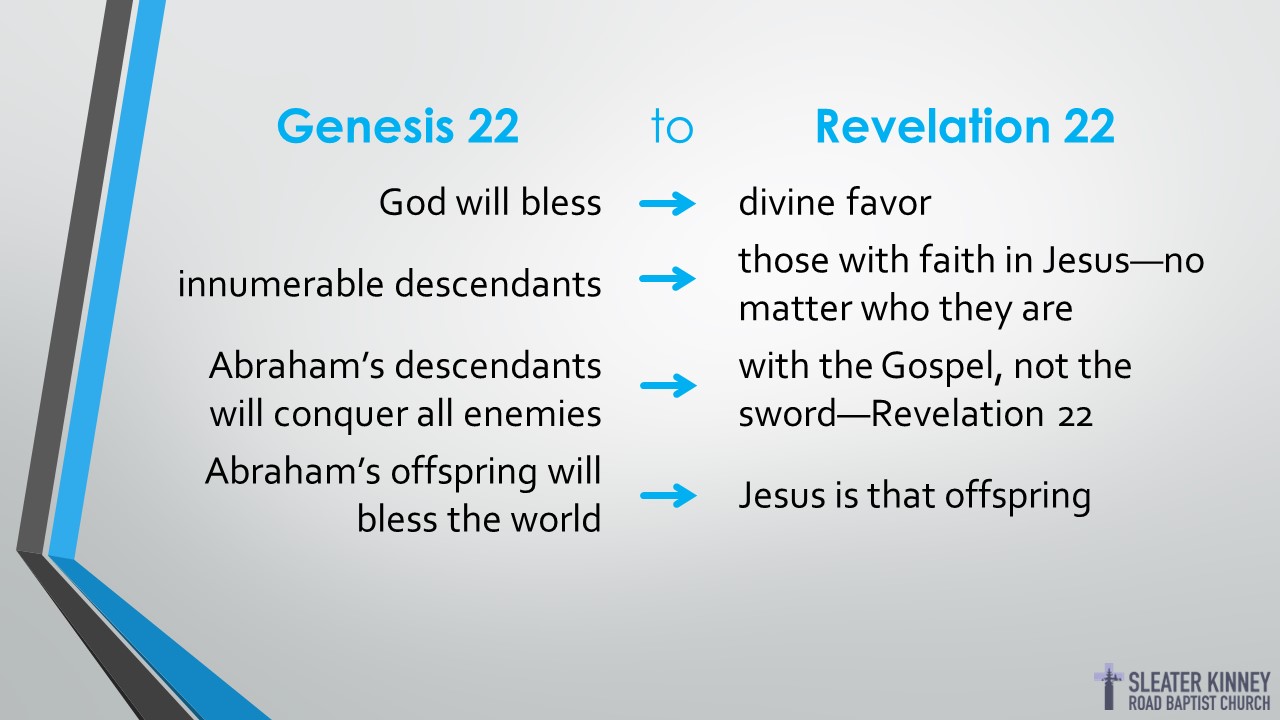









 The Eccentric Fundamentalist