
This is my latest translation, and you can see the 26-page document with detailed translation notes and a semantic diagram here. It is a powerful passage.
This is my latest translation, and you can see the 26-page document with detailed translation notes and a semantic diagram here. It is a powerful passage.

This is a short commentary I wrote after doing some exegetical work on Romans 8:1-4. That detailed work can be found on my “Bible & Creed Translations” page. This is not a terse, exegetical commentary. It has been deliberately written for normal people, but it is based on some thorough exegetical work.
—————————-
|
1 |
Therefore, [there is] now no punishment to those in union with Christ Jesus, |
Paul begins the passage by drawing an overarching conclusion (“therefore”) from everything which has come before. In light of:
something fundamental has forever changed in a person’s life once they become an adopted son or daughter of God. Maybe the best way to understand “therefore” here is to understand Paul writing something like, “therefore, the conclusion of the whole matter is this!”
This is the sum of the matter – “there is now no punishment to those in union with Christ Jesus.” Something has changed. There used to be punishment in store for you, but now there is not. There used to be the promise from the Lord that He would mete out flaming fire upon you, who refused to obey the Gospel of our Lord Jesus (2 Thess 1:8), but now there is not.
If you are a Christian, it means your name was written in the Lamb’s book of life from before the foundation of the world. You were elected, selected and chosen by God, for reasons only He knows, to be a recipient of His great mercy, love, grace and kindness. You have been united to Him by repentance and faith in Christ. You are in union with Christ, and therefore there is now no punishment for you.
Why not?
|
2 |
Because the law of the life-giving Spirit, in union with Christ Jesus, has liberated you from the law of sin and death. |
This “law of the life-giving Spirit” is a rule of life which governs your heart and mind. It is the divine influence and help from on high, in the Person of the Holy Spirit, who rules in a Christian’s heart and mind now that the kingdom of darkness has been banished from within you (cf. 2 Cor 4:3-4).
This is in complete contrast to the “law of sin and death” which used to rule and war in your body, controlling your thoughts and actions, motivating and impelling you to do nothing but seek after your own lusts and desires. You used to present your body to sin as an instrument to be used for unrighteousness (Rom 6:13); now that has all been changed and flipped on its head.
For just as you once presented your members as slaves to impurity and lawlessness leading to more lawlessness, so now present your members as slaves to righteousness leading to sanctification (Rom 6:19).
Your entire being has changed. You have changed. You have been given spiritual life. You have God’s Holy Spirit within you, and your heart of unyielding stone has been replaced by a soft heart of flesh (Eze 36:24ff); a heart sensitive to the things of God, motivated and impelled by His holiness and driven by a thirst for righteousness. You love God, and therefore seek to keep His commandments (Jn 14:15).
This rule of life comes from the “life-giving Spirit.” It is He who brings life to the spiritually dead. But, He does not do it alone. He does it “in union with Christ Jesus.” All three Divine Persons of the Trinity work together to accomplish a sinner’s salvation, sanctification and eternal glorification. It is the Apostle Peter who proclaimed to the crowds on Pentecost that Christ dispenses the Spirit to His brethren;
This Jesus God raised up, and we are all witnesses of it. So then, exalted to the right hand of God, and having received the promise of the Holy Spirit from the Father, he has poured out what you both see and hear (Acts 2:32-33).
Think about the word “liberation.” It implies that you were enslaved to someone or something. You were powerless to fight against it. It dominated you. It controlled you. It consumed you. It exercised unrelenting control and mastery over your heart, soul and mind. Now, Paul is not speaking about actual slavery in a worldly sense. But, if you go one step further to the spiritual sphere, things are suddenly very clear.
People are born enslaved to their lusts, desires and wickedness impulses. People are, by nature, children of wrath (Eph 2:3). People belong to the kingdom of darkness, and must be transferred to the kingdom of God’s dear Son (Col 1:13). When a sinner repents and believes the Gospel, he does so only because the life-giving Spirit, in union with Christ Jesus, has liberated him from the law or rule of sin and death in his life.
The Spirit is the One who performed the action here. He liberated you. You did nothing. It is an act which was accomplished at a specific point in time, and as a result, you entered into a new state. There is now no punishment for you. You have been liberated from the law of sin and death. The Spirit did this, dispensed by the Son, according to the good pleasure of the Father’s will. The Spirit and the Son did it all, because it was predestined by the Father. Salvation is liberation from the domain of darkness.
How have Christians been set free?
|
3 |
For [God did what] the law could not ever do, because it was weakened by the flesh. God sent His own Son as like a sinful man and, regarding sin, He imposed judgment against the sin while He was in the flesh, |
Because God acted while we were helpless. Because God had determined to act in eternity past, despite knowing every wicked and sinful thing you have done, are doing, or ever will do.
But God, being rich in mercy, because of his great love with which he loved us, even though we were dead in transgressions, made us alive together with Christ – by grace you are saved! – and he raised us up with him and seated us with him in the heavenly realms in Christ Jesus, to demonstrate in the coming ages the surpassing wealth of his grace in kindness toward us in Christ Jesus (Eph 2:4-7).
In short, “[God did what] the law could not ever do, because it was weakened by the flesh.” The law could never perfect anybody; it could only prove our own weakness. The law could never atone for sins; it could only forgive, as it were, on credit in light of the coming Messiah who would taste death for every man (Heb 2:9). As Paul wrote elsewhere,
I do not set aside God’s grace, because if righteousness could come through the law, then Christ died for nothing! (Gal 2:21).
The law, while inherently holy and good, was weakened by our sinful flesh. Therefore, God acted. He sent His own Son in the state or condition of being like a sinful man. Christ was not a sinful man, but He was made in the form or likeness of one. He was conceived by a miracle of the Holy Spirit specifically so He would not be contaminated by the curse of sin.
As the chief angel Gabriel told Mary, “Therefore [that is, in light of Jesus’ miraculous conception] the child to be born will be holy; he will be called the Son of God,” (Lk 1:35). Jesus is holy precisely because He is not tainted by sin, yet the Scriptures still affirm “for we do not have a high priest incapable of sympathizing with our weaknesses, but one who has been tempted in every way just as we are, yet without sin,” (Heb 4:15).
It should also go without saying that, if God sent Jesus in the form or likeness of sinful flesh, to be as like sinful flesh and identify with all the frailties and limitations of wicked men, that the Son was pre-existent. He did not spring into being at His birth in Bethlehem.
What did Jesus do? Simple. “[R]egarding sin, He imposed judgment against the sin while He was in the flesh.” While He was in the flesh; that is, while Jesus was incarnate on this earth as the God-Man, He imposed judgment against “the sin.” He defeated sin. He conquered sin. “God made the one who did not know sin to be sin for us, so that in him we would become the righteousness of God,” (2 Cor 5:21).
What is “the sin”? Many English translations do not translate the article “the,” because many times it is not necessary to do so. In this case, however, it is important. In this case, “the sin” is basically a synonym for “the curse.” Jesus imposed judgment against “the curse” of sin and death, against the penalty of the fall, against the sentence which God imposed on all humanity in the Garden of Eden so long ago. That curse has been broken, rent in two, and shattered into thousands of pieces. Jesus imposed judgment against the very curse, against the very “sin” which has bound men, women, boys and girls from all over the globe into slavery to the law of sin and death since the events from Genesis 3.
Jesus did this. You did nothing, you do nothing and you cannot do anything. He performed the action of this verb, and He did it at a particular point in time in the past. He did it during the incarnation, through His perfect and holy obedience to the law and His voluntary and willing torture and death for His people’s sake. This is what theologians call the active and passive obedience of Christ. He actively obeyed the law and fulfilled God’s perfect standards of righteousness and holiness for His elect. He also passively allowed Himself to be arrested, tried, tortured and then executed for His children’s crimes, in their place, as their true substitute.
Jesus did this. He imposed judgment against “the sin” while He was in the flesh. Praise the Lord for the Son’s faithfulness! But, why did He do it? What was the purpose?
|
4 |
so that the requirement of the law would be fulfilled among us who are not living according to the flesh, but according to the Spirit. |
Jesus did this for a very specific reason; “so that the requirement would be fulfilled . . .” What requirement is Paul talking about? He’s talking about the requirement that Christ be perfect and holy in our place, as our substitute. Remember, if righteousness could come by the law, then Christ died for nothing. Paul also wrote:
yet we know that no one is justified by the works of the law but by the faithfulness of Jesus Christ. And we have come to believe in Christ Jesus, so that we may be justified by the faithfulness of Christ and not by the works of the law, because by the works of the law no one will be justified (Gal 2:16).
So, Jesus, the Son of God, fulfilled the requirement of the law perfectly, and He did it for all the ones whom God has given to Him. If you are a Christian, then Jesus did this for you. If you are not a Christian, but you repent of your sins and believe the Good News He suffered and bled and died to bring to you, then He did it for you, too.
This requirement is not fulfilled among everybody. It is only “fulfilled among us who are not living according to the flesh, but according to the Spirit.” Paul is not saying that we fulfill the requirement by living our lives according to the Spirit, as if this was a statement about a Christian’s obligation.[1] He is stating a fact, not a condition. Here is what Paul is saying:
In short, Paul is saying Jesus fulfilled the requirement of the law for those who are controlled and governed by the Spirit, who are Christians. This is a statement about status; “those who are living according to the Spirit” = those who are saved. Jesus did this for the elect; for those whom God has given to Him.[2]
The verb is passive here, which in this instance means the action is done to the recipient. The recipient does nothing at all. The recipients of this grace are “us . . . who are living according to the Spirit.”
[1] For example, William Hendrickson wrote, “The purpose and result of Christ’s work of redemption was that His people, by means of the operation of the Holy Spirit in their hearts and lives, should strive, are striving, to fulfill the law’s righteous requirement. Out of gratitude for and in response to, the outpouring of God’s love, they now love God and their neighbor,” (Romans 1-8 [Grand Rapids, MI: Baker, 1980], 248).
See also Leon Morris, The Epistle to the Romans, in PNTC (Grand Rapids, MI: Eerdmans, 1988), 303-304. Douglas Moo, The Epistle to the Romans, in NICNT (Grand Rapids, MI: Zondervan, 1996), 404-405 also seems to take this view.
[2] John Calvin observed, “They who understand that the renewed, by the Spirit of Christ, fulfil the law, introduce a gloss wholly alien to the meaning of Paul; for the faithful, while they sojourn in this world, never make such a proficiency, as that the justification of the law becomes in them full or complete. This then must be applied to forgiveness; for when the obedience of Christ is accepted for us, the law is satisfied, so that we are counted just,” (Commentary on the Epistle of Paul the Apostle to the Romans [Bellingham, WA: Logos Bible Software, 2010], 283).

 If you’ve traveled in Baptist fundamentalist circles, then you’ve likely encountered various flavors of King James Only-ism. This is a movement which, to a greater or lesser extent, promotes the King James Bible as the only English translation of the Scriptures for Christians to use.
I do not agree with this movement. I cannot support any movement which elevates a translation above the original Greek and Hebrew text.
If you prefer the Textus Receptus for the New Testament, that is lovely. Good men, like Kent Brandenburg, have written helpful books promoting this printed Greek text, which underlies the KJV, NKJV and the newer Modern English Version. If you prefer the Byzantine Text, fine. If you prefer the eclectic text, such as the UBS-5 or the NA-28, even better!
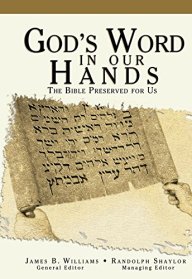
I wanted to recommend a good book about the preservation of Scripture to folks who may want some resources on this issue. What makes this volume unique is that is was written by fundamentalists for people in fundamentalist churches. Here is a synopsis:
The solid facts of the process by which the Bible has come to its present form are explained in detail. The book includes textual criticism of the existing manuscripts and autographs, including the Textus Receptus, the Majority, Eclectic, and Minority texts, and the Masoretic Text. It also provides needed answers to the arguments of those who adhere to extreme or exclusive positions. This book is excellent for pastors, teachers, and laypersons alike. It will prove that all conservative versions are, without a doubt, translations of the plenary verbally inspired Word of God.
The book is entitled God’s Word in Our Hands: The Bible Preserved for Us, and it costs 99 entire cents on Kindle. It’s written in an easy-going, conversational style. You can understand it. Buy it. Read it. Understand it. Use multiple English Bible versions to compare during your devotional reading. Grow in the Lord.
Goodbye.

I have been plugging away at my own translation and exegesis of Romans 8:1-4 for about a week or so now. I’m not quite finished, but I thought I’d post the translation anyway. It is a marvelous passage for all those who have been declared righteous by faith, and therefore “have peace with God through our Lord Jesus Christ,” (Romans 5:1-2). If you do not know this peace, please read about the Good News and find out how to have it.


 The LXX is an Roman numeral abbreviation which means “70.” It’s a shorthand way to refer to the Greek translation of the Hebrew Bible which Jesus and the apostles used and quoted from. Many of the Old Testament quotations the New Testament writers used did not come from the Hebrew translation. Many of them came from the Greek translation of the Old Testament. Verbatim. Exactly.
The LXX (also known as the “Septuagint”) is referred to this way because, allegedly, 70 translators worked on the translation from Hebrew into Greek. I recently picked up a copy of the LXX because I wanted a chance to study Greek a bit more, and because if this is the text Jesus and the apostles quoted from, then it would make sense to own a copy.
If you’ve done translation work, then you know it is difficult to resist putting a bit of interpretation into your translation. Sometimes this isn’t too bad an idea. For example, I’ve noticed that Mark often didn’t use Jesus’ actual name to refer to Him. He usually just wrote “he.” That means you’ll have an entire chapter (or two!) where Jesus’ name isn’t even mentioned. All you really have is “he . . . he . . . he . . . he.” Some translations clean this up a bit by throwing Jesus’ name into the mix occasionally. I don’t see anything wrong with that.
I noticed something interesting in Isaiah 42:1 from the LXX yesterday evening. Here is the English text:
Isaiah 42:1 “Here is my servant whom I support, my chosen one in whom I take pleasure. I have placed my spirit on him; he will make just decrees for the nations.
Christians understand Isaiah to be referring to Jesus of Nazareth. Got it. What does the LXX read? Behold the bit of commentary they tossed into their translation:
Ιακωβ ὁ παῖς μου ἀντιλήμψομαι αὐτοῦ Ισραηλ ὁ ἐκλεκτός μου
Jacob, my servant whom I will help; Israel, my chosen one . . .
How interesting! This gives us some insight into how the Israelites interpreted the Hebrew Bible during the inter-testamental period before Messiah came. They interpreted this Messianic passage to be referring to the nation of Israel. I haven’t done enough study in the LXX to know how much of a trend this is, but I’ve read elsewhere that it is very common.
It’s always a joy to stumble across something by accident and confirm something for yourself, rather than read about it in a book.

If you’re a Christian, you must prove your faith by the way you live your life. Love God with all your heart, soul, mind and strength . . . and then keep His commandments because you love Him. It’s easy to spot a fake. You know, somebody who talks a good game but doesn’t actually do anything. James knew this. It’s why he wrote this:

Controlling your speech is just one common example which makes a wider point. Talk is cheap. Prove your repentance and faith in the Gospel of Jesus Christ by your life of habitual, loving obedience to His law.

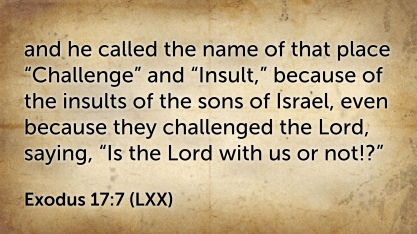 On their journey towards Mt. Sinai from Egypt, the Israelites became angry. Actually, they became angry a lot, but this time they said something particularly foolish:
Exodus 17:7 (KJV): And he called the name of the place Massah, and Meribah, because of the chiding of the children of Israel, and because they tempted the LORD, saying, Is the LORD among us, or not?
I spent some time pondering why on earth they would ask this question. It’s a pretty stupid question, really. Is the Lord with them? Well, let’s quickly re-cap everything He had done for them in a few short months since Moses returned to Egypt:
In light of all this, why in the world would God’s people even ask such a foolish question? They asked it because they were ungrateful, selfish, self-centered, and inherently wicked. I’m just the same, and so are you. We’re ungrateful for God’s blessings and provisions. You’re selfish and materialistic, ignoring God’s grace and petulantly demanding still more. Like the noted philosopher Janet Jackson asked, “what have you done for me lately?”
These people had lots of reasons to trust God to provide for them and take care of them. He’d rescued and cared for them every step of the way. More than that, He was visibly revealing Himself every single moment of every single day, by cloud or by fire. If you’re a Christian by repentance and faith in Jesus Christ and His perfect, finished work, then think about the Israelites the next time you’re tempted to complain and ask anything stupid. If you’re a Christian, the Lord is always fully with you, in the Person of the indwelling Holy Spirit (cf. John 14:23).
For those who are interested, here is my own translation of this verse from the Greek Septuagint.

![Revelation 59 [widescreen].png](https://eccentricfundamentalist.com/wp-content/uploads/2016/08/revelation-59-widescreen.png?w=800) The Book of Revelation gives God’s people some very precious glimpses into His heavenly throne room. The Book of Hebrews tells us all the rituals, furniture and setup for the holy place in the tabernacle in the wilderness and, later, King Solomon’s temple was just a figure, a representation of the real throne room (ἀντίτυπα τῶν ἀληθινῶν) in heaven (Hebrews 9:24; cf. Exodus 25:40, 26:30, 27:8, etc.). Throughout Revelation 4-5, God gave us a look at His real throne room.
The Book of Revelation gives God’s people some very precious glimpses into His heavenly throne room. The Book of Hebrews tells us all the rituals, furniture and setup for the holy place in the tabernacle in the wilderness and, later, King Solomon’s temple was just a figure, a representation of the real throne room (ἀντίτυπα τῶν ἀληθινῶν) in heaven (Hebrews 9:24; cf. Exodus 25:40, 26:30, 27:8, etc.). Throughout Revelation 4-5, God gave us a look at His real throne room.
The scene opens on the Apostle John being granted a vision of supreme importance; a vision so vital that God chose to have Him write it all down in a book which is preserved in your Bibles even today. John saw a scroll in God’s hand. The scroll had writing on both sides, and was sealed with seven seals. A mighty angel proclaims with a loud voice,
. . . who is worthy to open the book, and to loose the seals thereof? And no man in heaven, nor in earth, neither under the earth, was able to open the book, neither to look thereon. And I wept much, because no man was found worthy to open and to read the book, neither to look thereon (Revelation 5:2b-4).
But, all was not lost. A man enters the throne room. One of the 24 elders motions to John and says,
Weep not: behold, the Lion of the tribe of Juda, the Root of David, hath prevailed to open the book, and to loose the seven seals thereof (Revelation 5:5).
These allusions probably seem strange and bizarre to a non-believer, or to a Christian who ignores the Old Covenant books. These are deliberate allusions, freighted with all sorts of Messianic and triumphant implications. The man is Christ Jesus. He is the “lion” who sprang from the Jewish tribe of Judah (Genesis 49:9ff). He is the “root” descended from King David’s father, Jesse (Isaiah 11:1ff). This is the risen Christ who has been continually interceding for His people since He returned to His Father’s house in the days after his resurrection (Acts 1:9ff). This is the Savior of whom John the Baptist declared, “Behold the Lamb of God, which taketh away the sin of the world!” (John 1:29).
This is the crucified, resurrected, co-equal and co-eternal Son of God who came to give His life a ransom for many (cf. Mk 10:45). John the Baptist continued, “This is he of whom I said, ‘After me cometh a man which is preferred before me: for he was before me,'” (John 1:30). Jesus is greater than John, because he existed before John. And yet, John the Baptist is several months older than his cousin, Jesus! How can John be younger, then? It is because Jesus is the co-equal, co-eternal Son of God . . .
whom he hath appointed heir of all things, by whom also he made the worlds; Who being the brightness of his glory, and the express image of his person, and upholding all things by the word of his power, when he had by himself purged our sins, sat down on the right hand of the Majesty on high (Hebrews 1:2b-3).
This is who has strode into God’s throne room. This is why the Apostle John need not dispair. Someone worthy has been found to open the seven-sealed scroll and unleash the terrible but righteous judgments of God upon a rebellious and wicked world (cf. Gen 6:5).
But, why is Jesus Christ so particularly worthy? The 24 elders are angelic beings and are perfectly holy – why can’t they open the scroll? What about the four living beings who are also before God’s throne? Are they tainted in some way? Our passage tells us why only Jesus is worthy:
Then he came and took the scroll from the right hand of the one who was seated on the throne, and when he had taken the scroll, the four living creatures and the twenty-four elders threw themselves to the ground before the Lamb. Each of them had a harp and golden bowls full of incense (which are the prayers of the saints) (Revelation 5:7-8).
Pay attention to what these angelic beings say, to what they sing in praise and worship to Jesus Christ. Here it is, in my own translation (detailed translation notes are available here):
and they were singing a new song, saying, ‘You are worthy to take the scroll and to open its seals, because you were slaughtered, and by your own blood you bought for God [people] from every tribe, language, people and nation, and you have made them a kingdom and priests for our God, and they will rule on the earth’ (Revelation 5:9-10).
First, they make a simple statement – “You are worthy to take the scroll and to open its seals.” Only Messiah, the Anointed and Chosen Son of God, can perform this task. Why? How is He uniquely qualified? There are several reasons:
He was murdered, slain and slaughtered like a sacrificial animal. He died to take away the sins of the world. More than that, He did it willingly and voluntarily. He wasn’t checkmated into it. He wasn’t cornered and out-manauvered. He didn’t struggle valiently and die fighting. He deliberately, passively and meekly allowed His enemies to destroy Him (cf. John 14:28-31). He let Himself be slaughtered. What do you think about that?
We observe the Lord’s Supper because of Jesus’ shed blood, which is a synonym for His death. It is through His death, by means of that death, that Jesus Christ perfectly saves men, women, boys and girls on this earth from slavery to the kingdom of darkness and transfers them to His own kingdom (Colossians 1:13). His death is the instrument which accomplishes this miracle.
Jesus’ death has purchased people for God from everywhere on earth. This purchasing was done in the past, when He died. It happened in the past. From God’s perspective, all His chosen people from all over the world already are saved. It’s so certain and sure that He regards it as a done deal. The angelic beings in God’s heavenly throne room sing about it as an accomplished fact. Jesus is not buying; He bought. Jesus did not die intending to save every single person in the world. Everybody is born hating God (Romans 3:18). Everybody is born inherently worthless to Him (Romans 3:12). Many people continue to hate Him until their dying day, or cloak their hatred in a noxious shroud of good works intended to bribe the Lord and “earn” His favor, as if such a thing were even possible (cf. Galatians 2:21). Jesus died to save His chosen people, and those chosen people are from every tribe, language, people-group and nation in the entire world. The Gospel isn’t restricted by racial divide, the highest mountainpeaks, the lowest valleys, the most treacherous waters or the most bigoted, sinful and hateful prejudices of sinful men. It is intended for all people, and among all people, Christ has already purchased His own for God!
God’s people want to serve Him. Christ is building His kingdom, which is not here yet. His people are priests in the sense that they have direct and personal access to Him which outsiders do not have. If you do not have salvation through repentance and faith in Jesus Christ, then you do not have God (1 John 2:23). You have no access to Him. He is actively angry with you. You reject Him and His Son. You hate Him. You are a criminal in His world. His people, however, make God known to those who hate Him. They tell others about God and His dear Son, Jesus Christ. They mediate the Lord to a pagan world. They don’t offer up literal sacrifices, they offer up their own selves as spiritual sacrificies to Him for His work (Romans 12:1f, 1 Peter 2:5). They regard themselves as slaves for His sovereign, holy and appropriate use. And, again, this is presented as an accomplished fact, a done deal, a past event with ongoing results.
God’s people will rule with Him in eternity. God’s enemies will suffer for all eternity.
Jesus Christ is worthy because of what He did. He died to save sinners. When this scene takes place, the world has definitively rejected Him and the Good News He suffered and bled and died to bring to people. The world deserves judgment. He and His Father are the Ones the world is rejecting. It is only fitting that the “Lamb of God which taketh away the sins of the world” be the One who unleashes His Father’s righteous judgment on the very world which rejected Him and has “no cloak for their sin,” (John 15:22).

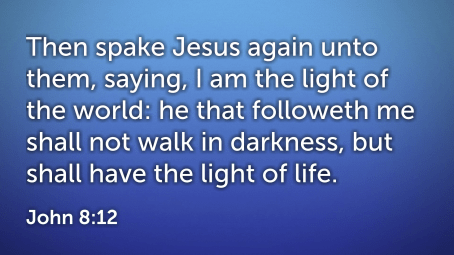
There is a host of misinformation and lies in the world about the human condition. The Bible makes things very clear. You need to be rescued. You need to be rescued from Satan’s clutches and from his fiery orphanage of the damned. That last bit isn’t hyperbole on my part; after all, a rescue implies some kind of mortal danger, doesn’t it? What on earth do you need to be rescued from?
12Giving thanks to the Father, who made you acceptable to share in the saints’ inheritance in the light, 13who rescued us from the kingdom of the darkness and transferred us to the kingdom of His beloved Son, 14in whom we now have the redemption, that is, the forgiveness of sins.[1]
The Bible tells us you need to be rescued and delivered “from the kingdom of darkness” (ἐκ τῆς ἐξουσίας τοῦ σκότους). Some translations render this as “delivered,” but I don’t think this is brutal, stark or arresting enough. It’s too dainty, too proper, too high-brow. You don’t need to be delivered, you need to be rescued from Satan’s kingdom.
This phrase is usually translated two different ways; as “power of darkness” (Tyndale, KJV, NKJV, NET, ISV) or “domain of darkness” (LEB, ESV, NASB). The idea of darkness is very clear in Greek, but the word ἐξουσίας is expressing the idea of sphere of control or rule. Another interesting possibility is jurisdiction. Altogether, you have several good translation options, each of which paints a dark and forbidding picture of who we really are. We are, all of us, people who desperately need to be rescued from the jurisdiction, power, domain and kingdom of darkness.
Darkness is the domain of Satan. It isn’t any wonder that our popular culture depicts evil in sinister shades of black (for example, think Darth Vader and “the dark side”), and good in glowing robes of white. This is Biblical imagery.
This is not good news. The Apostle Paul did not beat around the bush. Elsewhere, he made it clear that an unbeliever is spiritually dead, wallowing in his own trespasses and sins (Ephesians 2:1). Every single person in the world naturally lives according to the normal course of this sin-cursed and condemned word, according to the “prince of the power of the air,” who is Satan. People are born with Satan as their spiritual father (cf. John 8:44ff), their wills, minds, hearts and souls enslaved to him and all the wickedness he stands for. It is Satan who is working right now, every moment of every day, in his children’s lives, whom Paul calls the “children of disobedience,” (Ephesians 2:2). Even worse, the Bible tells us that everybody is born, by our very nature, makeup and constitution as sinners, as “children of wrath,” (Ephesians 2:3).
This is what you need to be rescued from, and this is what Christ has, is and will infallibly accomplish (cf. John 6:37) for all those who are His. You are born under the jurisdiction of Satan, subject to his laws, his standards, his will, his character, his nature and his wickedness. You reflect those qualities, you live according to these characteristics and you echo your spiritual father’s criminal spirit. As the Bible says, you are inherently unprofitable and worthless to God the way you are (Romans 3:12). You are under his domain and power, subject to his control, his influence, his whims and his regulations. He is the rudder of the ship of wickedness, sin and rebellion that is you. You were born a citizen of his vile, unrighteous and evil kingdom – a kingdom of darkness – and you will remain a resident in that kingdom unless or until you repent of your sins and believe the Good News which Jesus Christ willingly and voluntarily suffered, bled and died to bring to you.
There is Good News (εὐαγγέλιον – “Gospel”) to combat this Bad News. Jesus Christ came to save sinners. You are a sinner. He came to save, reconcile, redeem and forgive people from every tribe, tongue people and nation on earth; to rescue them from the kingdom of darkness and transfer them to His own kingdom. You can be adopted into Jesus’ kingdom. This is why Paul told the Christians in Colossae to be “giving thanks to the Father,” because Jesus, “made [them] acceptable to share in the saints’ inheritance in the light.” Hopefully you, too, can join the saints from Colossae in thanking God for the wonderful gift of salvation in Christ Jesus!
[1] This is from my own translation; the exegetical work can be found here.
[2] Article VII, in The 1833 New Hampshire Confession of Faith, in The Creeds of Christendom, ed. Philip Schaff (New York, NY: Harper & Bros, 1882), 3:774.

Jesus is writing to the people in the local church in Philadelphia, and He says something very simple and yet very profound – Jesus always knows our deeds, and what we do. Here is the text, from my own translation:

We can hide nothing from Him. He is omniscient and all-knowing. Jesus never takes in knowledge and learns new things. He is equal in power, glory, honor and attributes to the Father. He knows what you have done, are doing and will do.
There is nothing you can do that Jesus does not already know all about:
Proverbs 5:21 For the ways of man are before the eyes of the LORD, and he pondereth all his goings.
Proverbs 15:3 The eyes of the LORD are in every place, beholding the evil and the good.
Job 34:21-22 For his eyes are upon the ways of man, and he seeth all his goings. There is no darkness, nor shadow of death, where the workers of iniquity may hide themselves.
Jesus’ remark gives the sense of, “I always know your deeds!”[1]
He knows the good and the bad. He knows our faithfulness and our deliberate failures. He knows whether your heart and spirit is hypocritical or tender. He knows your motivations and your motives. He knows what you’re planning and what your ambitions are.
Jesus’ remark will either (a) strike fear into the unregenerate, pretending heart, (b) convict and rebuke the lazy Christian who stopped trying a long time ago, and is just treading water on autopilot; or (c) comfort the weary sinner who is honestly trying to serve the Lord day by day.
Let everybody sit up and take notice of these simple truths:
As you go about your day to day life, whether you are a non-Christian who thinks this is all ridiculous superstition, a “slacker” Christian who lives a life of pitiful hypocrisy, or a sincere Christian who tries day by day to be cleaving tighter unto the Lord (Acts 11:23), know this – the Risen and Resurrected Christ knows your deeds. “He is Lord of all,” (Acts 10:36), and the Father demands you apologize to Him and set things right by repenting of your sins and believing in His Son’s perfect work for your sake, in your place, as your substitute. As the Scripture reads,
Mark 1:14-15 After John was taken, Jesus came into Galilee preaching the gospel of the kingdom of God and saying: ‘The time is come and the kingdom of God is at hand; repent and believe the gospel.’ (Tyndale 1534 translation)
[1] I take the word translated “I know” to be expressing a timeless truth. Here is my note on this from my own pitiful translation; Οἶδά: (1) Voice – a simple active voice. (2) Tense – context suggests a gnomic perfect, suggesting that Jesus has always known the church’s deeds. He never comes to know anything – He always knows all. (3) Mood – a declarative indicative.

 The Eccentric Fundamentalist